



Abstract
Psychological contracts reside in the eye of the beholder and capture the employee-employer exchange relationship. It is a dynamic relationship as employees deliberately manage and change their psychological contract over time. Triggers seem to be the drivers underpinning this dynamism. Yet little is known about how these triggers operate and affect the psychological contract. To address this, we explore triggers and their impact using a 6-week daily diary study (N = 117). We found a linear chain of positive relationships from initial triggers to connectedness of past triggers, to the experience of negative emotions, to the expected reoccurrence of the initial trigger, ultimately disrupting the psychological contract. The findings revealed the dynamic effect of triggers on the employment relationship, not only by exposing the underlying micro-processes, but also by revealing that the impact of triggers can linger for approximately 11 days before leveling off. These findings suggest that the psychological contract may fluctuate on a daily basis due to the influence of triggers. The theoretical implications for understanding the dynamic nature of the psychological contract are discussed in relation to the disruptive role of triggers.
Introduction
The advent of the digital era has drastically changed the nature of work for employees (Coetzee & Deas, 2021), reflected in a shift from mutual loyalty, job security, and continuity of employment to a more short-term focus, greater flexibility, and performance-contingent and precarious work arrangements (Bankins et al., 2020). These changes can have deleterious consequences on employees’ psychological contract. Psychological contracts capture employees’ mental schema of the exchange agreement between themselves and their organization, through which they appraise their daily work environment (Rousseau et al., 2018). Consequently, in this changing world of work reflected in the Fourth Industrial Revolution, compounded by the global COVID-19 pandemic, and characterized by revolutionary and evolutionary changes in the nature of jobs and occupations (Coetzee & Deas, 2021), greater attention needs to be paid to capturing the process by which employees appraise their increasingly complex and ever-changing psychological contract.
The potential implications of these circumstances manifest in increased dynamism of employees’ organizational life as disruptions in their psychological contract occur more often and more quickly as a result of the many stimuli in their environment. Neuroscientific insights reveal that an individual’s capacity to process the myriad of modern-day stimuli is insufficient, however (Dehaene et al., 2006; Dijksterhuis & Aarts, 2010; Lavie et al., 2004). Consequently, many stimuli remain unconscious, unattended, and unnoticed (Lavie et al., 2004), while others, referred to as “triggers” (Wiechers et al., 2019; 2022), halt the automatic processing of the daily flow of stimuli by capturing one’s attention and activate a state of conscious attention to contract terms, impacting the psychological contract (Wiechers et al., 2022). This is a process marked by reflective consciousness and higher-order reasoning (Dijksterhuis & Aarts, 2010).
Attention is the guiding principle of triggers (Wiechers et al., 2022) because focusing more attention on an incoming stimulus increases the likelihood that one will become aware of a trigger (Dijksterhuis & Aarts, 2010). However, attention is selective (Driver, 2001; Drover et al., 2018). Whether an employee’s attention to their psychological contract is triggered and consequently activated depends on two things. The first concerns the relevance of the stimulus (e.g., Drover et al., 2018). Only meaningful stimuli, determined by personal importance, will reach the recognition stage (Treisman, 1969), such as goal-driven stimuli (Drover et al., 2018). Recent research showed that certain stimuli do indeed stand out due to goal-directed attention (Wiechers et al., 2022) and personal goals (through self-regulatory processes) being key drivers of the psychological contract (Rousseau et al., 2018). The second concerns memory-guided attention (e.g., Dehaene et al., 2006; Failing & Theeuwes, 2018; Molden, 2014). Past and memory-stored stimuli elicit lingering selection biases (Failing & Theeuwes, 2018), such that interconnected stimuli stand out more quickly in the daily flow of stimuli—even if people are unaware of the connection (Kiefer & Brendel, 2006; Naccache et al., 2002). Consequently, an individual’s attention is effortlessly and more quickly activated (Dehaene et al., 2006; Molden, 2014) as a result of the interconnectedness of comparable or related stimuli of previous triggers, called “connected triggers” (Wiechers et al., 2022).
When attention is consciously drawn to the terms of the psychological contract, an appraisal process is initiated (Wiechers et al., 2022). Appraisals can occur instantaneously (Moors et al., 2013), and include an assessment of relevance (e.g., a threat to personal goals) and possible negative consequences (Weiss et al., 1999). Appraisals occur automatically (i.e., they are uncontrolled), efficiently, and quickly (Moors et al., 2013), and are followed by attribution of meaning (Weiss et al., 1999). For example, novel meanings are attributed to the interconnectedness of stimuli (Wiechers et al., 2022), affecting perceptions of subsequent occurrences, both in the short and long term (Griep & Vantilborgh, 2018b; Ng et al., 2014; Solinger et al., 2016). Moreover, appraisal may also include an assessment of potential future occurrences because employees are guided by their interpretations of the past as well as their expectations of the future (Gioia et al., 2002; Sandberg & Tsoukas, 2015; Stigliani & Ravasi, 2012). As such, employees add meaning to the situation (Maitlis & Christianson, 2014), before identifying such occurrences as psychological contract “disruptions” (Rousseau et al., 2018).
Disruptions (i.e., a deviation from original employer obligations) actively change the psychological contract; major changes generate a transition from the status quo to either the renegotiation or repair phase, and minor changes through assimilation where self-regulation generate small revisions with limited cognitive effort (Rousseau et al., 2018). These disruptions are accounted for in the Dynamic Phase Model (Rousseau et al., 2018). However, this model does not explore what initiates this process of psychological contract change, or how people assimilate triggers into actively managing and changing the contract (Bankins, 2015; Solinger et al., 2016). We enrich the model by exploring how triggers activate this dynamic process that results in disruption. Employees monitor the exchange relationship for discrepancies between employer obligations and the inducements provided (Rousseau et al., 2018). So-called “direct” (directly targeted stimuli) and “indirect” (stimuli experienced through others) triggers (Wiechers et al., 2019) will prompt attention to the psychological contract when there is a deviation in the exchange. Furthermore, Rousseau and colleagues argue that the speed of delivery also contributes to (re)evaluation of the psychological contract. This will be reflected in “slow” triggers, which activate awareness of the absence of expected cues (Wiechers et al., 2022). Triggers, indirect, direct, or slow, all prompt a shift from automatic processing to reflective consciousness about the terms of the psychological contract. Re-evaluation of perceptions of contract fulfillment are thus influenced by both velocity and discrepancy feedback (Rousseau et al., 2018), and it is triggers that activate this process.
Triggers are thus situated at the core of disruption, as drivers of change through an appraisal process that occurs prior to disruptions. The estimation of the impact of triggers may shape whether an employee anticipates there will be major change, such as a phase shift, or minor change, such as an assimilation of the psychological contract. There is a need for further ground-up exploration of how this occurs, which elements are significant, and how stimuli lead to disruption in this process. Understanding the process through which triggers disrupt the psychological contract is becoming increasingly important in today’s turbulent work setting, where triggering stimuli may follow each other in quick succession. Furthermore, as employees place greater attention on negative occurrences (Baumeister et al., 2001), they are more likely monitor situations and appraise signals when they experience negative affect (Forgas & George, 2001). Consequently, a greater understanding of the process underlying disruptions will offer alternatives to manage early harmful signals and minimize the potential negative consequences for an individual’s psychological contract (Zhao et al., 2007). Therefore, we ask how do day-to-day triggers negatively disrupt the psychological contract?
To unpack the concept of disruptions, we conducted an exploratory study to capture the micro-processes that accompany perceived disruptions. In doing so, we respond to a recent call for a more systematic ground-up exploration of the psychological contract as a process (Bankins et al., 2020) and complement prior work in the following ways. First, our findings reveal that triggers underlie the dynamic nature of the psychological contract as they frequently disrupt the flow of an ongoing exchange, providing an explanation for why frequent fluctuations of psychological contract evaluation occur as demonstrated by recent empirical studies (e.g., Griep & Vantilborgh, 2018a, 2018b; Solinger et al., 2016). Second, we demonstrate that the reoccurrence of triggers elicits negative emotions, which in turn heighten employees’ sensitivity to future triggers, and ultimately affect their psychological contract. This reveals the hitherto underexposed micro-processes within the black box of disruptions and extends the theory of the Dynamic Phase Model (Rousseau et al., 2018) by highlighting the role of triggers in disrupting the psychological contract. Finally, our findings indicate that triggers linger in the background—they are “sticky,” readily perceivable, easily accessible, and (sub)consciously linger over time.
Method
Procedure and Sample
We conducted this study among university lecturers of five universities of applied sciences in the Netherlands. 1 We recruited our respondents by email and asked them to complete a survey capturing demographic information prior to completing 30 consecutive daily surveys over the course of 6 weeks. We emailed respondents toward the end of each working day (i.e., 3:00 p.m.), and requested that they complete the survey by 11:59 p.m. that day. Failure to complete the survey by the stipulated deadline was coded as a missing response. We administered the measures on a daily basis for the following reasons. In the absence of theoretical evidence about the fluctuating nature of our variables over time, (a) daily measures are frequent enough to capture meaningful changes, but not so frequent that respondents are likely to drop out (Ohly et al., 2010); (b) individuals can reflect accurately upon, and make assessments of, work-related experiences over the course of 1 day (Griep & Vantilborgh, 2018a); and (c) scholars have suggested that—in the absence of theoretical arguments—repeated measures should be taken in close temporal proximity (Griep et al., 2021b).
A total of 117 respondents completed the general online survey and were willing to respond to the daily surveys (response rate = 76.21%). Because the unit of analysis was “repeated measures” rather than “respondents” (Conway & Briner, 2002), the effective sample size was 2172 observations (117 respondents × a maximum of 30 daily surveys) or an average of 18.56 completed daily surveys per respondent. Our effective sample size of 2172 observations exceeds the minimum required Level 2 sample size of 30 respondents (Maas & Hox, 2005) needed to produce accurate estimates of standard errors in multilevel research.
The average age of our respondents was 47.36 years (SD = 11.50), 51.28% were women, 48.72% held a higher education degree, and their average organizational tenure was 12.11 years (SD = 8.59). Respondents spent an average of 4.06 days per week at work (SD = 0.90).
Measures
Consistent with recommendations (e.g., Hülsheger et al., 2015; Ohly et al., 2010), we used shortened scales or single items to ensure that each daily survey was as brief as possible in order to increase response rates over time (Fuchs & Diamantopoulos, 2009). The chosen single-item measure should be the most valid indicator of the overall construct it aims to assess. As such, each single-item measure must have a narrow focus, and should be unidimensional and unambiguous to respondents (Sackett & Larson, 1990). In order to identify the best suited single item to measure a construct, scholars (e.g., Rossiter, 2002) advocate the use of expert judgments. Following this advice, we pilot-tested all single-item measures using a small group of experts. The presentation of the scales was counterbalanced to eliminate the role of potential order effects in the results. Furthermore, to reinforce the temporal focus of the measures, all items were worded such that they (a) included the word “today,” and (b) were written in the past tense (e.g., “This is how I felt”).
Two pilot surveys were conducted to explore if triggers negatively disrupt the psychological contract. We needed to determine if our single item measure captured “PC disruption,” as this is a new construct, only recently coined by Rousseau et al., (2018). We did this in two ways. First, we conducted a pilot survey to demonstrate that the item we used taps into similar underlying constructs: breach and violation. Negative disruptions reflect a discrepancy between perceived employer obligations and inducements (i.e. breached employer obligations) impeding employee goals, eliciting a strong negative affect (i.e., violation feelings). The single item correlated positively and significantly in a verification measurement (n = 222) with the traditional five item psychological contract breach scale (.359, p < .001) and the four item violation scale (.400, p < .001) identified by Robinson and Morrison (2000). Second, we conducted another verification measurement. To give more meaning to the potential disruption, our single measurement was followed by an open-ended text box: “Explain how much, in your opinion, you have lost as a result of this violating experience and/or broken employer obligation?” Tracking participants’ responses gave us reason to believe that the item also related to breach and violation-related behavioral outcomes (Zhao et al., 2007) and conducted a second pilot survey (n = 69) where we were able to show that the item was also significantly correlated with behavioral outcomes such as job satisfaction (−.836, p < .001; Wanous et al., 1997), organizational commitment (−.835, p < .001; Solinger et al., 2016), perceived organizational support (−.835, p < .001; Rhoades & Eisenberger, 2002), and organizational trust (−.289, p < .05; Gabarro & Athos, 1976).
Initial perceptions of triggers were measured using a single item, based on the measure that was used in Conway and Briner’s (2002) diary study: “Did you experience a trigger today?” Respondents could select either “yes” or “no.” We explained that triggers are factors that intentionally or accidentally disrupt the daily work routine to draw participants’ attention to their exchange relationship. When participants indicated that they had experienced at least one trigger on a given day, we coded the trigger variable as 1. In contrast, when they indicated that they had not experienced any triggers on a given day, we coded the trigger variable as 0 (for a similar approach, see Griep et al., 2016; Griep & Vantilborgh, 2018b; Solinger et al., 2016).
Connectedness of triggers was measured using a single item created for the purpose of this study: “Did you experience this trigger only on a single occasion?” 2 Respondents could select either “yes” or “no.” When participants indicated that they had experienced (a) similar trigger(s) in the past (i.e., they perceived the triggers to be connected), we coded the variable as 1. In contrast, when they indicated that they had experienced the trigger only once, we coded the variable as 0 (for a similar approach, see Griep & Vantilborgh, 2018b).
Negative emotions that follow the experience of a trigger were assessed using a list of five negative emotions (i.e., sadness, guilt, shame, frustration, and anger) following the cognitive-emotional model of individual reactions (Liu & Perrewé, 2005). We provided respondents with the instructions, “Listed below are a number of words that describe negative emotions. Please read each word and decide the extent to which you experienced the respective emotions after you were confronted by a trigger” and asked them to rate each emotion on a 6-point scale ranging from 1 (“not at all”) to 6 (“to a very great extent”). Cronbach’s alpha coefficients, which were independently calculated for each set of daily measurements, indicated that their internal consistencies were satisfactory (M = .76, SD = .05, range = .70–.83).
Expected reoccurrence of the initial trigger was measured using a single item, based on the measure used in Conway and Briner’s (2002) diary study: “Do you expect such an event to happen in the future?” Respondents could select either “no” (score = 1), “perhaps” (score = 2), “probably” (score = 3), “yes, at some point” (score = 4), and “yes, in the near future” (score = 5).
Psychological contract disruption was measured using a single item, based on the measure was used in Solinger and colleagues’ (2016) study: “How would you rate the impact of the trigger on your relationship with (the name of the organization)?” where respondents were asked to rate this item on a scale ranging from 0 (“no impact at all”) to 100 (“severe negative impact”). In a caption, we explained that this rating relates to the extent to which their perceived obligations were violated and/or perceived obligations were broken and was followed by an open text box to explain the disruption in words.
Analytical Approach
Because our data have a nested structure (i.e., daily surveys nested within respondents), we computed intraclass correlation coefficient (ICC) values for initial perceptions of triggers, connectedness of triggers, negative emotions, expected reoccurrence of the initial trigger, and the level of disruption of the psychological contract (ICC values = .87, .82, .81, .86, and .48, respectively). These ICC values indicate that a substantial proportion of the variance could be attributed to within-person differences. Hence, we estimated a 2-level mediation model that partitions within- and between-person variance using Mplus version 7.4 (Muthén & Muthén, 2012). The mediation effects were tested using the product-of-coefficients approach (Preacher & Hayes, 2008), and their significance was scrutinized by computing 95% confidence intervals (95% CI; Preacher & Selig, 2012). Specifically, the mediation effects were tested using the product-of-coefficients approach and their significance was scrutinized by means of 10,000 bootstrap samples 95% CIs, thereby exceeding the minimal of 5000 bootstrap samples. Specifically, we linked the regression coefficients, initial perceptions of triggers to connectedness of triggers to negative emotions, to the expected reoccurrence of the initial trigger, and, finally to the disruption of the psychological contract.
At this point, it is worth noting that the analytical approach we are using has an exceptional capacity to handle missing data between our numerous daily surveys (Hox, 2010; Ployhart et al., 2002). Following a recent approach taken by Hülsheger and colleagues (2021) and Griep and colleagues (2021a), we did not remove respondents when they missed one or more daily surveys, but rather included every respondent who completed at least one daily survey. According to these scholars, this approach is desirable because missing data patterns are rarely random. Therefore, it is advisable to retain all respondents, even those with extreme missing data, for the type of analysis we conducted in this study (see, for example, Hox, 2010; Raudenbush & Bryk, 2002; Singer & Willett, 2003).
Results
Descriptive Statistics
Means, Standard Deviations, and Zero-Order and Within-Person Correlations Among Study Variables.
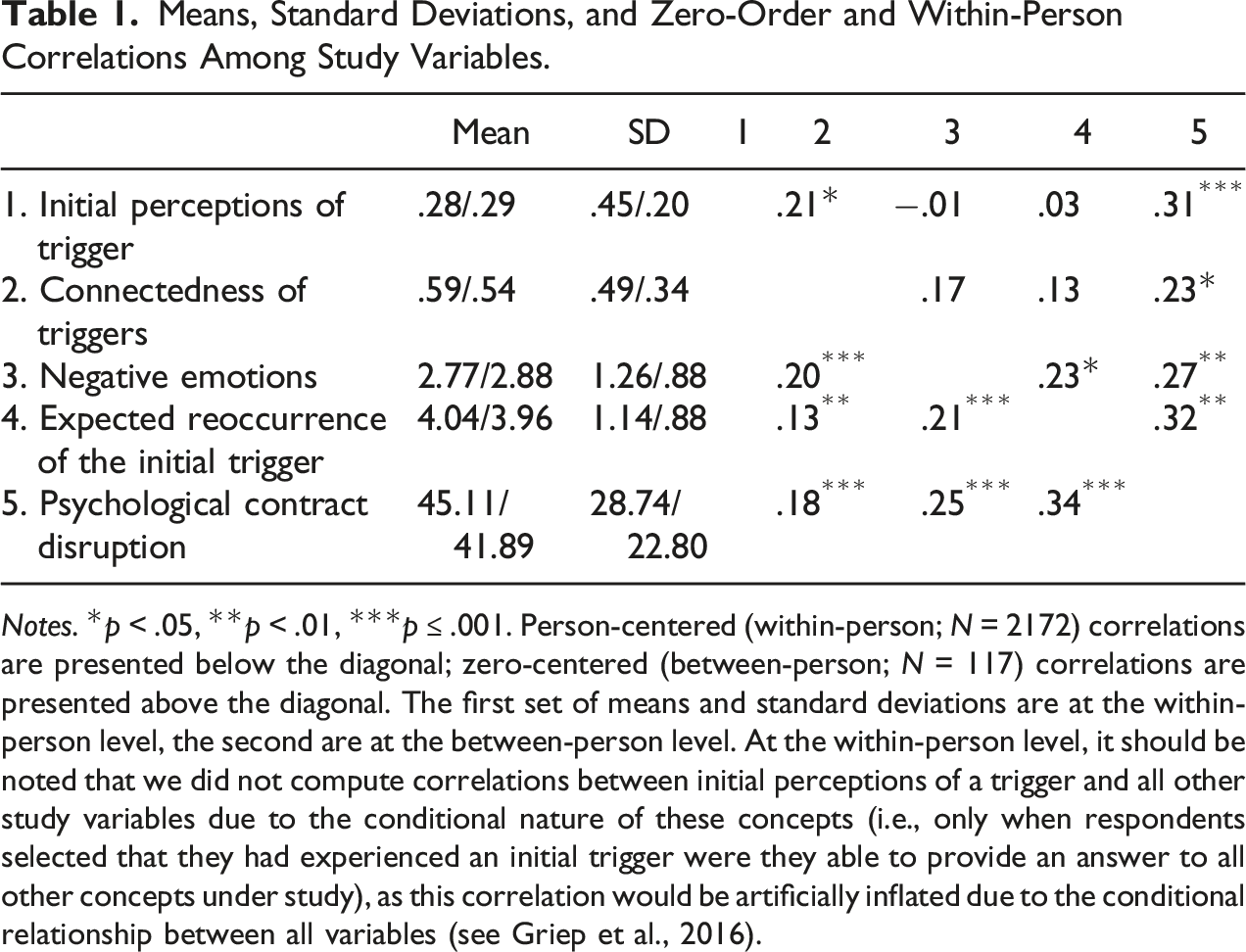
Notes. *p < .05, **p < .01, ***p ≤ .001. Person-centered (within-person; N = 2172) correlations are presented below the diagonal; zero-centered (between-person; N = 117) correlations are presented above the diagonal. The first set of means and standard deviations are at the within-person level, the second are at the between-person level. At the within-person level, it should be noted that we did not compute correlations between initial perceptions of a trigger and all other study variables due to the conditional nature of these concepts (i.e., only when respondents selected that they had experienced an initial trigger were they able to provide an answer to all other concepts under study), as this correlation would be artificially inflated due to the conditional relationship between all variables (see Griep et al., 2016).
Preliminary Tests
In light of the principle of parsimoniousness, we first estimated and compared a full 2-level mediation model that partitions within- and between-person variance with a partial 2-level mediation model 3 that partitions within- and between-person variance to determine which model fit the data best. We compared both models using a chi-square difference test and the sample-size adjusted BIC value. We found that the partial 2-level mediation model that partitions within- and between-person variance (sample-size adjusted BIC = 11796.05) fit the data significantly better (Δχ2(3) = 36.92, p < .001) than the full 2-level mediation model that partitions within- and between-person variance (sample-size adjusted BIC = 11816.10). As such, all of the results presented below (including the mediation effects) are from the partial 2-level mediation model.
Inferential Statistics
Figure 1 displays the standardized estimated paths for the partial 2-level mediation model that partitions within- and between-person variance (RMSEA = .03, CFI = .97, TLI = .95, SRMRwithin = .09). Specifically, we found that the initial perceptions of triggers were positively related to their connectedness (estimate = .402, p = .003, 95% CI [.120; .566]). The connectedness of triggers in turn was positively related to the experience of negative emotions (estimate = .206, p < .001, 95% CI [.116; .295]). These negative emotions in turn were positively related to the expected reoccurrence of the initial trigger (estimate = .111, p = .031, 95% CI [.013; .213]). The expected reoccurrence of the initial trigger in turn was positively related to the experienced psychological contract disruption (estimate = .160, p = .001, 95% CI [.051; .271]). Moreover, we also found that the initial perceptions of triggers (estimate = .423, p = .022, 95% CI [.008; .667]), the connectedness of triggers (estimate = .097, p = .011, 95% CI [.014; .179]), and the experience of negative emotions (estimate = .144, p < .001, 95% CI [.063; .233]) were positively related to the experienced psychological contract disruption. Standardized estimated paths in the 2-level mediation model. Notes. *p < .05, **p < .01, ***p < .001.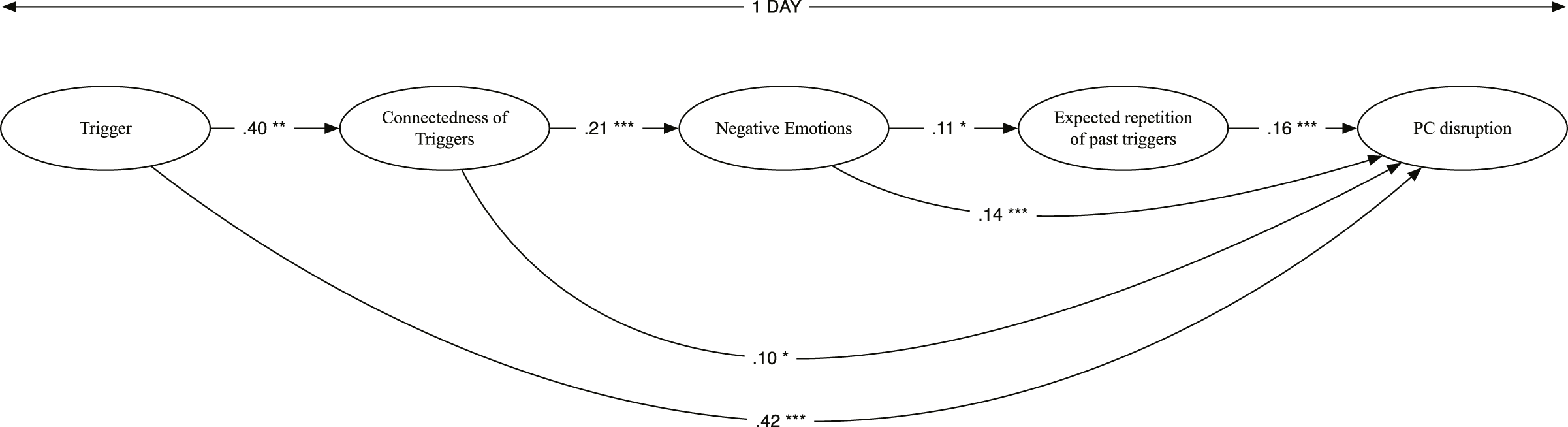
We also found evidence for a series of mediation results: (a) the initial perceptions of triggers were positively related to the experience of negative emotions via the connectedness of triggers (estimate = .217, p = .003, 95% CI [.059; .397]); (b) the connectedness of triggers was positively related to the expected reoccurrence of the initial trigger via negative emotions (estimate = .042, p = .031, 95% CI [.005; .094]); (c) negative emotions were positively related to the psychological contract disruption via expected reoccurrence of the initial trigger (estimate = .328, p = .032, 95% CI [.032; .749]); and (d) the initial perceptions of triggers were positively related to the psychological contract disruption via the connectedness of triggers, negative emotions, and the expected reoccurrence of the initial trigger (estimate = .066, p = .034, 95% CI [.004; .187]).
Post-Hoc Testing
To further explore these results, we performed two post-hoc tests. First, the existence of prior triggers (connected triggers) could be considered a boundary condition, which suggests it functioned as a moderator in the tested model rather than as part of the chain of mediators that we present. We therefore tested a model in which trigger connectedness operated as a moderator of the relationship between the initial perceptions of triggers and the experience of negative emotions to determine if the presence of trigger connectedness amplifies the relationship between initial perceptions of triggers and the experience of negative emotions. This model fit the data (sample-size adjusted BIC = 12655.26) less well than the model presented in this manuscript (sample-size adjusted BIC = 11816.10). For a full discussion of this analysis, please see the Appendix.
Second, our results suggest that the disruption of the psychological contract arises from appraisals of (interconnected) past, present, and potential future triggers, and their accompanying negative emotions, and that the effect may vary (see Table 1). However, these results do not demonstrate how long this effect on the psychological contract lingers over time. Solinger and colleagues (2016) previously showed, for example, that recovery after a disruption, such as breach, usually occurs within 2 weeks and a recent qualitative study by Wiechers and colleagues (2022) found a cumulative effect of triggers. Since triggers are assumed to underlie the dynamic nature of psychological contracts, it is plausible that they must have a lingering effect to bring about these demonstrated results. Moreover, if triggers are indeed the drivers of disruptions (Wiechers et al., 2022), they will not only activate this process, but also persist in the background. We explored this through the following question: If the psychological contract is once disrupted by a trigger, how long does its impact linger?
We sought to empirically examine if, and for how long, the negative effect of triggers on the psychological contract lingered once it was affected by the chain of events described above. In order to explore this question, we examined the relationship between each pair of consecutive daily measures. We found that the following standardized relationships were significant for the negative effect on the psychological contract: days 1 and 2 (estimate = .868, p < .001, 95% CI [.561; .985]), days 2 and 3 (estimate = .764, p < .001, 95% CI [.479; .964]), days 3 and 4 (estimate = .837, p < .001, 95% CI [.489; .988]), days 4 and 5 (estimate = .808, p < .001, 95% CI [.393; .972]), times 5 and 6 (estimate = .910, p < .001, 95% CI [.640; .992]), days 6 and 7 (estimate = .939, p < .001, 95% CI [.741; .996]), days 7 and 8 (estimate = .939, p < .001, 95% CI [.725; .992]), days 8 and 9 (estimate = .912, p < .001, 95% CI [.590; .987]), days 9 and 10 (estimate = .787, p = .009, 95% CI [.203; .978]), and days 10 and 11 (estimate = .758, p = .023, 95% CI [.024; .969]). All subsequent consecutive associations were no longer significant. This suggests that the negative effect of a trigger on the psychological contract continues to linger for approximately 11 days (i.e., the final significant association was between Day 10 and Day 11), after which it leveled off.
Discussion
In this exploratory diary study, we examine how day-to-day triggers disrupt the psychological contract. Our findings indicate a chain of relationships occurs highlighting a process in which a trigger leads to connectedness with previous triggers, negative emotions, expected future triggers to finally, a disruption of the psychological contract. Triggers at work can occur frequently, with varying impact, and also have a lingering effect that lasts for approximately 11 days before leveling off.
The findings of this study have several theoretical implications. First, triggers and the appraisal process they initiate disruptions of the psychological contract. This finding extends current theory by highlighting the role of triggers as drivers of the dynamic nature of the psychological contract. For example, triggers may help explain the pattern of frequent fluctuations found in psychological contract evaluations (Bal et al., 2017; Griep & Vantilborgh, 2018a; 2018b; Ng et al., 2014; Solinger et al., 2016). After all, triggers not only disrupt the ongoing exchange and generate attention to specific exchange relationship conditions (Wiechers et al., 2019), but also may lead to disruptions that require changes to employees’ psychological contracts. At the same time, the lingering nature of triggers will also affect the psychological contract and thus, temporarily or not, affect an employee’s evaluation of their psychological contract. So, the moment of measuring and the phase of processing (recent) triggers experienced may explain the established fluctuations monthly (Ng et al., 2014), weekly (Bal et al., 2017; Solinger et al., 2016), and even on a daily basis (Conway & Briner, 2002).
Second, we extend the theory of the Dynamic Phase Model (Rousseau et al., 2018) by incorporating triggers as drivers of the processes of disruptions and revealing the micro-processes underlying potential disruptions. Our results show that triggers, accompanied by negative emotions, disrupt the exchange relationship. This degree of disruption seems to depend on an appraisal of the trigger in which new meanings are attributed (Wiechers et al., 2022) that help employees assess the situation and its significance (Smith & Kirby, 2009). Our findings give reason to believe that these appraisals of the relevance of a stimulus (Lazarus, 1991) are influenced by the perception that a similar trigger has previously been encountered. This supports the idea that when a latent trigger matches another encountered previously, it will stand out (Failing & Theeuwes, 2018; Molden, 2014) and, due to increased vigilance, will elicit more negative emotions (Morrison & Robinson, 1997). Simultaneously, negative emotions signal a situation that necessitates attention (Frijda, 1988). This elicits secondary appraisals (Moors et al., 2013) that include the estimation of the future (Lazarus, 1991), such as expectations of the future reoccurrence of triggers. Identifying comparable triggers, for instance, may raise subsequent concerns about the other party’s ability and willingness to fulfill their obligations, and increase the likelihood of identifying similar triggers in subsequent events (Robinson & Morrison, 2000). The results show that the degree of expectation that the trigger will return affects the perception of disruption of the psychological contract. A possible explanation for this is that employees tend to be sensitive to reoccurrences of triggers because they consider them to be a signal of an impending breach (Wiechers et al., 2022).
These underlying processes of disruptions in the Dynamic Phase Model (Rousseau et al., 2018) are in line with recent insights from scholars such as Bankins (2019), Sandberg and Tsoukas (2015), and Stigliani and Ravasi (2012) who indicate that the process of sensemaking is not only retrospective but also anticipatory. Bankins (2019), for example, underscored the importance of flashbacks and flashforwards in shaping the psychological contract, thereby revealing that sensemaking is influenced by both retrospective and prospective meanings. Given the reliance of sensemaking on the interplay between retrospective and prospective aspects (Konlechner et al., 2019), and the interconnectedness of triggers (Wiechers et al., 2022), sensemaking here is not only a retrospective (“Has this happened to me before?”) but also a prospective (“Will this happen to me again?”) part of appraising a trigger. Therefore, our findings suggest that (connected) past, present, and future triggers, and their accompanying negative emotions, are drivers in the disruption of psychological contracts.
Finally, our findings reveal the “sticky” nature of triggers, allowing an additional glimpse into the underlying micro-processes of disruption. The lingering nature of triggers suggests that the experience of a disruption is not necessarily anchored to a specific moment and event in time but may instead be formed by a series of triggers. Over time this can add pressure on the exchange relationship, as evidenced by Conway and Briner’s (2002) finding that small triggers (“everyday events”) can accumulate, though they did not reveal the process. This identification of the lingering nature of triggers contributes to the idea that employees have tolerance thresholds (Jones & Griep, 2018; Rigotti, 2009; Schalk & Roe, 2007). After all, the average duration of the lingering effect of a trigger is approximately 11 days before it levels off. It is foreseeable that during turbulent periods, a new trigger may occur before the effects of the prior trigger have leveled off. The experience of multiple consecutive triggers may thus strain the employment relationship (Wiechers et al., 2019), until a threshold value is reached (Rigotti, 2009). Most research focuses on the crossing of these threshold boundaries (i.e., psychological contact breach; Conway & Briner, 2009). At the same time, our study shows that understanding the process within these tolerable threshold boundaries (Schalk & Roe, 2007) is equally important. It is precisely within these boundaries that processes take place in which (connected or unconnected) triggers and their (expected or not) repetition manifest in an ongoing (accumulating) fluctuation of psychological contract evaluation which ultimately is the origin of disruptions. Therefore, these underlying processes provide an additional lens to understanding employees’ responses to change. Mitigating the negative consequences of triggers as they develop will support a mutually productive relationship.
Practical Implications
This study offers important insights into the process by which employees appraise their increasingly complex and ever-changing daily work environment. Specifically, it reveals the pivotal role that triggers play in disrupting psychological contracts and how the latter change over time. Employers should be aware of how triggers work and use strategies and interventions to actively build and repair psychological contracts with their employees as a way of de-escalating the disruptive effect of triggers. Since our findings indicate that the negative effect of a trigger lingers for approximately 11 days, we suggest that an ideal time frame for de-escalation interventions is within those first 11 days. Overall, the findings suggest that it is rare that a single trigger is involved in an employee’s appraisal and sensemaking process but rather a series of triggers that may or may not connect the past (memory-stored; Dehaene et al., 2006; Molden, 2014), the perceived present, and the anticipated future (anticipatory sensemaking; Lazarus, 1991; Sandberg and Tsoukas, 2015). As such, managers should be aware of and act upon the possible cumulating effect (see also Wiechers et al., 2022) of past triggers and expected reoccurrence of triggers if they are to reduce the negative effect of day-to-day changes on the psychological contract. We thus challenge managers to focus not only on current changes but to engage in a conversation regarding the origins of any current tensions. In this way, they might be more successful in tempering negative expectations regarding future changes to at least mitigate the effect of the expected reoccurrence of triggers.
Limitations and Future Research
The findings of this study must be interpreted in light of its limitations. First, the sample poses a challenge to generalizability. Since our study focuses on a homogeneous group of highly skilled professionals who were working in universities of applied sciences, the generalizability of our findings is limited by the unique characteristics of this sample. Therefore, future research studies should replicate this study in other organizational contexts to explore the micro-processes that accompany perceived disruptions in more fast-paced, dynamic, unsettled, and highly competitive workplaces.
Second, our daily diary method best supported the research question as it allowed us to follow the day-to-day within-person processes (Bolger & Laurenceau, 2013) while reducing the retrospection biases by capturing triggers as they occurred (Bolger & Laurenceau, 2013; Ohly et al., 2010). However, the fact that participants were encouraged to complete daily survey questions may also have led to reactivity bias (Arslan et al., 2021), whereby respondents were influenced by their conscious or unconscious reactions to the survey itself. For example, daily diaries may cause increased vigilance for triggers, and precisely because triggers are more likely to be noticed when conscious attention is paid to selected stimuli, this could have affected the results. However, we did not see in our data an increase over time in the number of triggers that might have been expected given this phenomenon. One explanation may be that the shift from unconscious to conscious awareness—necessary for experiencing triggers—is not strongly affected by reactivity bias, maybe a result of the process of allocating attention being unconscious and uncontrolled (Failing & Theeuwes, 2018; Yantis & Johnston, 1990). Furthermore, we used anonymous surveys, which can help to reduce reactivity in diary studies (Arslan et al., 2021), but it does not completely eliminate the effect of reactivity on the results. Future studies could address this by adopting other types of measurement. For example, smartphone apps may be less obtrusive and allow for more natural data collection, or randomizing the order of questions may prevent conscious or unconscious reactions to certain questions (see further Arslan et al., 2021).
Third, our study focused on negative events or circumstances with negative consequences. However, there are also positive circumstances that lead to positive employee emotions such as psychological contract (over-)fulfillment (Lambert et al., 2003; Rousseau et al., 2018). As a result of the positive-negative asymmetry effect (Baumeister et al., 2001), we expected negative triggers (e.g., receiving criticism from a manager) to have a greater impact than positive triggers of the same type (e.g., receiving positive feedback from a manager), that these would be more prevalent and have more deleterious consequences for employee attitudes and behavior (Griep et al., 2016; Solinger et al., 2016; Zhao et al., 2007), and therefore we primarily focused on the negative effect. However, there are also many situations where employees experience positive emotions. This raises the question as to whether these triggers set into motion the same process as the one found in our study or a different one. It is foreseeable that some conditions will buffer responses to psychological contract evaluations (e.g., Dulac et al., 2008; Griep et al., 2016; Ng et al., 2014; Zagenczyk et al., 2009). For example, employees will value organizational support because it indicates that their organization cares about their well-being (Dulac et al., 2008), which has the potential to buffer against the negative consequences of any disruption. While other conditions, for example, the lack of recognition (Brun & Dugas, 2008), will strain the relationship. Future research, therefore, should replicate this study with a focus on both negative and positive triggers in order to capture emotional reactions to the full range of possible triggers. This would comprehensively reflect the Dynamic Phase Model (Rousseau et al., 2018), which recognizes that disruptions—to which triggers can lead—can be either positive or negative.
Finally, although we conducted a pilot study that confirmed that our last single item reflects the disruption of the psychological contract, our measure—even with the significant correlation between the measures—touches both the concept of a psychological contract and, in part, the concept of the employee-organization relationship more broadly through our question wording. This means that our results should be interpreted with caution. Therefore, to extend its reliability, we welcome in-depth empirical studies that would gauge the robustness of our findings with validated measurements of disruptions in different change settings to show how triggers disrupt the psychological contract.
Our study also raises several new questions for research and practice. The first pertains to the exploration of possible organizational interventions to interrupt the negative consequences of triggers. For example, (a) How can the connection to possible previous triggers be reduced? (b) How can the expected reoccurrence of triggers be mitigated so that this step is eliminated in the appraisal process and the impact of a trigger be rendered less severe? and (c) Where is the “sweet spot” for intervention to reduce the negative effect of the expected reoccurrence of past triggers on the psychological contract, given the lingering effect of triggers? Furthermore, the question arises of whether the 11-day lingering effect found in our study applies to every trigger or there are different (empirically distinguishable) types of triggers, each with their own stickiness and distinguishable lingering effect. The multitude of triggers found in the diaries and the differences in their effect, within-person as well as between-person, suggests that the type of trigger (e.g., direct, indirect, or slow; Wiechers et al., 2019, 2022) does indeed matter in shaking up and disrupting the psychological contract. Exploring this would help to develop a roadmap for organizations to intervene and to protect or repair psychological contracts under different time frames, leading to more engaged and satisfied employees.
Footnotes
Declaration of Conflicting Interests
The author(s) declared no potential conflicts of interest with respect to the research, authorship, and/or publication of this article.
Funding
The author(s) received no financial support for the research, authorship, and/or publication of this article.

Notes
Associate Editor: Yannick Griep