



Abstract
Are late careers worth studying in their own right? The way we think and reason about older workers and late careers—in scholarship and in practice—has been disproportionately informed by a research paradigm that focuses on age differences among employees, which captures how older workers on average differ from younger workers on average. While this contrastive paradigm has been generative, it can also inaccurately portray older workers as a static, homogenous group. In contrast, older workers show considerable heterogeneity (older workers vary), meaningful dynamics (older workers change), and dynamic heterogeneity (older workers vary in how they change). In this paper, we propose that the contrastive paradigm be complemented with a centered paradigm that centers on how older workers vary and change. We develop a theoretical model of how older worker dynamics and older worker heterogeneity shape the quality of their employment relationship—in terms of psychological contracts—which in turn shape their career trajectories and work role enactment. By centering this line of research on older workers, we gain a higher-resolution view of these late careers as unfolding over time and varying among older workers.
Introduction
Older workers are an increasingly large and important segment of the modern workforce. Traditionally, older workers’ careers are contrasted to younger workers, with late careers believed to be in a disengagement stage characterized by a declining trajectory of involvement (Super, 1957; see also Barclay, Stoltz, & Chung, 2011; Demerouti, Peeters, & van der Heijden, 2012). However, research suggests this view of late careers is overly simplistic—late careers possess considerable heterogeneity in their dynamics and trajectories (Taneva & Arnold, 2018; Wang, Zhan, Liu, & Shultz, 2008). Unfortunately, scholarship and practice has tended to overlook this heterogeneity among older workers, focusing instead on age differences that capture how older workers differ on average from their younger counterparts. This frame has led to a “one-size-fits-all” approach that portrays older workers as homogenous despite their personal and contextual variability (Bal & Jansen, 2015). Management know-how around older workers is a prominent “grand challenge” (Kulik, Ryan, Harper, & George, 2016). We contend that one important step to move the needle on this grand challenge is by centering on older workers’ heterogeneity and dynamics—how older workers vary and how older workers change.
We situate late-career heterogeneity and dynamics in the employee-organization relationship (EOR): the variety, change, and variety of change in older workers’ work patterns and employment relationships. The nature and quality of these EORs drive older worker participation and retention, but our understanding of these EOR dynamics is still emerging. The core explanatory concept in EORs is the psychological contract (Robinson, Kraatz, & Rousseau, 1994), which captures essential elements of employment—the work performed and the returns received—providing valuable insights into the work preferences and behavioral patterns of all employees, including older workers (Garcia, Amarnani, Bordia, & Restubog, 2021). We highlight two overlooked issues: heterogeneity among older workers and how older workers change over time. Centering this research on older workers’ dynamics and heterogeneity will deepen our understanding of variety, change, and variety of change in (a) the work and non-work conditions that give rise to older workers’ psychological contracts; and (b) the career consequences of older workers’ psychological contracts, which altogether flesh out how late careers unfold and vary.
The aim of this conceptual paper is to inform research on older workers’ EORs by developing a theoretical model of heterogeneity in the antecedents, consequences, and dynamics of older workers’ psychological contracts across the spectrum of relational and transactional elements. The model adopts a centered paradigm rather than a contrastive paradigm, focusing not only how the average older worker differs from the average younger worker, but on how older workers’ varied work and non-work experiences shape the types of psychological contract older workers hold, which in turn influence late-career behaviors and trajectories. The proposed model is depicted in Figure 1—the stacked boxes represent temporal change, as differences and changes in work and non-work experiences (left side of model) predict differences and changes in psychological contract type, which in turn predicts late-career trajectories (right side of model). A dynamic model of late-career employment orientation. Note. The stacked boxes represent changes over time.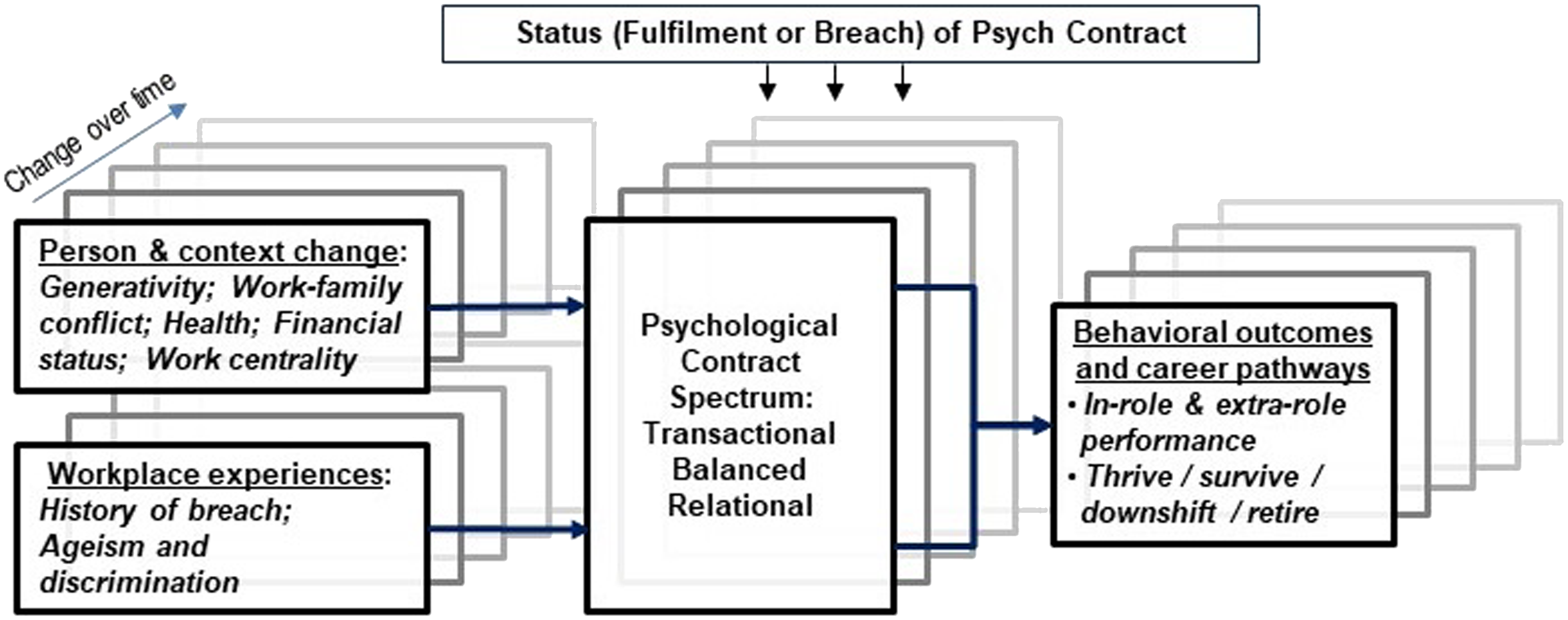
We make two important contributions to the literature. First, we propose a departure from the ‘lifespan paradigm’ or contrastive paradigm of research comparing younger versus older workers. This paradigm has yielded important insights (for example, how reactions to breach vary with employee age on average; Bal, De Lange, Jansen, & Van Der Velde, 2008). It emphasizes differences across the lifespan, but can portray each age group as a largely undifferentiated segment. We advocate for a new wave of research on older workers adopting a “centered paradigm”—examining how older workers vary in their own right rather than contrasting them to middle-aged or younger workers on average. We contend that a centered paradigm deepens our understanding of older workers’ dynamics and heterogeneity. Second, we advance the literature on how psychological contracts evolve in late careers. Psychological contracts are not static—they evolve and shift in line with people’s circumstances and experiences (Bankins, 2015; Robinson et al., 1994). As older workers undergo changes with aging—changes to their needs, circumstances, and work experiences—their psychological contracts ought to change accordingly. However, the nature of this change remains unexplored. Surprisingly little is known about longitudinal change in psychological contracts. Only a handful of studies in the literature (Bankins, 2015; Griep & Vantilborgh, 2018; Ng, Feldman, & Lam, 2010) track changes in psychological contracts over at least three time points, consistent with the definition of longitudinal research (Ployhart & Vandenberg, 2010). Older workers’ psychological contracts are dynamic and varied, which drive their EORs.
The rest of the paper develops these ideas, proceeding as follows. First, we present a case for the centered paradigm and explain what it means for research on older workers. Next, we show how this centered paradigm can deepen our theoretical understanding of older workers’ EOR, developing propositions about the unfolding of their psychological contracts and late careers. Then, we comment on the potential roles of psychological contract status. Last, we outline implications for theory, conceptualization, methods, and practice.
A Research Paradigm Centered on Older Workers
The past two decades has rightfully seen growing interest in research on the experiences and challenges of older workers—for compelling practical and theoretical reasons (Wang, Olson, & Shultz, 2013)—but this approach has largely been situated in a contrastive paradigm that cross-sectionally compares older workers to younger workers on average (Bohlmann, Rudolph, & Zacher, 2018). For example, one prominent line of research is on cognitive changes over the lifespan on average. This research notes that with age, crystallized intelligence (e.g., domain specific knowledge and problem-solving ability) increases on average, but fluid intelligence (e.g., processing speed and inductive reasoning) decreases on average (Kanfer & Ackerman, 2004). Older workers gain valuable domain-relevant experience and expertise over time but may struggle to devote long hours to demanding tasks such as creative problem-solving (Abbasi & Bordia, 2019). Scholars also argue that motivation and needs differ over the lifespan (Kanfer & Ackerman, 2004). Younger employees may seek skill and career growth on average while older employees desire to disengage and give back to the community on average. The contrastive paradigm has been highly generative for our understanding of lifespan development (Zacher & Froidevaux, 2021). However, the focus on lifespan differences on average comes with an under-recognized tradeoff that unfortunately downplays the diversity and variability among older workers.
Overall, while the contrastive paradigm has provided useful insights on aging and adult development, it also portrays older workers as static and undifferentiated. Older workers differ in their resource context: their health, financial status, family demands and carer duties, and career identities, all of which can impact their levels and form of involvement at work. There is no “typical older worker”; average tendencies and characteristics evident in age effects are of limited help in the management and design of workplace policies aimed at this important group.
In this paper, we advocate that the contrastive paradigm be complemented with a “centered” paradigm—borrowing from language in the diversity literature (Garay & Remedios, 2021). The centered paradigm emerged in the diversity literature partly in reaction to tacit expectations that research on minority groups requires a contrast against majority groups. These forced contrasts portray minority, non-prototype groups as far more homogenous than they truly are, focusing on average group members and thereby drowning out their diversity (Kim et al., 2021). We likewise believe that focusing implicitly on the “average” older worker is not particularly meaningful in light of the vast heterogeneity among older workers.
Building on these foundations, we contend that research on older workers can likewise be conducted without a forced comparison to younger workers. Centering on older workers enables us to unpack how older workers vary and change. We join this chorus in the broader diversity literature: research that is centered on older workers need neither include data on younger workers, nor generalize to younger workers. That is, research using a centered paradigm can study older workers without covering the full age distribution of employees. Research observing an effect among older workers can genuinely contribute to the literature without needing to establish that results would be different among younger workers. Instead, research in this centered paradigm can instead aim for inclusivity by drawing out differences among older workers at higher resolution. 1
Differences among older workers are best understood not as static but rather as dynamic. That is, older workers possess not only levels of attributes such as health, finances, and workplace contexts, but also trajectories of these attributes as their health, finances, lives, and workplaces change over time. Older workers show a dynamic heterogeneity that is overlooked in “snapshot studies” of older workers. Indeed, theories in gerontology have long recognized increasing diversity among individuals as they age (Nelson & Dannefer, 1992). For example, the cumulative advantage/disadvantage (CAD) approach notes “the systematic tendency for inter-individual divergence in a given characteristic (e.g., money, health, or status) with the passage of time” (p. S327; Dannefer, 2003), which is due to interactions between personal agency, social structures, and environmental effects that accumulate over time (as captured in popular beliefs such as “rich get richer” and “poor get poorer”; Dannefer, 2003). Similarly, Light, Grigsby, & Bligh (1996) noted that biology (genetic influences) and environment can interact to produce greater diversity in personality as people age and “become more who they are” (p. 171).
We situate this dynamic heterogeneity among older workers within the organizing framework of the employment relationship as these changes shape the unfolding of give-and-take within the EOR. The psychological contract is the lynchpin of this EOR—it reflects dynamic changes in employee conditions and needs (Rousseau, Hansen, & Tomprou, 2018) and transmits these changes to older worker behavior and role enactment over the unfolding of late careers (Garcia et al., 2021).
Theoretical Background—Older Workers’ Psychological Contracts
What do we mean by an older worker? Following recent practice in empirical research on older workers, we define older workers as those who are 50 years and older (Choi, Dabelko-Schoeny, Lee, & Bunger, 2020; Jiang, Zhang, Hu, & Liu, 2021; Peters, Van der Heijden, Spurk, De Vos, & Klaassen, 2019). However, we hasten to add that the choice of a cut-off is a complex matter that depends on various factors and perspectives, including population aging trends, subjective age, and occupational norms (McCarthy, Heraty, Cross, & Cleveland, 2014; Zacher & Rudolph, 2023). For example, it was common to see 40 years as a cut-off for older workers in the late 20th century when average retirement ages were in the mid-50s (Gist, Rosen, & Schwoerer, 1988; Liden et al., 1996). With increasing longevity and delayed retirement ages, the cut-off has since trended upwards.
Most importantly, we believe that a choice of age cut-off should be determined—and theoretically justified—based on the nature of the research question (Zacher & Rudolph, 2023). For questions relating to retirement behavior and transitions, recent research often uses age cut-offs of 60+ that are closer to typical retirement ages (e.g., Agahi, Kelfve, Hassing, & Lindwall, 2022; Sacco, Cahill, Westerlund, & Platts, 2022). For questions relating to career-related choices and behaviors in the full span of the late-career stage, we tend to see age cut-offs of 50+ which allow adequate time for career choices and their uni- and bi-directional relationships to manifest (e.g., Garavaglia, Marcaletti, & Iniguez-Berrozpe, 2021; Rahn, Martiny, & Nikitin, 2021). For our purposes and at this general point in time, an age cut-off of 50+ is reasonable.
We focus on older workers’ psychological contracts with their employers: their beliefs about the nature of exchange in an employment relationship (Rousseau, 1995). Psychological contracts from the older workers’ perspective comprise their perceived obligations—both what they feel (a) they owe to their employer; and (b) their employer owes to them. These perceived obligations capture the nature and depth of exchange within the employment relationship. We focus on older workers’ self-attributed obligations to the employer as a proximal driver of older worker behavior and orientation within the employment relationship.
Psychological contracts comprise multiple elements that vary idiosyncratically among older workers. Nevertheless, psychological contracts tend to fall along a continuum between transactional contracts and relational contracts (Rousseau, 1995; see also Anderson & Schalk, 1998), which respectively reflect the extent to which the EOR resembles an economic transaction or an enduring relationship (Rousseau, 1995). At one pole of the continuum, highly transactional contracts are marked by a primarily economic transaction: tangible returns for tangible contributions. These contracts have a short-term orientation, as employees see their obligations to the employer as a tightly bounded transaction in terms of timespan, depth, and exchange. At the opposite pole of the continuum, highly relational contracts reflect a more intensive and long-term social exchange with mutual trust playing a crucial role. Employees with a highly relational contract construe their obligations to the employers to be more long-term, expansive, deep, and socioemotional. These employees commit their resources and demonstrate loyalty even without immediate reward because of their long-term commitment to the organization, trusting that their contributions will be eventually rewarded (Raja, Johns, & Ntalianis, 2004; Rousseau, 1995). Along the middle of the continuum are balanced contracts that “blend” aspects of both relational and transactional psychological contracts (Rousseau, 1995). Overall, employees’ psychological contracts vary from primarily transactional to relational.
As older workers approach the threshold of retirement, their psychological contracts (especially in terms of the depth, intensity, and long-term nature of the EOR relationship) shape their employment plans both within and beyond the organization (e.g., Garcia et al., 2021). Going a step further, we propose that older workers’ psychological contracts—whether primarily transactional, relational, or somewhere in between—are crucial to their late-career trajectories. Importantly, older workers’ psychological contracts are conditioned on their goals and resources, which respectively inform employees’ willingness and ability to commit to intensive relational obligations versus bounded transactional obligations to the employer. This premise integrates two lines of scholarship. First, employees select into, commit to, attend to, and ultimately endorse transactional versus relational obligations in keeping with their dispositions and goals (e.g., Low, Bordia, & Bordia, 2016; Raja et al., 2004; Rousseau et al., 2018), which is further revised based on socialization and how employers treat employees (Rousseau, 1995). Second, the depth of employees’ contributions to exchange with the employer is also bounded by their resource availability (e.g., Bordia, Restubog, Bordia, & Tang, 2014). Goals and resources respectively reflect the “ends” and “means” that drive behavior (Carver & Scheier, 1998). For these reasons, we position older workers’ goals and resources as important drivers of their psychological contracts, particularly their self-attributed obligations to the employer, which in turn shape late-career trajectories.
Our theory development adopts a dynamic view of these processes. Older workers’ psychological contracts reflect their changing dispositions, situations, and experiences. Psychological contracts—particularly employees’ self-attributed obligations to the employer—are believed to be highly dynamic as employees self-regulate their obligations in line with their situations and experiences (Rousseau et al., 2018). We center this broad principle on older workers by situating it in older workers’ dynamic heterogeneity—how older workers vary, how older workers are changing, and how older workers vary in how they are changing.
In the following section, we present the antecedents and consequences of types of psychological contracts (relational vs. transactional). For each of these relationships, we present paired formal propositions reflecting our dynamic approach—the first sets-up the relation at the static level while the second involves variation in trajectories (unless trajectories are not expected, such as when the construct is time-invariant). These paired propositions provide insight into heterogeneity of how older workers’ change in terms of both antecedents and consequences. Scholarship on the aging workforce has repeatedly called for more longitudinal research that sheds light on how older workers change over time (Fisher et al., 2016; Wang et al., 2017). Likewise, scholarship on psychological contracts has made similar pleas to adopt longitudinal methods to deepen understanding of how psychological contracts evolve (Rousseau et al., 2018; see also Bankins, 2015). This paper responds to these two sets of calls in tandem.
Note that these two emerging lines of longitudinal work have thus far not spoken to each other. That is, emerging longitudinal thinking in the aging literature has not quite extended to how the EOR evolves with the looming prospect of retirement (Garcia et al., 2021). Likewise, emerging longitudinal thinking on psychological contracts has focused inordinately on the employee socialization process (Rousseau et al., 2018) which tends to apply to earlier careers rather than late careers or to consequences of breach (Achnak & Vantilborgh, 2021). We advance both literatures by developing an integrative longitudinal perspective on the dynamics of psychological contracts in the unfolding of late careers.
Antecedents of Types of Psychological Contracts
Following the focus on heterogeneity among older workers in the gerontology literature (Dannefer, 2003), we develop propositions around older workers’ differences in their contextual goals, resources, and workplace conditions that shape their psychological contract. Thus, we include not only personal and social changes but also experiences relevant among older workers to understand work and psychological contract dynamics in late careers.
Health Status
Health can be a major influence on older workers’ ability to work (van den Berg, Schuring, Avendano, Mackenbach, & Burdorf, 2010; Wang et al., 2008). Generally, health status declines as people age (Truxillo, Cadiz, & Hammer, 2015), but older workers’ health status also varies across people and over time. Indeed, a study that examined heterogeneity in health-related quality of life among older individuals found broad variation within specific age groups with older individuals in good and poor health present from 51 to 85+ years of age (Lowsky, Olshansky, Bhattacharya, & Goldman, 2014). Health concerns can reduce the ability of older workers to devote the resources needed to fulfill intensive relational obligations. When feeling unwell or facing medical intervention, older workers limit their involvement at work to its basic elements, such as maintaining core job duties. Therefore, we predict that health status will be positively related to relational contract and negatively to transactional contract. Moreover, we expect that with changes in health status, the contract will change as well: worsening health status activates self-protective goals that will result in a more transactional contract, while an improvement in health status enables employees to adopt relational obligations if they wish and activates approach goals in line with relational contracts.
Financial Status
Financial remuneration is one of the fundamental reasons people undertake paid employment. As people approach retirement, finances become salient for not only ongoing expenses but also retirement savings (Wang et al., 2008). Older workers often report needing to delay retirement or returning to post-retirement work in order to increase pension savings (Kim & Feldman, 2000). The financial motive is primarily associated with transactional contract and associated economic exchange relationships. With a low financial status, the older worker will be more attentive to short-term, tangible gains rather than longer-term socioemotional gains associated with relational contract. On the other hand, with a high financial status, the employee can afford to indulge in other forms of long-term rewards at work, such as career growth, status, and influence in the organization. Therefore, we propose that financial status will be positively associated with relational contract and negatively with transactional contract. Moreover, financial status can change during the late-career stage. Bad returns on investments or unexpected family expenditures can quickly change financial status. Changes in financial status can render money especially salient to the older worker, which might shift them toward transactional psychological contracts. Money primes that render money salient tend to make employees less interdependent and adopt an economic orientation (Vohs, 2015; see also Stajkovic, Greenwald, & Stajkovic, 2022), which is consistent with a transactional psychological contract. Regardless of whether the financial shock is positive or negative, we expect that changes in financial status shift psychological contracts toward more transactional forms.
Work Centrality
Work centrality refers to the importance of work in one’s life (Paullay, Alliger, & Stone-Romero, 1994). Those with high work centrality consider work the primary source of purpose in life and devote more time and energy into work. Work-related achievements play an important role in their life. Work centrality tends to be positively related to organizational commitment and career planning (Mannheim, Baruch, & Tal, 1997). Given the importance of work, it is not surprising that those high in work centrality tend to adopt a relational orientation at work (Bal & Kooij, 2011).
There is limited research on antecedents of, and changes in, work centrality. While elements of self and identity (such as work centrality) tend to be deep seated, they nevertheless do respond to personal efforts or situational pressures to change. Work experiences such as job satisfaction, rewards, and the development of mastery in work activities can enhance work centrality, while stress and feelings of lack of mastery can reduce work centrality (Mannheim et al., 1997). Given our dynamic orientation in this model, we propose that changes in work centrality will accordingly inform changes in their psychological contract.
Generativity
Erik Erikson defined generativity as “primarily the concern in establishing and guiding the next generation” (1963, p. 267). It figures prominently in his theory of human development in the seventh stage of generativity versus stagnation. Generativity becomes salient during middle to late adulthood as individuals increasingly ponder their legacy after death (Doerwald, Zacher, Van Yperen, & Scheibe, 2021; McAdams & de St Aubin, 1992). Not all people consider their post-mortem legacy, which explains the considerable variance in generativity among older workers (e.g., Garcia, Bordia, Restubog, & Caines, 2018) depending on how well they have resolved earlier developmental needs. While generativity is multifaceted, we focus on generativity concern (the individual difference regarding the value placed on concern for the next generation; McAdams & de St Aubin, 1992) because it captures older workers’ beliefs, values, and motivations as the “need to be needed” by society and the desire for “symbolic immortality” grows with age, alongside cultural expectations for older people to serve as guides for the next generation. These motivations are thought to shape older workers’ preference for relational, as opposed to transactional, contracts. That is, highly generative workers prioritize and value altruistic pursuits over extrinsic rewards (i.e., high salary), which aligns with relational psychological contracts marked by a concern for the welfare of the organization and its members (Rousseau, 1995). We predict that generativity concern is likely to be positively related to relational and negatively to transactional contracts.
Work–Family Conflict
Work–family conflict is “a form of inter-role conflict in which the role pressures from the work and family domain are mutually incompatible in some respect” (Greenhaus & Beutell, 1985, p. 77). That is, participation in one domain (work or family) becomes difficult by virtue of participation in the other domain. Work-family conflict may prevent workers from investing significant amounts of time and resources to sustain relational psychological contracts. The experience of work-family conflict may lead to a preference for transactional psychological contracts as a means to conserve resources (e.g., time) and minimize potential strain. Accordingly, we propose that work-family conflict will be positively related to transactional contracts and negatively to relational contracts. Notably, older workers may be in situations where their work-family conflict is trending upward (e.g., as they become sandwiched in multiple carer obligations; Beutell & Wittig-Berman, 2008) or trending downward (e.g., as their children leave the nest). Upward trends in work-family conflict will mean that more resources are diverted to the family domain. Downward trends in work-family conflict imply that fewer resources are needed to enact the family role. Psychological contracts will deepen (i.e., become more relational) or loosen (i.e., become more transactional) in line with these trajectories of resource availability. Consequently, we predict employees’ psychological contracts change in line with the direction of the trajectory of work-family conflict.
History of Psychological Contract Breach
Another factor that informs contract type is whether the employee has prior experience of psychological contract breach (Morrison & Robinson, 1997). Prior exposure to psychological contract breach erodes trust in the organization and predisposes employees to vigilantly monitor the fulfillment of existing psychological contracts (Morrison & Robinson, 1997; Robinson & Morrison, 2000). Prior breach experiences also breed uncertainty regarding the employment relationship. These conditions may lead individuals to adopt transactional, as opposed to relational, psychological contracts. Breach inhibits the formation of relational psychological contracts because these are grounded on trust and organizational commitment. Moreover, a history of breach makes employees wary, leading them to form short-term and purely economic contracts that do not require high initiative, constant monitoring and confidence (Raja et al., 2004). Therefore, we predict that a history of breach will drive more transactional contracts and less relational contracts. An accumulated history of breach is something older workers bring to the late-career stage (we later discuss the role of subsequent breach episodes in our model). Therefore, we treat it as effectively static.
Ageism
Age stereotypes refer to “beliefs and expectations applied to members of an age group solely based on their membership in that group and not on knowledge of their individual characteristics” (Finkelstein, 2014, p. 14). Typically, older workers are stereotyped as poor performers, resistant to change, unable to learn, and costlier to employ than younger workers (Finkelstein, 2014). These age stereotypes elicit unfair treatment (discrimination) at work since they color judgment and decision outcomes (hiring, training, and promotion; Finkelstein, 2014). We propose that ageism and discrimination will shape their psychological contracts. Ageism and discrimination convey signals that the organization places less value on older workers, and is therefore disinclined to keep its promises to older workers in particular. Further, it weakens the sense of belongingness that underpins relational psychological contracts (Rousseau, 1995). Thus, older workers may consider it ‘safer’ to focus on transactional, short-term obligations rather than long-term socioemotional investments in the organization. Accordingly, we hypothesize that experience of ageism will be positively related to more transactional and less relational contracts.
Ageism can change over time. A new manager can bring a different approach to older workers or the organization can undergo a diversity inclusive culture change. Increases in ageism may also strengthen the salience of the discrepancy between older workers’ relational obligations to the employer and how the employer values older workers, which may prompt older workers to revise their obligations to the more transactional end of the continuum. Overall, we expect that a change in experience of ageism will result in a change in psychological contract orientation.
Consequences of Types of Psychological Contracts
The psychological contract is a defining feature of the employment relationship and has significant implications for older workers’ workplace behavior and career trajectories. Late-career trajectories reflect the broad range of cognitive, affective, and behavioral manifestations of role enactment, including but not limited to performance behaviors, work hours and employment conditions, psychological investment, role expansion and contraction, which altogether capture the evolution of older workers’ investment in the workforce. Employers would benefit from insights into the forms of career trajectories that older workers pursue as these would have implications for organizational readiness to adapt to and support these trajectories.
Late-career trajectories—in terms of changing involvement in the workforce—can take many forms. We consider four possibilities here: an upward trajectory (thriving), a flat trajectory (surviving), a downward trajectory (downshifting), and exit in the form of retirement. We do not wish to imply that any of these trajectories are better or worse than others. The trajectories follow from older workers’ psychological contracts, which are in turn a result of personal characteristics, needs, and work and non-work experiences and represent the best adaptive outcome the individual can manage (Kooij, Zacher, Wang, & Heckhausen, 2020).
The first trajectory trends upward and is characterized by a sustained, vigorous, and ambitious involvement in work with no thought of retirement or withdrawal from work. A similar trajectory has been noted in the successful aging literature where a work engagement pattern that positively deviates from an average normative pattern has been referred to as successful aging at work (Zacher & Rudolph, 2017). Employees demonstrating this trajectory may remain highly motivated and involved at work and seek to continue taking on new work roles or challenges, delivering high-quality work behaviors, expanding their work role, overall deepening their give-and-take with the organization cognitively, affectively, and behaviorally. Following Taneva and Arnold (2018), we refer to this trajectory as thriving. Given the high levels of involvement in work roles represented by this trajectory, we expect thriving to result among employees with more relational psychological contracts.
In the second trajectory, employees may try and maintain their existing levels of engagement and perform adequately enough to meet the essential requirements of the job. This trajectory can imply that the employee is only moderately involved at work, perhaps biding time to some milestone (like pension eligibility). This trajectory is likely to be an outcome of a more transactional contract, where the focus is on the short-term and attention only to the core elements of the job. Employees with a more transactional contract have an economic, short-term relationship with the employer. They self-regulate their work behavior and role enactment around a “set point” that fulfills minimum standards and is believed to be adequate and fair per the terms of their transactional psychological contract. These workers want to stay employed (often out of necessity), and therefore perform just enough to fulfill these transactional obligations to the employer. Indeed, research has shown mixed results on the relationship between transactional contract and in-role performance (Lu, Capezio, Restubog, Garcia, & Wang, 2016; Shore, Tetrick, Lynch, & Barksdale, 2006), consistent with a flat or “surviving” trajectory as described by Taneva and Arnold (2018).
Third, employees may adopt a downward trajectory and seek to reduce their involvement at work, consistent with the disengagement career stage postulated by Super (1957). This phenomenon has also been referred to as downshifting where employees may reduce work hours to pursue other activities. Downshifting is often seen in the context of bridge employment which refers to a transition from full-time career role to complete retirement via gradual reduction in work via part-time or ad-hoc roles in the same or different organization (Feldman, 2007; Shultz, 2003). Downshifting does not necessarily imply imminent departure from the workforce. In fact, downshifting could be a way to sustain working and an employee may be able to continue work—albeit in a smaller role—for years to come. However, the employee is likely to limit psychological involvement in work and is more likely attend to limited aspects of work.
We expect downshifting to occur among employees with more transactional psychological contracts. As employees reduce involvement at work, they often eliminate non-essential work tasks and reduce long-term planning and commitment to work. Older workers with more transactional contracts may begin to shrink their role (Bruning & Campion, 2018) and/or adjust to part-time or casual work roles with limited involvement in the organization. Those with relational contracts maintain involvement in the organization and are unlikely to downshift.
Further, we expect the rate of downshifting to accelerate when psychological contracts break down entirely. Rousseau (1995) refers to these situations as transitional conditions (also known as “no guarantees” conditions) which occur in work situations that are so unstable that neither transactional nor relational obligations are indicated or meaningful (e.g., job insecurity, radical organizational change, layoffs). Such conditions were likely most prevalent during the first several waves of the COVID-19 pandemic, when older workers were at particularly high risk of being targeted by layoffs (Pit et al., 2021). The behavioral consequences of transitional conditions are poorly understood and seldom studied; we do know that employees in transitional conditions tend to be highly disengaged (Soares & Mosquera, 2019). A transitional condition will likely lead to rapid and discontinuous downshifting, prompting older workers to consider either an earlier-than-planned retirement or potential job search to find more stable conditions.
The final career endpoint would be retirement or complete exit from the workforce. The retiring trajectory reflects the transition period between work and this endpoint, in many cases presaged by a downshifting trajectory (Bordia, Read, & Bordia, 2020). Older workers with a more relational contract are unlikely to completely retire as they continue long-term investment in the organization. A more transactional contract (or transitional condition) is a likely pathway to retirement as such workers are less likely to struggle with complete letting-go of work.
Thriving, surviving, downshifting, and retiring capture the various shapes of late-career trajectories documented in the literature, both historically (Super, 1957) as well as recent development (Taneva & Arnold, 2018). Contextual and workplace dynamics shape the psychological contract, which in turn informs the shape taken by the late-career trajectory. This dynamic relationship allows for changes in older workers’ personal conditions to prompt changes in their late-career trajectories by dint of changes in their psychological contracts.
Effects of the Status of the Psychological Contract (Fulfillment/Breach)
The status of the psychological contract refers to employee perceptions of how much the organization has fulfilled or failed to fulfill (i.e., breached) its obligations toward the employee. A fulfilled contract strengthens the relationship and, based on the norm of reciprocity, increases the likelihood that the employee will reciprocate by contributing to the organization (Rousseau, 1995). Inversely, a perception of breach of obligations damages the relationship; breach consistently undermines job performance, fosters workplace deviance and, in extreme instances, employee turnover. The status of the psychological contract has ongoing implications for the type of employment relationship the employee maintains. However, emerging research on psychological contract status and breach complicates this story, showing that employees agentically contribute to their own breach experience (Griep & Vantilborgh, 2018) and actively reinterpret breach experiences (Solinger, Hofmans, Bal, & Jansen, 2016). Consequently, theory allows for psychological contract breach to operate not only as a moderator but also as a mechanism.
Recent research on psychological contracts indicates that these are revised and updated as the employee encounters feedback from the organization (Bankins, 2015; Rousseau et al., 2018). Generally speaking, the employees’ obligations to employer intensify—shifting from transactional to more relational—as employers continually fulfill their obligations and win workers’ trust (Morrison & Robinson, 1997). However, when employers do not hold up their end of the bargain, employees experience a psychological contract breach that erodes employees’ trust and faith in their employer. In such situations, employees reconsider their employment relationships and what they feel they owe to their employers. Breach can shift more relational contracts to more transactional contracts as employees learn that their trust in the employer is likely misplaced. Alternatively, a transitional condition could emerge if employees experience depths of single or accumulated breach that lead them to believe that there are “no guarantees” from the employer at this point. Employers may nevertheless be able to repair the psychological contract by investing resources into the older worker, thereby reinstating a transactional psychological contract or potentially rebuilding trust and shifting to a relational psychological contract, but these changes are likely to be longer-term. In Figure 2, we present a diagram of how these unfolding changes in psychological contract status might shift late-career trajectories. Conceptual diagram of psychological contract type, status, and late-career trajectories. Note. This colored diagram depicts how changes in psychological contract status (breach and repair) might inform hypothetical shifts in late career pathways (retiring, downshifting, surviving, and thriving).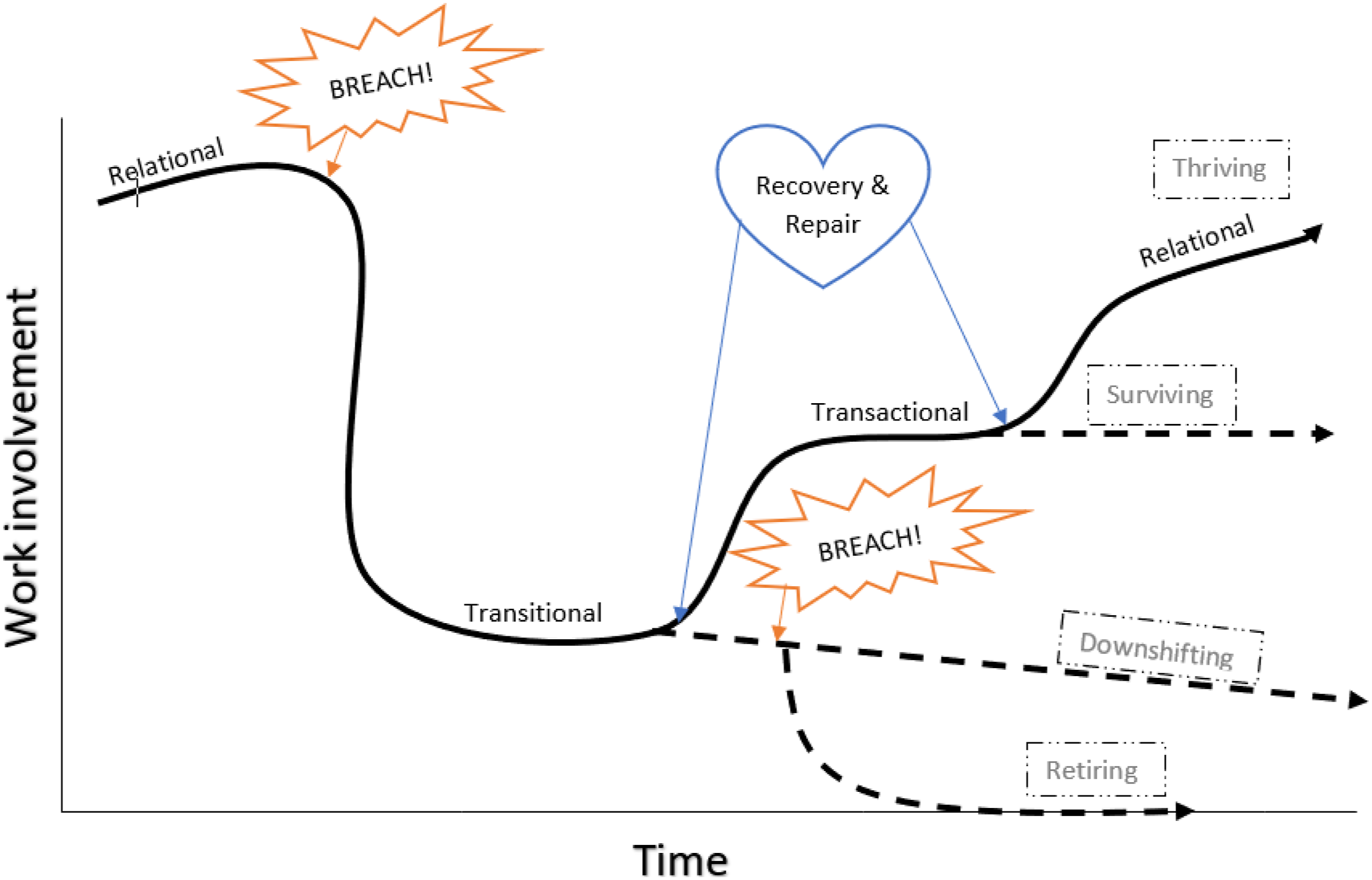
Importantly, transactional psychological contracts and especially transitional conditions may prompt older workers to disengage from the employer in ways consistent with downshifting, which in turn prompts employers to divest resources and support from these workers, which in turn validates and reinforces employees’ perceptions of breach (Griep & Vantilborgh, 2018)—a vicious cycle. In this way, older workers’ psychological contract types and organizational (non)fulfilment of the psychological contract potentially form a feedback loop as employees become increasingly certain that they cannot trust and rely on their employer.
Overall, a dynamic perspective on psychological contracts points to three possible roles of psychological contract status/breach. We depict these in a heuristic model in Figure 3. First, breach could serve as an exogenous shock intervening directly on psychological contract type and its trajectory. Serious breach may introduce sharp and persistent change (i.e., discontinuity) in these trajectories toward more transactional contracts and potentially transitional conditions. Since breach signals a betrayal of social exchange and also constrains resource availability (Bordia, Restubog, Bordia, & Tang, 2010, 2014), it likely serves as a boundary condition for our temporal predictions. That is, breach ought to both strengthen the temporal processes that drive the employee toward transactional contracts or transitional conditions and weaken the temporal processes that drive the employee toward relational contracts. Heuristic processes involving psychological contract status (breach or fulfillment). Note. This colored diagram depicts three proposed heuristic processes that position psychological contract status as a shock/boundary condition, feedback mechanism, and sensitivity mechanism, respectively. In black, psychological contract breach or fulfillment serves as a boundary condition (dashed black line) that strengthens or weakens how older workers’ changes relate to their trajectories of psychological contract type. In gray, psychological contract breach serves as a feedback mechanism in a vicious cycle by shifting psychological contracts more transactional, eliciting disengaged or counterproductive employee behavior that deters employer investment in the employee, leading back to more perceived breach. Reverse causal paths are plausible but omitted for clarity. In blue, psychological contract breach serves as an alternative sensitivity mechanism. Older workers’ changes may render them less sensitive to psychological contract breach (main effect on psych contract status) and less reactive to psychological contract breach (moderating effect on the psychological contract status-to-type path).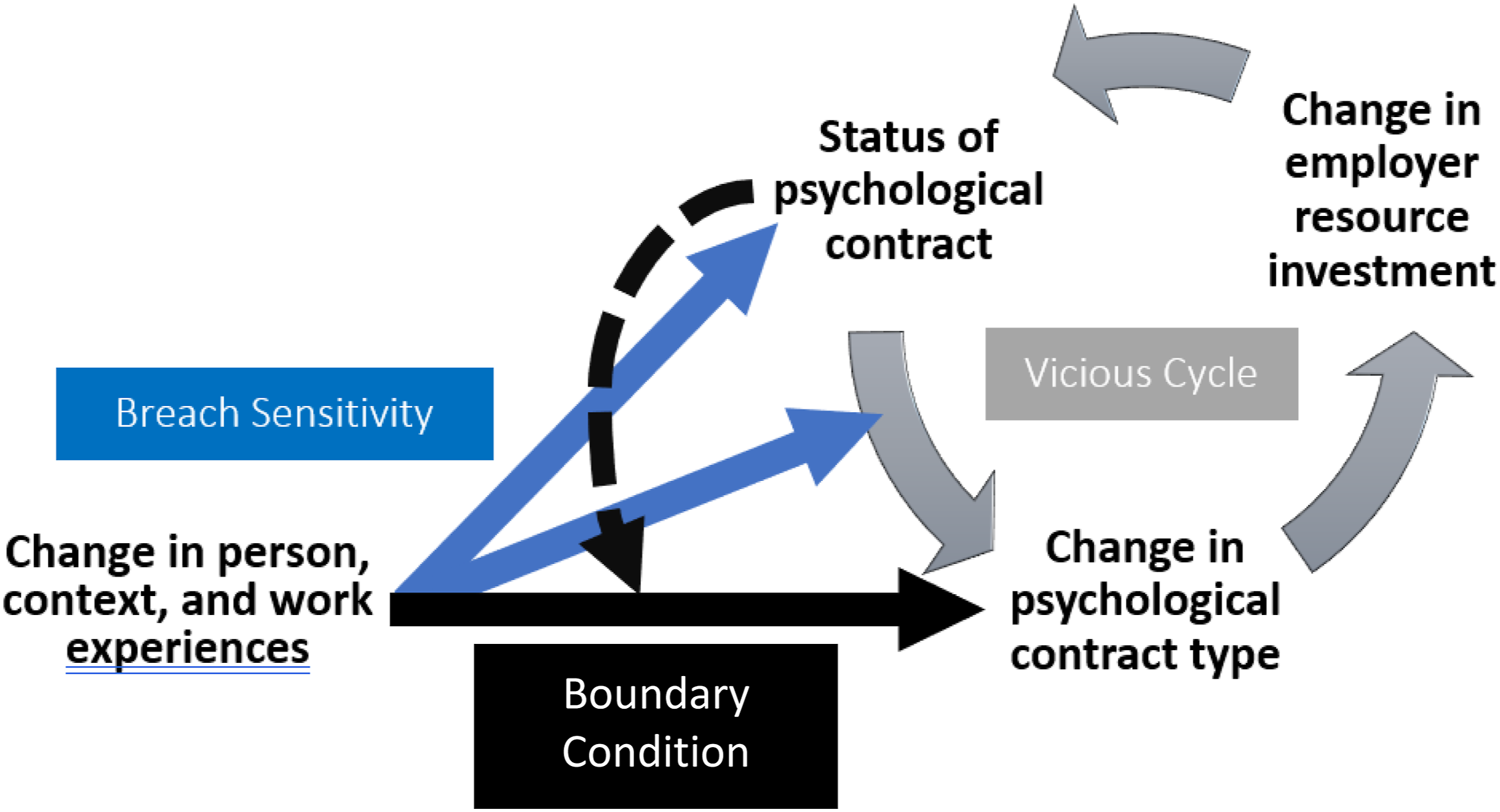
Second, we must also entertain the possibility that breach perceptions are sustained by employees’ own behavior (Griep & Vantilborgh, 2018). In which case, psychological contract breach could serve as a self-sustaining feedback loop mechanism. Breach shifts employees toward transactional contracts or potentially transitional conditions, which then leads employees to behave in ways that ironically dissuade employers’ reinvestment in and repair of the employment relationship, which we believe will reinforce subsequent breach perceptions, shifting older workers further toward highly transactional contracts and ultimately toward unsustainable transitional conditions. The inverse would also apply, with contract fulfillment, relational psychological contract, and employer resource investment forming a virtuous cycle.
Last, since breach perceptions are subjective and socially constructed, older workers’ characteristics and trajectories may also inform their perceptions of and reactions to breach (e.g., de Lange, Bal, Van der Heijden, Jong, & Schaufeli, 2011). Older workers likely vary considerably in the extent to which they attend to breach, care about breach, forgive breach, and accept breach repair—not to mention what they count as breach in the first place. Third, perceptions of and reactivity to psychological contract breach may themselves depend on older workers’ dynamic heterogeneity. Upward trajectories in older workers’ resources may diminish their perceptions of and reactivity to breach, which sustains more relational and less transactional psychological contracts. Consequently, this differential sensitivity and reactivity to breach may serve as alternative mechanisms linking older workers’ changing characteristics to their trajectories of psychological contracts, doing so by reducing lability in psychological contract status and minimizing sensitivity to breach.
These proposed disparate roles of psychological contract breach complicate its position in the theoretical model, playing triple duty as shock/boundary condition, feedback mechanism, and sensitivity mechanism. For this reason, we offer only heuristic predictions as above rather than formal propositions. These conceptually rich effects emerge from our dynamic point of view. These ideas can be probed longitudinally—albeit not simultaneously in one model. Empirical research will be needed to adjudicate which of these heuristic views of psychological contract status and breach can be most productively applied to understand (late) career trajectories.
Theoretical, Methodological, and Practical Implications
The challenges and opportunities associated with the aging workforce increasingly attract research interest (Caines et al., 2020; Kulik, Perera, & Cregan, 2014). Much attention has been devoted to lifespan developmental changes and the adaptive coping strategies employed by older workers to compensate for losses and capitalize on gains (Zacher & Froidevaux, 2021). We believe that the next step is to sharpen our resolution on older workers’ dynamic heterogeneity. Centering on older workers can be done without a forced contrast to their younger counterparts, focusing instead on how older workers vary, how older workers change, and how older workers vary in how they change. A deeper understanding of late-career differences and pathways is needed for policy-makers and employers to help our diverse older workers achieve sustainable career pathways and prolong (for those who need or want it) productive participation in the workforce.
One strength of our model is that it strives to incorporate a variety of influences—dispositional, work, and non-work—that dynamically shape employment orientation of older workers as captured in the type of psychological contract. Our approach is in line with the latest thinking in career theory that acknowledges work and non-work influences on career dynamics grounded in the psychological contract as an overarching rubric (Baruch & Rousseau, 2019). Furthermore, our model acknowledges the dynamic nature of late-career decision-making by capturing different career pathways and trajectories older workers pursue aside from retirement.
While we have incorporated important variables in our model, we do not claim to be exhaustively representing all relevant influences or outcomes. Moreover, even for these variables, there is the possibility of nonlinear effects—accelerating or asymptotic over time—which is difficult to anticipate a priori. Instead, we hope that our approach spurs a broader meta-theoretical shift that centers older workers, exploring how heterogeneity in older workers can possess dynamic properties and generate dynamic consequences for work and careers. A fruitful domain for such dynamic theorizing includes occupational wellbeing outcomes of older workers.
Older workers’ psychological contracts—their self-attributed obligations to the employer—lie along a transactional-relational spectrum. In the middle of the spectrum are what Rousseau (1995) referred to as balanced contracts that blend elements of both transactional and relational psychological contracts, sometimes characterized by expectations of rewards for high performance. Research indicates that it resembles the relational psychological contract but with more ‘strings attached’ (Chambel & Alcover, 2011; Hui, Lee, & Rousseau, 2004; Soares & Mosquera, 2019). More research is needed on balanced psychological contracts in older workers—how relational and transactional elements are blended in older workers’ schemas of their psychological contract.
In our portrayal of psychological contracts, we focused on depth, intensity, socioemotional nature, and time horizon of obligations as key factors that distinguish relational and transactional poles of the psychological contract continuum. Nevertheless, Rousseau (1995) noted that another factor in characterizing psychological contracts is specificity of performance criteria. Reasonably specific performance criteria are the norm in modern organizations, especially in the Global North. However, some older workers are employed in contexts with non-specific performance criteria, like when organizations loosen performance expectations on older workers to repay them for their decades of commitment (potentially more common in highly collectivist settings). We expect our model to still hold under this condition, though further research is needed.
Theoretical and Methodological Implications for Research on Psychological Contracts of Older Workers (PC-OW).
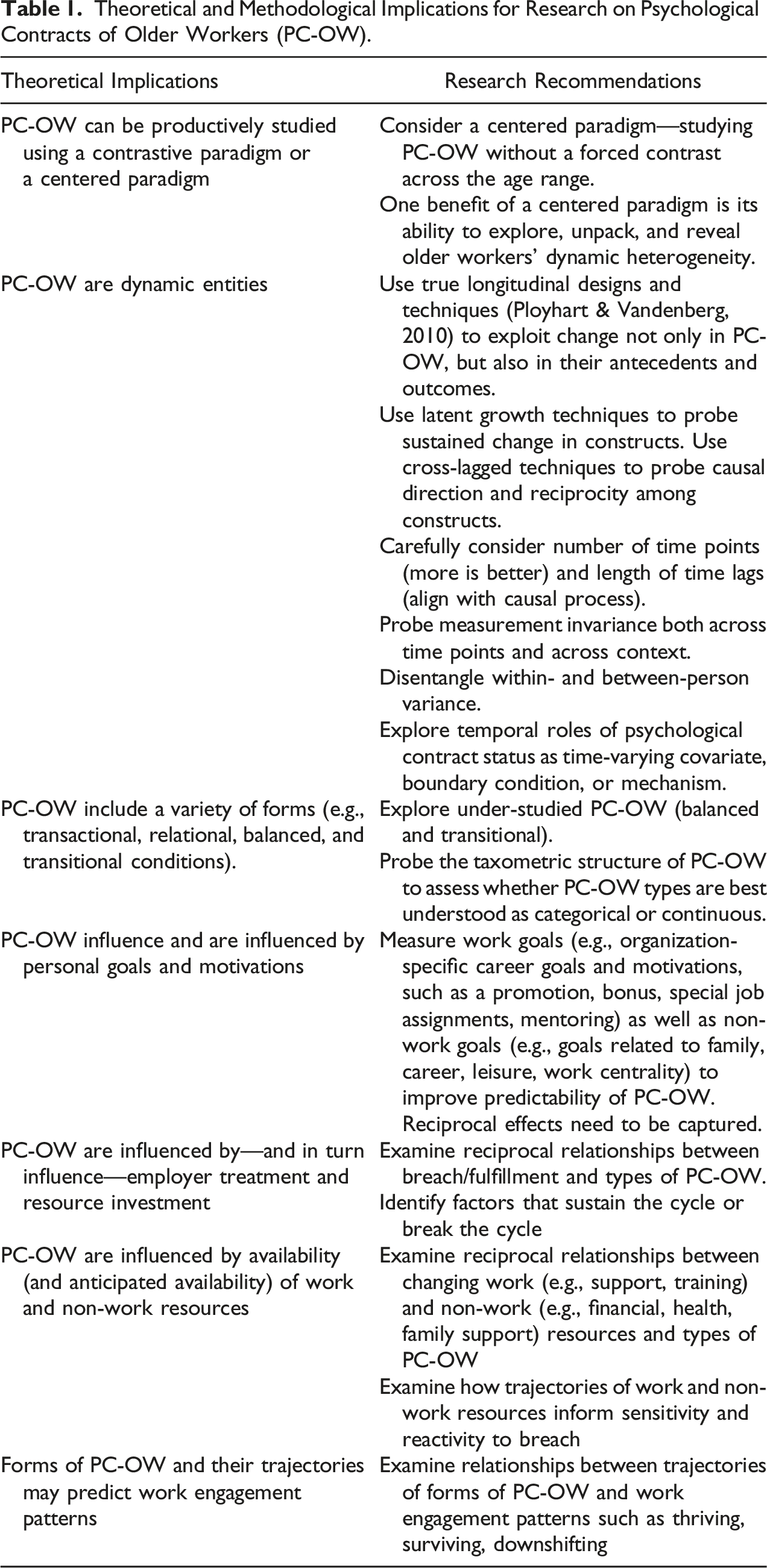
Methodological guidelines for longitudinal designs prescribe a minimum of three time points in which all variables are assessed in order to provide insight into the shape of change over time (Ployhart & Vandenberg, 2010). Notably, the number of time points required is often four to accommodate nonstationarity if there is sustained change (Usami, Murayama, & Hamaker, 2019). Time lags ought to be long enough for repeated assessments to capture meaningful lasting change rather than temporary deviations from trait levels of variables, which suggests that optimal time lags are on the order of months or years rather than days or weeks. Note measurement invariance—whether measures behave the same way as people mature and age over the course of the longitudinal study. Aging measures can fail to show adequate measurement invariance to demonstrate change over time (e.g., age discrimination; Peng, Min, Rosenblatt, & Zhang, 2022). While at least partial scalar invariance is needed, departures from measurement invariance are still substantively interesting. Rigorous probing can ensure consistency of measurement across context and time.
One advantage of longitudinal research is its contribution to both causal identification and estimation (Finkel, 1995; Maxwell & Cole, 2007). Causal identification in both the aging and psychological contracts literatures is elusive because these areas are not particularly amenable to experimental designs with random assignment. Some longitudinal techniques can strengthen causal inference by treating the individual as their own control, holding stable endogenous confounds constant over time (Finkel, 1995). Further, cross-sectional designs may result in distorted effect sizes that can only be recovered properly using longitudinal designs (Maxwell & Cole, 2007). Longitudinal designs are therefore critical to rigorous tests of theory in this literature, which is unfortunate given how sparse true longitudinal designs are in the psychological contracts literature. Because longitudinal designs offer stronger causal inference (Finkel, 1995) and reliable effect sizes (Maxwell & Cole, 2007), they are more meaningful to practice and policy. Policy decisions are hinged on assumptions about both (1) the causal direction of effects and (2) the magnitude of effects. We see longitudinal research not only as a tool to unearth new insights but also to reinforce the rigor and robustness of this literature.
We believe our model suggests practical implications for the management of late-career trajectories and their determinants. The varying trajectories have consequences for staffing; for example, downshifting or retirement will require work redesign and succession planning. We invite managers to take a holistic person-centered approach to manage late-career needs of older workers; holistic because a range of work and non-work influences shape career needs (Sykes-Bridge, Bordia, Garcia, Amarnani, & Bordia, 2022) and person-centered because older workers differ in needs and orientation to work. Examining the psychological contract provides a useful mechanism to do so. An older worker with a more relational contract feels ‘part of the fold’ and will welcome participatory decision-making and other supportive practices. On the other hand, an older worker with more transactional contracts will likely only welcome limited involvement. In such cases, research has shown that supportive practices inviting greater participation can backfire (Garcia et al., 2021).
We hope that scholars will answer our call for more research centered on older workers. This is an exciting opportunity to deepen our understanding of older workers: they may appear undifferentiated yet are incredibly diverse. We need to engage with the fact that diversity among older workers is a moving target. Our theories and methods must keep up with these older workers in motion. We need to consider not only where they are but also where they are going.
Footnotes
Declaration of conflicting interests
The author(s) declared no potential conflicts of interest with respect to the research, authorship, and/or publication of this article.
Funding
The author(s) disclosed receipt of the following financial support for the research, authorship, and/or publication of this article: This research was supported by an Australian Research Council grant (DP200103440) to the first, second, and third authors. We are grateful to Carol Kulik and Hannes Zacher for comments on an earlier version of this paper (HZ) and its proposal (CK).

Note
Author Biographies
Associate Editor: Walter D. Davis