



Abstract
In the present research, we developed NegotiAct, a comprehensive coding scheme for negotiations, comprising 47 mutually exclusive behavioral codes. NegotiAct was derived by systematically integrating (i) 89 extant coding schemes for negotiations, (ii) pertinent findings from negotiation research, and (iii) specific interaction behaviors that were previously not considered in coding schemes for negotiations (e.g., active listening). To facilitate the application of NegotiAct, we designed a coding manual with precise instructions and with definitions and examples for every code. NegotiAct can be customized to address many research questions in experimental settings as well as field research by splitting codes into more specific behaviors. Thereby, differentiated codes can always be traced back to the original codes, preserving comparability across studies and facilitating cumulative research. In combination with interaction analytical methods, NegotiAct enables scholars to detect and investigate specific communication patterns across the negotiation process. As a first empirical validation of NegotiAct, we demonstrate a substantial interrater reliability for 18 videotaped negotiations (κ = .80) and conduct an exploratory validation analysis, studying the relation of multi-issue offers, active listening, and joint gains.
“As telescopes are for astronomy and microscopes for biology, so coding schemes are for observational methods: They bring the phenomena of interest into focus for systematic observation” (Bakeman & Quera, 2011, p. 13).
Negotiation has been studied by psychology and management scholars for over 50 years, both as a prominent case to study conflict and cooperation and because of its direct relevance for organizational practice. Over the decades, our field has collected vast knowledge about antecedents of negotiation outcomes, such as cognitive biases, motivation, emotion, reputation, relationship, gender, power, and culture (Brett & Thompson, 2016; Thompson, Wang, & Gunia, 2010). However, we still know comparably little about the observable interaction patterns during negotiation, which are often complex and difficult to study (Donohue, 2003; Weingart, 2012). Such phenomena require both new theoretical and methodological approaches to study their dynamic character. Interaction analytical theories and methods, such as lag sequential analysis (e.g., Bakeman & Quera, 2011), pattern analysis (e.g., Magnusson, 2000) or statistical discourse analysis (e.g., Lehmann-Willenbrock, Chiu, Lei, & Kauffeld, 2017) open novel potential for decrypting and modeling these complex interaction systems with a new level of precision. One important prerequisite for this work is a comprehensive (i.e., capturing entire interactions by assigning a code to each behavior) and precise coding of observed behavior (Lehmann-Willenbrock & Allen, 2018).
Over the last decades, many coding schemes have been developed and used to study behavior in negotiations (e.g., Adair, Okumura, & Brett, 2001; Weingart, Bennett, & Brett, 1993). Their application resulted in significant insights in negotiation research: The field collected extensive insights into negotiation strategies and tactics, such as creating value by making multi-issue offers (i.e., offers that involve more than one issue) or claiming value by referring to the bottom line (e.g., Weingart, Smith, & Olekalns, 2004). Moreover, deceptive behaviors in negotiations, including lying by omission and commission (e.g., O’Connor & Carnevale, 1997), or the consequences of communicating emotions (e.g., Van Kleef, 2008) have been detected. To focus on their specific behaviors of interest, researchers mostly developed their own specialized coding scheme. This is a common approach to avoid borrowing an ill-fitted coding scheme, which would potentially feel “like wearing someone else’s underwear” (Bakeman & Gottman, 1997, p. 15).
However, developing narrow coding schemes for only one research purpose can be problematic (cf. Putnam & Jones, 1982b), especially as it prevents effective cross-study comparisons. In a recent meta-analysis by Yao, Brett, Zhang, & Ramirez-Marin. (2021) for instance, information sharing was included as a control variable and defined as interest- and priority-related information exchange. Yet, some included studies using specific coding schemes measured only part of this, for instance only priority-related information exchange (Liu & Wilson, 2011) or even only the provision, but not the request of priority-related information (Adair, & Brett, 2005). Other coding schemes used broader operationalizations and, for instance, also considered requesting to make an offer as a facet of information sharing (Weingart, Thompson, Bazerman, & Carroll, 1990). Thus, when conducting a meta-analysis, researchers are often forced to include results based on different operationalizations. Clearly, it is challenging and may even be problematic to integrate such widely varying measures from different coding schemes—even though they might be labeled identically. Thus, it is unclear whether and to which extent the same underlying theoretical construct is assessed. This clearly hampers a reliable and valid aggregation of potential effects and challenges the interpretation of findings and the accumulation of knowledge (see Block, 1995). Moreover, to study temporal interaction patterns every behavioral unit should be coded, not just behaviors that concern a specific research question (e.g., Lehmann-Willenbrock & Allen, 2018).
Thus, although prior coding schemes clearly served their respective purposes well, they could, and—as we argue below—should be improved in two important ways. First, the behaviors entailed in specialized coding schemes have yet to be integrated into one single coding scheme to obtain comprehensiveness. Second, behaviors that are typical for many types of interactions but not specific to the negotiation context (e.g., active listening, humor, or small talk; e.g., Rogers & Farson, 1987; Lehmann-Willenbrock & Allen, 2014; Yoerger, Allen, & Crowe, 2018) have so far been largely ignored in extant negotiation coding schemes. The impact of such behaviors on interaction outcomes has been demonstrated across different types of interactions that are structurally similar to negotiation settings, such as team meetings (e.g., Kauffeld & Lehmann-Willenbrock, 2012) or supervisor–subordinate interactions (e.g., Meinecke, Klonek, & Kauffeld, 2016). To study the potential impact of such behaviors on the negotiation process and its outcomes, it is necessary to integrate them in a comprehensive coding scheme.
Our manuscript offers three main contributions. First, with our development of NegotiAct, we introduce a coding scheme that can better account for verbal behavior than any existing coding scheme. Thereby, it allows for a fine-grained coding of the entire interaction in negotiations. In turn, such exhaustive coding drastically reduces the use of a “miscellaneous” coding category that has to be frequently applied in extant coding schemes, which implies that large conversational chunks and nuances in the negotiation are lost to researchers. With NegotiAct, research can focus on these previously blind spots to better understand negotiation interactions and the explanatory mechanisms therein that ultimately explain negotiation outcomes. Second, the newly integrated set of behaviors creates opportunities to investigate fine-grained temporal dynamics of negotiation processes. This methodological advancement will allow testing new theoretical approaches that aim at explaining the dynamic communicative patterns as they unfold over the course of a negotiation. For example, lag sequential analysis (cf. Bakeman & Quera, 2011) will enable negotiation researchers to identify behavioral sequences that have not been studied so far and will provide them the means to answer questions such as: What are the immediate and lagged behavioral consequences of (detected) deception (cf. Gaspar & Schweitzer, 2013)? Or which statements precede and follow interest-related questions (cf. Hüffmeier et al., 2019; see Table 2 for more exemplary research questions)? To demonstrate the coding scheme’s respective utility, we present an exploratory analysis showing that multi-issue offers (e.g., Pruitt & Lewis, 1975; Walton & McKersie, 1965) trigger active listening. Moreover, we identify linkages between multi-issue offers, active listening, and joint gains. Thereby, our coding scheme paves the way to develop new theory that will advance negotiation science. Third, NegotiAct contributes to a convergence in coding negotiation interactions. It can be applied to numerous research questions in experimental settings as well as in field research and across different cultural settings. This leads to more standardization of the coded verbal contents of negotiations, which for instance facilitates meta-analyses that ideally require that constructs are operationalized in identical ways to allow for meaningful interpretations of the results. Furthermore, in light of desirable changes towards more Open Science, NegotiAct facilitates research that produces comparable datasets that can easily be merged. The resulting and larger datasets can potentially be used by different researchers for various research endeavors. Thereby, less time is spent for coding and faster knowledge accumulation is possible.
Theoretical Background
Coding Schemes in Negotiation Research
Coding schemes are instruments that help to directly examine behaviors that unfold in interactions such as negotiations (Weingart et al., 2004). Their purpose is to focus the researcher’s attention on the behaviors of interest and to facilitate a systematic examination of interaction processes (Bakeman & Quera, 2011). Coding schemes consist of standardized rules that define how codes (i.e., labels or categories) can be applied to observed behaviors (Keyton, 2018). These rules concern the segmentation of interactions into behavioral units and the application of codes to these units (Bakeman & Quera, 2011).
Behaviors can be classified into verbal, nonverbal, and paraverbal behaviors. Verbal behaviors are defined as the spoken language component of a speaker’s message (e.g., Ekman, 1957). In contrast, nonverbal behaviors are “all the parts of the message other than the language itself” (Burgoon & Dunbar, 2018; p. 105), including different modalities such as kinesics (e.g., gestures, eye contact) or proxemics (e.g., use of space, seating arrangements; for an overview of coding nonverbal behavior, see Burgoon & Dunbar, 2018). Finally, paraverbal behaviors are defined as vocal nonverbal behaviors (cf. Vinciarelli, Pantic, & Bourlard, 2009). They comprise “all spoken cues that surround the verbal message and influence its actual meaning” (Vinciarelli et al., 2009; p. 1747). In the following, we focus on verbal behaviors (e.g., offer-making) and include selected paraverbal behaviors that occur in isolation of verbalized content, namely linguistic (e.g., back channeling) and non-linguistic vocalizations (e.g., laughter; Vinciarelli et al., 2009). Thus, we do not consider nonverbal behaviors in the development of our new coding scheme for analyzing communication during negotiations.
Limitations of Existing Coding Schemes
Overview of Prominent Coding Schemes and Respective Behavioral Codes.
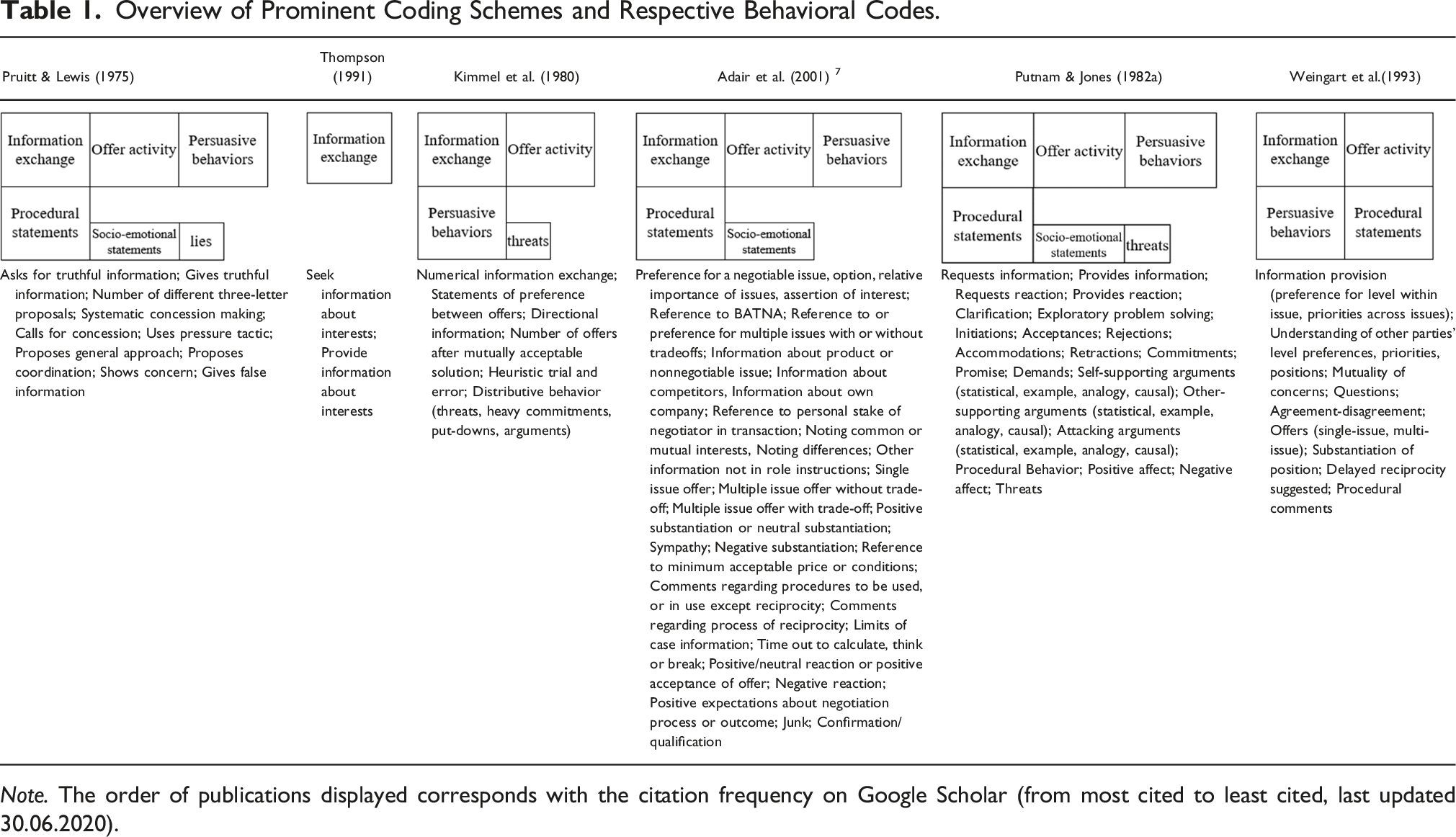
Note. The order of publications displayed corresponds with the citation frequency on Google Scholar (from most cited to least cited, last updated 30.06.2020).
First, negotiators regularly deploy unethical behaviors (e.g., O’Connor & Carnevale, 1997; Schweitzer & Croson, 1999). However, these behaviors are either missing in extant negotiation coding schemes (Adair et al., 2001; Thompson, 1991; Weingart et al., 1993) or only partly captured with one code, such as “threats” (Kimmel, Pruitt, Magenau, Konar-Goldband, & Carnevale, 1980; Putnam & Jones, 1982a) or “gives false information” (Pruitt & Lewis, 1975). Unethical behaviors have mostly been studied separately from the negotiation process, for instance by using self-report questionnaire scales (e.g., the SINS scale by Robinson et al., 2000). If unethical behaviors were studied in the negotiation process at all, only selected further negotiation behaviors such as questions were also coded (Schweitzer & Croson, 1999).
Second, socio-emotional statements are either missing in prominent negotiation coding schemes (Kimmel et al., 1980; Thompson, 1991; Weingart et al., 1993) or are only partly captured. For instance, Pruitt and Lewis (1975) introduced one code (“shows concern”) that reflects a positive relationship between the parties. Adair et al. (2001) as well as Putnam and Jones (1982a) restricted socio-emotional statements to positive and negative (affective) reactions. Other socio-emotional statements, such as negative relationship remarks or apologies are not captured. However, extant negotiation research on socio-emotional behaviors suggests that these behaviors are key drivers of how negotiations unfold over time (e.g., Van Kleef & De Dreu, 2010).
Third, typical interaction behaviors that are not specific for negotiations are missing completely in prominent coding schemes for negotiations. These behaviors are central to most human interactions and meaningfully impact interaction processes and outcomes. Examples include active listening (e.g., Kauffeld & Lehmann-Willenbrock, 2012), humor (e.g., Lehmann-Willenbrock & Allen, 2014), or small talk (e.g., Morris, Nadler, Kurtzberg, & Thompson, 2002).
Unethical behaviors, socio-emotional behaviors, and typical interaction behaviors (e.g., active listening) and their respective impacts on negotiation outcomes have mostly been studied as discrete research questions and during separate research endeavors. Thus, it is not clear how these behaviors affect each other in a negotiation or how they might be intertwined (i.e., behavioral linkages or patterns). For instance, extant coding schemes cannot be applied to study if priority-related questions (i.e., asking for priorities among issues; cf. Hüffmeier et al., 2019) affect unethical behaviors such as deception during negotiations (cf. Gaspar & Schweitzer, 2013). This and related problems could be solved by developing specialized coding schemes to address these specific research questions. Using different specialized coding schemes for different research questions, however, would result in non-comparable datasets. This would in turn hamper effective cross-study comparisons, an aggregation of potential effects and thereby the accumulation of knowledge (cf. Block, 1995).
Exemplary Research Questions.
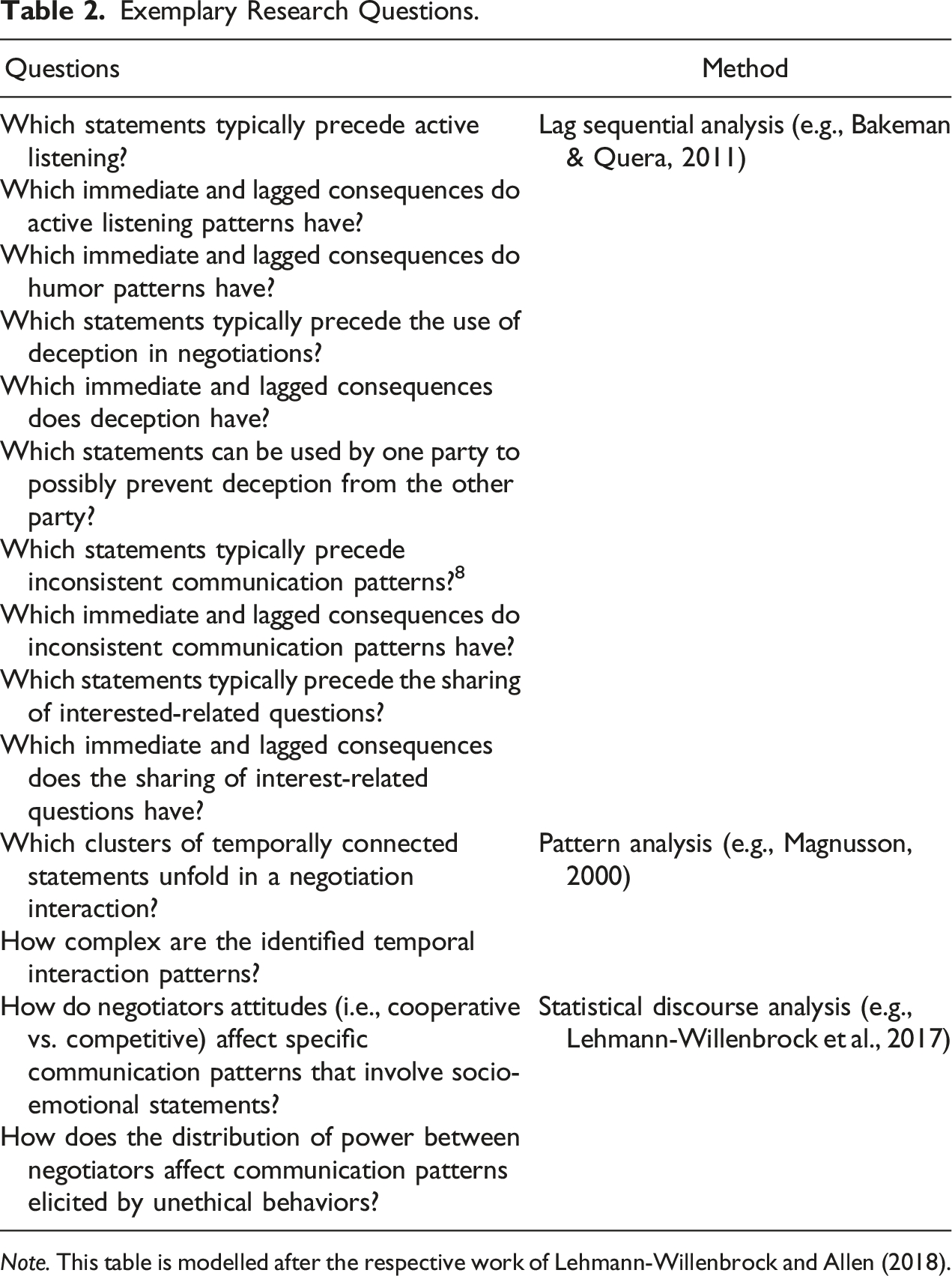
Note. This table is modelled after the respective work of Lehmann-Willenbrock and Allen (2018).
Deriving Requirements for a New Coding Scheme
We derived specific requirements for a new coding scheme from our analysis of prominent coding schemes: (1) The codes in a coding scheme should be exhaustive and mutually exclusive (Bakeman & Quera, 2011; Lehmann-Willenbrock & Allen, 2018) to allow for studying temporal interaction patterns by means of lag sequential analysis (e.g., Bakeman & Quera, 2011), pattern analysis (e.g., Magnusson, 2000), or statistical discourse analysis (e.g., Lehmann-Willenbrock et al., 2017; cf. Table 2). Thus, it should be possible that exactly one code can be assigned to every observed behavior, including currently underrepresented unethical, socio-emotional, and typical interaction behaviors (e.g., active listening). (2) The new coding scheme must provide standardized rules concerning the segmentation of interactions into behavioral units and the application of codes to these units, including precise definitions of the coded behaviors (Keyton, 2018). To gain insight into the fine-grained temporal dynamics in negotiation interactions (cf. Table 2), the new coding scheme should allow to capture shorter utterances (e.g., “alright,” “no,” and “hmm”) as well as longer statements to elaborate on a more complex point (e.g., a substantiation). Thus, interactions should be segmented into thought units. A single thought unit captures exactly one statement as the smallest meaningful segment of behavior (cf. Bales, 1950; Kauffeld & Lehmann-Willenbrock, 2012). (3) As the coding scheme is intended to fit different research questions, it should allow for customization while remaining compatible across studies. Thus, if the research question requires a fine-grained analysis of certain behaviors (e.g., different types of humor), it should be possible to further split the codes into fine-grained codes (e.g., self-defeating, aggressive, affiliating, or self-enhancing humor; see Martin, Puhlik-Doris, Larsen, Gray, & Weir, 2003). (4) The new coding scheme must ensure sufficient interrater reliability, as “the level of reliability places an upper bound on a coding scheme’s predictive ability” (Weingart et al., 2004, p. 448).
The Present Research
With a new coding scheme, we aim to provide a means for studying temporal interaction patterns in negotiations, to allow for cross-study comparisons, and to contribute to cumulative research on negotiation interactions. To achieve this goal, in Phase 1 we develop the coding scheme NegotiAct, which is designed to accord with requirements 1 through 3 detailed above. We use a deductive approach, by drawing from negotiation theories, integrating existing coding schemes from negotiation research, and using insights from team and leadership research. In Phase 2, we present NegotiAct as the resulting coding scheme with its categories and the respective behavioral codes. In Phase 3, we apply NegotiAct to a sample of videotaped negotiations and analyze whether it yields a satisfactory interrater reliability (requirement 4). Moreover, we provide a direct comparison between NegotiAct and extant coding schemes to illustrate potential advantages. Finally, we study two exemplary research questions in an exploratory manner to demonstrate the applicability and utility of NegotiAct (for a procedural overview, see Figure 1). Procedural overview for the development of the new coding scheme.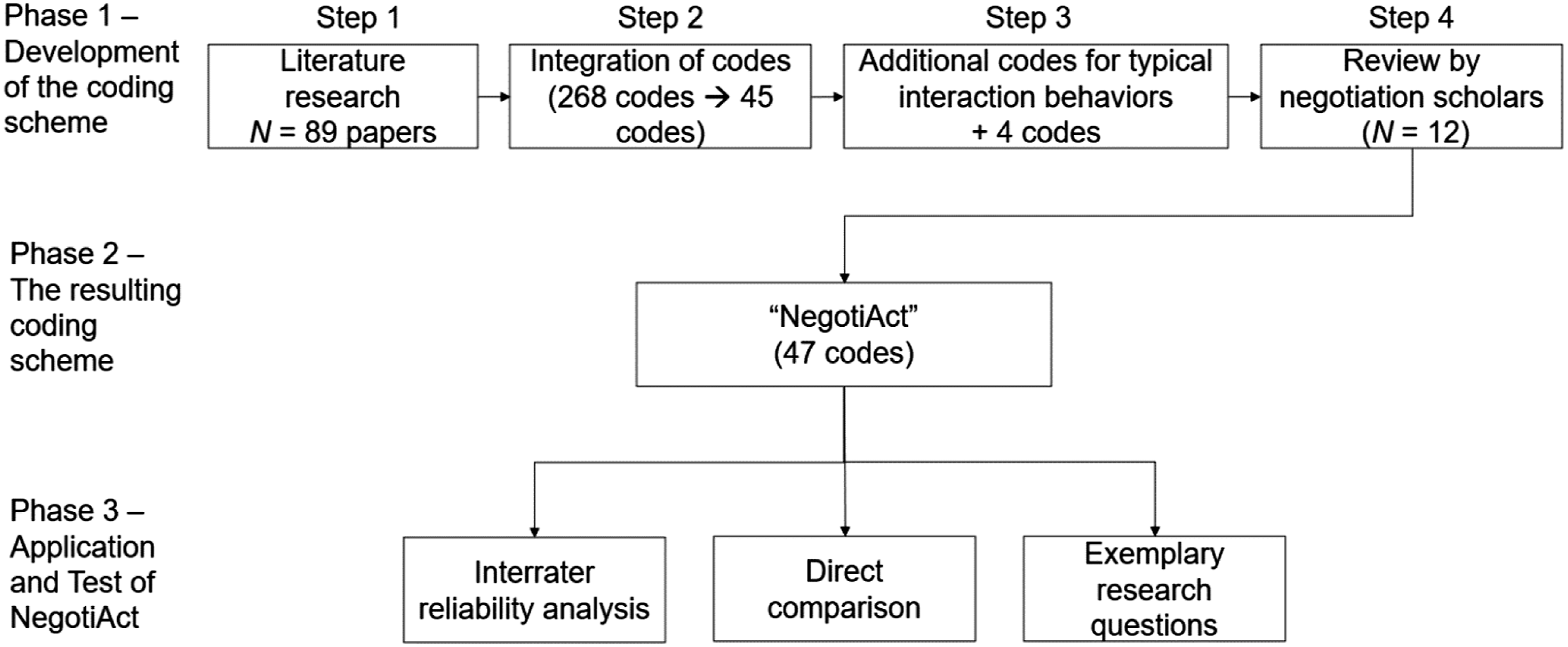
Phase 1—Development of NegotiAct
Step 1—Literature Research
In a first step, we identified existing papers that coded interactions in negotiations. For a systematic literature review, we used the databases Academic Search Premier and Business Source Premier, 1 resulting in 3225 papers. Manuscripts were excluded when (i) no interactions in negotiations were coded (n = 3122), (ii) negotiating participants were underage, not healthy, or not human (n = 42), (iii) papers appeared in both databases (duplicates), n = 11, and (iv) studies were published neither in German nor in English (n = 9). Half the papers were evaluated by a second independent researcher, resulting in a high consensus regarding the decision on the papers’ inclusion (Cohen’s kappa = .93). Discrepancies were discussed until agreement was reached. The systematic literature search resulted in 41 papers that accorded with search terms. Because some papers referred to coding schemes from earlier studies when describing their codes, we added those articles that were so far not included (backward search, n = 35). An unsystematic literature search on all EBSCO-Host databases and Google Scholar using names of negotiation scholars who had conducted interaction analyses (n = 8) completed the search. Finally, four negotiation scholars were asked to add relevant missing articles (n = 4). The literature search resulted in 88 (+1) 2 papers in total. In summary, the studies in these 89 papers were conducted in 19 different countries and the respective culturally different contexts (e.g., in Japan, Australia, the US, and Germany; for an overview, see https://osf.io/nwrb6/?view_only=228c618358b2416fab69981b185d07ac), and overall, 56 different negotiation tasks were used in these papers.
Step 2—Integration of Codes
In a second step, we extracted all codes that were applied in the included 89 papers from Step 1. Of these 268 different codes, we integrated those that described similar behaviors into one code. For instance, we integrated “acceptance of offer” (e.g., Adair et al., 2001), “accepts concession” (e.g., Olekalns & Smith, 2003), and “proposal other support” (Donohue, Diez, & Hamilton, 1984) into “accept offer.” Forty-five codes resulted from this integration. Based on extant negotiation theory (e.g., Lewicki, Saunders, & Barry, 2014; Walton & McKersie, 1965), we then developed seven categories and assigned the codes to the respective categories (for an overview, see https://osf.io/4qtfy/?view_only=3e086066f7f643b09a0d724b04a50fec).
Step 3—Complementing Codes From Team and Leadership Research
There are coding schemes outside the negotiation domain that also aim at capturing entire verbal interactions. We used these coding schemes as inspiration for codes that may also be relevant for negotiation research. In doing so, we focused on two coding schemes from team and leadership research: act4teams (Kauffeld, 2006) and act4leadership (Meinecke et al., 2016). In particular, “active listening” (i.e., paraphrasing the other party’s statement and generic paraverbal responses, such as “mm hmm”; see Kauffeld & Lehmann-Willenbrock, 2012; Rogers & Farson, 1987) are common interaction behaviors that we decided to add to our list of codes. We also added “lightening the atmosphere” (e.g., jokes), “empty talk,” and “visualizing” to our coding scheme in this step, resulting in 49 codes.
Step 4—Review by Negotiation Scholars
In a fourth step, we sent our preliminary coding scheme to 12 negotiation scholars (M[research experience] = 8.5 years, ♀ = 41.6%). They were asked to review the coding scheme and to propose changes, for instance, to provide a better contrast between similar codes such as “positive affective reaction” and “positive relationship remark.” Based on the received feedback, we discussed necessary changes among the authors of this manuscript and modified the coding scheme accordingly, resulting in 56 codes (for a summary of the negotiation experts’ feedback and our implementation, see https://osf.io/u9yvf/?view_only=d81507a177234fddb95b1b46bafae55c). Finally, we aggregated overlapping codes into one code (e.g., “hurry” and “time out” into “time management”), which reduced the final number of codes to 47.
Phase 2—The Resulting Coding Scheme
Overview of Categories and Codes.
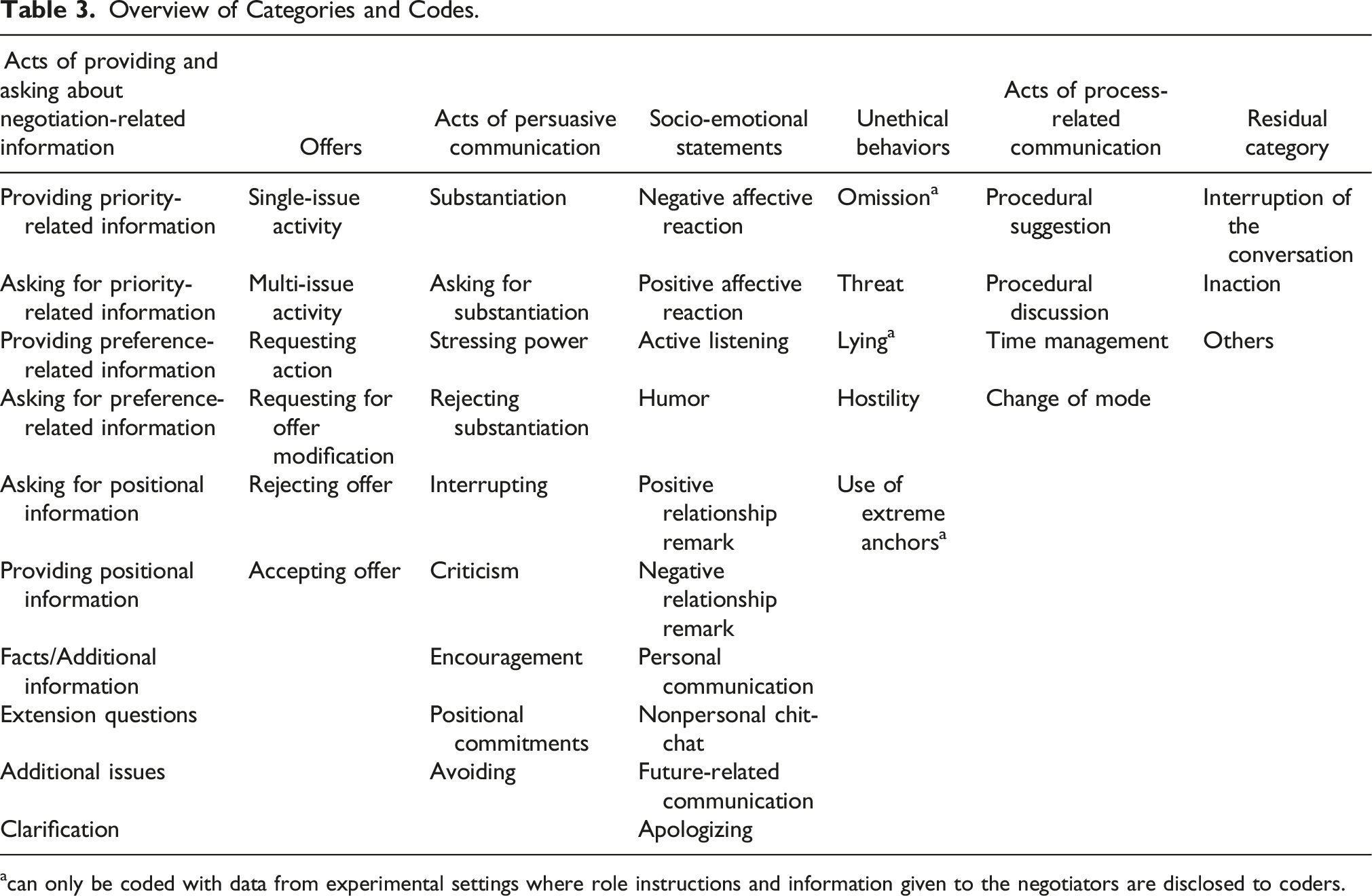
acan only be coded with data from experimental settings where role instructions and information given to the negotiators are disclosed to coders.
Acts of Providing and Asking About Negotiation-Related Information
Extant coding schemes (e.g., Adair et al., 2001; Putnam & Jones, 1982a), textbooks (e.g., Lewicki et al., 2014), and negotiation theory (e.g., Walton & McKersie, 1965) distinguish between general information exchange and concrete actions in a negotiation (e.g., making offers). We followed this distinction by introducing one discrete category for offers and by dividing information exchange into two separate categories: (i) acts of providing and asking about negotiation-related information, and (ii) acts of persuasive communication.
Acts of providing and asking about negotiation-related information are defined as negotiators' provision of information and "queries to the other party regarding their preferences, reservation price, best alternative to negotiated agreement (BATNA), general needs, desires and goals" (Weingart, Thompson, Bazerman, & Carroll, 1987, p. 286). The category is represented by ten behavioral codes in total: (i) providing priority-related information, (ii) asking for priority-related information, (iii) providing preference-related information, (iv) asking for preference-related information, (v) providing positional information, and (vi) asking for positional information, (vii) facts/additional information, (viii) extension questions, (ix) additional issues, and (x) clarification.
The distinction between providing and asking for information is essential, as providing and asking are expected to have different effects on the outcome of negotiations and potentially on the process (e.g., Hüffmeier et al., 2019; Thompson, 1991). Hüffmeier et al. (2019), for instance, demonstrated that interest-related questions positively influenced the joint gains in team-on-team and solo-on-solo negotiations. Unilateral information provision, however, was not associated with joint gains. Moreover, the distinction between priority-related information (i.e., the different value negotiators assign to different issues) and preference-related information (i.e., the different value negotiators assign to different options within issues) has proven to be essential in negotiations (e.g., Brett & Thompson, 2016; Weingart et al., 2004). Furthermore, inquiry about or mentioning of potential additional issues in a negotiation has so far rarely been coded (for an exception, see Hüffmeier et al., 2019). However, it represents a substantially different line of thought than any of the above-mentioned behaviors. Thus, we integrated it with a separate behavioral code in NegotiAct.
Offers
The offer category is defined by statements that capture the parties’ ‟offer-counteroffer process” (Lewicki et al., 2014, p. 236). The category is represented by six behavioral codes in total: (i) single-issue activity, (ii) multi-issue activity, (iii) requesting action, (iv) requesting an offer modification, (v) rejecting offer, and (vi) accepting offer. Furthermore, we recommend additionally coding what an offer actually comprises (i.e., respective issues and values can be noted in a comment function next to the verbal codes). This, for instance, allows observing whether tough offers or large concessions are triggered by certain acts of communication (cf. Vetschera, 2013) or whether negotiators make multiple equivalent simultaneous offers (MESOs; see Leonardelli, Gu, McRuer, Medvec, & Galinsky, 2019).
Acts of Persuasive Communication
Acts of persuasive communication entail forcing behaviors and statements “that individuals deploy to bring out desired attitudinal or behavioral change […] to adjust the other party’s positions, perceptions, and opinions” (Lewicki et al., 2014, p. 285). They “aim at convincing the opponent to comply with one’s own proposals” (Giebels, De Dreu, & Van De Vliert, 2000, p. 262). The category is represented by nine behavioral codes: (i) substantiation (i.e., statements that follow an argumentative structure and that connect information with opinions or recommendations), (ii) asking for substantiation, (iii) stressing power, (iv) rejecting substantiation, (v) interrupting, (vi) criticism, (vii) encouragement, (viii) positional commitments, and (ix) avoiding.
Socio-Emotional Statements
Socio-emotional statements capture the relational interaction between parties, such as “lightening the atmosphere, separating opinions from facts, expressing feelings […] and offering praise” (Kauffeld & Lehmann-Willenbrock, 2012, p. 140). From a negotiation theory perspective, this category reflects attitudinal structuring, one of four substantial negotiation subprocesses that Walton and McKersie (1965) defined as “activities that influence the attitudes of the parties toward each other and affect the basic relationship bonds between the social units involved” (p. vii). The category is represented by 10 behavioral codes: (i) negative affective reaction, (ii) positive affective reaction, (iii) active listening, (iv) humor, (v) negative relationship remark, (vi) positive relationship remark, (vii) personal communication, (viii) nonpersonal chit-chat, (ix) future-related communication, and (x) apologizing. Because typical interaction behaviors (i.e., active listening, humor, personal communication, and nonpersonal chit-chat) were not included in extant coding schemes for negotiations at all, we elaborate on these behaviors in the following paragraphs, and we argue why it was important to integrate them in a coding scheme for negotiations.
Active listening influences team meeting processes (by maintaining functional and dysfunctional communication cycles, e.g., Kauffeld, 2006) and outcomes. Kauffeld and Lehmann-Willenbrock (2012), for instance, found a negative relationship between supportive socio-emotional statements (i.e., active listening and providing support) and team meeting success. Regarding the negotiation domain, active listening has long been recommended as a useful tool in negotiations (e.g., Fisher & Ury, 1981), but it has rarely been empirically investigated. Exceptions include crisis negotiations, where active listening was studied as a rapport-building behavior (e.g., Garcia, 2017). The impact of active listening on the negotiation process and the impact of active-listening patterns (e.g., in combination with offer exchanges) on the (economic) outcome of negotiations are promising research topics (see also our exemplary initial analysis below).
Temporal humor patterns (e.g., jokes followed by laughter) were found to elicit positive socio-emotional communication, procedural structure, and new solutions and to enhance performance in team meetings (Lehmann-Willenbrock & Allen, 2014). From a negotiation perspective, humor has mostly been studied as a separate behavior unconnected to other negotiation behaviors (e.g., Adelswärd & Öberg, 2009; O’Quinn & Aronoff, 1981). So far, humor is conceptualized as a tool to structure the interaction and to strengthen the relationship between negotiators (for an overview, see Gockel, 2017). Thus, to allow studying whether and how humor and laughter in fact play an important role in the negotiation process, it was essential to incorporate them in a coding scheme for negotiations.
Small talk in negotiations is defined as “seemingly trivial communications about unrelated topics, especially at the start of the negotiation” (Shaughnessy, Mislin, & Hentschel, 2015, p. 105). In the act4team (Kauffeld, 2006) and act4leadership (Meinecke et al., 2016) coding schemes, this is partly captured as “empty talk” (e.g., truisms) and understood as negative, counteractive statements. However, small talk as part of pre-meeting communication was found to positively influence meeting effectiveness (Allen et al., 2014). In negotiations, there is evidence that small talk can serve as a social lubricant that positively influences negotiations, especially by building rapport between negotiators (e.g., Morris et al., 2002). However, small talk is hardly represented in extant coding schemes. It is mostly lumped together with statements that do not fit given categories (e.g., “junk; uncodable,” Adair et al., 2001; “et cetera,” Donohue et al., 1984). Thus, it is unclear whether and when small talk has positive and negative effects on the negotiation process. It was therefore important to integrate a behavioral code for small talk. Specifically, Bakeman and Quera (2011) recommended to define codes at a rather finer level than the research question demands because distinctions that were never made in the first place cannot be used when they may be needed later. Therefore, it seemed even more sensible to split small talk into two separate codes: “nonpersonal chit-chat” and “personal communication.”
Unethical Behaviors
Behaviors that are commonly regarded as ethically unacceptable and inappropriate (Fulmer, Barry, & Long 2009; Robinson et al., 2000) and as exceeding “traditional competitive bargaining” behaviors (Lewicki et al., 2014) are also relevant to capture in a comprehensive coding scheme. The category is represented by five behavioral codes: (i) threats, (ii) hostility, (iii) omissions, (iv) lying, and (v) use of extreme anchors.
Besides threats, hostility in every other form (e.g., insulting the other party or using indecent language) is only part of negotiation schemes developed in the context of conflicts and crisis negotiations (e.g., Sillars, Coletti, Parry, & Rogers, 1982; Taylor, 2002). Another common unethical behavior in negotiations is deception (e.g., Boles, Croson, & Murnighan, 2000; Schweitzer & Croson, 1999). Deception, as operationalized by O’Connor and Carnevale (1997), comprises “misrepresentation by omission” and “misrepresentation by commission.” Apart from Pruitt and Lewis (1975), only Donohue et al. (1984), with the code “information concession,” and Geiger (2007), with the code “deception, lies,” have captured facets of deception. Deception has mostly been studied exclusively in the context of common-value or indifference issues (i.e., issues where all parties want the same or one party is indifferent towards the different options comprised in one issue, e.g., Olekalns & Smith, 2007, 2009). Additionally, when captured in the process of negotiations at all, only selected other behaviors, such as questions (Schweitzer & Croson, 1999), were coded and studied as potential antecedents for deception. Thereby, the vast majority of negotiation behaviors was neglected.
A special kind of misrepresentation is the use of extreme anchors. It is often seen as ethically more accepted than lies and may thus even be perceived as a traditional distributive bargaining behavior (Robinson et al., 2000; Walton & McKersie, 1965). We believe it was important to account for these differences in acceptability. Thus, we captured this behavior with a distinct code. The coding of omission, lying, and the use of extreme anchors is obviously restricted to studies where coders have access to negotiators’ (role) instructions and information to confirm the lie (e.g., laboratory studies).
Acts of Process-Related Communication
Acts of process-related communication entail “statements that refer to the process or rules of the negotiation itself, or how the negotiation is to proceed, or is not proceeding” (Brett, Shapiro, & Lytle, 1998, p. 415). The category is represented by four behavioral codes: (i) procedural suggestion, (ii) procedural discussion, (iii) time management, and (iv) change of mode. It reflects how negotiators manage the process of negotiation and is not related to the negotiation task itself (Weingart et al., 2004). Adair et al. (2001) capture suggestions or questions regarding the process, but also statements that introduce a change of mode (e.g., a time out to calculate). Other examples of a change of mode are the use of visual aids (e.g., a whiteboard; see Kauffeld, 2006) or changing the mode of communication (e.g., moving from email to negotiating live). This can be complemented by statements that address time management in the negotiation (e.g., Weingart et al., 2004).
Customization Feature
Our aim was to develop a coding scheme that is reliable, comprehensive, and applicable to a variety of research questions with different emphases. Moreover, by integrating codes that were applied in 19 different countries, NegotiAct should be applicable to different cultural contexts. To facilitate the coding process, we constructed NegotiAct hierarchically. Each thought unit first can be assigned to one of the seven overall categories. Then, a specific code of the selected category can be assigned (for an example, see Figure 2). Example statement and coding decision tree.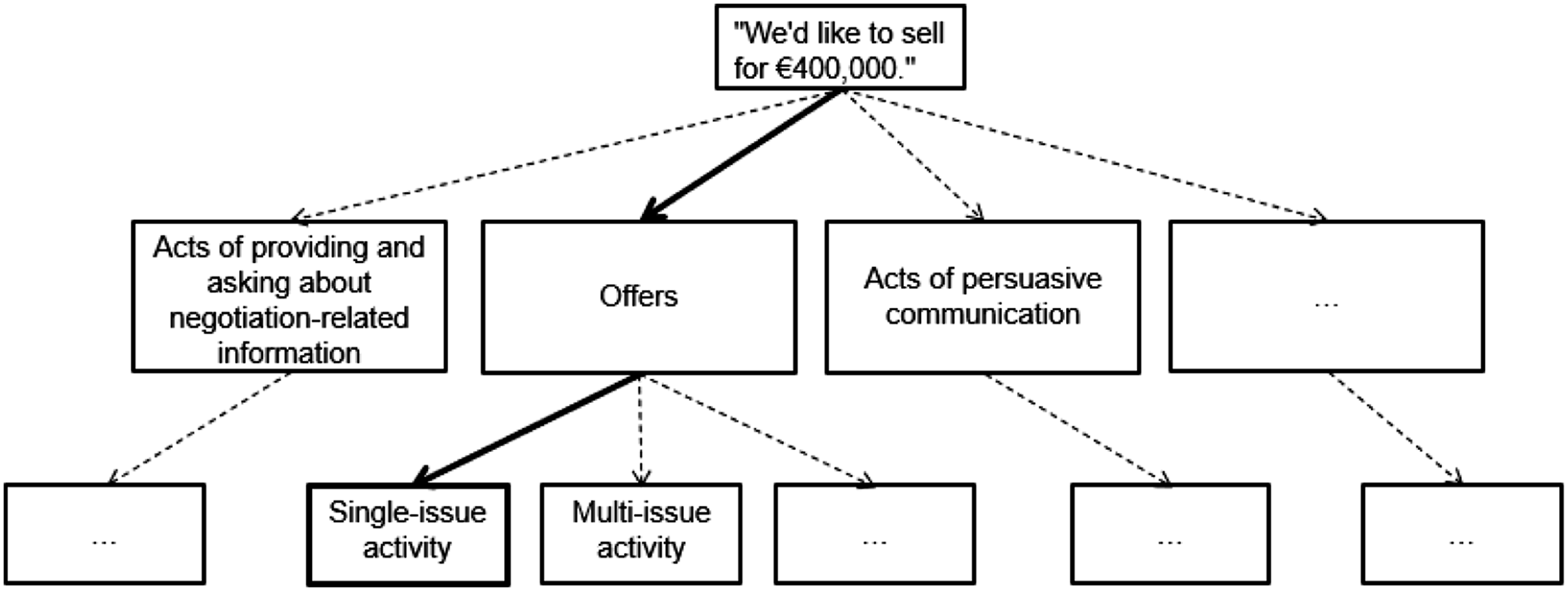
Sample Transcripts Using NegotiAct.
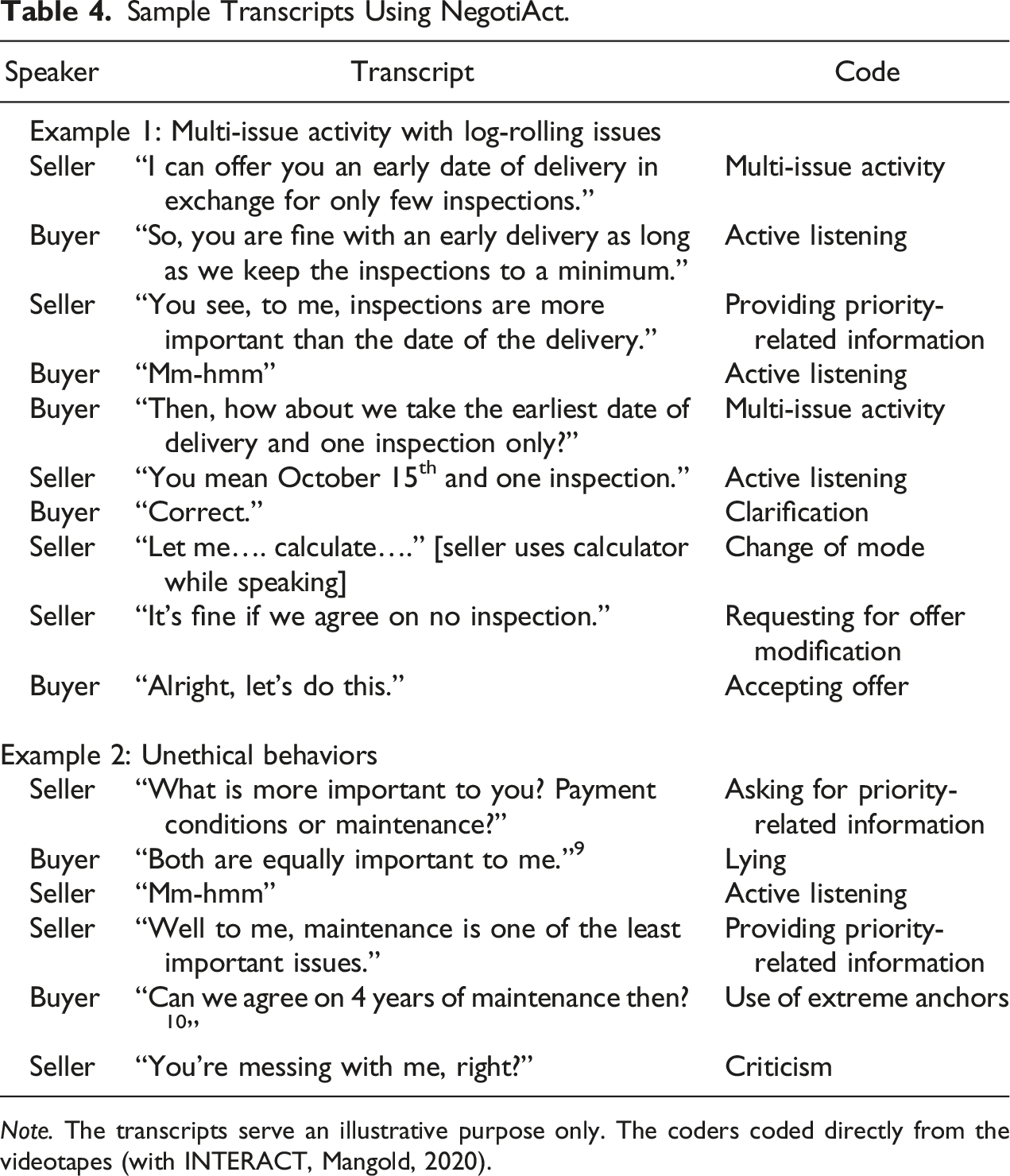
Note. The transcripts serve an illustrative purpose only. The coders coded directly from the videotapes (with INTERACT, Mangold, 2020).
Phase 3—Application and Test of NegotiAct
To verify that NegotiAct meets the fourth requirement (i.e., reliability), we apply the new coding scheme and analyze whether NegotiAct yields the necessary level of interrater reliability. Furthermore, we directly compare NegotiAct and extant coding schemes to illustrate potential advantages of the new coding scheme. Finally, we illustrate the value of NegotiAct by addressing two exemplary research questions on the role of active listening for the process of negotiations and the emergence of economic outcomes.
Interrater Reliability Analysis
Most frequently, Cohen’s kappa (Cohen, 1960) is used as a global measure to assess the level of agreement between independent coders (Weingart et al., 2004). Bakeman and Quera (2011) recommend targeting a minimum accuracy 3 of 80%, preferably more (see also Bakeman et al., 1997; Gardner, 1995). Given the number of behavioral codes that NegotiAct comprises, a minimum accuracy of 80% would be reached, if the kappa exceeds .62 (see Bakeman & Quera, 2011, p. 165).
Method
Sample
The data used for this study were part of a larger dataset gathered by Hüffmeier et al. (2019). We used 18 videotaped solo-on-solo negotiations from the related laboratory experiment, which employed two different integrative negotiation tasks (task 1 adapted from Thompson, Peterson, & Brodt, 1996, and task 2 from Moran, Bereby‐Meyer, & Bazerman, 2008). We coded nine videotaped negotiations for each task to show that our coding scheme can be reliably applied to different settings. The task adapted from Thompson et al. (1996) comprised eight issues. Participants had to engage in logrolling and recognize compatible issues to achieve high joint gains. The task adapted from Moran et al. (2008) was more complex and, in addition to logrolling and the recognition of compatible issues, participants had to craft contingent contracts, add issues to the negotiation, and identify time trade-off options to create value (see the supplemental material for respective pay-off matrices).
To obtain a representative variability in outcome variables, we split all negotiation videos available in the study by Hüffmeier et al. (2019) based on their measures of joint gains (Thompson, 1990) and feelings about the relationship (Curhan, Elfenbein, & Xu, 2006) into terciles (low-, intermediate-, and high-performing dyads). Next, we randomly drew one video from each combination (3 × 3 = 9 combinations; e.g., low joint gains, high relationship outcomes) for each negotiation task. Thus, a total of 18 negotiation dyads (N = 33) 4 were analyzed as part of our validation efforts. The participating negotiators (24 men, 9 women) were undergraduate students of a major German university and participated as part of their management course work.
Coding Procedure
The duration of the videotaped negotiations ranged from 14 to 30 min (M = 21.62, SD = 6.5). We coded the negotiation interactions with NegotiAct and INTERACT software (Mangold, 2020). We used INTERACT software as it allowed us to code directly from the video, without transcribing it first (for a discussion of different software options, see Lehmann-Willenbrock & Allen, 2018). This procedure considerably reduces the time investment and coding effort. Moreover, paraverbal behaviors such as laughter or active listening (i.e., “mm hmm”) can more easily be recognized and accurately coded as such when coding directly from the video rather than from transcripts. As we coded directly from the video, thought units were identified and marked according to time, rather than words. Of note, this approach makes it almost impossible for two coders to segment and unitize a video at the exact same millisecond and subsequently to calculate interrater reliability for the segmentation process (Guetzkow, 1950). Therefore, we followed the standard procedure for establishing interrater reliability when using software to code videos (cf. Lehmann-Willenbrock & Allen, 2018) and defined clear unitizing rules, so that only one trained rater identified the units and interrater reliability was established concerning the codes that were assigned to these units. Thus, in a first step, the first author segmented all 18 videos into thought units (cf. Bales, 1950; Kauffeld & Lehmann-Willenbrock, 2012), resulting in 5365 units in total. The third author was trained as an additional coder and given specific instructions (i.e., the NegotiAct coding manual and verbal explanations) for assigning codes to the identified units. In a second step, both coders independently coded the material.
Results
Agreement Percentages.
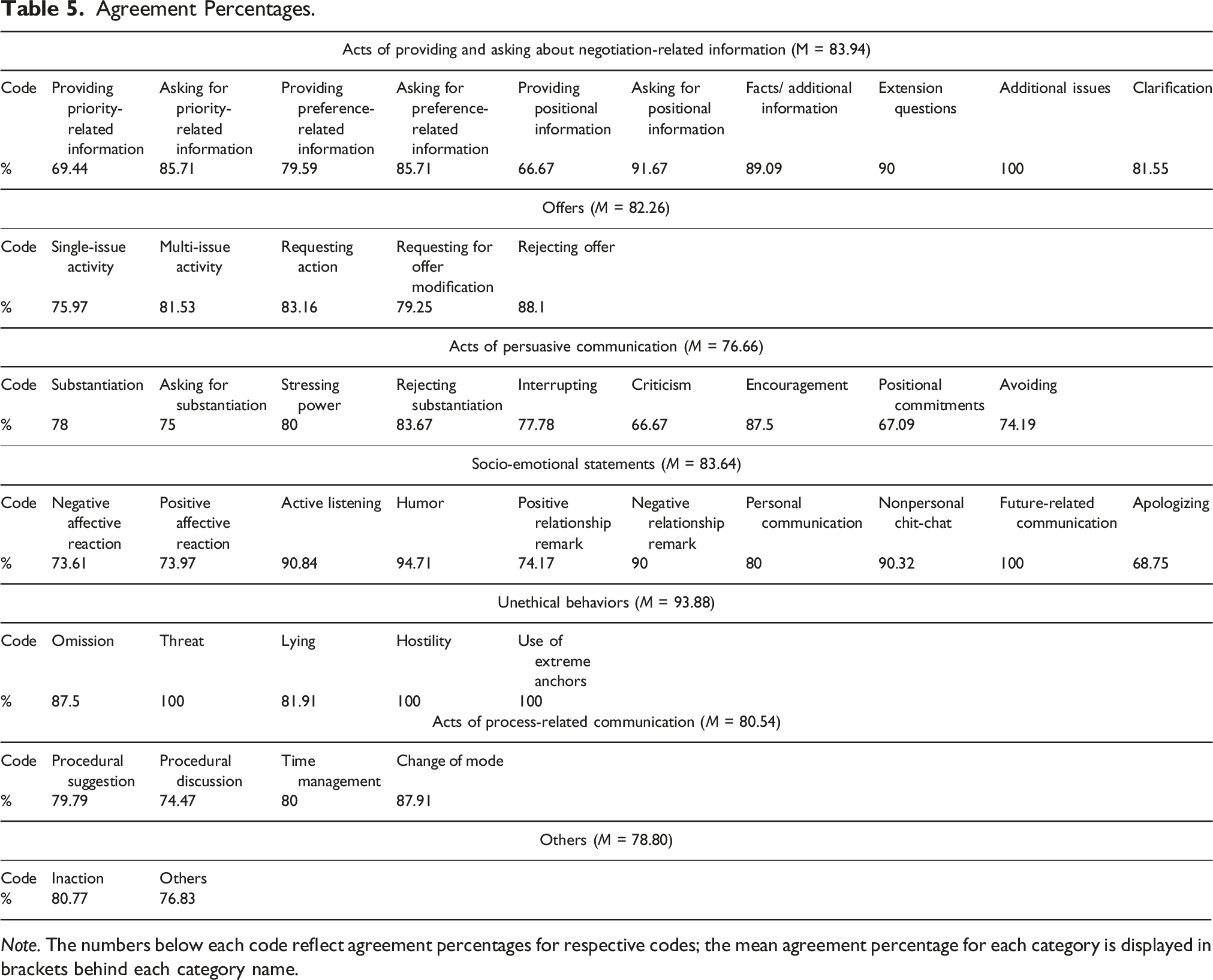
Note. The numbers below each code reflect agreement percentages for respective codes; the mean agreement percentage for each category is displayed in brackets behind each category name.
Direct Comparison
Percentage of Socio-Emotional and Unethical Statements Captured with NegotiAct.
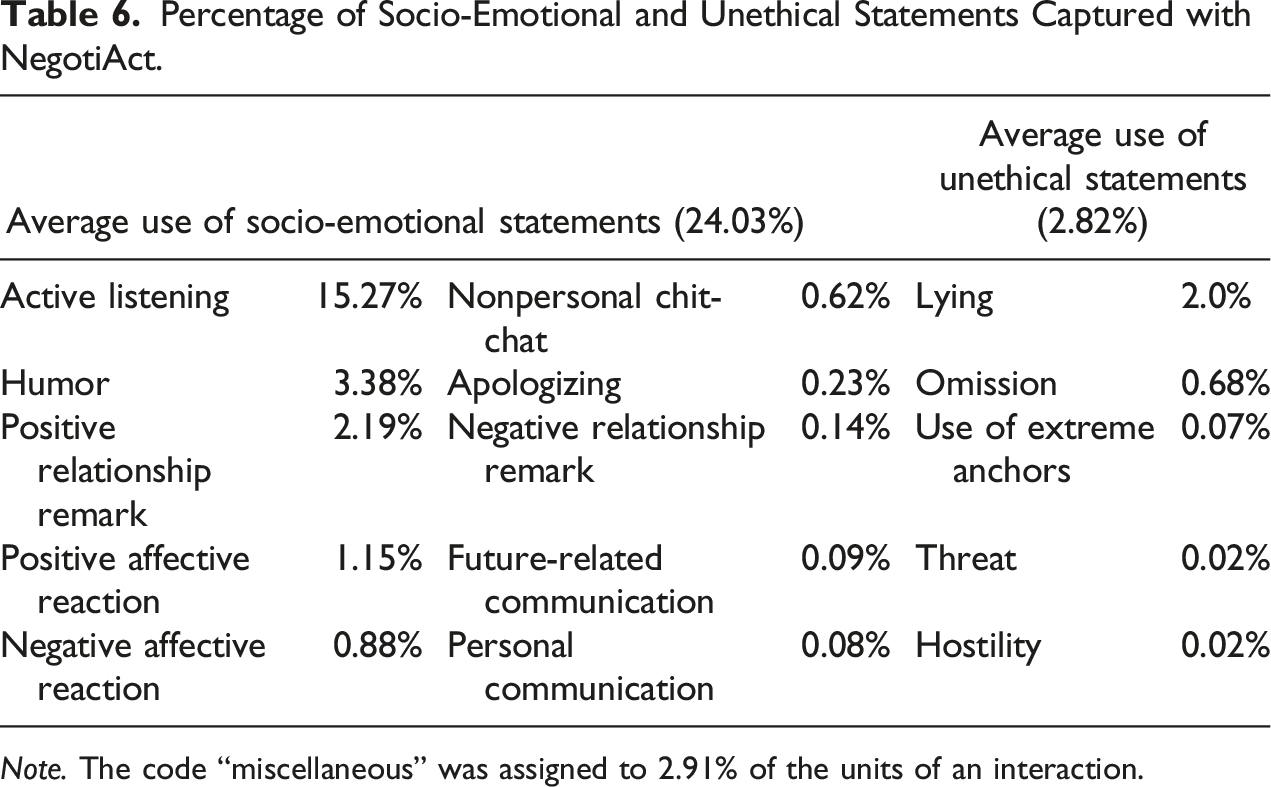
Note. The code “miscellaneous” was assigned to 2.91% of the units of an interaction.
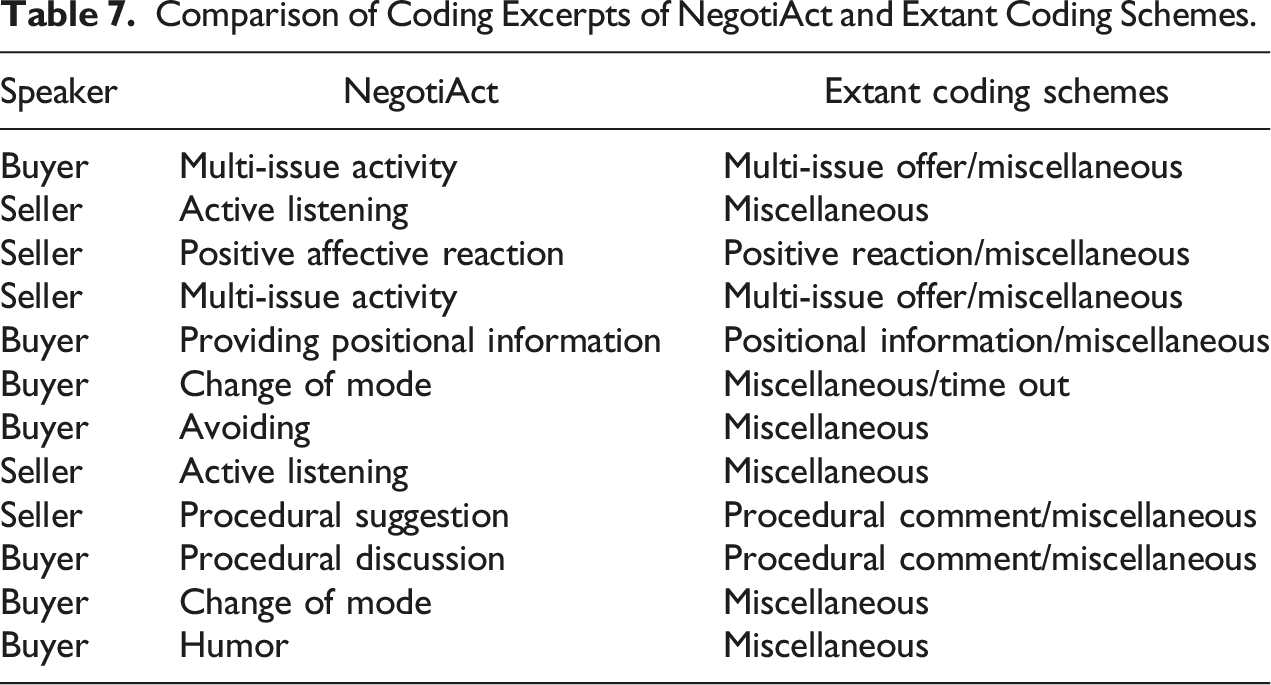
Comparison of Coding Excerpts of NegotiAct and Extant Coding Schemes.
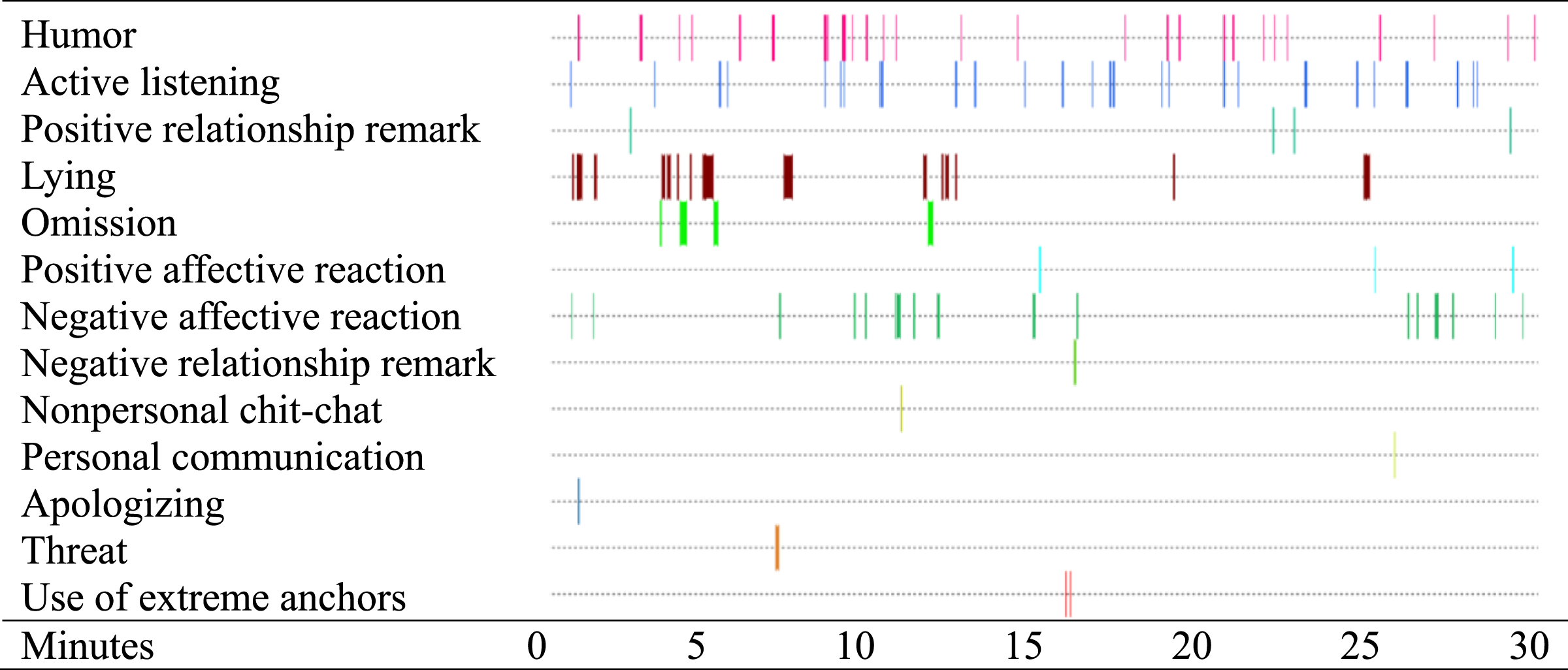
Exemplary time line chart for one negotiation interaction showing only socio-emotional statements and unethical behaviors.
Second, extant coding schemes would need to assign a “miscellaneous” coding category substantially more often than NegotiAct when segmenting the interaction into thought units (see Table 7). This implies that large conversational chunks and nuances in the negotiation are lost to researchers. More specifically, these occurrences represent blind spots in the interaction, which naturally hamper the understanding of negotiation interactions and the explanatory mechanisms therein that ultimately explain negotiation outcomes.
Investigating two exemplary research questions on active listening
To further validate the coding scheme and to demonstrate its value, we address two exemplary research questions in an exploratory manner. 6 We decided to study the role of active listening for the negotiation process and for the emergence of joint gains because active listening is a central addition of our coding scheme that goes beyond prior coding schemes for negotiations. So far, active listening has merely been studied as a rapport-building behavior in crisis negotiations (e.g., Garcia, 2017). However, the effects of active listening on other negotiation behaviors are unclear. It is also unclear how certain active listening patterns may be associated with joint gains.
Active listening has its roots as a therapeutic communication technique (Gordon, 1970). One objective of active listening is to understand the underlying information of the speaker’s statements (Rogers & Farson, 1987). Thus, it seems especially helpful to apply when it comes to the exchange of information that needs further processing. Pertinent examples in the negotiation domain are multi-issue offers that can provide indirect information about negotiators’ priorities and preferences (Olekalns & Smith, 2003). Some studies found multi-issue activity to be positively related to joint gains (e.g., Liu & Wilson, 2011; Olekalns & Smith, 2003); in others, there was no (e.g., Cai, Wilson, & Drake, 2000) or even a negative association (Weingart et al., 1990). Brett and Thompson (2016) conclude that multi-issue offers might have an effect on joint gains, “depending on when and how they are used in the negotiation” (p. 70).
One factor that could influence this relationship is the attentiveness of the negotiation counterpart. Less attentive negotiators might not always understand the underlying information in multi-issue offers (Olekalns & Smith, 2003). More attentive negotiators, on the contrary, may have a better chance to extract and process this indirect information. This may occur via active listening. Active listening indicates a willingness to consider and systematically process the information provided by the other party (Rogers & Farson, 1987) and may thereby help the discovery of mutually beneficial solutions.
Our argumentation has two implications that we want to address in our first application of NegotiAct: First, it suggests that multi-issue activity and active listening could occur as a temporally dependent sequence in negotiations. Second, we query whether negotiators who more frequently use active listening in response to multi-issue offers may achieve higher joint gains. We thus pose the following two research questions:
Research Question 1 (RQ 1): Do sequential multi-issue activity → active listening patterns develop more often than would be expected by chance within interaction processes in negotiations?
Research Question 2 (RQ 2): Are multi-issue activity → active listening patterns positively related to joint gains?
Method
We analyzed the same data that was used to establish interrater reliability. In the following, we describe only the dependent variable and the two relevant codes for our exploratory analyses in more detail.
Measures
Joint gains
To assess the economic outcomes and integrativeness of the agreement, joint gains were calculated as the sum of both negotiators’ individual outcomes (i.e., points earned as per the agreement). This is a common outcome measure in negotiation research (Tripp & Sondak, 1992).
Multi-issue activity
Multi-issue activity was coded when one of the negotiators made an offer that comprised two or more of several possible issues. For additional analyses, we counted the frequency of multi-issue activities per negotiation.
Active listening
Active listening was coded when one of the negotiators paraphrased the other party’s statements or when one of the negotiators used generic paraverbal responses, such as “mm hmm.” Again, we counted the frequency of active listening instances per negotiation for additional analyses.
Statistical Analysis Strategy
We performed a lag sequential analysis to assess whether multi-issue activity → active listening patterns develop within negotiation interaction processes. Lag sequential analysis evaluates whether certain behavioral sequences happen more often than would be expected by chance and are therefore statistically meaningful (e.g., Bakeman and Quera, 2011; see Lehmann-Willenbrock & Allen, 2014, for an illustrative application of this principle). To answer our research question, we wanted to study if multi-issue activity by one negotiation partner triggers active listening as a direct response by the other party (lag1 sequence).
To do so, we first determined how often one behavior was followed by another behavior (i.e., transition frequency) for each possible combination of two behaviors of our coding scheme (i.e., 2209 pairs). For instance, active listening followed multi-issue activity 99 times. Next, we computed transition probabilities for the proposed sequence, indicating the likelihood that active listening is triggered by multi-issue activity (p = .33). Transition probabilities are still confounded with the unconditional probability of the following event. Thus, we computed the expected joint frequency by chance (i.e., if events were independent) for the proposed sequence (expected frequency = 45.35). We then tested whether the expected joint frequency differs significantly from the observed transition frequency, by calculating a z value (the three formulas for these calculations are provided in the supplemental material). A z value smaller than −1.96 or larger than 1.96 indicates a sequence occurring above chance level. The statistical power for the study of RQ 1 relies on the number of thought units (N = 5365) and should therefore be sufficient (cf. Bakeman & Quera, 2011). For the study of RQ 2, we calculated the overall frequency of multi-issue activity → active listening patterns per dyad and tested its relationship with joint gains by means of Spearman’s Correlation analysis. Given the number of coded negotiations (N = 18), this dataset has at least .80 power to detect an effect as small as r s = .47.
Results
Lag Sequential Analysis
Minimum, Maximum, Means, Standard Deviations, and Intercorrelations.
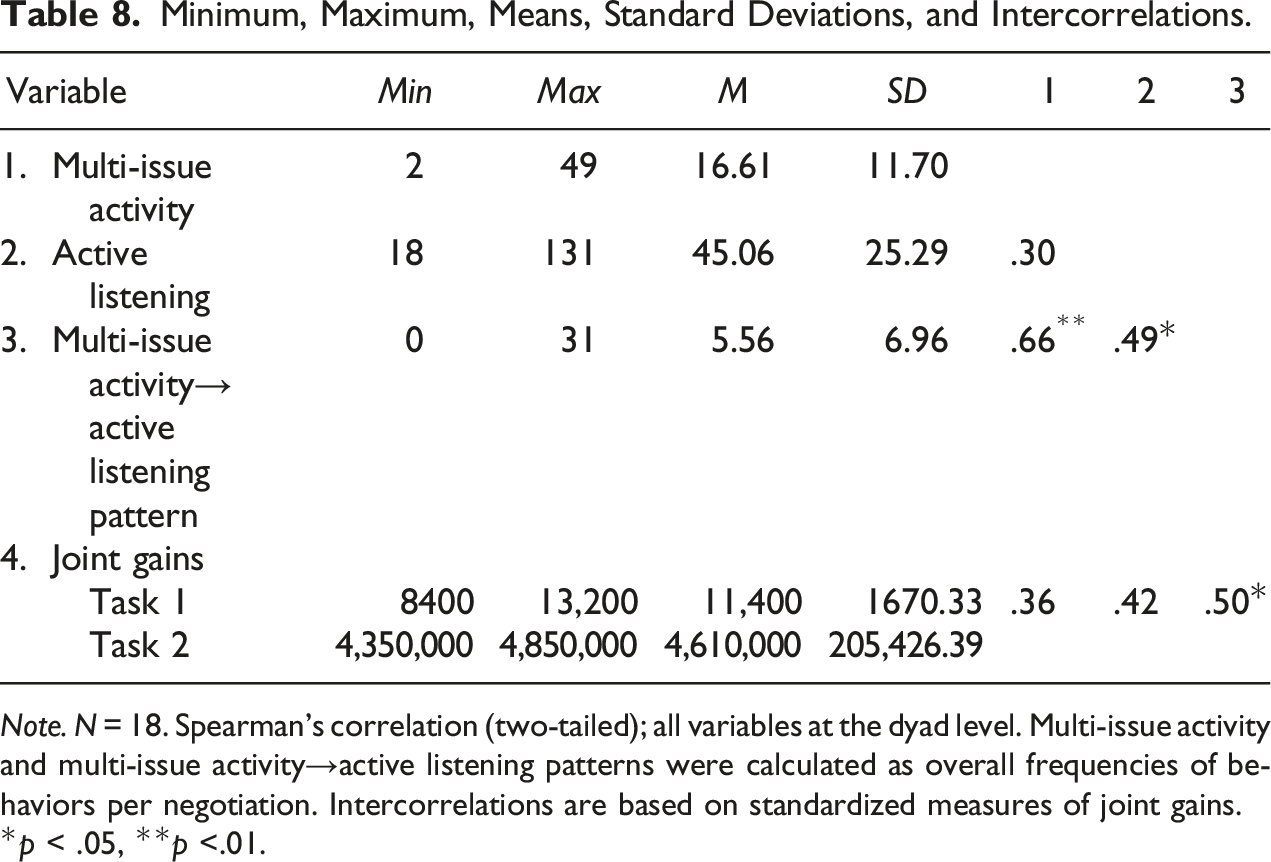
Note. N = 18. Spearman’s correlation (two-tailed); all variables at the dyad level. Multi-issue activity and multi-issue activity→active listening patterns were calculated as overall frequencies of behaviors per negotiation. Intercorrelations are based on standardized measures of joint gains.
*p < .05, **p <.01.
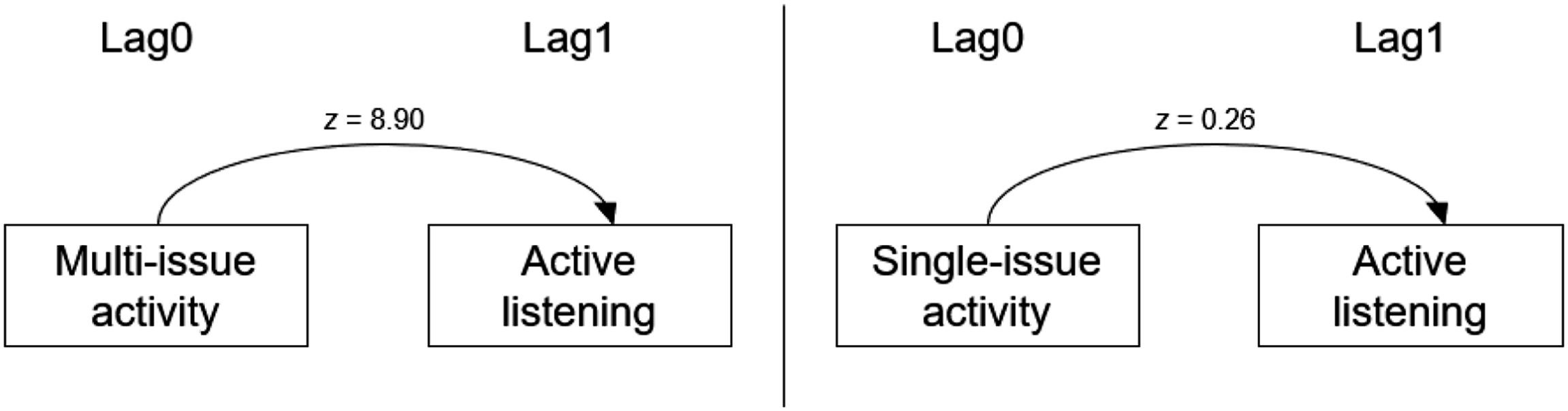
Lag sequential analyses.
Correlation Analysis
After having established multi-issue activity → active listening patterns, we recoded our dataset across all negotiations such that multi-issue → active listening patterns represented a single behavioral event. Descriptive statistics and intercorrelations of this pattern and joint gains are presented in Table 8. We found a large and statistically significant correlation between multi-issue activity → active listening patterns and joint gains (r s = .50, p = .03). By contrast, the relationship between multi-issue activity alone and joint gains was smaller and statistically not significant (r s = .36, p = .14); nor was the relationship between active listening alone and joint gains (r s = .42, p = .08). These findings positively answer RQ 1: Negotiators who used active listening in response to multi-issue offers achieved higher joint gains.
Discussion
In this manuscript, we developed and introduced NegotiAct, a comprehensive coding scheme for negotiations. NegotiAct captures 47 distinct, mutually exclusive behaviors that can be observed in negotiations. It provides options for a comprehensive overview, a granular view on certain behaviors of interest, and an integrative view on temporal processes within the negotiation. Besides, we integrate into a single coding scheme the vast majority of different behaviors that can be observed in negotiations and that were previously scattered across many disparate coding schemes. Now, a great bandwidth of verbal behaviors can be studied jointly to understand how they affect each other. Thereby, we contribute to an increased accessibility of the rich and diverse negotiation behaviors. Importantly, by doing so, we connect different streams of negotiation research paving the way for theoretical development that will help the negotiation research to progress.
In addition, our detailed coding manual, consisting of standardized rules for the segmentation of interactions into thought units and the allocation of codes to these units, allows for a reliable application of the coding scheme. This is supported by a substantial interrater reliability (Fleiss et al., 2003; Landis & Koch, 1977). In turn, a reliable coding scheme facilitates the replicability of studies using NegotiAct. Furthermore, a customization feature enables researchers to adapt the coding scheme to their specific research question without compromising its internal logic. This circumvents the need to develop new coding schemes for each new research project and may over time contribute to a large body of comparable and compatible datasets of negotiation behavior stemming from a multitude of primary studies. This is desirable for two reasons: First, comparable datasets based on constructs that are operationalized in identical ways facilitate the meaningful interpretation of meta-analyses and thereby the valid aggregation of potential effects. Second, compatible datasets can easily be merged and potentially be used for various research endeavors by different researchers, which is a desirable change towards more Open Science. Besides, referring back to Bakeman and Gottman’s (1997) “underwear problem,” it also prevents researchers from using ill-fitted coding schemes in the first place. Overall, NegotiAct paves the way to a faster knowledge accumulation and further theoretical and empirical developments in our understanding of negotiation.
An additional core feature of NegotiAct is its capability for identifying crucial communication behaviors thus far hidden in a blind spot in previous research. This grants negotiation scholars the opportunity to understand the role of communication behaviors not yet considered by negotiation research. Furthermore, it allows them to identify communication patterns that characterize certain phases or qualities of a negotiation. Studying actual behavior as it unfolds in a negotiation is an objective called for by many researchers (e.g., Brett et al., 1998; Putnam & Jones, 1982b; Turan, Dudik, Gordon, & Weingart, 2011). With NegotiAct, we address this call, aiming to unravel and identify temporal interaction patterns in negotiations. We demonstrate the coding scheme’s utility by studying two exemplary research questions on active listening in an exploratory manner. With lag sequential analysis, we could show that multi-issue offers, one typical example of indirect information provision in negotiations (e.g., Olekalns & Smith, 2003), trigger active listening. Furthermore, we found a positive relationship between multi-issue activity → active listening patterns and joint gains. Given the limited sample size (N = 18) and respective low power, our correlation analysis is merely indicative of a pattern in support of RQ 2. Still, our findings provide a first exploratory insight into the question of when and how multi-issue activity leads to higher joint gains (cf. Brett & Thompson, 2016).
Limitations and Future Directions
NegotiAct is a comprehensive coding scheme when it comes to verbal behaviors and it captures some paraverbal behaviors (e.g., laughter as part of humor and back channeling as part of active listening). However, we did not include nonverbal behaviors in our coding scheme for the following two reasons: First, we use thought units as segmentation units in order to achieve high granularity in the coding of verbal behaviors in negotiations. However, non-verbal behaviors often require different time windows to observe and analyze. For instance, gaze movements need an even smaller time window than thought units (i.e., very few milliseconds) and, thus, several nonverbal codes would be assigned to one thought unit, which should be avoided when coding interactions (Bakeman & Quera, 2011). In contrast, body postures may change less over the course of a negotiation (cf. Burgoon & Baesler, 1991; Ekman, 1957). Second, by segmenting the interaction into thought units and with 47 behavioral codes, NegotiAct already provides a very fine-grained picture of the negotiation interaction process and there is an upper limit to how many codes can be reliably measured with a coding scheme and human coders (cf. Sim & Wright, 2005).
We designed NegotiAct to be applicable to different negotiation contexts, by integrating 89 papers that in total used 56 different negotiation tasks to develop our coding scheme. Moreover, we coded negotiations in two different settings with different negotiation tasks to demonstrate that NegotiAct can be applied to and is reliable in different settings. Still, we encourage future research to apply NegotiAct to other settings, for instance, salary negotiations. In these negotiations, where power differences can be expected, codes may be differently distributed among the negotiation parties than in buyer-seller negotiations. For instance, high power negotiators could possibly use more unethical behaviors, such as threats, than low power negotiators (cf. Boles et al., 2000). Moreover, both negotiations were studied in laboratory experiments and, thus, occurred in an artificial environment with student samples. However, as we integrated 17 papers that coded negotiations in field settings (see https://osf.io/nwrb6/?view_only=228c618358b2416fab69981b185d07ac) we believe that NegotiAct can also cover entire interactions comprehensively in real-world negotiations. Thus, we encourage negotiation researchers to use and test NegotiAct not only for laboratory studies, but also in field settings.
Although coding with NegotiAct was done manually, automated coding by means of supervised machine learning (SML) is clearly a future perspective. By cumulating and merging comparable datasets—human-coded with NegotiAct—we can build a training set that is large enough to train a machine sufficiently. In turn, the trained machine can be used to code new, uncoded data. Thereby, NegotiAct in combination with SML can contribute to further cumulative research, while substantially saving human resources (for an introduction to machine learning on group interaction data, see Bonito & Keyton, 2018).
Conclusion
With NegotiAct, we developed a coding scheme that captures the entire negotiation interaction in a fine-grained manner. Our customization feature ensures that it will fit many future research questions. We thereby facilitate cross-study comparisons and cumulative research on negotiation interactions. Crucially, we develop an important prerequisite for future work to advance negotiation research that takes a dynamic perspective. We provided exemplary research questions that can be addressed with NegotiAct, showed that it can be used with a high interrater reliability, and we demonstrated the application of NegotiAct with exploratory analyses of active listening patterns. Instead of applying an ill-fitting coding scheme, we encourage future research to use our one-size-fits-all coding scheme, NegotiAct.
Supplemental Material
Supplemental Material - NegotiAct: Introducing a Comprehensive Coding Scheme to Capture Temporal Interaction Patterns in Negotiations
Supplemental Material for NegotiAct: Introducing a Comprehensive Coding Scheme to Capture Temporal Interaction Patterns in Negotiations by Elisabeth Jäckel, Alfred Zerres, Clara S. Hemshorn de Sanchez, Nale Lehmann-Willenbrock, and Joachim Hüffmeier in Group & Organization Management
Footnotes
Declaration Of Conflicting Interests
The author(s) declared no potential conflicts of interest with respect to the research, authorship, and/or publication of this article.
Funding
The author(s) received no financial support for the research, authorship, and/or publication of this article.

Supplemental Material
Supplemental material for this article is available online.
Notes
Associate Editor: Yannick Griep
Author Biographies
References
Supplementary Material
Please find the following supplemental material available below.
For Open Access articles published under a Creative Commons License, all supplemental material carries the same license as the article it is associated with.
For non-Open Access articles published, all supplemental material carries a non-exclusive license, and permission requests for re-use of supplemental material or any part of supplemental material shall be sent directly to the copyright owner as specified in the copyright notice associated with the article.
