




Abstract
Temporal tensions abound for those involved in temporary interorganizational collaborations (IOCs). Participating members must navigate working within their home organization and the temporary IOC simultaneously. These tensions undermine efforts toward two important outcomes in temporary organizing contexts: temporal synchronization and ambitemporality. To be effective, leaders need a keen awareness of the temporal tensions present and an ability to manage these tensions through the enactment of additional temporal tensions. We identify temporal adaptive capacity (TAC) as a crucial competency needed by leaders to effectively manage the multi-level temporal tensions present when participating in temporary IOCs. Finally, we offer practical implications and a research agenda through the introduction of propositions related to TAC.
Introduction
Successfully navigating the challenges that temporary organizing presents requires distinct leadership capabilities. High levels of environmental volatility, uncertainty, complexity, and ambiguity suggests that existing, permanent organizational designs and leadership practices may no longer be effective to meet contemporary challenges (Worley & Jules, 2020). Instead, more temporary forms of organizing with flexible processes and unstructured interactions across organizations contribute to the agile designs necessary in today’s unrelenting environments (Baran & Woznyj, 2020). Temporary organizing (TO) encompasses collaborative activities among interdependent actors who pursue common goals and are characterized by their time-limited duration and expected termination point (Bakker et al., 2016; Sydow & Windeler, 2020) with termination mechanisms based on either time or goal attainment (Braun & Lampel, 2020). This conventional view of TO must also consider the perceptions of those involved, that is, TO is viewed as such because participants perceive their activities as temporary. As a result, TO represents a continuous perceptual construction by involved members and not simply a dichotomous consideration of whether activities have a time-limited duration or not. The continuous perceptional evaluation further complicates how leaders manage temporary arrangements. TO arrangements rely less on rigid rules and formalized policies for interaction and instead allow for some unstructured interactions and fluid responses (Majchrzak et al., 2007). This fluidity within temporary organizing requires leaders to rely on different capabilities to manage others when operating within such systems. Temporary organizing takes on many forms (Bakker et al., 2016; Braun & Lampel, 2020; Sydow & Windeler, 2020); in this paper, we are focused on temporary organizing within interorganizational collaborative efforts.
Temporary interorganizational collaborations (IOCs) are systems comprised of members from multiple interdependent participating organizations that collaborate on an ad-hoc, limited basis (Mathieu et al., 2018; Solansky et al., 2014; Zaccaro et al., 2012). We define temporary IOCs as multi-party collaborative systems that have a perceived temporary duration (Bakker et al., 2016; Mathieu et al., 2018; Sydow &Windeler, 2020). Understanding the processes and leadership activities associated with effective temporary IOCs has begun to shed light on ways to leverage such collaborative forms employed in adverse and tumult-laden conditions (Luciano et al., 2021; Williams et al., 2017). Opportunities remain to explore temporary organizing, particularly for leaders, as conditions require leaders manage their “home” or permanent organization while its members also operate within a temporary IOC system.
Consider, for example, the challenges that Pemsel and Söderlund (2020) documented in their case study of a Swedish public–private partnership devoted to construction of a new university hospital and research center. Their evidence found that participating members brought with them their “home” organization’s timing norms, temporal orientations, and temporal conceptions. Empirical data found that members from different organizations preferred to work at a different pace, to accomplish work in diverse sequences, or to conceive of time and its urgency in varied ways. The result: leaders needed to account for and navigate challenges that arose due to temporal differences between home organization expectations and the needs of the temporary IOC. They describe the competing reality of temporal tensions where “actors who attempted to resolve their temporal differences were pressured on two sides. On the one hand, they had to continue representing their home organizations’ requests for legitimacy; on the other hand, they also had to honor the project’s mission, which required some decoupling from the home organization’s temporal requirements (p. 143–144).” When leaders engage their organization in temporary IOCs, the leaders have the responsibility to effectively manage their organization and its members to cope with the potential competing temporal tensions. Effectiveness in such TO contexts requires leaders to have capabilities beyond what is expected when managing is limited to the typical operations of the permanent, home organization. Instead, leaders must consider a myriad of temporal tensions that can arise in temporary IOCs. Therefore, we focus on what leaders can do for their organizations and members in these settings.
The complexity of leading organizations and individuals involved simultaneously in temporary and permanent contexts is demanding. In this paper, we are focused on how leaders can manage temporal tensions. Leaders must be able to manage and balance divergent and competing temporal tensions for the sake of enhancing critical temporal outcomes that can impact overall IOC effectiveness such as synchronization and ambitemporality (Geraldi et al., 2020; Stjerne et al., 2019). These relevant temporal outcomes operate simultaneously and ultimately result when participating members share timing norms and pace (i.e., synchronization) and where multiple, divergent temporalities are welcomed and embraced (i.e., ambitemporality). The key for leaders is knowing how and when to pursue each outcome.
Leadership within temporary collaboration systems, which as a process can be held within a single actor or some group of actors (Luciano et al., 2021), is recognized as a critical mechanism for IOCs in temporary environments. There are significant expectations on how leadership is needed to: coordinate activities among members with potential differences in time horizons; bind the system (individuals, teams, organizations, and systems) despite potential competing pacing routines used by members; and manage complex, diverse processes and objectives for collaborating organizations subject to unique visions for continuity expectations among members. All this dynamism results in significant temporal tensions that leaders must attend to. However, the specific competencies needed to manage these dynamic, multi-level temporal tensions are unexplored (Geraldi et al., 2020; Mathieu et al., 2018). Effective collaborations benefit from effective leadership (Luciano et al., 2021). Thus, we heed the calls for further research and seek to extend the recent findings on temporality, dynamism, and tensions within IOCs (Bakker et al., 2016; Braun & Lampel, 2020; Luciano et al., 2021; Mathieu et al., 2018) by identifying the leadership competency needed to successfully manage the temporal tensions present within TO contexts. We are guided by the following research question for such contexts: What competency do leaders need to manage temporal tensions for their organizations? Addressing this research question is critical because the leadership competencies needed to navigate between the temporary IOC and the enduring permanent characteristics of the home organization benefit all involved if temporal tensions are managed in these potentially complex settings (De Benedittis, 2019; Goetz et al., 2020; Sydow & Windeler, 2020).
To address our research question and to orient our work, we limit our attention to the temporal tensions and temporal outcomes that occur in temporary IOC settings. We adopt the practice-based theory of temporal tensions (Stjerne et al., 2019) to explore temporal tensions leaders must manage in their home organizations when participating in a temporary IOC. Whereas Stjerne and colleague’s (2019) practice-based theory of temporal tensions focuses on resolving temporal tensions at the IOC system level, we extend this focus to include the leader’s role in managing temporal tensions for the sake of navigating the temporalities between the home organization and the temporary IOC. In doing so, we make the following contributions. First, we emphasize the relevant temporal tensions evident across the multiple levels (i.e., individuals and their home organization) found within temporary IOCs thereby extending Stjerne and colleagues’ theory to account for the temporal tensions within a participating, member organization. Second, we explore the role of leadership to achieve the associated temporal outcomes despite inherent temporal tensions and introduce the notion of temporal adaptive capacity (TAC) as a capability needed to manage the temporal tensions within organizations operating as part of temporary IOCs. Third, we introduce propositions related to the impact that TAC has in achieving temporal outcomes of synchronization and ambitemporality. Finally, we establish a research agenda for pursuing further exploration of TAC. See Figure 1 for a graphical depiction of our theoretical model, which incorporates a multi-level perspective for organizations operating within temporary IOCs, and the role of TAC in managing tensions. Conceptual process model of temporal adaptive capacity.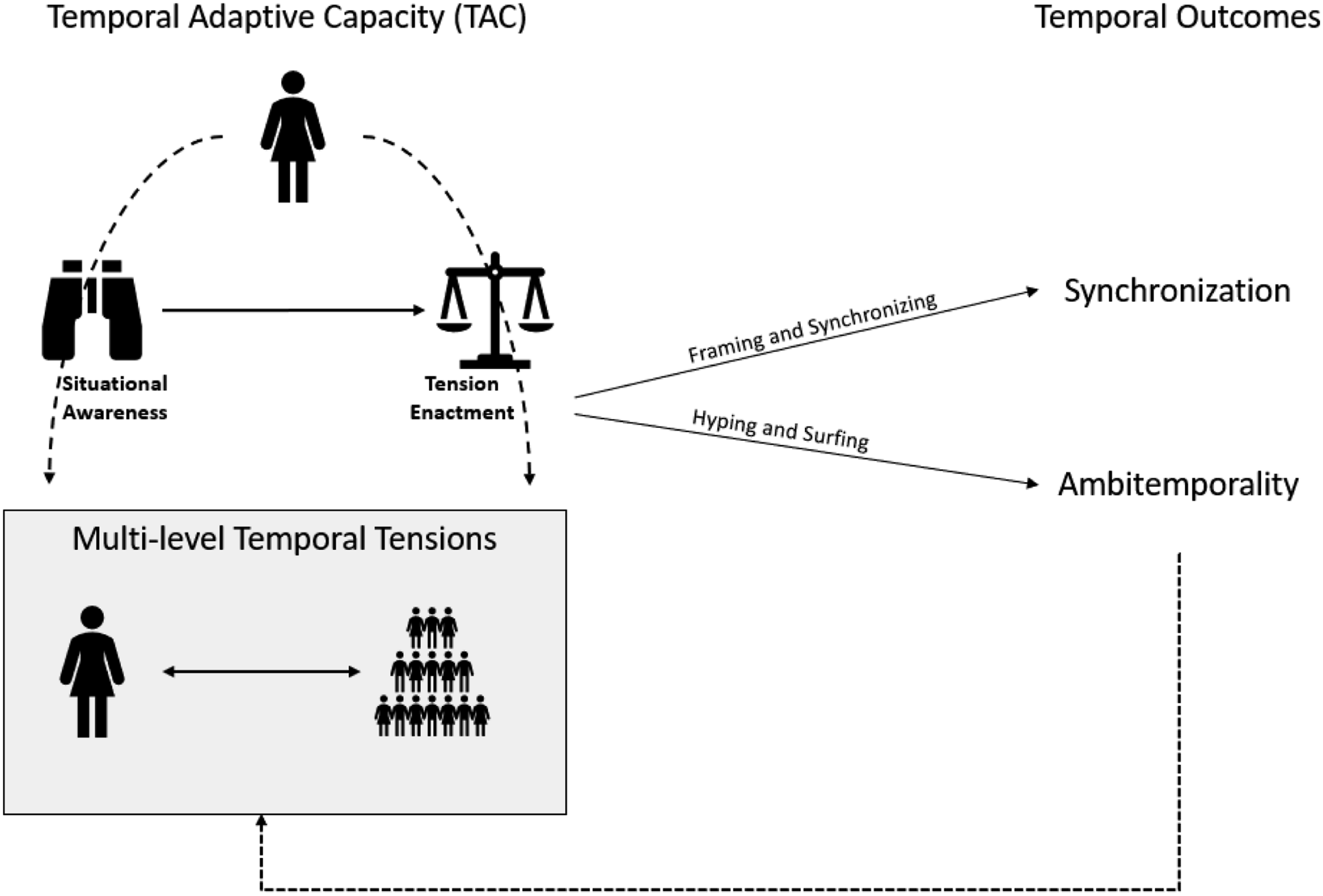
Temporal, Multi-level Tensions
Tensions abound within IOCs (Ashforth & Reingen, 2014; Mathieu et al., 2018; Ramus et al., 2017), especially when considering the interplay between temporary and permanent organizing efforts (Braun & Lampel, 2020; Sydow & Windeler, 2020). Some tensions unify participating members and create cohesion that stabilizes the system while others may disrupt or break apart existing symmetries and destabilize the system (Solansky et al., 2014). Tensions based on temporality result from “inherent contradiction in the way that temporary and permanent organizations enact time” (Geraldi et al., 2020, pg. 82). Permanent organizations extend collective action towards future time horizons, while temporary organizations often seek to buttress permanence in other organizations (Geraldi et al., 2020). Advancing beyond objective clock time, individuals subjectively experience temporal tensions as opposing temporal orientations, diverse rhythmic cycles, or perspectives of the past or future. The contradictory and at times paradoxical tensions wend through organizations, both temporary and permanent, requiring adaptive responses to manage (Angeli et al., 2020). Thus, temporal-based tensions that spur people to take action might include a contrasting sense of urgency or divergent temporal orientations (Oliveira & Lumineau, 2019). These tensions represent the ultimate leadership challenge for managing permanent, home organizations within temporary IOCs. Below is a brief overview of the types of temporal tensions at play and across multiple levels.
Individual Level Temporal Tensions
How individuals think about time influences how they attend to and process information (Bluedorn, 2002) and make strategic decisions (Heracleous & Bartunek, 2021; Reilly et al., 2016; Souder & Bromiley, 2012). Research on temporal orientations has grown rapidly over the past decade (Reilly et al., 2016; Shipp & Jansen, 2020; Tang et al., 2020). Temporal orientation generally refers to how individuals make sense of events that have occurred, are occurring, or that will occur (Bluedorn, 2002; Peetz & Wohl, 2019). Thus, temporal orientation comprises a significant component of human cognition that structures people’s understanding of the world and their actions (Bluedorn, 2002). A failure to think about the distant future (e.g., short-termism) increases the likelihood that decision-makers will miss future threats (Bluedorn, 2002; Bluedorn & Martin, 2008), harming competitiveness (Chen & Miller, 2012; Marginson & McAulay, 2008). Nevertheless, focusing on the distant future (e.g., long-termism) can undermine actions in the short-term. For individuals working in TO contexts, the near-term task at hand serves as an addendum to their more persistent long-term focus within their home organizations. These individual tendencies can create destabilizing tensions when combined across all agents.
Collective-Level Temporal Tensions
Temporal orientation also considers how subjective temporality influences organizational strategy and behavior (Nadkarni et al., 2016). Although much of the research on temporal concepts (such as temporal depth, temporal focus, and urgency) focuses on the individual level of analysis (Lin et al., 2019; Nadkarni et al., 2016; Shipp et al., 2009), Bluedorn and Standifer (2006) propose that temporal orientations of individuals may operate and exist within collectives. For our purposes, collective-level temporal tensions include tensions that occur at the team, group, and/or organization level. In discussing collective-level temporal orientation, Peetz and Wohl (2019) contend that “there is likely a unique collective temporal orientation associated with each social group’s past, present, and future” (p. 610). The extent of temporal orientation has been considered a feature of culture for decades (Hofstede, 2011) and is relevant for organizational culture as well given organizations differ in how they value past, present, or future thinking (Hofstede, 2010). Therefore, we expect organizations to exhibit a temporal orientation as a cultural feature. Some organizations will possess a short-term orientation while others will display a longer-term orientation. When collective temporal orientations are misaligned with a purpose of an IOC, leaders must act and adapt.
Cross-Level Temporal Tensions
A multitude of varying temporal orientations or numerous divergent rhythmic structures might result in cross-level tensions regarding time horizons, pacing, or continuity (Stjerne et al., 2019). For instance, problems that prompt temporary IOCs often require the management of multiple interrelated and interdependent timelines of when things occur and in what order. As each IOC participant might enact notions of time differently (Geraldi et al., 2020), temporary IOCs can become a chaotic mixture of temporalities. Prior scholarship points to the many forms of temporality and their interactions as temporal complexity (Halbesleben et al., 2003) or the timescape (Adam, 2000). Given the existence of multi-level, cross-level temporal tensions, organizations operating in temporary IOCs need leaders with specific abilities in managing such temporal complexity.
Temporal Adaptive Capacity (TAC)
With such competing multi-level temporal tensions, participating organizations and individual actors need leaders with specific competencies in managing across levels and across temporalities. Without managing these multi-level temporal tensions, participants will face confusion. As noted by Pemsel and Söderlund (2020), challenges emerge within and between home (permanent) organizations and temporary organizations regarding temporal tensions. We need leader competencies to manage such temporal complexity (Geraldi et al., 2020; Mathieu et al., 2018). Leaders in temporary IOCs must examine multi-level temporal tensions and use this awareness to make informed adjustments for the sake of synchronization and ambitemporality.
We extend the practice-based view of temporal tensions (Stjerne et al., 2019) and propose temporal adaptive capacity (TAC) as an individual competency that organizational leaders need for successfully participating in temporary IOCs. Our theoretical extension integrates an adaptive capacity theoretical framework to establish TAC. Adaptive capacity has its roots in the environmental sustainability literature and refers to a system that can adapt in a new environment or changed environment by overcoming uncertainty and disruptions through benefiting from new opportunities (Fazey et al., 2007). Adaptive capacity has been adopted and applied in organizational management as a mechanism to not just cope but thrive as a dynamic capability (Wang & Ahmed, 2007). At the firm level, adaptive capability refers to the “ability to integrate, build, and reconfigure internal and external competencies to address rapidly changing environments” (Teece et al., 1997, p. 516). Adaptive capacity has also been conceptualized as a multiple-level construct as organizational adaptive capacity (Staber & Sydow, 2002), team adaptive capacity (Randall et al., 2011), and leader adaptive capacity (Blass & Ferris, 2007). We draw from these perspectives of adaptive capacity and define leader TAC as the adaptive ability to continuously monitor temporal tensions through situational awareness and the intentional enactment of temporal tensions for organizations and individuals operating in temporary contexts. In other words, TAC is a leader’s capability to link high situational awareness of existing temporal tensions to the ultimate enactment of needed temporal tensions.
Situational Awareness
Following the adaptive capacity literature, an essential component of TAC is situational awareness. Situational awareness is defined as “the perception of the elements in the environment within a volume of time and space, the comprehension of their meaning, and the projection of their status in the near future” (Endsley, 1995, p. 36). Dynamic decision-making happens through this three-step hierarchy as leaders’ situational awareness provides: (a) an understanding of system features that provide information for developing perceptions, (b) the basis for meaning of the various system features, and (c) a process for projecting future system states based on the current state and system dynamics (Endsley, 1995). Empirical research has found that greater levels of complexity can enable a leader to differentiate stimuli and integrate these inputs for more adaptive responses (Hannah et al., 2013) whether that awareness is time related (Shipp & Jansen, 2020) or otherwise. Ultimately, the sensing abilities leveraged in situational awareness help prepare organizations to act despite uncertainty (Worley & Jules, 2020). IOCs are ripe with complexity and provide leaders with opportunities to consider unique temporal dimensions and to integrate patterns and synthesize dynamic conditions, thus deepening situational awareness (Hannah et al., 2013).
Endsley (1995) further articulates three sequential levels across situational awareness. First, individuals must perceive the relevant characteristics of their environment for a particular goal. For instance, leaders of temporary organizations should attend to certain temporal elements, such as the pacing of projects (Stjerne et al., 2019). Second, individuals must comprehend and make sense of the meaning of their perceptions. In this manner, leaders should recognize the various temporal tensions that exist within their organizations and how their own actions either contribute to or alleviate tensions. Finally, leaders need to anticipate possible future states by asking how temporal tensions might influence a future state, such as the ability to meet a future project deadline. Similar to other cascading models within management (see Joseph and Newman, 2010), we contend that the TAC dimensions are consecutive; that is, leaders must fulfill each level of situational awareness before they can enact temporal tensions to benefit the organizational system. The enactment dimension of TAC requires leaders to leverage their situational awareness to effect a change in their environment. Therefore, we expect leader TAC to represent complex, reflective yet proactive processing of the temporal fluidity of orientations, priorities, and faultlines within self, others, organizations, and IOC systems for the sake of situational awareness and the subsequent enactment of appropriate temporal tensions.
Leaders of temporary organizations should develop situational awareness for a variety of temporal variables. For instance, leaders with TAC are apt to understand and utilize various temporal orientations so that both short-termism and long-termism qualities of individuals and organizations are tapped and operationalized for overall effectiveness. By recognizing variance in time horizon perspectives and integrating the benefits of each, leaders are able to navigate temporary IOC settings without being detrimental to permanent settings and vice versa. For example, short-termism is a valuable orientation for creating a sense of urgency to act which can create tight coupling within temporary IOCs. Long-termism is an equally important orientation for the purposes of promoting learning and growth over time for the permanent home organization. Leader TAC is a competency needed to ensure temporal priorities are balanced, legitimized, and operationalized across their home organization when operating within a temporary IOC system. Leader TAC would also provide the necessary skills required to navigate dynamic, fluid temporal faultlines as IOC actors transition between temporary and permanent contexts. Faultlines refer to methods of division between groups and members and have recently been examined from a temporality perspective as time is noted as a key determinant of organizing faultlines (Meister et al., 2020). Faultlines can evolve and change over time, and leaders are needed to recognize that individual perceptions are likely to alter as attributes of faultlines shift in saliency from membership in multiple groups (Meister et al., 2020). This is especially common when individuals shift their activities within and between their home organization and temporary IOCs. By recognizing the temporal orientations and faultlines that exist within a temporary IOC, leaders may better position themselves to effectively enact temporal tensions to instill needed stability and/or change within their home organization.
Enactment of Temporal Tensions
TAC as a dynamic, adaptive capability will allow for the effective management of an organization and its actors through the complex maze of competing tensions found innately between the home organization and temporary IOC functioning. We expect that leaders with TAC will be well equipped to manage organizations within temporary IOCs effectively by intentionally enacting appropriate temporal tensions. The intentional enactment of temporal tensions to counter the divergent temporal tensions that are likely present as participants navigate from their home organization and the temporary IOC can serve to support sustainable operations (Ashforth & Reingen, 2014). Bakker et al. (2016) suggests that in TO situations, individuals need capabilities to monitor processes and to reflexively enable and restrain actions and actors for coordination. In establishing TAC, we propose that situational awareness serves as this monitoring capability and that based on the awareness, the leader can reflexively enact tensions for temporal coordination. We define the enactment of temporal tensions as the intentional introduction of tensions to introduce change within the organization for purposes of coordination (Bakker, et al., 2016). We suggest that TAC includes the intentional enactment of temporal tensions by leaders as they work to navigate the myriad temporal structures and perspectives present at the interface between permanent organization and temporary organization membership (e.g., attention to the past, present, and future; scheduling due dates; and setting the pace) (Geraldi et al., 2020). Each intentional, temporal tension enacted by organizational leaders should recalibrate how organizations perform in temporary IOCs for the sake of temporal synchronization and ambitemporality. TAC represents a continuous process of situational awareness that leads to the needed enactment of tension. Therefore, if leaders misalign their enacting behaviors, the situational awareness component of TAC should alert the leader to the need for further enactment of different tensions.
We focus on four possible temporal tensions that leaders can enact to enhance temporal outcomes. These four include: temporal framing, temporal synchronizing, temporal hyping, and temporal surfing. Temporal framing establishes the time horizon for a future collaboration (Stjerne, et al., 2019). Leaders can intentionally frame temporal demands by establishing a clear time horizon for the temporary IOC. Temporal synchronizing establishes common pacing norms between the home organization and the temporary IOC (Stjerne, et al., 2019). This often requires a shift with the home organization to match timing norms with the temporary IOC. Temporal hyping is defined as “creating a sense of urgency and importance around the project by turning to the ‘pain points’ of the past” (Stjerne, et al., 2019, p. 361). Leaders can intentionally hype past pain points to better prepare for interacting within the temporary IOC. Temporal surfing leverages the varied timing norms of collaborative partners while keeping timing norms of the home organization constant (Pemsel & Söderlund, 2020). Taking this approach, leaders adopt a view towards future benefits that embrace timing norm differences and amplify differences in ways that improve adaptation and collaborative functioning. Overall, we expect temporal framing and synchronizing to promote synchronization and temporal hyping and surfing to promote ambitemporality and we discuss these relationships next.
TAC Enactment of Framing and Synchronizing for Temporal Synchronization
Managers that oversee collaborative arrangements often experience tensions relating to the pacing of events from their home organization and their partners; each organization brings its own unique temporal structures and characteristics to the joint activity (Stjerne et al., 2019). The resulting tensions often exert a detrimental effect on the coordination of two or more partner organizations due to the lack of a common temporal order (Skade et al., 2020; Söderlund & Pemsel, 2021; Stjerne et al., 2019). As a force to alleviate such tensions, temporal synchronization refers to various activities that merge divergent temporal structures (Skade et al., 2020). Stjerne and colleagues (2019) define temporal synchronization as “setting a new pace that fits both organizations’ needs” (p. 361). In this manner, synchronizing efforts aim to set forth a continuity of events within temporary IOCs that alleviates tensions in temporary collaborations, teams, or projects (Sydow & Braun, 2017; Whyte & Nussbaum, 2020). Temporary IOCs that achieve synchronization across divergent timelines realize greater stabilization and efficiencies within and across various projects, contributing to effectiveness (Sydow and Braun, 2017).
Prior scholarship identifies several actions that underlie temporal synchronization (Skade et al., 2020; Stjerne et al., 2019). For instance, merging (Stjerne et al., 2019), setting pace (Skade et al., 2020), and temporal boundary spanning (Whyte & Nussbaum, 2020) all contribute to synchronizing efforts. In particular, a manager may increase awareness among other participants within the IOC of the interdependencies relevant to when events occur to spur other members to more efficiently achieve shared goals (Skade et al., 2020). Moreover, Hilbolling and colleagues (2021) emphasize that synchronization occurs through serendipitous alignment, temporary exclusion, and planning for the future. The type of activity that the IOC pursues may also influence appropriate synchronization. For example, the importance of merging temporal structures often becomes salient as one project ends and another begins, prompting managers to consider how to best span the temporal disjuncture between projects (Whyte & Nussbaum, 2020). Nevertheless, a commonality among the various actions that contribute to temporal synchronization is that such efforts establish continuity among timelines that permits collaborations to achieve greater synergies (Whyte & Nussbaum, 2020).
By relying on situational awareness and the framework of temporal practices developed by Stjerne and colleagues (2019), we propose that TAC is what leaders need to achieve temporal synchronization for their home organization in temporary IOC contexts. Temporal synchronization requires that organizations involved in temporary IOCs rely on a common pace. Participating organizations need leaders with competencies to navigate pacing expectations. We suggest that an enacted tension of temporal framing will promote temporal synchronization. Through temporal framing, leaders can “pull” participating members to the present situational needs or perhaps “push” them toward a vision of the future (Geraldi et al., 2020). This enacted tension allows organizations to establish a common expectation of what the future entails for the home organization in the TO context by clarifying the expected time commitment in future interactions and collaborations. Orienting to future events may also be especially beneficial in the presence of high environmental dynamism (Nadkarni & Chen, 2014). Framing of the future enables synchronization of what is expected in a common future.
We also expect temporal synchronizing to promote synchronization. Leaders can intentionally synchronize the pace of activities to meet the needs and align with the temporary IOC so organizations can minimize permanent organizing self-interests for the sake of meeting the challenges of the present need within the temporary IOC. Temporal synchronizing is an alignment process that leaders can promote so that timing norms of the home organization and temporary IOC are shared or at least can co-exist productively (Geraldi et al., 2020). Synchronizing timing norms allow leaders to promote temporal synchronization within their organizations. We therefore propose the following regarding leader TAC enactment.
TAC Enactment of Hyping and Surfing for Ambitemporality
Somewhat paradoxically, temporary IOC success can also benefit from change and adaptation as participants welcome the balancing of divergent individual objectives, operating norms, and temporal perspectives—especially when such differences promote innovation and novel outcomes. Novel opportunities provide IOCs with the prospect for flexibility development as members seek to solve both existing and continually emerging problems over the course of an IOC engagement. Ambitemporality, as the ability to “accommodate seemingly contradictory temporal orientations” (Reinecke & Ansari, 2015, p. 618) represents a pathway to find value in divergent perspectives and orientations that exist between IOC members and overcome potential conflict rooted in temporal tensions that could derail collaboration efforts. Ambitemporality is evident when multiple temporal orientations are respected and welcomed. In some cases, the conflict that results from temporal differences can be productive. Additionally, the ability to actively emphasize different facets of temporal orientation—past, present, and future focus—may be adaptive, especially if environmental dynamism varies between temporary and permanent organizing contexts (Nadkarni & Chen, 2014). Essentially, the notion of ambitemporality represents a temporal type of organizational ambidexterity—a capability to manage tensions and paradoxes (O’Reilly & Tushman, 2013) for improved overall performance.
Prior research identifies several mechanisms that support ambitemporality (Braun & Lampel; 2020; Chen et al., 2019; Reinecke & Ansari, 2015; Stjerne et al., 2019). Instead of forcing synced time structures and processes, some suggest that allowing temporal differences to exist or at least be recognized is another viable option for temporary IOCs. Collectives that display diversity in the temporal orientations of their individual members are more capable of considering proximal and distant information simultaneously when selecting among alternative courses of action (Chen et al., 2019). An important first step for leaders adopting this approach is to recognize, articulate, and share their organization’s temporal assumptions and priorities in order to alert IOC partners to their temporal needs (Reinecke & Ansari, 2015). The result may be a greater appreciation of alternative perspectives and procedures, which may ultimately magnify mutual interdependencies between IOC members or open members to new interpretations and temporal understandings (Reinecke & Ansari, 2015). Another possible approach for productive IOC functioning is the relinquishment of any one member’s time orientation and the development of a new “shared” temporal orientation, or at least partially shared (Stjerne et al., 2019). Other strategies for balancing contradictory temporal orientations find members willing to innovate and break free of traditional timing norms or at a minimum abandon at least parts of existing temporal conceptions (Pemsel & Söderlund, 2020). Under either scenario, IOC success is still possible despite the multiplicity of member temporal requirements. Ultimately, leaders involved in temporary IOCs have options for achieving temporal ambitemporality but must recognize the reality of complexity present to support dynamic functioning (Granqvist & Gustafsson, 2016).
We propose that TAC is what leaders need to meet the challenges of leading in temporary IOC contexts so that ambitemporality is achieved. Ambitemporality is particularly important as individuals navigate potential simultaneous, divergent temporalities in serving home organization and temporary IOC needs. We expect leaders can enact the tension of hyping to promote ambitemporality. By citing past frustrations, the leader can rely on hyping to draw attention to past problems in order to motivate potential new solutions. Hyping can thus offer reminders for how and when changes support improved collaborative functioning and ultimately better position their organization (Stjerne et al., 2019). The ultimate result of hyping improves temporal ambitemporality by reducing competing attention of tasks associated with past and future events yet spurring members to action. We also expect temporal surfing to serve as an enacted tension to promote ambitemporality. Surfing allows leaders the option to deliberately learn from and take advantage of other members’ timing norms. Although members within the home organization may retain their traditional pacing and sequencing, surfing provides room for opportunism and adaptation when necessary. Thus, surfing provides leaders flexible mechanisms for leveraging available timing norms when the context calls for the interjection of new tempos. As such, leaders must adeptly rely on the most appropriate timing norms, from their organization or from others, depending on the circumstance. We therefore propose the following.
Discussion
Because temporary IOCs are common, complex, and unstable (i.e., constantly changing and difficult to lead), the ability to account for their temporal nature and managing their temporal complexities is essential for ensuring success. Simply put, participating organizations within temporary IOCs bring their own temporal dynamics into the joint activity. This temporal complexity can lead to the destabilization of collective activities. We suggest that organizations face numerous multi-level, divergent temporal tensions that negatively impact effective temporal outcomes such as temporal synchronization and ambitemporality. We propose TAC as the competency needed to lead in dynamic, temporary contexts. The novel conceptualization of a temporal-based leader approach requires keen situational awareness and the appropriate enactment of temporal tensions. In this manner, we extend prior understandings of temporal leadership (e.g., Chen & Nadkarni, 2017) by considering the situational awareness and intentional enactment of temporal tensions through framing, synchronizing, hyping, and surfing for the purposes of positively impacting temporal synchronization and ambitemporality.
Theoretical Contributions and Research Implications
Research Contributions and Agenda.
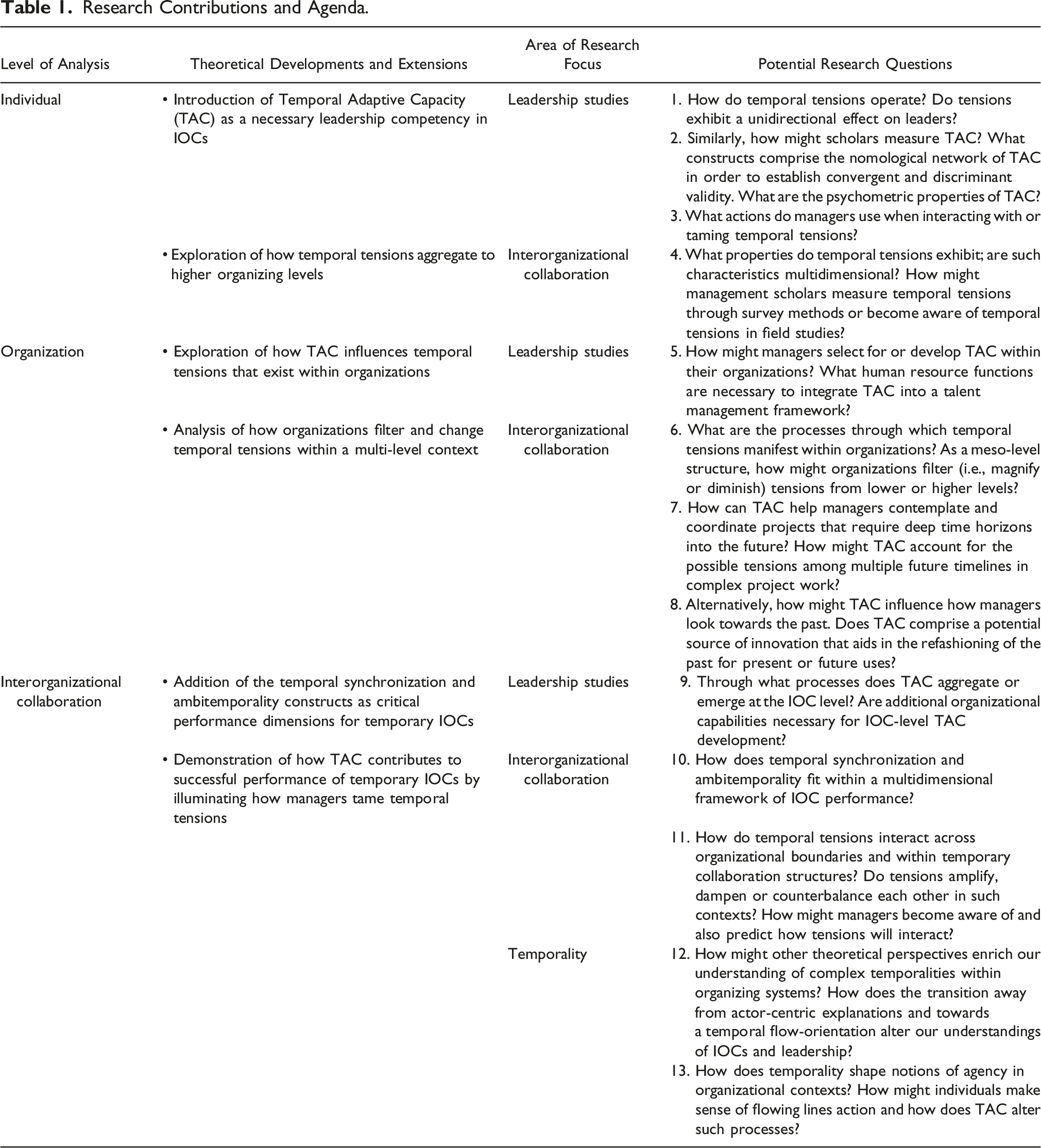
Our work also contributes to the leadership literature by introducing TAC as a useful competency for managing the multi-level temporal tensions inherent in TO contexts. Similar to other dynamic capabilities (Wang & Ahmed, 2007), we suggest that TAC can serve as an important competency in managing the temporal dynamics and rapidly changing environments that are hallmarks of effective IOCs (Majchrzak et al., 2015). Previous studies demonstrate the need for collaborative work systems to undergo structural change (e.g., Majchrzak et al., 2015; Quigley et al., 2018); we view leader TAC as one potential catalyst for such change. Perhaps even more importantly, we see TAC as a competency that can be developed over time and nurtured in organizational leaders. Others have found the organization-level performance consequences that derive from leaders’ temporal focus (Back et al., 2020; Chen & Nadkarni, 2017; Nadkarni & Chen, 2014). Similarly, team-level time horizon composition positively relates to organizational ambidexterity (Chen et al., 2019). Extending these benefits to other organizational members or partner organizations will first require that leaders are aware of the existing environmental temporal conditions, the temporal orientations of others involved, and the tensions that result from each. An important first step in evaluating the utility of TAC will be the creation and empirical testing of a TAC measurement tool. Insight from future empirical studies of TAC will contribute to the temporal study of IOCs and provide a complementary method to the qualitative studies most often used to explore IOC dynamics (Majchrzak et al., 2015).
We also contend that a leadership competency regarding temporality will be critical to future IOC efforts, especially those that respond to natural disasters, massive infrastructure projects, and space exploration. Scholars have long thought about the necessity to extend time horizons into the future (Chen & Nadkarni, 2017; Nadkarni & Chen, 2014); Weigand, Flanagan, Dye, and Jones (2014) refer to such capabilities as collaborative foresight. Yet, many recent issues that prompt collaboration require managers to not only extend time horizons into the near future, but also into the distant future. NASA currently has plans to launch a probe to nearby star system Alpha Centauri in 2069 (Clery, 2016), although the technology to propel an object that far remains speculative and the travel time would likely exceed multiple generations (Litchford & Sheehy, 2020). TAC might serve a critical role as managers contemplate multiple timelines in the distant future. Continuing to draw on NASA’s mission to a faraway star system, managers from multiple organizations will need to simultaneously and sequentially develop new technologies that fit together to accomplish their goals, requiring many timelines to complete the work. TAC may help managers keep up with such temporal demands. As such, we are especially curious about the cognitive processes that people employ when thinking about far away events and also when juggling interrelated time horizons.
We also hold that TAC might uncover how managers think about the deep past. Many organizations are steeped in history that stretches back centuries. Scottish whisky makers, for example, frequently employ practices that were in use in the early 1800s and make those practices salient to consumers today even when coordinating with multi-national corporations (McKendrick & Hannan, 2014). Similarly, cultural organizations, such as symphonies or theatrical troupes, frequently form temporary collaborations to perform historical works. We wonder how TAC shapes how people view the distant past and enact traditions in contemporary settings. Is it possible that TAC could represent a pathway for innovation, as managers refashion objects, practices, or symbols from the past for modern use? We cannot help but think about the breakout success of the Broadway musical Hamilton and its reimagining of U.S. history as an illustrative case. Although TAC appears to comprise an indispensable element for organizations involved in temporary IOCs, we encourage scholarship to probe its application to the extremities of how people think of temporality.
Our development of TAC also highlights two performance dimensions of organizations involved in temporary IOCs: temporal synchronization and ambitemporality. As the issues that prompt collaborations become larger in scope and require more complex agent interactions (Sydow & Braun, 2017; Sydow & Windeler, 2020), successfully attending to temporality within IOCs becomes more pressing. However, recent reviews of IOCs often underplay the role of temporality, even when focusing on process theorizing (Bryson et al., 2015; Majchrzak et al., 2015). We join Hilbolling and colleagues (2021) by focusing on the temporal processes as key performance metrics for organizations within temporary IOCs, adding to other performance dimensions, such as coordination and goal attainment. Specific to temporality, how might the actions that support temporal synchronization and ambitemporality change as IOCs change? Are the performance outcomes the same, irrespective of temporal context–temporary or permanent?
Beyond applications to building better collaborative systems, TAC and temporal tensions inform ongoing discussions of temporality within organizations (Oliveira & Lumineau, 2019). For example, our discussions of temporal tensions can offer context to how “organizations incorporate multi-leveled temporal dimensions” into their organizing activities (Heracleous and Bartunek, 2021: 227). In particular, we see especially fruitful connections among our theoretical constructs and those of sensemaking. Dawson and Sykes (2019) review the temporal sensemaking literature, sketching a view of how pasts and futures intermingle as people enact an emergent present. Through subjective temporal tensions and the cognitive underpinnings of TAC, we believe that there is room to further push the boundaries of the temporal sensemaking construct (Dawson and Sykes, 2019). In particular, temporal tensions illustrate the unpredictable nature of temporality, while TAC offers further insight into the role of human agency during the construction of temporality (Bluedorn, 2002; Dawson and Sykes, 2019). Moreover, TAC and sensemaking suggest important implications in moving towards a flow-orientation of organizing, rather than an actor-centric orientation (Baygi et al., 2021).
We suggest that tensions relating to temporality are multi-level and originate among organizational members, participating organizations, and the entire IOC. Temporal tensions intersperse throughout collaborative systems often posing challenges to leaders as participating organizations and IOCs enact temporality differently (Geraldi et al., 2020; Stjerne et al., 2019). We shed light on how temporal tensions manifest and especially focus on the role of temporal orientation and time horizons. From this perspective, we submit that temporality and time orientations can be both stabilizing and destabilizing (Solansky et al., 2014) but recognize that when combined across levels may introduce potentially counterbalancing effects. This recognition offers opportunities to further investigate temporal tensions in collaboration settings. Although we know that varied temporal rhythms and time orientations may introduce tensions and require adaptive responses (Braun & Lampel, 2020), we do not yet know whether these tensions operate unidirectionally. For example, organizational members may exhibit temporal affinities that contribute to identity conflicts with the IOC (i.e., a destabilizing tension) while their organization finds that their own scheduling or pacing strategies align well with the IOC goals (i.e., a stabilizing tension). A potential area for future research is IOC system-level TAC. A leader’s ability to map how multiple temporal tensions interact, aggregate to higher organizing levels, and influence lower levels may also encourage studies of tensions and temporality that emphasize more dynamic perspectives (Baygi et al., 2021). Such investigations may illustrate the temporal dynamics within IOCs and help us better understand how leaders continually accomplish interorganizational efforts through temporal work.
Managerial Implications: Situational Awareness and Enactment of Temporal Tensions
Our theoretical framework underscores that leaders need a clear understanding of temporal tensions to navigate their home organizations successfully in a temporary IOC. Leaders need to develop a situational awareness of various temporal elements. This skill set is an essential component of TAC. Situational awareness represents the leader’s recognition of simultaneous, multi-level, fluid temporal tensions that tend to destabilize interactions within temporary IOCs. The lesson for leaders involved in temporary IOCs is to be thoughtful about introducing ample chances for interactions among partners and the timing of when those interactions occur. Such interactions allow participants to achieve a shared understanding (Majchrzak et al., 2007) of the conditions and together make sense of how best to move forward especially when facing temporal fluidity of organizing. Thus, we emphasize the need for leaders to develop TAC to manage temporal tensions and guide organizational processes through situational awareness and dynamic enactment of appropriate tensions of temporal framing, synchronizing, hyping, and surfing to maintain synchronization and ambitemporality.
We also encourage leaders to develop monitoring systems that may serve as situational awareness productivity tools or as early warning detectors for decision-makers who manage organizations in temporary IOCs (e.g., Benbya et al., 2020). Leaders may choose among various temporal concepts that contribute to effective IOC outcomes to surveil (Whyte & Nussbaum, 2020). For instance, such monitoring mechanisms could alert leaders that their collaborative systems are beginning to move out of pace relative to partner organizations (Skade et al., 2020) or that the temporal orientation among collaborators focuses too narrowly on short-term activities and goals (Bluedorn & Standifer, 2006). Implementation of temporal monitoring tools could complement other cost-minimization control mechanisms and allow firms to invest further in opportunity maximization approaches based on trust and respect (Mudambi & Tallman, 2010). For some temporal metrics, managers may wish to modify attitudinal pulse surveys for rapid deployment and observation over short intervals (Macey & Fink, 2020). We especially think that artificial intelligence that focuses on temporal traces within networks (Sergent et al., 2020) may be promising and bolster recent theoretical advancements regarding temporality within complex organizing settings (Baygi et al., 2021). Thus, temporal monitoring systems could assist leaders with the dynamic decision-making process by quantifying the temporal dynamics, detecting changes among temporal characteristics, and evaluating the effectiveness of intentional enacted tensions. Ultimately, the benefit of temporal intelligence systems may help minimize the all-too-common reality of unsuccessful multi-firm collaborations (Greve et al., 2010).
Conclusion
The emergent and dynamic nature of organizational life makes temporality relevant when we consider the process of how organizations work together. Thus, we address previous calls to incorporate temporality into management theory and encourage future explorations of the role of leaders in managing tensions between home organizations and temporary IOCs. By developing an approach to managing multi-level competing temporal tensions through TAC, we hope our work creates a platform from which others may launch explorations of such leader competency in future studies. A keen attention to the temporal features of collaborative organizing and the intentional introduction of relevant temporal tensions made available by TAC offer the potential for achieving important outcomes for those involved in temporary IOCs.
Footnotes
Declaration of Conflicting Interests
The author(s) declared no potential conflicts of interest with respect to the research, authorship, and/or publication of this article.
Funding
The author(s) received no financial support for the research, authorship, and/or publication of this article.

Associate Editor: Lucy Gilson