



Abstract
Current research on negotiated individualized flexible work arrangements focuses on highly paid, skilled professional workers. We refer to this as “flexibility through privilege,” the ability to obtain “flexibility I-deals,” due to high labor market power. Yet as work-life tensions grow across occupations globally, most individuals need increased access to flexibility. As the COVID-19 pandemic illuminated, work-life equality, the ability of workers to have equal access to, opportunity to use, and benefit from flexible working arrangements is a rising form of job inequality. We examine how existing flexibility i-deals can be reconceptualized more broadly to include collectively bargained arrangements across many occupations, and flexible working forms. Our essay advances understanding by (1) broadening notions of the typical employee and occupation involved; (2) expanding negotiation processes beyond an organizational sphere of control; (3) identifying new forms of negotiated flexibility such as control over work-life boundaries and technological availability; and (4) addressing not only employer-employee mutual benefits, but larger societal interests concurrent with new tensions and unintended consequences of mainstreamed implementation. We propose the term “collective flexibility” as the collective right of workers to customize their work schedule, place, workload, boundaries, connectivity, and employment mode with their employer and other stakeholders to benefit employers, employees, and society. We offer a future research agenda. Expanding how we frame and study what a flexibility i-deal is with a collective approach regarding how they are accessed, negotiated, maintained, and who they serve may enhance their potential as a lever for social change to advance economic, social, and health employment rights.
Keywords
Making Flexibility I-Deals More Ideal: Advancing Work-Life Equality Collectively
“Flexibility can mean different things to each of us, and we recognize there is no one-size-fits-all solution… at Microsoft…. To address this, we have provided guidance to employees to make informed decisions …..that could include changes to their work site, work location, and/or work hours.” Microsoft Chief People Officer Hogan (2020).
Microsoft, like many leading employers around the globe, as a response to the COVID-19 pandemic, is adapting employment policies in ways that increase employees’ ability to customize flexible working. Moving into the future, the company goal is to “offer as much flexibility as possible to support individual work styles, while balancing business needs and ensuring we live our culture” (Bariso, 2020). As the accelerated rise of technology is making many knowledge worker jobs more virtual and portable, employers are permitting growing numbers of employees to negotiate individualized changes to their work arrangements. Individuals may request to customize where they work, choosing the office, their home, or a hybrid combining the two, selecting these options around mandated “core” hours (Zeidner, 2020). Those with a difficult commute may bargain to mostly work remotely. Others living near the employer may prefer frequent days on site. Some employees may wish to work part time, part year, compress their work week, or alternate shifts to better care for children and other family members. The increasing variation in how employees desire work and nonwork flexibility to be structured, reflects the growing diversity of work-life needs (Kelliher, Richardson, & Boiarintseva, 2019) and identities (Kossek, 2016). Even when changes prompted by the COVID-19 pandemic subside, a transformation of flexible working arrangements toward mass customization is likely to be a long-term workplace trend. And as discussed below, access to flexibility options need not be limited to knowledge workers, but available to all occupations (Kossek and Lee, 2020).
While by no means new, individualized work arrangements, sometimes referred to as “ i-deals,” are growing and central to the modern employment relationship (Rousseau, 2001). I-deals are defined as “voluntary, personalized agreements of a nonstandard nature negotiated between individual employees and their employers regarding terms that benefit both” (Rousseau (2005, p.23). As job security has declined over recent decades, employing organizations have moved away from standardized conditions (Bosch, 2004), toward boundaryless careers (Arthur & Rousseau, 1996). In this context, highly skilled workers with market power, have been able to negotiate individualized work arrangements and gain such benefits as interesting work, good pay, and access to flexibility, Employing organizations benefit from i-deals as they foster positive employee attitudes such as increased commitment and the willingness to work long hours (Hornung, Rousseau, & Glaser, 2008).
I-deals are most commonly negotiated after hiring, a practice referred to as ex-post i-deals (Rousseau, Ho, & Greenberg, 2006); Simosi, Rousseau, & Weingart, 2021). The content of i-deals varies. Developmental i-deals offer time off for education or training opportunities (Liao et al., 2016). Task i-deals include changes to job tasks to focus on interesting work (Hornung, Rousseau, Weigl, Mueller, & Glaser, 2014). Financial i-deals involve special compensation or incentives (Rosen, Slater, Chang, & Johnson, 2013). Flexibility i-deals provide the ability to customize hours, location or workload (Hornung et al., 2008; Wang et al., 2017).
Our focus in this paper is on flexibility i-deals, in light of their growth and rising importance to the employment relationship (Kossek & Ruderman, 2012). We contend that how employers implement i-deals, and how scholars study them, should be reviewed with an updated broader framework, given that more workers may now have access to flexibility i-deals. First, we contend that there is a need for a new approach to conceptualizing flexibility i-deals that is not predominately focused on highly skilled knowledge workers.
Second, we examine the fundamental weakness of current conceptualizations of i-deals that typically places emphasis on individualized bargaining conducted within the firm, because of the power imbalance it reifies in the employer–employee relationship. Flexibility is critical to worker well-being, yet via conventional i-deals, the employer may easily implement flexibility in ways that may not be fair, or transparent, and are overly controlling of employees’ working arrangements. Even favored workers who may love their i-deals at the outset, risk of being disadvantaged over time. Instead, of mainly individualized bargaining, we argue for advancing collectively bargained i-deals. Considerable i-deals research centers negotiation on the interpersonal level within the organizational boundaries of control of a single employer. We draw on the notion of collective rights used in gender equity bargaining implemented in countries such as New Zealand and Australia (Proctor-Thomson, Donnelly, & Parker, 2021). We also expand the types of flexibility i-deals to negotiate in order to address emerging flexibility issues such as the right to disconnect during personal time. We propose the term “collective flexibility” as the collective right of workers to customize their work schedule, place, workload, boundaries, connectivity, and employment mode with their employer, in consideration of relevant stakeholders.
Third, we believe the assumed benefits of i-deals can be expanded to include multiple stakeholders (e.g., employer, employees, family, society). A collective approach would allow for greater transparency, consistency and equality. It could ultimately allow employees across at all levels of society to take advantage of the benefits of i-deals.
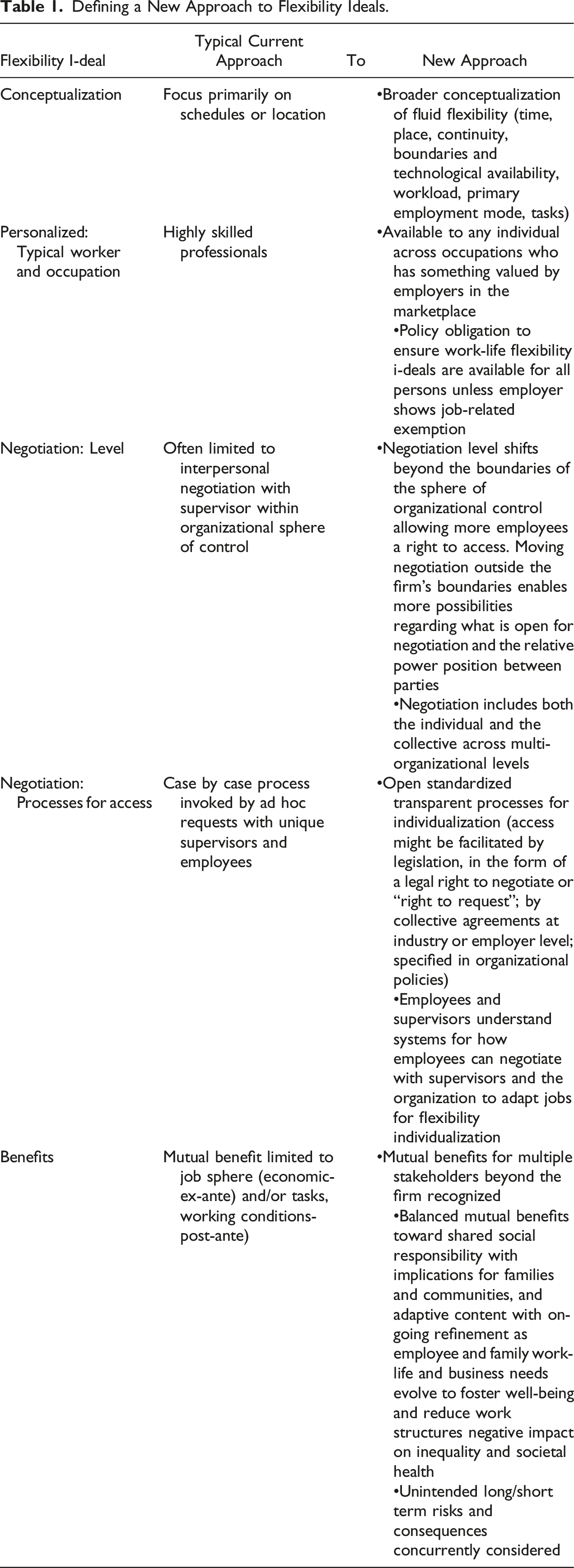
Defining a New Approach to Flexibility Ideals.
Moving toward New Employer and Employee Perspectives on Flexibility I-Deals: Covid-19 Opportunities and Risks
In her seminal work, Rousseau (2005) identifies three essential elements of i-deals—that they are personalized, negotiated, and intended to be of benefit to both the employer and the employee (for a summary, see Table 1), distinguishing flexibility i-deals from some other forms of formal flexible working arrangements. Before discussing how these elements can be updated and expanded, we first offer general background with supporting rationale for why a new approach is needed. This includes the need be cognizant of ongoing employer resistance to expanding flexibility i-deals despite worker benefits, and the fact that Covid-19 has created a paradigm shift with dual tensions supporting greater flexibility access, while further exposing inequality risks.
Employer Resistance to Flexibility Despite Research, Social Justice and Legal Rationale
Historically, most firms have refused to offer negotiated individualized flexibility, until it was seen as serving the company interests. Many employers hold the often false belief that most people cannot be trusted to work flexibly. Or when flexibility is allowed, career premiums should be limited to people who use flexibility to work long hours, but not when it is used for work-life needs (Leslie, Manchester, Park, & Mehng, 2012). Another basic assumption is that the workplace was most efficiently run if everyone worked the same schedule and in a standardized way. This belief still prevails in many firms, despite growing research evidence, outdated beliefs on work-life relationships, and social justice arguments supporting our thesis: that offering more flexibility i-deals to more workers in a collective way would benefit employees, employers, and society.
For example, telework studies consistently show that management support and workers’ enthusiasm for flexibility and beliefs about productivity effects are often at odds (OPM, 2018). These disparities are surprising given research trends. Evidence shows that teleworkers are more likely to report higher job satisfaction, less job stress, work longer hours, higher performance, and are less likely to intend to turnover than non-teleworkers (Allen, Golden, & Shockley, 2015; Kossek & Michel, 2011; Kossek & Thompson, 2016). Granted, most research has been cross-sectional, so it is hard to assess causality. Nevertheless, the past data on flexibility benefits is generally promising, despite likely selection effects. For example, it is possible that the results of past study samples were skewed by mainly studying higher performing workers who were likely to be given more flexibility as a reward. (Allen et al., 2015; Kossek, 2005).
And work cultures still have outdated (but “sticky”) beliefs and historical roots regarding how the workforce should prioritize work over nonwork roles. Many employees, but especially high potential workers, have been socialized to show work commitment by making work the central focus of their lives. As scholars Williams, Berdahl, & Vandello, (2016) observe, cherished professional social identities in countries such as the U.S. and the U.K. are grounded in strong workplace norms socializing workers to enact unending work devotion (Blair-Loy, 2006). “Good workers” are rewarded to place work commitments above personal needs (and make personal and family sacrifices) in order to “get ahead” and advance into upper class status. Even though the business case for limiting flexibility’s availability has not been supported, beliefs about who should be entitled to access (and trusted) are hard-wired in most employers’ human resource systems conventionally held assumptions on what constitutes meritocracy in distributing flexibility.
Legal and social justice arguments also can be made that the lack of broad flexibility access has perpetuated workplace gender and racial discrimination, intersecting with family roles. For example, evidence shows there are long standing racial inequities in access to paid sick and family leave, adversely affect many racial groups but particularly African Americans and single mothers (Goodman, Williams, & Dow, 2021). Similarly, although there is often implicit bias against hiring women with young children or who are pregnant, studies show expanding access to and the length of maternity leave-taking improves mothers’ economic well-being, labor market participation and child health (Han, Ruhn, & Waldfogel, 2009). Thus, it is society and not just employers and employees who have a stake in how flexibility should be accessed and supported. Moreover, the under-selection of women for prestigious jobs in many occupations is often attributed to the lack of flexibility. For example, in law and for judicial appointments making partner is linked to flexibility access (Rose, 2020). In sum, such workplace conventions and beliefs have held back flexibility expansion until the Covid-19 crisis.
Covid-19 Paradigm Shift toward Flexibility Mass Customization
Increased access for the masses
Like the U.S. Great Depression, experts suggest that the COVID-19 pandemic has been a transformative societal experience. In relation to flexibility, particularly working from home, Covid-19 has created a paradigm shift in that flexible working is increasingly viewed as a condition of employment. Notably, a recent Society for Human Resource Management survey found that 81% of respondents reported choosing a job based on the potential for work-life balance and opportunities for flexibility in their working arrangements (SHRM, 2021a,b). Many employers are adapting their pre-pandemic narratives regarding work-life flexibility practices from those of viewing them as ad hoc work-life accommodations, to now recasting flexible arrangements as general “business productivity tools” (Kossek et al., 2021c). Progressive employers offer the opportunity to customize working arrangements, not only to high potential, highly valued individuals but also as a means to attract workers away from other occupations due to growing labor shortages (e.g., health care, trucking, manufacturing) and resignations experienced during the Covid-19 pandemic (Klotz, 2021).
This trend of providing more employees some degree of choice to select, control, and shape their working arrangements in terms of the timing, location, workload and other working conditions, has the potential to foster mainstreaming of “flexibility i- deals.” It reflects a major shift in work organization that could lead to a re-invention of the employment relationship towards a workplace that allows greater tailoring of flexible working arrangements to habitually support the different personal needs of individuals.
Changing views of work-nonwork ideal worker rigidities
A potential consequence of this shift away from standardization to greater customization, may be a weakening of the prevailing “ideal worker” overwork norm with a move towards supporting diversity in work-life styles (Kossek, 2016). Professionals in not only western countries, as noted above, but also in Asia (e.g., Japan, China), for example, often work very long hours as a way to demonstrate devotion to their employers and careers. Personal and professional identities have long been intertwined and employers have co-opted this sometimes to manipulate workers’ “competing devotions” to always prioritize work over family (Blair-Loy, 2006) Yet with the loss of life during the pandemic, and the fact that some front line workers worked in daily fear of getting Covid-19 and bringing it home to their families has led to wider variation in how work-nonwork roles are enacted within professions. More employees today are desiring the right to place nonwork roles equal if not higher consideration than work roles (Kossek, 2016, 2012).
Rethinking the work-life social contract
The experiences of the pandemic have caused many—including a sizable number of women (Vasudevan, 2021), to reflect on what is what is important to them and how want to allocate their time and energy as they age. This leads to greater interest in negotiating work-life flexibility (Alexander, De Smet, Langstaff, & Ravid, 2021) in order to control the structuring of work activity to interfere less with other life roles. While Covid-19 has many challenges, those able to experience working more flexibly during the pandemic found some positives (Kossek et al., 2021a, b). For example, many employees and their families experienced better well-being through decreased commuting. They also had more time for nonwork activities such as exercise, caring for pets (instead of paying a dog-walker), supervising homework, and home-cooking meals (due to closed restaurants). Such experience has prompted some employees to rethink how they want to engage with work and this may make many them reluctant to return to pre-pandemic conditions of limited flexibility (Goldberg, 2022).
Flexibility job inequalities exposed by Covid-19
The Covid-19 pandemic exacerbated and exposed growing work-life inequality among workers. Differences arose from gender roles (e.g., the unequal societal caregiving demands for employed women and men), as well as from jobs (e.g., the greater ability of nonessential workers to telework and multi-task domestic demands with their jobs, unlike many essential workers) Race and gender are often correlated with job level with women and minorities often concentrated in lower level jobs that systematically have less access to flexibility (Kossek & Lee, 2020).
And it is not just access to flexibility that matters for equality. Covid-19 exposed inequities in the gendered adverse impacts of how flexibility is implemented and experienced, given how caregiving demands remain unequally distributed in society. For example, during the pandemic, employees who had heavy care demands, often women, ended up being adversely affected by teleworking—some to the point of contemplating occupational turnover or even giving up custody of children in order to be able to perform their jobs (Kossek, Dumas, Piszczek & Allen, 2021b). And often 24-7 work availability expectations prevailed, creating a form of “inflexible flexibility”—(Kossek et al., 2021c). By this we mean, flexibility is either implemented in ways that dictate employer parameters to certain days or times that not flexible to meet employees’ needs; or is enacted with no work-nonwork boundaries. Thus, some professionals—predominately women—who were given access to telework full-time, actually experienced less flexibility to control working time, and more work-nonwork role overload as their employer expected them to be at their “beck and call.” They lacked flexibility to manage their rising domestic demands such as virtual schooling, shopping for food for elders, and displaced child care from centers to home.
Having discussed growing opportunities and risks of expanded flexibility, let’s now turn to examining elements of Rousseau’s i-deals to before elaborating the adapted framework.
Adapting Rousseau’s I-deals Concepts toward to a Mainstreamed Flexibility Approach
In this section we suggest adapting Rousseau’s i-deals concepts. We question emphasis on the process being an individualized one between a worker and their employer, for mutual benefit. Instead, we propose that a collective approach would make the access and implementation process resulting in a more even balance between employee and employee power in negotiation and between less and more privileged workers (and possible better features of i-deals). Flexibility i-deals should be mainstreamed in access, with processes put in place to ensure equity in implementation, and safeguard against potential adverse impacts such as increased stigmatization and consequences of use on traditionally marginalized populations. We also call for negotiation to shift from an individualized flexibility process to be negotiated collectively (e.g., giving employees a right to request flexibility) between employee groups and organizations. We call for national or industry institutionalized flexibility policies that give workers a right to request flexibility in order to advance collective negotiation. To do this, it is important the negotiation context is moved beyond the bounds of the organization in order to enable greater balance of power in the negotiation process. Employers typically hold greater power in the employment relationship. This is particularly the case in contexts where they are able to hire and fire at will such as in the U.S. While there are exceptions such as in Germany where workers and managers are allowed to co-craft specific arrangements together in a regulated flexibility approach (c.f. Hornung et al., 2008), considerable previous i-deals research has primarily focused on the role of the individual in the development of an i-deal (Gascoigne & Kelliher, 2018; Rousseau, 2005).
We argue that in countries such as the U.S. and U.K. which have traditionally valued more individualistic cultural approaches to i-deals, a collective approach to crafting flexibility i-deals might result in better ideals and ways to implement flexibility. For example, a few global firms are beginning to demonstrate that collective approaches to i-deals can be effectively implemented across cultural contexts. At Northern Trust, a large global bank, groups of workers migrated in teams to hybrid working, long before the pandemic. Members developed a team charter on how to back up electricity, core hours, how to contact each other, and how office space will be shared in the main office (Kossek, Thompson & Lautsch, 2015). These are examples of how individuals, teams and employers working together may lead to more creativity with better i-deals, as the features and implementation are co-crafted. Thus, the way in which flexibility’s features are implemented and designed may benefit from being jointly crafted via negotiation by workers and the organization—allowing for the creation of new work roles. A collective approach also takes the burden off individuals and managers to be expected to reinvent i-deals terms from scratch.
In sum, we argue that the existing approach to i-deals is not inherently bad. However, we contend that all workers need increased access to work-life i-deals to take account of their growing nonwork demands and interests. Yet we temper this view with the belief that the current approach to how flexibility i-deals are conceived and implemented often is too individualized in many industrialized countries (e.g., U.S. and U.K.). We believe that how they are often currently enacted is too informal, too privileged, and creates inequality, harming workers families and society. Yet we also recognize that many i-deals studies are conducted outside of the U.S. and U.K, around the globe (Ilsoe, 2010; Liao et al., 2016). Our assumptions made here are culturally bounded to more individualistic Western cultures, where individuals asking for a special hidden deal different from the collective is not unusual (Liao et al., 2016).
Flexibility I-deals: Current Definitional Considerations
Let’s briefly review elements of Rousseau’s definition in order to understand how flexibility i-deals differ from other flexible arrangements. First, since an essential element is that they are negotiated, this distinguishes them from some other types of changes to working arrangements and conditions. The latter would be the case, for example, where employees take advantage of a legal right to change their working arrangements. In some countries (e.g., Germany, Sweden) parents have a right to work part-time (c.f. Kruse, 2020). In others (U.K., Australia, Denmark) employees have a “right to request” changes to their working arrangements. Employers are only able refuse these requests on legally specified grounds (cf Croucher & Kelliher, 2005). Flexibility i-deals also differ from circumstances where employees have the opportunity to exercise discretion over their working arrangements without prior agreement from their supervisor. This would include for example, formal flex-time schemes which grant employees schedule control within an established framework, such as the requirement to work during prescribed “core” hours each day.
Negotiation
The question arises over what constitutes negotiation of flexibility i-deals in a workplace context. If an employee puts a proposal to their manager, who simply agrees to it, does this represent negotiation? Strictly speaking, negotiation is generally understood to involve bargaining over resources, with some form of concession needed in order to gain some form of benefit and where the relative power position between the two parties is central to the outcome (McAndrew, 2017; Walton & McKersie, 1991). Further, the expectation that the supervisor must negotiate is a legal and collective right, where the i-deal terms can only be refused if the accommodation demands are legally shown to be too costly or difficult.
Mutual benefits
The characteristic of mutual benefit is likely to mean that some customized arrangements might fall outside of the traditional i-deals definition. It is clear that where an employer agrees an i-deal, in order to be able to recruit, retain or motivate an employee, they gain some benefit from this. However, where they agree through a feeling of social obligation to support, for example, working parents, or are benevolent towards an employee with particular needs, at least in the short term, the benefit for them is less clear. Even where there is mutual benefit, under the current conceptualization it is likely that the benefit will not be unequally balanced between the employer and employee.
Towards a New Approach to Flexibility Ideals
Table 1 shows how these concepts might be adapted to mainstream flexibility i-deals access to more employees across and within occupations. Below we develop our argument that revisions are needed to current i-deals conceptualization in order to to broaden assumptions about the types of workers involved, negotiation including processes for accessing, bargaining levels and content, and mutual benefits.
We define collective flexibility i-deals, as a collective right for workers to customize their work schedule, load, location, continuity, work availability, and connectivity (including the right to disconnect from work in our increasingly 24-7 connected world) in negotiation with their employers. The notion of collective right has been developed in many countries such as Australia and New Zealand’s approaches to gender equality bargaining, which focus on “the collective negotiation of provisions that are of interest to women,” may address workplace structural inequities, and are likely to foster gender equality (Colling and Dickens, 1998: 390). Collective regulation involves “the interrelated levels of the employment relations system, including the legislative framework, collective bargaining, workplace policy and management cultures, (which) interact to shape opportunities” (Proctor-Thompson, et al. 2021: 615). Below we suggest 5 themes for broadening flexibility that we organize around Rousseau’s core elements.
Individualization Rights: Typical Employee
Theme 1: Policy obligation to make flexibility i-deals available to any worker in any occupation
We have noted that current i-deals research concentrates on highly paid, skilled professional workers with significant market power, and often those who can work virtually. We view this as “flexibility through privilege,” the ability to obtain “flexibility I-deals” due to high labor market power. This approach perpetuates a workforce-workplace societal mismatch in the flexibility access that most employers are providing and what growing numbers of workers need and want
All individuals across any occupation should have the ability to choose their working hours, days, workload, location, continuity, and availability, not through private, invisible deals, but openly and collectively. We propose that such an expansion is needed to make i-deals fairer. This would allow them to be open to many more workers, including hourly paid service and manufacturing workers, and those in collective bargaining agreements, who largely been left out from this trend toward greater flexibility. These workers frequently lack the opportunity to customize their working arrangements, despite juggling the same pre and post pandemic life demands as professionals.
As the COVID-19 pandemic’s shortages of many essential workers has highlighted, in reality, employees across many occupations have market and social value. In this context, we advocate that every employee should have the right to negotiate a flexibility i-deal for mutual benefit. Granted, it has long been socially constructed that “some front-line jobs just can’t have access to flexibility.” Yet as we learned during the labor shortages of the pandemic, many employers quickly learned how to make jobs that had previously been deemed difficult to offer any flexibility now more flexible. Hourly and customer-facing workers such as in retail, health care workers, have now been given the opportunity to choose their shift through self-scheduling and shift trades. While available before the pandemic, airlines and retail workers can even more easily now make shifts they do not want to work available to co-workers (Kossek, Gettings & Misra, 2021). Even in tough jobs such as policing, compressed work weeks such as working 4–10 hour days are increasingly common. For manufacturing jobs, where flexibility has been relatively limited, employers are staffing with an extra generalist employee especially during winter months when schools close due to bad weather and illness (Kossek, Hammer, Thompson & Burke, 2015).
A collective approach will also help address inequities among professionals. Currently, many individually- based variations may occur where supervisors who are not open to greater flexible working can act as gatekeepers to control access and the amount and nature of, employees’ ability to control their flexibility. We argue that a collective and transparent approach is needed to moderate these gatekeeping roles and to ensure fairness in access, together with increasing employees’ negotiation power to secure better outcomes.
Broadening access might not only reduce inequities between different types of jobs, but might also facilitate a leveling up. This could help reduce societal work-life differences across rural and urban settings, and even globally between industrialized and non-industrialized countries. A right to negotiate a flexibility i-deal would be less geographically restricted, since currently knowledge worker jobs with higher market power are often clustered in urban areas in wealthier countries. Organizational and collective, national and NGO policy imperatives could be piloted to provide a basic right for all employees to be able to negotiate a flexibility i-deal.
Negotiation: Process for Transparent Access, Level, Content
Theme 2: Open standardized processes for individualization access and implementation agreements.
We argue that in order to make i-deals more mainstreamed, the processes for access needs to be more transparent and standardized. The current informal and ad hoc nature of many i-deals means that they are often “hidden.” The specific details of the arrangement agreed between the worker and their manager may not be clear to other workers, including those in the same team, with the same manager, or more broadly throughout the organization. Lack of transparency means that individuals entering negotiations to secure an i-deal for themselves lack sight of the nature and scope of any existing i-deals. As a result, employees often negotiate “blind,” not knowing what their manager has agreed with other workers and therefore what might be available to them
Formalizing the process by which i-deals are negotiated could allow for greater equity between workers. For example, Rousseau reports (2022) that in countries such as Denmark, the union shop steward is a broker with management in crafting i-deals. The steward is aware of what i-deals exist and all are public. This approach is referred to as controlled decentralization. Similarly, drawing on 10 case studies comparing flexible working bargaining agreements in the metal manufacturing industry, Ilsοe (2010) found company-level agreements were more effective, when implemented in Denmark, than in Germany. They surmised reason for these differences is because in Denmark, the bargaining occurred in a context where management trusted workers to consider the companies’ interests when managing hours. Thus, a cultural context of high trust that considers balancing employee and employer interests may facilitate collective i-deals bargaining.
A formalized and standardized process for negotiating i-deals would have a number of advantages. First, it would signal to employees that non-standard working arrangements are available through a socially co-created negotiated process. Second, it would help legitimize i-deals. As a result, those with i-deals might feel more prepared to be open about the details of their arrangement, since they may feel that their arrangement is more secure. Third, this could lead to a framework setting out the boundary parameters within which i-deals can be negotiated. Thus, standardization and openness of the process would allow for greater equity of opportunity regarding customization of working arrangements. It may be of particular importance in addressing inequities where there are differences in supervisors’ willingness to agree to changes to working arrangements. Standardization in this way focuses on the process of obtaining a deal, rather than the content of the deal. Fourth, standardization of processes for accessing i-deals might also minimize the economic transaction costs, which are the economic costs and complexity of the firm reinventing each arrangement (Williamson, 1975) to organizations of offering i-deals, since the processes for accessing and implementing i-deals would be clear. Such standardization would also enable employees and their supervisors to better understand how employees can negotiate i-deals with supervisors and how the organization can adapt jobs for individualization that existed prior to the registration of flexibility needs.
A standardized, transparent process taking a more inclusive approach would also benefit from some guiding and/or regulatory mechanisms in order to ensure that the opportunity to customize working arrangements is genuinely available to a wider group of employees. At a basic level, this might be in the form of an organizational policy, perhaps where the default response is positive to an employee’s request. This process would thereby shift responsibility from the employee to demonstrate that it can work, and to the managers who would need to demonstrate that it is not workable. Stronger regulation might be the form of legislation giving a right to request, or through collective agreements specified at an industry or employer level. For example, in the U.K., employees irrespective of age or caregiving needs have the legal right to request flexible working. In practice, this means that the employer is obliged to consider the request and is only able to refuse for specific, legally defined reasons. Although the limitations of only providing a legal right to request and the breadth of the specified grounds for refusal have been criticized (Croucher & Kelliher, 2005), it has opened up access to flexible working arrangements to many workers across many jobs and provides a more transparent process that existed prior to the registration.
Theme 3. Shift negotiation level toward the collective altering relative power positions and consistency of opportunity
The content of any i-deal will inevitably, at least to some degree, remain influenced by the relative power between the workers and the employer. Greater standardization and transparency as discussed above would allow the worker to be better informed about the possibilities open to them and allow them greater opportunity to be better prepared for the negotiation. In cases where workers are represented by a trade union, or other representative body, a framework for negotiation of i-deals could form part of a collective agreement between the trade union and the employer. Trade union or professional employee association representatives would also be able to assist individuals in the negotiation of an i-deal in either representative or support roles.
Existing research on i-deals has given some consideration to moving negotiation beyond the individual level. In their review of i-deals research Liao, Wayne, & Rousseau (2016) propose that future work should examine i-deals from a multi-level perspective, including group i-deals (and “we” deals). Since i-deals are individually negotiated agreements regarding working arrangements and conditions of employment, customized to suit individual circumstances, they inevitably create within-group differences (Klein, Dansereau, & Hall, 1994). As a result, they may present a challenge for perceptions of fairness in the way in which employees are treated, not least because some employees may seek customized arrangements more actively and be able to negotiate them more effectively. For flexibility i-deals, in particular, fairness is an important issue as different types of flexibility (e.g., teleworking, vs. part time work etc.) have differing risks and benefits for employer and employee stakeholder groups (Kossek, Thompson & Lautsch, 2015).
Although i-deals by nature represent within-group differences in working conditions. Liao et al. (2016) argue that they might be considered at a group level by examining their prevalence and availability within a group. Liao and colleagues also note the need to understand how individuals may perceive the distribution within the group and how this may impact employee attitudes and behaviors (Erdogan & Bauer, 2010; Greenberg, Roberge, Ho, & Rousseau, 2004). Granted, problems may arise from inconsistencies and relate to perceptions of justice about how group members are treated where there are differences in what is agreed to in an i-deal. Yet this is less likely to be the case in relation to consistency in the opportunity for individuals to even access the opportunity to negotiate an i-deal. Building on this idea, it is important to consider how consistency of opportunity might be achieved. While supportive line managers may strive to offer the opportunity to negotiate an i-deal to all employees, we propose that a collectively bargained approach may offer a more robust and resilient approach to achieving this principle of consistency of opportunity.
In developing this argument, we draw on literature relating to gender equality bargaining, based on studies in countries where this is more prevalent (Donnelly & Procter Thompson, 2015). A number of mechanisms exist to help achieve gender equality in the workplace, including through working arrangements and conditions. These considerations take account of outside work commitments, for example, through legislative provisions, workplace policies and practices, individual and collective bargaining. However, if these bargaining arrangements that consider outside work demands are conducted in isolation, there may be limitations on their effectiveness. Legislation needing to be supported with other mechanisms, such as collective bargaining if it is to be effective (OECD, 2016). Likewise, the existence of organizational policies may not always result in the intended practice and where bargaining takes place on an individual basis. Rather, the outcome may be dependent on the power that an individual holds in the employment relationship. This finding is consistent with early ethnographic research conducted decades ago on the Time Bind individuals face in corporate life (Hochschild, 2001). Such tensions remain relevant today regarding prevailing work-nonwork hegemonies, where work role is largely favored in many industrialized societies over favoring other parts of life such as time with family. Proctor-Thomson et al. (2021) observes that the tension between statutory, organizational and collective regulation is particularly marked in relation to flexible, non-standard working arrangements. They note two interacting dynamics involved with securing the provision of non-standard (flexible) working arrangements. The first is the sphere of organizational control—what the organization can/cannot control. The second is negotiability, whether there is a role for negotiation, (individual or collective), in determining the arrangement, or whether it stems from legislative provisions and/or organizational policy.
Where negotiation is between the individual and their manager and therefore likely to be within the organizational sphere of control, such arrangements may be vulnerable and subject to alteration or being withdrawn (Cooper & Baird, 2015; Donnelly et al., 2018; Hornung et al. 2008). Even where access is mandated through organizational policy, access may be subject to change, in line with shifting organizational priorities, and exceptions and varied interpretation may be permitted. Where access is through legislative provision, it is argued that the provision is often weak (Croucher & Kelliher, 2005; Proctor-Thomson et al., 2021), since it may only provide “the right to request,” as in, for example, the U.K., Australia, Canada, and New Zealand, although stronger provision exists in Scandinavian countries (Larsen & Ilsoe, 2016).
Taking these factors into account, for gender equality, it is proposed that collectively negotiated provision of flexibility may allow for wider access; and enhance the provisions of legislation and protect against the kind of vulnerabilities where access is wholly inside the organizational sphere of control. Similarly, with i-deals collective agreements may have the potential to be a communication and educational tool for both employees and for managers and therefore may mitigate some of the outcomes associated with the secrecy of the private aspects of i-deals (Liao et al., 2016).
Conceptualization of Content
Theme 4: Broadening flexibility i-deals to include more work-nonwork flexibility forms and consideration of bundling synergies and misfits (e.g., time, place, continuity, boundaries, workload, connectivity, primary employment mode)
The content of what is considered a flexibility i-deal in the i-deals literature would benefit from being updated and broadened. We propose that flexibility i-deals might be renamed work-life flexibility i-deals, since flexibility i-deals are often sought by employees to support personal preferences and diverse needs for work and nonwork role integration (and sometimes separation of boundaries as well).
Currently, the i-deals literature lacks integration with how the traditional work-life flexibility literature has conceptualized flexibility (cf Allen, Johnson, Kiburz, & Shockley, 2013; DeMenzes & Kelliher, 2017; Kossek & Michel 2011; Kossek et al., 2015; Kossek & Thompson, 2016). Reviews of the extant flexibility i-deals research show that most relate to hours or location, and with workload i-deals often considered separately from the flexibility i-deals concerning schedule and location (cf. Rousseau, Hornung & Kim, 2009; Simosi, et, al., 2021). Yet in the work-life literature, these are often considered just as different forms of flexibility. Workload reduction, for example, may involve reduced hours, or time in the office, or a job share and often may involve customization of work hours, load and days jointly by definition (Kossek & Ollier-Malaterre, 2019). Further, there are new forms of flexibility related to boundary management that could be added to the negotiation agenda. These include the right to not be available to work, and to be able to disconnect from texts and emails as new frontiers to negotiate for customization as a flexibility i-deals (Kossek, & Lautsch, 2012). And with the move toward hybrid work, work mode also has emerged as an aspect for negotiation. An employee may be chosen to be primarily an office, local or remote worker as a preferred work mode (Kossek et al., 2021). The timing and length of leaves for maternity and paternity or adoption may be negotiated as a continuous or intermittent absence from work. Right now the i-deals literature is relatively silent on these issues.
Examining the impacts of i-deals where multiple flexibility forms are bundled also may identify favorable and unfavorable clusters. For example, Liao et al. (2016) found in their meta-analysis that access to different quantitative measures of i-deals such as content (flexibility, task or career) tend to be correlated. Similarly, different forms of flexibility often occur together (Kossek, Perrigino, & Lautsch, 2021) and can be leveraged for synergies. For example, employees who work from home may also be able to alter their working hours. Or different types of flexibility when negotiated separately may be difficult to manage, such as part-time working arrangements in an always-on, 24-7 work-culture, which could lead to “bad deals” for workers. Given that flexibility i-deals will continue to grow in dimensions and complexity, we argue for a more expansive definition of flexibility i-deals in the literature to fit with the broadening of how flexibility is considered in the wider work-life literature.
Mutual Benefits
Theme 5: Mutual benefits for multiple stakeholders beyond the firm recognized over time for sustaining flexibility i-deals
Much of the current i-deal research focuses on short-term job-related benefits to the organization’s productivity and employee’s working conditions. Yet the ability to access and sustain mutually beneficial flexibility i-deals has the potential for long-term benefits far beyond the organization and an individual worker. We argue that flexibility i-deals should ultimately not only benefit the employer and the individual worker, but potentially also contribute to societal goals (e.g., wider labor force participation, better mental health and levels of educational attainment, reduction of carbon emissions through less commuting, improved caregiving).
Reducing overworking and work-life stress, in particular, has the potential to positively impact the health of workers, families, and communities. Giving many employees more opportunities to restructure work in different ways through flexibility i-deals potentially frees up time for individuals to make space for greater involvement in other personally meaningful nonwork roles and spheres that benefit society. Examples include volunteering in the community, becoming politically engaged for positive social change, or helping families and friends with care and social needs. We think the delineation of benefits from i-deals in future research needs to include a social accounting balancing wider societal benefits. Thus, there could be a market value placed on commitment to a shared social responsibility of employees and employers to support the mainstreaming of flexibility i-deals.
When considering i-deals, a longer-term view should be taken when assessing the benefits as well as the negative impacts on job inequality and health. Taking a longer term multiple stakeholder approach to flexibility i-deals would also help restore a greater sense of mutuality between employers and employees. For example, it might help sustain a working relationship in the longer-term, since the demands of the employee’s personal and family life would be considered on an equal basis to work demands. Adopting this approach could also reduce turnover, employee burnout and work-life conflict as well (Kossek & Michel, 2011). There might also be child and elder care and health care cost savings by enabling workers to be able to restructure work to allow them to better care for self and family.
Discussion
In this essay, we argue that access to individualized negotiated work practices that promote employee well-being, such as the ability of individuals to tailor flexible working, should not be a perquisite limited to elite workers. Instead of workplace cultures supporting “personalized flexibility for the few,” workplace norms need to evolve toward “flexibility for the majority” as “the new normal” for several reasons. First, given work-life tensions have grown across nearly all occupations globally, most individuals need increased access to flexibility. Employers can help promote occupational resilience (Kossek & Perrigino, 2018) by designing jobs to give more flexibility to workers. Second, as the COVID-19 pandemic illuminated, work-life equality, the ability of workers to have equal access to, opportunity to use and benefit from flexible working arrangements is a rising form of job inequality (Kossek & Lee, 2020). By not updating the flexibility policies, given the adverse impacts observed during the COVID-19 pandemic, employers are perpetuating inequality. Third there is a growing diversity of work-life needs and identities in society which are simply not being addressed in the design of most workplaces to support work life inclusion (Kelliher et al., 2019; Kossek & Lee, 2021).
To address these issues, we proposed a new broadened i-deals conceptualization that could lead to the further development of a stream of the i-deals literature that focuses on mainstreaming flexibility i-deals. Specifically, our article advances understanding by (1) broadening notions of the typical employee and occupation involved; (2) expanding negotiation processes beyond an organizational sphere of control; (3) identifying new forms of negotiated flexibility such as control over work-life boundaries and technological availability; and (4) addressing not only employer-employee mutual benefits, but larger societal interests concurrent with new tensions and unintended consequences of mainstreamed implementation. In making this argument, we contribute to the organizational behavior, work-life and human resource literatures by thinking about i-deals in a way that recasts them as a mechanism for fostering work-life equality, well-being, and adapting the modern workplace to accommodate the needs of an increasingly diverse workforce.
Granted, increasing employee’s abilities to individually customize and negotiate flexible working for personal needs is something we and others have advocated long before the pandemic. For example, we have noted the need for employers to move from focusing on “ideal workers toward ideal work for all” (cf Kossek, Perrigino, & Gounden- Rock, 2021). Yet we now emphasize the critical importance of leveraging the insights and momentum from the Covid-19 pandemic to advance broadening the flexibility i-deals research and practice, in particular. There is growing evidence that giving individuals the right to access and negotiate greater flexibility, customizing their working arrangements for mutual benefit, is not only increasingly possible, but has longer-term societal and economic benefits for mental health and the economy.
Future Studies on Flexibility I-deals as a Means to Address Inequality
We note that work-life inequality is growing in organizations and increasingly stratified within and across occupations. This is reflected in individuals’ differential ability to access, tailor, and have freedom from experiencing negative consequences from requesting and using work–life flexible employment-scheduling practices, designed to give employees greater control over when, where, how much, or how continuously work is done” (Kossek & Lautsch, 2018, p. 5). As witnessed in the pandemic, women and men in the same types of jobs faced differential negative outcomes from working flexibly. Women, even those who were highly skilled and highly educated, had to reduce working hours to supervise children, while still performing their jobs, reducing their productivity and well-being (Kossek et al., 2021a,b). And at the other end of the employment spectrum, working women living in or near poverty, had to often chose between working to provide food and housing for their families, and supervising child care and school, or caring for aging parents. Attention needs to be given not only to the creation and initial negotiation of i-deals, but to their long terms consequences and potential adverse impacts. If these are not addressed they may contribute to job inequality and harm already marginalized workers, such as women, minorities, and employed caregivers. Research has long shown that women who chose to work flexibly and prioritize work-life caregiving demands, or take time out of the labor market for maternity, often face negative pay, promotion and job security consequences, impacting long term occupational equality regardless of job type (Kossek & Lautsch, 2018). Research is needed on how to counter these current and downstream career impacts.
And studies are needed how to continue to expand flexibility to occupations that have historically had less access. Unlike many knowledge workers, essential workers, in sectors such as health care, grocery and police, were unable to work from home and faced increased exposure during the rise of COVID-19 and potential job loss, despite their equal need for flexibility (Kossek & Lee, 2020). The fact remains, that for a majority of workers—those less privileged with high skill levels, job security, pay or market power and those with greater caregiving demands, such as women across all occupations, are still largely unable to fully access and negotiate the individualized flexibility arrangements they need.
With the relenting development of technologies to determine scheduling, there is danger that many individuals may lose their discretion to negotiate the flexibility i-deal they need, because they are viewed as less valued labor and more replaceable than higher skilled and paid workers. For example, the grocery store cashier who needs to have her shift end an hour earlier than the software-determined schedule, when she is called to pick up her child early from school during a Covid-surge.
Research on Informal and Informal Flexibility
The shift toward increased individualization of employment practices has grown as a way to attract, motivate, and retain talent (De Menezes & Kelliher, 2017). Historically, many employment practices from pay levels to working hours were standardized for groups of workers based on the job they performed, or where unionized, their collective bargaining group. However, as the employment relationship has become less long-term, union membership has declined, and employers have increased their labor market dominance, there has been a shift away from formalized policies toward more informal flexibility. For example, some companies have gotten rid of formal standardized vacation or sick time policies, with employees theoretically being allowed to take what they need (Brandon, 2014). While this might appear to give workers greater discretion and allow them the flexibility they need, in practice the result is often that workers take less sick and vacation time due to employer and customer pressures.
While there is a growing literature on flexible working, this research has largely focused on formal approaches such as those provided through legislation (such as legally mandated paid leave), collective bargaining or employer policies. Relatively little research has been conducted in the work-life literature on the informal negotiation of flexible working (De Menezes & Kelliher, 2017), an area ripe for greater integration with the i-deals literature. This is an important area to examine, which often involves supervisors and workers, and sometimes unions and organizational or legal policy imperatives. It holds potential for improving the effectiveness of implementing flexible working, as meta-analyses show mixed and null results between using formal flexibility and reduction in work-family conflict (Allen et al., 2013). Ironically, a recent review (De Menezes & Kelliher, 2017) showed that informal flexibility had higher performance benefits than formal flexibility policy use. Certainly more research is needed to understand the potential benefits of increasing access to informal day to day flexibility.
Studies Needed on Balanced Flexibility I-deals Implementation
Recent studies indicate that for women STEM scientists working in masculine work environments, the disrupted boundaries of the pandemic increased professional image self-management pressures among high performing women, leading many to sacrifice personal and family roles (Kossek, Allen & Dumas, 2021; Kossek et al., 2021). Even in a post-pandemic world there is a risk that new forms of hybrid working and flexibility may be implemented in ways that promote inequality, such as where employers only allow limited degree of customization. For example, in the UK some organizations have adopted an approach that only offers limited choice, such as being able to choose to work remotely for between 40 and 60% of their working time, meaning that many workers are at risk of losing control over their work schedules. Such workers may jeopardize their job security if they resist returning to the workplace, or working at times stipulated by their employer that could, for example, make planning child care difficult. And if women are heavier users of i-deals but the office still rewards workers who either still work on site more, or are rewarded for managing work-life boundaries in ways that increase work permeability, this may not only increase work stress and conflicts from intensified work-nonwork multi-tasking in the long term for women managing family demands, but harm their promotion and increase their isolation. These insights support the case for updating the i-deals literature, which has been relatively silent on the negative gendered impacts of growing flexibility i-deals.
Future Studies on Negotiation of I-deals Antecedents, Timing and Outcomes
I-deals inequities.
Granted, while there will always be some inequities between workers, due to market imperfections or other employment factors, opening up i-deals to make them more transparent will help scholars examine why these labor market differences persist and how to close them. Studies might examine variations in antecedents, contexts, and flexibility ideal outcomes depending on the types of jobs involved, the types of flexibility i-deals bargained, whether the i-deal is individually or collectively negotiated, the employee characteristics, the degree of transparency in i-deal terms, the length of the i-deal, its timing, and whether the i-deal is limited in multiple stakeholder impact.
Group versus individual ideal negotiation comparative effectiveness.
Future research should also compare the effectiveness of group versus individual negotiation processes. To date, most flexibility i-deals research has, for example, overly emphasized individual negotiation over a group- based perspectives that could include other stakeholders such as coworkers, supervisors and families. Individual negotiation diffuses employee power. Yet we have noted that employers typically hold more power in the employment relationship than the employee, allowing them greater influence over the negotiation and maintenance of i-deals. Such issues have had limited practical and scholarly examination.
Cross-organizational and national research.
We also think there is a lot of promise for studies to cross organizational and country levels of analysis in examining flexibility i-deals. For example, in Australia and New Zealand, the collective bargaining rights for gender equality exists side-by-side with national policy. The collective bargaining is an enhancement to what is provided through legislation, moving the negotiation of i-deals outside of the organizational control (Proctor-Thomson et al., 2021). In this context workers retain the right to negotiate individually, but legislation helps balance the power in negotiation, typically weighted in favor of the employer, allowing them to set the negotiation parameters.
New flexibility i-deals concepts and construct validation.
Future studies might build on the broadening of new content areas for negotiating flexibility ideals we proposed. For example, given the growing blurring of work-life boundaries and 24-7 work access, research might examine the negotiation of i-deals related to new legislation, such as the legal right to disconnect from work such as in France and Spain (Brin, 2019) and Belgium (Parker, 2021).
Future research is needed to address the theoretical problem that the terms flexibility and i-deals have had each, in our view, had some concept drift and can mean different things to scholars and in practice. For example, there may be some fuzziness in our understanding of the distinction between negotiating i-deals versus granting i-deals. Additionally, contex is also often under-specified such as if flexibility i-deals are more normalized in an organizational, industry, or national context.
Concept validation on flexibility ideals.
In reviewing the literature, we observed that while some scholars define flexibility i-deals narrowly, viewing it as something that must be negotiated between two parties, others seem to have considered nearly any flexible work arrangement to be an i-deal; citing the i-deals research in their introduction and literature review but without strong connection to their empirical work. We also noted that few studies clearly defined the attributes of the flexibility i-deals, a gap ripe for future research to address. Advancing clarity for scholars may be achieved in future studies measurement and conceptualization by drawing more closely on Rousseau’s (2005) essential elements of i-deals and our enhancements of her framework, in defining the characteristics and terms of flexibility i-deals. Crucially, this would help to distinguish i-deals from other forms of flexible working arrangements. As discussed earlier the criteria of being individualized and negotiated means that they differ from other forms of flexible working arrangements, such as where employees take advantage of a legal right to change their working arrangements, or where a policy exists that allows employees to exercise discretion without prior agreement from their manager, Future research could more clearly define what constitutes negotiation in this context. Similarly, the need for mutual benefit is likely to mean that some customized arrangements might fall outside of i-deals, particularly where any benefit may be beyond the organization per se and relate to wider social obligations, Thus, although the scope of negotiation and mutual benefit required for an i-deal may be hard to define, it would seem that not all studies, ostensibly concerned with i-deals, seem to be examining arrangements that meet these criteria.
Need for systematic review of measurement of i-deal implementation.
A further area for future research would be to review the measures used in past research on flexibility i-deals and flexible work arrangements. Analysis of these might allow scholars to propose better measurement of (a) the parties involved in determining whether and how a flexibility i-deal or arrangement was accessed, (b) whether a formal policy was used at all, in part, or whether the entire arrangement was informally negotiated; and (c) whether the flexibility i-deal was negotiated with a supervisor at the start of a relationship as a condition of accepting employment (ex ante) or after employment (post ante). The later timing of when the i-deal was established may matter, for the breadth of the i-deal and the benefits. It may be that some individuals are better situated in the market to bargain hard at the beginning of employment for i-deals, while others may perceive less bargaining power in the market or have less family resources to care for children or seniors while working. Likewise, for ex poste flexibility ideals, where they are negotiated once the employment relationship has started and the worker has proven themselves, a flexibility ideal may be offered as a reward. Such i-deals may also be based on greater transparency, as workers may have greater knowledge of what i-deals have been previously negotiated within the firm, bargaining information that is more difficult to obtain as a pre-hire outsider. Future studies should examine whether different benefits and forms of ideals may accrue in these varying conditions. Such variation would be ripe for social psychology lab experiments before or after field replication.
Simultaneous i-deals for multiple employers.
Given employees increasingly work for more than one employer, future research is also needed on whether and how i-deals assumptions might need to be altered to consider whether i-deals could be made simultaneously with multiple employers and the shift in bargaining dynamics when multiple employers and bargainers are involved. This certainly is needed to update scholarship to match the growing practice of the gig economy and employees negotiating flexible work arrangements with multiple employers (e.g., Lyft, Uber, Bolt) across sometimes multiple industries in multiple countries simultaneously.
Bridging flexibility and i-deals literatures to synthesize and address gaps.
Lastly, systematic reviews are needed on the ideas in this review and the pros and cons of mainstreaming i-deals. In particular, greater integration of the i-deals and work-life flexibility literatures hold considerable promise to advance the understanding of effective implementation of flexible working for mutual benefit. Reviews should identify the possible benefits for employers and workers of standardizing ideal processes versus more idiosyncratic processes. This is particularly crucial as hybrid and remote arrangement grow post pandemic. Collective and individual negotiation processes need to also be compared. While we believe mainstreaming access and greater transparency would reduce transaction costs and of administering and implementing i-deals, lead to better -i-deals, and reduce perceptions of inequities, studies are needed to provide support for this. Studies are also needed to evaluate whether collective approaches indeed result in better i-deals outcomes for workers. Or does transparency really matter for effectiveness? And do mutual benefits vary for different types of flexibility? Reviews are also desperately needed comparing balanced and imbalanced flexibility implementation to avoid employee entitlement on one hand and employer abuse on the other. Contextual cross-cultural issues to be considered in broadening flexibility i-deals in reviews as well. Lastly, research is under-developed on the gender, race or class equality implications of expanding flexibility i-deals for career and societal outcomes.
Conclusion
Mainstreaming flexibility i-deals is needed in future research and practice. Every worker will likely need a flexibility i-deal at some point in their working lives. Further, we argue, even face-to-face jobs can increasingly be tailored to give individuals some opportunity to negotiate arrangements for mutual benefits. Broadening access to flexibility i-deals has the potential to foster a major shift in the employment relationship and negotiated working conditions in three ways: less standardization of work-life flexibility arrangements for all employees to better address the increasing diversity of work-life needs, less asymmetry in negotiated power dynamics, and greater alignment of worker, organizational, and societal interests for broader benefits. In sum, expanding how we frame and study what a flexibility i-deal with a collective approach regarding how they are accessed, negotiated, maintained, and who they serve may enhance their potential as a lever for social change to advance economic, social, and, health employment rights.
Footnotes
Declaration of conflicting interests
The author(s) declared no potential conflicts of interest with respect to the research, authorship, and/or publication of this article.
Funding
The author(s) disclosed receipt of the following financial support for the research, authorship, and/or publication of this article: This work was supported by the Dr. Kossek received a U.S-U.K. Fulbright fellowship with support from Cranfield University that facilitated the publication of this article.
Authors’ Note
Ellen Ernst Kossek https://orcid.org/0000-0001-7630-6397 and Clare Kelliher  . This research paper grew out of virtual discussions on flexibility when a planned face to face collaboration from a pre-pandemic awarded U.S.-U.K Fulbright fellowship was put on hold for several years due to the Covid-19 pandemic and occurred in May–June 2022.
Note
Author Biographies
Associate Editor: Maria Simosi