




Abstract
Drawing on recent research highlighting the dynamic and social properties of psychological contracts, we propose a framework that examines socially embedded triggers and their impact on psychological contract change. Our model accounts for the social context in which individuals’ sensemaking process about their employment relationship occurs. The model specifies how individuals make sense of coworkers’ psychological contract violation and integrate that information into the creation of a plausible convergent or divergent account. These accounts have the potential to reinforce or initiate a review of the terms of the individual’s psychological contract schema, or they may leave the schema intact. Research and practical implications of this conceptual framework are discussed.
Keywords
Introduction
Psychological contracts (PCs) have received a lot of attention in the last 30 years (see Coyle-Shapiro, Costa, Doden, & Chang, 2019, for a recent review), but only recently have researchers incorporated the influence of social context in the formation and violation of an individual’s PC (e.g., Dabos & Rousseau, 2013; Tomprou, Rousseau, & Hansen, 2015). Violations of PC occur when an employee believes that the organization has failed to fulfill important promises or obligations (Rousseau, 1989). It captures “a highly significant breach” (Tomprou et al., 2015, p. 561) that generates a strong negative emotional reaction (Robinson & Rousseau, 1994). Moreover, meta-analytic findings demonstrate the negative effect of breach and violation on employees’ attitudes and behaviors (Zhao, Wayne, Glibkowski, & Bravo, 2007). Most of research has indeed been focused on understanding the outcomes of PC breach and violation for the dyadic employee–organization relationship, neglecting the role of the social environment (Alcover, Rico, Turnley, & Bolino, 2017).
To address this, researchers have recently begun to consider the social context in which PCs are embedded (Alcover et al., 2017; Bankins, 2015; Laulié & Teakleab, 2016). The social context is composed of recruiters, managers, supervisors, human resource department staff, top managers, mentors, and coworkers (Alcover et al., 2017; Marks, 2001). Both formal and informal interactions help employees to develop beliefs and expectations that constitute their PCs (Rousseau & Greller, 1994). While the focus of PC research has been on the dyadic employee–organization relationship (Alcover et al., 2017; Ho, 2005), we argue that social information from coworkers may set in motion a sensemaking process in the focal individual about their own PC and may, eventually, shape their PC schema.
This article draws upon the emergent PC literature and research that views PC and its violations as dynamic and social (Alcover et al., 2017; Bankins, 2015; Parzefall & Coyle-Shapiro, 2011; Wiechers, Coyle-Shapiro, Lub, & ten Have, 2019). We adopt and integrate a social information processing (SIP) framework (Salancik & Pfeffer, 1978), a sensemaking approach (e.g., Weick, 1995), and insights from social networks (Ho, 2005) to explore the role of social information and interpersonal cues regarding coworker’s PC violations as factors shaping a focal individual’s psychological contract schema. While previous studies examined the role of social influence on an individual’s fulfillment evaluation of shared psychological contracts, we carve out a distinct contribution in which the focus is on the intrapsychic and cognitive processes related to focal individuals’ PC when a negative disruption happens to a coworker. The main contribution of our study is to explain how social cues given by a coworker may lead to changes in focal individuals’ PC schema, even in absence of focal individuals’ breach and violation. Overall, this conceptual model emphasizes that coworkers’ PC experiences are likely to influence the focal individual’s own PC.
Social Information About Coworkers’ Psychological Contract Violation
The SIP framework draws on the “fundamental premise that individuals, as adaptive organisms, adapt attitudes, behaviors, and beliefs to their social context and to the reality of their own past and present behaviors and situations” (Salancik & Pfeffer, 1978, p. 226). In other words, it posits that individuals look for clues in their social environments to understand, form, and determine their expectations and their behavioral implications (Salancik & Pfeffer, 1978). Moreover, in ambiguous and uncertain situations, individuals rely more on social information, which drives attention and provides information for sensemaking (Salancik & Pfeffer, 1978). Given the idiosyncratic, ambiguous, and subjective nature of PCs (Rousseau, 1995; Rousseau & Tijoriwala, 1998), this makes them susceptible to social information from different sources (Salancik & Pfeffer, 1978). Individuals have an intrinsic need to judge their relative standing by looking for social information to confirm their initial assessment (Frank, 1985) and to decide if their assessment needs to be adjusted (Ho & Levesque, 2005). As an evaluation of one’s PC is a subjective process (Morrison & Robinson, 1997), social information may facilitate this assessment by providing cues about the employee–organization relationship (Turnley & Feldman, 1999). These cues may be provided by the context, organization, and interactions with distal and proximal agents (Marks, 2001; Rousseau, 2001).
Salancik and Pfeffer’s (1978) seminal work on social information processing also states that interpersonal cues influence an individual’s attitudes and feelings. These cues are “behaviors of an individual in context that are noticed by another person” and include both direct and indirect interactions (Wrzesniewski, Dutton, & Debebe, 2003, p. 103). Accordingly, observing what happens to coworkers (indirect) or talking with them about their experiences (direct) may give an individual information about how the organization treats employees and help them “fill in the blanks” (Rousseau & Greller, 1994, p. 386) in their exchanges with their employer. Individuals are likely to incorporate signals from coworkers into their own PC (Turnley & Feldman, 1999). We conceptualize both observed and disclosed coworkers’ PC violations as interpersonal cues relevant to understanding focal individuals’ PC as they have the potential to trigger an active PC-related sensemaking process.
Conceptualization of Observed and Disclosed Coworker’s PC Violations
The influence of coworkers’ experiences can occur through observation or disclosure. Specifically, individuals may observe the experiences of co-workers or talk with them (Rousseau & Greller, 1994). In the context of PC violations, the focal individual may observe a coworker’s PC violation (e.g., the organization promised that the coworker would work with an important client, but the coworker did not start to work with that client, and they are frustrated about it) or the coworker may disclose it to the focal individual (e.g., the coworker explicitly tells the individual that they are angry because the organization did not deliver on its promised promotion). In the former, the focal individual is aware of what was promised to the coworker and observes the organization (or one of its actors) failing to fulfill its promise or obligation and the reaction of the coworker. In the latter, a coworker explicitly discloses or reveals to the focal individual that the employer failed to fulfill what was promised.
The observation or disclosure of a coworker’s PC violation is conceptually distinct from a shared individual psychological contract fulfillment (PCF) and shared team PCF proposed by Laulié and Tekleab (2016). Shared individual and shared team PCF draw from normative contracts described by Rousseau (1995), in which a group of individuals shares a similar evaluation of how well their organization has fulfilled its PC to them individually. Shared individual PCF and shared team PCF is “an aggregation of the members’ perceptions of own PCF and the aggregation of the members’ perception of team’s PCF,” respectively (p. 664). Shared perceptions of the PC are key to understanding both individual (e.g., employee’s own contribution) and team-level outcomes (e.g., average employees’ contribution) (Laulié & Tekleab, 2016; Tekleab, Laulié, De Vos, De Jong, & Coyle-Shapiro, 2020). As a potential precursor to “sharedness,” our focus on observed and disclosed PC violations is critical to understanding how focal individuals make sense of what happens to their coworkers and how they process this interpersonal cue that may lead to changes (or not) in their own PC. In line with Weick’s sensemaking framework (1995), we shed light on the intrasubjective and intrapsychic elements of the process after the observation or disclosure of a coworker’s PC violation.
Triggering the Sensemaking Process
Sensemaking theorizing states that individuals observe, actively read, and construe the reality in which they live (Weick, 1995). Sensemaking has also been defined as the process of organizing received and processed information into schemas, which are the foundation of how individuals perceive, process, and interpret information, make decisions, and act (Rousseau, 2001; Weick, 1995). Schemas facilitate one’s daily life events by allowing for a (quasi) automated and customary behavior that does not demand active thinking or high cognitive effort (Fiske & Taylor, 1984; Louis, 1980).
Sensemaking is activated by “cues—such as issues, events, or situations—for which the meaning is ambiguous and/or outcomes are uncertain” (Maitlis & Christianson, 2014, p. 70). In the first stage, these cues need to be noticed and interrupt an individual’s day-to-day activities by generating disruption to their understanding of the world (Fiske & Taylor, 1984; Louis, 1980; Maitlis & Christianson, 2014). If this interruption in the flow does not take place, the event is unlikely to reach a deeper level of information processing (Wiechers et al., 2019) and trigger a sensemaking process (Maitlis & Christianson, 2014). Unexpected events trigger a conscious sensemaking process if the “discrepancy between what one expects and what one experiences is great enough, and important enough, to cause individuals or groups to ask what is going on and what they should do next” (Maitlis & Christianson, 2014, p. 70). Moreover, the sensemaking process is activated because the information from the environment may be inconsistent or deviate from the existing schema, and may require modification (Louis & Sutton, 1991; Weick, 1995), or because it is relevant for the existing schema (Harris, 1994). Specifically, the sensemaking process is likely to occur when an event disrupts the existing schema about the employment relationship. PC violation is likely to trigger an active process of sensemaking because it captures a discrepancy between expectations and reality, and the absence of a specific and expected event has the potential to initiate contract change (Bankins, 2015; Morrison & Robinson, 1997; Parzefall & Coyle-Shapiro, 2011).
As we discussed above, interpersonal cues related to a coworker’s PC violation might elicit a conscious assessment of the situation by the focal individual. To trigger an active sensemaking process, the interpersonal cue needs to be noticed, and the focal individual must be motivated to attend to and interpret the cue, shifting from a swift and automatic process to a more conscious level (Weick, 1995; Wiechers et al., 2019; Wrzesniewski et al., 2003).
From Stimulus to Trigger: Selective Attention Filter
Individuals are exposed to a myriad of stimuli, but their capacity to process all the available information is limited (e.g., Johnston & Dark, 1986). Consequently, some stimuli are ignored, while others are attended to Driver (2001). Attention is the critical cognitive process that selects what aspect of the environment requires further examination while ignoring others (Dehaene & Changeux, 2011; Dijksterhuis & Aarts, 2010; Kahneman, 2011). Put differently, the modes of operation of attention include conscious and unconscious choices about what is observed, monitored, and ignored (Klein, Phillips, Rall, & Peluso, 2007) as well as the selection of what stimulus reaches conscious and higher-order cognitive processing (Dehaene & Changeux, 2011). These processing modes have neurobiological roots that postulate the existence of an unconscious, automatic, and reflexive level (X-system or Type 1) and a more deliberate, controlled, and reflective level (C-system or Type 2) (Evans & Stanovich, 2013; Lieberman, Gaunt, Gilbert, & Trope, 2002; Lieberman, 2007). X-system processes are linked to the ongoing flow of experiences that do not require full activation of cognition, whereas C-system processes are connected to how individuals deliberately integrate information and respond to the environment (Lieberman et al., 2002; Wegner & Smart, 1997).
Not all stimuli in the form of interpersonal cues will garner an individual’s attention, given their prevalence. Those that reach attention will be monitored. Once it reaches consciousness, the interpersonal cue has the potential to trigger the active sensemaking process. A stimulus is only a trigger when it activates the C-system, which in turn unfreezes the PC and generates awareness about PC terms (Wiechers et al., 2019).
Observed and Disclosed Psychological Contract Violations as Triggers
Triggers are “psychological mechanisms that elicit a shift from automatic processing to conscious attention and activate the mental model of psychological contract into a state of awareness of contract terms (…) triggers ‘unfreeze’ the psychological contract and provoke awareness” (Wiechers et al., 2019, pp. 277–278) by activating the sensemaking and appraisal process. By their nature, triggers disrupt the normal flow of information by drawing one’s attention to closely examine the event, which in turn can lead to a revision of the terms of an individual’s PC. Schemas such as PCs are relatively stable but dynamic. Reflecting this, Rousseau, Hansen, and Tomprou (2018) proposed a dynamic phase-based model of PC–PC creation, maintenance, renegotiation, reparation, and dissolution. Once created, PCs remain in the maintenance phase until a disruption occurs. A disruption may be viewed as a trigger that requires active management of PC terms (Bankins, 2015; Rousseau et al., 2018; Wiechers et al., 2019). A disruption can be either a negative or positive discrepancy between what was promised and what the individual received (Rousseau et al., 2018).
We choose to focus on negative disruptions (PC violation), which are linked to the under- or unfulfillment of PC for three main reasons. First, individuals pay more attention to negative events (Baumeister, Bratslavsky, Finkenauer, & Vohs, 2001; Labianca & Brass, 2006). Second, individuals tend to monitor and dissect information when they experience negative events and affect (Forgas & George, 2001). Third, active sensemaking is more likely to be triggered when individuals interpret their environment and their own feelings as negative (Frijda, 1986; Schwarz & Clore, 2007; Staw, Sutton, & Pelled, 1994). Therefore, we propose that the observation of a coworker’s PC violation or the disclosure of a PC violation by the coworker is likely to trigger the sensemaking process for the other individual (the focal individual) because seeing or hearing about another’s PC violation has the potential to disrupt the ongoing flow of the employment relationship. For instance, a coworker’s PC violation may raise questions about the organization’s ability to fulfill promises for the focal individual witnessing or hearing about it or signal potential environmental discrepancies in his/her own treatment.
Conditions and Likelihood of Triggering
PC and PC violation are inherently subjective and idiosyncratic (Morrison & Robinson, 1997; Rousseau, 1995) as is the process of sensemaking (Maitlis & Christianson, 2014). The sensemaking process is complex and involves not just a particular trigger but also the interpretation of many other cues from the environment (Maitlis, 2005). In a context in which a coworker’s PC violation is observed or disclosed, the focal individual’s “decision” to move to a deeper and active exploration of the event may be influenced by other factors and cues. Factors such as individual experiences and differences (e.g., PC phase), the role of a coworker as a social referent (e.g., cohesive and equivalent other), and the assessment of the situation (e.g., blame and fairness attributions) may be critical to the decision to initiate or block active sensemaking and appraisal processes.
Individuals’ PC experiences
Rousseau et al.’s (2018) dynamic phase model provides important insights to help understand how interpersonal cues may be related to further scrutiny via active sensemaking. According to this model, when an individual begins their employment relationship, their psychological contract is formed through the integration of prior experiences and beliefs with the information provided by the current organization, its agents, and peers (Rousseau, 2001; Rousseau et al., 2018). Once formed, PC crystalizes, and individuals move to the maintenance phase. This phase is similar to the “status quo” described by Rousseau (1995) and denotes high stability and low PC-related cognitive efforts (Rousseau et al., 2018). A key aspect in this phase is the fulfillment of obligations and the subsequent positive affect (Rousseau et al., 2018). Indeed, PC fulfillment has been associated with positive attitudes, emotions, and behaviors (see Coyle-Shapiro et al., 2019). Accordingly, we argue that if the focal individual is in a stable maintenance phase and perceives their PC as fulfilled, it becomes less likely that information from the coworker regarding a PC violation will reach consciousness, activate the X-system, and trigger an active sensemaking process. Three main reasons explain the potential blocking of sensemaking. First, a stable PC relies on higher-order schematic processing, ignoring data-level cues (Fredrickson, 2001; Lord, Diefendorff, Schmidt, & Hall, 2010; Rousseau et al., 2018). Due to the higher-order processing, stable schemas may shape the perceptual process by “lessening the frequency with which schema inconsistent information is discovered and made conscious” (Harris, 1994, p. 311). Second, conflicting information can be ignored (Lord & Foti, 1986) because schemas may blind individuals to information that threatens or operates outside of the scope of the schema (Harris, 1994; Krefting & Frost, 1985). Third, as the individual’s PC is being fulfilled, this allows them to attain their personal goals (Rousseau et al., 2018), which can reinforce the dismissal of that particular cue that has the potential to undermine their goals.
On the other hand, if the focal individual perceives a negative disruption or is in a repair phase, it is more likely that observed or disclosed PC violation by a coworker will trigger the sensemaking process because of their increased alertness. The repair phase captures high awareness and alertness to organizational actions, namely, discrepancies between inducements and contributions and the quality of treatment (Rousseau, 1995; Rousseau et al., 2018). Moreover, when in an alert state, individuals tend to process more environmental data (Forgas & George, 2001). Therefore, we suggest the following:
Coworker as a social referent
Previous conceptual and empirical work has suggested that the social environment and influence is critical to understanding individuals’ PC perceptions (Ho, 2005; Ho & Levesque, 2005; Ho, Rousseau, & Levesque, 2006). Social referents are key to employees’ processing information and their judgments about the employment relationship (Ibarra & Andrews, 1993; Pfeffer & Langton, 1993). Specifically, individuals look to social referents to confirm (or not) that their assessment of the organization and job-related promises is adequate or in need of further reevaluation and assessment (Ho, 2005; Ho & Levesque, 2005; Ho et al., 2006). According to social network theory, individuals choose their social referents based on cohesion and structural equivalence (Burt, 1987; Ho, 2005). Cohesion captures the proximity between the individual and the social referent (i.e., “the cohesive other”; Ho, 2005). Accordingly, the cohesive other and the focal individual possess a proximal and stronger relationship, which is characterized by the frequency, intensity, and reciprocity of exchange (Granovetter, 1993).
Due to these relationship characteristics, cohesive others easily and frequently share information, which will be deemed salient and relevant by the focal individual (Ibarra & Andrews, 1993). Applying this notion of cohesive other and inherent proximity with the focal individual, we argue that coworkers may be considered cohesive others and, in this case, a stimulus from a cohesive other generates more attention and is more likely to trigger the sensemaking process of the focal individual. This proposition is aligned with Alcover et al.’s (2017) conceptualization of the coworker as a proximate agent as well as the findings from Wiechers et al.’s (2019) study about how stimuli from a given agent generate more attention than stimuli from others depending on their proximity to the focal individual.
The second characteristic of the coworker as a social referent is structural equivalence, which means that the coworker holds a similar position as the focal individual in the network (Burt, 1987; Ho, 2005). The equivalent other may be (or not) proximate to the focal individual, but they occupy a similar or equal position (Ho, 2005). Moreover, the coworker and the focal individual are likely to consider themselves as substitutes because they have similar roles, tasks, experiences, and information (Ho, 2005; Sailer, 1978). An individual tends to pay increased attention to the equivalent other’s experience, perception, attitudes, and behaviors because it provides information about their position. In the case of the observation or disclosure of a PC violation by a coworker who occupies an equivalent position within the organization, the focal individual may be concerned about their own standing, which can in turn trigger the sensemaking process.
Situational assessment and attributions
A third factor that has the potential to initiate or inhibit the sensemaking process is blame attribution and consequential assessment of the fairness of the event. Before the shift to conscious sensemaking and a detailed appraisal process, the focal individual assesses whether the coworker fulfilled their part of the deal and searches for available reasons for the organizational violation. In doing so and following Morrison and Robinson’s (1997) proposed process, the focal individual calculates the coworker’s contributions and the respective organization’s rewards to assess the balance of the relationship and decide if the event requires further exploration and appraisal. This line of reasoning is consistent with the conceptual model of third-party reactions to injustice (O’Reilly & Aquino, 2011), in which attributions and justice cognitions are core to the motivation of third parties. For instance, questions about the severity and blame are crucial factors in the motivation to avoid or approach the situation (O’Reilly & Aquino, 2011). Specifically, after the observation or disclosure of a PC violation by a coworker, a focal individual’s overriding goal will be to assess the severity of the coworker’s PC violation as well as attribute blame for the event to a party. The severity of PC violation captures “the extent to which employees perceive that the most important promises” have not been fulfilled (Ng & Feldman, 2009, p. 1056). Blame attribution captures the degree of responsibility each party has in the negative disruption event and is related to the intentionality and control of the organization’s action (Costa & Neves, 2017). If the focal individual finds the coworker’s PC violation is not severe and/or that the coworker is to blame for the organization’s action, they will be motivated to “avoid” and do nothing (O’Reilly & Aquino, 2011). In support of this argument, the fairness literature states that when the organization does not have control over the situation (e.g., PC violation), individuals tend to be tolerant (Folger & Cropanzano, 2001). Prior research has shown that when individuals blame the context for PC violation, no changes occur in the perceptions of the employment relationship in terms of their organizational commitment (Costa & Neves, 2017). On the other hand, if the focal individual finds the coworker’s PC violation is severe and the organization is to blame (the coworker’s PC violation was intentional), they will feel motivated to engage in active sensemaking.
Intraindividual Sensemaking Process
Active sensemaking combines cognition, emotion, and action to create and shape the environment in which the individual is embedded (Weick, 1995). PC research has explored the cognitive dimension of sensemaking more than the behavioral and emotional dimensions. For instance, studies build on cognitive sensemaking to explain how employees interpret and provide meaning to violations of PC (Dulac, Coyle-Shapiro, Henderson, & Wayne, 2008), to interpret the environment during uncertain times (De Vos, Buyens, & Schalk, 2003; Rousseau, 1995), and to interpret and understand the socialization process (De Vos et al., 2003). Regarding the behavioral dimension, Thomas and Anderson (1998) found that employees who engage in active learning about their roles and social relationships might shape the content of their contract, whereas De Vos, Buyens, and Schalk (2005) argued that employees seek consistent information with work values that are relevant to their PCs. More recently, Bankins’ (2015) multi-method study uses both cognitive and behavioral dimensions of sensemaking to explore agency and enactment in the process of PC breach and violation. Finally, despite the criticality of the emotional dimension of sensemaking in shaping the overall process and enabling accounts that accomplish sensemaking (Maitlis, Vogus, & Lawrence, 2013), it has received little attention (Maitlis & Christianson, 2014). Emotional sensemaking not only influences how individuals interpret information, revise their beliefs, and make decisions (e.g., Schwarz & Clore, 2007), but it also “appears to be an important factor in shaping the kind of sensemaking process that occurs following a triggering event” (Maitlis et al., 2013, p. 223). Moreover, emotions and affect are influenced by social information and shape the information processing by influencing goal selection, individual efforts, and valence assessment (Hom & Arbuckle, 1986; Seo et al., 2004). Consequently, individuals use both cognitive and affective systems concurrently to process information and self-regulate (Lord et al., 2010) and decide how to act (Carver & Scheier, 1998). In other words, affect has a direct influence on the individuals’ actions, which in turn may reduce or increase the affect associated with that situation (Carver, 2006; Carver & Scheier, 1998).
By considering complementary appraisal mechanisms, we acknowledge the importance of understanding the different dimensions of sensemaking and how they contribute to the final attributional account. This incorporation of the three dimensions aligns with Weick, Sutcliffe, and Obstfeld (2005) conceptualization of sensemaking as an interplay of different mechanisms used to perceive, interpret, give meaning, and act. Moreover, it has been argued that the sensemaking process is a “reciprocal interaction of information seeking, meaning ascription, and action” (Thomas, Clark, & Gioia, 1993, p. 240), which involves cognitions, emotions, and behavior. In PC research, Parzefall and Coyle-Shapiro (2011) also found that cognitions, emotional responses, and behaviors are intertwined in the process of making sense of what happens in the employment relationship.
Cognitive Appraisal
Cognitive appraisal includes vigilance (Morrison & Robinson, 1997) and social comparison (Ho, 2005). The former is a monitoring activity that occurs when the individual wants to obtain information about whether one’s organization is fulfilling or violating the PC (Morrison & Robinson, 1997; Robinson & Morrison, 2000). According to Rousseau and McLean Parks (1993), vigilance is common in exchange relationships when the two parties are concerned with the other’s ability and willingness to fulfill its obligations. In other words, knowing that coworkers experienced PC violation may generate concerns about the overall organization’s ability and willingness to fulfill its obligations and may also initiate a reassessment of similar situations experienced by the focal individual. Consequently, they will closely monitor the exchange relationship. Moreover, when employees are actively looking for PC violation, their perceptions that the organization has violated its PC may increase, even in the absence of objective information (Robinson & Morrison, 2000). Therefore, when a focal individual observes or hears about a coworker’s PC violation, they are more likely to scrutinize the actions of their organization.
Social comparison theory (Festinger, 1954) states that individuals strive for an accurate and stable view of the world and themselves. Wood (1996) defined social comparison as “the process of thinking about information about one or more other people in relation to the self” (pp. 520–521). More specifically, individuals use similar others as a source of information (i.e., coworker; Festinger, 1954). Accordingly, people engage in comparison with coworkers to reduce uncertainty and make sense of events. Both conscious (deliberate and controlled) and unconscious (automatic) processes are used to search for information and detect differences and similarities between a focal individual and the relevant other (Lord & Maher, 1991; Wood, 1996). The observation of a coworker’s PC violation or disclosure of a PC violation by a coworker is not only likely to create uncertainty about the ability or willingness of the organization to keep its promises to the focal individual but also to initiate a deeper comparison between the focal individual and the coworker, activating a more deliberate and conscious information processing about the relative standing of the focal individual and the coworker. This comparison process may entail a comparison of abilities, opinions, attributes, and circumstances (Taylor & Lobel, 1989). Conclusions from the social comparison are key to employee’s assessment of the work environment (Greenberg, Ashton-James, & Ashkanasy, 2007) and may have ultimate decisive effects on their attitudes and behaviors (Kilduff, 1990).
Affective Appraisal
PC violation involves negative emotions and affect following perceptions of the unfulfillment of promises and obligations (Morrison & Robinson, 1997; Rousseau et al., 2018; Zhao et al., 2007). When observing or hearing about a coworker’s PC violation, the focal individual may also feel similar emotions as a result of affect transference. The process of affect transference is based on emotional contagion, which occurs automatically and instinctively (Hatfield, Cacioppo, & Rapson, 1994), and on social appraisal, which results from observing and appraising others’ emotions or emotional responses (Manstead & Fischer, 2001). This process of transference means that the coworker’s PC violation elicits the focal individual’s negative affect, which in turn requires more effort and sustained attention (Carver & Scheier, 1998). In addition, negative affective states such as frustration are the ones who require more engagement and effort to process (Carver, 2006). Emotional contagion involves the conveyance of emotional states by which the emotions a member experiences can spread to others (Hatfield et al., 1994). The contagion occurs when a second person feels the same as the first person. In other words, the emotional or affective state of the second individual converges with the emotional or affective state of the first (Barsade, 2002). For example, if the disclosure of PC violation is accompanied by intense negative emotions, it may automatically generate similar emotions in the other party. On the other hand, social appraisal occurs when the first person’s emotion gives meaning to what happened to them and the other person observes, registers, and appraises that meaning. Specifically, the second person considers the first person’s emotion when assessing the significance of what is happening (Manstead & Fischer, 2001). For instance, the sadness and anxiety of the coworker describing a PC violation may make the focal individual more sensitive to imbalances in the exchange relationship. Moreover, the negative emotions associated with an unexpected event (trigger) are likely to energize the focal individual to pursue and develop their understanding of the event (Maitlis et al., 2013). Accordingly, the observation or disclosure by a coworker of a PC violation is likely to be an event involving emotions that signal a need to fully understand what happened.
Behavioral Appraisal
When a discrepancy exists between what one expects and what one receives, individuals go through a cognitive process of making sense of the event (Louis, 1980). This also applies to observed or disclosed PC violation by a coworker. During the sensemaking process, the focal individual not only answers the question “What is going on here?” but also “What do I do next?” (Weick et al., 2005). In the sensemaking process after a disruption in the PC, the event interpretation, emotional response, and subsequent behavior are linked (Parzefall & Coyle-Shapiro, 2011). Moreover, PC violation “is likely to activate employees’ conscious information search to fill in the ‘gap’ in one’s understanding of an event or a series of events” (Diehl & Coyle-Shapiro, 2019, p. 190). Accordingly, focal individuals may seek information that is relevant to their PC (De Vos et al., 2005; Diehl & Coyle-Shapiro, 2019), which includes knowing more about what happened to a coworker’s PC. When seeking information, individuals engage in inquiry, which involves directly asking another person for the information (Ashford & Cummings, 1983). This person can be a supervisor, other coworkers, subordinates, support personnel, or even people outside of the organization (Morrison, 1993). Peers and supervisors tend to be chosen because they are familiar with the job and are accessible (Morrison, 1993) due to their proximity. The information-seeking behavior serves as an additional basis for confirmation or disconfirmation of the coworker’s PC violation event.
Sensemaking Result: Convergent and Divergent Accounts
Sensemaking produces accounts (Maitlis, 2005; Weick et al., 2005), which capture a social construction that contains a plot or story line, characters, a time sequence, and attributions (Harvey, Weber, & Orbuch, 1990). In other words, accounts describe and explain the world by giving it meaning and making it meaningful (Antaki, 1994). These accounts establish order and relationships between the involved entities and are critical in enabling action (Weick, 1995). As such, accounts and subsequent action are closely related (Maitlis, 2005). An account signals the end of that iterative sensemaking process (Maitlis et al., 2013), in which the individual reaches a plausible story (Weick, 1995, Weick et al., 2005). Moreover, accounts of events tend to “serve the interest of the sensemaker” (Diehl & Coyle-Shapiro, 2019, p. 190). In other words, sensemaking and appraisal are biased and help the focal individual preserve a consistent self-image and identity (Erez & Earley, 1993) as well as a coherent schema about their employment relationship (Rousseau, 2001). Moreover, schemas tend to be stable and hard to modify even when contradictory information is received (Fiske & Taylor, 1984).
We suggest the sensemaking process following an observation of a coworker’s PC violation or disclosed PC violation by the coworker may result in a convergent or divergent account (Figure 1). Convergent accounts are characterized by a plausible story in which the coworker’s version is acknowledged. To reach that plausible story, the focal individual goes through intraindividual micro-processes, such as vigilance on the organization’s actions, social comparison with the coworker, emotional contagion, social appraisal following the event, and information seeking, and concludes that what they observed or what the coworker disclosed matches their perception of reality. In other words, the focal individual believes what they observed or what the coworker told them and determines the organization failed to keep its promises. It is important to note that we are not saying that coworker and individual share their PC terms and/or violation, rather we argue that the coworker experience is convergent with the focal individual’s assessment of the situation. In contrast, divergent accounts portray a story in which the focal individual discredits what they saw or ends up not believing the observed or disclosed information. Specifically, when the sensemaking result does not corroborate the observed or disclosed coworker’s PC violation, the focal individual is likely to ignore the event. Conceptual model.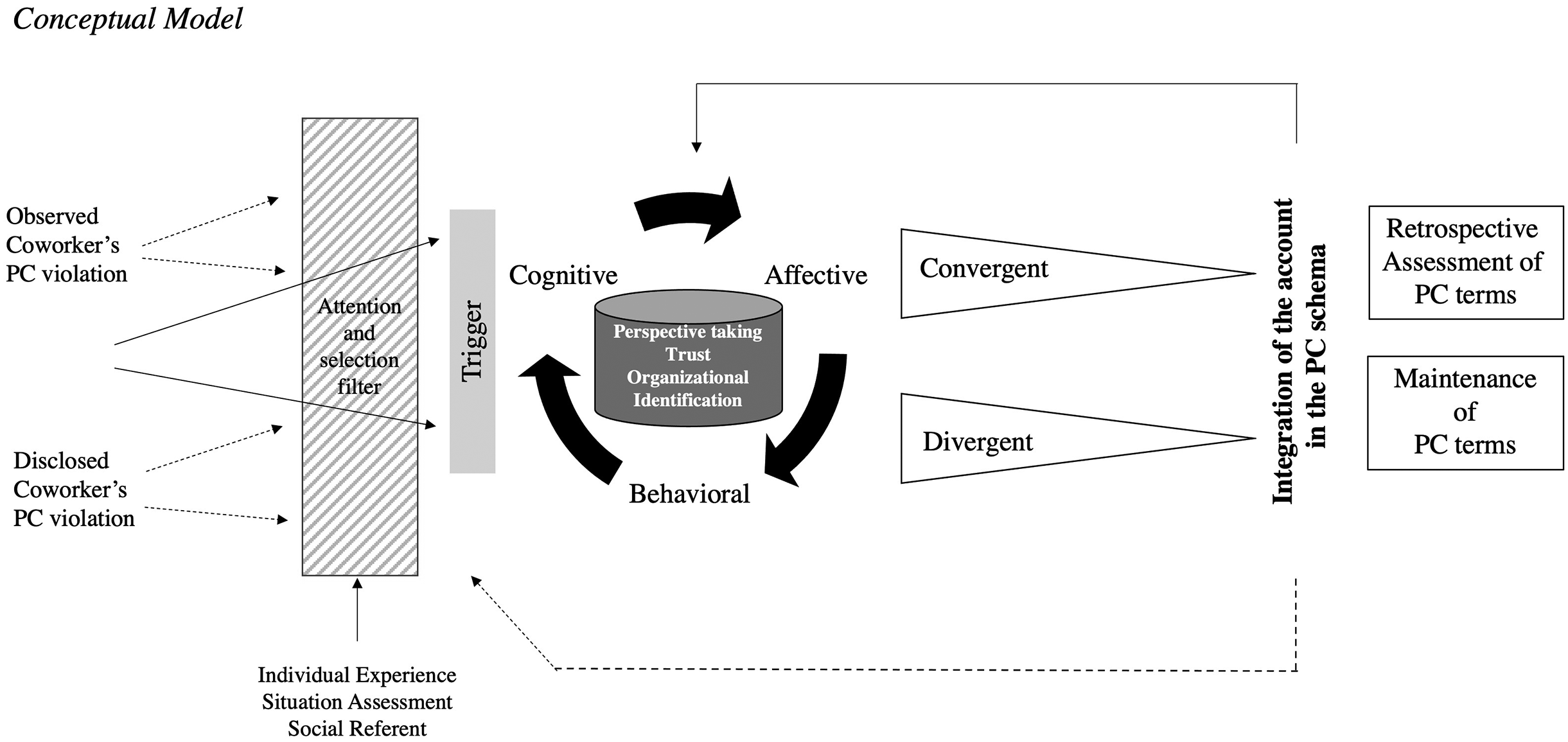
Boundary Conditions of the Accounts
As argued above, the likelihood of reaching a convergent or divergent account depends on a comprehensive sensemaking process involving heightened vigilance and social comparison, emotional contagion, and social appraisal, as well as information-seeking behaviors. However, there are also other factors (intraindividual, relational, and organizational) that shape the result of the sensemaking process. We discuss perspective-taking, coworker trust, and organizational identity as critical influences on the account.
Perspective-taking
Perspective-taking and empathy both play an important role in facilitating the convergent account. Perspective-taking is the “cognitive or intellectual process that results in the affective response of empathy” (Parker & Axtell, 2001, p. 1087). Focal individuals who adopt a coworker’s perspective are more likely to develop empathy (Parker & Axtell, 2001), be concerned about the problems of a coworker (Davis, 1983), understand the coworker’s experiences (Egan, 1990), make positive attributions, and acknowledge the role of external circumstances when something happens unexpectedly (Parker & Axtell, 2001). Consequently, focal individuals who take the perspective of the coworker and develop empathy are more likely to “see through their eyes.” On the contrary, focal individuals who are low in perspective-taking and empathy will be more likely to ignore what happened to the coworker.
Coworker trust
Coworker trust can shape the outcome of the sensemaking process. Trust depends on the interpersonal behavior of the coworker during prior interactions and it has been defined as the “individual’s belief about the integrity and dependability of another” (Ferrin et al., 2006, p. 871). Definitions of interpersonal trust tend to imply the other (coworker) is dependable, cares for the focal individual’s interest, is competent, and behaves with integrity (e.g., Robinson, 1996). Accordingly, such trust will facilitate a convergent account. On the contrary, if trust is absent, the focal individual is likely to think the coworker does not care about them, is not competent, and does not act with integrity, which will facilitate and validate a divergent account.
Organizational identification
High organizational identification has the potential to undermine a convergent account and facilitate a divergent account. Organizational identification is key for organizational success because employees who identify with their employers are more supportive (Ashforth & Mael, 1989), have their decisions aligned with their organization’s goals (Smidts, Pruyn, & Riel, 2001), and internalize the organization’s achievements and failures as their own (Mael & Ashforth, 1992). Individuals who strongly identify with their organization may disregard moral standards and engage in acts that favor the organization (Ashforth & Anand, 2003). These individuals will be motivated to maintain the terms of their own PC and work toward relationship maintenance with the organization because the organization is an important part of their self-concept (Tajfel, 1978). Individuals who hold multiple group memberships (i.e., organization, department, and work group; Van Knippenberg & Van Schie, 2000), and identify to a greater extent with the work group than the organization, are more likely to favor a coworker’s version of events rather than the organization’s. Furthermore, strong identification with the work group means individuals will act in alignment with the beliefs of that group (Tajfel, 1978). Drawing from these arguments, focal individuals who identify to a lesser extent with the organization and to a greater extent with the group are likely to side with the coworker’s version of events.
Impact of Accounts on the PC Schema
Integration of Account in Existing PC Schema.
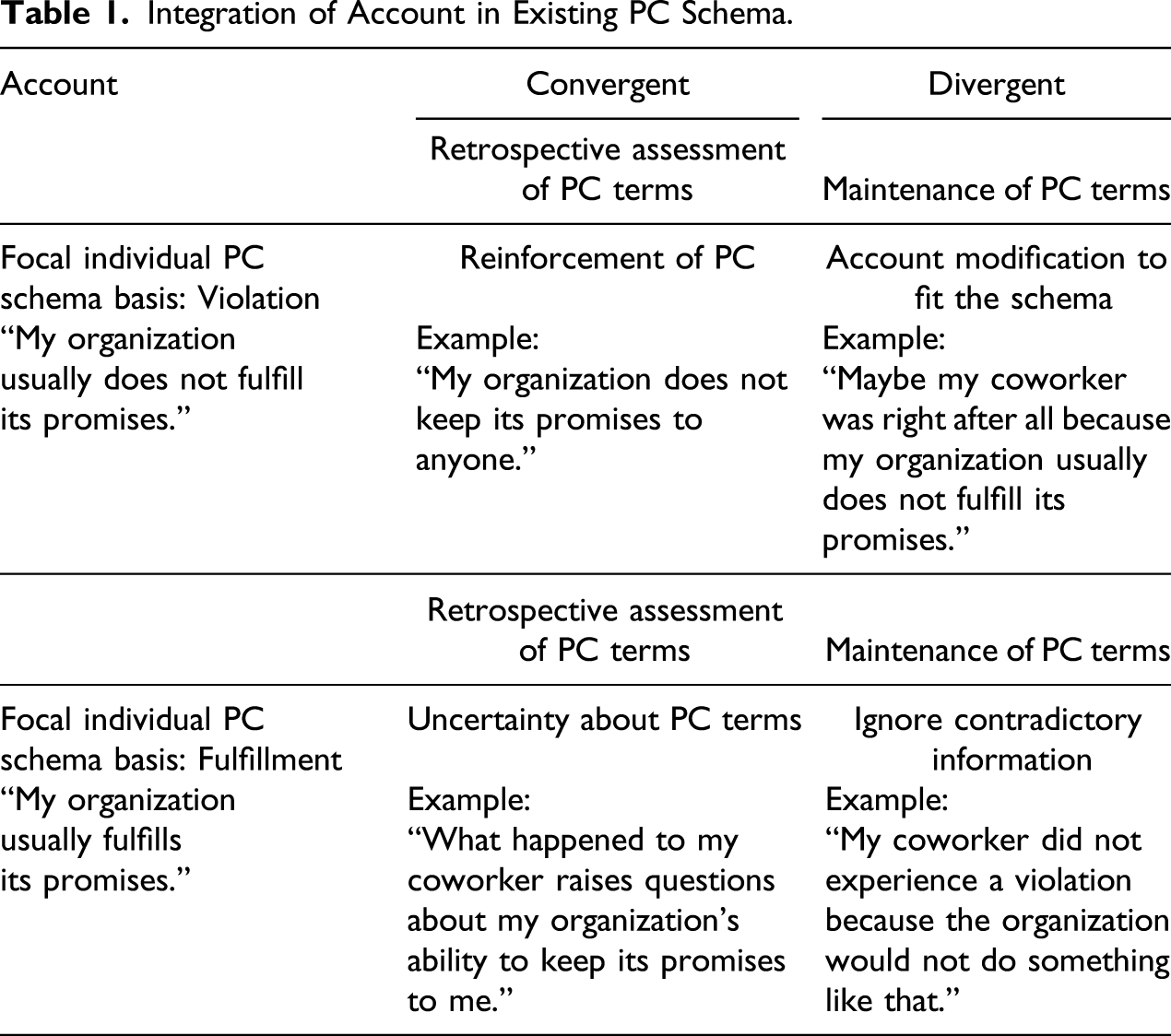
The convergent account captures a plausible story in which the focal individual believes the organization is not fulfilling what was promised to a coworker, which means the focal individual needs to integrate this new information into their understanding of the employment relationship. Consequently, the focal individual may initiate a retrospective assessment of PC terms, which captures a close examination of the terms of PC and the organization’s actions (i.e., the ability of the organization to keep its side of the deal). If the focal individual’s PC schema is often violated and those violations are a core part of the schema, the convergent account will reinforce the existing PC schema. An illustrative example is “my organization does not keep its promises to anyone.” On the other hand, if the existing PC schema relies on fulfillment, the convergent account may raise questions regarding the exchange in the employment relationship and may eventually motivate individuals to revise their schema (Harris, 1994; Klein et al., 2007; Louis & Sutton, 1991). This happens because it provides additional information about the organization’s ability or willingness to fulfill its promises. Moreover, the individual gains more knowledge about how the organization treats employees and may question whether their expectations are realistic (Hiltrop, 1995) and whether the organization will violate any future commitments. A practical example is “what happened to my coworker raises questions about my organization’s ability to keep its promises to me?” A revision of PC schemas may create a new or altered view of specific duties or the whole employment relationship (Rousseau et al., 2018).
The divergent account reflects the mismatch between observed or disclosed PC violation and the results of the sensemaking process. The literature on sensemaking and attributions has shown that the individual can either ignore the contradictory information or modify it to fit the current schema (Lord & Foti, 1986). In other words, the schema is challenged, but the solution is consistent with the existing beliefs; hence, the schema is likely to resist change (Rousseau, 2001), and the focal individual will rely on the existing PC schema to guide behavior (Rousseau et al., 2018). Specifically, if the focal individual has a PC schema based on unfulfilled promises, the account is likely to be reassessed and reinterpreted to fit the PC schema. This solution will demand some degree of information and schema manipulation and reflection (Harris, 1994). An illustrative example is “maybe my coworker was right after all because my organization usually does not fulfill its promises.” On the other hand, if the focal individual’s PC schema is based on fulfillment, the divergent account information will be easily ignored (i.e., “my coworker did not experience a violation because the organization would not do something like that”). It is worth noting that the ability to maintain the schema (i.e., the terms of the PC) intact is functional for the focal individual (Crocker, Fiske, & Taylor, 1984) because it retains a sense of consistency, order, coherence, and predictability in the employment relationship (Rousseau, 2001). Therefore, the focal individual is likely to ignore or modify information regarding the observation of a coworker’s PC violation or disclosure of a coworker’s PC violation in order to keep their PC schema unchanged.
Process Loop: PC Schema, Attention, and Information Processing
We suggest that the existing schema may shape what stimuli pass the attention filter and how the information is processed (consciously or unconsciously). Schemas operate as guides for individuals’ perceptions, interpretations, and expectations (Louis, 1980) and influence the search, acquisition, and processing of information as well as subsequent actions (Harris, 1994). As Lord and Foti (1986, p. 38) explain: “schemas help to reduce the information-processing demands associated with social activities by providing a ready-made knowledge system for interpreting and storing information.” This means that once crystalized, schemas rely less on singular and isolated data from the environment (Fredrickson, 2001; Lord et al., 2010), which can in turn make it hard for stimuli to cross the attention filter. Indeed, Harris (1994) stated that schemas shape the perceptual process by lessening the frequency with which incongruent information is found and made conscious. From a PC perspective, schema facilitates the exchange relationship between the individual and the organization without consciously monitoring PC terms (Diehl & Coyle-Shapiro, 2019). The cues need to be disruptive enough to bring PC-related information to consciousness (Wiechers et al., 2019).
Discussion
Theorizing and research on how the social environment influences the underlying processes of PC violation is still in its infancy. However, recent discussions highlight that the social environment is important to understanding the dynamics of PCs (e.g., Alcover et al., 2017; Wiechers et al., 2019). Thus, the main objective of this article was to develop an intraindividual processual framework to clarify how social triggers (e.g., interpersonal cues)—conceptualized in terms of a coworker’s observed or disclosed PC violation—activate a focal individual’s complex sensemaking process, which has implications for their own PC.
Theoretical Implications and Directions for Future Research
Our main contribution uncovers the intrapsychic and cognitive processes related to individuals’ PC when coworkers experience a PC violation. To achieve this, we integrate and extend the literature on dynamic and social properties of PC (e.g., Bankins, 2015; Wiechers et al., 2019), social information processing (Salancik & Pfeffer, 1978), sensemaking (Weick, 1995), and social networks (Ho, 2005) by offering an integrated model of how the social context (i.e., interpersonal cue) reaches individuals’ attention and triggers a complex (cognitive, affective, and behavioral) sensemaking process. Overall, this study proposes that third parties’ (i.e., coworkers) experiences influence how focal individuals make sense of their employment relationship.
Through the present article, we offer several opportunities for further research in the management field in general and PC in particular. First, by proposing that both observed and disclosed coworker PC violations trigger an active sensemaking process, we call for studies exploring what focal individuals consider an “observed” and “disclosed” PC violation. Previous research has shown that different meanings are ascribed to PC violation, and these meanings may range from a unique event to repeated and accumulated events (Parzefall & Coyle-Shapiro, 2011). Qualitative studies using the critical incident technique may help in this regard because they provide rich information about how employees experience and perceive significant events (Chell, 1998).
Assuming that an observed and disclosed PC violation by a coworker triggers a sensemaking process in the focal individual, this raises additional questions. For instance, if not all triggers cause focal individual awareness and conscious attention (Wiechers et al., 2019), when is sensemaking more likely to be triggered? Is this more likely when there is personal direct disclosure of a PC violation than when there is an observation that may contain ambiguity? According to the deontic model, violations are likely to trigger deontic reactions when the source of transgression is less ambiguous (Folger, 2001). As such, future empirical work is needed to explore whether the sensemaking process differs between a focal individual explicitly hearing about a PC violation or merely observing it. Literature on social networks and communication may provide the basis to further explore the differences between types of information (communication vs. observation). Moreover, an interesting line of research could examine whether the source is dependent on the type of network ties (friendship vs. advice ties). This line of inquiry could use an experimental design in which participants are exposed to both types of triggers, and their reactions are measured after the manipulation. Another interesting line of research is related to the types of interpersonal cues captured and processed by the focal individual. For instance, the observation of a PC violation is more subjective and likely to be a discrete event, whereas the disclosure of a PC violation can involve both the description of an event and the expression of higher units of meaning (e.g., distrust, disrespect, and disloyalty). A relevant note here is that discrepant information is usually processed at the data level rather than at the higher schematic level (e.g., Fredrickson, 2001).
Second, our conceptual model focuses on the overall sensemaking process by considering cognitive, affective, and behavioral appraisal dimensions (Maitlis et al., 2013; Weick et al., 2005). The micro-mechanisms described in the current article are not extensive, and other mechanisms may have a role in the sensemaking process. Researchers have the unique opportunity to explore the key intraindividual intervening variables in the sensemaking process. Moreover, more research on contextual cues that facilitate or inhibit the sensemaking process in the employment relationship is warranted. Another relevant question about the sensemaking process is time. Sensemaking is both iterative and interactive (Maitlis et al., 2013), and both Parzefall and Coyle-Shapiro (2011) and Bankins (2015) reflected on the intertwined nature of interpretation and action. However, additional clarity regarding the time frame and temporal orientation is required (Maitlis & Christianson, 2014). Is the process after an observed or disclosed PC violation sequential? Or does the interpretation of the event, emotional response, and behavior occur simultaneously and feed on each other, as a clear illustration of enactment? These questions may be examined using process research because it allows for an “understanding how things evolve over time and why they evolve in this way” (Langley, 1999, p. 692). In addition, the proposed model does not account for actors’ (e.g., coworker and organization) actions during the sensemaking process. Sensemaking theorizing states that actors’ actions may alter the environment and/or situation under consideration and the trajectory of events (Weick, 1988). For instance, organizational responsiveness (e.g., by offering compensation or apologizing, Henderson, Welsh, & O’Leary-Kelly, 2019) may play a role in shaping an individual’s sensemaking process or even alter the trajectory of events. Alternatively, coworkers may disclose to the individual that the perceived PC violation resulted from an honest misunderstanding (Morrison & Robinson, 1997). Understanding employees’ and employers’ actions during the sensemaking process may provide additional insights into the process itself as well as its results.
Third, we proposed that the sensemaking process enables the emergence of distinct accounts (convergent vs. divergent). Two main research possibilities emerge from this. First, measures need to be developed for the accounts. As previously discussed, in reaching the end of sensemaking, the focal individual integrates this information into their existing PC schema. The examples provided for each combination (convergent vs. divergent and PC violation basis vs. PC fulfillment basis) may provide the basis to develop measures that can be fully explored in field or experimental studies. Second, we did not explore alternative scenarios or “in-between” possibilities. For instance, what happens if the sensemaking process is inconclusive? Contexts with high degrees of ambiguity may trigger sensemaking, but the context may be too hard to make sense of because of the unclear cues and actions and ambivalent meanings (Maitlis & Christianson, 2014). In this case, the individual may “get stuck” in the process and be unable to understand the current situation. Other “in-between” situations may include a focal individual reaching a convergent account but deciding to ignore it to protect themselves or a focal individual who has a divergent account but enjoys working with that coworker. Investigating whether individual differences such as personality or other dispositions (e.g., reciprocation wariness and psychological entitlement) may influence the outcomes of these types of “in-between accounts” would be interesting. Moreover, researchers may also want to explore if these accounts result from mixed messages from different coworkers or organizational agents. As Schalk and Rousseau (2002) noted, different parties (i.e., recruiters, managers, coworkers, supervisors, and top management) contribute to an individual’s PC. Moreover, information from coworkers may be used as a “frame of reference and context against which employees weigh the information received from agents situated higher up the organizational hierarchy” (Alcover et al., 2017, p. 13). Consequently, mixed messages from an organizational representative and a coworker may explain why individuals get stuck “in between” accounts as both parties may provide a plausible story for the event. In addition, individuals may change the weight given to each party’s argument depending on the specificity of the situation (Ho & Levesque, 2005). They may attribute more relevance to the coworker’s message or the organizational agent’s message if the information about the PC violation event is job-related or related to the top management (Shah, 1998).
Fourth, we focused on proximal outcomes of sensemaking, specifically its impact on the individual PC schema. We are aware that more distal outcomes may occur as a consequence of the accounts in the dual pathway and subsequent integration of the account in the individual PC. For instance, at the intraindividual level, as a result of a convergent account and retrospective assessment of PC terms, focal individuals may find an event or set of events that they consider to be violations (Morrison & Robinson, 1997). As the focal individual connects scattered events from their and the coworker’s experience of violation, the likelihood of perceiving a “new” violation increases (Wiechers et al., 2019). Moreover, at the relational level, the convergent account may strengthen the relationship with the coworker and hamper the relationship with the organization. Previous research has shown that expressions of organizational dissent to peers could bring coworkers closer and further develop their relationship (Sias, 2005). On the other hand, when a focal individual reaches a divergent account and the PC schema remains unchanged, they may also decide to distance themselves from the coworker because the individual believes the organization (and its agents) holds a negative view of that coworker and they do not want to experience “guilt by association” (Hess, 2006, p. 212).
Last, we believe exploring how information about coworkers’ PC violations is further processed at the team level is worthwhile because members of the same social system are likely to share similar cognitive structures that guide their experiences, interpretations, and behaviors (Louis & Sutton, 1991). Furthermore, “the team rather than the organization emerges as the primary focus of identification” (Richter, West, van Dick, & Dawson, 2006, p. 1252). Team identification may also play an important role in the sensemaking process and in the overall structure of an individual’s PC (Epitropaki, 2013). Recognizing that when the organization fails to fulfill a coworker’s PC, this may ultimately lead to a shared perception of breach among team members and teams.
Implications for Practice
This article offers some insights into the management of PCs. First, managers need to be aware of the role of social context in shaping the employment relationship, especially the PC. Greater importance needs to be given to the social environment because observed or disclosed violations—those that happen to coworkers—can disrupt others’ PCs. Second, the sensemaking process occurs and develops in an informal way beyond the control of senior managers (Maitlis & Christianson, 2014), which makes the middle managers’ position critical in the detection and resolution of violations in employees’ PCs. Organizational agents—especially supervisors—are required to monitor employees’ expectations, acknowledge their role as sensegivers, and provide information or justification for the event. In other words, it is paramount for organizations that managers are sensegivers in an attempt to “influence the sensemaking and meaning construction” of employees “toward a preferred redefinition of organizational reality” (Gioia & Chittipeddi, 1991, p. 442). Sensegiving can thus minimize the negative impact and prevent further perceptions of PC violation.
Conclusion
This article developed a framework of an intraindividual processual approach to observed and disclosed PC violations as well as the resulting accounts and their impact on individual PC. These emerging constructs seem paramount in the current approach to PC as a dynamic and social concept. We hope this article further encourages researchers to explore and examine its propositions.
Footnotes
Declaration of Conflicting Interests
The author(s) declared no potential conflicts of interest with respect to the research, authorship, and/or publication of this article.
Funding
The author(s) received no financial support for the research, authorship, and/or publication of this article.

Associate Editor: Lucy Gilson