




Abstract
Meaningful work (MW) is an important topic in psychological and organizational research with theoretical and practical implications. Many prior studies have focused on operationalizing MW and distinguish between the attributes of a job that make it meaningful, such as task variety or significance, and the affective experience of meaning during work, such as the feeling that what one does at work is meaningful. However, most empirical research focuses on the former definition and utilizes quantitative scales with deductive questions that omit what people find important in their experiences. To address this, we conduct a qualitative investigation of psychological narratives focusing in-depth on the quality and content of feelings of meaningfulness and meaninglessness during experiences at work—crucially, without any framing around task attributes. We introduce the term affective eudaimonia to describe these experiences. Overall, our results corroborate many existing thematic findings in the MW literature, such as the importance of connecting and contributing to others and avoiding confinement. We also offer new findings: Although the way that people give language to meaningless narratives is more descriptive, vivid, and experiential in tone than meaningful narratives, meaningless narratives are also more structurally static and constrained. We use these results to inform practical suggestions to promote day-to-day experiences of meaning at work and provide a basis for further academic discussion.
Keywords
Introduction
There is substantial interest in workplace wellbeing among policymakers and members of the public (Financial Times, 2019). Workplace wellbeing has many dimensions and determinants, and in this paper, we focus on “meaningful work” (MW) (Haybron, 2016). MW has both intrinsic and instrumental value, as it is associated with outcomes such as turnover intention (Arnoux-Nicolas et al., 2016), physical health (Allan et al., 2019), and productivity (Ariely et al., 2008).
One of the earliest approaches to the psychological assessment of meaning at work was the job diagnostic survey (Hackman & Oldham, 1975), which is now cited in over 15,000 publications. 1 The authors of this survey distinguished between affective reactions to work, such as feelings of meaningfulness, and job attributes, such as the significance or variety of tasks. Despite the clear distinction between affective experiences and task attributes in the Hackman research, perceived meaningfulness is assessed by considering attributes alone rather than affective meaning, too (Ariely et al., 2008; Chadi et al., 2016; Frieder et al., 2018; Bailey et al., 2019a).
Assessing perceived meaningfulness matters because job attributes may not be perceived as meaningful in an affective sense even though they are conceptualized as reflective of MW. To understand whether, how, and why work feels meaningful—and, equally substantial, meaningless—in an affective sense, we require more information about what employees themselves feel and believe, and how they express this in their own language. Therefore, this research considers how people describe feelings of meaningfulness and meaningless at work. We conduct a qualitative investigation of psychological narratives, which adds balance to a literature weighted towards a positivistic quantitative approach (Bailey & Madden, 2019).
A need for qualitative research methods and interpretative epistemologies has been recognized in the field of work and organizational psychology (Symon et al., 2000). Our research approach focuses on how people narrate their feelings; the affective, experiential, and momentary components of meaningfulness and meaninglessness. This micro-narrative approach draws from existing narrative approaches that ask how people describe their jobs and careers overall at a more macro-level, which may differ from how they describe the affective and experiential moments of their jobs and careers. We use narrative tools from personality psychology to view the data (McAdams, 1985; Bauer et al., 2019), and our main research question is, “How do people narrate moments when they felt meaningfulness or meaninglessness at work?” While our analyses do confirm some prior findings, they also provide new insight into the ways people give language to meaning that can advance our academic understanding and inform initiatives to promote meaningfulness at work.
We make several contributions to existing literature. First, we bring depth to existing understandings of the affective experience of meaning, purpose, and eudaimonia with a bottom-up qualitative narrative inquiry. Within this, we propose using the term affective eudaimonia to describe and conceptualize subjective psychological states of meaningfulness and meaninglessness that are momentary and experiential instead of approaches that take a hedonic-affective eudaimonic-evaluative, or task attribute focus. Second, we deepen our understanding of how people talk about feelings of meaningfulness and meaninglessness at work. Third, we provide new knowledge about aspects of the language used to describe feelings of meaningfulness and meaninglessness at work that makes a conceptual contribution to academic discussion of eudaimonia and has practical relevance, such as for professional development and organizational change towards more MW.
Defining Meaningful Work
What is meaningful, or meaningless, work? There are many definitions and a lack of clarity about what is related to them. Bailey et al. (2019a) conducted a systematic review of 71 papers researching MW. They condensed existing definitions of MW into five categories: definitions from the Job Characteristics Model (JCM) (Hackman & Oldham, 1975) that emphasize task attributes as linked to psychological states, from work spirituality that focus on inner life and community, from the humanities tradition about the subjective perception of a meaningful life, those that view meaningfulness a multifaceted eudaimonic psychological state, and, finally, those portraying meaningfulness as an occupation-specific phenomenon. These categories are not exclusive: Psychological meaningfulness is present across the JCM, humanities, and psychological state approaches to MW, albeit in different ways.
The definition of MW that is adopted has consequences for understanding what promotes MW. For example, within the workplace spirituality literature, organizations are typically viewed as providing the conditions for MW by creating settings where individual needs for aspects of spirituality are met, such as community engagement and having an inner life. The humanities tradition places less emphasis on the organization's role; instead, the innate individual drive to discover meaning is the focus, and MW cannot be supplied solely by job-design initiatives or organizational management (Bailey et al., 2019a). Thus, definitions of MW impact upon what is emphasized as a source of meaning/lessness. Similar tensions emerge in theoretical approaches to facilitating meaning, such as in addressing others' needs versus oneself (Lips-Wiersma & Morris, 2009; Lysova et al., 2019; Bailey et al., 2019b).
Our approach views meaningfulness as a multifaceted eudaimonic psychological state (Bailey et al., 2019a). Specifically, we define MW as the subjective sense of meaningfulness or meaninglessness that individuals derive from their work (Steger et al., 2012; Bailey et al., 2019a). To avoid any of the ambiguity about antecedents and outcomes that characterizes this literature (Bailey et al., 2019a), our outcome is subjective meaningfulness, and other factors, like task attributes or the organizational climate, are the drivers. Within this definition of MW, we consider two sub-dimensions. One is the global, cognitive, and/or evaluative dimension of the subjective psychological state of meaning—in the language of Kahneman and Riis (2005), the “evaluating self.” To tap into this dimension, one might ask, “Overall, how meaningful do you consider your job to be?” (a global evaluation of work). Another is the momentary, affective, and/or experiential subjective dimension—the “experiencing self.” An inquiry into this dimension might ask, “How meaningful does what you are doing at work right now feel?” or “Tell me about a moment at work that felt meaningful to you” (a momentary emotional experience).
The conceptual distinction between evaluations or cognition and experiences or affect is well-established in previous literature (Kahn, 1990; Kahneman & Riis, 2005; Luhmann et al., 2012b; Dolan & Kudrna, 2016; Bailey et al., 2017). For example, in the literature on workplace engagement, cognition and affect have been used to describe different ways that the authentic self manifests (Kahn, 1990; Bailey et al., 2017). We represent the affective facet of psychological meaningfulness using the term affective eudaimonia, which we define as subjective psychological states of meaningfulness and meaninglessness that are momentary and experiential (see Figure 1). Although some approaches consider affect and eudaimonia to be separate, there is also recognition that there is conceptual overlap (Kashdan et al., 2008), and the distinction between “experienced eudaemonia” and “evaluated eudaemonia” is not new (Kahneman & Riis, 2005, p. 301). We are separate from three related literatures: traditional affective approaches aligned with hedonic rather than eudaimonic wellbeing, such as those that ask about happy feelings (Angner, 2010); eudaimonic approaches to meaningful work that emphasize global, cognitive, and/or evaluative states, such as those inquiring about a meaningful life (Bailey et al., 2017); and some applications of the task attribute approach to meaningful work that do not always consider affect or emotion, as discussed above (Ariely et al., 2008; Chadi et al., 2016; Frieder et al., 2018; Bailey et al., 2019a). Affective eudaimonia. Terms drawn from Kahneman & Riis (2005), Luhmann et al. (2012a), Huta & Waterman (2014), Bailey et al. (2019a).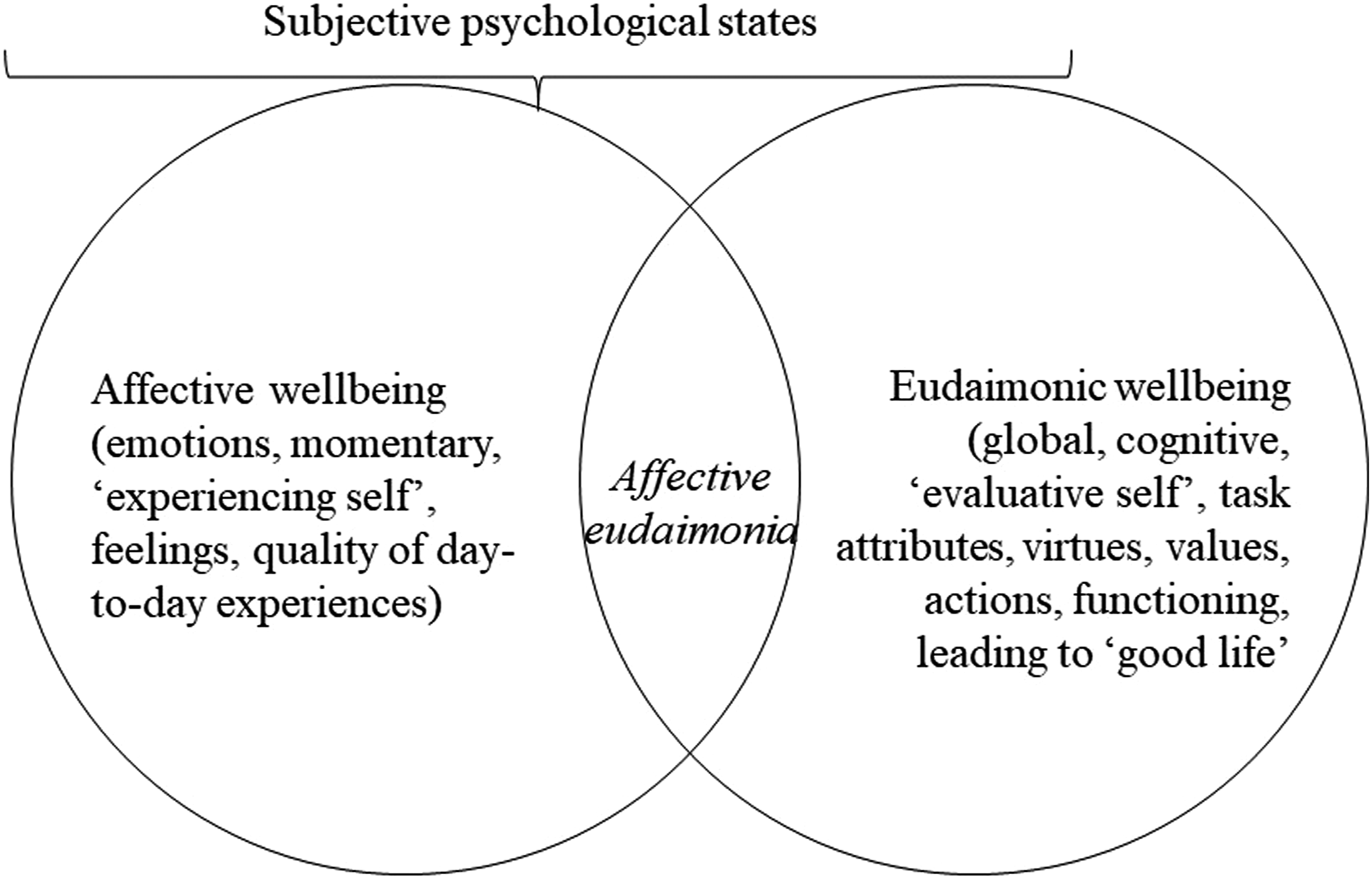
Our investigation of the psychological experience of affective eudaimonia overlaps with other approaches to MW. The research methods we use are in line with qualitative and inductive methods typical for humanities traditions, emphasizing measuring the subjective experience of meaning. We do not, however, de-emphasize the importance of organizational-level antecedents. Although we use an individual-level psychological definition, sources of meaningfulness may come from satisfying individual needs or the organizational environment. For example, ethical leadership (an organizational-level factor) can positively impact the subjective experience of meaning for individuals (Demirtas et al., 2017). We are not aligned with the JCM because we do not emphasize psychological meaningfulness as inherently linked to particular job attributes. Instead, we allow people to tell us if job attributes feel meaningful or meaningless rather than assuming their importance. Overall, our approach is mostly psychological, although we include some humanities perspectives.
Why Study Affective Eudaimonia?
A better understanding of affective eudaimonia provides improved knowledge about what it means to have good wellbeing—living a “good life” or having “good work.” The subjective experience of MW falls within wellbeing research more generally, including job attributes and affective states (Haybron, 2016; Guest, 2017; Bauer et al., 2019). MW sits within eudaimonic wellbeing, although this perspective does not usually focus on psychological states, instead emphasizing the virtues, values, actions, and behaviors necessary for individuals and societies to be well. Nevertheless, understanding how people feel in their experiences is important because we cannot have a complete picture of wellbeing without including the subjective and momentary experience of meaningfulness. As the National Academy of Sciences (2014) concluded, “an important part of people's experiences may be overlooked if concepts associated with purpose and purposelessness are not included alongside hedonic ones like pleasure and pain” (p. 5).
The correlates of affective eudaimonia differ from those of evaluative eudaimonia, which matters when wellbeing measures prioritize certain groups or initiatives in policy (HM Treasury, 2020). For example, people who are unemployed report worse global evaluations of meaning in life than people who are employed (Ward & King, 2019); however, the unemployed do not appear to differ from the employed in reports of how meaningful their activities feel (Dolan et al., 2017). Any conclusions about the consequences of being employed for the psychological state of meaning appear to depend on whether there is an inquiry into global evaluations of meaning or momentary experiential states of affective eudaimonia. In general, cognition and affect have distinct correlates and reveal different insights about people’s psychological experiences (Kahn, 1990; Kahneman & Deaton, 2010; Luhmann et al., 2012a; 2012b), affecting our understanding of how well individuals, communities, and societies are doing and whose wellbeing should be prioritized.
Literature Review
In this section, we review a selection of studies from the extensive literature on MW. Aligned with our definition of MW and the nature of our investigation, we focus on psychological studies, selecting those that take a qualitative and narrative approach to investigate meaningful work.
Psychological approaches to narrative inquiry show how people use narratives to make sense of the separate experiences of their lives and construct them into coherent life stories (Bauer & Gaskell, 2000; Lysova et al., 2019). From this viewpoint, psychological narratives are central to understanding human experience, and narrative language constitutes and expresses worldviews (Connelly & Clandinin, 1990; Bruner, 1991; Clandinin, 2006; Bauer & Gaskell, 2000). Investigating psychological narratives enables a systematic study of personal experience by privileging subjectivity (Riessman, 2000), one of our fundamental interests. Instead of life stories, however, we focus on how people talk about moments that felt meaningful or meaningless at work. Therefore, our narrative approach is experiential, and we elicit experience-centered first-person accounts of events (Riessman, 2000; Squire, 2008). Riessman and Quinney (2005) refer to such micro-narratives of events as ‘discrete stories’: “they’re answers to a single question, topically centered and temporally organized” (p. 394). Our study investigates how people construct and comprehend their feelings in these psychological micro-narratives; that is, how people narrate and give language to moments of felt meaning, and its absence, at work.
A psychological and experiential interpretation of narratives is only one of many theoretical approaches to narrative study. Like wellbeing, narratives have been of interest for thousands of years, and they date back to early philosophers like Aristotle (Jovchelovitch & Bauer, 2000). Debates about the nature and value of narrative approaches are longstanding (Mitchell, 1981; Gergen & Gergen, 2011), and narrative inquiry spans a multi-disciplinary space across fields including history, anthropology, sociology, theology, philosophy, linguistics, and aspects of evolutionary biological science (Connelly & Clandinin, 1990). Applications of narrative inquiry are broad, covering social work, law, medicine, nursing, and occupational therapy (Riessman & Quinney, 2005). This paper does not focus on discussions about different approaches to narrative inquiry and instead concentrates attention on one specific approach.
One concern about a psychological approach to narratives is that the “social” is excluded (Gergen & Gergen, 2011). Indeed, psychological explanations consider how internal psychological processes precede or follow expression (e.g., Bruner, 1991), while some social explanations show how narrative identities—including how individuals make meaning from their experiences—are produced contextually within specific cultural and historical circumstances (Bruner, 1991; MacIntyre 1981; Šverko & Vizek-Vidovic, 1995; Jovchelovitch & Bauer, 2000; Boova et al., 2019). We are aligned with the view that narratives carry knowledge of both, as people internalize the shared knowledge of social and cultural norms into psychological experiences (Jovchelovitch & Bauer, 2000; Boova et al., 2019). Therefore, while we are mainly interested in how people narrate their personal, psychological, and affective experiences, we recognize that these experiences are not formed in vacuums. For example, work orientations—internalized subjective evaluations of “what makes work worth doing”—are influenced by social and cultural factors (Boova et al., 2019, p. 189).
Two recent literature reviews on MW guided our necessarily selective review of a large literature (Bailey et al., 2019a; Lysova et al., 2019). We used these reviews as a basis to identify psychological studies using qualitative and narrative approaches. Bailey et al. (2019a) gathered 14 studies aligned with psychological definitions of meaningful work. We examined these studies and identified only one qualitative study, which also used a narrative approach (Bunderson & Thompson, 2009). Due to the limited number of studies identified, we also included the qualitative and narrative studies from Bailey et al. (2019a) that adopted a humanities definition of meaningful work, which overlaps with the psychological definition and our methodological approach. Out of the 12 empirical studies they classified as humanities, we identified seven that used a qualitative narrative approach (Bailey & Madden, 2016; 2017; Pavlish & Hunt, 2012; Bunderson & Thompson, 2009; Lips-Wiersma, 2002; Lips-Wiersma & Morris, 2009; Thory, 2016). Lysova et al. (2019) identified three articles about “personal narratives,” which all drew upon qualitative data from a psychological perspective (McAdams & Pals, 2006; Bailey and Madden, 2017; Schabram & Maitlis, 2017).
In what follows, we discuss selected key findings from these studies and evaluate how they align with affective eudaimonia. We include the findings under broad headings according to the approach taken to eliciting narratives. Broadly, the approaches ask about life and work histories or the scenes and moments in time that comprise these histories. Our main point is that neither of these approaches asks people about moments that felt meaningful or meaningless in a momentary, experiential sense, which would be consistent with an approach inquiring into affective eudaimonia.
Life and Work Histories
Two studies reported narrative investigations around the notion of work as a deeply meaningful “calling.” Schabram and Maitlis (2017) conducted life story interviews with animal shelter employees, an approach that directs attention to evaluations of life overall rather than on feelings, experiences, or moments. In Bunderson and Thompson (2009), the authors asked 23 zookeepers how they got into zookeeping, their thoughts and feelings about work and their organizations, and their interactions with others. It did not appear that meaningfulness or its synonyms were asked about in these work histories, although “feelings about work” were included. Both studies’ results included several themes, such as negotiating the challenges of work as a calling and its contribution to personal identity. Emotions were also important aspects of pursuing work as a calling: Bunderson and Thompson (2009) reported that participants described feelings like pride, and Schabram and Maitlis (2017) reported that negative emotions like sorrow and anxiety were associated with the challenges of pursuing deeply meaningful work. We build upon these studies by asking specifically about moments that felt meaningful or meaningless, rather than meaningfulness within the context of life stories or general feelings about work.
Lips-Wiersma (2002, 2009, 2012) conducted in-depth investigations of meaning in life using an approach that blended perspectives from the humanities and workplace spirituality literatures. They initially used storytelling to document career and life narratives, which later informed action research and a quantitative scale. Their key conclusion was a framework covering developing and becoming self, unity with others, serving others, and expressing full potential. Narrative evidence from emotional intelligence training suggests this model facilitates MW (Thory, 2016). The focus on career and life narratives suggests that this framework was influenced by data from participants’ evaluating selves rather than their experiencing selves, as in affective eudaimonia. While their research focuses on the presence of meaning, they do later note that conversations about the quest for meaning are often expressed in negative ways as complaints (Lips-Wiersma & Morris, 2017, p.69). This is consistent with the idea from literature outside MW on impressions and stereotypes that “bad is stronger than good” (Baumeister et al., 2001).
Scenes and Moments in Time
Bailey and Madden’s (2016, 2017, 2019) research included aspects of affective eudaimonia in an experiential, psychological sense, also including meaninglessness. The authors asked people about “incidents or times when they found their work to be meaningful and, conversely, times when they asked themselves, “What’s the point of doing this job?” (2016, p. 53), when “their work appeared meaningless” (2017, p. 11), or “when they found their work meaningless” (2019, p. 5). By including language around incidents and times, their questions were more temporally focused than those in the above section that asked more broadly about life stories. Such questions may be thought of as asking about significant moments or “scenes” from life stories, contributing to narrative identity (see McAdams, 1985; McAdams et al., 2004; McAdams & Pals, 2006).
Scenes do appear to tap into people’s experiences at work because they emphasize specific incidents and times. However, the latter two questions above also appear to tap into cognitions and evaluations; respondents were asked to reflect on the point of their jobs, or the appearance of work itself, without reference to affective feelings or psychological states. There is no language in these questions about experiences, affect, or feelings. Experiences at work could feel meaningful even without reflection on the point or appearance of work, such as a friendship at work that feels meaningful even if the work itself is evaluated as meaningless. Nevertheless, these inquiries reveal important aspects of meaningfulness and meaninglessness at work.
One key finding of Bailey and Madden (2016) was that of a “meaningfulness ecosystem,” which conceptualizes MW to consist of organizational, interactional, job, and task meaningfulness. Holistic meaningfulness is reached when all of these are experienced. MW is characterized as self-transcendent, poignant, episodic, reflective, and personal. MW is difficult to build by management but easy to destroy with poor management (2016) and linked to experiencing a lack of control over time (2017). The authors stress the temporality of meaning, which arises in episodic and “transcendent moments in time”—rather than as a sustained quality—and requires a reflective outlook (“looking back”) on the work (Bailey & Madden, 2017, p.15).
Bailey and Madden’s key meaninglessness findings were seven “deadly sins” of leadership (2016) and the role of relational processes (2019). The sins occur when leadership disconnects people from their values and supportive relationships, takes employees for granted, gives them pointless tasks, mistreats them, overrides their better judgment, or puts them at physical or emotional risk. Four core themes that facilitated experiencing meaninglessness were powerlessness, disconnection, devaluation, and self-doubt. They used the concept of “netdoms” by White (2008): “intersecting socio-cultural realms of experience, or different but overlapping and entangled social networks and domains” (p. 2). Switching between netdoms was the main response strategy towards meaninglessness; when faced with, for example, devaluation, people switched towards other people that treated them respectfully. We contribute to this research by asking directly about feelings during experiences of meaninglessness, focusing on how people narrate these feelings.
In another humanities-based narrative approach, Pavlish and Hunt (2012) examined nurses’ perceptions of MW. They asked about environmental factors influencing perceptions of descriptors, conditions, and consequences of MW, meaningful nursing roles, and stories of meaningful moments (p. 115). As with the Bailey and Madden studies, their focus on stories of meaningful moments is important; however, they did not appear to ask about feelings. They identified connections, contributions, and recognition as descriptors of MW, and these experiences were more likely to occur in “learning-focused environments with constructive management, cohesive teamwork, and sufficient patient-contact time” (p. 118). On the other hand, stressful, task-focused environments with divisive management functioned as a barrier to MW. They proposed that modifying working environments can enhance meaningfulness, illustrating that the humanities approach does not always focus on individual meaning-making.
Tools of Narration
The results of the studies above can be viewed through three established psychological “tools” of narration (McAdams, 1985; McAdams et al., 2004; Bauer et al., 2019). The first tool, tone, refers to whether events turn out to be good or bad within the narrative. When Bunderson and Thompson (2009) talk about zookeepers feeling pride in achieving work as a calling, and Schabram and Maitlis (2017) discuss the anxiety and sorrow associated with the struggles of achieving deeply meaningful work, these adjectives speak to the tone of meaning-making in the narratives. Theme refers to why events happen and to the values, motives, needs, reasons, or purposes for action that the narrative conveys. Themes were identified in each study above and were the most common approach (Lips-Wiersma, 2002; 2009; 2012; Bailey and Madden, 2016; Pavlish and Hunt, 2012).
Finally, structures correspond to how narratives are organized according to degrees of perspectivity, such as differentiation and integration (i.e., complexity and coherence) or psychosocial perspectivity. Perspectivity may involve taking multiple points of view, describing doing one thing for multiple reasons (mixed motivation), relating complex emotional experiences (McAdams et al., 2004), or displaying wisdom about challenging life events (Bauer et al., 2019; Ryan et al., 2019). None of the foregoing studies appear to conduct a structural analysis of narratives, but their thematic findings suggest structures are relevant. For example, when Bailey and Madden (2016) discuss their meaningfulness ecosystem, this involves a structural perspective from multiple viewpoints—organizational, interactional, job, or task meaningfulness. The episodic and transcendent nature of meaning requiring a reflective outlook suggests complex emotional experiences (Bailey & Madden, 2017, p.15). We apply these three tools of narration to better understand how people narrate scenes and moments in time when asked specifically about feelings of meaningfulness and meaninglessness, providing new evidence about the psychological experience of meaning at work and how people feel and make meaning within moments.
Aims of the Present Study
Previous literature has taken important steps towards a deeper understanding of how people narrate affective eudaimonia. We build upon these steps in several ways. Most importantly, we ask about meaning in terms of experiences, moments, feelings, and psychological states, rather than evaluations, task attributes, life and career stories, or scenes and moments in time that are not necessarily affective. This allows us to assess whether asking questions about meaningful work that include its affective, emotional qualities will reveal novel insights or confirm past findings.
We address areas identified by others as needing further empirical research in MW. Bailey et al. (2019a) note that MW studies have mostly adopted a positivistic, quantitative approach, and there is a lack of “understanding of how MW is… experienced by employees” (p. 84). We use a bottom-up, qualitative approach focused on the language that people use and the narratives they construct to reach what people regard as important for how they feel in their own meaningful or meaningless experiences. Using this approach, we address the need to better understand the individual-level antecedents of MW (Bailey et al., 2019a), the call to place people as humans instead of as objects in work psychology (Weiss & Rupp, 2011), and, generally, contribute to a “greater understanding of the experience of meaningfulness” (Bailey et al., 2019a, p. 84). Lips-Wiersma and Morris (2009) and Lips-Wiersma and Wright (2012) state that more research into meaninglessness is needed, which we address by asking about meaninglessness alongside meaningfulness. Finally, we focus on our results about narrative tones and structures, as these were not as thoroughly examined as narrative themes in our literature review above (Bauer et al., 2019).
Overall, the present study uses a qualitative narrative approach that inquires into the richness of subjective psychological experiences (Lips-Wiersma & Wright, 2009; Weiss & Rupp, 2011; Bailey et al., 2019a). We focus on the experiences that people associate with feelings of meaningfulness and meaninglessness at work and individual-level perceptions of their antecedents (whether organizational- or individual-level; Lips-Wiersma & Morris, 2012; Bailey et al., 2019a). Our approach aims to deepen our understanding of the language that people use to narrate meaningful and meaningless work, especially its tone and structure, to build a more complete picture of workplace wellbeing. We propose that the practical implications of our study inform the development needs of organizations, Human Resource Development (HRD) practitioners, managers, and employees themselves.
Our main research question is, “How do people narrate moments when they felt meaningfulness or meaninglessness at work?” To answer this question, we investigate the tone, theme, and structure of these narratives (McAdams, 1985; Bauer et al., 2019). Overall, we aim to understand how people give language to the experience of affective eudaimonia.
Methods
COREQ Quality Indicators (Tong et al., 2007) and Their Description in This Research With Added Positionality Statements.
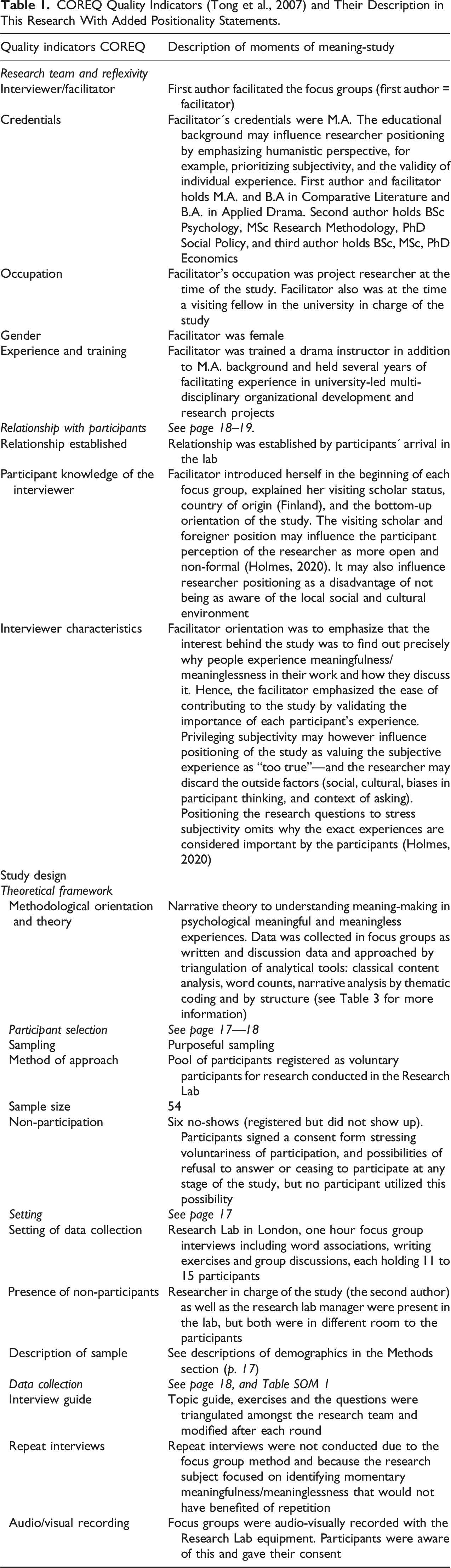
Sample. Participants were recruited from a research lab at a university in London, UK, which invites undergraduate, masters, doctoral students, and local community members to take part in research using fliers, emails, and word of mouth. We included participants who reported that they could speak about their present or past employment experiences. A core purpose of the study was to hear a diversity of perspectives through heterogeneous voices on a phenomenon that is widely relevant and does not require expertise but rather reflection of experience. Ethical approval was obtained using the university ethics procedure.
Each session was conducted in June 2017, lasted one hour, and was video recorded. There were 54 participants across four sessions, and participants were paid £10. Of the 54, 36 were female, and ages ranged from 20 to 64 years. In the last six months, six reported primarily working full-time, 15 working part-time, 25 primarily studying, five were unemployed, and three did not say. We decided to include participants not currently in employment because they could still reflect on and recall memorable moments from past jobs. It may have been the case that the ability to reflect on past employment experiences over time added different information to our understanding of MW—instead of only including the perspectives of those immersed in their more recent experiences—but the results held across employment groups.
Procedure. The four sessions were divided into two themes (two sessions per theme), and each session had two elements (writing exercise and focus group). The first theme centered on feelings of meaningfulness and the other on feelings of meaninglessness, and the themes for each group were allocated by a coin toss. Participants were asked to reflect on these feelings firstly by self-reflective writing exercises (Wald & Reis, 2010; Polkinghorne 2005; Jasper, 2005; Kitzinger, 1994). In the meaningfulness-emphasis groups, the prompts were to write about “experiencing purpose and meaning, something that feels worthwhile, and/or fulfilling,” and the meaninglessness-emphasis groups about “experiencing feelings of purposelessness, meaninglessness, unfulfillment, something that´s not worthwhile, and/or felt futile.” Thus, the questions for writing exercises were identical across groups apart from the variation of adjectives. Participants then discussed these experiences in a focus group setting. Further details of data collection procedures are available in Table S1.
We emphasized the importance of moments and feelings in understanding how meaning is perceived as affective. In our elicitation, we were careful to ask solely about feelings and experiences of meaningful work—not evaluations. We did not ask people to “tell stories” as such but asked them to “describe in their own words” or “share an experience or feeling.” Nevertheless, the data emerged as storied and continued to do so in the focus groups, corroborating the notion that human experience and narratives are deeply interconnected. In other words, although we only asked about affective experiences, our answers contained evaluations, too. Our questions facilitated storytelling that transmitted experiential and momentary narratives about feelings.
Positionality. Understanding researcher positioning is essential in qualitative research to assess possible bias arising from, for example, personal background, social and political position, intentions and assumed context of the research task, or ontological and epistemological beliefs (Yin, 2011, p. 123; Berger, 2015; Holmes, 2020). These may influence the research topic, relation with participants, and research process (ibid., Grix, 2019). In terms of the research topic, the research team designed the interview guide to facilitate an inductive stance on how people interpreted the subject. Concerning the participants, the main objective was to give space for participant discussions (Silverman, 2013). Thus, in the discussions, the researcher-facilitator asked intentionally open and vague questions, that is, “Who would like to share?”, and “Any other insights?” The conversation was encouraged mostly non-verbally (Bauer & Gaskell, 2000), but when the flow slowed, it was facilitated by questions such as, “What do you think is the opposite of feeling meaningfulness/meaninglessness?”. We triangulated analyses across the multi-disciplinary research group to prevent bias; however, we acknowledge that it is impossible to eliminate positional bias and are instead explicit about its influence (see positionality statement in Table 1).
Summary of Methods of Analysis and Main Findings.
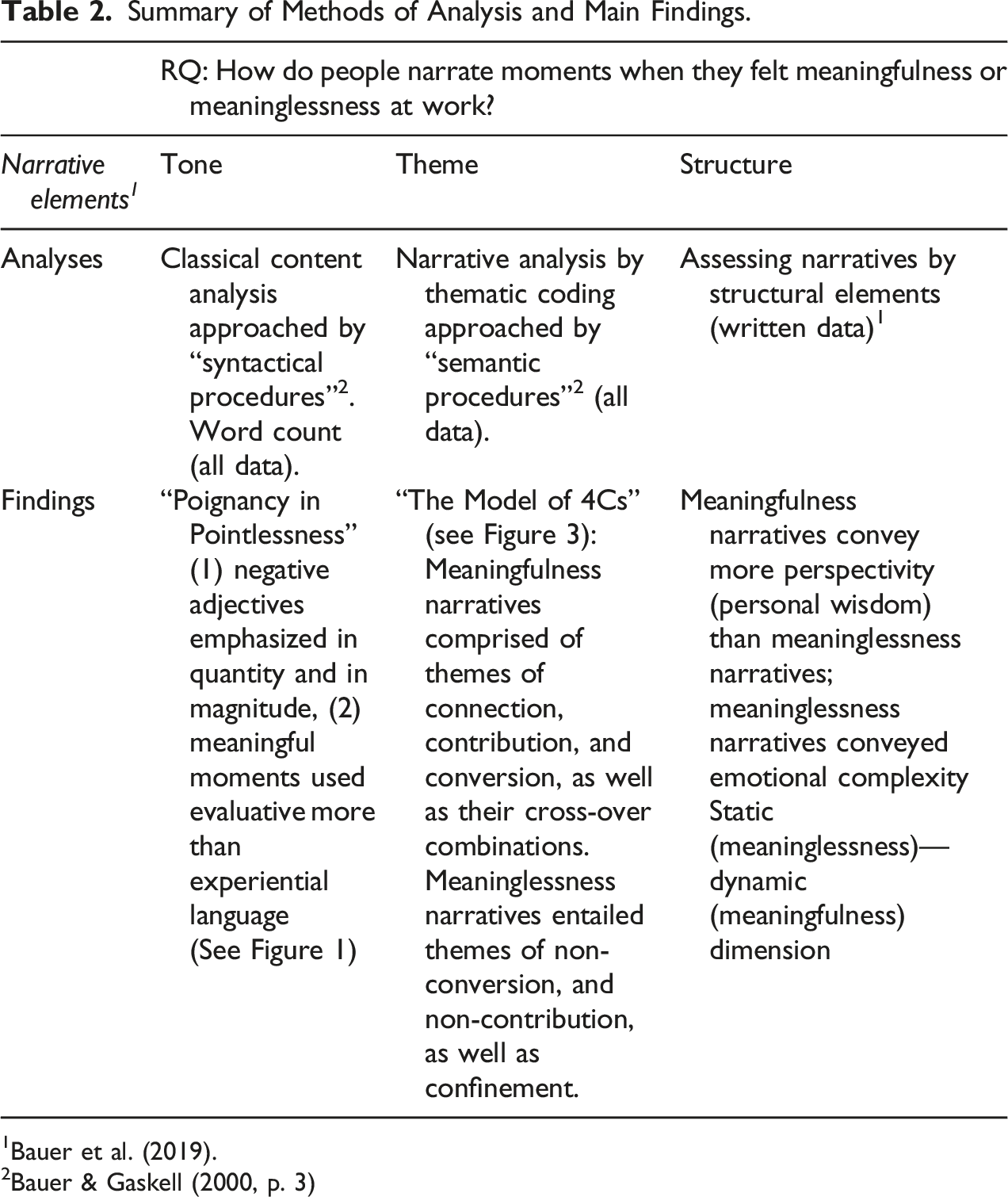
2Bauer & Gaskell (2000, p. 3)
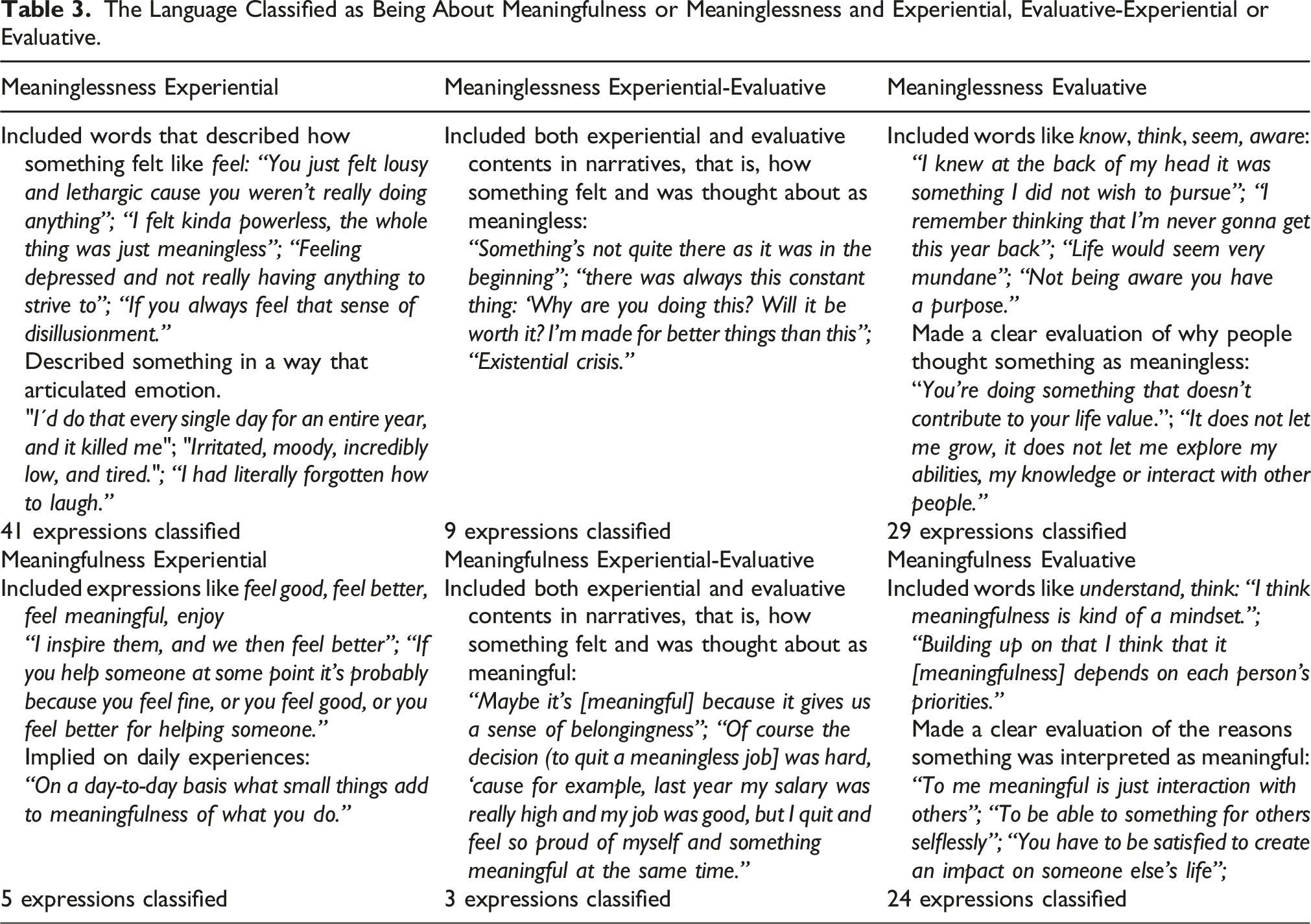
The Language Classified as Being About Meaningfulness or Meaninglessness and Experiential, Evaluative-Experiential or Evaluative.
The analyses of theme focussed on the contents of the feelings—what do people emphasize or consider important when narrating meaning/lessness? What are the reasons for action conveyed in the narrative (McAdams, 1985; Bauer et al., 2019)? To explain what people talked about, we turned to semantic procedures of the narratives that addressed the “denotational and connotational meanings,” “what is said,” and/or the “themes and valuations” that emerge (Bauer & Gaskell, 2000, pp.133–134). Thematic analysis methods were applied to create groupings from an inductive perspective, although some themes deductively confirmed those from prior research (see Discussion). Groupings were coded, and the frequencies of the codes were recorded numerically.
Finally, we conducted a structural narrative analysis using the written narratives. The structural elements we analyzed were complexity; coherence that is temporal, thematic, or causal—that is, unifying narratives across time, topic, or explanation; experiential and reflective growth themes; and value perspectivity (see McAdams, 1985; Bauer et al., 2019). We coded segments of these texts as being high, medium, or low in each of these structural elements according to their relative frequency in the narratives: high if the structural element appeared more compared to the counterpart (meaningful to meaningless, and vice versa), medium, if it appeared seemingly similar to its counterpart, and low if it appeared less compared to the counterpart. During this analysis, we noticed that these ratings were insufficient to capture the nuance of the narratives in certain respects. Therefore, we included an additional category covering “static” or “dynamic.” Structurally static narratives were either monotonous and/or included structural aspects without narrative development. Structurally dynamic narratives expressed action, change, and movement. The static–dynamic dimension was examined across the narratives in all the structural aspects: complexity, coherence, value perspectivity, and growth themes (see Table 5).
Triangulation and validity. We triangulated our analytic strategy (Leech & Onwuegbuzie, 2007). Mixing analytical tools allowed us to retain flexibility with the data and to remain open to emerging categories, thus following the bottom-up approach. For example, we noticed early on that the language used by the participants needed to be examined both on the syntactical and semantic levels (Bauer & Gaskell, 2000) because findings emerged in regards to the choice of words and vocabulary people used (tone), as well as in terms of their thematic, latent and interpretative content. Later, we focused on the structure of narratives at the suggestion of reviewers to incorporate narrative approaches more explicitly.
We also employed investigator triangulation. The first author conducted the analysis, which was first discussed in 10 weekly triangulation meetings with the second author, and with all authors before establishing the categories. In these meetings, the first author presented the preliminary codes and findings. These were discussed in comparison with the data, and interpretations were negotiated to reach agreement. To prevent first author bias, differences between the investigators were scrutinized to reach an agreed, corrected set of categories. The validation of the codes was conducted by constant comparison of datasets and checking the prevalence of codes by simple tabulations (Silverman, 2014). Datasets were compared, and it was found that all four groups’ accumulated data did not radically deviate from each other in quality, content, and quantity.
Findings
The overall findings are summarized in Table 2. In brief, our analyses of tone revealed that people related meaningless moments more descriptively and vividly regarding the use of adjectives, and more experientially (vs. evaluatively) when expressions were classified, than meaningful moments. The main themes identified were connection, conversion, contribution, and confinement, and the descriptive, vivid, and experiential meaningless moments were never about connection—instead, they were usually about being confined. Despite meaningless moments being related more vividly in tone, they were generally simpler in structural coherence, although they did relate emotional complexity. Meaningless moments also appeared structurally static in terms of both coherence and growth themes.
Tone. Part one analyses of tone using word counts of adjectives showed that participants used more adjectives when describing meaningless experiences than they did for meaningful experiences. In total, participants used 64 different adjectives when describing meaningless moments, compared to only 47 for meaningful moments. The word cloud in Figure 2 illustrates that the adjectives expressing meaninglessness were most frequent—adjectives such as bored, frustrated, tired, useless, and repetitive were prominent, comparing only to the positive adjectives happy, grateful, and content. We interpret these analyses as showing that meaninglessness language is more descriptive and vivid in terms of the adjectives used. Word cloud of the most frequently used adjectives describing meaningless and meaningful moments. Only those words with 3+ mentions used.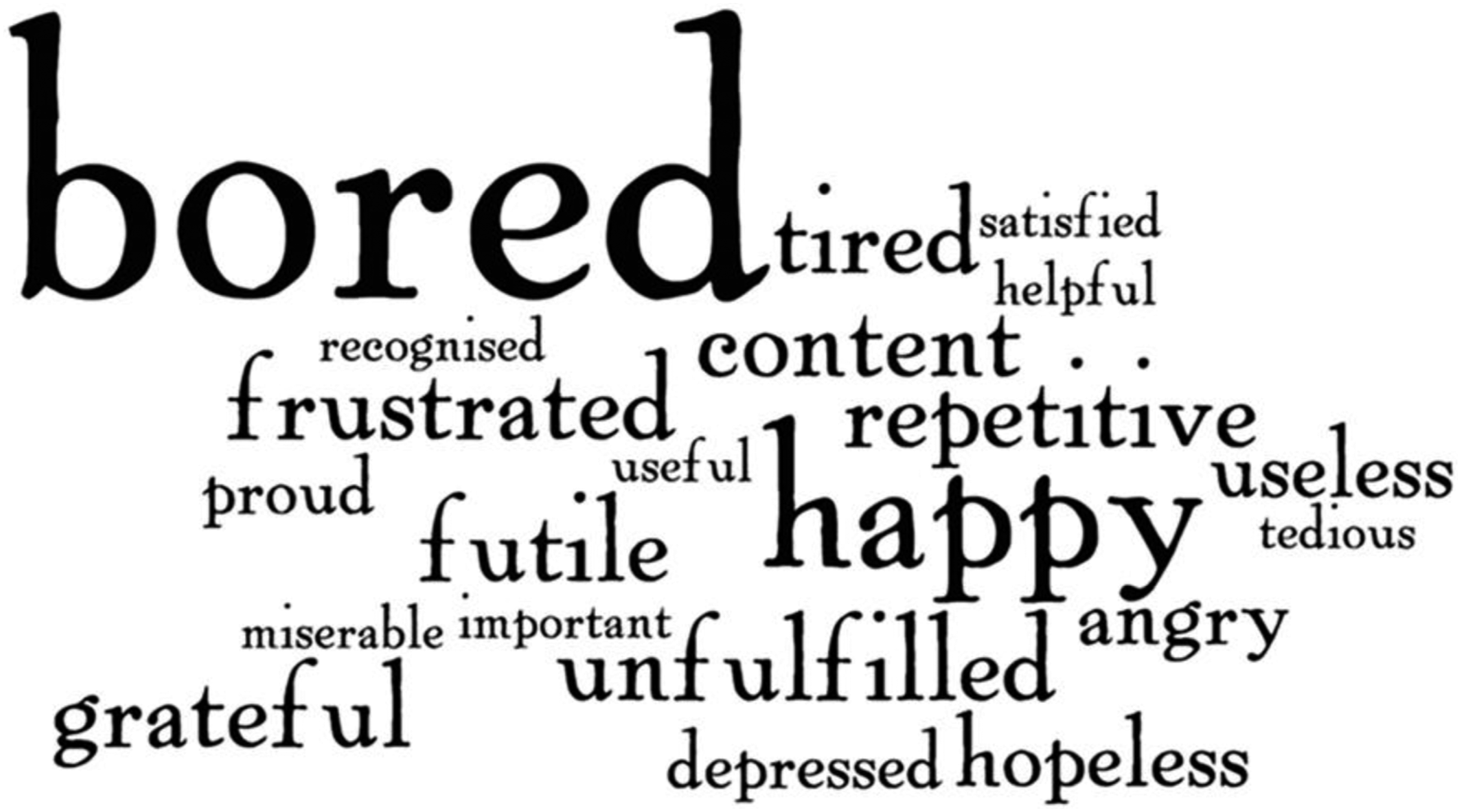
Part two analyses of tone showed that people described meaninglessness affluently in both experiential and evaluative languages. There were 29 different evaluative expressions and 41 experiential expressions. An example of a meaningless evaluative expression is “I knew in the back of my head this was something I did not wish to pursue,” and an example of an experiential meaningless expression is: “…it just felt like (…) day in day out, and I was a dead man walking.” When people described meaningfulness, however, evaluative language was more common. Five expressions used experiential language, for example, “…I feel that it’s meaningful because if I share the joy then the happiness doubles”, whereas 24 were evaluative, such as, “If you have an end goal that you understand what you´re working or doing it towards.” Further examples are in Table 3.
Overall, meaninglessness had more experiential descriptions than did meaningfulness. While people may not often discuss feeling meaningfulness (Bailey & Madden, 2016, p. 5; Lips-Wiersma & Morris, 2017, p. 69), they do often discuss feeling meaninglessness (Lips-Wiersma & Morris, 2017, p. 69)—and, as our results highlight, in more descriptive, vivid, and experiential language. We summarize these results as a “poignancy in pointlessness,” an affective/emotional quality embedded in meaningless experiences conveyed by expressive language.
Theme. Results of the thematic coding initially distinguished five main categories: impact and influence, other people, self, lack of agency and waste of time, and there were subthemes in each category (see Figure 3). These were later condensed and renamed into the four categories: other people = connection, self = conversion, influence and impact = contribution, lack of agency and waste of time = confinement. The number of times each theme appeared in the data are shown in Figure 4. Initial coding tree with codes and categories, which were later condensed into Model of 4 Cs. Model of 4Cs—Connection, Contribution, Conversion, Confinement. Theme surrounded by bolded line (connection) emerged from descriptions of meaningful moments, non-bold lines were for meaningful and meaningless moments, and themes surrounded by dotted line arose only from descriptions of meaningless experiences. Numbers represent the times categories appeared in the described experiences. Further descriptions of the major themes are available in Table 4, and of the crossover themes in SOM2.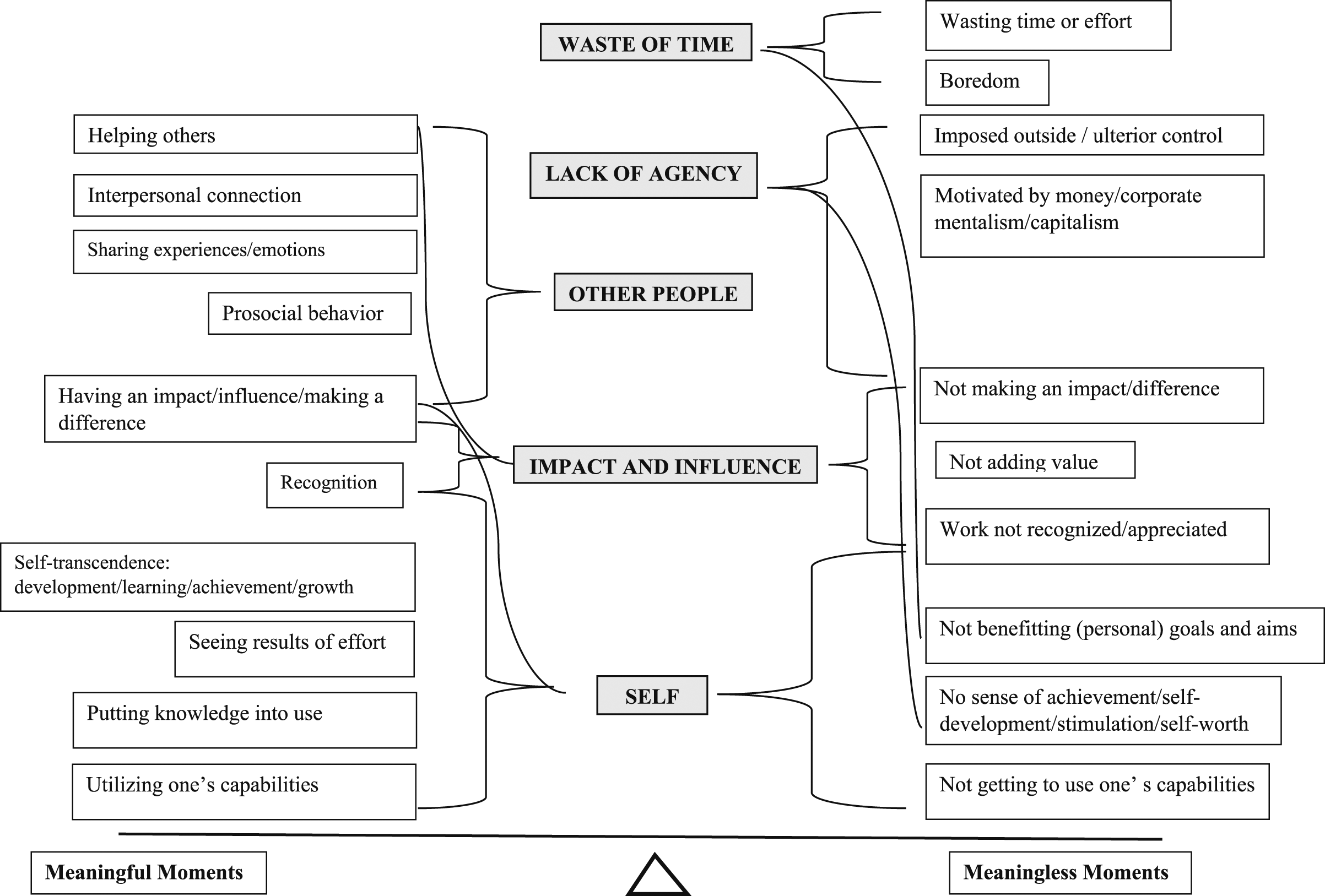
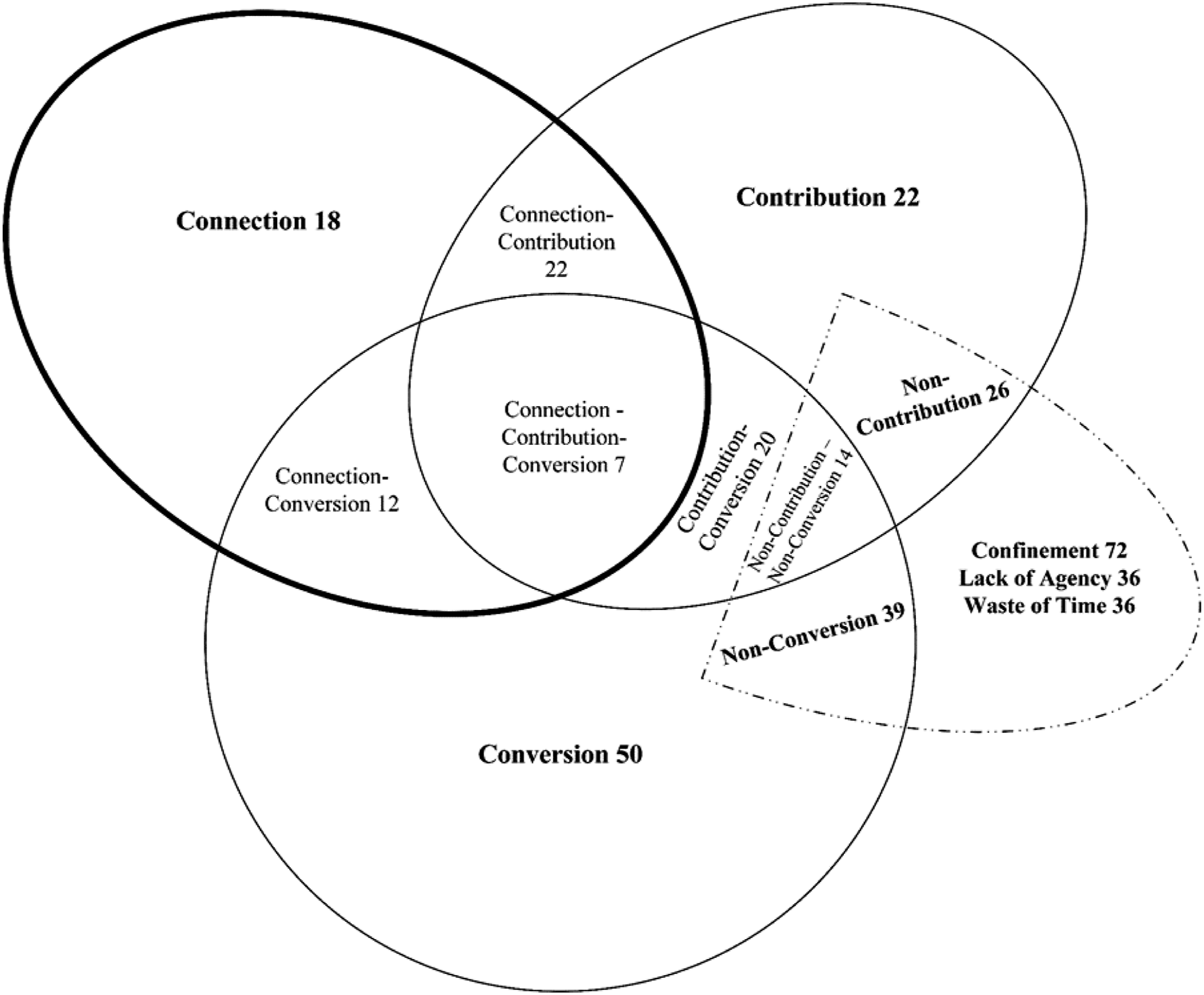
One of these themes entailed descriptions of meaningful moments alone, which was connection—doing something with others. This meant engaging in sharing, forming, and deepening relationships at the workplace. As an example of this theme, one participant described meaning for her to consist almost entirely of connection between the working team, “Work closely with my team and become friends… share happiness and experience… and keep company. Feel comfortable and confident in the team…”
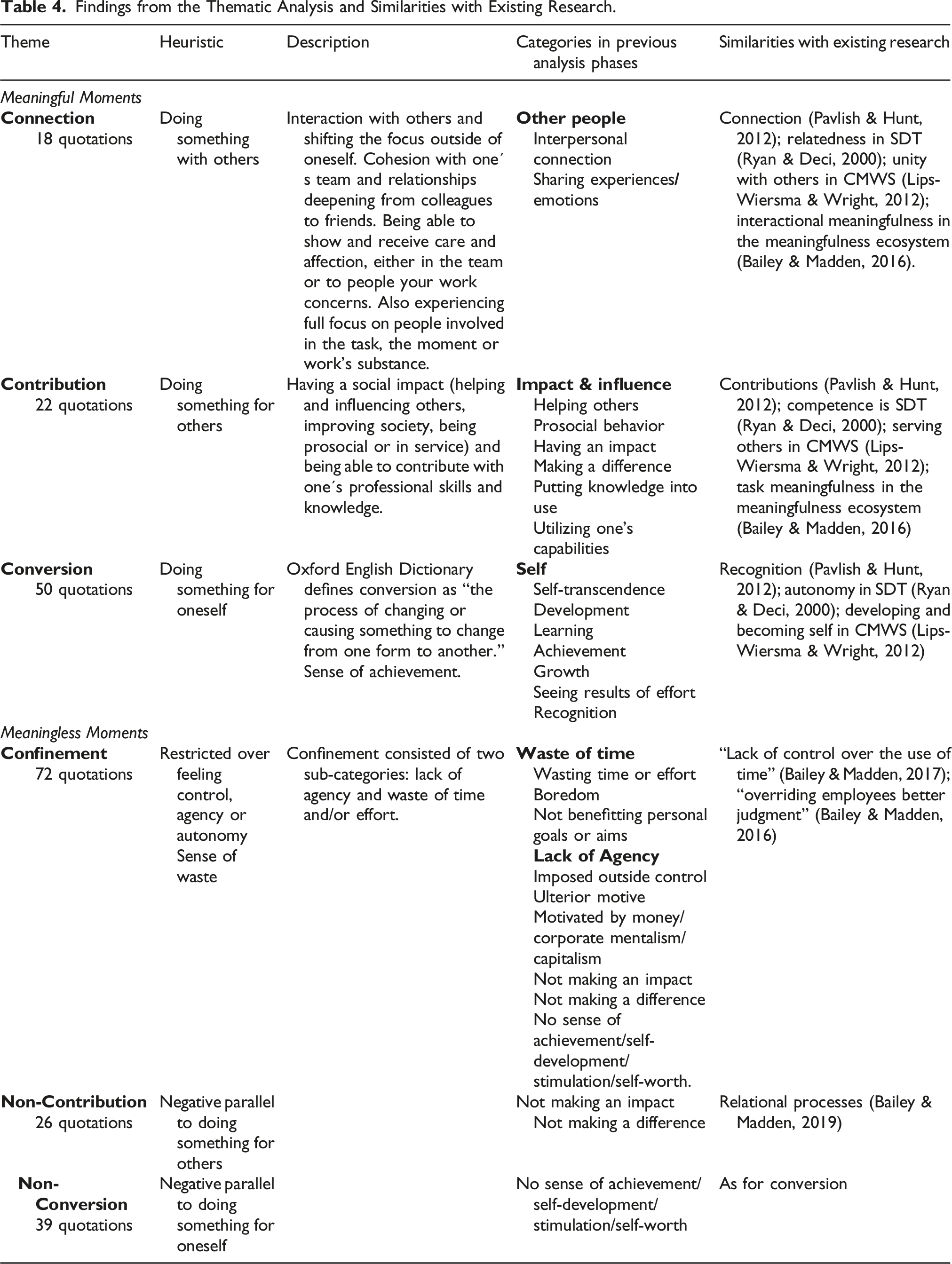
The themes contribution and conversion included both meaningful and meaningless moments. Participants talking about contribution emphasized doing something for others—having a social impact and contributing with professional skills and knowledge. This was different to doing something with others because the positive contribution was emphasized. As an example, one participant said, “In a dead-end retail job, helped a pensioner choose a radio, showed her how to use it, at that moment I felt so grateful to be able to help her, maybe subconsciously, I wanted to thank her for giving me the opportunity to do something meaningful.” Non-contribution in a meaningless moment was described as lacking the ability to create value for others, “… I’m not adding value to anybody’s life, I’m sitting here processing changes that [the manager] could do… he could just change the font in a second… and it was just at the end of the day walk in, walk out, without feeling like you’d added any value.”
Conversion was about doing something for one’s self, and the narratives discussed of accomplishment, personal change, or self-growth. For example, one participant said, “…Taking a risk created meaning for me—without it, I wouldn´t have unlocked this newfound interest, which has since shaped my studies and career aspirations.” Participants lacking conversion articulated the absence of achievement, self-development or self-worth: “A job that focuses too much on the minute details that do not seem to serve any bigger purpose (e.g. data entry). The job quickly becomes stagnant and do not allow for further learning/personal development and growth… I did not feel like I was learning anything or using any of my skills…”
One theme contained only meaningless moments, which was confinement. Some participants reported feeling restricted, lacking agency or autonomy, and a sense of waste of time or effort. People described lack of agency as experiencing working for an ulterior motive, under outside control, as a mismatch between one´s tasks and the goal of the work, or not being able to participate in decision-making. For example, one participant discussing an experience of meaninglessness while working for a non-profit felt frustrated by controlling management: They hoped to plan an event organized by a youth group for other youth groups but they wanted to control every strategy & expectation. They would say let the youth be creative but you need to make sure there is room for these many speeches… it just seemed that was the face to [an] ulterior motive to maintain funding. […] I felt frustrated.
Another participant reported meaninglessness arising from wasting their effort and time in creating an audition tape that ultimately failed: I finally submitted the tape, only to realize later that the sound and visual were out of sync, and therefore the tape was useless […] It was a hard earned good audition that ended up being a complete waste of time, and therefore had no meaning whatsoever.
“Waste of time” was the most common phrase used to describe a meaningless moment, and it arose as one unambiguous reason for experiencing meaninglessness throughout the data. However, time was not a phrase or concept people used when they considered meaningful moments.
Findings from the Thematic Analysis and Similarities with Existing Research.
Items & Findings of Structural Analysis According to Relative Frequency (High, Medium, and Low) and On Static–Dynamic Dimension.
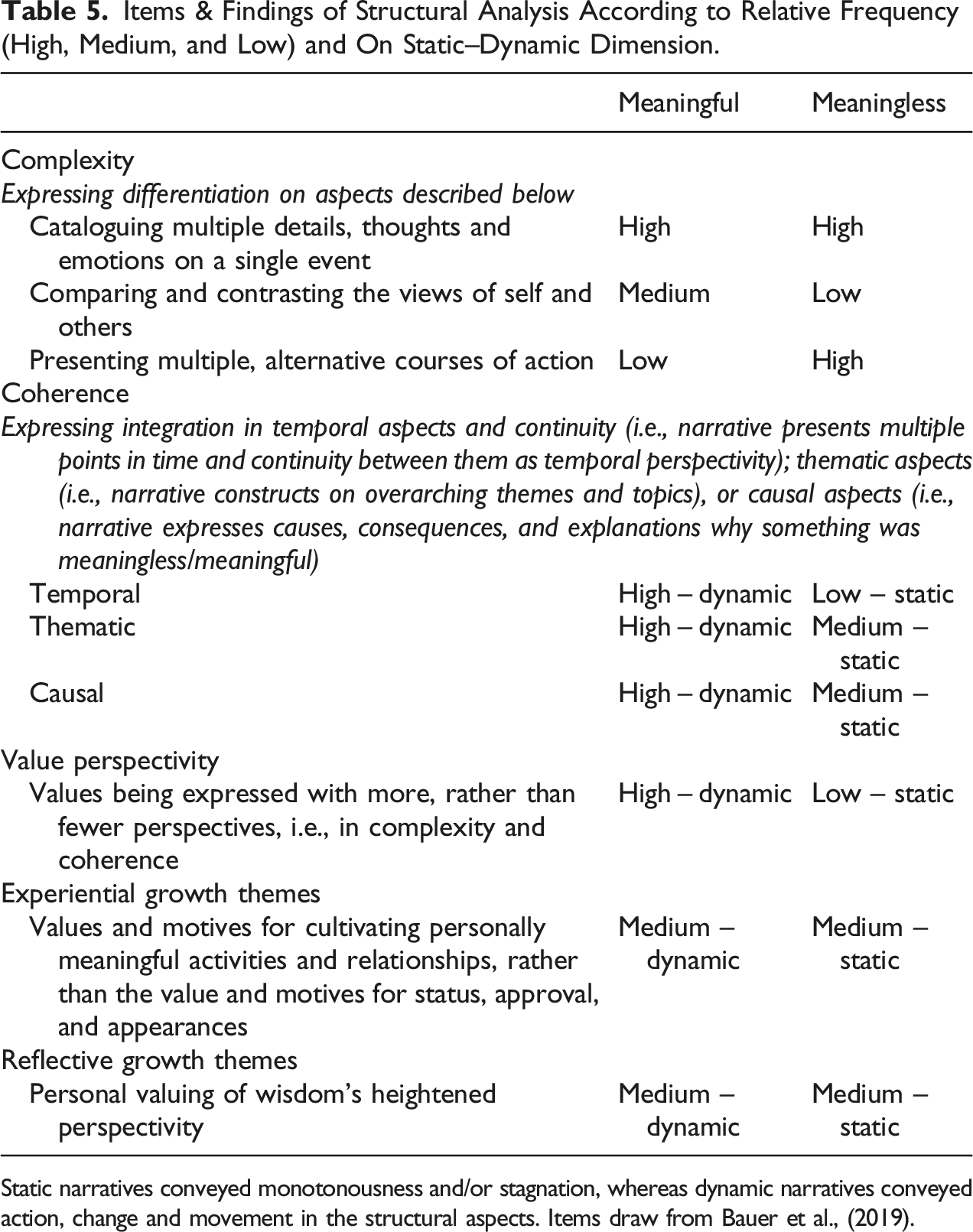
Static narratives conveyed monotonousness and/or stagnation, whereas dynamic narratives conveyed action, change and movement in the structural aspects. Items draw from Bauer et al., (2019).
Value Perspectivity
To assess perspectivity, we looked for examples where participants took multiple, complex, and coherent points of view. One meaningful quote from a participant portrays a deep perspective of coherent values about making a difference that supports their career choice in medicine: I chose medicine as a career because I want to live a purposeful, worthwhile life where I can bring hope to others… One moment where I feel my work and effort is meaningful is when I speak to patients on the ward and try to help them with their suffering…I felt like I had the power/ability to make others feel better. It was being able to make someone feel like there are people who care about them… and who can actually do something to help them.
Here, the points of view include both the self (living one’s own worthwhile life) and others (bringing hope, helping people, making them feel better and cared about). On the other hand, another participant discussing meaninglessness during event production appeared to lack perspectivity when talking about the futility of trivial tasks: Doing work (e.g. brainstorming ideas for a video, writing a petition) when it was unclear how my own efforts would contribute to an end goal/product precisely. [I felt] unmotivated, grumpy, frustrated, tired. Sense that there was a waste of effort and I did not really care about or enjoy what I was doing… Opportunity cost of other things I could be doing with my time and energy felt like a waste of resources. Not learning/growing as an individual nor achieving collective benefits and goals.
In this quote, there is no evidence of taking the perspective of others, and a sense that the self is not developing temporally because there is no learning—that is, there is little coherence. The finding that perspectivity was more pronounced in the meaningful narratives is somewhat in contrast to the expectation that wisdom is constructed in “relation to life’s difficult and unfulfilling events” (Bauer et al., 2019, p. 82). Instead, it suggests that wisdom and perspectivity are construed more fluidly about experiences that feel good and meaningful, although meaningless experiences could transform into meaningful ones with the added ingredient of perspectivity (see Discussion).
Static—Dynamic Dimension and Coherence
We uncovered a seemingly novel structural element present in the narratives, which we refer to as a static–dynamic dimension. As mentioned earlier, this dimension is about whether narratives expressed action, change, and movement across aspects of structure. Static–dynamic dimension was present especially in the structural aspects of coherence and growth themes, that is, narratives conveyed either dynamic or static coherence, and dynamism or stagnancy of growth themes. Whereas meaningful narratives conveyed dynamic coherence on many levels (action and development in temporal, thematic, and causal coherence structures), meaningless narratives were especially static on the temporal dimension (and static on the others, too—see Table 5). For example: I was given some quite boring tasks such as data entry. At the time it was very unfulfilling and futile. It may have had some benefit for the company, but it felt pointless and like they were just trying to fill my time because I was not allowed, or did not have the ability to do many other tasks… It was frustrating as I wanted to do some more interesting work and I felt my time was being wasted. [I felt like] time could have been used on other, more interesting tasks which could have added more value…
Although the temporal aspect is present in this quote, time is described as a wasted resource, which is considered experientially so frustrating that it overrides the evaluation of being beneficial for the organization. There is no dynamic discussion of change over time. It appears there is a start at causal coherence—data entry, the cause, “may have had some benefit,” an effect, but this is not developed nor dynamic; thematically, the point that time could have been better spent is straightforward, static, and not developed. Furthermore, the narrative lacks dynamism in structure because it is restricted in action, change, and movement by repetitive static temporal narration. The story does not change because the expressions describing temporal stasis take over: “filling time”; “time wasted”; “time could have been used [to add value]” does not provide context for the thematic or causal development of the narrative.
In comparison, a meaningful narrative from a teacher showed dynamic coherence in all temporal, thematic and causal ways: Once I had done this internship as a teacher of secondary school kids …I was a student there once when I was young. It felt like I am giving back to the society. It felt like I am also learning simultaneously. It felt happy, and like this is what I want to do. The fact that I could learn so much from young minds. And the fact that giving back what the institution had given to me as a student was amazing… It felt meaningful to do this since I was a kid… I wanted to teach there once in my lifetime.
This quote illustrates both coherence and dynamic temporal change when the teacher considered their history with the school, thematically by linking motives and values of learning and teaching with contributing to society, and causally through relating their earlier student experience (a cause) to a later desire to give back to the school (the effect).
Static–Dynamic Dimension and Growth Themes
Our investigation revealed not only relatively lower amount of coherence expressed temporally, thematically, and causally in meaningless narratives, but the absence of any changeability with respect to experiential (inner and intrinsic) and reflective growth (learning and wisdom), too. For example, a quote from an employee about his meaningless experiences in a law firm illustrates the static dimension: I had to pack files into boxes. Didn’t have to consume much brain power and the work is tedious and boring. People at the office were also not very respectful of the work I did. Other co-workers in the team were also not insightful at all. The entire experience was dreadful. [I felt] miserable, dreadful and bored. Not important work. Boring conversations every day. Primarily because I felt mentally irritated by the lack of cognitive stimulation. It was draining looking at computers performing repetitive actions. I felt I was worth more to myself.
The language around being “worth more” and having boring conversations communicates the absence of experiential growth, although the lack of respect indicates a desire for status and approval from others (another growth dimension). The lack of “brain power” and cognitive stimulation communicate the absence of change in terms of reflective growth and learning, and the repetitive actions indicate a static experience without change.
In meaningfulness narratives, experiential and reflective growth themes were in dynamic action. This meaningfulness example relates these by linking causes and consequences of meaningful activities (coherence), and cataloging various thoughts, actions and emotions from multiple points of view in relation to others (complexity), leading to reflective growth (learning): Customers are satisfied and contented with the service given due to the great teamwork with the other colleagues, we are able to keep our pace on and catch up with the non-stop coming orders. The manager also gives us, the employees, the motivation and encouragement on the good work that we have done. Despite the exhaustion, hard work has paid off. I feel a sigh of relief and joyfulness within after witnessing all the smiling faces… The experience gained was wonderful, which could not be learned by just reading books or attending to classes in school. With the experiences gained, are the boosters on the knowledge within…. molding and shaping one into a better person from the experience, learn to be independent, importance of teamwork and sharpen one’s skill in whatever aspects.
Here, the satisfied customers (consequence) are linked to the cause (teamwork and motivating manager), and points of view are related from the self, customer, and colleague perspectives. Experiential and reflective growth are shown through learning about the importance of teamwork and sharpening skills, and there is dynamism in language like “molding and shaping.”
In meaningless narratives, however, growth themes were described mostly as absent or, when mentioned, problematic and stuck. Meaninglessness narratives showcased growth themes in fewer, more heuristic, and more static perspectives than the complexly and dynamically expressed perspectivity around the growth themes in meaningful narratives. As examples, “I felt that I should use that time to learn useful things for my future career” and “Time is golden so should be spent wisely on doing things that are either useful for my own development or entertaining.”
Meaninglessness Narratives and Complexity
It is important to note that although meaningless narratives were simpler in structure than meaningful narratives in general, there was one exception for emotional complexity. Meaningless narratives catalogued detailed emotions to a significant degree. This aspect of complexity matched the findings for tone, which showed that meaningless narratives were more complex in terms of experiential language, and vividness of adjectives. For example: I worked full-time for a year performing data-entry tasks, repetitively, for 8 hours a day. It was slow, monotonous and incredibly boring—the job was insanely unfulfilling as I felt I was capable of great use in a different field, but it was the only job available. [I felt] depressed, drowsy, lethargic, apathy, boredom, moody, miserable, resentment. I felt like …I was wasting my time since I could be more productive and efficient completing a job where I required mental stimulation. Since data-entry requires no brain power, it made me irritable, worthless and bored.
In the example, we interpret the descriptions of emotions as showing complexity, richness, and vividness in vocabulary, given there were eight negative adjectives (from depressed to resentment) and strong adverbs (incredibly, insanely). Thus, meaninglessness language portrays an experience packed with emotion, which explains why “meaninglessness strikes hard” (Bailey and Madden, 2016; p. 54). At the same time, other structures in meaninglessness narratives conveyed stagnation.
Connecting tone, theme, and structure. In summary, meaningless narratives were more descriptive, vivid, and experiential in tone than meaningful narratives. These descriptive meaningless narratives primarily related themes of being confined, while meaningful narratives mostly related experiences of connecting with and contributing to others, or personal growth and conversion. Structurally, meaningless narratives lacked perspective and were static in their coherence and growth relative to meaningful narratives. Thus, with more affect, the experience of being confined, and a lack of perspectivity and change, meaninglessness narratives resemble the experience of a fly captured in a glass jar—desperate to escape confinement but hampered by restricted visibility. Meaningfulness narratives resemble a gentler, freer glide through unrestrained skies, connecting with and contributing to others and learning, lending a panoramic view.
Discussion
This study conducted a narrative investigation of how people described moments that felt meaningful or meaningless at work. It introduced the term affective eudaimonia to describe these moments, referring to a particular facet of the multifaceted eudaimonic state approach to MW described by Bailey et al. (2019a). This facet is aligned with the “experiencing self” (Kahneman & Riis, 2005), which is affective (feelings-based) and exists on a moment-to-moment basis, differently to hedonic-affective, eudaimonic-evaluative, and task attribute approaches. The analyses were informed by Bauer et al. (2019), who summarizes the tone, theme, and structure of narratives about meaningfulness and meaninglessness. We found that meaningless narratives were more descriptive, experiential, and vivid in tone than meaningful narratives, and more likely to be thematically about experiences of confinement than connecting with or contributing to others or experiencing personal growth and conversion. Furthermore, these vivid and confined meaningless experiences lacked perspectivity and were static in their structure and growth, metaphorically resembling a fly trapped in a jar that is desperate to escape and obtain a broader view of itself and the wider world.
Our work is situated broadly within vast literatures about meaningful work and narratives. We build specifically on a subset of qualitative psychological studies within these literatures that use narrative approaches. Our primary contribution is to consider whether and how asking about affective (feelings of) meaning adds new information to what we currently understand about the experience of meaning, and its absence, at work. Prior research can be categorized as investigations that inquired about life and work histories (Lips-Wiersma, 2002; 2009; 2012; Schabram & Maitlis, 2017) that were not necessarily experiential or about scenes and moments in time that did not ask about affect, feelings, and emotions (Pavlish & Hunt, 2012; Bailey & Madden, 2016, 2017, 2019). These studies mostly conducted thematic analysis of narratives, omitting their tone and structure, and we extract and focus on findings based on the latter two aspects of narratives. Our findings both confirm and extend prior research.
Tone
The finding that meaningless moments are more descriptive and experiential in tone than meaningful experiences reinforces other work. This work includes Lips-Wiersma and Morris’ (2017) observation that conversations about meaning are often expressed negatively, as complaints, and Baumeister et al. (2001), who generally showed that “bad,” such as meaninglessness, is stronger than “good,” such as meaningfulness. Our analyses further illustrated how meaninglessness was communicated through syntactical procedures. As Bunderson and Thompson (2009) found, the word pride was used to describe how meaningful experiences felt, although it was less common than other meaningful adjectives. A new finding from our results is that more adjectives and more experiential (versus evaluative) language were used to describe meaningless experiences than meaningful experiences, suggesting that the negative dimension of meaningfulness is particularly characteristic of affective eudaimonia. This is important theoretically for understanding what it means to experience wellbeing (Kahneman & Riis, 2005; Angner, 2010; Haybron, 2016), in that felt meaning may be more about meaninglessness than meaningfulness. Any investigation of affective eudaimonia would be incomplete without the former, even though many large surveys do not include meaninglessness and instead only ask about meaningfulness (Dolan et al., 2017; Anusic et al., 2017). A practical implication is that it may be more important to prevent meaninglessness than promote meaningfulness at work.
Theme
In general, our themes confirmed other work, suggesting that asking about life histories, scenes, moments in time, or moments of felt meaning, produces similar thematic conclusions. Portions of our thematic analysis were strikingly similar to Pavlish and Hunt (2012), although we completed our analyses before identifying this paper. These authors also identified connection and contribution as overarching themes, reinforcing the importance of these social dimensions. Social dimensions were also highlighted in the meaningfulness ecosystem, which described interactional meaningfulness (Bailey & Madden, 2016), and in Lips-Wiersma’s (2002, 2009) model, which included unity and service to others. Helping others is also important in the related literature on organizational citizenship (Smith et al., 1983; Bolino et al., 2004).
In addition to themes of connection and contribution, Pavlish and Hunt (2012) identified recognition. In contrast, we identified conversion and confinement as other themes and considered recognition a sub-theme of contribution and conversion (depending upon whether the recognition was for doing something for others, such as volunteering, or oneself, such as a promotion). Pavlish and Hunt's (2012) identification of learning as a facilitator of meaningfulness (and inhibitor of meaninglessness) aligned with our conversion theme, which emphasized the importance of personal growth, self-development, and self-transcendence. While confinement was not identified by Pavlish and Hunt (2012) as an important theme, it was by Bailey and Madden (2017) in discussing the “seven deadly sins” of leadership. It is also important in related theories, such as self-determination theory, where autonomy is seen to foster intrinsic motivation, particularly in the context of work (Ryan & Deci, 2000; Gagné & Deci, 2005; Deci et al., 2017; Bauer et al., 2019).
Structure
Finally, examining structure showed how people organize their narratives about moments of felt meaningfulness and meaninglessness at work. Meaningful narratives held more value perspectivity; that is, participants related multiple and complex points of view (Bauer et al., 2019). This suggests that providing opportunities to look at meaningless day-to-day experiences from different dynamic and changeable viewpoints could positively transform them. For example, collectively sharing experiences at work could offer new views that create meaningfulness by adding structural perspectivity if people listen. Conversation could be encouraged with language such as, “What opportunities do you have to look at your work from other points of view?” and “What perspectives are you able to gain on your work by sharing it with others?” This approach goes beyond viewing narratives as individual-level drivers for MW and considers broader solutions such as the potential of the collective to widen the perspectivity of subjective experiences.
Meaningless narratives lacked a temporal dimension to structure, suggesting they were “stuck” in time. This was consistent with our thematic findings that wasting time characterized meaningless narratives about confinement, and with the findings of Bailey and Madden (2017) that meaninglessness is “being stuck in the moment” and occurs when there is a “lack of control over the use of time” (p. 11). A relevant task for management and leadership would be to help employees avoid meaninglessness by focusing on how the conditions and systems facilitated by leadership impact employees’ experiences. Creating conditions for employees to exercise authentic control, not confinement, over their time may be a valuable asset in achieving that, as well as providing opportunities for staff to connect their experiences temporally. For example, professional development programs that build in an ipsative manner by encouraging employees’ personal bests and building on prior milestones could reduce or transform meaninglessness. Again, this approach is about how staff can be guided within their professional contexts to avoid the psychological experience of meaninglessness rather than relying on individuals to make meaning. However, some staff may accept meaningless experiences in certain professional contexts due to winder circumstances, such as financial or family pressures, and future research could explore the influence of these circumstances on the construction of meaningfulness at work.
Other structural findings provide further insight into how meaningless narratives might transform into meaningful ones. For example, we found that meaningful narratives were more dynamic and changeable across temporal, thematic, and causal dimensions of coherence and reflective and experiential growth, whereas meaningless narratives were more static. This is different to the degree of structural elements present in narratives (high, medium, and low), and speaks to another dimension about whether they are fixed. This finding complements Bailey and Madden’s (2019) findings that during meaninglessness, people dynamically switch between “netdoms” as a response strategy (such as from colleagues that devalue to friends that respect), emphasizing that people engage in dynamic action and movement as they transition out of meaningless experiences—even though they may be stuck when in them. It could be that switching is a beneficial strategy employed to gain some perspective on a meaningless moment, and that after switching back, people view the meaningless moment as less so. While more research is needed, it could be that meaningfulness is enhanced by opportunities for staff to consider how their experiences change across aspects such as time, topic, event, skill, or knowledge, similar to how it is enhanced with relational netdoms.
Although we inquired only about feelings and experiences, evaluations were present in people’s responses, too, especially for meaningfulness. Meaningful narratives had more evaluative language and, relatedly, value perspectivity, and meaningless narratives had more experiential language and less perspectivity—although both meaningful and meaningless narratives contained evaluative and experiential language. Recollections of affective eudaimonia appear to consist of a dynamic dialogue between the experiencing and evaluating selves, which can be considered a meaning-making process (Kahneman & Riis, 2005). Identifying the conversation between these selves could prove beneficial in understanding and inquiring about employees’ experiences. Future research should delve deeper into the possible conflict between these selves to discover which one is prioritized, when, and how: The heightened perspectivity of the evaluating self, or the heightened affectivity of the experiencing self? This conversation could be harnessed by leadership and management to avoid or transform feelings of meaninglessness.
Limitations
There are limitations to this research. By asking about moments and feelings, we assumed that moments and feelings are important, and people might describe them as less important if they are not emphasized. By focusing on tone, theme, and structure, we did not consider other aspects of narratives, such as the process of selecting them. People may select certain meaningful narratives because they contrast with meaningless narratives, have transformed a meaningless experience into a meaningful one, or cohere with the moments of colleagues, as examples. 2 The meaningful narratives that we observed may have started as meaningless, and our data may not have revealed this. Such processes could be investigated with follow-up questions such as, “Why did you choose to tell me about this experience?”, and “How did this experience become meaningful for you?” It is also possible that different researchers would lead participants to select different experiences to relate to, as it is impossible to eliminate the effects of researcher positionality.
The generalizability of these results is a limitation and area for future research. While many participants were not in work at the time of the interview, our sample also appeared psychologically sophisticated and possibly well educated. It may be that eliciting narratives from a different group would produce new insights. It may be difficult to implement initiatives that make work itself more meaningful for some jobs, and initiatives that focus on non-work tasks, such as foreign language courses for workers using their native language on the job, may have more value (Mortimer, 1990). The cultural context of London, England may also be important, as worker legislation and customs will differ in other countries, which could affect narratives about affective eudaimonia. However, our themes were identified in other samples; for example, nurses in the United States also spoke of connection and contribution (Pavlish & Hunt, 2012). There may be generalizations of context that make the generalization of results more likely.
Conclusions
This paper described affective eudaimonia, which is the experience of eudaimonic feelings of meaningfulness, meaninglessness, and related adjectives. Our research investigated these feelings at work, finding the tone of narratives about meaningless experiences to be more evocative than meaningful ones, suggesting that workplaces should focus on preventing the former over promoting the latter. Our thematic results indicated that workplaces should support moments of connection, contribution, and conversion, and avoid confinement, such as via job design, employee-driven professional development, the organizational culture, management, and/or leadership. Structurally, meaningless narratives lacked perspectivity and were static with respect to time and growth, which initiatives could address by facilitating wisdom and perspective-taking.
Studying experience is a complex area and distinguishing felt and lived experiences from evaluations is not straightforward. Reflecting on experiences by its nature may introduce an element of evaluations. For example, it may be that people evaluate their work based on their expectations about what work should be like, and this subsequently influences how they discuss their experiences at work. Future research could use methods aligned with people’s experiences, but that do not offer as much depth as a qualitative study, such as the Day Reconstruction Method (DRM) (Kahneman et al., 2004). Nevertheless, our research probed deeply into experiences of eudaimonia—a mental state encompassing both positive and negative dimensions of psychological experiences. Rooting workplace wellbeing in the experience of eudaimonia illustrates important pathways to authentically meaningful and sustainable working lives that exist in people’s everyday lived and felt experiences.
Supplemental Material
sj-pdf-1-gom-10.1177_10596011211047324 – Supplemental Material for Moments of Meaningfulness and Meaninglessness: A Qualitative Inquiry Into Affective Eudaimonia at Work
Supplemental Material, sj-pdf-1-gom-10.1177_10596011211047324 for Moments of Meaningfulness and Meaninglessness: A Qualitative Inquiry Into Affective Eudaimonia at Work by Suvi-Jonna Martikainen, Laura Kudrna and Paul Dolan in Group & Organization Management
Supplemental Material
sj-pdf-2-gom-10.1177_10596011211047324 – Supplemental Material for Moments of Meaningfulness and Meaninglessness: A Qualitative Inquiry Into Affective Eudaimonia at Work
Supplemental Material, sj-pdf-2-gom-10.1177_10596011211047324 for Moments of Meaningfulness and Meaninglessness: A Qualitative Inquiry Into Affective Eudaimonia at Work by Suvi-Jonna Martikainen, Laura Kudrna and Paul Dolan in Group & Organization Management
Footnotes
Acknowledgements
We thank Dr. Clare Rawdin and Professor Helinä Melkas for their comments and suggestions. Martikainen wishes to express her thanks for the financial support of the Foundation of Economic Education and the Finnish cultural Foundation. Dolan gratefully acknowledges financial support from the Templeton Foundation, grant number 1-SPS-C532—Templeton/St Louis Happiness Project. Kudrna was partially supported by the National Institute for Health Research (NIHR) Applied Research Centre (ARC) West Midlands, grant number NIHR200165. The views expressed are those of the author(s) and not necessarily those of the NIHR or the Department of Health and Social Care.
Declaration of conflicting interests
The author(s) declared no potential conflicts of interest with respect to the research, authorship, and/or publication of this article.
Funding
The author(s) received no financial support for the research, authorship, and/or publication of this article.

Supplemental Material
Supplemental material for this article is available online.
Notes
Associate Editor: Sarah Bankins
References
Supplementary Material
Please find the following supplemental material available below.
For Open Access articles published under a Creative Commons License, all supplemental material carries the same license as the article it is associated with.
For non-Open Access articles published, all supplemental material carries a non-exclusive license, and permission requests for re-use of supplemental material or any part of supplemental material shall be sent directly to the copyright owner as specified in the copyright notice associated with the article.
