




Abstract
Drawing on the concept of requisite complexity, we propose that mental model complexity is crucial for teams to thrive in dynamic complex environments. Using a longitudinal research design, we examined the influence of team mental model complexity on team information search and performance trajectories in a sample of 64 teams competing in a business strategy simulation over time. We found that team information search positively influences performance growth over time. More specifically, and consistent with requisite complexity, we found that mental model complexity positively influences both performance growth and information search over time, above and beyond the effects of mental model similarity and accuracy.
Keywords
Introduction
Because contemporary team tasks in most organizations are increasingly cognitive and information-laden in nature, gaining insight into team cognitive structures and cognitive processes is crucial for understanding team task execution and predicting and explaining team performance (Hinsz, Tindale, & Vollrath, 1997). Therefore, it is not surprising that in the last decades, team researchers have recognized and investigated the effects of team members’ cognitive structures on team processes and performance (Mohamed, Ferzandi, & Hamilton, 2010). Indeed, findings of a prior meta-analysis indicate that there is a strong relationship between team cognitive structures, team processes, and team performance (DeChurch & Mesmer-Magnus, 2010).
A central concept in team cognition literature is the notion of mental models—team members’ organized representations of the elements of their task or team environment (Mohammed et al., 2010). A variety of studies have indicated that mental model similarity—the extent to which models are similar among the team members—and mental model accuracy—the degree to which the models adequately represent a given performance domain—are positively related to team functioning and performance (DeChurch & Mesmer-Magnus, 2010). Research suggests that mental model similarity and accuracy impact team performance through the beneficial effects they have on internal team interaction processes, such as coordination, communication, and cooperation (Mathieu, Heffner, Goodwin, Cannon-Bowers, & Salas, 2005). Although quite necessary for efficient team functioning, we suggest that there are two aspects that may limit the ability of these mental model characteristics for explaining teams’ abilities to effectively interact with and adequately process information in complex dynamic environments.
First, the conceptualization of similarity and accuracy is based on the assumption that mental models consist of the “key elements” of a domain (e.g., Mohammed et al., 2010). This implies that a task can be mentally represented with a limited number of critical elements and that a meaningful distinction can be made between key and trivial elements. Yet, there often are no clear criteria for determining which elements should be construed as key and which are more peripheral aspects of task understanding. This is particularly relevant given that in many tasks, aspects which may at one time be trivial may become critical at other times (e.g., Uitdewilligen, Waller, and Pitariu, 2013). Therefore, as mental model accuracy and similarity are based on a limited number of tasks elements, teams may reach high accuracy and similarity even though they only capture a limited part of the relevant task environment. In other words, by focusing only on the most critical task elements, these concepts may fail to capture the full breadth of the relevant task concept domain.
Second, although similarity and accuracy represent correspondence in interconnectedness (correspondence to other team members and correspondence to a referent), they are not indicators of the extent to which the concepts in the models are interconnected among each other. Particularly in complex dynamic environments, where the relation between task elements may shift over time, the level of interconnectedness may provide additional information on teams’ potential to make sense of novel situations by perceiving connections between disparate information cues (Mohammed et al., 2017). Moreover, the level of interconnectedness may be related to teams’ ability to explore alternative action patterns when adjusting to external contingencies (Kozlowski, Gully, Nason, & Smith, 1999).
Drawing on the concept of requisite complexity, we suggest that mental model complexity may be significantly important above and beyond similarity and accuracy for predicting successful team information processing in complex dynamic environments, as it provides a measure of the extent to which teams can process and integrate novel information (Calori, Johnson & Sarnin, 1994; Weick, 1979). The concept of requisite complexity refers to “the matching of an individual, team or organization’s level of complexity to the demands of its environment” (Hannah, Lord, & Pearce, 2011; Uhl-Bien, Marion, & McKelvey, 2007). As human organizations are also interpretative systems (Weick 1995), the complexity of their internal representations of their environments are likely driving the extent to which they seek information and synthesize diverse and potentially conflicting aspects of the environment (Droiver & Steufert, 1969).
Mental model complexity refers to the number of elements captured in team members’ mental models and the degree to which these elements are related to each other (e.g., Curseu & Rus, 2005). Therefore, compared to teams with less complex mental models, teams with highly complex mental models take into account a larger amount of task relevant concepts and make more connections between concepts. As such, it is an indication of the richness of the knowledge representations held by the team for a particular knowledge domain (Curseu, Schruijer, & Boros, 2007). Given that in dynamic complex environments, teams need to process and integrate a wide variety of cues in order to make sense of and adapt to their environment (e.g., Burke, Stagl, Salas, Pierce, & Kendall, 2006; Weick 1995), mental model complexity may exert additional influence on performance development over and above accuracy and similarity. In particular, based on information processing theories of requisite complexity, we pose that teams with high mental model complexity are likely to engage in comparatively higher levels of information search (Driver & Steufert, 1969; Christianson, 2019).
The influence of team members’ mental models on external task-related processes involved in the collection and processing of information from the task environment has received relatively scant attention (Kouchaki, Okhuysen, Waller, & Tajeddin, 2012). Starbuck and Milliken (1988) posited that knowledge structures function as a lens, which filters the information that is received from the environment and determines how this information is socially interpreted. Congruent with the notion of requisite complexity (Driver & Steufert, 1969; Uhl-Bien et al., 2007; Hannah, et al., 2011), teams with high mental model complexity may have a comparatively higher ability to absorb and process novel information and may therefore sustain in a wider search of information from the relevant task environment, leading to differences in team learning and performance over time in complex, changing environments. We therefore suggest that for teams performing information-laden tasks in complex, time-limited environments, team mental model complexity may play a vital role in the development of team effectiveness. Thus, the purpose of this study is to examine the effect of team mental model complexity on team information search behavior and the trajectory of team performance in a complex, dynamic environment.
We contribute to the literature on team dynamics in two main ways. First, we expand existing knowledge on team mental models by introducing and empirically testing the effects of mental model complexity on team processes and outcomes. Extant literature covers many aspects of TMM similarity and accuracy, but issues of TMM complexity have not garnered similar attention. This is regrettable, given the heavy use of teams by organizations to address critical, complex situations in dynamic environments (Burke et al., 2006). The exploration of TMM complexity can provide additional information on the extent to which teams can access and integrate novel information, which are crucial processes for adaptation and learning in complex dynamic situations. We provide evidence that this dimension of team mental models is related to information search over and above MM similarity and accuracy, which subsequently relates to team performance over time. Second, in response to numerous calls for more investigation of team development and change over time (e.g., Arrow, Poole, Henry, Wheelan, & Moreland, 2004; Waller, Okhuysen, & Saghafian, 2016), we take a dynamic approach to team functioning by examining the temporal trajectories of team information search processes and team performance. With trajectories, we refer to the dynamic development of these variables over the lifetime of the team. Analyses of trajectories provide a nuanced picture of how teams develop over time and enable us to establish not only whether team cognitive structural variables impact team processes and performance, but also when this influence is most salient.
The article proceeds as follows. First, we introduce the notion of trajectories in team performance and information search and provide reasons why the study of trajectories offers unique insights regarding team dynamics. We then elaborate on the notion of team mental models and introduce the concept of team mental model complexity and its role in team information search. We test our research hypotheses in a study with 64 teams as they worked during a complex business strategy simulation.
Theory and Hypotheses
Mental Model Complexity and Performance Trajectories
We conceptualize team functioning not merely as an end product or retrospective summary of the result of team actions, but instead as the dynamic trajectory of team performance indicators over time (Mathieu & Rapp, 2009). In the theoretical and empirical literature on team performance, a number of theoretical notions provide propositions regarding the development of performance trajectories over time. Learning curve literature suggests that when experience with the task accumulates, teams develop routines and procedures that enable them to reduce the time required to complete their tasks and improve the quality of their performance (Edmondson, Dillon, & Roloff., 2007; Brodbeck & Greitemeyer, 2000). This suggests that on average teams will portray a positive rate of improvement (slope) in team performance over time. This general slope is often further specified by negative acceleration, in which after initial rapid growth, increase in performance levels off or plateaus as additional opportunities for improvement become scarce and more difficult to locate (Argote, 1993; Kanfer & Ackerman, 1989). In addition, performance trajectories may be characterized by lags because initial investments in time and resources may not immediately translate into higher levels of team performance (Chidambaram & Bostrom, 1997; Ericksen & Dyer, 2004).
Even though performance curves on average tend to portray a positive slope, between-team differences cause heterogeneity in the rate of improvement (e.g., Edmondson et al., 2007; Santos, Uitdewilligen, & Passos, 2015). Building on complexity theory and in particular on the notion of requisite complexity, we propose that in complex dynamic environments, mental model complexity is likely to affect the development of team performance over time. As detailed below, we suggest that mental model complexity has incremental predictive validity in predicting performance trajectories over and above the more often studied concepts of mental model similarity and accuracy.
Team Mental Models
Mental models (MMs) are defined by Rouse and Morris (1986) as knowledge structures that enable humans to describe, explain, and predict a system with which they interact. Mental models can be conceptualized in various ways at the team level. Most empirical studies operationalize mental models at the team level in terms of the similarity or overlap among the mental models of the different members. This research has consistently indicated a link between the similarity of team members’ MMs and team task performance (DeChurch & Mesmer-Magnus, 2010). Shared MMs impact team performance through their effect on team interaction processes (Mohammed et al., 2010), specifically coordination, communication, and collaboration (Mathieu et al., 2005; Rico, Sánchez-Manzanares, Gil, & Gibson, 2008). Various studies have shown that in addition to having some degree of overlap in mental models, it is important that team members hold accurate mental models—models that adequately represent the relevant task domains (e.g., Edwards, Day, Arthur, & Bell, 2006).
As such, mental model similarity is relevant for the efficiency of the team processes occurring among the team members (e.g., information exchange, coordination), and accuracy is relevant for the accurate perception of information and the selection of appropriate procedures; however, TMM complexity may exert additional influence on the dynamic, interactive, externally oriented processes that update team learning and causal assumptions over time (Hannah et al., 2011; Christianson, 2019). Because mental model complexity is an indicator of the detail of the contextual knowledge and the level of interconnectedness among constructs (Hodgkinson & Johnson, 1994), it better represents the team’s ability to notice a wide variety of relevant information cues and integrate these with other relevant concepts in order to form a comprehensive understanding of the relevant task situation (Mohammed, Hamilton, Sánchez-Manzanares, & Rico, 2017). Moreover, in contrast to similarity and accuracy, complexity better represents the variety in possible pathways team members may use in connecting concepts, as well as the number of alternative pathways they may conceptualize for executing a task. Therefore, given that in dynamic and complex environments, task characteristics are not constant but may change over time (Uitdewilligen et al., 2013); mental model complexity may better represent a team’s ability to incorporate task structure contingencies and changes into their knowledge structures.
Team mental model complexity
Team mental model complexity refers to the number of elements captured in team members’ mental models and the degree to which these elements relate to each other. The notion of requisite complexity suggests that in order for an entity to approach controlling a complex system, the entity as a whole must contain a commensurable amount of complexity as the system itself (Uhl-Bien et al., 2007). Accordingly, scholars mainly in the field of strategic decision making have emphasized the importance of complexity in cognitive knowledge structures for making decisions in multifaceted and ambiguous environments (e.g., Bartunek, Gordon, & Weathersby, 1983; Calori et al., 1994; Prahalad & Bettis, 1986; Weick, 1979). The higher the number of elements and the relationships among them, the more detailed the contextual knowledge (Hodgkinson & Johnson, 1994) and the better the team’s ability to notice and make sense of relevant information and build a comprehensive model of the task situation (Mohammed et al., 2017; Rico, Gibson, Sánchez-Manzanares, & Clark, 2019; Weick, 1995).
Likewise, other scholars have warned against the dangers of holding overly simplistic knowledge structures, specifically under conditions of extreme and unexpected environmental change (Kiesler & Sproull, 1982). MMs are essentially interpretations and simplifications of an external system (Fiske & Taylor, 1991); therefore, if the compilation of team members’ MMs is not sufficiently elaborate to cover the complexities of the team’s environment, this may compromise the team’s ability to make decisions in and about complex environments (Walsh, 1995; Weick, 1979). Based on Starbuck and Milliken’s (1988) notion that knowledge structures function as an information-filtering lens that affects information interpretation, we suggest that the complexity of a team’s knowledge structures is positively related to the team’s ability to notice anomalous information and form alternative interpretations.
Team mental model complexity is likely related to performance improvement of the team over time. In order to optimize team functioning in a complex environment, teams need to identify and develop innovative strategies and approaches that cover a wide variety of relevant interrelated variables (Kozlowski et al., 1999; Sterman, 1994). The breadth and interconnectedness of complex team-level knowledge networks provides them with the ability to take into account a wide variety of combinations of variables that may result in appropriate solutions for the decision problems they face (Yang, Narayanan, Baburaj, & Swaminathan, 2016). Teams with more complex mental models therefore have more potential to identify possible improvements in their strategies then teams with less complex mental models (Driver & Steufert, 1969). In contrast, teams with less complex mental models are more likely to use simplified solutions or heuristics that only cover part of the relevant variables (Hinsz et al., 1997; Kleinmutz, 1985). They may thereby ignore important environmental variables and fail to identify gaps between their knowledge structures and the actual environmental conditions, which is a crucial impetus for learning and adaptation (Kiesler & Sproull, 1982; Nadkarni & Narayanan, 2007).
Consistent with the theoretical principle of collective requisite complexity, mental model complexity at the start of a team project provides the potential for performance improvement (Hannah et al., 2011). It is via the dynamic social interactive process by which the cognitive contributions of the different team members are integrated and transformed that this potential is translated into performance improvement. As these are team processes that occur over time, the effects on performance are likely to become visible only after a sufficient amount of time has passed. Therefore, we expect the effects to be visible at the midpoint of the teams’ lifecycle. Moreover, the effects may become more prominent over time as effects of previous periods accumulate and interact over time, causing upward or downward spirals (Lindlsey, Brass, & Thomas, 1995). Therefore, we propose that:
H1: Team cognitive complexity is positively related to performance trajectories, such that teams with more complex MMs will manifest higher performance over elapsed time and improve performance faster than teams with less complex MMs.
The Effect of MM Complexity on Team Information Search Trajectories
Similar to team performance, team information search is likely to occur in varying levels at different moments in time. For instance, the midpoint equilibrium model of Gersick (1988) suggests that halfway the team project, there is an increase in information gathering from outside stakeholders. In contrast, literature on team learning suggests a narrowing of information search over time (e.g., Laughlin & Hollingshead, 1995). Initially, all information may be equally relevant as teams have not developed heuristics for what information to attend to and what information to ignore. As a result, information gathering may lead to overload and ambiguity as the complex nature of the work typically generates a multitude of possible problems to address and solutions with which to address those (Haas, 2006). The more knowledge the team members gather, the more time and attention is required for processing this information. Over time, as team members observe patterns and regularities in a domain, they develop information search strategies that allow them to seek out those information sources they have learned to be most relevant for decision making (Lipshitz, Klein, Orasanu, & Salas, 2001). This targeted information search increases efficiency as less time is required for searching, filtering, and integrating information. Therefore, as teams develop experience in a specific environment over time, they are likely to engage in more targeted information search, paying attention to some information sources while ignoring others.
Yet, there are also costs associated with focusing on narrow sources of information, and we argue that teams with more complex mental models will maintain higher levels of information search over time. Previous literature suggests that there is a crucial linkage between team cognitive structures and team information search processes (e.g., Cummings, 2004). The information processing view of teams implies that the compilation of team members’ knowledge structures significantly influences the information that is attended to by the team and how this information is processed (Hinsz et al., 1997). More specifically, because knowledge structures focus attention upon specific aspects of the situation and influence how this information is interpreted, more complex and elaborate team-level knowledge structures likely facilitate a wider coverage of the relevant environment (Mogford, 1997; Starbuck & Milliken, 1988).
In addition, the value of information search in complex environments is greater under conditions that enhance effective processing of such information (Haas, 2006). The theory of absorptive capacity (Cohen & Levinthal, 1990) indicates that teams must have an adequate amount of related prior knowledge in order to be able to process and capitalize on new information. Teams’ mental models are an important determinant of their ability to accurately assess the most valuable external knowledge and assimilate this into their existing knowledge base (Nemanich, Keller, Vera, & Chin, 2010). Therefore, the variety and integration of a team’s structured prior knowledge represented in the complexity of their mental models affects the extent to which a team benefits from information search. This is consistent with the finding that the value of knowledge sharing with parties outside of the group increases when work groups are more structurally diverse (Cummings, 2004). Given that teams with relatively simple mental models are likely to more quickly experience overload and benefit less from prolonged extensive information search, we expect that they will more rapidly engage in heuristic information search strategies, focusing on a narrower source of information than teams with more complex mental models. We expect that this effect will become visible over time and manifest in a less steep decline in information search for teams with more than teams with less complex MMs. Therefore, we propose that:
H2: Team cognitive complexity is positively related to information search trajectories, such that teams with more complex MMs will engage in more information search over elapsed time and have a less negative slope of information processing than teams with less complex MMs.
The Dynamic Relationship Between Information Search and Team Performance
In order to operate effectively in a dynamic, complex environment, teams search the environment for external information of relevance to their work (Ancona & Caldwell, 1992; Cummings, 2004). For instance, the literature on team situation assessment indicates that in highly dynamic task situations, continuous scanning of the relevant task environment is crucial for team performance and viability (Artman, 2000). We expect that information search will become increasingly related to team performance over time. Initially, in complex environments, teams are faced with and abundance of information that may lead to overload and feelings of uncertainty (Ellwart & Antoni, 2017; Haas, 2006). Uncertainty is a noxious state that teams are motivated to decrease or eliminate. Over time, teams create cause-and-effect rationales and logics regarding why certain things are happening in their environments and decrease the cognitive energy spent on collecting and interpreting information from those environments, including disconfirming information (Weick, 1995). Those teams able to sustain information search are able to update their rationales and logics to match a dynamic, changing environment. Information search remains important for team performance in dynamic environments as team members must recognize relevant cues indicating changes in order to quickly adapt to changes in the team environment (Burke et al., 2006). Therefore, the ability to remain engaged in deep-level information processing (DeDreu, Nijstad, & van Knippenberg, 2008) in later task episodes enables teams to remain adaptive and sustain high performance levels.
H3: Team information search will be increasingly positively related to team performance over time.
Methods
Research Design
In order to test these hypotheses, we collected team information search and team performance measures at multiple points in time. In order to assess the longitudinal nature of these data, we applied random coefficient modeling (RCM) (Bliese and Ployhart, 2002). RCM is a data analysis technique consisting of two stages. In the first stage (level 1 analysis), we assessed the form of the change trajectories of these variables over time. In the second stage (level 2 analysis), we tested whether our team cognition variables accounted for significant differences among teams in the form of these trajectories. In order to illustrate our findings, we display figures with fitted curves we derived by computing the information search and performance trajectories for teams with high and low MM complexity.
Sample
Participants included 371 students enrolled in the bachelor’s degree program in international business at a Dutch university. The language of instruction for all business courses in the program is English. Students were randomly assigned into 64 teams ranging from five to seven members. Of the students, 207 (55.8%) were German, 77 (20.8%) were Dutch, and 87 (23.5%) had a variety of other nationalities. Their mean age was 20.35 years (SD = 1.35), and 174 (46.9%) of the students were female. Team size ranged from five to seven members with 25 (39.1%) teams consisting of five members, 28 (43.8%) teams consisting of six members, and 11 (17.2%) teams consisting of seven members. The simulation, which will be explained below, constitutes an obligatory part of the curriculum. Students who voluntarily gave consent to participate in this institution-approved study received extra credit for completing the measures and questionnaires used to collect data. Data were collected in two consecutive years; due to the nature of the team-level MM measures, we included in the analyses only teams of which all team members submitted the MM measures, leaving us with 64 out of the total of 126 teams. Complete teams did not differ significantly from incomplete teams in terms of the dependent variable team performance (t = −.808, p = .422).
Simulation
The Global Business Game (Wolfe, 2003) is a web-based simulation in which team members must work together as the management team of a globally competitive company in the video equipment industry. The simulation is an obligatory requirement for the students and is part of a two-week course in the international business bachelor’s degree program. Thirty-five percent of students’ individual grades for the course is determined by their team’s performance ranking in the simulation, making team performance in the simulation consequential for participants.
The interactive simulation captures the essential elements a globally competitive firm faces, and the main strategies and operating methods available to such a firm. All teams start with the same household video and equipment company with limited assets and specialized competencies. Teams must create a strategy for their company regarding production, marketing, logistics, and internationalization by making decisions on a large number of variables concerning the operation of their factories (e.g., wage rates, number of plants, number of line supervisors, quality control, production planning), logistics (e.g., shipping methods, factory locations), marketing and sales (e.g., number of sales officers, prices, advertising budget), and finances (e.g., dividend, stock issues, capital sales). In the course, strategic and operational decisions have to be made on a daily basis and the outcomes of teams’ decisions are shared with teams the next day.
Procedure
Before the start of the course, team members were randomly assigned to their team. During the two-week period, there were six class-based meetings in which team members received feedback on their strategic and operational decisions and were given the opportunity to pose questions about the simulation to experienced tutors. First, students were instructed to read the GBG manual to develop an understanding of the simulation. After this they received an online multiple-choice test with twelve questions testing their understanding of the simulation. This test was a prerequisite for the simulation; students who failed this assessment had to retake the test until they obtained a satisfactory score.
Team members could practice the operation of the simulation during a two-day practice period. The simulation lasted for 9 days and included seven decision periods, as can be seen in Figure 1. At the third plenary session of the first week, participating team members were required to individually complete the MM measure, described in the following section. Timing of decision periods and measures.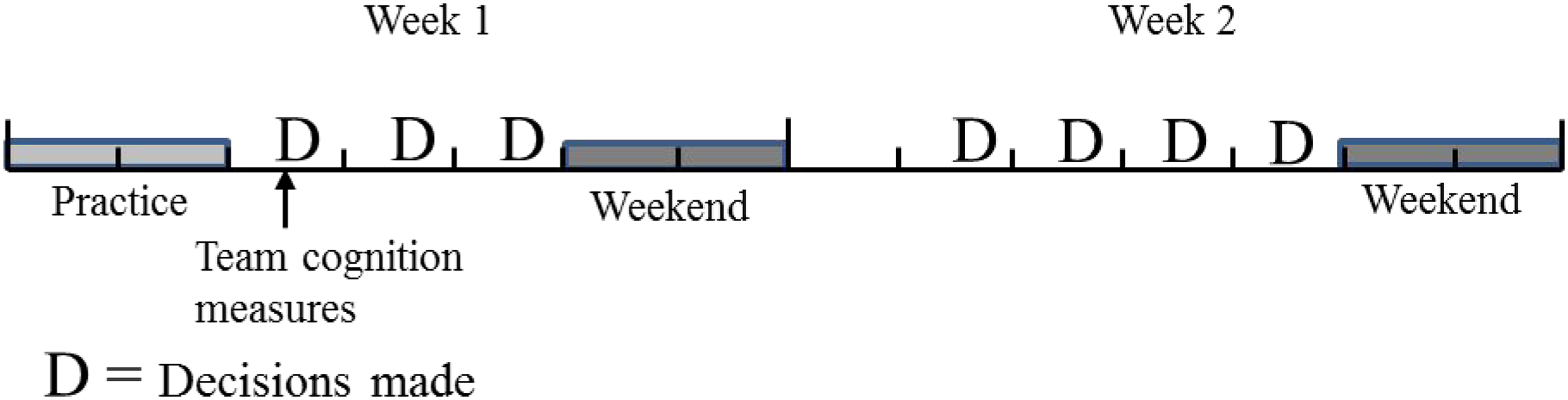
Measures
Team MM complexity
During the plenary session, one of the researchers gave a short presentation to explain how to complete the MM measure; team members were then provided with a list of 72 concepts, categorized into the three main areas of marketing and sales, manufacturing, and finance, and one sheet containing a rectangle with the word “profit” printed in the middle. We derived the concepts on the concept sheet from a thorough scanning of the student manual of the simulation. We selected all concepts on which relevant decisions could be taken in the simulation (e.g., advertising budget, vacation days, dividends, ten-year bonds), and all concepts that represent important inputs for those decisions (e.g., product quality, worker absenteeism, lost sales, overdraft, bond rate, market share). The list, derived in this way, was revised and assessed for completeness and consistency by a subject matter expert: the course coordinator, with six years of experience in teaching the simulation.
Participants were requested to individually construct a mental map on this sheet, representing their understanding of the simulation. They did this by selecting from the concept sheet those concepts they used in their understanding of the simulation and drawing lines between concepts they considered to be related to other concepts in their maps. Students were given 30 minutes to complete the exercise, during which they were instructed not to communicate. They could leave the room if they finished early. They were told that their concept maps would be rated, and if they were rated as sufficient and they had filled in the additional questionnaire, they would receive half a point extra on their final grade.
This method resembles a causal mapping or concept mapping technique as used in a number of previous studies (Eden, 1992; Thorsden, 1991). Mohammed, Klimoski, and Rentsch (2000) make a distinction between elicitation, referring to the technique used to determine the content component of the MMs, and representation, referring to the technique for determining the structure of the MMs. MM assessment techniques differ in the extent to which elicitation and representation can be freely determined by the participant—versus being prespecified by the researcher. With the present method, the structure is not prespecified in that, apart from the location of profit in the middle, students were free to locate concepts at any place they considered most suitable for their own understanding. However, the concepts were partly fixed, in that participants could only choose from 72 prespecified concepts from the concept sheet. Students were instructed that they were free to pick and use as many of these concepts as they deemed necessary for depicting their understanding of the simulation. Unlike the often-used measurement method of similarity ratings (DeChurch & Mesmer-Magnus, 2010), the number of concepts and links participants can use in their model is not completely fixed in the present measurement approach. This allows us to assess MM complexity and similarity as separate constructs. At the beginning of the academic year, students received a mind mapping exercise in which they were trained to schematically depict their learning material in a visual mind map representation, so all students were familiar with the basic idea behind mind mapping and had some previous experience with this technique.
For the analyses of the team-level MMs, we entered the concept maps of the individual team members into a team matrix, in which each link between two concepts is represented by a 1 on the intersection of the two concepts in the matrix. Based on the work of Nadkarni and Narayanan (2005), we derived three indicators of team MM complexity. The first indicator, comprehensiveness, refers to the total number of concepts in the map. Based upon our review of the simulation manual, we limited the maximum number of concepts that could be used to 72. This aspect captures the extensiveness of the MM, or the extent to which the participant made use of the offered concepts. The second indicator, density-1, is defined by the number of links between concepts divided by the number of concepts used in the map. This aspect captures the ratio of the number of linkages used to the number of concepts in the map and reflects the density or connectedness of the concepts within the map. The third concept proposed by Nadkarni and Narayanan (2005), density-2, is defined by the number of links in the map relative to all possible links. However, since for the present study, the number of all possible links was equal for all teams, this measure reflects the total number of links in the map.
Because the study by Nadkarni and Narayanan (2005) indicated that the three measures of complexity are likely to load strongly on one underlying factor, we conducted an exploratory factor analysis with varimax rotation. The results indicated that a common factor consisting of the three aspects of complexity explains 78.46% of the total variance with factor loadings of .88 for comprehensiveness, .79 for density-1, and .98 for density-2. Therefore, we averaged the three aspects of team MM complexity into one combined score.
Mental model similarity
We derived mental model similarity indexes by using an approach that has been used in previous studies (e.g., Mathieu et al., 2005), in which the average quadratic assignment proportion correlation between the matrices of the different team members is calculated using Ucinet (Borgatti, Everett, & Freeman, 1992). The quadratic assignment proportion is a measure of association among the matrices based on Pearson’s correlation coefficient on the corresponding cells of the data matrices.
Mental model accuracy
In order to derive indexes of mental model accuracy, we calculated the average quadratic assignment proportion correlation of each team member’s mental model with a referent mental model (e.g., Edwards et al., 2006). To derive a referent mental model, we asked the coordinator of the simulation, a subject matter experiment with over six years of experience in teaching the simulation, to complete the mental model measure.
Team information search
Information search was assessed with two measures that were directly derived from the logged data of the GBG simulation. For each time period, the simulation stores information on how often each of the 38 different information pages of the simulation have been visited by one of the members of a team. The information pages cover a wide variety of information that can be important for team decision-making; for example, the firm’s balance sheet, production schedule, sales promotions, and subcontracting agreements. For each team, we assessed the total number of pages visited (search depth) and the number of unique pages (search breadth) visited per time period. An exploratory factor analysis on the averages of these two constructs over the seven time periods indicates that a common factor explains 80.63% of the total variance with factor loadings of .90 for both search depth and search breadth. Therefore, we averaged the two measures into one combined score for team information search.
Team performance
In accordance with the reasoning of Mathieu and Rapp (2009) on the use of performance indexes in management simulations, we operationalized team performance as a weighted index of five team performance indexes: after-tax profits in the home country currency (40%), rate of return on assets (20%), earnings per share (20%), rate of return on owner’s equity (20%), and stock price (20%). Scores on the team performance indexes were reported after each decision period and provided the input for team members’ final course grade.
Control variables
Because team size may influence team performance as well as the functioning of team MMs (Wheelan, 2009), we included team size as a control variable in our analyses. In addition, we included the gender distribution of the teams as a control variable in the analyses. Gender distribution was calculated as the number of female team members relative to the total number of members in the team. In addition, given the relation between mental model similarity and transactive memory systems (TMS) in team cognition literature (Mohammed et al., 2010), at the third plenary session of the first week we administered the TMS questionnaire developed by Lewis (2003). Cronbach’s alpha for the scale was .66, which indicates moderate reliability. A mean Rwg(j) of .93, based on a slightly (positively) skewed distribution, and an ICC(1) of .22 and ICC(2) of .62 provided support for acceptable intermember reliability (LeBreton & Senter, 2008), so we aggregated individual-level responses to a team-level score.
Results
Correlations
Means, Standard Deviations, and Correlations.
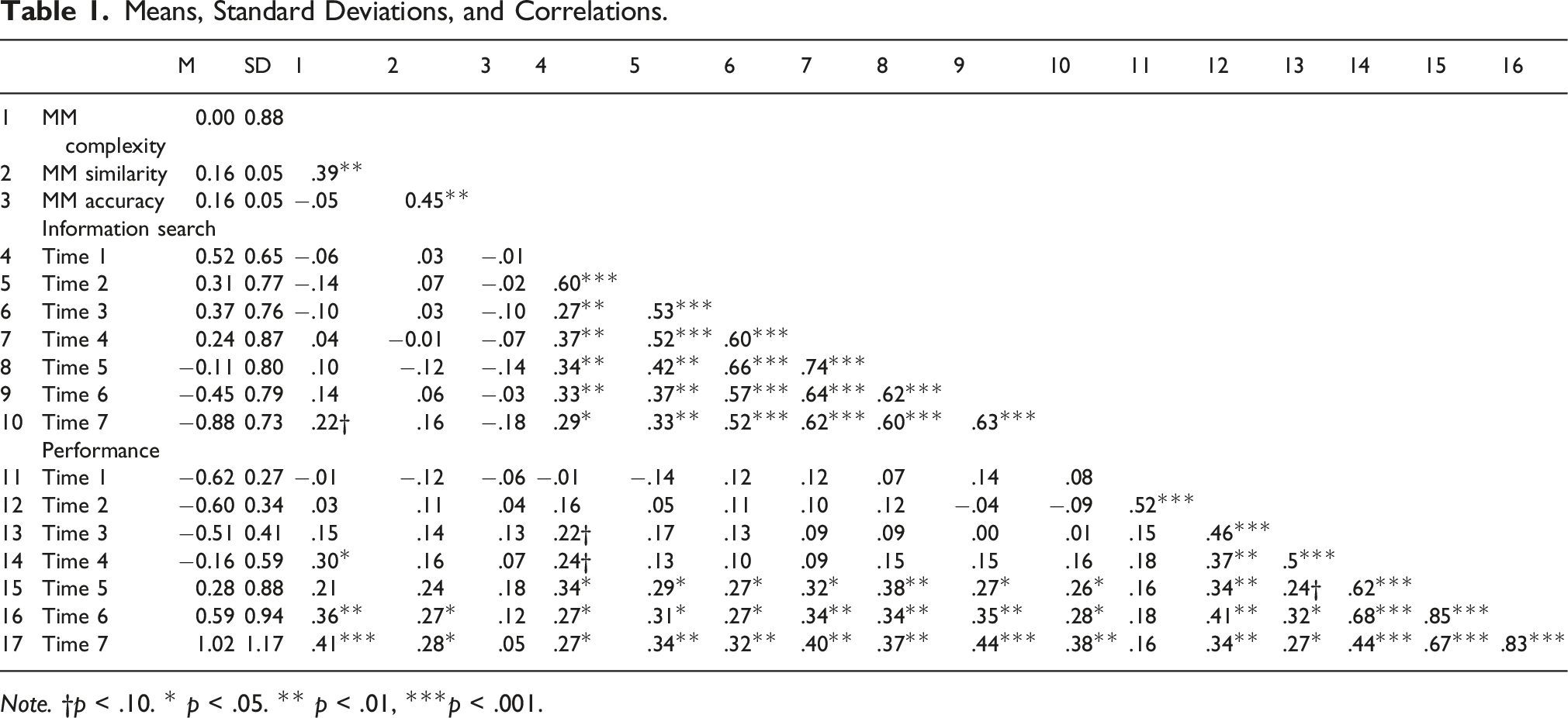
Note. †p < .10. * p < .05. ** p < .01, ***p < .001.
Random coefficient modeling framework
For our RCM analyses, we followed the recommendations of Bliese and Ployhart (2002) and Singer, Willett, and Willett (2003). RCM has the advantage that it can assess and account for nonindependence of observations measured over time and can incorporate time varying, as well as time stable predictors (e.g., Mathieu & Rapp, 2009).
To build our longitudinal model of team information search and team performance, we followed the guidelines by Bliese and Ployhart (2002). We started with a simple regression model without any random effects as a baseline and proceeded with consecutively more complex models, at each step adding random effects. We used chi-square difference tests based on the models’ log-likelihood ratios to compare the change in fit between the more parsimonious and the more complex model. Consistent with the recommendations of Bliese and Ployhart (2002), we applied a two-step procedure. In the first step—level 1—we established the fixed function for time and in the second step—level 2— we added our predictor variables in order to test our hypothesized relationships. All models were estimated with the open source software R (R Core Development Team, 2018), and the random effects models were estimated with the use of the NLME library (Pinheiro & Bates, 2000). We used orthogonal polynomials to index the linear, quadratic, and cubic growth curve parameters (Mathieu & Rapp, 2009).
Within- and between-team variance in performance and information search
As a first step, we examined the ICC(1) for the time varying criterion variables team performance and team information search. The ICC(1) indicates how much of the variability in the criteria is attributable to within versus between team differences over the seven performance episodes (Bliese and Ployhart, 2002). Our analysis reveals the ICC(1) for team information search was .18, indicating that between-team variance explains 18% of the total variance in team information search over time and within-team variance explains 82% of the variance. Analysis also reveals an ICC(1) of .17 for team performance, indicating that between-team variance explained 17% of the total variance in performance over time and within-team variance explained 83% of the variance over time. These values indicate that considerable between-team, as well as within-team, differences exist in team information search and team performance.
Level 1 Analysis
The next step in our longitudinal analysis is determining the fixed functions for time—the sample level (average) development trajectory of team performance and team information search over time. In this step, we started with the baseline model and consecutively added a random intercept, slope, and quadratic and cubic polynomials. Using a polynomial approach, the intercept terms represent the values at the midpoint of the simulation, and the slope represents the linear increase in the values over time (Mathieu & Rapp, 2009). Additionally, we tested for autocorrelation and heteroscedasticity in the model error structures.
Fixed functions of performance and information search
Results for the fixed function for information search breadth indicate that both the linear and quadratic parameters are negative and differ significantly from zero (−9.35, p < 0.001; −3.08, p < 0.001, respectively), whereas the cubic parameter fails to reach significance (−0.47, p > 0.05). Hence, the final quadratic model indicates a declining and inverse u-shaped trajectory of team information search.
Results for the fixed function for team performance indicate that both the linear (12.22, p < 0.001) and quadratic parameter (2.87, p < 0.001) are positive and differ significantly from zero, whereas the cubic parameter (−1.13, p > 0.05) is negative and fails to reach significance. Hence, the final quadratic model indicates positive and u-shaped growth in performance.
Determining variability in growth parameters
The fixed models, reported above, assume no variability in the growth parameters across teams. Here, we loosen this assumption by consecutively allowing for random variability in the intercept, slope, quadratic, and cubic parameters.
First, for team information search, the model with a random intercept significantly improved the quadratic base model (χ2diff(1) = 180.87, p < 0.001). Second, the model with a random slope significantly improved the model with only a random intercept (χ2diff(2) = 16.32, p < 0.001). Third, the model with a random quadratic parameter significantly improved the model with a random slope (χ2diff(4) =18.37, p < 0.001). Fourth, we tested whether a model with a random cubic parameter would improve upon the model with a random quadratic parameter. However, the cubic parameter was not significant, and the model with the cubic parameter showed decreased fit (χ2diff(5) = 2.82).
For team performance, the model with a random intercept significantly improved the quadratic base model (χ2diff(1) = 117.01, p < 0.001). Second, the model with a random slope significantly improved the model with only a random intercept (χ2diff(2) = 211.45, p < 0.001). Third, the quadratic model significantly improved the model with only a random slope (χ2diff(4) = 91.09, p < 0.001). Fourth, we tested whether a model with a random cubic parameter would improve upon the model with a random quadratic parameter. In this random model, the cubic parameter became significant (and −1.13, p < 0.05), and the model significantly improved the quadratic model (χ2diff(5) = 47.8, p < 0.001).
Determining the error structure
Finally, we tested for autocorrelation and heteroscedasticity in the models’ error structures. For information search, our analyses revealed no evidence of first order autoregressive autocorrelation for the quadratic model, and the model including test for heteroscedasticity failed to converge. For team performance, our analyses revealed no evidence of first order autoregressive autocorrelation for the cubic model (φ = 0.082, χ2diff = 0.77, p = 0.38), and a model including test for heteroscedasticity failed to converge.
Level 2 Analyses: Predictors of Team Performance Trajectories
In the first portion of the RCM analyses, we examined the relationship of team performance and information search with time. In this second portion of the RCM analyses, we add our predictor variables—team MM similarity, accuracy, and complexity—to predict variance in the trajectory parameters.
Results of Models Predicting the Temporal Trajectory of Team Performance.
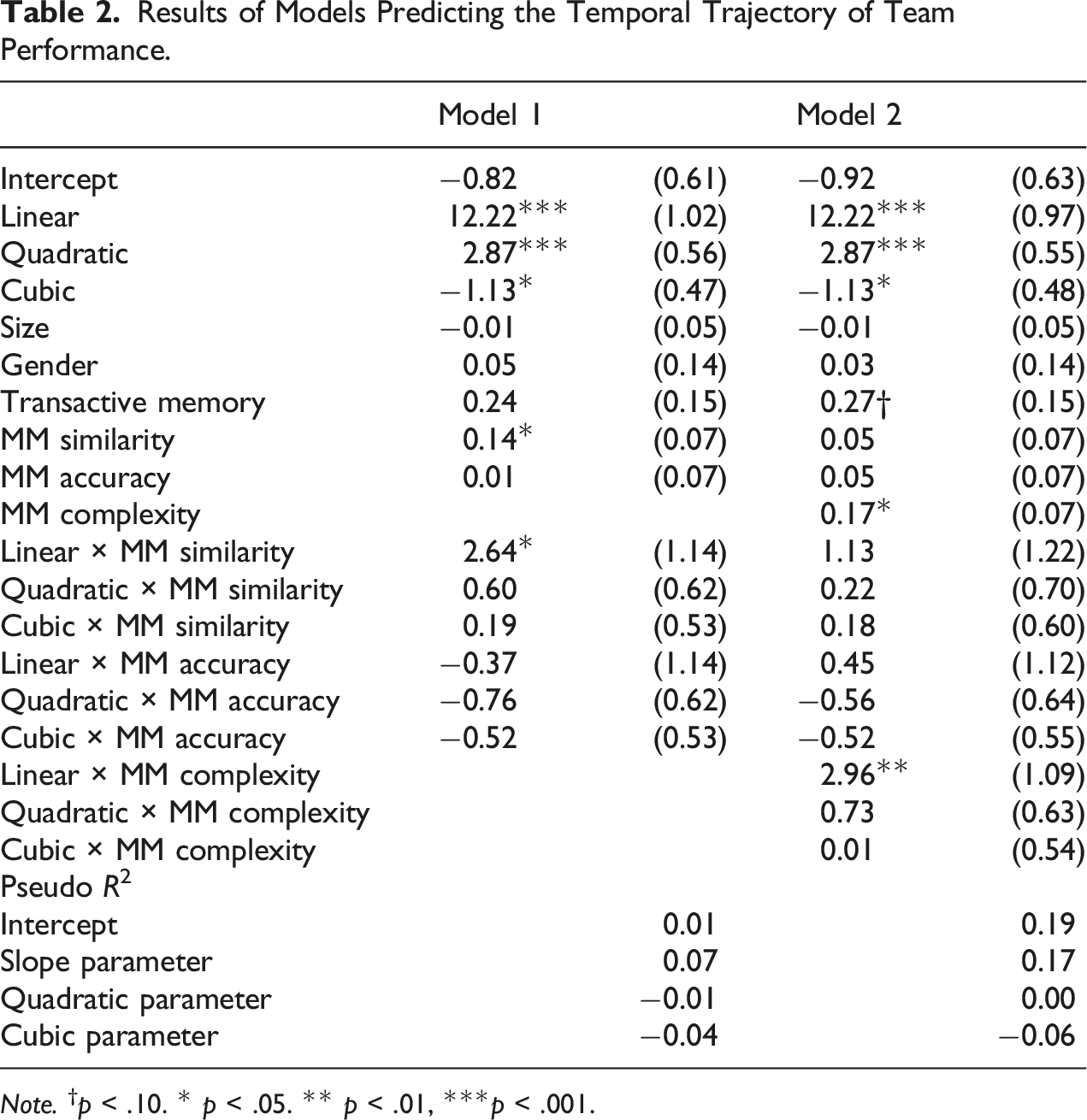
Note. †p < .10. * p < .05. ** p < .01, ***p < .001.
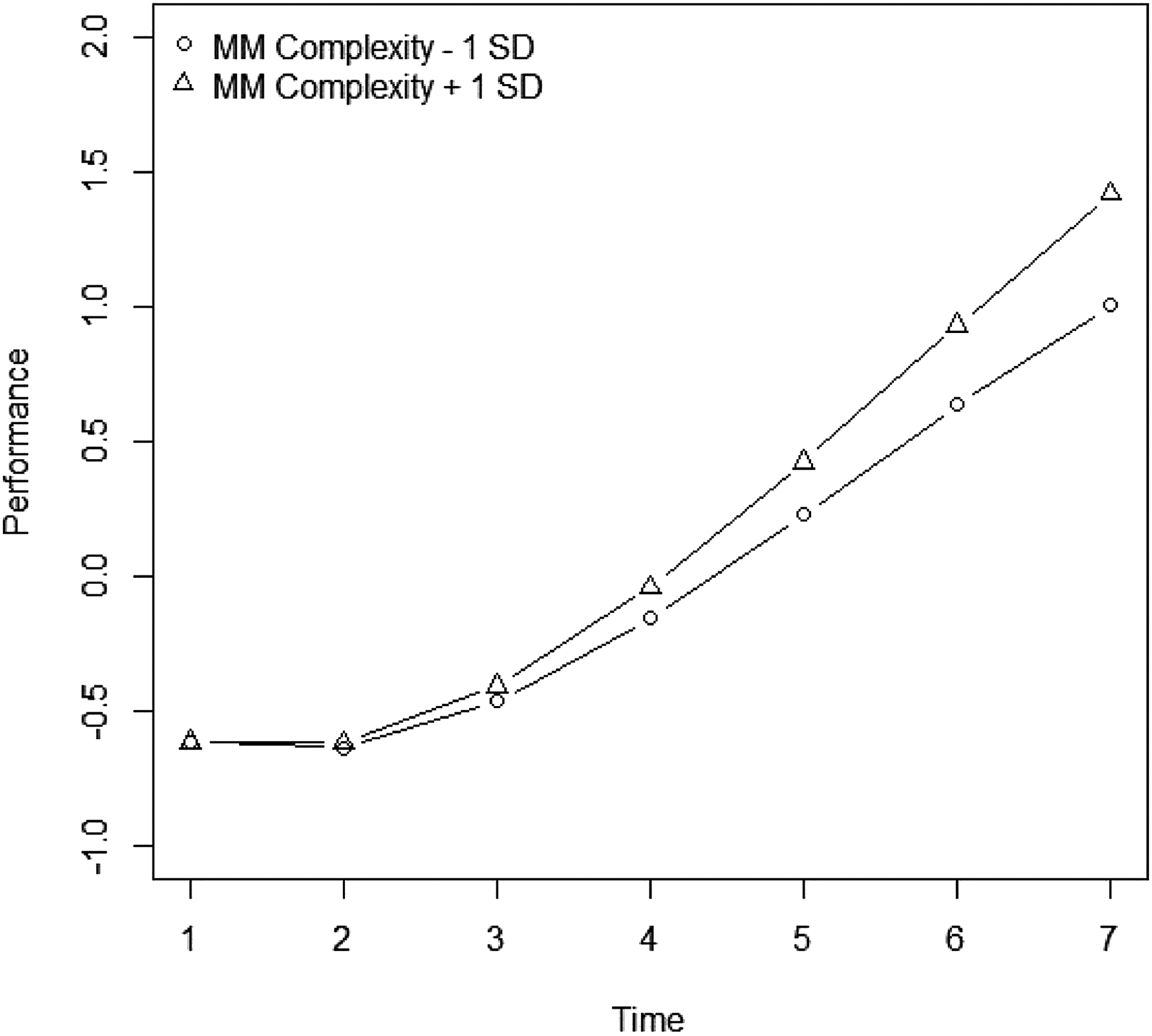
The effect of mental model complexity on performance trajectories over time.
Following the recommendation of Singer et al. (2003), we derived Pseudo-R2 statistics for the variance components associated with each temporal parameter by calculating the relative decrease in the residual variance associated with that parameter from the base model—including control variables and MM similarity and accuracy—to the present model. The Pseudo-R2 statistics of model 2 indicate that relative to this model, the model including MM complexity explains 1% additional intercept variance, and 10% additional slope variance. Together, these results provide support for Hypothesis 1 regarding the effects of mental model complexity on team performance trajectories.
Results of Models Using MM Complexity and TMS in Predicting Information Search.
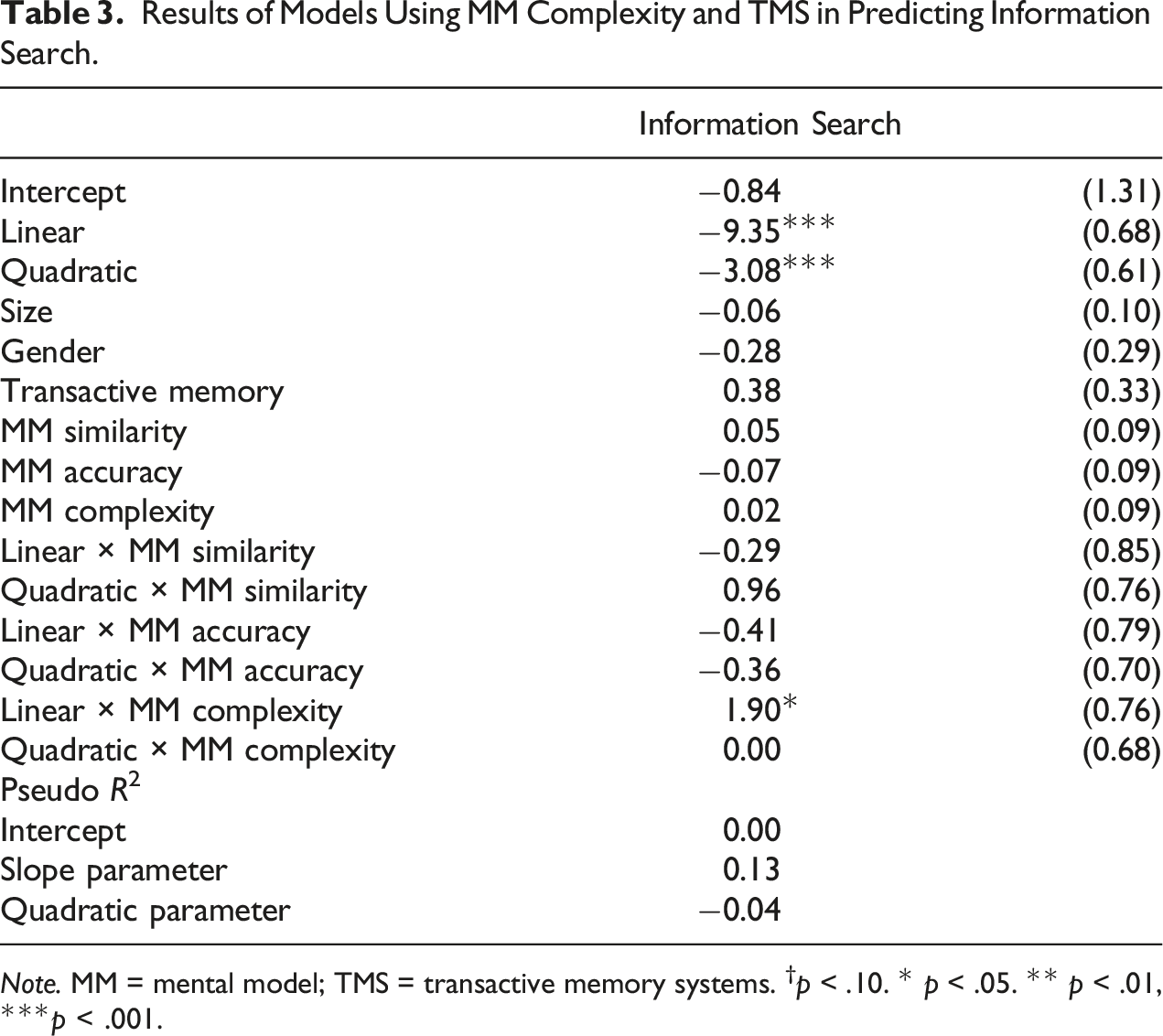
Note. MM = mental model; TMS = transactive memory systems. †p < .10. * p < .05. ** p < .01, ***p < .001.
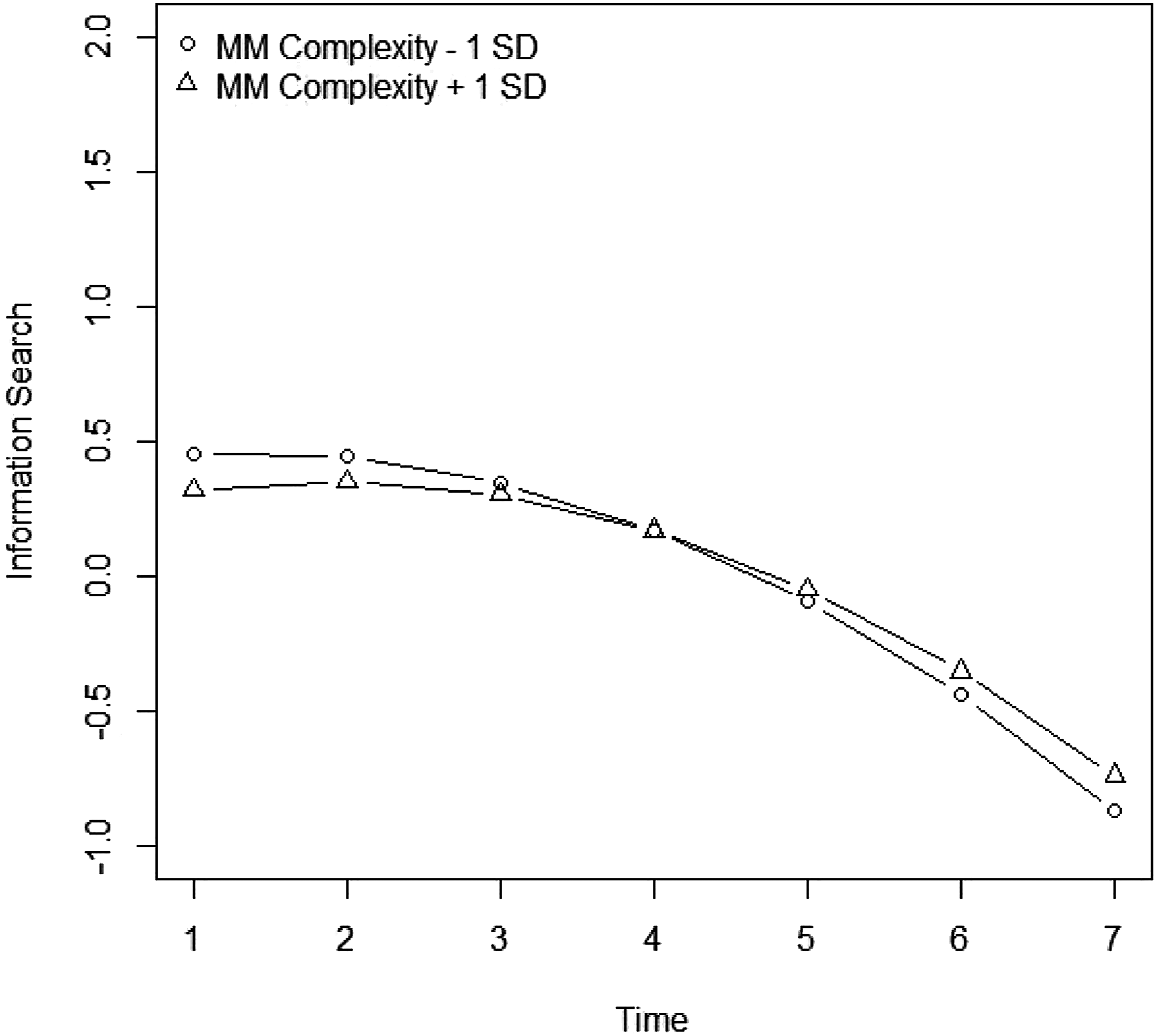
The effect of mental model complexity on information search over time.
Information Search Predicting Performance Trajectories.
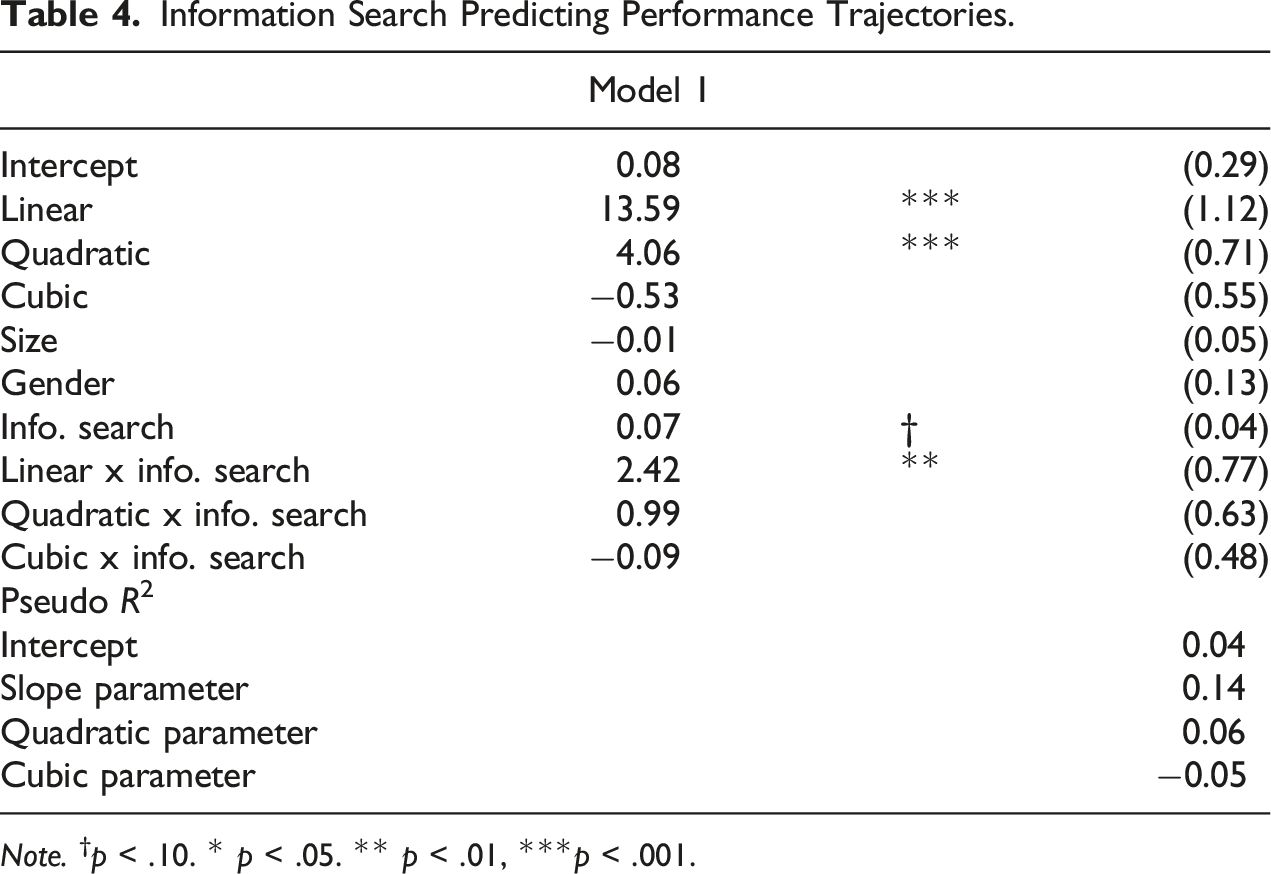
Note. †p < .10. * p < .05. ** p < .01, ***p < .001.
Discussion
Teams are critical tools for organizations dealing with dynamic, turbulent, information-laden environments. Therefore, improving our understanding regarding how teams might improve their performance over time in such situations is an important endeavor. Theoretical work on requisite complexity (Uhl-Bien et al., 2007; Hannah, et al., 2011) suggests that teams must have information processing capacity that matches the information processing requirements of the task. Complexity is thereby defined as “having highly differentiated perceptual structures that can also be integrated to create a multidimensional understanding of an event” (Hannah, et al., 2011, p. 216). Our research provides evidence for this concept of requisite complexity by showing that team MM complexity predicted the midpoint and the slope of team performance over and above MM similarity and accuracy. Importantly, our results help underscore the role of team information search as an important driver of team performance trajectories. The development trajectory of team information search indicates that although information search decreased over time for all teams, this decrease was less pronounced for teams with more complex mental models. Moreover, the breadth and depth of the information that was accessed became increasingly important for team performance as the simulation progressed.
Our research thus contributes to the existing body of literature on team mental models (Mohammed et al., 2010). Prior research on shared MMs has aimed to demonstrate the positive impact of accurate and shared MMs on team performance. The accumulating evidence indicates that accuracy and similarity in MMs indeed are important antecedents for the quality and effectiveness of team processes (DeChurch & Mesmer-Magnus, 2010). However, when studying teams engaged in complex cognitive tasks embedded in highly dynamic environments, such as project teams or crisis management teams, it may not be sufficient to look only at similarity and accuracy in MMs (Uitdewilligen, Waller, & Zijlstra, 2010). For relatively stable tasks, for which the integration of peripheral elements is less critical, accuracy may be the best predictor (e.g., Edwards et al., 2006). Yet, to the extent that task can be impacted by more peripheral aspects that are less likely to be represented in the core elements of a task (e.g., the effect of an infectious disease on the functioning of an organization), MM complexity is likely to outperform MM accuracy as a predictor because it may better represent the variety of concepts and cues that the team attends to and considers in making decisions.
Scholars have argued that sometimes too much similarity in MMs may actually be detrimental for team performance, reasoning that more diversification allows each members’ model to cover a particular aspect of the overall team task (Banks & Millward, 2007; Cooke et al., 2003; Mohammed and Dumville, 2001). However, given the often-used similarity ratings approach for measuring team MMs, MM similarity and overall coverage of the task environment are opposites on the same dimension. Because the number and concepts of the models are fixed by the researcher, the more similar team members’ MMs are, the smaller the amount of possible structures they cover. In contrast to the similarity rating technique that is most often used in MM research (DeChurch & Mesmer-Magnus, 2010), the free concept mapping approach used in this study allows for the independent assessment of MM similarity and coverage of the relevant task environment—which we assessed as MM complexity. As can be seen from the results of the present study, MM complexity and MM similarity were, although correlated, both positively predictive of team performance trajectories, yet MM complexity was the stronger predictor in this setting.
Although scholars have emphasized the role of team MM accuracy in team effectiveness (e.g., Cooke, Salas, Cannon-Bowers, & Stout, 2000), in the present study, MM accuracy did not significantly predict team performance trajectories. An explanation for this nonsignificant effect may be that a basic assumption of MM accuracy measures is that one or a limited number of optimal referent models exist and can be derived by the researcher (Edwards et al., 2006). Yet, previous research already suggests that there may be equifinality in MM models, such that different models may lead to good outcomes (Mathieu et al., 2005). In relatively simple situations in which the number of combinations MMs can assume and the amount of contingencies are limited, MM accuracy will constitute a meaningful construct. However, in complex situations such as the one represented in the present study, the sheer number of different task situations and possible linkages between concepts may render the notion of optimal MMs problematic. Therefore, in this type of situation, team MM complexity may constitute an alternative measure for the quality of MMs, as complex knowledge structures indicate that teams have at their disposal a larger variety of possible models, each of which can be most appropriate in a different situation. For example, whereas in a market where demand surpasses supply, production capacity may be the most important driver for sales volume; in a market where supply surpasses demand, marketing efforts may be more crucial. The more complex an MM, the higher the chance that it will contain both accurate sub-models.
A number of scholars have argued for more dynamic approaches to team-level research that investigate how team processes and characteristics emerge, develop, and change over time (Marks, Mathieu, & Zaccaro, 2001; Roe, Gockel, & Meyer, 2012). More in particular, scholars have long argued for taking into account not only what relations exist between variables, but also ascertaining when and how long effects exist (George & Jones, 2000; Mitchell & James, 2001), or as McGrath (1988: 265) indicated “a known time relation between variables of interest is essential to the interpretive logic of all of our study designs.” In this study, we heeded these calls with the application of RCM techniques to our longitudinal data. This made it possible to assess and predict the patterns of team information search and team performance over time. Our results clearly show the additional benefits of this type of a longitudinal approach. Although the analyses indicate that team mental model similarity and complexity predict variance in overall team performance, the trajectory analyses provides a more nuanced understanding regarding how and at what time points these variables have their most crucial impact on team functioning.
Mental model complexity showed some but limited impact on team performance at the midpoint. The main impact is on the rate of development of team performance over time, in such a way it distinguishes teams with moderate from those with accelerated development patterns. An explanation for the difference in the rate of performance growth perceived from the third session onward may be that the effects of team cognition variables become more prominent as effects of previous periods accumulate and interact over time, causing upward or downward spirals (Lindsley et al., 1995). Team performance trajectories follow a path-dependent process in which initial decisions set in motion a self-reinforcing process that establishes the boundaries and conditions for future decisions. The effect of good initial decisions may provide a team with a positive basis for subsequent decisions—for example, because of an increased availability of resources, a wider variety of information, or an increased number of options to choose from—while wrong initial decisions may complicate later decisions—for example, by depleting resources or causing unnecessary constraints. In this way, a deviation-amplifying loop is established in which the teams that initially performed well become even better and the teams that initially performed less well become even worse (Hackman, 1990).
In addition, the results of our study have significant implications for research on team information search behaviors (Woolley, Bear, Chang, & DeCostanza, 2013; Haas, 2006). Our research contributes to this research by introducing a temporal perspective. Information search trajectories showed a distinct shape over time, indicating that most teams spend a significant amount of time in the beginning of a complex task on exploring different information sources; however, after a short increase in search activities, information search rapidly decreases. Interestingly, this decrease in information search is much more pronounced for teams with less complex MMs than for teams with more complex MMs. This is consistent with the perspective of motivated information processing in groups (De Dreu et al., 2008), which suggests that the extent to which team members engage in information processing is dependent on group members’ motivation to develop and hold accurate and well-informed conclusions about the world. Our results suggest that the team’s motivation to seek out additional data is influenced by the potential benefits the team can attain from the additional effort, as this decrease was less pronounced for teams with highly complex mental models.
Limitations
Although we were able to exert a high level of control and precision in terms of our data collection and analyses, we faced inevitable trade-offs in terms of limitations. One limitation of the present project is that even though team information search and team performance were measured repeatedly over time, team mental models were assessed only at the beginning of the simulation. Our study was based on the assumption that cognitive structures that were formed during the initial training phase would constitute the basis of the team knowledge structures during later phases. Therefore, although the average levels of team MM complexity may increase over time due to team learning, we assumed that the rank order between teams would remain relatively stable; however, the veridicality of this assumption remains untested in the present study. Whereas some studies on the effects of cognitive structures—particularly of shared MMs—on team performance show stable effects over time (e.g., Edwards et al., 2006; Mathieu et al., 2005), others indicate that teams’ cognitive structures can undergo substantial changes during repeated team member interactions (Cooke et al., 2003; Levesque, Wilson, & Wholey, 2001). In particular, when conceptualizing team mental models as an emergent state (Mohammed et al., 2010), it is likely that mental model complexity may both impact team processes and be impacted by team processes. For instance, previous research suggests that mental model complexity may also have been affected by information search in addition to affecting information search (Curseu & Pluut, 2018). Additional research assessing behaviors as well as cognitive states over time is required to investigate such dynamic reciprocal relations.
Second, papers are living documents that change and develop over time, yet it is important to be transparent about changes made to the theoretical model during this process, as this may impact the interpretation of the results. In the initial version of the manuscript, in addition to the main effect, we also hypothesized an interaction effect between mental model complexity and information search on the development of performance over time. Yet we chose here to both pursue parsimony and what proved to be stronger arguments; thus, we excluded this hypothesis in the final version of the article. In addition, we initially also aimed to test the incremental contribution of MM complexity over TMS, but due to the merely moderate reliability of the TMS measure in our study, we were not able to make a fair comparison, and therefore only maintained the TMS variable as a control variable in our study. This may have concomitant limitations for a confirmatory interpretation of the results (Banks et al., 2016).
Third, although the simulation was designed to capture the complexity of the decision making process faced by management teams, our sample comprises only undergraduate students performing a simulated task. The participants lacked the depth of knowledge and experience associated with expert decision makers in field settings. Field experts may have had more time to develop their mental models and integrate them with their team members. Therefore, the generalizability of our results remains limited until empirical research explores these relationships in field settings.
Finally, as our study did not have an experimental design with randomized conditions, we are not able to draw causal conclusions and rule out all possibilities of alternative explanations for our findings. It is, for instance, possible that our measure of MM complexity has tapped into the collective intelligence of the team members (e.g., Woolley, Chabris, Pentland, Hashmi, & Malone, 2010). Research on antecedents of team MM complexity is still in its infancy (for an exception, see Curseu et al., 2007). Individual team member intelligence has been related to team MM accuracy (Edwards et al., 2006), and it is not unlikely that individual- as well as team-level intelligence are important drivers of team MM complexity. Therefore, we cannot exclude collective intelligence as a potential confound of our results. Additional research is needed to disentangle the effects of a more crystallized form of intelligence embedded in collective knowledge structures from more fluid forms of collective intelligence (Cattell, 1971). Moreover, previous research suggests that mental model complexity may also be affected by information search in addition to affecting information search, suggesting the possibility of reversed causality (Curseu & Pluut, 2018).
Conclusion
Gaining an understanding of how teams may navigate and make optimal decisions in dynamic complex environments constitutes one of the main challenges for team researchers in the coming years. We have developed and tested a model of the role of team MM complexity over and above the effect of MM similarity and accuracy. We found that a temporal approach to analyzing and assessing the effects of these cognitive structures on team performance created a more nuanced depiction of when and how these team cognition variables influenced team performance over time. In order to enable teams to thrive in turbulent environments, managers and leaders of teams should ensure not only that team members have similar knowledge structures to facilitate the intricacies of internal team processes, but should also take steps to promote the complexity fit with the external environment. Our work here suggests that taking these extra steps will significantly increase the likelihood that teams are able to successfully notice, interpret, and navigate the changes of the turbulent contexts within which they are embedded.
Footnotes
Declaration of Conflicting Interests
The author(s) declared no potential conflicts of interest with respect to the research, authorship, and/or publication of this article.
Funding
The author(s) received no financial support for the research, authorship, and/or publication of this article.
