




Abstract
This article advances prior theory on inclusive leadership to better understand how leaders foster team creativity through members’ experience that their uniqueness belongs within the team (i.e., team-derived inclusion). We argue that leaders can instigate such sense of inclusion in their team by engaging in two behaviors: stimulating all members of the team to fully express their unique viewpoints and perspectives (harvesting the benefits of diversity) and facilitating beliefs about the value of differences in the team (cultivating value-in-diversity beliefs). In Study 1 (n = 491 employees), we validated newly developed scales measuring these two leader behaviors. Using a sample of 38 teams within one organization (Study 2), we showed that harvesting the benefits of diversity, without also cultivating value-in-diversity beliefs, has a negative effect on team-derived inclusion and indirectly team creativity. In Study 3, we demonstrated based on 93 teams from multiple organizations, while ruling out several alternative explanations, that harvesting the benefits of diversity positively relates to team-derived inclusion and indirectly team creativity, if leaders also cultivated value-in-diversity beliefs. Our model and findings across studies are the first to shed light on inclusive leadership as double-edged sword in that leaders may need to complement harvesting with cultivating to prevent negative effects and elicit positive effects on inclusion and, eventually, team creativity.
Keywords
The extent to which organizations can thrive in rapidly changing business environments depends on the creativity of their workforce (Zhou & Hoever, 2014). Research increasingly suggests that developing creative solutions to complex organizational problems is rarely the domain of the lone genius but rather requires team creativity (van Knippenberg, 2017; Wuchty, Jones, & Uzzi, 2007)—the generation of novel and useful ideas by a team of employees working together interdependently (Hoever, Zhou, & van Knippenberg, 2018; Shin & Zhou, 2007). Although assembling teams that are diverse is often regarded as a necessary means to foster a cross-fertilization of ideas, research also suggests that the mere presence of diversity in a team is not a sufficient condition for team creativity (Homan, Buengeler, Eckhoff, van Ginkel, & Voelpel, 2015; van Knippenberg & Schippers, 2007). For instance, although differences in perspectives and expertise can enhance team creativity (see van Knippenberg & Hoever, 2017, for a review), team members may not fully share their unique insights or welcome and integrate those of others unless they feel like valued “insiders” in their team (Leroy, Hoever, Vangronsvelt, & Van den Broeck, 2020; Shore et al., 2011).
We apply a theoretical lens of inclusion to better understand what fosters team creativity (Ferdman & Davidson, 2004; Nishii, 2013; Roberson, 2006; Shore et al., 2009). Prior work has highlighted the importance of an individualistic orientation for team creativity, in contrast to a more collectivistic focus (e.g., Goncalo & Staw, 2006). In inclusive team environments, employees also feel that they can express their unique self (especially in terms of their unique task-relevant perspectives); however, at the same time, they also maintain a sense of belonging to the group (Shore et al., 2011). In emphasizing the coexistence and thus interdependence between uniqueness and belongingness, team-derived inclusion supersedes potential tensions between personal and relational identities (Brewer, 1991). This is important as unique inputs need to be welcomed and integrated by the team before creative output can emerge (Hoever, van Knippenberg, van Ginkel, & Barkema, 2012).
Leadership has been argued to be vital in fostering team-derived inclusion (Randel et al., 2018). Yet, insights into which specific leader behaviors actually foster team-derived inclusion are lacking. We propose that team leaders stimulate team-derived inclusion by engaging in two related but theoretically distinct behaviors. First, leaders can “harvest the benefits of diversity” by inviting all team members to fully participate in and uniquely contribute to team processes. This implies that leaders elicit and stimulate the combination of the team members’ different ideas, strengths, and perspectives (Carmeli, Reiter-Palmon, & Ziv, 2010; Nembhard & Edmondson, 2006). Second, leaders can “cultivate value-in-diversity beliefs” by actively promoting positive conceptions of diversity in their team to motivate team members to engage across difference (Homan, van Knippenberg, Van Kleef, & De Dreu, 2007; van Knippenberg, Haslam, & Platow, 2007). This means that leaders aid in building the shared perception that differences in members’ strengths, knowledge, values, and input provide opportunities for the team as a whole to create added value (Janssen & Huang, 2008; van Dick, van Knippenberg, Hägele, Guillaume, & Brodbeck, 2008; van Knippenberg, van Ginkel, & Homan, 2013).
We argue that these leader behaviors interact in promoting team-derived inclusion and, in turn, team creativity (Figure 1). Specifically, for fostering team-derived inclusion and indirectly, team creativity, harvesting the benefits of diversity needs to be complemented by cultivating value-in-diversity beliefs. Because uniqueness and belongingness are interconnected, the overall sense of team-derived inclusion will be reduced when individual differences are invited and elicited (harvesting), but their appreciation by others is not facilitated (cultivating). In contrast, when leaders do both, team members will feel fully included, which should aid with the team’s ability to build on unique input toward more creative outcomes. Hypothesized research model.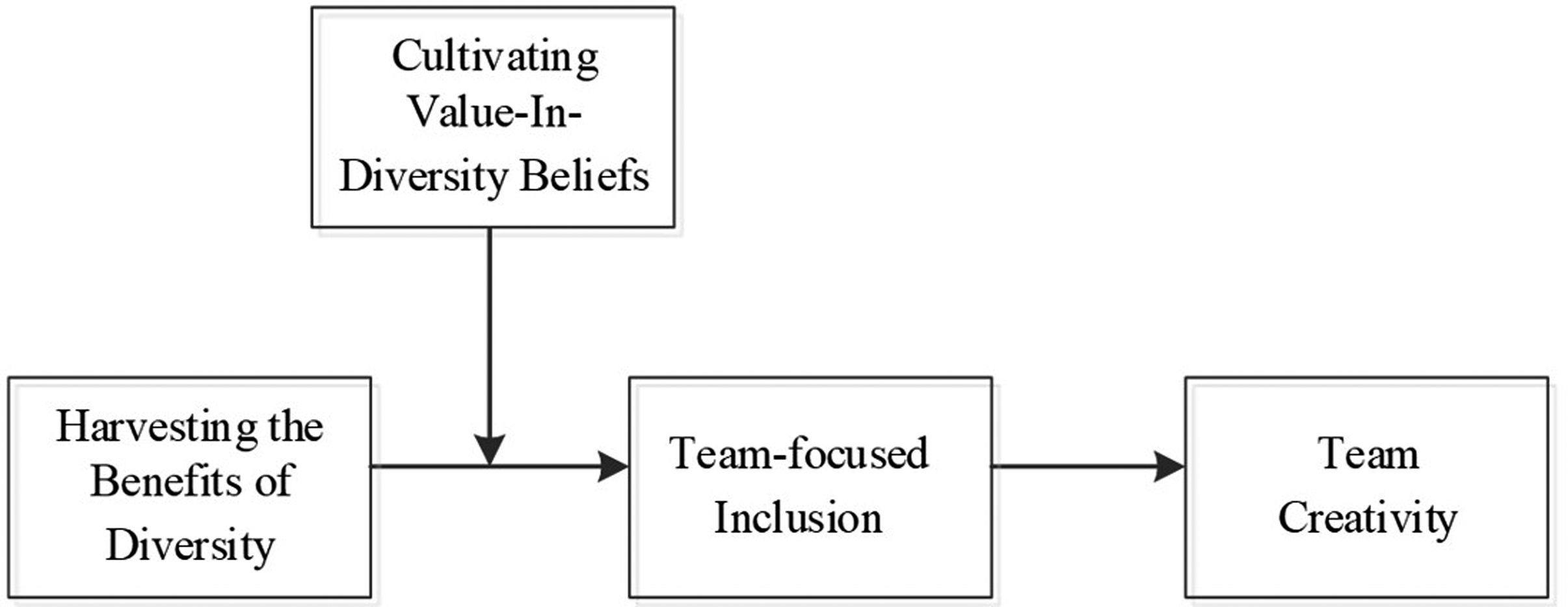
This study contributes to existing research in important ways. Prior work has considered a variety of frameworks on how leadership promotes creativity (Mainemelis, Kark, & Epitropaki, 2015). For instance, by means of intellectually stimulating followers, transformational leaders pool the best and most creative ideas from followers (Shin & Zhou, 2003, 2007; Wang & Rode, 2010). Authentic leadership theory and research further suggest that creativity is stimulated by asking employees to bring their authentic and unique selves to the workplace (Lemoine, Hartnell, & Leroy, 2019). Prior work on these multicomponent leadership styles however shows mixed results (e.g., Eisenbeiss, van Knippenberg, & Boerner, 2008; Jaussi & Dionne, 2003; Jung, 2001; Wilson-Evered, Härtel, & Neale, 2001), partly due to shortcomings in terms of broad conceptualizations (e.g., van Knippenberg & Sitkin, 2013; Lemoine et al., 2019).
Our work adds to prior work by offering more precision in our conceptualization of inclusive leadership (i.e., harvesting the benefits of diversity and cultivating value-in-diversity beliefs). Prior work has already used the terms “leader inclusiveness” and “inclusive leadership” focused on either the importance of creating psychologically safe environments in which followers voice their creative ideas (Nembhard & Edmondson, 2006; Randel, Dean, Ehrhart, Chung, & Shore, 2016) or on preventing exclusionary environments with high within-team variability in the quality of Leader–Member-Exchange (LMX) relationships (Buengeler, Piccolo, & Locklear, 2021; Nishii & Mayer, 2009). Our work, using theory on inclusion (Shore et al., 2011; Randel et al., 2018), adds to these perspectives by highlighting the need for leaders to emphasize both the inclusion of novel perspectives (uniqueness) and avoiding exclusion of people into outgroups (belongingness) as both are highly interconnected in the context of teamwork. We elaborate on this theoretical perspective next.
Theoretical Background and Hypotheses
Team-Derived Inclusion: Satisfying Both Uniqueness and Belongingness Needs
Inclusion has recently been defined as the satisfaction of people’s needs for uniqueness and belongingness (Shore et al., 2011). Building on Brewer’s (1991) optimal distinctiveness theory, Shore and colleagues proposed that feeling included in one’s team entails feeling connected to the collective (belongingness) while at the same time perceiving oneself as sufficiently distinct from other team members (uniqueness). Specifically, individuals tend to fulfill their need to belong by establishing strong bonds with and seeking acceptance from other team members. In addition, people often come to identify themselves with their team and attribute positive characteristics to it and its members (Baumeister & Leary, 1995). At the same time, individuals strive for uniqueness as they want to retain a certain level of differentiation from other team members in order to not become interchangeable (Shore et al., 2011).
The frame of reference which individuals consider felt inclusion may vary according to the salience of particular identities. Within the context of organizational life, one’s work team may be especially relevant, since the importance of this group membership is continuously reinforced, and most proximal to individuals’ daily work experiences (Shore et al., 2011). Thus, we conceptualize felt inclusion regarding one’s team as denoting both feeling unique in that team and feeling one belongs by virtue of having other members of the team grant and respect one’s uniqueness. Within a team context, the satisfaction of the needs for uniqueness and belongingness is thus likely interdependent (Shore et al., 2011) Team-derived inclusion solves a problem in past research that has suggested a tension between one’s personal and relational identities (Brewer, 1991; Ferdman, 2017). Within current inclusion theorizing that underlies our conceptualization of team-derived inclusion, we follow others in combining uniqueness and belongingness in the overall concept of team-derived felt inclusion (e.g., Buengeler, Leroy, & De Stobbeleir, 2018; Shore et al., 2011).
Team-Derived Inclusion and Team Creativity
We put forward that team-derived inclusion is conducive to team creativity for various reasons (see also Shore & Chung, 2021; for several other rationales). For multiple members working interdependently to develop solutions that are more creative than what an individual could have developed single-handedly, members need to both recognize and bring in their unique perspectives while the team needs to constructively use and combine these elements (Hoever et al., 2018; Leroy et al., 2020). Critically, the extent to which members experience both uniqueness and belongingness in their team may facilitate the mobilization and integration of members’ resources in the team, to benefit team creativity.
Team members who feel they can and are encouraged to express their uniqueness in the team are more open to sharing, discussing, and utilizing novel perspectives and divergent ideas. Research has shown that when individuals feel valued as a unique member of the team, they feel empowered to personally contribute to the team’s activities (Davidson & Ferdman, 2002; Ferdman & Davidson, 2004; Mor Barak, 2014; Swann, Kwan, Polzer, & Milton, 2003). Indeed, awareness of one’s uniqueness in the team reflects a member’s insight that he or she can offer ideas and perspectives that others may not and can hence increase a sense of responsibility to make this input heard in the team (Schittekatte & van Hiel, 1996). As such, if members believe that their personal contributions are of value to the team, they may increasingly voice problems, combine new ideas into solutions, and communicate creative suggestions (van Knippenberg, 2000; van Knippenberg & Schippers, 2007). This makes the team think more divergently and solve problems more creatively (Nemeth & Kwan, 1985). In addition, members are more willing to deal with the uncertainty and risk associated with team creativity (Carmeli, Cohen-Meitar, & Elizur, 2007; Hirak, Peng, Carmeli, & Schaubroeck, 2012; Swann et al., 2003).
Experiencing a sense of belonging critically complements the effects of a sense of uniqueness for the team processes conducive to team creativity. Research shows that feeling connected to the collective may stimulate information sharing, increase voice behaviors, and optimize collective learning and creative processes (Goncalo & Staw, 2006; Shalley, Zhou, & Oldham, 2004; Van der Vegt & Bunderson, 2005). A sense of belonging also boosts members’ identification with the team and willingness to contribute to it (e.g., in the form of creative ideas) and lowers members’ feelings of uncertainty or risk when expressing disparate perspectives (Carmeli et al., 2010; Hirak et al., 2012; Shemla & Wegge, 2019; van Prooijen, van den Bos, & Wilke, 2004). Similarly, a sense of belonging to the team may increase members’ motivation to invest the effort needed to understand diverging viewpoints and work through them to arrive at new, integrative understandings of complex issues. For one thing, an increased sense of belonging engenders a more prosocial motivation toward the team which in turn may lead members to frame disparate views as constructive rather than oppositional (De Dreu, Nijstad, & van Knippenberg, 2008). This may prompt behaviors like perspective taking (Grant & Berry, 2011) which may aid in transforming diverse insights into collective creativity (Hoever et al., 2012). For another, members who experience a stronger sense of belonging may also be more likely to try and link others’ input to the team’s goals. This is important, since the relevance of others’ input for the team may not always be immediately clear, thereby requiring additional efforts to integrate. This, in turn, is an important prerequisite to the integration of perspectives vital for collective creativity (van Knippenberg, 2017).
In sum, team creativity is enhanced when individual team members experience a sense of belonging to their team with all their uniqueness. In inclusive team contexts, members can express themselves without the fear of becoming an outsider or being rejected for expressing divergent perspectives (Shore et al., 2011). This, in turn, facilitates the co-construction of knowledge and constructive team discussions, fostering team creativity (Carmeli et al., 2010; Edmondson, 1999; Hirak et al., 2012). Therefore, we hypothesize: Hypothesis 1: Team-derived inclusion is positively related to team creativity.
The Role of Leadership in Promoting Team-Derived Inclusion
Harvesting the benefits of diversity entails actively inviting all members to contribute their different viewpoints, strengths, and characteristics and encouraging the voicing of ideas and critical perspectives. When team leaders prompt the expression of everyone’s idiosyncratic characteristics and ideas, members are encouraged to express their perspectives and ideas, including the personal experiences that inform them within their team (Kahn, 1990; Thomas & Ely, 1996). As such, harvesting the benefits of diversity is more holistic in nature than earlier conceptions of inclusive leadership (e.g., Nembhard & Edmondson, 2006) in that it refers to inviting team members to not only voice different opinions but also do so in a way that enables them to be expressions of their personal identity and history rather than disconnected from their personal experience. This implies that leaders explicitly elicit members’ diverse personal qualities and experiences that constitute their full self (cf. Ferdman & Deane, 2014; Kahn, 1990; Thomas & Ely, 1996). This distinction is especially important in the context of team creativity, since the generation of creative ideas is not only the product of technical exchange of knowledge, but it also emerges from the interaction of different team members’ experiences and points of views that are related to individuals’ unique self.
By inviting everyone’s characteristics, talents, and voices across multiple lines of difference, leaders set the stage for the members’ perception of being an insider in and valuable contributor to the team (Shore et al., 2011). However, harvesting the benefits of diversity will not necessarily benefit felt inclusion in the team. When leaders invite team members to voice their different perspectives but the team is not open to hear those perspectives, this could inhibit feelings of team-derived inclusion. Indeed, research on leading diverse teams more broadly has recognized that especially when different identity categories are salient, team leaders need to create a viable social basis for teams to be able to benefit from the open exchange of divergent ideas and insights (Homan, Gündemir, Buengeler, & van Kleef, 2020). Since team members generally incline toward discounting new information (Cruz, Boster, & Rodriguez, 1997; Taggar, 2001), the expression and sharing of unique perspectives may elicit feelings of rejection. Indeed, increasing the number of diverse perspectives without creating an environment that enables team members to cope with and value such differences highlights to individuals how they are different from others, making them feel less rather than more included. Therefore, we suggest that the positive influence of harvesting leader behaviors on team-derived inclusion is conditional on leaders also cultivating value-in-diversity beliefs.
We argue that for eliciting team-derived inclusion, leaders also need to explicitly promote collective beliefs that differences between the members entail an advantage for the team as a whole (see, for instance, Shemla, Meyer, Greer, & Jehn, 2016; van Dick et al., 2008; van Knippenberg & Haslam, 2003). Hence, team leaders also need to actively position differences as a natural and positive aspect of the team and cultivate beliefs that these interpersonal differences are an asset for the team (Holvino, Ferdman, & Merril-Sands, 2004; Homan et al., 2008; van Knippenberg et al., 2007). Indeed, value-in-diversity beliefs have been shown to generate more positive perceptions of and responses to differences among group members (Homan et al., 2007; van Knippenberg et al., 2013). As a result, team members are more likely to notice, be open to, and value the differences among them (Homan et al., 2007, 2008; Nishii, 2013). Likewise, more meaningful exchanges arise, in-depth information processing increases, and the exploration of diverse input is stimulated (Kearney & Gebert, 2009). In addition, the shared belief that differences inherently hold advantages and opportunities for the team—for instance, because a variety of experiences, perspectives, and insights enriches the team and offers resources for adaptive change—will lead to more effort to work with differences in the team (Janssen & Huang, 2008; van Knippenberg et al., 2013), explain and learn from different viewpoints (Ely & Thomas, 2001), and integrate diverse input (Nishii, 2013; Shore et al., 2009). Hypothesis 2: There is an interactive relationship between harvesting the benefits of diversity and cultivating value-in-diversity beliefs with team-derived inclusion such that the relationship between harvesting the benefits of diversity and team-derived inclusion is positive when cultivating value-in-diversity beliefs is high and negative when it is low.
A natural extension of our model, combining Hypothesis 1 and 2, is that the interaction effect hypothesized above further feeds into team creativity. This extension highlights how team leaders are key actors when it comes to shaping the team environment and motivating the team to make creative contributions (Mumford, Scott, Gaddis, & Strange, 2002; Qu, Janssen, & Shi, 2015; Shalley & Gilson, 2004; Somech, 2006). Team-derived inclusion is a particularly interesting and novel variable to help understand how leaders motivate the team toward creativity as it describes the psychological basis of well-known antecedents of team creativity (e.g., information elaboration; van Knippenberg, Homan, & De Dreu, 2004).
When leaders encourage and appreciate unique views and characteristics while instilling a shared belief in the team that differences are valuable, this makes team members feel fully included in their team. As a result, they are more likely to express their unique selves by sharing novel ideas and perspectives and to value others expressing their unique selves in this way. Teams characterized by high levels of inclusion are more prone to discuss, recombine, and integrate novel ideas and perspectives. Such use of differences is conducive to team creativity (Hoever et al., 2012; Homan et al., 2015). However, our model also suggests that encouraging team members to bring forth their diverse perspectives (harvesting) without building an environment that equally appreciates such differences (cultivating) will be detrimental to team-derived inclusion and team creativity. Hypothesis 3: Team-derived inclusion mediates the interactive relationship between harvesting the benefits of diversity and cultivating value-in-diversity beliefs with team creativity.
Studies
We conducted three studies to test our hypotheses. Study 1 comprises the development of a scale to assess the two leader behaviors—harvesting the benefits of diversity and cultivating value-in-diversity beliefs—hypothesized to stimulate team creativity via fostering team-derived inclusion. In Study 2, we tested our hypotheses within teams of one organization whereas Study 3 served to confirm our results in a sample of teams of various organizations.
Study 1: Scale Development
The aim of this pilot study was to construct and validate our conceptualization of leader behaviors (i.e., harvesting the benefits of diversity and cultivating value-in-diversity beliefs) and test the discriminant validity of this measure from two related concepts of leadership, intellectual stimulation (Podsakoff, Mackenzie, & Bommer, 1996), and authentic leadership (Walumbwa, Avolio, Gardner, Wernsing, & Peterson, 2008).
Measures 1
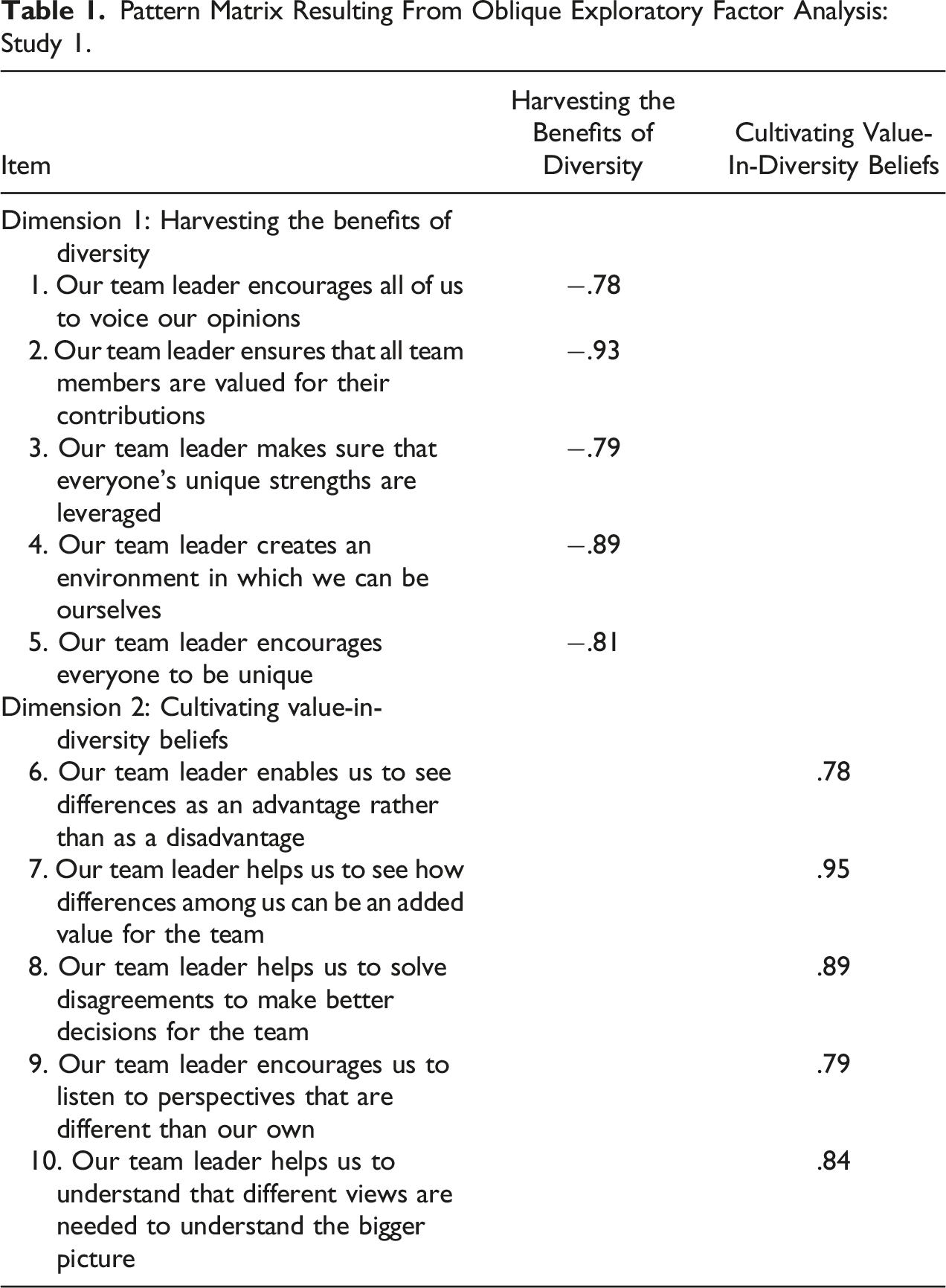
Pattern Matrix Resulting From Oblique Exploratory Factor Analysis: Study 1.
For the development of the items of cultivating value-in-diversity beliefs, we relied on the conceptualizations of van Knippenberg et al. (2007) and Nishii (2013), focusing on the development of collective pro-diversity beliefs aimed at the appreciation and integration of differences. We focused on leader actions designed to ensure the team as a whole understands the benefits of making decisions that integrate diverse perspectives. Similar to harvesting the benefits of diversity, our measure focused on the leader’s impact on the team as a whole.
We followed Hinkin’s (1998) deductive approach to develop both scales. We first developed an initial list of items based on the previously outlined conceptualizations of the two leadership behaviors. This set of eight items per scale was then further refined iteratively by presenting our definitions (and those of a few alternative constructs; i.e., intellectual stimulation and authentic leadership) and our set of items to a pool of topic experts (established scholars in the field), asking those experts to sort the items according to the definitions provided. That process of matching items with definitions occurred several times until all raters agreed that our final set of items aligned with the construct in question (Hinkin, 1998).
We also included measures for authentic leadership (Walumbwa et al., 2008) and intellectual stimulation, a dimension of transformational leadership (Podsakoff et al., 1996), to ensure discriminant validity of our measures. Due to space constraints, we could not include the full measure of transformational leadership, so we opted to use a four-item measure of intellectual stimulation. Intellectual stimulation entails that leaders promote followers developing divergent perspectives and has previously been linked to employee voice (Detert & Burris, 2007). While the stimulation of follower contributions resembles our conceptualization of harvesting the benefits of diversity, it is different in that it focuses on the individual follower rather than the team as a whole. Furthermore, intellectual stimulation—while geared toward promoting individual members’ creativity—is not focused on linking work-related insights to members’ personal experiences and backgrounds. Authentic leadership has been linked to follower authenticity or the expression of one’s authentic self at work (Lemoine et al., 2019; Leroy, Anseel, Garner, & Sels, 2015). In this regard, authentic leadership is more akin to harvesting the benefits of diversity than intellectual stimulation as it encourages the expression of follower’s full and authentic self. However, authentic leadership is not focused on the team level; while it promotes the authenticity of individual followers, it does not explicitly promote an environment where the authenticity of others is appreciated.
Analyses and Results
Exploratory and confirmatory factor analysis
To explore the factor structure of the scales developed to measure harvesting the benefits of diversity and cultivating value-in-diversity beliefs, we collected data from a convenience sample of 491 employees across 45 for-profit organizations in Belgium. These organizations’ focal activities include providing consultancy, insurance, or financial services. Human Resources (HR) representatives provided us with the e-mail addresses of 1362 employees whom we invited to complete an online survey. In total, 548 team members (40%) responded. Respondents’ average age was 40 (SD = 10.26) and 66% were women. 25% held a graduate degree, 53% held an undergraduate degree, and the average tenure was 10 years (SD = 9.34).
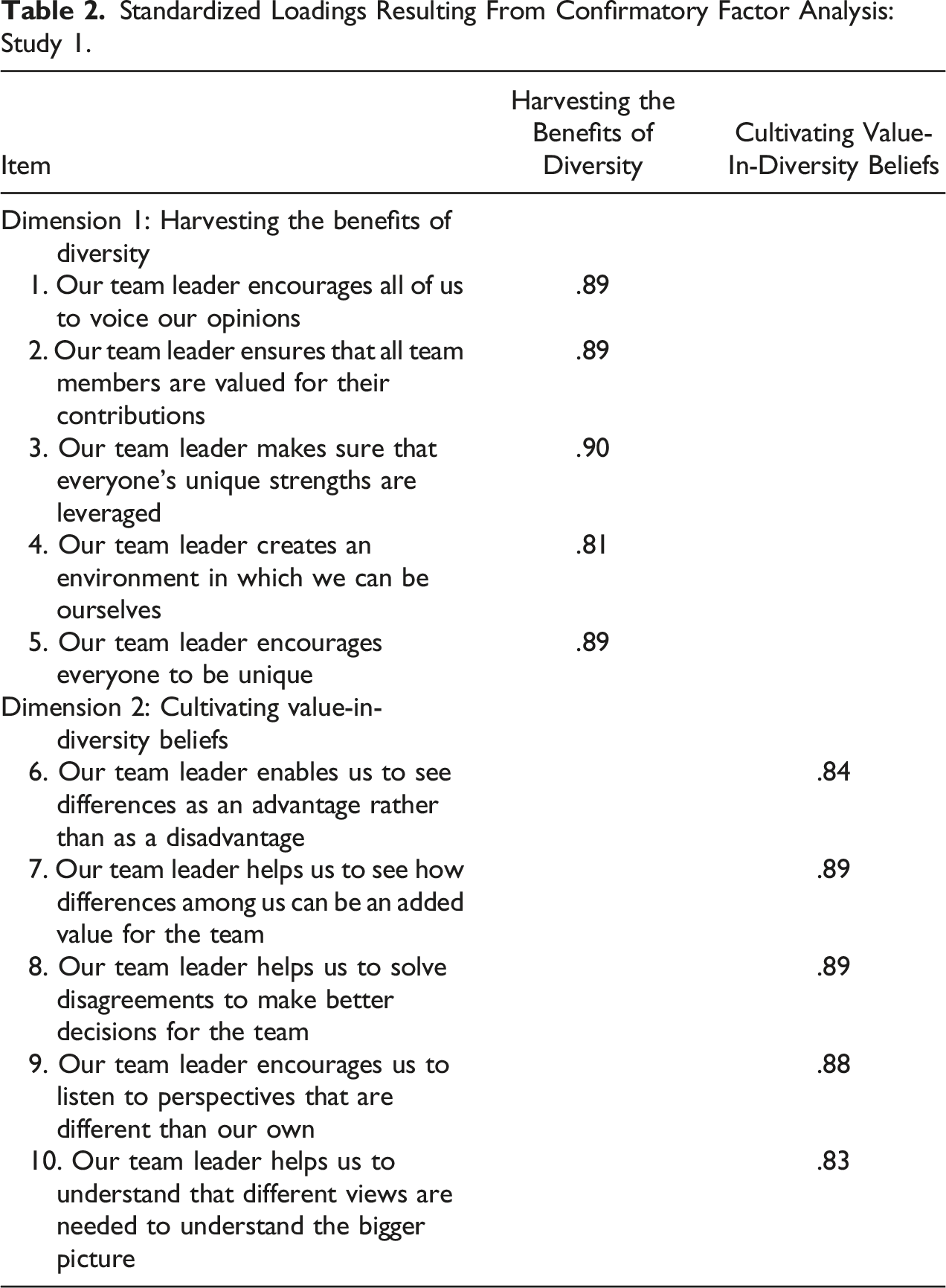
As a first step, we performed an exploratory factor analysis (EFA) for our two new measures. Because of the assumed interrelatedness of the two hypothesized inclusive leader behaviors, we used oblique (non-orthogonal) rotation in SPSS 22 (Direct Oblimin Rotation Method with Kaiser Normalization). All items loaded on their respective subdimension and the resulting two-factor model explained 75.94% of the variance. Table 1 presents the measurement items with their respective factor loadings.
Standardized Loadings Resulting From Confirmatory Factor Analysis: Study 1.
Discriminant validity
We ran a CFA model to examine the discriminant validity between harvesting the benefits of diversity, cultivating value-in-diversity beliefs, intellectual stimulation, and authentic leadership. We found that a model differentiating these factors showed a good fit to the data (χ 2 = 356.82; df = 465; p < .001; CFI = .97; TLI = .97; RMSEA = .08; SRMR = .02). Alternative models that combined the items of authentic leadership or intellectual stimulation into one factor with the items of harvesting the benefits of diversity resulted in a worse fit (p < .001) than the model in which these variables were kept separate.
Study 2: Establishing the Hypothesized Relationships
In Study 2, we tested our hypothesized relationships using the leadership measures developed and validated in Study 1. We collected data from employees in a single organization as a means of holding organization-level factor constants.
Method
Sample and procedure
We collected data in a Belgian healthcare organization with 218 employees. As we were interested in leader behaviors conducive to team-derived inclusion (i.e., inclusion as experienced in the context of one’s team) at the team level of analysis, our sampling focused on identifying teams. Our partner organization was not amenable to our collecting data from their entire workforce; therefore, we asked our contact person in the HR department to randomly select teams that met two criteria. The teams needed to (a) consist of at least two members who interdependently work on collective tasks and share responsibilities toward achieving common goals (Kozlowski & Bell, 2003) and (b) have a formal team leader. We received e-mail addresses of 180 team members and 38 team leaders. We sent online surveys to these respondents (leaders rated team creativity, and team members rated the other measures) and assured absolute confidentiality of the information provided. In total, 38 teams were included in our final sample (i.e., a total of 174 [97%] followers and 38 [100%] leaders). Respondents’ average age was 41 (SD = 8.81) and 73% were women. 92% held an undergraduate degree and 8% held a graduate degree, and the average tenure in the organization was 14 years (SD = 10.34). The average age of the team leaders was 47 (SD = 7.99), 59% were women, and their average tenure was 10 years (SD = 8.54). 29% held an undergraduate degree, and 71% held a graduate degree.
Measures
Harvesting the benefits of diversity and cultivating value-in-diversity beliefs
We used the items developed in Study 1 (internal consistencies of these and other constructs in Study 2 are reported on the diagonal of Table 4).
Team-derived inclusion
We measured team-derived inclusion using five items reflective of uniqueness from Janssen and Huang (2008) and five items indicating belongingness developed by Lee, Draper, and Lee (2001). Items were adapted to a team context and were measured on a seven-point Likert scale ranging from “totally disagree” (1) to “totally agree” (7). Sample items are “In this team, I can be my unique self” (uniqueness) and “In this team, I feel connected with the other team members” (belongingness). Given that we conceptualized team-derived inclusion as comprising both high levels of uniqueness and belongingness, uniqueness and belongingness sub-scores were collapsed into one overall score.
Team creativity
We measured team leaders’ judgments of team creativity using the three-item scale developed by Sung and Choi (2012). Team leaders indicated their agreement on a seven-point Likert scale ranging from “totally disagree” (1) to “totally agree” (7). A sample item is “This team comes up with new and practical ideas in solving problems.”
Analyses of measurement models
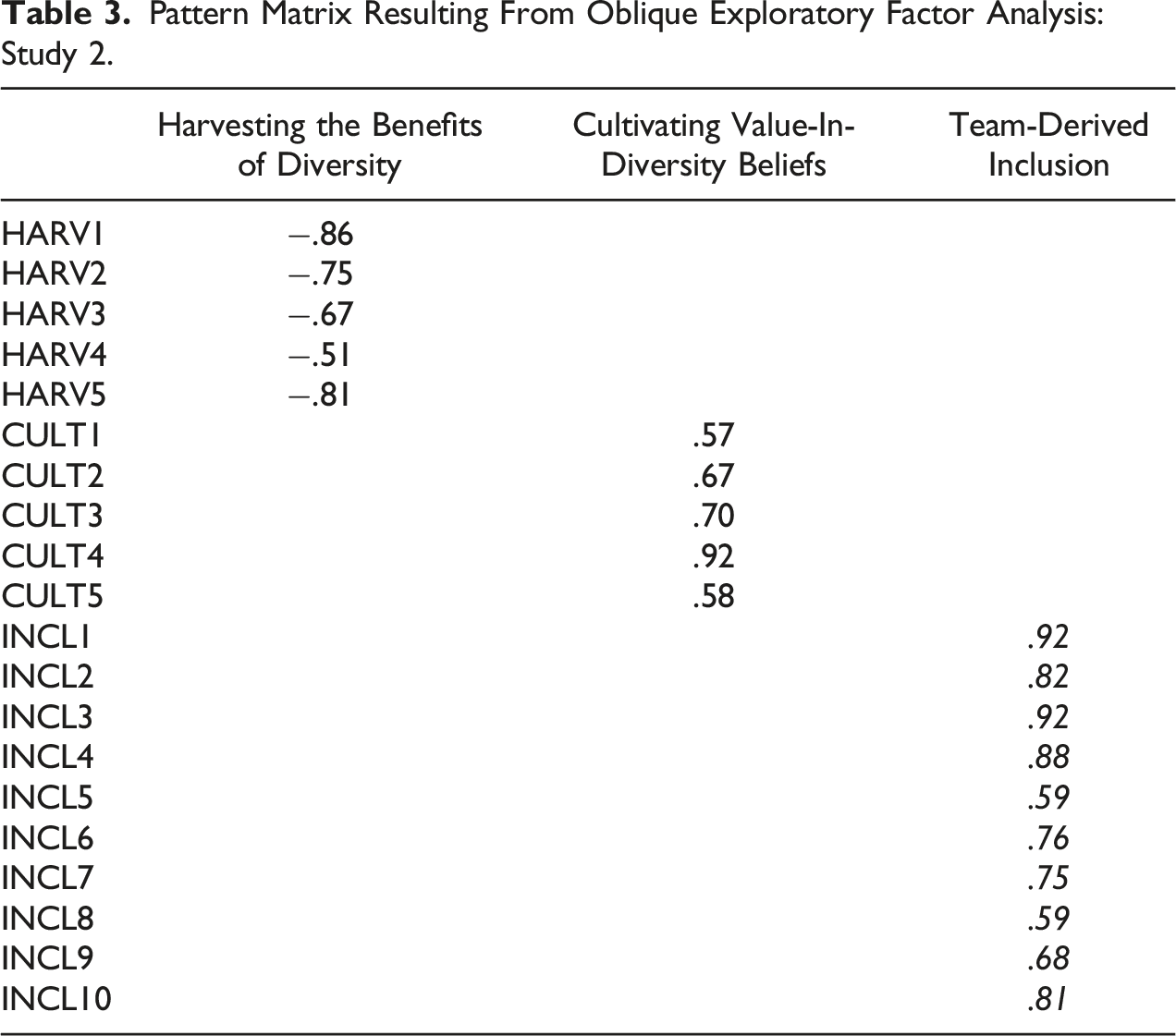
Pattern Matrix Resulting From Oblique Exploratory Factor Analysis: Study 2.
Because our leader behaviors are conceptualized at the team level and assumed to be perceived uniformly among the members, we aggregated the ratings of the individual team members to the team level. In support of this aggregation decision, mean rwg was .90 (Mdn = .89) for harvesting the benefits of diversity and .85 (Mdn = .84) for cultivating value-in-diversity beliefs, using a uniform null distribution. ICC(1) and ICC(2) were .22 and .53 for harvesting the benefits of diversity and .26 and .29 for cultivating value-in-diversity beliefs (Bliese, 2000). Analyses of variance (ANOVA) indicated significant between-group variance for both variables: F(37,173) = 2.11, p < .01, and F(37,173) = 2.42, p < .01, respectively.
For team-derived inclusion, we do not a priori expect high levels of sharedness across all teams. The “team-derived” in the concept label denotes the context in which team members experience inclusion rather than the fact that all members experience similar levels of inclusion. Our theorizing makes it clear that feeling included is an individual-level variable, not a team-level construct: Individuals report to what extent they feel to be included in their specific (i.e., team-based) work context. This aligns with the theoretical basis of satisfaction of basic psychological needs (Brewer, 1991). This theoretical assumption suggests that team members may not agree on felt inclusion, with some members experiencing more inclusion than others. A team-level conceptualization of inclusion would be more akin to team psychological safety (Edmondson, 1999) where all team members agree that the environment is one that promotes inclusion (uniqueness and belongingness). Having explained our theoretical reasons to focus at inclusion at the individual level, van Knippenberg et al. (2013) argued that sharedness may reinforce the effect of team-focused inclusion experienced by members such that the effects of team-derived inclusion on team creativity may be even stronger when all team members share similar perceptions of inclusion. Therefore, we include the level of dispersion in team-derived inclusion as a control variable in our studies.
Aligned with our theoretical thinking, for team-derived inclusion, we thus do not report measures of aggregation. We are however interested in the between-group variance in team-derived inclusion as without this variance we would be unable to explain effects using team-level leadership and team creativity. An ANOVA showed a significant amount of between-group variance: F(37,173) = 1.69, p < .01. Because of our focus on this between-group variance in individual team-derived inclusion, we used the average scores per team in our team-level analyses.
Results 2
Means, Standard Deviations, and Correlations Between Team-Level Study Variables: Study 2.
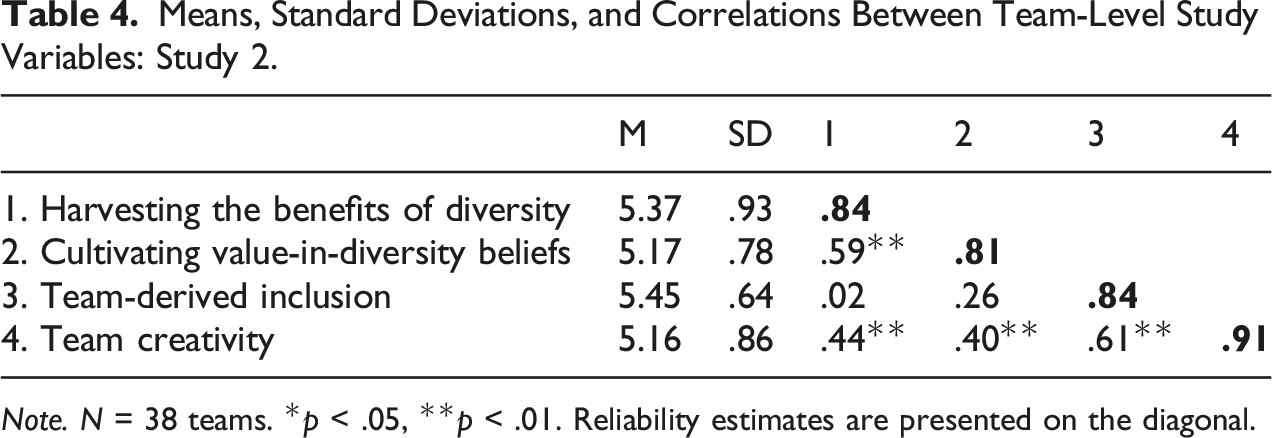
Note. N = 38 teams. *p < .05, **p < .01. Reliability estimates are presented on the diagonal.
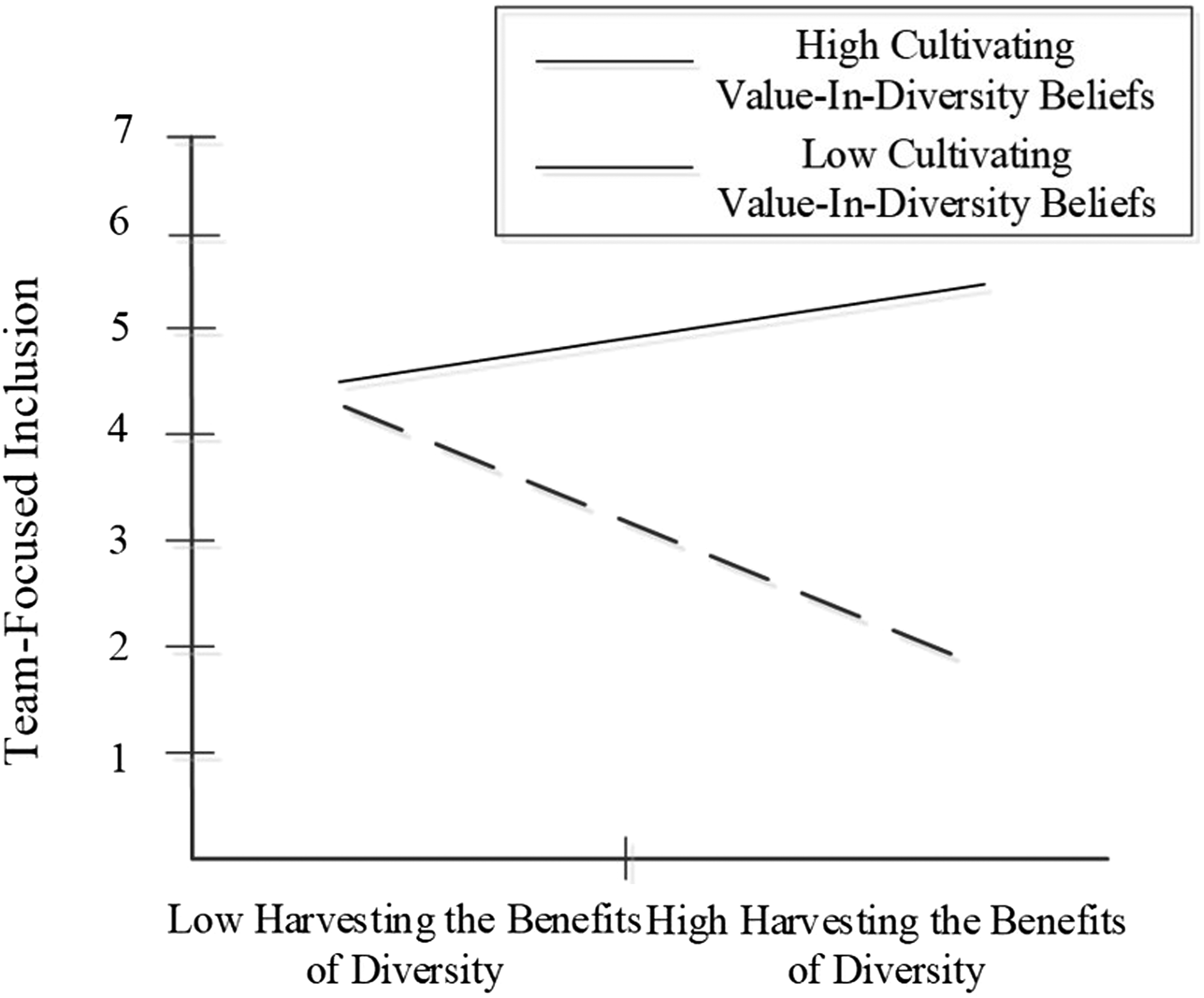
Interaction effect between harvesting the benefits of diversity and cultivating value-in-diversity beliefs on team-derived inclusion: Study 2.
Means, Standard Deviations, and Correlations Between Team-Level Study Variables: Study 3.
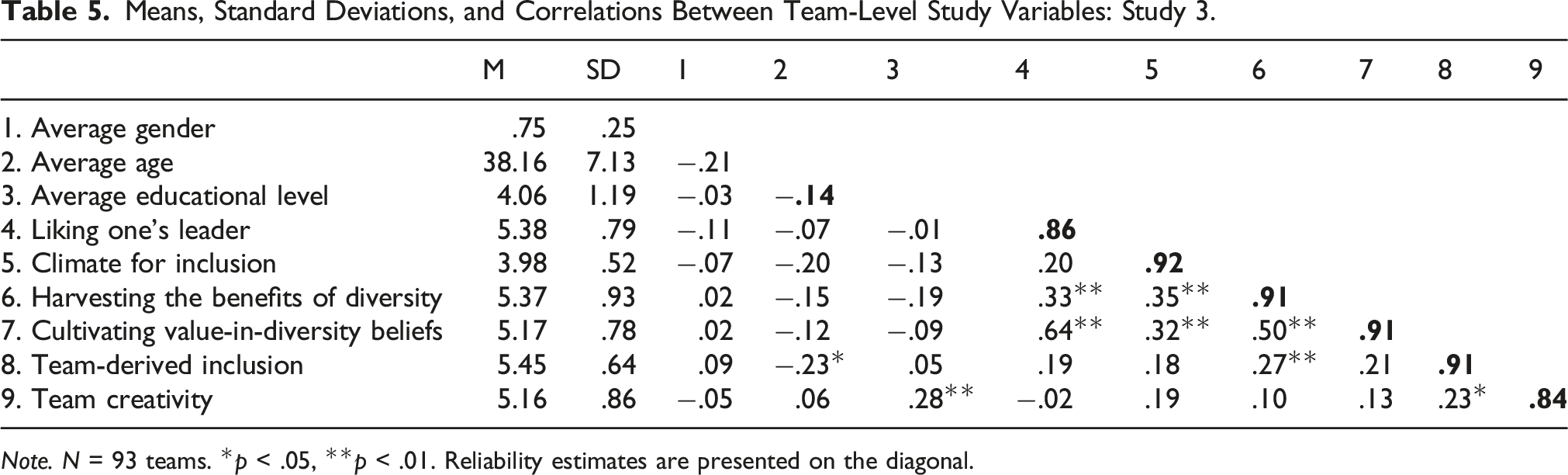
Note. N = 93 teams. *p < .05, **p < .01. Reliability estimates are presented on the diagonal.
This only partially confirms our Hypotheses 2 and 3 in that we saw clear detriments to harvesting without high degrees of cultivating but could not confirm that high degrees of cultivating strengthened the effects of harvesting. Part of these results could be explained by the fact that the organization already had an overall climate focused on promoting inclusion, potentially restricting the leader’s positive impact in this regard. Mor Barak, Luria, and Brimhall (2021) argued that inclusive leadership is not just restricted to leaders of teams but can be institutionalized in the larger organization, for instance, in the overall climate for inclusion in the larger organization (Nishii, 2013). In the next study, we intend to replicate these findings and overcome the limitation of a single organization and control for the effects of an overall inclusive climate in the organization.
Study 3: Replicating the Hypothesized Relationships
To investigate the generalizability of these results, we tested the same hypotheses in a larger sample drawn from multiple organizations in Belgium. Sampling a wide variety of organizations allowed us to assess whether our previously established results hold across contexts. The larger, more heterogeneous sample also allowed us to control for organizational-level factors that might influence team-level relationships. Specifically, in Study 3, we controlled for organizational climate for inclusion to see how leader behaviors explain variance in team processes beyond the variance explained by climate for inclusion (e.g., Nishii, 2013). Additionally, we were curious to see if our effects of leadership explained any variance after controlling for general liking of the leader (Wayne, Shore, & Liden, 1997). Prior work has suggested that follower measures of leader behavior are confounded by a general liking toward the leader (e.g., Brown & Keeping, 2005; Mumford & Fried, 2014). Hence, we wanted to make sure our effects were specific to our leader behaviors rather than a more general leader appreciation (Nishii & Mayer, 2009).
Method
Sample and procedure
We collected data in 36 Belgian small to medium organizations (of maximally 100 employees) that provided social welfare services, such as civic integration services, mental and physical care, and environmental services. Again, we asked HR representatives of the participating organizations to randomly select teams that consist of at least two members who interdependently work on collective tasks and have a formal team leader. HR representatives provided us with the e-mail addresses of 1129 team members and 172 team leaders. We sent online surveys to these respondents and assured absolute confidentiality.
We excluded teams from further analyses if less than half of their members completed the online survey. 93 teams could be retained for further analyses (i.e., a total of 430 [38%] followers and 93 [54%] leaders). Respondents’ average age was 39 (SD = 10.52) and 68% were women. 55% held an undergraduate degree, 22% held a graduate degree, and the average tenure was 9 years (SD = 8.30). 36% of the respondents indicated that they interacted with their team leader on a daily basis, 58% did so on a weekly basis, and 6% on a monthly basis. The average age of the team leaders was 43 (SD = 8.81), 62% were women, and their average organizational tenure was 12 years (SD = 9.67). 56% held an undergraduate and 38% held a graduate degree.
Measures
We used the same measures and raters (with leaders only rating team creativity) as in Study 1 and Study 2. Internal consistencies are reported on the diagonal of Table 5.
Control variables
We included control variables for both general leader liking and the broader organizational climate for inclusion to differentiate the effects of our rated leader behaviors from more general impressions about the leader and the broader organizational climate. The three-item measurement of leader liking by Wayne et al. (1997) was rated on a seven-point Likert scale ranging from “totally disagree” (1) to “totally agree” (7). A sample item is “I like my leader very much.” In addition, we included team leaders’ perceptions of the overall climate for inclusion in the organization. The leaders’ perspective allows us to avoid single-source bias but also to tap into the perspective of the key implementers of an organizations’ inclusion strategy and expectations which may influence their own leader behaviors. We used the climate for inclusion scale (Nishii, 2013). Items were measured on a five-point Likert scale ranging from “totally disagree” (1) to “totally agree” (5). Sample items are “In this organization, promotion processes are fair” (equitable practices), “This organization is characterized by a nonthreatening environment in which people can reveal their ‘true selves’” (integration of differences), and “Top management exercises the belief that problem-solving is improved when input from different roles, ranks, and functions is considered” (inclusion in decision). Finally, similar to Study 1, we also controlled for the dispersion of team-derived inclusion to account for potentially stronger effects of inclusion when inclusion experiences are less dispersed (van Knippenberg et al., 2013).
Again, because our research model is conceptualized at the team level, we aggregated individual member ratings to the team level. In support of this aggregation decision, we found a mean rwg of .91 (Mdn = .92) for harvesting the benefits of diversity and of .91 (Mdn = .91) for cultivating value-in-diversity beliefs, using a uniform null distribution. ICC(1) and ICC(2) were .33 and .71 for harvesting the benefits of diversity and .33 and .72 for cultivating value-in-diversity beliefs (Bliese, 2000). ANOVA indicated significant amounts of between-group variance for both variables: F(92,335) = 3.45, p < .001, and F(92,329) = 3.55, p < .01, respectively. For team-derived inclusion, similar to study 2, an ANOVA indicated that there is a significant amount of between-group variance (F(92,316) = 1.92, p < .01). This suggests that there are differences between teams with regard to team-derived inclusion and that these can be related to team-level differences in team creativity and leadership behaviors.
Analyses of measurement models
Using the Mplus statistical package, we performed several CFAs (Muthén & Muthén, 1998-2015). The estimation of a measurement model containing the main variables of our study resulted in a good fit of the model to the data (χ 2 = 472.41; df = 222; p < .001; CFI = .97; TLI = .96; RMSEA = .05; SRMR = .04) (Hu & Bentler, 1999). In a second CFA, we estimated the fit of a model containing harvesting the benefits of diversity and cultivating value-in-diversity beliefs as a higher-order factor. This model showed a worse fit to the data compared to a model in which both leader behaviors are defined as separate constructs (χ 2 = 839.78; df = 225; p < .001; CFI = .92; TLI = .91; RMSEA = .08; SRMR = .05). In a third CFA, we estimated a model that contained both the core model variables and the control variables of liking one’s leader and climate for inclusion. This measurement model also showed a good fit to the data (χ 2 = 1400.39; df = 609; p < .001; CFI = .94; TLI = .93; RMSEA = .05; SRMR = .05). Three items of the climate for inclusion scale had to be deleted because these items showed factor loadings below the cutoff value of .40 on their subdimension. We deleted a fourth item because its error term was highly correlated with another item’s error term. Overall, the results suggest that our measurement model fits the data and that the measures are distinct from each other. Furthermore, pairwise comparisons of variables (e.g., combining cultivating value-in-diversity beliefs or harvesting the benefits of diversity with leader liking in one factor) systematically showed a worse fit to the data than our hypothesized structure.
Next, we tested the structural model to examine the hypothesized relationships between the model variables (McDonald & Ho, 2002; Mueller & Hancock, 2008). As multilevel structural equation models were too parameter-intensive for our data and results of a path model are similar to the results obtained using multilevel modeling (Grizzle, Zablah, Brown, Mowen, & Lee, 2009), we proceeded using aggregated measures in a path model in Mplus (Muthén & Muthén, 1998-2015). Further, to diminish potential common-method bias due to the fact that the independent and mediating variables were rated by team members at one point in time, we used a random split-sample approach (Podsakoff, Mackenzie, Lee, & Podsakoff, 2003; Robinson & O’Leary-Kelly, 2003). Harvesting the benefits of diversity, cultivating value-in-diversity beliefs, and team-derived inclusion were rated by different members of the same team. This lowers the extent to which common-method variance is present in the data as different variables are rated by different raters. The independent variables were standardized to reduce the risk of multicollinearity and aid interpretation (Snijders & Bosker, 1999).
Results 3
Descriptive statistics and correlations among team-level variables are presented in Table 5. Internal consistency estimates based on the individual-level data are shown on the diagonal. Our hypothesized path model showed a good fit to the data (χ
2
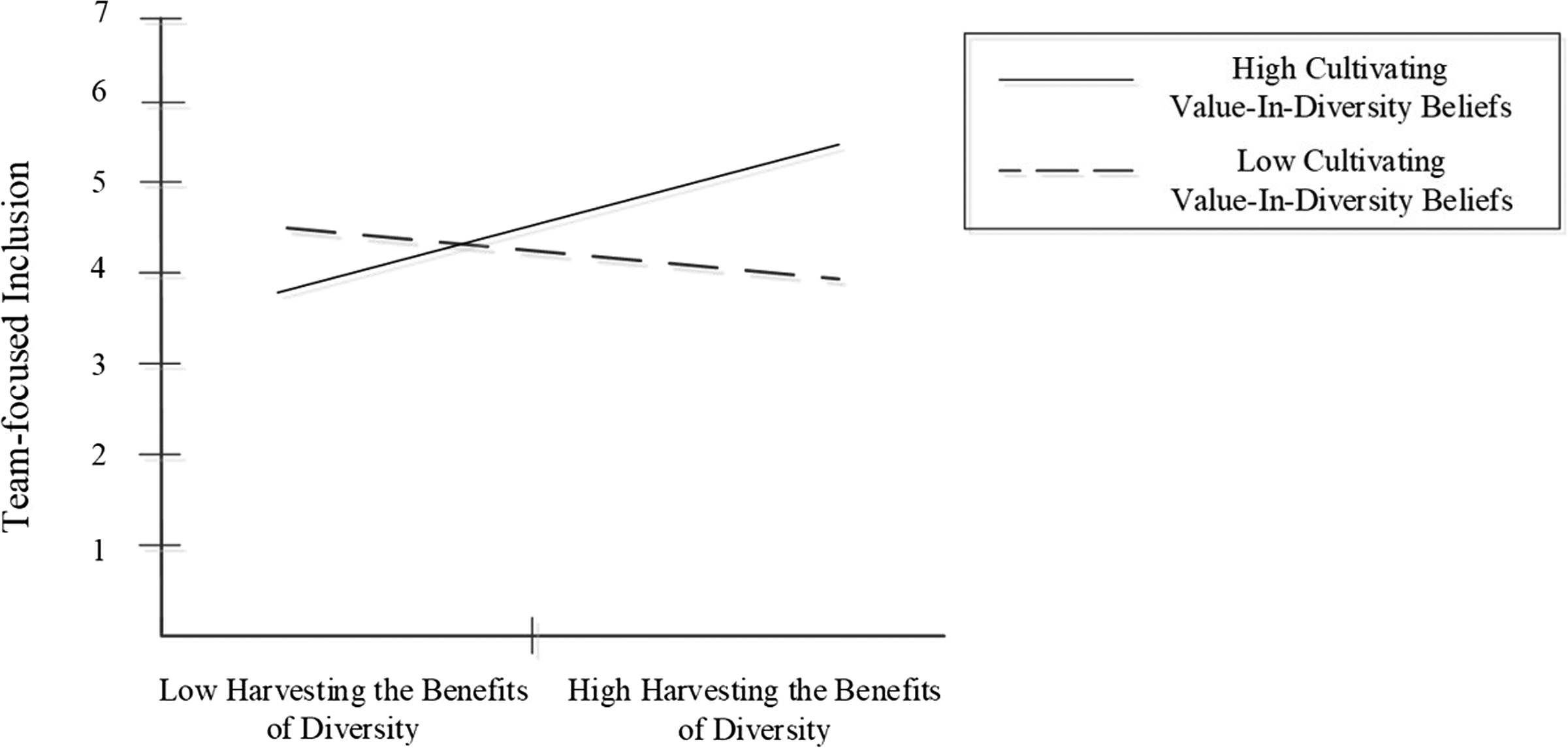
= 4.15; df = 4; p = .37; CFI = .99; TLI = .98; RMSEA = .02; SRMR = .02). Figure 3 shows the full structural model with standardized path coefficients. In line with Hypothesis 1, we found a positive and significant relationship between team-derived inclusion and leader-rated team creativity (β = .23; p <.05). Confirming Hypothesis 2, in which we predicted that the extent to which leaders engage in cultivating value-in-diversity beliefs moderates the relationship between harvesting the benefits of diversity and team-derived inclusion, we found a significant and positive interaction effect on team-derived inclusion (β = .43; p < .01). The simple slope computed at one standard deviation above the mean of the moderator (Aiken & West, 1991) was positive and significant (β = .38; p < .01), whereas the simple slope at one standard deviation below the mean of the moderator was not significant (β = .02; p = .78). Figure 4 reveals that the relationship between harvesting and team-derived inclusion is positive under the condition that leaders also engage in cultivating. In contrast, if cultivating is low, there is no effect of harvesting. Team-level moderated mediation model with standardized path coefficients: Study 3. Note. N = 93 teams. *p < .05, **p < .01. Dotted lines indicate control variables. Interaction effect between harvesting the benefits of diversity and cultivating value-in-diversity beliefs on team-derived inclusion: Study 3.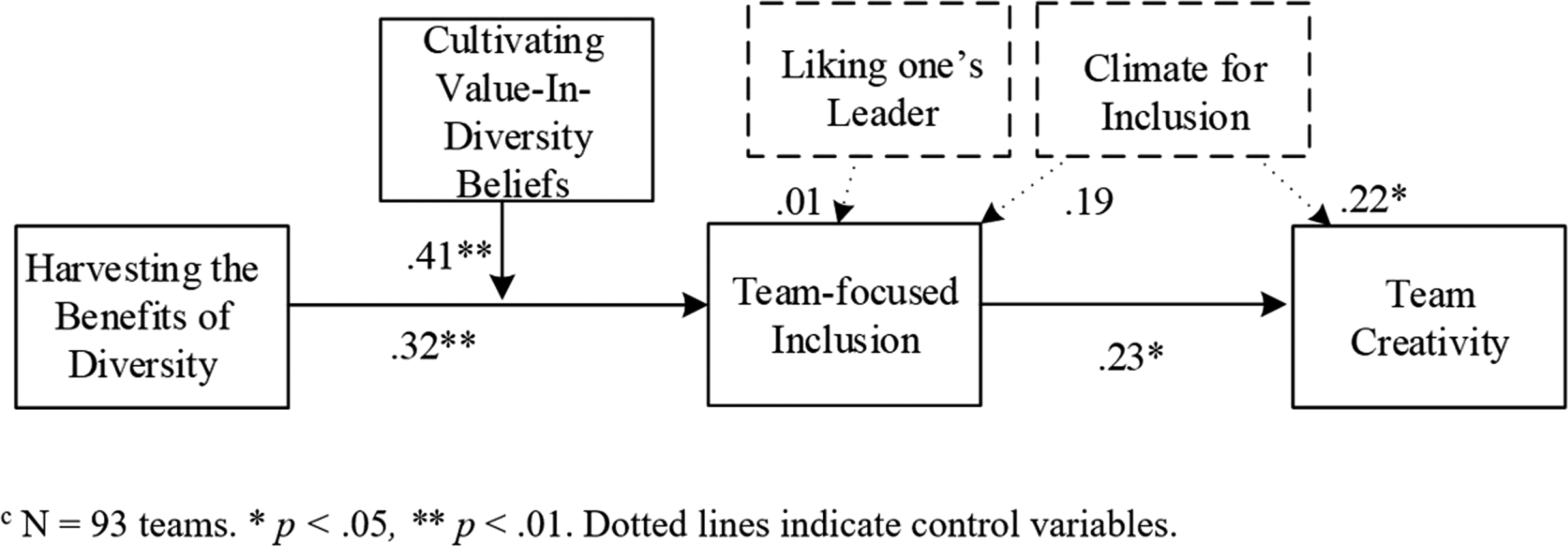
Hypothesis 3 posits an indirect relationship of the interaction between harvesting and cultivating with team creativity via team-derived inclusion. Therefore, we examined the indirect conditional effects of harvesting on team creativity through team-derived inclusion under conditions of low, average, and high values of cultivating. Consistent with predictions, at high levels of cultivating (i.e., one standard deviation above the mean), the indirect conditional effect was positive and significant (β = .12, p < .05). At both mean and low (one standard deviation below the mean) levels of the moderator, the indirect conditional effect was not significant (β = .06, p = .08 and β = .01, p = .78, respectively). Hence, only when cultivating was high, harvesting indirectly stimulated team creativity through team-derived inclusion.
Discussion
Inclusion promises to ensure that the diverse members of an organization can and are motivated to fully participate and contribute to the collective, unrestrained by dividing forces. Yet, the literature on inclusion so far has not yet tackled the question of how leaders can stimulate inclusion, and whether experiencing inclusion allows teams to indeed capitalize on their differences, as indicated by high team creativity. Using a three-study design, we examined the role of team-derived inclusion in team creativity and elaborated on how leaders could stimulate team-derived inclusion such that team creativity results. Our findings revealed that our measure of the two theoretically derived leader behaviors (harvesting the benefits of diversity and cultivating value-in-diversity beliefs) allows capturing two leadership behaviors that show discriminant validity with related leadership behaviors (Study 1); team-derived inclusion, understood as the experience of both belongingness and uniqueness in a team, predicted the team’s creativity (Study 2 and 3); and that a leader’s harvesting the benefits of diversity was most conducive to team-derived inclusion and indirectly team creativity when the leader also engaged in cultivating value-in-diversity beliefs (Study 3) and even negative when the leader scored low on cultivating value-in-diversity beliefs (Study 2).
Theoretical implications
By showing that through harvesting the benefits of diversity and cultivating value-in-diversity beliefs leaders stimulate team-derived inclusion and thereby facilitate team creativity, our study contributes to the existing literature in several ways. First, research on the leadership role in fostering team creativity (Amabile, Schatzel, Moneta, & Kramer, 2004; Shin, Kim, Lee, & Bian, 2012; Wang & Rode, 2010), in particular of diverse teams (Homan et al., 2020), is scarce and has only recently begun to systematically move beyond the notion of transformational leadership (van Knippenberg & Hoever, in press). This study assists in building understanding of how team leaders can facilitate collective creativity. This focus makes it important to explore how leaders can create conditions that allow teams to let their members’ resources materialize in the team context and enable members to positively engage with and constructively combine them in creative output (e.g., Homan et al., 2020). Our results suggest that the dual leader behaviors of harvesting the benefits of diversity and cultivating value-in-diversity beliefs may serve this purpose by creating a setting in which members experience a sense of belonging as unique members of the team. These results resonate with other conceptualizations of leadership in the service of bringing out diversity’s benefit for teams (Homan et al., 2020) or achieving inclusion through leader actions. Most importantly, two of van Knippenberg and van Ginkel’s (2021) three leadership elements deserve mentioning here as they underscore similar behaviors as those highlighted in our dual leader behaviors. Specifically, cultivating value-in-diversity beliefs aligns with the element of advocacy of diversity mindset in highlighting the promotive potential of differences, and harvesting the benefits of diversity behaviors aligns with stimulating elaboration in the form of making sure diverse input is brought into and leveraged in the team.
We further add to team creativity research by adopting an inclusion lens in answering the question of how value in diversity can be attained in teams and how and whether it can facilitate collective creativity. In line with the information/decision-making perspective (van Knippenberg & Schippers, 2007), we argued that harvesting the benefits of diversity and cultivating value-in-diversity beliefs can foster team creativity through the creation of a team environment in which divergent input from different team members is elicited and valued. Specifically, by encouraging members to share and build upon different insights and building beliefs that diversity is valuable, leaders function as a motivating force that engages members in the production of novel ideas. Interestingly, a positive indirect effect when both behaviors were pronounced only materialized in Study 3. In Study 2, the presence of high levels of cultivating value-in-diversity beliefs merely suppressed the negative effects of harvesting the benefits of diversity. One explanation lies in the existence of a high climate for inclusion in the organization which provided the sample for Study 2. More specifically, following a substitutes-for-leadership reasoning (Howell, Dorfman, & Kerr, 1986), an organization’s high climate for inclusion may neutralize the positive effects of leader cultivating value-in-diversity beliefs as cultivating may be the norm rather than the exception for all leaders. In contrast, leaders engaging in harvesting the benefits of diversity without also cultivating value-in-diversity beliefs in an inclusive organizational climate may be penalized, as evident in lowered felt inclusion in the team and, indirectly, team creativity in the results from Study 2. Future research may identify additional context variables that influence the impact of the two leader behaviors.
Furthermore, this study contributes to the debate on whether perceptions of belongingness hinder or foster team creativity (van Knippenberg & Schippers, 2007). Research is still inconclusive regarding the relationship between creative processes on the one hand and variables reflecting belongingness in teams, such as team identification, social cohesion, and team identity, on the other hand (Homan et al., 2020; van Knippenberg et al., 2007). Most group creativity research is premised on the assumption that creativity is more likely to emerge when people feel liberated to express their authentic and unfiltered point of view (Forster, Friedman, Butterbach, & Sassenberg, 2005) and that team cohesion and belongingness stifle creativity by constraining members and determining which thought can be openly expressed and which should be withheld to avoid offense. Our results, suggesting that it is the integrated satisfaction of members’ need for belongingness and uniqueness that enables creativity in teams, are in line with the recently offered idea that creative ideas are more likely to emerge in the presence of both constraints and authenticity (Ferdman et al., 2010; Goncalo, Chatman, Duguid, & Kennedy, 2015; Leroy et al., 2020; Jansen, Otten, Zee, & Jans, 2014).
Our study also adds to the inclusion literature by focusing on team leaders as instrumental in building an inclusive team environment. Although scholars converge in their assertion that perceived inclusion is associated with positive consequences for individual employees, work groups, and organizations, little is known about how perceptions of inclusion develop and empirical work on the antecedents and outcomes of collective inclusion is scarce (Buengeler et al., 2018; Jansen et al., 2014; Sabharwal, 2014). Our study functions as a deductive integration of two leader behaviors that are important in realizing the benefits of differences in teams (Sabharwal, 2014). Our findings suggest that leaders are key actors in fostering full participation of members in team processes (Carmeli et al., 2010; Hirak et al., 2012; Nishii, 2013) and shaping collective beliefs concerning the value of diversity for heightened team functioning (van Knippenberg et al., 2007).
Moreover, our conceptualization of harvesting the benefits of diversity and cultivating value-in-diversity beliefs is essentially oriented at the team as a whole, which provides more directions for studying the development of team—rather than individual—processes and outcomes such as team learning and team performance. The core difference between Nembhard and Edmondson’s (2006) leader inclusiveness and our construct of harvesting the benefits of diversity is that the former concept focuses on eliciting voice behavior from individual team members. However, the invitation and appreciation of other deep-level differences in all members’ strengths, backgrounds, and capacities—which is the essence of valuing the inherent differences in team members’ whole self (Ely & Thomas, 2001)—is not present in this construct. Further, we found that the active promotion of value-in-diversity beliefs strengthens the opportunities for creating value in diversity (Homan et al., 2007; van Dick et al., 2008). Indeed, our results suggest that without constructing a meta-narrative that values differences, team-derived inclusion and team creativity may not be fostered to their full extent. Few work speaks to how leaders foster team creativity specifically (van Knippenberg & Hoever, 2017). As such, the theoretical underpinnings of “leading toward team creativity” are rather limited (Wilson-Evered et al., 2001). Scholars have called for more fine-grained theorizing to help elucidate how leaders can help foster team creativity (Boies, Fiset, & Gill, 2015; Homan et al., 2020; Mainemelis et al., 2015). We answer that call by developing a theoretical perspective of how leaders foster team creativity through team-focused inclusion.
Limitations and Directions for Future Research
Our findings should be interpreted within the context of this study’s limitations. First, in developing and validating a measure of the two leader behaviors aimed at assisting in establishing an inclusive team environment, we based our conceptualization of harvesting the benefits of diversity and cultivating value-in-diversity beliefs on research that identified leader behavior concerning the invitation of different inputs and voices (i.e., Nembhard & Edmondson, 2006) and studies that highlighted the role of value-in-diversity perceptions as an important condition under which perceived and actual diversity in team contexts relates to beneficial team outcomes (i.e., Homan et al., 2007; van Knippenberg et al., 2007). Informed by these studies, we considered both dimensions as relevant leadership behaviors for initiating team-derived inclusion. We do not claim, however, that this is an exhaustive conceptualization of possible leader behaviors that may stimulate inclusion (see, for instance, Randel et al., 2018; van Knippenberg & van Ginkel, 2021, this volume). Future research may cross-validate our findings in other settings and contexts and deduct potential additional behaviors conducive to experiencing inclusion.
We found a high correlation between harvesting the benefits of diversity and cultivating value-in-diversity beliefs (r = .59 and .50 in Study 2 and 3, respectively). On the one hand, it is not surprising that these constructs are considerably correlated as they both refer to the extent to which team leaders positively approach and value diversity. On the other hand, although correlations such as ours are not problematic when constructs are clear and high correlations are theoretically explained (van Knippenberg & Sitkin, 2013), this finding may raise questions regarding the constructs’ conceptual distinctiveness. It could be questioned, for instance, whether both inclusive leader behaviors reflect the constituting parts of an overarching construct rather than two separate constructs. In our study, several factor analyses indicated that modeling the variables as separate dimensions provided a better fit to the data than models in which they are specified as one factor (see Appendix B). Moreover, the primary goal of this research was to pinpoint how these leader behaviors interact in fostering team-derived inclusion and team creativity, rather than specifying an overarching additive construct. Our approach is consistent with van Knippenberg and Sitkin’s (2013) critique of the higher-order charismatic-transformational leadership construct and as this overarching construct does not allow for the examination of whether and how distinct dimensions may interact, producing different outcomes (see also Lemoine et al., 2019).
Relatedly, a possible partial explanation for the high correlation in our study is the presence of common-method variance in our data (Podsakoff et al., 2003). To alleviate concerns, we applied a random split-sample approach to assure that different members from the same team rated the independent and mediating variables. We further examined moderation hypotheses. Common-method variance is not considered to be a problem when interactions are examined (MacKinnon, Lockwood, Hoffman, West, & Sheets, 2002; McClelland & Judd, 1993; Siemsen, Roth, & Oliveira, 2010), as it deflates rather than inflates interaction effects, making them more difficult to detect (Siemsen et al., 2010). Last, we aggregated the data to the team level. This contributes to leveling out possible impact of social desirability or negative/positive effect on individual self-ratings. The stability of findings across two studies further increases our confidence in the respective findings. Future research may replicate our findings with a longitudinal or experimental design.
Last, this research has been conducted in Western organizations. Given the relatedness of cultural norms of individualism (collectivism) and the pursuit of uniqueness (belongingness) (e.g., Goncalo & Staw, 2006), future research should address the role of such cultural dimensions in the establishment of workplace inclusion.
Practical Implications
Realizing the benefits of diversity has become a business imperative. The present study targets two important issues in this regard: on the one hand, it shows how organizations, through their leaders, can stimulate a collective sense of inclusion. On the other hand, it addresses the question of how the promise of team creativity that diverse workforces entail can be realized. Organizations increasingly introduce practices and initiatives that focus on the full participation of different organization members in work processes and emphasize the provision of opportunities for all employees to use the full range of their skills, viewpoints, strengths, and competencies at work (Ferdman & Deane, 2014; Roberson, 2006).
Given the importance of collective creativity for organizations’ ability to innovate and adapt to changing environments, the finding that an inclusive approach to leadership and team-derived inclusion play a role in facilitating team creativity is also relevant to organizations (George, 2007; Zhou & Shalley, 2008). Indeed, HR managers often indicate that improving the utilization of different employees’ talents and enhancing teams’ creativity and problem-solving ability are the most important reasons for increasing workplace diversity (Robinson & Dechant, 1997; Mannix & Neale, 2005). Our findings show that team leaders are key actors in shaping inclusive work environments (Boekhorst, 2015).
Therefore, raising team leaders’ awareness of their role in creating an inclusive work environment and guiding them to add both dimensions of inclusive leadership to their behavioral repertoire should become a focus in leadership interventions and development programs. In this way, team leaders can be trained in conveying inclusive behaviors on a daily basis. Likewise, HR representatives can communicate the importance of inclusion by being part of the development of value-in-diversity beliefs and by ensuring that new hires are made aware of and can contribute to realizing the benefits of the inherent diversity in the workforce (Homan et al., 2007; van Dick et al., 2008; van Knippenberg et al., 2007, 2013).
Conclusion
As today’s organizations incorporate an increasingly diverse workforce, the question arises how the benefits of this diversity can be realized. Following recent research on building inclusive work environments, we proposed that leaders who harvest the benefits of diversity by explicitly inviting and appreciating the variety of unique inputs from all team members stimulate team-derived inclusion, defined as team members’ collective experience of both uniqueness and belongingness. Yet, at the same time, team leaders should also cultivate collective value-in-diversity beliefs because only in conjunction are these two leader behaviors beneficial for team-derived inclusion, and indirectly, team creativity.
Footnotes
Appendix A
Overview of Measures: Study 2 and 3
Appendix B
Comparison of Measurement Models: Study 2
Factors
χ2
df
CFI
TLI
RMSEA
SRMR
Model 1
Four factors: Harvesting the benefits of diversity; cultivating value-in-diversity beliefs; team-derived inclusion (defined as a higher-order factor, constituted by uniqueness and belongingness); team creativity
472.41
222
.97
.96
.05
.04
Model 2
Three factors: Harvesting the benefits of diversity and cultivating value-in-diversity beliefs defined as a higher-order factor; team-derived inclusion (defined as a higher-order factor); team creativity
839.78
225
.92
.91
.08
.05
Model 3
Five factors: Model 1 with liking one’s leader; climate for inclusion (defined as a higher-order factor, constituted by equitable employment practices, integration of differences, and inclusion in decision-making)
1400.39
609
.94
.93
.05
.05
Model 4
Four factors: Harvesting the benefits of diversity; cultivating value-in-diversity beliefs; and liking one’s leader defined as one factor; team-derived inclusion; team creativity; climate for inclusion
2185.58
618
.87
.86
.08
.05
Model 5
Four factors: Harvesting the benefits of diversity; cultivating value-in-diversity beliefs; team-derived inclusion; and climate for inclusion defined as one factor; team creativity; liking one’s leader
4726.63
619
.67
.65
.13
.13
Model 6
Four factors: Harvesting the benefits of diversity; cultivating value-in-diversity beliefs; and team-derived inclusion defined as one factor; team creativity; liking one’s leader; climate for inclusion
3937.35
620
.74
.72
.11
.10
Declaration of Conflicting Interests
The author(s) declared no potential conflicts of interest with respect to the research, authorship, and/or publication of this article.
Funding
The author(s) received no financial support for the research, authorship, and/or publication of this article.

Footnotes
Associate Editor: Lisa Nishii