




Abstract
The social identity approach to stress proposes that the beneficial effects of social identification develop through individual and group processes, but few studies have addressed both levels simultaneously. Using a multilevel person–environment fit framework, we investigate the group-level relationship between team identification (TI) and exhaustion, the individual-level relationship for people within a group, and the cross-level moderation effect to test whether individual-level exhaustion depends on the level of (in)congruence in TI between individuals and their group as a whole. We test our hypotheses in a sample of 525 employees from 82 teams. Multilevel polynomial regression analysis revealed a negative linear relationship between individual-level identification and exhaustion. Surprisingly, the relation between group-level identification and exhaustion was curvilinear, indicating that group-level identification was more beneficial at low and high levels compared with medium levels. As predicted, the cross-level moderation of the individual-level relationship by group-level identification was also significant, showing that as individuals became more incongruent in a positive direction (i.e., they identified more strongly than the average team member), they reported less exhaustion, but only if the group-level identification was average or high. These results emphasize the benefits of analyzing TI in a multilevel framework, with both theoretical and practical implications.
Understanding the development of exhaustion, a state of depletion arising from chronic workplace strain (Maslach & Jackson, 1981) and a core dimension of burnout (Wright & Cropanzano, 1998), has been in the interest of many studies (e.g., Alarcon, 2011, for a meta-analysis). One of the reasons for this interest is that exhaustion—beyond the suffering it implies—relates to a wide range of organizationally relevant variables, particularly lower performance and higher intentions to quit (e.g., Belkin, Becker, & Conroy, 2020; Lee & Ashforth, 1996; Wright & Cropanzano, 1998). Maslach, Schaufeli, and Leiter (2001) pointed to the inherently social nature of burnout and the need to investigate this phenomenon from the perspective of “the person within context” (p. 413). They stated six contextual factors relevant to the development of burnout, namely, workload, control, rewards, community, fairness, and values (see also Maslach & Leiter, 1997). They argued that exhaustion is a phenomenon that develops through the interaction of people with their environments.
The community aspect of burnout suggests that burnout is not only the consequence of an individual’s “chronic misfit between [the] self and the job” (Maslach et al., 2001; p. 413). In line with this assertion, burnout should not be examined (exclusively) as an individual-level phenomenon. Accounting for the interindividual aspects of burnout, research on burnout contagion found that negative feelings are transmitted through interactions, resulting in a crossover of burnout from one colleague to another, thereby increasing average workteam burnout (e.g., Bakker, Schaufeli, Demerouti, & Euwema, 2007a; Meredith et al., 2020; Zagenczyk, Powell, & Scott, 2020). In addition, average workteam exhaustion relates to individual team members’ exhaustion after controlling for job demands and job resources (Bakker, Emmerik, & Euwema, 2006; see also Bakker, Westman, & Hetty van Emmerik, 2009). Taken differently, contagion processes suggest that individuals within the same team are more similar in their exhaustion levels compared with individuals from different teams. However, besides this focus on negative community aspects, protective community-relevant factors of exhaustion, such as sharing similar values, have primarily been studied from an individual team member’s perspective.
In the present manuscript, we argue that adopting a multilevel perspective, which has the individual team member embedded in a team context, is warranted to better understand the role of such protective factors in exhaustion. We exemplify this argument by integrating the social identity approach, which investigates the importance of identifying with social groups such as one’s team (Haslam, Jetten, Cruwys, Dingle, & Haslam, 2018), and person–environment fit theory (Edwards & Shipp, 2007). We argue that the team identification (TI)–exhaustion relationship may differ across and within teams and that the within-team association between identification and exhaustion is affected by the average identification within the team. To this end, our study makes two primary contributions.
First, in line with the propositions of the social identity approach to stress (Haslam & van Dick, 2011) and research on burnout (Maslach et al., 2001), many studies reported a negative relationship between TI and exhaustion. The more employees identified with their team, the less exhausted they were (e.g., Steffens, Haslam, Schuh, Jetten, & van Dick, 2017). However, there are also mixed findings. For example, roughly 30% of the effect sizes reported by Steffens et al. (2017) did not indicate significant associations between team (or organizational) identification and exhaustion and health.
We argue that one reason for these inconsistencies in the literature is a neglect of considering other members’ TI and exhaustion, despite social identification constituting an essential connection between the individual and the other team members (Haslam, 2012; Jans, Leach, Garcia, & Postmes, 2015; Tajfel, 1982; Tajfel & Turner, 1979; Turner, Oakes, Haslam, & McGarty, 1994; see also van Dick, Ciampa, & Liang, 2018). Recently, Häusser, Junker, and van Dick (2020) emphasized the different processes that underly the positive effects of social identification on health and well-being. Some of these processes through which TI relates to less exhaustion are individually based, such as reappraising stressors to be less threatening. Other processes to explain their association, such as sharing similar values or supporting each other (Maslach et al., 2001), depend on social interactions with other team members. These social interactions suggest a contextual effect, defined as a difference in exhaustion between two employees with similar levels of TI who belong to two different teams (Raudenbush & Bryk, 2002). The average TI should relate to (lower) exhaustion in addition to the individuals’ identification with their respective team.
Second, and building on the idea of cross-level interactions (Häusser et al., 2020) and person–environment fit theory (Edwards & Shipp, 2007), we highlight the importance of investigating the association between the individual members’ identification with their team and exhaustion in relation to the other team members’ identification with their team. We propose that the individual team members’ identification with their team represents a “social cure” (Haslam et al., 2018) that relates to less exhaustion if all members strongly identify with their team. However, we also propose that the individual team members’ identification may become a “social curse” (Wakefield, Bowe, Kellezi, McNamara, & Stevenson, 2019) that relates to more exhaustion if the individual identifies more or less strongly than the average team member. In doing so, we present a critical constraint for the beneficial consequences of TI that has implications for designing interventions that aim to decrease exhaustion.
In what follows, we start by introducing intraindividual mechanisms underlying the effects of social identity on exhaustion at the individual level. Next, we address interindividual mechanisms, which speak to the effects of social identity on exhaustion at the group level, including their interaction in the form of incongruence among individuals and their team. We then test our hypotheses in a sample of 525 employees within 82 teams.
The TI–Exhaustion Relationship: Intraindividual Mechanisms
Social identification is inherently a group-oriented phenomenon that is related to viewing the self collectively as “we” and “us” instead of “I” and “me” (e.g., Reicher, Spears, & Haslam, 2010; Tajfel & Turner, 1979). This act of social identification can relate to less exhaustion through various mechanisms. At the (intra)individual-level, identifying with a team satisfies basic psychological needs, such as employees’ sense of agency, belonging (“I am part of the team”), control, meaning, and purpose (Ashforth & Mael, 1989). Of these basic psychological needs, social identification is most closely linked to the need to belong (Tajfel & Turner, 1979). Cherniss (1980) proposed social isolation—a lack of belonging—as one of the main predictors of exhaustion and burnout. In line with this, Van den Broeck, Vansteenkiste, Witte, Soenens, and Lens (2010) showed that satisfaction of the need to belong was related to lower exhaustion.
Moreover, social identification is a source of self-affirmation and reduces uncertainty, thus fostering self-efficacy and leading to more positive attribution styles (e.g., Cruwys, South, Greenaway, & Haslam, 2015; Greenaway, Cruwys, Haslam, & Jetten, 2016; Hogg & Terry, 2000). Positive attribution styles mean that employees are more likely to attribute positive events to stable, internal causes (“our skills helped us achieve this”). In contrast, they attribute negative events to external, unstable causes (“this was bad luck”). Favorable attribution styles help to deal with stressful experiences, whereas negative attribution styles have been found to positively relate to exhaustion (Bianchi & Schonfeld, 2016). Consequently, the more individuals identify with a specific group, such as their team, the more they benefit from these positive internal processes and, in turn, the more health and well-being and the less ill-health and ill-being they report, including lower depression and exhaustion (see Steffens et al., 2017).
The TI–Exhaustion Relationship: Interpersonal Mechanisms
Psychological groups do not necessarily involve interactions among group members (see Turner, 1984, e.g., one can strongly identify with a soccer team yet never meet the team), and members benefit from group memberships even without interacting with other members (Khan, Garnett, Hult Khazaie, Liu, & Gil de Zúñiga, 2020). However, the propositions of the social identity approach can readily be applied to group contexts that involve interactions among group members. These interactions lead to the development of a common sense of the teams’ norms, values, and goals and thus a true sense of “we-ness” (e.g., Haslam, 2012; Hopkins et al., 2016; Leach et al., 2008; Postmes, Haslam, & Swaab, 2005; Turner et al., 1994). Building on these interactions among group members, social identity also functions through interpersonal or group-level mechanisms to generate and reinforce various forms of social capital, which are resources that develop through social relationships (Aguinis et al., 2011).
Resources, in general, alleviate the negative association between job stressors and exhaustion (Bakker & Demerouti, 2017; Demerouti, Bakker, Nachreiner, & Schaufeli, 2001). The relational transformation process through sharing a social identity (Hopkins et al., 2016) enhances several social resources, including social cohesion, collective self-efficacy, and solidarity among in-group members (Steffens et al., 2017). TI specifically encourages more supportive behavior (Van Dick & Haslam, 2012), defined as “an exchange of resources between two individuals perceived by the provider or the recipient to be intended to enhance the well-being of the recipient” (Shumaker & Brownell, 1984, p. 11). Supporting this logic, strongly identified team members perceive receiving more support (e.g., Avanzi, Schuh, Fraccaroli, & van Dick, 2015; Haslam, O'Brien, Jetten, Vormedal, & Penna, 2005), providing more support (Haslam & Reicher, 2006), and the received support to be more effective (Frisch, Häusser, van Dick, & Mojzisch, 2014). From the individual’s perspective, research by Avanzi et al. (2015) and more recently by Junker, van Dick, Avanzi, Häusser, and Mojzisch (2019) demonstrated that social identification negatively related to exhaustion via perceived social support and perceived collective self-efficacy. Taken together, these interpersonal mechanisms elicited from social identity suggest that the more the average team member identifies with this team (i.e., the higher the group-level TI), the less exhausted the individual team member will be. On this basis, we hypothesize that Hypothesis 1: Average TI will negatively relate to average exhaustion (group-level effect).
These collective phenomena have primarily been researched at the individual level and the majority of studies using data in which individuals were nested in teams focused on the individual-level of analysis (e.g., Bjerregaard, Haslam, Morton, & Ryan, 2015; van Dick, van Knippenberg, Hägele, Guillaume, & Brodbeck, 2008). However, a few studies also point to the relevance of investigating group-level social identification in addition to individual-level social identification. For example, Escartín, Ullrich, Zapf, Schlüter, and van Dick (2013) found a significant contextual effect such that the individual’s identification with a team as well as greater average TI reduced the likelihood of bullying behavior within a group. More generally, we propose that it is not only beneficial for individuals to strongly identify with their team because of the (intra)individual-level mechanisms described above. In addition, it is beneficial for individuals to belong to a team with a higher average TI because of the described group-level mechanisms. We therefore propose that Hypothesis 2: Average TI will explain variance in exhaustion in addition to the individual-level identification (contextual effect).
(In)congruence Effects of Individual-Level Identification and Group-Level Identification
The individual- and group-level mechanisms we discussed thus far suggest distinct individual- and group-level processes through which TI relates to exhaustion. However, understanding these in a true multilevel sense also requires an appreciation of their interaction (Häusser et al., 2020). That is, the individual’s TI may be more or less beneficial depending on both the group’s average TI and the individual’s identification relative to this group average. We propose that this (in)congruence between the individual’s identification and the team’s average identification will have important implications for individuals as they understand themselves in relation to the group as a whole.
Person–environment (P-E) fit theory (e.g., Edwards & Shipp, 2007) is ideal for developing this hypothesis for two reasons. First, P-E fit theory emphasizes the importance of, amongst others, valuing similar things. The more individuals identify with a group, the more they care about this group, and the more they adopt the group’s values and norms, thus perceiving congruence between themselves and their group (Edwards, Caplan, & Harrison, 1998; Rink & Ellemers, 2007). Second, several scholars have acknowledged that exhaustion develops as a consequence of incongruence between individuals and their organizations (see Maslach et al., 2001). Specifically, Maslach and Leiter (1997) highlighted that the community, including feeling connected to others and supporting each other, constitutes one relevant aspect of (in)congruence and, consequently, a predictor of exhaustion.
P-E fit theory proposes that congruence between individuals and, for instance, their team with regards to attributes (such as gender or age) or attitudes (such as values, or—as in our case—identification) benefits individuals, teams, and organizations (Kristof-Brown, Zimmerman, & Johnson, 2005). That is, individuals report more positive outcomes, such as job satisfaction and less negative outcomes, such as exhaustion, if they perceive their team to have similar norms and values to their own. Kristof-Brown et al. (2005) also showed that, beyond the original propositions of P-E fit theory, congruence at higher levels of a positive characteristic was more beneficial than congruence at lower levels. Likewise, it seems plausible that congruence between the individual and the average team member’s identification may be more beneficial if they align at higher than at lower levels of TI.
In the case of congruence at high TI (i.e., if the individual identifies as strongly as the average team member and if the average TI is high), they benefit from the intraindividual as well as from the interindividual consequences of social identity. Conversely, in the case of congruence at low TI (i.e., if neither the individual nor the average team member cares about being part of the team), all team members contribute less to building the team’s social capital and also cannot benefit from intraindividual mechanisms, thus increasing their exhaustion. 1
P-E incongruence has generally been found to negatively affect individuals, teams, and organizations (Kristof-Brown et al., 2005). As noted above, incongruence has further been theoretically and empirically identified as an antecedent of burnout (e.g., Edwards & Cooper, 1990; 2013; Maslach & Leiter, 2008; Maslach et al., 2001). Moreover, incongruence has asymmetric effects (Kristof-Brown et al., 2005; Van Vianen, 2018). That is, incongruence is more negative if the environment provides less (for instance resources) than if the environment provides more than the individual seeks. The different intra- and interindividual mechanisms social identity elicits suggest similar effects of incongruence between individuals and their teams on exhaustion.
The more average TI increases, the more employees have common values and goals related to the group and the more social cohesion and collective self-efficacy develop (Avanzi et al., 2015). Team members who are incongruent in a negative direction, with a standing within the group lower than the team’s average, conform less to such group values and goals. Although they may benefit to some extent from the social capital of the group as a whole, they are also more likely to interpret this social capital negatively (e.g., “I receive support because they believe I am less capable”; see also Fisher, Nadler, & Whitcher-Alagna, 1982). Therefore, they should be less likely to reciprocate (Häusser et al., 2020).
On the other hand, team members who are incongruent in a positive direction—with a standing in the group higher than the team’s average—are not provided with the social capital they are seeking or expecting from the group. Their self-categorization as a team member is not reflected in similar self-concepts of the other team members, which should increase stress and exhaustion. On this basis, we propose that average TI will moderate the relationship between individual-level TI and exhaustion such that Hypothesis 3: Incongruence between an individual’s TI and average TI will have more negative implications for exhaustion if an individual is incongruent in a positive direction (i.e., identifying more strongly than the average team member) than if they are incongruent in a negative direction (i.e., identifying less strongly than the average team member).
Method
Participants and Procedure
Data were collected from three organizations in the banking, insurance, and wholesale sectors. The team tasks (e.g., accounting functions in the back office) and organizational structures were comparable between the three companies. Nevertheless, we controlled for potential differences across organizations using effect-coded dummy variables to ensure that these would not affect our findings. The data were collected in the context of a larger employee survey organized by the respective HR department as part of a team development process. In advance, all team leaders were personally informed about the goals and content of the survey. This procedure ensured a close briefing of the team members and a high level of involvement in the survey. For the survey, anonymous online access to the questionnaire was provided to each team member so that response rates could be displayed at the team level. A total of 633 employees were invited to participate. Of these 633, 592 employees without managerial responsibilities participated in this study, 525 of them worked in teams with at least three respondents and were included in the present sample. These were teams as defined by Kozlowski and Bell (2003); that is, they performed organizationally relevant tasks, shared common goals, had task interdependencies, and were embedded within the broader organizational context. The response rate within each participating team was very high, indicating a high level of commitment to the survey. There was no dropout in 59 teams (72%) and a dropout of one team member in 16 teams (22%). Only seven teams had a dropout of two (N = 4 teams), three (N = 2 teams), or four (N = 1 team) team members. Nevertheless, the data in these seven teams were based on two-thirds of all team members, and the overall response rate of those team members included in the present study was 93.92%. The final 525 respondents were nested in 82 teams, with team size varying from 3 to 25 participants (M = 6.40, SD = 3.88). Participants were evenly balanced concerning gender (50.5% women) and were, on average, 40.86 years old (SD = 11.06), had worked for their current employer for 5.65 years (SD = 2.09) and in their current team for 4.21 years (SD = 1.97).
Measures 2
TI
Team identification was assessed using three items from Doosje, Ellemers, and Spears (1995). A sample item is “I identify with my team.” Participants indicated their agreement with each item on a scale ranging from 1 = do not agree at all to 7 = fully agree. The individual-level Cronbach alpha was .91; the group-level Cronbach alpha was .99.
Exhaustion
We used four items of the Maslach Burnout Inventory General Survey (Schaufeli, Leiter, Maslach, & Jackson, 1996) to operationalize exhaustion. Respondents indicated their agreement with each item on a scale ranging from 1 = do not agree at all to 7 = fully agree. The individual-level Cronbach alpha was .90; the group-level Cronbach alpha was .99.
We use shortened versions of TI and exhaustion to reduce the overall length of our questionnaire and potential dropout. We validated these shortened versions in a separate sample of 148 employees, recruited online via snowball sampling. The majority of these were women (67.6%), were between 18 and 35 years old (75.7%), and had between 1 and 10 years of work experience (73.6%). Only a few (29) had managerial responsibility. The 3-item TI scale correlated to r = .99, p < .001, with the original 4-item scale. The 4-item exhaustion scale correlated to r = .98, p < .001, with the original 5-item scale. We further cross-validated these shortened versions by randomly splitting the data into two subsamples (N 1 = N 2 = 74). We compared the correlation between the original versions of TI and exhaustion, r = −.11, p = .333, in the first subsample with the correlation between the shortened versions, r = −.12, p = .317, in the second subsample and found that these did not differ (Fisher’s z = −.06, p = .476). Taken together, these results show considerable overlap between the shortened and the original scales.
We performed confirmatory factor analyses (CFA) to test the distinctiveness of TI and exhaustion. In these analyses, we group-mean centered all observed variables and compared a two-factor model, in which all items loaded on their intended latent factor, to a one-factor model, in which all items loaded on the same latent factor. As expected, the two-factor solution provided a superior fit to the data (χ 2 = 22.05, df = 13, p = .055, with scaling correction factor for MLR = 1.50; CFI = .99, TLI = .99, RMSEA = .04, SRMR = .03) compared to the one-factor solution (χ 2 = 645.12, df = 14, p < .001, scaling correction factor for MLR = 1.57; CFI = .51, TLI = .27, RMSEA = .29, SRMR = .19; Sartorra–Bentler scaled Δχ 2 = 395.07, Δdf = 1, p < .001). Moreover, a model in which all items loaded on a common-method factor in addition to their intended factor did not fit the data better than the intended two-factor model (χ 2 = 9.10, df = 6, p = .168, scaling correction factor for MLR = 1.94; CFI = 1.00, TLI = .99, RMSEA = .03, SRMR = .01; Sartorra–Bentler scaled Δχ 2 =13.73, Δdf = 7, p = .056).
Analysis
All hypotheses were tested in MPlus version 8 (Muthén & Muthén, 1998–2017) using multilevel structural equation modeling (MSEM) with maximum likelihood parameter estimation and numerical integration. Missing data were handled with the full information maximum likelihood (FIML) procedure. In all analyses, we used two effect-coded variables to control for differences between the three organizations. We grand-mean centered TI and exhaustion so that when these variables predict the random slopes in our model, the means of the random slope variables remain equal to their intercepts (e.g., the g10 term for a random slope b1j = g10 + Xjg11 + u1, where X is a grand-mean centered predictor). This procedure allows using the intercepts of the random slopes to construct response surface parameters. Due to the MSEM approach, which we describe in more detail in the section on Hypothesis 3, the individual-level components of our variables are group-mean centered by default using a latent decomposition into within- and between-group parts (see Preacher, Zyphur, & Zhang, 2010), which facilitates the interpretation of our findings and reduces the risk of finding spurious cross-level interaction effects (Aguinis, Gottfredson, & Culpepper, 2013).
To test Hypothesis 1 and 2, we used MSEM with individuals nested in work teams to simultaneously model the association between TI and exhaustion at the individual and the group level. To test the contextual effect proposed in Hypothesis 2, we compared the individual-level effect to the group-level effect (Raudenbush & Bryk, 2002).
To test Hypothesis 3, we employed multilevel polynomial regression analysis. The MPlus code used for this analysis can be found in Appendix A.
Polynomial regression analysis has been recognized as the current standard to assess congruence hypotheses (e.g., Edwards, 1994; 2002), and Zyphur, Zammuto, and Zhang (2016) recently proposed a multilevel approach that uses latent variable interactions to assess group-level effects. By modifying this approach to the cross-level case of predictors and outcomes that vary at multiple levels of analysis, we were able to generate polynomial regression estimates of the relationship among TI for individuals within each team and the team averages both predicting exhaustion (EE).
To explain, we start with a typical polynomial regression model as follows

The present case, however, is special in two regards as IV1 and IV2 are measured on different levels (i.e., the individual and the group level), and the group-level variable IV2 is an aggregate of the individual-level variable IV1. The dependent variable exhaustion (EE) is therefore decomposed into an individual-level part that differentiates individuals within each group (W)


Combining equations (1) and (3) then results in separate equations that predict the individual-level effect


To arrive at the same terms as in equation (1), we form a cross-level interaction using


Through substitution, expansion, and grouping like terms, we obtain the following

In equation (8), each b term is designed to have the same meaning it typically has in polynomial regression analysis, with nonlinearity and an interaction among predictors included alongside the possibility of variation across teams in the within-group effects (i.e., the error components
The group-level effect describes how individuals’ exhaustion is affected if the average TI increases or decreases. If an individual’s TI is as strong as the average team member’s identification (i.e., there is congruence), the group-level term captures this individual’s standing on the observed variable. In this case, the within-group variables equal zero so that the individual-level effects
Conversely, the individual-level effect describes how the individual’s TI relative to the team average affects exhaustion. In other words, the individual-level effect captures the effect of incongruence by describing what happens if the individual identifies more or less strongly with the team than the average team member. As this effect is contingent on the group-level of identification,
Results
Descriptives and Correlations
Intra-Class Coefficients (ICC [1]) and Correlations Based on Pair-Wise Missings (N = 517–525, Nested in 82 Teams).
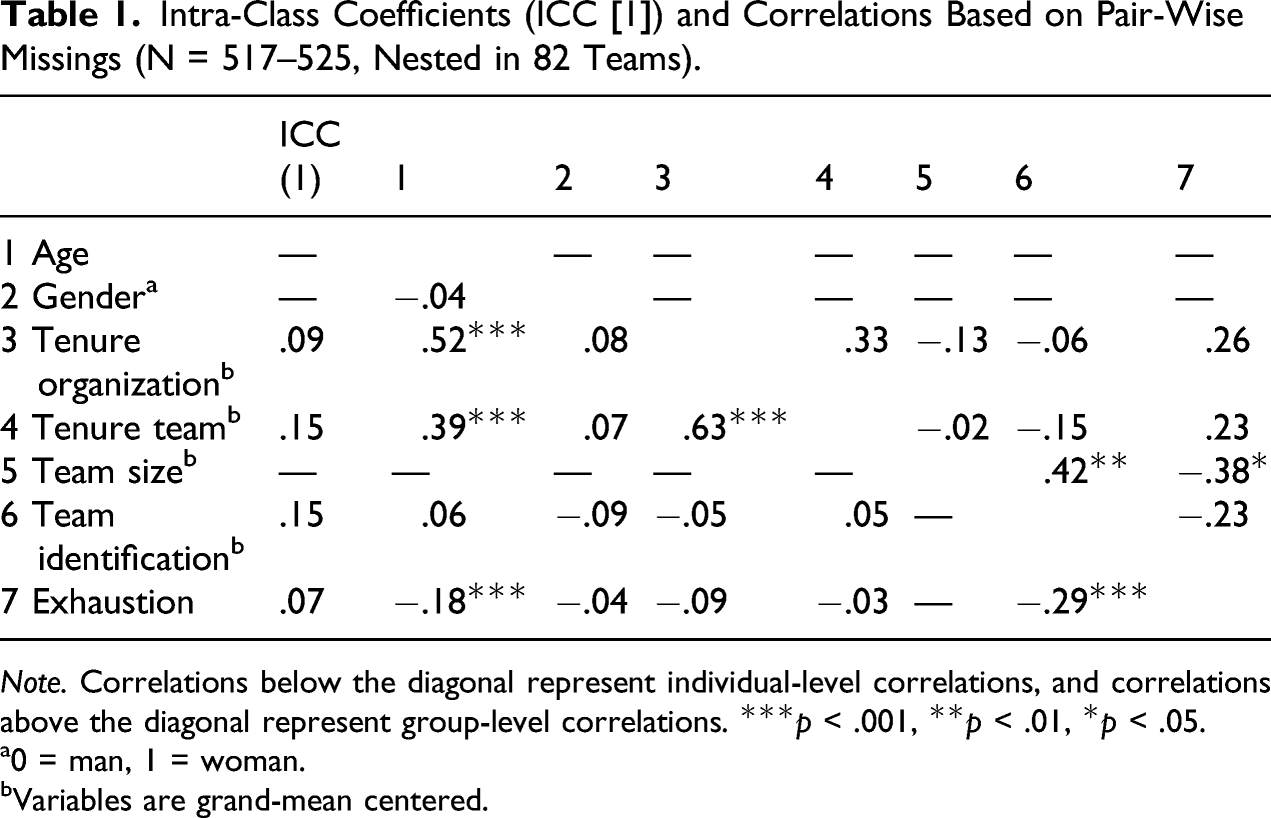
Note. Correlations below the diagonal represent individual-level correlations, and correlations above the diagonal represent group-level correlations. ***p < .001, **p < .01, *p < .05.
a0 = man, 1 = woman.
bVariables are grand-mean centered.
The scatterplot with average TI (group level) on the X-axis and relative TI (individual level) on the Y-axis, as displayed in Figure 1, shows that most data points varied around average levels of TI. If the average TI was low, relative identification varied substantially, including relatively lower and higher identification. There was comparably less variation of relative identification if average TI was high. Scatterplot of average team identification (group level, TB) on the X-axis and relative identification (individual level, TW) on the Y-axis.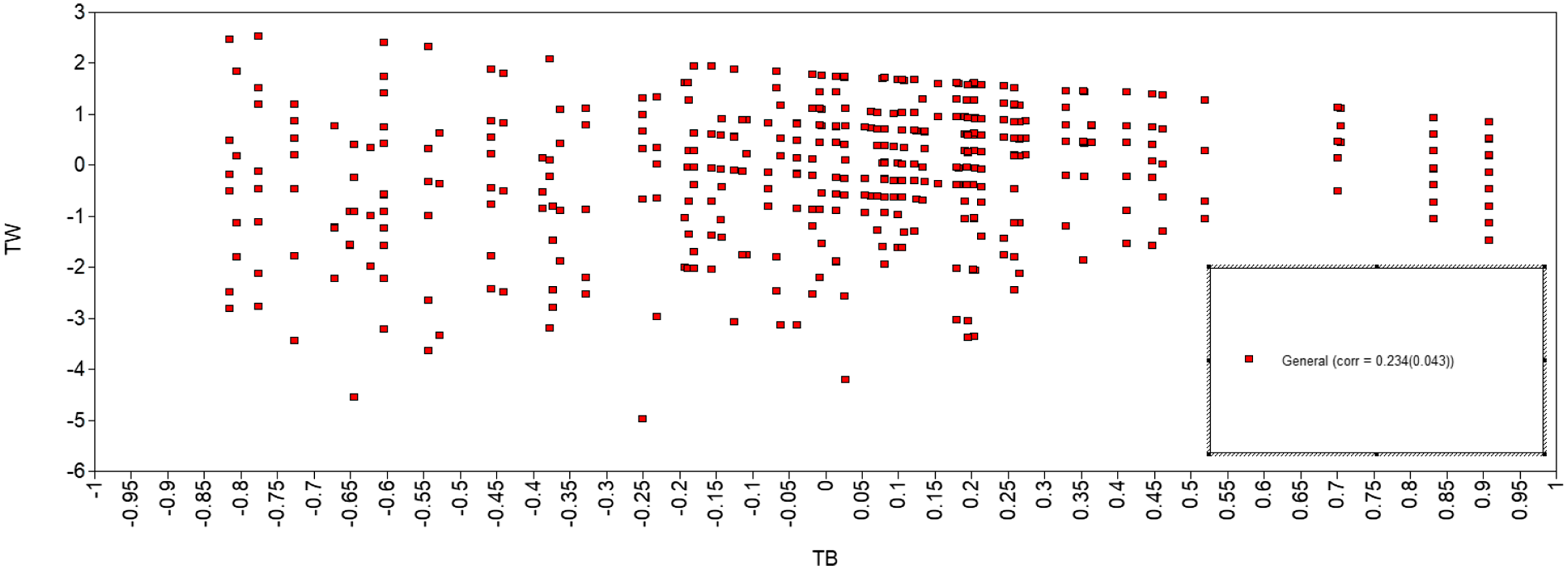
Results of Hypothesis Testing
Cross-Level Polynomial Regression Predicting Exhaustion.
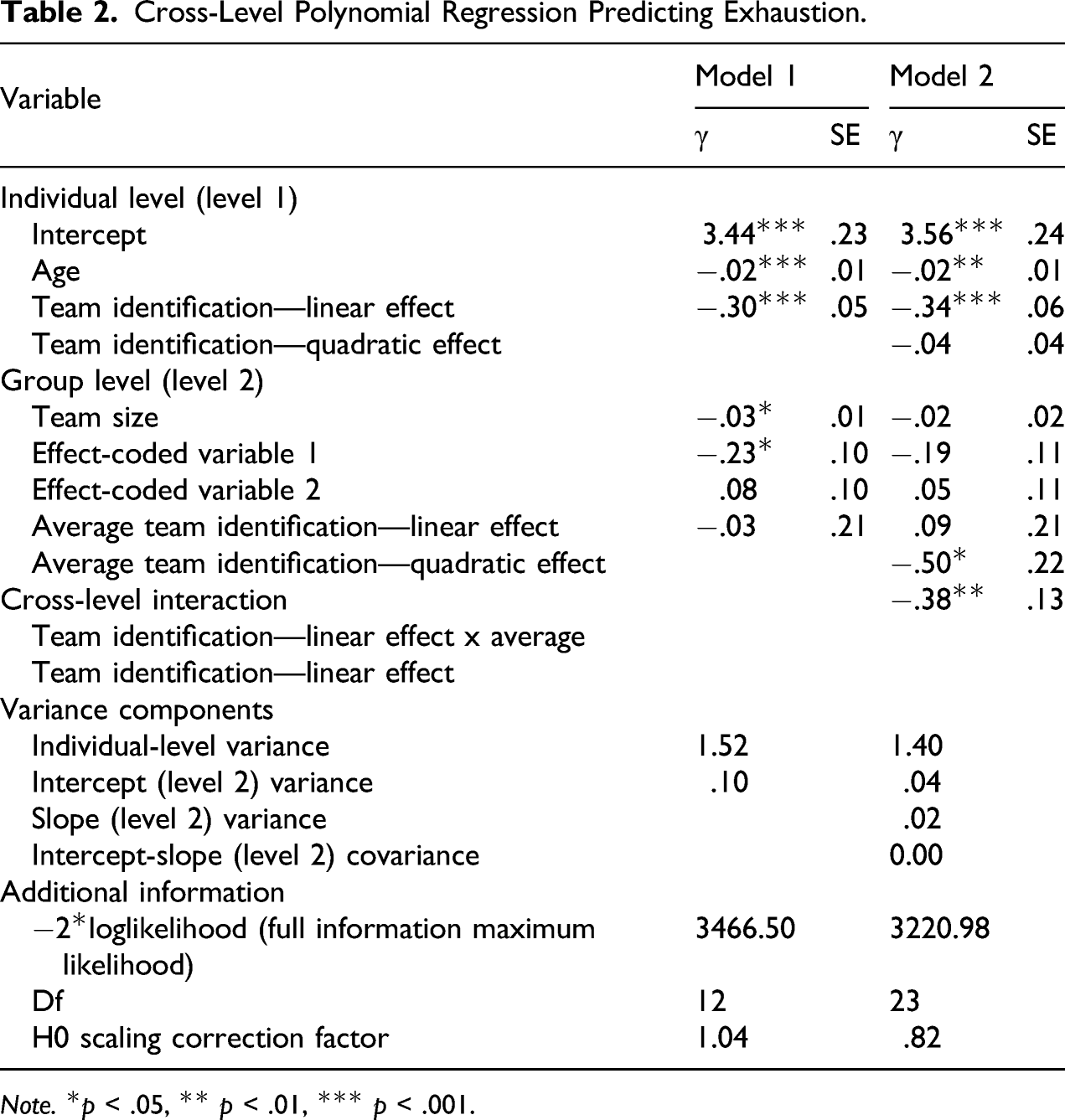
Note. *p < .05, ** p < .01, *** p < .001.
Model 2 in Table 2 and Figure 2 display the results for the polynomial regression analysis. As can be seen, the negative relation between the linear term of relative TI and exhaustion remained significant when including the polynomial terms (γ = −.34, SE = .06, z = −5.51, p < .001, 95% CI [−.47, −.22]). In contrast, the quadratic term of relative TI was not significant (γ = −.04, SE = .04, z = −1.13, p = .257, 95% CI [−.12, .03]). Conversely, the linear term of average TI was not significant (γ = .09, SE = .21, z = .43, p = .669, 95% CI [−.33, .51]), but the quadratic term of average TI was (γ = −.50, SE = .22, z = −2.26, p = .024, 95% CI [−.93, −.07]). As shown in Figure 2, exhaustion was lower if average TI was either low or high compared to moderate. We refer to this unexpected finding in our discussion. Structural and measurement relationships of our final multilevel latent polynomial regression model.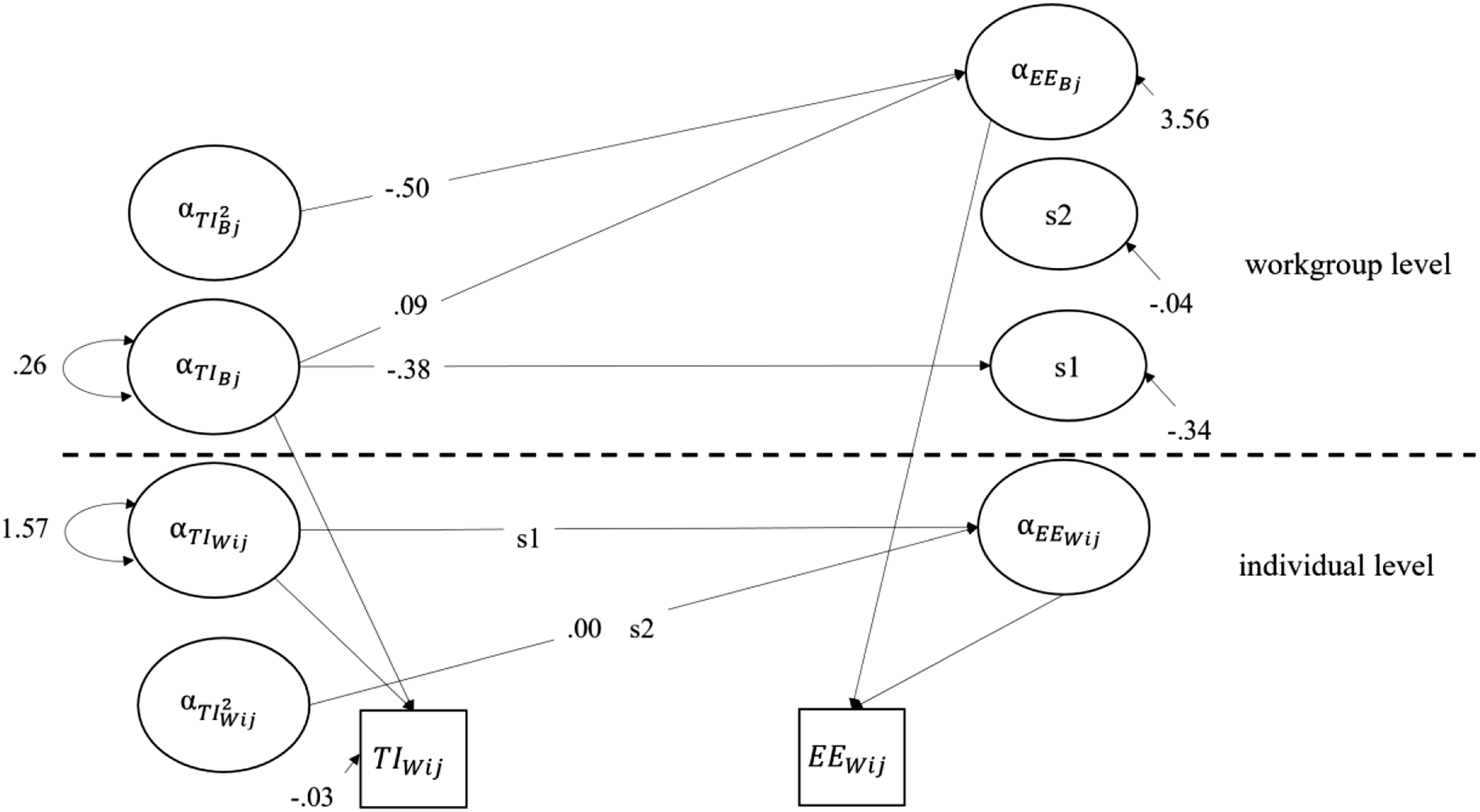
To test Hypothesis 3, which stated that incongruence between the individual’s TI and the average TI would affect exhaustion, we investigated the cross-level interaction effect. This effect was significant and negative (γ = −.38, SE = .13, z = −2.84, p = .004, 95% CI [−.63, −.12]). The response surface plot (see Figure 3) and simple slope analyses both show how the level of average TI moderated the relation between individuals’ relative TI and exhaustion. If average TI was on a moderate level, there was a negative relationship between the individual’s relative TI and reported exhaustion (γ = −.39, SE = .08, z = −4.96, p < .001, 95% CI [−.54, −.23]). Response surface plot of the cross-level moderation of average team identification (X-axis) on the relation between the individuals’ team identification (Y-axis) and exhaustion (Z-axis).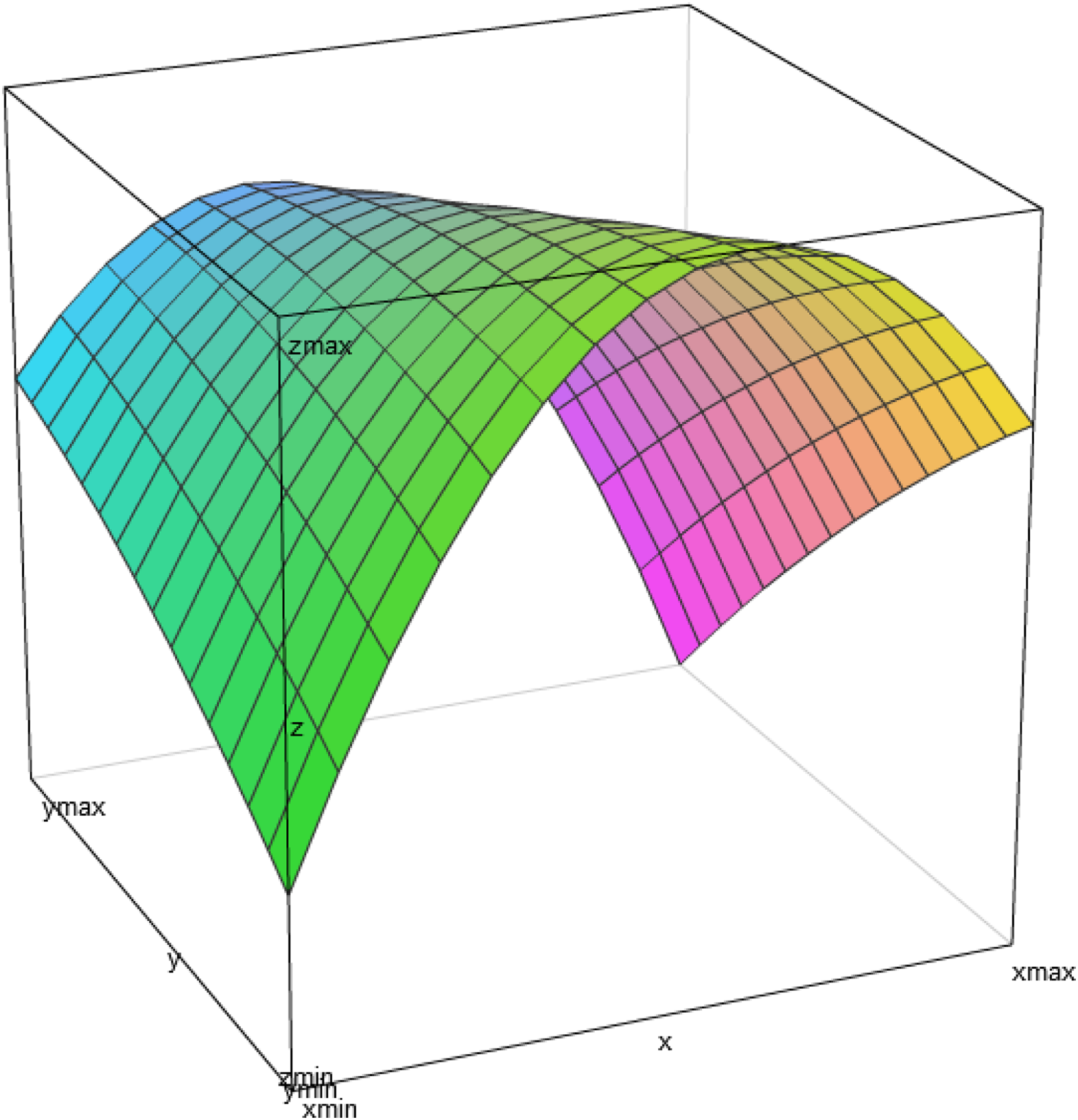
In line with Hypothesis 3, this negative relation became nonsignificant (γ = −.01, SE = .14, z = −.07, p = .944, 95% CI [−.28, .26]), when the level of average TI went down by one unit. That is, individuals who were incongruent in a positive direction did not benefit from their relative to the group average’s stronger TI. Figure 3 indicates that this relation even became marginally positive in those cases where average TI approached zero (γ = .74, SE = .39, z = 1.92, p = .054, 95% CI [−.01, 1.50], when average TI decreased by three units).
Also, in line with Hypothesis 3, when the level of average TI went up by one unit, the negative relation between the individual’s relative TI and exhaustion became stronger (γ = −.76, SE = .17, z = −4.52, p < .001, 95% CI [−1.09, −.43]). This result suggests that an individual’s relative TI was more beneficial the more all team members identified with their team (and, accordingly, a less than average identification was less beneficial).
Robustness Checks
We run two variations of our model to test the robustness of our findings and present the detailed results in Appendix B. In the first model, we included only the two effect-coded variables to control for differences between the three participating organizations. In this model, the quadratic term of relative TI was significant (γ = −.07, SE = .03, z = −2.13, p = .033, 95% CI [−.14, −.01]), suggesting that exhaustion was lower when the individuals relatively identified less or more with their team compared to moderate TI. All other associations did not differ in their interpretation. In the second model, we omitted all control variables. This model could only be run when fixing the residual variance of exhaustion at the group level to zero. In this model, the quadratic term of average TI was only marginally significant (γ = −.31, SE = .18, z = −1.71, p = .088, 95% CI [−.67, .05]), yet all other associations were similar to those reported in the main analyses.
Taken together, these results show that, as predicted, incongruence between individual TI and the average TI significantly related to the individual team member’s exhaustion, whereas congruence did not. There is also some, but less robust, indication of curvilinear associations at the individual and at the group level.
Discussion
Previous research to understand exhaustion as a function of social identity has predominantly focused on the individual (van Dick et al., 2018). As a result, researchers have perceived identifying with different groups as inherently positive and desirable, in ways that have contributed to the recent focus on interventions to increase individuals’ group memberships and their identification with those groups to increase health and well-being (Haslam, Cruwys, Haslam, Dingle, & Chang, 2016). As our theoretical reasoning suggested, the association of individual identification with exhaustion should be considered in relation to the average TI: depending on the average TI within a team, the individual’s relative TI was more or less beneficial. These results provide two important conceptual extensions to this approach.
The first extension concerns the necessity of considering how strongly other team members identify with their team in understanding the consequences of the individual members’ TI (see also Escartín et al., 2013). We found that higher average TI boosted the individual-level effect on exhaustion, but lower average TI eliminated this effect. This finding supports our and others’ (e.g., Haslam & van Dick, 2011; Häusser et al., 2020; Hogg & Terry, 2000) reasoning that social identity processes do not only operate through intraindividual processes but also through interindividual processes, which require a common perception of group membership together with similar values and norms. In particular, this finding provides an important explanation for why researchers could not always show the beneficial effects of social identification on health and well-being (for an overview, see Steffens et al., 2017).
The second extension concerns the need to consider higher-order relationships when studying the consequences of TI. We found a linear relationship between relative TI and exhaustion on the individual level, which replicates previous findings (see Steffens et al., 2017). Although less robust, average TI had an inverted curvilinear, rather than a linear, association with exhaustion at the group level. Follow-up analyses also showed some support for an inverted curvilinear association at the individual level. Curvilinear associations have occasionally been reported before. For instance, Avanzi, van Dick, Fraccaroli, and Sarchielli (2012) found that individuals’ organizational identification was curvilinearly associated with workaholism. In their study, workaholism decreased with higher identification but increased when identification became too strong and, in turn, reduced well-being (see also Avanzi et al., 2020).
Our results call for a more thorough investigation of the different mechanisms associated with the social identity approach and the possibility that it may be more beneficial for individuals to identify with their team at a low level than to identify with this team moderately. Specifically, van Dick and Haslam (2012) proposed that TI would reduce stress via more social support and collective self-efficacy. Häusser et al. (2020) argued that this mechanism should primarily operate at the group level. Building on these propositions, one explanation for the curvilinear relationship at the group level may be that moderate average TI may result in receiving support from some team members but not from others or in receiving support on some days but not on others. Such variation in receiving support across persons or across time renders such supportive behavior less predictable so that the individuals cannot rely on these collective resources, which, in turn, increases their exhaustion. Future research may test this assumption, ideally employing an experience sampling design, which more easily allows detecting fluctuations in peer support in a short time frame.
More generally, our findings further build the case that exhaustion is not only an individual phenomenon but also a social phenomenon (e.g., Bakker et al., 2007a; Maslach et al., 2001). Expanding this view, our results highlight that social factors not only contribute to the development and prevention of exhaustion. Instead, some of these factors might serve as a “cure” or a “curse” depending on the respective context. Following this line of argument, we suggest that researchers jointly assess the role of such social factors. In particular, the more similarities individuals see with their team members, the stronger they identify with their team. In turn, team members who strongly identify with their team are often seen as more representative team members and they interact more with their fellow team members (Ashforth & Mael, 1989; Hogg & Turner, 1985). Yet, similarity, being a representative group member, and more interactions increase the chances that other team members catch these members’ emotions (for an overview, see, e.g., Bakker, Westman, & Schaufeli, 2007b). Taken together, this suggests that emotional contagion may further explain why TI is a mixed blessing in exhaustion.
The interplay between relative TI and average TI in predicting exhaustion also supports the emphasis by Johns (2006) on context when studying organizational behavior. Following up on the present research, we suggest to further study the specific context and team characteristics that increase or decrease the likelihood of finding cross-level interaction effects. For instance, strongly identified team members are more motivated to adhere to group norms, such as supporting each other (for an overview, see Wakefield et al., 2019). However, Uehara (1995) observed that individuals tend to avoid over-benefitting from social interactions. Therefore, team norms for mutual support might ameliorate this cross-level interaction effect in that relative TI might then relate to less exhaustion even if the average TI is at a lower level.
Our results also have practical implications for both individuals and organizations. Employees, especially those with high team identification, should occasionally assess whether their identification with the team is reflected in equivalent levels of their colleagues’ identification. Although such subjective assessments may differ from other team members’ actual team identification, they may serve as first indicators of whether the individual identifies more or less strongly with their team. Organizational interventions, in turn, may focus primarily on fostering team identification among those teams with, on average, low team identification and on those with heterogeneous levels of identification. Supporting supervisors to engage in more activities to increase their team members’ identification may be one promising way to do so (Steffens et al., 2014).
The present study is, of course, not without limitations. Most importantly, we relied on self-reported cross-sectional data to test our hypotheses. We took, however, great care to reduce the risk of common-method variance by, amongst others, assuring participants’ anonymity and using well-validated items (Podsakoff, MacKenzie, Lee, & Podsakoff, 2003). The weak correlations between TI and exhaustion at the individual level and the CFA results further support the assumption that the risk of common-method variance is low and that the focal variables are indeed distinct. In addition, using aggregate measures at the group level further reduced the risk of spurious results. Moreover, and although the causal propositions of the social identity approach have widely been supported, it is still possible that exhaustion may also predict TI in the present sample. That is, employees may reduce their TI because they are exhausted and not vice versa.
Furthermore, we used an aggregate measure of individual team members’ TI to assess group-level TI. However, Bliese, Maltarich, Hendricks, Hofmann, and Adler (2019) recently pointed to the fact that instruments developed to assess individual-level constructs may not adequately differentiate at the group-level. This argument suggests that an aggregate measure of the form used in the present study may underestimate the true effect that group-level TI has on exhaustion. Such aggregate measures depend on each participant’s response and may be biased in the sense that they over- or underestimate true average TI. However, aggregate bias because of missing team member data is neglectable because 94% of the teams included in the analyses have no or only one dropout. Nevertheless, possible aggregate biases emphasize the need to develop specific instruments to assess TI at the group level.
Finally, Mathieu, Aguinis, Culpepper, and Chen (2012) highlighted that studies to detect cross-level interaction effects are often underpowered, which may also apply to the present study. Given the size of the cross-level interaction effect in the present study (0.30), a primary way to increase power would be to sample larger teams (e.g., more than fifteen team members). Although this would have been desirable from a power perspective—more data always are—it was not practically feasible. Furthermore, such large teams might not represent the reality in many organizations, potentially jeopardizing the findings’ generalizability from such an altered research design. A replication of this study’s findings would therefore be a worthwhile endeavor for future research.
To conclude, the present study provides initial evidence for a complex interplay of social identity processes within individuals and in interaction with their team members. Identification unfolds its most positive effects in teams with high average TI, which is a significant contribution to the literature.
Footnotes
Appendix A
Syntax for Latent Multilevel Polynomial Regression Analysis With Team Identification (ID) and Exhaustion (EE) in MPlus
Statements after ‘!’ are comments about input commands and are ignored by MPlus.
Title: Crosslevel polynomial regression;
Data: file is data.dat;
Variable: names are teamsize gruppe1 comp ID1 ID2 ID3 EE1EE2 EE3 EE4 age; Missing = all (−77); ! Arbitrary missing value flag −77
Cluster = gruppe1; USEVAR = teamsize age EE Team g1 g2; between = teamsize g1 g2; ! g1 and g2 are effect-coded variables to control ! for differences between the three organizations
within = age;
DEFINE: EE = MEAN (EE1 EE2 EE3 EE4); ! defines mean for exhaustion
ID = MEAN (ID1 ID2 ID3); ! defines mean for team identification
If (comp EQ 1) then g1 = −1; If (comp EQ 2) then g1 = 1; If (comp EQ 3) then g1 = 0; If (comp EQ 1) then g2 = −1; If (comp EQ 2) then g2 = 0; If (comp EQ 3) then g2 = 1; If (comp EQ _missing) then g1 = _missing; If (comp EQ _missing) then g2 = _missing; ! defines effect-coded variables
center
teamsize ID (grandmean);
ANALYSIS: type = two level random; ! ‘random’ to have the possibility to ! specify latent interactions
algorithm = integration; ! numerical integration is necessary if using latent ! interactions
PROCESSORS=4; ! inserted to speed up processing
INTEGRATION=9; ! inserted to reduce computation burden
MODEL:
%within% ! the within-group model is specified in the following section
Tw by ID@1; ! Create a latent within-group variable that captures virtually ! all the original variance of ID ID@.01; ! puts latent variable ‘behind’ random intercept to allow using ! ‘XWITH’ to form a latent interaction term as follows:
T2w | Tw XWITH Tw; ! Form a latent interaction term that is the square of ! the latent within-group ID variable
EEw by EE @1; ! Create a latent within-group variable that captures virtually ! all the original variance of EE EE@.01; S1 | EEw on Tw; ! Regress outcome variable on the latent within-group ID ! variable with a random slope S1 EEw on T2w@0; S2 | EEw on T2w; ! Regress outcome variable on the latent squared ! within-group ID variable with a random slope S2
EEw on age; ! Regress outcome variable on control variable age
%between% ! the between-group model is specified in the following section
Tb by ID@1; ! Create a latent between-group variable that captures ! virtually all the original variance of ID
ID@.01; ! puts latent variable ‘behind’ random intercept to allow using ! ‘XWITH’ to form a latent interaction term as follows:
T2b | Tb XWITH Tb; ! Form a latent interaction term that is the square of ! the latent between-group ID variable
EEb by EE@1; ! Create a latent between-group variable that captures ! virtually all the original variance of EE
EE@.01; S1 on Tb (b4); ! Regress S1 on Tb forms the cross-level interaction term
[S1] (b2); ! The intercept of the random slope variable S1 is its mean, which is ! the error- corrected average effect of EEw on Tw from the within model
[S2] (b5); ! The intercept of the random slope variable S2 is its mean, which is ! the error-corrected average effect of EEw on T2W from the within model
EEb on Tb (b1) ! Regress outcome variable on the latent between-group ID ! variable
T2b (b3); ! Regress outcome variable on the latent squared between-group ID ! variable
EEb S1 S2 on teamsize g1 g2; ! control for teamsize and organization
Model constraint:
new (ll_glID lo_glID av_glID hi_glID simp_ll simp_lo simp_av simp_hi); ! creates new variables to investigate the cross-level interaction at specific ! values of between-group ID
ll_glID = −3; lo_glID = −1; av_glID = 0; hi_glID = 1; simp_ll = b2 + b5 + b4*ll_glID; ! tests the simple slope at the within-group ! level if between-group ID is −3
simp_lo = b2 + b5 + b4*lo_glID; ! tests the simple slope at the within-group ! level if between-group ID is −1
simp_av = b2 + b5 + b4*av_glID; ! tests the simple slope at the within-group ! level if between-group ID is 0
simp_hi = b2 + b5 + b4*hi_glID; ! tests the simple slope at the within-group ! level if between-group ID is 1
OUTPUT: sampstat tech3;
Appendix B
Results From Robustness Checks. Note. *p < .05, **p < .01; ***p < .001.
Variable
Alternative Model 1
Alternative Model 2
γ
SE
γ
SE
Individual level (level 1)
Intercept
2.88***
.10
2.78***
.13
Team identification—linear effect
−.38***
.05
−.37***
.05
Team identification—quadratic effect
−.07*
.03
−.05
.03
Group level (level 2)
Effect-coded variable 1
−.20
.12
Effect-coded variable 2
.05
.11
Average team identification—linear effect
−.11
.17
−.04
.18
Average team identification—quadratic effect
−.65**
.20
−.31
.18
Cross-level interaction
Team identification—linear effect x average
−.33**
.11
−.28**
.09
Team identification—linear effect
Variance components
Individual-level variance
1.43
1.52
Intercept (level 2) variance
.08
.00
Slope (level 2) variance
.02
.01
Intercept-slope (level 2) covariance
.00
.00
Additional information
−2*loglikelihood (full information maximum likelihood)
3255.30
8584.56
Df
19
12
H0 scaling correction factor
.85
1.49
Acknowledgments
We thank Alex Haslam, our Associate Editor Thomas Zagenczyk and two anonymous reviewers for their valuable feedback on an earlier version of this manuscript.
Declaration of Conflicting Interests
The author(s) declared no potential conflicts of interest with respect to the research, authorship, and/or publication of this article.
Funding
The author(s) disclosed receipt of the following financial support for the research, authorship, and/or publication of this article: This research was partially funded by a grant from the German Research Foundation (HA 6455/4-1 and DI 848/15-1) awarded to the first three authors and by a grant from the Swiss National Science Foundation (13DPD3-124662/1) awarded to the fourth author.

Notes
Associate Editor: Thomas J. Zagenczyk