




Abstract
Prior literature paints an incoherent picture on the relationship between team diversity and performance. The current article investigates circumstances under which demographic diversity (gender and nationality) facilitates performance. Based on the categorization–elaboration model, we build a theoretical framework to demonstrate the crucial role of team learning and efficacy as mediators, and team identification as a moderator to understand how and when demographic diversity facilitates team performance. In a cross-sectional study among 72 project teams, data were collected from multiple sources (self-reports, database, and performance assessments) to obtain objective and subjective indices of team diversity and performance. Results from a multigroup structural equation model showed that team diversity facilitated performance for teams with a strong, but not a weak, collective team identity. Second, team diversity facilitated performance through increased team learning and team efficacy only for teams with a strong team identity. Finally, multisource data revealed a different pattern of results for objective and subjective measures. The objective diversity index seemed a more powerful predictor of performance compared with the subjective index, particularly for strongly identifying teams. These findings provide valuable insight for increasingly diversifying organizations, on the circumstances under which team diversity’s potential flourishes. Moreover, it underlines the importance of data triangulation as objective and subjective measures of diversity are conceptually different and show incoherent empirical findings in the diversity–performance link across extant literature.
To deal with globalizing markets and rapid technological innovations, work is increasingly organized in teams. Teams have the potential to form flexible and creative working units set out to perform complex and dynamic tasks (Ilgen, Hollenbeck, Johnson, & Jundt, 2005). At the same time, demographic changes have led to an increasingly heterogeneous workforce, resulting in a greater diversity in, for example, gender, nationality, and ethnicity in work teams. In theory, such team diversity has the potential to foster performance through the various perspectives, knowledge, and expertise that members from different backgrounds bring to the team. In reality, however, profiting from diversity’s potential is highly challenging.
In the last 50 years, research on the team diversity–performance link has shown inconsistent results, with the effects being either negative, neutral, or positive across different types of contexts, types of diversity, and types of performance outcomes (e.g., Joshi & Roh, 2007; Van Dijk, Van Engen, & Van Knippenberg, 2012; Van Knippenberg & Schippers, 2007; Williams & O’Reilly, 1998). Theoretical perspectives have also been divided with on one hand the social categorization and on the other the information-elaboration perspective. Social categorization explains negative effects of team diversity because it posits that dissimilarity between people activates the tendency to categorize similar others into ingroups “us” and dissimilar others into outgroups “them” (Turner, Hogg, Oakes, Reicher, & Wetherell, 1987). This social categorization process may in turn evoke intergroup bias (i.e., negative affective reactions and evaluations toward dissimilar others) and conflict among team members. In contrast, the information-elaboration perspective explains positive effects of team diversity because it posits that diverse teams possess a broad range of relevant knowledge, skills, and perspectives that evoke team elaboration—the exchange, discussion, and integration and generation of information and perspectives among team members.
Reconciling these two perspectives in one theoretical model, Van Knippenberg and colleagues introduced the categorization–elaboration model (CEM; Van Knippenberg, De Dreu, & Homan, 2004). In this model, the social categorization and elaboration perspective are integrated as two “routes” that interact with each other to explain the team diversity–performance link. Specifically, CEM suggests that—in principle—all diverse teams have a higher propensity to perform better than homogeneous teams through the process of information elaboration. Yet if this process is undermined because social-categorization–based intergroup biases are activated, diversity will hamper performance. In recent years, this model has formed the springboard for diversity research that has moved away from studying main effects and shifted its focus on mediators to explain how diversity enhances performance and contingency factors that shed light on when diversity enhances performance (Guillaume, Dawson, Otaye-Ebede, Woods, & West, 2015; Van Knippenberg & Mell, 2016). In the current work, we build on this trend and identify both mediating mechanisms and moderating contingency factors to explain positive effects of demographic diversity.
Our first aim is to focus on mediating processes that may explain how team diversity translates into performance. Here, we integrate knowledge from team learning literature (Bell, Kozlowski, & Blawath, 2012; Decuyper, Dochy, & Van den Bossche, 2010; Edmondson, Dillon, & Roloff, 2007) to provide deeper insight in the workings of elaborative processes proposed in CEM (Homan et al., 2008; Homan, Van Knippenberg, van Kleef, & De Dreu, 2007; Kearney & Gebert, 2009). Both team learning models and CEM share the notion that teams must go through a process of sharing, critically evaluating and combining differential perspectives and knowledge to reach enhanced performance. Despite this conceptual similarity, work on team diversity and elaboration that integrates team learning is scarce (see Tekleab, Karaca, Quigley, & Tsang, 2016; Van der Vegt & Bunderson, 2005, for exceptions). In this study, we aim to demonstrate that team learning and efficacy may be two important elaborative processes that mediate the team diversity–performance link.
Our second aim is to focus on moderators that explain when team diversity leads to performance. To date, the vast majority of empirical studies focus on external contingency factors such as organizational strategy (e.g., management style, organizational climate) or task design (e.g., task complexity, routine; Guillaume et al., 2015). In the present study, we emphasize the importance of internal group dynamics in the team, and study how team performance in diverse teams is contingent upon the quality of the internal “team spirit”—the level of collective team identification. Research on team identification as a contingency factor is scarce (see Van der Vegt & Bunderson, 2005, for an exception), particularly in relation to demographic diversity. Based on CEM, we aim to demonstrate that a strong team identity is an important precondition for demographic diversity’s potential to flourish.
Our third aim is to take a multisource approach, and measure team diversity in a subjective and objective manner to investigate their interrelatedness. Most studies on team diversity have focused on objective diversity indices—the actual differences that exist between team members (Harrison & Klein, 2007). However, this trend is challenged by an upcoming line of research focusing on the effects of perceived diversity—the subjective experience of diversity (Shemla, Meyer, Greer, & Jehn, 2016). The argument for this is that people react on the basis of perception rather than reality, and thus subjective diversity should have more explanatory power over objective diversity (Hobman, Bordia, & Gallois, 2003). In the current work, we include both objective and subjective diversity indices because in our view, only the combination enables us to discern whether the effects of team diversity on performance should be attributed to team members’ subjective experience of demographic differences, to the actual differences, or to both. In this research, demographic team diversity pertains to gender and nationality, as both are prevalent and relevant in our study context (see “The Current Study”). In Figure 1, our conceptual model is displayed. Below we will outline our theoretical framework and hypotheses further.
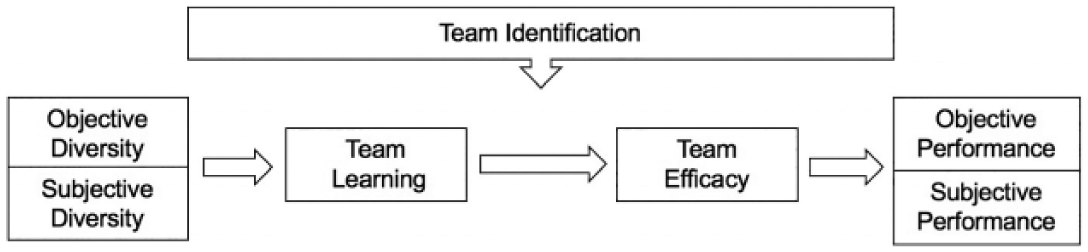
Conceptual model of the relationship between (objective and subjective) demographic diversity on (objective and subjective) team performance via team learning and efficacy, contingent upon team identity strength.
Theoretical Framework and Hypotheses
How Diversity Leads to Performance: Team Learning and Efficacy
Based on the work on CEM (Van Knippenberg et al., 2004) and team learning models (Decuyper et al., 2010; Edmondson et al., 2007), we posit that team learning and team efficacy may form key mediators in the team diversity–performance link. Following CEM, more diversity among team members brings a larger and more varied pool of information, knowledge, and perspectives in the team (Van Knippenberg et al., 2004). Such informational richness offers a springboard for elaborative processing in teams—the process in which different views and knowledge of diverse team members are shared, constructively debated, and integrated in the context of the team’s tasks and goals (Van Knippenberg & Schippers, 2007). Empirical support for CEM’s elaboration was found in work demonstrating that teams profit from the benefits associated with team diversity to the extent that they succeed in activating elaborative processes (e.g., Homan et al., 2008; Homan et al., 2007).
Equivalent to CEM’s elaboration, team learning can be defined as the process in which team members engage in activities to acquire, share, reflect, or combine knowledge and perspectives through interaction with each other (Edmondson, 1999). Empirical work on team learning shares the finding with work on CEM that learning forms an important prerequisite for high team performance (Edmondson, 1999; Oertel & Antoni, 2015; Santos, Uitdewilligen, & Passos, 2015; Van den Bossche, Gijselaers, Segers, & Kirschner, 2006). Moreover, there is some empirical evidence showing that team learning mediates the relationship between team diversity and performance (Tekleab et al., 2016; Van der Vegt & Bunderson, 2005). Team learning thus may be an important elaborative process through which team diversity translates in higher performance.
Thus far, however, most research on team learning has focused on expertise or function-level diversity. Indeed, such deep-level diversity (i.e., diversity in less observable attributes such as expertise, function, or ability) can be expected to foster learning because members with different expertise will likely offer the type of knowledge and skill that is directly relevant to the team tasks. Despite the fact that demographic diversity might not seem directly task-relevant, following CEM we argue that demographic diversity can also evoke team learning. Specifically, people with different backgrounds (e.g., in nationality or gender) have different perspectives and knowledge that can be discussed and integrated during team collaboration (Van Knippenberg et al., 2004). In fact, there is research that demonstrates that when demographic diversity is high, the visibility of differences between team members on the surface-level creates the expectation that team members are likely to be different from each other in their knowledge and opinions (Rink & Ellemers, 2006). The mere expectation of others being different may already set the stage to engage more actively in information sharing and discussion (Loyd, Wang, Phillips, & Lount, 2013). In contrast, when team members see that everyone is similar on the surface, they expect to be like-minded and may “skip” learning processes to find out more about other’s perspectives and opinions. In line with this reasoning, there is initial research demonstrating a positive link between surface-level diversity and information elaboration (Harvey, 2015).
In addition, models on team learning may further inform us about the critical step of how elaborative processes translate into higher performance. That is, CEM suggests a direct relationship between elaboration and performance. However, the team learning literature suggests that the process through which team members transfer their shared collective knowledge repository into high-quality performance is multistaged and that it is important to make a distinction between team processes and emergent states (Bell et al., 2012). Team processes, such as team learning, are the action-oriented team behaviors that indicate how the team will work on its tasks. Team emergent states are cognitive or motivational states that emerge from the team learning processes and form the psychological mind-set for teams to perform well (McIntyre & Salas, 1995). In the current work, we focus on team efficacy—that is, the collective belief that the team is effective in completing its task—as a relevant emergent state to explain how demographic diversity may translate into performance.
Teams only profit from their learning if, in the end, team members perceive that the content of what is learned clearly contributes to the teams’ product (Edmondson et al., 2007). Learning should be steered toward the team tasks or goals in order for it to translate into higher performance. Therefore, following the work by Bell and colleagues (2012), we assume that team learning translates into performance, only to the extent that team efficacy follows from the interactions inherent in team learning. Team efficacy influences the choices teams make, how much effort is devoted to the team tasks, and how persistent a team is when it faces difficulty or failure (Bandura, 1997). As teams learn, they build a shared knowledge repository that can contribute to a team’s efficacy in the sense that teams build a collective belief that the efforts invested in team learning will be, and can be, successfully incorporated in the team product. Thus, in order for diverse teams to profit from their learning, team efficacy is likely an important mediator. Taken together, we formulate the following first hypothesis:
When Diversity Leads to Performance: Collective Team Identification
It is important to note that more diversity in the backgrounds of team members does not “automatically” translate into more team learning and higher performance. Profiting from informational richness in diverse teams requires effort. Different views and knowledge of diverse team members must be actively shared, constructively debated, and integrated in the context of the team tasks and goals (Van Knippenberg et al., 2004; Van Knippenberg & Schippers, 2007). Therefore, team members must be aware of the potential benefits of diversity and be motivated to exchange and integrate all the information and different perspectives (van Ginkel & van Knippenberg, 2008). To this end, it is important to understand the moderating factors that determine when team diversity positively contributes to team learning and performance outcomes.
According to CEM, one such factor is that diversity may provoke social categorization—the process in which team members differentiate between members who are similar (“us”; ingroup) and dissimilar (“them; outgroup”) to the self (Turner et al., 1987). Social categorization may lead to intergroup bias, and hence disrupt team elaborative processes and enhanced performance from taking place. Indeed, intergroup bias leads to a “closing of the mind,” because it activates heuristic (reliance on stereotypes) rather than deep-level information processing, it enhances identity threat, and it reduces the willingness to trust and confide in others in personal knowledge and perspectives (Van Knippenberg & Schippers, 2007). To this end, contingencies that prevent social categorization from turning into intergroup biases will yield positive effects of team diversity (Van Knippenberg et al., 2004). In the current work, we aim to show that collective team identification is such a contingency factor. We argue that in diverse teams, a strong collective team identity shields the team against potential ramifications of social categorization and offers the “team spirit” that allows diversity’s potential to flourish.
Collective team identification can be defined as the affective significance that members of a team attach to their team membership (Ellemers, Kortekaas, & Ouwerkerk, 1999). Identification refers to seeing the self in terms of “we” rather than “I.” In social identity theory (Tajfel & Turner, 1979) research, identification is mostly understood as an individual-level construct (i.e., the individual self-definition in terms of group membership). Yet there are also clear indications that identification can be construed as a collectively shared state (i.e., a shared sense of “we-ness”), and that through team interaction and shared experience, identification is reinforced on the collective level (Smith & Postmes, 2011). Therefore, we conceptualize team identification on the collective level (see also Dietz, Van Knippenberg, Hirst, & Restubog, 2015; Van der Vegt & Bunderson, 2005).
According to the common ingroup identity model, a strong collective ingroup identity mitigates potentially negative effects of social categorization in diverse teams by reducing the focus from negatively evaluating “dissimilar” others, and emphasizing an inclusive, shared collective identity instead (Gaertner & Dovidio, 2012; Homan et al., 2008). In this way, rather than forming a source of division and threat, differences between group members come to define a team identity (Jetten, Postmes, & McAuliffe, 2002). In support of this, empirical research showed that a strong collective identity orients team members toward collective (rather than individual) goal pursuit (Dietz et al., 2015), generates more cooperative working behaviors (Eckel & Grossman, 2005), and motivates members to act on behalf of their shared group membership (Bergami & Bagozzi, 2000). A strong collective identity allows a team to become “more than the sum of its parts.” Thus, we assume that in diverse teams, a strong team identity motivates team members to invest in the collective, and hence advances team performance outcomes. Therefore, we hypothesize that
Finally, considering Hypotheses 1 and 2 together, we posit that the indirect effect of diversity on team performance via team learning and efficacy as a whole is conditional on collective team identification, suggesting a multigroup mediation model among the study variables (Figure 1). There is some indirect support for the crucial role of identification in both steps of this hypothesized path model. First, in prior work on moderating effects of variables that mitigate identity threats in diverse teams, it was shown that factors such as learning orientation (Nederveen Pieterse, Van Knippenberg, & Van Dierendonck, 2013), perceived value in diversity (Homan et al., 2007), and open-mindedness (Nakui, Paulus, & van Oudenhoven-van der Zee, 2011) moderate the relationship between diversity and team elaborative processes. This work suggests that in diverse teams, members’ willingness to learn from others’ divergent knowledge and perspectives is contingent upon their motivation to have an open attitude toward “those who are different.” In a similar vein, in a team with a strong collective identity, diverse team members feel a sense of “we-ness.” Rather than feeling threatened by other—different—team members, diversity in teams with a strong identity is seen as an asset and there is a strong willingness to invest in the collective (Jetten et al., 2002). This allows team members to be open and rely on deep-level information processing (rather than stereotypes and heuristics) when interacting with others who are different from the self (Van Knippenberg et al., 2004). Indeed, van der Vegt and Bunderson (2005) provided first empirical evidence for the moderating role of team identification on the relationship between expertise diversity and team learning and performance. Following CEM, similar results can be expected for demographic diversity.
Second, with respect to team efficacy, a meta-analysis revealed that the extent to which team efficacy leads to higher performance depends on the level of team interdependence (Gully, Incalcaterra, Joshi, & Beaubien, 2002). This supports the idea that the more team members perceive that their goals, tasks, and outcomes are contingent upon a sense of “sharedness,” the more team efficacy will result in positive outcomes. Therefore, it can be argued that when there is a strong collective team identity in a diverse team, all “eyes are on the same price”; there is a joint belief in the team’s capacity that steers the team toward higher performance outcomes. In teams with a weak collective identity, different team members may hold a different notion of what it takes to perform well, which ultimately does not benefit team performance. Taken together, prior research suggests that there are different possible moments in the mediated chain where team identification may moderate the indirect relationship between team diversity and performance via team learning and efficacy. Based on this, we formulate the overall hypothesis that
A Multisource Approach: Objective and Subjective Indices of Diversity and Performance
Apart from CEM’s focus on team process and contingency factors to understand how and when diversity translates into higher performance, another way to understand differential effects of team diversity on performance is by distinguishing between objective and subjective indices (Van Dijk, Meyer, van Engen, & Loyd, 2017). Indeed, in their seminal review, Van Knippenberg and Schippers (2007) defined diversity as a characteristic of a social grouping (i.e., group, organization, society) that reflects the degree to which there are objective or subjective differences between people within the group (without presuming that group members are necessarily aware of objective differences or that subjective differences are strongly related to more objective differences). (p. 519)
Thus far, such explicit distinction between objective and subjective diversity indices in one research design is rare (see Harrison, Price, Gavin, & Florey, 2002; Zellmer-Bruhn, Maloney, Bhappu, & Salvador, 2008, for exceptions). What’s more, the effects of both objective and subjective diversity on team performance are inconsistent across the literature (Joshi & Roh, 2007; Shemla et al., 2016), and how or when these inconsistencies emerge is still largely unclear. To provide further insight in the conceptualization of objective and subjective indices of demographic diversity and explain how they may have a differential impact on team learning and performance, we rely on self-categorization and social identity theory and the distinction they make between three processes through which diversity becomes salient or relevant: comparative fit, cognitive accessibility, and normative fit (Tajfel & Turner, 1979; Turner et al., 1987).
First, comparative fit is the extent to which social categories yield high within-category similarity and high between-category differences (Turner et al., 1987). When diversity is conceptualized as a division in subgroups, it maximizes comparative fit (e.g., objective faultline indices, Lau & Murnighan, 1998; or scales assessing subjective subgroup diversity, Greer & Jehn, 2007) and generally shows negative effects on team outcomes. When diversity is conceptualized as heterogeneity, it emphasizes differences between individual members rather than subgroups, and thus minimizes comparative fit. Heterogeneity is therefore more often (but not always) associated with positive team outcomes (Harrison & Klein, 2007; Shemla et al., 2016). We follow CEM and conceive of both objective and subjective diversity as heterogeneity. To measure this, we use Blau’s objective heterogeneity index (Blau, 1977), and a subjective team heterogeneity measure (see also Nederveen Pieterse et al., 2013; Tekleab et al., 2016; Van Dick, van Knippenberg, Hägele, Guillaume, & Brodbeck, 2008; Venturini, Mosso, & Bellotto, 2015). Second, demographic diversity (e.g., gender, nationality) is a form of surface-level diversity, which indicates high cognitive accessibility because of the ease with which these social categories are activated (Stangor, Lynch, Duan, & Glas, 1992). This cognitive accessibility might render objective and subjective indices of demographic diversity to be aligned because “what you see is what you get” (Harrison et al., 2002; Zellmer-Bruhn et al., 2008).
Third, whether people also need to be aware of demographic diversity (i.e., subjective) or whether its mere presence (i.e., objective) is sufficient to be relevant for team processes, is a question referring to normative fit. On the one hand, there is research suggesting that team members’ subjective experience of diversity is more predictive of team outcomes because diversity needs to be perceived as meaningful for it to beneficial to the team tasks (Hobman et al., 2003). On the other hand, there is research suggesting that the mere presence of objective demographic differences is most important because objective differences unconsciously change the group dynamic such that more time and energy is devoted to understanding each other’s viewpoints (cf. Rink & Ellemers, 2006). To this end, whether objective, subjective, or both indices of demographic team diversity are important for team learning and performance remains an empirical question.
On a final note, similar to team diversity indices, a large variety of measures on team performance exist, and it depends on the team context and goals what performance measure is most relevant (Horwitz & Horwitz, 2007). Scholars have generally recommended combining objective and subjective team performance indicators to provide fine-grained insight in the effect of team diversity on performance (Mathieu, Maynard, Rapp, & Gilson, 2008) and to avoid common-method bias (Podsakoff, MacKenzie, Lee, & Podsakoff, 2003). As with team diversity, objective and subjective team performance indicators may not necessarily be aligned or be predicted by team variables in similar fashion. For example, team members may experience that their team performance is “high,” yet this does not necessarily mean that actual performance ratings are also high (i.e., it could be “misperception”), and this effect might also be contingent upon a team’s identity strength.
Taken together, to our knowledge, this is one of the first studies to model both objective and subjective diversity as predictors of objective and subjective performance. Considering the novel character of the research design and the fact that we factor in objective and subjective performance indices, we formulate the exploratory two-sided hypothesis that
The Current Study
In the current study, we investigate the impact of team diversity (gender and nationality) on team learning and performance. To test our predictions, research was set out among project teams in a Dutch undergraduate psychology program. Diversity in gender and nationality are prevalent among psychology students in this context. Gender is salient because men make up only 29% of the population of psychology students in this program. Nationality is salient because even though our data were collected at a Dutch university, the majority (61%) of students in this psychology program is German. 1 The German students at this university follow their own introduction and language program before the start of the first year, separate from the Dutch program. Therefore, these two nationalities are socialized quite separately on campus and are salient among the students.
Method
Sample and Data Collection
The University recently introduced problem-based learning in project teams explicitly with the aim to prepare students for teamwork in present-day organizations. Team size varied between three and six members, and allocation to the teams was random. Project teams were responsible for delivering a joint product within 4 months’ time. Students were required to interact frequently, share information, and coordinate their actions to perform well. This project-based teamwork strongly resembles self-directed teamwork, which is highly popular in nowadays professional contexts. Data were collected via different sources. Objective diversity indices were calculated based on demographic data obtained from admission records in the Psychology program. Objective team performance ratings were based on an external grading system, and executed by expert supervisors using a priori determined assessment criteria and scoring forms. All subjective and team process variables were based on self-report measures, via a survey. During one of the theory lectures, students were informed that this study was about perceptions on effective teamwork among students in the new educational setup of the bachelor’s program. After filling out an informed consent form, students filled out the survey. Students received study credits in return for their efforts. It took about 10 min to complete the survey. Participation was voluntarily and the data were collected with approval from the ethics committee of the University.
To obtain sufficient power to test our model predictions at the team level, data were collected in the study program for 3 subsequent study years. Data collection started 4 weeks after the start of the project, to make sure that the socialization period was completed and that teams were actually actively engaged in the project tasks (the total duration of the project was 10 weeks). The questionnaire was online for 3 weeks. Thus, data collection stopped before the deadline of the team product so that the final grade on the project work could not affect responses. In total, 238 team members filled out the survey. Six participants were eliminated from the data set due to substantial missing data (i.e., missing data on one or more entire model variables). The number of remaining participants per team varied between one and six. In total, we collected data from 88 teams. As we focus on team-level properties, we only included teams with two or more respondents (see also Oertel & Antoni, 2015; Zellmer-Bruhn et al., 2008). This led to a minimum representation rate of .33 and a maximum of 1 (full representation). The average representation rate was M = .57, SD = 0.18). In total, responses from 216 students in 72 module teams were included. The mean age was Mage = 20.05 (SD = 2.63) and 170 were female (78%). Most participants were German 121 (56%), 92 (43%) were Dutch, and 3 (1%) had a nationality other than German or Dutch.
Measures
In Table 1, the Cronbach’s alpha for self-reported variables are depicted; the reliability of all variables was high (≥.80).
Variable Characteristics.
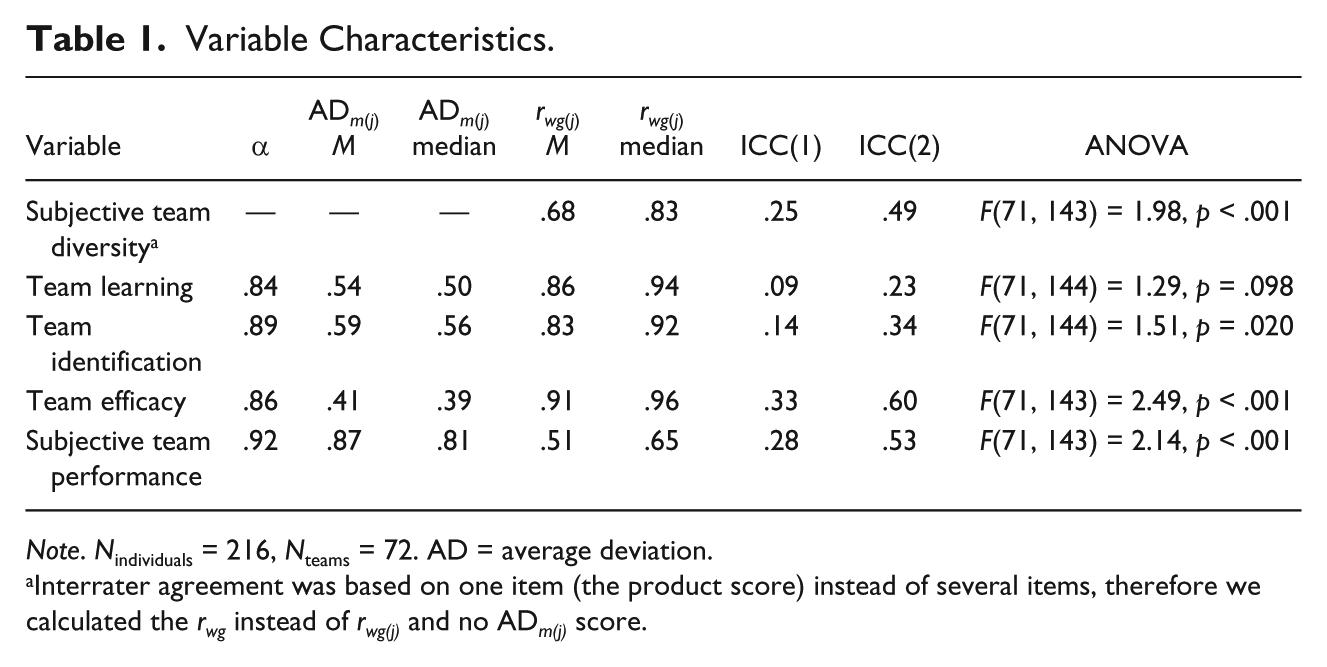
Note. Nindividuals = 216, Nteams = 72. AD = average deviation.
Interrater agreement was based on one item (the product score) instead of several items, therefore we calculated the rwg instead of rwg(j) and no AD m(j) score.
Objective diversity
To calculate objective demographic diversity, we used Blau’s heterogeneity index. The Blau index is calculated as 1 minus the sum of the squared proportions of people in each category. Scores range from 0 to 1, where 0 means that everyone within the team belongs to the same category. Maximum heterogeneity is achieved when there is an equal distribution within each possible category. To create a diversity index based on multiple demographic attributes, we followed recommendations by Harrison and Klein (2007) and calculated a Blau index from the combined number of categories a team could potentially have, based on gender and nationality.
Subjective diversity
To assess subjective demographic diversity based on gender and nationality, we used two items asking participants, “To what extent do you perceive your team members to be different from each other in terms of [gender/nationality]?” on a 5-point Likert-type scale (1 = very similar, 5 = very different). To create a subjective diversity measure, we calculated the product term of both (Harrison et al., 2002).
Team learning
The items to measure team learning focused specifically on those aspects of team learning that were related to learning about the team’s tasks and work processes (Jehn & Rupert, 2007). Factor analysis demonstrated that task and process learning collapsed into one factor. We constructed a scale called team learning consisting of seven items (e.g., As a team, we learn more about the tasks by sharing task-related knowledge). All team learning items were rated on a 5-point Likert-type scale (1 = not at all, 5 = completely).
Objective team performance
Several supervisors assessed the quality of the final team product of all project teams using a standardized assessment form. In the assessment form, 70% of the grade was determined by the quality of the content of the project deliverables, 20% the quality of the written report, and 10% the professional work attitude. The grade could range from 1 (bad) to 10 (excellent).
Subjective team performance
To measure subjective team performance, we adapted Hackman’s (1987) team effectiveness scale. The scale consisted of nine items on which the team members could give a grade to the performance of the team on a scale ranging from 1 (bad) to 10 (excellent). Performance topics included quality of work, realizing deadlines, efficiency of mutual cooperation, and the overall level of performance and were comparable with the objective performance criteria. Factor analyses demonstrated that the subjective performance scale consisted of one factor.
Collective team identification
Collective team identification was measured with eight items (Ellemers et al., 1999; for example, I feel a bond with my project team), on a 5-point Likert-type scale (1 = not at all, 5 = completely).
Collective team efficacy
Team efficacy was measured with five items, based on a scale adapted from Moolenaar, Sleegers, and Daly (2012; for example, My project team has confidence in itself) on a 5-point Likert-type scale (1 = not at all, 5 = completely).
Data Aggregation
Individual responses about the team were aggregated to the team level. We inspected several indices to justify aggregation (Table 1). As can be noted, particularly for the team learning variable, the ICC2 was below the commonly advised threshold (ICC1 > .10, ICC2 > .50; Bliese, 2000). Yet according to LeBreton and Senter (2007), low interrater reliability does not necessarily imply low interrater agreement. Particularly, ICC2 values are highly sensitive to small team size, such as is the case in our small project teams. To this end, we relied on interrater agreement rwg(j) indicators (James, Demaree, & Wolf, 1984), and average deviation (AD) indices (Burke, Finkelstein, & Dusig, 1999) as well to justify aggregation. Table 1 shows that for all variables, mean interrater agreement was moderate, rwg(j) = .51-.70, to strong, rwg(j) > .70 (LeBreton & Senter, 2007). Moreover, AD indices were below the recommended AD thresholds (smaller than number of response categories divided by 6; Burke et al., 1999). Therefore, given the small team sizes in this context, aggregation was justified.
Analytic Strategy
First, the hypothesized relationships among variables were tested with structural equation modeling (SEM), using the computer program AMOS, to obtain maximum likelihood estimates with robust standard errors and a robust chi-square measure of overall goodness of fit. In contrast to linear regression analyses, SEM allows for modeling relationships among multiple independent, process, and dependent variables while also investigating their interrelatedness (Hayes, Montoya, & Rockwood, 2017). Thus, SEM is able to provide a complete picture of our hypothesized model rather than offering a piecemeal approach. This does more justice to the complex nature of the current theory formation and practice on objective and subjective team diversity and performance (see also Pek & Hoyle, 2016). The fit of an SEM model is considered good when the root mean square error of approximation (RMSEA) and the standardized root mean square residual (SRMR) are ≤.06 and the comparative fit index (CFI) and the Tucker–Lewis index (TLI) are ≥.95. We also report the χ2 to enable model comparisons (Hu & Bentler, 1999; Kline, 2016). Akaike’s information criterion (AIC) is used to compare nonnested models (Muthen & Muthen, 1998-2012). Study year was included as a covariate as we collected data in three subsequent study years (see also Zellmer-Bruhn et al., 2008). 2
Second, to investigate whether the hypothesized structural equation model would differ across teams with a strong versus weak team identity, we applied multiple group analyses to compare parameter estimates for hypothesized relations in the SEM for teams with strong and weak group identities (Lowry & Gaskin, 2014). In contrast to moderation analysis of continuous variables in regression analysis, multigroup comparisons in SEM requires the data set to be split at different levels of the moderator. 3 Thus, we divided the sample of 72 teams in two clusters of teams; those with a strong team identity and those with a weak team identity. Considering that mean or median splits are not appropriate to make dichotomous groups from continuous variables (Garcia, MacDonald, & Archer, 2015), 4 we conducted k-means cluster analyses based on the continuous variable collective team identification to reliably cluster groups of teams. This resulted in two clearly distinguishable clusters: a weak team identity cluster (n = 29, Mteam identification = 2.73) and a strong team identity cluster (n = 43, Mteam identification = 3.59), F(1, 70) = 141.83, p < .001, with which we conducted multiple group comparison.
Third, to investigate the mediating role of team learning and efficacy, indirect effects of diversity on performance via team learning and efficacy were calculated. We used a bootstrapping approach (5.000 iterations) to calculate 95% confidence intervals for our indirect effects and test our hypothesis. This approach is robust against potential violations of the normality assumption in indirect effects testing (Williams & MacKinnon, 2008). Finally, to rule out alternative (causal) models, we inspected the model fit for alternative models.
Results
Descriptive Statistics
Table 2 displays means (M), standard deviations (SD), and correlations (r) for all model variables. Aside from the overall indicators of subjective and objective diversity, we also included the diversity measures for gender and nationality separately. On average, team members assessed their subjective performance as “sufficient” and the objective performance was assessed as “good.” In the educational system, both assessments would indicate a grade of 7. 5 We also calculated descriptive statistics for teams with a strong versus weak group identity separately (Table 3). Teams with a weak group identity scored lower on team task learning, subjective performance, and team efficacy, relative to the teams with a strong group identity. Moreover, differences in correlational patterns demonstrated that, whereas for teams with a strong group identity objective diversity was positively related to both objective and subjective performance, this relationship was not significant for teams with a weak group identity. There was incongruence between objective and subjective performance for weakly identified teams, whereas for strongly identified teams there was alignment.
Descriptive Statistics Model Variables (M, SD, Minimum, Maximum, r).
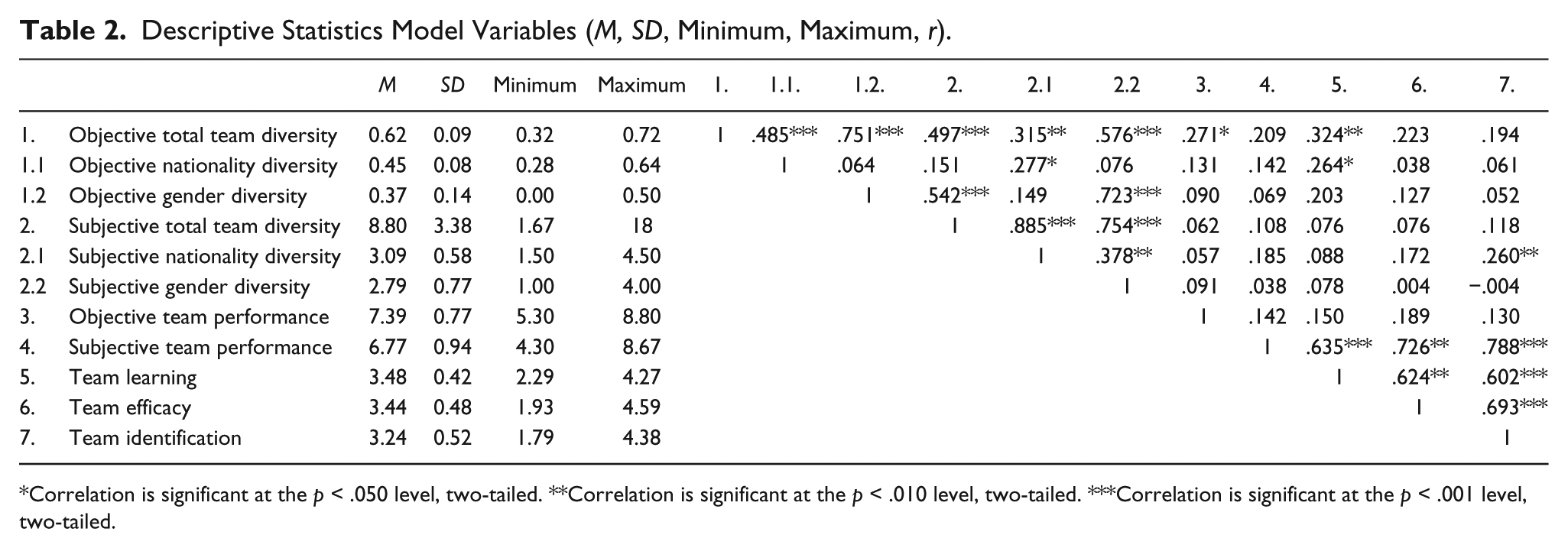
Correlation is significant at the p < .050 level, two-tailed. **Correlation is significant at the p < .010 level, two-tailed. ***Correlation is significant at the p < .001 level, two-tailed.
Descriptive Statistics (M, SD, Minimum, Maximum, r) Separately for Cluster of Teams With Weak Group Identity (n = 29; Below the Diagonal) and a Strong Group Identity (n = 43; Above the Diagonal).
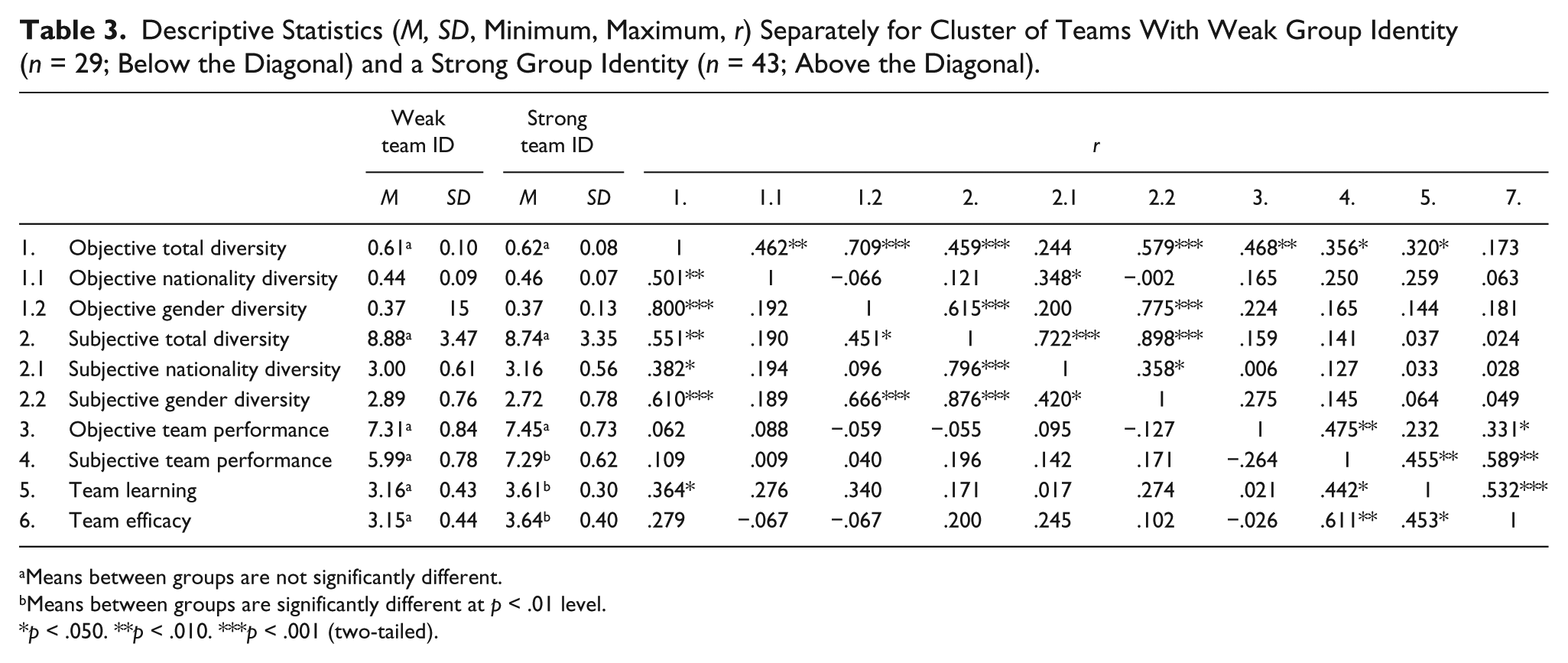
Means between groups are not significantly different.
Means between groups are significantly different at p < .01 level.
p < .050. **p < .010. ***p < .001 (two-tailed).
Importantly, subjective diversity was not significantly correlated to any of the mediators and team performance outcomes (Table 2). This meant that in this data set, subjective diversity did not serve as a predictor variable for team learning and performance for both strong and weakly identified teams. At this stage, we therefore drop subjective diversity as a predictor variable from our model.
Model fit
We tested our hypothesized model (excluding subjective diversity) against a baseline model in which none of the paths between variables were expected to be significant. This baseline model obtained bad model fit, χ2(30) = 108.47, p < .001, RMSEA = 0.19, SRMR = .24, CFI = 0.00, TLI = .000 AIC = 132.47. We compared this baseline with the hypothesized model in which we added paths from objective team diversity to (objective and subjective) performance, from objective team diversity to team learning, from team learning to team efficacy, and from efficacy to (objective and subjective) performance. Moreover, error terms between objective and subjective performance were allowed to correlate. Study year was modeled as a covariate. 6 This model obtained good fit, χ2(14) = 14.84, p = .39, RMSEA = 0.029, SRMR = .083. CFI = .989, TLI = .977, AIC = 70.84, and was significantly better compared with the baseline model, Δχ2(16) = 93.63, p < .001. Overall, we concluded that our model was a good fit to the data.
Hypotheses Testing
First, to test Hypothesis 1, we inspected whether there was a significant indirect relationship between objective diversity and team efficacy via team learning, and an indirect relationship between objective diversity and subjective and objective performance via both team learning and efficacy in all teams (irrespective of team identity strength). Standardized indirect effects revealed a significant indirect effect of objective diversity on objective performance (γ= .041, p = .036) and subjective performance (γ = .145, p = .013) via team learning and efficacy.
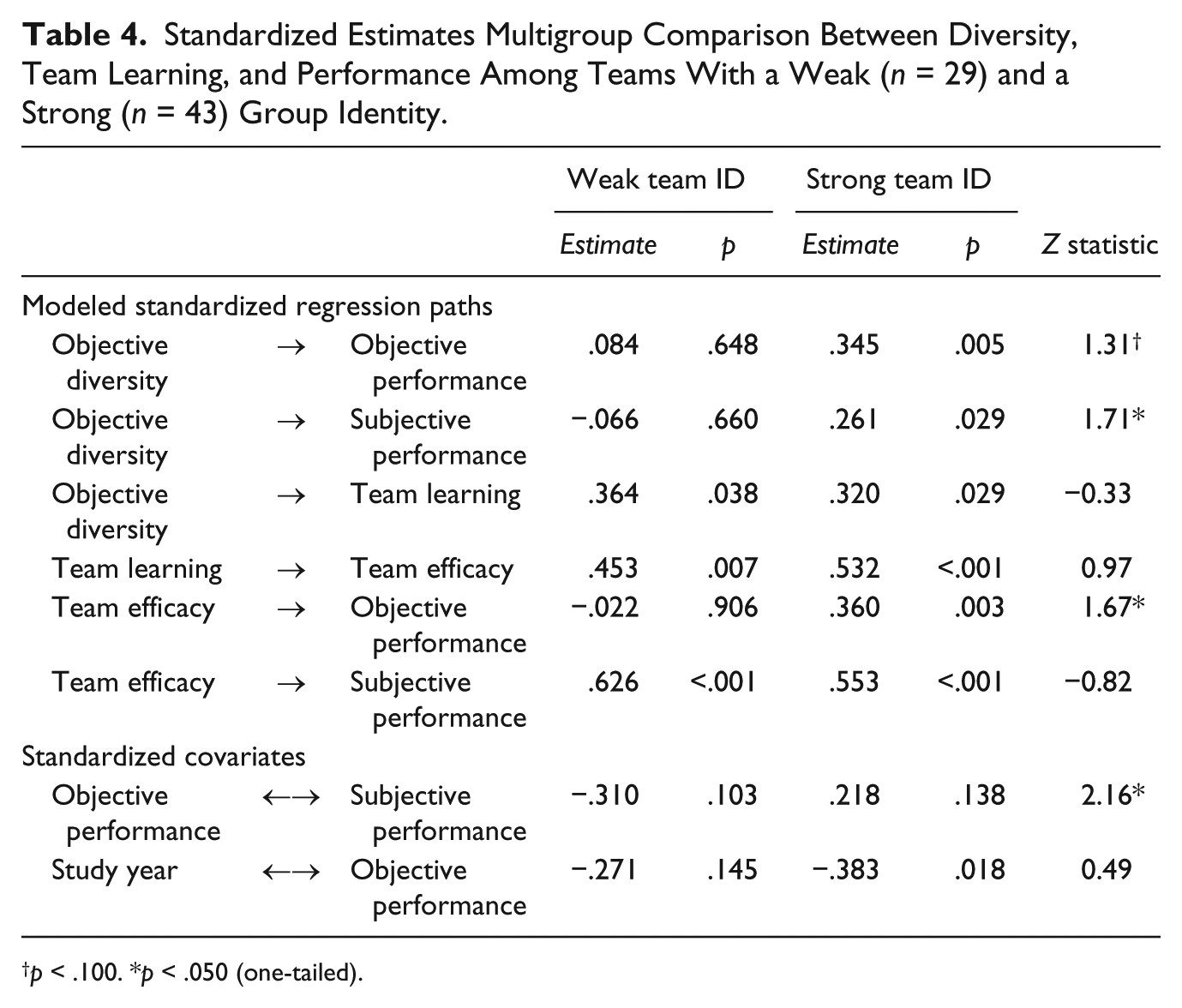
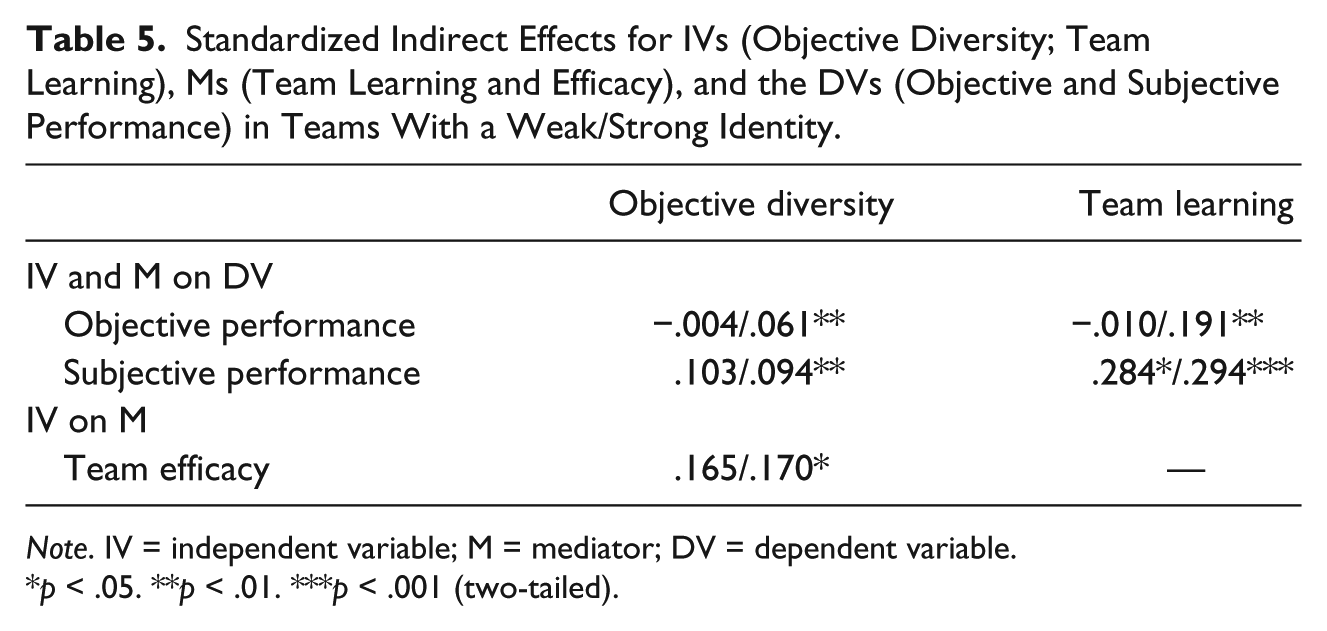
Subsequently, our goal was to test whether relationships between diversity, team learning process, and performance outcomes were contingent upon team identity strength. Therefore, in a second step, we conducted multigroup comparison (Lowry & Gaskin, 2014) and compared the χ2 of the unconstrained model (paths were allowed to vary between strongly and weakly identified teams), χ2(14) = 14.84, p = .39, against the constrained model (paths were not allowed to vary), χ2(28) = 43.35, p = .032. The difference between models was significant, Δχ2(14) = 28.55, p = .012, indicating that the model was different for teams with a strong relative to weak group identity. We inspected standardized estimates (see Figure 2), conducted path-by-path comparisons between the teams with weak and strong identities to investigate where moderation occurs (see Table 4; Gaskin, 2011, 2016), and we inspected indirect effects to investigate where (conditional) mediation occurs (see Table 5).
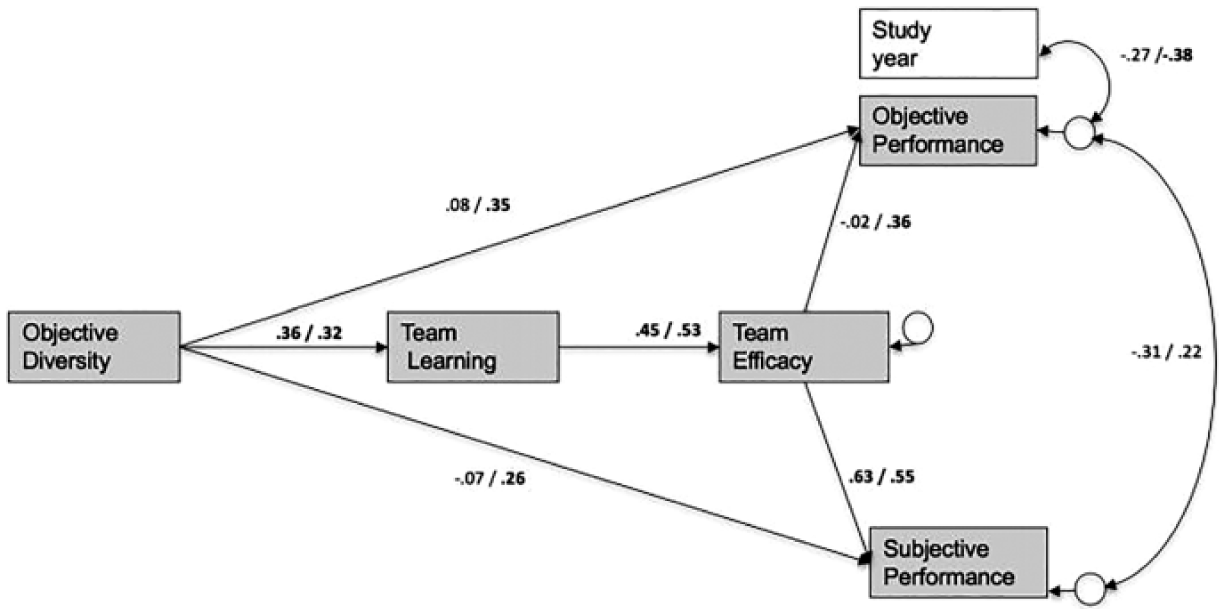
Structural equation model with standardized estimates for teams with a weak/strong team identity.
Standardized Estimates Multigroup Comparison Between Diversity, Team Learning, and Performance Among Teams With a Weak (n = 29) and a Strong (n = 43) Group Identity.
p < .100. *p < .050 (one-tailed).
Standardized Indirect Effects for IVs (Objective Diversity; Team Learning), Ms (Team Learning and Efficacy), and the DVs (Objective and Subjective Performance) in Teams With a Weak/Strong Identity.
Note. IV = independent variable; M = mediator; DV = dependent variable.
p < .05. **p < .01. ***p < .001 (two-tailed).
Supporting Hypothesis 2, only for teams with a strong (and not a weak) group identity objective diversity was significantly positively related to both objective (γ = .345, p = .005) and subjective (γ = .261, p =.029) performance (Figure 2, Table 4). In support of Hypothesis 3, we found that the indirect effect of team diversity on performance via team learning and efficacy was contingent upon a team’s identity strength. Specifically, for teams with a strong group identity, the indirect effect of objective diversity to both subjective (γ = .061, p < .01) and objective (γ = .094, p < .01) performance outcomes via team learning and efficacy was significant. For weakly identified teams, however, this mediation model did not hold: The indirect effects of objective team diversity to both objective and subjective performance via team learning and efficacy were not significant (see Table 5).
Finally, we investigated the exploratory Hypothesis 4 that relationships among variables in our research model were different for objective and subjective indices of both diversity and performance. Correlational data already revealed that while subjective and objective diversity were positively correlated, subjective diversity did not predict any of the model variables. Objective diversity did predict our model variables, particularly in teams with a strong group identity (see Table 4 and Figure 2). We also inspected differences in the parameter estimates for objective and subjective performance indices. Here we found differences to be moderated by team identity strength. In teams with a strong group identity, there was a positive trend between objective and subjective performance indices (γ = .218, p = .138), and in teams with a weak group identity, this trend was negative (γ = –.31, p = .103). Moreover, while in teams with a strong group identity team efficacy had a positive effect on both objective (γ = .360, p = .003) and subjective (γ = .553, p < .001) performance, in teams with a weak group identity this effect was only found for subjective (γ = .626, p < .001) but not objective (γ = –.02, p = .906) performance. Thus, in teams with a weak identity, what the team believed it could do, did not correspond with what they had to do to accomplish the project work well; for teams with a strong group identity, their efficacy beliefs and subjective performance were aligned with objective performance.
Finally, for teams with a weak group identity, the current research model explained only 1% of the variance in objective team performance, whereas for teams with a strong group identity this was 29%. For subjective performance, the percentages were comparable (38% and 42%, respectively). To conclude, the results demonstrate that diversity’s potential for learning and performance is present for teams with strong identity, but absent for teams with a weak identity, and that this particularly holds for objective diversity and performance.
Alternative Model Testing
To rule out other models providing a more optimal fit to our data, we tested several plausible alternatives. In prior research on team learning, a reverse causal pathway between team learning and efficacy has been suggested, such that team efficacy precedes team learning in predicting performance, rather than vice versa (Edmondson et al., 2007; Van den Bossche et al., 2006). To rule out this alternative route, we tested the reversed causal chain. The model fit was bad, χ2(14) = 38.92, p < .001, RMSEA = 0.159, SRMR = .133, CFI = 0.682, TLI = .319, AIC = 94.92. While we could not directly compare Δχ2 because the models were not nested, the increase in the AIC (ΔAIC = 24.08) indicated that the model in which team learning preceded efficacy prevailed over the alternative. Moreover, the estimates from team diversity to efficacy and from team learning to performance were all nonsignificant, rendering this alternative as less suitable.
We also plotted our model separately for gender and nationality diversity Blau indices to confirm that it was indeed the combined diversity index that was driving the effects and demonstrated the most optimal model fit. For diversity in nationality, the model fit was moderately good, χ2(14) = 20.496, p = .115, RMSEA = 0.081, SRMR = .116, CFI = 0.913, TLI = .814, AIC = 76.496. As the covariance matrix for this alternative model was not identical to our original model, we could not compare model fit indices directly, yet the increase in the AIC (ΔAIC = 5.655) suggested that the combined diversity index was more optimal. Moreover, parameter estimates between objective nationality diversity and objective and subjective performance were nonsignificant among teams with both a strong and weak identity. For gender diversity, while the model fit was again moderately good, χ2(14) = 17.267, p = .242, RMSEA = 0.081, SRMR = .098, CFI = 0.952, TLI = .897, AIC = 73.267, the increase in the AIC (ΔAIC = 2.427) suggested our original model was more optimal. Parameter estimates between gender diversity and both subjective and objective performance were again nonsignificant. We conclude that the combination of multiple forms of demographic diversity created the kind of heterogeneity that facilitated team performance.
Discussion
This research was set out to shed light on the equivocal relationship between demographic team diversity and performance. Prior research already demonstrated how informational diversity can translate into enhanced performance via team elaboration (Santos et al., 2015; Van der Vegt & Bunderson, 2005). Indeed, task-related diversity is often associated with positive implications for team effectiveness. For demographic diversity, however, associations are more negative or inconclusive (Horwitz & Horwitz, 2007). The current work aimed to provide insight in when and how demographic diversity does facilitate team performance.
Theoretical Implications
The current study findings support and extend CEM (Van Knippenberg et al., 2004) such that it provides evidence that demographic diversity has the propensity to foster team performance. The results suggest that even when team diversity is ostensibly unrelated to a team’s goals or tasks, it can still be of added value to the team product. People from different backgrounds have different opinions and ideas that require a team to critically reflect and discuss each other’s viewpoints before reaching common ground (Kearney & Gebert, 2009). Even more so, demographic diversity may act as a cue, eliciting deep instead of peripheral cognitive processing of relevant task information. Such critical reflection and discussion likely prohibits teams from falling into pitfalls such as groupthink and social loafing, and may facilitate in-depth decision making and idea generation instead.
Results in this study confirmed the importance of a strong collective team identity, as core contingency factor that determines when positive effects of diversity are likely to occur. Specifically, results showed that demographic diversity’s potential for performance is contingent upon a shared sense of “we.” When diverse teams are strongly committed, they are less likely to fall prey to social categorization processes that drive people into their own subgroups, potentially resulting in intergroup bias, conflict, and miscommunication. This result contributes to the existing knowledge-base largely focusing on external factors that seek to explain the conditions under which diversity fosters performance (Guillaume et al., 2015) and is novel in the sense that it focusses on the internal group dynamics. Indeed, as Van der Vegt and Bunderson (2005) noted, although the external context surrounding a team suggests conditions under which [ . . . ] diversity is beneficial, one must consider the motivational climate within a team in order to identify conditions under which [ . . . ] diversity will be leveraged (p.533).
Importantly, it has been argued that as teams become more diverse, it becomes more difficult to build a strong team identity because the lack of commonalities between members is expected to hamper the emergence of a “shared sense of we,” which, in turn, impedes performance (e.g., Williams & O’Reilly, 1998). This argument is particularly put forward in research on demographically diverse teams (Jehn, Northcraft, & Neale, 1999). In the current work, however, the level of identification was unrelated to demographic team diversity (Table 2). Similarly, recent research has demonstrated that particularly in small interactive groups, strong collective identities can be built not only in homogeneous teams on “what we have in common,” but also in diverse groups based on unique and distinct contribution of each member (Jans, Postmes, & Van der Zee, 2012). Therefore, research on diverse teams’ motivational climate is important to understand how to benefit from differences in teams.
Third, complementing CEM’s work on elaboration (Van Knippenberg et al., 2004), our results show that team learning is an important process variable to understand how teams profit from demographic diversity. Moreover, by implementing knowledge from team learning models (e.g., Bell et al., 2012) into CEM, we revealed that not all team learning automatically translates into higher team performance. Team learning must be channeled and directed toward task accomplishment. If not, learning may only form a distraction, abandoning focus and losing time on irrelevant things. In the present study, we showed that it is through the collective belief in the team’s ability to accomplish the task that team learning is directed toward performance.
Fourth, even though subjective and objective diversity were positively correlated, the study revealed that only objective demographic diversity was predictive for subsequent team learning and performance. A possible explanation for this is that demographic diversity is not directly perceived as task-relevant, and as such it may not affect on performance on a conscious level (i.e., low normative fit). Instead, it may be that actual differences in opinions and ideas from team members with various backgrounds change the intergroup dynamic more implicitly, and that through critical discussion the overall team product is lifted to a higher level. This perspective also sheds a different light on the increasingly popular stream of research focusing on subjective team diversity measures (Shemla et al., 2016). We would argue that particularly in the case of demographic diversity and the combination of high cognitive accessibility and low normative fit (i.e., diversity is salient but not directly perceived as relevant to the team’s tasks and goals) the notion that people’s perceptions rather than the real level of diversity drives their actions is questionable (Hobman et al., 2003). Interestingly, the relative impact of objective and subjective diversity indices might be quite different with regard to expertise or functional diversity where levels of cognitive accessibility and normative fit may be conversed.
Finally, only for teams with a strong identity, we found congruence between objective and subjective team performance outcomes, in the sense that both were predicted by team diversity, learning, and efficacy in a similar fashion, and that they were positively related to each other. In contrast, for weakly identified teams, there was incongruence between the two: Team members’ subjective experience of performance was negatively related to objective performance, and what’s more, diversity had no explanatory power on either of the two performance indices. In future research, we recommend including both objective and subjective measures as both are likely to show a markedly different pattern of results; not only across different studies, but even in subsamples within studies.
Practical Implications
In educational settings, project-based team learning has become more popular as it forms a mirror image of the type of self-directed teamwork that is required from employees in nowadays organizations. Our study shows that to make diverse project teams work, the facilitation of team identification is important (Van Dick et al., 2008). To this end, team supervisors should aim to create an environment in which members can build their own team identity, emphasize their interdependency, and facilitate joint goal setting so that a collective sense of “sharedness” can be created. As a next research step, it would thus be valuable to investigate leadership or coaching skills that may support such team building in diverse teams.
The multisource approach to measure team performance provided valuable insight in the (in)congruence between team members’ perceptions of their performance, versus their actual performance. Particularly, teams with a weak team identity tended to have a different idea about their performance level relative to objective assessment standards. To prevent these “struggling” teams from getting astray, it seems that intermediate feedback or assessment moments should be planned, so that teams can express their perceived performance, and external coaches or supervisors can express whether this is a realistic perception (Michaelsen & Sweet, 2008). This early detection of misperceptions may allow teams to get back on track and realize that, perhaps, their approach is not so effective after all.
Limitations and Future Research
We studied participants in real teams during a project that was meaningful and important to them, thus ensuring the ecological validity of our findings. A limitation of this sample however was its size. We tested our SEM model based on 72 teams. While the data collection process to get to this sample size took up to 3 years, still there are power issues. For example, path-by-path multiple group comparisons revealed large differences in our parameter estimates between teams with a weak versus strong group identity, yet p values barely “hit” the <.05 threshold. Although we are confident that our predicted findings are robust (alternative SEM models indicated worse model fit), replication of these effects with a larger sample size is needed to verify the results.
Furthermore, in the current study, we only focus on how team diversity affects performance depending on intragroup dynamics and interactions. Nevertheless, teams do not exist in a social vacuum; they can also share knowledge or learn from other teams, or they can compete with other teams, through intergroup interaction. In prior literature, some work exists on the impact of these “boundary spanning activities” and how they affect team performance (Decuyper et al., 2010). Nevertheless, a focus on intra- and interteam learning might be an interesting venue for future research on team diversity.
Finally, project teams in our study were relatively short-lived (i.e., 10 weeks), which limits the generalizability of our findings to newly formed teams. While it is not uncommon for project teams in professional settings to work on a product for a relatively short period of time and then part again, often team members already have a history of working together, which is likely to affect their collective identity formation and strength. Research on the longitudinal development of small groups, for example, suggests that new groups go through different phases of socialization, emphasizing times of uncertainty, conflict, and productivity (Wheelan, 1994). In heterogeneous groups, it may take longer to get all heads together, and set common goals to start performing effectively, whereas in homogeneous groups, common ground is likely reached at earlier stages of group membership (Zellmer-Bruhn et al., 2008). In future research, a longitudinal approach to the team diversity-performance link is valuable.
Conclusion
Further strengthening the CEM (Van Knippenberg et al., 2004), we empirically demonstrated that demographic diversity positively affects both objective and subjective team performance, given that a strong collective team identity exists. Particularly in diverse teams, it is important that team members find common ground because it is through this shared sense of “we” that diverse teams can profit from the unique contributions of each team member. We further shed light on how team diversity translates into performance. Through team learning, diverse teams build the collective confidence, or team efficacy, to perform well. Finally, we relied on self-report measures, databases, and external performance assessments to empirically test our predictions. This multisource approach demonstrated that objective diversity had a markedly higher impact on team performance relative to subjective diversity. Potentially, this is caused by the fact that particularly for demographic diversity, team members are not directly aware of its added value. Therefore, including both objective and subjective indices paints a fuller picture on when, why, and in what form the team diversity–performance link exists.
Footnotes
Declaration of Conflicting Interests
The author(s) declared no potential conflicts of interest with respect to the research, authorship, and/or publication of this article.
Funding
The author(s) received no financial support for the research, authorship, and/or publication of this article.
Notes

Associate Editor: William Gardner