




Abstract
This study examined how organizational control is related to employees’ organizational trust. We specifically focus on how different forms of control (process, outcome, and normative) relate to employees’ trust in their employing organizations and examine whether such trust in turn relates positively to employee job performance (task performance and organizational citizenship behavior). In addition, and in response to the recommendations of past research, we examined these relationships in a high control and compliance-based cultural context. Using data from 105 employee–supervisor dyads from professional services firms in Singapore, we find support for our hypothesized model. The implications of the results for theory and practice, and directions for future research, are discussed.
How to stimulate and guide employees toward organizational performance is often studied by looking at the role of different types of Human Resource Management (HRM) practices. The focus in the HRM literature is typically on either control/compliance- or on employee-commitment-oriented HRM configurations (Arthur, 1994; Hauff, Alewell, & Hansen, 2014). Over the last decades, the interest of management scholars has shifted increasingly from a control-oriented performance view to a more commitment-oriented one. As a result, control practices, particularly those focusing on bureaucratic and formal controls, are studied to a much lesser degree, despite their prominence in organizations (Sitkin, Cardinal, & Bijlsma-Frankema, 2010).
One reason for this lack of interest in control practices in the management literature is that the effect of formal control on performance is much stronger in stable environments, where goals to be accomplished can be defined ex-ante and processes to be observed can be standardized (Snell, 1992). These conditions are believed to be increasingly rare in the globalized economy where knowledge-intensive services are more common than traditional and “Tayloristic” workplaces. In addition, the aforementioned HRM research focused on control has typically depicted it rather negatively, and often as an antithesis of commitment or engagement. For example, Arthur (1994) suggested that the more commitment employees show, the less control is needed.
Despite this negative framing of control in the literature, there are many situations where companies have recently been forced to tighten their control systems to comply with increased external regulations (Weibel, 2007). As such, the relative dearth of knowledge concerning how control-related management practices affect performance and other employee outcomes is problematic. In addition, new insights from the organizational trust literature imply that formal control practices may actually, in some instances, positively affect employees’ organizational trust (Weibel et al., 2016).
Trust, defined as the willingness to be vulnerable based on positive expectations regarding the intentions of another party (Mayer, Davis, & Schoorman, 1995; Rousseau, Sitkin, Burt, & Camerer, 1998), is of critical importance for organizations. For example, research indicates that more trusting employees show greater cooperation and commitment, engage in more knowledge sharing, and carry out less counterproductive work behaviors (Dirks & Ferrin, 2001; Fulmer & Gelfand, 2012; Robinson, 1996). As a consequence, organizational trust is an important mechanism through which management practices can affect important workplace outcomes (Zhang, Tsui, Song, Li, & Jia, 2008).
Two reasons have been offered as to why organizational control may help foster employees’ trust in their employing organizations (Weibel et al., 2016). First, control practices may signal the organization’s predictability, fairness, and reliability. In other words, controls may lead to perceived organizational goodwill and as such enable employees to have more trust in their employing organization. Second, control practices may also signal organizational ability (cf. Maguire & Phillips, 2008) and thus may enhance the belief that an organization is capable of delivering on its promises to both employees and external stakeholders (Bridoux, Stofberg, & Den Hartog, 2016).
Weibel et al. (2016) provided both qualitative and quantitative evidence that three types of organizational control (i.e., output, process, and normative control) enhance employees’ organizational trust. However, they conducted their study in a European context, in countries that varied in control-orientation, but where such orientation may have been constrained as compared with cultures in other parts of the world (e.g., some Asian cultures). An important question is whether such effects would hold (and be larger in relative magnitude) in such contexts. In addition, the aforementioned study did not consider the downstream consequences of organizational control and the trust it engenders, such as job performance.
Building on this prior research, the purpose of the current study is threefold. First, we examine whether organizational control is positively related to employees’ trust in their organization. Second, we test this relationship within the specific context of Singapore. In this context, power distance is high and control practices are heavily relied upon (Hofstede & Hofstede, 2005; House, Hanges, Javidan, Dorfman, & Gupta, 2004). Here, strong controls should form a relatively “natural” and hence legitimate way to manage employees. Third, we extend previous work by exploring whether organizational controls influence overall job performance as a function of the organizational trust it engenders. We consider both task performance and organizational citizenship behavior (OCB) as outcomes, in that they both represent important ways by which employees can contribute to the organization and help it attain its goals (e.g., Mayer & Gavin, 2005; Robinson, 1996). We performed a multisource survey study in Singapore to test our model.
Theoretical Background and Hypotheses
Control and Trust
Control
Organizational control comprises the specification of organizational standards for aligning the actions of employees with the goals of the organization, as well as the monitoring and rewarding of the extent to which such standards are met (Flamholtz, Das, & Tsui, 1985; Snell, 1992). Control practices can consist of varying combinations of formal and informal controls. Formal controls rely on officially documented rules and are often implemented by managers, whereas informal controls are based on norms and often enacted by peers (Baldauf, Cravens, & Piercy, 2005). In addition, there are different control targets. For example outcome controls are focused on attaining goals and results, process controls are concerned with compliance with procedures, and normative controls are targeted toward value congruence among employees (Kirsch, 1996; Weibel et al., 2016). The aim of control practices is generally to ensure that employees are provided with information on relevant performance standards, to correct deviant behavior, and to stimulate effective performance (Sitkin et al., 2010).
Organizational trust
Within an organizational setting, trust can involve a variety of referents, including individuals (trust in one’s supervisor or a colleague), specific groups (e.g., management, coworkers, team/workgroup), or the organization as a whole (Schoorman, Mayer, & Davis, 2007). Trust in these different targets is conceptually and empirically distinct, and consequently has at least partially different antecedents and consequences (Searle, Weibel, & Den Hartog, 2011). While to date most empirical work has focused on interpersonal trust (i.e., trust in a specific other party such as one’s supervisor or coworkers), here we consider employees’ trust in their employing organization as a whole (referred to as organizational trust). Maguire and Phillips (2008) defined organizational trust as “an individual’s expectation that some organized system will act with predictability and goodwill” (p. 372). Thus, when looking at organizational trust, the trust referent is a collective, or system, including multiple actors rather than a single individual or specific group. This implies a broader and more diffuse set of sources for vulnerability and risk as compared with trust in individual parties (as is the case with interpersonal trust).
Organizational trust is derived from employees’ assessments of whether the organization has the competence to reliably meet goals and responsibilities (organizational ability), signals positive intentions regarding stakeholders’ well-being (organizational benevolence), and adheres to commonly accepted moral principles (organizational integrity) in its relationships with different stakeholders (Gillespie & Dietz, 2009; Searle et al., 2011).
Trust and control
While empirical evidence remains scarce, existing work on the relationship between control practices and employees’ trust in their employing organizations suggests that control facilitates organizational trust by establishing reliability in the way the organization deals with recurring problems and by signaling the legitimacy of decisions through the application of a standard set of criteria (Weibel et al., 2016). Controls can enable employees to deal with situations involving both risk and dependencies by offering predictability and protection against arbitrariness through the systematic application of clear and recognizable rules (Zaheer, McEvily, & Perrone, 1998).
The aforementioned study on control and organizational trust by Weibel and colleagues (2016) reported on data collected from employees in a number of European countries (including France, the Netherlands, Switzerland, and the United Kingdom), and showed that in these contexts, control is positively related to employees’ organizational trust. The present study addresses whether these organizational trust perceptions on the part of employees “matter” in relation to employee task performance and citizenship, as rated by supervisors. Second, we test our hypotheses in an Asian context with an even stronger rule-orientation, than those explored by Weibel et al. These authors’ qualitative work presented interview findings from two regions with very different approaches to control: Germanic countries which are seen to be rather rule- and control-oriented, and the United Kingdom, in which people are proposed to be much more skeptical when it comes to rules and controls (Lane & Bachmann, 1998). Managers from both regions expressed predominantly positive views of control practices and made mostly positive associations between control and trust. We explore the connections between control practices, organizational trust, and employee performance within a region that differs from all of these on an important cultural dimension: power distance. Within high power distance societies, we not only expect control practices to exert positive effects, but we expect these positive effects to be strong.
The empirical context of our study
In response to the recommendations of past research to study trust in different cultural contexts (see Ferrin & Gillespie, 2010), we further explore the relationship between control and trust (and their performance-related outcomes) in Singapore. Since its independence in 1965, the city-state of Singapore has achieved substantial economic growth and is currently a key regional trade center. The Singaporean economy has strong high-tech, service-oriented, and knowledge-based sectors. It has a population of three million citizens with more than 75% being of ethnic Chinese origin. Yet Singapore’s society is not dominated by Chinese cultural values but rather influenced by values from both the East and the West due to the large numbers of multinational companies. A unique feature of Singapore is the strong involvement of the government in all aspects of society (see Li, Ngin, & Teo, 2008, for a detailed overview of management practices and leadership in Singapore).
Cross-cultural research has characterized Singapore as high in power distance (Li et al., 2008). Countries high in power distance are characterized by a strong need for hierarchy, centralized power, and a lack of informal communication channels across hierarchical levels. Hofstede and Hofstede (2005) showed that people in high power distance countries tend to prefer elaborate control systems and believe in the importance of thorough instructions. In Singapore, individuals tend to abide by many rules not because they have need for structure but because of their high power distance. Therefore, we expect that the impact of organizational control on organizational trust should be quite salient within this particular culture:
Control, Trust, and Performance
Only a limited number of studies have explored the effect of control practices on employee job performance (including both task performance and OCB). In essence, the HRM literature has cast formal control systems as the dysfunctional antithesis of high commitment work systems, as control systems are proposed to entail high monitoring costs and are seen as less effective, flexible, and adaptive (e.g., Arthur, 1994; Guthrie, 2001). Moving beyond the HRM literature, however, there are arguments that controls can contribute to performance-related outcomes in a more meaningful way (Sitkin et al., 2010).
Controls are fundamental building blocks for feedback processes and learning (Adler & Borys, 1996), and the consistency they create can be viewed as a form of procedural justice. Controls facilitate coordination and communication within and among teams as they define essential common goals and common rules of engagement (Gittell, 2001). This means employees understand better what is expected of them and what their own and other roles in the team entail, which makes it easier to perform their tasks as expected. In addition, the sense of common goals and experience of cooperation catalyzed by control practices are likely to foster citizenship among employees.
The literature suggests that the effect of organizational controls on performance is more indirect, with controls enabling coordination, communication, common goals, feedback, learning, and, as we will argue here, organizational trust. In turn, it is through these psychological processes that performance is affected (Sitkin et al., 2010). The reason for this more indirect influence is that for organizational controls to influence individual performance, they have to be both implemented by management (i.e., a practice or policy is not enough—it is the actions taken that matter) and noticed by employees. This reasoning is in line with the HRM literature, in which it is also argued that formal HR systems designed by the organization may not necessarily be consistently implemented by individual managers and may not necessarily be noticed by employees (and individual differences in expectations and experiences may affect interpretation of the practices; Ostroff & Bowen, 2016).
We argue that control practices should foster trust in the organization as they form signals of organizational goodwill and ability. In comparison with control, trust in the organization should more proximately affect employee performance due to the quality of social exchange it fosters between employees and employers (Colquitt & Rodell, 2011; Dirks & Ferrin, 2001). Trust is affectively toned and related to positive emotions. Positive emotions create psychological resources employees can draw upon and that help them perform (Fredrickson, 2001). Also, when trust exists, employees’ regulatory resources need not be diverted to self-protection, considering others’ intentions, or to monitoring other parties. Thus, trusting employees have more cognitive and emotional resources available to devote to performing their job tasks well and additionally for engaging extra-role behaviors such as citizenship (Dirks & Ferrin, 2001; Mayer & Gavin, 2005).
Although organizational trust has not previously been linked to employee performance, related research does suggest a positive relationship. For example, Mayer and Gavin (2005) showed that employees who trust their managers and the top management team show higher task performance and more OCBs. In contrast, when employees perceive that their employers do not fulfill their obligations, employees’ trust declines, along with their willingness to contribute to the organization (Robinson, 1996).
Prior studies indeed suggest that interpersonal trust can affect both individual-level (Colquitt & Rodell, 2011; Grant & Sumanth, 2009) and organizational-level (Davis, Schoorman, Mayer, & Tan, 2000; Zaheer et al., 1998) performance outcomes. However, to date, there has been a dearth of empirical studies examining the relationship between organizational trust and performance-related outcomes. Here, we extend previous work by empirically exploring how output, process, and normative control separately relate to both task performance and OCB, via organizational trust.
Harkening back all the way to Ouchi (1980) and Eisenhardt (1985), past research has tended to treat control as multidimensional. For instance, clan organizations have been said to depend on normative controls, whereas bureaucratic organizations are known to rely on process controls. We too consider process, output, and normative control practices as separate forms of control. However, we do not expect them to differentially affect trust and performance, as they each contribute to establishing reliability, legitimacy, and predictability (Zaheer et al., 1998), which serve as sources of trust and enablers of performance and citizenship. Whereas such a view differs from the theoretical arguments put forward by Das and Teng (1998), they are consistent with empirical findings of Şengün and Wasti (2007). Thus, we seek to provide clarity to the literature on this somewhat disagreed upon point.
Output control, trust, and performance
Output control focuses on the outcomes, products, or services employees produce. Output control practices involve setting predefined formal targets, and employing information systems that enable monitoring of whether targets are met and whether rewards and sanctions are tied to goal accomplishment (Snell, 1992). For example, output control in a software development project may include budgets, functional requirements, contractual agreements, and final products. We expect that output controls have a positive effect on organizational trust for two reasons. First, goal definition, the measurement of goal attainment, and reward processes provide clarity and predictability, which enhances employees’ trust in both the organization’s ability to deliver on its promises and its benevolent intentions. Also, assisting employees in navigating their way through the organization better equips them in managing their own performance according to organizational expectations. Second, output control practices provide important feedback for employees, again strengthening their beliefs that the organization is capable and willing to support them in learning and readjusting their efforts for maximum effectiveness. A firm belief that the organization provides transparency and reliability in a process that would otherwise render employees vulnerable is expected to enhance organizational trust and, in turn, trusting one’s employing organization should increase employees’ willingness to contribute to the organization through task performance and OCB.
Process control, trust, and performance
In contrast to the focus on outcomes, process controls shape how employees perform their job (i.e., how standardized procedures are enacted). Process control practices consist of the outlining of processes and rules concerning how employees should perform their work, monitoring how these processes and rules are enacted, and rewards/sanctioning practices (Snell, 1992). For example, a call-center employee may be provided a predefined script to use during his or her interactions with customers. The employee may be monitored on metrics, including the average time spent on a call, the average rate of calls, his or her professionalism, and the demonstration of interest in the caller, which can then be used by the employee’s supervisors for performance appraisal purposes.
Based on the literature, we propose that process controls, as long as they are perceived to be professional and beneficial, can help employees see the organization as trustworthy as these process controls provide support to employees in their daily work. For instance, such controls enable coordination between different employees, and hence strengthen the reliability of cooperation in and between teams. This is likely to enable both task performance and foster citizenship toward other team members. Process controls also contribute to more transparency by clarifying expectations and discriminating between acceptable and unacceptable behaviors, reassuring employees of the organization’s integrity. As noted, not having to spend time scanning what is right and wrong and engaging in self-protection frees up resources to focus on contributing to the organization in different ways (Mayer & Gavin, 2005).
On a more practical level, if employees perceive process controls that are helpful in reducing errors, this not only can help them do their job better (and thus directly affect task performance) but also assures them of the competence of the organization, enacting trust, which further motivates work effectiveness and citizenship. Thus, well-implemented process controls should strengthen employees’ trust in the organization and, in turn, enhance their willingness to contribute through task performance and OCBs.
Normative control, trust, and performance
Finally, employee behavior is also expected to be affected by normative controls enacted by the organization. That includes the promotion of organizational norms and values, and sanctioning norm violation (Sitkin & George, 2005). For example, to underline the symbolic importance of their uniform, employees at a fast-food chain may receive a penalty when they do not adhere to the set dress code. In addition to formal procedures (e.g., safety compliance requirements), normative control practices often rely on informal norm enforcement practices, such as peer pressure. Normative controls should thus facilitate value congruence among organizational members (Gillespie & Mann, 2004), which is also seen as a core feature of trust (Edwards & Cable, 2009). Sharing common values assists in building trust between organizational members, facilitating social bonds, and clarifying “how we do things around here,” while sanctions following deviance from these norms enhance trust in the overall organization (Weibel et al., 2016). In this way, we expect normative control to enhance trust and, in turn, contribute to task performance and OCB.
Our full hypothesized model is illustrated in Figure 1.

Theoretical framework predicting performance and OCB.
Method
Sampling and Data Collection
Participants were obtained via a snowball sampling approach with the support of business school students at a Singaporean university. This approach is frequently used to obtain data from a variety of firms and industries by building on the contacts of specific individuals within organizations (Wheeler, Shanine, Leon, & Whitman, 2014). Student-recruited sampling enabled access to supervisor–subordinate dyads from a variety of professional service firms in Singapore.
In line with the recommendations of Wheeler et al. (2014), the students were briefed and invited to provide contact details of two English-speaking respondents who agreed to take part in a survey on employees’ attitudes and behaviors. As English is the official language of Singapore, non-English fluency is rare in professional organizations. The students were informed that the survey respondents had to meet the following sample criteria: They had to be employed full-time (at least 30 hr per week), over 18 years of age, employed within a noneducational setting, and in an organization large enough to contain multiple levels of management. In addition, the respondents were required to have a full-time supervisor who was also willing to complete a short additional survey. Students received no class credit, nor was there a benefit or reward offered for these nominations. Identified potential participants were then sent an email outlining the purpose of the study, indicating its voluntary nature, and providing a link to an online survey. They were assured of their confidentiality and informed of their right to withdraw from the study at any time without penalty.
Snowball sampling is not without limitations. Some contend this approach can make samples more susceptible to selection bias (i.e., the occurrence of similarity in gender and ethnicity between the student recruiter and respondents; Wheeler et al., 2014). The following steps were taken to limit the possibilities of selection bias. First, the students were briefed both verbally and in writing about the type of respondents needed. We prepared information sheets for the student recruiters and also letters for them to hand deliver to the employees and their supervisors. The letters provided information about the purpose of the study, the duration of the survey, what sorts of things the survey sought to measure (employees’ attitudes and behaviors), and information about the senior researchers. We emphasized that we did not want to disturb those who were not prepared to participate in the survey. We outlined in the information sheets and during the briefing our interest in respondents who matched our sample criteria. We added a clause emphasizing that the employment context had to have a clear hierarchical structure, and thus would exclude those working in small family businesses.
After 2 weeks, reminders were sent to all potential participants. The survey closed after 5 weeks. Of the 206 employees who were invited to participate, 110 employees (along with their supervisors) participated in the study, yielding a 53.4% response rate. Five questionnaires were discarded due to missing information. Respondents were matched to their supervisors through the provision of a supervisor contact telephone number. In total, we received usable data from 105 employee–supervisor dyads.
Fifty-nine percent of the participating employees were male. The participants ranged in age from 19 to 64 years (average age = 35.5 years). Of them 20% had completed high school, 13.5% junior college, 50.9% college, and 10.9% graduate school. In terms of job level, 40% of the employees belonged to junior management, 30% to middle management, 20% to senior management, and 10% to top management. Average tenure with one’s current employer was 6.51 years. Median employer size was 100 employees.
Measures
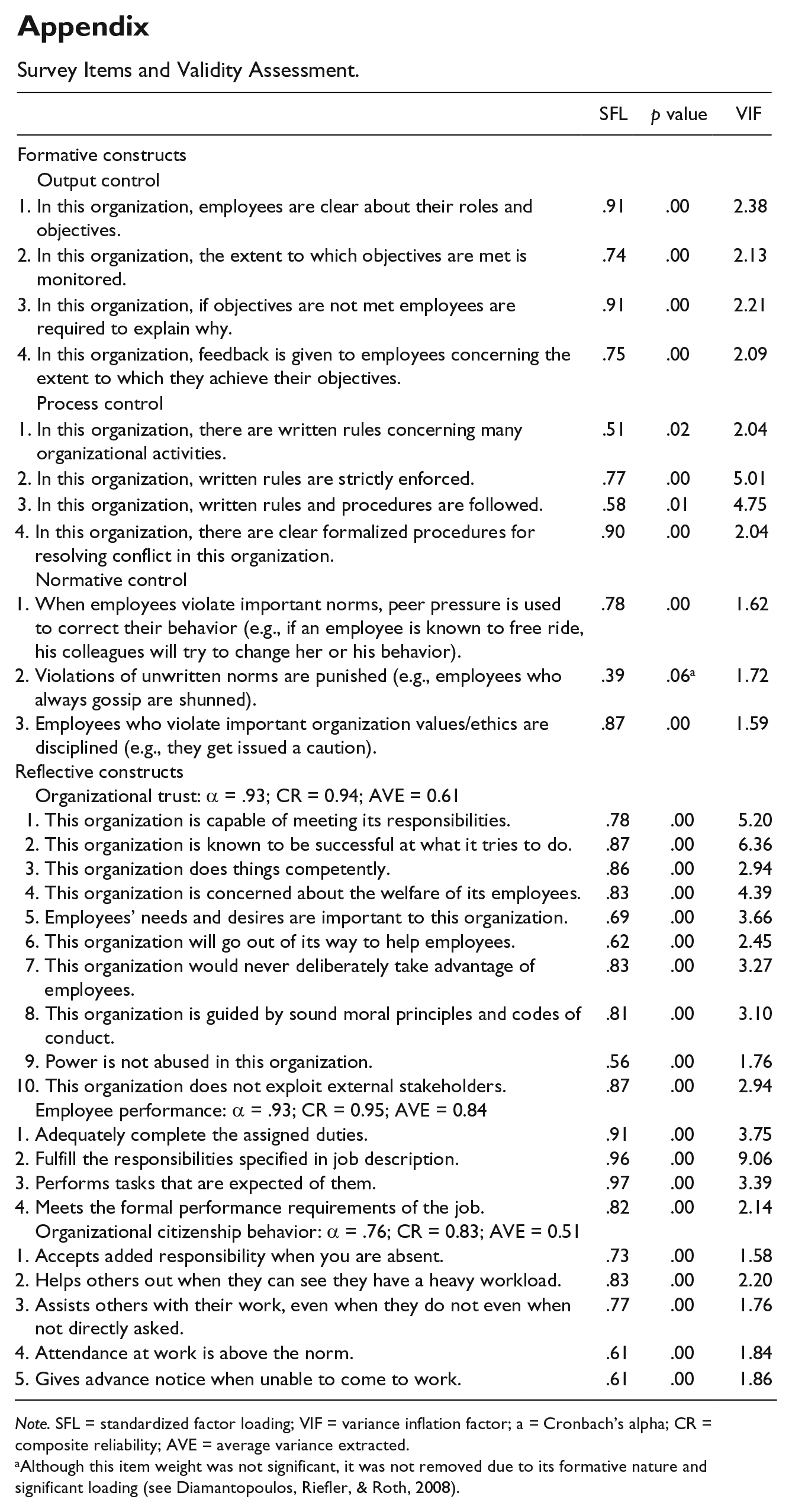
Measurement scales, unless specifically indicated otherwise, used a 5-point Likert-type scale response style (1 = strongly disagree, 5 = strongly agree). All survey items, along with scale-level psychometric properties, are reported in the appendix. Employees’ supervisors provided performance and OCB ratings for their participating subordinate. Performance and OCB served as endogenous variables. Employees provided ratings of control and trust perceptions, with the control ratings serving as exogenous variables and trust perceptions as an endogenous variable. This dual source approach was included to alleviate common source bias (Podsakoff, MacKenzie, Lee, & Podsakoff, 2003). Following the common classification criteria of Jarvis, Mackenzie, and Podsakoff (2003), all endogenous variables were measured reflectively. Reflective models assume that causality flows from the construct to the indicators. Hence, in reflective models, a change in the construct causes a change in the indicators. In the case of our control measures, the opposite was true. A change in these indicators results in a change in the construct under study. Therefore, the three latent exogenous variables (output, process, and normative control) were measured formatively.
Organizational control
We measured the three forms of control as separate constructs to explore their relative strength as predictors of trust and performance. The three types of control were measured using Weibel et al.’s (2016) measures. The output control measure focuses on the extent to which standards are set, progress is monitored, and goal attainment is rewarded. Process control items relate to the extent of written rules regarding activities and procedures in the organization. Normative control items referred to the presence of formal and informal consequences for the violation of norms, ethics, and organizational values.
Organizational trust
To measure organizational trust, Searle and colleagues’ (2011) instrument was used, which draws on the work of Mayer and Davis (1999). This measure is comprised of 10 items and focuses on employees’ perceptions of whether their organization is trustworthy with regard to its competence and goodwill. The measure had an internal consistency of α = .93.
Employee performance and OCB
Williams and Anderson’s (1991) measures were used for assessing in-role/task performance (four items with an internal consistency of α = .93 in our sample) and OCB (five items with an internal consistency of α = .76 in our sample). OCB has been treated as both unidimensional and multidimensional in the literature, with one-, two-, five-, and six-factor models in active circulation (Cropanzano, Rupp, Thornton, & Shao, 2016). Because we did not have reason for predicting differential effects of our independent variables on differing facets of OCBs, we opted for treating the OCB as unitary construct. This is consistent with LePine, Erez, and Johnson (2002), who argued that a unidimensional approach can adequately capture the OCB construct space.
Statistical control variables
We controlled for gender and participants’ hierarchical job level in our analyses as these variables have been found to correlate with trust (see Searle et al., 2011). For example, those who are at a higher hierarchical level are likely to have more personal influence on the organization and its policies, which can enhance trust. Thus, the relationship between control and trust may be stronger for those higher in the hierarchy. Similarly, Glaeser, Laibson, Scheinkman, and Soutter (2000) showed that men are more trusting than women. Gender was coded as 1 = male, 2 = female; and job level as 1 = top management, 2 = senior management, 3 = middle management, 4 = junior management, 5 = nonmanagement. We also controlled for tenure as longer tenured employees generally have greater in-role performance and display more OCBs (Ng & Feldman, 2010). Tenure was reported in years. Finally, we controlled for organization size as larger organizations tend to have more slack (Rau, Haerem, & Fredericks, 2015). We measured organization size by the total number of employees (1 = 0-250 employees, 2 = 251-999 employees, 3 = >999 employees).
Data Analysis
Prior to testing our hypotheses, we checked for possible nonresponse bias. Then, following the guidelines of Anderson and Gerbing (1988), we analyzed the suitability of our measurement model. We used structural equation modeling (SEM) with the partial least squares (PLS) estimation method to test our hypotheses. Compared with a covariance-analytical approach, the PLS estimation method has the advantage of utilizing less strict assumptions regarding the distribution of data while allowing the robust estimation of smaller samples, such as ours (Goetz, Liehr-Gobbers, & Kraft, 2010). In addition, the software package Smart PLS Version 2.0 M3 has appropriate techniques to test our model, as it allows for the inclusion of both formative and reflective measures (Diamantopoulos & Winklhofer, 2001; Fornell & Bookstein, 1982), and provides indices of overall model fit (Henseler, Hubona, & Ray, 2016).
Results
Table 1 depicts the means, standard deviations, and correlation coefficients for our six study variables plus our three statistical control variables.
Means, Standard Deviations, and Intercorrelations.
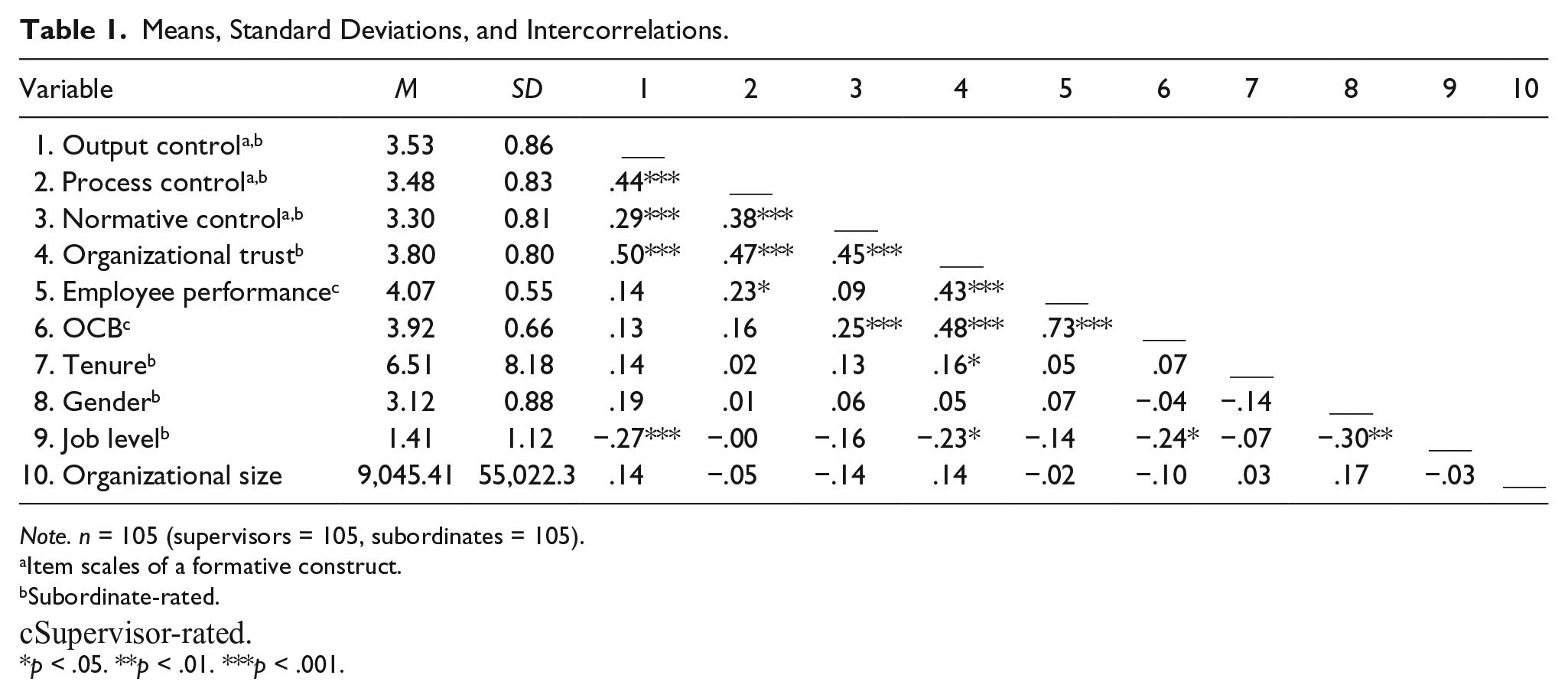
Note. n = 105 (supervisors = 105, subordinates = 105).
Item scales of a formative construct.
Subordinate-rated.
Supervisor-rated.
p < .05. **p < .01. ***p < .001.
Measurement Model
Following Anderson and Gerbing’s (1988) recommendations, we conducted a confirmatory factor analysis (CFA) to assess the suitability of the multi-item reflective scales. Factor loadings were significant and above .60, supporting the unidimensionality of these measures (Hulland, 1999). Composite reliabilities (ranging from .84 to .95) were all above the .60 threshold (Bagozzi & Yi, 1988), and the average variance extracted (AVE) indices were all greater than the .50 threshold (Fornell & Larcker, 1981). In addition, we tested for discriminant validity by confirming that each construct’s variance shared with other constructs was lower than its AVE (Fornell & Larcker, 1981).
In checking our formative measures, we followed Diamantopoulos and Winklhofer’s (2001) guidelines. First, we controlled for possible multicollinearity of the proposed indicators capturing output control, process control, and normative control. The variance inflation factors (VIFs) were between 1.06 and 1.41, below the standard cutoff of 10 (Hair, Anderson, Tatham, & Black, 1998). Then, as recommended by Diamantopoulos, Riefler, and Roth (2008), we assessed each formative indicator’s weight and found most factor weights to be significant and above .50 (Santosa, Wei, & Chan, 2005). Overall, these preliminary tests revealed that our measures showed acceptable psychometric properties (see the appendix for further details).
In addition, we examined the adequacy of our measurement model with an alternative model, which included organizational citizenship behavior - individuals (OCBI) and organizational citizenship behavior - organizational (OCBO) as two separate constructs (Williams & Anderson,1991). The resulting seven-factor model did not provide a significantly better fit than the more parsimonious six-factor solution as judged by the chi-square difference test, lending empirical support of our choice to treat OCB as a unitary construct. Furthermore, we compared the six-factor solution with a model combining all control variables into one factor (four-factor model) and a single-factor model. As these two models resulted in a significant decrement in fit, we proceeded with the six-factor solution where we combined OCBI and OCBO into one construct. As shown in Table 2, our hypothesized six-factor model provided a good fit to the data, χ2(df) = 411.53(293), χ2/df = 1.41; comparative fit index (CFI) = .94; incremental fit index (IFI) = .95; root mean square error of approximation (RMSEA) = .06; standardized root mean square residual (SRMR) = .07.
Comparison of Alternative Measurement Models.
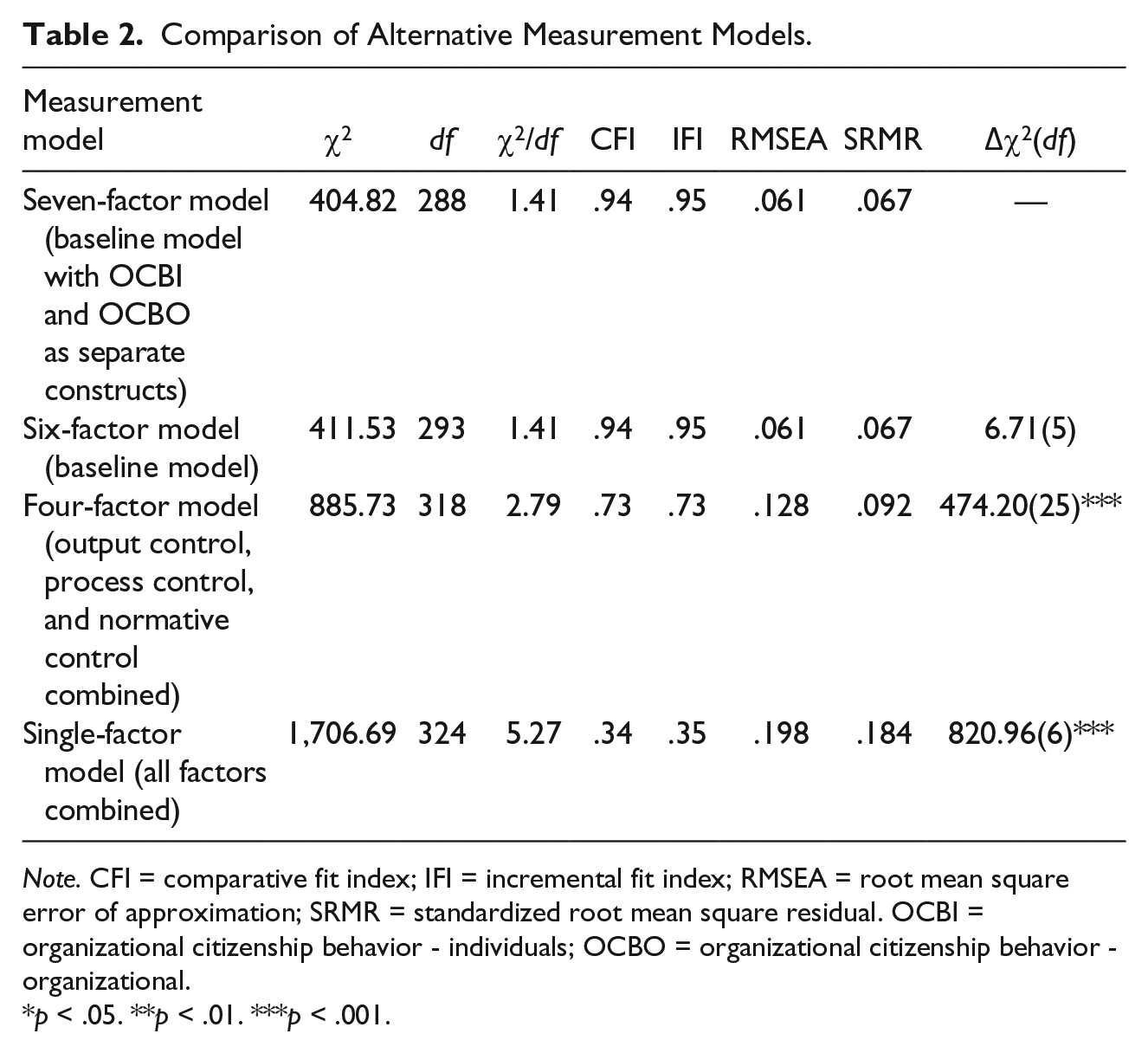
Note. CFI = comparative fit index; IFI = incremental fit index; RMSEA = root mean square error of approximation; SRMR = standardized root mean square residual. OCBI = organizational citizenship behavior - individuals; OCBO = organizational citizenship behavior - organizational.
p < .05. **p < .01. ***p < .001.
As indicated by the coefficient of determination (R2) we report, our model explains 13.1% of the variation in employee performance, 22.4% in OCB, and 35.9% in organizational trust, providing high explanatory power (Chin, 1998). The SRMR is .07, which is below the common threshold of .08 (Henseler et al., 2016). Taken together, these findings suggest a good fit of our model. The results of our analysis are summarized in Table 3.
Tests of Hypotheses via PLS-SEM.
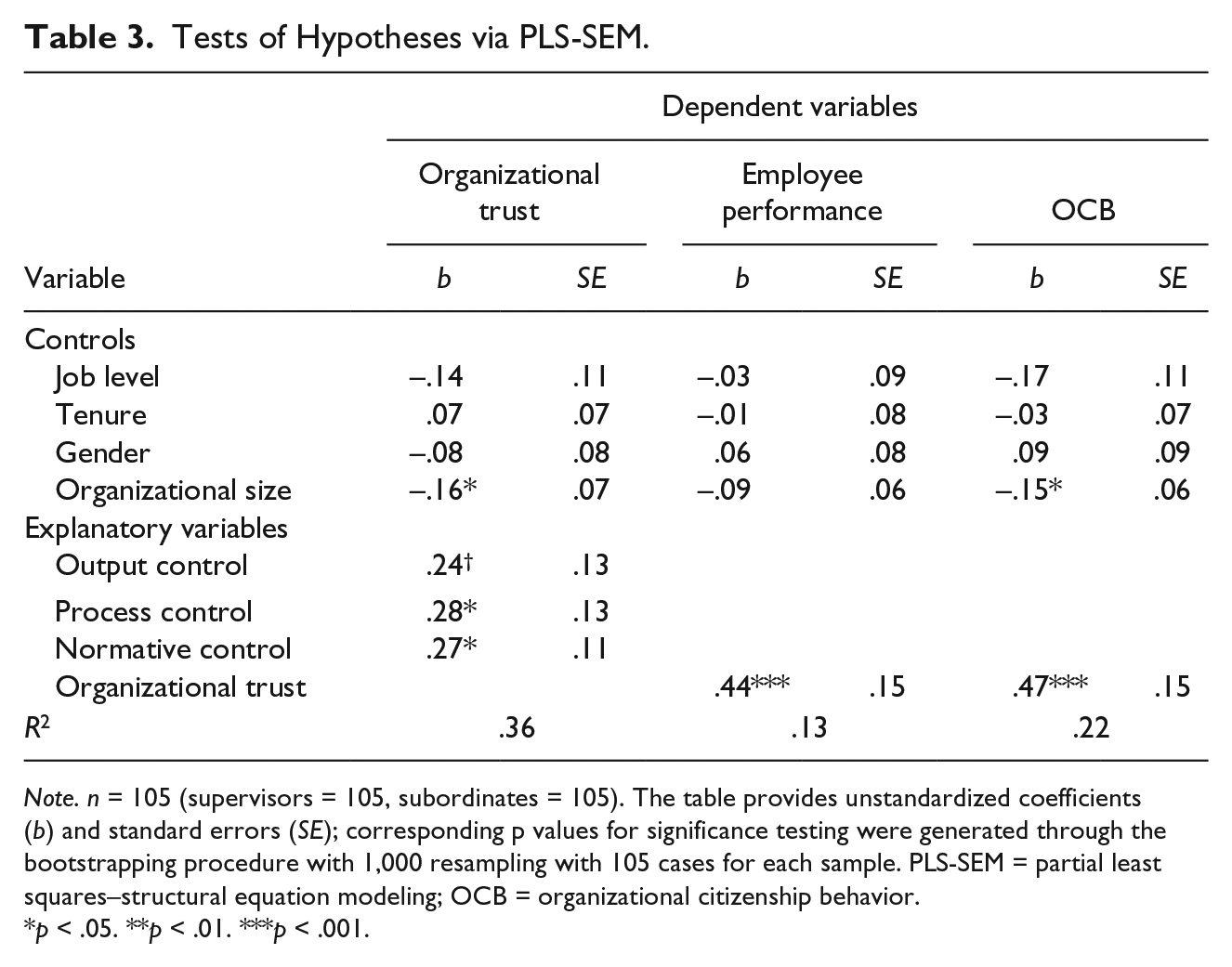
Note. n = 105 (supervisors = 105, subordinates = 105). The table provides unstandardized coefficients (b) and standard errors (SE); corresponding p values for significance testing were generated through the bootstrapping procedure with 1,000 resampling with 105 cases for each sample. PLS-SEM = partial least squares–structural equation modeling; OCB = organizational citizenship behavior.
p < .05. **p < .01. ***p < .001.
Hypothesis Testing
H1 predicted a positive relationship between employee perceptions of organizational control and perceived trust in the organization. PLS-SEM results indicated that output, normative, and process control were positively related to organizational trust (b = .24, p = .08; b = .27, p = .02; b = .28, p = .04).
H2 to H4 focused on the mediating role of trust in the relationship between control (outcome, process, and normative) and employee outcomes (OCB and employee performance). We performed a mediation analysis and therefore regressed organizational trust on employee performance (H2a-H4a) and OCB (H2b-H4b), computing the coefficients for direct and indirect paths (Preacher & Hayes, 2008). As recommended by Preacher, Rucker, and Hayes (2007), we conducted our mediation analysis with percentile-based and bias-corrected confidence intervals across 1,000 bootstrap resamples, which do not assume a certain sampling distribution. As can be seen in Table 4, output control, normative control, and process control have significant indirect paths to employee performance. Analyzing the statistical control variables included in our model revealed no significant effects for gender, job level, or tenure. Organizational size seemed to restrain the relationship between organizational trust and OCB, as there was a significant negative relationship between these variables.
Results of Mediation Analysis.
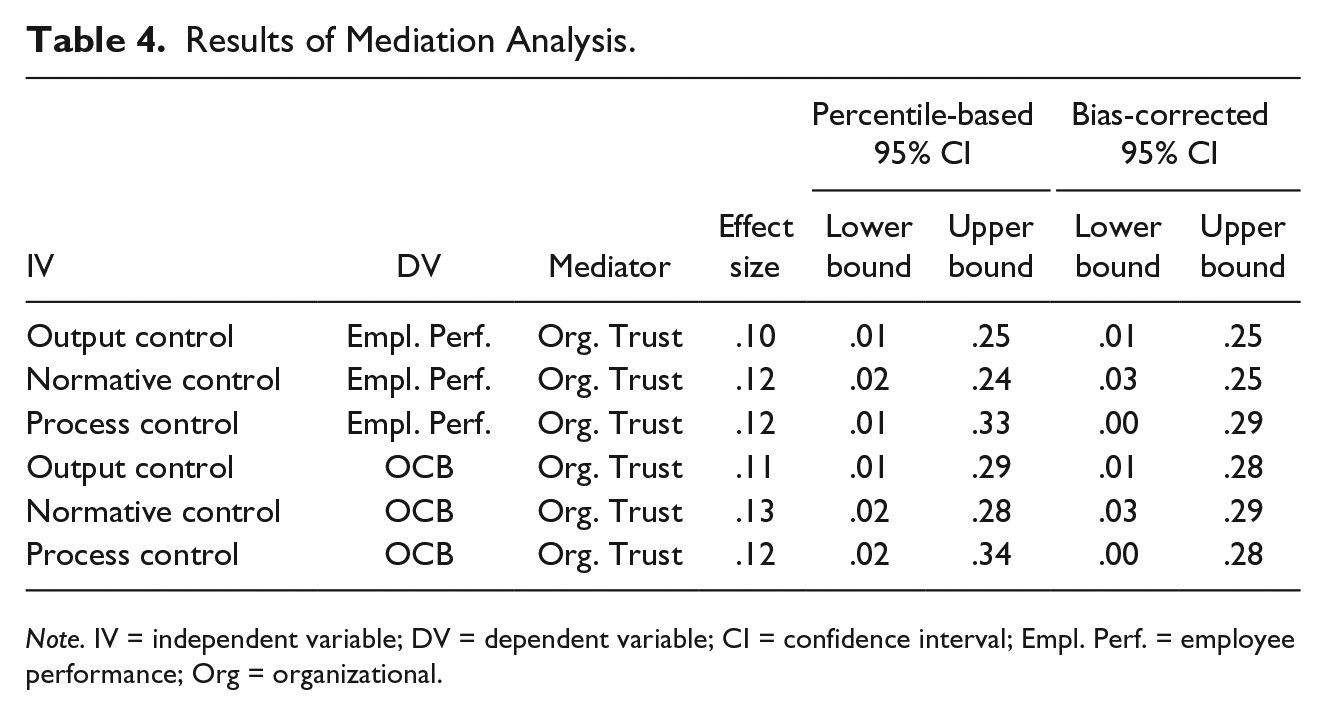
Note. IV = independent variable; DV = dependent variable; CI = confidence interval; Empl. Perf. = employee performance; Org = organizational.
As none of the confidence intervals for output control, normative control, or process control contained zero, the indirect effects support the proposed mediating effect of organizational trust. These findings indicate a mediating effect of organizational trust, supporting our hypotheses.
Discussion
The aims of our study were threefold. First, we wanted to test how organizational control relates to organizational trust, specifically within the context of Singapore. Adding to the work of Weibel and colleagues (2016) who found a positive relationship between control and trust in European organizations, our study provides further support for the idea that due to the clarity and regularity offered by organizational controls, control can relate positively to employees’ trust in the organization. We found that the relationship between control and employee organizational trust indeed seems potent in the high power distance context of Singapore (although the effect sizes found were not larger than those reported by Weibel et al., from Europe). We also add to previous work by separating out the three forms of control (process, output, and normative controls) and testing for their effects. Our results suggest that in the Singaporean context, all three forms of control are relevant to employees’ organizational trust.
Next, we sought to explore whether organizational trust mediates the relationship between the three forms of control and both task performance and OCB. Our results supported the notion that trust acts as a mediator in these relationships. That is, trust was found to mediate the relationship between all three forms of control and both task performance and OCB. The pattern of findings suggests that control systems help to enhance trust in the organization and that this translates into favorable organizational outcomes, such as improved task performance and OCB of employees.
The results of our study add to our understanding of how organizational control effects performance. The bulk of organizational control research considers the boundary conditions (moderators) influencing this relationship, with little consideration of the mechanisms (mediators) responsible for the observed effects (see Otley, 2016, for an overview). A smaller but clearly growing community of management control researchers is beginning to identify how the effect of control on performance is manifested at the individual level (see Chenhall & Moers, 2015, for an overview). While empirical research in this area is clearly making progress, we are not aware of any investigations that consider organizational trust as such a mechanism, which we argue is a key missing link necessary for understanding these relationships. Our study contributes to a more refined understanding of this particular interplay.
Our results have implications for future research. As noted, in HRM research, formal control systems are often seen as the somewhat “ugly cousin” of high commitment work systems. The control–commitment dichotomy was first introduced by Walton (1985) and has been used quite extensively since (Hauff et al., 2014). Despite this framing in the literature, our results suggest that it is possible to go beyond the traditional HRM view of control as a negative organizational practice. Different forms of control do relate positively to employee trust in their employer and, in turn, also indirectly enhance different types of employee contributions to the organization. Future work might try to test whether and when it is possible to integrate control and commitment elements within HRM systems rather than pitting them against each other.
Although we studied the relationship between trust and control and proposed trust as an outcome of control, we cannot test for the direction of causality in our data (see also our discussion of limitations below). It may well be that causality runs both ways. In addition to sound control systems aiding the development of trusting beliefs about the organization, more trusting employees may also (subsequently) interpret management practices such as controls and the intentions behind such controls more positively. In contrast, less trusting employees may be more suspicious of the intentions behind controls. Although this potential interplay between trust and control has not yet been studied, the related work on trust and justice is relevant here, as research has established trust as both an antecedent and consequence of justice and these constructs have been said to potentially coevolve over time (Brockner & Siegel, 1995) and be reciprocal in nature (Colquitt & Rodell, 2011). This would form an interesting area to explore further.
Although we studied the relationship between control and employee organizational trust in the high power distance context of Singapore, we were not able to offer a fully cross-cultural comparison. Future studies could focus more clearly on the impact of cultural values on the use and acceptance of controls in relation to organizational trust. For example, one reason our effect sizes were not stronger than the European findings reported by Weibel et al. (2016) may have been that Singapore, while high in power distance, is low on uncertainty avoidance (Hofstede & Hofstede, 2005). Reflecting the extent to which the members of a culture feel threatened by ambiguous or unknown situations, uncertainty avoidance could be argued to be positively associated with preference for control practices. As such, future research might consider replicating and extending this research within a cultural context that is high in both power distance and uncertainty avoidance, such as Russia.
Future research could also test whether the positive effect of control on trust is perhaps bounded. Weibel et al. (2016) suggested there may be a trade-off between two aims of a control system: An “optimal” control system provides sufficient agreement and reliability, yet it also grants employees sufficient autonomy and flexibility to carry out their work without being micromanaged. Thus, for trust to be maintained, it may also be important to assess how strictly and rigidly control is implemented. For example, Schoorman et al. (2007) implied that strict control may inhibit the development of trust by signaling that employees are merely complying with control, rather than acting on their trustworthy intentions. Relatedly, the intensity of monitoring has been shown to play a role in interpersonal trust (Holman, Chissick, & Totterdell, 2002). Evidence shows that employees who are closely monitored report higher levels of stress and greater levels of dissatisfaction than those who are less closely monitored (David & Henderson, 2000). Extreme monitoring might signal distrust (Falk & Kosfeld, 2006) and may reduce the beneficial influence of control practices on organizational trust.
Limitations
While the findings of this study corroborate and extend earlier findings, there are some limitations (in addition to those noted above) that should be acknowledged and considered when interpreting and generalizing our results. First, although the sampling method included dyads of employees and managers from across a wide range of firms within Singapore, our snowballing approach to collect data may have led to a certain types of sampling bias and therefore limit the confidence we can have in our inferences (Johnson, 2005). Future research should explore the link between control, trust, and outcomes in a more controlled sample.
Second, our data were collected at a single point in time, making it difficult to rule out the possibility of reverse causality (Podsakoff et al., 2003). As such, we cannot draw firm causal conclusions based on our mediation results. We therefore suggest that future research utilize panel data and longitudinal approaches to more robustly test the direction of causality and development of trust over time. Third, while a strength of this study is its multisource data for the overall model, the results for the first hypothesis are based on self-reported questionnaire responses. Future studies might therefore comprise more objective assessment of various types of controls within organization.
Finally, as mentioned above, although we sought to extend past research by replicating and extending past findings in a unique cultural context, our research was in no way comparative. Differences between our findings and those of Weibel et al. (2016) could have been due to organizational differences, measurement differences, and other unknown factors. Truly comparative cross-cultural research is needed to provide more definitive evidence here. Furthermore, cultural values have been shown to vary between people within geographical regions just as much as (if not more than) they do between geographic regions (Lam, Schaubroeck, & Aryee, 2002; Triandis, Leung, Villareal, & Clack, 1985). Therefore, future comparative work should also measure cultural values such as power distance and uncertainty avoidance at the individual level of analysis.
Practical Implications
Despite these limitations, the findings offer implications for managing people in organizations. First, the pattern of relationships we find suggests that control systems do appear to have potentially beneficial impacts on employees’ organizational trust and ultimately their overall job performance. The current study challenges a simplistic dichotomized view of management practices being either control- or commitment-oriented, as well as the implied negative stance on control as less likely to yield positive (attitudinal) effects. Instead, our findings suggest that the judicious use of controls might be fruitful for organizations and can help employees contribute to the organization. Finally, our findings suggest controls that focus on how tasks should be performed can promote clarity and support for employees, which are associated with increased trust, citizenship, and task performance.
Conclusion
Extant research has at times suggested control and trust are incompatible with management systems seen as either control-oriented or promoting of engagement, trust, and commitment. The results of this study challenge this perspective and instead suggest that organizational trust may be achieved through implementing organizational controls. Controls may enhance employee performance both directly and through enhanced trust. This suggests that the link between control systems and trust is sensitive and related to the way in which behavior is controlled.
Footnotes
Appendix
Survey Items and Validity Assessment.
| SFL | p value | VIF | |
|---|---|---|---|
| Formative constructs | |||
| Output control | |||
| 1. In this organization, employees are clear about their roles and objectives. | .91 | .00 | 2.38 |
| 2. In this organization, the extent to which objectives are met is monitored. | .74 | .00 | 2.13 |
| 3. In this organization, if objectives are not met employees are required to explain why. | .91 | .00 | 2.21 |
| 4. In this organization, feedback is given to employees concerning the extent to which they achieve their objectives. | .75 | .00 | 2.09 |
| Process control | |||
| 1. In this organization, there are written rules concerning many organizational activities. | .51 | .02 | 2.04 |
| 2. In this organization, written rules are strictly enforced. | .77 | .00 | 5.01 |
| 3. In this organization, written rules and procedures are followed. | .58 | .01 | 4.75 |
| 4. In this organization, there are clear formalized procedures for resolving conflict in this organization. | .90 | .00 | 2.04 |
| Normative control | |||
| 1. When employees violate important norms, peer pressure is used to correct their behavior (e.g., if an employee is known to free ride, his colleagues will try to change her or his behavior). | .78 | .00 | 1.62 |
| 2. Violations of unwritten norms are punished (e.g., employees who always gossip are shunned). | .39 | .06 a | 1.72 |
| 3. Employees who violate important organization values/ethics are disciplined (e.g., they get issued a caution). | .87 | .00 | 1.59 |
| Reflective constructs | |||
| Organizational trust: α = .93; CR = 0.94; AVE = 0.61 | |||
| 1. This organization is capable of meeting its responsibilities. | .78 | .00 | 5.20 |
| 2. This organization is known to be successful at what it tries to do. | .87 | .00 | 6.36 |
| 3. This organization does things competently. | .86 | .00 | 2.94 |
| 4. This organization is concerned about the welfare of its employees. | .83 | .00 | 4.39 |
| 5. Employees’ needs and desires are important to this organization. | .69 | .00 | 3.66 |
| 6. This organization will go out of its way to help employees. | .62 | .00 | 2.45 |
| 7. This organization would never deliberately take advantage of employees. | .83 | .00 | 3.27 |
| 8. This organization is guided by sound moral principles and codes of conduct. | .81 | .00 | 3.10 |
| 9. Power is not abused in this organization. | .56 | .00 | 1.76 |
| 10. This organization does not exploit external stakeholders. | .87 | .00 | 2.94 |
| Employee performance: α = .93; CR = 0.95; AVE = 0.84 | |||
| 1. Adequately complete the assigned duties. | .91 | .00 | 3.75 |
| 2. Fulfill the responsibilities specified in job description. | .96 | .00 | 9.06 |
| 3. Performs tasks that are expected of them. | .97 | .00 | 3.39 |
| 4. Meets the formal performance requirements of the job. | .82 | .00 | 2.14 |
| Organizational citizenship behavior: α = .76; CR = 0.83; AVE = 0.51 | |||
| 1. Accepts added responsibility when you are absent. | .73 | .00 | 1.58 |
| 2. Helps others out when they can see they have a heavy workload. | .83 | .00 | 2.20 |
| 3. Assists others with their work, even when they do not even when not directly asked. | .77 | .00 | 1.76 |
| 4. Attendance at work is above the norm. | .61 | .00 | 1.84 |
| 5. Gives advance notice when unable to come to work. | .61 | .00 | 1.86 |
Note. SFL = standardized factor loading; VIF = variance inflation factor; a = Cronbach’s alpha; CR = composite reliability; AVE = average variance extracted.
Although this item weight was not significant, it was not removed due to its formative nature and significant loading (see Diamantopoulos, Riefler, & Roth, 2008).
Associate Editor: Jin Nam Choi
Declaration of Conflicting Interests
The author(s) declared no potential conflicts of interest with respect to the research, authorship, and/or publication of this article.
Funding
The author(s) received no financial support for the research, authorship, and/or publication of this article.