



Abstract
Integration processes after mergers are fraught with difficulties, and constitute a main cause of merger failure. This study focuses on the human aspect of post-merger integration, and in particular, on the role of occupational identification. We theorize and empirically demonstrate by means of a survey design that employees’ identification with their occupation is positively related to their willingness to cooperate in the post-merger integration process, over and above the effect of organization members’ organizational identification. This positive effect of occupational identification is stronger for uniformed personnel but attenuates in the course of the integration process. Qualitative interviews further explore and interpret the results from our statistical analysis. Together, these findings have important practical implications and suggest future research directions.
Keywords
Introduction
Merger and acquisition (M&A) activity over the last decades has run at unprecedented levels (Gomes, Weber, Brown, & Tarba, 2011; Makri, Hitt, & Lane, 2010). Mergers 1 require significant resource commitments, and can dictate the fortunes of the companies involved for years to come. However, many mergers fail, at least to some extent (Dyer, Kale, & Singh, 2004). Well-known examples of failed mergers are AOL–Time Warner (merged in 2001, split up again in 2009) and Daimler–Chrysler (merged in 1998, divested in 2007). Studies of merger success focusing on financial or strategic aspects of the deals fall short of providing sufficient explanation of merger outcomes (King, Dalton, Daily, & Covin, 2004). Therefore, both scholars and practitioners increasingly focus on sociocultural aspects of the integration of merged and acquired firms (Sarala, Cooper, Junni, & Tarba, 2016). In particular, human integration, concerned primarily with generating employee satisfaction, is seen as an important determinant of the overall success of a merger (Birkinshaw, Bresman, & Håkanson, 2000).
A number of studies point to the importance of organizational identification as a key factor in human integration and in explaining merger success (for an overview, see He & Brown, 2013). Higher levels of post-merger organizational identification are associated with a greater likelihood that employees will take the organization’s perspective and will act in the organization’s best interest (Bartels, Douwes, de Jong, & Pruyn, 2006; Riketta, 2005; Van Dick, Ullrich, & Tissington, 2006). In times of considerable organizational change (such as in post-merger integration), these aspects are of crucial importance.
However, work situations offer multiple targets for employee identification (He & Brown, 2013; Hillman, Nicholson, & Shropshire, 2008; Vough, 2012). For instance, an employee may identify not only with the organization as a whole but also with his or her own work group or division (Ashforth & Johnson, 2001), or with his or her occupation or profession (Pratt, Rockmann, & Kaufmann, 2006). Studies have found that organization members are often more committed to their occupational identity than to their employer or organization because employees tend to have more in common with their professional peers than with other organizational members (Johnson, Morgeson, Ilgen, Meyer, & Lloyd, 2006).
Unfortunately, the role of occupational identification in the context of mergers has not been studied, with the exception of Empson (2004), who in a qualitative study discusses the evolution of employees’ occupational identity in the context of a merger between two accounting firms. She suggests that mergers can under conditions help occupational groups to more fully develop their occupational identity. Examining occupational identification in an organizational change context (such as mergers) becomes even more important as long-term relationships with organizations will likely get disrupted (Ashforth, Harrison, & Corley, 2008).
In this article, we study the role of occupational identification in post-merger integration, and in particular its effect on employees’ willingness to cooperate in making the merger into a success. Such willingness to cooperate is important, as the outcome of fundamental organizational change processes depends on the readiness of employees to do what is necessary, even if this is not part of their formal job descriptions or assignments (Melkonian, Monin, & Noorderhaven, 2011). We study the effect of occupational identification on willingness to cooperate over and above the effect of organization members’ identification with the post-merger organization, which has already been established in previous research (Kroon, Noorderhaven, & Leufkens, 2009).
Research has demonstrated that occupational identification affects organizational outcomes that are important in large organizational change processes such as in post-merger integration, such as extra-role behaviors, organizational citizenship behaviors, job performance, and more generally, organizational commitment (see, for example, Ashforth, Joshi, Anand, & O’Leary-Kelly, 2013; Snape & Redman, 2003; Van Dick, Wagner, Stellmacher, & Christ, 2004; Witt, 1993). We build on these findings and theorize that employees’ identification with their occupation has a positive effect on their willingness to cooperate in making the merger a success. Moreover, following arguments based on the occupational identity literature, we argue that this positive effect is moderated by a number of factors. We expect the positive effect of occupational identification to be strongest for those employees who are most affected by the merger in their job and for uniformed employees. Finally, we expect the effect to become weaker over time.
We test our theory on both quantitative and qualitative data from a merger between two service-sector organizations, and find support for most of our hypotheses. Although our study pertains to a single case, we have rich data on how the merger was experienced by different categories and groups of employees over the course of an integration process. Previous studies have drawn attention to differentiation within a single merger or acquisition (Brannen & Peterson, 2009; Monin, Noorderhaven, Vaara, & Kroon, 2013). Covin, Sightler, Kolenko, and Tudor (1996), in particular, pointed to “the importance of considering key identity and organizational groups and their reactions to the merger” (p. 139). As a merger can have very different effects on different groups and employees within the companies (Schweizer, 2005), a single case, if studied in depth, can reveal many interesting phenomena. Our study reveals the positive relationship of occupational identification with willingness to cooperate, beyond the influence of organizational identification. We also show that the positive effect of occupational identification differs between categories of employees, and diminishes over time.
Below, we first develop a theoretical framework and advance hypotheses. Subsequently we describe our research design and empirical findings. The article concludes with a discussion of the study’s main theoretical and practical implications and with suggestions for future research.
Theoretical Background
Occupational Identification
In social identity research, there is increasing awareness of the importance of taking multiple identification targets into account (Ramarajan, 2014). Although research on occupational identification (or “professional identification,” as it is often termed) has become more prevalent in recent years (for an overview, see Miscenko & Day, 2016), the literature remains sparse in comparison with that exploring organizational identification (Ashforth et al., 2008; He & Brown, 2013). Occupational identity has been defined as the relatively stable and enduring constellation of attributes, beliefs, values, motives, and experiences in terms of which people define themselves in their professional or occupational roles (Ibarra, 1999). 2 Social identity theory (Tajfel & Turner, 1986) explains how employees identifying with their occupation incorporate distinctive professional attributes into conceptions of their self-identity. In a similar way as with organizational identification, the process of occupational identification refers to “the extent to which one defines him- or herself in terms of the work he or she does and the prototypical characteristics ascribed to individuals who do that work” (Mael & Ashforth, 1992, p. 106).
In an individual’s lifetime, occupational identification can be expected to develop before organizational identification, as a result of professional training, education, and socialization (Aranya, Pollock, & Amernic, 1981; Bamber & Iyer, 2002; Russo, 1998). If employees leave an organization, they often keep their occupational affiliation; consequently, occupational identification could be argued to also transcend any given organization (Ashforth et al., 2008). Moreover, the organization can be incorporated into one’s occupational identity (Pratt et al., 2006).
Because work and occupational status play such a prominent part in peoples’ lives, we can assume that an individual’s occupation is an important target of identification (Kreiner & Ashforth, 2004). Loi, Ngo, and Foley (2004) illustrated that occupational identification is a key construct in explaining employees’ job attitudes such as job satisfaction and organizational commitment. As organization members’ perceptions play an important role in the success and failure of organizational change, these factors are of crucial importance (Sarala et al., 2016). In our study, we explore the role of occupational identification in a particularly turbulent organizational change context, namely, post-merger integration.
Post-Merger Integration
The post-merger integration phase can be seen as potentially critical to M&A success (Angwin & Meadows, 2015; Bauer & Matzler, 2014). Employees experience mergers, and in particular post-merger integration, as extreme cases of organizational change that profoundly affect their lives (Van Vuuren, Beelen, & De Jong, 2010). Hence, to further our understanding of the factors influencing the success of mergers, scholars have increasingly begun to focus on social, cultural, and psychological factors related to the integration of merged firms (Gomes, Angwin, Weber, & Tarba, 2013; Sarala et al., 2016).
We aim to go beyond much previous research in this line of research, which often has been one sided in its focus on employee resistance (Ford, Ford, & D’Amelio, 2008; Piderit, 2000). Employees can also construct, sometimes surprisingly, positive interpretations of change (Sonenshein & Dholakia, 2012), which may lead to a favorable attitude in a post-merger integration process. In this light, a crucial factor for the success of post-merger integration seems to be employee support or buy-in. If employees do not “buy in” to the organizational changes necessary for the integration to succeed, value realization becomes very difficult (e.g., Gioia, Thomas, Clark, & Chittipeddi, 1994; Piderit, 2000).
In our study, we follow previous research that focuses on employees’ willingness to cooperate as an important variable in post-merger integration (Marmenout, 2010; Melkonian et al., 2011; Weber, Shenkar, & Raveh, 1996). Although important to study in its own right (Cording, Christman, & Weigelt, 2010; Meglio & Risberg, 2011), we believe that organization members’ willingness to cooperate in the integration process is also a key factor that ultimately determines the success or failure of a merger or acquisition.
Occupational Identification and Post-Merger Integration
In times of considerable change, identity perceptions become particularly salient (Albert & Whetten, 1985; Ashforth et al., 2008). During post-merger integration, people have to redefine the meaning they derive from the social context they work in (Van Dick et al., 2006). This period can influence in intricate ways not only the identifications of employees but also the relationships between identification targets and attitudinal and behavioral outcomes that are important for implementing the merger, such as organization members’ willingness to cooperate in the integration process (Chreim, 2007).
We expect both occupational and organizational identities to be particularly salient during post-merger integration, and each of these identifications is likely to independently affect an employee’s willingness to cooperate in the integration process (Johnson et al., 2006). The difference between occupational and organizational identification is that the former draws on activity whereas membership is a defining feature of the latter (Lammers, Atouba, & Carlson, 2013). Early work emphasized possible conflicts between occupational identification and organizational identification (Gouldner, 1957; Sorensen & Sorensen, 1974), but more recent studies across a range of occupations typically find moderately strong positive associations between occupational and organizational identification (Hassan, 2012), suggesting that conflicts between the two are far from unavoidable. A potential explanation is that the organization allows an individual to work in the chosen profession and, thus, provides the individual to strengthen his or her occupational identity (Russo, 1998).
Both organizational and occupational identification have been shown to be related to crucial variables, such as acting in the organization’s best interest (Ashforth & Mael, 1989), turnover intentions (Bartels et al., 2006), organizational commitment (Witt, 1993), and general behaviors supporting the organization (Van Dick & Wagner, 2002). The key question in our context is whether this positive relation will also persist during post-merger integration, as such an organizational change can pose a threat to employees’ self-definition and self-esteem (Hogg & Terry, 2000). Although this question has not been studied yet, a case study of merging accounting firms by Empson (2004) suggested that mergers can, under conditions, help occupational groups to more fully develop their occupational identity, which is likely to be associated with increased willingness to cooperate in the merger. A comparable observation was made in the context of merging academic departments (Adedoyin, Miller, Jackson, Dodor, & Hall, 2015). However, more systematic exploration of this issue is necessary.
Hypothesis Development
As noted in the “Introduction” section, strong occupational identification is associated with extra-role behaviors, organizational citizenship behaviors, job performance, and more generally organizational commitment (see, for example, Ashforth et al., 2013; Snape & Redman, 2003; Van Dick et al., 2004; Witt, 1993), all of which are important in large organizational changes. Our question is whether this positive relationship also extends to willingness to cooperate in post-merger integration.
We believe it is plausible that this is the case. As Russo (1998) noted, occupational identification helps employees cope with difficult periods. A strong occupational identification may also help employees accept and deal with the tasks assigned to them in the post-merger integration process. In a study of two military staff organizations, Witt (1993) found that employees who had a strong occupational identification could better cope with job assignments that were seen as not very satisfactory or unfair, in the sense that such assignments were less detrimental to their organizational commitment compared with employees with weaker occupational identification. This is understandable, as “for individuals who identify with their occupations, helping in matters related to their occupations is tantamount to helping oneself” (Ashforth et al., 2013, p. 2432). Therefore, our baseline hypothesis is as follows:
Whereas we propose an overall positive effect of occupational identification on employees’ willingness to cooperate in the integration process, this expectation can be refined in several ways. First, post-merger integration processes change over time (Gleibs, Mummendy, & Noack, 2008; Haspeslagh & Jemison, 1991; Seo & Hill, 2005), and this is likely to influence the role of occupational identification.
Post-merger integration often involves alteration of the value chain (Pablo, 1994), which is effected through interventions such as transfer of management systems, redeployment of assets, integration of product lines, integration of technologies, and rationalization of plant and equipment allocation (Shrivastava, 1986). In-depth studies reveal that such post-merger integration processes typically proceed in phases. Birkinshaw et al. (2000), for instance, observed two phases in the acquisition integration processes they studied. First, acceptable performance was achieved in the individual operation units, and next attempts were made to integrate across these. Monin et al. (2013) distinguished three phases in the integration process they studied. In the first phase, most processes and activities were aligned but remained separate, but in the second and third phases, departments were brought under common management and physically integrated. In both studies, progressively stronger integration was observed across the different phases, and such integration is likely to influence both the strength of identification to different targets and the effects of these identifications.
Whereas a strong occupational identification will initially help employees accept the new tasks and roles in the course of the integration process (as we reasoned in the argumentation leading to Hypothesis 1), as the integration process proceeds, tensions between occupational norms and organizational requirements become more likely. Employees may, therefore, feel that their occupational identity is increasingly threatened by the merger as autonomy is removed, tasks change, and organizational–professional conflicts start to arise (Scott, 1966). This may lead to an erosion of commitment to the organization and organization members will be less likely to act in the organization’s best interest. Hence, we hypothesize the following:
Another important distinction we can make in mergers is related to the impact the integration process has on different (groups of) employees within the companies. Haspeslagh and Jemison state that neither managers nor employees can be fooled by the “no change—all synergies expected syndrome,” meaning that employees of units that will become highly integrated know and expect that their autonomy will not be left unaffected (Haspeslagh & Jemison, 1991, p. 143).
Although a strong occupational identification can help employees accept tasks assigned by management (Witt, 1993), workers with strong occupational identities may respond more negatively when management is perceived to breach the psychological contract between the organization and employees (Hekman, Bigley, Steensma, & Hereford, 2009). These effects will diminish employees’ intentions to engage in cooperative behavior during post-merger integration. Accordingly, we expect that the relationship between occupational identification and employees’ willingness to cooperate in the integration process is less positive for individuals whose jobs are strongly impacted by the merger.
Finally, the positive relation between occupational identification and willingness to cooperate is likely to vary between occupational groups with different specific characteristics, which may influence identity perceptions (Glynn, 2000). Dress markers (i.e., the style, color, fabric, and accessories of work clothes) signal occupational identities (Elsbach, 2004). An extreme example of dress marking occupational identity is the uniform (Joseph & Alex, 1972).
Rafaeli and Pratt (1993) quoted a mock prison guard from the famous Stanford prison study: “Once you put on that uniform . . . then you are certainly not the same person. You become that role” (p. 44). Uniform suppresses individuality (Joseph & Alex, 1972), and organizational control over dress codes, of which the organizational uniform is the extreme case, increases employees’ compliance with organizational rules (Pratt & Rafaeli, 1997). However, this organizational control is only one side of the coin. Organizational uniforms (e.g., police uniforms) are also explicit status indicators, which may boost self-esteem (Joseph & Alex, 1972).
In the context of post-merger integration, organizational uniforms may create a bridge between organizational identification and occupational identification. Especially when the organizational uniform remains unchanged after the merger, this may confer a sense of continuity and help employees create a fit between their occupational identities and new work roles. This, in turn, provides them with more confidence and comfort in carrying out these roles (Elsbach, 2003) leading to a more positive attitude toward the merger. Uniformed employees who continue to wear their familiar uniform may, thus, be more likely to cooperate in the integration process. We, therefore, posit the following hypothesis:
Method
Below, we describe how we test our hypotheses using data from a large-scale study of two merged service organizations.
Research Setting
Our study was conducted at two merged firms from different European countries. The companies operate in the same service sector, and one company was approximately twice the size of the other. The merger was announced at the end of 2003, and the companies officially merged in May 2004. 3 It was at the time the largest merger in the industry in terms of the size of the companies (turnover 13 + 7 billion euros) and number of employees (72,000 + 30,000).
In the integration process, the identities of the two companies were largely preserved while increasingly close operational relations were developed. In other words, the merger was characterized by both a high degree of integration and a high degree of autonomy. This type of integration process is labeled “symbiotic” (Haspeslagh & Jemison, 1991, p. 146). A symbiotic post-merger integration process constitutes an ideal setting for our research. Because the two companies were not quickly and fully integrated, but gradually, and with different speeds and intensity for different departments and functions, the merger confronted different employees and occupational groups with divergent conditions, necessary for testing Hypotheses 3 and 4. The gradual integration process provided us with the opportunity to observe how the effect of occupational identification evolved over time, as the integration became more intense (Hypothesis 2).
The study started shortly after the legal completion of the merger and covers a period of almost three and a half years. Data were collected at Time 1 (November 2004) and then approximately every 6 months ending at Time 5 (February 2007). In each wave of the study, we collected quantitative (surveys) as well as qualitative (interviews, observations, press releases, and company documents) data. As Kroon and Rouzies (2015) pointed out, “M&As can be seen as complex and dynamic research objects [and] an important advantage of mixed methods is that this research design can clarify, complement or explore alternative explanations for relationships” (p. 198). Hence, in addition to achieving triangulation, it allows for a more fine-grained exploration and interpretation of the statistical results (Doyle, Brady, & Byrne, 2009). By using such a multi-method design, we also respond to recent calls for new methodological approaches to the study of mergers (Meglio & Risberg, 2010), and for mixed methods in particular (Kroon & Rouzies, 2015).
Quantitative Part
The unit of analysis in our study is the individual organization member. To comply with top management’s request of overall representativeness for the selected employee populations throughout the integration process, we opted for a repeated cross-sectional survey design (rather than a panel study). By choosing this design, we also aimed to avoid sample attrition that would likely not be random (Tuma, 2004), but related to our outcome variable willingness to cooperate. The stratified samples represent employees from a variety of hierarchical levels and functional departments. The samples used in our study were drawn in different ways. Some departments gave us access to complete lists of addresses and we randomly selected samples from these. In other cases, we delivered questionnaires to the secretariat of a department, either to be distributed randomly, or to the whole population of the department. In both cases, distribution was via mail folders. Finally, for some groups, we distributed questionnaires randomly among employees in a dedicated resting room. These procedures created the possibility that an employee received the questionnaire multiple times (across different waves of the survey). To check for possible bias introduced by this, we included a question: “Have you ever filled out this questionnaire before?” Excluding repeated respondents did not lead to any change in the results. In total, 5,340 questionnaires were collected. 4 Response rates are around 30% for both companies throughout the five time periods.
Variables
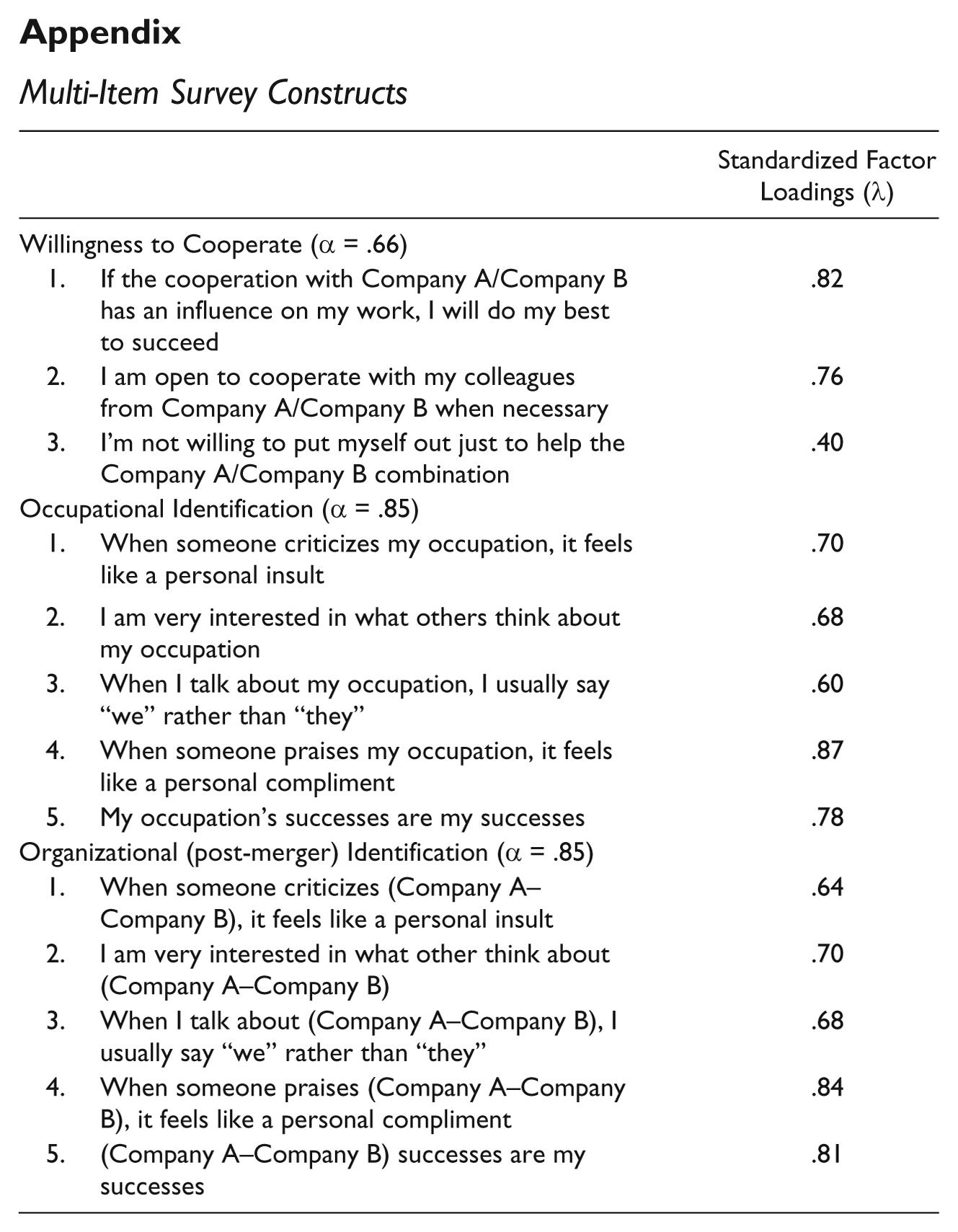
The questionnaire contained several concepts that are relevant for the present context. The main interest of the part of the study we report on here pertains to the effect of occupational identification on employees’ willingness to cooperate in the integration process. The appendix reports the multi-item survey constructs used in this study together with their factor loadings and Cronbach’s alpha for scale reliability.
The dependent variable in this study, willingness to cooperate, is measured by three items that are equivalent to Melkonian et al.’s (2011) Willingness to Cooperate Scale and close to Weber et al.’s (1996) Readiness to Cooperate Scale, the last one being reverse-coded. These items were rated on a Likert-type scale (1 = completely disagree to 5 = completely agree). Cronbach’s alpha for the Willingness to Cooperate Scale equals .66. Although this is slightly below the conventional threshold of scale reliability of .7, we decided to nevertheless retain all items, as they were also reflected in the data structure emanating from our qualitative analysis (see below).
Occupational identification is measured by five items that are equivalent to Mael’s (1989) and Mael and Ashforth’s (1992) Organizational Identification Scale. However, we changed “organization” to “occupation” in each item to form the occupational identification measure. The measure has been used in earlier studies such as those by Bamber and Iyer (2002) and Lui, Ngo, and Tsang (2003). These items were also rated on a Likert-type scale (1 = completely disagree to 5 = completely agree). With a Cronbach’s alpha of .85, the Occupational Identification Scale demonstrates good scale reliability.
Organizational (post-merger) identification is measured by five items that are identical to Mael’s (1989) and Mael and Ashforth’s (1992; original first five items) Organizational Identification Scale. These items were also rated on a Likert-type scale (1 = completely disagree to 5 = completely agree). With a Cronbach’s alpha of .85, the Organizational Identification Scale demonstrates good scale reliability.
To document the organizational unit in which an employee works, a single question was asked: “Please indicate your occupational group.” Respondents could choose between seven alternatives that were provided based on consultation with both companies: peripheral service agents (service jobs), peripheral operations (specialized service jobs), in-house service agents (service jobs), engineers (technical jobs), corporate staff (specialist jobs), secondary business unit (managerial and commercial jobs), and sales offices (sales jobs). We grouped the first three organizational units (in which organization members wore and continued to wear the same organizational uniforms in their daily jobs) into the dummy variable uniform to test Hypothesis 4.
The variable impact on the job is measured by a single item: My work has changed because the Company A–Company B Combination, rated on a Likert-type scale (1 = completely disagree to 5 = completely agree). We believe that this construct is sufficiently narrow and unambiguous to our respondents, hence a single-item measure may suffice (Wanous, Reichers, & Hudy, 1997).
The variable wave (expressed in dummy variables) directly measures the different time periods in which the data were collected and provided the basis for the different phases in symbiotic post-merger integration. To test Hypothesis 2, we used Wave 1 as a base category and included Wave 4 and Wave 5 in interaction with occupational identification. Interviews with both managers and employees confirmed that the integration process was going into a new phase after Wave 3: “You can see that the first phase is over now” (executive vice president, human resources management [HRM]). A general sales manager further noted, “The initial period has now come to an end.”
Finally, several control variables are included in the model. Company is a dummy variable for distinguishing the two merged organizations (0 = Company A and 1 = Company B). The dominant merger partner may be expected to be able to secure greater continuity during post-merger integration (Van Dick et al., 2006), which could lead to a higher willingness to cooperate in the integration process for employees in Company A (legally the acquiring company). Gender is included as a dummy variable (0 = male and 1 = female) and age and tenure, both expressed in years, are two other variables that control for individual effects. Previous research points out that these variables are related to both willingness to cooperate (Melkonian et al., 2011) and organizational commitment (Mathieu & Zajac, 1990) because more aged and experienced workers tend to be more satisfied with their organization and have higher hierarchical positions in their jobs. To measure the hierarchical level within the organization, we asked respondents whether they have any subordinates, resulting in the variable manager. Corley (2004) argued that the hierarchical level within the organization may influence identification processes and effects. Finally, we distinguish between professionals and other employees. Professions are a subset of occupations, characterized by a high level of expertise, more self-regulation, and a belief in the importance of the work for society (Van Maanen & Barley, 1984). Previous work indicates that professionals (just like managers) show a more positive relation between occupational and organizational commitments than other employees (Wallace, 1995), and as this may also affect willingness to cooperate, we control for the variable professionals in our analyses. Based on discussions with management, we grouped peripheral service agents, peripheral operations, and engineering in the category of professionals.
Analysis
We conducted a confirmatory factor analysis by using structural equation modeling with AMOS 21 to check for convergent and discriminant validity. Convergent validity is examined by looking at the item factor loadings in the appendix. All except one standardized item loadings (λ) for the multi-item constructs are equal or above the value of 0.60, supporting convergent validity (Hildebrandt, 1987). 5
To assess discriminant validity, we performed a series of chi-square difference tests on the factor correlations. Our hypothesized three-factor model exhibited a good fit to the data: χ2(df = 62) = 2,182.14, p < .01, comparative fit index (CFI) = 0.93, goodness of fit index (GFI) = 0.94, and root mean square error of approximation (RMSEA) = 0.08. The hypothesized measurement model also fitted the data significantly better than alternative models. A two-factor model combining organizational and occupational identification into a single factor led to the following model fit indices: χ2(df = 64) = 2,863.40, p < .01, CFI = 0.90, GFI = 0.92, RMSEA = 0.09. The two-factor model combining organizational identification and willingness to cooperate into a single factor displayed the following model fit indices: χ2(df = 64) = 3,924.77, p < .01, CFI = 0.86, GFI = 0.90, RMSEA = 0.11. A two-factor model combining occupational identification and willingness to cooperate into a single factor showed the following model fit indices: χ2(df = 64) = 4,386.60, p < .01, CFI = 0.85, GFI = 0.90, RMSEA = 0.12. Finally, a one-factor model displayed the worst fit to the data: χ2(df = 65) = 4,513.56, p < .01, CFI = 0.84, GFI = 0.90, RMSEA = 0.12. Thus, we could validate the hypothesized measurement structure (Price, Choi, & Vinokur, 2002).
Subsequently, we performed hierarchical multiple regressions to examine employees’ willingness to cooperate in the integration process. Before calculating the interaction terms used to test Hypotheses 2 through 4, we mean centered the variables involved (Aiken & West, 1991).
In our study, we collected the independent and dependent variables using the same instrument. Hence, there is a risk of common method bias (Podsakoff, MacKenzie, Lee, & Podsakoff, 2003). Although recent studies (Doty & Glick, 2009; Spector, 2006) indicate that these method bias effects may be overstated, we nevertheless undertook procedural remedies against common method bias, such as protecting respondent anonymity and reducing item ambiguity. We also pretested all survey items with extensive qualitative interviews with (senior) managers.
Finally, some of our cases had a number of missing values, particularly on the questions regarding the multi-item constructs. A consequence of this item nonresponse is that parameter estimates are biased (in the situation of non-ignorable item nonresponse) or less accurate (in the situation of ignorable item nonresponse). Hence, we faced a trade-off between deleting cases with missing data (and thereby obtaining less biased and more accurate estimates) and losing valuable information. For this reason, we only deleted cases that had more than one third of missing values and thereby losing less than 3% of our data. 6 Based on our distribution of missing data for the remaining 5,187 cases, we opted for a missing data technique that is based on the maximum likelihood (ML) routine. Newman (2014) argued that such a routine can provide less biased, more powerful estimates than other available missing data techniques. One of the common ML routines is the Expectation Maximization (EM) algorithm. Bernaards and Sijtsma (2000) found that EM methods better recover complete questionnaire rating scale data than any other method. 7 Moreover, when the missing-at-random (MAR) assumption no longer holds, which is problematic for other direct estimation algorithms, the EM algorithm does not lead to any problems (Enders, 2001).
Qualitative Part
To obtain a more comprehensive understanding of the role of occupational identification in a post-merger context, we enriched the questionnaire data with qualitative interviews. In the period 2004-2007, we interviewed 245 knowledgeable informants (mostly from the legally acquired company), again from a variety of hierarchical levels and functional departments. We began by interviewing top managers who were then able to recommend additional informants throughout the hierarchy. This focus on respondents from a variety of hierarchical levels complements the tendency in published M&A research to primarily focus on higher management (Kroon, Cornelissen, & Vaara, 2015). On average the interviews lasted 60 min and they were all recorded and transcribed verbatim before being subjected to qualitative analysis. We conducted the interviews in native languages and English, depending on the mother tongue and language skills of the interviewee.
The interview protocol that was designed for this subject comprised not only broad questions dealing with post-merger integration in general (e.g., “Could you describe your interaction (if any) with [the merger partner]?” “What do you think of the speed of the merger?”) but also specific questions about bases of identification and the impact of the merger on people’s working life (e.g., “Are you proud to work for [own company]?” “Is it important for you to continue to work for [own company]? Why?” “Has the merger influenced your job? Do you expect (further) changes in the future ?”) “Is your department or function different from the rest of [own company]? If so, in what sense?” “Considering your own function or department, could you tell me in what regard(s) [other company] and [own company] are different from each other?” “Do you feel closer to others employees of [own company], or to your (colleagues of the same function = interviewer gives the occupation) at [other company]?”
Our 245 interviews were relatively evenly spread over five waves (roughly synchronous to the five waves of the survey). Of the interviewees, 6% were peripheral service agents, 3% peripheral operators, 6% in-house service agents, 10% engineers, 33% headquarters staff, 7% secondary business unit personnel, and 34% worked in sales offices. In terms of hierarchical level, 21% were higher managers (executive vice presidents, country managers, and division heads), 42% were middle managers (general managers and heads of departments), and the remaining 37% were lower level employees.
Analysis
Our qualitative data analysis proceeded in stages in which we executed different coding and analytical practices. We followed the tenets of the “Gioia-methodology” (Gioia, Corley, & Hamilton, 2013), a specific operationalization of the principles of grounded theory (Glaser & Strauss, 1967). In the grounded theory approach, the trustworthiness of a study can be evaluated on four criteria: credibility, transferability, dependability, and confirmability (Lincoln & Guba, 1985). With regard to credibility, Lincoln and Guba (1985) emphasized the importance of deep immersion into the research context, reflected in prolonged engagement, persistent observation, and triangulation by means of different types of data and different observers. As described above, we engaged with the merging firms during 3½ years and conducted a multitude of interviews. We also had access to many intra-company documents, and had many occasions for informal discussion and observation. In terms of transferability (Lincoln & Guba, 1985) in grounded theory studies, a thick description of the research context is important to make “transferability judgments” possible (p. 316). For this reason, we have extensively described the research setting above. Dependability (Lincoln & Guba, 1985) was increased by having both authors code the interview data independently. This yielded a very high reliability (>90%). Confirmability, finally, requires the construction of an “audit trail” (Lincoln & Guba, 1985, pp. 318-327). We first developed a coding scheme that helped us to identify and elaborate on specific themes related to how our informants viewed the post-merger integration process. We began by identifying first-order codes (i.e., language used by the informants), illustrated with quotes. Then, we searched for relationships between these codes and began assembling them into second-order themes. Finally, we were able to collapse the themes into aggregate dimensions. Our theoretical framework and developed hypotheses provided a logical starting point for this examination (Charmaz, 2006). So although the notions of identification targets, impact on the job, identity markers, willingness to cooperate, and time were not strictly emergent in our data (i.e., we were looking for them in our data going into the study), examining how they are interrelated in a post-merger integration context pushes our analysis beyond this “known” and explores novel and theoretically interesting aspects of the merger phenomenon that can provide an advancement of theory. We finally built on the observations at the individual level and explored the results from our quantitative analysis. Here, we accounted for our themes and their interrelationships (Gioia et al., 2013). Figure 1 displays our final data structure.
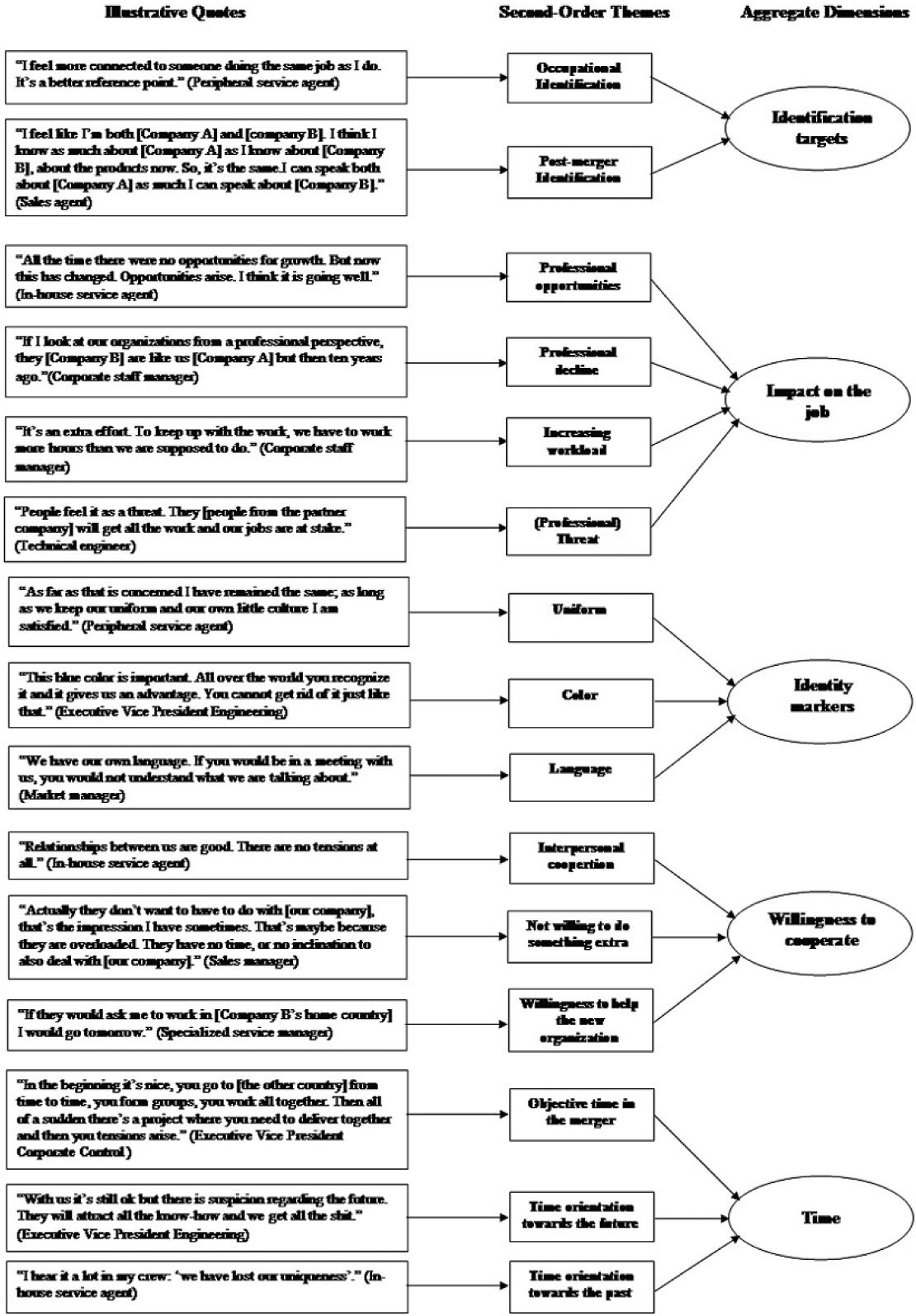
Structure of the qualitative data.
Results of Quantitative Part
Means, standard deviations, and construct correlations are presented in Table 1. Both occupational identification and willingness to cooperate have a relatively high mean, 3.85 and 4.18, respectively. It is interesting to note that the mean for occupational identification is higher than the mean for organizational identification (3.31).
Descriptive Statistics and Correlations Matrix (N = 5,187).
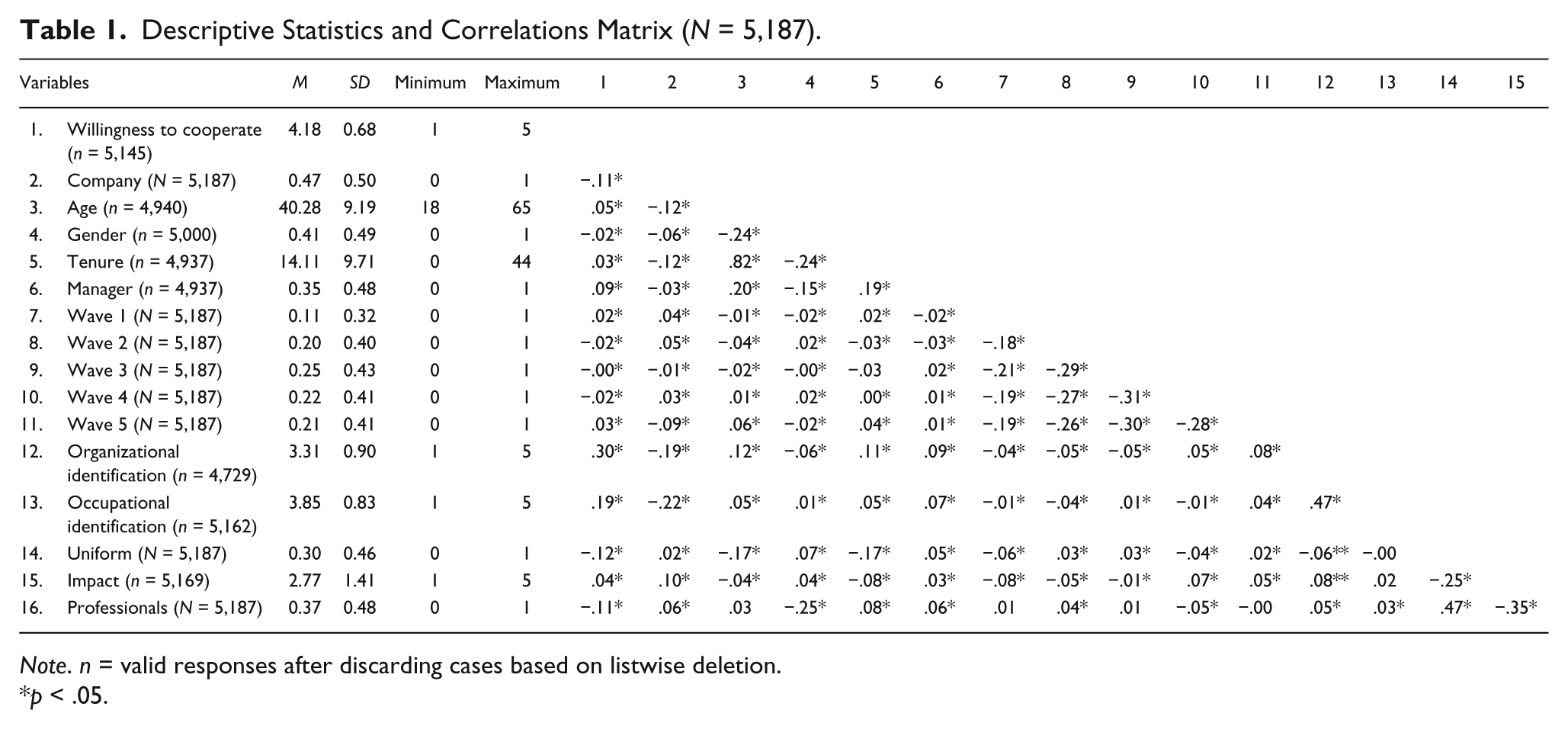
Note. n = valid responses after discarding cases based on listwise deletion.
p < .05.
The results in Table 2 (Model 1) show that employees from the acquiring company are more willing to cooperate in the integration process than employees from the acquired company. This is in line with our expectations that employees from the apparently dominant company experience a greater sense of continuity, which may lead to more positive perceptions about the merger (Van Knippenberg & Van Leeuwen, 2001). Furthermore, employees who have been employed for a longer period of time are less willing to cooperate in the integration process. Age and managerial status in our sample have a positive impact on the extent to which people are willing to cooperate in the integration process, and professional status a negative impact. The latter finding is contrary to our expectations. Finally, we can conclude that male employees are more willing to cooperate than female employees.
Results of Regression Analysis for Willingness to Cooperate (N = 5,187).
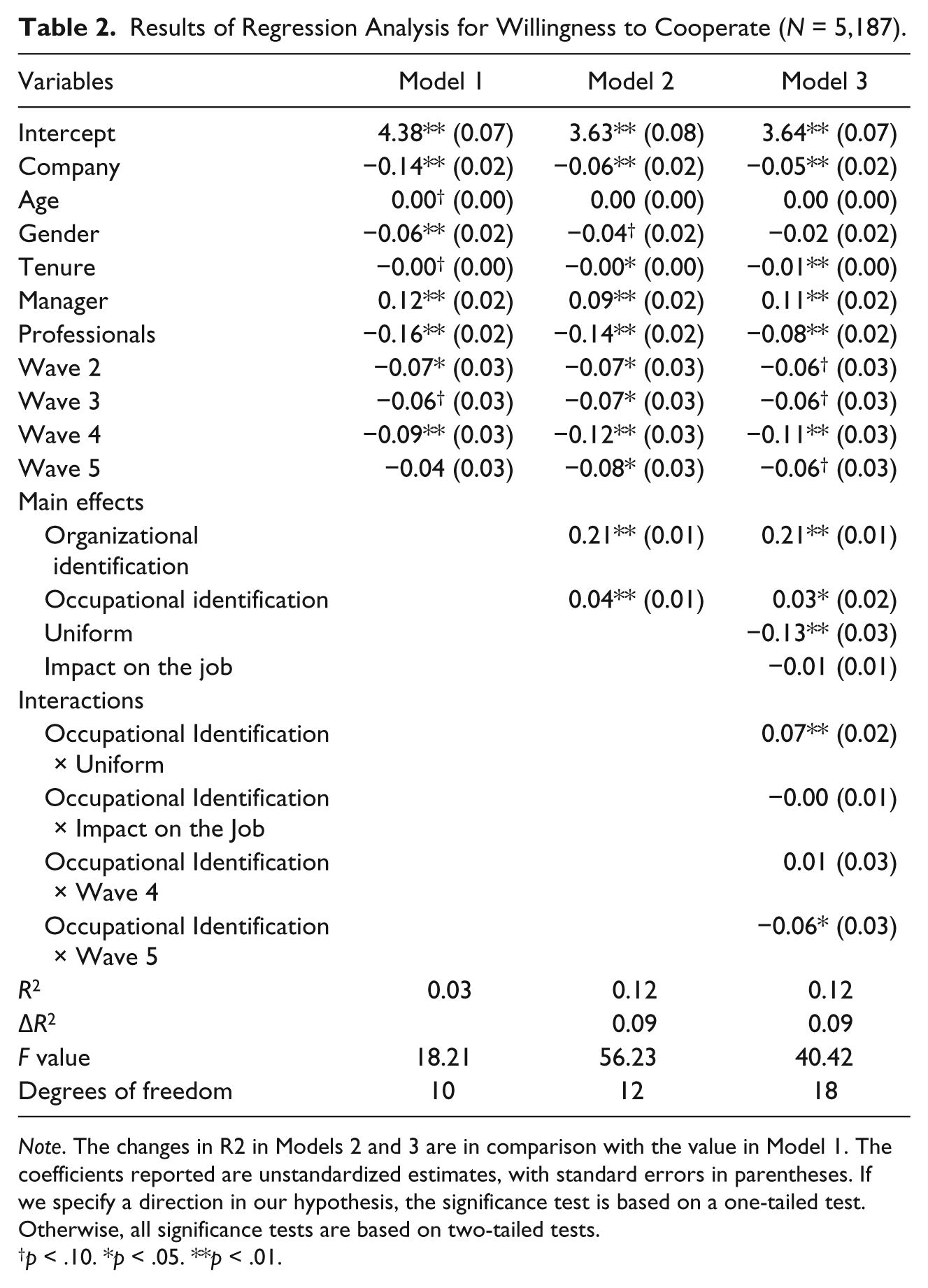
Note. The changes in R2 in Models 2 and 3 are in comparison with the value in Model 1. The coefficients reported are unstandardized estimates, with standard errors in parentheses. If we specify a direction in our hypothesis, the significance test is based on a one-tailed test. Otherwise, all significance tests are based on two-tailed tests.
p < .10. *p < .05. **p < .01.
To examine the effect of both occupational and organizational (post-merger) identification on employees’ willingness to cooperate in the integration process, we introduce these variables in Table 2, Model 2. The additional variance accounted for by the identification variables is significant (ΔR2 = .09, p < .01), which is in line with the findings of earlier studies suggesting that an identity perspective is appropriate in the context of mergers (Ashforth et al., 2008; Drori, Wrzesniewski, & Ellis, 2013; Langley et al., 2012). Confirming earlier findings, we observe that the effect of organizational (post-merger) identification on willingness to cooperate is significantly positive (Kroon et al., 2009). Hence, higher levels of post-merger identification are associated with a greater likelihood that employees will take the organization’s perspective and will act in the organization’s best interest (Bartels et al., 2006; Riketta, 2005; Van Dick et al., 2006). The coefficient of the occupational identification variable in Model 2 is significant and positive (b = 0.04, p < .01), providing support for Hypothesis 1.
Hypothesis 2 predicts that the positive effect of occupational identification on employees’ willingness to cooperate in the integration process attenuates in later phases of symbiotic post-merger integration. In Table 2 (Model 3), we only find the interaction term “Occupational Identification × Wave 5” to be negative (b = −0.06, p < .05). This lends some support to Hypothesis 2. The gradual increase in integration eventually seems to weaken the positive effect of occupational identification. We plotted this interaction in Figure 2.
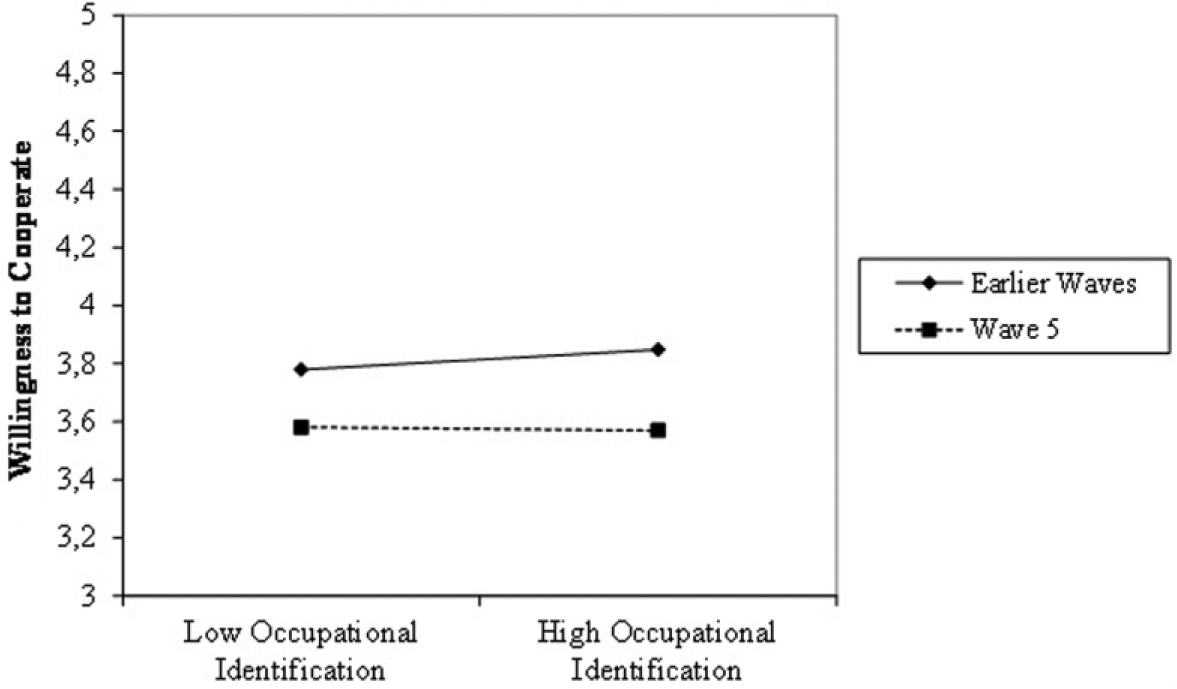
The relationship between occupational identification and willingness to cooperate moderated by Wave 5.
Hypothesis 3 predicts that the positive relationship between occupational identification and willingness to cooperate is weaker for employees whose job is more strongly affected by the merger. In Table 2 (Model 3), we see that the coefficient of the interaction term “Occupational Identification × Impact on the Job” is not significant. Hence, we have to reject Hypothesis 3. An explanation could be that in the merger studied, task autonomy was not that much affected (the mean of the variable “impact on the job” is below the midpoint of a 5-point scale). Moreover, the main effect of “impact on the job” is significantly positive. This indicates that the merger did not disrupt employees to the extent that they felt alienated.
To test whether wearing an organizational uniform has a reinforcing effect on the relationship between occupational identification and employees’ willingness to cooperate in the integration process (Hypothesis 4), we regressed “willingness to cooperate” on “uniform,” “occupational identification,” and “Occupational Identification × Uniform.” As can be seen from Model 3 in Table 2, the main effect of “uniform” is negative (b = −0.13, p < .01), whereas the coefficient of the interaction term “Occupational Identification × Uniform” is significantly positive (b = 0.06, p < .05), thereby supporting Hypothesis 4. In symbiotic post-merger integration, there is a negative effect of creating uniform-based boundaries, but the organizational uniform also reinforces the positive effect of occupational identification. We plotted this interaction in Figure 3.
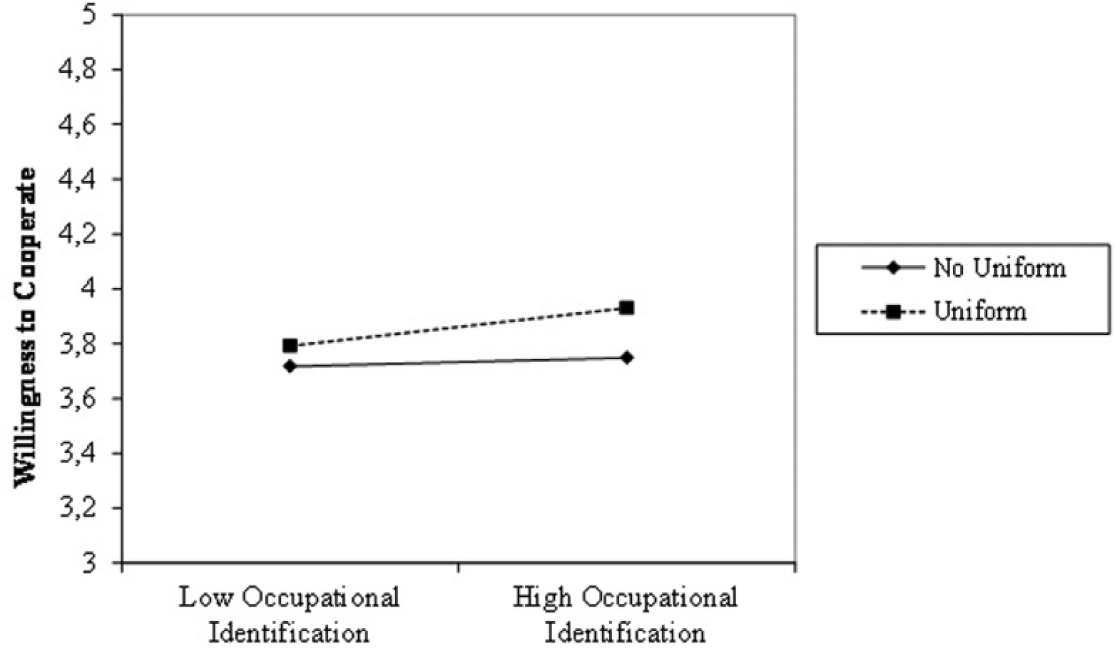
The relationship between occupational identification and willingness to cooperate moderated by uniform.
Results of Qualitative Part
As we went through the interview transcripts, we first focused on generating categories of targets for identification in a post-merger integration context. This process confirmed that, next to the organization, occupation is an important identification target category for organization members. In fact, some employees (in particular the professional workers) could better relate to their occupation compared with their pre-merger (or post-merger) organization. As an informational technology (IT)-specialist noted, “No, it’s first IT, then [Company A], then nothing for a long time, and in the end it’s [company A-B]. It’s just that, how they approach IT, it’s so different. It is difficult feeling part of it.”
In general, our findings suggest that these different identification targets do not drive out each other but in a synergetic way allow organization members to identify with multiple targets in a post-merger integration process (Pratt & Foreman, 2000). Our interview data demonstrate the importance and synergetic nature of, in particular, occupational and post-merger organizational identification:
Do I feel more connected to my occupation or my organization? Actually, to both. It’s not that far apart. Would I be able to perform the same work in a different organization? Yes! Why I am not doing this? I think because this company makes me feel like home. (Technical engineer)
As our interview data further illustrate, organization members differed in the extent to which they were willing to cooperate as an interim outcome in the integration process. Based on our empirically grounded findings, we conceptualize willingness to collaborate as an amalgam of attitudes and behavioral intentions reflected in good personal relations between Company A and Company B members, a willingness to help moving the “new” organization forward, or, conversely, a lack of readiness to go the extra mile. Evidence for this concept emerged not only in a positive sense (“I go through fire and water for the organization”—Sales agent) but also in a negative sense (“You feel the tensions and frustrations [between people from Company A and Company B]”—Technical engineer) and, in the extreme situation, an intention to leave the organization: (“I don’t stay here in this organization forever. Actually, my plans are to make a switch next year and that could be in a different company”—HRM manager). In an attempt to better understand the relationships we found in our quantitative study, we further analyzed the concept of willingness to collaborate in relation to the other themes in our data.
Although the effect of occupational identification on willingness to collaborate in our statistical analysis was lower than that of organizational identification, our interview data suggest the importance of both concepts in explaining organization members’ willingness to cooperate. An HRM manager, for example, explains how both targets of identification make him act in the best interest of the company during the integration process: “I feel more connected to someone else doing the same job as I do. But I also like to be part of something new. This new [Company A–Company B] makes me proud and makes me enthusiastically work for it.” Further evidence is provided by a sales manager who could not identify with his occupation nor with the post-merger organization: “If you would ask me to work for [Company B], my answer would be: ‘No, no way!’ I have to say that I got a bit irritated and now I am like, I just do my own thing.”
We also looked for factors that could potentially influence the relationship between occupational identification and willingness to cooperate in the integration process. A first category that emerged from our analysis was the presence of identity markers. As hypothesized, wearing an organizational uniform that remains the same after the merger confers a sense of continuity and helps employees creating a fit between their occupational identities and new work roles. A service agent noted, “As long as we keep our uniform I am satisfied. It makes you feel being part of your own world.” This, in turn, provided employees with more confidence and comfort in carrying out these roles: “We all walk in the same uniform. It leads us to treat them [Company B members] as colleagues. We are all part of the same group” (In-house service agent). In addition, we noted that organizational uniforms boosted self-esteem and increased status perceptions (Joseph & Alex, 1972). A manager at technical operations told us that their “uniform makes us look like an elite group. It has exposure to the outside world. I have the feeling that other people are looking up to us.” This all resulted in uniformed personnel displaying an increased willingness to cooperate in the integration process. The same manager emphasized, “Yes, I would work harder [for the company].” Interestingly, top management realized the importance of uniforms as identity markers: “A couple of weeks ago we talked about introducing a new uniform. But it turns out that this is a gigantic decision. No new uniform for us . . . ” (Executive vice president of peripheral service agents).
The interview statements also led us to believe that there are other important identity markers that carry out the same role as an organizational uniform does. Two of these identity markers which were most often mentioned by our respondents are the company’s color (“The most important issue at the moment is whether we remain blue 8 ”—Peripheral service agent) and the language that in particular professionals speak among themselves (“We live in our own world. It’s a matter of communicating at the same level. You have to understand it.”—In-house service agent). Speaking the same language further resulted in an increased salience of organization members’ occupational identity and led to more comfort in working together with colleagues from the other company. As an employee from the acquired company noted, “I feel more connected to my occupation compared to the organization. It is a matter of speaking the same language. I have better personal contact with someone doing the same job as I do.”
In our statistical analysis, we did not find support for a significant relation between the merger’s impact on individuals’ jobs and their willingness to cooperate in the integration process. However, our qualitative data allowed us to further examine the nature of the merger’s impact on jobs. This seems to be an important factor in understanding the relation between occupational identification and willingness to cooperate. If the merger leads to a decline in the professional level of work, a threat, or a severe increase in workload, then in particular organization members with high levels of occupational identification appear to be less willing to cooperate in the integration process. A business development manager explained,
Don’t get me wrong, but in terms of content our systems are just better. The state of the art is far better compared to the systems of [Company B]. Yet, we still opt for their systems. This will have serious consequences. It means that we have to take a step back and people get peevish by it. I don’t know whether I still like my work if it turns out to be this way.
In contrast, some of our informants confirmed that the merger’s impact could turn out for the better: “There will be more opportunities. In my daily work I have to make sure that we work towards a common goal. I will get a lot of experience and knowledge from this merger. I am sure of it” (Sales agent). A customer service manager who strongly identified with his profession and with the post-merger organization further noted that autonomy was an important factor in how the impact of the merger was perceived in relation to people’s occupational identity:
What is definitely true is that we get more freedom in this new situation. Herewith we also get more responsibility in our work. If you can cope with this in a correct way, it can lead to many positive things.
Finally, we observed that not only increasing integration with the passing of time but also organization members’ time orientation influences the relationship between occupational identification and willingness to cooperate in the integration process. In general, our qualitative data confirm the results from our statistical analysis. As integration proceeds, employees’ occupational identity is increasingly threatened by the merger and conflicts between organizational and professional requirements, as well as between members from both companies start to arise. A corporate staff manager in the second phase of integration noted,
The feeling changed compared to a year ago. The integration gets more intense and you start fighting about issues. We don’t agree about things. I know it’s wrong and I should not do it but it’s part of my daily work. It affects me.
Beyond the passing of time and the progressively advancing integration, we also found a noteworthy difference between our informants’ time orientations. On one hand, employees (mostly professional workers) expressed a skeptical, and sometimes cynical, view on the future about how the merger would influence their daily jobs. This, in turn, led to feelings of uncertainty, identity threat, and eventually less willingness to cooperate in the integration process. A technical engineer explained this process as follows:
I am really curious how it will look in a few years’ time. What will happen to the group? What will we experience? You hear about this job guarantee of five years. But what will happen after these five years? Will it be like, [Company B] does the fancy stuff and we have to look for some other work? You never know what to expect.
On the other hand, those employees who see the future in a more positive light felt their professional and organizational identity being less threatened and were more willing to cooperate. A specialized service worker reasoned that “people see more opportunities and careers are growing fast because we are growing. There is a good vibe and we don’t complain anymore.”
Another group of employees expressed more nostalgic feelings and longed back to the past and the pre-merger identity of their company. In some cases, it was difficult for people to transfer their identity to the new post-merger organization. Employees in this group also linked their nostalgic feelings to decreasing autonomy in their jobs. A corporate staff member noted that “in the past you were your own boss and you did what felt good. Now you have to take into account the view of the other organization. It certainly has an impact.” This led to an erosion of commitment to the organization and organization members being less likely to act in the organization’s best interest.
Discussion and Conclusion
Drawing on quantitative and qualitative data from a field study of a merger between two service-sector companies, we establish that occupational identification positively influences employees’ willingness to cooperate in the post-merger integration process. This positive influence is stronger for uniformed personnel, and tends to become weaker later in the integration process. Contrary to our expectations, the impact of the merger on the respondent’s job did not moderate the positive relation between occupational identification and willingness to cooperate. We believe our study makes a number of theoretical contributions and has implications for further research.
Recent research suggests that an emphasis on employee resistance to change is inadequate when trying to explain what occurs inside organizational change attempts (Bartunek, Balogun, & Do, 2011; Ford et al., 2008). Our study provides inputs for more complete models of employees’ willingness to cooperate in fundamental change processes. Building on previous studies emphasizing the importance of various types of identification (e.g., Ashforth et al., 2008), we argue that occupational identification is an important, yet overlooked, determinant in post-merger integration. Whereas current research provides more insight into the meaning of occupations and the evolution of an occupational identity, insights into the effects of occupational identification remain limited (Nelson & Irwin, 2014; Pratt et al., 2006). In fact, to the best of our knowledge, the effects of occupational identification have not yet been studied in a merger context.
One might expect that employees’ perceptions about their (occupational) identity are likely to be disrupted by a fundamental organizational change (such as that caused by a merger). However, in some changes, such as the symbiotic merger that we studied, organizational requirements and professional commitments may actually become more aligned. If the “new” post-merger organization meets work expectations and increases the prestige of both the organization and occupations, managers and employees will feel less threatened by the organizational change and are more likely to act in the organization’s best interest. Our empirical analysis indeed shows a significant positive effect of occupational identification on employees’ willingness to cooperate in the integration process, beyond the effect of organizational identification. This is an important contribution because it challenges classical assumptions about the effects of change on identifications and their consequences. The early presumption of unavoidable conflicts between occupational and organizational identification has given way to more nuanced theory based on recent studies across a range of occupations that typically find moderately strong positive associations between occupational and organizational identification (Hassan, 2012). We extend this work into the domain of post-merger integration and provide empirical evidence for the existence of “identity synergy” (Pratt & Foreman, 2000) in this context. We encourage future research continuing the study of independent and distinct relationships between different identification targets and important outcome variables such as organization members’ willingness to cooperate in a merger.
Our findings also demonstrate that there are important moderators influencing the relationship between occupational identification and willingness to cooperate in the integration process. For the effects of occupational identification, the use of identity markers is important. We focused on one extreme form of identity markers, that is, organizational uniforms. Uniforms provide employees with a salient means of expressing their social distinctiveness and social status categorizations (Elsbach, 2003). In our study, these dress markers apparently helped employees to create a bridge between their occupational identities and new work roles. As a result, members of both organizations were better able to signal their occupational identities, which resulted in increased confidence and psychological comfort in relation to the change brought about by the merger. Future studies might further explore the conditions under which organizational uniforms as well as other identity markers help or hinder integration after a merger. The critical influence of language on post-merger integration processes has received some attention (e.g., Kroon et al., 2015; Piekkari, Vaara, Tienari, & Säntti, 2005), but we are not aware of studies that get into the effects of corporate colors. Regarding the effects of uniforms, it would be interesting to study the effect of a forced change in organizational uniform (i.e., the opposite of what happened in the merger we studied).
Our study also points to the importance of the time dimension. Research using real-time data collection within organizations for a long period of time after a merger is completed is rare (Yu, Engleman, & Van de Ven, 2005). The gradual increase in integration eventually seems to cause tensions between occupational identification and employees’ willingness to cooperate. But this effect in our study only becomes notable after 3 years of integration, confirming Colman and Lunnan’s (2011) assertion that it takes approximately 2 years after a merger before many visible effects of the integration process can be noted. This result can likely be attributed to a careful task integration process and a focus on realizing synergies during the course of the integration (Birkinshaw et al., 2000). Future studies could build on our findings and incorporate time as a central theoretical variable when looking at post-merger integration and/or identification processes.
Implications for Practice
Insufficient managerial attention is a key cause of post-merger integration failure (Melkonian et al., 2011; Yu et al., 2005). Our findings stimulate managers to include in their focus an aspect that has so far received little consideration: the identification of employees with their occupation. If managers emphasize in their communication that employees’ occupational identities will remain intact, and that the merger may even provide opportunities for further professional growth, this will help in gaining their willingness to cooperate. Our findings corroborate earlier research suggesting that M&As mean very different things to different departments or groups of employees (Brannen & Peterson, 2009; Larsson, 2005; Monin et al., 2013). For managers and human resources (HR) practitioners, this means that a differentiated approach may be necessary when the organization is involved in a large-scale change process. More specifically, in organizations in which both uniformed and non-uniformed employees are employed, management needs to be aware of the differential effects of identification with the occupation and organization for these groups. Our findings confirm the importance of organizational uniforms as identity markers, but this also means that changing the familiar organizational uniform after a merger is likely to make integration more difficult.
Limitations and Suggestions for Future Research
An important limitation of this study is its (repeated) cross-sectional design. Although we collected data at different points in time, our analysis could not follow changes over time in individual employee perceptions. Any causal interpretation of the results, therefore, is speculative. In future studies, use of longitudinal research designs would allow us to more closely examine how the relationship between identification targets and employee attitudes and behaviors changes over time.
Another limitation concerns the nature of the data, as we collected the independent and dependent variables using the same instrument. However, we undertook several remedies against common method bias. In addition, our support for Hypotheses 2 and 4 is unlikely to be an artifact of single-respondent bias, because it is implausible that respondents will theorize such a moderated relationship when filling out the questionnaire. Furthermore, most of our conclusions are based on interactions with an objective measure (i.e., time and organizational unit), which also argues against an interpretation in terms of common method bias.
Although the effects that we found in our study have a statistically small impact, we believe that these findings are nevertheless important. First, there are methodological reasons for the small effects we found; such effects are usually smaller in field studies (e.g., because of a lack of control) and, therefore, hard to detect (Aguinis, Beaty, Boik, & Pierce, 2005). There are also statistical reasons for the small effects of our interaction terms; measurement error in the independent variable and the moderator is compounded when both variables are multiplied to obtain the interaction term. Second, our qualitative interview data supported and enriched our quantitative methods. Third, on a more theoretical basis, our empirical setting (i.e., a friendly, symbiotic merger) can be regarded as providing a conservative test. In other words, we expect that the (interaction) effects will be more pronounced in mergers of a less friendly nature and/or in mergers that are managed using a more rigorous integration approach.
A final limitation of this study is related to the generalizability of the findings. Our data were collected in one particular merger, where top management chose to pursue a symbiotic post-merger integration approach. In symbiotic post-merger integration, the temporary preservation of the pre-merger organizations is likely to contribute to perceptions of persisting alignment of professional and organizational goals, making it more likely to find support for some of our hypotheses. However, the careful management of the symbiotic merger we studied may have reduced the uncertainty that people normally experience being involved in a merger or acquisition (Cording, Christman, & King, 2008), making it less likely to find effects of occupational identification. Hence, the generalizability of the findings of our study may be restricted to cooperative organizational change processes such as those encountered in a symbiotic post-merger integration process. We encourage future research to replicate or contradict the findings of this study in other organizational change contexts, in which more radical organizational discontinuities occur.
Our qualitative research suggests that some of the factors we studied are more complex than reflected in our quantitative study. This pertains in particular to identity markers, which go beyond organizational uniforms, and also include corporate colors, language, and probably much more. It also pertains to the time dimension. Although we have focused on the effects of objective time, employees also differ in their perceptions of past and future, and it seems worthwhile to explore the effects of this in relation to identification in a post-merger context. Taken together, these future research directions will hopefully enrich our understanding of multiple identification processes in times of organizational change.
Footnotes
Appendix
Multi-Item Survey Constructs
| Standardized Factor Loadings (λ) | |
|---|---|
| Willingness to Cooperate (α = .66) | |
| 1. If the cooperation with Company A/Company B has an influence on my work, I will do my best to succeed | .82 |
| 2. I am open to cooperate with my colleagues from Company A/Company B when necessary | .76 |
| 3. I’m not willing to put myself out just to help the Company A/Company B combination | .40 |
| Occupational Identification (α = .85) | |
| 1. When someone criticizes my occupation, it feels like a personal insult | .70 |
| 2. I am very interested in what others think about my occupation | .68 |
| 3. When I talk about my occupation, I usually say “we” rather than “they” | .60 |
| 4. When someone praises my occupation, it feels like a personal compliment | .87 |
| 5. My occupation’s successes are my successes | .78 |
| Organizational (post-merger) Identification (α = .85) | |
| 1. When someone criticizes (Company A–Company B), it feels like a personal insult | .64 |
| 2. I am very interested in what other think about (Company A–Company B) | .70 |
| 3. When I talk about (Company A–Company B), I usually say “we” rather than “they” | .68 |
| 4. When someone praises (Company A–Company B), it feels like a personal compliment | .84 |
| 5. (Company A–Company B) successes are my successes | .81 |
Acknowledgements
We are greatly indebted to associate editor Orlando Richard and the four anonymous reviewers for their constructive guidance in our paper’s revision process. We also thank Alma Timmers, Audrey Rouzies, Philippe Monin, and Tessa Melkonian for their role in the data collection process.
Associate Editor: Orlando Richard
Declaration of Conflicting Interests
The author(s) declared no potential conflicts of interest with respect to the research, authorship, and/or publication of this article.
Funding
The author(s) received no financial support for the research, authorship, and/or publication of this article.