



Abstract
Counterfeits cause tremendous damages to brand companies by eroding their market shares and reducing customers’ buying motives. In response to such damages, many companies choose to develop and deploy anti-counterfeiting technologies, thus preventing counterfeiters from imitating their products. The companies can also rely on law enforcement exerted by local regulatory authorities to outlaw counterfeits. In this article, we study how brand companies may leverage the two approaches effectively. Specifically, we consider an authentic company that sells its products to a market that is administered by its regulatory authority. A counterfeiter exists in the market and may imitate the product offered by the authentic company. To combat counterfeiting, the authentic company may invest in anti-counterfeiting technology with uncertain outcomes, aiming to help customers effectively distinguish between genuine and fake products. We show that an increase in the authentic company’s anti-counterfeiting capability does not necessarily yield a higher profit. We also find that, in equilibrium, the anti-counterfeiting effort exerted by the authentic company does not necessarily decrease with the penalty levied by the authority, even though they serve the same purpose. Our analysis further highlights the importance of coupling law enforcement type with anti-counterfeiting capability in the cooperation with the regularity authority. Specifically, when having a high (low, respectively) anti-counterfeiting capability, the authentic company should promote a cooperation that focuses on preventive (corrective, respectively) law enforcement.
Introduction
Counterfeit products have posed a severe threat to the global economy. According to the Organization for Economic Cooperation and Development (OECD), transactions of counterfeit and pirated goods accounted for up to 2.5% of global trade in 2019 (OECD, 2021). The U.S. Customs and Border Protection (CBP) reported that the monetary value of confiscated fakes have risen to $3.3 billion. 1 Alongside the increasing volume of counterfeit products, the counterfeiting business is becoming more diversified. Counterfeiters are no longer limited to producing clothing or footwear of well-known brands in labor-intensive industries. They have expanded their scopes into more sophisticated products, including electronics products (such as mobile phones) or healthcare products (such as drugs and vaccines). What makes the situation even worse is that counterfeiters are establishing new sales channels, including fake franchise stores and online shops on e-marketplaces in emerging economies (Asian Age, 2016). Counterfeiting activities cause substantial losses on brand companies. The presence of counterfeits erodes market share of genuine products. Moreover, counterfeits are typically of inferior quality compared to genuine ones. For consumers, the risk of getting counterfeits and thus suffering inferior qualities makes them reluctant to purchase. Decreased market shares and diluted purchase motives may in turn discourage brand companies from improving product quality and expanding product offerings, ultimately harming consumer welfare.
In practice, two approaches have been widely employed to prevent counterfeiting activities, legal actions and anti-counterfeiting technologies. Regulatory authorities in most countries have established Intellectual Property Rights (IPR) enforcement teams to identify and penalize IPR violations. Parallel to other practices of law enforcement, IPR enforcement teams can undertake either preventive actions or corrective actions. For the former, the IPR teams may actively inspect factory floors of local business owners. Whenever any counterfeiting activity is detected, the team suspends business licenses of related parties and confiscates equipment used for production. Via such preventive actions, the IPR enforcement teams can prevent counterfeit products from being produced and sold to consumers. On the other hand, if those products have reached the hands of consumers, the teams can turn to corrective actions. Specifically, in response to infringement reports about the selling of counterfeit products, the teams will collect evidence of the selling, freeze generated financial flows, engage in legal procedures of copyright or trademark violations, and compensate brand companies for their losses. That said, it is worth noting that IPR enforcement in emerging economies is indeed weak and limited due to large market sizes, inadequate budgets, and the focus placed on economic development. In fact, as reported by the media, 50% of the goods listed on the largest online and mobile marketplace in China are either fakes or products that infringe the IPR of others (Dasgupta, 2015).
Realizing the inefficiencies of IPR enforcement in emerging economies, many brand companies have turned to advanced anti-counterfeiting technologies to protect their products from being imitated. These brands develop and deploy anti-counterfeiting features (including but not limited to authenticity labels, certificates, and packages), which presumably may help their customers distinguish genuine products from counterfeit ones. According to a market report, the global anti-counterfeiting packaging market is projected to reach USD 326.3 billion by 2029. 2 Among these solutions, holographic anti-counterfeiting labels are the most well-known and widely used, particularly in the food and pharmaceutical industries (Haleem et al., 2022; Yang et al., 2024). Recently, leading pharmaceutical companies such as Pfizer took further steps to strengthen their efforts against counterfeit drugs by investing in more advanced technologies—including radio-frequency identification (RFID) and blockchain—to verify product authenticity in markets prone to counterfeiting (Pfizer, 2024).
Ironically, advanced technological developments such as 3D printing, digital scanning, and AI-driven design tools not only benefit brand companies but also enable counterfeiters to produce highly convincing fake products capable of deceiving customers (Meraviglia, 2018; Origify, 2024). This trend is further fueled by the presence of black markets in emerging economies, where illicit manufacturers are enabled to procure replicas of anti-counterfeiting features (Chen, 2023; Reuters, 2024a; Xinhua, 2016). Entities in black markets may reverse-engineer genuine products to replicate anti-counterfeiting features through various technological means. They may also bribe unethical employees of authentic companies to collect technical specifications or designs of proprietary anti-counterfeiting features, and then imitate such features with their own equipment. As reported by Wired (2007), while holograms were once considered a highly reliable method for authentication and were widely adopted across industries, counterfeiters can now easily order duplicates of holographic labels from suppliers via illicit channels.
As commented by GSK (2024), “[t]echnological advances have meant it is easier for criminals to accurately reproduce packaging[,] making it increasingly difficult for consumers to distinguish between authentic and counterfeit products.” As a matter of fact, it has been well recognized by industrial practitioners that anti-counterfeiting technologies employed by pharmaceutical companies are likely to become accessible to counterfeiters within 12 to 18 months and need to be improved and updated regularly (Bansal et al., 2013). In short, while anti-counterfeiting technologies are widely adopted, it is not rare that such efforts could become unreliable. As a result, they may fail to boost either consumers’ buying motives or brand companies’ profits. Given the substantial costs associated with anti-counterfeiting measures and the potential unreliability of these technologies in combating counterfeiting activities, brand companies must carefully evaluate whether to invest in developing anti-counterfeiting technology and, if so, determine the appropriate level of investment (Reuters, 2024b).
Building on the above industry dynamics, this article seeks to answer the following research questions: Whether and when should an authentic company deploy an anti-counterfeiting technology, given the possibility that the technology developed is unreliable? How does the regulatory authority of the market affect the authentic company’s decision on its anti-counterfeiting effort and its profit? What are the implications for the company if the regulatory authority places its focus on preventive enforcement, as opposed to corrective enforcement?
To address these research questions, we consider an authentic company that offers its products to a consumer market, where a counterfeiter may imitate the genuine products and sell them to consumers. To combat counterfeiting, together with its product offerings, the authentic company can exert an anti-counterfeiting effort to develop an anti-counterfeiting technology, preventing its products from being imitated. Meanwhile, the counterfeiter may acquire replicas of imitated anti-counterfeiting features from external sources and attach them to their products to imitate genuine products. The cost of obtaining a replica depends on the reliability of the anti-counterfeiting technology developed by the authentic company. If the anti-counterfeiting technology turns out to be reliable (unreliable, respectively), the cost of a replica for the counterfeiter is high (low, respectively). The authentic company’s anti-counterfeiting effort determines the probability of the anti-counterfeiting technology being reliable (the larger the investment, the more likely the technology turns out to be reliable).
Conditional on the realized imitation cost, the counterfeiter decides on whether or not to make deceptive counterfeits. If the counterfeiter decides to do so, it faces a penalty levied by the regulatory authority of the market once the counterfeiting activity is detected either before or after the sales. For customers in the market, they cannot differentiate between genuine products offered by the authentic company and deceptive counterfeits made by the counterfeiter (for customers, they cannot distinguish two products based on their appearance including some anti-counterfeiting features). Furthermore, they have no information regarding the decision made by the authentic company on exerting the anti-counterfeiting effort and that by the counterfeiter on producing the fake. As a result, she has to form a belief when making the purchase decision.
We find that the authentic company’s equilibrium profit is not monotonically increasing in its anti-counterfeiting capability. In more detail, when the company’s anti-counterfeiting capability is relatively low, a marginal increase in its capability may backfire by reducing its equilibrium profit. This occurs because the increase in the anti-counterfeiting capability makes the counterfeiter more likely to produce and sell a fake, thereby completely negating the benefit gained from the increased capability. This result suggests that for a brand company targeting high profitability, a significant improvement in its anti-counterfeiting capability can be necessary. We also find that the anti-counterfeiting effort exerted by the authentic company does not necessarily decrease in the penalty levied by the regulatory authority, even though they serve the same purpose of countering the counterfeiting activity. In fact, an increase in the penalty has two opposite effects on the company’s profit. On the one hand, it can discourage the counterfeiter from making and selling its fake, thus helping save the anti-counterfeiting cost; on the other hand, it can attract more customers to make a purchase, which drives the authentic company to exert more effort. Our analysis shows that the latter effect dominates when the penalty is relatively light and the counterfeiter does not enter the market with certainty (i.e., the counterfeiter plays mixed strategy). This result can yield an important and non-intuitive message to brand companies that engage in a business relationship with emerging economies. Specifically, while some governments of those economies have started to strengthen their IPR enforcement (e.g., by charging higher penalties on counterfeiting activities), it probably cannot help decrease brand companies’ spendings on anti-counterfeiting technologies because the companies may hardly enjoy a free ride by relying purely on the improved enforcement. Instead, they need to increase their investments in anti-counterfeiting technologies as well. In addition, we show that when the authentic company’s anti-counterfeiting capability is high, increasing corrective reinforcement intensity could disincentivize the company from exerting its effort to protect its products from being imitated, which could inadvertently lead to an increased probability of counterfeit occurrences.
We further analyze the preventive and corrective law enforcements and compare their impacts. Our analysis reveals that compared with corrective law enforcement (which penalizes the counterfeiter after the selling of its products), when the anti-counterfeiting capability is low, preventive law enforcement (which outlaws the counterfeiter beforehand) may reduce the counterfeit occurrence probability in equilibrium more effectively, at the cost of bringing a lower equilibrium profit to the company. The reason comes from an over-investment problem. In fact, preventive law enforcement raises customers’ expectations for the product quality and thus motivates the counterfeiter to enter the market. This forces the authentic company to increase its anti-counterfeiting effort as well, thereby raising the company’s cost burden. This finding highlights the need for brand companies, including those with strong anti-counterfeiting capabilities, to maintain close collaboration with regulatory authorities. It also underscores the importance of the coupling between the company’s anti-counterfeiting capability and the regulatory authority’ law enforcement type: a company with a high (or low, respectively) anti-counterfeiting capability should advocate for a cooperation that emphasizes preventive (or corrective, respectively) law enforcement. We also study the consumer welfare implications of these two law enforcement types and show that with a high anti-counterfeiting capability being in place, preventative law enforcement benefits both the authentic company and customers.
The remainder of the article is organized as follows: in Section 2, we review related literature. We then present the model and assumptions in Section 3 and derive the equilibrium solution in Section 4. In Section 5, we examine the impact of the regulatory authority’s law enforcement on the authentic company’s equilibrium strategy, followed by some extensions and discussions in Section 6. Finally, we conclude our article in Section 7. All the proofs and extended discussions can be found in the E-Companions.
Literature Review
While Leibenstein (1950) studied the impact of counterfeit products on consumer behavior, early works on counterfeit products either focus on photocopying problems (Besen and Kirby, 1989; Johnson, 1985; Liebowitz, 1985) or are qualitative in nature (Harvey, 1987; Harvey and Ronkainen, 1985).
Grossman and Shapiro (1988a, 1988b) initiated a stream of literature that models and analyzes the trade problem of counterfeit products. They classified counterfeit products into two types, non-deceptive counterfeit products and deceptive ones. For non-deceptive counterfeit products, consumers know that they are purchasing counterfeit products (as opposed to genuine products) after a close inspection or by inferring information from product distribution channels. Thus, in this scenario, consumers choose to buy counterfeit products mainly for the sake of low price. Economic impacts of non-deceptive counterfeit products have been extensively studied, with representative references including Grossman and Shapiro (1988a), Conner and Rumelt (1991), Banerjee (2003), Yao (2005), Tsai and Chiou (2012), Gao et al. (2017), Pun and DeYong (2017), Yi et al. (2022), Chen et al. (2022), and Lu et al. (2023). For deceptive counterfeit products, consumers are incapable of distinguishing them from genuine goods. Hence, the consumers can at best form a belief about the genuineness of products available in the market and then make their purchase decisions based on that belief.
In research on deceptive counterfeit products, the majority of studies focus on how genuine companies deter counterfeiters from entering the market. Grossman and Shapiro (1988b) studied an international trade problem where foreign suppliers produce both legitimate low-quality products and counterfeit products that imitate genuine products offered to the domestic market. Zhang and Zhang (2015) developed an optimal supply chain structure in a market with deceptive counterfeit products. Cho et al. (2015) demonstrated that the effectiveness of anti-counterfeiting strategies depends largely on whether an authentic company faces a non-deceptive counterfeiter or a deceptive one. Ding (2014) found that the presence of counterfeit products helps a monopolist alleviate the time-inconsistency problem. Based on a vertical product differentiation model, Qian (2014) took into account two layers of asymmetric information and shows that enforcement and fixed-cost signals can relax conditions for separating equilibrium. Qian et al. (2015) showed that an authentic company tends to improve its searchable quality more than its experiential quality. Gao (2018) modeled overt technologies as a fixed barrier cost for counterfeiters and examine how this barrier cost affects counterfeiter entry into a dubious drug market. Pun et al. (2021) explored the value of adopting the blockchain technology and how the adoption may be influenced by government policies, including subsidies and corrective enforcement. Shen et al. (2022) illustrated that the usage of a permissioned blockchain technology benefits a brand company (i.e., the incumbent) via discouraging the entry of a copycat (i.e., the counterfeiter) and thus affects the supply chain performance of the company. Gao and Wu (2023) examined a retailer’s decision on whether to sell authentic products or counterfeit goods, and how regulation influences this choice. Lu et al. (2023) studied how converting counterfeiters can benefit brand companies and influence the social welfare. Li et al. (2023) addressed a product authenticity problem in which a platform offers inspection services to buyers.
As we consider a problem in which customers cannot differentiate a genuine product made by an authentic company from a fake by a counterfeiter, this article is in line with the stream of literature that studies deceptive counterfeits. Our game-theoretical model differs from the existing literature (e.g., Pun et al. 2021) via the following three salient features: First, while the existing literature assumes that the decision on adopting the anti-counterfeiting technology is binary and once adopted, it yields a certain outcome, our paper treats the investment in the anti-counterfeiting technology as a continuous decision variable associated with uncertain outcomes; Second, in our model, the authentic company cannot commit its anti-counterfeiting effort to customers, which reflects the reality that consumers often lack the domain knowledge to assess the effort and have to form a prior belief without relying on it. Third, to the best of our knowledge, this work is the first study to consider both preventive and corrective law enforcements in the same modeling framework and compare their impacts on the optimal anti-counterfeiting strategy. These modeling features set a distinction between our paper and those in the literature and render rather unique results and insights.
Model and Assumptions
Consider an authentic company that sells its products. The unit production cost is
The mass of customers in the market is normalized to one. We assume that customers are heterogeneous regarding their willingness to pay. We use a parameter
For a customer, she is not able to tell the genuineness of a product at the time when she decides on whether to purchase a unit.
5
As a result, the type-
To combat counterfeiting, the authentic company can invest in and develop an anti-counterfeiting technology. However, as highlighted in the introduction, the technology may not be perfect. After the company launches its genuine products, the counterfeiter may obtain imitated anti-counterfeiting features (e.g., labels, tags, certificates, or packages) through external channels such as black markets. 6 In what follows, we will refer to these anti-counterfeiting features collectively as “labels,” though the scope extends beyond its conventional meaning. If the authentic company invests more in its anti-counterfeiting technology, the resulting features become technologically more difficult for the black markets to imitate. Thus, it is more likely that the anti-counterfeiting technology will turn out to be reliable, making it extremely costly for the counterfeiter to obtain the imitation labels.
Formally, we let
We denote by
If the anti-counterfeiting technology turns out to be unreliable (i.e.,
The availability of counterfeit products could affect the sale of the genuine products to different degrees. For example, the adverse impact could be low (high, respectively) if the authentic company (the counterfeiter, respectively) can effectively guide customers to visit their stores. In this stylized model, to emphasize the effect of law enforcements on combating counterfeit products, we consider the worst case. That is to say, the sales of the genuine products are zero if the counterfeiter is able to sell goods on the market (we will relax this assumption in Section 6.2).
Selling counterfeit products is illegal in this economy. To hinder such illegal activities and protect the IPR, the regulatory authority of the market forms an enforcement team to administer the market. The team can put factory floors into close scrutiny. As a result, the counterfeiter may be detected, followed immediately by a preventive legal action, such as a revocation of its business license and a confiscation of its production equipment prior to the occurrence of any sale. We assume that the enforcement of the preventive legal action takes place with a probability of
The sequence of events is as follows:
The authentic company exerts its anti-counterfeiting effort level If the anti-counterfeiting technology turns out to be unreliable (that is, Whether the preventive legal action is enforced is realized. If the preventive legal action is in place, the counterfeiter incurs the penalty cost The customers decide on whether to buy a product from the market. Whether the corrective legal action is enforced is realized. If the corrective legal action is in place, the counterfeiter incurs the penalty cost
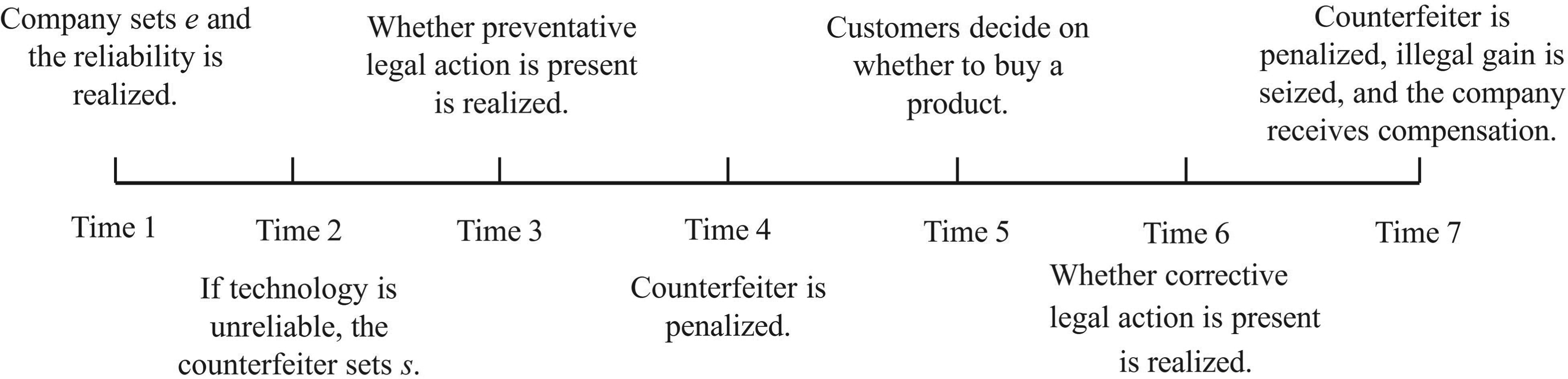
Sequence of events.
In the base model setting, the customers, when deciding whether to buy a product on the market, cannot observe the authentic company’s anti-counterfeiting effort
To recap, our model has three unique features that set it apart from the existing literature. First, it treats the investment in the anti-counterfeiting technology as a continuous decision variable associated with uncertain outcomes. Second, it assumes that the authentic company’s anti-counterfeiting effort is non-committal to customers due to their lack of domain knowledge. Third, it incorporates and compares both preventative and corrective law enforcement measures in the same modeling framework. As will be shown later, those features contribute to generating rather unique results and insights.
In this section, we first establish the authentic company’s and counterfeiter’s objective functions. Second, we define the equilibrium for this game. Third, we derive the equilibrium solution for this game.
First, the authentic company’s profit function can be formulated as follows:
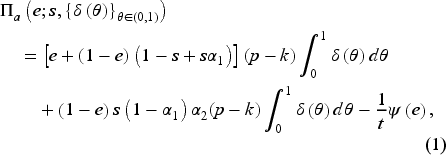
Next, we can formulate the profit function of the counterfeiter with
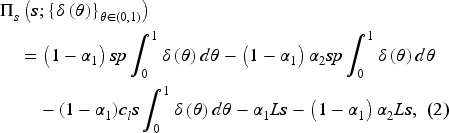
With the above preparation, we are in position to define the equilibrium solution in this game. We adopt the concept of perfect Bayesian equilibrium throughout the article.
A profile of strategies
Conditions (i) and (ii) require that both the authentic company and the counterfeiter maximize their respective profits in equilibrium. Condition (iii) means that the customers maximize their utility based on their belief. Finally, condition (iv) mandates that the customers’ equilibrium belief be consistent with equilibrium play. We note from condition (iv) that
Applying the first-order condition to the authentic company’s problem yields the best response associated with the anti-counterfeiting effort as follows:

Similarly, by solving the counterfeiter’s optimization problem, we obtain that the counterfeiter’s best response strategy satisfies
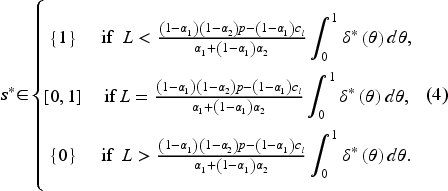
We let

For notational simplicity, we define
The equilibrium outcome can be characterized as follows:
If If when when
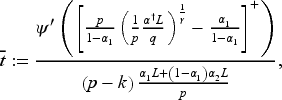
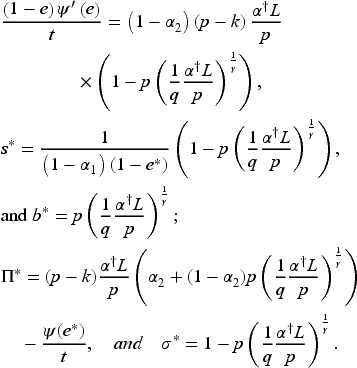
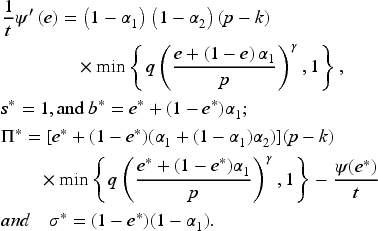
Proposition 1 confirms our intuition that whether the authentic company exerts its anti-counterfeiting effort depends on the penalty level
When the penalty
With the characterization of the equilibrium solution, we are ready to study how the company’s anti-counterfeiting capability affects the equilibrium strategy and the equilibrium profit of the authentic company. From Proposition 1, it is clear to see that when the penalty
Suppose Both the authentic company’s equilibrium anti-counterfeiting effort level The authentic company’s equilibrium profit
Proposition 2(a) shows that with increased anti-counterfeiting capability, the counterfeiter with
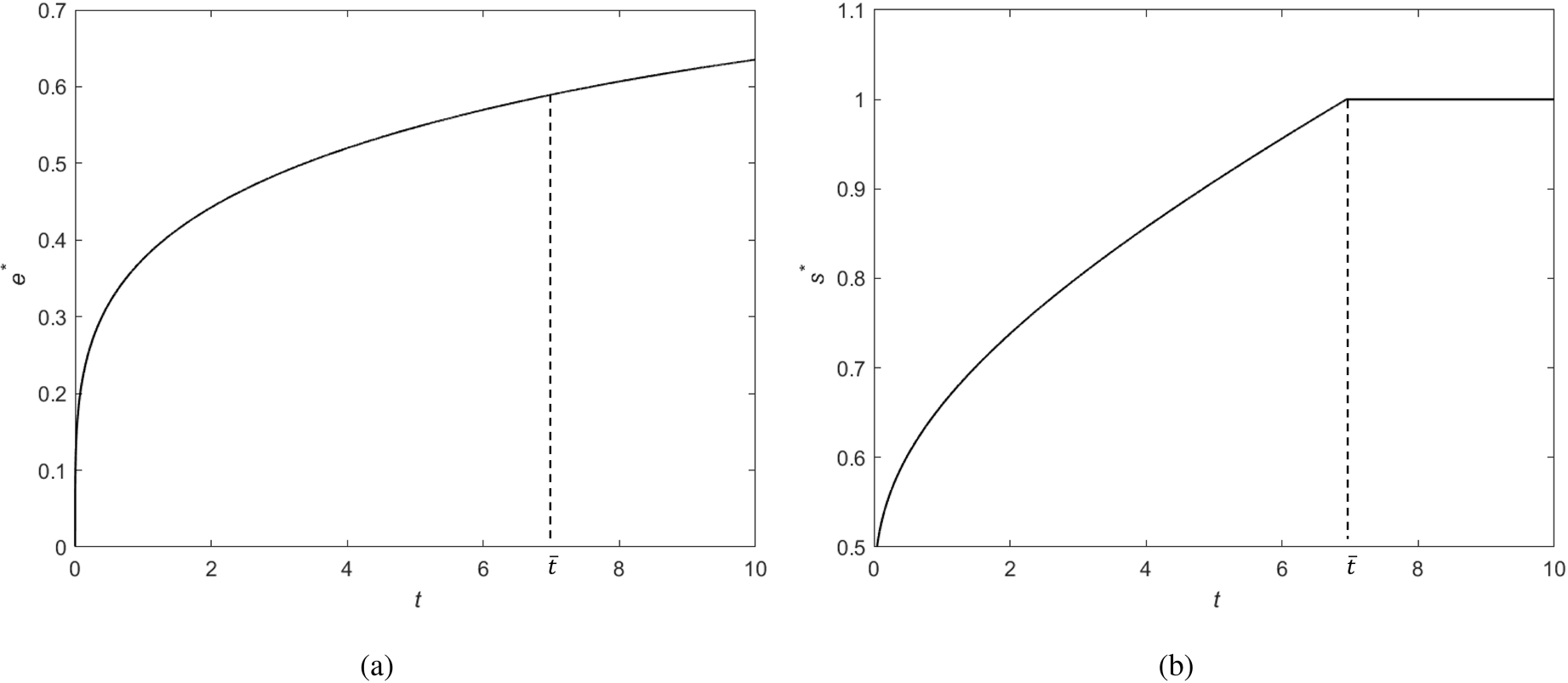
Equilibrium decisions in the base model; model parameters:
More interestingly, Proposition 2(b) reveals the impact of the anti-counterfeiting capability on the equilibrium profit. As illustrated in Figure 3(a), the authentic company’s equilibrium profit
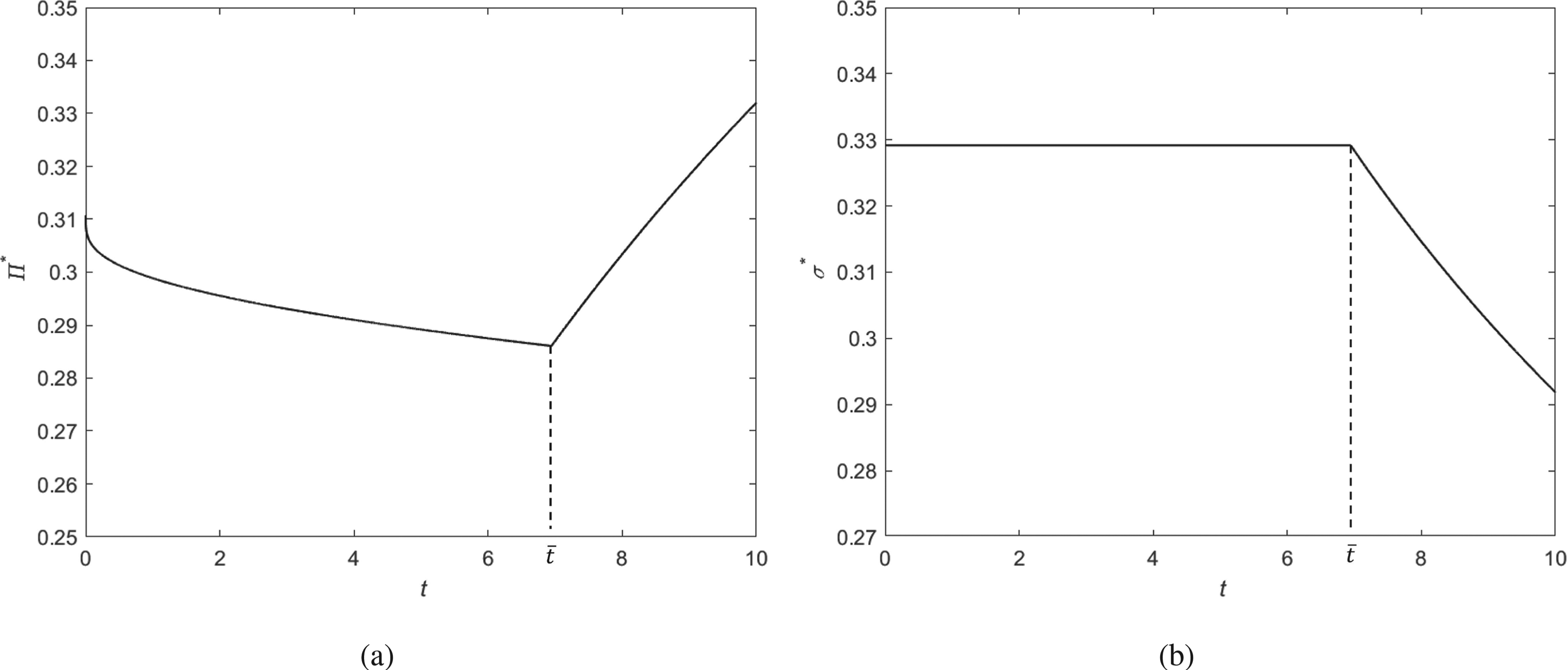
Authentic company’s equilibrium profit and counterfeit probability; model parameters:
The structural property of
In this section, we study the impacts of law enforcement. We first investigate how the authentic company’s equilibrium anti-counterfeiting effort is influenced by the penalty level
Impact of Penalty and Enforcement Intensity
The following proposition presents the impact of penalty on the company’s equilibrium effort and the resulting counterfeit occurrence probability.
Suppose
The comparative statics for the equilibrium counterfeit occurrence probability is rather intuitive. As shown in Proposition 3, this probability is non-increasing in the penalty
The comparative statics for the equilibrium anti-counterfeiting effort, on the contrary, is quite complicated. One may conjecture that an increase in the penalty may decrease the equilibrium anti-counterfeiting effort exerted by the authentic company, that is,
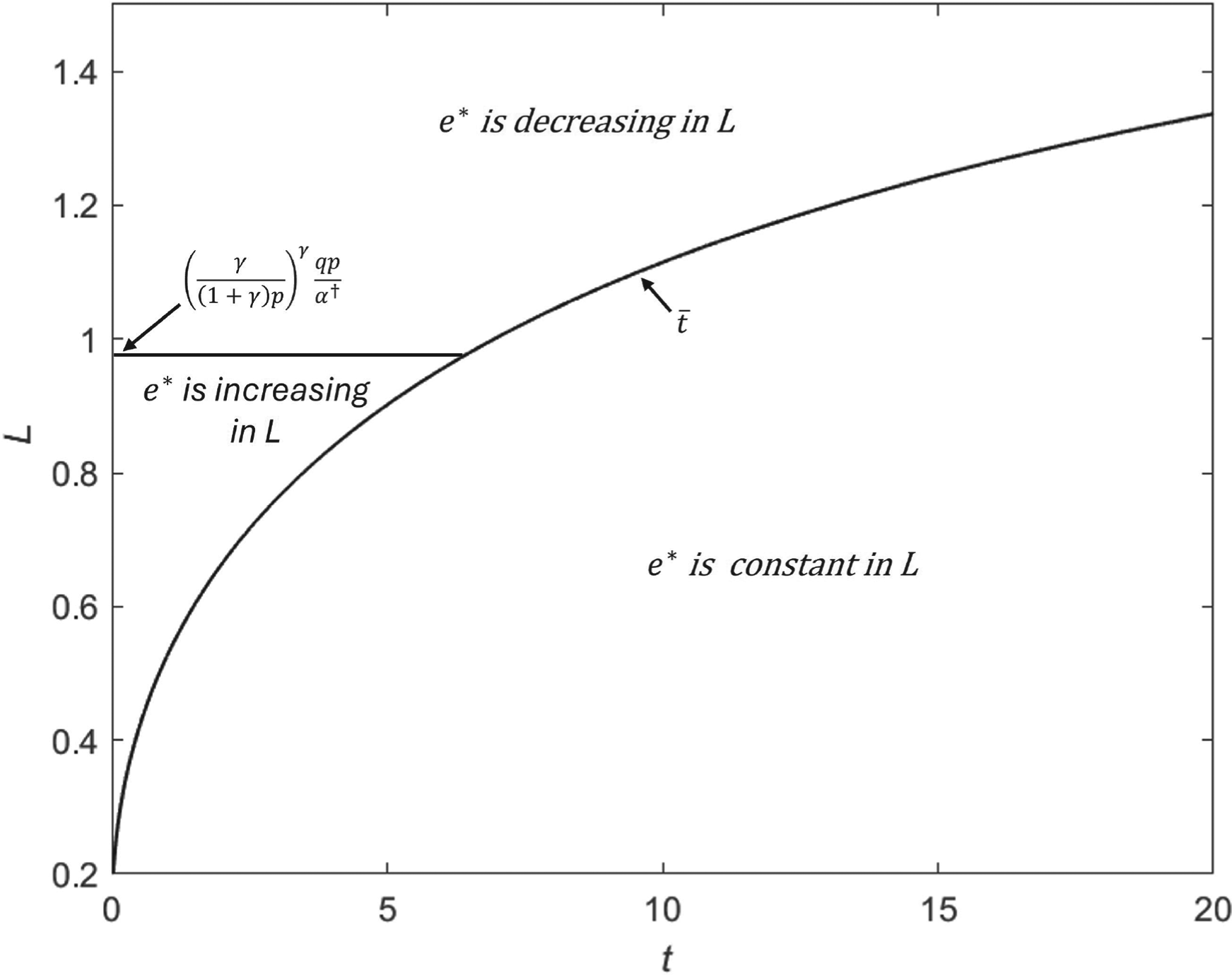
Impact of penalty on authentic company’s anti-counterfeiting effort; model parameters:
To understand this result, we recall from Proposition 1 that in this case, we have
The above result can yield an important and non-intuitive message to regulatory authorities and brand companies. Specifically, although governments of some emerging economies start to strengthen IPR enforcement (e.g., by increasing penalties imposed on counterfeiting activities), doing so probably cannot alleviate brand companies’ cost burden brought by exerting anti-counterfeiting efforts, because those companies may not be able to enjoy a free ride by purely relying on the strengthened enforcement; instead, they need to increase their investments in anti-counterfeiting technologies as well. As a side proof, according to Nandi (2025), though law enforcements for intellectual property are continuously improved, the Asia-Pacific region is considered as the fastest growing market for anti-counterfeiting technologies.
We also conduct comparative statics analysis for model parameters
Suppose
Proposition 4 first shows that the main comparative statics results for the penalty
Proposition 4 further finds that when the anti-counterfeiting capability is relatively high, that is,
We have incorporated two types of law enforcement into our model: preventive and corrective measures. As discussed, preventive law enforcement outlaws counterfeit goods before the counterfeiter can sell them to the market, while corrective law enforcement takes effect only after counterfeit goods are sold. We now examine how these two enforcement types influence the authentic company’s equilibrium strategy and its equilibrium profit. To isolate their respective impacts, we consider two special cases. In the first case, only the preventive law enforcement is available (i.e.,
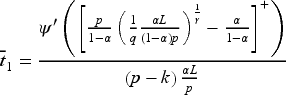
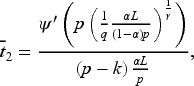
Suppose There exists a
Proposition 5(a) shows that compared to corrective law enforcement, preventive law enforcement induces higher effort from the authentic company and makes the counterfeiter entry more likely (see Figure 5(a) and (b) for illustration). This result is mainly due to the increased customers’ expectation on the genuineness of the product to be purchased. Indeed, when the preventive law enforcement is in place, the products sold on the market are more likely to be the genuine ones since the counterfeit products are likely to be outlawed before the purchase.
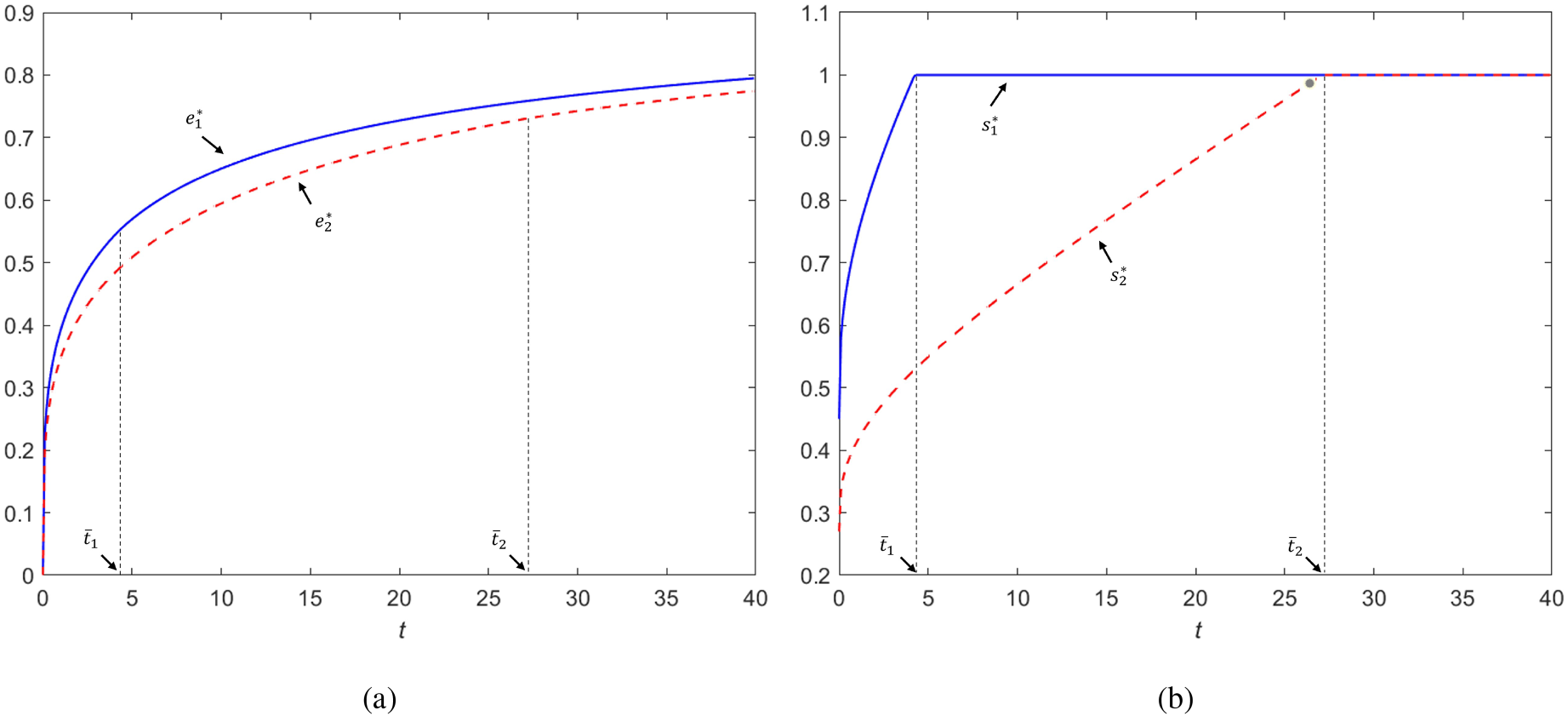
Equilibrium decisions with different law enforcements; model parameters:
Proposition 5(b) and (c) shows that the two types of law enforcement pose different impacts on the authentic company’s profit and the probability of counterfeit occurrence. Specifically, compared to the corrective law enforcement, when the authentic company’s capability of anti-counterfeiting is high, the preventive law enforcement not only lowers the equilibrium counterfeit occurrence probability (thus, attracting more customers to purchase) but also leads to a higher equilibrium profit for the authentic company. However, when the capability of anti-counterfeiting is low, the preventive law enforcement would make the authentic company worse off (see Figure 6). The reason behind this counter-intuitive result is as follows. Note that when the preventive law enforcement is in place, from Proposition 5(a), the counterfeiter becomes more aggressive (via setting a higher
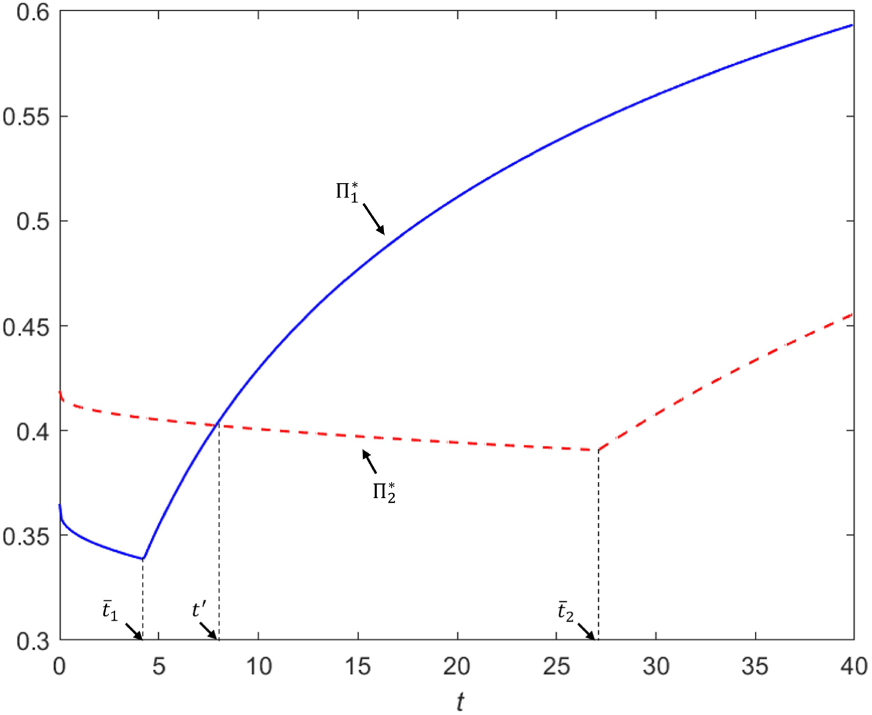
Equilibrium profits with different law enforcements; model parameters:
In short, our analysis highlights the value of brand companies’ collaboration with regulatory authorities and more importantly, implies that the value depends heavily on the coupling between the anti-counterfeiting capability and the law enforcement type. Particularly, when a brand company has a good anti-counterfeiting capability, the company needs to promote a preventative collaboration with the regulatory authority so that the regulatory authority puts more resources into preventive law enforcement, such as inspecting factory floors and warehouses of local business owners that make similar products. That way, the counterfeits of the company’s products could hardly be produced and delivered to the market. On the other hand, if the company has a weak anti-counterfeiting capability, it is desirable for the company to establish a reactive collaboration with the authority by which the authority will place more focus on handling infringement reports during its selling process, such as collecting evidence from the market, conducting legal prosecutions against counterfeiters, and compensating the brand company with levied fines. A blinded cooperation without considering its own capability of anti-counterfeiting may not serve the company’s best interest, yielding an over-protection of the company’s brand and a decrease in its profit.
Finally, we analyze how these two types of law enforcement affects the consumer welfare. To that end, we follow the literature and define the consumer surplus

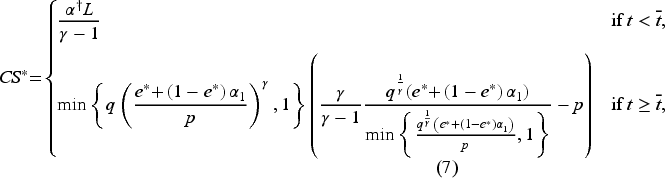
We also define
Suppose
Proposition 6(a) indicates that increasing the penalty will not improve the consumer welfare when
Proposition 6(b) shows when
In this section, we present several extensions of the base model. In Section 6.1, we take into account a positive product cost for the counterfeiter and discuss its impact on the equilibrium solution. Next, we explore the adverse impact of selling counterfeit products on the authentic company in Section 6.2 and study the case that the company has the commitment ability to its anti-counterfeiting effort in Section 6.3. Finally, we model the authentic company’s pricing decision endogenously in Section 6.4. All figures in this section can be found in EC.4.
Product Cost of the Counterfeiter
We extend our analysis to the case of a positive product cost,
When
Proposition 7 shows that our main results in the base model are robust. Specifically, the counterfeiter enters the market only when the penalty
Proposition 7 further reveal some interesting insights. In particular, a higher
In the base model, we assumed that the sales of the genuine products drop to zero if the counterfeiter is able to sell the counterfeits on the market. In this section, we extend the model by considering the case in which the availability of counterfeits may have a limited impact on the sales of the genuine products and use a parameter
The counterfeiter’s effort
As shown in Proposition 8, our analytical results in the base model continue to hold for this extension. Proposition 8 further shows that the equilibrium anti-counterfeiting effort
In the previous analysis, we have assumed that the customers have no information regarding the authentic company’s anti-counterfeiting effort. In reality, some brand companies can commit to their anti-counterfeiting efforts by publicizing or signaling their efforts credibly. 12 In this extension, we study a setting in which the authentic company can credibly commit to its anti-counterfeiting effort. Our aim is to evaluate how this commitment ability influences the authentic company’s decision and the resulting counterfeit occurrence probability. For the purpose of differentiation, we add “check” to the equilibrium results in this extension.
Unlike in the base model, a customer’s belief now depends on the anti-counterfeiting effort
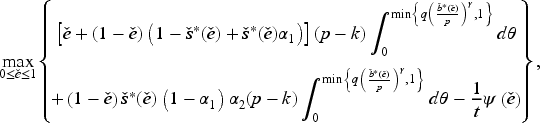
When
Proposition 9 demonstrates how the authentic company’s ability to commit to its anti-counterfeiting effort may influence the level of effort exerted (see Figure EC.2(a) for an illustration). When the anti-counterfeiting capability is low, that is,
Proposition 9 further shows that possessing the commitment ability does not necessarily help the authentic company reduce the counterfeit occurrence probability. When the anti-counterfeiting capability
In the base model, we have assumed that the market price
We begin the discussion with a counterfeit-free case in which there is no counterfeiter on the market and denote the authentic company’s optimal price in that case by
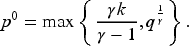
When the counterfeiter is present, for the exogenous price considered in the base model, Proposition 1 reveals an important relationship between the counterfeiter’s equilibrium decision
Note that the counterfeiter’s decision
The above corollary can serve as a bridge to analyzing the case in which

We now turn to general cases (especially the case in which the sufficient condition collapses). Given that our research focuses lies in the authentic company’s decision on exerting the anti-counterfeiting effort, we are particularly interested in how the company’s decision interacts with its anti-counterfeiting capability. However, we find that it is no longer tractable to derive the equilibrium solution in closed form (the technical challenge stems from the fact that, the price
The asymptotic behavior of the equilibrium price
We then conduct a numerical experiment to study how the authentic company’s equilibrium decision on the price varies with its anti-counterfeiting capability. The result is presented in Figure EC.4. A straightforward observation from the figure is that the equilibrium price
In this article, we consider a market in which an authentic company aims to sell genuine products while facing the potential imitation by a counterfeiter. To counter the probable counterfeiting activity, the authentic company can develop an anti-counterfeiting technology with uncertain outcomes. At the same time, the market is administered by a regulatory authority, who may deploy an IPR team to outlaw the fake through preventive and/or corrective measures. We employ a game-theoretic model to analyze the problem and derive the equilibrium solution, from which we obtain several important insights.
We examine how the authentic company’s equilibrium profit may vary with its anti-counterfeiting capability. Interestingly, when the capability is relatively low, an increase in its capability would lead to a reduction in the equilibrium profit. This result implies that if the authentic company wants to target high profitability, it may have to forgo an improvement on this capability unless there exists a substantial opportunity to enhance the capability significantly.
Second, we explore the interaction between the two widely used approaches to combating counterfeits, the anti-counterfeiting technology adopted by the authentic company and the penalty levied by the regulatory authority. While those two approaches serve the same purpose of preventing and combating counterfeits, our analysis indicates that the anti-counterfeiting effort exerted by the authentic company does not necessarily decrease in the penalty levied by the authority. In particular, we show that when the penalty is low, an increase in the penalty (which is likely to be the case in the market of emerging economies) may be accompanied by an increased investment in anti-counterfeiting technology. We also find that a stringent law enforcement may lead to a higher counterfeit occurrence probability.
Third, we examine how preventive and corrective law enforcement may influence the authentic company differently. Interestingly, we find that preventive law enforcement can more effectively reduce the counterfeit occurrence probability but lead to a lower profit of the authentic company. This happens when the anti-counterfeiting capability is relatively low. Thus, our analysis implies the importance of the coupling between anti-counterfeiting investment and law enforcement type when the authentic company seeks a cooperation with the regulatory authority. Moreover, we examine the consumer welfare implications of these two law enforcement types. Our result shows that when a strong anti-counterfeiting capability is in place, preventative law enforcement benefits not only brands but also customers.
Finally, we extend our base model by incorporating several additional features. Results show that our insights in the base model are robust. These extensions also have yielded some non-intuitive insights. For example, the authentic company’s equilibrium anti-counterfeiting effort could be non-monotone in the counterfeit product cost, and a greater adverse impact from selling counterfeits might not result in a higher anti-counterfeiting effort in equilibrium. Furthermore, committing to its anti-counterfeiting effort could adversely increase the counterfeit occurrence probability. These results collectively suggest that combating counterfeit products is inherently complicated, involving careful examination and planning.
We suggest some avenues for future research. In our model, we have assumed that customers cannot tell the genuineness of a product and has to form a belief when making the purchase decision (unless the authentic company can credibly commit to its effort). We can extend the analysis by considering another setting in which customers are partially informed. For example, customers with some research may be able to observe the coexistence of genuine products and fake ones in the market. It would be interesting to study how the partial information may influence the customer’s expectation and accordingly, the equilibrium decisions made by the authentic company and the counterfeiter. The second avenue for extending the analysis is to incorporate the authentic company’s endogenous effort to detect and report counterfeiting activities, capitalizing on their expertise in identifying misconduct (Babich and Tang, 2012). It would be valuable to explore how the authentic company’s such efforts impact the development of their anti-counterfeiting technology. The third direction to extend the analysis is to consider a case where the regulatory authority is endogenized as a game player (e.g., Pun et al., 2021). In that case, the authority needs to consider the tradeoff between its efforts put into regulating the market and the social benefit gained from outlawing counterfeits. It is desirable to study which type of law enforcement, as well as what level of enforcement effort, is the optimal choice for the regulatory authority. Finally, in our model, we have assumed that the counterfeiter sources imitation labels from external suppliers via illicit channels. We can extend the analysis to the case where the counterfeiter can actively exert its own effort to imitate the anti-counterfeiting features developed by the authentic company, rather than relying on external sources. To model this extension, we think that a sequential contest framework from the economics literature could provide a useful approach, as it allows for an analysis of the strategic interaction between the authentic company and the counterfeiter, taking into account the technological competition and the dynamics of imitation.
Supplemental Material
sj-pdf-1-pao-10.1177_10591478251335156 - Supplemental material for Combating Counterfeit Products: Anti-counterfeiting Technology and Law Enforcement
Supplemental material, sj-pdf-1-pao-10.1177_10591478251335156 for Combating Counterfeit Products: Anti-counterfeiting Technology and Law Enforcement by Shiqing Yao, Kaijie Zhu and Ruina Yang in Production and Operations Management
Footnotes
Acknowledgments
The authors thank the department editor, senior editor and two anonymous reviewers for constructive comments that greatly improved the article. The second author was supported by Research Grants Council of Hong Kong under project No. 14504618. The third author was supported by National Natural Science Foundation of China (NSFC) under project No. 72271195.
Declaration of Conflicting Interests
The author(s) declared no potential conflicts of interest with respect to the research, authorship, and/or publication of this article.
Funding
The author(s) received no financial support for the research, authorship, and/or publication of this article.

Notes
How to cite this article
Yao S, Zhu K and Yang R (2025) Combating Counterfeit Products: Anti-counterfeiting Technology and Law Enforcement. Production and Operations Management 34(11): 3493–3512.
References
Supplementary Material
Please find the following supplemental material available below.
For Open Access articles published under a Creative Commons License, all supplemental material carries the same license as the article it is associated with.
For non-Open Access articles published, all supplemental material carries a non-exclusive license, and permission requests for re-use of supplemental material or any part of supplemental material shall be sent directly to the copyright owner as specified in the copyright notice associated with the article.
