



Abstract
Many firms adopt behavioral-based pricing (BBP) to customize prices for both existing and new consumers whose valuations of products are influenced by the variety-seeking behavior, that is, the tendency to pursue diversity in brand or product choices. While this behavior is common in practice, it remains underexplored in the literature. To investigate BBP in markets with variety-seeking consumers, we develop a two-period model involving two competing firms. Our findings reveal that when firms adopt BBP, a greater degree of variety-seeking among consumers mitigates first-period price competition, resulting in higher profits for the firms. The adoption of BBP increases profits when consumers exhibit a high variety-seeking degree, enhances consumer welfare when this degree is low, and can lead to mutually beneficial outcomes for both the firms and consumers. If a firm unilaterally adopts BBP, its competitor benefits when the consumer's variety-seeking degree is high. In scenarios where the firms can strategically decide whether to adopt BBP, asymmetric equilibria may arise, with only one firm choosing to implement it. The firms may strategically adopt BBP without necessarily price-discriminating consumers, as the potential for price discrimination can reduce first-period competition. When BBP is exogenously feasible, the firms experience higher profits in relation to the consumer's variety-seeking degree compared with when it is not feasible, with gains from BBP feasibility increasing as the degree of variety-seeking rises. In addition, with behavioral-based personalized pricing, that is, the firms can charge tailored prices to existing consumers, profits also increase with the consumer's variety-seeking degree. However, with behavioral-based services, that is, firms can customize prices for both new and past consumers and provide additional services to previous customers, as the consumers variety-seeking degree increases, service levels decline while profits initially decrease before they rise again. These findings highlight the distinct characteristics of BBP and elucidate various real-world operational strategies.
Introduction
With the advancement of information technology, firms can identify their past and new consumers, customizing prices for the two consumer segments (Penmetsa et al., 2015; Valletti and Wu, 2020). Such practice is referred to as “behavioral-based pricing (BBP)” in the literature (Li et al., 2020; Li and Jain, 2016; Rhee and Thomadsen, 2017). Real-world examples show that in some industries, firms with BBP charge lower prices to new consumers than to past consumers, but in other industries, firms with BBP charge lower prices to past consumers than to new consumers: In the pet food industry, Raw Pet Food offers a 25% price discount for new buyers, and Honey's Real Dog Food offers each new consumer free food for a week, or a “mini taster box”; however, in the fast food industry, KFC and McDonald's allow consumers to redeem rewards with the points earned in consumers’ previous purchases (see E-companion A for more details of the examples).
One plausible explanation for different BBP practices is that, in different industries, consumers have different tendencies to seek diversity in their brand or product choices. For example, they have a higher tendency to switch firms to try new products when buying food for themselves than when buying food for their pets. The consumer's tendency to seek diversity in brand or product choices, which is referred to as the consumer's variety-seeking behavior, is prevalent in many industries and will affect firms’ BBP operations. Due to the variety-seeking behavior, consumers’ purchasing experience with a brand or product will reduce their valuation of it (Feinberg et al., 1992; Givon, 1984; Ratner et al., 1999). This will directly affect firms’ customized prices for past and new consumers, leading firms to alter their initial prices. Moreover, the consumer's variety-seeking behavior will affect firms’ strategic choice of adopting BBP or not, that is, whether to build the capability of customizing prices for past and new consumers. To the best of our knowledge, no prior research has examined the effects of the consumer's variety-seeking behavior on BBP. As we will show later on, exploring how the consumer's variety-seeking behavior affects BBP is important because it is truly influential and can better explain many widely observed practices associated with BBP.
Moreover, the consumer's variety-seeking behavior will affect the implementation of different behavioral-based discrimination schemes. There are two emerging behavioral-based discrimination schemes. The first one is behavioral-based personalized pricing, which enables the firms to charge a personalized price to each past consumer; for example, an online travel platform, Ctrip, collects customer history information to charge personalized hotel prices to consumers. The second one is behavioral-based service, which enables the firms to price-discriminate past and new consumers as well as offer additional services to past consumers; for example, in Estee Lauder's online store, its past consumers can directly communicate with salespersons, while its new consumers need to communicate with robots before communicating with salespersons. We will further study how the consumer's variety-seeking behavior affects the two behavioral-based discrimination schemes, respectively.
To study the effects of the consumer's variety-seeking behavior on BBP, we develop an analytical model with two horizontally differentiated firms. Each firm sells a nondurable product over two periods. Before the first period, the firms strategically choose whether to adopt BBP, which allows them to collect consumers’ first-period purchase information to charge customized second-period prices to past consumers and new consumers. Consumers are variety seeking such that in the second period, they have a decreased valuation on the product they previously bought. The equilibrium analyses of the model generate insights into firms’ BBP in markets with variety-seeking consumers.
Our research questions and main results are as follows: First, how does the consumer's variety-seeking degree affect the firms with BBP? We find that a higher consumer's variety-seeking degree will not benefit the firms if they do not adopt BBP but will benefit them if they adopt BBP. As the consumer's variety-seeking degree increases, the firms with BBP will raise their first-period prices, raise their second-period prices for new consumers, and reduce their second-period prices for past consumers. So, if the consumer's variety-seeking degree is high, the firms will charge higher prices to new consumers than to past consumers.
Second, how does the firms’ BBP adoption affect their profits and consumer welfare? We find that, while the firms’ BBP adoption will weakly increase the firms’ second-period profits, it will decrease the firms’ first-period prices and profits if the consumer's variety-seeking degree is low and increase the firms’ first-period prices and profits if the consumer's variety-seeking degree is high because if the consumer's variety-seeking degree is high (low), BBP adoption increases (decreases) the firm's incentive to strategically wait to serve consumers until the second period, leading the firms to compete less (more) aggressively in the first period. Overall, BBP adoption will increase (decrease) the firms’ profits over the two periods if the consumer's variety-seeking degree is high (low). In a special case with a moderate consumer's variety-seeking degree, if the firms adopt BBP, they will not alter their second-period prices to price-discriminate consumers, but the firms’ profits will increase because the firms’ price-discrimination potential can mitigate their first-period price competition. Moreover, we find that the firms’ BBP adoption will increase (decrease) consumer welfare if the consumer's variety-seeking degree is low (high). The firms’ BBP adoption can lead to an all-win outcome for the firms and consumers.
Third, whether and when should the competing firms strategically adopt BBP before selling to variety-seeking consumers? We derive that in equilibrium, only one firm will adopt BBP if the consumer's variety-seeking degree is low, neither firm will adopt BBP if the consumer's variety-seeking degree is intermediate, and both firms will adopt BBP if the consumer's variety-seeking degree is high. When the consumer's variety-seeking degree is high, a firm's unilateral BBP adoption will benefit its competitor. In the special case with a moderate consumer's variety-seeking degree, in equilibrium, both firms will adopt BBP but will not actually price-discriminate consumers. In this case, the firms strategically use their price-discrimination potential to mitigate their first-period price competition. We also find that if the consumer's variety-seeking degree exceeds a threshold, the feasibility of BBP will lead to higher profits for both firms, where their profit gains from the feasibility of BBP will increase in the consumer's variety-seeking degree.
Last, what are the effects of the consumer's variety-seeking degree on other formats of behavioral-based discrimination? We find that if the firms adopt behavioral-based personalized pricing, the firms’ profits will increase in the consumer's variety-seeking degree, and when the consumer's variety-seeking degree is high, the firms’ profits are higher than those without price discrimination. If the firms adopt behavioral-based service, as the consumer's variety-seeking degree increases, the firms will reduce their service levels for past consumers, and their profits will first decrease and then increase. When the consumer's variety-seeking degree is high or low, the firms will benefit from adopting behavioral-based service. These results bring novel insights that supplement the BBP literature.
Literature Review
Our study is related to two streams of research. First, our study is related to research on BBP in duopoly competition. Two seminal papers—Villas-Boas (1999) and Fudenberg and Tirole (2000)—find that firms should offer price discounts to poach consumers that bought from the firms’ competitors. Moreover, Fudenberg and Tirole (2000) show that firms with BBP will set higher first-period prices than those without BBP. Different from Fudenberg and Tirole (2000), we show that in the presence of the consumer's variety-seeking behavior, firms can offer price discounts to past consumers, and firms’ BBP adoption may lead to lower first-period prices. Acquisti and Varian (2005) find that if consumers are sophisticated enough to avoid establishing a purchase history or to delay a purchase, sellers cannot benefit from BBP. However, in other cases (e.g., when sellers offer enhanced services to past consumers, when sellers are unable to commit to a pricing policy, and when competition exists), sellers can find BBP profitable. Mehra et al. (2012) study BBP in a market with an incumbent and an entrant, where switching between them incurs costs for consumers. They find that with BBP, a higher switching cost can benefit the consumers but harm both firms. Different from Mehra et al. (2012), we consider two symmetric firms selling to variety-seeking consumers that have staying costs in repeat purchases. We show that a higher consumer's variety-seeking degree will benefit firms with BBP. Li and Jain (2016) consider that BBP leads to the perception of unfairness when some consumers are charged a higher price than others for the same product. They find that when the consumer's fairness concern is sufficiently strong, firms benefit from adopting BBP. Jing (2017) finds that when product quality is exogenous, BBP benefits the firm with the higher production efficiency and harms the firm with the lower production efficiency; however, under the endogenous quality scenario, BBP may increase both firms’ profits. Li (2018) explores BBP in a supply chain setting in which two horizontally differentiated manufacturers sell through exclusive retailers to consumers. The author finds that whether BBP is beneficial depends on the manufacturers’ pricing strategy. Amaldoss and He (2019) find that in the case where consumers consider only a few of all the products in making purchasing decisions, firms can earn more profits with BBP than without BBP if product valuation is low.
The above studies generally find that firms with BBP should poach competitors’ consumers with price discounts, which is inconsistent with many commonly observed real-world practices. Only a few studies (e.g., Caillaud and De Nijs, 2014; Chen and Pearcy, 2010; Rhee and Thomadsen, 2017; Shin and Sudhir, 2010) have examined the conditions under which firms should reward past consumers. Chen and Pearcy (2010) consider the presence of consumers’ preference dependence between periods. The authors uncover that if the preference dependence is low, firms with BBP may reward old consumers. Caillaud and De Nijs (2015) find that in a dynamic model with overlapping generations of consumers, in equilibrium, one firm rewards new consumers, whereas the other rewards past consumers. Different from Caillaud and De Nijs (2014), we find that when the consumer's variety-seeking degree is high, in equilibrium, both firms will reward past consumers. Rhee and Thomadsen (2017) find that when two vertically differentiated firms are in competition, the lower-quality (higher-quality) firm can reward past consumers if the “quality-adjusted cost differential” between the two firms is small (large). We show that vertically identical firms will reward past consumers if the consumer's variety-seeking degree is high.
Our paper contributes to the BBP literature by studying the implications of BBP for competing firms in the presence of variety-seeking consumers whose purchasing experience with a product will reduce their valuation of it. So, in our study, the consumer's preference changes over time. While Shin and Sudhir (2010), Zhang (2011), and Fudenberg and Villas-Boas (2006) also consider this issue in studying BBP, our paper is very different from theirs. Fudenberg and Villas-Boas (2006) consider that when firms adopt BBP, the existence of lock-in consumers (i.e., consumers will never switch firms) can lead firms with BBP to raise their first-period prices. In Shin and Sudhir (2010), the preference change, caused by exogenous events such as “change in the consumer's geographic location,” is stochastic and unavoidable. In contrast, in our paper, the preference change is a predictable result of the consumer's purchase decision—buying a product reduces its future value, and consumers can avoid such value reduction by switching to a new firm. Thus, in our paper, at the beginning of the first period, forward-looking consumers can optimize their shopping paths. Moreover, Shin and Sudhir (2010) consider the change in the consumer's horizontal preference for the products (specifically, consumers’ locations on the Hotelling line), whereas we consider the change in the consumer's vertical preference for the products. Shin and Sudhir (2010) derive a necessary condition for firms to reward past consumers. That is, the market consists of high-type consumers that demand a larger quantity of the products and low-type consumers that demand a smaller quantity of products, and firms can identify the types of past consumers. We show that even when all the consumers demand the same quantity of products, the firms can reward past consumers. Moreover, we study the effect of the consumer's variety-seeking degree on the firms and consumers. Zhang (2011) develops a BBP model in which two firms can choose their product designs and prices. In an extended model, Zhang (2011) assumes that when switching to another firm in the second period, consumers incur a cost. The result in Zhang (2011) shows that this “switching cost” decreases the firms’ first-period profits and increases the firms’ second-period profits. While these papers study brand loyalty, we study the consumer's variety-seeking behavior. We capture this behavior by considering that consumers incur a staying cost from a repeat purchase. We show that this staying cost can benefit firms with BBP and will affect firms’ strategic choices of adopting BBP or not.
Our study is also related to Pazgal and Soberman (2008), who consider that firms can engage in behavioral-based discrimination by adding values to their offers to past consumers. The authors find that past consumers are so valuable in the second period that behavioral-based discrimination leads to cut-throat competition in the first period and lower profits for firms. However, we find a different result that, in the presence of variety-seeking consumers, the firms’ BBP adoption can mitigate their competition in the first period and increase their profits. The difference between our findings and those of Pazgal and Soberman (2008) is mainly because, in the presence of variety-seeking consumers, a larger first-period market share will have a negative effect on the firms’ second-period profits, and such an effect will become stronger as the consumer's variety-seeking degree increases.
As a remark, to some extent, our study is related to the literature on personalized pricing (Chen et al., 2020; Choe et al., 2018; Elmachtoub et al., 2021; Hajihashemi et al., 2022) because both BBP and personalized pricing relate to price discrimination with the use of consumer information. While firms with personalized pricing can perfectly price-discriminate consumers, firms with BBP compete in the “third-degree” price discrimination. Recently, Choe et al. (2018) compare BBP and personalized pricing, and Choe et al. (2022) bridge BBP and personalized pricing by studying behavior-based personalized pricing. In an extended model, we consider the case where firms can charge personalized prices to past consumers, but for new consumers that first buy from the firms, the firms have to charge uniform prices. We show that with behavioral-based personalized pricing, firms’ profits increase in the consumer's variety-seeking degree.
The second stream of related research investigates the consumer's variety-seeking behavior in competition. Kahn and Raju (1991) point out that some consumers are variety-avoiding by showing a tendency to repurchase the last brand bought, while others are variety-seeking by showing a tendency to shun the last brand bought. They find that for a minor brand, price discounts have a larger effect on the variety-avoiding segment than on the variety-seeking segment. However, for a major brand, price discounts have a larger effect on the variety-seeking segment than on the variety-avoiding segment. Chintagunta and Rao (1996) find that when a strong brand and a weak brand are in competition, the consumer's variety-seeking behavior results in the price of the strong (weak) brand declining (increasing) over time. Seetharaman and Che (2009) study firms’ price competition with variety-seeking consumers that have a staying cost of repeat purchasing the products they have bought. They find that the consumer's variety-seeking behavior reduces the elasticity of demand and rivalry between the firms. Sajeesh and Raju (2010) develop a three-stage model in which consumers exhibit the variety-seeking behavior by perceiving higher reservation prices in the second stage for the products they have not bought. They find that the consumer's variety-seeking behavior decreases firms’ profits but increases consumer surplus. Zeithammer and Thomadsen (2013) find that the consumer's variety-seeking behavior can soften or intensify the price competition between two vertically differentiated firms, depending on the firms’ differentiation degree and the consumer's variety-seeking degree. Shang et al. (2022) study two competing firms’ positioning and pricing strategies. They find that the firms can benefit from more variety-seeking consumers when some of these consumers are myopic.
As far as we know, our paper is the first analytical study to address the consumer's variety-seeking behavior issue in association with BBP. Following the classical setting of Fudenberg and Tirole (2000) in modeling BBP, we first show that considering the consumer's variety-seeking behavior will substantially change the results reported in the extant related literature. For example, we find that when the consumer's variety-seeking degree is high, the firms’ BBP adoption will increase their profits. This result is different from the existing literature (e.g., Zhang, 2011), which finds that the firms’ BBP adoption can lead to a prisoner's dilemma. Second, we uncover that competing firms’ strategic choices of adopting BBP or not depend on the consumer's variety-seeking degree. We find that when the consumer's variety-seeking degree is low, the asymmetric equilibrium where only one firm adopts BBP will occur. Facing variety-seeking consumers, the firms may strategically adopt BBP without actually price-discriminating consumers because the firms can use their price-discrimination potential to mitigate their first-period competition. Third, we provide important insights into two emerging formats of behavioral-based discrimination, namely, behavioral-based personalized pricing, and behavioral-based service, which have not been studied in the literature. Our studies and findings substantially contribute to the BBP literature.
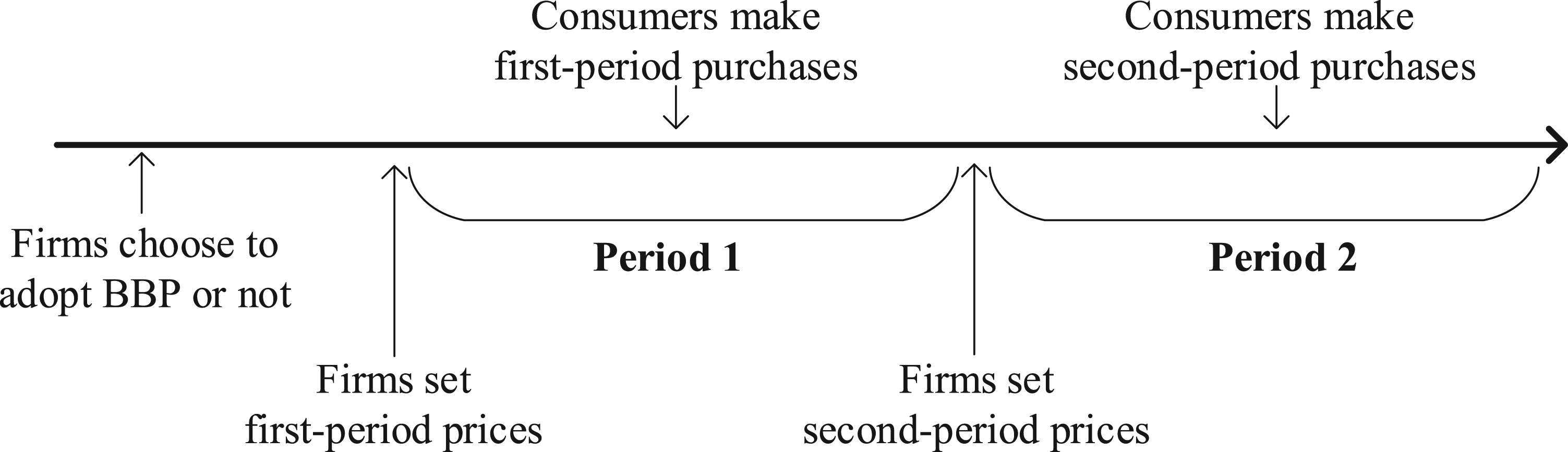
Sequence of the events.
We consider two firms, A and B, each selling a perishable product over two periods, namely, periods 1 and 2.
1
The two firms’ products are vertically identical but horizontally differentiated. The products’ base values from their vertical attributes are v. To capture their horizontal differentiation, we consider that a unit mass of consumers are uniformly distributed over a Hotelling line within [0, 1], where firm A is located at 0 and firm B is located at 1. A consumer's distance to firm
Consumers can be variety-seeking, thus perceiving a diminishing base value of the same branded product that they previously bought. We consider that consumers incur a staying cost δ in a repeat purchase of the same branded product, where δ captures the consumer's variety-seeking degree, with a higher δ indicating a higher variety-seeking degree.
3
So, in the second period, if consumers buy the same branded product as before, they will perceive a reduced base value v
We discuss the sequence of the events in the following and illustrate it in Figure 1.
Before the first period, the firms simultaneously choose whether to adopt BBP or not. If a firm chooses to adopt BBP, it will have the capability of price-discriminating consumers with different purchase histories, that is, the capability of customizing second-period prices for past and new consumers. If the firm does not adopt BBP, it will have no price-discrimination capability. At the beginning of the first period, firm A decides its first-period price In the first period, consumers arrive and make first-period purchases, and the firms’ first-period profits are realized. At the beginning of the second period, the firms decide their respective second-period prices. If firm A (B) has not adopted BBP before the selling period, it will decide the uniform second-period price In the second period, consumers make second-period purchases, and the firms’ second-period profits are realized.
In solving for the equilibrium, the following three concepts are used. First, a decision, once made, will be observable in the later stages of the game. For example, once the first period starts, all consumers will know whether each firm has the price-discrimination capability or not; once the second period starts, all players will know the number of consumers that made their first-period purchase from each firm. Second, a decision made in an earlier stage cannot be changed. This indicates that the firm's commitment on adopting BBP or not is credible. If the firm does not adopt BBP before the first period, once the first period starts, the firm will never be able to price-discriminate consumers. In practice, to adopt BBP, the firm has to exert some preselling observable actions, for example, developing consumer management systems, and asking consumers’ permission to collect and use their data. If no such preselling observable action is taken, it is a convincing commitment that the firm will not price-discriminate consumers. Third, all players have rational expectations about future events. For example, in making purchase decisions in the first period, consumers rationally anticipate how their current purchase decisions will affect the firms’ first-period market shares and second-period prices. The above three equilibrium-solution concepts are commonly used in the literature, for example, Fudenberg and Tirole (2000), Shin and Sudhir (2010), and Li and Jain (2016). In our paper, we use superscript * to denote the equilibrium or optimum decisions and expressions.
We study a subgame in which the firms choose not to adopt BBP before the first selling period. So, in this subgame, the firms will have no price-discrimination capability. We use the superscript “N” to indicate this subgame. We analyze it backwardly from the game's last stage where consumers make second-period purchase decisions. In the second period, the consumer's net utilities of buying from firm A and firm B depend on her first-period purchase decision, specifically, given by
At the beginning of the second period, observing the consumers’ first-period indifference point
In the first period, anticipating the firms’ optimal second-period prices, consumers strategically maximize their (discounted) net utility over the two periods. The consumer's total discounted net utility over the two periods is
At the beginning of the first period, firm A and firm B will maximize their respective (discounted) total profits over the two periods, which are given by
When neither firm adopts BBP, as the consumer's variety-seeking degree δ increases, more consumers will switch in the second period to buy from a new firm, and the firms’ prices and profits will not increase.
Lemma 1 indicates that a higher consumer's variety-seeking degree is not beneficial for the firms without BBP, that is, when they do not adopt BBP. In the presence of the consumer's variety-seeking behavior, consumers may switch firms in the second period even though the firms do not adopt BBP because the consumer's first-period purchase experience of a product will reduce her second-period valuation of this product. As the consumer's variety-seeking degree increases, more consumers will switch in the second period, which is not beneficial for the firms without BBP.
We study a subgame in which both firms adopt BBP (i.e., building the capability to price-discriminate new and past consumers) before the first selling period. We use the superscript “B” to indicate this subgame. We analyze it backwardly from the game's last stage where consumers make second-period purchase decisions. In the second period, the consumer's net utilities of buying from firm A and firm B are
At the beginning of the second period, observing the consumers’ first-period indifference point
In the first period, anticipating the firms’ optimal second-period prices, consumers strategically maximize their (discounted) net utility over the two periods. The consumer's total discounted net utility over the two periods is
At the beginning of the first period, firm A and firm B choose first-period prices to maximize their respective profits over the two periods, which are given by
When the firms adopt BBP, in the second period, the firms’ customized prices for new consumers are lower than those for past consumers when
Lemma 2 shows that the firms with BBP may offer price discounts to new consumers or to past consumers, depending on the consumer's variety-seeking degree δ. To understand the intuition, note that with BBP, in the second period, the firms will set customized prices for past and new consumers according to their respective product valuations. If the consumer's variety-seeking degree is low (specifically,
Next, in Lemmas 3–4 and Proposition 1, we show how the consumer's variety-seeking degree δ affects the equilibrium results when the firms adopt BBP. For convenience, in Lemma 3, we start by discussing the second period.
When the firms adopt BBP, as the consumer's variety-seeking degree δ increases, in the second period: (i) the firms will raise the prices for new consumers and reduce the prices for past consumers, (ii) more consumers will switch to buying a new product, and (iii) the firms’ second-period profits will decrease if
Lemma 3 shows how the consumer's variety-seeking degree δ affects the second-period equilibrium results in the case where both firms adopt BBP. In the second period, a firm makes profits from two consumer segments, namely, past consumers that made first-period purchases from it and new consumers that made first-period purchases from its competitor. As one would expect, Lemma 3(i) shows that as δ increases, in the second period, the consumers have a greater tendency to switch to buying a new product, prompting the firms to reduce the prices for past consumers and raise the prices for new consumers. Moreover, Lemma 3(ii) shows that as δ increases, in the second period, a larger number of consumers will switch from a firm to its competitor to experience a new product because the consumer's value loss from using the old product (they previously bought) increases more than the price difference between the new product and the old product. Owing to the increased number of switchers, the firms’ demands from new consumers will increase, and the firms’ demands from past consumers will decrease, where the firms’ total demands from both new and past consumers are still 1/2 as the two firms are symmetric. So, essentially, as δ increases, the firms will have a larger ratio of the number of new consumers to the number of past consumers. This ratio change may increase or decrease the firms’ second-period profits, depending on the relative profitability, that is, the relative price, of the new and past consumers. If the consumer's variety-seeking degree is low, specifically, when
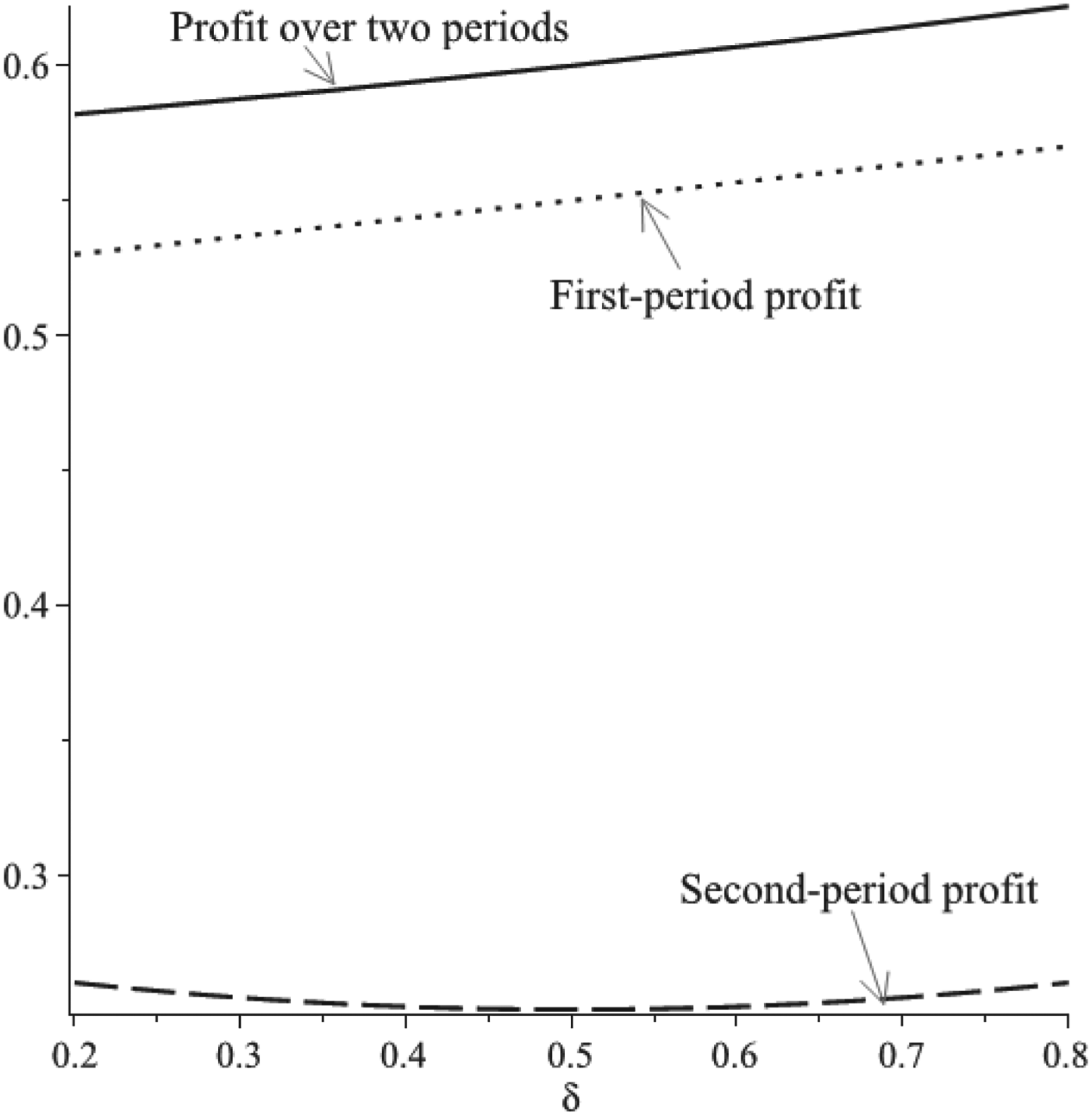
Effect of the consumer's variety-seeking degree δ on profits when the firms adopt BBP. 13
If the firms adopt BBP, as the consumer's variety-seeking degree
Lemma 4 shows that as the consumer's variety-seeking degree
When the firms adopt BBP, as the consumer's variety-seeking degree
Proposition 1 gives an important result that both firms—if they have adopted BBP—benefit from a higher consumer's variety-seeking degree δ. Figure 2 illustrates this result. Note that the mechanisms will be different when δ falls in different regions. In the region where
So far, we have derived the equilibrium outcomes in the case where no firms adopt BBP and in the case where both firms adopt BBP. In this section, we compare the equilibrium outcomes in the two cases to explore how the firms’ BBP adoption (i.e., the firms building the capability of price-discriminating past and new consumers) before the first selling period affects the selling periods’ outcomes. For convenience, we discuss the firms’ second-period prices before discussing the firms’ first-period prices.
When
Lemma 5 summarizes the effects of the firms’ BBP adoption on the second-period outcomes. In the second period, the firms have two segments of consumers, that is, past and new consumers. Owing to the difference in product valuations between the two segments, without BBP, the firm's uniform price will be too low to serve the segment with higher valuations but too high to serve the segment with lower valuations. The firms’ BBP adoptions enable them to customize their prices to the two segments. If
Compared to the case where the firms do not adopt BBP, if the firms adopt BBP, their first-period prices and first-period profits will decrease when
Lemma 6 shows that the firms’ BBP adoption will decrease their first-period prices and first-period profits if the consumer's variety-seeking degree is low (specifically,
Compared to the case where the firms do not adopt BBP, if the firms adopt BBP, their profits over the two periods will increase when
Proposition 2 shows that in the presence of variety-seeking consumers, if the firms adopt BBP (i.e., building the capability of price-discriminating past and new consumers) before the first selling period, their profits over the two selling periods will increase when the consumer's variety-seeking degree is high (specifically,
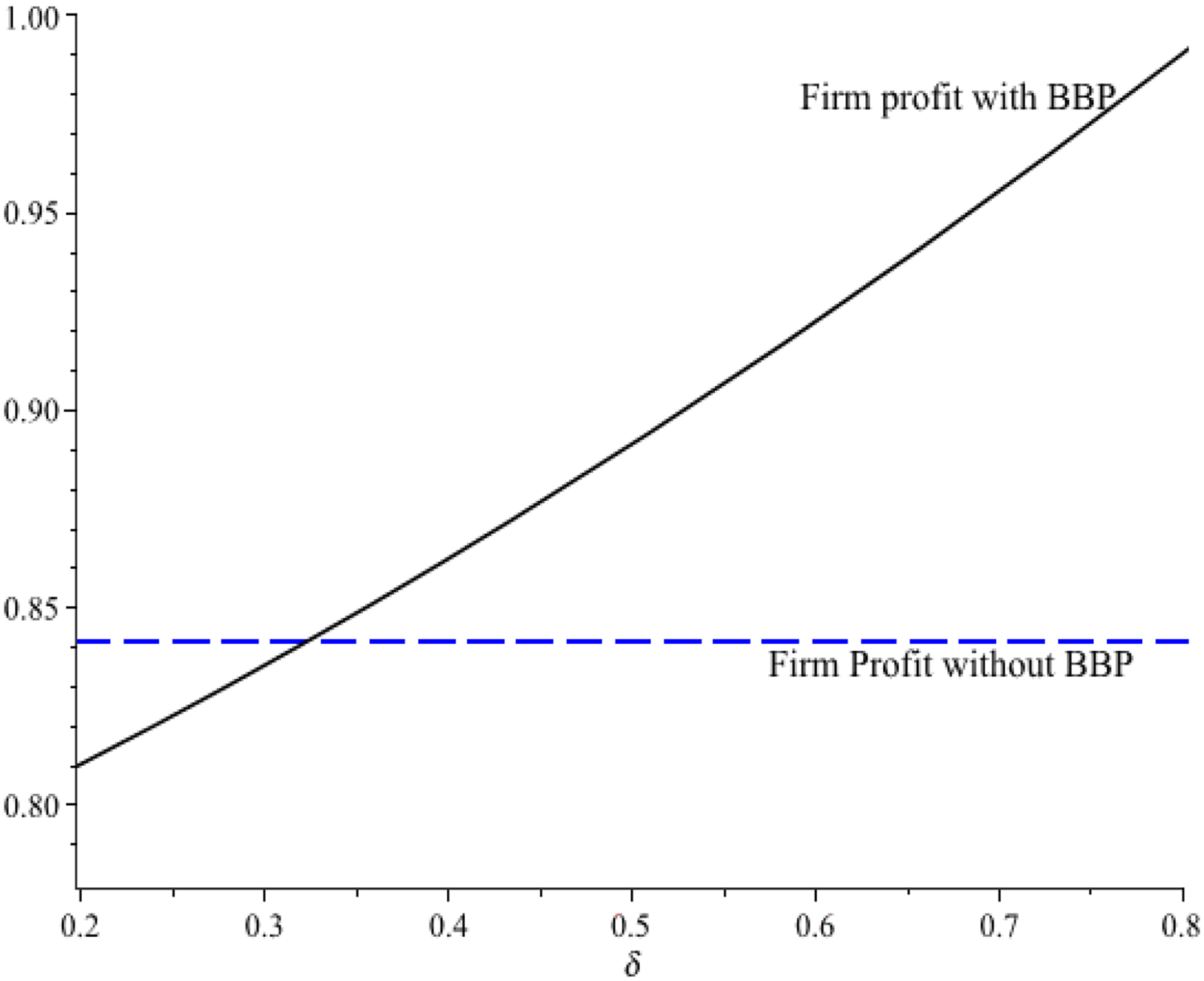
The firm's equilibrium profits when they adopt BBP and when they do not adopt BBP. 14
So far, we have revealed the effects of BBP adoption on the firms. One may also wonder how the firms’ BBP adoption affects consumer welfare, which is defined as the consumer's total discounted net utility. Specifically, the consumer welfare function in subgame
Compared to the case where the firms do not adopt BBP, if the firms adopt BBP, consumer welfare will increase when
Proposition 3 shows that in the presence of the consumer's variety-seeking behavior, the firms’ BBP adoptions (i.e., the firms building the capability of price-discriminating past and new consumers) before the selling periods may increase or decrease consumer welfare, depending on the trade-off between the two effects. First, BBP adoption enables the firms to better extract consumer surplus in the second period, which will have a negative effect on consumer welfare. Second, if both firms adopt BBP, they may reduce their first-period prices, which may have a positive effect on consumer welfare. In fact, Lemma 6 shows that this positive effect is present if
Recall that in the very first stage of the game, that is, before the first selling period starts, each firm chooses between adopting BBP (i.e., building the capability of price-discriminating past and new consumers) and not adopting BBP (i.e., not building the price-discrimination capability). The firms’ first-stage choices will lead to four subgames: subgame N where neither firm adopts BBP, subgame B where both firms adopt BBP, subgame BN where only firm A adopts BBP, and subgame NB where only firm B adopts BBP. Subgame N and subgame B have been analyzed in Sections 4 and 5, respectively. Subgame BN and subgame NB are symmetric, and their technical analyses are provided in E-companion B. We compare the firms’ profits across the different subgames to derive the firms’ equilibrium choices of adopting BBP or not.
We begin with comparing firm A's profits in subgame BN versus subgame N (or, equivalently, firm B's profits in subgame NB versus subgame N) to understand whether the firms have the incentive to unilaterally adopt BBP to deviate from subgame N. Lemma 7 shows the result, where
When a firm does not adopt BBP, the other firm will unilaterally adopt BBP if
Lemma 7 shows that when a firm does not adopt BBP, the other firm will unilaterally adopt BBP if the consumer's variety-seeking degree δ is either low or high and will not unilaterally adopt BBP if δ is intermediate. This is because the firms’ benefit from price-discriminating past and new consumers is nonmonotonic in δ. As one would expect, this benefit will be high if past and new consumers significantly differ in their product valuations, which equal the product base value minuses the mismatching cost. For the products, past consumers have lower base value and lower mismatching cost than new consumers. On average, compared with new consumers, past consumers have a significantly lower valuation when δ is high and a significantly higher valuation when δ is low. Thus, when δ is high or low, the firms’ benefits from price-discriminating past and new consumers are high. However, when δ is intermediate, the difference in the valuation between past and new consumers is trivial, and the firms’ benefits from price-discriminating them are low, which is not enough to compensate for the firms’ losses from the aggravated poaching competition caused by BBP. Thus, when δ is intermediate (specifically,
If a firm unilaterally adopts BBP, its competitor's profit will increase when
Proposition 4 shows that when the consumer's variety-seeking degree δ is high, if a firm (without loss of generality, we suppose it to be firm A) unilaterally adopts BBP, the other firm (called firm B) will be better off. This result is driven by two actions made by firm A when it adopts BBP: First, when δ is high, BBP adoption leads firm A to increase its first-period price, which mitigates the first-period competition between the two firms. Second, when δ is high, BBP adoption leads firm A to increase its second-period price for new consumers, which decreases its poaching threat to firm B. In contrast, when δ is small, firm A's unilateral BBP adoption will harm firm B by aggravating the first-period competition and increasing the second-period poaching threat. Once firm A adopts BBP, should firm B adopt BBP, too? In Lemma 8, we answer this question. Note that
When a firm adopts BBP, the other firm will have the incentive to bilaterally adopt BBP if
Lemma 8 shows that when the consumer's variety-seeking degree is high (specifically,
Using the results in Lemma 7 and Lemma 8, we derive that in equilibrium, only one firm will adopt BBP if
If
Figure 4 illustrates the result of Proposition 5. In the parameter region BN/NB where
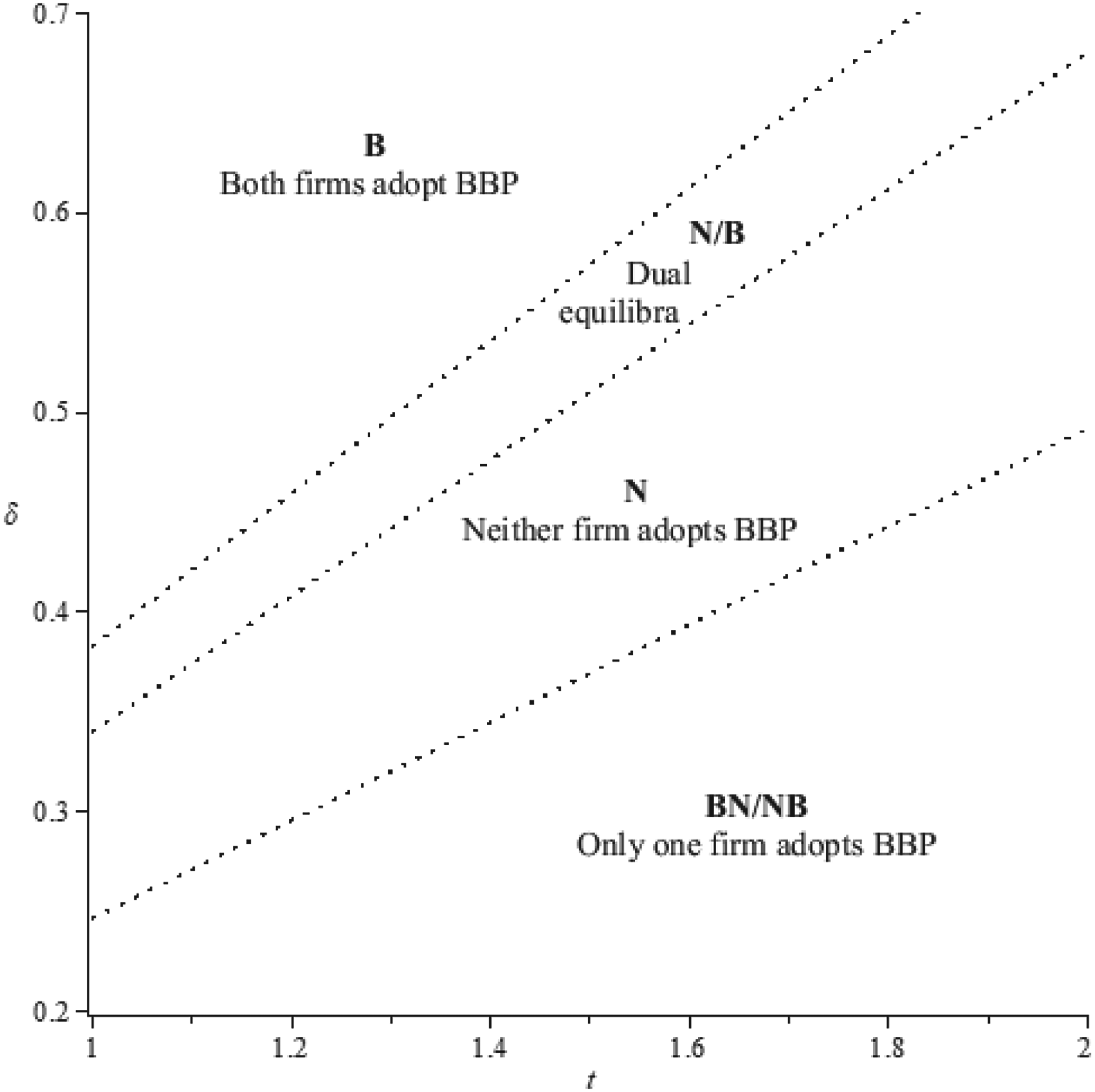
The firms’ equilibrium choices of adopting BBP or not. 15
Note that in the parameter region N/B, that is, when
Proposition 5 shows the equilibrium result for the case where BBP is exogenously feasible to the firms such that they can choose to adopt BBP or not. In practice, BBP may be exogenously infeasible due to regulations, consumers’ privacy or fairness concerns, or a lack of information systems. For this case where BBP is exogenously infeasible, the equilibrium result will be the same as that in subgame N where no firm adopts BBP. By comparing the equilibrium results between the case where BBP is exogenously feasible and the case where BBP is exogenously infeasible, we can determine the effect of the feasibility of BBP, yielding the result in Proposition 6.
If
Proposition 6 shows how the feasibility of BBP will affect the firms’ profits. If the consumer's variety-seeking degree is very high (specifically,
We extend the main model in three different ways. First, in Section 8.1, we consider the case with
Inertial Consumers
In the main model, we consider the consumer's variety-seeking behavior by assuming that consumers incur a cost
In the presence of inertial consumers, with BBP, the firms’ second-period prices for new consumers are lower than those for past consumers. The firms’ BBP adoption will increase their profits if
Proposition 7 shows that when consumers are inertial, with BBP, in the second period, firms should offer price discounts for new consumers. This finding explains some real-world practices. For example, in the mobile service industry, consumers are inertial and prefer staying with their old mobile service provider, and mobile service companies (such as Lycamobile) offer price discounts for new consumers.
Moreover, Proposition 7 shows that compared to the case where the firms do not adopt BBP, if the firms adopt BBP, their profits will increase if the consumer's inertia degree is low (specifically,
The main model addresses BBP under which a firm price-discriminates consumers based on their first-period behaviors, thus has to charge the same second-period price to consumers with the same first-period behavior (e.g., firm
When the firms adopt behavioral-based personalized pricing, as the consumer's variety-seeking degree
Proposition 8 shows that when the firms adopt behavioral-based personalized pricing, as the consumer's variety-seeking degree δ increases, the firms’ first-period profits increase, the firms’ second-period profits first decrease and then increase, and the firms’ total profits in the two periods increase. The result is similar to that when the firms adopt BBP, as discussed in Proposition 1. If the consumer's variety-seeking degree exceeds a threshold (specifically, when
In practice, the firms can build the capability to recognize consumers to price-discriminate past and new consumers, as well as to provide additional services to past consumers. We refer to this practice as “behavioral-based service.” For example, in Estee Lauder's online store, its past consumers can directly communicate with salespersons, while its new consumers need to communicate with robots before communicating with salespersons. For more examples of behavioral-based services, the reader may refer to Pazgal and Soberman (2008) and Li (2021). Motivated by these real-world examples, in this extension, we consider that before the first period, firm
The game sequence is as follows: Before the first period, firm A chooses its service level
When the firms adopt behavioral-based service, as the consumer's variety-seeking degree
Proposition 9 shows the effect of the consumer's variety-seeking degree δ when the firms adopt behavioral-based service. As δ increases, more consumers will switch firms to experience product diversity, reducing the number of consumers that make repeat purchases. This decreases the firms’ benefit from improving their service levels for past consumers, where improving services incurs an R&D cost. Thus, a larger δ will lead to lower service levels. Proposition 9 also shows that the firms’ profits are nonmonotonic in δ. This is because, as δ increases, the firms’ first-period profits will monotonically increase, and the firms’ second-period profits will first decrease and then increase, whereas the effect on the firms’ second-period profits can dominate the effect on the first-period profits. In reality, the firms need to weigh the cost and benefit of offering behavioral-based services. Our result suggests that when the consumer's variety-seeking degree is high or low, the benefit of behavioral-based service is likely to outweigh its cost, so the firms may consider providing such service.
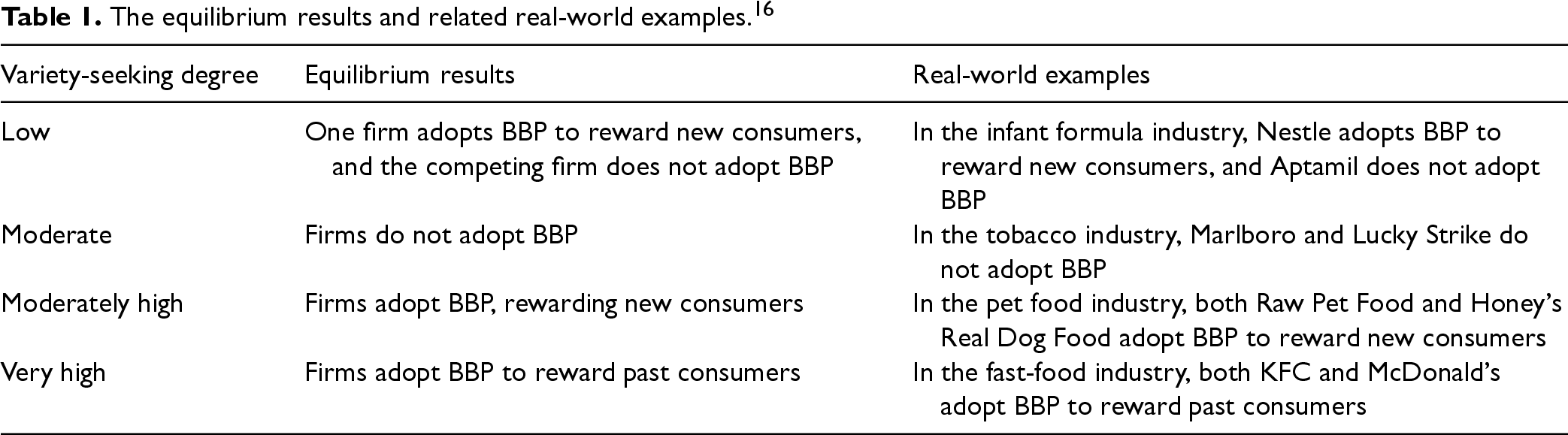
In this paper, we develop a game-theoretic model to study two competing firms’ BBP operations in the presence of variety-seeking consumers that undervalue the products they have bought. Each firm sells a product over two periods. Before the first period, the firms strategically choose whether to adopt BBP, which will give them the capability to price-discriminate consumers with respect to their different purchase histories, specifically, the capability of customizing second-period prices for past and new consumers. We find that a higher consumer's variety-seeking degree will not benefit the firms if they do not adopt BBP but will benefit them if they adopt BBP. This result suggests that with BBP, firms can use advertising to encourage consumers to seek product variety. For example, when KFC and McDonald's reward their old consumers, they do not need to encourage consumers to eat their food for every meal; instead, they should highlight that trying different foods provides a wonderful experience for consumers. By comparing the results when the firms adopt BBP versus when the firms do not adopt BBP, we find that the firms’ BBP adoption will increase their profits if the consumer's variety-seeking degree is high and will increase consumer welfare if the consumer's variety-seeking degree is low. If the consumer's variety-seeking degree is moderate, the firms’ BBP adoption will lead to a win-win outcome for the firms and consumers. If a firm unilaterally adopts BBP, its competitor will be better off when the consumer's variety-seeking degree is high. This indicates that the firms can benefit from facilitating their competitors’ BBP adoption by lobbying, sharing information, and so on. In equilibrium, only one firm will adopt BBP to reward new consumers if the consumer's variety-seeking degree is low, neither firm will adopt BBP if the consumer's variety-seeking degree is moderate, both firms will adopt BBP to reward new consumers if the consumer's variety-seeking degree is moderately high, and both firms will adopt BBP to reward past consumers if the consumer's variety-seeking degree is very high. In Table 1, we summarize the equilibrium results and show some real-world examples. Our results suggest that under competition, firms should strategically choose their BBP strategy considering the consumer's variety-seeking degree.
The equilibrium results and related real-world examples. 16
Moreover, we extend our main model in three different aspects. In the extension in which consumers are inertial and benefit from repeat purchases, the firms with BBP should reward new consumers, and if the consumer's inertia degree is low (high), the firms’ BBP adoption will benefit (harm) them. In the extension in which the firms adopt behavioral-based personalized pricing (i.e., building the capability of charging personalized prices to past consumers), the firms’ profits increase in the consumer's variety-seeking degree. When the consumer's variety-seeking degree exceeds a threshold, the firms with behavioral-based personalized pricing will have higher profits than those without it. In the extension in which the firms adopt behavioral-based services (i.e., building the capability to price discriminate past and new consumers and offer additional services to past consumers), as the consumer's variety-seeking degree increases, the firms’ service levels to past consumers will decrease, and the firms’ profits will first decrease and then increase. This result suggests that in industries in which consumers are more variety-seeking, firms should exert less effort to serve their past consumers.
Our study has some limitations, which provide opportunities for future research. First, while we consider perishable products, future research can consider durable products by assuming that the product bought in the first period has a residual value in the second period. We conjecture that if the products are durable, consumers will buy one product in the first period and use it for both periods when the consumer's variety-seeking degree is not very high, and when the consumer's variety-seeking degree is very high, in the second period, consumers will buy a new product even if their old product is functional. Second, we set profit maximization as the firm's objective, whereas, in reality, many firms prioritize expanding their market share. Future research can extend to consider that the firm's objective is to maximize a weighted sum of its profit and its market share. We conjecture that if the firms weigh more on the market share, their BBP adoption is more likely to decrease their profits and increase consumer welfare. Third, due to the feature of the two-period linear Hotelling model with consumer switching, we assume that the consumer's discount factor is strictly lower than one. Future research can develop a different model (e.g., a Hotelling model where the consumer's mismatch cost of a firm's product is a quadratic function of her distance to the firm) to accommodate the extreme case of the consumer's discount factor equaling one. Fourth, we consider that the firms choose whether to adopt BBP (i.e., build the capability to price-discriminate past and new consumers) before the first period, where “not adopting BBP” is a credible commitment of not price-discriminating consumers. Future research can consider that this commitment is incredible, for example, in the second selling period, the firms can incur some costs to overturn this commitment. Such extension can lead to an interesting consumer strategic behavior that, when standing at the beginning of the first period, consumers will consider the firm's possibility of overturning its preselling commitment on not price-discriminating consumers. We conjecture that if the firms’ costs of overturning commitments are low, they may commit not to price-discriminate consumers (i.e., choose not to adopt BBP) before the first period but overturn this commitment later to price-discriminate past and new consumers. Last, in Table 1, we compare our results with the real-world examples although we recognize that the classifications of different industries are based on limited empirical evidence and our observations. Future research can conduct further empirical studies to validate our findings.
Supplemental Material
sj-pdf-1-pao-10.1177_10591478251327755 - Supplemental material for Behavior-Based Pricing for Competing Firms Facing Variety-Seeking Consumers
Supplemental material, sj-pdf-1-pao-10.1177_10591478251327755 for Behavior-Based Pricing for Competing Firms Facing Variety-Seeking Consumers by Ting Zhang, Tsan-Ming Choi and TC Edwin Cheng in Production and Operations Management
Footnotes
Acknowledgments
The authors sincerely thank the department editor Prof. Albert Ha, the senior editor, and the two anonymous reviewers for their valuable comments, which significantly enhanced the quality of this paper. We also express our gratitude to the audiences at the 2023 National Conference on Supply Chain and Operations Management and the seminar participants at Harbin Institute of Technology, The Hong Kong Polytechnic University, University of Liverpool Management School, Lanzhou University, Jiangnan University, and Shanghai University for their kind and constructive feedback. Cheng was supported in part by The Hong Kong Polytechnic University under the Fung Yiu King - Wing Hang Bank Endowed Professorship in Business Administration.
Declaration of Conflicting Interests
The authors declared no potential conflicts of interest with respect to the research, authorship, and/or publication of this article.
Funding
The authors received no financial support for the research, authorship, and/or publication of this article.

Notes
How to cite this article
Zhang T, Choi T-M and Cheng TCE (2025) Behavior-Based Pricing for Competing Firms Facing Variety-Seeking Consumers. Production and Operations Management 34(9): 2873–2890.
References
Supplementary Material
Please find the following supplemental material available below.
For Open Access articles published under a Creative Commons License, all supplemental material carries the same license as the article it is associated with.
For non-Open Access articles published, all supplemental material carries a non-exclusive license, and permission requests for re-use of supplemental material or any part of supplemental material shall be sent directly to the copyright owner as specified in the copyright notice associated with the article.
