



Abstract
How we manage operations—the domain of Operations Management (OM)—has important implications for the practice of diversity, equity, and inclusion (DEI) in organizations. Conversely, DEI goals have important implications for organizations’ OM practices. We outline the two-way links between DEI and OM to offer future research opportunities. In particular, we examine interactions between OM and DEI across four broad themes: (1) Workforce, (2) Supply Chains, (3) Health and Society, and (4) Technology, Platforms, and Innovation. We conclude with a discussion of DEI in OM as it relates to research and teaching. This article is a collaborative effort with the Senior Editors involved in the special issue of Production and Operations Management on “DEI in Operations and Supply Chain Management.”
Introduction
This article is part of a special issue of the journal Production and Operations Management on diversity, equity, and inclusion (DEI) in Operations Management (OM), written as a collaboration between the Guest Editors (GEs) and the Senior Editors (SEs). The objective of this article (and of the entire special issue) is to highlight the many ways that DEI practices are relevant for operations in organizations and vice versa. This article also points to ways OM researchers 1 can incorporate DEI in their research and teaching, even if DEI is not their focus. With its wide authorship, the article offers a broad range of perspectives on how OM and DEI interact rather than a summary of the special issue.
DEI is typically thought of as a topic of interest primarily for scholars in such disciplines as human resources (HR) or organizational behavior (e.g., Yadav and Lenka, 2020). However, this article, and more generally the special issue, dispels that notion and offers a robust and complementary role for OM through various OM-based operational perspectives on DEI. Specifically, these articles show OM can be a key contributor to the practice of DEI. Being primarily concerned with designing systems and supply chains and studying how different elements interact for operational performance and other objectives, OM is vital in ensuring DEI is operationalized and implemented appropriately in organizational processes. In turn, DEI goals, in addition to those for operational performance or other objectives, shape systems and supply chains, thereby impacting the discipline of OM. When a particular issue (e.g., repetitive work, poor working conditions) is studied from a DEI perspective in other disciplines, adding an OM perspective can contribute to the body of theory in that area. Likewise, the study of typical OM issues (such as inter-firm supply chain agent interactions) in other disciplines through a DEI lens can enrich OM theory.
A special issue on DEI should reflect the spirit and principles of DEI. The two GEs invited 22 OM scholars to serve as SEs based on their demonstrated interest in DEI research and/or service. This larger-than-usual team was selected to ensure a diversity of perspectives and experiences; the Supplemental Information describes the process in more detail. Subsequently, the SEs were invited to participate in this editorial to capitalize on the group's unique breadth of perspectives on DEI research in OM; almost all agreed. All SEs were asked to suggest topics and 64 suggestions were received. The GEs created a Google Jamboard with a sticky note for each topic heading, and two interactive Zoom sessions were held to structure these. Participants were invited to rearrange the topic notes however they felt was meaningful. The rearrangement yielded aggregate themes for research; topics like “supply chain,” “technology,” and “education” emerged in both sessions, and others, such as “workforce” and “health,” emerged in only one session. The GEs prepared and shared a Google document using the clustering of topics that emerged. They incorporated feedback from the SEs and iterated with them over multiple outlines and drafts of this article.
This structured and collaborative brainstorming exercise pointed to four broad themes of exploration regarding the links between DEI and OM: (1) Workforce, (2) Supply Chains, (3) Health and Society, and (4) Technology, Platforms, and Innovation. Within each area, we show how OM can incorporate DEI perspectives and vice versa, drawing on existing work in OM and elsewhere and highlighting areas for future research. How OM scholars approach research and teaching is foundational to each domain. Figure 1 summarizes these themes and offers a sample of topics that we think are interesting and important in the study of DEI and OM.
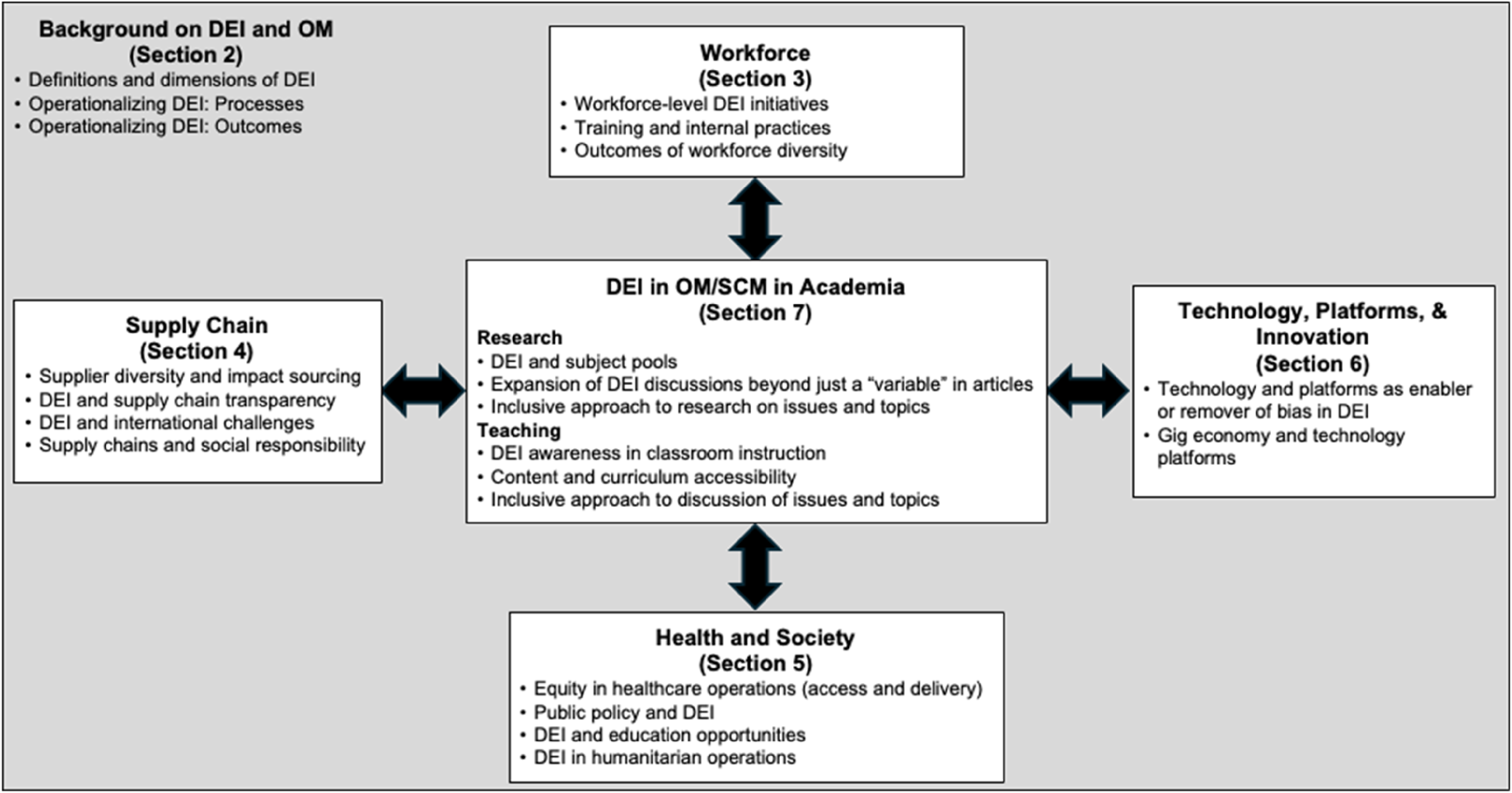
Diversity, equity, and inclusion, and operations management: themes and topics addressed in this paper.
In what follows, we offer perspectives on DEI and how it relates to OM in general (Section 2). In the sections that follow, we present operational perspectives on DEI and the workforce (Section 3), supply chains (Section 4), health and society (Section 5), and technology, platforms, and innovation (Section 6). These are followed by a section on DEI in operations and supply chain management (OM/SCM) in academia (Section 7); and some closing thoughts (Section 8).
All SEs listed as co-authors have approved this version, though undoubtedly, several would have preferred to express some thoughts differently. The author contribution statement and online appendix detail how we addressed concerns about potential conflicts of interest among such a large team. Several articles offer advice on working with large teams of authors (Borer et al., 2023; Frassl et al., 2018; Moshontz et al., 2021), and while we only encountered these late in the process, we are pleased that we followed at least some of their guidance. Some of their recommendations pertain to teams much larger than ours, but they make good reading for anybody wishing to embark on a similar project.
DEI practices first emerged in US organizations after legislative changes rooted in the civil rights movement and employment non-discrimination 2 . In the OM/SCM domain, the scope of DEI broadened from the focus on civil rights and non-discrimination to creating equitable economic opportunity within the extended value chain (e.g., supplier diversity initiatives and smallholder sourcing). Other regions have put in place regulations related to non-discrimination. For example, the European Union (EU) has established frameworks for the equal treatment of persons inside and outside the scope of employment (Schiek, 2002). Awareness of DEI in the US and beyond increased with the 2020 murder of George Floyd in Minneapolis, and continues to grow due to issues such as the ongoing migrant crisis in the Mediterranean and other comparable concerns worldwide.
At the same time, a counter-trend to DEI has gained momentum in the US. DEI-related discussions have become heated, and DEI offices have been downgraded or shut down in public universities in Florida, Texas, and elsewhere 3 . Others are changing the terminology, referring for instance to “inclusive excellence” instead of “DEI.” In medicine, Bajaj et al. (2024) argue that DEI needs a stronger focus on outcomes and a more solid evidence base, precisely what we hope the special issue helps to provide. Without wading into the surrounding political debates, where nuance is often the first victim of ideology, this article examines the ways with which DEI and OM can enrich each other. We use the term “DEI” here because that was the term used in the call for papers for the special issue, but the arguments and objectives put forward in this article and in the special issue do not depend on the specific label used.
In that sense, we must be mindful of the effects of our work as OM practitioners and researchers on the diversity, equity, and inclusiveness of organizations, intended or unintended, and recognized or unrecognized. Even well-intended improvement efforts can have unforeseen harmful consequences for some populations. Many organizations have charters or goals related to DEI in place, as they do for sustainability and other societal concerns (Berenguer et al., 2024). OM is about achieving performance goals through processes that convert inputs to outputs. Tang (2024) outlines how DEI efforts can be seen as inputs to organizational improvements, and how DEI metrics can be seen as outputs of organizational improvements. OM tends to address problems through systems thinking and by formulating metrics, developing strategies, and specifying and improving processes to achieve stated goals, whether related to DEI, sustainability, or other concerns. Regardless of how specific institutions engage with DEI, we argue that thoughtful attention to the challenges and opportunities of DEI in OM can make us better educators and researchers, as Johnson and Fabusuyi (2023) argue in their op-ed.
Others have already called attention to issues of DEI in OM, broadly defined. Kalkanci et al. (2019) advocate for “inclusive innovation” to address the needs of underserved populations. Esper et al. (2020) call attention to the issue of race in supply chain management research and practice. Sordi et al. (2022) define supplier diversity in terms of economic inclusion, and Silva et al. (2023) highlight the global nature of DEI within supply chains. Corbett (2024) reviews the non-obvious ways OM interacts with DEI, and Johnson and Chichirau (2020) propose an agenda for DEI that addresses research, practice, and service. Murphy and Roy (2021) focus on LGBTQIA issues for OR/MS scholars. Tang (2024) suggests opportunities for DEI in decision science, and Sunar and Swaminathan (2022) identify themes for socially relevant and inclusive OM. Some of these articles are editorial introductions to special issues.
Scholars have also been calling for greater attention to the role of DEI in other fields. The 23 authors contributing to Alawattage et al. (2021) call for the inclusion of voices and issues often neglected in the field of accounting, and Brown-Liburd et al. (2024) provide an editorial introduction to a special issue on challenges for marginalized communities in the academic and practical accounting profession. Ferdman (2020) serves as an introduction to a special issue on DEI in consulting psychology, with Lemanek et al. (2023) and Bernauer et al. (2023) doing the same for academic medical settings and the hospitality and tourism sectors, respectively. Arsel et al. (2022) synthesize published work and outline a research agenda on DEI in consumer research. Effectively drawing on other theories to inform OM requires familiarity with contemporary treatments of DEI in other disciplines. Because racial and social justice and the issues DEI seeks to address are rooted in people's subjective experiences of difference, bias, and discrimination, OM researchers should be amenable to a wide range of qualitative and quantitative methods of data collection and analysis. OM researchers should view problem structuring methods as co-equal in importance to modeling, algorithm design, and systems development for operational problem-solving. We also need to rethink the meaning of generalizability and its desirability and feasibility in OM research. This article contributes to this literature in several ways, focusing on domains core to OM, addressing a range of themes, and drawing from the perspectives of a diverse and extensive (by OM standards) team of scholars with relevant DEI expertise as described in the methodology in the introduction section.
Definitions and Dimensions of DEI
Paraphrasing Arsel et al. (2022), DEI has become ubiquitous despite a lack of agreement about definitions and the relative importance of each component. DEI can be defined in several ways and is sometimes expanded to include “B” for belonging, “A” for accessibility, “J” for justice, and “R” for respect. Diversity, according to Arsel et al. (2022: 920), “refers broadly to real or perceived physical or socio-cultural differences attributed to people and the representation of these differences in research, market spaces, and organizations.” Diversity can be recognized along multiple demographic dimensions (including gender, race, ethnicity, national origin, sexual orientation, individual and team abilities and disabilities, personality types, economic, military, marital status, religious beliefs, and age) and has been variously measured, including with the Blau Index and entropy (see Harrison and Klein, 2007 for a detailed overview).
According to Arsel et al. (2022: 920), “[e]quity refers to fairness in the treatment of people in terms of both opportunity and outcome.” Many definitions and classifications of this concept exist based, for example, on equal opportunities (inputs), equal outcomes, or a combination. Equity in inputs, also known as “horizontal equity” or “equality,” requires all individuals to be treated equally. Conversely, equity in outcomes, or “vertical equity,” allows disparate treatment based on predetermined characteristics (Karsu and Morton, 2015). For instance, resource allocation in resource-constrained settings (a commonly studied decision problem in OM) can be equal among individuals (horizontal equity) or favor those in greater need (vertical equity; Arnette and Zobel, 2019). A more complete treatment of measures of equity can be found in Harrison and Klein (2007).
Inclusion “refers to creating a culture that fosters belonging and incorporation of diverse groups and is usually operationalized as opposition to exclusion or marginalization” (Arsel et al., 2022: 920). Inclusion allows individuals and entities to feel they belong while retaining their essential uniqueness (Shore et al., 2011). Defining inclusion is particularly challenging as it encompasses the processes by which organizations integrate individuals in the workplace and make them feel respected and engaged (Tang, 2024). Irrespective of definition, it is particularly difficult to translate inclusion into clear performance metrics (Romansky et al., 2021).
As an overall concept, DEI is most associated with building equitable workplaces: valuing a diverse workforce and opinions, treating all employees equitably and building inclusive work environments. We extend DEI considerations by looking at processes and outcomes at the individual, organizational, supply chain, and societal levels. We highlight the critical need to account for diverse groups and to build equitable and inclusive solutions when developing OM applications that address today's business and societal problems. As such, we take a broad view of DEI in the context of OM, encouraging our community to include DEI considerations in their research and application efforts.
Operationalizing DEI: Processes
OM in practice seeks to identify the most effective ways to improve organizational operations and processes. Revising operational processes to improve DEI opens a new and innovative area of study. Opportunities are evident in the areas of leadership commitment to DEI-oriented team configurations, and approaches to process improvements. The connection between leadership quality and successful DEI efforts has been studied in different industries, including business schools (Buttner et al., 2006). For example, Karimi and Roy (2024) show that having a woman (rather than a man) as health minister results in a 66% increase in a country's contraceptive procurements, and Cole et al. (2024) show that teams that include workers with a disability are significantly more productive when supervised by a person with a disability, especially as the number of team members with a disability increases.
Another approach to DEI in operations is the establishment of diverse working teams. Scholars have studied the positive effects of diverse teams on innovation (e.g., Chan et al., 2023; Nielsen et al., 2018; Woolley et al., 2010) and performance (e.g., Dezsö and Ross, 2012). Collective actions, including discussion circles and accountability partnerships, can also build worker relationships across genders and racio-ethnic identities (Opie and Livingston, 2022). However, more research is needed on the effects of team diversity on operational performance and on increasing DEI initiatives in operations; Section 3.2 describes work on diverse teams and forecasting performance as one example. In general, companies may need to increase their recruitment of underrepresented groups in operational settings to achieve team diversity.
Standard approaches to continuous improvement can also help advance DEI in organizations. For example, Sodhi (2024) argues that the process focus and cross-functional approach of such initiatives can increase inclusion and reduce microaggressions by identifying root causes of DEI-related “defects.” Justice-oriented DEI initiatives, allowing employees greater autonomy in scheduling and working practices within quality and productivity targets, may also be supported by OM approaches like continuous quality improvement (Matthews et al., 2024).
Operationalizing DEI: Outcomes
OM is uniquely positioned as a field in which DEI-related outcomes can be integrated – with each other and with broader organizational goals – and operationalized. While DEI measures are increasingly visible, many organizations only capture demographic information (Zheng, 2023). A recent study revealed only 25% of organizations measure DEI comprehensively (HR Research Institute, 2019), although at least one has operationalized DEI programs and measures within a formal framework 4 . There may be less resistance to DEI (as recently seen in the US) if the typical measures of performance (low cost, less variability, etc.) remain the focal point (Sodhi, 2024). Nonetheless, OM can make an important contribution by managing the diverse and intertwined objectives reflected, for example, in the United Nations Sustainable Development Goals, which recognize a wide range of sustainability, DEI, and other issues (Sodhi and Tang, 2024).
DEI has the potential to impact firms’ relationships with other organizations and customers, yielding rich research opportunities. For example, many firms have committed to DEI initiatives, as have their supply chain partners, financial institutions, and regulatory bodies. Firms may disclose their commitments to secure business at favorable terms, improve relationships, and gain regulatory approvals, suggesting they see an economic case for DEI. Understanding what, to whom, and how to disclose DEI initiatives is non-trivial and requires detailed investigation (Crane and Glozer, 2016). Studies show customers’ favorable and potentially monetizable perceptions of quality and a willingness to pay a premium in reaction to social sustainability disclosures (Duan et al., 2021; Nichols et al., 2019). More detailed studies on the effects of disclosures of DEI-specific initiatives, such as those that promote equality in gender, race, and disability, would be beneficial.
However, caution is needed given the prevalence of practices like greenwashing, whereby companies exaggerate their positive environmental actions while concealing their negative impacts (Marquis et al., 2016). The natural question is whether some companies are “diversity washing,” i.e., selectively disclosing information to exaggerate their positive diversity initiatives while obscuring their negative DEI actions. Recent studies suggest that this is a real and growing problem (Baker et al., 2024). As OM scholars, our response could be to examine what companies should do to foster authentic DEI within their operations and across their supply chains. Balakrishnan et al. (2024) show that diversity data disclosed by firms do not undermine consumer attitudes and behaviors toward the firm even when those disclosures reveal racial disparities; they find that consumers value the progress rather than absolute numbers. Li et al. (2024) find that DEI announcements yield positive abnormal stock returns during the announcement period, and Shalpegin et al. (2023) argue that boycotting firms for their poor DEI performance can have unintended consequences, harming guiltless supply chain actors.
The theme of finding economic rationales for DEI initiatives is evident in other areas of inter-organizational research. There is evidence that individual attributes and biases based on individual characteristics affect agent behavior in inter-firm interactions. For example, women have an advantage over men in collaborative supply chain interactions (Ma et al., 2021). Gender bias, whether detrimental or favorable, can be a potent factor in operations (Son et al., 2024). Overall, there is a need for a more thorough understanding of how organizational relationships and interactions are impacted by such factors.
Classic performance measurement frameworks in OM (e.g., the internal process and learning and growth components of the balanced scorecard) can be extended to examine how organizations determine levels of performance and employee satisfaction as well as who is advantaged and disadvantaged by existing performance measurement systems (Opie and Livingston, 2022). It may be useful to conduct longitudinal comparative analyses of performance incentives according to diversity factors (e.g., race, ethnicity, gender) to examine how financial performance and updated scorecard factors, such as pay equity, are connected (Jourdan, 2023; Opie and Livingston, 2022).
It is important to consider any potential trade-offs implied by different equity measures, whether at the organizational or societal levels, including any loss of efficiency within the system (Liu et al., 2024a). Opting for the most equitable decision, for example, allocating resources according to vertical equity, might not be the most efficient choice, a trade-off often referred to as the price of equity or fairness (e.g., Bertsimas et al., 2011; Breugem and Van Wassenhove, 2022). One significant yet underexplored area of inquiry is whether transparency regarding this trade-off and the societal value of fairness enhances public support for such initiatives. It is also conceivable that DEI outcomes can be integrated with other performance outcomes such as profits, customer satisfaction, and employee well-being (Sodhi, 2024). Well-run operations may meet multiple desirable objectives, avoiding unnecessary sacrifices; for example, Glover et al. (2024) illustrate how a small clinic can simultaneously meet financial and community objectives.
With this brief background on OM and DEI, we next explore each of the four domains of research detailed in Figure 1 focused on DEI in workforce, supply chains, health and society, and technology, platforms, and innovation, followed by a DEI in academia in operations and supply chain management.
DEI and the Workforce: Operational Perspectives
The field of people analytics and operations promises to improve human capital decisions by improving firms’ ability to quantify performance, recruit, motivate, and retain skilled workers, compensate and promote them fairly and effectively, and plan and build productive and inclusive teams and workplaces. Here, we focus on workforce diversity, its impact on outcomes, and the potential roles of OM.
Workforce Diversity
Diverse and representative workforces, whether assessed by gender, sexual orientation, ethnicity, or disability status, are still far from being achieved. In the field of OM/SCM women are historically underrepresented (SCMR, 2022). A 2023 survey shows that women make up 41% of the supply chain workforce (up from 35% in 2016) but only 26% of C-suite and executive positions (Gartner, 2023). STEM fields also exhibit significant racial disparities. Based on a recent PEW survey (Fry et al., 2021), Hispanic workers represent 17% of the total workforce across all occupations but only 8% of STEM workers. Similarly, Black workers account for 11% of the overall employed population, yet they make up just 9% of STEM professionals.
Flexibility is argued to be the most effective way to attract and retain women, outperforming initiatives related to benefits or even pay equity (Gartner, 2023). This implies that offering more flexible work arrangements improves the representation of women. However, flexibility introduces other challenges. For example, employees with weaker social connections to colleagues face a greater likelihood of layoffs or receiving lower ratings; boundaryless work (an outcome of increased flexibility) risks employee burnout, and flexibility accommodations can lead to pay or career discrimination (see Kossek et al., 2021 and references therein). Therefore, it is important to examine the short-term implications of flexible work practices on diversity and their long-term impacts on the talent pipeline, which is a better indicator of inclusion. Other recent and notable initiatives include gender-specific DEI goals and executive compensation being linked to DEI outcomes (Gartner, 2023). OM researchers have also started to study policy preferences, such as family leave policies and subsidized childcare (Kaaua and Virudachalam, 2023). In their assessment of gender-dominant operational settings, Metters and George (2024) challenge us to examine these operations through the appropriate theoretical lens from women's studies literature.
In addition to race and gender (the focus of much work in DEI), other dimensions of difference should be considered in creating inclusive work environments. For instance, individuals who do not conform to traditional cisgender norms comprise 7.2% of US adults 5 , and we are starting to understand differences in their customer experience (Mejia and Parker, 2021). Arora (2024) calls for more research in settings with LGBTQ clients, employees, and communities. Bias against these individuals in service delivery can increase workforce challenges and impact operational performance. Overall, we know very little about the operational benefits of more inclusive work practices, such as same-sex partner insurance and parental leave policies, and more inclusive customer-facing practices and service approaches
For employees with physical and mental health challenges, remote work and remote learning have made it easier to pursue work. For example, neurodivergent professionals are shown to be better at creating accessible physical and digital workspaces from home (Das et al., 2021) and, on the assembly line, a diversity of disabilities in the workforce can improve productivity by providing more flexibility around operational configurations (Narayanan and Terris, 2020). Similarly, technologies can create greater opportunities for individuals with disabilities (Narayanan et al., 2019). For example, a Tokyo cafe 6 uses robots remotely controlled by employees with significant physical disabilities to boost the earning potential of these employees (Steen, 2021).
Some aspects of creating an inclusive workforce may be driven by policies that organizations choose to pursue. For example, Ornelas et al. (2024) explain how tribal casinos seek to promote “tribal economic development, self-sufficiency, and strong tribal governments” and often employ members of the tribe to the extent possible, though the actual workforce composition varies widely. Similarly, community rehabilitation programs in the US are mandated to hire workers with disabilities for 75% of their workforce to qualify for AbilityOne contracts (Narayanan and Terris, 2020). Policies aimed at DEI can range from laissez-faire to regulatory to transformative; Bodrzíc and Gold (2024) suggest that OM is particularly well-placed to examine the type of policy that is most appropriate for a given scenario. In many cases, such regulations are intended to foster representation and inclusion and promote social equity for marginalized populations. Yet, a focus on the systems and processes that drive workforce inclusion can promote superior social impact when considered from the perspective of integrating marginalized populations into the broader community. One such domain is the Workforce Innovation and Opportunities Act of 2014 that focuses on competitive integrated employment – i.e., individuals with and without disabilities working side by side without any pay or benefit differences, producing the same output (Narayanan and Terris, 2020).
Effect of a More Diverse Workforce on Outcomes
Team diversity can affect the process by which team members interact. Although greater diversity may be associated with more interpersonal conflict (e.g., Mannix and Neale, 2005), it can also foster more constructive interactions through heightened information sharing. For instance, teams with a critical mass of women members perform better than teams where women members are integrated into a male dominated environment (Bear and Woolley, 2011). Another study finds evidence that gender-diverse teams perform best and all-women teams perform poorly because they are less aggressive in pricing strategies, invest less in R&D, and invest more in social sustainability (Apesteguia et al., 2012). Similarly, diversity in characteristics like race or ethnicity reduces expectations of similarity in perspectives, improving the likelihood that individuals will express dissenting opinions and share privately held information (e.g., Phillips et al., 2006; Phillips and Loyd, 2006). In turn, such improved information sharing reduces overconfidence in team judgments and forecasts (Keck and Tang, 2018), improves general forecasting accuracy (Lamberson and Page, 2012; Mellers et al., 2014), and enhances innovation (Chan et al., 2023; Girotra et al., 2010). Sunder et al. (2024) demonstrate that gender-diverse teams adapt more quickly to changes in organizational routines, suggesting a mechanism for their impact on performance, and Goradia and Byron (2024) find that physicians in gender-diverse departments have better patient outcomes.
While these studies evidence the impact of a diverse workplace on performance, there remain questions about the impact of diversity across gender, race, ethnicity, and other key characteristics. As one specific example, how does greater diversity within a firm's upper echelons (i.e., the board of directors or top management) affect its outcomes and competition? Most research on gender and/or racial diversity among members of the corporate elite focuses on internal implications such as profitability (Jeong and Harrison, 2017; Post and Byron, 2015), but little is known about its external implications. Do firms – perhaps those with a majority of men at the helm – compete more aggressively with firms led by women or underrepresented racial minorities, believing it easier to gain an advantage (i.e., market share)? And, if such differences exist, how do they manifest in operational practices and/or outcomes?
Workforce diversity is particularly crucial in the AI age. A diverse representation of researchers is essential for promoting responsible AI, ensuring equity, and achieving outcomes that benefit people from all backgrounds. A diverse AI workforce plays a key role in fostering fairness and supporting the responsible development of AI systems, as noted in the White House Executive Order on the Safe, Secure, and Trustworthy Development and Use of Artificial Intelligence in October 2023 (The White House, 2023).
How OM can Help Achieve a More Diverse Workforce
People analytics addresses sensitive and life-changing issues: who gets hired, fired, and promoted and how much they are paid. All of these decision scenarios are critical to building inclusive workplaces. In recent years, there has been an explosion of tech applications to support HR operations, often with less-than-optimal outcomes (e.g., Amazon created a biased resume scanning tool 7 , and a HR Tech firm created and sold a behavioral video analysis tool 8 for recruitment that showed differences in results based on whether or not a person wore glasses). In 2023, the Equal Employment Opportunities Commission settled a lawsuit with iTutor and related companies that rejected applicants because of their age and then launched the algorithmic fairness initiative (See et al., 2023).
There is a large knowledge gap with respect to the ethical and inclusive use of AI and machine learning in people operations (Anderson et al., 2021). Responsible AI is a critical need to ensure fairness in this context. Solutions are being developed; for example, Kelley et al. (2022) offer examples of how algorithmic transparency can reduce discrimination in algorithms. There is a long tradition in the OM field of using analytics to support difficult and sensitive decisions, including in life-and-death situations such as organ transplants (e.g., Ata et al., 2017). The OM community can contribute to analytic tools used in a wide range of HR and compensation decisions for greater transparency and equitability. OM solutions can also be used to enhance workforce diversity by analyzing the root causes of gender, race, class, and other imbalances (e.g., Chen et al., 2022) and ensuring equitable compensation (Anderson et al., 2023).
Relatedly, the employee experience can be modeled as a way to improve retention. Modeling approaches that focus on productivity gains fail to account for the mental and physical load on workers that impact attrition. In service settings, where frontline employee roles are critical, Rosenzweig et al. (2024) find that codified policies and procedures improve employee assessment of service equality the firm delivers. Thornton et al. (2024) discuss the importance of proactively managing cross-racial service encounters and supporting frontline employees. Such support can help retain employees and support their well-being. Avoiding irresponsible behavior is also important for recruitment and retention. Darby et al. (2024) find that firms demonstrating systematic social irresponsibility are less likely to attract young employees – irrespective of gender. Thus, firms should both improve responsible behavior and prevent irresponsible behavior to create and retain a diverse workforce.
As a discipline, OM examines system design and its performance implications. When diversity of employee characteristics is accounted for, employees can perform at their peak. For instance, models of scheduling should account for employee needs, including breaks (Kesavan et al., 2022), and in some cases, cultural constraints complicate scheduling (Ornelas et al., 2024). Effective OM models that account for these challenges can support employee success. Further, helping workers succeed may require a deeper understanding of their cognitive schemas. For example, an employee's language, including writing direction, can affect how they perceive the workplace environment around them, which can impact their success in an operational setting. Loske et al. (2024) demonstrate that the picking productivity of warehouse employees declines when they ride forklifts in a direction opposite to their original writing direction, possibly because of its impact on their spatial orientation. In short, OM and analytics can contribute to attracting, retaining, and making a workforce more successful, improving employee well-being.
DEI and Supply Chains
Next, we explore how firms can encourage a more diverse supply chain through supplier selection, and we then examine how firms can improve DEI practices within a given supply chain.
Supplier Diversity
A diverse supplier base starts with a well-designed effort to engage with suppliers and supplier selection, a key process in any firm. In US federal programs, supplier diversity is an important lever for improving the performance of small businesses, achieving equity for women and minority business owners, and serving underserved communities (US General Services Administration, 2022). One study demonstrates that US companies with diverse suppliers show a 133% greater return on procurement investments than those lacking such diversity (David, 2023; Jones, 2006). There has also been an increase in global supplier diversity programs in recent years (Supplier.io, 2022). However, even with an increase in global and US federal and state initiatives supporting supplier diversity (e.g., National Minority Supplier Development Council), the number of minority suppliers remains stagnant for most large corporations; 80% of companies conduct less than 5% of their purchases with diverse suppliers (Supplier.io, 2023).
There are substantial challenges that small, diverse suppliers face, driven by the lack of clearly defined government policies and innate bias among purchasing managers. Aral and Van Wassenhove (2024) set up a series of experimental scenarios to show that Black suppliers are less likely to be awarded contracts than their White counterparts, and Hill et al. (2024) argue that large purchasing organizations need to make it easier for marginalized suppliers to get access to and work with them.
With regard to supplier inclusion, federal and state governments and large corporations have programs and policies to set aside contracts for smaller and minority suppliers. Kent et al. (2024) document variations across state programs and the challenges in defining minority suppliers. For example, if a black-woman-owned supplier has to be assigned to precisely one category, it can make a big difference if the supplier is categorized as “black-owned” or “women-owned”; recognizing intersectionality between categories is critical. Polyviou et al. (2024), who show how smaller suppliers are awarded complex federal government contracts, argue that performance is not substantially different between small and large suppliers.
Large purchasing organizations operating across national boundaries also need to consider localizing their strategies to be more inclusive. Berenguer et al. (2024) observe an upward trend in supplier diversity efforts at global corporations. DEI initiatives in supply chains should be based on the characteristics and needs of the geographic regions in which firms operate. Cultural differences impact how DEI is understood and practiced, and programs must be adapted to regional cultures, languages, and workforce and supplier demographics. For instance, the city of Seattle passed laws in 2023 banning caste-based discrimination in the IT sector with many Indian immigrant workers; the legislature of California followed suit although the bill was vetoed by the governor 9 . Intersectionality – how identities like race, gender, and disability status interact to produce different experiences and barriers – must also be considered in each locale.
Socioeconomic disparities between regions may require tailoring supplier diversity programs and support primarily owing to cultural differences. This is especially so since political and legal contexts shape what DEI actions are possible, and companies must navigate regional laws and norms while upholding their values, which may necessitate additional advocacy in certain regions. While the overall goals of supply chain DEI – fair representation, equitable opportunities, and inclusive cultures – stay the same, tactics for achieving these need to be customized to be effective in the local context. A thoughtful regional approach, guided by local knowledge, allows companies to drive DEI impact across diverse geographic supply chains.
For supplier diversity initiatives to take root and yield meaningful results, their intent must be internalized by firm leaders. At its core, supplier diversity is about expanding opportunities and creating a more inclusive and equitable procurement ecosystem. It is not about taking business away from existing suppliers or compromising on quality or competitiveness. Rather, it is about nudging current suppliers to increase their DEI efforts (and their businesses) by leveraging the untapped potential of diverse suppliers to drive innovation, resilience, and value creation. This message may be lost or diluted if not supported or effectively communicated by the firm's leadership. While existing suppliers may feel threatened by these efforts, they need to be engaged with empathy, transparency, and a clear and direct articulation of the firm's broader strategic vision.
Improving DEI Throughout the Supply Chain
A fundamental aspect of supply chains is that they connect firms via the flow of products, information, and resources. One question that arises is whether the internal benefits of DEI initiatives spill over to external relationships with supply chain partners. Specifically, can the various DEI initiatives embraced by firms, such as gender-equal pay or programs to support LGBTQ employees, create a more supportive culture that extends to supplier development programs? These questions could be considered in research that adopts a broad supply chain perspective. For example, Cen et al. (2024) use textual analysis to show that a customer firm's equal employment opportunity policies spill over to its dependent suppliers.
Ensuring that suppliers across all tiers adhere to ethical sourcing practices and labor standards (e.g., fair wages, safe working conditions, non-discrimination, and prohibition of child or forced labor) are critical aspects of social sustainability in supply chains and overlap with DEI objectives. By holding suppliers accountable, companies can leverage their purchasing power to drive positive change and create more equitable and inclusive supply chains. This is particularly important in industries and regions where vulnerable populations, such as women, minorities, and low-wage workers are disproportionately represented in the supplier workforce (e.g., the garment industry in South-East Asia). Supplier accountability can involve implementing supplier codes of conduct, regular audits and assessments, and training and support to improve practices. Companies must also be willing to take action when suppliers fail to meet these standards, including terminating contracts or developing corrective action plans. These efforts require a long-term commitment to supplier engagement and development, as well as a willingness to invest in the capacity-building of diverse suppliers.
The literature examines a number of important and related issues driving working conditions in supply chains, including the frequency of buyer audits and the composition of audit teams (Short et al., 2016), regulatory scrutiny (Villena et al., 2021), worker training in lean practices (Distelhorst et al., 2017, Villena et al., 2021), factory structure (unionized vs. non-unionized, see Bird et al., 2019, Oka, 2016), and predatory pricing practices by buyers (Anner, 2019; 2020). In addition to factors impacting working conditions, some studies examine their performance implications (e.g., orders received by factories, see Liu et al., 2019) and the customer-side implications of firms being more transparent regarding their efforts (Buell and Kalkanci, 2021).
In addition to working conditions and their positive impact on supply chains, a firm's operational decisions can impact employee well-being through the work performed. For example, Li et al. (2023) examine how firms can redesign their harvesting protocols (a key operational decision) to improve firm profits and reduce the ergonomic stress experienced by workers during the harvesting process. This connection between operational decisions and working conditions is an important avenue for future research.
Financial inclusion is another pressing issue critical to DEI in supply chains. Only a small portion of the total value generated by production goes to small producers, who are typically located in the upstream supply chain in developing economies. This pattern is particularly prominent in agricultural supply chains. For example, cocoa farmers are reported to receive only 3 cents of the $3.49 spent by consumers on an organic chocolate bar (Alsever, 2006). Limited and unstable incomes prevent farmers from taking action to improve their productivity or investing in sustainable practices (Eldridge et al., 2022), and the countries where these farmers are located are increasingly prone to high crime rates and mass migration 10 . These challenges of value distribution are attributable to several factors, including the fact that small price-taking producers are often at the beginning of long supply chains and separated from consumers by several middlemen. Technological and supply chain innovations have been created to alleviate poverty in the upstream chain, including blockchain-enabled platforms that allow consumers to tip the farmers of the sustainable products they purchase (Alizamir et al., 2023), direct sourcing relationships with farmers, region-based procurement pricing (de Zegher et al., 2019), and the elimination of payment delays (de Zegher et al., 2018). Research in the OM field can guide current practice by investigating whether and when such innovations can bring more equity to value distribution along global supply chains.
Improving DEI throughout a supply chain can also enhance its ability to prepare and plan for, absorb, recover from, and more successfully adapt to adverse events (NRC, 2012), resulting in more resilient supply chains. For example, the flexibility gained from working with diverse suppliers and the adaptability required to meet the changing needs of diverse stakeholders are valuable in addressing unanticipated supply chain disruptions (Sheffi and Rice, 2005; Wieland, 2020).
DEI and Operations for Health and Society
The constitution of the World Health Organization (2020) defines “health” as a state of “complete physical, mental and social well-being and not merely the absence of disease or infirmity” (Bircher and Kuruvilla, 2014), acknowledging that societal factors aid or impede the achievement of health of individuals and groups. Health in this context refers to a broad range of topics, including (but not limited to) health behavior, health policy and economics, mental health, racial health disparities, LGBTQ health, and gender inequality in health. In exploring links between DEI and OM related to health, it is essential to consider the broader societal context, including public services. In this section, we focus on equity in health care and other public services.
Equity in Health Care
There is a long tradition of using optimization, simulation, and other OM methods to support healthcare operations and treatment decisions. The development of machine learning techniques, large language models, and the surge of health IT systems have seen predictive models integrated into decision-making in care provision and policy formation. These models, along with prescriptive analytics, offer the potential for customized and precise medical treatments, improved workflow efficiency, and cost reduction in healthcare services.
However, any such solutions can have disparate impacts when biases and differences between groups are not accounted for. Jetley and Zhang (2024) find that disparity in pain measurement frequencies for Black patients in ICUs likely results in their higher rates of readmission. Wang et al. (2024) document substantial technology bias in the context of pulse oximetry, leading to non-White patients with sepsis experiencing a 79% higher risk of mortality than White patients. Cheng et al. (2024) show that gender bias increases wait times for female patients in emergency departments, particularly when they are crowded. Attari et al. (2024) show that supply chain complexity is a key factor in large quantities of opioids escaping detection by the Drug Enforcement Agency, largely impacting non-White communities.
When a solution or predictive model is implemented in a real-world setting, it interacts with data generated by complex socioeconomic and behavioral dynamics. Ball et al. (2024) use data from the WebMD platform and note that drug reviews from women are a better predictor of drug recalls than reviews from men, suggesting that regulators may need to pay attention to the gender of the individuals reporting drug complaints. Training data have historically been biased toward certain demographics, leading to disparities in prediction accuracy and decision-making quality across population groups (Obermeyer et al., 2019). Carefully built analytical solutions can address these biases. For example, Canellas et al. (2024) present a novel mixed integer linear programming model to ensure fairness in patient prioritization and mitigate bias in wait times in emergency departments and hospital operations. Other examples include addressing racial bias in scheduling (Samorani et al., 2022) and fairness in organ allocation (Bertsimas et al., 2013). However, for the most part, the OM literature has not adequately addressed issues of fairness in healthcare operations.
Most studies of healthcare OM focus on maximizing population-level outcomes, but there is growing recognition that benefits may translate disproportionately across communities. In light of this, equity considerations are being explicitly incorporated into study objectives, for example, McCoy and Lee (2014) for vehicle capacity allocation in humanitarian healthcare settings and Aprahamian et al. (2019) for public health screening schemes to improve outcome equity.
The healthcare OM literature should be revisited through the lens of fairness and equity at the individual and population levels. While the growing attention to equity is commendable, more work is needed to advance the science of operational decision-making to reduce disparities in care. Areas for development include reporting model performance and consequences for different patient cohorts, the delivery of quality care in health deserts, and generally contributing to the development of health equity science. There are several ways OM researchers can contribute to improve health equity, including (1) the design of the healthcare delivery process for accessibility of services, especially to disadvantaged groups affected by physical or socioeconomic barriers, (2) the development of cost-effective, patient-centric care to increase access to quality care (e.g., Wang et al., 2019); (3) exploration of how technologies such as telemedicine, wearable devices, and generative AI can increase access and lower the cost of access to disadvantaged patient groups; and (4) addressing the social determinants of health, such as living and working conditions.
Equity in Other Public Services for Society
Beyond healthcare, many other public services, such as childcare, education, food security, and infrastructure present DEI-related operational challenges and opportunities. The growing availability of quantitative measures of social vulnerability (Cutter et al., 2003; Flanagan et al., 2011) provides an opportunity for data-driven optimization of public goods allocation while increasing equity. Addressing such vulnerability is critical for policy development and the delivery of public services (Arnette and Zobel, 2019). The OM community has a long-standing tradition of applying quantitative methods to policy analysis, including regarding school boundaries and busing (e.g., Bertsimas and Delarue, 2023, Ozel et al., 2023), disease screening (e.g., Chen et al., 2018, Garcia et al., 2024), fair housing (Tang et al., 2023), non-profit funding to minimize disparities in childcare access (Arora et al., 2021), and the inclusion of refugee children while minimizing the burden on educational infrastructure (Demir et al., 2024).
Equity is central to public policy planning, and integrating the principles of fairness, accessibility, and inclusivity into the design, implementation, and evaluation of public services and policies is critical. Brennan (2024) cautions that the OM models used in urban planning have deviated from planners’ awareness of the needs of disadvantaged populations. Consequently, the first step of public policy planning should be to understand the root causes of outcomes and how these differ across demographic groups. Policy evaluation should also be disaggregated by relevant demographics to understand disparate impact and ensure that no group is disproportionately harmed. For example, Baghersad et al. (2024) incorporate horizontal and vertical equity to study the allocation of resources for stormwater infrastructure improvement projects. Similar modeling approaches can play a role in equitably allocating resources to address other problems, such as the Flint water crisis in the US.
OM researchers can contribute to equitable public services, including education equity at all levels. Researchers could consider (1) better allocation of educational resources (infrastructure, supplies, and instructional staff) to ensure equal access to education, (2) how technologies such as online learning management tools and generative AI mitigate or exacerbate learning gaps among disadvantaged students (Keppler et al., 2022, Pei et al., 2023), and (3) how personalized learning pathways from the classroom to the institutional level can accommodate various learning styles and needs.
DEI is also an important consideration for international humanitarian aid organizations and their donors, who typically recognize the importance of embracing diversity by localizing their responses (Besiou and Van Wassenhove, 2020). In particular, involving local experts in the decision-making process allows for more equitable and culturally relevant results in the short and long term (Seifert et al., 2023). However, diversity fault lines may become evident during high-pressure disaster response, so humanitarian organizations need to address inclusion proactively (Gazdag et al., 2024). A further consideration is beneficiary preferences, which are frequently shaped by culture, social bonds, and experiences that can be impacted by inequity. Breugem et al. (2024) provide an approach to modeling such preferences with examples drawn from the Syrian and Rohingya refugee crises. Food banks are a key channel for humanitarian assistance to low-income and food-insecure households (Orgut and Lodree, 2023). Here, culturally appropriate foods are a key element of inclusion, particularly because food providers may not share the same socioeconomic and cultural backgrounds with individuals visiting food banks (Hamilton et al., 2024).
DEI and Technology, Platforms, and Innovation
Technology and innovation disrupt existing processes and can exacerbate and ameliorate DEI challenges. Platform models are at the center of much recent OM work and deserve special scrutiny.
Technology and Platforms as Enablers or Obstacles of DEI
This section considers the extent to which technology influences biases and the resulting discrimination. We focus on the role of technology in gender and racial bias, but technology may influence other biases. The way technology is implemented can be inherently biased; for example, Wang et al. (2024) demonstrate systemic bias in measures of blood oxygen saturation and the administration of supplemental oxygen. On the one hand, technology may remove face-to-face interaction and likely influence the extent to which gender and/or racial bias is exhibited by concealing demographic information. On the other hand, technology may also magnify these biases. For example, online platforms are beginning to implement features that enable self-identification of minority-owned businesses (Avery, 2022), but these features could significantly hinder their success or even survival. Son et al. (2024) find that after restaurants are identified as Black-owned on a major platform, their average ratings decrease; this effect is stronger in areas in which more hate crimes have been reported. It has also been shown that the algorithms on which technologies are built are typically trained on historical data and hence may reflect or exacerbate historical bias in their recommendations (e.g., job recommendations for online workers; Chen, 2023; Mehrabi et al., 2021). These unintended consequences point to the need for greater care when implementing technology.
New technologies that rely on the internet may greatly increase productivity, but could also further widen the digital divide between those with a fast internet connection and those without, creating a challenge in harnessing technologies’ potential. Paraskevas et al. (2024) demonstrate that a strategic focus on e-commerce can help bridge the gap in access to retail products and services caused by the digital divide. In the emerging economy context, Liu et al. (2024b) find that those from the most disadvantaged groups (in this case, women of lower caste in India) reap the greatest wage benefits of digital skills.
Platforms, New Business Models, and DEI
Gig economy platforms are seen as democratizing access to job opportunities and reducing earning disparities on the lines of gender, race, or disability, allowing greater flexibility in where and when work is conducted (Foong et al., 2018) and involving relatively homogenous tasks (Litman et al., 2020). However, recent evidence suggests that disparities in the traditional labor markets can persist on these platforms (Kricheli-Katz and Regev, 2016) and even in settings where workers’ demographic information is invisible (Litman et al., 2020). Moreover, people with low earnings are more likely to engage in and rely on independent contracting, including gig work (Bernhardt et al., 2022). Despite smoothing fluctuations in non-platform income (Farrell and Greig, 2016), increasing access to platform work may also increase the likelihood of financial hardship (Daniels and Grinstein-Weiss, 2019) and lower levels of social protection (World Bank Group, 2023). Platforms often rely on opaque and non-intuitive algorithms for worker compensation and evaluation (Rahman, 2021), leading to unpredictability and a lack of control over factors on which workers are assessed. The increased ability to select service providers (as is common on labor platforms) can also contribute to service inequity through the exclusion of groups on the basis of race or sexual orientation (Mejia and Parker, 2021) or due to the lower expected financial gains from serving lower-income communities (e.g., lower tips) (Ding et al., 2023).
OM can bring DEI considerations into the design of online labor platforms through (1) incentives and information-sharing mechanisms that create consumer surplus, improve worker welfare, and enhance platform efficiency, (2) more fair and inclusive algorithms to assign work, determine pay, and evaluate workers, and (3) recognizing service equity as an explicit metric. Notably, developing fair algorithms requires attention to the process of data generation to mitigate the bias embedded in datasets and avoid perpetuating or amplifying unfairness and discrimination. Despite the potential of many platforms to broaden access and foster inclusivity, studies document persistent bias (e.g., Cui et al., 2020, Edelman et al., 2017, Wang et al., 2023).
E-Government service systems are examples of specific platforms with a mandate to ensure equity and inclusion due to their public service focus. Such platforms typically provide access to detailed, highly structured records of service requests that can support efforts to empirically characterize the corresponding service relationships (Zobel et al., 2021). The platforms further inclusion by providing access through multiple modes and supporting equitable resource distribution by geolocating all service requests and detailing the associated outcomes (Zobel and Baghersad, 2020).
Some business models are essentially operational innovations that promote equity and inclusion by increasing access. For example, telehealth and online education increase access to health and education services for those in remote areas. Shared service delivery, for example, shared medical appointments in which a doctor sees several patients with the same condition together and gives one-on-one attention to each in turn (e.g., Sönmez et al., 2023), increases access for poor populations with unpredictable schedules (Buell et al., 2024). This care model also increases equity in the information that a client gains by visiting a service provider. For example, while a doctor may be unlikely to know what a patient from a poor neighborhood can afford in their local supermarket to improve their diet, fellow patients sharing that appointment would know and could share that information.
This entire discussion of technology, platforms and business models revolves around innovation, the effects of which can be exclusionary or inclusive. Inclusive innovation has been defined as “the inclusion within some aspect of innovation of groups who are currently marginalized” (Foster and Heeks, 2013: 335). A focus on DEI in our field can allow collaborative integration of economic, environmental, and social issues of relevance to underserved populations in OM decisions. Following the “ladder of inclusive innovation” introduced by Heeks et al. (2014), Kalkanci et al. (2019) conceptualize inclusive innovation in three major areas of OM – product and service, process and business model, and supply chain innovation – and develop a framework for inclusivity in each. Building on this framework can help our field meet the needs of historically marginalized populations better while creating more sustainable economic value.
DEI in OM Research and Teaching
Thus far, we have examined the key OM domains focused on the workforce, supply chains, health and society, and technology, platforms, and innovation. We now examine DEI in the context of academia, with a focus on research and teaching. What we do with respect to DEI in OM research and teaching is (or can be) a foundation for DEI in any domain including each of the domains discussed so far, as illustrated in Figure 1.
DEI in the OM Research Process
We now explore how DEI and racial-and-social justice can be brought into research programs in ways that go beyond merely recognizing deficits in current operations. The first stage is awareness that the challenges DEI efforts address are real and prevent organizations from improving operations. If researchers find that the issues are indeed relevant for them, then come the stages of theory-building, research design, analytic methods, and connections to policy/public impact.
There may also be gaps in well-established research. For instance, a recent meta-analysis of studies on positive psychology notes that most were conducted in Western, educated, industrial, rich, and democratic countries (Donaldson et al., 2021) and calls for work in the realm of well-being and positive psychology research to extend beyond these contexts. Similarly, in clinical research, the Federal Drug Administration has noted a serious imbalance in representation in drug trials (Yates et al., 2020). These challenges will be increasingly important as OM research in behavioral and other domains continues to mature.
The concern about overly homogenous study populations is seen in the recruitment of subjects for behavioral experiments as well. The most convenient option for many OM researchers is students at the local university lab, the vast majority of whom are likely to be White, young, and middle-class 11 . The move to online crowdsourcing platforms such as Prolific and Amazon's Mechanical Turk has enabled opportunities for gathering a much larger and more diverse pool of participants that can make results of studies more representative 12 . Nevertheless, more should be done to reach people of color or poorer people in experiments to ensure the conclusions drawn apply to those with a diversity of views and lived experiences. More work is needed to partner with responsible organizations or new platforms trying to make inroads into unrepresented communities so we can understand the modifications needed to make existing theories more inclusive.
Just as there are opportunities to expand and diversify subject pools, there could be several OM applications where examining racial and social justice requires existing and novel modeling and analytic methods. New perspectives could be brought to areas such as supply chain modeling, transportation, town and urban planning, health care, and natural resources through analytical methods to analyze DEI challenges in parallel with contemporary DEI theories. Possible questions include the following: how can climate change response models address DEI issues with reference to the populations impacted? How do service systems make the daily experiences of frontline service workers salient to better recognize their individual identities? OM researchers could also focus on interrogating assumptions in methodologies that fail to account for identity characteristics. For example, what might be gained or lost by allowing persons in a queue to have balking probabilities – for instance in preventive healthcare or vaccination or receiving social services – that vary according to race, ethnicity, or gender, or by allowing that potential facility sites are not necessarily identical except for demand for a generic good and distance from other sites?
Empirically, there are many ways to introduce DEI and racial and social justice concerns into OM research, whether to close existing gaps or to pursue new areas of research. A traditional approach is to modify existing models to address some aspect of identity. In the case of multivariate regression, this can be done through the introduction of a new independent variable representing this characteristic. However, the role of race, gender, and other identity characteristics may be more subtle and fundamental. For example, one may ask how race or income influences operational policies, the decision alternatives that individuals may perceive as available, or the perceived risks associated with the use of technologies. Researchers can infuse DEI and social justice into OM research in creative and impactful ways by addressing theory-building, conceptual frameworks, research design, data sourcing, analytic methods, and connections to policy, planning, and management. Part of “DEI-informed” research is seeking out new and different viewpoints on such concepts as “difference,” “structural barriers,” and “opportunity,” especially for those with marginalized identities. Johnson et al. (2024) assess a collection of existing OM studies to illustrate the opportunities to deepen DEI engagement in OM research.
OM researchers may be interested in incorporating DEI and racial and social justice issues but are unsure how to get started, unfamiliar with critical approaches, uncomfortable with discussions of race, gender, or social justice, or concerned about the legal repercussions of controversial research. We suggest that researchers start by considering how the problems they wish to solve might have connections to DEI, perhaps through the impact that considerations of identity might have on their understanding of the problem or the ways that their research program could advance our understanding of DEI. We encourage these researchers to make personal connections with those whose identities and experiences are different from their own and learn how others perceive the problems they seek to solve. We also encourage researchers to consider how their modeling and solutions might be changed if persons and groups traditionally excluded from the problem-solving process were consulted and even played a substantive role throughout. Researchers should thus seek to include diverse viewpoints and lived experiences on their teams and include diverse communities in all aspects of the research process to validate modeling assumptions, provide feedback on proposed solutions, and participate in defining the problem and meaningful solutions.
Increasing researcher diversity can contribute to scientific research and can take many forms (across disciplines, genders, cultures, and ethnicities). Diverse researchers can draw on unique experiences and insights to address pressing social issues, such as health disparities, environmental justice, and social inequality. When certain groups are underrepresented in the science community, this hampers our ability to be aware of and deeply understand historical and ongoing inequity. The need for diversity applies to faculty in OM departments, journal editorial boards and reviewers, boards and officers of professional organizations, and more (Newhouse and Brandeau, 2021; Topaz and Sen, 2016). We believe that encouraging researcher diversity can facilitate a richer and more vibrant research community that is representative of the wide-ranging social problems we aim to solve.
DEI in OM Academia: Teaching
Traditional OM education distills complex real-world problems into easily solved canonical models. Methodologies for examining matters of DEI and case studies or classroom examples that illustrate these methodologies are not yet mainstreamed in the OM canon. A few recent articles have begun to provide such resources. Venkataramanan and Ernstberger (2015) outline potential revisions to decision sciences curricula to strengthen the connections between “liberal learning principles” (such as practical reasoning, analytical thinking, multiple framing, and reflective exploration) and business applications. For example, they note the role that multi-objective frameworks can play in modeling equity and other societal implications of decision-making. They argue that in-class debates on additional objectives and trade-offs can help students expand their understanding of optimality beyond simple wealth generation. A forthcoming special issue of INFORMS Transactions on Education (2024) focused on DEI contains classroom materials, and Vogiatzis and Kontou (2025) offer a classroom case study and supporting materials to guide students in statistics and optimization to examine racial inequities and the “price of unjustness” in automated traffic law enforcement. Nock et al. (2025) show that adding social justice prompts to problems in a course on engineering decision-making enhances students’ ability to evaluate the social implications of technical decisions without detracting from their learning of technical concepts. It is our hope that teaching students to embed equity considerations into their work will accelerate OM research that does the same.
Two approaches to accommodating students in our classrooms are increasing accessibility by those with disabilities or impacted by them, and increasing student engagement with the course material. As regards the first issue, the INFORMS DEI committee has prepared a report on inclusive teaching (Bhandawat et al., 2024) that classifies visible and invisible disabilities and suggests strategies and tools to mitigate their impact. Tools include automatic transcription and captioning for videos, production of voice and video textbooks, and screen readers; strategies include syllabus negotiation, prioritizing comfort and autonomy during class time, and improved class layout and technologies.
Classroom engagement can be improved using textbooks and other teaching resources by persons from diverse backgrounds, taking critical approaches to common topics, and using cases that highlight DEI and racial and social justice issues. An example of the former is the text Mathematics for Social Justice: Focusing on Quantitative Reasoning and Statistics (Karaali and Khadjavi, 2021). An example of the latter is the case of automated traffic enforcement technologies and their disparate impact on communities of color, which brings together data science, spatial analysis, and optimization in urban planning, transportation, and social justice (Vogiatzis and Kontou, 2025). Instructors may also consider cases with a diverse set of protagonists. Students, including those from underrepresented minorities, want to be able to picture themselves in leading roles, and seeing teaching materials where that is the case can help them, as well as promote inclusivity among all students.
Conclusions
This article presents the views of the Guest Editors and 18 of the Senior Editors associated with a special issue of POM on diversity, equity and inclusion. It highlights some of the current operational issues related to DEI in the workforce, supply chains, health and society, and technology, platforms, and innovation. It also offers our thoughts on how to engage more deeply with DEI in OM research and teaching. There are inevitably domains not covered here in which DEI can be incorporated. Not every article can or should address every element of DEI, but we hope that the examples offered here confirm that research in OM can benefit from a DEI perspective and that DEI can benefit from an OM perspective. Although the label “DEI” is becoming increasingly controversial and may gradually be replaced by other terms, the arguments and objectives presented in this article and in the special issue remain equally relevant.
Consistent with the OM mindset, establishing deeper and richer connections between OM and DEI, whether in research, teaching, or service to the academy, should be seen as a process that involves continuous improvement, observation, analysis, learning, experimentation, and a mix of incremental and radical innovation. As with OM in practice, this requires a willingness to revisit long-held beliefs and challenge prevailing wisdom, which in turn requires an open and inquisitive mindset and a culture of psychological safety. The authors hope that this article and the special issue that prompted it will help accomplish these goals.
Supplemental Material
sj-docx-1-pao-10.1177_10591478251318107 - Supplemental material for Diversity, Equity and Inclusion and Operations Management: Critical Linkages and Research Opportunities
Supplemental material, sj-docx-1-pao-10.1177_10591478251318107 for Diversity, Equity and Inclusion and Operations Management: Critical Linkages and Research Opportunities by Charles J Corbett, Sriram Narayanan, John Aloysius, Gemma Berenguer, Ebru K Bish, Margrét V Bjarnadóttir, Guodong (Gordon) Gao, Wiljeana J Glover, Michael P Johnson, Başak Kalkanci, Jun Li, Susan E Martonosi, Jorge Mejia, Anant Mishra, Karthik V Natarajan, Chris Parker, ManMohan S Sodhi, Wenjie Tang, Kaitlin D Wowak and Christopher W Zobel in Production and Operations Management
Footnotes
Appendix
This appendix summarizes the philosophy and methodology behind the POM special issue on “Diversity, Equity, and Inclusion in Operations and Supply Chain Management.” A more complete discussion is available in the Supplemental Information. This appendix and the SI were prepared by Sriram Narayanan and Charles Corbett; the other authors were not involved and are not responsible for their content.
Why this special issue? Traditionally, DEI is often thought of primarily as a human resources/organizational behavior issue. However, it interacts with operations and supply chains in various ways, some of which we already know but many others are not yet understood. This special issue explores these interactions between DEI and operations and supply chain management (OM/SCM). POM has a long history of openness to experimentation and innovation and is therefore a natural home for this issue.
In crafting the special issue, we identified two fundamental interrelated guiding principles:
A special issue should include at least some papers that would otherwise not have been published in that journal. Otherwise, why bother with a special issue? The special issue should create a space for furthering research and academic discourse in DEI. As an emerging topic we aimed to include issues that may not yet fit in the conventional format of a 32-page POM paper, yet had potential to influence future work in OM.
We followed three strategies to achieve this. First, we experimented with greater diversity in article types, by inviting “analytical essays and brief reports,” which would be shorter papers that could educate the broader OM/SCM community on the potential implications of DEI for OM/SCM. Leading journals in other fields (such as medicine and the sciences) have a much wider range of article formats than we do in OM. Second, we needed to include a strongly developmental review process, so we recruited a diverse and broad-minded set of Senior Editors to assist with this. Third, to make papers more accessible to a broader audience than usual, we encouraged shorter papers and we offered copy-editing services for all accepted papers.
The result is a special issue with 40 papers, including 17 analytical essays. The special issue has contributions from 135 unique authors (not counting this editorial), with representation across North America, Europe, Asia and South Asia; 55% of the authors published for the first time in POM.
Supplemental Information offers more detail on what we learned and some of the challenges we encountered. Overall, this was an eye-opening and inspiring exercise, and although we learned a lot in the process, we are now even more aware of what we do not know. We hope that this issue will contribute towards greater diversity, equity, and inclusion in OM/SCM, through the papers it includes as well as through some of the unconventional approaches we took to assembling the special issue.
Acknowledgments from Guest Editors Charles Corbett and Sriram Narayanan
A special issue like this is not possible without considerable support from many people, most of all Dr Kalyan Singhal (EIC) and Dr Subodha Kumar (Deputy EIC). The guest editors are grateful to several individuals from MSU including Dr Robin Miller (Department of Psychology) for suggestions early in the process; Dr Matt Anderson (Associate Dean of Diversity, Equity and Inclusion) and Dr Jabbar Bennett (Vice President and Chief Diversity Officer), who generously contributed to the copy-editing budget for the special issue. They are grateful to Dr Heather Caruso (Associate Dean, Equity, Diversity and Inclusion) and Dr Miguel Unzueta (Professor of Management and Organizations), both at UCLA Anderson School of Management, for suggestions early in the process. Cambridge Proofreading provided excellent copy-editing assistance. They are grateful to the many authors who considered the special issue for their work. The guest editors particularly want to thank the Senior Editors and the anonymous reviewers, who often provided stellar reviews that significantly informed our discussions of the paper. The Senior Editors were John Aloysius, Nick Arnosti, Gemma Berenguer, Ebru Bish, Margrét Bjarnadóttir, Gordon Gao, Wiljeana Glover, Michael Johnson, Başak Kalkanci, Jun Li, Susan Martonosi, Suzanne Masterson, Jorge Mejia, Anant Mishra, Karthik Natarajan, Chris Parker, Kamalini Ramdas, Mohan Sodhi, Wenjie Tang, Beril Toktay, Katie Wowak, and Chris Zobel. They are very grateful to the SEs for their insightful and open-minded feedback; the final responsibility for all acceptances and rejections lies entirely with us, as Guest Editors. They are grateful to Nick Arnosti, Kamalini Ramdas and Beril Toktay for insightful suggestions on earlier versions of this manuscript.
Author Contributions
Guest Editors CC and SN designed and led the process by which this manuscript was created. CC and SN had entertained the notion of involving all SEs in a joint article; one of the SEs also raised this possibility during a Zoom call early on. All authors contributed suggestions for topics, suggestions for how to organize the manuscript, sections of text, and/or commented on outlines and drafts. Except for CC and SN, the authors contributing to this manuscript did not collaborate closely or directly with one another, only through CC and SN. Only CC and SN are “close collaborators” with the other authors on this manuscript; none of the other authors are “close collaborators” with one another. The Editor-in-Chief of POM, Professor Kalyan Singhal, confirmed that “the POM journal does not consider this collaboration on this thought piece for the special issue on DEI to create a COI [conflict of interest] between the SEs and/or between them and us [the GEs].”
Declaration of Conflicting Interests
The authors declared no potential conflicts of interest with respect to the research, authorship, and/or publication of this article.
Funding
The authors received no financial support for the research, authorship, and/or publication of this article.
ORCID iDs

Notes
How to cite this article
Corbett CJ, Narayanan S, Aloysius J, Berenguer G, Bish EK, Bjarnadóttir MV, Gao GG, Glover WJ, Johnson MP, Kalkanci B, Li J, Martonosi SE, Mejia J, Mishra A, Natarajan KV, Parker C, Sodhi MS, Tang W, Wowak KD and Zobel CW (2025) Diversity, Equity and Inclusion and Operations Management: Critical Linkages and Research Opportunities. Production and Operations Management 34(3): 310–330.
References
Supplementary Material
Please find the following supplemental material available below.
For Open Access articles published under a Creative Commons License, all supplemental material carries the same license as the article it is associated with.
For non-Open Access articles published, all supplemental material carries a non-exclusive license, and permission requests for re-use of supplemental material or any part of supplemental material shall be sent directly to the copyright owner as specified in the copyright notice associated with the article.
