



Abstract
Livestream e-commerce has emerged as a novel way to promote and sell products. This channel differs from existing promotion channels like TV/online video advertising because viewers voluntarily consume the content on this channel and are highly engaged due to social interactivity with the livestreamer and other viewers. A key design aspect of product promotions is the duration for which a product is presented during a livestream session. In this article, we empirically study the impact of product presentation duration by analyzing a unique dataset from two of the largest livestream shopping platforms in China. We find that when the product duration is longer, product revenue is higher. However, as the average presentation time increases, the session revenue decreases. The role of presentation duration in driving sales may differ between official (single-brand) livestreams sponsored by brands and third-party (multi-brand) livestreams. On analyzing the heterogeneous effects between official and third-party livestreams, we find that the positive impact on product-level sales is largely driven by third-party livestreams. On the other hand, both official and third-party livestreams can improve session-level sales by reducing the average product duration in a session. Thus, in the context of third-party livestreams, we observe a tension between the incentives of the brands (advertisers) whose goal is to drive an individual product’s sales and third-party livestreamers whose goal is to maximize total sales in a session. Our findings have useful implications for the design of e-commerce livestreams.
Introduction
Livestream shopping is a rapidly growing phenomenon that is providing a huge impetus to e-commerce sales. By 2023, livestream shopping volume was estimated to reach $50 billion (eMarketer, 2024) in the US and $695 billion in China (Statista, 2024). Several livestream platforms have emerged, for example, Taobao Live and Douyin in China, and Facebook Live and Amazon Live in the US. A livestream is essentially a virtual showroom where viewers can watch live presentations by a livestreamer promoting a series of products and purchase these products by clicking on product links. During the presentation, the viewers can interact amongst themselves or with the livestreamer and like, share, and follow the livestreamer. The combination of exhilarating presentations and social interactions entertain viewers and create high engagement levels, which assist sales (Chen and Liao, 2022; Osei-Frimpong and McLean, 2018). Thus, livestream commerce combines product promotions and e-commerce while providing entertainment and real-time social interactions. This unique approach to product promotions calls for a better understanding of how to design a livestream. Despite its promise, the effect of livestream design on sales is under-examined (Chen et al., 2019; Zhang et al., 2024). Television and in-stream video advertising are traditional methods for promoting products through video. A key design decision in these formats is the length of time an advertisement is shown, as previous research has demonstrated that ad duration significantly influences viewer engagement and brand perception (Shapiro et al., 2021; Tuchman, 2019). Similarly, in livestream shopping, the time a product is displayed, referred to as product presentation duration (or product duration for short), is an important design consideration.
Research on video advertising across different media suggests that longer ads can improve message retention but may also negatively impact brand perception, as viewers looking for entertainment often find lengthy promotions distracting. For example, Singh and Cole (1993) found that longer commercials are more effective in enhancing consumer learning and attitudes about products and brands in prime-time TV advertisements. On the other hand, studies by Jeon et al. (2019) and Aslam et al. (2021) show that shorter or skippable ads result in less viewer irritation and higher purchase intentions. Livestream shopping differs from traditional advertising in terms of viewer intent. In traditional media, consumers primarily want to engage with the main content and not the ads. In contrast, livestream shopping viewers are more receptive to promotional content because they participate knowing that product promotion is an integral part of the experience (Goh et al., 2013; Hardy, 2021). While TV and in-stream ads are often seen as intrusive (Li et al., 2002), livestream audiences are more open to marketing messages, meaning that product duration may have a different impact on consumer behavior in this context.
In livestream shopping, real-time social interactions through live chats can keep viewers engaged for longer, increasing both engagement and the likelihood of purchases, as shown by Tan et al. (2019). However, if the product presentation lasts too long, it may lead to reduced viewer engagement, similar to what happens with short-form video ads (Xiao et al., 2023). When viewers lose interest, they are less likely to purchase the products (Todri, 2022). Therefore, our first research objective is to explore the effect of product presentation duration on product sales during a livestream session. 1 The answer to this question helps the brands understand how presentation duration affects their product’s sales in a livestream session.
Prior literature (Berger et al., 2007) shows that a larger product assortment in a store can increase overall sales because consumers are variety-seeking and the inclusion of a larger variety is more likely to satisfy diverse consumer choices. In a livestream session of a given length, an increase in the average product presentation reduces product variety (i.e., the number of products presented) and vice versa. These trade-offs apply only at the session level and not at the individual product level. Therefore, our second research objective is to examine the effect of average product presentation duration on the total sales achieved in a livestream session. The answer to this question helps the livestreamers understand how the average product presentation duration affects the overall sales in a livestream session.
Importantly, we note that there are two types of livestreams-official livestreams that are run by a single brand and showcase items owned by that brand, and third-party livestreams that feature products across multiple brands. We expect that the effect of product presentation duration differs between the two types of livestreams for multiple reasons. Nierobisch et al. (2017) demonstrated that single-brand stores attract a greater proportion of brand-loyal customers. Similarly, official livestreamers may attract more brand-loyal audiences, mitigating the need to promote the brand to the audience. However, official livestreamers may have deep knowledge of the brand’s products and so the marginal benefit of product duration may be higher than in the case of third-party livestreams. Further, third-party livestreams that showcase multiple brands may encourage viewers to engage in cross-brand comparisons which affect their purchase decisions, as seen in multi-brand retail settings (Desmichel and Kocher, 2020; Rahnamaee and Berger, 2013). Therefore, third-party livestreamers may require more time for presenting additional information to enable this comparison. Furthermore, Lou et al. (2019) found that identical ads posted by influencers generated more engagement than those posted by the brand itself, especially for apparel brands. This heterogeneity of response indicates that the effectiveness of information presented may differ across livestreamers, potentially affecting the time they spend on product promotions. Accordingly, our final research objective is to analyze the heterogeneous effects of product presentation duration on sales between official and third-party livestreams at both the product and the session level. The answers to our research questions would help third-party livestreamers and brands design effective livestream shopping sessions and also highlight whether they prefer different designs due to differences in their incentives.
We collect a comprehensive dataset on about 75,000 product presentations from 2,304 livestream shopping sessions conducted on two major platforms during the last quarter of 2021 in China. Using a combination of several high-dimensional fixed effects (FEs) and an instrumental variable (IV) analysis of product-session level data, we find that when product presentation duration increases, product revenue also increases on average. Our heterogeneous effects analyses reveal that the positive relationship between product duration and product sales is entirely driven by third-party livestream sessions. For official livestreams, a longer product presentation is not significantly associated with product revenue. However, at the session level, when the average product presentation duration is longer, the session revenue for both official and third-party livestreams decreases. Notably, our product- and session-level findings for third-party livestreams together highlight a key misalignment between the incentives of a third-party livestreamer and brand owners selling their products through third-party livestreamers. Whereas the former would prefer shorter product presentations, the latter would prefer a longer presentation of their product. For official livestreamers, our findings suggest that while a longer presentation does not seem to have a significant impact on product-level sales, they might prefer to decrease the average product presentation duration to improve session-level sales.
The rest of the article is organized as follows. In Section 2, we present related literature and clarify our positioning. In Section 3, we discuss the context and the data. In Section 4, we present our empirical strategy, followed by Section 5, where we discuss our findings. We conduct several robustness checks and additional analyses in Section 6. Finally, we discuss the implications, and limitations of our results and conclude in Section 7.
Related Literature
Livestream is an emerging shopping channel that integrates product advertising with real-time e-commerce and social interactions (Cai et al., 2018; Hamilton et al., 2014). Because of the newness of the channel, existing literature studying livestreams is relatively scant. The design of a livestream is, however, related to the literature on influencer marketing, advertising duration on TV and online videos, and shelf-space planning in traditional stores. Here, we present the relevant literature from all these streams and highlight our key contributions.
Influencer Marketing and Livestream Shopping
Influencer marketing is an approach to social marketing where brands employ the services of influencers to drive sales (Li et al., 2024). These influencers have a dedicated following on social platforms like Instagram, YouTube, TikTok, etc., because they post content that their viewers like. Brands affiliate with these influencers so that brand messages can be embedded into their content posts.
Existing research has examined several aspects of influencer marketing like the extent of affiliation a brand should seek with influencers (Pei and Mayzlin, 2022), how to select influencers and schedule their posts (Han et al., 2023; Mallipeddi et al., 2022) and how influencers’ characteristics and the nature of content affect consumer engagement (Hughes et al., 2019). Due to the embedded nature of the brand content in posts, consumers are likely to miss the true nature of a post and may be deceived. This issue is especially problematic for content targeted at young children. Van Reijmersdal et al. (2020) studied whether disclosure of the sponsored nature of the content should be made prior to the start of content videos, or concurrently with the start of the videos to ensure that the true nature of the content is recognized by consumers.
Livestream shopping is a specific approach to influencer marketing where the influencer engages in a live presentation of content (Pan et al., 2022). Existing literature recognizes that social presence and synchronicity inherent in a livestream induces consumers to be more engaged than with pre-recorded content (Ang et al., 2018). Further, promotional content (posts and videos) is typically embedded in influencer content. In contrast, in livestream shopping, the entire content is promotional in nature. Due to these reasons, the design of effective livestream sessions gives rise to new types of questions that are not pertinent in the context of standard influencer marketing. We contribute to the broad literature on influencer marketing by focusing on its real-time variety.
Some literature that specifically studies livestream shopping does exist. One of the first research objectives of researchers studying livestream shopping was to ascertain whether this channel adds value by providing additional sales. Chen et al. (2019) showed that sellers on Taobao who host livestreams on Weibo to promote their products generate more sales than the sellers who do not. Possible reasons why livestream shopping increases sales are its ability to acquire new customers and retain existing ones (Wongkitrungrueng and Assarut, 2020). Some recent work has explored the features of the livestream that increase consumer engagement. Thus, Park and Lin (2020) showed that video content attractiveness and livestreamer trustworthiness improve engagement, and Sun et al. (2019) find that interactivity between the livestreamer and viewers influences viewers’ engagement. Zhang et al. (2024) studied the nuanced short- and long-term impacts of the adoption of a lucky draw during a livestream session results on sales improvement.
We contribute to this nascent literature on livestream shopping research by studying the pace of product presentation as a key design feature in livestreams. We show that appropriately choosing the pace helps in improving viewer engagement and sales. We differentiate between the official and third-party livestreams and recognize that the appropriate pace of product presentation may differ across the two types of livestreams. Accordingly, we analyze the potential heterogeneous effects between official and third-party livestreams.
Advertising Duration on TV and Online Videos
Similar to TV and video advertising, consumers are exposed to products during a livestream session, and the purpose of product exposure in all of these formats is to drive sales. However, the mechanism responsible for driving sales across these formats is very different. Consumers exposed to a product on TV/online video advertising may not buy it right away. Therefore, a major objective of advertising in these channels is to drive long-term recall, leading to studies that explore the connection between ad duration and recall (Clarke, 1976; Goldstein et al., 2015; Peters and Bijmolt, 1997). However, the objective of product exposure during a livestream session is different because managers are interested in driving immediate sales. Due to the difference in objectives across these formats, the impact of product presentation duration on consumer response may differ.
Second, TV advertising is a distraction for consumers who are exposed to advertising while watching TV shows. Thus, overexposure may irritate them and make the ads counterproductive (Goldstein et al., 2014; Todri et al., 2020; Wilbur, 2008). The interests of consumers watching livestreams are aligned with exposure to multiple products because they explicitly watch the livestreams for that purpose. Due to these reasons, the effect of presentation duration in TV/video ads may be significantly different from that in the livestream format.
Third, an individual TV/video ad is relatively short (usually, lasting from 5 seconds to 60 seconds) in practice. Several of such ads (typically 5–7) are presented during a commercial break on TV which lasts 3–4 minutes. It is well-known that more competition (i.e., more number of ads) in a commercial break reduces ad effectiveness (Peters and Bijmolt, 1997). Hence, there is a tradeoff between the duration of ads and the number of ads in a break. In contrast, a livestream session lasts for several hours and allows the presenter to introduce a relatively large number of products to the consumers. Consequently, the extent of competition between the products is very different and the format allows for product promotions that can be several minutes long unlike TV or video ads. Therefore, it is likely that the effect of ad duration in livestream sessions may substantially differ from TV/video ads.
These differences between the presentation duration in livestreams and the standard advertising channels call for an in-depth examination of product presentation duration in livestreams. Further, heterogeneous effects based on the nature of livestreams would also be useful to understand. Our article is one of the first ones that do such an analysis and contributes broadly to the literature on the design of product promotion strategy in the context of livestreams.
Last, we briefly compare the livestream shopping context to teleshopping 2 where there has been a serious lack of quantitative empirical work (Alcañiz et al., 2006; Blas et al., 2006). Like in livestream shopping, a host presents products on the television home shopping channel, and viewers can call or use a link shown on the television screen to make a purchase. Despite some similarities, there are important differences between the two contexts. Typically, a presenter in the home shopping channel promotes a given product for a very long time (several hours), unlike in a livestream setting where the product presentation duration is much shorter. This difference makes the product presentation duration a salient design feature for livestreams while it is not an important decision in the context of home shopping TV channels. Further, the scale and variety of real-time social interactions possible in the livestream shopping channel are quite limited in TV channels. Consequently, it is much harder to engage consumers on home shopping channels. A recent article (Pymnts, 2016) confirms that the home shopping channels are watched mainly by women in the age group of 35–64 years. Thus, livestream channel caters to a very different demographic (much younger) compared to teleshopping channels and hence the design features of this channel are also likely to be unique.
Shelf-Space Planning
We also relate our research to the shelf-space planning literature. Brick-and-mortar stores do traditional shelf space planning to utilize the limited physical space available to them to maximize their revenue. Increasing the product assortment in a limited space increases the risk of inventory stock-outs, requiring frequent replenishment and lost sales (Hübner et al., 2013). On the other hand, a smaller product assortment is likely to miss the demand from the excluded products, thus reducing sales (Akçay and Tan, 2008). The shop’s revenue conditioned on a given assortment size can be increased by limiting the amount of inventory on the shelves and keeping the additional inventory in the backroom (Hübner et al., 2020), or allowing each product to be displayed on multiple shelves (Geismar et al., 2015). To summarize, the theme in the literature on store shelf space planning is to study the judicious utilization of space in stores.
In contrast to the physical space constraint, livestreamers must deal with the constraint of limited time availability. They decide the duration of the session and how much time to spend promoting each product with the aim of maximizing sales under the limited duration of the livestream session. In choosing a product presentation duration, livestreamers must consider several trade-offs. Choosing a larger number of products (implying a shorter product presentation duration) has a higher chance of meeting the diverse preferences of consumers, thus driving sales (Besbes and Sauré, 2016; Draganska et al., 2009). However, there is a potential negative impact of a relatively large product assortment, often referred to as the “over-choice effect,” which contends that the higher cognitive cost on consumers in deciding what to buy from a wider choice set may lead to a paralysis in decision making and reduce sales. This effect has been documented both theoretically and empirically (Dhar, 1997; Tversky and Shafir, 1992).
Another pertinent factor is that the time spent on presenting a product may influence viewer engagement and consequently affect sales (Kumar et al., 2020). A longer presentation duration can be disengaging (Brechman et al., 2016) and reduce the viewers’ purchasing intention, while a shorter presentation duration may not be compelling to the viewers to make a purchase. Therefore, the selection of a suitable presentation duration, which is part of the session design of livestream sessions, is crucial to maximizing the livestreamers’ revenue. To the best of our knowledge, our work is the first one that addresses the question of how livestreamers could plan the pace of display of their product assortment to maximize sales. Therefore, our main interested variables are both product sales and session sales.
Data
Empirical Setting
Livestream shopping involves different stakeholders: livestreamers, consumers/viewers, product brand owners, and the platform (see Figure 1). Livestreamers are central figures in livestream shopping, serving as hosts and shaping the direction of sessions. They can host multiple sessions at different times through their own channel. Livestream sessions conducted by official livestreamers exclusively promote products from a single brand, while those hosted by third-party livestreamers 3 promote products from multiple brands. Brand owners can opt for dedicated official livestreamers, third-party options, or both. For instance, in Figure 1, brand owner 1 exclusively presents through its official livestreamer (Livestreamer 1), while brand owner 2 utilizes both official and third-party livestreamers (Livestreamers 2 and 3). Conversely, brand owners 3 and 4 solely rely on third-party livestreamers (Livestreamers 3 and 4). The platform facilitates livestreamer interactions and viewer purchases, playing a crucial role in facilitating transactions.
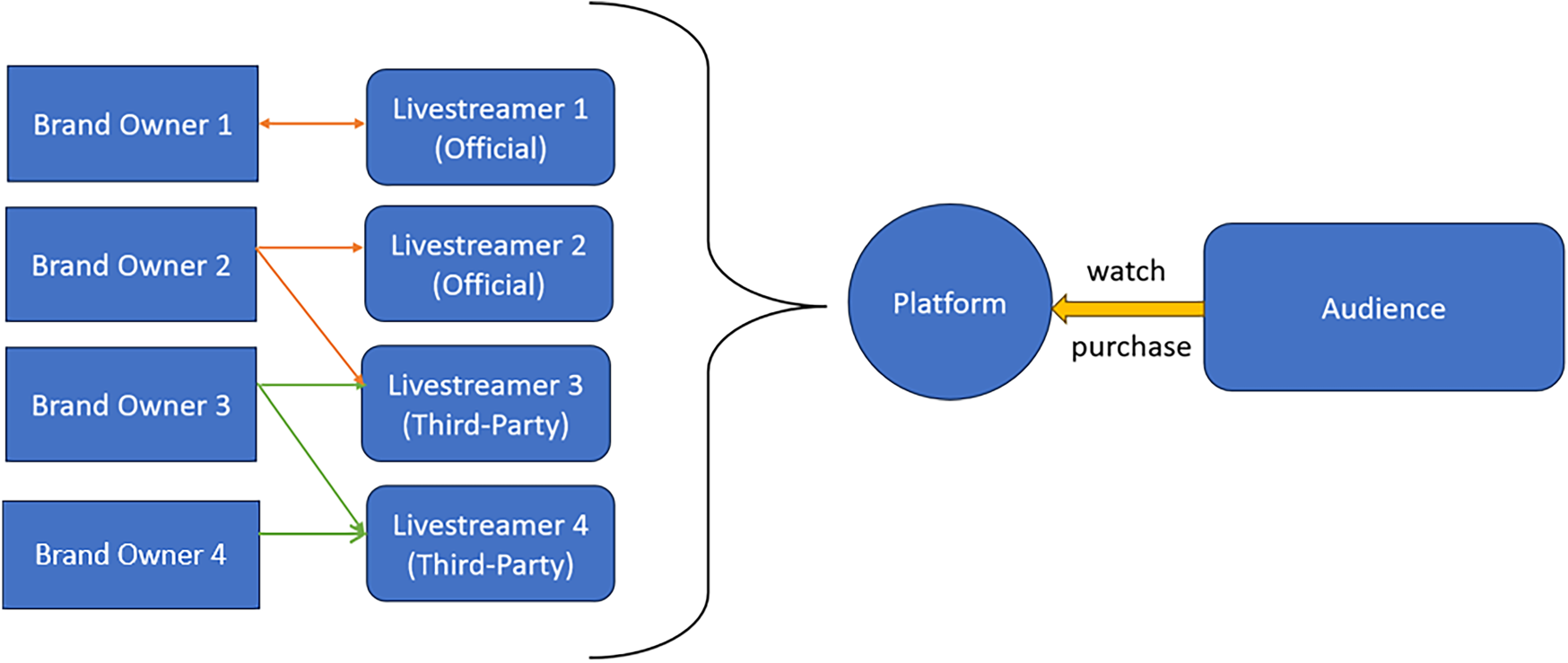
Relationship between stakeholders.
The flow of a certain livestream session is illustrated in Figure 2. Before starting a livestream session, livestreamers must choose the total session duration, accordingly, the products to feature and their presentation durations, and tailor their livestream style to match both their approach and the nature of the products. After each session, livestreamer performance is evaluated using metrics such as total sales, average watch time, and conversion rate. Between sessions, livestreamers maintain their fan groups by addressing logistics, answering questions, and posting promotional updates. Therefore, the decisions made by livestreamers play a crucial role for all stakeholders on the livestream shopping platform.
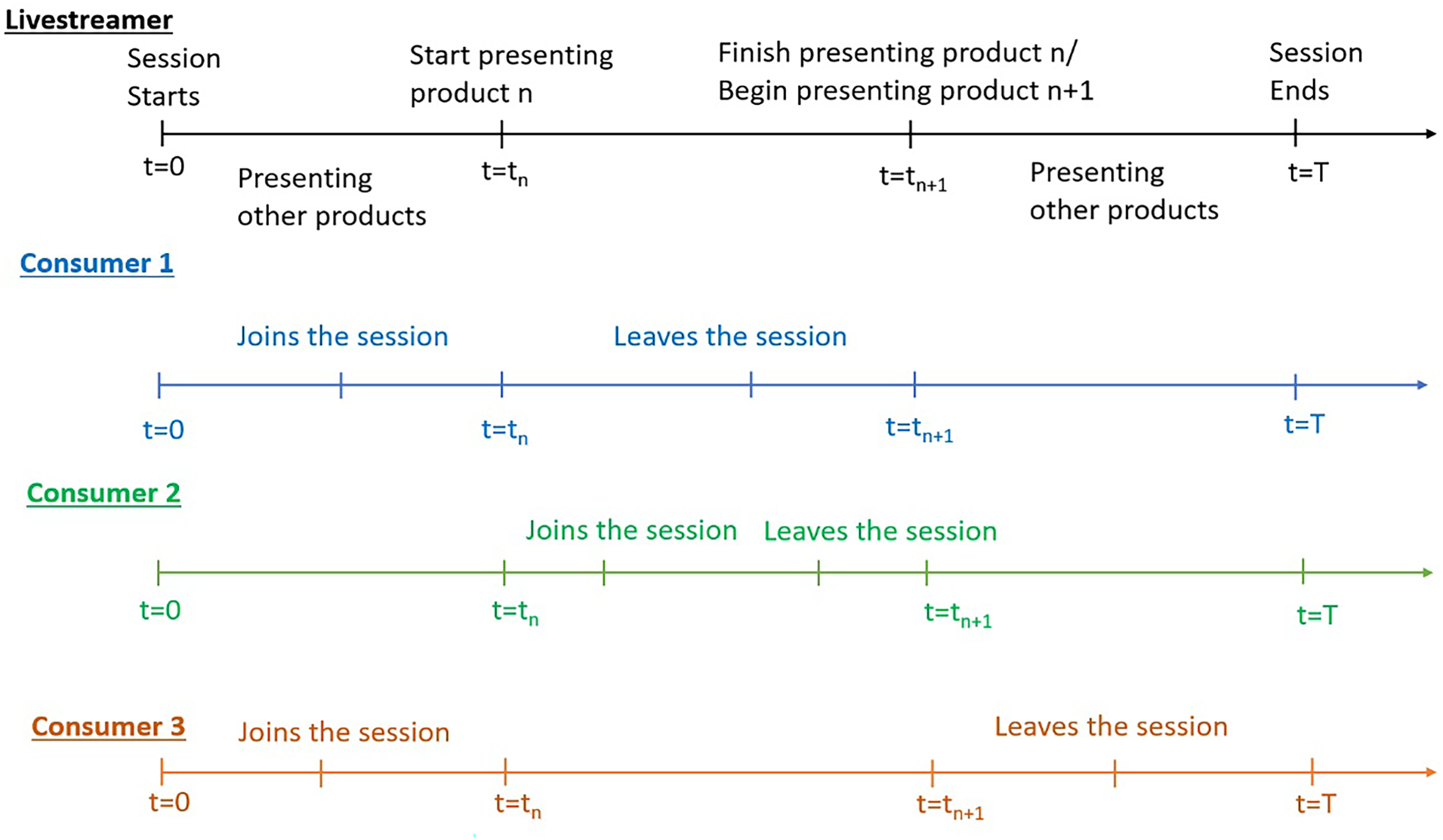
Flowchart of a livestream session.
Consumers, on the other hand, have the flexibility to join livestream sessions at various points in time, leading to diverse engagement scenarios. In Figure 2, we demonstrate distinct patterns among them. Consumer 1 enters the session before the presentation of product
A typical user interface that users see when they join a session is shown in Figure 3. The left panel of the figure demonstrates the user interface (UI) of a typical livestreaming session hosted by a livestreamer. While the livestreamer introduces the product, consumers can interact with the livestreamer by liking, sharing, subscribing, and asking questions or commenting through the comment box. Besides the current presenting products, consumers can also use the item pocket to view the product list, which lists all the products being presented in the section (as shown in the right panel of the figure). 4 The associated links are automatically deactivated when a product sells out during a session. Despite this, livestreamers are obligated to continue presenting until the pre-determined time expires. Moreover, it falls upon the livestreamer to manage the presentation tempo in sync with the pre-determined time slots for each product. This ensures a seamless transition between products with minimal time gaps, optimizing the overall efficiency of the livestream session. Due to the real-time nature of livestreaming sessions, consumers lack the option to playback while a session is active. 5
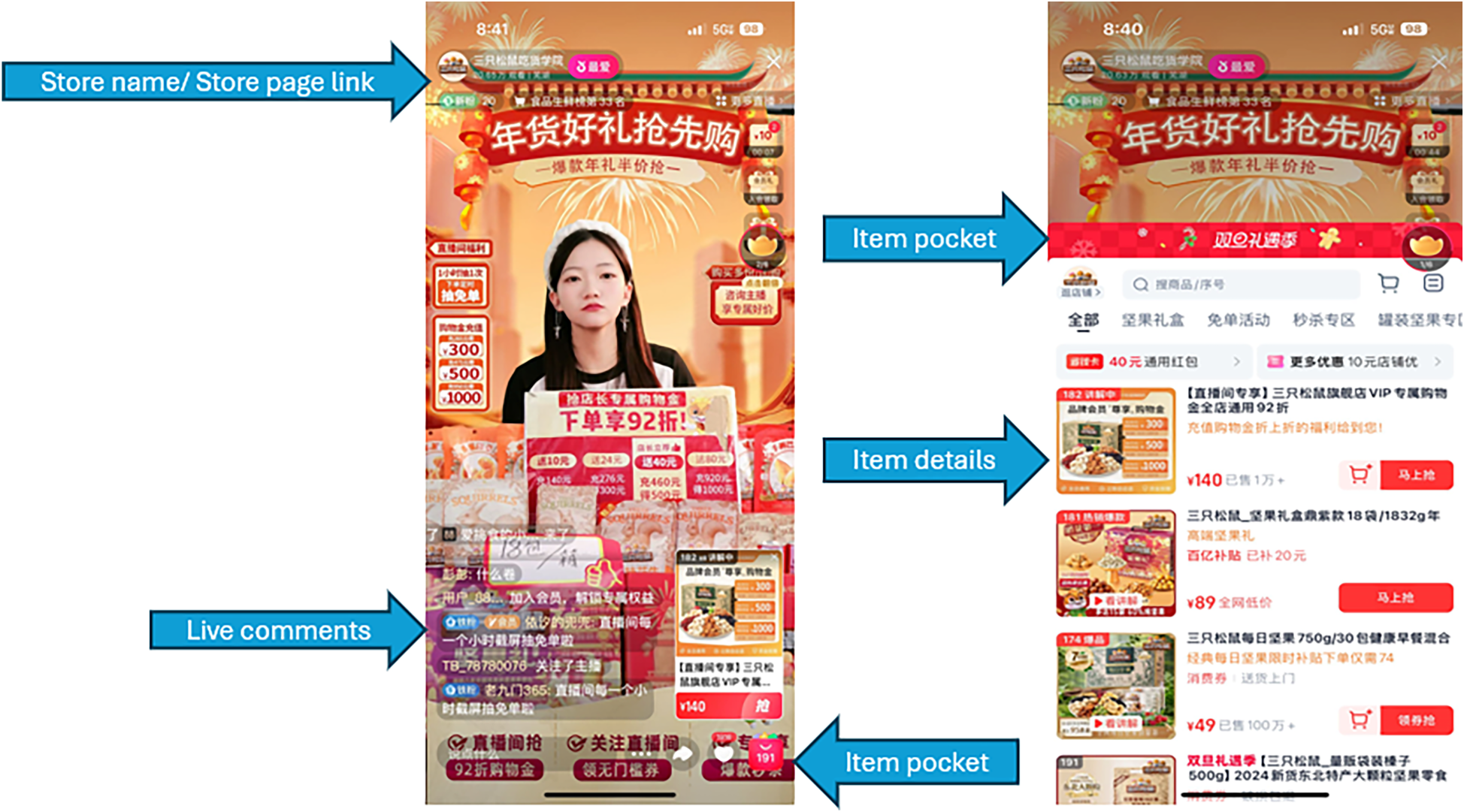
Livestreaming shopping interface.
Several popular platforms across different countries provide livestream shopping services, such as Taobao Live, Facebook Live, and TikTok. In this study, we explore data from two platforms in China. One primarily oriented towards e-commerce and the other centered around entertaining short videos. Figure 4 illustrates the UIs of one identical official channel on both platforms. While esthetic differences, such as varying color choices and icon placements, may exist, the core functionalities are the same.
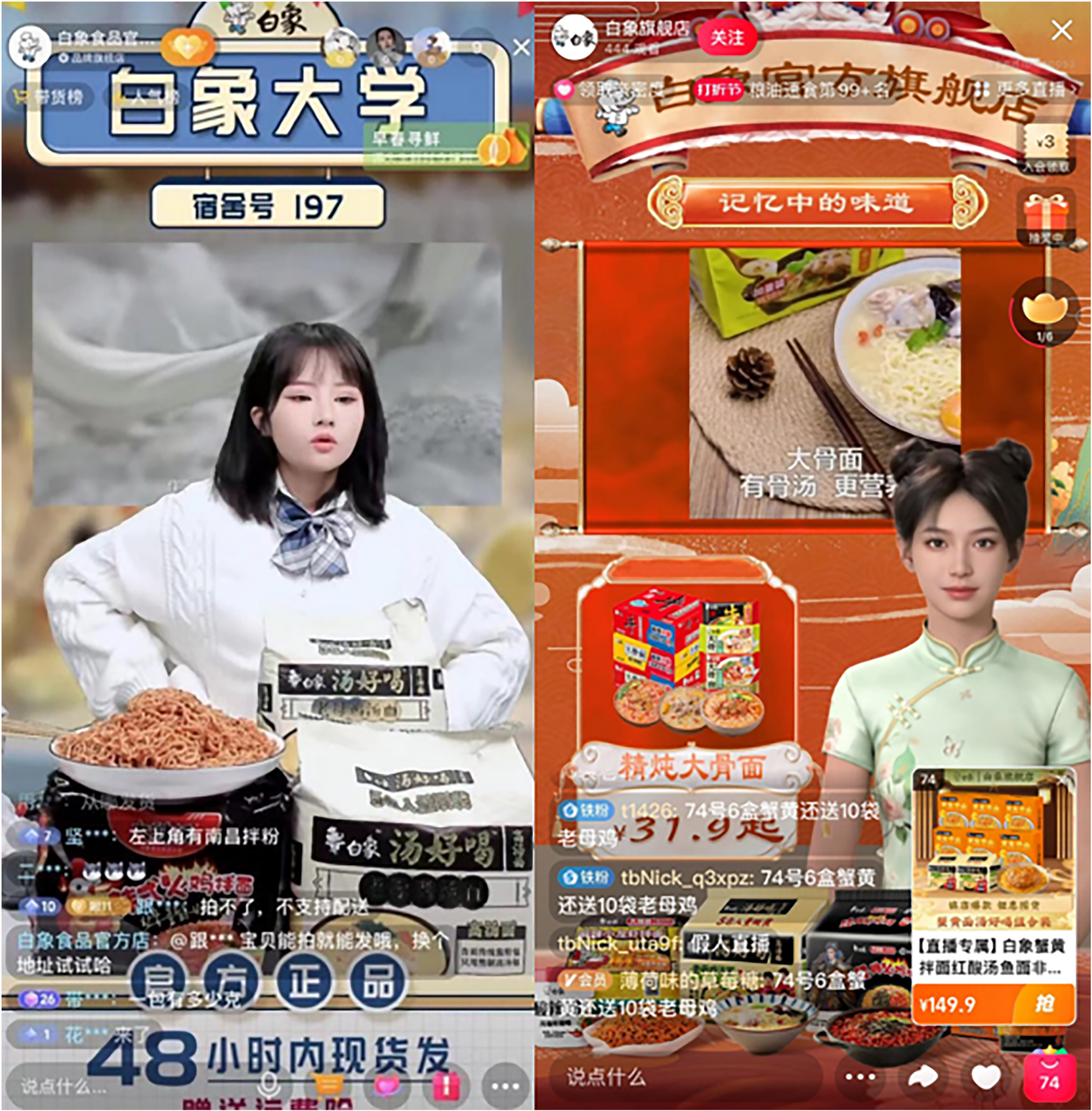
User interfaces on the two platforms.
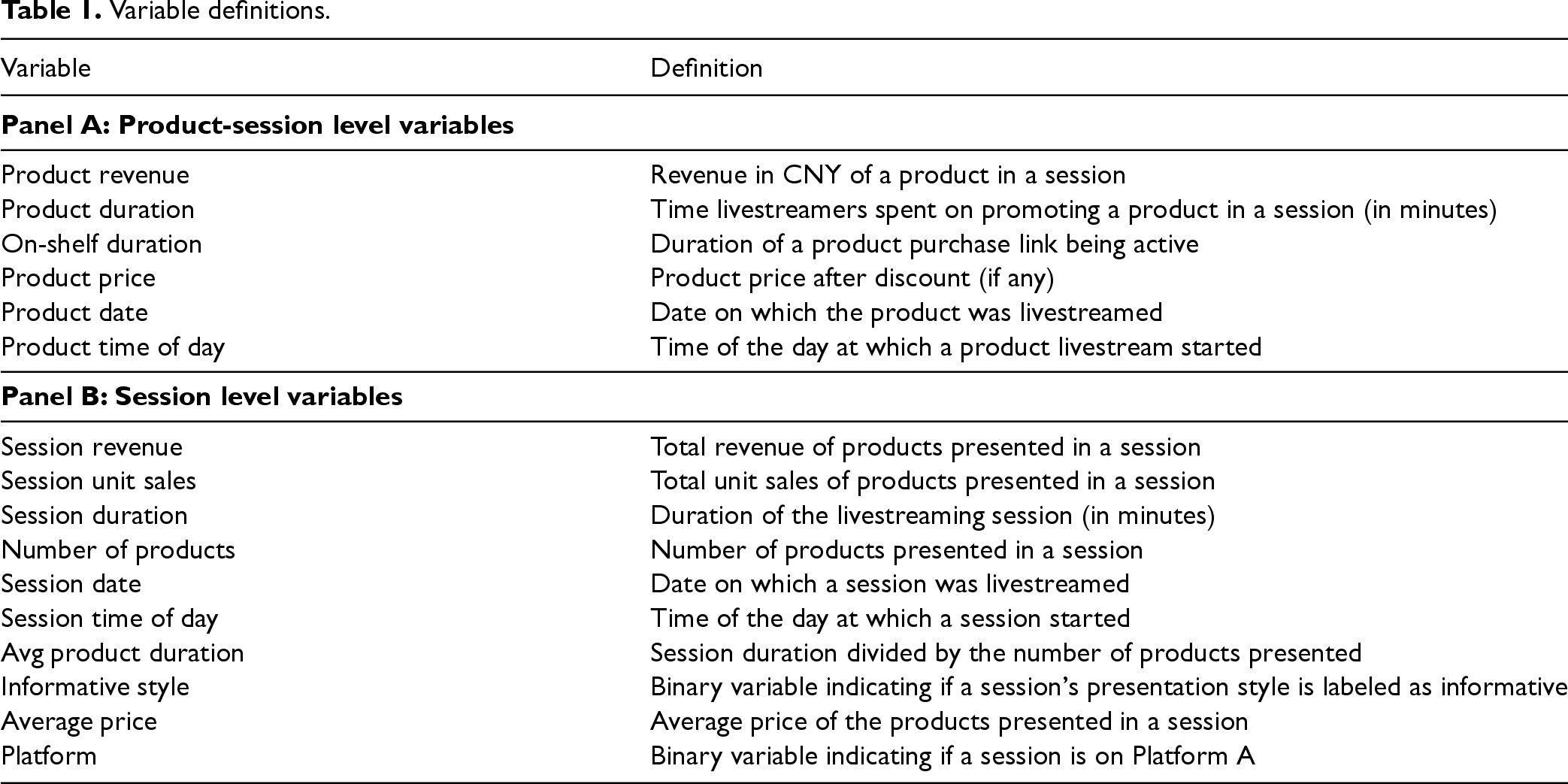
We obtain our data from two major livestream shopping platforms in China. 6 The business model of one of these platforms is short-video streaming (we call it Platform A), while the other is an e-commerce platform (we call it Platform B). These two platforms are the two most popular platforms with millions of daily active users. Together, they account for more than 60% of the livestreaming market by gross merchandise value sold in 2021. The data contains details of 74,997 product presentations during 2,304 livestreaming sessions by 163 livestreamers across the two platforms from September 1 to December 31, 2021. 7 We acquire data at both the product and session levels. For each livestreaming session, we have information about the date and time of the day a session starts 8 , the livestreamer, the platform where the session was conducted, the average price of all in the session, and the livestreaming design features, such as the number of products in that session and the total session duration. For each product-session, we collect the following information: unit sales and revenue in Chinese Yuan (CNY), the product price, the date of product presentation, the time spent presenting each product (product duration), and the duration for which a product was available for sale from the time product presentation begins (on-shelf duration). If a product is sold out before the presentation ends, the on-shelf duration is shorter than the product duration. In contrast, the on-shelf duration is longer than the product duration if the livestreamer keeps the purchase link active even after the presentation for that product is over. The definitions of all the variables can be found in Table 1.
Variable definitions.
Variable definitions.
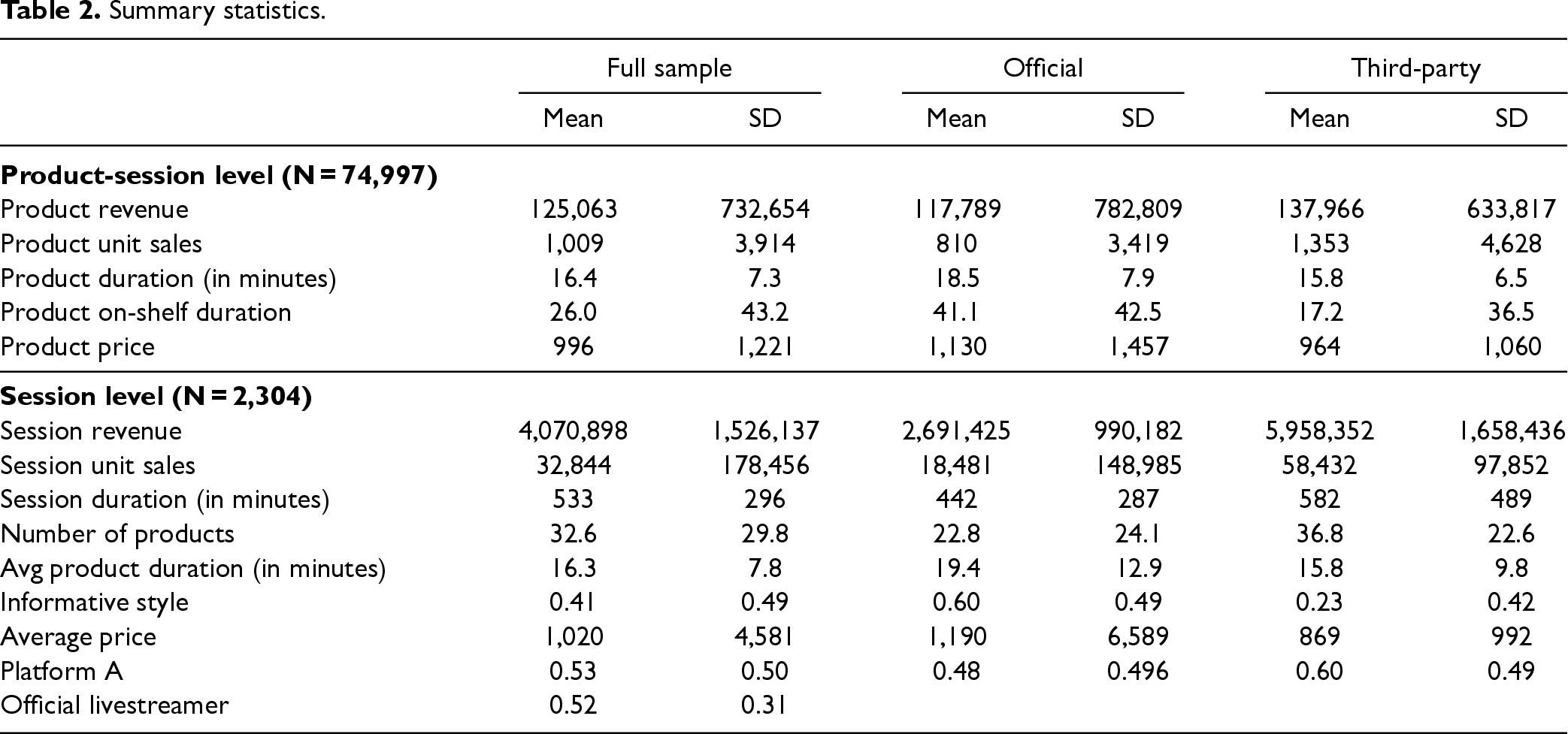
Table 2 presents the descriptive statistics of the variables of interest. We show distributions for product-session level data of the full sample (74,997). There are 27,448 product-session observations for official livestreams while 47,549 product-session observations for third-party livestreams. The products belong to 22 categories and 103 subcategories. A product category is a broad classification, such as clothing, cosmetics, and food and beverages, while a product subcategory sorts the products into a more detailed class, such as women’s clothing, women’s accessories, perishable food, seafood, etc. Each session belongs to a single category, whereas each product belongs to a single subcategory. We then show distributions for session-level data of the full sample (2,304), the subset of official livestreaming sessions(1,203), and third-party livestream sessions (1,101).
Summary statistics.
Summary statistics.
The duration for which the products are presented during a livestream session (
Session-Level Data
At the livestream session level for the full sample, the average revenue is 4,070,898 CNY, and the average unit sales is 32,844. The mean session duration is about 533 minutes. At the session level, our main independent variable is
Empirical Strategy
In this section, we discuss our empirical strategies to estimate the product- and session-level effects of product presentation duration.
Product Level
Our primary research question examines the relationship between product presentation duration and livestreaming revenue. At the product-session level (hereinafter product level), we examine whether a product’s presentation duration impacts that particular product’s revenue in the session. Therefore, for the product level analysis, our main independent variable is given by the duration for which product
We can estimate this effect by regressing the dependent variable on
First, we need to account for the unobserved heterogeneity across different livestreamers. For example, a livestreamer who promotes products at a greater pace could also have a higher ability to positively influence the viewers, generating higher sales. Second, the estimate may be driven by selection across product types. For instance, subcategories that generate higher average product sales may also need shorter presentation time. Third, we also need to ensure that the effect is not marred by selection issues related to a session’s timing. It is plausible that sessions on certain days or during certain times of the day not only generate higher sales but also have more products presented per unit of time.
We leverage the large scale and the high granularity of our data to tackle the above challenges. We use linear models with many levels of FEs since they can accommodate various factors that potentially bias our estimates. As we observe multiple sessions of a livestreamer, we include livestreamer FEs to account for unobserved heterogeneity in ability across various livestreamers. To solve the category-level selection issue, we include subcategory FEs. Finally, we include date-time FEs, that is, the interaction between date and time of the day, Date
Specifically, we estimate the following regression model for our product-level analysis:

We include on-shelf duration as a covariate because this is the time during which viewers can buy the product, making it potentially correlated with both product presentation duration and product sales. Product price is included as a covariate because we are interested in estimating the impact on revenue independent of the price. We control for the style (informative or persuasive) of the presentation as it is likely to influence the time the presenter spends on the presentation and also the sales of the product. As the mindset of viewers of the two platforms is potentially different, the time spent on product presentation could vary with the platform. Further, because of the inherent popularity difference between the platforms, product sales could also be affected by the platform type. Therefore, we control for the platform. The rationale behind considering session duration is that the effectiveness of a certain product presentation can significantly differ based on the overall duration of the livestream sessions. To account for further differences across sessions, we include the number of products presented and the average price of the products presented as covariates.
At the session level, we examine whether the average product duration influences session revenue. For session-level analysis, our main independent variable is given by the total duration of the session divided by the number of products presented during the session (
Finally, to resolve any remaining endogeneity issues, we resort to IV analysis for both the product-session-level and the session-level analyses. First, we discuss our IV for the product-session level analysis, followed by a discussion of the IV that we use for the session-level analysis.
Product-Level IV
At the product level, for any focal product
The exclusion restriction of the instrument requires that the average product duration of non-focal subcategories does not affect the sales of the focal product, except through its influence on the product duration of the focal product. The idea behind choosing the average product duration of non-focal subcategories as the IV is that the demand for the focal product is unlikely to be directly influenced by the pace at which products in the other subcategories are presented. The only way it should influence the demand for the focal product is through its effect on the time it leaves for the focal product presentation.
However, livestreamers may choose to present complementary products from different subcategories in a session. If this is the case, the time spent on products of other subcategories may influence the sales of the focal product. To mitigate this concern, we re-construct our IV based on two relevant facts in our data. First, the mean product presentation duration is about 16 minutes. Second, on average, viewers watch a livestream session for 13.6 minutes with a standard deviation of 9.3 minutes (
To further mitigate any concerns with respect to the validity of the exclusion restriction assumption, in E-Companion Section 2, we perform inference using the plausibly exogenous IV framework (Conley et al., 2012). The results from this analysis indicate that our results are robust even when the exclusion restriction of the IV may not hold.
The monotonicity of the product-level instrument will be violated if there exists a subpopulation of product-session observations where a longer average product duration of non-focal subcategories would increase the focal product duration, and vice versa (these are called defiers). The defiers may exist, for example, if the average product duration of non-focal subcategories is positively correlated with the product duration of some focal-subcategory products. This situation is more likely in relatively long livestreams with few product presentations (i.e., sessions with very high average product presentation duration), as such livestreams may allow for allocating more time to products from both non-focal and focal product subcategories. Conversely, such a situation is also likely in relatively short livestreams with many product presentations (i.e., sessions with very low average product presentation duration). To check whether such potential defiers are driving our results, we repeat our analysis after splitting sessions with long, medium, and short average product durations. In Table 4 of the E-Companion, we observe that the results for livestreams with relatively high and low average product durations are qualitatively similar to the medium ones, indicating that the presence of defiers is unlikely.
Further, if at all there exist defier products, these are likely to be the most important products in the focal subcategory, because, controlling for session duration, an increase in the average duration of non-focal product subcategories leaves less time for the focal subcategory. In such a situation, some less important products from the focal subcategory may be dropped, leaving more time to present such a focal product. To address this possibility, we take the product presented for the longest duration in a subcategory as the most important product in that subcategory. Based on our argument, such a product is most likely to be a defier. Next, we regress the average duration of top products (i.e., products presented for the longest) in the focal subcategory on our IV which is the average time spent presenting products of non-focal subcategories, excluding six adjacent products of the focal product, while including session and subcategory FE. The results reported in Table 5 of the E-Companion clearly suggest a strong negative relationship not only between the average product duration of the focal subcategory products and the IV but also between the longest product duration in the focal subcategory and the IV, indicating that the presence of defiers due to the aforesaid reason is unlikely.
Session-Level IV
Now, we turn to discuss the IV we use at the session level. For the impact on session-level revenue, our main treatment variable is
The monotonicity of the instrument will be violated if there exists a subpopulation of sessions where a longer average product duration of past sessions of the same category would decrease the average product duration of the current session and vice versa. Such defiers could exist when a livestreamer chooses not to follow the category’s average product duration trend and experiments by instead hosting a session with a very long or a short average product duration. Therefore, sessions with a very long or a short average product duration are likely to be defiers. This would imply the relationship between the IV and the treatment variable could be negative (opposite of expected) for sessions with a very short or long average product duration. To check if this is indeed the case, we repeat our analyses after splitting our full sample into three subsamples: sessions in the lowest, highest, and middle quartiles of average product duration (see Table 6) in the E-Companion. The first-stage results in all three cases indicate a strong positive correlation between our session-level IV and the average product duration, mitigating the concern related to the lack of monotonicity.
Results
In this section, we present the results from estimating the empirical models described above. We first present the results of the effect on product revenue in a livestreaming session. Next, we discuss the results of the session-level outcomes. We also investigate any heterogeneous effects between official and third-party livestreams along with the two levels of analysis.
Impact of Product Duration on Product Revenue
We first focus on the impact of the product duration on product revenue during a livestreaming session. Table A.1 in the Appendix presents the regression results (without IV) for the full sample, showing the impact of product presentation duration on product revenue using different models. The first column does not include any FEs but includes all the controls. In the subsequent columns, we add livestreamer, product subcategory, and date-time FEs sequentially. The positive and statistically significant coefficient for
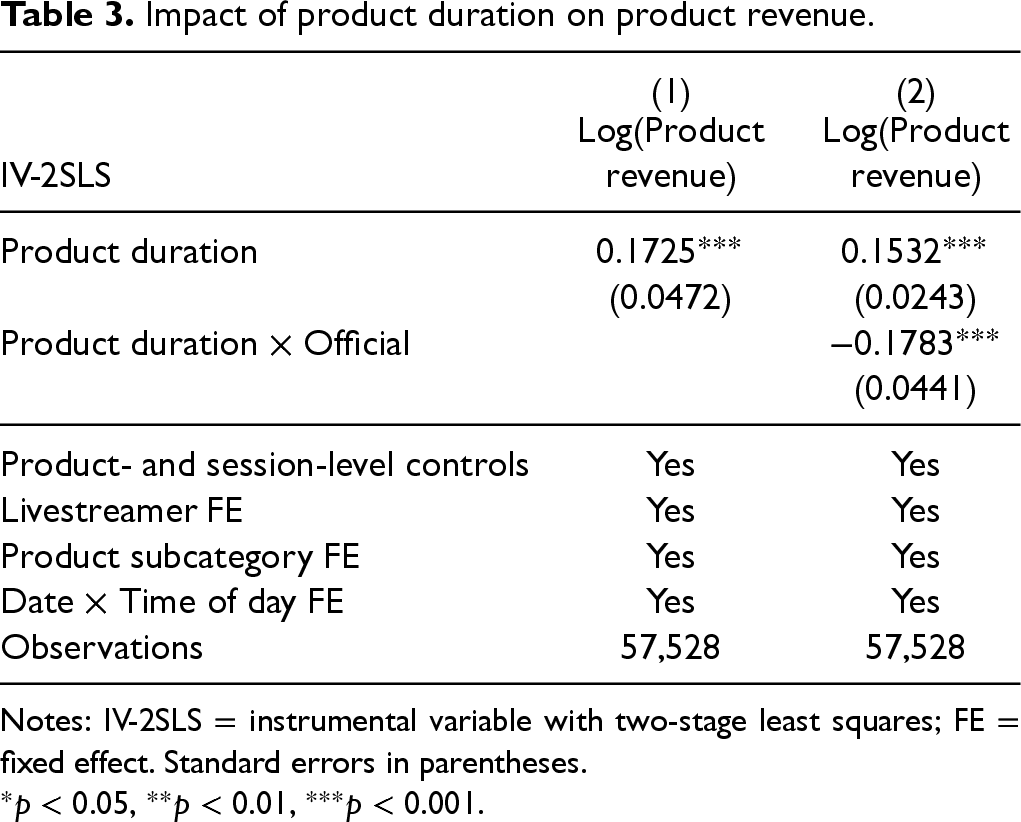
Our main specification addresses endogeneity concerns by employing instrumental variables, as shown in column (1) of Table 3.
9
The coefficient for
Impact of product duration on product revenue.
Impact of product duration on product revenue.
Notes: IV-2SLS = instrumental variable with two-stage least squares; FE = fixed effect. Standard errors in parentheses.
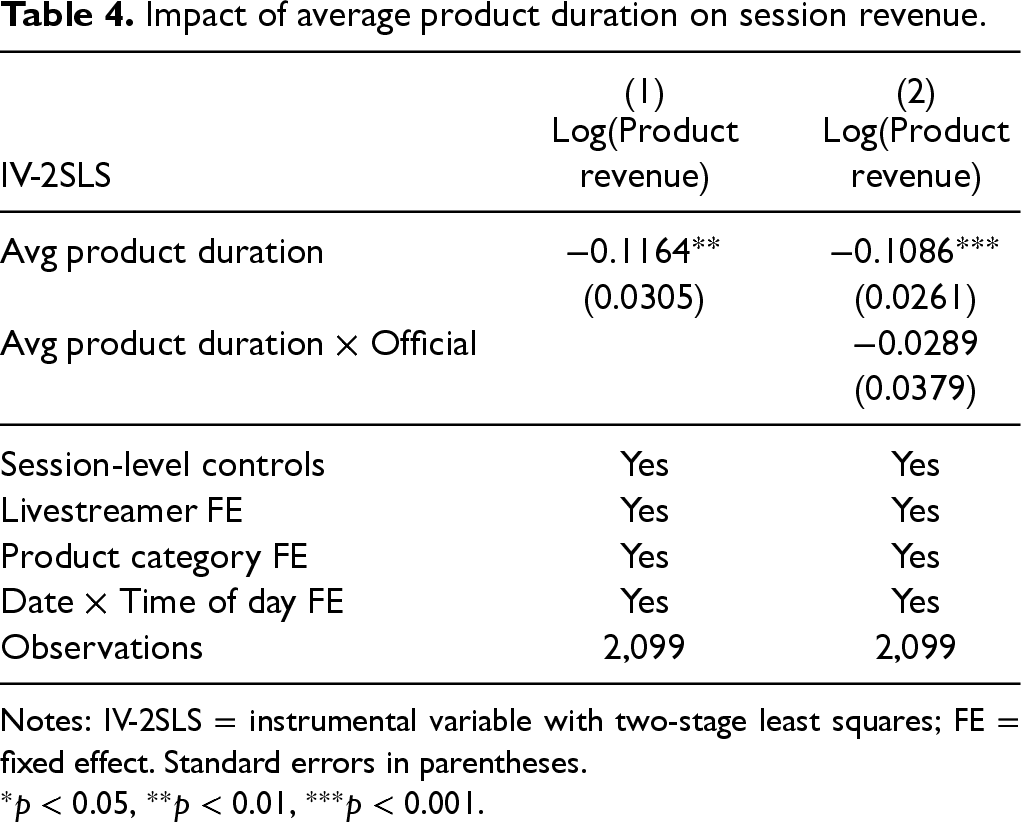
Impact of average product duration on session revenue.
Notes: IV-2SLS = instrumental variable with two-stage least squares; FE = fixed effect. Standard errors in parentheses.
Here, we analyze the impact of average product duration on session revenue while controlling for session duration, in Table A.2 in the Appendix. The coefficient for
Next, we investigate the potential heterogeneous effect between official and third-party livestreams at the session level using the interaction term Avg product duration
Robustness Checks
In this section, we include several checks and additional analyses to establish the robustness of our main findings.
Product-Level Analyses
Alternative IV
To test the robustness of our results, we introduce an alternative IV. For the product-level analysis, we use the average product presentation duration in other non-focal subcategories in the same session as the IV for the focal product. Besides the employment of this IV, to mitigate the endogeneity concerns, we also control for the product sales of other subcategories in the same session. This is to ensure that the demand for the focal product is not directly influenced by the pace at which products in the other subcategories are presented. The results are presented in Table 5. Our main results remain robust.
Impact on product revenue using alternative IV.
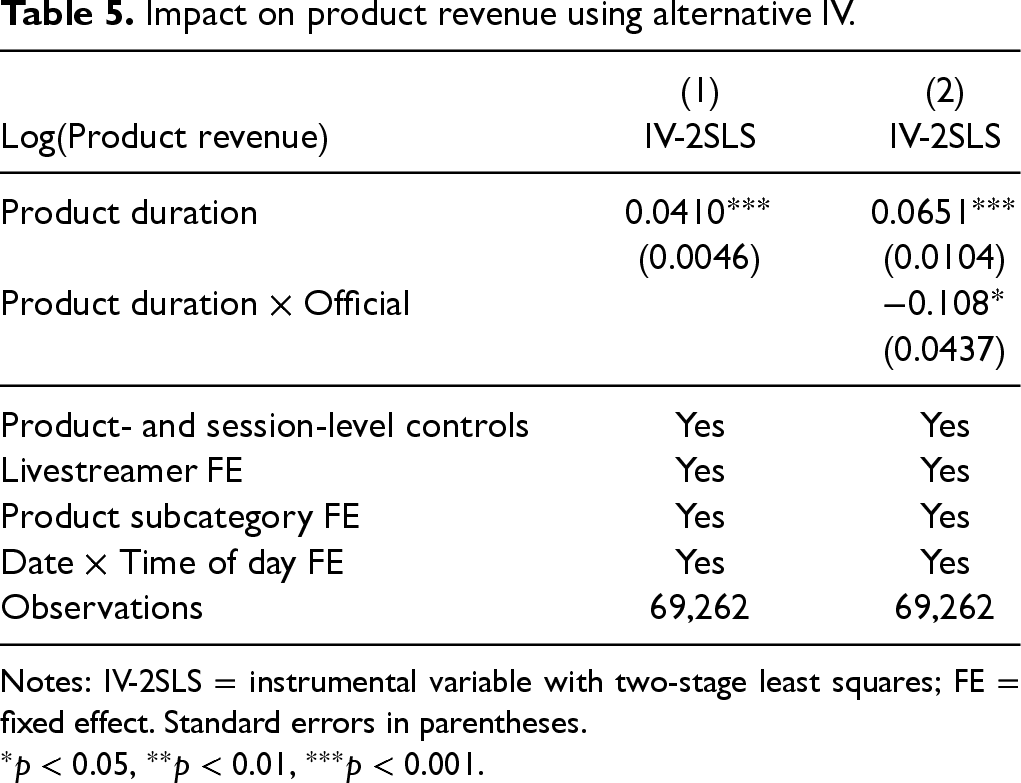
Impact on product revenue using alternative IV.
Notes: IV-2SLS = instrumental variable with two-stage least squares; FE = fixed effect. Standard errors in parentheses.
During a particular session, the products may get sold out before the end of the live streamer’s presentation. To ensure that our results are not driven by those sold-out products, we do a subsample analysis focusing on products that did not sell out. 10 These “non-sold-out” products are characterized by having an on-shelf duration longer than their presentation duration. The results of this analysis are presented in Table 6. We find that our main conclusion remains valid. This suggests that our findings are not solely influenced by products that quickly sell out and have implications for all products in general.
Sub-sample analysis with only non-sold-out products.
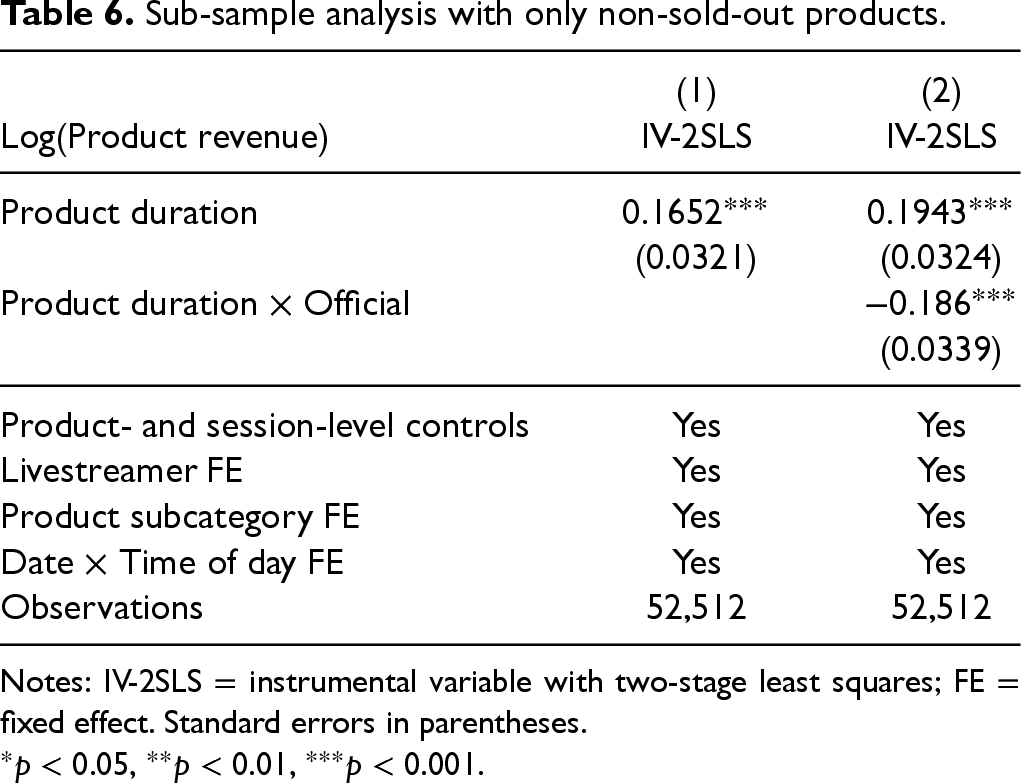
Sub-sample analysis with only non-sold-out products.
Notes: IV-2SLS = instrumental variable with two-stage least squares; FE = fixed effect. Standard errors in parentheses.
One of the potential confounders between product sales and the duration is the position at which the product is presented during the session. It is possible that the product’s position (rank) in a session is correlated with both the time spent on the product presentation and the product’s sales. To mitigate such concerns, we repeat our main analysis after including the product’s rank/position FEs in a session and find similar results (see Table 7).
Impact on product revenue after controlling product’s position in a session.
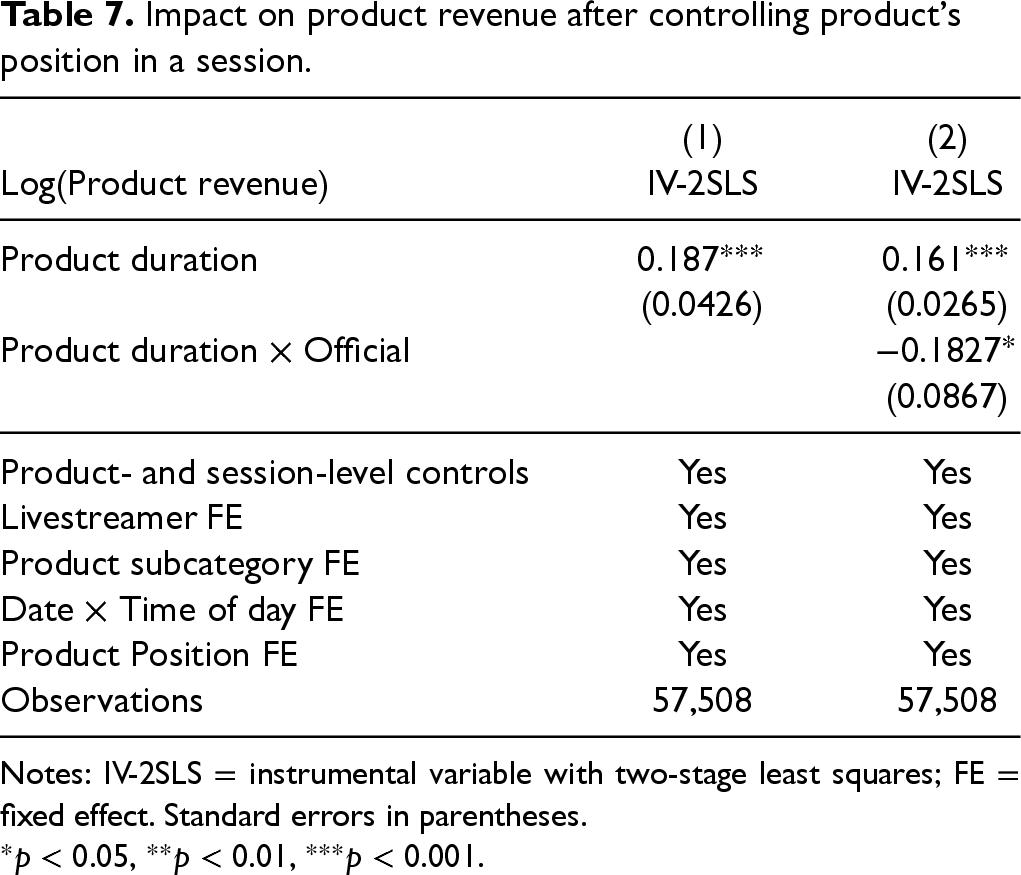
Impact on product revenue after controlling product’s position in a session.
Notes: IV-2SLS = instrumental variable with two-stage least squares; FE = fixed effect. Standard errors in parentheses.
In the main model, we use linear models with many levels of FEs since they can accommodate various factors that potentially bias our estimates. However, certain selection-induced biases could remain despite including those FEs. To resolve such issues further, we use propensity score matching (PSM) to address the endogeneity issue.
We redefine the treatment as a binary indicator that equals 1 if the product duration is above the median product duration of each livestreamer
After this matching process, we check whether the treatment and control groups have similar characteristics. The results are reported in Table 7 in the E-Companion. The two groups appear to be fairly balanced in terms of the covariates after PSM. Next, we run our main regression based on the matched sample. Table 8 reports the results. We observe that our primary findings at the product level remain robust.
Impact on product revenue using PSM.
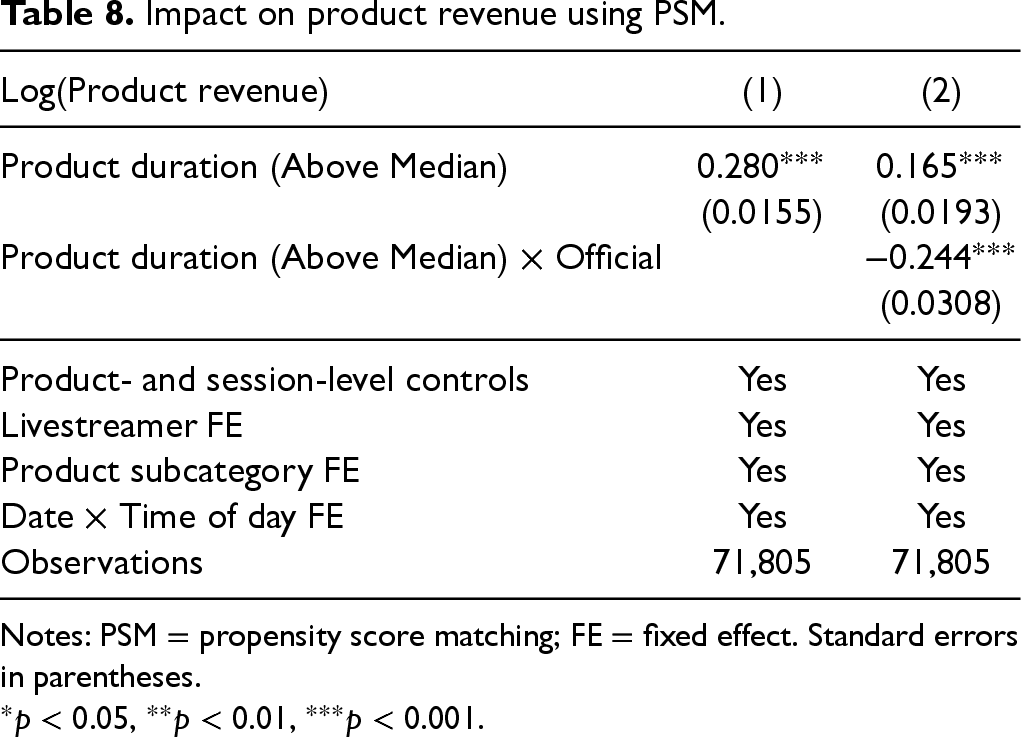
Impact on product revenue using PSM.
Notes: PSM = propensity score matching; FE = fixed effect. Standard errors in parentheses.
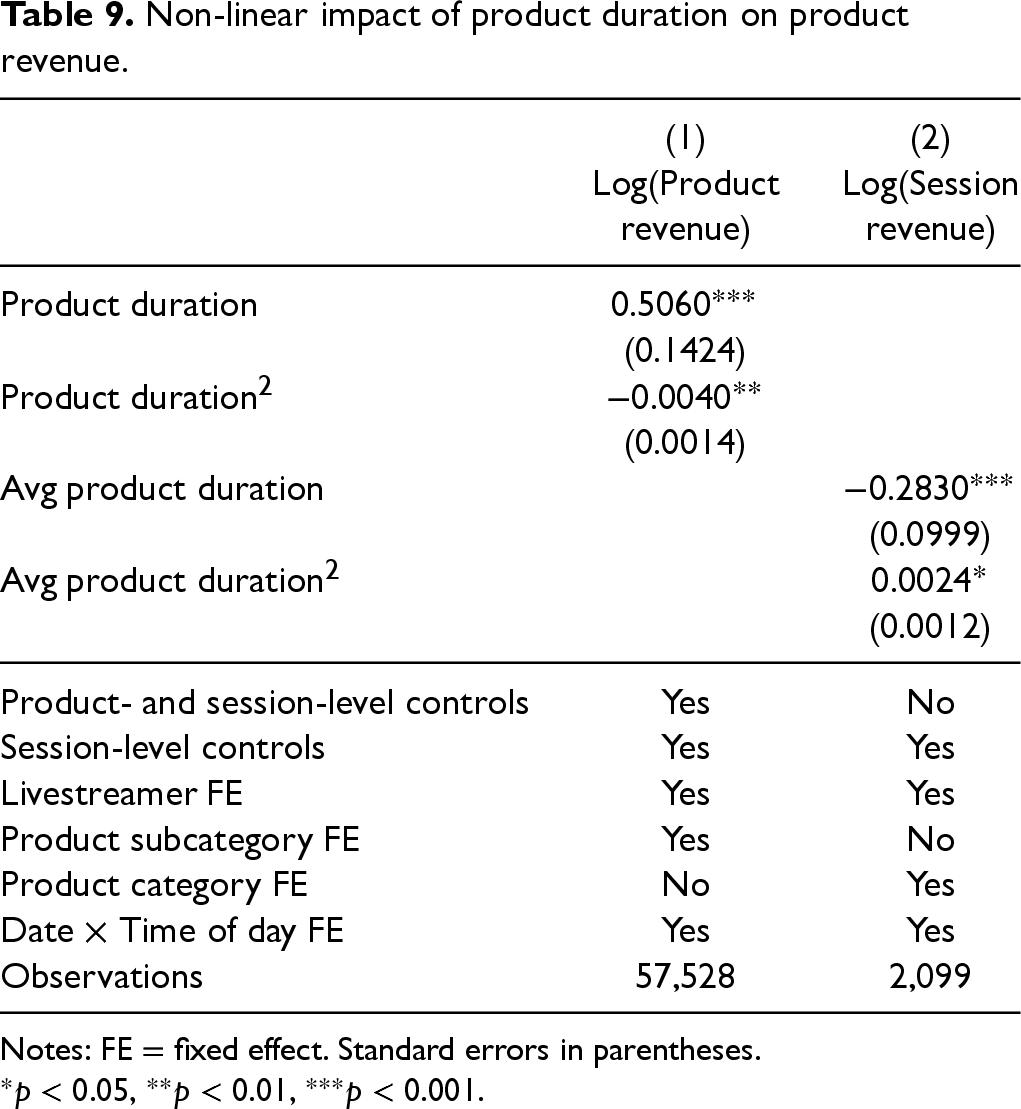
In equation (1), we use a linear model specification and find that product duration has a significant negative effect on official livestream product revenue while a positive effect on third-party livestream product revenue. However, by allowing a non-linear model specification, the link between product duration and revenue can be much better explained. We use a quadratic model to fit our data. The results are reported in Table 9.
12
In column (1), the coefficient of
Non-linear impact of product duration on product revenue.
Non-linear impact of product duration on product revenue.
Notes: FE = fixed effect. Standard errors in parentheses.
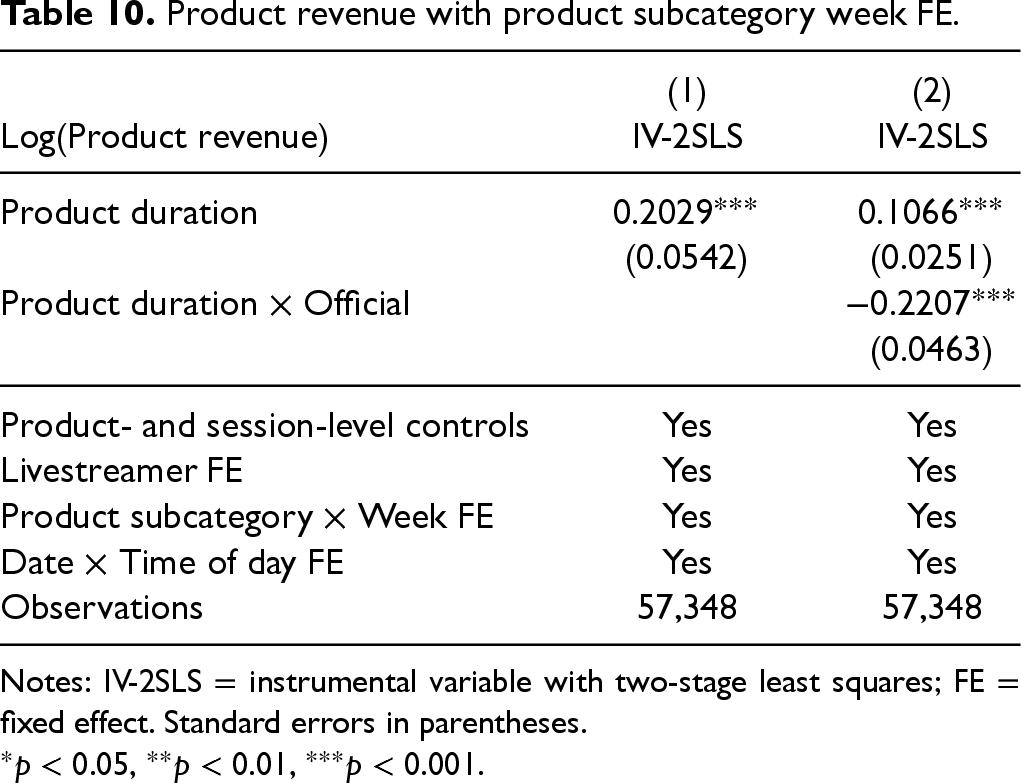
Product revenue with product subcategory week FE.
Notes: IV-2SLS = instrumental variable with two-stage least squares; FE = fixed effect. Standard errors in parentheses.
One of the potential concerns regarding our IV construction is that there could exist time-varying unobserved variables, for example, previous ad spending, that may affect both the sales and the time allocation of the presentation of different products in the current period. Hence, our IV (average product duration of products from other subcategories) and the focal product’s sales might not be independent of each other. To resolve such a concern, one can analyze a model that includes the product-week FEs. Including these interaction FEs into our regression ensures that any unobserved temporal shock to a product does not bias our estimates. However, we note that, as the same product is not often presented multiple times in any given week in our data (about 90% of observations get dropped), we instead include subcategory-week level FEs, where a subcategory includes multiple products. We believe the analysis with subcategory-week FE serves as a reasonable proxy because the unobserved variables at the individual product level are likely correlated across products within a subcategory. Another reason is that our IV is based on the average product duration of products across (non-focal) subcategories and not on the product duration of an individual product. Table 10 presents the results. Our main results remain robust.
Session-Level Analyses
Alternative Session Controls
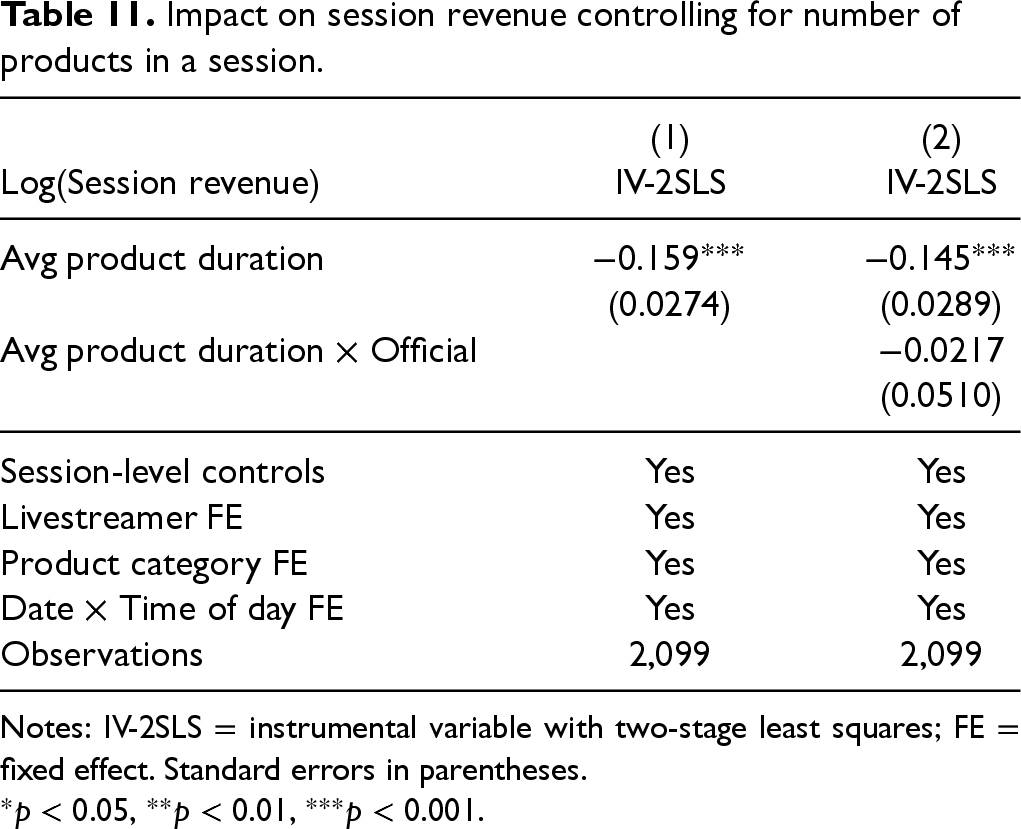
Earlier, in our main analysis, we analyzed the impact of average product duration on session revenue, after controlling for session duration. As average product duration is the ratio of session duration to the number of products presented, this implies that we capture the variation in the number of products across sessions. Alternatively, one could also analyze the impact of average product duration after controlling for the number of products so that average product duration varies due to the variation in session duration. Therefore, instead of session duration, we include the number of products as a covariate in our regression. 14 In such a case, an increase in Avg product duration can be interpreted as an increase in session duration, given the number of products presented in the session. Table 11 presents the results. Our main results remain robust.
Impact on session revenue controlling for number of products in a session.
Impact on session revenue controlling for number of products in a session.
Notes: IV-2SLS = instrumental variable with two-stage least squares; FE = fixed effect. Standard errors in parentheses.
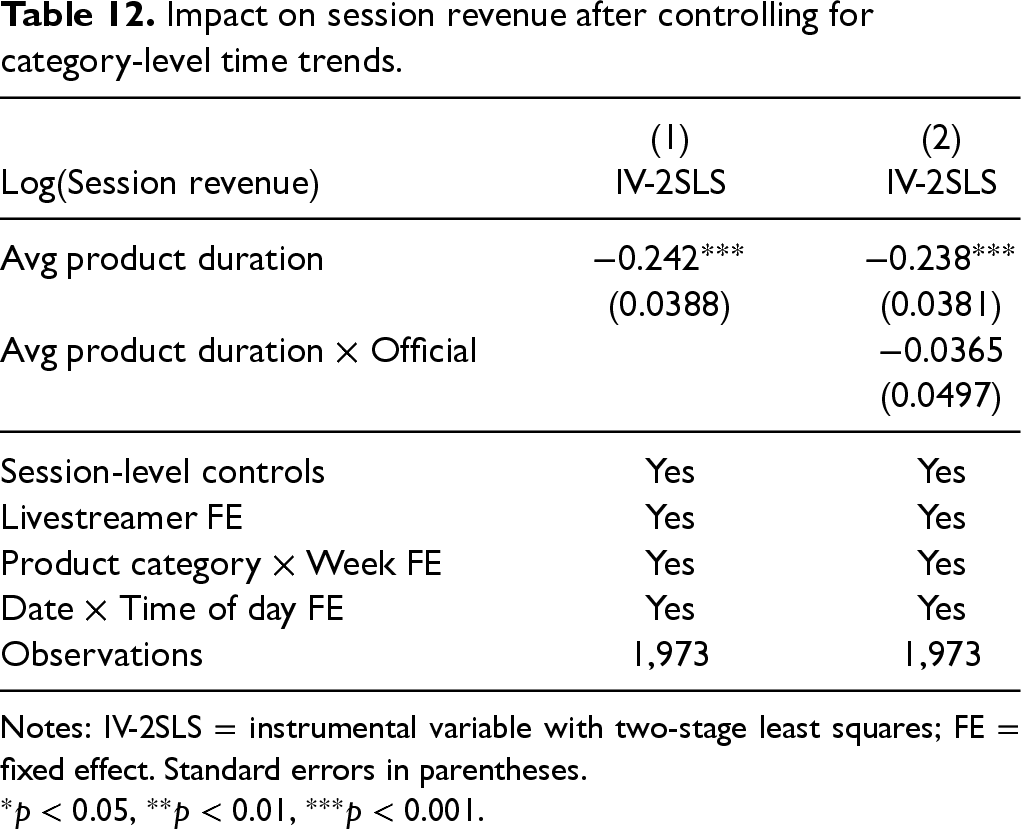
It is plausible that our results are driven by rising/declining time trends or temporal shocks related to the sales of products in a given category. To check if our estimates are indeed biased by such temporal movements in a category’s sales, we further include the interaction (cross) fixed effects between a category and week. We find that our results remain qualitatively similar even after controlling for category-level time trends (see Table 12). Importantly, this analysis also allows us to account for any trends associated with the correlation between sales across weeks in a given category. Furthermore, there is a related potential concern that our session-level IV (mean average product duration of past sessions of the focal category) is correlated with the average sales of the past sessions which, in turn, could be correlated with the sales of the focal session, as they belong to the same category. To assuage this concern, we also control for the sales (per unit time) from sales of the past sessions of the same category. Estimates in Table 12 suggest that our main results remain unaltered.
Impact on session revenue after controlling for category-level time trends.
Impact on session revenue after controlling for category-level time trends.
Notes: IV-2SLS = instrumental variable with two-stage least squares; FE = fixed effect. Standard errors in parentheses.
Impact on session revenue with PSM.
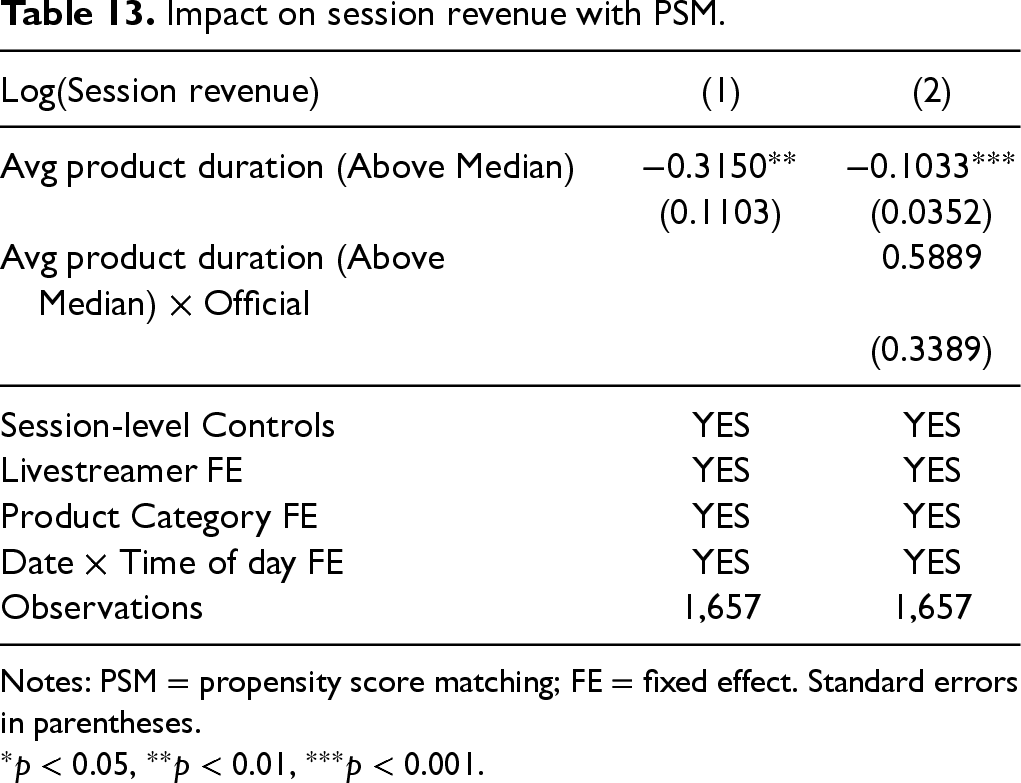
Notes: PSM = propensity score matching; FE = fixed effect. Standard errors in parentheses.
Analogous to product-level analysis, we use PSM to address the endogeneity issue for the session-level analyses. We redefine the treatment as a binary indicator that equals 1 if the Avg product duration is above the median average product duration of each livestreamer
After this matching process, we check whether the treatment and control groups have similar characteristics. The results are reported in Table 8 in the E-Companion. The two groups appear to be fairly balanced in terms of the covariates after PSM. Next, we run our main session-level regression based on the matched sample. Table 13 reports the results. We observe that our primary findings at the session level remain robust.
Conclusion
To the best of our knowledge, our work is the first to study a key design aspect of the livestream shopping channel, which is a new type of online channel for product promotions that crucially relies on real-time interaction with consumers. This design aspect is the product promotion duration which is likely to influence livestream sales. We empirically uncover an interesting heterogeneity in the way the product duration is related to sales in official and third-party livestreams—while an increase in product duration reduces product sales for third-party livestreams, it has no significant effect on official livestreams. We also discover that, for third-party livestreams, when product duration increases, session-level sales reduce whereas product sales increase.
Our findings provide practical implications for both livestreamers and brand owners. First, the finding that longer product presentations increase product revenue has practical significance for brand owners. In third-party livestreams, where multiple products are featured, brands must negotiate more airtime for their products. Longer presentations may allow for a deeper dive into product features and unique selling points, which enhances consumer understanding, potentially leading to higher conversion rates. To secure this extended time, brands may need to offer additional incentives to livestreamers, such as higher commissions, or bonuses tied to sales milestones. Brand owners can also aim to build long-term relationships with successful third-party livestreamers. By nurturing these relationships, brands can negotiate better terms for product presentations. Second, the tension between the goals of brand owners and third-party livestreamers stems from their differing motivations. Brand owners focus on improving the sales of their products in third-party livestreams, which may require longer presentations. In contrast, third-party livestreamers, who showcase multiple products from various brands in one session, are incentivized to keep the presentation for each product shorter. By featuring a broader range of products, they may be able to retain the attention of a diverse audience and increase overall session-level sales. This dynamic creates a potential conflict, as what benefits one party (longer presentation) might detract from the other’s goal (session sales).
Our article is not without its limitations. First, as in any observational study based on the IVs, we cannot completely rule out all potential confounders. Particularly, we do not have access to product-level time-varying variables such as advertisement spending and percentage of discount, which could have potentially influenced product duration and sales. Second, we do not have access to very granular user-level data to observe how they are engaging with each product presentation during livestream sessions, which could have helped us explore the mechanism behind our results in greater detail.
Supplemental Material
sj-pdf-1-pao-10.1177_10591478251314455 - Supplemental material for Designing E-commerce Livestreams: How Product Presentation Duration Affects Sales?
Supplemental material, sj-pdf-1-pao-10.1177_10591478251314455 for Designing E-commerce Livestreams: How Product Presentation Duration Affects Sales? by Si Xie, Siddhartha Sharma and Amit Mehra in Production and Operations Management
Footnotes
A. Appendix
Acknowledgments
The authors would like to thank the participants of the research seminar at the University of Connecticut, as well as attendees of the Conference on Information Systems and Technology (CIST 2023) and the Production and Operations Management Society Annual Conference (POMS 2022), for their valuable feedback and insightful discussions.
Declaration of Conflicting Interests
The author(s) declared no potential conflicts of interest with respect to the research, authorship, and/or publication of this article.
Funding
The author(s) received no financial support for the research, authorship, and/or publication of this article.

Notes
How to cite this article
Xie S, Sharma S and Mehra A (2025) Designing E-commerce Livestreams: How Product Presentation Duration Affects Sales? Production and Operations Management 34(12): 4079–4096.
References
Supplementary Material
Please find the following supplemental material available below.
For Open Access articles published under a Creative Commons License, all supplemental material carries the same license as the article it is associated with.
For non-Open Access articles published, all supplemental material carries a non-exclusive license, and permission requests for re-use of supplemental material or any part of supplemental material shall be sent directly to the copyright owner as specified in the copyright notice associated with the article.
