



Abstract
Exclusivity is a key component of certain service offerings such as elite members-only social or country clubs. Indeed, such services may only appeal to customers if they limit the crowd density, that is, the maximal number of customers granted access to the service. We consider a service provider, who sets its crowd density cap in addition to its price. Customers are heterogeneous in both their willingness to pay (WTP) for the service and their density tolerance. Each customer purchases the service only if the price is below her WTP and the density is below her tolerance. Importantly, customers’ WTP and density tolerance may be statistically dependent, and we develop a novel, copula-based framework to model the dependence structure of these two dimensions of heterogeneity. We analytically characterize the provider’s optimal price and density decisions. As long as the customer population is not too severely sensitive to density: (i) the provider optimally serves all segments of the market and sets the price and density so that the price, not the density, is the determining factor for customers (from a particular subpopulation) on the margin between purchasing and not and (ii) as customers’ valuations and density tolerances become more positively dependent, the provider earns higher revenue and optimally increases its service density. By contrast, the optimal price is quasi-convex but not necessarily increasing. On the other hand, with severely density-sensitive customers, it may be optimal to partially cover the market and to make density the determining factor in customer decisions. Our findings offer prescriptive guidelines for service operations in the presence of density-sensitive demand and also provide an explanation for the failed versus successful practices of prominent private clubs.
Introduction
Members-only private clubs, a fast-growing service industry, offer a unique experience for customers who crave privacy and exclusivity (Kodé, 2024). These clubs strategically limit the general public’s access to their service, typically through invitation-only membership at an extravagant price (Kendall, 2008). Prominent examples abound and include private social clubs such as Soho House (Burton, 2017) and member-exclusive country clubs such as the (private ski resort) Yellowstone Club (Tong, 2022) and Augusta National Golf Club (Buteau and Paskin, 2015). With high-profile members such as Bill Gates and Warren Buffett at Yellowstone Club and Augusta National, and celebrities such as Kendall Jenner and Harry and Meghan, Duke and Duchess of Sussex, at Soho House (Neate, 2024), privacy and exclusive access to service are naturally paramount for these clubs.
To curate an image of exclusivity, service providers often deliberately cap the crowd density, that is, the maximal number of customers granted access to their service facilities. Yellowstone Club, for example, states that it is “limited to 864 residential properties to protect exclusivity and exceptional, highly personalized service” (Yellowstone Club, 2016). On the other hand, although Soho House may aspire to achieve buzz without busyness, it recently posted a more than $100million annual loss (Neate, 2024). In late 2023, the club announced that it was “closing the doors to new members across our houses based in London, New York, and Los Angeles” (Sperance, 2023), and in a letter to members, founder Nick Jones noted the importance of ensuring that the clubs “don’t feel too busy” (Baldwin, 2024). Prominent investors even publicly questioned Soho House’s future “viability as a public company” in early 2024. In addition to its “persistent non-profitability,” their report notes that Soho House’s “rapid expansion … raises worries about the potential dilution of the exclusive experience” and that “overcrowding decreases member satisfaction, potentially eroding the unique ambiance” (GlassHouse Research, 2024). In other words, Soho House has struggled to achieve enough volume to be profitable without jeopardizing its aura of velvet-rope exclusivity and privacy.
Just as a recent New York Times article (Kodé, 2024) argued, “while people who join private clubs often seek intimacy, personalized treatment and a feeling of exclusivity, the clubs usually seek profitability and increased membership.” Service providers such as the above-mentioned private clubs must now assess their customers’ sensitivity to the crowd density, namely their willingness to accept the provider’s announced density cap, in addition to their willingness to pay (WTP) for the service. That is, the service provider must choose at what density cap to operate in addition to setting the price. For instance, after extending access to its lounges through a credit card partnership, Delta Air Lines “has become the poster child for overcrowded airport lounges” (Potter, 2022). Such overcrowdedness forced Delta to revise its access policy to allow only flyers of certain membership status tiers to gain access within a limited 3-h window before their departure, among other changes (Delta Airlines, 2024). However, the airline has had to backpedal on some of the changes to its access policy due to the significant backlash by its customers (Rubio, 2023). As illustrated by the woes of both Delta and Soho House, the service density decision involves a subtle tradeoff between how much crowdedness customers can tolerate and how much they are willing to pay for the service.
Moreover, different customer groups likely also differ in their density tolerance and WTP, which can exhibit a nontrivial relationship. For example, business travelers, who have higher WTP, prefer a less crowded and quieter airport lounge to get work done, while family travelers, who are typically budget-constrained, may not be as sensitive to the crowd density (O’Shea and Etzel, 2024). This may suggest a negative correlation between the WTP and the density tolerance. However, in other cases, the correlation may be positive. For instance, for a major live sporting event or marquee concert, devotees of the sport or musical artist should have a higher WTP for a ticket. These same devotees are often willing to tolerate large crowds in order to see their favorite team or artist in person, 1 whereas a casual fan, by comparison, will likely have both lower WTP and lower crowd density tolerance. This may suggest a positive correlation. Such a correlation between the WTP and the sensitivity to the provider’s announced density limit can be a major consideration for service providers when making their pricing and other operational decisions. To further illustrate, consider Alaska Airlines, which adopted an unusual policy during the COVID-19 pandemic. It blocked middle seats in Premium Class—which has extra legroom and can be purchased for an extra fee—but not in the rest of the plane (Griff, 2021). Alaska seems to have judged that customers in different cabins have different density preferences, on top of their differences in WTP. Specifically, since it blocked middle seats only in Premium Class, Alaska may have determined that the passengers willing to pay for Premium Class tended to be more sensitive to the crowd density limit and that their demand would be more elastic to a change in the middle-seat-blocking policy than would demand for Main Cabin seats.
Also related to COVID-19, it is worth noting that customer density sensitivity arises beyond just the desire for exclusivity. Many service operations such as dine-in restaurants (Rubin and Maddaus, 2020) and public transportation (BTS, 2020; Kaufman et al., 2020) ground to a halt during the outbreak of the pandemic. Upon reopening, service providers did and continue to wrestle with a vexing problem: how to successfully operate a service business with customers who have become notably sensitive to crowd density due to health and safety concerns. For example, in contrast to other U.S. airlines (Honig, 2021), Delta Air Lines continued voluntarily blocking middle seats on its aircraft until 1 May 2021 (Pallini, 2021) to give its customers “more peace of mind” (Delta, 2021).
Motivated by these practical settings, our main research question asks how a profit-maximizing service provider should price and set its density cap in the presence of customers’ heterogenous density tolerance (i.e., their maximum acceptable density) and, in particular, its dependence with their WTP. In the above examples, the density tolerance is likely to be “rigid” for each customer in that it is a hard threshold above which she is unwilling to accept the service. Indeed, extremely low density is the ultimate determinant for celebrities or jet-setters, who value privacy and exclusivity the most, to join elite private social or country clubs. Referring in a New York Times interview to the celebrity membership of his ultra-exclusive San Vicente Bungalows (SVB) in Los Angeles— which includes, for example, Taylor Swift and Elon Musk (Kay, 2023)—Jeffrey Klein notes that “Privacy is the new luxury” and describes the club as “an oasis” (Trebay, 2019). The article observes that “Mr. Klein understood better than most that the one craving that famous people cannot satisfy is to get their anonymity back,” and SVB allows them to do so. Maintaining this aura of pampered privacy is critical to this and similar clubs’ success, and if a privacy-seeking celebrity member resigns from SVB because management increases the density cap, then a reduced price will likely be completely ineffective at wooing her back. In other words, an individual customer deems WTP and density tolerance as nonsubstitutable: each customer will make the purchase if and only if both (i) the price is below her valuation and (ii) the density cap is below her tolerance. Demand in this context may not be adequately modeled in a conventional way, whereby the service provider can lower the price to induce customers to accept the service at a higher density. In particular, as a novel feature in this work, we model customers’ preference heterogeneity and the interdependence between density tolerance and WTP through a parametric family of copulas that naturally captures a continuum of dependence structures including three polar dependence structures: both perfect positive and negative dependence as well as independence.
For a wide range of distributional parameters that exclude only the most severely density-sensitive customer populations, we provide the complete characterization of the provider’s optimal strategy, which always takes a “full-coverage, price-active” structure. A “full-coverage” strategy induces positive demand from all three clusters of polar dependence structure, despite this requiring it to accommodate the demanding customers from the negatively dependent cluster, who have high WTP only if their density tolerance is very low (and vice versa). Under a “price-active” strategy, the demand from the cluster of perfect positive dependence is determined only by the price and not by the density. In other words, for those lucrative customers who have both high valuation and high-density tolerance, it is better for the provider to price some of them out (with a high price) rather than to crowd some out (with a high density).
Furthermore, we find that as the two preference dimensions become more positively dependent, both the optimal density and revenue increase, but not necessarily the optimal price, which can be increasing, decreasing, or first decreasing followed by increasing. We characterize the parametric condition for these distinct price movements, which we show is driven by the provider’s intention to maintain the balance between the demand and the density. In particular, the optimal price is shown to be higher than the price that the provider should charge when customers are insensitive to the service density (i.e., have only a one-dimensional preference for WTP as in the classical model). The positive dependence between the customer valuation and density tolerance exerts a direct positive and an indirect negative effect on the optimal price. For a given price–density pair, more positive dependence between these two dimensions enhances the demand, calling for a higher price to rebalance the demand with the density if the latter is fixed. Besides this direct positive effect, however, more positive dependence also incentivizes the provider to increase the density cap, lowering the demand if the price remains unchanged. Again, to rebalance the demand with the density, the provider now has the incentive to lower the price, resulting in an indirect negative effect. When customers’ density tolerance is more evenly distributed (e.g., follows a uniform distribution), the direct positive effect dominates the indirect negative effect, leading to an increasing optimal price as the two preference dimensions become more positively dependent. On the other hand, when customers’ density tolerance is sufficiently concentrated on the higher level (i.e., a left-skewed density tolerance distribution), the indirect negative effect is dominant, and hence the monotonicity of the optimal price is reversed (i.e., decreasing as the dependence becomes more positive). Naturally, the optimal price exhibits nonmonotone behavior in between these two regimes.
The managerial implications of our findings abound. In general, we provide guidelines for service providers on how to make price decisions and set the density limit when facing density-sensitive customers with dependent valuations and density tolerances. In reality, it is likely that the extremely density-sensitive customers are not the majority in the market, suggesting a more uniform or left-skewed distribution of the population density tolerance where our above-mentioned results apply. Indeed, as an illustrative example from another context with density sensitivity, we leverage a real dataset (on train travel decisions during COVID-19 in the Netherlands) to numerically validate the left-skewness of the density tolerance distribution. For exclusivity-driven service businesses, the customers’ density tolerance will likely feature similar left-skewness as the most zealous pursuers of extreme exclusivity such as celebrities or other ultra-wealthy individuals are a small minority of the population. Furthermore, those individuals typically also exhibit higher WTP, implying a negative dependence between valuation and density tolerance. Accordingly, our results suggest that the operator of an exclusive country club or social club will optimally operate with a very low-density cap and charge a high price. These findings offer a potential explanation for the struggles of Soho House in recent times and possibly also for Delta’s troubles with its Sky Club. If the density cap is not set low enough, then too many of the customers with very high WTP—who, under negative dependence, are likely to have very low density tolerance—will deem the service not sufficiently exclusive and will decline to purchase. Our prescriptive guidance for these service providers would thus be to lower the density cap and raise the price. Indeed, a number of prominent private clubs are known for the notorious gatekeeping strategy of imposing a hard (low) density cap and charging an exorbitant membership fee; according to our results, this aligns with the optimal strategy given a customer base that exhibits negative dependence between valuation and density tolerance. For instance, Yellowstone Club has an explicit cap of 864 resident members, and “there’s a long waitlist to buy a $22 million condo at the Yellowstone Club, the only way to become a member at the ultra-exclusive private ski resort” (Tong, 2022). Similarly, The Madison Club, situated within an exclusive private residential community in the resort town of La Quinta, CA (near Palm Springs), reportedly has limited its membership to only 225 and charges a one-time initiation fee of more than $200,000 with annual membership dues of $46,000. 2 On the other end of the spectrum, patrons of public nightclubs and bars may exhibit less negative dependence between their WTP and density tolerance, which may even be positively dependent. Think of two types of club-goers in this case: those “singles” who are seeking a romantic relationship or to expand their social network, and those “couples” who are already in a relationship and have less desire to socialize with strangers. While overcrowding (i.e., high density) is unpleasant for both types of customers, singles, compared with couples, are likely to have higher WTP for the service and have a higher tolerance for the crowd density due to their needs to socialize. As such, the club-goers’ WTP is likely positively associated with density tolerance. 3 For these service settings, our results suggest that the service providers should be less exclusive and charge lower prices (than those where customers exhibit more negative dependence between WTP and density tolerance), consistent with our anecdotal observations.
Finally, we characterize the optimal policy for the remaining range of distributional parameters, which reflects a severely density-sensitive population. In this regime, the full-coverage, price-active strategy is not always optimal. Instead, it can be optimal to only partially cover the market without serving the cluster with negative dependence, and/or to use density instead of price to regulate the demand from the cluster with positive dependence. In particular, partial coverage is optimal only when customers are extremely density-sensitive. Under either full or partial coverage, density (respectively, price) should be the active lever when customers are highly (respectively, relatively less) sensitive to the density cap.
Literature Review
As elaborated below, our work speaks and contributes to multiple research streams.
As discussed in Section 1, density sensitivity is exemplified by luxury services. In economics, there is a small stream of literature on the theory of clubs (e.g., swimming pools) initiated by Buchanan (1965) and continued by Scotchmer (1985) and others (see Sandler and Tschirhart, 1997 for a survey). This literature examines a competitive setting where customers are typically homogeneous and their utility depends additionally on the service’s congestion level. In contrast, we model customer heterogeneity both in their WTP and their sensitivity to density and explore their dependence structure.
Operations literature has a long history of studying queuing-based service systems. Recently, the approach has been applied to various applications including infection-averse customers (Hassin et al., 2023) and time-based pricing (Tang et al., 2023). More broadly, in queues with strategic customers, dating back to Naor (1969), the majority of studies model delay-averse customers, who exhibit avoid-the-crowd behavior and hence prefer to join services with shorter queue length. In such studies, valuation and delay sensitivity tend to be modeled as independent from each other. Importantly, although delay sensitivity seems to resemble our notion of density sensitivity, two important distinctions exist. First, the delay sensitivity in queuing-based models refers to customers’ waiting time, while our density sensitivity refers to the simultaneous crowdedness present in a service setting. Second, preferences for time and money are substitutable in the delay-sensitive models by monetizing the waiting time as a cost subtracted from the valuation of the service, whereas our model explicitly separates the WTP and density sensitivity in a nonsubstitutable way and treats them as two heterogeneous preference dimension with a rich dependence structure.
Multidimensional preferences, though understudied in service settings, have been featured prominently in the literature of product line design, whereby products exhibit multiple quality traits. Representative works include Chen (2001), Lacourbe et al. (2009), Lauga and Ofek (2011), Liu and Shuai (2019), Lin et al. (2020), and Rashkova and Dong (2022). Common in this stream of research is the substitutability between different quality dimensions in that consumers’ utility along one quality dimension can be compensated by another dimension. Furthermore, the interdependence between different heterogeneous preference dimensions has not yet been explored. By contrast, we consider a customer’s “rigid” preferences, whereby a purchase is made only if both dimensions of her preferences, namely the price and density, are satisfied. In addition, we investigate the effects of their dependence structure on the service provider’s optimal strategies.
To model such dependence structure between heterogeneous preferences, we leverage the notion of copulas (see Nelsen, 2007 for a general introduction), whose applications in operations management seem to be limited, apart from a few notable studies. Wang and Dyer (2012) develop a copulas-based framework to model dependent uncertainties in a decision tree. They illustrate their methods using the elliptical family (e.g., normal copulas and
Model
We consider a market with a monopolistic service provider (e.g., a members-only social or country club, serving a specific area). The provider must determine a price
The customer population consists of a continuum of unit mass. First, each customer has a valuation for the service, represented by a random variable
As a novel feature in our setting, customers demonstrate rigid preferences in that they will purchase the service if and only if the price does not exceed their valuation of the service (i.e.,

Model Dependence Structure via Copula
The above-mentioned characteristics may not be independent of each other. For instance, customers with higher WTP may tend to have lower density tolerance, or vice versa. We are interested in the role that the dependence structure between

We now express the demand function in (1) for a given copula

Provider’s Problem
Given the provider’s decision


We now establish a crucial property of the provider’s density decision and the induced demand, which allows us to further simplify the provider’s problem. The following lemma demonstrates that it is optimal for the provider to induce demand equal to its chosen density.
(Balance density and demand)
The provider’s optimal strategy
To understand this result, we note that for a fixed price, demand is decreasing in the density
Intuitively, the lower the membership cap is at a private club, the more private and exclusive the club is and thus the more people would desire to join, but by definition, the membership cap would keep the club from admitting all of these potential members. Similarly, in a pandemic, it might be that 80% of potential customers would feel safe flying on an airplane or visiting a movie theater that is operating at 20% density, but at 20% density the airplane or theater cannot serve all of these customers. In either case, it is optimal for the provider to lower the density just enough that it can serve exactly as many customers as wish to purchase; otherwise, it is either under or over-serving the addressable market. The density level that achieves this outcome will be different for different prices, as demand decreases in price. Using Lemma 1, we essentially reduce the provider’s problem that originally contained two decision variables into a problem with only one decision variable (we find it convenient to use the density
The Fréchet Copula
In this paper, we will primarily focus on a particular family of copulas—the Fréchet copula—to model the dependence between valuation


Fréchet’s (1958) family of copulas is defined as a convex combination of the three copulas

We focus on the Fréchet copula for three main reasons. First, the Fréchet copula is intuitive and simple to interpret. It is essentially a weighted average of three polar dependence relationships, namely perfect positive dependence, perfect negative dependence, and independence, including all three polar dependence relationships as special cases. The weights are determined by the two parameters

Second, the parameterized form of the Fréchet family offers a simple and tractable way to conduct sensitivity analysis, based on which we will draw important managerial and policy implications. As the Fréchet copula is completely determined by parameters
Last but not least, the Fréchet family of copulas proves to be able to approximate any bivariate copula in a unique way and the error bound can be estimated (Yang et al., 2006). More precisely, Yang et al. (2006) showed that any bivariate copula can be decomposed uniquely as a convex combination of a Fréchet copula and an indecomposable copula, which can be approximated again by a Fréchet copula.
We now proceed to solve the provider’s optimization problem. We consider a wide range of distributions for the density tolerance, focusing on power distributions
Benchmark Problem Without Density Sensitivity
To see the impact of customer density sensitivity on the provider’s optimal decisions, we introduce a benchmark case in which customers are completely insensitive to the density level (i.e., the marginal distribution

We now solve the provider’s problem under a broad range of distributions for customer density tolerance. Specifically, we focus on a power distribution, that is,
We first show that it is optimal for the provider to follow a certain strategy, as evidenced by the next lemma.
(Full-coverage, price-active strategy)
For density tolerance with the CDF
A key to understanding Lemma 2 is the impact of the inequalities on the service demand. First, the right inequality in the lemma implies that it is optimal to set price and density to satisfy
Regarding the left inequality, we recall from (6) that the demand from customers with perfectly positive dependence between their valuation and density tolerance is determined by
Using Lemma 1, we can reduce the problem to a single-variable optimization over the density
(Optimal strategy)
For density tolerance with the CDF


This result allows us to compare the provider’s optimal price and density with the optimal solutions of the benchmark problem (7). The following corollary reveals that the provider sets a higher price and a lower density when customers are density-sensitive.
For density tolerance with the CDF
It is perhaps intuitive that the provider should operate at a lower density when customers are density-sensitive than in the benchmark case, that is,
Corollary 1 reveals that in the face of customer density sensitivity, a provider starting from the benchmark price should increase the price and serve fewer (but more lucrative) customers. This is partially because the preference dimensions are not substitutable from the customer’s perspective. In an alternative model where congestion was translatable into monetary units, any and all customers could be recovered by sufficiently lowering the price. By contrast, in our setting, lowering the price (without lowering the density) cannot recover the customers for whom the density is unacceptable. Since a lower price can only attract those who were priced out but were willing to accept the service at the chosen density, it is better to raise the price above the benchmark and serve fewer, more lucrative customers. This finding is also consistent with anecdotal evidence from practice. As we have previously described, the prices charged by elite private clubs are often exorbitant, and this phenomenon is especially apparent when compared to their “public” counterparts (e.g., public restaurants and public golf courses); this aligns with our finding, since the latter serve a customer population that can be considered closer to the benchmark without density sensitivity (relative to customers of private clubs).
Next, we prove the monotonicity properties of several key quantities.
(Monotonicity)
For density tolerance with the CDF
Figure 1 plots the optimal price, density, and revenue as functions of
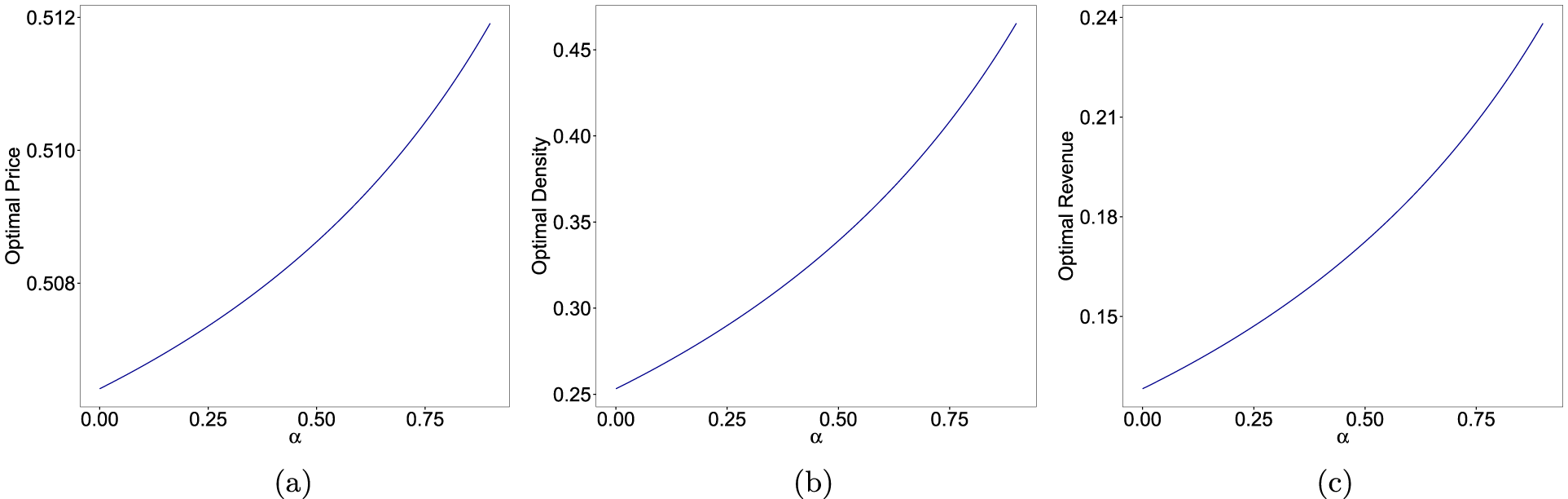
Provider’s optimal solution versus
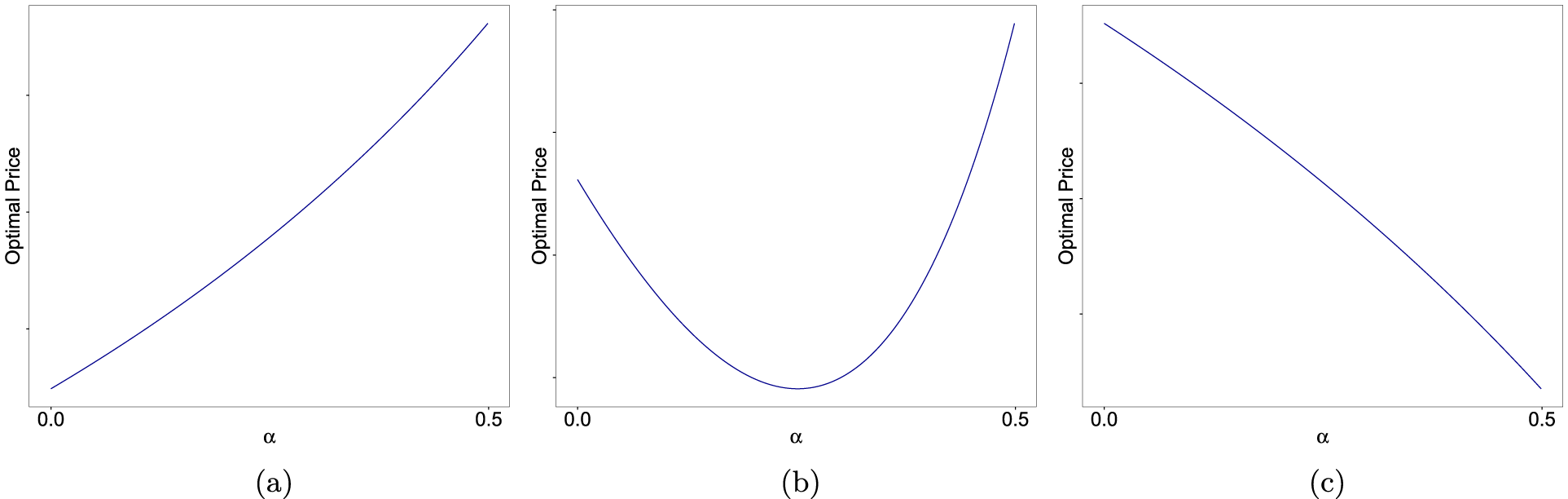
Optimal price versus
Intuitively, an increase in
From the axis scales in Figure 1, we also see that the optimal price is relatively less sensitive to changes in the dependence parameters, while the optimal density cap appears sensitive. This suggests that, in practice, the right choice for the provider’s density cap critically depends on an accurate measurement of the dependence parameters in the customer population. We also note that the optimal price is smooth in
Proposition 2 shows the monotonicity of the optimal density and revenue but does not offer a conclusion about the optimal price. Indeed, the optimal price may not be monotonic and may demonstrate novel behavior; we characterize the possibilities in the next proposition.
For density tolerance with the CDF
Proposition 3 reveals that as customer valuation and density tolerance become more positively dependent, the behavior of the optimal price depends on the density tolerance distribution

When
Combining Propositions 2 and 3, we note that as the demand becomes more negatively dependent (i.e.,
In this section, we consider customer populations exhibiting severe density sensitivity, represented by distributions
For a severely density-sensitive customer population, the optimal strategy is not always full-coverage, price-active; that is, the optimal price and density do not necessarily satisfy Full-coverage, price-active ( Full-coverage, density-active ( Partial-coverage, price-active ( Partial-coverage, density-active (
When both price and density are active in regulating the demand from the cluster with perfect positive dependence, that is,
(Optimal strategy: Severe density sensitivity)
When the optimal strategy is full-coverage, there exist two thresholds
(The explicit characterization of the thresholds, whose values depend on
Proposition 4 shows which lever (price vs. density) the full-coverage and partial-coverage strategy would activate in the optimum to regulate the demand from the customers with positively dependent preferences. In both cases, we find that density (respectively, price) should be the active lever when customers become highly (respectively, relatively less) sensitive to density, that is,
While having characterized the optimal structure for both full- and partial-coverage strategies in the optimum, Proposition 4 remains agnostic about when each of these two strategies is optimal. The answer to this question depends on the comparison of their respective optimal revenues, which turns out to be analytically intractable. Nonetheless, our numerical experiment suggests that the full-coverage strategy identified for
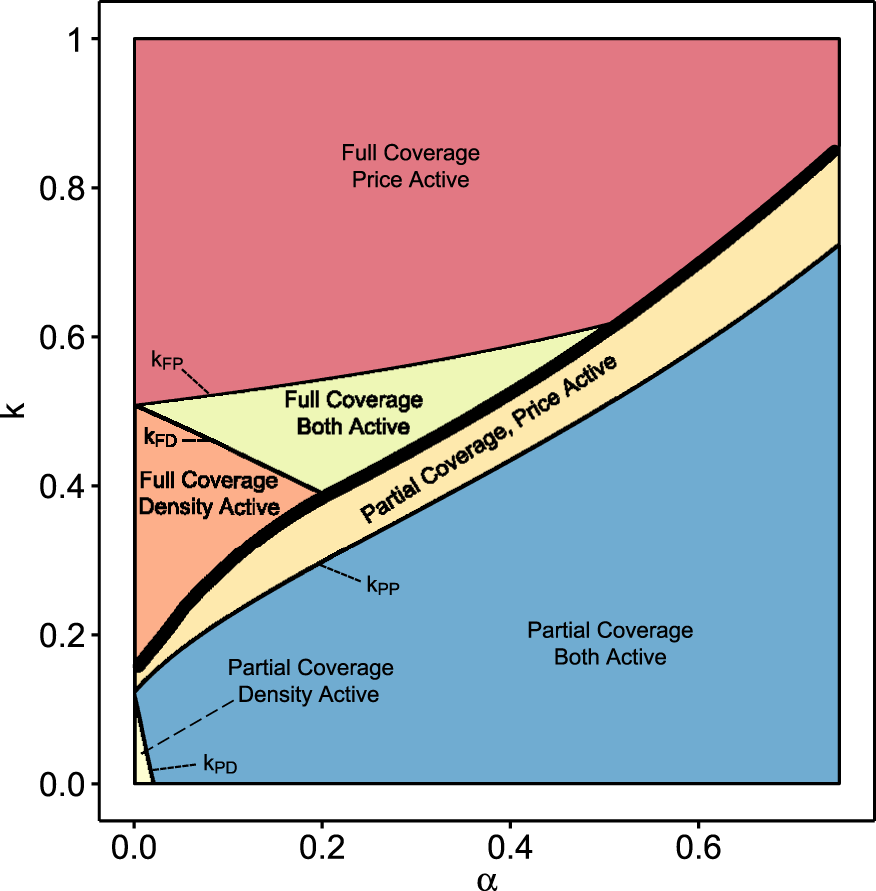
Optimal strategy in
As our last analytical result of the section, the following proposition characterizes how the optimal price and density are affected by the positive dependence parameter
The optimal density is increasing in
Figure 4 illustrates the findings in Proposition 5. Consistent with our findings for
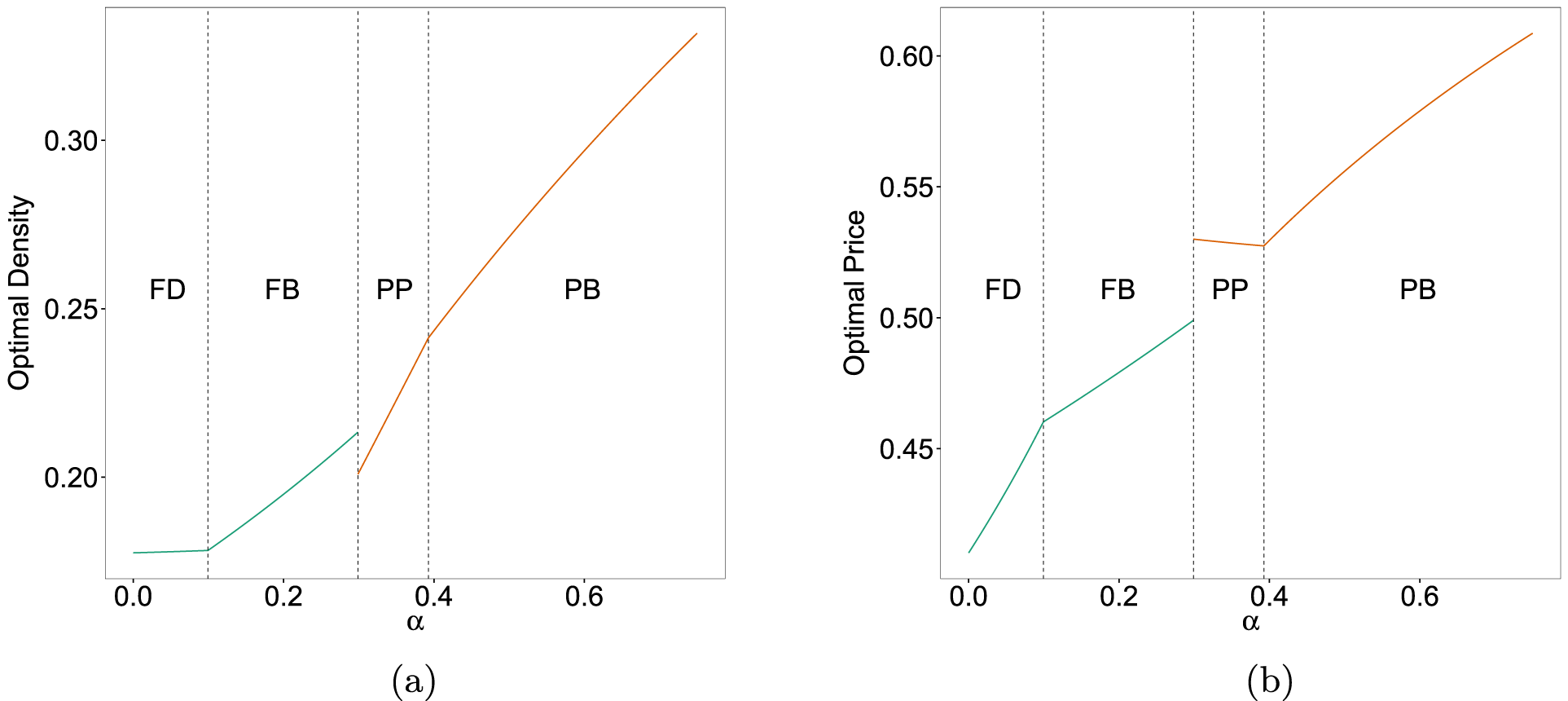
Optimal density and price versus
Ideally, we would calibrate our model using real-world data on exclusive private clubs. However, it is unfortunately extremely difficult to gather information about such clubs (let alone granular data) because they have a strong incentive to gatekeep any details about their membership and operations due to the nature of the business model and the clientele served. Indeed, Kendall (2008: p. 48) emphasizes “how difficult it is to gain accurate information about the practices of private clubs” and states that “we know little about membership in private clubs throughout the United States.” Without access to data on private clubs, we resort to an illustrative example using data from a different setting where customers are also likely to exhibit density sensitivity: train travel during the COVID-19 pandemic. We use this data to numerically validate our distributional assumptions, calibrate the model parameters, and subsequently evaluate the provider’s optimal strategy. The dataset is drawn from Shelat et al. (2022), which conducted a choice experiment measuring the impact of COVID-19 risk perceptions on train travel decisions in the Netherlands.
We use their data to construct an empirical distribution for crowd density tolerance; see Appendix E.1 of E-Companion for details. We can then use this empirical distribution to estimate the power distribution parameter by the method of moments. Specifically, for a power distribution with parameter
Next, using the estimated power parameter, we compute the optimal decisions and revenue by varying the degree of positive dependence
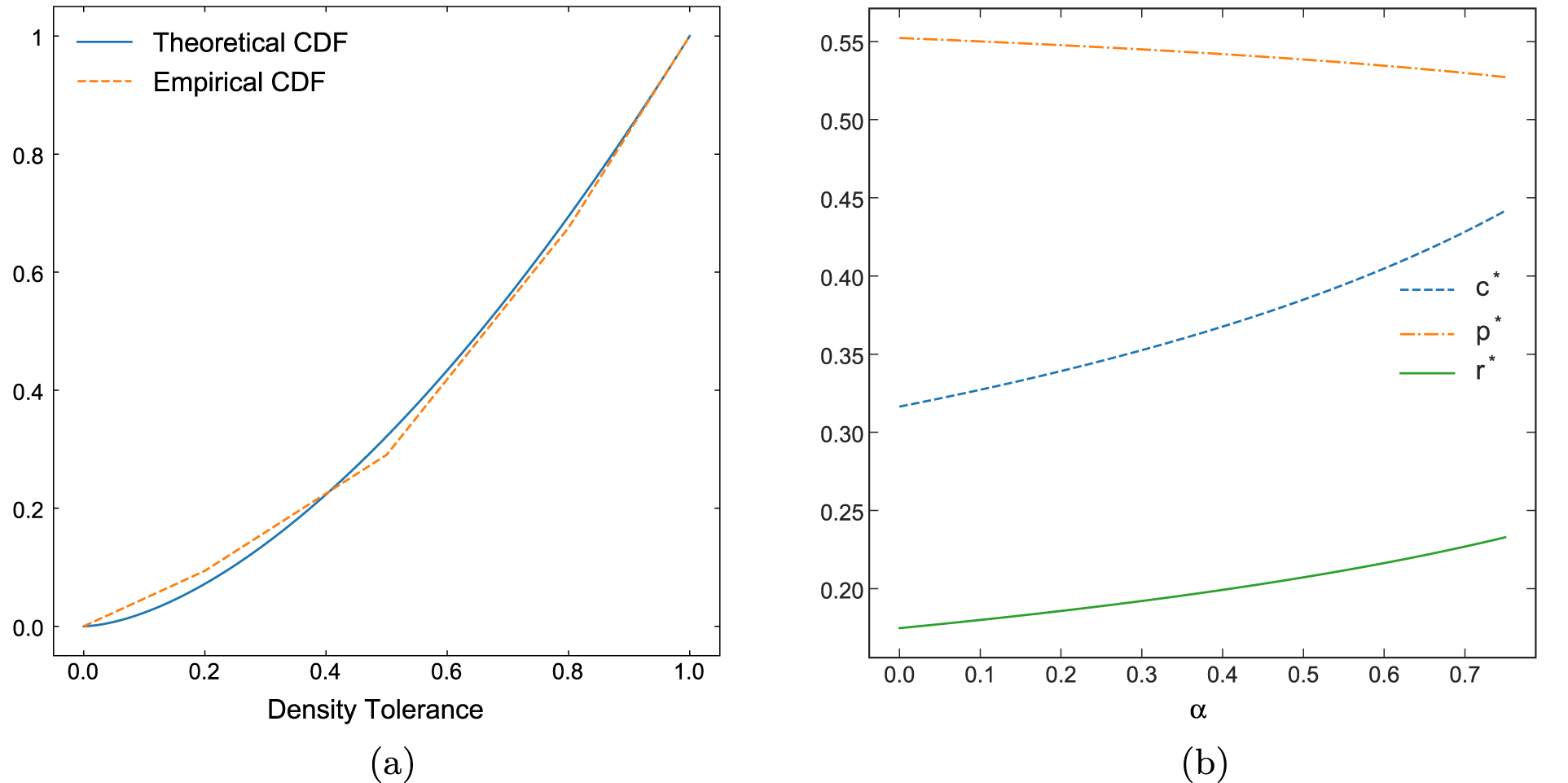
Estimated density tolerance CDF, and optimal decisions and revenue versus
Finally, for additional robustness tests, we consider, in Appendix E.2 of E-Companion, another dataset—from related work by Shelat et al. (2022)—that also measures traveler preferences during the COVID-19 pandemic. On this alternate dataset, we again find that the power family of distributions is a reasonable approximation for the customer density tolerance distribution. Although this setting is different from that of exclusive clubs, it is nevertheless encouraging to see that the power distribution family can be a reasonable choice for modeling density tolerance in a real-world setting.
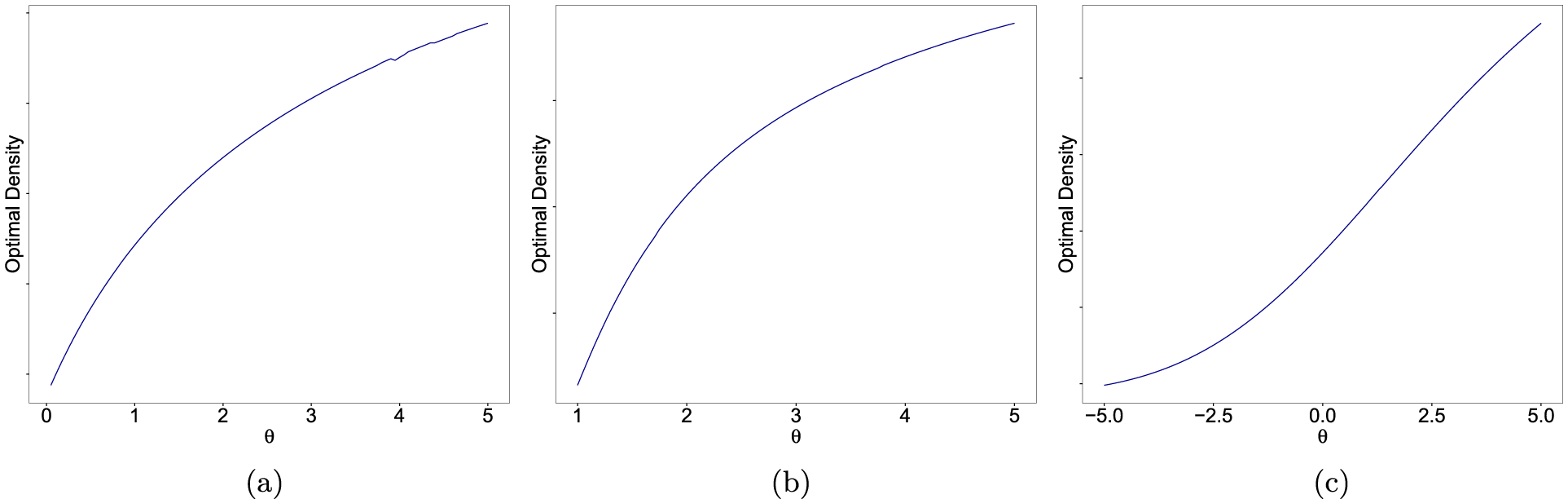
Optimal density versus
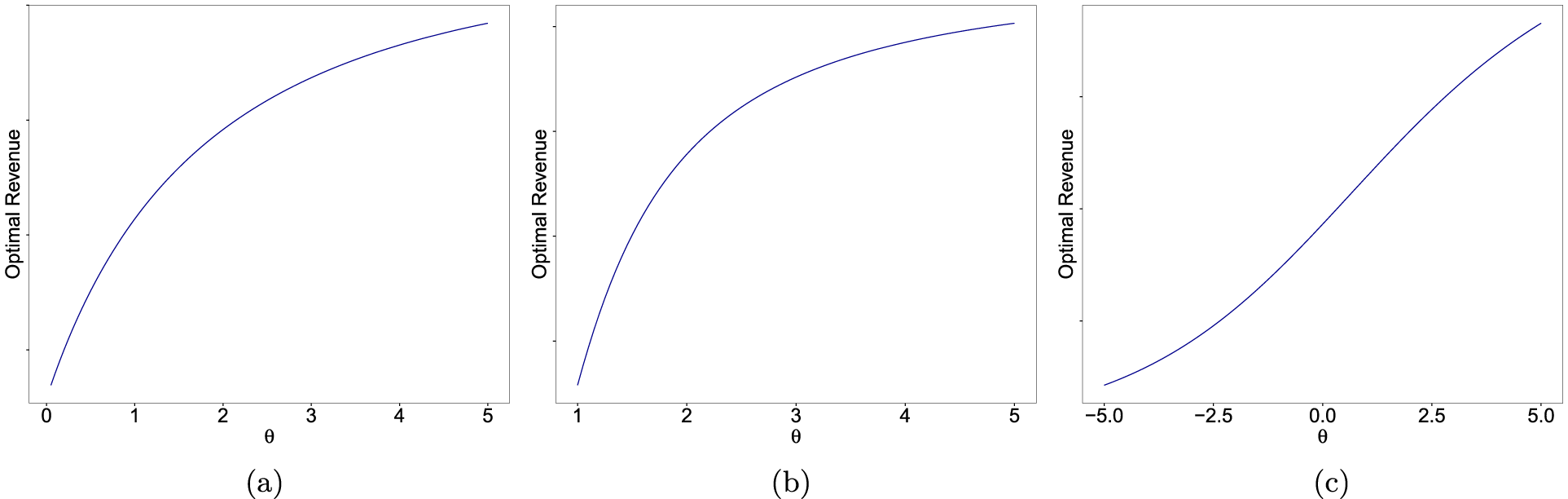
Optimal revenue versus
In most of the above development, we have focused on the Fréchet family of copulas, and under this family, we analytically characterized the service provider’s optimal price and density decisions. However, other copulas exist, and they allow the modeling of additional forms of dependence, so in this section, we extend our study to other copulas to validate the robustness of our qualitative findings.
First, we prove a general result that extends the revenue monotonicity from Proposition 2 to a broad class of copulas under arbitrary marginal distributions for valuation and density tolerance.
(Monotonicity for general copulas and marginals)
Suppose valuation and density tolerance are related according to a copula
Demand is increasing in a particular parameter is exemplified by the Fréchet case, where demand increases in
Next, we study our problem numerically under three different copulas: Clayton, Frank, and Gumbel. Each exhibits a different type of tail dependence (tail dependence reflects the frequency with which different types of extreme events occur jointly). For instance, the Clayton copula is characterized by asymmetric lower tail dependence, such that low realizations of both random variables are likely to occur jointly. We refer the reader to Wang and Dyer (2012: Table 2) for an in-depth treatment of these copulas, including complete formulas and structural properties.
The demand function under these different copulas is obtained by substituting each different copula
Next, in Figure 7, we plot the optimal revenue versus
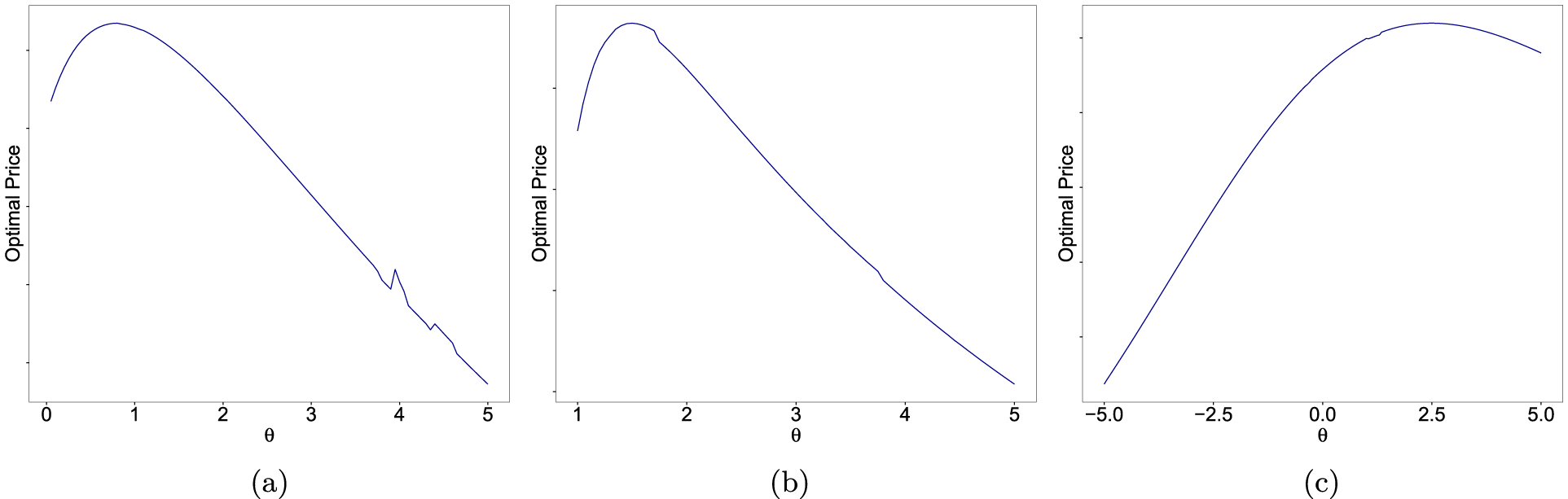
Optimal price versus
Overall, we thus find that our structural results for the Fréchet copula largely extend to more general families of copulas, even those exhibiting very different types of tail dependence.
Motivated by exclusivity- and privacy-based club operations, we have introduced a novel, copula-based framework for studying a service provider’s problem whose customers are sensitive to both the service price and the crowd density. A novel and crucial feature of our framework is the statistical dependence between customers’ valuation and density tolerance. Under this framework, we characterize the provider’s joint optimal price and density cap decisions in relation to the marginal density tolerance distribution and the degree of (positive or negative) dependence between the two customer attributes.
We find that a full-coverage, price-active strategy—in which the provider serves all segments of the market and activates the price (rather than the density) to regulate demand—is optimal for the service provider over a broad range of dependence structures and marginal density tolerance distributions. In particular, we demonstrate the nuanced interaction between the dependence structure and the marginal density tolerance distribution. As a result, while the optimal density cap and revenue are increasing as the valuation and density tolerance become more positively dependent, the optimal price may be nonmonotonic. For severely density-sensitive customer populations, we find that the full-coverage, price-active strategy may no longer be optimal. It may be optimal for the service provider to drop the demand cluster of negative dependence or/and activate the density to regulate the demand from the positively dependent cluster.
Our findings speak to some highly debated economic and social issues. In particular, our results shed light on how the interdependence between customers’ WTP and their tolerance for crowds can impact the service provider’s price and density decisions. Intuitively, more positive dependence benefits the service provider, who should set a higher density limit. Nonetheless, the effects on the price are more nuanced and may not be necessarily monotonic. When the extremely density-sensitive customers only constitute a small fraction of the population, likely the case in reality, the service provider should optimally lower its price as the customers’ WTP becomes more positively associated with their density tolerance. Our prescriptive guidelines thus provide an explanation for the failed versus successful practices of some prominent private clubs, offering a unique perspective to study exclusivity-driven operations.
Our incorporation of rigid multidimensional preferences both addresses a gap in the literature (which has typically assumed perfectly substitutable preferences) and allows us to employ a highly general model of dependence between the dimensions of valuation and density tolerance. While these are positive features of our work, the rigidity assumption does represent an extreme specification of preferences. In practice, customer preferences may fall somewhere between the extremes of perfectly substitutable and perfectly rigid; that said, a copula approach can still be applicable to model multidimensional heterogeneity of preferences in those cases, albeit potentially with the loss of analytical tractability. Along with this, our framework and results open multiple avenues for future work. We have assumed uniformly distributed WTP and a broader class of distributions for density tolerance, allowing more richness for the latter as a novel feature of our work. For more general WTP distributions, we believe that our main insights would likely continue to hold, but the analysis would be technically challenging if both
Supplemental Material
sj-pdf-1-pao-10.1177_10591478241302764 - Supplemental material for Optimizing Service Operations With Price- and Density-Dependent Demand: A Copula-Based Approach
Supplemental material, sj-pdf-1-pao-10.1177_10591478241302764 for Optimizing Service Operations With Price- and Density-Dependent Demand: A Copula-Based Approach by Andrew E Frazelle, Toghrul Rasulov and Shouqiang Wang in Production and Operations Management
Footnotes
Acknowledgments
The authors thank department editor Michael Pinedo, the senior editor, and the referees for their many helpful comments that led to a greatly improved paper. Also, Andrew Frazelle and Shouqiang Wang gratefully acknowledge summer research support from the Jindal School of Management.
Declaration of Conflicting Interests
The authors declared no potential conflicts of interest with respect to the research, authorship, and/or publication of this article.
Funding
The authors received no financial support for the research, authorship, and/or publication of this article.

Notes
How to cite this article
Frazelle AE, Rasulov T and Wang S (2024) Optimizing Service Operations with Price- and Density-Dependent Demand: A Copula-Based Approach. Production and Operations Management 34(6): 1531–1548.
References
Supplementary Material
Please find the following supplemental material available below.
For Open Access articles published under a Creative Commons License, all supplemental material carries the same license as the article it is associated with.
For non-Open Access articles published, all supplemental material carries a non-exclusive license, and permission requests for re-use of supplemental material or any part of supplemental material shall be sent directly to the copyright owner as specified in the copyright notice associated with the article.
