



Abstract
This position paper reframes the ongoing relevance versus rigor debate in operations research (OR) as a Kuhnian epistemological crisis, in which the dominant paradigm of quantitative modeling shows signs of exhaustion. Humanitarian fleet management is presented as an empirical case of extensive operations theory, which has not been implemented by the stakeholders who paid for its production. We propose a possible way out of the crisis by combining “hard” and “soft” OR, illustrating the potential with a selected problem structuring method. Optimization solutions can become more productive by first surfacing the organizational context of decision-making. The illustration emphasizes that hard and soft OR are not binary opposites but interlocking, mutually empowering components which expand the evidence base. Shifting the current paradigm toward more engaged scholarship could counteract the ongoing theoretical drift, for more strategic impact on the pressing problems of today.
Keywords
A Kuhnian Crisis Addressing Operations Management Problems
Quantitative modeling is the dominant paradigm for addressing problems of operations management and the subject of growing controversy among its own scholars. The epistemological debate developed to the point where, in 1979, Ackoff declared “The future of Operational Research is Past” (Ackoff, 1979).
The intervening decades have not seen the predicted demise of the field. At the same time, the state of operations research (OR) remains characterized by a “natural drift” (Corbett and Van Wassenhove, 1993), which privileges the abstract over the practical, models over interventions. Its research projects scope in those problems that can be solved with quantitative methods (“hard” OR), and not necessarily what the focal organization urgently needs to fix. Consequently, a growing body of research is content to solve a select few operational problems with rigorous scientific methods, to arrive at internally valid results. Without external validity, the value of these outcomes is questionable. The peer-reviewed findings lack the coherence of a canon and are generally inaccessible to the decision-makers who invested resources to support the research. Diffusing the managerial implications to the stakeholders is mostly an afterthought. Comparatively little of the technical solutions are implemented with any measurable impact. Almost 50 years after Ackoff declared that it was over, OR still pretty much proceeds as usual. However, if the serial, often exasperated, assessments by its own gatekeepers are any indication, its crisis has yet to subside (Hall and Hess, 1978; Ackoff, 1979; Dando and Bennett, 1981; Corbett and Van Wassenhove, 1993; Rosenhead and Mingers, 2001; Hopp, 2004; Roth et al., 2016; Gallien et al., 2016; Vries and Van Wassenhove, 2020; Hopp and Simchi-Levi, 2021; Spearman and Hopp, 2021).
Insanity: doing the same thing over and over again and expecting different results.
— Apocryphal, attributed to Albert Einstein
“The Structure of Scientific Revolutions” (Kuhn, 1962) noted that the history of science does not reveal a steady accumulation of facts to discover the Truth. Kuhn memorably observed that its progress is guided by a shared “paradigm,” or a set of norms, which define the problem set of each discipline, and how it is to be legitimately addressed. Far from a linear trajectory, normative science consists of successive cycles of inquiry, each of which incrementally articulates the prevailing paradigm. Over time, a critical mass of anomalies accumulates within these norms, spreading a sense of crisis. The exhaustion of the incumbent paradigm culminates in a scientific revolution, after which its community turns to a more promising set of problems and methods, with renewed vigor. We describe the current crisis of OR in Kuhnian terms: the prevailing norms of modeling and quantitative optimization appear to have reached a point of diminishing returns, but have yet to be replaced by a new paradigm.
Our particular illustration of the crisis is derived from humanitarian fleet management, a sector in which the authors have collective decades of experience. This empirical example exhibits several salient characteristics: first, humanitarian logistics have significantly professionalized in the past decades (Sagemeister, 2024; Seipel, 2011). Yet, despite ongoing improvements, its fleets struggle with inefficiencies that persist over time. These inefficiencies can be observed independent of the size or mission of the organization (Fleet Forum et al., 2021). Second, operations scholars have studied the humanitarian fleet intensely. Classic OR objective functions (like optimizing fleet sizes under cost and availability constraints) apply to the humanitarian fleet, resulting in a significant stream of high-quality literature. Third, the increasing volume of research findings has not generally been implemented by the organizations that invested time and attention to help produce them. Humanitarian fleet research can, therefore, be considered an empirical case of the Kuhnian crisis.
The focus on humanitarian logistics also permits an overdue examination of the return on investment (ROI) of OR studies (Vries and Van Wassenhove, 2020). Their costs are twofold. The first consists of organizational attention and efforts that are diverted to OR projects by, for example, collecting input data. Researchers presume that commercial companies can afford to invest time and effort into the rigor that distinguishes hard OR. We emphasize that, in the humanitarian sector, these costs are borne by resource-poor organizations, who are under constant pressure to justify their expenses and minimize overheads. More importantly, a failure to implement a solution inflicts opportunity costs on the focal organization. In the case of humanitarian organizations that work to reduce suffering or save lives, these missed opportunities have consequences for society. In the humanitarian sector, OR that is relevant and impactful is a responsibility that cannot be shrugged off, nor delegated to its management.
This paper illustrates how humanitarian fleet management can avoid the negative ROI and opportunity cost of OR solutions that are never used. It will demonstrate the use of a mapping template, based on the logic of a Lean Management tool, which we adapted to the structure of humanitarian organizations. By doing so, it makes the decision-making structures visible, and allows the researcher to identify where and how technical OR models should be applied. Reflecting on this exercise, we discuss the necessity of reconciling so-called “hard” and “soft” OR. Together with selected literature on soft OR (Binder and Watkins, 2024; Rosenhead and Mingers, 2001; Womack et al., 1990) we assert that the work of structuring the organizational (political, behavioral) problem is an essential component of rigorous OR applied to problem sets in operations management. It adds to its evidence base and legitimates its outcomes.
Furthermore, the lessons learned from addressing inefficiencies in humanitarian fleet operations may have a wider relevance than operating vehicles at low cost. The ecosystem of the humanitarian sector is comparable to the larger (more or less) resource-constrained problems that face civilian society today, and for which OR should deliver scientifically valid solutions. Challenges like climate change, circular economy, and pandemic response are both political and technical, with numerous stakeholders negotiating how best to allocate resources, under multiple constraints and high uncertainty. Reductive problem definitions and silver bullet technologies will not enable these stakeholders to make the necessary changes. We consider an alternative way forward and derive implications for future OR engagements.
An Empirical Example and its Lessons
The scholarly debate on OR’s crisis of relevance to address operational problems has produced the volume of commentary which is summarized in the introduction. In the following sections, we focus on its practical consequences in a representative field of operations—humanitarian fleet management.
The individual activities of SFO are contrasted with SFM, illustrating differences in activities, information flows, stakeholders involved, and degrees of managerial involvement.
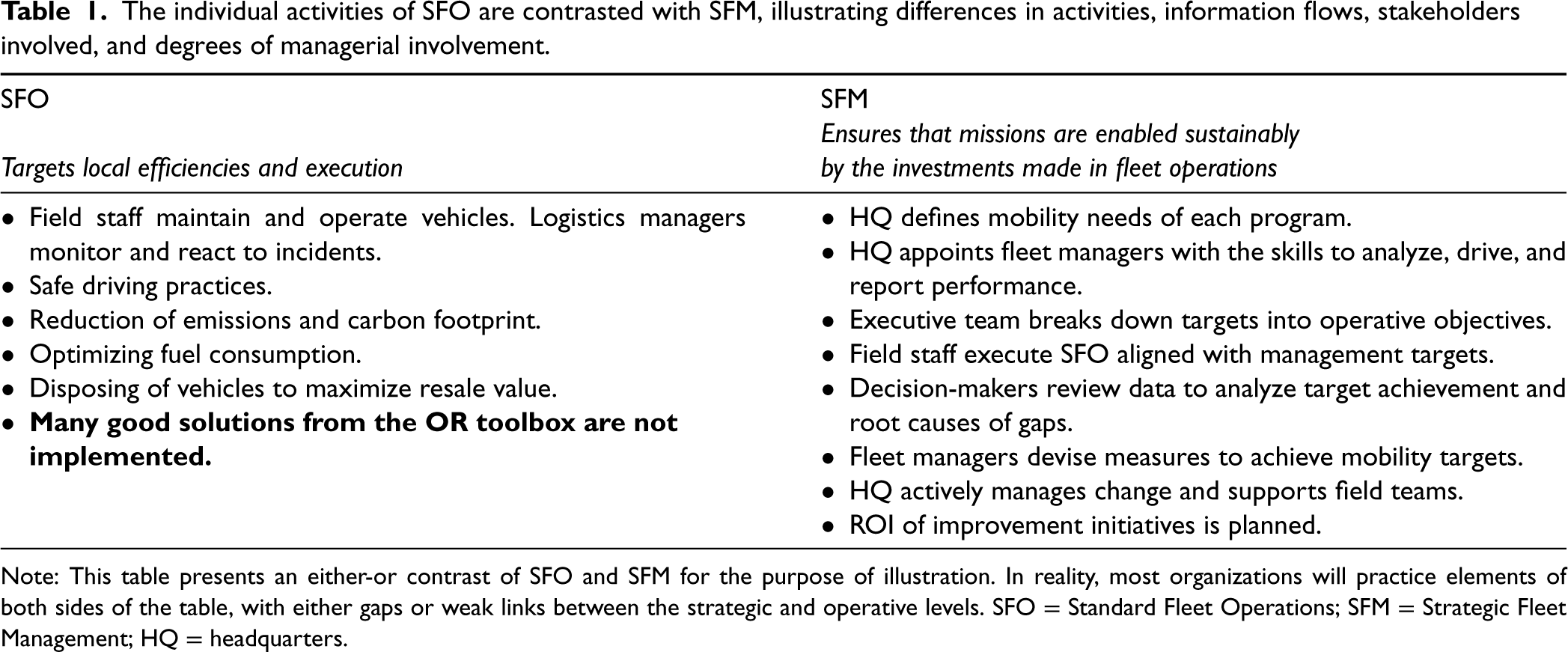
The individual activities of SFO are contrasted with SFM, illustrating differences in activities, information flows, stakeholders involved, and degrees of managerial involvement.
Note: This table presents an either-or contrast of SFO and SFM for the purpose of illustration. In reality, most organizations will practice elements of both sides of the table, with either gaps or weak links between the strategic and operative levels. SFO = Standard Fleet Operations; SFM = Strategic Fleet Management; HQ = headquarters.
Humanitarian organizations are defined by overarching goals, called missions, such as providing medical care or ensuring food security. To fulfill their missions, organizations execute individual programs consisting of short-term projects that are equipped with essential resources, including assets and staff, funded by donor budgets. These programs aim for technical outcomes like food distribution, vaccination initiatives, and public health education. Central to executing most programs are vehicle fleets that transport both staff and supplies to the target population.
Our point of departure is an empirical paradox. Humanitarian fleet operations have significantly improved over the past decades. Evidence has emerged of better maintenance and repair of vehicles, more comprehensive driver monitoring and training, and improved fuel consumption (Fleet Forum et al., 2021). This progress is attributable to diligent efforts made by staff in the field, supported by consultants, academic researchers, and facilitating consortia like Fleet Forum (Fleet Forum, 2024). Despite this ongoing professionalization of humanitarian operations, certain challenges persist. These recur across a broad range of humanitarian organizations, independent of mission or size, and over time. In contrast to the progressive improvement of fleet operations, fleet management as a whole has not professionalized much.
To clarify terms, we define fleet operations as the work done on the ground to purchase, operate, maintain, and dispose of vehicles, activities that logistics departments typically host. Fleet management, in contrast, is executed at the strategic level of the organization. It encompasses all decisions and actions that ensure that the organization can meet the demand for mobility. The decision-making necessary for fleet management will be cross-functional in nature, working with logistics, IT, finance, and HR and integrated into the mission and program planning. At present, we observe two distinctive stages of maturity along the professionalization trajectory: Standard Fleet Operations and Strategic Fleet Management. Table 1 presents a simplified and admitted extreme contrast between the two stages for the sake of argument. The first stage, Standard Fleet Operations, is characterized by improvements in basic fleet operations, which usually target local efficiency, that is, aiming at “doing things right.” These initiatives are evident across the sector today. With the term Strategic Fleet Management, we refer to a comprehensive professionalization of fleet management, that strives not just at “doing things right” but also “doing the right things” (as defined by Teece et al., 1997) that serve the needs of the organization’s mission. In practice, most humanitarian organizations practice certain elements of Standard Fleet Operations and Strategic Fleet Management, but there remain gaps and, at best, weak links between the two.
In organizations that attain the maturity of Strategic Fleet Management, the fleet is no longer viewed as a purely technical asset and cost to be minimized. Instead, it is treated as an enabler of humanitarian response, with all decisions, activities, and performance measurements thoughtfully aligned to the strategy of that mission. This is best understood by an example. Most small and medium-sized organizations have simple dashboards that display data like the number of vehicles, distances driven, fuel consumed, accident rates, and repair costs. Monitoring these indicators in isolation will not help to judge whether driving a vehicle for 15,000 km per year is good or bad for humanitarian outcomes. Without the organizational context, the data provide little strategic decision support. If an organization assumes that maximal utilization of an expensive asset is reasonable, operational targets will be set to drive each vehicle as much as possible. However, for certain tasks—think of moving medical staff to treat patients, or distributing food quickly during an emergency—driving fewer kilometers may actually be the optimal way to deploy the fleet to serve the targeted population. Subtle judgments like these will only be possible if the organization’s strategy is broken down into plans for mobility within given budgets. This is the essence of Strategic Fleet Management.
The reality today is far from this ideal: in most international humanitarian organizations, the fleet is too big, too costly, too unsafe, and too polluting (Fleet Forum et al., 2021). When these issues are solely addressed by the activities that are typical to Standard Fleet Operations, success is usually limited and temporary. Only a few, usually large, humanitarian organizations succeed in managing their fleet so that fleet strategy and execution are fully aligned. The general reproduction of underperformance, and resistance to interventions suggest that structural obstacles stand in the way of progress (Senge, 1990).
The Many Theories of Humanitarian Fleet Operations
A problem set that involves, among other elements, the optimal allocation of resources under cost constraints, invites the attention of OR. Humanitarian fleets have, in fact, been the subject of OR study for years, producing a significant stream of peer-reviewed literature. This research has deliberately focused on the technical decision problems listed on the left side of Table 1.
The extant literature ranges from descriptive studies introducing the challenges faced by humanitarian fleet management (see, e.g., Pedraza-Martinez et al., 2011; Tomasini and Van Wassenhove, 2009), to OR studies proposing model-based solutions to its specific problem sets. We cite here some important examples: research on transport planning (see, e.g., Balcik et al., 2010; Battini et al., 2014; Gralla and Goentzel, 2018; Tricoire et al., 2012), and decision-making over a vehicle’s life cycle (see, e.g., Eftekhar et al., 2014; Eftekhar and Van Wassenhove, 2016; Gu et al., 2021; Pedraza-Martinez and Van Wassenhove, 2013). A related stream strives to optimize fleet sizing and asset allocation on an aggregated level (see, e.g., Kunz and Van Wassenhove, 2019; McCoy and Lee, 2014; Pedraza-Martinez et al., 2020). Studies of vehicle supply chains examine the effects of centralized or decentralized fleet procurement (see, e.g., Besiou et al., 2014; Kunz et al., 2015; Stauffer et al., 2016). Further studies integrate fleet sizing decisions with strategic location decisions, e.g., location-transportation problems (see, e.g., Chang et al., 2024; Moreno et al., 2016, 2018). Lastly, some scholars discuss how humanitarian organizations measure performance (see, e.g., D’Haene et al., 2015; Haavisto and Goentzel, 2015; Patil et al., 2021). In general, the extant literature draws upon fleet management optimization from the commercial sector and adapts it to the requirements of the humanitarian context. These introduce sector-specific constraints (like earmarked funding, decentralization, and uncertainty) to carefully controlled objective functions.
The OR literature on humanitarian fleets displays consistent methodological rigor, which has not shielded it from controversy. The low impact of peer-reviewed research has been acknowledged by its scholars, who have reflected on probable causes (Gralla and Goentzel, 2018; Kunz et al., 2017; Kunz and Van Wassenhove, 2019; Leiras et al., 2014; Vries and Van Wassenhove, 2020). The critical focus includes the way in which OR fleet studies are set up, often without real-world data, or selecting cases of large international humanitarian organizations that are already advanced in their operations, and not representative of the sector. Some note that the very nature of classical optimization stands in the way of implementing the models. Their scientific prose and notation do not convey practical implications to decision-makers. Even when they promise performance improvements under specific conditions, the fact remains that few of the OR models have been adopted by the organizations that participated in the studies.
A Possible Way Forward
The above provides a specific, compelling case of the OR crisis, and points to the costs to society. At the same time, an extensive range of “soft” OR methods exists to address these issues. These are not strictly quantitative, hence, controversial among “hard” management scientists. In the next step, we use the example of humanitarian fleet management to illustrate a possible way forward, by applying one of these problem structuring methods and describing its effect on the solution search.
All technical decision problems targeted by classical hard OR are embedded in an organizational context and decision-making processes. The challenge, so far scoped out of OR projects, lies in developing a shared understanding of the organizational system and structuring it for decision support (Rosenhead and Mingers, 2001). The soft OR literature has produced problem-structuring methods, like Robustness Analysis or Soft Systems Analysis (Rosenhead and Mingers, 2001). Practitioners have also contributed scientific problem-solving toolboxes, like Lean Management and Design Thinking, which have been widely implemented, with a positive impact on a broad range of sectors (Binder and Watkins, 2024; Brown, 2008; Netland and Powell, 2016). They are often simple visualization exercises, capable of synthesizing a range of factors, without special equipment or training.
The objective of problem structuring is to discover the most important aspects of the question, not deliver an absolute answer or natural law. Since they yield different versions, depending on the perspective of the user, scientists may object to the unreliable reproducibility of the problem structure. The soft OR literature contends, however, that conflicts of interest and divergent perceptions of the problem are consequential aspects of the research, hence belong in the evidence base as issues to be re/solved, rather than excluded from view. It is also worth emphasizing that problem structuring methods do not invalidate or substitute the knowledge generated by optimization models. They complement them by engaging with stakeholders, which is the prerequisite of “the learning effect of OR” (Corbett and Van Wassenhove, 1993: p.635). A preliminary, interactive study of the business case prepares an organizational environment to recognize the power of an OR model to guide decision-making.
In the next subsection, based on our experience with humanitarian fleet management, we present an exemplary problem structuring method customized to its specific context. The precise choice of this tool is not central to our argument. We settle on a method inspired by Wagner et al. (2020), which reverses the logic of the 5-why analysis from the Lean Management toolbox (Serrat, 2009), for its simplicity, and because its visualization supports interaction with decision-makers and other stakeholders.
Structuring the Problem of Humanitarian Fleet Management
We begin by introducing the main elements of our problem structuring method in Figure 1, which represent typical characteristics of international humanitarian organizations. These organizations have headquarters located in a peaceful, usually prosperous country with good infrastructure. At these locations, well-educated executive teams interact with donors and are responsible for strategic planning and control. The field offices are located in the very crisis regions that the organizations serve, at a distance from headquarters, but in proximity to impacted populations, and execute individual programs. Loose, non-hierarchical structures, characterized by weak lines of command, link these two markedly distinct organizational parts. The structure produces a cultural, physical, and logical divide, represented by the dashed line in Figure 1, which is fundamental to the dynamics of the organization. The inbuilt distance between management and staff profoundly influences how decisions are made and implemented (Gu et al., 2021; Pedraza-Martinez et al., 2011, 2020).

Generic elements of the humanitarian problem structuring method in which headquarters and field are separated (see dotted line) by geography, culture, and logical perspectives.
Figure 1 depicts at a high level the causality of the effects, which combine to arrive at field-level outcomes. In his study of how organizations learn and improve their performance, Senge claims that one of the main reasons why good ideas are never implemented is “not from weak intentions, wavering will, or even nonsystemic understanding, but from mental models” (Senge, 1990: p.159). According to his seminal definition, these are “deeply held internal images of how the world works, images that limit us to familiar ways of thinking and acting.” He emphasizes the importance of managing mental models, continuing, “That is why the discipline of managing mental models—surfacing, testing, and improving our internal pictures of how the world works—promises to be a major breakthrough for building learning organizations” (Senge, 1990: p.159). For these reasons, the main building blocks of our problem structure are precisely those mental models held by executives, logical decisions within organizational structures, and (intermediate) outcomes. The exercise of mapping the cumulative effect of these constructs reveals the way in which managerial perceptions of fleet trigger logical decisions, that manifest over time to create the institutional structure. Headquarters staff working within this structure produce (first- and second-level) intermediate outcomes, which, in turn, set the scope for practices in the field. Under the guidance of the headquarters, be it tacit or explicit, teams in the field make rational decisions within their span of influence. The fleet performance that is the outcome of the system will impact how well the program is fulfilled.
Empirically, there can be no doubt that these elements exist, and that they are linked. With this map, we do not intend to prove causality with scientific precision, any more than the 5-why analysis on which it is based. A rigorous model of causality can be attempted following commercial precedents (see, e.g., Repenning and Sterman, 2001). Since the size and complexity of such a model will impose high costs on the organization, we advise against it, in favor of what Rosenhead called “very limited technical apparatus …” (Rosenhead, 1978b: p.81). Since all we seek is a better, shared understanding of how the inefficiencies are consistently reproduced, with no need for further rigorous proof, we settle upon the generic impact map (Wagner et al., 2020) to structure the problem in advance of a solution search.
The following sections are essentially reports from the field. They illustrate how the problem structuring method unearths the unseen context of real, repetitive problems. Those readers interested only in the theoretical implications can proceed directly to the concluding discussion. We contend, however, that the rich detail of the empirical context strengthens the case for practical and epistemological change.
Drawing upon collective decades of experience working with different organizations, we present the detailed problem structure of a generic humanitarian fleet organization in Figure 2. We walk through how stakeholders should interpret and apply it for diagnostics and solution search. The map is read from left to right. We provide examples wherever these are instructive. The presented problem structuring method describes decision-making in a worst-case organization that we, based on empirical data, deem realistic, especially for small- and medium-sized international humanitarian organizations. It is clear that organizations are already working on a number of the topics represented by the boxes, which means that not every organization will need to include and address each topic or link.
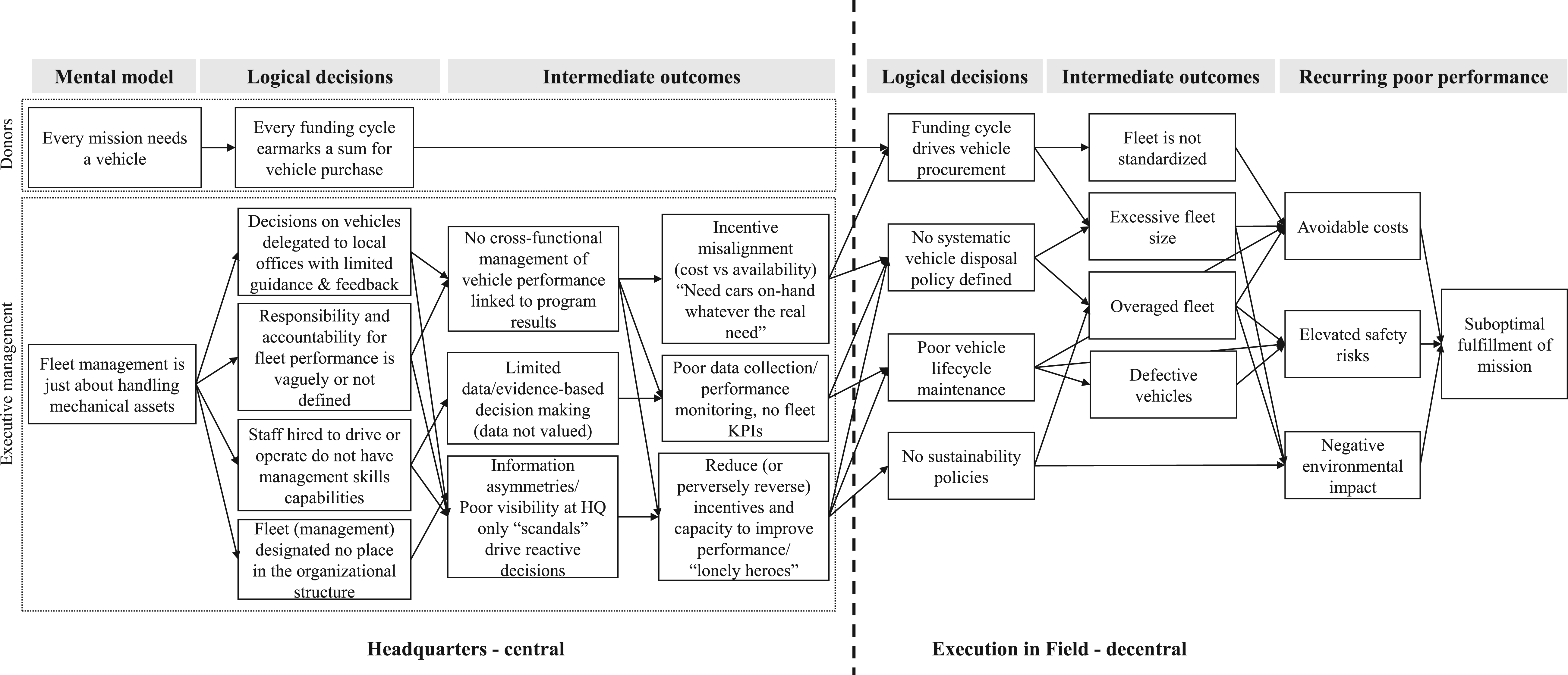
Detailed problem structure of a generic international humanitarian organization, based on extensive field data.
Two influential mental models constitute the point of departure for fleet management structures in our generic organizations. We distinguish between the mental model, which is held by management, and that which donors hold (see lower and upper left in Figure 2) and map out the impact of each separately, based on observations of multiple projects.
What Executive Management Thinks:
Fleet management is perceived as the purely operational task of handling mechanical assets. Since the fleet is not seen as relevant to the mission’s strategy, it does not justify dedicated management attention. Our map derives four logical decisions from this common mental model, which in turn defines how the fleet is positioned within the organizational structure. First, limited management attention justifies the decentralization of decisions on vehicles. All fleet management decisions are delegated to local offices, with little management support, guidance, or feedback (Besiou et al., 2014; Hirschinger et al., 2016; Kunz and Van Wassenhove, 2019). Second, responsibility and accountability for fleet performance are defined either vaguely from above, or not at all. Organizations do not routinely appoint—and subsequently lack—a dedicated fleet manager. Fleet work becomes one of the many technical to-dos of low priority for whoever is assigned the task. This causes the impression that “no one is responsible for the fleet”.
Third, the staff hired to drive or operate the vehicles will tend to lack management capabilities (D’Haene et al., 2015; Patil et al., 2021). They do not possess the skills, nor do they have the time to analyze and represent the fleet in the form of a business case that targets mission performance. Fourth and finally, fleet management and performance control are assigned no official place within the organizational structure. This creates a variety of practical consequences, including a lack of uniform reporting protocols or the scattering of fleet-related expenses across multiple administrative boundaries. When individual cost buckets are managed by different departments, the total financial consequences for the organization become impossible to recognize. Should a manager attempt to identify the root cause of indirect costs (like logistics), the fact that they are fragmented and allocated across departmental budgets will make an accurate diagnosis and targeted action tedious and close to impossible.
These structural manifestations of the mindset generate the following first-level intermediate outcomes. No cross-functional management activities link fleet management to program results. Fleet performance is not reviewed and configured as part of the program strategy, nor is it integrated into the program design (Haavisto and Goentzel, 2015; McCoy, 2013). Furthermore, the fleet staff do not routinely make evidence-based decisions drawing upon data from the organization’s systems (Gralla and Goentzel, 2018; Gu et al., 2021; Keshvari Fard et al., 2019; Pedraza-Martinez and Van Wassenhove, 2013). Because these data are structured more to feed the high demands of donor audits, they are not used to make operative decisions. The fleet-relevant data are not collected, and the reports, which make in/efficiency visible, are not regularly generated. The general lack of managerial feedback loops perpetuates information asymmetries between center and periphery, organizational functions, and hierarchical levels. The details of the fleet’s performance and needs are simply not visible at the headquarters level. Because of the price tags of vehicles, there exists a vague suspicion of the immense cost of the fleet. The awareness of the fleet’s impact on the organization is achieved more by informal communications (like storytelling, rumors, or scandals) than by a disciplined flow of actionable information. Practices like these promote firefighting to cut or control costs rather than strategic management of investments in mobility.
In the next stage, we derive the second-level, intermediate outcomes that lay the foundation for decision-making in the field. Not setting and managing organization-wide goals for fleet performance removes local incentives to collect and pass on the key performance indicators of the fleet. To monitor performance, managers need detailed breakdowns of cost, together with actual demand for transport. Instead, information asymmetries perpetuate a misalignment of incentives between headquarters and the field (Kunz and Van Wassenhove, 2019; Pedraza-Martinez et al., 2011, 2020). Local offices are evaluated on program fulfillment and will tend to over-prioritize the availability of vehicles without full awareness of the associated costs. Headquarters, for their part, are focused on the efficiency of operations but fail to recognize costs in full, nor in a timely manner. Rather than resolving these conflicting interests, the incentives and opportunities to improve the fleet’s total performance are diminished or perversely reversed. When misalignment is not systematically made visible at the executive level, it can lead to what we describe as the tragedy of the “lone heroes”. These are individuals who recognize improvement opportunities and take the initiative to solve urgent problems, in good faith, from the bottom up. Without managerial support, they work valiantly against the larger forces propagating through the organization. We have personally observed the defeat of many of these people: they experience the inefficiencies first-hand, recognize what must be done about them, appeal to their colleagues to take action, issue reports that are ignored, and find themselves locked into a system that always seems to revert to “business as usual.” Inevitably frustrated, those lone heroes tend to leave the organizations. They join others offering higher salaries, which increases staff turnover in the sector and diminishes the retention of knowledge and institutional memory.
What Donors Think:
Donors equally determine whether and how organizations manage their fleets internally. In our problem structuring method, the significant role they play in driving inefficiencies becomes apparent. Donors determine the scope of fleet management in humanitarian organizations through the specifications of their funding decisions and the criteria for program success. From the outside, they typically impose a short-term horizon for the planning of vehicles (Beamon and Balcik, 2008; Patil et al., 2021). Mindful of the fact that no mission can deliver without transport, donors decide that every new grant or program budget should foresee a position to purchase vehicles. When they earmark program funding for vehicles, they counteract efforts for long-term fleet planning, fleet sharing, life cycle management (selling off old vehicles), and optimal fleet sizing.
How the Field Actually Does It
Field offices evidently operate within the given organizational structure, and, at first glance, the decisions made by local staff about their fleet may appear independent. The common perception is that field offices have high levels of autonomy. The decisions at the field level are, however, the logical consequence of the system as it is set up from above, the outcome of decisions made in the headquarters. In addition, international humanitarian organizations are subject to a multitude of external rules and regulations, procedures, and audits from both headquarters and donors, all of which limit local autonomy.
We, therefore, shift our attention to the right side of Figure 2 to consider four unintended—and wasteful—effects of local decision-making on the fleet. First, vehicles are acquired individually, driven by the funding cycle, and not procured in optimal quantities that fulfill the total demand for transport. In practice, this means that once a program is launched, earmarked funding sets off an order process for purchasing vehicles, often detached from total current fleet size, or demand. This creates a perverse incentive to add vehicles to the fleet independent of the existing asset base. Additionally, when field managers prioritize vehicle availability, they are motivated to add vehicles opportunistically whenever funding is available. This results in a flurry of so-called “Christmas shopping” before the money runs out. Plotting the spending forms a hockey stick at year-end when funding cannot be transferred to the next period or applied to other programs’ needs (Kunz et al., 2015). Ironically, the opposite also occurs. When negotiating with donors on how to fund a planned project, the trade-offs required by budget cuts are made based on snap judgments. For example, when the program’s objective is to alleviate hunger, it will seem out of the question to reduce spending on food commodities, whereas the option to cut vehicle spend will appear reasonable. Without systematic fleet management and processes to make the knock-on effects visible, the negative impact on program execution will go undetected until it is operational. By the same logic, the planning processes targeting local efficiencies do not support the possibility of sharing capacity between programs and functions within and between organizations. The enormous potential benefits of collaboration are not exploited today. Agreements that must be contracted top-down are delegated to field offices, which do not have the power to enact them.
Second, at the organizational level, intermediate outcomes create the misalignment of incentives while neglecting the control of fleet performance. This is the origin of field-level practices that do not dispose of vehicles in a timely and systematic way. Without aligning incentives across the organization, the headquarters will struggle to establish vehicle disposal policies that run counter to local interests in the field (Gu et al., 2021; Pedraza-Martinez and Van Wassenhove, 2013). Combine this with poor data collection, the lack of fleet performance monitoring, and the widespread misconception that fully depreciated vehicles cost the organization nothing will remain unchallenged. Staff in the field will be perversely motivated to retain ageing vehicles and will fail to replace them in time to benefit from the best possible resale value. Old vehicles are also retained as a source of parts that are difficult to fund or find in remote locations.
Third, if fleet performance is not systematically measured and managed, no incentives will be put in place to improve the performance and safety of individual vehicles. Maintenance over the life cycle of the asset will not be optimized or appropriately budgeted, and vehicle utilization policies will not be implemented (Eftekhar and Van Wassenhove, 2016). As a result, cost pressures could easily lead to a reduction in spare part inventories or maintenance actions. This leads to a steady increase in inactive vehicle stock and an additional reason for keeping over-aged vehicles. Last but not least, the fact that local teams do not put sustainability policies into place reflects negatively on the sector (Corbett et al., 2022).
To summarize, the simple visualization of Figure 2 provides an integrative explanation for the performance paradox of humanitarian fleets. In a typical international humanitarian organization, local decisions combine to produce intermediate outcomes, which then lead to the problems that, over time, accumulate and are difficult to reverse: non-standardized and over-aged fleets, excessive fleet sizes, and defective vehicles (Eftekhar and Van Wassenhove, 2016; Gu et al., 2021; Kunz et al., 2015; McCoy and Lee, 2014). These produce avoidable costs, growing safety risks, and negative environmental effects in the sector.
We highlight the key insight of the problem structuring exercise for a hard OR project, to emphasize how it fundamentally differs from consulting (for which it has been mistaken in the past). Introducing standard OR solutions directly into an unprepared organization, as illustrated in Figure 2, will not yield impactful results. First of all, any modeling of optimal fleet size, or of the best location of a vehicle-sharing hub may not arrive at the optimal solution if it works with a deliberately reductive, or even the wrong, selection of constraints. Many of the influential constraints are tacit, or a legacy no longer seen by either headquarters or the field (this is what Senge (1990: p. 159) calls “surfacing” the underlying obstructive mental model). Second, and arguably more impactful, is the fact that the logical structures of the larger organization will influence what is possible in the local functional teams. They will determine what can be implemented, or not. The more an initiative targets action and structures in the field, without assuring appropriate governance in the headquarters, the more one-off its improvement will be. If nothing else is changed, the larger system will counteract the local improvement and eventually restore the old balance. The most powerful OR model will stand little chance of being implemented to yield its projected results.
This reversal has been observed repeatedly in practice but is by no means inevitable. Mental models are not fixed and immutable. Once the problem structuring method makes the propagation of effects explicit, it will be relatively straightforward for researchers and managers to identify the pathways for sustainable improvement. The same impact map can be redrafted, shifting from a descriptive and explanatory mode to a prescriptive one. It can then serve as a managerial guideline for a redesign of the fleet management processes.
In the appendix, we present the successful fleet management projects at MSI Reproductive Choices (Baker, 2018), and the United Nations High Commissioner for Refugees (UNHCR) (Kunz et al., 2015; Kunz and Van Wassenhove, 2015) as empirical examples of successful transformations of the larger system in support of sustainable improvement. We apply the same problem structuring method to each business case to illustrate how a revised mental model at the executive and donor level fans out to create an organizational context which is capable of deploying technical solutions. The examples illustrate how fleet is managed not as a purely technical local function but as an enabler of the larger humanitarian missions (healthcare delivery, and refugee support, respectively).
The Need for a Paradigm Shift
If the volume of critical reflection compiled in our introductory remarks is any indication, our scholarly community does not need more description, or even motivation, to address its crisis of relevance. It needs to recognize that it is more than an ideological preference between “relevance” and “rigor,” and find a new paradigm. This position paper, therefore, presents the problem set of humanitarian fleet management as a compelling case of the OR crisis. It then uses that empirical example to demonstrate the value that is added by structuring the operational problem prior to drafting a solution (computational or otherwise). In the honorable pursuit of theoretical rigor, the “methodological chasm” (Sanders, 2009) between the empirical methods of “soft” and quantitative “hard” OR is holding back the productivity of hard-won solutions, at a high cost to society. If, however, the two methods are recognized as complementary, they can combine to offer us a way out of the decades-old Kuhnian crisis. A fruitful reconciliation of the two OR methods would acknowledge them as mutually-dependent and mutually-empowering. Instead of doing the same thing over and again, in the vain hope of different outcomes, relevance, ROI, and impact are within reach.
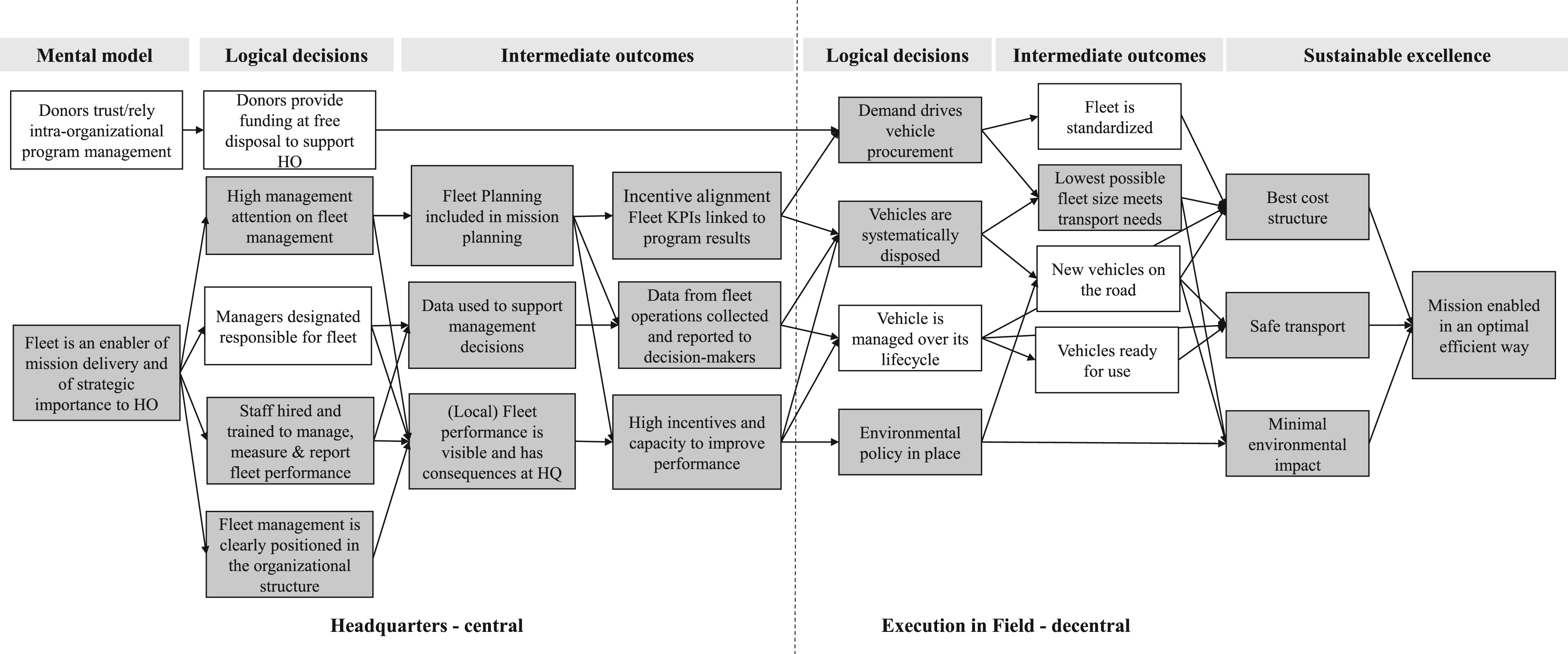
Impact map of MSI’s transformation toward Strategic Fleet Management.
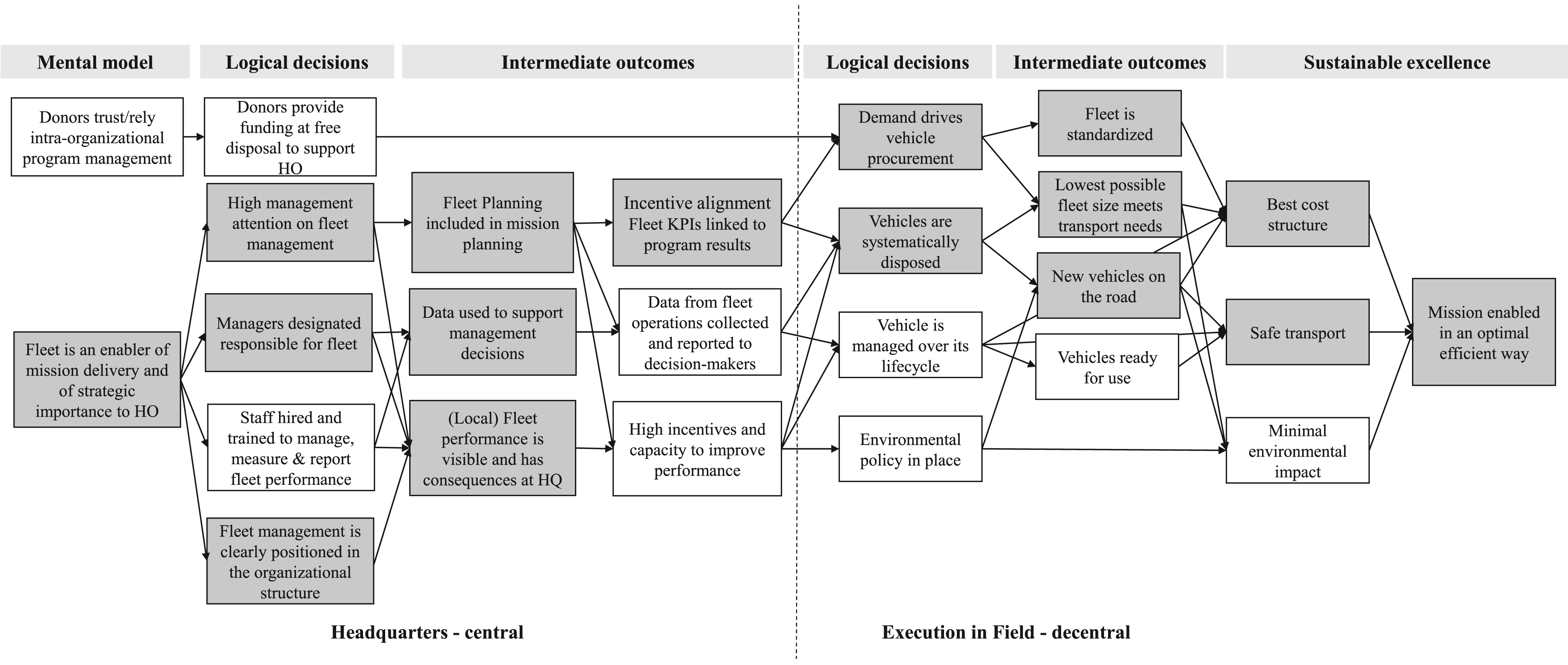
Impact map of United Nations High Commissioner for Refugees’s (UNHCR’s) vehicle leasing initiative following implementation.
A number of learnings can be generalized from the specific case of humanitarian fleet operations and management. The problem structuring method should be selected to create a decision-making context in which the technical contribution of the hard OR (typically optimization models) can take root, and thrive. In order to achieve this prerequisite to implementation, we highlight its most important characteristics. Its documents are simple enough for stakeholders to apply and interpret, without special technical knowledge (see Rosenhead, 1978a; Smith and Shaw, 2019). It must create a shared understanding of both the problem to be solved, and the decisions that are involved, to prepare the focal organization for solution implementation. Revisiting the unspoken assumptions on what matters in each problem set, and what might be feasible to implement, should never be neglected if the project investment is to pay off with performance improvements. At the same time, the “soft”, contextual structuring of the problem extends the evidence base which guides the design of the “hard” solution.
We contend that if we seek impact, there is no alternative to working this way. There is abundant evidence of the limitations of “mathematically sophisticated but contextually naïve techniques” (Ackoff, 1979: p.94). Our simple problem structuring exercise revealed that a typical humanitarian organization will never sustainably implement technical solutions (like optimal fleet sizing or vehicle retirement policies), however rigorous they might be, without supporting governance and information management structures.
While its controversy and self-assessment have been a largely internal academic debate, OR’s crisis of relevance has potentially wider implications for society. The urgency of the operational problems which require scientific guidance is increasing. If the humanitarian sector exhibits proliferating stakeholders, misaligned incentives, high levels of uncertainty, short decision horizons, and scarce resources, it arguably represents many of the global challenges of our time. These include climate change, circular economy, and pandemic response. There can be no doubt that each of these problems is both political and technical in nature. Like humanitarian operations, they will require a comprehensive structuring phase, in which key stakeholders articulate and visualize decision-making pathways. For example, the coronavirus disease 2019 (COVID-19) pandemic showed that high investments made into national emergency stockpiles (the optimal quantity is an OR solution) did not ensure preparedness, because little attention was paid to processes that maintained and approved requests for that stock (Australian National Audit Office, 2014; Kamerow, 2020; Laing and Westervelt, 2020; Sodhi and Tang, 2021; Thakur-Weigold et al.,2022).
Our conclusion is optimistic because it sees a way out of the Kuhnian crisis. The empirical evidence indicates that a complementary application of soft and hard methods can create relevant and impactful OR. This presents our scholarly community with an opportunity to add value to organizations, both humanitarian and commercial, public and private. We will need to develop new skills to apply the methods of intervention-based research (see Chandrasekaran et al., 2020), and, by this, we do not mean the rhetorical sophistry that is generally dismissed as “consulting”. Extending the scope of quantitative OR studies to include the decision-making context will require expertise in producing the kind of mid-range, context-dependent theory that is standard in engineering and medical sciences (Chandrasekaran et al., 2020; Van Aken, 2004, 2007). This is how we prepare the organization to implement technical OR solutions, and make them productive, because Operations Management is scientific, but it is so much more (Martin and Golsby-Smith, 2017).
Our vision of engaged scholarship has additional benefits. With this new paradigm, OR does not diminish in rigor but gains in strategic significance. This secondary outcome is far from trivial and part of a larger trend in the business management literature. Scholars of operational functions ranging from manufacturing, logistics, and procurement to IT (Fuller et al., 1993; Hayes and Pisano, 1996; Kraljic, 1983; Porter and Millar, 1985; Skinner, 1969), have all recognized that the potential of these traditionally technical functions is higher than previously understood. Like humanitarian fleets, they are no longer a necessary evil to be operated by low-level staff, a cost to be minimized, and complexity to be shielded from executive attention. When operations are designed to enable the organization’s mission, they can play a driving role in elevating its overall performance. This would be a win for both scholarship and society.
Footnotes
Appendix. Two Empirical Illustrations
The following reports and impact maps are based on our experience, although they are not the output of specific exercises with its executives. The two cases are selected from the public domain to showcase the prescriptive potential of soft OR in action, without disclosing confidential project data. Each illustration applies the same problem structuring method (impact mapping) from the principle discussion to show how leadership prepared the structures of its organization to effectively “receive” technical solutions, including hard OR, to improve performance. We emphasize that neither organization applied a formal, two-step process which begins working with soft OR, after which, they identify the hard OR questions to be answered. In each case, the mental model of leaders motivated them to put enabling structures in place, which supported decision-making in both headquarters and field necessary for successful implementation. The links to the business literature in change management become apparent, although we emphasize that the work of problem structuring (soft OR), must be completed prior to solution search and implementation. Following a careful problem definition, change management initiatives support the implementation of solutions (see Kotter, 1995).
Acknowledgments
The authors thank Paul Jansen and Rose Van Steijn of Fleet Forum for the years of fruitful collaboration, and their leadership in the sector.
Declaration of Conflicting Interests
The authors declared no potential conflicts of interest with respect to the research, authorship, and/or publication of this article.
Funding
The authors received no financial support for the research, authorship and/or publication of this article.

How to cite this article
Schaumann SK, Thakur-Weigold B, Van Wassenhove LN (2024) Reconciling Rigor Versus Relevance: Lessons from Humanitarian Fleet Management. Production and Operations Management 33(6): 1306–1319.