




Abstract
The literature in sustainability has emphasized external pressures as a main driver of firms’ environmental responsibility. However, under similar external pressures, some firms search for environmental technology, while others do not. By focusing on information and communication technology (ICT) firms, we try to answer the question of when firms are motivated to search for renewable energy technology. Drawing on the framework of the behavioral theory of the firm, we propose that a mismatch between ICT firms’ CO2 emissions performance and their aspiration to a certain level of emissions induce firms to evaluate their environmental performance status—whether they are aligned well with environmental requirements and their peer firms—and their technology status—whether they possess sufficient technologies to reduce emissions—which in turn affects their search for renewable energy technology. We corroborate our hypotheses using data on CO2 emissions and renewable energy patents of U.S. ICT firms from 2010 to 2018. When we compare two groups of firms—one group whose emissions performance is poor and the other group whose emissions performance is good compared to their own past emissions—we find that the former is more likely to search for renewable energy technology compared to the latter. When we focus on each of the two groups, we find that firms decrease their search for renewable energy technology as the degree of poor emissions performance exacerbates (firms’ emissions increase above aspiration) or the degree of good emissions performance increases (firms’ emissions decrease below aspiration). Our findings have implications for public policy as well as firms’ environmentally sustainable operations.
Introduction
Environmental responsibility is a business practice that delivers value to firms by mitigating their eco-harmful impacts (Flammer, 2013; Wang et al., 2016). As climate change has become a critical global challenge, 1 increasing numbers of external actors are pushing firms to reduce eco-harmful byproducts in their operation management. For example, shareholders respond negatively to a firm that pollutes the environment, through an oil spill or the discharge of hazardous waste (Klassen and McLaughlin, 1996; Lo et al., 2018). Accordingly, in explaining firms’ engagement in environmental responsibility, the extant literature has focused on firm-external factors, such as pressure from governments, non-governmental organizations (NGOs), investors, supply chain partners, media, and customers (Berrone et al., 2013; Krass et al., 2013; Jira and Toffel, 2013; Kassinis and Vafeas, 2006).
Although there has been much focus on how extrinsic pressures shape firms’ choices to implement environmental responsibility, little is known about the effect of intrinsic factors. Under similar pressures to mitigate eco-harmful impacts, firms show heterogeneous environmental responsibility behaviors (Crilly et al., 2012; Hardcopf et al., 2019; Hart, 1995; Lee and Klassen, 2016). In particular, some firms engage in a behavior that requires substantial time and resources, such as exploring environmental technologies (Berrone et al., 2013; Krass et al., 2013; Shrivastava, 1995), while other firms show minimum levels of effort to meet legal requirements (Buysse and Verbeke, 2003). The question of when firms are internally motivated to implement proactive environmental responsibility behavior, such as exploring environmental technology, is still understudied. Understanding a firm-level source of heterogeneity in environmental responsibility is critical for effective, sustainable operation management and environmental policy design (Hardcopf et al., 2019).
A particularly intriguing phenomenon is the exploration of firms in non-energy-intensive sectors for renewable energy technology. Given the global-wide emphasis to shift from using fossil fuels to renewable energy, 2 all sectors, including non-energy-intensive ones, are expected to seek renewable energy technology. For energy-intensive sectors, a substantial amount of energy usage and a high eco-harmful impact have necessitated these sectors to consider technologies that help prevent or mitigate emissions. Yet, compared to energy-intensive sectors, developing renewable energy technologies has not been the norm for non-energy-intensive sectors, at least not until the relatively recent emphasis on the global climate crisis. 3 By examining when firms in non-energy-intensive sectors are motivated to search for renewable energy technology, we can understand firms’ intrinsic motivations to engage in environmental responsibility. As an ideal example of a non-energy-intensive sector, we focus on information and communication technology (ICT) firms in examining the motivation to search for renewable energy technology. ICT firms have two contrasting impacts on the environment. On the one hand, ICT allows the entire economy to manage and save energy, thereby reducing global emissions efficiently. 4 On the other hand, in recent years, ICT firms’ data centers and communication networks supporting that technology have grown ICT firms’ emissions exponentially (Belkhir and Elmeligi, 2018). Accordingly, environmentally responsible ICT firms have begun proactively implementing renewable energy technology in their operations, which can help firms cut CO2 emissions. Furthermore, ICT firms give rise to the application and development of renewable energy technologies. For example, in 2013, Microsoft began constructing data center facilities that use marine renewable energy to the point of being energy self-sufficient. Their underwater data center was successfully deployed and began operating under the ocean in June 2018. 5 Since renewable energy technology can help tackle the global challenges of CO2 emissions, understanding when ICT firms are motivated to search for such technology is an important step in addressing critical global environmental issues.
To examine ICT firms’ motivation to search for renewable energy technology, we use the framework of the behavioral theory of the firm (BTOF). BTOF argues that firms’ motivation for innovative and exploratory behaviors comes from a mismatch between their performance and aspiration level (Cyert and March, 1963; Eggers and Kaul, 2018; Gaba and Bhattacharya, 2012; Kim et al., 2015; Tyler and Caner, 2016). Whether a firm’s current performance is above or below its aspiration level and how far its actual performance diverges from the aspiration affect the firm’s tendency to pursue exploratory behaviors, such as increasing R&D expenditures (Greve, 2003), adopting new ways to conduct R&D (Gaba and Bhattacharya, 2012), and pursuing radical inventions (Eggers and Kaul, 2018). While it is difficult to observe each firm’s aspiration toward environmental responsibility such as annual CO2 emissions reduction, the convention of BTOF offers a way to proxy that aspiration. Using the proxy, we expect to show that ICT firms’ motivation to search for renewable energy technology comes from the mismatch between their aspiration and actual CO2 emissions.
Our main argument is that the mismatch between ICT firms’ CO2 emissions and aspiration induces firms to internally evaluate their environmental performance status—whether they are well aligned with environmental requirements as well as their peer firms—and their technology status—whether they possess sufficient leading-edge technologies for addressing the emissions problem. We first compare two groups of firms—firms with poor emissions performance (i.e., firms that emit CO2 above aspiration) and those with good emissions performance (i.e., firms that emit CO2 below aspiration)—and propose that ICT firms that show poor emissions performance may understand that they do not align well with environmental requirements and their peer firms, and they may lack technology to reduce emissions. Thus, compared to those with good emissions performance, ICT firms with poor emissions performance are more motivated to search for renewable energy technology. Next, we focus on each group of poor or good emissions performance firms. For firms with poor emissions performance, we expect firms to decrease their search for renewable energy technology as the degree of poor emissions performance increases (i.e., emissions further increase above aspiration), because they may narrow their interest only to avoiding severe punishment for poor emissions performance. This, in turn, induces firms to decrease search behavior that needs long-term investment to bear fruit. For firms with good emissions performance, we contend that, as the degree of good emissions performance increases (i.e., emissions decrease further below aspiration), firms become more satisfied with their emissions levels and thus have less incentive to engage in search behavior that requires substantial time and resources, which in turn leads to a decrease in searching for renewable energy technology. We corroborate our hypotheses using patent data on renewable energy technology and CO2 emissions data of U.S. ICT firms from 2010 to 2018.
This study contributes to the literature in three ways. First, by adding a behavioral perspective in explaining firms’ environmental technology search behavior, we complement sustainable operation management literature. As Atasu et al. (2020: 152) noted, “[…] sustainable operations research could benefit from a deeper understanding of […] managerial behavior to better identify operational mechanisms that improve social and environmental responsibility.” Accordingly, recent sustainable operation management literature has introduced behavioral factors of firms, such as the attention of the firm (Dhanorkar et al., 2018), learning of the organization (Mani and Muthulingam, 2019), and using precise numbers in estimation (Bansal and Muthulingam, 2022). By attempting to add behavioral factors to sustainable operational management literature, we extend our focus to the environmental responsibility literature as well. There has been much theoretical attention to firm-external factors to explain firms’ environmental responsibility (e.g., Jira and Toffel, 2013), but few studies have examined firm-internal factors (Bansal and Roth, 2000; Berrone et al., 2013; Crilly et al., 2012; Lee and Klassen, 2016). Our paper contributes to these two streams of research by showing that firms’ searching behaviors for environmental technology are driven by the gap between firm performance and firm aspiration levels of CO2 emissions.
Second, our findings contribute to studies on non-energy-intensive sectors, where energy consumption and carbon emissions have increased in recent years (Seck et al., 2016), but “little is known about the adoption of energy technologies and management practices” (of non-energy-intensive sectors) (Ramirez et al., 2005: 766). In particular, though evidence shows that ICT firms are key actors in developing technologies that mitigate eco-harmful impact (Cecere et al., 2014), there is a lack of studies regarding these firms’ motivations for exploring environmental technologies. By examining ICT firms’ search for renewable energy technology, our study may help to shed light on when non-energy-intensive sectors such as ICT firms explore environmental technology.
Third, we add to the BTOF literature by applying the framework to examine environmental performance, such as ICT firms’ CO2 emissions, that is not directly related to their financial or market performance. The BTOF literature has in general focused on firms’ aspirations regarding the performance of their main businesses, such as sales performance (Baum et al., 2005; Greve, 2003), innovation performance (Gaba and Bhattacharya, 2012), and the number of new products introduced (Tyler and Caner, 2016). Considering the increasing awareness of climate change among various stakeholders that induces firms to strategically consider their environmental responsibility, we suggest that CO2 emissions, as non-market performance, can also induce ICT firms to be motivated to pursue technological exploration.
Theory and Hypotheses
Environmental Responsibility and the Search for Environmental Technology
As greenhouse gas emissions are increasingly recognized as a major cause of climate change, public concerns about environmental sustainability have grown. By engaging in environmental responsibility, therefore, firms can demonstrate their consideration of critical global challenges to their businesses, appealing to external actors who require firms to be eco-friendly (Buysse and Verbeke, 2003; Hart, 1995). In addition, environmentally irresponsible firms often lose their reputation and receive negative market reactions. For example, Lo et al. (2018) provides empirical evidence that the stock market negatively reacts to publicly listed Chinese manufacturers when they pollute the environment. Therefore, through environmental responsibility, firms can enhance their image and reputation (Lee and Tang, 2018; Philippe and Durand, 2011; Lee et al., 2023) and somewhat protect themselves from penalties that would be imposed by regulators or shareholders on firms involved in eco-harmful accidents in the future (Flammer, 2013; Klassen and McLaughlin, 1996).
Furthermore, firms can generate new and competitive resources through environmental responsibility (e.g., Flammer, 2013). For example, efforts to mitigate eco-harmful byproducts allow firms to generate unique resources (Hart, 1995) that give them an opportunity to develop eco-friendly products, manufacturing processes, and novel technologies (Berrone et al., 2013; Yang et al., 2019) and thus to improve their long-term profitability (Bansal and Roth, 2000; Shrivastava, 1995).
Among various environmental responsibilities, we focus on a firm’s search for environmental technology, which pertains to the firm’s investment in novel environmental technology. Drawing on the literature of technology search (Lee et al., 2023; Rosenkopf and Nerkar, 2001), we define the search for environmental technology as the effort to find a leading-edge environmental technology that can become an input for the firm’s subsequent technology development. As environmental technology has been characterized as novel (Marzucchi and Montresor, 2017), uncertain (Cainelli et al., 2015), complex, and radical (Barbieri et al., 2020), in general, firms are reluctant to adopt environmental technology (Klassen, 2000; Shrivastava, 1995). Instead, firms can take a relatively easy way that can mitigate their eco-harmful byproducts in a short term, such as purchasing off-the-shelf products or services that can easily be installed.
Meanwhile, developing environmental technology usually requires firms to explore domains in which they have less expertise, thus committing a considerable amount of resources (Berrone et al., 2013; Hart, 1995). However, this commitment pays off by allowing firms to attain further technological opportunities to succeed in the long term (Ram et al., 2009) and a desirable public image as seeking to advance technology in order to address climate change (Shrivastava, 1995). Moreover, as firms are accustomed to exploiting existing technology rather than exploring new one (Ahuja and Lampert, 2001), exploring a technology in which firms have less expertise allows them to expand their technology boundary and increase the potential to develop novel innovations (Rosenkopf and Nerkar, 2001). Specifically, by searching for environmental technology, firms can access new domains of technology and increase new inventive opportunities in the new domains (De Marchi, 2012; Ghisetti et al., 2015). Thus, although exploratory, firms may search for cutting-edge environmental technologies not only to reduce their eco-harmful byproducts but also to advance innovations in novel domains.
While ICT firms have been regarded as a non-energy-intensive sector (European Commission, 2008; Jones, 2018), because of the increasing energy demand of the ICT sector and the associated rising concern about its energy source in recent years, both governmental and non-governmental organizations have started to consider how firms in this sector address climate change (Carbon Disclosure Project, 2014) and how much renewable energy they use in comparison to peer firms (Miller et al., 2015). Greenpeace, the largest global environmental organization, has analyzed global ICT firms’ renewable energy usage and evaluated the energy performance of these ICT firms. Their report emphasized the importance of renewable energy usage to avoid catastrophic climate change: “it is critical that large energy-consuming corporations step forward to help shift energy policy and increase the market demand for renewable energy” (Greenpeace, 2015: 15). Under such circumstances, ICT firms’ efforts to search for renewable energy technology can be interpreted as firms striving to meet global needs in emissions mitigation by advancing technology that can tackle the issue of CO2 emissions.
CO2 emissions: Comparing Performance and Aspiration
To examine ICT firms’ motivation to search for renewable energy technology, which is an exploratory behavior for ICT firms, we adopt the BTOF framework, which explains a firm’s motivation for exploratory behavior by comparing firm performance with a specific reference point (Cyert and March, 1963). Since the comparative reference point that a firm set is difficult to observe, we follow the convention of BTOF that introduces an aspiration level, 6 which serves as a benchmark for performance evaluation and which arises from the comparison with the firm’s own past performance as well as the average performance of peer firms that are comparable to the focal firm (e.g., Greve, 2003). Hence, when performance does not meet a firm’s aspiration, the firm understands that its usual operations are insufficient to reach the aspiration. Then, the firm is motivated to change its current way of doing things and thus to engage in exploratory behavior, expecting that such behavior will improve its performance up to the aspiration (e.g., Posen et al., 2018). On the other hand, when performance far exceeds aspiration, the firm has no more incentive to pursue unusual practices and is thus less likely to show exploratory behavior (Eggers and Kaul, 2018).
Since we focus on a firm behavior aiming to enhance environmental performance, we examine the most relevant firm performance, CO2 emissions, which have been highlighted as a critical environmental performance of the firm. Global environmental agreements such as the Paris Agreement and a number of environmental requirements 7 focus on mitigating toxic emissions such as CO2 that have been regarded as the main factor in global warming. 8 Accordingly, firms have started to track and disclose their annual CO2 emissions on their corporate websites, in corporate sustainability reports, and in reports of environmental organizations such as the Carbon Disclosure Project (CDP). Tracking CO2 emissions allows firms to clearly evaluate whether their environmental efforts contribute to reducing their emissions and helps them to plan their subsequent eco-friendly behaviors.
Statements from several ICT firms’ sustainability reports elaborate on the importance of CO2 emissions to firms in setting their reference point, evaluating their environmental performance, and deciding on their next environmental behaviors. For example, Apple stated in its 2014 Environmental Responsibility Report, 9
A portion of energy comes from burning fossil fuels, which creates carbon emissions. Those emissions make up our carbon footprint — our share of the climate change problem. We’re striving to reduce that footprint. […] Apple accounts for greenhouse gas emissions from electricity using both default emissions and net emissions, so we can see the impact of our investment and recognize our contribution to the connected grid. […] And when our assessments reveal a material, process, or system that’s making a significant negative impact on our carbon footprint, we reexamine how we design that product, process, or facility (pp. 4–5).
Considering the global interest as well as the firm-level emphasis on CO2 emissions, we postulate that ICT firms’ search for renewable energy technology is motivated by the difference between their CO2 emissions performance and aspiration level.
Following prior work in BTOF that compares firms performing above and below aspiration (Baum et al., 2005; Eggers and Kaul, 2018), we first compare two groups of firms—those with poor emissions performance (i.e., emissions above aspiration) and good emissions performance (i.e., emissions below aspiration). Firms with poor emissions performance perceive that they produce more CO2 emissions than the firm’s own past emissions as well as the average emissions of peer firms. Given the negative public reaction to excessive CO2 emissions, firms with poor emissions performance are more likely to be concerned about their environmental performance status that they will be regarded as not adequately responding to environmental requirements from various firm-external actors and not properly aligning with peer firms. These firms will also be concerned about their technology status as they do not have enough leading-edge technologies to decrease their emissions toward aspiration.
Therefore, these firms may understand that they face two problems: potentially failing to align with environmental requirements and peer firms, and lacking the technological capability to reduce emissions. When a problematic situation occurs, firms are usually motivated to explore to solve the problem (Posen et al., 2018). Thus, compared to firms with good emissions performance, firms with poor emissions performance are more likely to be motivated to search for the leading-edge innovation in the hope that such behavior will enable them to align with environmental expectations and to gain technology that can help them reduce emissions toward aspiration. We can thus expect that:
Hypothesis 1. ICT firms with poor emissions performance (i.e., producing more CO2 emissions than their own past emissions as well as average emissions of peer firms) are more likely to search for novel renewable energy technology, compared to ICT firms with good emissions performance (i.e., producing less CO2 emissions than their own past emissions as well as average emissions of peer firms).
Our next two hypotheses examine firms’ search behaviors within each of two groups of firms—poor and good emissions performance firms, respectively. For the firms with poor emissions performance, we expect that the search for renewable energy technology is likely to decline as the degree of poor emissions performance exacerbates (i.e., firms’ emissions increase further above aspiration), because the two previously mentioned concerns on environmental performance status and technology status—that is, falling short in meeting environmental requirements and peer firms as well as having insufficient environmental technology—will be amplified. Increasing deficiencies in adhering to environmental requirements and aligning with peer firms can result in severe sanctions such as government penalties, negative media coverage, and consumer boycotts, which can become a considerable burden on operations. As a threat to business increases, firms, in general, shift their attention from their aspiration to the threat (e.g. Audia and Greve, 2006)—in our context, to the threat that severe punishments would be imposed. This shift to avoiding punishment rather than meeting aspirations may make firms unable to bear a long time horizon of exploratory behavior and lead them to favor behavior that can have immediate results. For example, when adopting renewable energy for business, some firms purchase credit for renewable energy that is not necessarily related to actual emissions reduction but can immediately establish an eco-friendly image to the public. 10
Focusing on avoiding a burden on a firm’s operations also affects the firm’s effort to solve the problem of insufficient technology to reduce emissions. Firms will become more likely to seek a way that is less burdensome and can be quickly adopted and applied in their emissions reduction, such as installing pollution control devices in facilities, which in turn leads to a decrease in the search for cutting-edge innovations. Taken together, for poor emissions performance firms, we expect that these firms’ motivation to search for renewable energy technology may decline as the degree of poor emissions performance increases.
Hypothesis 2. For firms with poor emissions performance (i.e., producing more CO2 emissions than their own past emissions as well as average emissions of peer firms), as the degree of firms’ poor emissions performance increases, firms’ search for novel renewable energy technology decreases.
For the firms with good emissions performance, we expect that the search for renewable energy technology will decline as the degree of good emissions performance increases (i.e., firms’ emissions decrease further below aspiration). Firms with good emissions performance believe that they produce less CO2 emissions than the firm’s own past emissions as well as the average emissions of peer firms. These firms may understand that they have sufficient technological capability to improve their own emissions performance, becoming satisfied with their technology status. The larger the degree of good emissions performance, the greater the challenge for firms to maintain their good emissions performance, because the much-improved performance will not be easy to repeat in the future (Kim et al., 2015). In this case, firms will become reluctant to engage in exploratory behavior, which might enable further emissions reduction and accordingly adjust their aspiration on emissions much lower. As firms consider the difficulty of maintaining their improved performance, they may reduce their effort to search for leading-edge renewable energy innovations.
Furthermore, as the degree of good emissions performance increases, firms may perceive that they have a favorable environmental performance status and, thus, have a competitive advantage in emissions performance. These firms may want to maintain their favorable competitive positioning by continuing to search for advanced renewable energy technologies. While doing so, these well-performing firms may pay attention, at least partially, to leverage their competitive positioning by monetizing their environmental innovations through the development of products or services that they can sell in the market. Hence, this shift in attention may result in a marginal reduction in firms’ search for new cutting-edge technologies. Taken together, among good emissions performance firms, we expect that firms’ motivation to search for renewable energy technology may decline as the degree of good emissions performance increases.
Hypothesis 3. For firms with good emissions performance (i.e., producing less CO2 emissions than their own past emissions as well as average emissions of peer firms), as the degree of firms’ good emissions performance increases, firms’ search for novel renewable energy technology decreases.
Figure 1 summarizes our discussion so far regarding the predicted relationship between a firm’s CO2 emissions relative to aspirations and the likelihood of the firm searching for renewable energy technology.
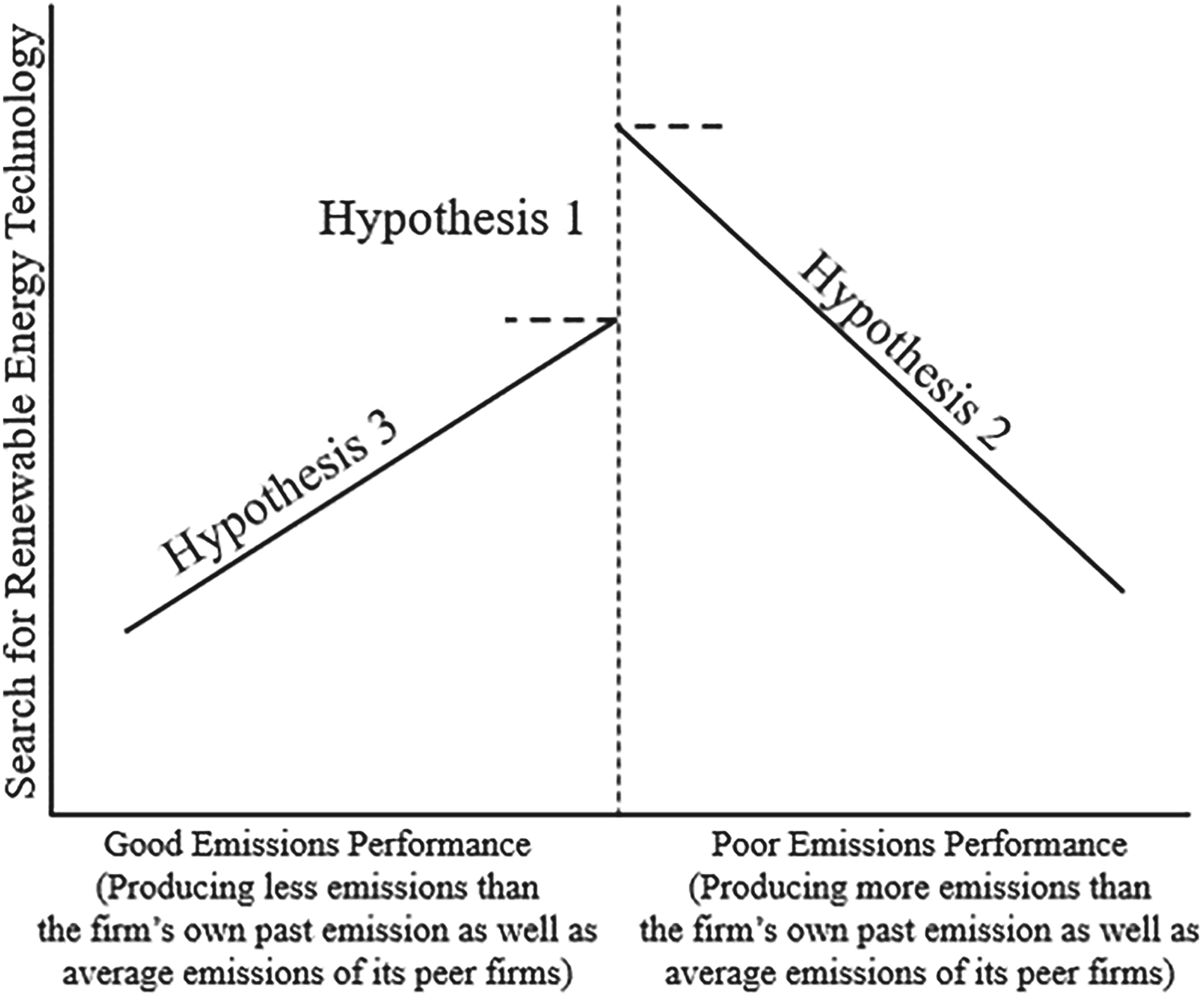
Summary of theoretical model.
We choose the U.S. ICT sector as our research setting because ICT firms in general belong to a non-energy-intensive sector (European Commission, 2008; Jones, 2018), where the main business and expertise do not lie within the field of renewable energy technology. 11 On the contrary, firms in an energy-intensive sector would almost always be motivated to search for renewable energy technologies in their regular course of business because of their significant impact on the environment. In such a case, it is not easy to disentangle the firms’ motivation from their universal interests in renewable energy technology. Thus, to test the firms’ motivation to engage in environmental responsibility behaviors, we exploit CO2 emissions in a non-energy-intensive sector, in particular, ICT firms, and these firms’ search behaviors for renewable energy technology that are heterogeneous across these firms. Therefore, the context of ICT firms allows us to precisely analyze our hypothesized effects.
Though ICT firms, in general, are regarded as non-energy-intensive firms and their energy consumption has not shown exponential growth in recent years (Jones, 2018), these firms have increasingly imposed a burden on global emissions, and their emissions have roughly doubled between 2007 and 2020 (Belkhir and Elmeligi, 2018). Accordingly, many ICT firms have acknowledged their significant impact on the environment and have increased their emissions reduction activities such as green product design, energy efficiency in process improvement, and renewable energy installation (Carbon Disclosure Project, 2014). Since a data center accounts for the largest portion of ICT firms’ emissions (Belkhir and Elmeligi, 2018) and ICT firms expand their data capacity continuously, these firms’ environmental responsibility has recently received heightened public attention and has been assessed in comparison to peer firms (Greenpeace, 2015; Miller et al., 2015). Thus, a number of ICT firms aspire to adopt renewable energy to run their operations with less CO2. For example, Amazon, Apple, Facebook, Google, and Microsoft have established goals to use renewable energy for 100% of their total electricity usage (Miller et al., 2015).
Sample and Data Sources
Data were retrieved from multiple sources. First, we obtained a list of U.S. ICT firms from Fortune 1000 and CDP. By using an “Industries” filter provided by Fortune at the point of data collection, we extracted a list of firms included in “Technology” or “Telecommunications” industries and appeared at least once in Fortune 1000 from 2016 to 2018. We also collected ICT firms that are listed in CDP. By using the “GICS sector” filter in CDP data, we extracted firms included in the “Information Technology” or “Telecommunication Services” sector. Here, we identified 207 U.S. ICT firms in total. From Compustat, we identified and added a number of firms that have the same two-digit SIC code as those 207 firms (i.e., two-digit SIC codes of 35, 36, 38, 48, and 73). This procedure results in 3,131 firms. Among them, we excluded firms that have missing values in firms’ financial information that are required for computing our control variables. Finally, we obtained a sample of 1,687 firms.
Given that many global agreements and climate change conferences focus on CO2 emissions reduction (e.g., Kyoto Protocol in 1997, Paris Agreement in 2015, and United Nations Framework Convention on Climate Change or UNFCCC), we use firms’ annual CO2 emissions to represent their environmental performance. Accordingly, we obtained our sample firms’ annual CO2 emissions, measured by the unit of CO2 metric tons from 2010 to 2018, by manual collection from firms’ corporate websites, annual sustainability reports, 12 and proprietary data such as responses to CDP questionnaires. 13 If a firm reported its annual emissions in multiple sources, we cross-checked whether the firm’s CO2 emissions were identical among these various sources. If the reported emissions were different, we averaged them. Since many firms in our initial sample of 1,687 firms did not report their CO2 emissions during our sample period or report the emissions only one time, our sample construction process ended up with 74 U.S. ICT firms from 2010 to 2018. 14 Figure 2 displays the annual CO2 emissions of the top five high-emitting firms in our sample: AT&T, IBM, Intel, Alphabet, and Texas Instruments.
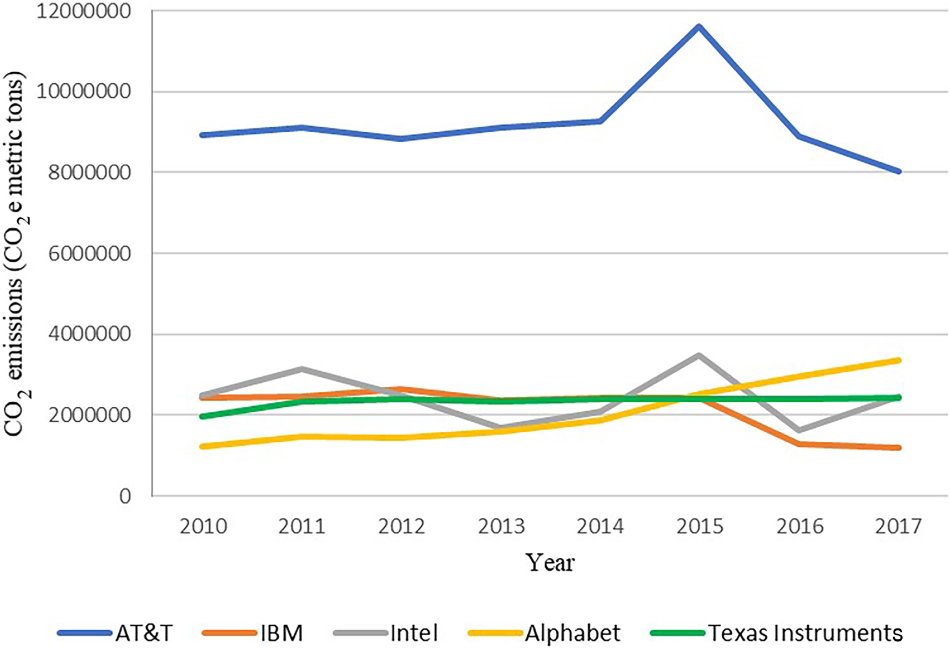
Annual CO2 emissions of top five emitters.
We use patents to measure a firm’s investment in cutting-edge innovation. Patents are widely employed in the technology management literature to examine a firm’s search behavior (Jung and Lee, 2016; Rosenkopf and Nerkar, 2001). We obtained firms’ patent data from the DISCERN database (Arora et al., 2021), which matches a firm and a patent considering the historical changes in a firm’s name, structure, and ownership. 15 This allowed us to precisely match the patent information to each firm. Using the classifications in Hascic and Migotto (2015), we identify a renewable energy patent as one that belongs to the Y02E class based on a Cooperative Patent Classification (CPC) scheme. 16 We collected 236,148 granted patents that our sample firms filed from 2010 to 2018, and 1,653,913 instances of prior art that those granted patents cited from 2010 to 2018. Among them, 1,514 patents (0.64%) belong to the Y02E class, and 10,604 citations (0.64%) are made to the prior art in the Y02E class. ICT firms in our sample mainly have patents belonging to physics (64%, class G in the CPC scheme) and electricity (57%, class H in the CPC scheme). 17 The very small portion of renewable energy patents shows that ICT firms, by searching for renewable energy technology, explore technological domains where ICT firms have less expertise.
Dependent Variable
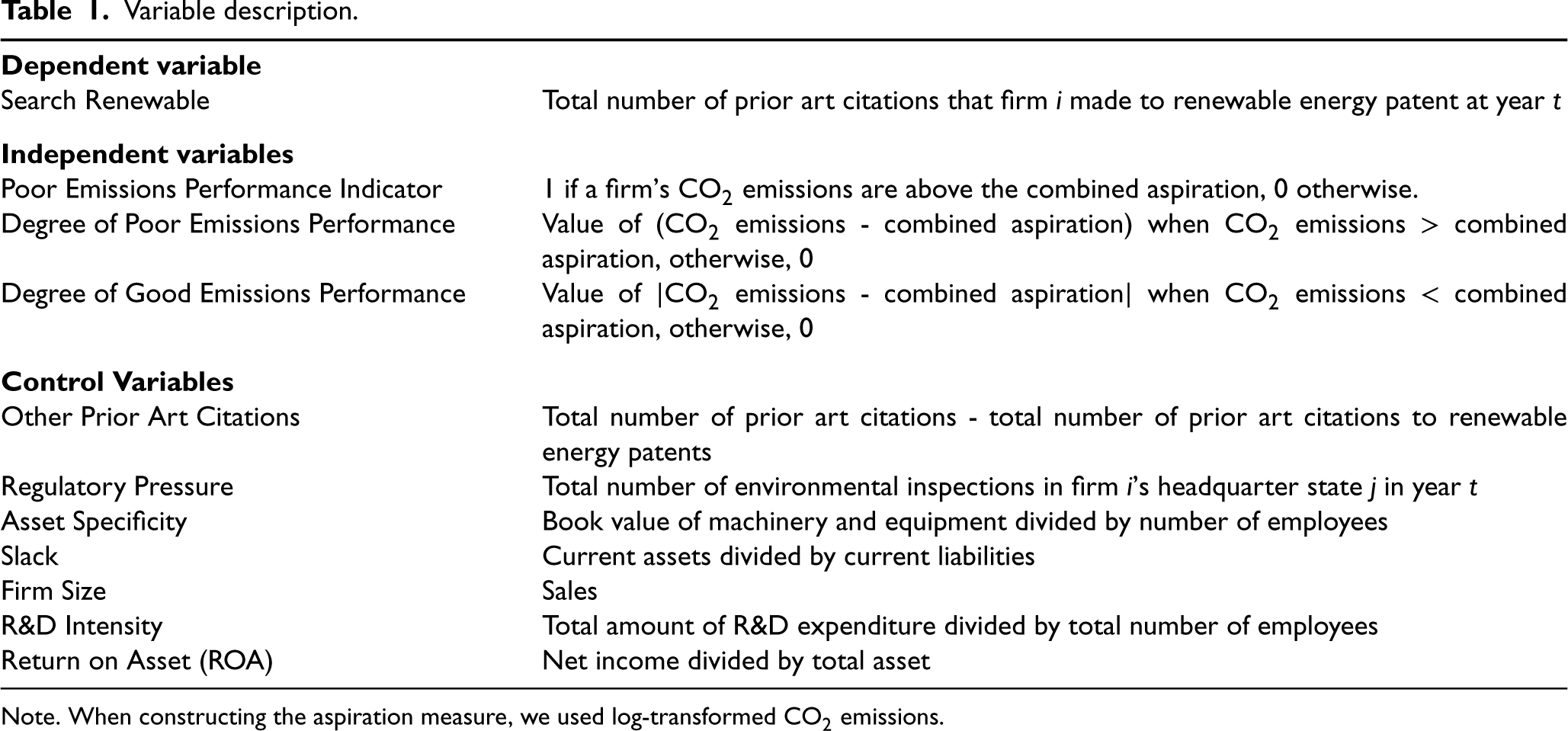
Our dependent variable is a firm’s search for renewable energy technology. Following prior work studying the firm’s technology search (Katila and Ahuja, 2002; Rosenkopf and Nerkar, 2001), we constructed Search Renewable as the total number of citations to prior art that firm
Independent Variables
To construct our main independent variables, we first created a variable for aspiration. A firm’s aspiration can arise from historical records of its own performance (i.e., historical aspiration) and from the average performance of peer firms (i.e., social aspiration) (Cyert and March, 1963). Following the convention of BTOF, we construct our aspiration measure combining both historical and social aspiration (e.g., Baum et al., 2005; Greve, 2003). To construct a firm’s historical aspiration, we use the following formula (e.g. Eggers and Kaul, 2018):

To construct a firm’s social aspiration, we employ the most advanced method adopted by recent BTOF literature (Kuusela et al., 2017). This advanced method utilizes a matching approach to define peer firms that are most relevant to the focal firm in terms of revenue and total assets within each industry-year group (based on two-digit SIC codes). As a first step of this advanced method, we calculate the Mahalanobis distance between the focal firm and other firms within the same industry-year in terms of revenue and total assets. We then identify the
Then, in following the convention of BTOF (e.g. Greve, 2003), we construct the combined aspiration level as a combination of historical and social aspirations with a different weighted scheme, represented by the following equation:

Then, to test Hypothesis 1, which compares poor and good emissions performance firms, we construct a dummy variable of Poor Emissions Performance Indicator, which takes the value of 1 when a firm’s CO2 emissions are above the combined aspiration level and 0 otherwise. To test Hypotheses 2 and 3 that examine each of poor and good emissions performance firms, we take a spline-based approach following BTOF convention (e.g. Eggers and Kaul, 2018). The spline-based approach uses separate variables for firms with poor and good emissions performance, thereby analyzing behaviors of two groups of firms, respectively (Greve, 2003). Degree of Poor Emissions Performance is set to 0 when firms’ CO2 emissions are below combined aspiration and is equal to CO2 emissions minus combined aspiration when emissions are above combined aspiration. Similarly, Degree of Good Emissions Performance is set to 0 when firms’ CO2 emissions are above combined aspiration and is equal to the absolute value of CO2 emissions minus combined aspiration when emissions are below combined aspiration.
Control Variables
To control for a firm’s overall likelihood for technology search, we use Other Prior Art Citations as the total number of prior art citations of firm i’s patents made in year t, excluding the number of prior art citations to renewable energy patents. To capture external pressures on firms to decrease emissions, we rely on information from the Environmental Council of the States, providing the number of yearly environmental inspections by state, which is used by prior research as an appropriate source for regulatory pressures (Berrone et al., 2013; Kassinis and Vafeas, 2006). We construct Regulatory Pressure as the total number of environmental inspections in a sample firm’s headquarter state j in year t.
We include two resource-related control variables that may have an influence on pursuing exploratory behaviors. The first is the specificity of assets—a firm’s resources that cannot be easily transformed or transferred from existing use and users—which enables firms to bear greater uncertainty in their businesses and engage in patenting activities (Ziedonis, 2004). To control for the effect of specific assets on firms’ tendency in exploratory behavior, we include Asset Specificity as the ratio of the book value of a firm’s machinery and equipment to the number of employees (Berrone et al., 2013). The second resource-related control variable is slack resources, which enable firms to pursue exploratory behaviors (Baum et al., 2005; Greve, 2003; Tyler and Caner, 2016). In the context of environmental responsibility, slack resources may allow firms to explore uncertain environmental ideas (Berrone et al., 2013). To control for the effect of slack-driven technology search, we calculate Slack as current assets divided by current liabilities (Tyler and Caner, 2016).
We control for several firm-level variables that can affect the firm’s propensity for technology exploration, including Firm Size, measured as firm sales (Dang et al., 2018); R&D Intensity, measured as the ratio of total amount of R&D expenditures and total number of employees; and annual return on assets (ROA), measured as net income divided by total assets.
It is unlikely that the gap between CO2 emissions and aspiration immediately motivates firms to search for renewable energy technology in the same year. For this reason, we lagged one year for independent and control variables. We include firm- and year-fixed effects to control for unobserved firm heterogeneity and temporal effects. Robust standard errors are clustered at the firm level. Table 1 summarizes how we constructed our main variables, and Table 2 displays descriptive statistics and a correlation matrix. Correlations among independent and control variables, which are deployed in the same regression model, range from low to moderate.
Variable description.
Variable description.
Note. When constructing the aspiration measure, we used log-transformed CO2 emissions.
Descriptive statistics.
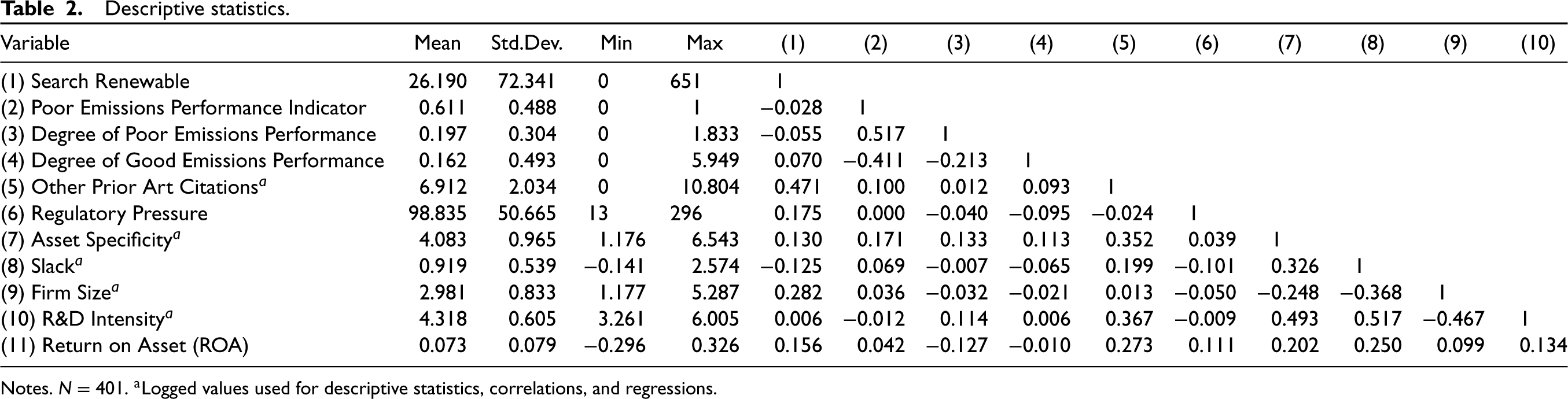
Notes.
Heckman Two-Stage Approach
Because our independent variables require information on CO2 emissions, our final sample consists of those firms reporting annual CO2 emissions. Firms’ tendency to report CO2 emissions is unlikely to be completely random, and such firms can systematically differ from firms not reporting emissions in efforts to search for renewable energy technology. For example, firms reporting CO2 emissions may hold more technologies in tracking their emissions or may have a corporate culture that prioritizes the adoption of renewable energy technology, prefers proactive environmental responsibility behavior, or takes the need to reduce emissions more seriously. Thus, our final sample may include firms that show stronger tendencies in searching for renewable energy technology, and our analysis may be driven by those systematic differences, not by our variables of interest. To address this empirical concern of selection bias, we followed the Heckman two-stage procedure (Heckman, 1979).
In the Heckman first stage, using 1,687 ICT firms (4,646 firm-year observations), we predicted the likelihood of appearing in the final sample (74 firms). Considering the potential factors affecting a firm’s propensity to report CO2 emissions, we included most of the control variables (i.e., Regulatory Pressure, Asset Specificity, Slack, Firm Size, R&D Intensity, and ROA). We add an exclusion restriction variable of the number of emissions-reporting firms headquartered in the same location as the focal firm (Number of Firms Reporting Emissions). When other firms increase their reporting of emissions, the practice becomes a well-established norm, to which a focal firm is highly likely to conform (e.g., DiMaggio and Powell, 1983). Thus, the number of emissions-reporting firms headquartered in the same location as the focal firm would increase the focal firm’s tendency to report emissions and thus would be relevant to our main independent variables. Also, other firms’ emissions-reporting tendencies may not directly affect the focal firm’s technology search. Therefore, our exclusion restriction variable meets two conditions: it should be relevant to the main independent variables and not directly affect the main dependent variable. The results of the first stage are reported in Appendix Table A2 in the E-Companion (Supplemental Material). 23 We then calculated an Inverse Mills Ratio using the predicted values from the first stage in order to use it as a control in the Heckman second stage. Because our main dependent variable (Search Renewable) is composed of count data and its variance is larger than its mean, we used negative binomial regression for the second stage.
Control Function Approach
Unaccounted factors and unobserved firm attributes could influence both our dependent and independent variables, leading to simultaneity. For instance, firms’ already developed renewable energy technologies or even underdeveloped technologies can impact firms’ search tendency and help firms reduce emissions. We try to address simultaneity concerns by adopting the control function approach, which is one of the instrumental variable methods that estimate the model of the endogenous variables as a function of instruments (Wooldridge, 2015). As the control function approach can be applied to nonlinear models (Wooldridge, 2015), it has been adopted by a wide range of scholars in fields including operations management (Chakravarty et al., 2022; Chan et al., 2021; Musalem et al., 2021), marketing (Petrin and Train, 2010), as well as strategic management (Choi and McNamara, 2018). As our empirical model is nonlinear (i.e., negative binomial), we also adopt the control function approach.
The control function approach proceeds in two stages. In the first stage, the endogenous variable is located in the dependent variable, and instrumental variables (i.e., excluded instruments), as well as control variables of the main empiric model (i.e., included instruments), are included as explanatory variables. In the second stage, the residual obtained from the first stage is included as an additional control variable, which serves to address the potential endogeneity concern (e.g., Chan et al., 2021).
We carefully chose four instrumental variables that satisfied relevance and exogeneity conditions—(a) the average number of deaths indirectly caused by the weather events occurring in a headquarter state; (b) the severity of controversies related to marketing or advertising, (c) the severity of customer-related issues; and (d) emissions grouping (quartiles of firms’ CO2 emissions)—performed the first-stage estimations of the control function approach, and obtained residuals which serve as additional control variables in the second stage of the control function approach. Appendix 3 in the E-Companion (Supplemental Material) contains a detailed description of the control function approach, a description of instrumental variables, and relevant test results (i.e., instrumental relevance and exogeneity conditions test, first-stage results of the control function approach). 24
Results
The results of fixed-effects negative binomial analysis after addressing issues of selection bias and simultaneity are displayed in Table 3. For our variables of interest, we report incidence-rate ratios in brackets above non-exponentiated regression coefficients. Model 1, the baseline estimation including only control variables, shows that firms with larger sizes and larger numbers of other prior art citations are more likely to search for renewable energy technology. Hypothesis 1 predicts that ICT firms with poor emissions performance are more likely to search for renewable energy technology compared to firms with good emissions performance. In both Models 2 and 3, coefficients of Poor Emissions Performance Indicator are negative and insignificant, not supporting Hypothesis 1. To understand what drives this result, we conduct and report a post-hoc analysis in the post-hoc analysis section by examining our model with new independent variables, which are calculated based on historical aspiration only and social aspiration only, respectively.
Main result: The impact of CO2 emissions versus aspirations on search for renewable energy technology.
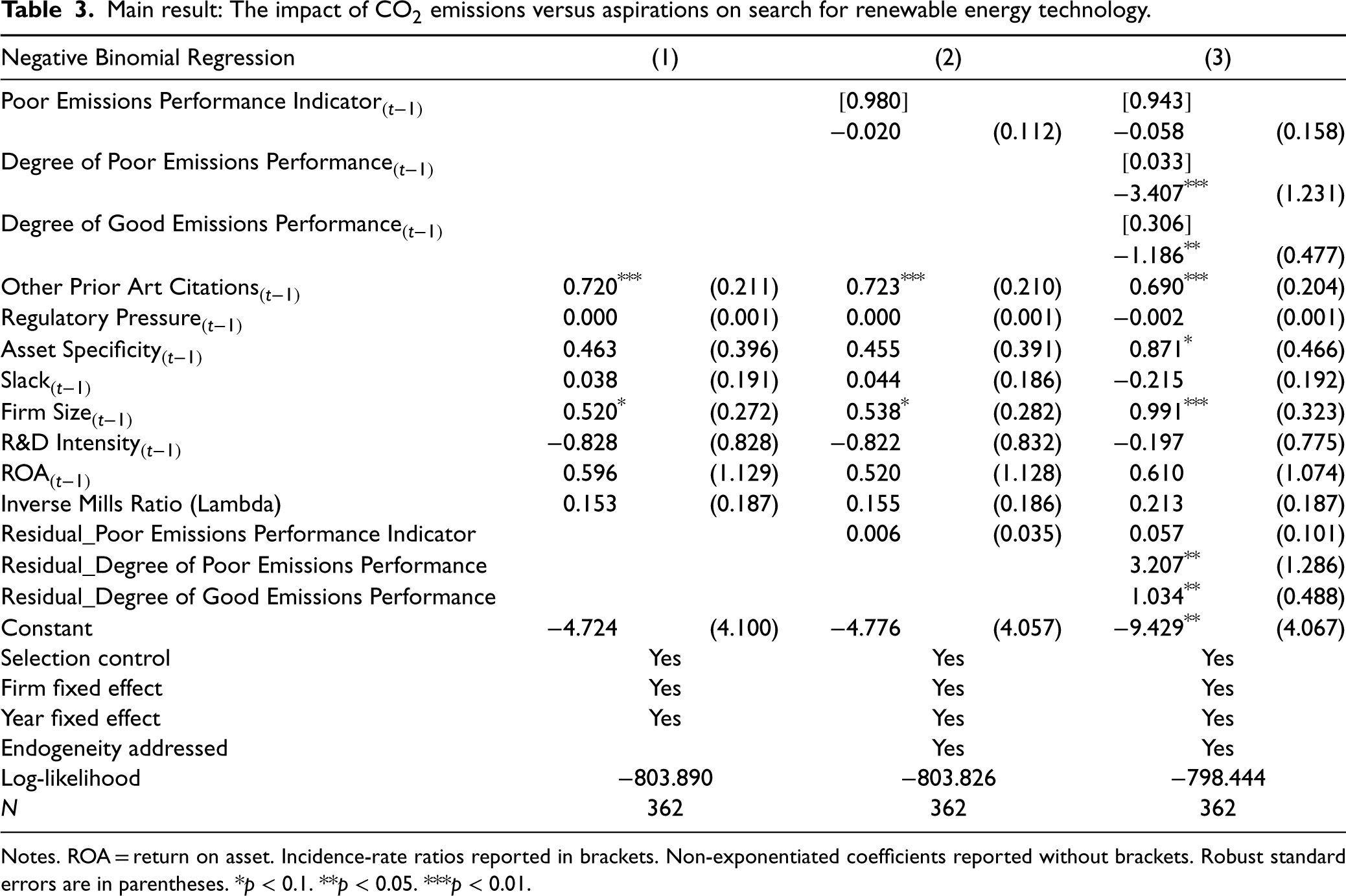
Main result: The impact of CO2 emissions versus aspirations on search for renewable energy technology.
Notes. ROA = return on asset. Incidence-rate ratios reported in brackets. Non-exponentiated coefficients reported without brackets. Robust standard errors are in parentheses. *
Hypothesis 2 predicts that ICT firms decrease their search for renewable energy technology as the degree of poor emissions performance exacerbates. In Model 3, the coefficient of Degree of Poor Emissions Performance (
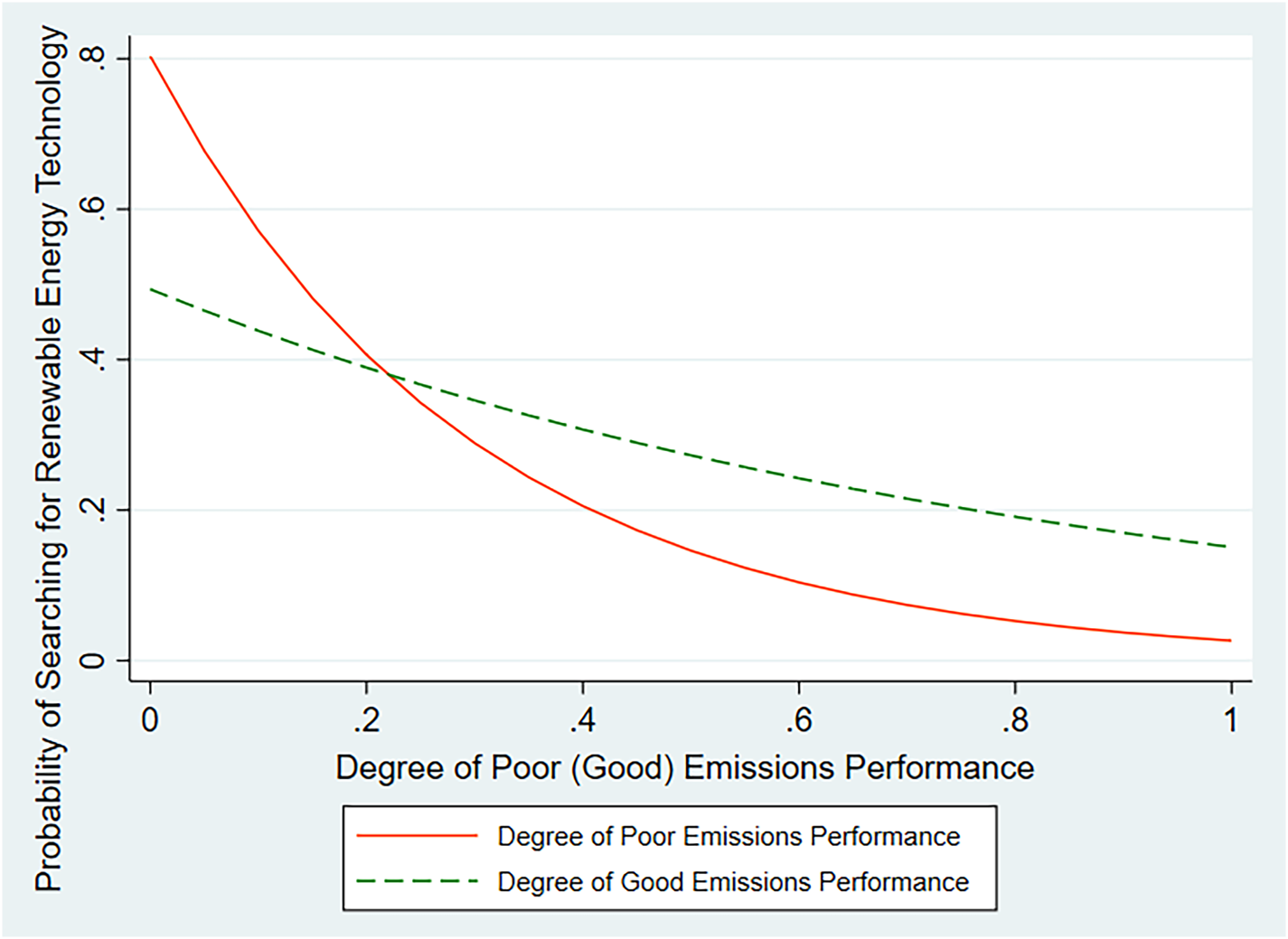
Visualization of the effect of emissions versus aspiration on search renewable.
To test whether our theoretical arguments are supported only in non-energy-intensive sectors or can be generalized across energy-intensive and non-energy-intensive sectors, we construct a new alternative data set that covers all sectors using the databases of Compustat, CDP, and DISCERN. Here, the sample period has changed to 2006–2015 because CDP data are available during this period and DISCERN provides the data up to 2015. The alternative data set consists of the initial sample of 18,255 firm–year observations with 3,988 firms. Because of missing values in CO2 emissions, control variables, and instrumental variables, the initial sample has reduced to 923 firm–year observations with 200 firms, which becomes a final sample for the alternative data set. 25 Hence, we adopt the Heckman two-stage procedure. In the Heckman first stage, using an initial sample of 3,988 firms, we predicted the likelihood of appearing in the final sample (200 firms) with the list of control variables and exclusion restriction that we used for the main analysis. Then, in the Heckman second stage, we conduct a split sample analysis between energy-intensive and non-energy-intensive firms. We identify energy-intensive firms based on the literature (Liddle, 2012), which classifies firms related to iron and steel; non-ferrous metals; non-metallic minerals; chemical and chemical products; and paper, pulp, and printing as the energy-intensive sector. Among the final sample of 200 firms in the alternative data set, 34 firms (17%) are identified as energy-intensive firms.
Table 4 displays the results of split sample analysis. It shows that, for non-energy-intensive firms (Model 2), all of our three hypotheses are in general consistent with our main result. On the contrary, the direction of our hypothesized effects becomes the overall opposite for energy-intensive firms, though statistically insignificant (Model 3). The results imply that the motivations to search for renewable energy technology are different from non-energy-intensive firms and energy-intensive firms. Thus, our hypotheses are less applicable to energy-intensive firms, and our findings can be generalized for non-energy-intensive firms beyond ICT firms. 26
Comparison between non-energy-intensive versus energy-intensive industry (sample: firms in all sectors).
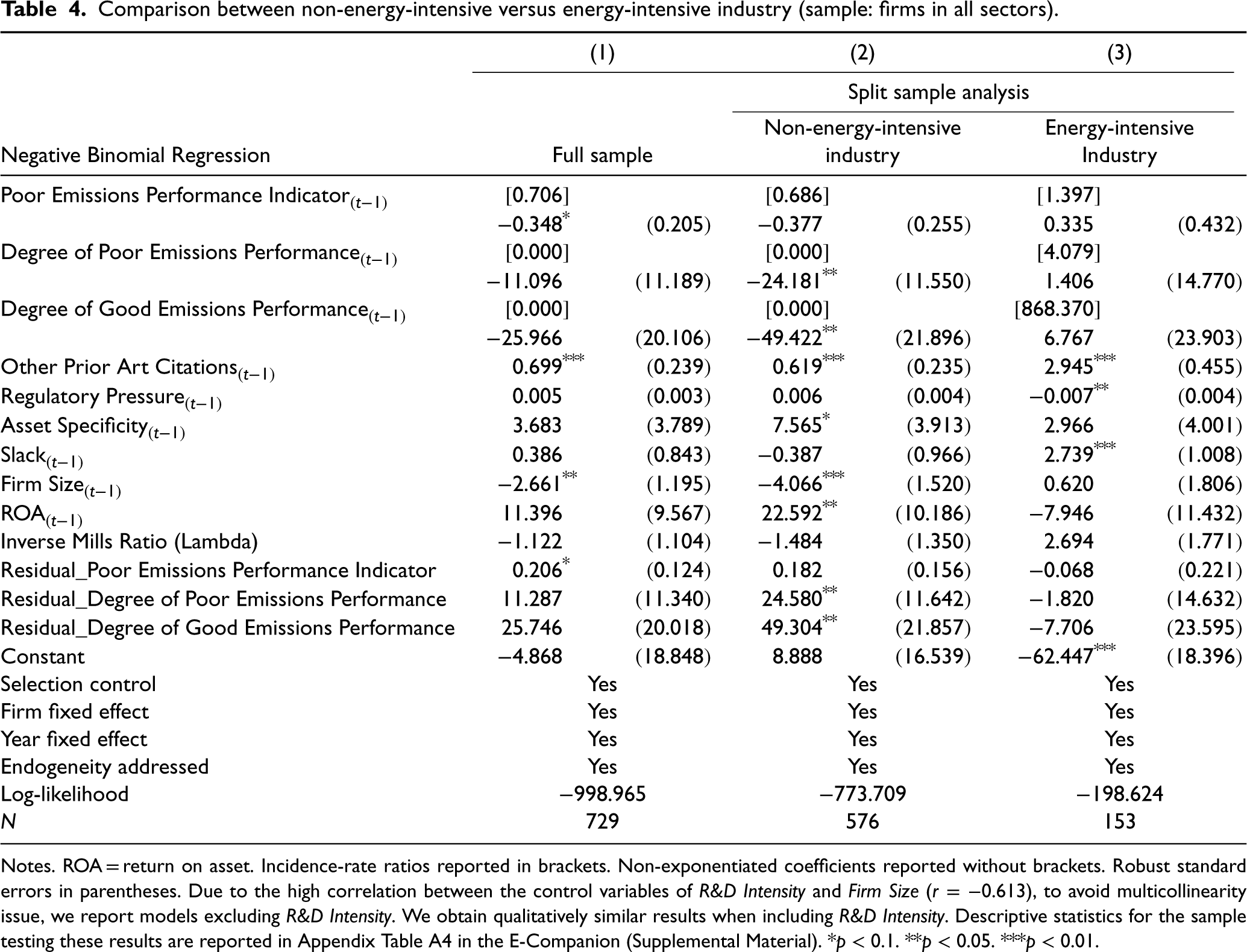
Notes. ROA = return on asset. Incidence-rate ratios reported in brackets. Non-exponentiated coefficients reported without brackets. Robust standard errors in parentheses. Due to the high correlation between the control variables of R&D Intensity and Firm Size (
We performed several other estimations to confirm the robustness of our findings. First, we examined the robustness of our findings after adding a number of control variables: financial performance relative to aspiration, managerial concern on clean energy, and incentive provision. For financial performance relative to aspiration, we checked whether our results remained robust after we included the gap between firms’ financial performance and aspiration as a control using return on asset (ROA), return on sales (ROS), and earnings per share (EPS) as measures of firms’ financial performance. If ICT firms’ financial performance is poor (i.e., financially performing below aspiration), they may pull back from their efforts in environmental responsibility and use their time and resources to recover from financial distress. On the other hand, firms with good financial performance (i.e., financially performing above aspiration) may use their excessive financial resources to increase their search for renewable energy technology. To control for those effects, we created variables of Poor Financial Performance Indicator, Degree of Poor Financial Performance, and Degree of Good Financial Performance, and added them to our main model. Results are shown in Table 5. Our variables of interest (i.e., Poor Emissions Performance Indicator, Degree of Poor Emissions Performance, and Degree of Good Emissions Performance) show results consistent with those of the main analysis.
Including controls for financial performance versus aspiration.
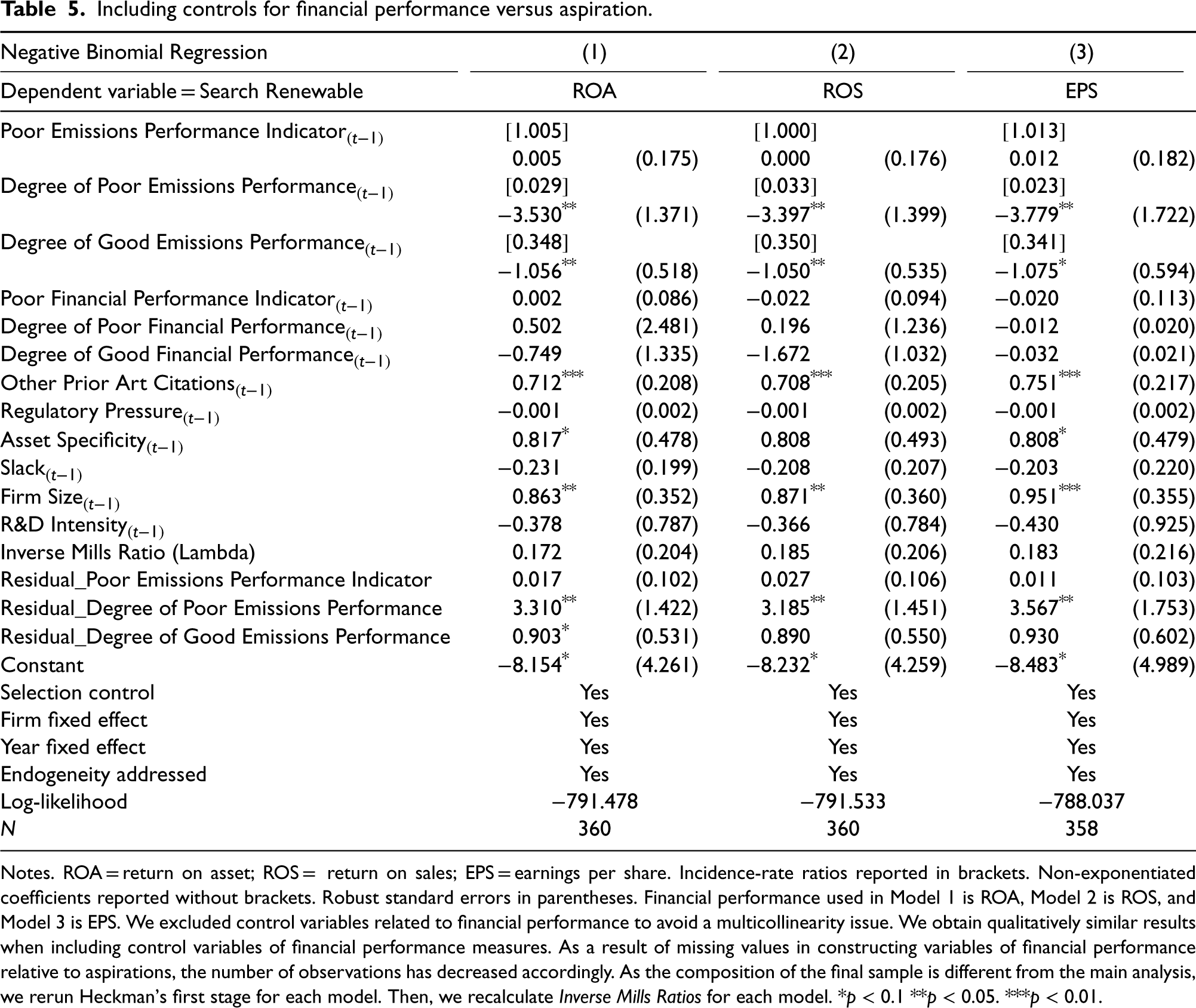
Including controls for financial performance versus aspiration.
Notes. ROA = return on asset; ROS = return on sales; EPS = earnings per share. Incidence-rate ratios reported in brackets. Non-exponentiated coefficients reported without brackets. Robust standard errors in parentheses. Financial performance used in Model 1 is ROA, Model 2 is ROS, and Model 3 is EPS. We excluded control variables related to financial performance to avoid a multicollinearity issue. We obtain qualitatively similar results when including control variables of financial performance measures. As a result of missing values in constructing variables of financial performance relative to aspirations, the number of observations has decreased accordingly. As the composition of the final sample is different from the main analysis, we rerun Heckman’s first stage for each model. Then, we recalculate Inverse Mills Ratios for each model. *
For managerial concern on clean energy, ICT firms’ search for renewable energy technology may be triggered by managerial concern or managerial interest in renewable energy technology, not by the mismatch between firms’ CO2 emissions and aspiration. It also might be the case that firms that explicitly state managerial interest in renewable energy technology engage in more search than those that do not. To address this issue, we retrieved relevant information from the KLD database (Ioannou and Serafeim, 2015) and created a dummy variable, Concern on Clean Energy, that equals 1 if a firm explicitly shows its commitment to use renewable energy or clean fuels for emissions abatement and 0 otherwise, and added it as a control. Results are displayed in Model 1 in Table 6. Our results remain robust after controlling for the firms’ explicit statement of their interest in renewable energy. For incentive provision, we control for the possibility that ICT firms’ search for renewable energy technology can be motivated by managerial expectations for receiving incentives. Using information from the CDP questionnaire, we created a dummy variable, Incentive, that equals 1 if a firm provides either monetary or non-monetary incentive to managers for managing climate change issues and 0 otherwise. Results are shown in Models 2 and 3 in Table 6. Our results remain robust after controlling for the effect of incentive provision to managers. In particular, the coefficients of Incentive are negative and significant in both Models 2 and 3, indicating that firms with incentive provisions are less likely to search for renewable energy technology compared to firms with no incentive provision.
Including controls for concern on clean energy, incentive provision to managers.
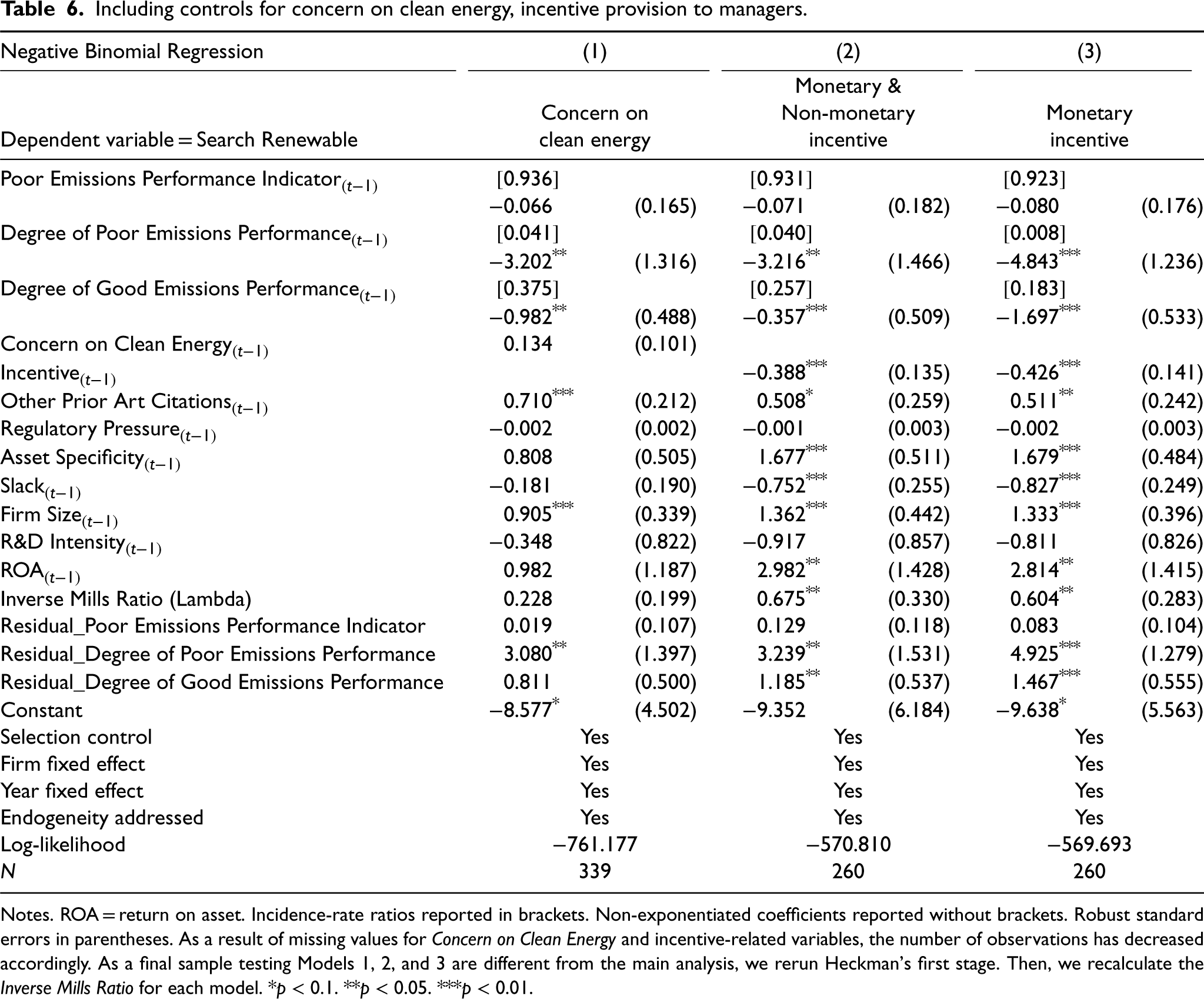
Notes. ROA = return on asset. Incidence-rate ratios reported in brackets. Non-exponentiated coefficients reported without brackets. Robust standard errors in parentheses. As a result of missing values for Concern on Clean Energy and incentive-related variables, the number of observations has decreased accordingly. As a final sample testing Models 1, 2, and 3 are different from the main analysis, we rerun Heckman’s first stage. Then, we recalculate the Inverse Mills Ratio for each model. *
Furthermore, we added two sets of control variables and examine the robustness of our findings. Descriptions of each set of control variables and relevant results are available in Appendix Tables A5 and A6 in the E-Companion (Supplemental Material). Though some results lack significance, our results remain robust.
Second, we performed two alternative estimations—Poisson and zero-inflated negative binomial estimation. See Appendix Table A7 in the E-Companion (Supplemental Material) for the details. We found results that were qualitatively similar to those of our main analysis and further confirmed that negative binomial estimation is preferred over either of the estimations.
Third, we examined whether our reported effects are robust with alternative measures of control variables, aspiration level, and dependent variables. For alternative measures of control variables, see Appendix Table A8 in the E-Companion (Supplemental Material) for the detailed results and discussion. We found consistent results with the main analysis. For alternative measures of aspiration, we constructed aspiration in three ways—scaling firms’ CO2 emissions by firms’ operational scale, using firms’ actual emissions targets, and using predicted emissions. See Appendix Tables A9 and A10 in the E-Companion (Supplemental Material) for the details. Though there is lack of significance, the coefficients of our main independent variables show overall consistent directions. For alternative measures of the dependent variable, we constructed two sets: the first set pertains to the firm’s search for renewable energy technologies, whether developed by the firm itself or by other firms (i.e., self-citation vs. non-self-citation). The second set focuses on the firm’s search for technologies, either developed in-house or acquired from other firms (i.e., in-house development vs. acquired). Results for the first set of alternative dependent variables are reported in Appendix Table A11 in the E-Companion (Supplemental Material), while those for the second set are displayed in Appendix Table A12 in the E-Companion (Supplemental Material). Though some results lack significance, our results remain robust.
Fourth, we conducted three different split sample analyses considering the diverse nature of our sample—annual energy usage, manufacturing versus service, and the data center importance in firms’ businesses. For the results and discussions regarding annual energy usage, see Appendix Tables A13a and A13b in the E-Companion (Supplemental Material); regarding manufacturing versus service, see Appendix Table A14 in the E-Companion (Supplemental Material); and regarding the data center importance in firms’ businesses, see Appendix Table A15 in the E-Companion (Supplemental Material). In short, apart from the split sample analysis based on firms’ annual energy usage, we obtained overall consistent results with our main analysis although some lack significance. Furthermore, within our sample ICT firms, there is no significant difference in our hypothesized effects between manufacturing and service firms, as well as among firms with varying data center importance.
We performed three post-hoc analyses. First, we tested our hypotheses using alternative independent variables constructed solely with historical aspiration, or solely with social aspiration to explain the results for Hypothesis 1. The results using independent variables based on historical aspiration are presented in Model 1 of Appendix Table A16 in the E-Companion (Supplemental Material); while those using social aspiration are reported in Model 2 of the same table. Overall, the results show consistency in the direction of effects, except for Poor Emissions Performance Indicator. When aspiration only incorporates historical aspiration, the coefficient of Poor Emissions Performance Indicator becomes positive and significant (
According to the BTOF literature, historical aspiration pertains to a firm’s own performance (Kim et al., 2015), whereas social aspiration is related to a firm’s competitive positioning (Wiseman and Bromiley, 1996; Joseph and Gaba, 2015). Then, when a firm’s actual emissions performance exceeds social aspiration, it implies the firm’s inferior position relative to its peers in terms of emissions. Hence, from the theoretical and empirical difference between the two types of aspiration, it is possible to understand that historical aspiration is narrowly about firms’ own performance, whereas social aspiration is more broadly about firms’ competitive positioning.
When firms understand that their emissions performance is poor relative to their historical aspirations, they are concerned that they do not have enough technological capability to address their emissions, thereby being motivated to strive to enhance their technological capability. Thus, as the empirical results show, poor-performing firms that are narrowly concerned about their own emissions performance (i.e., when the variable of Poor Emissions Performance Indicator is constructed using historical aspiration only) are more likely to search for renewable energy technology than firms with emissions lower than their own past emissions.
Regarding the insignificant result for social aspiration, when firms understand that their emissions performance is poor relative to their peer firms, they assess their competitive positioning as poor and may consider how to quickly reduce emissions and thus improve their environmental performance status. For example, they can purchase off-the-shelf renewable energy installations rather than developing them. This effect may offset the firms’ motivation to further search for renewable energy technology when they do not meet their aspiration, and thus, the empirical results show insignificant and indecisive direction when poor-performing firms more broadly consider their competitive positioning (i.e., when the variable of Poor Emissions Performance Indicator is constructed using social aspiration only). 27
Our second post-hoc analysis is regarding our argument in Hypothesis 2. Since the purchase of renewable energy from third-party energy suppliers enables a firm to immediately gain an image of being eco-friendly, poor emissions performance firms may purchase rather than search for renewable energy. We examined our hypotheses using a new dependent variable related to the firm’s energy purchases. Descriptions of the new dependent variable and relevant results are available in Appendix Table A17 in the E-Companion (Supplemental Material). In sum, the coefficient of Degree of Poor Emissions Performance is positive and significant for the new dependent variable of energy purchase. This suggests that ICT firms increase their energy purchase as the degree of poor emissions performance exacerbates, thus providing support for our theoretical argument for Hypothesis 2.
Our third post-hoc analysis pertains to our argument in Hypothesis 3. We examined whether good emissions performance firms increase their effort in monetizing environmental innovations to keep having a favorable competitive positioning. Accordingly, we tested our hypothesized effects using a new dependent variable that can capture firms’ monetizing opportunities through their environmental innovations. From Refinitiv data, we obtained the variable Environmental Product Development, which reflects the extent of a firm’s product lines or services designed to have a positive impact on the environment or those that are environmentally labeled and marketed. We tested this new dependent variable with independent variables constructed using historical aspiration only and social aspiration only, respectively. When independent variables are computed using historical aspiration only, none of the coefficients display significance (Model 1 of Appendix Table A18 in the E-Companion (Supplemental Material)); when independent variables are computed using social aspiration only, the coefficient of Degree of Good Emissions Performance is positive and significant (Model 2 of Appendix Table A18 in the E-Companion (Supplemental Material);
Discussion and Conclusion
In this study, we shed light on the question of when ICT firms, an exemplary case of non-energy-intensive sectors, are motivated to search for renewable energy technology, by using the mismatch between a firm’s CO2 emissions and aspiration. We demonstrated that firms with emissions performance higher than their own past emissions are, on average, more likely to search for renewable energy technology than those with emissions performance lower than their own past emissions. Within each of the firms with poor and good emissions performance, firms reduce the search for renewable energy technology as the degree of poor or good emissions performance increases.
Theoretical Contribution
Our focus on firms’ intrinsic motivation toward environmental responsibility contributes to the literature in two ways. First, our study adds a new behavioral factor to the sustainable operation management literature (e.g., Atasu et al., 2020). Recently the literature has examined various behavioral factors including attention of the firm (Dhanorkar et al., 2018), learning of the organization (Mani and Muthulingam, 2019), and precision (Bansal and Muthulingam, 2022). Second, though a large number of studies have examined the effect of institutional or regulatory pressures on firms’ engagement in environmental responsibility (e.g., Berrone et al., 2013), scholars have started to focus on firm-internal factors such as the CEO’s ethical motives (Bansal and Roth, 2000), strategic purposes (Crilly et al., 2012), and organizational learning and lean production capability (Lee and Klassen, 2016). Our study complements these two streams of literature by showing that the mismatch between firms’ CO2 emissions and aspirations can drive environmental responsibility behavior related to the exploration of renewable energy technology.
We supplement studies on non-energy-intensive sectors, which have received less attention in the literature (Ramirez et al., 2005) despite their increasing impact on the environment (Seck et al., 2016). Furthermore, while ICT firms, which in general belong to non-energy-intensive sectors, are the main actors in combining information technologies and environmental technologies to develop novel inventions such as energy conservation devices or efficient data processing systems (Cecere et al., 2014), the study of when ICT firms explore inputs of such inventions has been underdeveloped. Our study can enhance scholars’ understanding of behaviors of non-energy-intensive sectors, in particular, ICT firms’ exploration for renewable energy technology, which eventually enables ICT firms to help address the critical global issue of CO2 emissions.
Third, our study adds to the BTOF literature by focusing on firms’ environmental performance. While prior work in BTOF has generally focused on performance shortfalls and firm behaviors directly related to the firms’ main strategy (e.g., Posen et al., 2018), environmental performance has not yet been examined in the main research stream. Our research examined firm environmental performance, which is increasingly important to managers because of growing awareness of global environmental issues. We demonstrated that firms’ exploratory behaviors could be triggered by such factors in their environmental performance. Furthermore, we found strong evidence that among firms performing below environmental aspiration, firms decrease exploratory behavior as their performance becomes worse. This is the opposite of the general conjecture in the BTOF literature that firms increase exploratory behavior with worse performance (Kim et al., 2015; Posen et al., 2018; Tyler and Caner, 2016). Our finding may complement the BTOF literature in suggesting that there is a contingency that firms decrease, rather than increase, their exploratory behavior in response to their performance shortfalls.
Managerial and Policy Implications
ICT firm managers should consider that, when their environmental performance deviates too much from their aspiration, they tend to reduce their efforts to search for renewable energy technology. From the long-term perspective of firms’ environmental responsibility, as a result of those reduced searches, ICT firms may lose opportunities to incorporate renewable energy technology into their existing technology. Thus, in order to not lose inventive opportunities, when firms’ emissions rise substantially above aspiration, or firms show poor environmental performance, managers should not narrow their focus to solely meeting environmental requirements but should pay attention to their exploration for environmental technology. In contrast, when firms’ emissions drop substantially below aspiration, or firms show superior environmental performance, it is advisable for managers not to become too satisfied with their status and to consciously engage in the search for renewable energy technology in order to keep expanding their technological boundary, thereby increasing inventive opportunities.
In particular, one possible suggestion can be given from the findings in our robustness analysis. When we test our hypotheses by including a control of managerial incentives, we found that firms providing either monetary or non-monetary incentives to managers for addressing climate change issues are less likely to engage in the search for cutting-edge innovations (i.e., both monetary and non-monetary incentive: Model 2 of Table 6,
This study also has several implications for policymakers who prepare and implement effective environmental regulations. Despite the global emphasis on transforming energy sources from fossil fuels to renewable energy, the share of fossil fuels in global energy consumption barely changed between 2009 and 2019. 29 Our study shows that some firms engage in environmental responsibility behavior that requires a long-term period to bear outcomes, such as exploring environmental technology, with the motivation of complying with environmental requirements as well as attaining technological resources that help firms to mitigate their eco-harmful impact. Policies that exclusively value firms that succeed in reducing emissions in the short term will result in firms finding little incentive to explore environmental technology. For example, Krass et al. (2013) found that environmental tax seems to be not always effective in motivating firms to adopt environmental technologies. Thus, policymakers should consider a policy that does not narrow a firm’s focus to merely complying with regulations but also allows firms to explore environmental technology, which ultimately contributes to increasing the share of renewable energy in global energy consumption.
In addition, policymakers should understand that firms are differently motivated to explore environmental technology depending on the differences between their environmental performance and aspiration. Accordingly, different policies that can stimulate firms to explore environmental technology could be considered. In particular, for firms with poor environmental performance, carbon taxation or penalty rules could be differently applied to firms who still put effort into environmental technology exploration. For firms that show better environmental performance, the policy must avoid resulting in those firms losing their appetite for exploration.
Limitations and Future Research
Our study is subject to several limitations. First, we acknowledge that our aspiration measure, although well-supported by BTOF convention (e.g. Eggers and Kaul, 2018; Greve, 2003), simplifies the various criteria that firms may adopt for their performance evaluation. Consequently, it has limitations in incorporating firm managers’ intentions, such as being content to not do well in emissions (e.g., some might be satisfied with being laggards in terms of emissions performance). While our robustness analysis regarding predicted emissions as another reference point for evaluating firms’ emissions (i.e., Appendix Table A10 in the E-Companion (Supplemental Material)) may partially address such concerns, future research might construct new aspiration measures incorporating various criteria for evaluating emissions.
Second, while we focus on renewable energy technology to examine environmental technology development, there are various domains of environmental technology. To draw a comprehensive picture of firms’ environmental technology exploration, future studies could examine other environmental technologies such as dust collection, water purification, or biodegradable plastic (i.e., plastics that can be decomposed by microorganisms).
Third, we still lack knowledge of other firm behaviors related to renewable energy adoption, such as the number of partnered companies providing renewable energy or the amount of renewable energy credits firms purchase. To mitigate this concern, in post-hoc analysis, we examined our hypotheses with the dependent variable of the amount of firms’ energy purchase and found that firms increase their energy purchase as the degree of poor emissions performance exacerbates (Models 2 and 3 of Appendix Table A17 in the E-Companion (Supplemental Material)). We encourage future researchers to investigate other types of firms’ renewable energy adoption behaviors (e.g., bundled- and unbundled-renewable energy credit and long-term power purchase agreement).
Supplemental Material
sj-pdf-1-pao-10.1177_10591478241240126 - Supplemental material for Carbon Emissions and the Search for Renewable Energy Technology: Information and Communication Technology (ICT) Firms’ Environmental Responsibility
Supplemental material, sj-pdf-1-pao-10.1177_10591478241240126 for Carbon Emissions and the Search for Renewable Energy Technology: Information and Communication Technology (ICT) Firms’ Environmental Responsibility by Hyunsoo Kim, Hyun Ju Jung and Chul Ho Lee in Production and Operations Management
Footnotes
Acknowledgments
The authorsare grateful to the thoughtful and constructive comments from Department Editor Robert Klassen, an anonymous Senior Editor, and three anonymous reviewers throughout the review process.
Declaration of Conflicting Interests
The authors declared no potential conflicts of interest with respect to the research, authorship, and/or publication of this article.
Funding
The authors disclosed receipt of the following financial support for the research and/or authorship of this article: The research was supported by the Basic Science Research Program through the National Research Foundation of Korea funded by the Ministry of Education (2021R1A6A1A14045741), the ICT R&D program of the Ministry of Science and ICT /Institute of Information & Communications Technology Planning & Evaluation (2021-0-01689), and the Ministry of Trade, Industry and Energy and the Korea Institute of Energy Technology Evaluation and Planning (No. 20228520020020).

Notes
How to cite this article
Kim H, Jung HJ, Lee CH (2024) Carbon Emissions and the Search for Renewable Energy Technology: Information and Communication Technology (ICT) Firms’ Environmental Responsibility. Production and Operations Management 33(5): 1155–1175.
References
Supplementary Material
Please find the following supplemental material available below.
For Open Access articles published under a Creative Commons License, all supplemental material carries the same license as the article it is associated with.
For non-Open Access articles published, all supplemental material carries a non-exclusive license, and permission requests for re-use of supplemental material or any part of supplemental material shall be sent directly to the copyright owner as specified in the copyright notice associated with the article.
