




Abstract
To alleviate the financial shortage for public service provision, a government agency may jointly finance, own, and run a service system with a private firm (in the manner of a joint venture) or delegate service provision to the firm subject to regulation in service price or wait time. We model the service system as a queueing system in which customers are heterogeneous in service valuation and sensitive to price and delay. While the government aims to maximize social welfare, the firm’s goal is to maximize profit. Hence, the joint venture has the objective of a mix of profit maximization and social welfare creation. Under the regulation, two types of interaction between the government and the firm, that is, sequential move (in the absence of the government’s myopic adjustment) and simultaneous move (in the presence of myopic adjustment), are considered. We find that while wait time regulation is more efficient than price regulation in the presence of myopic adjustment, the relationship is reversed in the absence of myopic adjustment. Somewhat surprisingly, price regulation with myopic adjustment may backfire. However, in some instances, the government must take a large share in a joint venture to achieve the same performance under price regulation without myopic adjustment. Our work uncovers whether the government adopts myopic adjustment plays a critical role in choosing the regulation instrument.
Introduction
Public services such as healthcare, emergency services, and public transportation are provided by a government to people living within its jurisdiction, either directly through the public sector or by financing the provision of such services (McGregor Jr et al., 1982). As the population increases and the aging problem becomes more significant, the demand for public services is increasing over time, which requires large financial investments in public infrastructures. To reduce the tremendous financial pressure, many governments seek partnerships with the private sector.
The joint venture, as one form of public–private partnership (PPP), is a common mechanism governments use to address financial constraints for service provision. For instance, in January 1997, Huaxin, a company in Henan Province of China, invested in a public hospital, which became the first PPP hospital in China. 1 The Hong Kong Financial Secretary Corporation, on behalf of the Hong Kong government, sold 23% of its stake in the Mass Transit Railway (MTR) Corporation in a public offering in June 2000; the MTR Corporation then became the MTR Corporation Limited and was listed on the stock exchange of Hong Kong in October 2000. By inviting a private firm to be on board, the government jointly owns and operates the project with the private firm. The private firm thus has bargaining power for decision-making in the project. As argued by Luo and Kaul (2019), PPPs and other hybrid arrangements are better suited to deal with social problems concerning high information asymmetry and a high potential for innovative solutions. However, the private firm’s for-profit interest usually runs counter to that of the government and the general public.
In addition to the joint venture, the governments may allow private service providers to offer public services. This is known as privatizing public services and is commonly seen in sectors such as healthcare and transportation. Government agencies represent the general public, whereas private service providers are usually profit-driven. The conflict of interest between the government and private service providers may lead to undesired consequences. For instance, the toll for using one privately operated tunnel in Hong Kong (Western Harbor Crossing) is high, so the realized daily traffic volume is only 57% of its designed capacity, while the daily traffic volume of one public tunnel (Cross-Harbor Tunnel) is
Such a partial regulation has a critical impact on society. Inappropriate regulation instruments may even lead to inefficiency, in the sense that social welfare is lower with regulation than without. For example, if the service price is capped at a very low level, the service system can become overly crowded; see Besley and Coate (1991) for such an example in healthcare systems. If the wait time is set too short, the private service provider may respond by charging a high price, thereby serving only a small number of customers. Thus, it is critical to choose the right type and level of regulation. Furthermore, as pointed out by Stiglitz (1998), “it [i.e., the government] always has the possibility of changing its mind.” The reason for such a possibility could be the change of the decision environment or other short-sightedness, for example, to gain more votes in an election. For example, the Chinese government intervened and set prices on 32 occasions between 1998 and 2013. Each time, the average price reduction across therapeutic categories equaled 20% (Fang, 2015). As another example, the municipal government of Guangzhou, China, changed the toll standard of Huanan Expressway three times in 2003, 2012, and 2020. The private operator of Huanan Expressway publicly complained about the mandated toll reduction in 2012. 6 Thus, “the government is likely to be an unreliable partner even if the industry were to agree to price controls and other regulations” (Frank, 2003). The private firm then may react to the regulation adjustment by adjusting unregulated elements of its operation. If the government is simply to adapt to the change in the environment, its regulation adjustment will induce the firm to be adaptive correspondingly. However, if the government’s adjustment is for short-sighted purposes, the government adjusts the regulation after observing the actual performance of the privately run public system even when the decision environment does not change. In this case, because the firm will react in its own interest, the resulting welfare of the system could be lower. Over time, if the government myopically adjusts the regulation several times, the government is gaining in the short-term right after the adjustment but may be worse off over the long run. Therefore, whether the government will adjust the regulation for short-sighted purposes over time could have a significant impact on the regulation efficiency and the selection of a regulation instrument.
We study the following research questions: Is regulation an efficient way to improve welfare? Which type of regulation, price or wait time, is more efficient? If the government adjusts the regulation for short-sighted purposes over time, how would the results change? How does the price or wait time regulation perform compared with a joint venture? To answer these questions, we consider a system in which a private firm provides a type of public service to a population of price- and delay-sensitive customers with heterogeneous service valuations, in the manner of a joint venture or regulation. The firm can potentially decide the service capacity and price, or equivalently, the price and wait time, to maximize its profit. The government’s incentive is to maximize social welfare, that is, the sum of the firm’s profit and customer surplus. When a public service is run in a joint venture, the objective is a mix of profit maximization and social welfare maximization. Consistent with intuition, the resulting social welfare increases with the government’s project share or, equivalently, the capital that the government invests.
Motivated by practical examples in healthcare and toll systems, we then consider two types of regulation: price and wait time. The move of the government and the firm can be sequential or (effectively) simultaneous, depending on whether the government will adjust the regulation for short-sighted purposes over time. Hereafter, we refer to such a short-sighted adjustment as a myopic adjustment. In the absence of myopic adjustment, the interaction between the government and the firm under regulation is modeled as a Stackelberg game, with the government moving first to announce the regulated price (respectively, wait time) followed by the firm’s best response to the wait time (respectively, price) decision. In the presence of myopic adjustment, the equilibrium of interaction over time is captured by a Nash game.
Our analysis reveals that both price and wait time regulation are effective in the absence of the government’s myopic adjustment, in the sense that they increase social welfare compared with no regulation. Indeed, by enforcing a lower price (respectively, shorter wait time) than that without regulation, consumer surplus increases under regulation, although the firm’s profit may decrease. Hence, social welfare can be boosted by appropriately choosing a regulated price or wait time as long as the government will not adjust the regulation over time. Moreover, we find that price (a monetary regulation instrument) is more efficient than wait time (an operational regulation instrument). This is due to the firm’s flexibility in complying with the wait time regulation: the firm can increase either the service capacity or the service price (such that fewer customers are served) or both. Note that increasing the service price decreases consumer surplus and social welfare (as we have shown that the customers’ and the government’s interests are aligned). By contrast, under price regulation, the firm can only adjust its capacity. As a result, the firm’s incentive to increase the capacity is weaker under wait time regulation than under price regulation, and hence, price regulation is more effective.
However, in the presence of myopic adjustment, the ranking of the two regulatory schemes is reversed: wait time regulation is now more efficient. This result also indicates that the myopic adjustment has a stronger (negative) impact under price regulation than under wait time regulation. In the presence of myopic adjustment, the conflict of interest between the government and the firm means that the government will lower the regulated price whenever it revisits its decision myopically. The firm, however, responds by reducing the service capacity out of its profit-driven interest. In equilibrium, the firm earns zero profit with the least operational service capacity. When the government instead regulates the wait time, it shortens the wait time for the customers’ sake, which will push the firm to expand the service capacity but decrease the firm’s profit. Nevertheless, the firm can take advantage of pricing to profitably comply with the regulation by increasing the service price, which will reduce the number of customers it serves. Hence, the conflict of interest between the government and the firm is alleviated under wait time regulation. Moreover, the firm’s pricing power sustains the incentive to expand the service capacity. Hence, in equilibrium, the service capacity is larger under wait time regulation than under price regulation. Meanwhile, because the price under price regulation is extremely low (under which the firm receives zero profit), the number of customers the firm serves is larger than under wait time regulation. As a result, the system is very congested under price regulation, thereby leading to lower social welfare. Somewhat surprisingly, price regulation can backfire: when the market size is sufficiently large, the system is very congested with low capacity; the social welfare thus can be lower than it would be without regulation. With no regulation, the firm charges a higher price but has the incentive to invest in capacity.
Finally, we compare the performances of the regulations and the joint venture. The joint venture can avoid the possible backfire of price regulation with myopic adjustment. Furthermore, our numerical study shows that to achieve the same social welfare when the government regulates the service price without myopic adjustment, the government should take a large share under the joint venture when the market size is relatively large or/and the cost parameters such as the unit service cost, capacity cost, and delay cost are relatively small.
Literature Review
Extensive studies exist about the government’s regulation of corporate projects and operations. Monetary regulation such as price regulation (see, e.g., Greenberg and Murphy, 1985), taxation/toll (see, e.g., Krass et al., 2013), and subsidy (see, e.g., Cohen et al., 2019), are particularly common in practice. Regulation with other instruments can be regarded as quality regulation. For instance, the government may impose a requirement on a product, service, or project characteristics, such as quality (see, e.g., Melumad and Ziv, 2004), reliability (see, e.g., Gao et al., 2021), and hospitals’ readmission rate (see, e.g., Zhang et al., 2016). In the context of service systems, wait time or queue length is one of the commonly used quality indicators. Shang and Liu (2011) investigate firms’ competitive behavior in industries where customers are sensitive to both promised delivery time and quality of service measured by the on-time delivery rate. In this paper, we study practically motivated price and wait time regulation and compare their efficiency in public service systems.
Our paper is closely related to the literature on regulation and comparison of welfare-maximizing and profit-maximizing solutions in service (or production) systems with congestion. This literature dates back to the celebrated work by Naor (1969). The author uses an M/M/1 queue, where the queue length is observable and customers are homogeneous, to model a toll system and shows that the welfare-maximizing toll is lower than the revenue-maximizing one, thereby implying that the toll should be regulated downwards for welfare maximization. For an M/M/1 service system, Huang and Chen (2015) show that revenue maximization and welfare maximization lead to different pricing strategies when customers perform anecdotal reasoning, whereas the two objectives are equivalent in the fully rational benchmark. Haviv and Oz (2018) suggest a classification of regulation schemes based on a few desired properties and use it to categorize schemes from the existing literature and propose a novel regulation scheme that possesses all of the properties. In these papers, the (monopolistic) firm’s capacity is exogenously given. Considering an M/M/1 service system where the queue length is unobservable and customers have different service values, Mendelson (1985) studies the pricing and capacity decisions made to maximize social welfare and profit. In a decentralized setting, Liu et al. (2007) study a decentralized supply chain consisting of a supplier and a retailer facing price- and lead time-sensitive demands, analogous to our system consisting of the government and a service provider facing price- and delay-sensitive customers. The authors find that the inefficiency due to decentralization is strongly influenced by market and operational factors. Decision-makers in these papers are profit-seeking, whereas, in our decentralized system, the private sector is profit-seeking while the government seeks to maximize overall welfare. Moreover, in contrast to those papers, we are interested in how the various regulation schemes perform and how the regulation efficiency changes when the interaction between the private sector and the government changes from a sequential move to a simultaneous move. As far as we know, these two questions have not been studied in this stream of literature on service systems.
The equilibrium concept of regulation in the absence and presence of the government’s myopic adjustment in our paper turns out to coincide with those in the Stackelberg and Nash games, respectively. Thus, our work is related to the literature that discusses the impact of the decision sequence on outcomes in games with public and private organizations. De Fraja and Delbono (1989) analyze a situation in which one public firm and multiple private firms compete in setting quantities of a homogeneous commodity, and show that social welfare is higher when the public firm moves first, compared with a simultaneous move. Poyago-Theotoky (2001) makes an extension by introducing an output subsidy offered by a public firm to all firms. In addition to considering different decision sequences, our paper takes into account the operational-level system congestion and different regulation schemes for each decision sequence. Thus, we show not only how decision sequences affect social welfare for a given regulation scheme in systems with congestion but also how the preferred regulation scheme changes as the decision sequence changes.
Our paper is also related to the literature on privatized public service systems, many of which study two-tier service systems in the healthcare context. In these systems, the public service systems are partially privatized by introducing private service providers. De Vericourt and Lobo (2009) consider a healthcare system in which the paying hospital’s revenue is used to support the free hospital’s operations and identify the optimal resource and capacity allocation policy. Guo et al. (2014) study a similar self-financing two-tier service system in a queueing model. They first derive the optimal price and capacity of the toll system and then show that expanding the free system’s capacity can actually increase congestion for all customers, thereby exhibiting the Downs–Thomas paradox. Andritsos and Aflaki (2015) analyze the capacity competition in a two-tier system and show that providing a larger subsidy to the for-profit hospital can increase the waiting time in the nonprofit hospital. Hua et al. (2016) study the competition and coordination issues in a situation where the public SP is partially subsidized by the profits of the private SP. Qian et al. (2017) compare the efficiency of conditional and unconditional subsidy schemes in two-tier healthcare systems. Our paper differs from these papers in two aspects. First, the government or public party in our paper does not compete with the private service provider but influences its decisions by regulation. Second, we do not consider subsidy policies (belonging to monetary regulations) as we focus on the situation where the government lacks sufficient capital. In other words, we examine a new direction for managing the public service system. Considering the lack of capital, Zhou et al. (2023) propose to change the ownership of the public service provider to increase the social welfare of a two-tier system. The (partial) privatization of the public service provider in their paper leads to the joint venture mode, while our paper compares the performance of the regulation and joint venture. Moreover, compared with Zhou et al. (2023), we also consider the capacity decision of the system, which captures the long-run effect of the government’s policy.
The Model
Consider the scenario in which a government provides a type of public services, such as healthcare, highways, or tunnels. To develop a tractable model for the complex service system, we approximate it by an M/M/1 queueing system, see, for example, Wang et al. (2019), Xu et al. (2020), and Armony et al. (2021). Suppose that potential customers arrive according to a Poisson process with rate


In the following, we introduce several performance indicators of the system. Let



To ensure that the service provider is sustainable, a nonnegative profit should be achievable. That is, the return of capacity investment should be sufficiently large, which effectively requires a sufficiently large market size. We make the following assumption throughout this paper.
By definition, we refer to
The service system runs for a long time, and the system parameters may change over time. Because each party in the systems has full information about the parameters, their decisions can be adaptive to the parameter changes. For simplicity, we assume that the system parameters are constant over time.
The government can build the service system and provide the service by itself. However, the government lacks sufficient capital for capacity expansion. To address this situation, the government invites a private firm to jointly finance, own, and operate the service system. This operating mode is known as a joint venture. We assume that the private firm has sufficient capital. Under the joint venture, the private firm joins the board, as in the examples of the MTR Corporation in Hong Kong and the hospital in Henan province of China. Thus, the board of the public service provider consists of government agents who advocate for social welfare and the representatives of the private shareholders who advocate for profit. Hence, both private and public shareholders have an influence on decision-making. The bargaining among the public and private agents results in a compromise between maximizing welfare and maximizing profit (Matsumura, 1998; Fujiwara, 2007; Fan et al., 2020; Zhou et al., 2023). Let

For the joint venture, the objective function is a weighted sum of profit and social welfare. Such an objective of moving beyond profit maximization (Cachon et al., 2020) is consistent with the mixed mission of those firms certified as “B Corporation” in the U.S., which requires a sufficient portion of “social and environmental performance” in a firm’s agenda.
7
We thus refer to the scenario with the joint venture as Scenario B. In practice, the value of
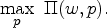
(i) Under joint venture, the equilibrium price If If Equilibrium in joint venture ( Note:
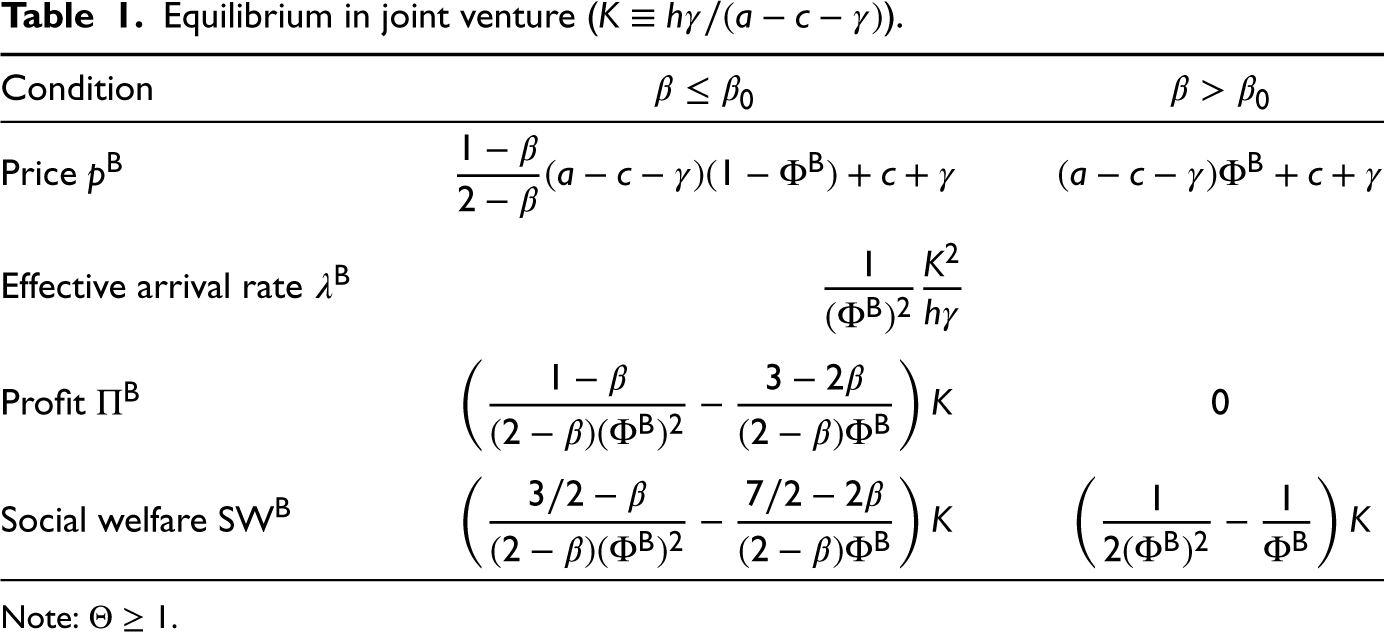

Consistent with our intuition, when the government’s weight is low, as it increases, the increasing focus on welfare maximization drives the public service provider to serve more customers at the cost of profitability. However, when the government’s weight is sufficiently large, the firm’s participation constraint is binding, that is,
In the following, we consider two special cases in which the weight
The optimal service price Equilibrium under benchmark scenarios ( Note:
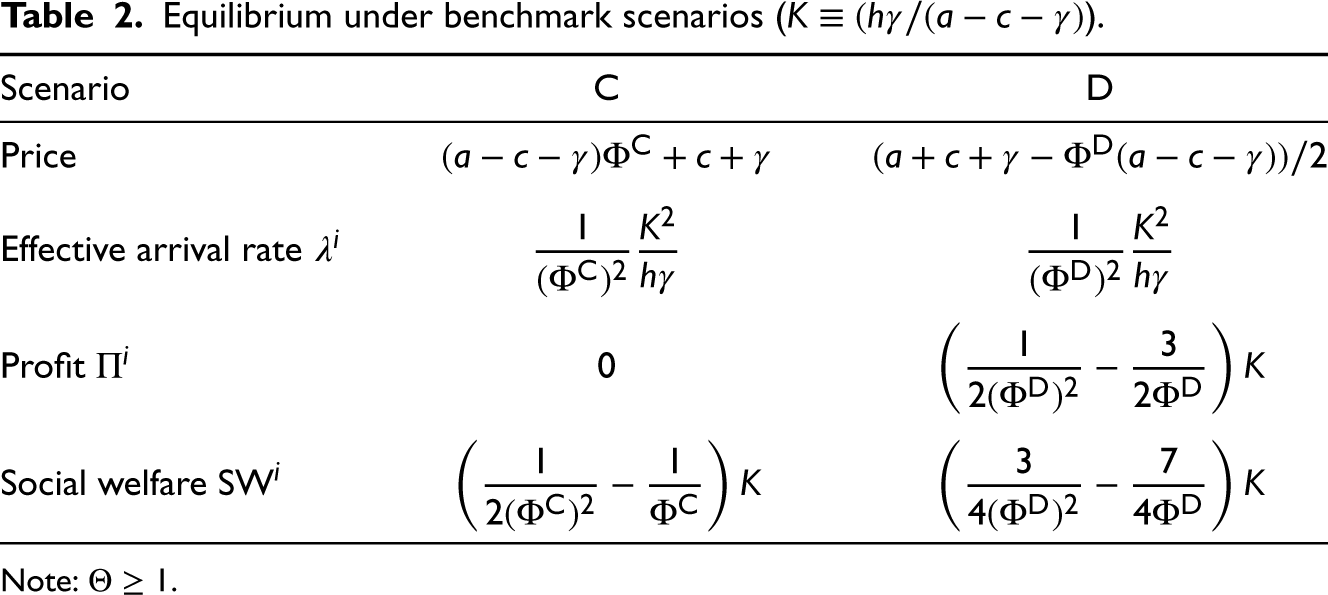
We note from Corollary 1 that the profit is exactly zero under Scenario C. That is, social welfare is maximized when the service provider earns no profit. This is consistent with the observation that a nonprofit usually generates the highest possible social welfare, see, for example, Kaul and Luo (2018). This result highlights the conflict of interest between the government and the private firm. Furthermore, according to Proposition 1, it follows that the optimal service price, wait time, and the firm’s resulting profit level are lower under nationalization than under privatization, while the resulting effective arrival rate, customer surplus, and social welfare are higher under nationalization. That is,
We illustrate the main findings of Proposition 1 and Corollary 1 in Figure 1. As the government’s weight increases from 0 to
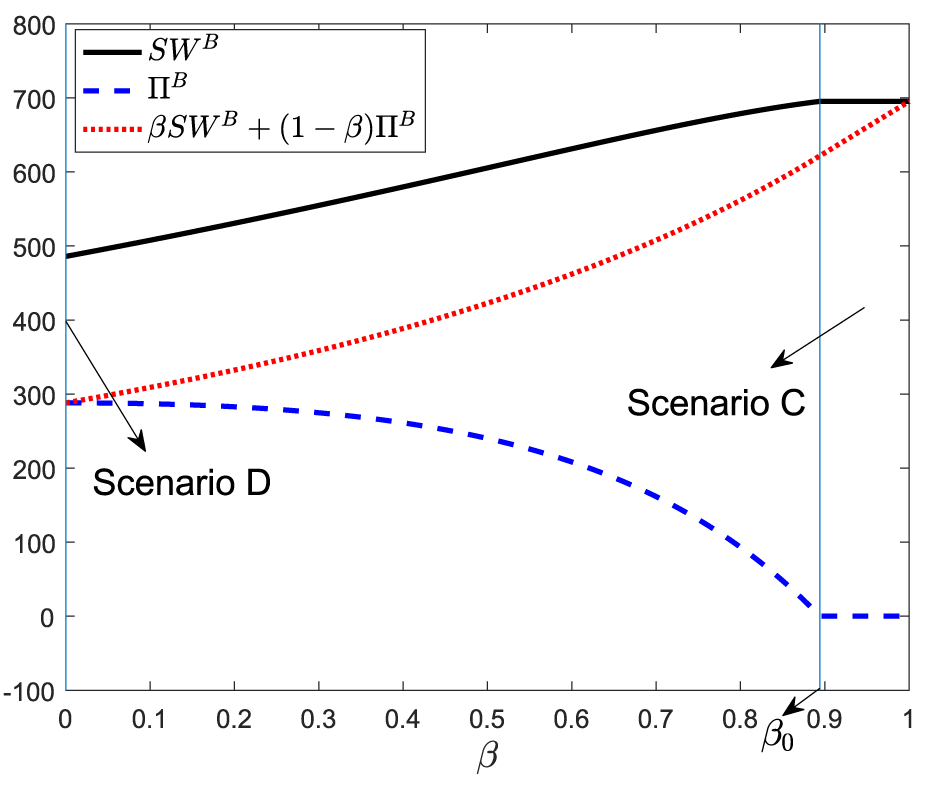
The equilibrium social welfare and profit in the benchmark scenarios (B, C, and D):
In this section, we consider an alternative operating mode for the capital-constrained government, that is, privatization with regulation, to deliver public service. Without the government’s permission, the private firm cannot operate in the public service market. Hence, as a return for delegating the service provision to the private firm, the government can regulate the firm’s operations to mitigate the misalignment of their interests. Consider the scenario in which the government contracts with a private firm. The firm finances, builds, and owns the service system and operates it, whereas the government imposes regulations in the contract. We consider a contract in which the government specifies a price floor
The government may adjust the regulation over time. The reason for such adjustments is two-fold. First, the system parameters can be time-varying. That is, the value of the parameters may change over time. In this case, it is optimal for the government to adjust the regulation term. We refer to this type of adjustment as responsive adjustment. Second, the government may adjust the regulation term for short-term purposes such as earning votes in an election. We refer to this type of adjustment as myopic adjustment. Apparently, the responsive adjustment is beneficial to the government and the public. In contrast, the public may or may not benefit from the myopic adjustment. Hence, we are interested in the impact of myopic adjustment in this paper. Note that our assumption of constant system parameters facilitates us to highlight this impact of myopic adjustment because the responsive adjustment is unnecessary when the system parameters do not change over time.
Regulation Without Myopic Adjustment
In the absence of myopic adjustment, the government does not change its decision over time, and in response, the firm does not change its decision either. Thus, we can model the interaction between the government and the firm as a (one-shot) Stackelberg game. Because the government has stronger bargaining power in public service provision than the firm, it is natural to assume that the government acts as a Stackelberg leader, whereas the firm acts as a follower; see, for example, Guan and Zhuang (2015). Such a Stackelberg game also reflects that the government has commitment power when it does not implement myopic adjustment. In the next section, we study the scenario in which the government implements myopic adjustment. We indicate the regulation without myopic adjustment by superscript “S,” as we model it as a Stackelberg game. For convenience, we use “SP” and “SW” to denote the price and wait time regulation without myopic adjustment, respectively.
Price Regulation Without Myopic Adjustment (SP)
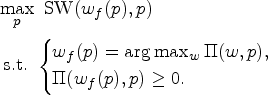
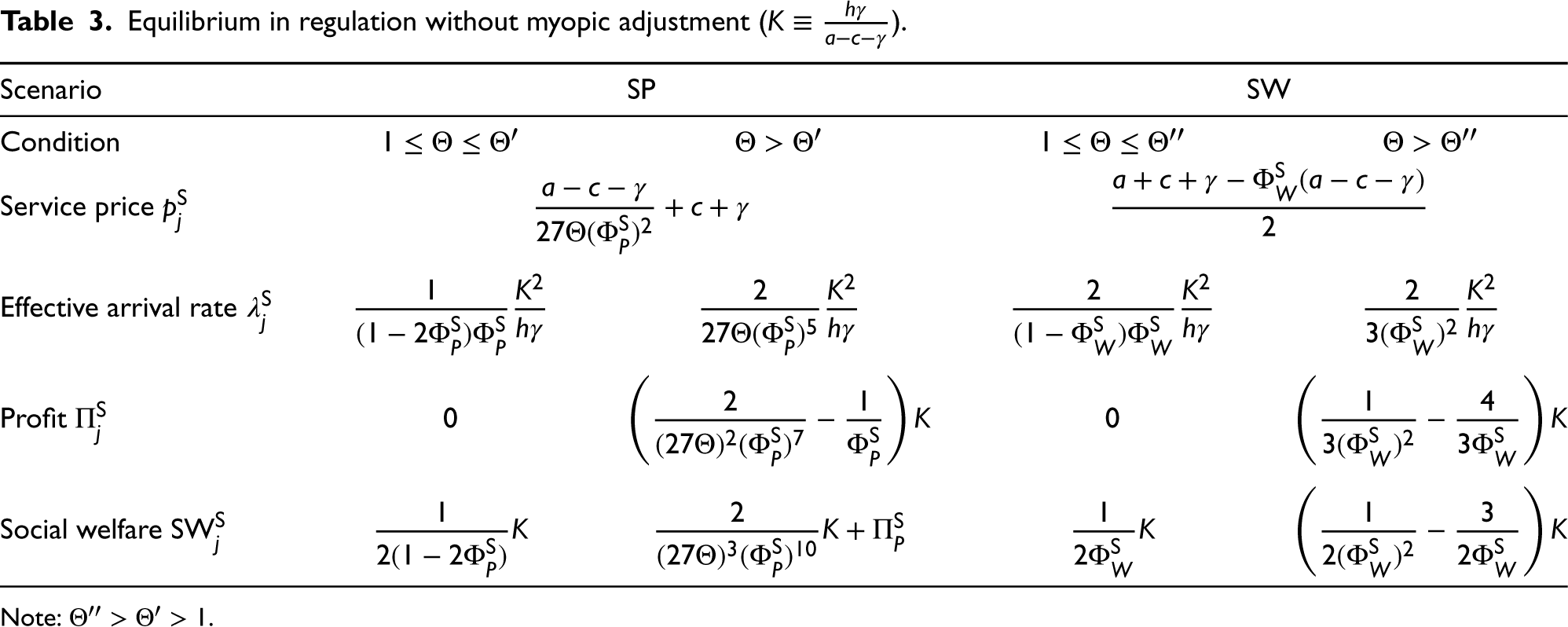
Equilibrium in regulation without myopic adjustment (
Note:
Given the expected wait time 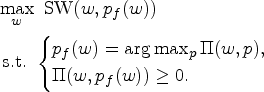
In the absence of the government’s myopic adjustment, under the two regulation scenarios (i.e., If If

When the market size is small, that is,
We compare the equilibrium performances of Scenarios C, D, SP, and SW as follows:
(Wait time) (Service price) (Effective arrival rate) (Firm’s profit) (Social welfare) (Customer surplus) The comparison of the equilibrium customer surplus follows the same order as the equilibrium effective arrival rate.
Recall from (4) that the total customer surplus increases in the effective demand. Thus, the comparison of the total customer surplus follows the same order as that of the equilibrium effective arrival rate. Compared with the regulation scenarios, nationalization (i.e., Scenario C) and privatization (i.e., Scenario D) are two extremes. In the extreme case of nationalization, for the sake of the general public, the government would sacrifice the private firm’s profit to improve customer surplus. Hence, under nationalization, the firm’s profit is the lowest, while the effective demand and social welfare are the highest. At the other extreme of privatization, the firm cares only about profit, thereby leading to the highest profit, the lowest effective demand (and consumer surplus), and the lowest social welfare of all scenarios. In between the two extremes, regulation attempts to protect social welfare by moderating the firm’s self-interested behavior.
As we can see, under SP (respectively, SW), the government’s regulation caps the price (respectively, wait time), that is,
Suppose that the government does not implement myopic adjustment. Compared with wait time regulation, price regulation achieves a win–win situation for the firm and government when
Implied from Theorem 1, Corollary 2 confirms that in the absence of myopic adjustment, price regulation can mitigate the conflict of interest between the government and the firm. Moreover, by Theorem 1(6), when the market size is large enough (i.e.,
As mentioned, when the government adjusts the regulation for short-sighted purposes, the firm can react to change its decision. This may result in disappointing consequences for both parties over the long run. Even so, as long as the firm does not react very quickly, the government can achieve and maintain short-term gains via the regulation adjustment for a certain period of time. However, firms do take time to learn, design, and implement reactive schemes in response to regulation adjustments, that is, myopic adjustment does occur in practice, see, for example, Stiglitz (1998) and Frank (2003), for practical observations and discussions. In response to the firm’s reaction, the government may find it beneficial to adjust the regulation term again, which triggers the firm’s subsequent decision change. This process evolves until no party can be better off by deviating from its own decision. Such an equilibrium concept is exactly captured by Nash equilibrium. In practice, only a few rounds of best responses could lead to an outcome very close to the Nash equilibrium. Therefore, we would focus on the notion of Nash equilibrium for the regulation scenario with myopic adjustment.
To see how the Nash equilibrium forms, we plot the firm’s best response to the government’s regulation in
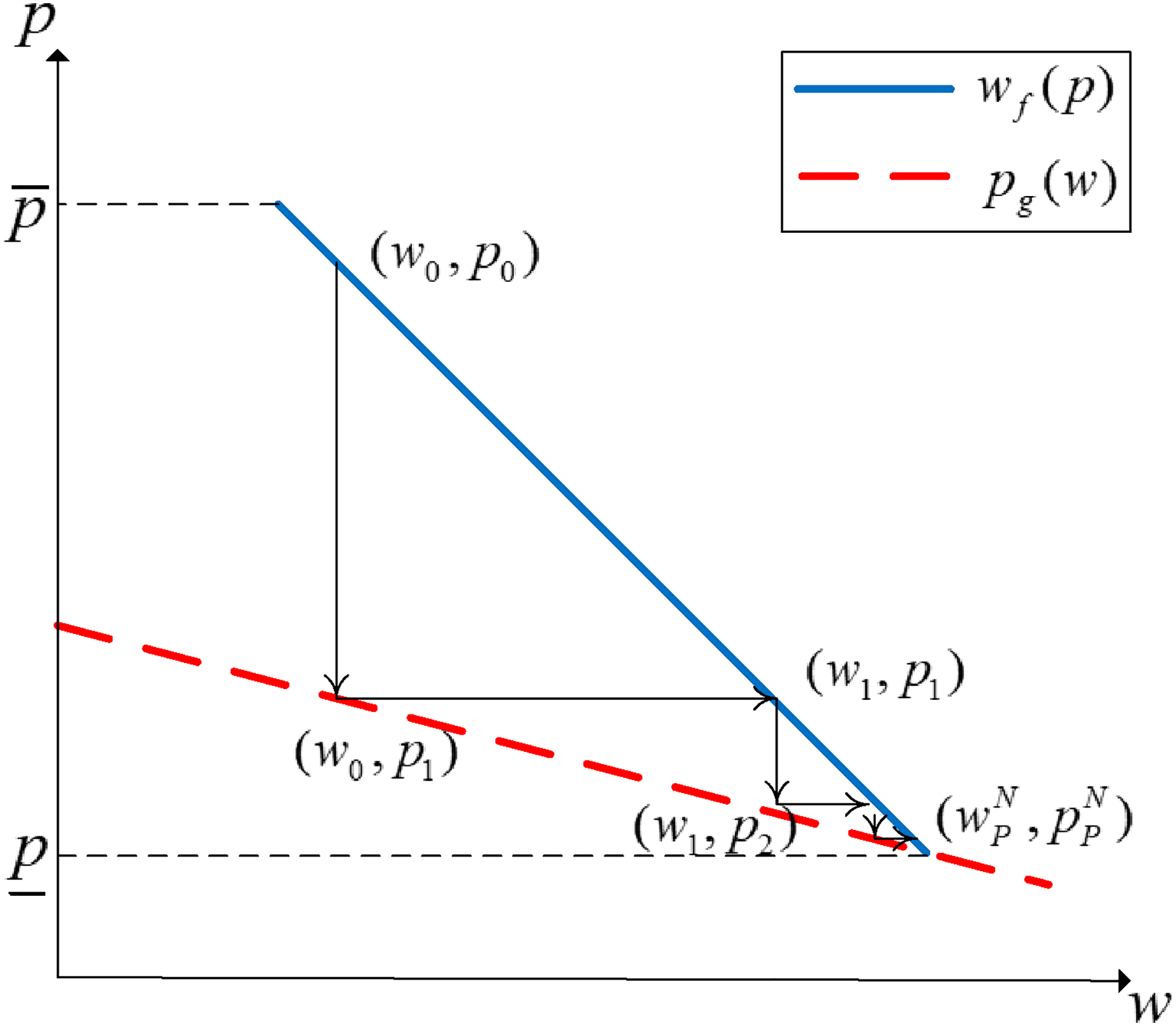
Dynamics in the presence of the government’s myopic adjustment.
Over repeated interactions, the Nash equilibrium can be achieved. However, if the government adjusts the regulation only once, the equilibrium, as a result of the firm’s reaction, will be
Given the wait time 
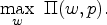
Given the service price 
In the presence of the government’s myopic adjustment, under the two regulation scenarios (i.e., If If Equilibrium in regulation with myopic adjustment ( Note:
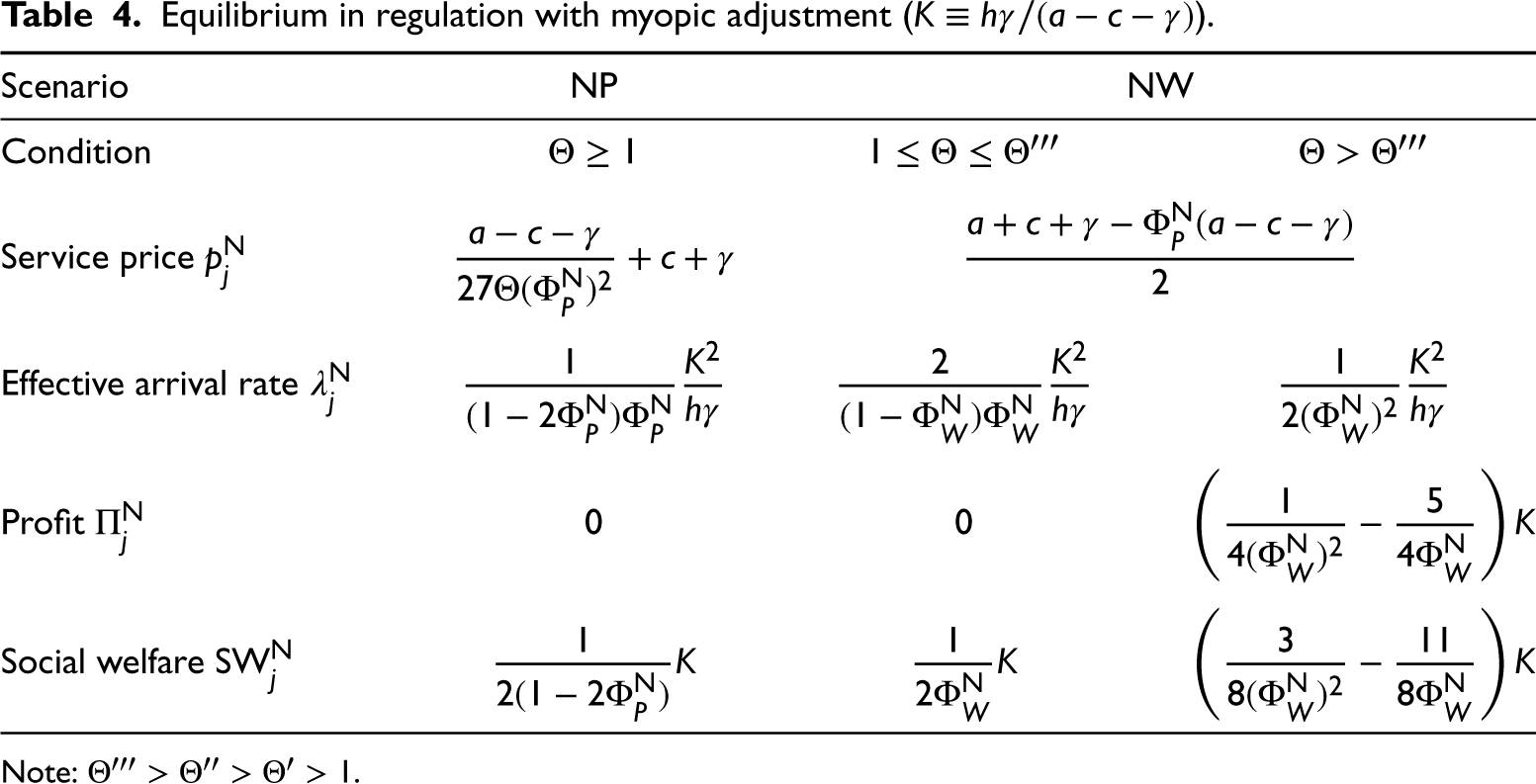
Recall that under Scenario C, the optimal service price that maximizes social welfare is sufficiently low that the firm’s profit is zero. Thus, we conjecture that the government will always undercut the price to pursue its short-sighted objective, that is, to maximize the short-term social welfare, under NP. Indeed, we show in the E-Companion (Supplemental Material) that for any given wait time, social welfare decreases with the regulated price in the parameter space that ensures
We compare the equilibrium performances of Scenarios C, D, NP, and NW as follows:
(Wait time) (Service price) (Effective arrival rate) (Firm’s profit) (Social welfare) (Customer surplus) The comparison of the equilibrium customer surplus follows the same order as the equilibrium effective arrival rate.
Like regulations without myopic adjustment, regulations with myopic adjustment have a direct effect on the targeted instrument and a side effect on the unregulated one:
Both regulation schemes have a positive effect on the effective arrival rate and customer surplus (with a lower price in NP and a higher service capacity in NW). However, the impact from NW is weakened by the increased price such that
Among Scenarios D, NP, and NW, no one scenario leads to a win–win–win situation for the firm, customers, and government over another. Scenario NW achieves a win–win situation for the firm and government over Scenario NP. Compared with Scenario D, Scenario NP leads to a lose–lose situation for the firm and government when
Corollary 3 highlights that neither price nor wait time regulation Pareto dominates the other for the government, firm, and customers in the presence of the government’s myopic adjustment. Moreover, price regulation with myopic adjustment may result in lower social welfare and lower profit for the firm than privatization. Thus, the government’s myopic adjustment may reduce the efficiency of price regulation over the long run.
In the presence of myopic adjustment, regulation efficiency, and the firm’s profit decrease, regardless of the regulation instrument, that is, The (negative) impact of myopic adjustment is more significant under price regulation than under wait time regulation, that is,
As confirmed by Theorem 3, regulation efficiency (in terms of maximizing welfare) decreases in the presence of the government’s myopic adjustment. It may not be surprising that the government is worse off when pursuing short-sighted objectives, but surprisingly, the private firm also gets hurt in this situation. This is because the government needs to keep adjusting its actions in order to improve social welfare, which means it keeps undercutting the firm’s profit. Moreover, regulation efficiency decreases more under price regulation than under wait time regulation, so the government prefers price regulation in the absence of myopic adjustment and wait time regulation in the presence of myopic adjustment. To better understand this phenomenon, it is helpful to remember that there exists a conflict of interest between the government and the firm, as revealed in Scenario C, and that when the government regulates the wait time, the firm has one more degree of freedom in deciding on its service capacity. In the absence of myopic adjustment, the government, as the Stackelberg leader, can better influence the firm’s decision about capacity investment when regulating the price, whereas its influence is weaker under wait time regulation because the firm will use the extra degree of freedom in its operational capacity to improve its profit, thereby undercutting social welfare. However, in the presence of myopic adjustment, when the government regulates the price, social welfare maximization drives the government to reduce the price invariably, while the firm reacts by decreasing capacity investment over time, thereby leading to a prisoner’s dilemma in which the firm earns zero profit and social welfare is the lowest among Scenarios SP, SW, NP, and NW (
In the following, we compare the performance of the joint venture and regulations. Combining Proposition 1 and Theorems 1 and 2, we have the following results.
(Regulations Versus Joint Venture )
(i) There exist two thresholds,
(ii) For
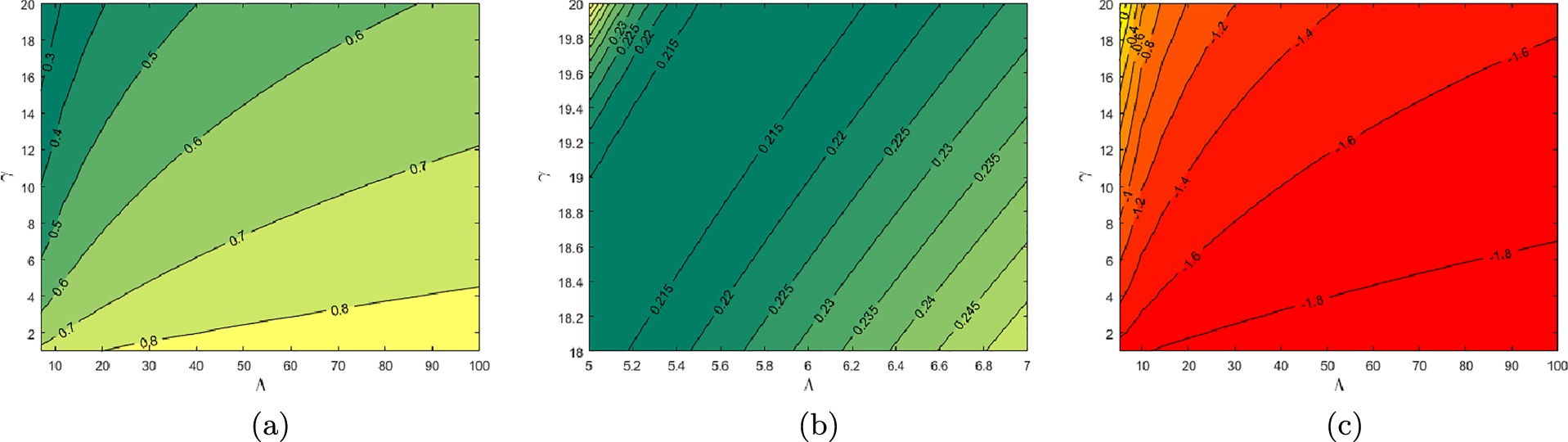
RI versus
With a sufficiently high weight on social welfare, the joint venture achieves greater social welfare than it would under a specific regulation scheme. However, such significant control of the joint venture project typically requires the government to invest sufficient assets, whereas regulation does not. It is worthwhile noting that when the market size is large enough (i.e.,
Sensitivity Analysis
In this subsection, we explore how system parameters, such as the potential market size 
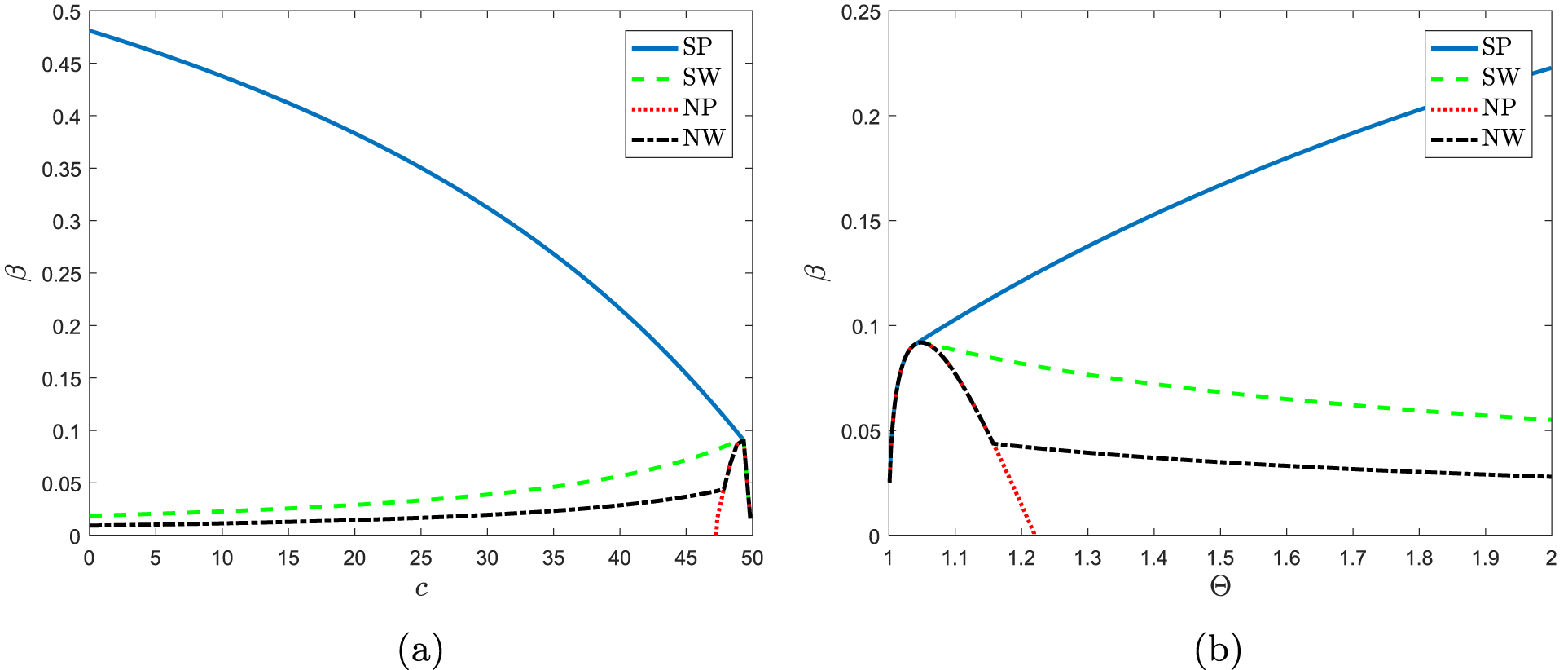
The value of
Figures 3(a) and (b) illustrate how
As mentioned, the performance of Scenario B hinges on the value of
First, because social welfare in Scenario B increases in
In E-Companion A (Supplemental Material), we provide two practical examples, toll tunnels and outpatient clinics in Hong Kong, to demonstrate the efficiency of regulation and the joint venture. The two examples have different cost structures. The service capacity cost is relatively high for the clinic example but low for the tunnel example. The examples show that given that the system is very congested under privatization, for example, when the service capacity cost is high enough (as in the clinic example), Scenario B (i.e., the joint venture) outperforms all possible regulatory schemes even when the government takes only a small share (as small as 9.973%) in the project. Heavy congestion is often observed in healthcare systems. Our result thus suggests that investing in private healthcare systems, even with a small share, could go a long way by benefiting the public a lot. However, in the tunnel example, where the service capacity cost is relatively low and the market size is relatively large, the government needs to take an 87.685% share of the project in Scenario B to achieve the same social welfare obtained in Scenario SP.
Conclusion
We first illustrate the conflict between the government’s objective of maximizing social welfare and the firm’s objective of maximizing profit. Joint venture can mitigate this conflict by combining these two objectives. However, it requires more capital investment for the government to increase the resulting social welfare. Then, we examine two regulation instruments designed to mitigate the conflict. Compared with no regulation at all, price regulation caps the service price, but it results in a longer expected wait time; wait time regulation decreases the expected wait time, but it leads to a higher service price. The firm’s profitability is hurt by regulation, and social welfare does not necessarily increase: when price regulation is adopted and the government pursues the short-sighted social-welfare-maximizing objective by myopic adjustment over time, social welfare may not benefit from regulation. Government must recognize this when choosing a method of regulation: in the presence of myopic adjustment, price regulation leads to a prisoner’s dilemma for the government and the firm. However, price regulation (respectively, wait time regulation) is to the government’s advantage in the absence (respectively, presence) of myopic adjustment. Our result also implies that a higher throughput may reduce the welfare of the system. Thus, it could be helpful if the government regulates the number of customers who can access the system, for example, by limiting the number of customers who can be served in a day. Finally, we compare the performances of the regulations and joint venture and show that, in some instances, the joint venture outperforms all the regulation schemes, even when the government takes only a small share in the project. In contrast, in other instances, the government must take a large share in a joint venture to achieve the same performance under price regulation without myopic adjustment.
Our paper has some limitations. First, we assume that customers are homogeneous in delay sensitivity. One may consider a scenario in which delay sensitivity is heterogeneous across customers, or a customer’s delay sensitivity is related (e.g., proportional) to her service valuation. Second, our model does not take market uncertainty into account. For instance, the potential market size could be stochastic, following some distribution. Lastly, we do not study the regulation performance in a competitive environment with two or more service providers, which would be interesting. We leave exploring these directions to future research.
Supplemental Material
sj-pdf-1-pao-10.1177_10591478241235005 - Supplemental material for Regulation of Privatized Public Service Systems
Supplemental material, sj-pdf-1-pao-10.1177_10591478241235005 for Regulation of Privatized Public Service Systems by Ming Hu, Weixiang Huang, Chunhui Liu and Wenhui Zhou in Production and Operations Management
Footnotes
Acknowledgments
We thank the thoughtful and constructive comments from J. George Shanthikumar (Department Editor), an anonymous senior editor, and three anonymous referees. Their suggestions considerably improved the paper. Authors are listed in alphabetical order with implied equal contribution and authorship.
Declaration of Conflicting Interests
The author(s) declared no potential conflicts of interest with respect to the research, authorship, and/or publication of this article.
Funding
The authors disclosed receipt of the following financial support for the research, authorship, and/or publication of this article: Wenhui Zhou was partially supported by the National Science Foundation of China, Grant/Award Numbers: 71925002. Weixiang Huang was partially supported by the National Science Foundation of China, Grant/Award Numbers: 72271098 and 72321001, and the Basic and Applied Basic Research Fund of Guangdong Province, Grant/Award Number: 2022A1515011983. The research of Ming Hu is in part supported by the Natural Sciences and Engineering Research Council of Canada, Grant/Award Numbers: RGPIN-2021-04295.

Notes
How to cite this article
Hu M, Huang W, Liu C, Zhou W (2024) Regulation of Privatized Public Service Systems. Production and Operations Management 33(4): 979–994.
References
Supplementary Material
Please find the following supplemental material available below.
For Open Access articles published under a Creative Commons License, all supplemental material carries the same license as the article it is associated with.
For non-Open Access articles published, all supplemental material carries a non-exclusive license, and permission requests for re-use of supplemental material or any part of supplemental material shall be sent directly to the copyright owner as specified in the copyright notice associated with the article.
