




Abstract
This article investigates a setting where the retailer invests costly effort to shape demand, such as reducing demand fluctuation through demand–control effort or increasing demand levels with demand–promotion effort. We explore the preference bias between these two effort types and examine the impact of such a bias on profit performance. The experimental findings reveal that actual effort investments exhibit a significant preference bias for promotion effort in the low-profit condition, while no significant preference bias is observed in the high-profit condition. This behavioral pattern can be captured by a reference-dependent behavioral model incorporating the retailer's optimism level in the reference point. Additional analyses, such as robustness experiments and model extensions, provide further support for the promotion-effort bias in the low-profit condition. Our analysis presents a comprehensive understanding of demand-shaping effort preferences and extends the application of the reference-dependence framework. It provides insights for managers in identifying potential biases and mitigating profit loss in demand-shaping activities.
Keywords
Introduction
The escalating importance of resource allocation for scaling up a retailer's business has been widely recognized in the industry and the academic literature. This issue entails the optimal distribution of a firm's budget across various activities that influence market conditions and customer behavior (Berry, 2014; Kung and Chen, 2012). Demand–control and demand–promotion efforts are two examples of such activities competing for a firm's limited resources. Demand–control efforts focus on activities that regulate demand fluctuations by enhancing demand forecasting accuracy, thus reducing supply–demand mismatch costs. In contrast, demand–promotion efforts involve practices that bolster demand levels through advertising and increased sales. In the face of rapidly evolving customer behavior and emerging competitors, resource-intensive retailers must promptly scale up their businesses to remain competitive.
Erroneous choices between the two effort types can lead to substantial profit losses. For instance, Walmart's expansion in Germany (2006) and Lidl's expansion in the United States (2018) were unsuccessful, largely due to insufficient investments in understanding local customer preferences (Pearson, 2018). Carrefour's failure in Singapore and Malaysia can be partly attributed to its reluctance to promote its brand (Marketing Interactive, 2012). Managers often resort to simple heuristics and rules to allocate resources, such as the “percentage-of-sales” rule for advertising budgets (Lilien et al., 1992) or constraining sales-force costs based on total sales percentage (Sinha and Zoltners, 2001). While practitioners and academics acknowledge the significance of each effort type for company performance (De Luca and Atuahene-Gima, 2007; Song and Parry, 1992), particularly with advancements in digital technologies that offer new operational possibilities (Mithas et al., 2012), the retailer's subjective preference for a specific effort type remains unclear.
To the best of our knowledge, only a few behavioral studies have simultaneously examined these two demand-shaping efforts, which are resource-intensive and vie for a firm's limited resources. Most studies have been theoretical, focusing on models that elicit a particular effort type primarily by configuring contract terms or transfer payments (Kurtuluş et al., 2012; Taylor, 2002; Taylor and Xiao, 2009). As such, through a behavioral lens, we aim to answer the following research questions: (a) Is there a preference bias for a specific demand-shaping effort, leading to overinvestment in that effort type relative to normative predictions? (b) Is this preference bias symmetrical between high- and low-profit margin products? (c) Which behavioral theory can account for this preference bias?
We address these questions in a newsvendor setting, where the retailer invests costly effort to shape demand before determining order quantity. The retailer chooses between control and promotion efforts, considering the influence of each effort type on demand—specifically, the degree to which demand uncertainty is reduced or demand level is increased. We develop a behavioral model based on reference dependence to predict the retailer's actual effort investments. This framework has been extensively studied in the context of newsvendor ordering decisions. Our proposed model predicts a preference bias for promotion effort over control effort, particularly for low-profit products. We also show that this bias decreases as the decision maker's level of optimism increases. Furthermore, our analysis predicts that the strength of the bias toward promotion effort is greater in the low-profit condition compared to its symmetric high-profit condition.
We conducted a laboratory experiment to empirically test our predictions. The experimental data revealed that (a) actual effort investments exhibit a significant preference bias for promotion effort in the low-profit condition, while no significant preference bias is observed in the high-profit condition and (b) a reference-dependent behavioral model incorporating optimism levels can capture such behavioral patterns. We included additional analyses, such as robustness experiments and model extensions, to provide more support for our findings.
Our study makes two significant contributions. First, to the best of our knowledge, this is the first study to analytically and experimentally demonstrate that retailers perceive the two demand-shaping effort types differently. Actual effort investments exhibit a preference bias for increasing the demand mean (promotion effort) rather than reducing the demand uncertainty (control effort) in the low-profit condition. In contrast, the preference bias can point in either direction in the high-profit condition. Such a bias depends on the decision maker's optimism level. These findings suggest that managers should reassess their optimism level when making effort decisions to properly evaluate each effort's impact.
Second, we use the reference-dependence framework proposed by Kirshner and Ovchinnikov (2018) to predict a preference bias in investing demand-shaping efforts. We validate the proposed behavioral theory using a laboratory experiment and derive managerial insights. Accordingly, we show that such a framework can be extended to predict behavioral biases in another operational setting, the retailer's costly demand-shaping effort. These findings contribute to the literature investigating a unified behavioral theory that can capture various retailer decisions. Our study represents a step toward finding robust, broadly applicable behavioral models.
This article is organized as follows. Section 2 presents a review of the related literature. Section 3 describes the setting of the demand-shaping effort investment and analyzes the normative and behavioral models. Section 4 details the experimental configuration and develops testable hypotheses. Section 5 analyzes the experimental data, provides tests for the hypotheses, and evaluates the behavioral model. Section 6 shows the robustness experiments and model extensions. Finally, Section 7 summarizes our results and discusses alternative potential explanatory factors, managerial and theoretical implications, and future research directions.
Literature Review
This study examines retailers’ preferences between two types of demand-shaping efforts. Retailers can influence demand by investing either control effort, which reduces demand uncertainty, or promotion effort, which increases demand. Theoretical studies on individual types of effort have been extensively developed, while few studies have simultaneously investigated both types of effort. One research stream focuses on the benefits of demand-shaping efforts for the supply chain. Chen and Xiao (2012) and Taylor and Xiao (2010) examine the influence of forecasting capabilities on supply chain performance among competing channel members. Tsay and Agrawal (2004) explore the potential advantages of including a direct sales channel in the presence of sales efforts. Kurtuluş et al. (2014) investigate the impact of category management on sales effort investment. Li (2023) examines how reducing demand uncertainty leads to increased profits for a newsvendor in a competitive environment.
Another research stream investigates how the interaction between supply chain contracts and the properties of demand-shaping efforts can induce the desired amount of control effort (Amornpetchkul et al., 2015; Marschak et al., 2015; Shin and Tunca, 2010; Taylor and Xiao, 2009) or promotion effort (Cachon and Lariviere, 2005; Krishnan et al., 2004; Mukhopadhyay et al., 2009; Taylor, 2002). Kurtuluş et al. (2012) observe higher control efforts under non-coordinating contracts. Taylor and Xiao (2009) demonstrate that the buyback contract outperforms the rebate contract in inducing control effort. Kouvelis and Shi (2020) reveal that the rebate contract yields higher promotion effort than the buyback contract when the retailer compensates the agent who invests the effort, whereas a wholesale price contract results in greater promotion effort than the two coordinating contracts when the manufacturer compensates the agent.
Notably, the literature typically examines control and promotion efforts independently, with little discussion on the preference for one type of effort over the other. One of our research contributions lies in exploring the preference bias between control and promotion efforts.
In contrast to theoretical studies, research in behavioral operations has developed a growing interest in understanding retailer decisions based on empirical data and refining standard theories. One robust finding is that these decisions usually deviate from predictions made by normative theory because of behavioral factors. One typical retailer decision is information sharing with upstream echelons, which can be influenced by lying aversion (Özer et al., 2011), gender (Ma et al., 2020), and communication methods (Johnsen et al., 2020). Another type of decision is bargaining over contract terms, which has been observed to be impacted by response time (Chen et al., 2023), loss aversion, reference dependence (Davis, 2015), and equality preference (Cui and Mallucci, 2016; Katok and Pavlov, 2013; Zhao et al., 2019). The most widely discussed topic is the ordering decisions of a newsvendor. Actual orders exhibit the “pull-to-center” effect, that is, above optimal levels in the low-profit condition and below optimal levels in the high-profit condition (Schweitzer and Cachon, 2000). This systematic regularity has been explained by ex-post inventory error regret (Kremer et al., 2014), anchoring and insufficient adjustment (Schweitzer and Cachon, 2000), and overconfidence (Ren et al., 2017; Ren and Croson, 2013). Becker-Peth and Thonemann (2018) comprehensively review behavioral articles in this setting. Our article contributes to the literature by studying another operational decision, the retailer's costly demand-shaping effort.
We conducted our study within the context of the newsvendor model and employed the reference-dependence framework to develop a behavioral model. Numerous theoretical studies and empirical evidence have substantiated this framework (Ho et al., 2010; Kőszegi and Rabin, 2006; Long and Nasiry, 2015). By incorporating selected reference points, the framework can accommodate both aggregate-level performance and individual-level heterogeneity, which other models, such as ex-post inventory regret or overconfidence, fail to address (Jammernegg et al., 2022; Uppari and Hasija, 2019).
Reference-dependent preference theory posits that decision-makers evaluate gains and losses relative to a reference point (Kahneman and Tversky, 1979). Ho et al. (2010) use realized demands as reference points and incorporate psychological costs related to inventory errors into the retailer's utility. This model has also been applied in other operational contexts (Davis, 2015; Zhao et al., 2020), offering additional empirical support for its theoretical foundations. Long and Nasiry (2015) propose another model, illustrating that the observed ordering tendencies of newsvendors can be explained using a reference point defined as a weighted average between the best and worst payoffs. This model has been utilized by Uppari and Hasija (2019) in a newsvendor context. In a subsequent study, Kirshner and Ovchinnikov (2018) show that the two aforementioned behavioral models are mathematically equivalent under loss and risk neutrality assumptions.
Similar to ordering decisions, investing in demand-shaping efforts involves dealing with uncertainty and weighing tradeoffs between gains and losses. Consequently, we base our behavioral model on the same framework as Kirshner and Ovchinnikov (2018), also assuming loss neutrality and risk neutrality. Such a formulation allows us to use the equivalency between the two previous reference-dependence models for predicting effort decisions. By employing this parsimonious model to explore effort decisions, we contribute empirical support to the robustness of Kirshner and Ovchinnikov's framework in predicting behavioral patterns, extending beyond newsvendor ordering decisions.
Model Analysis
The retailer's demand-shaping effort investment model is formulated within a newsvendor setting. The sequence of events is as follows. At the beginning of the selling season, the retailer initially decides whether to invest in control or promotion efforts. In practice, a company can invest in both efforts simultaneously while still needing to consider allocating resources between the two efforts (Erickson and Jacobson, 1992; Peterson and Jeong, 2010; Vinod and Rao, 2000). Without loss of generality, we assume that only one type of effort can be invested at a time. Both efforts have an associated cost, E. The underlying demand distribution is updated based on the chosen effort. Subsequently, the retailer selects an order quantity, considering a unit wholesale price (
The original market demand distribution (prior to effort investment) is denoted by
If the retailer invests in control effort (
Normative Model
We calculate the retailer's first-best expected profit






We compare the retailer's profit under each investment type to better understand the tradeoffs between the two effort investments. The retailer's relative profit from investing promotion effort over control effort is expressed as
There is a threshold of the promotion-effort factor,
invests control effort (
invests promotion effort (
Otherwise, the retailer is indifferent between control and promotion efforts. Additionally,
Proposition 1 indicates that
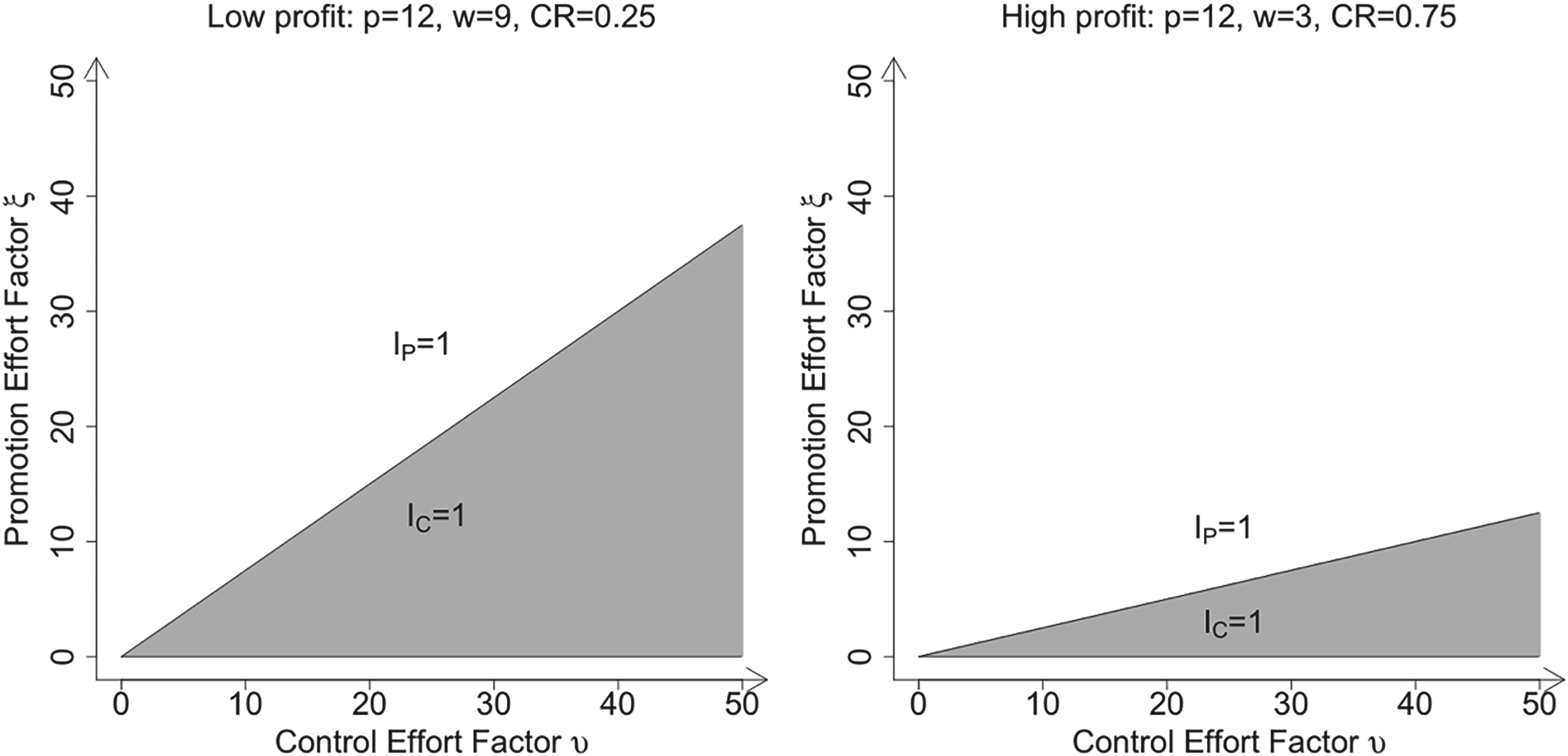
Optimal efforts under combinations of
Individuals have been observed to make decisions based on outcomes relative to a reference point rather than absolute outcomes (Kahneman and Tversky, 1979). Such a reference-dependence framework is well-developed and is primarily used in behavioral operations to predict newsvendor ordering decisions (Ho et al., 2010; Jammernegg et al., 2022; Long and Nasiry, 2015; Uppari and Hasija, 2019). We apply this framework to predict behavioral biases in another fundamental operations management problem, namely, selecting demand-shaping efforts.
Our behavioral model is based on the reference-dependence framework by Kirshner and Ovchinnikov (2018). These authors demonstrate that the models of Long and Nasiry (2015) and Ho et al. (2010) result in identical ordering quantity predictions (i.e., mathematical equivalence) under specific reparameterizations. In this article, we use this framework to formulate our behavioral model because of its parsimony and significant theoretical findings. In Section 4.2, we add bounded rationality theory to develop research hypotheses considering the random errors existing in human decisions.
Let
Accordingly, the reference effect function


To better understand how the framework influences the retailer's behavior, we examine the attributes of expected reference effect function
Since we focus on demand-shaping effort investments, we assume that the order quantity remains unaffected by the reference-dependent framework. Instead, the order quantity is set to optimize the expected profit given the chosen effort. This assumption is reasonable, as operational decisions are typically decentralized and handled by different departments within a company (Papier and Thonemann, 2021; Scheele et al., 2018). In our context, the sales or marketing department is responsible for effort investments, while the operations department manages inventory decisions. It is common for one department to presume that the other is making the best decisions. Also, technological advancements enable automatic inventory replenishment (Zhang et al., 2016), aligning with the optimal ordering assumption. In Section 6.2.1, we show that our findings remain consistent without this assumption.
Now, we analyze the influence of the reference-dependent framework on effort choice. We use

Setting
If
We provide the following explanations for Proposition 2 and the mechanisms leading to the preference bias. It is important to note that the reference effect resulting from promotion effort remains unchanged with respect to
When
On the other hand, when
From the above discussion, it can be observed that the value of
Following the results of Ho et al. (2010),
Proposition 2 proposes the conditions for the effort preferences. In the
In the low-profit condition, effort investments exhibit a preference bias for promotion effort, that is,
The consistent preference bias shown in the
For the
In addition, we compare the strength of the preference bias (measured by
When
When
Propositions 4a and 4b can be explained as follows. When
In summary, we predict a decision pattern different from the normative model when reference dependence is considered during the retailer's decision process. We expect a significant promotion-effort preference bias in the
We conducted the experiment for both the
Experimental Design
Each subject participated in only one profit condition and made demand-shaping effort decisions for nine independent tasks. Following the normative model, (a) three tasks had
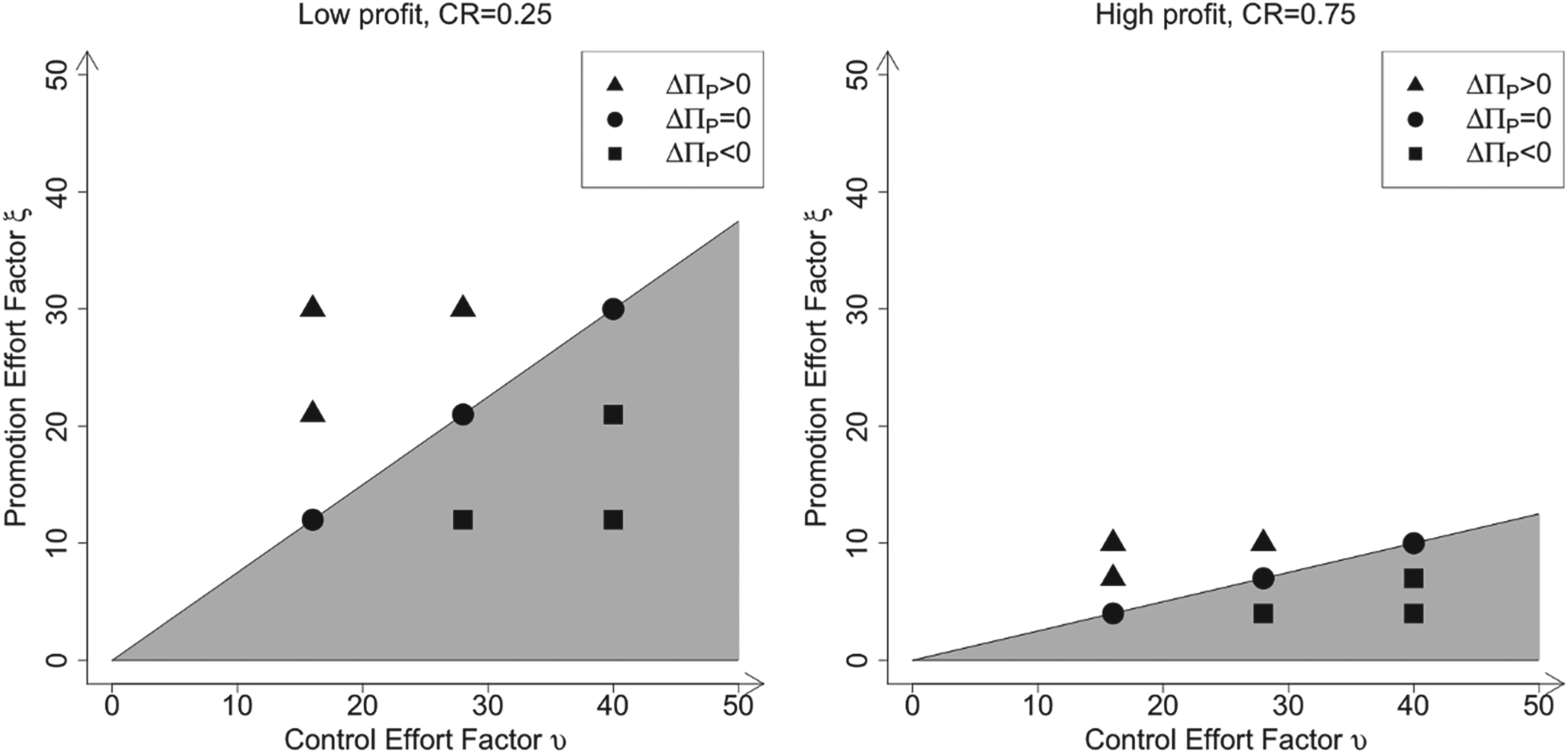
Experimental predictions based on effort factor
Summary of experimental parameters.
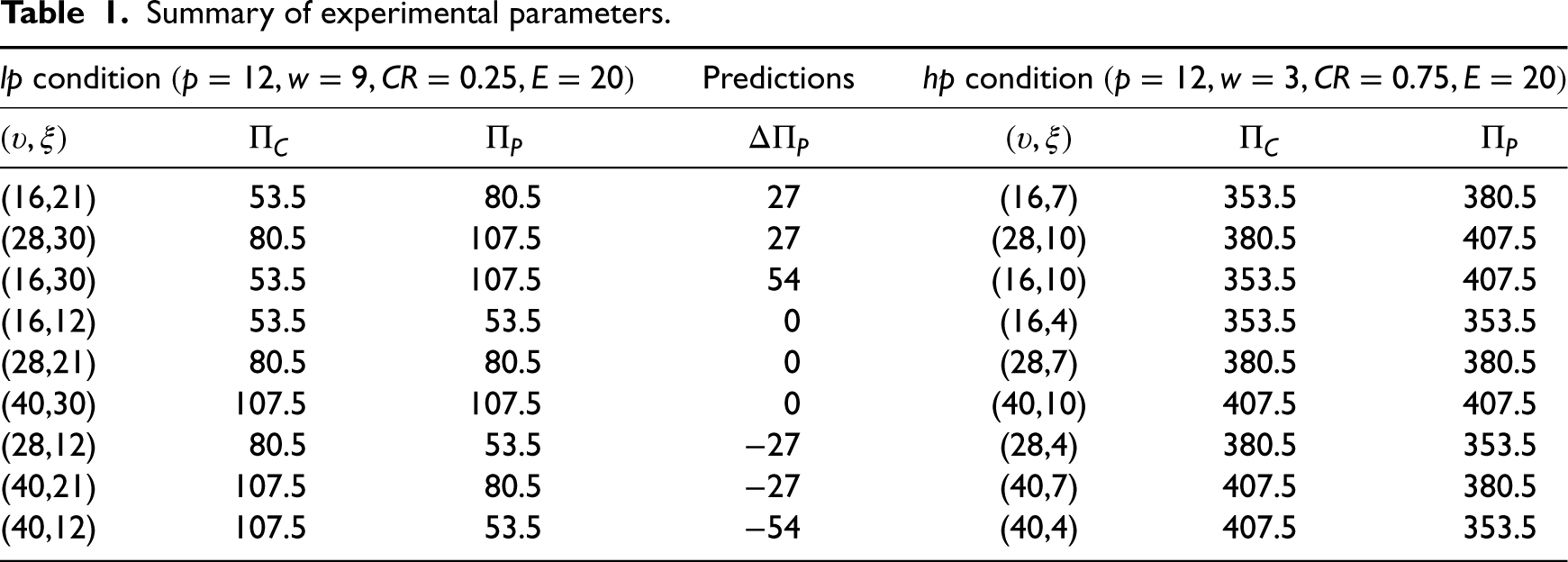
The experimental design was motivated by the following factors. First, the experiment task directly replicated the costly demand-shaping effort setting modeled in Section 3.1. It aimed to directly elicit subjects’ preferences between control and promotion efforts. Subjects chose between the two demand-shaping efforts based solely on each one's direct impact on the original demand distribution and realized profits. Second, as shown in Figure 2, we used three sets of
To mitigate potential confounding factors, we included the following configurations. First, 18 unique sequences of the nine tasks were generated by a Latin Square design and randomly assigned to subjects to eliminate the sequential effect (Bradley, 1958). Second, we provided decision support to reduce task complexity and control cognitive limitations in information processing. For example, the subjects were shown how the demand distribution was transformed based on the chosen effort in the main-task interface. A plot of 30 demand realizations before and after each demand shaping is shown for each effort. In addition, a plot of the realized profits associated with an effort investment across all possible demand realization was provided. Instead of explicitly showing the order quantities, we implemented these design configurations to avoid unintentional anchoring. Third, we randomized the locations of the effort-choice buttons to reduce the influence of perfunctory selection or consistent favoring of one side of the screen (Harrison and Rutström, 2009). Half of the subjects saw the control-effort button on the left and the promotion-effort button on the right, while the other half were presented with the opposite layout. Fourth, each task ended with a 10-s waiting screen, indicating the termination of a particular task and ensuring the understanding of a new combination
The experiment was programmed in z-Tree (Fischbacher, 2007) and implemented online using z-Tree Unleashed (Duch et al., 2020). Subjects were recruited on campus through the ORSEE recruitment platform (Greiner, 2004). We recruited 184 subjects (
Following the main experimental phase, subjects participated in a loss-aversion elicitation task adapted from Bolton et al. (2023) and Gächter et al. (2022). This task was included to empirically analyze whether loss aversion influenced effort decisions. The task consisted of seven choices in which the winning prize was fixed and the losing prize varied (see Figure C7 in Section C of the Supplemental Material for details and a screenshot). Our behavioral model and the corresponding analyses are based on the model of Kirshner and Ovchinnikov (2018), which assumes loss neutrality. Thus, examining the influence of loss aversion helps validate our behavioral model.
At the end of the experiment session, the subjects viewed a summary of their earnings. They were paid based on their overall performance in the main and loss-aversion elicitation tasks. The exchange rates were 1 euro = 400 ECU (Experimental Currency Units) and 1 euro = 85 ECU for the
Following the perfectly rational theory assumed in the normative model, the retailer chooses promotion effort if
Hypothesis 1. Across all nine tasks, the value of
Any deviation from this perfectly rational prediction indicates a preference for a specific effort. According to the behavioral model, the relative net utility from investing promotion effort over control effort is given by
Hypothesis 2. Across all nine tasks, the value of
In the
The next hypothesis concerns the asymmetric preference biases existing between the profit conditions. Because the previous estimates of
Hypothesis 3. Across all nine tasks, the value of
Data Analysis
In this section, we present the experimental results. We take the mean promotion effort investment of an individual subject as the unit of analysis. The Wilcoxon signed-rank test is used for one-sample tests, and the Mann–Whitney test for two-sample tests, using two-tailed p-values for all tests. In Section 5.1, we report the preliminary analysis and show the performance of the effort investments. For some tests, we examined whether the proportions differed significantly from 50% because testing
Performance of Decisions
First, we calculated the proportion of optimal decisions in the
The proportions investing the optimal effort type (%; excluding
).
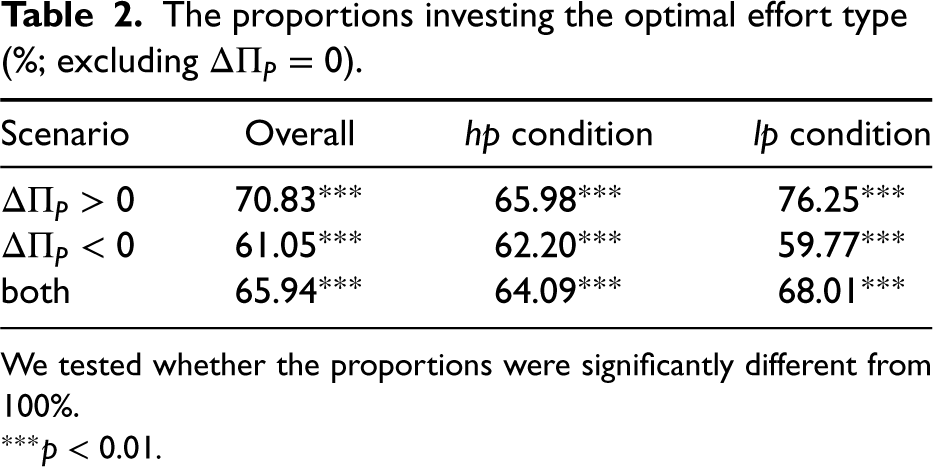
The proportions investing the optimal effort type (%; excluding
We tested whether the proportions were significantly different from 100%.
Upon examining the overall data, the proportion of investing the optimal effort is significantly larger in scenario
The proportions investing promotion effort (%).
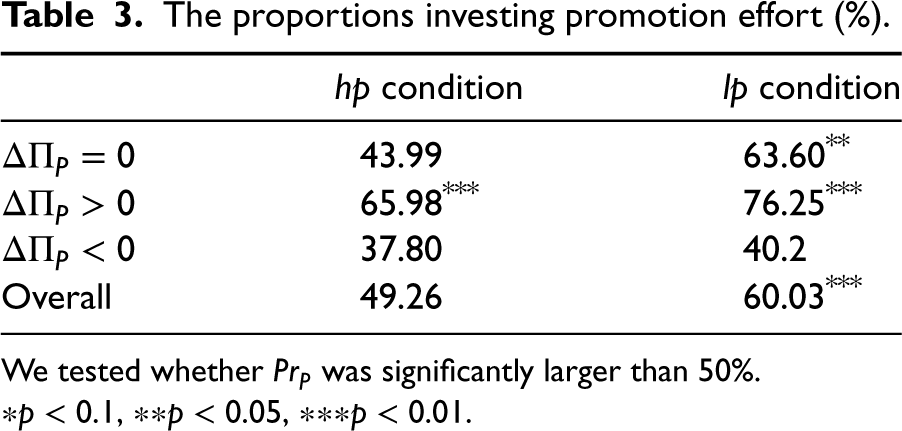
We tested whether
First, we note that the proportion in the
The effort decisions in the
In Section 5.1, the experimental results indicate a significant preference bias toward promotion effort. Since decision deviations are influenced by both bounded rationality and the theorized preference bias, comparing the proportions of promotion effort alone does not reveal the magnitude of the bias. To further demonstrate the existence of and measure the strength of the observed preference bias, we follow the behavioral model described by Equation (9) to estimate promotion-effort preference bias 
Table 4 presents the estimation results. In Model 1,
Maximum likelihood estimates for the promotion-effort preference bias measure
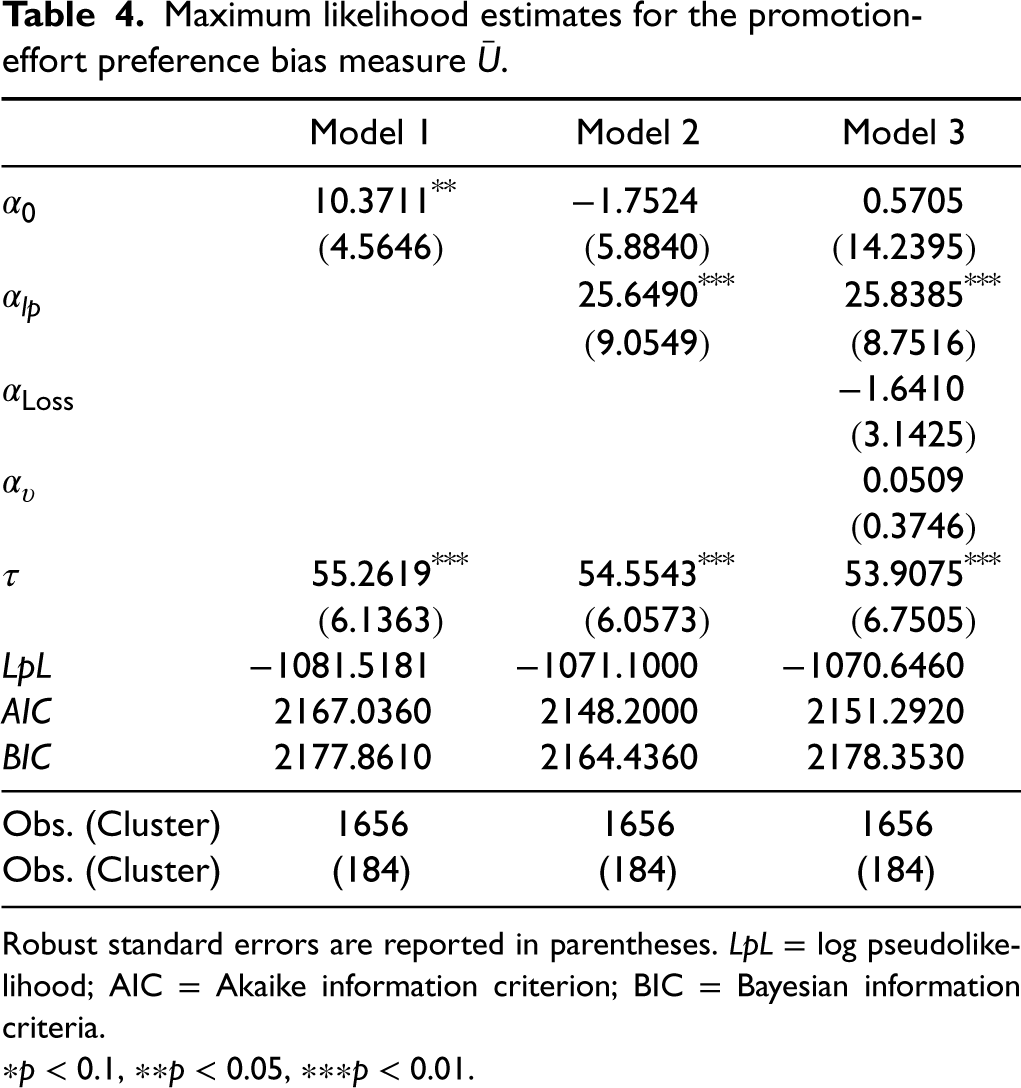
Robust standard errors are reported in parentheses.
As additional analysis to verify the theoretical formulation of
Overall, the experimental data support the predictions of the reference-dependent behavioral model. These findings provide evidence to directly measure the preference bias, rejecting Hypothesis 1 and supporting Hypothesis 2. They also support Hypothesis 3, indicating a stronger preference bias toward promotion effort in the
The above analysis demonstrates that actual effort investments align with our model's predictions. In this section, we provide further analyses to validate this proposed model. First, we estimate the behavioral parameters and test the predictive power of the behavioral model, further validating the theoretical underpinnings of the observed preference bias. Next, using the behavioral estimates, we conduct a sensitivity analysis to illustrate the influence of the preference bias on profit.
Validity of Proposed Behavioral Theory
We structurally estimated our behavioral model to validate the proposed behavioral theory further. We pooled all experimental data and specified that the behavioral parameters were common across all treatments and subjects (Becker-Peth et al., 2013; Duhaylongsod et al., 2023; Ho et al., 2010) because the reference effect affects all individuals across both profit conditions. Similar to Equation (10), the probability of investing promotion effort (
Structural estimation results.
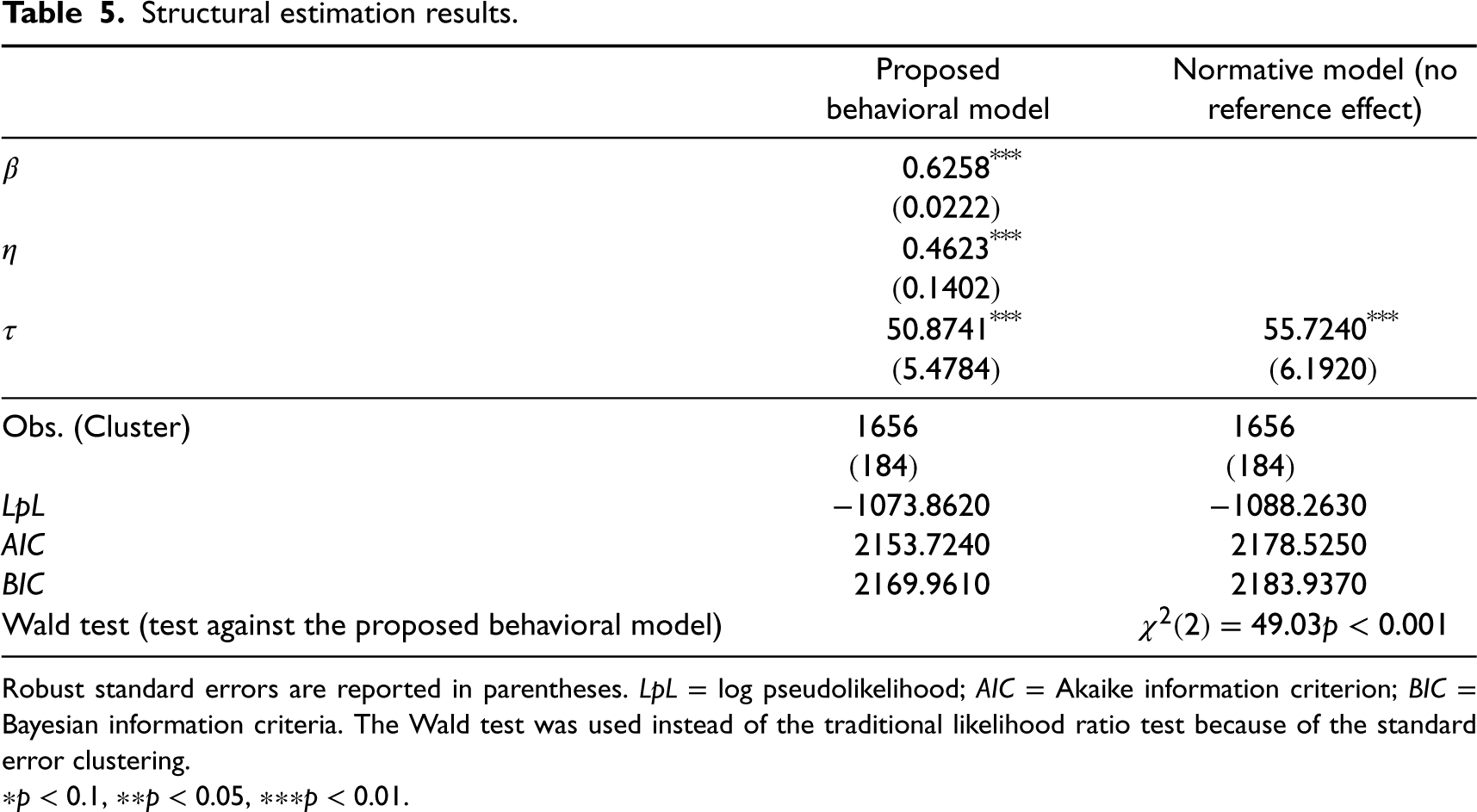
Robust standard errors are reported in parentheses.
The proposed behavioral model (column 1) surpasses the normative model (column 2) in performance. The behavioral parameters,
Next, the behavioral model's estimates (column 1) support the propositions from Section 3.2. Firstly, the significantly positive
Finally, we compare the predictive power of the behavioral and normative models using the out-of-sample validation method proposed by Özer and Zheng (2018, p. 511). We randomly selected 2/3 of the data in each task as a training set for estimating the models, with the remaining 1/3 forming the testing set. After obtaining the parameter estimates from the training set, we assessed the models’ predictive power using the testing set. Specifically, we used two standard metrics (Brandt and Dlugosch, 2021; Kasapidis et al., 2021): the accuracy score (proportion of correct predictions over all predictions) and the F1 score (harmonic mean of prediction precision and prediction sensitivity), where the prediction precision in the current case is the proportion of correctly predicted promotion effort over all promotion-effort predictions, and the prediction sensitivity is the proportion of correctly predicted promotion effort over all observations of promotion-effort decisions.
2
The results reveal that the predictive power of the behavioral model outperforms the normative model, with a higher accuracy score (
In summary, the analyses demonstrate that incorporating reference-dependent preferences into the retailer's effort investment decisions is beneficial because it results in a more accurate fit or prediction of actual effort investments than the normative model. Moreover, we find sufficient evidence to validate our proposed behavioral theory: the estimates of the behavioral parameters are consistent with the parametric thresholds in the derived propositions based on the behavioral model.
After empirically demonstrating the existence of preference bias in effort decisions, it is essential to understand how this bias can affect profit performance. We conducted analyses based on both experimental and simulation data.
First, we calculated the profit difference based on the experimental data. Table 6 presents the absolute and relative profit differences between the actual effort decisions and the normative ones. We denote the expected profit of the actual effort decision by
Absolute (relative) profit difference induced by biased decisions.
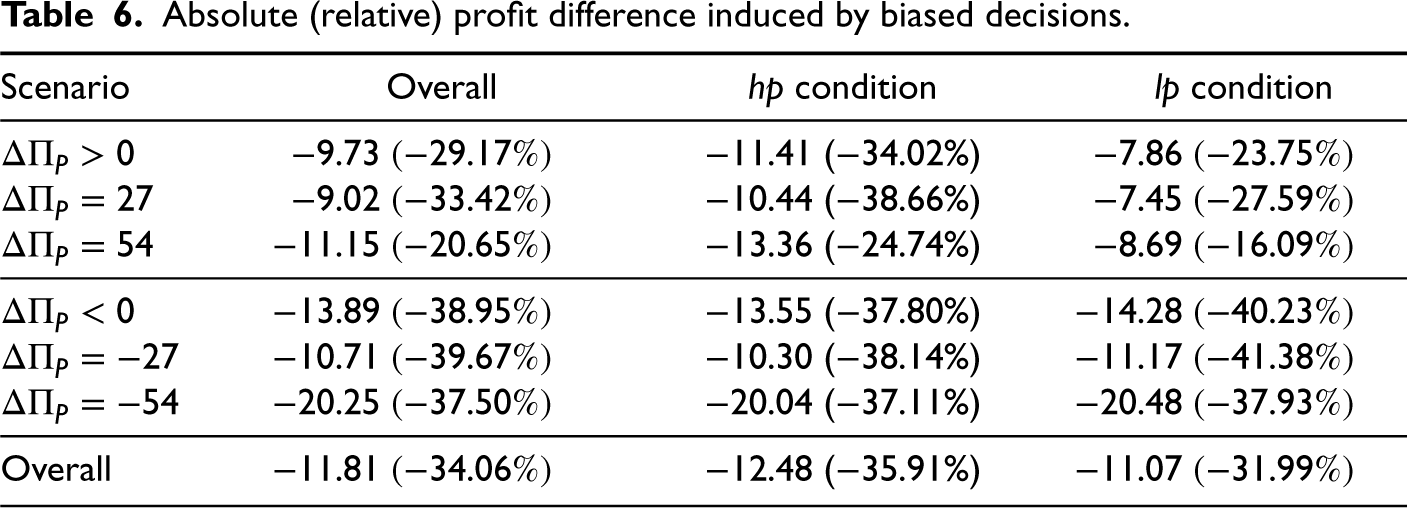
Absolute (relative) profit difference induced by biased decisions.
The results confirm that the biased effort decisions lead to significant loss of profit, that is, all the absolute profit differences are negative. The overall relative loss is
Moreover, the loss of profit is significantly more pronounced in scenario
Second, we conducted simulations based on the estimates of the behavioral model in Table 5. To isolate the effect of reference dependence, we assume bounded rationality for both the behavioral and normative models. Since we apply bounded rationality to explain the random error of actual decisions in the behavioral model, it is reasonable to include bounded rationality in the normative model as well. This approach provides a more realistic reflection of real-world decisions than the assumption that neither model is influenced by bounded rationality or that only behavioral decisions are influenced by it. Accordingly, we calculate the expected profits for the normative condition (

Figure 3 visualizes the relationship between
When
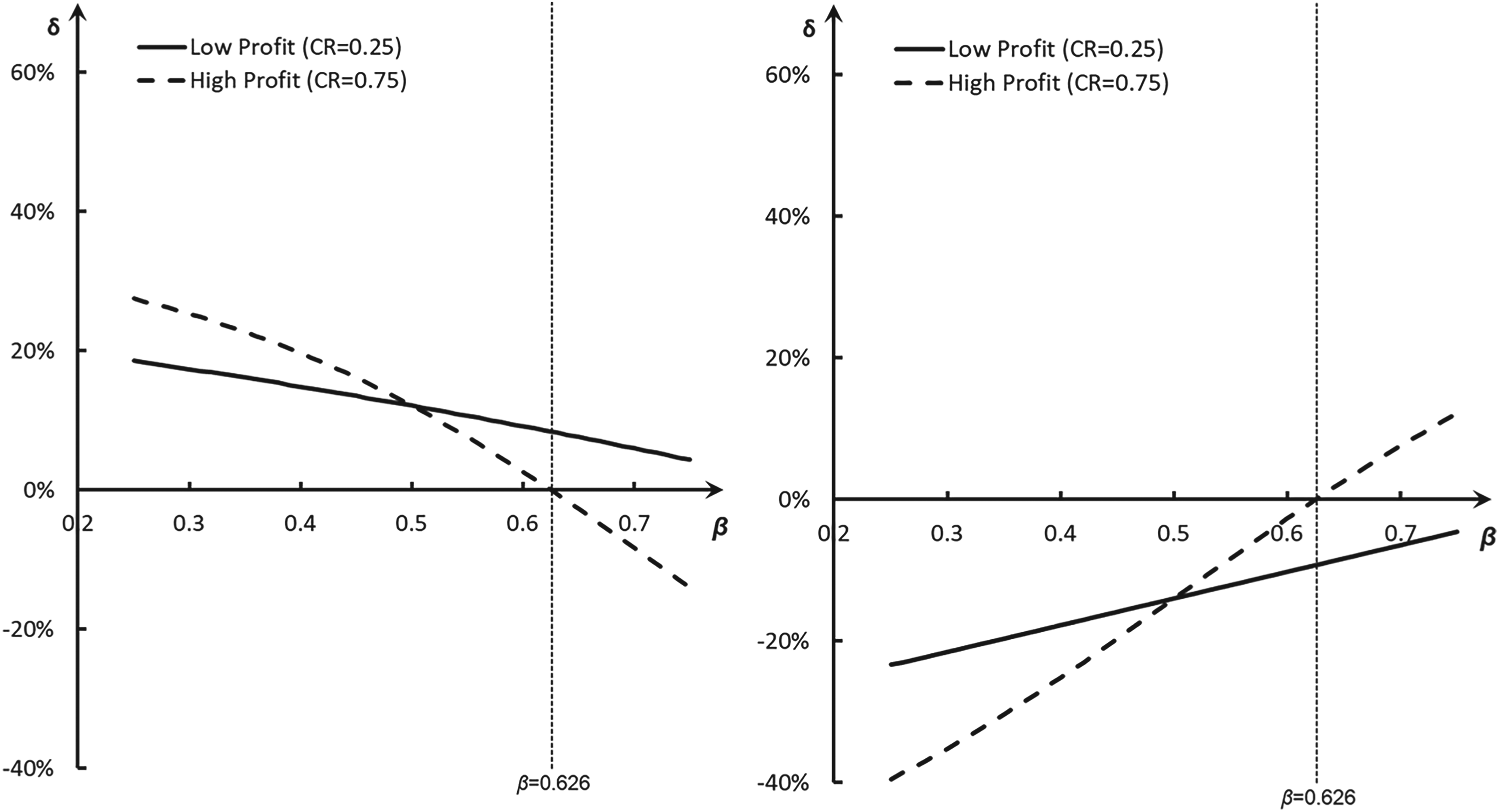
Relative profit difference between biased and normative decisions as a function of
We conducted additional analyses to further validate the behavioral model and observed regularities. Section 6.1 carries out an additional experiment that provides different decision support to demonstrate the robustness of preference bias toward promotion effort in the
Robustness Experiment
In the main experiment, we provided subjects with plots of realized profits for both control and promotion efforts as decision support. The experimental results show that effort decisions demonstrated a significant preference bias for promotion effort in the
In this follow-up experiment, subjects were given histograms of the profits under each effort investment and their respective profit means. In addition, we measured the subjects’ risk aversion using a Holt–Laury-type lottery choice game (Holt and Laury, 2002) to test whether risk attitudes affected the effort decisions. Screenshots of these configurations (i.e., decision support and risk elicitation) can be found in Figures C8 and C9 in Section C of the Supplemental Material. The experimental instruction and procedure remained the same as in the main experiment. We recruited 54 subjects. The power analysis based on the main experiment shows that a sample size of 486 (effort decisions by 54 subjects) is acceptable for a significance level of
The results are consistent with the main experiment. The overall proportion of promotion effort is significantly larger than 50% (
Robustness of Theoretical Findings
We made several assumptions in the normative and behavioral models to isolate the main effects and simplify the decision-making process for subjects in the experiment. To further validate our theoretical findings, which the experimental data corroborated, we extend the model in the following ways: a) allowing the retailer to place a biased order, instead of the optimal order, alongside the effort decision; and b) assuming the initial market demand follows a general symmetric distribution instead of a uniform distribution. The results of these extensions showcase the robustness of our theoretical findings.
Extension by Allowing Biased Orders
This extension only leads to changes in the behavioral model but not the normative model. In the updated behavioral model, the ordering quantity is determined by optimizing Equation (8) instead of being calculated by Equations (4) and (5). The analysis consistently demonstrates that the preference bias for promotional effort diminishes as the optimism level
Extension Under a General Demand Distribution
We follow Ren et al. (2017) and Ren and Croson (2013) to formulate the general demand distribution. Let
If the retailer invests control effort (
In the normative model, we can derive a threshold of the promotion-effort factor
Given the initial market demand
invests control effort (
invests promotion effort (
Otherwise, the retailer is indifferent between control and promotion efforts. Additionally,
In the behavioral model, we can calculate the threshold
Given the initial market demand
Our analysis also confirms the presence of a preference bias toward promotion effort in the
In the low-profit condition, effort investments exhibit a preference bias for promotion effort, that is,
This study examines the preferences between control and promotion efforts. We utilized a reference-dependent model to analytically specify the behavioral conditions under which effort decisions exhibit a preference bias for a particular effort type and characterize a measure for this bias. The experimental data confirm the predictions of the behavioral model, demonstrating the different preference biases between the
In this section, we extend the study by discussing alternative behavioral factors that might explain these preferences. We also present the managerial implications and theoretical relevance of our findings and outline potential paths for future research.
Discussion of Other Potential Explanatory Factors
In this section, we first provide additional evidence to validate our model's loss neutrality assumption. Next, we discuss other explanatory drivers inspired by those influencing newsvendor decisions, such as risk aversion, overconfidence, and a reference-dependent model with other reference points.
Evaluation of the Loss Neutrality Assumption
Our behavioral model was developed under the assumption of loss neutrality. We validated this assumption using the experimental data. First, the estimate of
It is important to note that the loss aversion collected from the elicitation task takes the status quo as the reference point, which is conceptually different from the reference point in our behavioral model. Hence, to further validate loss neutrality in our setting, we re-estimate our model by including loss aversion parameter
These analyses reveal that including loss aversion is less effective than our proposed reference dependence model in fitting the experimental data. This finding does not imply that loss aversion plays no role in the decision-making process. Instead, it suggests that such a parameter does not contribute additional positive effects to the fit of the behavioral model in this context. Some studies demonstrate that adapting a particular reference point can influence decision-making performance in a manner similar to loss aversion (Kahneman et al., 1991).
Risk Aversion
One possible model for explaining effort decisions is risk aversion. This reasoning stems from the fact that retailers may increase their willingness to invest control effort because such efforts reduce the supply-demand mismatch risk or profit-risk derived from the expected profit's random nature. Hence, the control effort's informational value (Delquié, 2008) is associated with a possible increase in utility.
To investigate the abovementioned predictions, we use the constant absolute risk aversion function (CARA),
Next, we used two other approaches to further investigate the risk aversion framework. First, we employed a structural approach to show the performance of this model in fitting the main experimental data (see Table H1 in Section H of the Supplemental Material). The results show that this model provides a poor fit for the data. Second, in the follow-up experiment, the estimation of
Other Theories Explaining Newsvendor Behavior
The literature has proposed several theories to predict newsvendor decisions, such as the anchoring-and-adjustment heuristic (Schweitzer and Cachon, 2000), minimizing ex-post inventory error (Kremer et al., 2014), overprecision (Ren et al., 2017; Ren and Croson, 2013), bounded rationality (Su, 2008), and reference-dependence (Ho et al., 2010; Jammernegg et al., 2022; Long and Nasiry, 2015; Uppari and Hasija, 2019). We integrated bounded rationality into our model. Regarding other models, we believe that they also have the potential to explain effort decisions with appropriate adjustments to this decision setting. For example, we find that overprecision can predict promotion-effort bias, control-effort bias, or no bias, depending on how its influence on demand is modeled (see Section H of the Supplemental Material for the proof and details). 3
Next, there could be other candidate reference points in our operational context. We previously elaborated on the rationale behind our choice of reference point in Section 3.2. Now, we examine the suitability of a reference point proposed by Uppari and Hasija (2019). They demonstrate that a stochastic reference point can explain the pull-to-center effect and subjects’ heterogeneity in the newsvendor context. Such a reference point is computed as the payoff evaluated at ordering the mean demand
We also use structural estimation based on the experimental data to test other alternative reference points, such as “MaxMin” (the maximum realized payoff evaluated at the minimum demand
Managerial and Theoretical Implications and Future Research
The role of retailers’ efforts in shaping demand information is crucial for supply chain performance, yet little behavioral research has been conducted in this area. This study provides valuable insights for managers, highlighting potential mistakes and corresponding profit consequences of effort choices under different profit conditions. A subsequent challenge in practice is to manage preference bias in effort decisions to enhance profit performance. The behavioral model highlights a distorted understanding of the impact of demand variance reduction due to reference-dependent preferences. The effect of reference-dependence on the preference bias largely depends on optimism factor β.
To control the preference bias, one can either mitigate the strength of reference dependence (denoted by
From a theoretical perspective, this study is the first attempt to apply the reference-dependence framework to demand-shaping decisions in an operational context. The normative model provides insight into the focal operational problem, while the behavioral model explores the drivers of preference bias and accurately captures decision-making patterns. These models serve as building blocks for further studies, such as bargaining or contract design with demand-shaping decisions. Another contribution is the empirical support for applying the reference-dependence framework from the newsvendor context to demand-shaping efforts. We validated this application by testing our analytical predictions, providing model extensions, and discussing other potential explanatory drivers. This study emphasizes that a unified behavioral theory can capture various retailer decisions.
Finally, we addressed Uppari and Hasijas’ (2019) call for understanding how reference points are chosen through theoretical and empirical analysis. We adopted the reference point proposed by Long and Nasiry (2015) and Kirshner and Ovchinnikov (2018)—a convex combination of the maximum and minimum payoffs—and compared it with three alternative reference points using empirical data. Few articles have provided empirical evidence to support the theoretical foundation of the model and the selection of reference points (Uppari and Hasija, 2019). Therefore, our study is a valuable contribution in this regard.
Our study provides potential avenues for future research. The current empirical observations could benefit from validation across various scenarios, including alterations in demand distribution or the supply chain contracts in use. An intriguing possibility is to evaluate various contracts or craft one that specifically aims to elicit optimal demand-shaping efforts, considering the identified preference biases. While our current setting focuses on the retailer's effort decisions, future iterations that account for both the supplier's and retailer's motivations in demand-shaping efforts stand to offer deeper insights.
Supplemental Material
sj-pdf-1-pao-10.1177_10591478231224965 - Supplemental material for Characterizing the Retailer's Preference for Demand–Control and Demand–Promotion Efforts
Supplemental material, sj-pdf-1-pao-10.1177_10591478231224965 for Characterizing the Retailer's Preference for Demand–Control and Demand–Promotion Efforts by Jose Benedicto Duhaylongsod and Yingshuai Zhao in Production and Operations Management
Footnotes
Acknowledgments
We thank the department editor, the senior editor, and three anonymous referees for their constructive and helpful comments. We also thank Prof. Ulrich Thonemann for his support of the project and Prof. Nicolas Fugger and Dr. Cedric Lehman for their comments and discussions on earlier versions of the manuscript.
Declaration of Conflicting Interests
The authors declared no potential conflicts of interest with respect to the research, authorship, and/or publication of this article.
Funding
The authors disclosed receipt of the following financial support for the research, authorship, and/or publication of this article: This work was supported by the Deutsche Forschungsgemeinschaft (grant number TH 1425/2-1).

Notes
How to cite this article
Duhaylongsod JB and Zhao Y (2024) Characterizing the Retailer's Preference for Demand–Control and Demand–Promotion Efforts. Production and Operations Management 33(2): 530–549.
References
Supplementary Material
Please find the following supplemental material available below.
For Open Access articles published under a Creative Commons License, all supplemental material carries the same license as the article it is associated with.
For non-Open Access articles published, all supplemental material carries a non-exclusive license, and permission requests for re-use of supplemental material or any part of supplemental material shall be sent directly to the copyright owner as specified in the copyright notice associated with the article.
