



Abstract
The living wage (LW) movement is part of the fight against forced labor: It aims to ensure that workers receive an income that can cover their daily subsistence needs. Our study expands the current understanding of LW pay by shifting from the traditional labor-capital view to an operations and supply chain management perspective. We use a game theoretical approach to explore the different responses of two competing supply chains to LW accreditation. We find that a moderate LW standard allows for Pareto optimality where key stakeholders (i.e., manufacturers, retailers, consumers, and workers) have a collective interest in promoting the LW movement. From a multistakeholder lens, the LW movement is only sustainable if the LW standard is neither too aggressive nor too conservative. We further demonstrate the following points. (1) Not all types of uncertainties are harmful to supply chains with LW pay. Yield uncertainty slows down the progress of the LW movement, whereas demand uncertainty encourages the voluntary adoption of LW pay among all stakeholders. (2) Supply chain coordination may slow the adoption of voluntary LW pay, which implies that the classic coordination paradigm is not a panacea in alleviating the plight of underpaid workers. (3) From the perspective of competition intensity, greater monopsony power hinders the progress of the LW movement, and we provide evidence for the positive effects of a competitive environment on incentivizing voluntary LW pay.
Keywords
Introduction
The exploitation of workers for commercial gain is termed as modern slavery (ILO, 2022). Forced labor is the method most commonly deployed by unethical employers to enslave workers (Gold et al., 2015). The International Labor Organization (ILO) defines forced labor as “all work or service which is exacted from any person under the menace of any penalty and for which the said person has not offered himself voluntarily.” In 2021, among the 50 million people worldwide trapped in modern slavery, forced labor accounted for the majority (i.e., 28 million) (ILO, 2022). The fight against forced labor is urgent. Wages are among the most important conditions of work. Underpayment of wages is a fundamental cause of forced labor. Underpaid workers may be deprived of their basic human rights to food, shelter, nutrition, health, housing, and education, which in turn exposes them to risks such as ill-health (ILO, 2022).
A living wage (LW) is the amount of money needed for the worker and his or her family to live decently (Ryan, 1912). The calculation of the LW standard depends on the workers’ livelihoods and needs (i.e., local food, education, housing, transportation and other daily necessities) (Brennan, 2017). Paying an LW is a tangible way to fight against forced labor by directly addressing the problem of underpayment. The LW is a voluntary rate of pay and is not legally required. The UN Global Compact calls for supply chains (SCs) to pay the LW to accelerate the drive toward achieving key UN Sustainable Development Goals (SDGs). The aims of the LW movement are specifically consistent with the aspirations of UN SDG8: Decent Work and Economic Growth.
Paying workers a decent wage is not only a moral imperative but can have a positive effect on businesses. Many employers have recognized the positive correlation between the LW movement and business competitiveness. For example, 86% of LW-accredited firms claim that LW accreditation improves their reputation, and 64% feel that LW accreditation can be an essential factor in product differentiation (Living Wage Foundation, 2021a). More directly, social responsibility boosts consumer demand, as the preference and propensity of consumers to buy responsible products are increasing (Pigors and Rockenbach, 2016). For example, Alta Gracia, which produces licensed collegiate apparel for universities in the United States, pays its manufacturing workers in the Dominican Republic an LW that is three and a half times the legally required minimum wage; such an LW policy protects workers’ rights in the garment industry and increases consumers’ willingness to pay by satisfying their responsible appetite (Buell and Kalkanci, 2021). Paying the LW is also common in the furniture, agriculture, and food industries. The global furniture seller IKEA explains that “introducing the LW is not only the right thing to do for workers but also demonstrates responsible brand image and provides a great experience to customers” (Living Wage Foundation, 2021b).
Given the benefits of the LW, progress in implementing it has been unexpectedly slow and prone to failure. Workers in South Africa, Bangladesh, and Cambodia have found it difficult to obtain LW salaries (Ethical Trade Initiative, 2021). Even in the UK, the LW was not paid to 4.8 million workers in 2021 (Living Wage Foundation, 2022a). The Rana Plaza building collapse in Bangladesh in 2013 has led to growing concern about the unfair treatment of garment workers (Perraudin, 2019). The major obstacles to SCs’ voluntarily paying the LW are as follows. First, maintaining LW pay over the long term requires concerted support and collective action at the multistakeholder level. The LW is not merely a way to ameliorate underpayment (i.e., the societal context) but also interacts with the performance of the manufacturers and retailers in SCs and the interests of consumers who purchase the final products (i.e., the business context) (Werner and Lim, 2016). It remains unclear under what conditions LW pay can help accelerate SDG 8 in both business and societal contexts. Second, the COVID-19 pandemic further exacerbated the problem of underpayment, which makes adopting the LW in SCs all the more urgent. However, the pandemic led to uncertainties in both demand and supply, which resulted in a debate over whether to continue or freeze LW pay among LW-accredited SCs (Besiou and Van Wassenhove, 2015; Topham, 2020). Third, channel coordination contributes to realizing centralized optimization and improving SC efficiency. A coordinated system implies that the two SCs compete but within they coordinate. Whether coordination is effective in facilitating mutual benefits among key stakeholders in an LW movement remains under-explored. Lastly, responsibility initiatives are often considered to be unaffordable in a competitive business environment, as demand is decreased by intense competition (Johan, 2003). Given the presence of multiple accredited and non-accredited LW providers, it is important to evaluate the effect of competition intensity on voluntary LW pay.
Although growing public awareness has increased the pressure on SCs to improve their accountability to workers, both scholars and practitioners still do not have a clear picture of how to sustain socially responsible transformation in a voluntary, long-lasting way, what slows the progress of the LW movement in reality, and how to overcome resistance to it. To fill these gaps, we analytically explore strategic LW pay using a game theoretical approach. Our findings highlight the interplay between societal and business contexts. We consider two SCs competing in the same market and selling substitutable products. Each SC consists of one manufacturer and one retailer. According to the SCs’ different LW strategies, we investigate three possible cases: Nonadoption (i.e., no SC pays the LW), full adoption (i.e., both SCs pay the LW), and partial adoption (i.e., one SC pays the LW and the other does not). We focus on finding a market-based solution to tackle underpayment from an operations and SC management perspective, where manufacturers, retailers, consumers, and workers voluntarily advocate for the LW (i.e., what we refer to as “Pareto optimality”). We further explore how uncertainties, coordination, and competition affect the propensity for achieving Pareto optimality through LW pay.
The paper proceeds as follows. In Section 2, the relevant literature is reviewed. The game theoretical models are presented in Section 3 and the equilibrium results are discussed in Section 4. The effects of yield and demand uncertainties, coordination, and competition on voluntary LW pay are evaluated in Section 5. Section 6 highlights important managerial implications of the findings and concludes with potential directions for future research. All notations and proofs can be found in the e-companion materials on page ec1.
Literature Review
Modern Slavery and Forced Labor
In March 2015, the United Kingdom passed the Modern Slavery Act 2015. Section 54 of the Act requires the private sector to adhere to transparency in SCs; this involves information disclosure in the SC, with the purpose of eradicating modern slavery (Cousins et al., 2022). The problem of eradicating modern slavery from a SC and operations management perspective is a relatively underexplored topic in the literature. Gold et al. (2015) advocated for tackling the problem of forced labor in SCs. They argue that modern slavery takes many forms, and that forced labor is the most common slavery practice and is intertwined with the daily operations of SCs. They use a business lens to identify the major challenges in addressing the societal problem of forced labor. They call for revisiting the problem from an operations and SC management perspective to advance a collaborative, long-lasting solution to modern slavery.
The research area in exploring the connection between the elimination of modern slavery and SC management has grown since then. Benstead et al. (2018) prove that retailers’ horizontal collaboration in managing supplier responsibility is effective in detecting modern slavery in SCs. Islam and Van Staden (2022) emphasize the importance of transparency for antislavery activities. Meehan and Pinnington (2021) explore whether greater transparency implies enhanced responsible efforts and find that strategic ambiguity can prevent firms from tackling modern slavery in SCs. Our study complements this stream of study by integrating the societal issue of forced labor into SC management. We consider that responsible actions to tackle modern slavery are transparent (i.e., by getting accreditation) and explore the alignment of interests among multiple stakeholders in promoting sustainable changes. In particular, we focus on demand and yield uncertainties, SC coordination, and market competition. All of these factors have been identified as barriers to eliminating slavery practices in SCs.
Living Wage
Wages are a hot topic in both theory and practice. According to the economics based on the neoclassical paradigm, the labor market determines the equilibrium wage by balancing labor supply and demand. In neoclassical models, the effects of a minimum wage have been widely examined. However, the effectiveness of paying the minimum wage remains controversial. On the one hand, the majority of economists argue that mandated minimum wages increase unemployment (Aaronson and French, 2007). On the other hand, studies such as Yu et al. (2021) have shown empirically that the minimum wage has no statistically significant impact on employment rates. Our study adds new knowledge to the literature on wages in neoclassical economics. Our work differs from the studies discussed above by examining an understudied dimension of wages in SCs—how LW pay can be voluntarily provided in competing SCs. We pay special attention to classic supply-chain problems that affect LW pay, such as uncertainties, coordination, and market competition.
LW is a relatively new concept in theory and practice. Mair et al. (2018) estimate the 2005 LW in BRIC countries and compare it to the wage of workers in the industry that makes clothing for Western European customers; they find that their LW estimate is, on average, approximately 35% higher than the actual pay in the BRIC apparel industry. Pollin et al. (2004) use empirical data to examine the effects of the global anti-sweatshop movement on wages in the apparel industry and find that an increase in retail prices does not significantly compensate for the rising wage costs of factory workers such that they would ensure a decent life. Other papers explore the implications of paying the LW. Paying workers a decent wage is not only a moral imperative but also a vital business strategy. Miller and Williams (2009) examine the effects of the LW in the global apparel industry, arguing that retailers should force manufacturers to raise their wages toward the LW in the apparel industry. Mair et al. (2019) find that although paying the LW increases production costs, it does not lead to unemployment because consumers’ preferences for social responsibility increase the demand for accredited products, and thus the need for manufacturing workers. Buell and Kalkanci (2021) empirically show that internally socially responsible actions, such as paying the LW voluntarily to workers, are more effective in increasing consumers’ willingness to pay than externally socially responsible actions, such as donations and tree planting.
Unlike the legally required minimum wage, the LW is voluntary in nature. Without the voluntary engagement of all stakeholders, the LW movement cannot be sustained in a voluntary, long-lasting way. Our study is partially motivated by Werner and Lim (2016), who review the benefits and challenges of LW implementation and propose a future research agenda. They argue that a systematic understanding of the incentives of employers to support the adoption of the LW is still needed. Moreover, the conditions under which all stakeholders would support LW pay remain underexplored, as SCs’ LW strategies further impact workers and consumers. Hence, our paper aims to figure out how LW pay can become a market-based solution where all stakeholders realize Pareto optimality with LW pay. Our paper differs from neoclassical models by shifting focus from the traditional labor-capital relationship to an operations and SC management perspective. By building game-theoretic models, our study analytically shows the threshold beyond which all stakeholders have a collective interest in promoting the LW. Our findings shed light on how to incentivize all stakeholders to support paying the LW.
Social Issues in Operations and Supply Chain Management
The concept of LW is relatively new in the literature on operations and SC management. Plambeck and Taylor (2016) find that if the retailer pressures the supplier to increase wages for manufacturing workers, the supplier is more likely to increase its social responsibility efforts under the backfire condition even though the profit margin shrinks. The decision on workers’ wages may be affected by market competition. Pigors and Rockenbach (2016) conduct laboratory experiments to evaluate how the degree of market competition influences SCs’ wage-setting decisions where consumers may or may not be informed of the wage. They find that regardless of the information type, competition induces SCs to pay a higher wage to their workers. Similar to Pigors and Rockenbach (2016), we also find a positive link between market competition and SCs’ socially responsible practices. Differently, our study uses a game-theoretical approach to understand voluntary LW pay in competitive markets in which the SCs may or may not provide the LW. Long and Nasiry (2020) investigate how wage transparency affects sales force compensation. They find that wage transparency is less likely to benefit the firm if demand uncertainty is high. Our paper examines not only the effect of demand uncertainty but also that of yield uncertainty on the tendency to pay the LW. We find that yield and demand uncertainties have different effects on the propensity for voluntary LW pay. To date, the link between social responsibility and coordination is under-explored. We contribute to this stream of literature by investigating the effectiveness of coordination in enhancing social-related responsible performance in SCs.
Model Description
In the basic model, we consider two SCs competing in the same market. The SCs are indexed by
We use subscripts
We assume that the basic market size is normalized to



The unit production cost is


The profit functions of manufacturer
The game sequences are as follows. First, two retailers decide on the LW strategy simultaneously. If the retailer decides to sell LW-accredited products, it has to ensure that its upstream manufacturer pays the LW. For example, in the cocoa industry, brands such as Tony’s Chocolonely recognize the important role of retailers in motivating SC responsibility and only source chocolate products from suppliers who pay an LW to manufacturing farmers (Tony’s Chocolonely, 2023); a Fair Wear member brand is recognized as being fully compliant with the LW standard if each of its manufacturers pays the LW to workers (Blackwell, 2018). Second, given the LW strategy, the manufacturer in each SC decides the wholesale price
We first derive the equilibrium under the three cases by using backward induction. We then analyze the impacts of LW pay by comparing the equilibrium outcomes in the three cases. We identify the conditions under which all stakeholders (i.e., manufacturers, retailers, consumers, and workers) would voluntarily engage in the LW movement. Throughout the analysis, to ensure that the sales quantities in both SCs are positive, we assume (1)
The Impact of LW pay on Prices and Quantities
We first explore the effect of LW pay on equilibrium prices and quantities.
(i) For SC1, which does not obtain LW accreditation under partial adoption: if
(ii) For SC2, which obtains LW accreditation under partial adoption: if
Voluntary LW pay is challenging to promote due to the additional cost burden. Lemma 1 indicates that the manufacturer and retailer in the accredited SC compensate for the additional labor cost by charging higher prices along the SC (as shown by the fact that prices under full adoption are always higher than under nonadoption).
Notably, the capacity for price adjustment depends on SC competition, namely, the LW strategy of the competing SC. If the LW is sufficiently low, then the accredited SC2 enjoys a significant advantage under partial adoption and is capable of charging a higher price as long as the price markup is affordable to consumers. To compete with the accredited SC2, the nonaccredited SC1 will lower the price substantially to regain the lost demand. Thus, a polarization effect is formed where the prices of the accredited (nonaccredited) products are the highest (lowest) among the three cases. However, the differentiated advantage is weakened by the increase in the LW standard. The reason is that if the accredited SC2 still leverages its advantage to sell more expensive accredited products, the competitor’s cheap nonaccredited products will become more appealing. This finding is consistent with the empirical research that shows that the price of accredited products is restricted by the consumers’ acceptable range, although the labor cost is partially absorbed (Pollin et al., 2004). Under this circumstance, the price of accredited products under partial adoption is lower than that under full adoption (reflecting the weakened differentiated advantage) but is still higher than under nonadoption (reflecting the price premium of accredited products).
(i) For SC1, which does not obtain LW accreditation under partial adoption: if
(ii) For SC2, which does not obtain LW accreditation under partial adoption: if
Intuitively, market demand is negatively influenced by the selling price; we term this the demand shrinking effect. In terms of SC1, Lemma 2(i) proves that this intuition may not hold under a socially responsible production and purchasing context. Under a low LW standard, the trade-off between prices and demands no longer exists because consumers’ socially responsible preferences avoid the undesirable demand shrinking effect (i.e.,
In terms of SC2, similarly, rising prices will not necessarily lead to the demand shrinking effect if the LW standard is acceptably low and the nonaccredited products are more in demand only under a higher LW standard. However, we note that under a low LW standard, compared to full adoption, the sales quantities for the accredited products under partial adoption are always higher. The reason is that the differentiated advantage is prominent under a low LW standard and the quantity benefit is exclusive to the accredited SC, which will otherwise be split with the competing SC if the LW structure becomes full adoption. This finding is supported by a survey conducted by the LW Foundation, which shows that 64% of accredited employers gain competitive advantages from product differentiation (Living Wage Foundation, 2021a). Our finding partially explains why the competitive advantage cannot be guaranteed, as the significance of the differentiation advantage depends on the LW standard and SC competition.
An initial aim of the LW movement is to raise the wages of underpaid workers. However, the increased labor costs affect the operational decisions of SCs and the purchasing decisions of consumers, both of whom are direct or indirect undertakers of these costs. We first investigate the affordability of LW pay for SC members—that is, whether the SC can afford to pay the LW.
We investigate the optimal LW strategies of the two SCs in a Nash equilibrium (NE). Realizing an NE implies that a single SC (i.e., including both the manufacturer and retailer) has no incentive to unilaterally deviate from its current LW strategy in terms of profitability.
If the LW standard is sufficiently high (i.e.,
Proposition 1 reveals that it is optimal to obtain LW accreditation if and only if the LW standard is sufficiently low, because higher quantities of accredited products are sold with a considerable price markup. However, this is not the case when the LW is sufficiently high due to a significant demand shrinking effect. The condition for the pure NE of nonadoption of LW accreditation can be transformed to
Note that when partial adoption is a NE, both the NY and YN cases are Nash equilibria. However, our paper considers two SCs acting simultaneously, which implies that the profit of SC1 under the NY case is symmetric to that of SC2 under the YN case. Therefore, we do not consider which SC opts to obtain the LW accreditation and which does not under partial adoption and focus on the NY case only in the later analysis. If we consider a leader-follower model with a sequential decision-making process, then the symmetry no longer exists and which SC pays the LW in the partial adoption matters. We pay specific attention to the equilibrium market structure of LW provision (i.e., paying LW at a full scale or partial scale). We find that the scale of LW pay exhibits an inverse relationship with the LW standard. Both SCs are incentivized to pay the LW only when the LW standard is sufficiently low. Otherwise, the equilibrium LW pay structure will become a partial adoption scenario. The reason is that if the LW standard is sufficiently low, then due to the competitive disadvantages resulting from the polarization effect, the nonaccredited SC is incentivized to obtain LW accreditation as well to avoid being competed out of the market. Our findings indicate that when human rights are considered in SC operational decisions, a lower LW standard is effective in motivating collective LW pay.
We next explore the affordability of LW pay for consumers, that is, whether consumer welfare can be enhanced in the LW movement. Following the approach of Singh and Vives (1984), consumer welfare under three cases can be expressed as follows:



If the LW standard is sufficiently high (i.e.,
Consumers benefit from the LW movement if and only if the LW standard is sufficiently low. We have shown in Propositions 1 and 2 that expensive LW-accredited products do not necessarily lead to the demand-shrinking effect. As long as the LW standard is not too high, consumers can access a larger number of responsibly produced products at an acceptable price. Therefore, LW accreditation becomes less attractive only under a sufficiently high LW standard, as under this context, prices are no longer affordable.
Consumer welfare is unlikely to be at its highest level under full adoption of LW accreditation. The consumer-side benefit of partial adoption primarily hinges on the polarization effect. More specifically, when the LW standard is sufficiently low, consumers have access to accredited products with an acceptable price markup while still having the option of purchasing the inexpensive nonaccredited products (whose price is even lower compared to that under nonadoption, that is,
We next characterize the impact of LW pay on worker welfare. Following Benjaafar et al. (2022), worker welfare is modeled as total wage earnings. LW pay has an impact on the total income earned, through SC competition and consumer purchasing behavior. Whether additional wage compensation can convert into real income is conditional on the magnitude of the hourly wage and the associated demand change. Worker welfare under three cases is formulated as follows:



If the LW standard is sufficiently high (i.e.,
Note:
Proposition 3 indicates that a sufficiently high wage compensation does not bring real benefits to workers. The reason is that the increase in the hourly wage fails to convert to higher total income because the working time sees a substantial decrease (caused by the significant demand shrinking effect). Our finding indicates that a too-aggressive LW standard ultimately undermines the interests of underpaid workers.
On the contrary, under a sufficiently low LW standard, accredited products are attractive and affordable to consumers, which leads to rising demand and results in higher total welfare. In addition, partial adoption is more desirable for workers than full adoption if the LW standard is relatively high. The main reason is that the polarization effect makes workers in the nonaccredited SC severely worse off because they produce very few products without LW compensation. That explains why partial adoption outweighs full adoption only under a higher LW standard, as the polarization effect moderates gradually.
We explore the optimal market structure of paying the LW in the competitive equilibrium (i.e., nonadoption, full adoption, or partial adoption) that can achieve “Pareto optimality” among all stakeholders. We define Pareto optimality as a situation where the LW strategy of the two SCs in a NE is Pareto-optimal; meanwhile, total consumer welfare and worker welfare are the highest under such a Pareto-optimal NE. More specifically, in a two-player game, a NE is Pareto-optimal if no change could make one player better off without harming the interest of the other (Myerson, 1991); that is, any attempt to benefit the manufacturer and retailer in one SC by deviating to another strategy profile will necessarily result in a profit loss to the manufacturer and retailer in the other SC (i.e., an increase in
(i) If the increase in the price premium of the accredited product is sufficiently low (i.e.,
(ii) If the increase in the price premium of the accredited product is moderate (i.e.,
(iii) If the increase in the price premium of the accredited product is sufficiently high (i.e.,
Note:
To elaborate on the alignment and conflicts of interest among different stakeholders, the conditions for achieving Pareto optimality are illustrated in Figure 1. The parameter region for realizing Pareto optimality is termed a Pareto zone. Corollary 1(i) shows that if the increase in the price premium of accredited products is sufficiently low (i.e.,
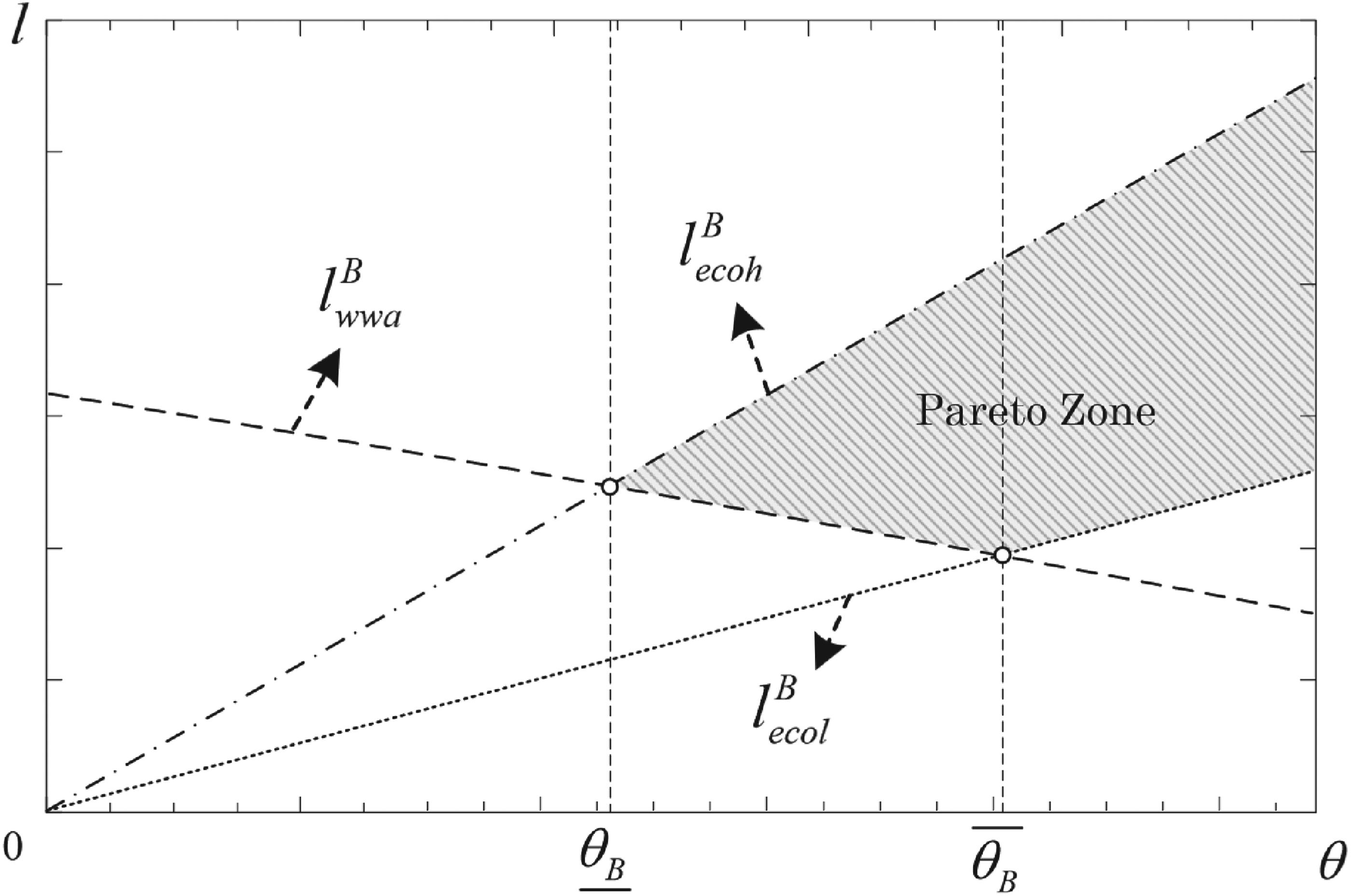
Illustration of the Pareto Zone.
Additionally, the Pareto zone of partial adoption enlarges if LW accreditation is more attractive to consumers. To be specific, when
In practice, the proposed LW standard differs between countries and leading organizations. When it comes to promoting the LW to tackle underpayment and ensure underpaid workers a decent life, supporters tend to focus on raising the LW standard. However, opponents argue that unless the LW is sufficiently low, it is difficult to maintain the current level of manufacturing operations and demand will be distorted by LW pay (Brennan, 2017). We explore the interplay between improving the LW standard (i.e., emphasized by aggressive LW promoters who call for a high LW standard) and maintaining economic affordability (i.e., emphasized by conservative LW promoters who suggest a low LW standard). Our results suggest that from a multistakeholder view, the LW standard should not be too aggressive or too conservative. A moderate LW standard is ideal for realizing Pareto optimality for all stakeholders.
Uncertainty
Owing to unexpected changes and uncertainty, managing socially responsible operations is complicated (Besiou and Van Wassenhove, 2015). This is especially true when it comes to promoting LW movement. We model the stochastic cases of yield and demand uncertainty and examine the effect of uncertainties on the propensity for voluntary LW pay. Yield uncertainty on the supply side may take place due to machine breakdowns, a random defect rate, or other exogenous causes. Facing yield uncertainty, manufacturers and retailers may set prices differently to hedge the risk of supply disruption. We first investigate the interplay between yield uncertainty and voluntary LW pay. Moreover, demand uncertainty may take place whenever consumer behavior changes. For example, during the COVID-19 outbreak, consumers’ demand for daily-necessity products increased but their need for luxury products decreased. This phenomenon raises the question of whether to continue or freeze LW pay when the degree of demand uncertainty is high.
The cost of target production has two parts. The first part includes a sunk material cost that is not retrievable after it has been spent. For example, in the textile and apparel industry, manufacturers set target production quantities after retailers have placed their orders. As soon as the target quantity is determined, they need to pay for preparation costs such as sourcing raw materials and setting up machines. The unit cost of producing the target quantity is
In determining the LW compensation, yield is one important consideration. However, we still consider an exogenously-given LW standard which will not be affected by yield uncertainty. The reasons are as follows. In calculating the wage gap, the LW income is determined based on a reasonable estimation (i.e., a stable amount) rather than the realized amount (i.e., affected by the yield uncertainty). For example, cocoa farmers have reached a consensus that 800kg/ha is a realistic productivity target, which is used in estimating the LW income (Fairtrade, 2022). To ensure the income of vulnerable farmers and mitigate the negative impact of yield uncertainty, Fair Trade helps by nonwage measures such as providing technical support or sharing costs (Fairtrade, 2022). However, the LW standard remains unchanged and is not affected by the degree of yield uncertainty.
We model the random proportional yield variable as


Before the retailers sell products in the market, the actual yield is realized. The retailers sell all of the available products without keeping inventory. The retail prices are related to the total available-to-sell quantity. The linear inverse demand function of non-LW-accredited products facing yield uncertainty is



Facing yield uncertainty,
(i) if the increase in the price premium of the accredited product is sufficiently low (i.e.,
(ii) if the increase in the price premium of the accredited product is moderate (i.e.,
(iii) if the increase in the price premium of the accredited product is sufficiently high (i.e.,
The random yield assumption will not alter our main findings obtained in the deterministic model in Corollary 1. The acceptable threshold value for the LW standard may or may not be equal to that in the deterministic model. To further explore how random yield influences the propensity for realizing Pareto optimality with LW pay, we derive Corollary 2 to investigate the effect of the degree of yield uncertainty on the threshold values.
The propensity for realizing Pareto optimality through partial adoption decreases with the degree of yield uncertainty (i.e.,
To elaborate on the threshold value changes, Figure 2 illustrates the findings obtained in Proposition 4 and Corollary 2. When
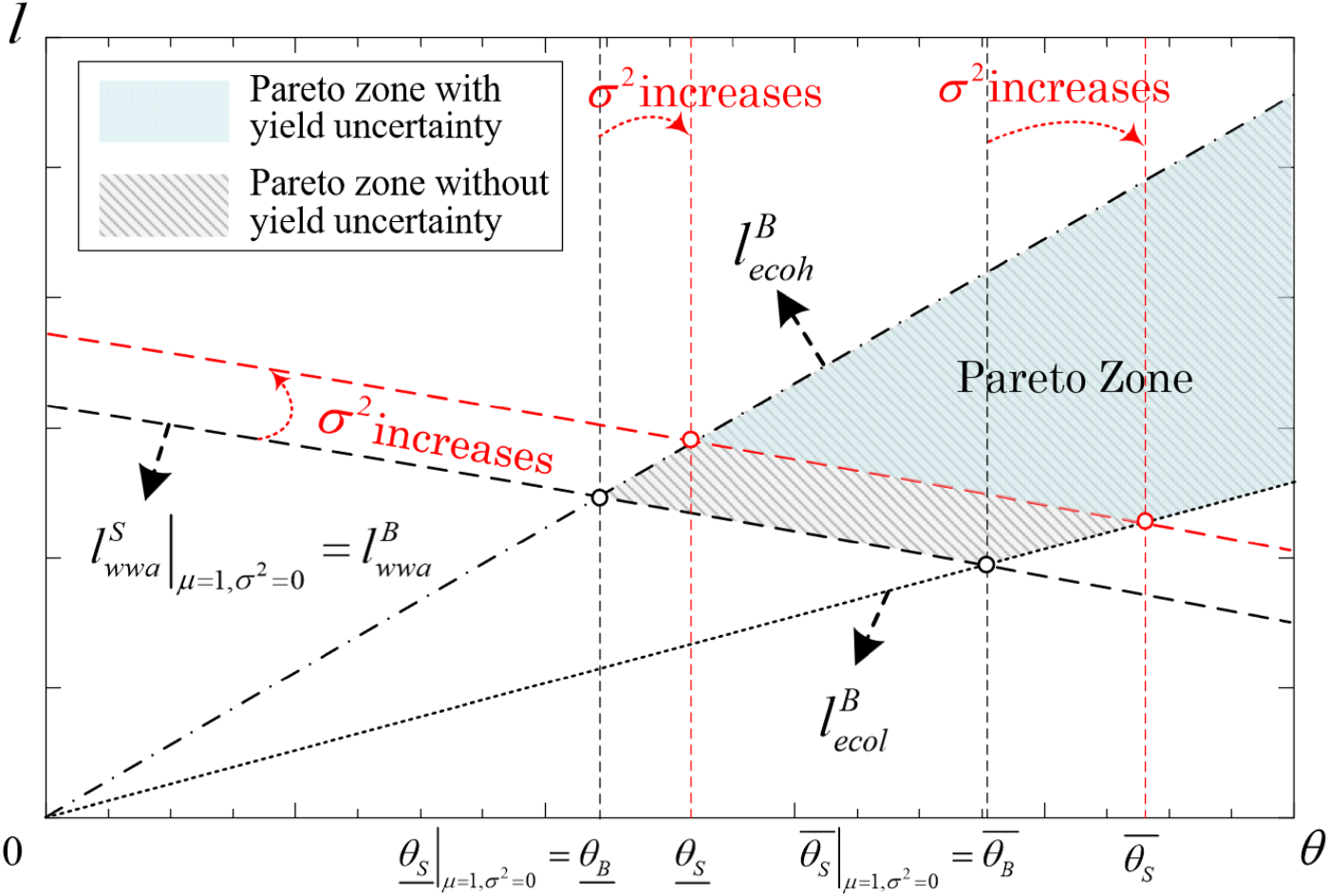
Illustration of the Pareto Zone under Random Yield.
Moreover, if
Generally, a higher degree of yield uncertainty (i.e.,



Facing demand uncertainty,
(i) if the increase in the price premium of the accredited product is sufficiently low (i.e.,
(ii) if the increase in the price premium of the accredited product is moderate (i.e.,
(iii) if the increase in the price premium of the accredited product is sufficiently high (i.e.,
Proposition 5 indicates that the Pareto zone under the stochastic demand model takes the same form as that of the deterministic model. The variance
The propensity for realizing Pareto optimality through partial adoption increases with the degree of demand uncertainty (i.e.,
Figure 3 visualizes the changes in the Pareto zone under demand uncertainty. A higher degree of demand uncertainty encourages voluntary partial adoption of LW accreditation. The upward shift of the red lines indicates that consumers can afford accredited products even under a higher LW standard, and SCs have collective preferences toward partial adoption even if the LW standard is higher. The dominant factor determining the upward trend of the thresholds is the polarization effect. The demand noise also makes the demand for responsibility volatile. Higher uncertainty increases the demand difference between accredited and nonaccredited products, and subsequently the polarization effect between two competing SCs. This explains why the accredited SC2 benefits more from demand volatility (i.e., as shown by
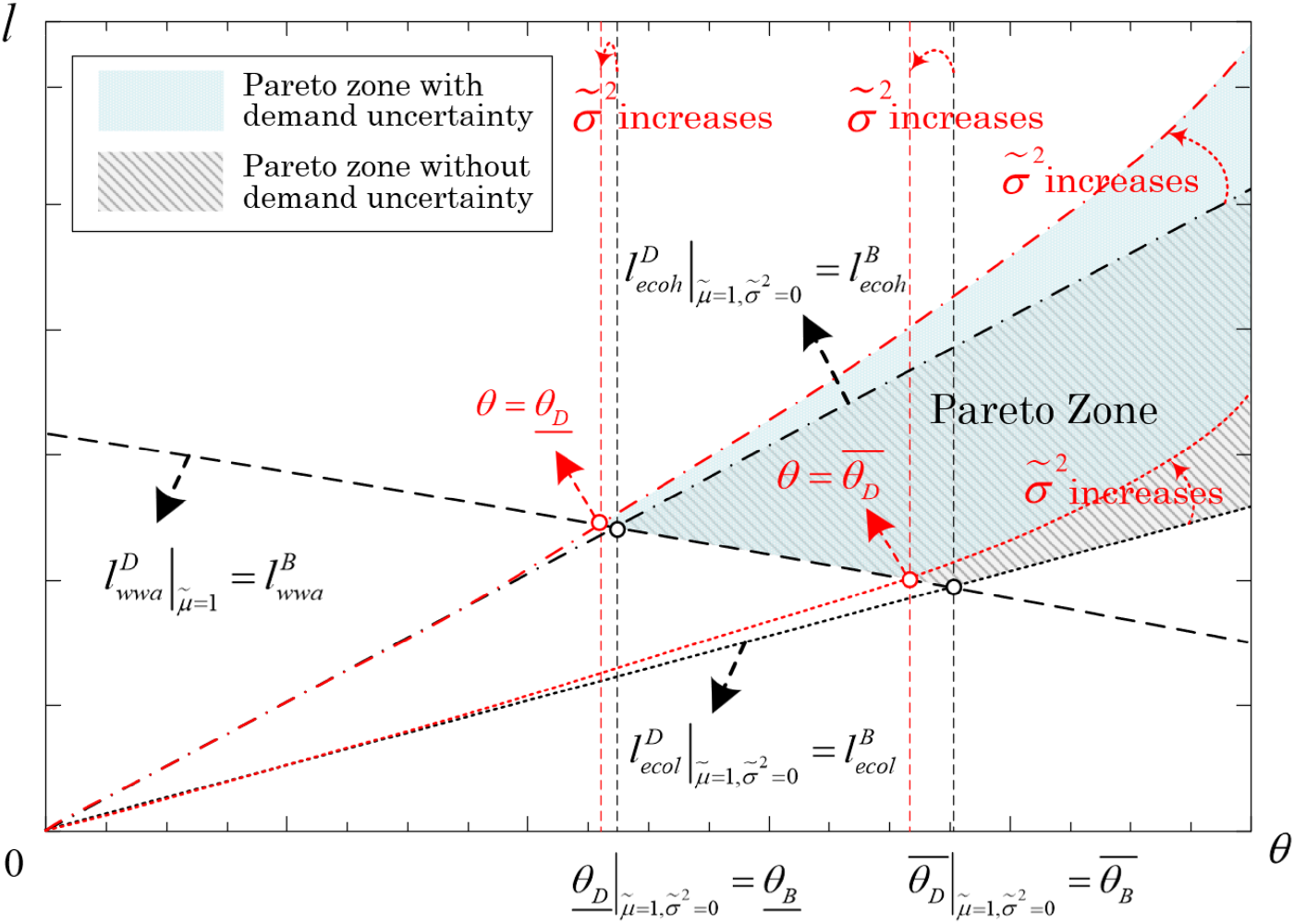
Illustration of the Pareto Zone under Deterministic and Stochastic Demand.
Demand uncertainty increases the area of the Pareto zone under the partial adoption of LW accreditation (i.e., the upward shift magnitude of
Channel coordination contributes to realizing centralized optimization and improving SC efficiency. The ways to achieve channel coordination have been widely examined in the literature. We focus on exploring whether a responsible SCs should achieve channel coordination as a strategic tool for realizing performance optimality in the LW movement.
In a centralized system, price and quantity are determined by maximizing the SC’s profit. The profit functions of SC
Under a centralized system,
(i) if the increase in the price premium of the accredited product is sufficiently low (i.e.,
(ii) if the increase in the price premium of the accredited product is moderate (i.e.,
(iii) if the increase in the price premium of the accredited product is sufficiently high (i.e.,
The main insights remain unchanged in a centralized system. When the SC is coordinated, the minimum level of the price premium needed to induce the partial adoption of LW accreditation (i.e.,
If the price premium of accredited products is sufficiently low (high), then centralization increases (decreases) the propensity of realizing Pareto optimality through the partial adoption of LW accreditation (i.e.,
To elaborate on the changes in threshold values, we provide Figure 4 to compare the parameter ranges of the Pareto zone in centralized and decentralized systems. If
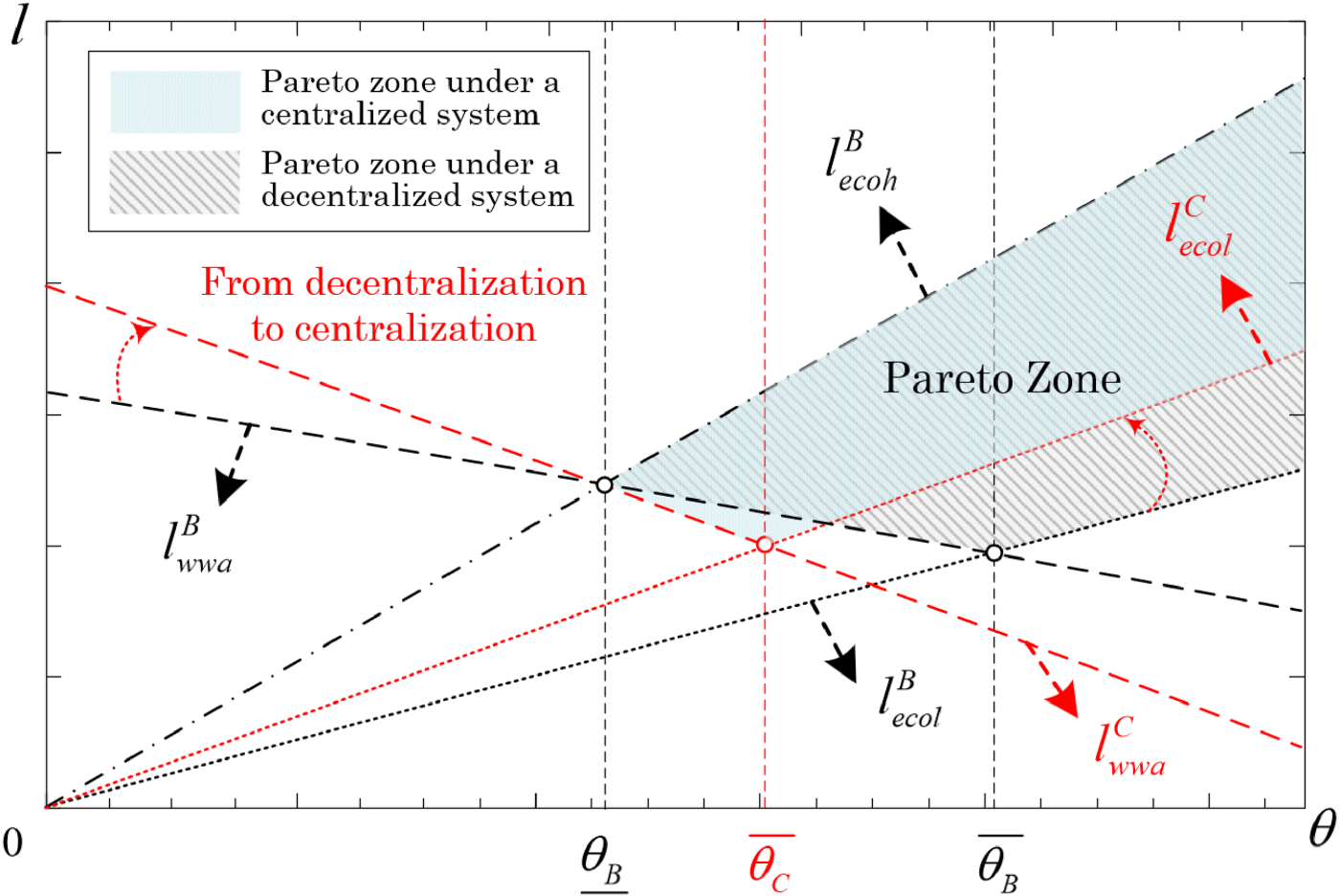
Illustration of the Pareto Zone when the SC is Coordinated.
A number of studies discuss the benefits of SC coordination in the context of environmental responsibility. It is generally agreed that a coordinated SC results in a better environmental performance (Lee, 2010) than an uncoordinated SC, but El Ouardighi et al. (2016) argue that coordination is not effective in improving environmental responsibility. To date, the link between social responsibility and coordination is under-explored. Our results add new insights to the literature on responsible SC management. Specifically, we find that the effectiveness of using the LW to tackle underpayment can sometimes be undermined by SC coordination.
We extend the basic model and examine the effect of market competition on voluntary LW pay. The basic model considers two competing SCs’ strategic decisions on whether or not to pay the LW. In this extension, we revisit the strategic LW pay decisions by considering an arbitrary number of SCs. LW accreditation is subject to market conditions where intense competition may amplify or undermine the motivation to pay the LW (Zadek, 2006). What will be the equilibrium level of LW providers in such circumstances?
Following Arya and Mittendorf (2018), we consider the case in which


(i) The competitive equilibrium when
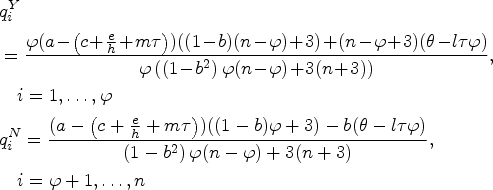
When there are more players in the market, internal competition induces lower quantities in each SC. One may deduce that it would be more difficult to motivate voluntary LW pay under fierce market competition because competition amplifies the negative demand shrinking effect. However, Lemma 3(ii) indicates that the quantity drawback is diluted by fiercer competition. With more players in the market, the accredited SCs bear less downward pressure on sales quantities because the bright side of differentiation outweighs the dark side of the demand shrinking effect.
We further prove that similar to the basic model, accredited manufacturers and retailers are more profitable if the LW standard is sufficiently low (i.e.,
When
The degree of market competition is a critical element in responsible decision-making. Our findings contradict other empirical evidence that market competition hampers manufacturers’ and retailers’ willingness to invest in socially responsible practices (Johan, 2003). The author argues that if market competition is fierce, acting responsibly increases the risk of losses in market demand that might eventually result in decreased profitability. Conversely, paying the LW becomes a way for SCs to stand out from competitors because of the more pronounced differentiated advantage. Meanwhile, the product’s prices are pushed down under greater competition among SCs, and thus consumers can afford to buy accredited products, and workers benefit from increasing total wages. This finding illustrates the economic drivers that lead SCs to engage in the LW movement when facing competition and clarifies the positive effects on consumer and worker welfare. Greater monopsony power will intensify the problem of underpayment, and competition enforcement can be particularly effective in addressing underpayment. In practice, OECD highlights the role of competition enforcement in protecting the interests of workers, because employers with greater monopsony power are more likely to increase the price and restrict output, which is not favorable for worker welfare (OECD, 2020).
We next examine the equilibrium penetration level of LW accreditation at the market level.
If
Lemma 4 shows that a differentiated market supply with both LW and non-LW accredited products will exist only if
Moreover, only a subset of SCs opt to pay their workers the LW. The reason is that if the amount of LW-accredited SCs exceeds the equilibrium penetration level, obtaining LW accreditation will not be profitable anymore due to the less obvious differentiated advantage. A numerical example is given in Figure 5 to provide a clearer illustration of the equilibrium penetration level. The parameter values are set based on the report of Fair Wear Foundation which provides guidance for the garment sector to estimate the LW cost (Fair Wear Foundation, 2017). For example, according to the cost breakdown of the surveyed garment factory, total overheads (i.e., production costs excluding labor cost) account for 0.43 cents per working minute whereas the direct labor cost equals 2.32 cents per working minute, roughly 5-6 times the overheads. Hence, we scale
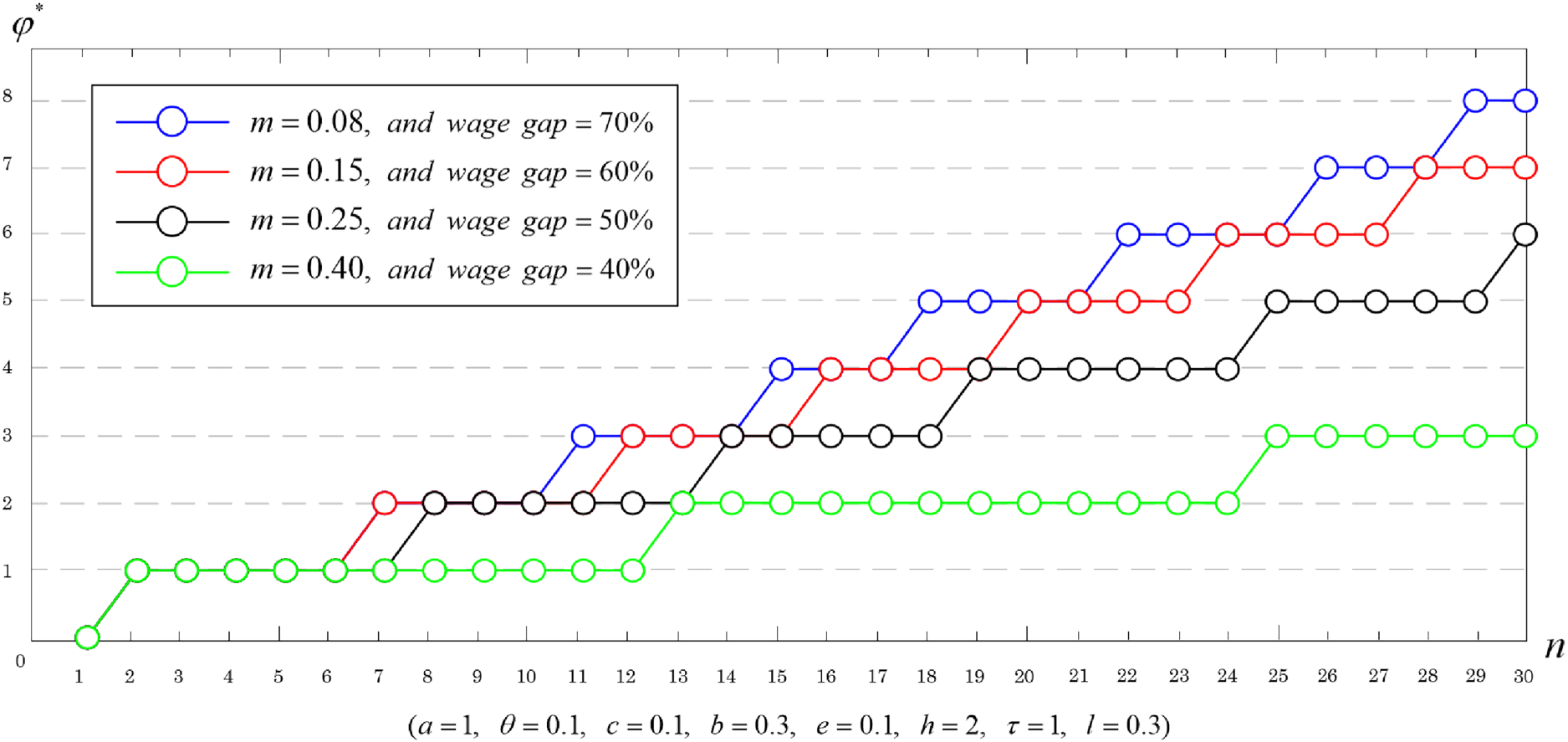
The Equilibrium Penetration Level of LW Accreditation when n SCs Compete in the Market.
Paying the LW is a tangible way to fight against forced labor by directly addressing the problem of underpayment. To sustain the LW movement in a collaborative, sustainable, and society-wide manner, it is important to identify the role of manufacturers, retailers, consumers, and workers in the process of LW pay. We use a game theoretical approach to explore the societal problem of LW pay from an operations and SC management lens. We consider a chain-to-chain competing structure in which each SC consists of one manufacturer and one retailer. Three cases are examined according to SCs’ LW strategies: Nonadoption, partial adoption, and full adoption of LW accreditation. We analytically identify under what condition paying the LW allows for Pareto optimality where key stakeholders have a collective interest in the LW movement. Our paper further demonstrates the effect of uncertainties, coordination, and competition on the propensity of realizing Pareto optimality through LW pay. The main results are summarized in the following four areas.
Contributions to the Literature. Our paper adds additional insights to the findings of Miller and Williams (2009) and Mair et al. (2019) by analytically identifying the condition under which the LW movement can become a market-led voluntary initiative. All stakeholders realize Pareto optimality when the LW standard is moderate. This finding implies that a too-aggressive or too-conservative LW standard is unfavorable to promoting voluntary LW pay from a multistakeholder lens. Hence, to accelerate SDG 8 in both business and societal contexts, the interests of all stakeholders should be incorporated into the design of the LW standard.
Action plans for Practitioners. Raising the LW standard alone may not be effective in tackling forced labor. The achievement of voluntary and sustained LW pay calls for a collaborative approach whereby different parties contribute to the overall effort in their different ways. In practice, most ways of estimating the LW standard (such as MIT’s LW Project) take enhancing wage levels as the only starting point (Brennan, 2017). Our results support the LW-setting philosophy of the national LW standard in the UK: the LW standard should be designed based on not only the calculation of the real cost of living but also economic affordability (Living Wage Foundation, 2022b).
Contributions to the Literature. The literature has seldomly explored the relationship between workers’ wages and SC uncertainties. One pioneering study, Long and Nasiry (2020), shows that wage transparency cannot bring economic benefits if demand is volatile. Our paper examines not only the effect of demand uncertainty but also that of yield uncertainty on the tendency toward voluntary LW pay. We find that not all types of uncertainties hinder the adoption of the LW. Yield uncertainty brings obstacles to delivering better pay for underpaid workers (e.g., the IKEA example), and demand uncertainty can be an opportunity to promote LW pay (i.e., the Rosslyn Coffee example).
Action Plans for Practitioners. The unstable business environment reinforces the need to identify uncertainties and to develop a proper understanding of the interplay between uncertainties and corporate social responsibility efforts. Delivering better pay to underpaid workers is likely to become a challenge in the face of supply disruption. To support the LW movement, the government could provide guidance to SC managers on how to cope with supply-side uncertainty to improve resilience. There is no need for SC managers to feel tremendous pressure to continue paying LW in times of demand shocks. The government could engage in dialogue to help SC managers understand the societal and business benefits of sustained efforts to combat forced labor when demand is volatile.
Contributions to the Literature. Past literature discusses the benefits of SC coordination in the context of environmental responsibility, but the effectiveness of coordination in enhancing responsible performance remains controversial (see Lee (2010) and El Ouardighi et al. (2016) for example). Our results add new insights by exploring the link between social responsibility and coordination. Specifically, if the price premium of the accredited product is sufficiently high, then coordinated SCs are less likely to pay the LW to their manufacturing workers because the polarization effect is amplified in a centralized system. Under such circumstances, a decentralized system better motivates all stakeholders to engage in the LW movement voluntarily. Hence, the classic coordination paradigm is not a panacea to the forced labor problem.
Action Plans for Practitioners. In the context of socially responsible SC management with LW pay, SC managers do not necessarily need to pursue centralized decision-making. Coordination improves SC efficiency but may not be effective in encouraging collective action by multiple stakeholders to tackle forced labor. Hence, to promote LW pay, an in-depth understanding of consumers’ willingness to pay for LW-accredited products is critical for SC managers to decide whether to construct a centralized or decentralized SC management system.
Contributions to the literature. Although acting responsibly leads to the risk of demand loss in a competitive market, the propensity for voluntary LW pay increases with competition intensity. Empirical studies have mixed findings on the effect of competition on socially responsible initiatives: Johan (2003) finds that market competition demotivates SCs to act responsibly, whereas Pigors and Rockenbach (2016) state that it is hard to incentivize responsible activities in a monopoly environment. Our paper enriches the above discussion from a game theoretical perspective. Specifically, we find that paying the LW is preferable for SCs facing fierce competition because of the more pronounced differentiated advantage. Greater monopsony power will intensify the plight of forced labor, and creating an active competitive environment can effectively promote mutually beneficial relationships with key stakeholders in the LW movement.
Action Plans for Practitioners. The OECD advocates that to protect human rights, competition authorities should fully utilize their power to prevent SCs monopolies from occurring (OECD, 2020). Our results are consistent with the OECD’s statement. Competition enforcement can be an effective tool to protect the interests of low-wage workers. The problem of forced labor would be further aggravated by the absence of competition, as the inefficiencies arising from weak competition discourage voluntary LW pay. To promote the LW movement for tackling forced labor, the associated authorities should better understand the dynamics between competition intensity and LW pay and enact policies that encourage thriving markets.
Footnotes
Acknowledgment
The authors gratefully thank the guest senior editor and three reviewers for their constructive comments and helpful suggestions on improving this paper.
Declaration of Conflicting Interests
The authors declared no potential conflicts of interest with respect to the research, authorship, and/or publication of this article.
Funding
The authors received the following financial support for the research, authorship and/or publication of this article: This work was supported by National Natural Science Foundation of China (grant number 72271050, 71832001), and Key Program of the National Social Science Foundation of China (grant number 23AZD030). This manuscript was a result of the research stay of Yifan Cao at the Technical University of Munich, funded by the China Scholarship Council (CSC).

How to cite this article
Shen B, Cao Y and Minner S (2024) Paying Living Wages in Supply Chains: The Effects of Uncertainties, Coordination, and Competition. Production and Operations Management 34(5): 1076–1093.
References
Supplementary Material
Please find the following supplemental material available below.
For Open Access articles published under a Creative Commons License, all supplemental material carries the same license as the article it is associated with.
For non-Open Access articles published, all supplemental material carries a non-exclusive license, and permission requests for re-use of supplemental material or any part of supplemental material shall be sent directly to the copyright owner as specified in the copyright notice associated with the article.
