



Abstract
Self-interested customers’ form of reasoning and its consequences for system performance affect the planning decisions of service providers. We study procedurally rational customers—customers who make decisions based on a sample containing anecdotes of the system times experienced by other customers. Specifically, we consider procedurally rational customers in two-station service networks with open routing, that is, customers can choose the order in which to visit the stations. Because some actions may be less represented in the population, a given customer may not succeed in obtaining anecdotes about all possible actions. We introduce a novel sampling framework that extends the procedurally rational framework to incorporate the possibility that a customer may not receive any anecdotes for one of the actions; in this case, the customer uses a prior point estimate in lieu of the missing anecdotes. Under this framework, we study the procedurally rational equilibrium in open routing. We show first that as the sample size grows large, customers’ estimates become more accurate, and the procedurally rational equilibrium converges to the fully rational equilibrium (which is also socially optimal). We then uncover two main findings. First, we obtain bounds on the distance between the procedurally rational and fully rational equilibrium, aiding operational planning and showing the rate of convergence to the fully rational outcome as the sample size of anecdotes of each individual customer grows. Second, if customers obtain anecdotes of both actions with high probability, then the equilibrium will approximate the fully rational outcome, despite the sampling error inherent to procedural rationality.
Introduction
In service systems with multiple stations, customers are often free to choose their routes through the network, creating an open-routing environment. In particular, in environments such as theme parks, shopping malls, and catered receptions, there are few structural restrictions on the sequence of stations that customers visit, enabling strategic routing choices. Practical case studies of service systems that fit the criteria for open routing, that is, having multiple stations which need not be visited in a fixed sequence, are performed by Baron et al. (2016) and Shtrichman et al. (2001). Baron et al. (2016) studied a medical clinic where multiple tests must be performed but the order is mostly irrelevant, and Shtrichman et al. (2001) discussed an army recruitment office where the recruits must submit to multiple independent evaluations. In these works the routing is flexible but centralized, so customers cannot self-select their routes. Systems with both open routing and self-interested customers have been studied by Parlaktürk and Kumar (2004) in a queueing model under steady state, and Arlotto et al. (2019) in a model where customers are present before the start of the service. Additionally, Honnappa and Jain (2015) studied the “network concert queueing game,” which involves customers choosing their arrival times to a queueing network as well as their routes through the network.
The existing literature on strategic open routing has assumed customers to be fully rational. However, an open-routing service network is a complex system, and even to compute (much less implement) the fully rational equilibrium requires customers to know all system parameters and then map out the interaction of multiple queues over all possible collective routing decisions. Even if some customers are sophisticated, the question remains what each customer assumes about the rationality of the others. Therefore, it is perhaps likely that customers will not behave like fully rational agents in such systems. Instead, they may adopt simple heuristics to decide on their routes, exhibiting bounded rationality. Bounded rationality has been studied in several strategic queueing contexts in recent years (see, e.g., Huang et al., 2013 and other references in Section 2), mostly in queueing systems with only one station. However, we are not aware of any work that studies bounded rationality in a multi-station, open-routing service network, which we believe to be the type of nuanced setting in which customers are likely to exhibit such behavior.
The present work aims to address this gap. Relaxing the assumption of full rationality opens up a world of possible modeling choices to incorporate bounded rationality. Some common choices in the behavioral operations literature include quantal response equilibrium (Su, 2008), reference dependence (Wu et al., 2015; Yang et al., 2018), and procedural rationality (Ren et al., 2018). Modeling bounded rationality is complex in almost any context. In this article, we propose a tractable model of bounded rationality that extends the framework of procedural rationality. The notion of procedural rationality was introduced by Osborne and Rubinstein (1998) as an alternative to the traditional Nash equilibrium concept. Their
The framework of procedural rationality has the benefit of requiring only one parameter: the number of “anecdotes” that each player takes for a given action. Moreover, it emulates a familiar formula from daily life of reasoning via anecdotes: asking colleagues to recommend a doctor after moving to a new city; asking a friend about her experience at a newly opened restaurant; or sampling different routes on a daily commute. For this reason, procedural rationality is also called anecdotal reasoning because individuals reason based on small samples or anecdotes, which constitute “word of mouth.” Aside from simplicity and its resemblance to human behavior, another important reason for choosing the procedural rationality framework is that the base model naturally extends to incorporate several important features in this paper’s setting. In our open-routing model featuring two stations, the anecdotes are categorized based on the routes through the service network, and customers can receive anecdotes for each of the two different routes to assess and compare. However, it is natural to expect that anecdotes for a certain route that is less represented in the population may be harder to sample than others, a feature that is not captured by existing models of procedural rationality.
To further clarify this concept, let us consider the following real-world example. A guest planning her trip to Disney World might post on social media, asking about others’ experiences with different routes through the park. One such post from July 2021, in the Facebook Group “Walt Disney World Tips and Tricks” 1 (a group with over 600,000 members as of August 2022) reads “We’re headed to WDW…our first day we will be at Magic Kingdom …We plan to [arrive at] rope drop, what route should we take at the park…?” 2 Note that “rope drop” refers to the park’s opening time when a significant number of guests enter simultaneously and make their routing decisions. This scenario closely resembles our model’s setting, where customers are present at the start of service. To further illustrate the concept within the context of our two-station model, let us imagine a hypothetical guest who makes a similar post, in a simplified system with only two rides (say, A and B): “which ride did you visit first, A or B, and how long were your wait times at both rides?” The replies to this post can be assumed to depend on the population proportion of routes, and if one of the routes is rare in the population, then it may not appear at all in the comments.
In the procedural rationality framework, and motivated by practical examples of customer reasoning about routing decisions like the one above, we seek a model with four important facets, namely one that: (i) is parsimonious (ideally, one or few parameters); (ii) captures the fact that the probability of obtaining both types of anecdotes is significantly affected by the population proportion; (iii) is reasonably aligned with customer behavior; and (iv) explicitly models the decision process for a customer who does not receive any anecdotes for one of the routes.
For the open-routing network, we focus on a model with two stations in which customers must visit both stations but can freely choose the sequence of service. Customers want to minimize the total amount of time that they spend in the system, but they exhibit procedural rationality in their reasoning about wait times. In our model, the customer decision-making process resembles the literature on procedural rationality (see, e.g., Osborne and Rubinstein, 1998; Spiegler, 2006), where each customer obtains anecdotes from others and bases her decision on these anecdotes. However, in this literature, the availability to customers of one or more anecdotes about each alternative is usually taken for granted. By contrast, a crucial contribution of our work to the procedural rationality literature is that we explicitly model the process customers use to sample the anecdotes, including the dependence of this process on the prevalence of each route in the population. This also entails handling the case in which a customer obtains all anecdotes from only one route and thus must make a decision without any anecdote from the other route. Consequently, our model necessitates that customers possess a prior estimate regarding the expected system time for each route.
We consider two related sampling processes for customers to obtain anecdotes: random route anecdotes and general route anecdotes. The random route anecdotes process mirrors the uniform random sampling from the entire population, where each customer obtains a sample with a fixed total number of anecdotes. The number of anecdotes for a specific route is a binomial random variable, with the total number of anecdotes as the trial parameter and the fraction of the population choosing that route as the probability parameter. We also consider general route anecdotes, where the numbers of anecdotes from the two routes follow a general joint distribution. Under either sampling process, it is possible for a customer’s sample to contain anecdotes from only one of the two routes, in which case she has no anecdotes from the other route. To handle this case, a customer is endowed with a prior estimate of the system time of each route, which she uses if she does not have anecdotes for the route.
For tractability, we study a fluid model with a continuum of infinitesimal customers. Fluid models have been commonly used in both rational queueing games (Akan et al., 2012) and the procedural rationality framework (Spiegler, 2006). In addition, our numerical study in Section 6 demonstrates that the insights gleaned from our fluid model indeed translate to the discrete setting. We note that while Arlotto et al. (2019) studied the fully rational counterpart of our model with discrete customers, the analysis of procedurally rational customers presents difficulties because the customers reason based on anecdotes. It is much easier for the customers than inferring the true expected system time, but it adds randomness to their reasoning as well as their decisions, making the discrete customer setting exceedingly cumbersome to analyze. Importantly, this randomness is fundamentally different from that in a mixed-strategy Nash equilibrium, in which players’ actions are random but their reasoning about expected utility is deterministic and perfectly accurate. By contrast, procedurally rational customers have noise in their estimates of the system time of each route, creating randomness in their reasoning itself. In the fluid model, the customer behavior is still complex, but since the aggregate behavior evolves deterministically, a careful analysis allows us to characterize the equilibria.
Our study makes a theoretical contribution to the procedural rationality literature by incorporating randomness in the number of each type of anecdote and by explicitly treating the case where a customer has no anecdotes for a particular alternative. We characterize the response function of procedurally rational customers and subsequently examine the procedurally rational equilibrium. Specifically, we compare the procedurally rational equilibrium with results from the fully rational model. In the latter, Arlotto et al. (2019) observed that customers herd by all choosing the same route through the network via a pure strategy. We uncover two primary findings, which we detail next.
First, we derive a closed-form bound on the difference between the procedurally rational equilibrium and herding for random route anecdotes, which converges to zero as
Related Literature
As mentioned, Arlotto et al. (2019) find that in an open-routing service network, fully rational customers herd, and we also find that procedurally rational customers herd under some circumstances. Herding behavior has also been observed in the economics literature (see Smith and Sørensen, 2020 for a recent example) as well as in other queueing-related settings (see Kremer and Debo, 2016; Veeraraghavan and Debo, 2011, etc.). In Smith and Sørensen (2020), Bayesian customers use the actions taken by previous customers to update their beliefs about the utility of different actions. A string of customers choosing the same action influences the later customers to increase their quality belief for that action, which can lead to herding. In prior queueing studies including the two mentioned above, when customers choose between service providers and some have private signals about quality, the queue length conveys information about the quality of a service provider; this can lead to customers joining a longer queue to obtain higher quality service because the difference in quality can outweigh the increased waiting cost. Crucially, in all studies of herding behavior that we are aware of—apart from the open routing setting, that is—the driver of herding is informational. By contrast, in an open routing setting, herding is strategic. The more customers that choose a given route, the better that route becomes relative to other routes (see Arlotto et al., 2019); this is strikingly different from herding in other contexts, in which making the same decision as others either has no direct impact on utility (Smith and Sørensen, 2020 and earlier studies of informational herding in economics) or actually harms the utility conditional on the quality level because it increases waiting time (Kremer and Debo, 2016; Veeraraghavan and Debo, 2011). Lastly, in the procedural rationality setting of this article, customers reason based on anecdotes. While this might appear similar to reasoning based on the actions of others leading to informational herding, it is in fact fundamentally different. First, procedurally rational customers are not Bayesian but rather reason heuristically, and second, they decide based not only on the actions observed in their sample (as in the studies mentioned above) but also on the consequences of those actions, that is, the realized system times.
More broadly, there is an extensive literature on strategic customer behavior in service systems, beginning with Naor (1969). Surveys can be found by Hassin and Haviv (2003) and Hassin (2016). Recent work on strategic customer behavior in service systems includes Yang and Debo (2019) and Cui et al. (2019), as well as several papers mentioned in Section 1 such as Wang and Hu (2020), which considers user-generated information sharing in a single-server queue with fully rational customers. There is also a burgeoning literature on modeling bounded rationality in operations management, which employs various customer behavioral models such as quantal choice and logit choice (Su, 2008; Chen et al., 2012; Huang et al., 2013; Li et al., 2016), among others. A recent survey of this literature can be found by Ren and Huang (2018). In particular, an area of work that has been actively incorporating bounded rationality is the study of strategic queueing: Li et al. (2016) on quality-speed competition, Debo and Snitkovsky (2018) on tipping and social norms, Yang et al. (2018) on loss-averse customers, and Moon (2021) on customers choosing from a combinatorial set of paths in a network.
Several recent papers in operations study procedurally rational customers, for example, Huang and Yu (2014) on opaque selling, Huang et al. (2017) on posterior price matching, and Ren et al. (2018) on join-balk decisions in a queueing system. Importantly, much of this work focuses on customers using anecdotal reasoning to infer quality. By contrast, in our model customers decide which route to follow through a service network, and they reason about their waiting time from choosing a given route. Another significant difference between this study and the existing economics and operations literature is that we have two types of anecdotes. In previous works on procedural rationality, it is conventional either to consider only a single type of anecdote or to assume that customers certainly have access to the same number of anecdotes (one or more) about every alternative. In either case, the composition of the sample (i.e., how many anecdotes from each alternative) is deterministic. This not only ignores the impact of the population proportion of alternatives chosen but also rules out the possibility that a customer may not receive any anecdote about one of the alternatives. By contrast, we propose a novel model which considers the availability of different types of anecdotes and how customers collect them, as well as how they choose in the event that one type of anecdote is missing entirely.
To our knowledge, the only previous work to assume that customers use anecdotal reasoning to infer waiting time in a service system is Huang and Chen (2015). They adopt the
The Model
We study a two-station service network with all customers present at the start of service. We label the stations as station
We consider a static routing game where players/customers choose route
Next, we offer an alternative interpretation of the procedurally rational equilibrium in our static open routing game model, in the form of a repeated game. Consider a repeated game where on each day, a large number of customers, approximated as fluid in our analysis, participate in the open-routing game. When customers make decisions on a given day, they rely on the anecdotes they have collected, which are sampled from the experiences of the customer population on a previous day. In this repeated game, a steady state is an outcome in which the customer population has reached a stable and consistent pattern of behavior, which emerges through interactions between the current customers and the past customers via anecdotes. Note that a procedurally rational equilibrium in the static game is equivalent to a steady state in the repeated game.
To further validate the relationship between our static game’s procedurally rational equilibrium and the repeated interaction interpretation, we conduct numerical experiments (details in Section 6). In our experiments, customers are discrete (hence non-fluid), and on each day, they act based on the anecdotes collected from past customers. Our observations demonstrate that the simulation converges to an outcome that closely resembles the equilibrium of our static fluid model. Our numerical findings thus highlight the applicability of the intuitions and understandings derived from studying the static routing model to a scenario where customers behave anecdotally based on past customers’ experiences.
Next, we formally describe the decision process of procedurally rational customers. Similar to the procedural rationality literature, we assume each customer is choosing her route based on her estimate of the system time for each route, which depends on other customers’ actions. A given customer starts with a prior estimate
One could propose an expanded model where the estimated expected system time is calculated as a convex combination of
We will explore two model variations pertaining to how customers sample anecdotes. The first variation, random route anecdotes, assumes that each customer samples a fixed total number
Given a customer sampling process, we study a model where customers are depicted as fluid. In our fluid model, a certain volume (normalized to 1) of fluid must be processed at both stations. Station
Response Function Under Fluid Approximation
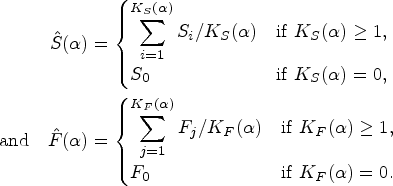
Next, we derive the fluid response function for our procedurally rational model. Let
Define
In the fluid regime, the fraction of customers who choose route

Let
For any
In general, when
To ensure meaningful comparisons with the Nash equilibrium with
Given a procedurally rational model, we define
In this subsection, we focus on the procedurally rational model with
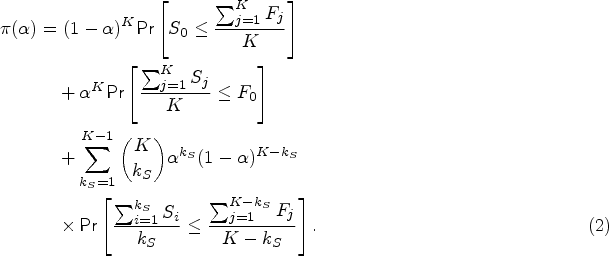
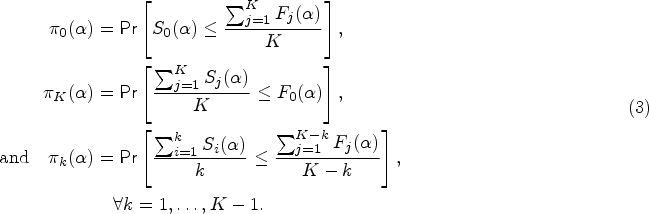

Consider a sequence of procedurally rational models with changing
In addition to having the same equilibrium outcomes, we note that the response function under our procedurally rational model converges to that of the fully rational model in the interval
For any fixed
Thus, as customers receive more anecdotes, their estimates of the system time approach the true mean; while not altogether surprising, this finding is valuable in that it establishes the connection between procedural rationality and full rationality. Moreover, as we will demonstrate in Section 5, the cumulative system time for all customers is minimized at
We have seen that customer behavior under procedural rationality converges to the socially optimal herding equilibrium as the sample size grows to infinity, but in practice, access to a large number of anecdotes can come at a cost to people, as they may be simply overwhelmed by information or have limited memory (see, e.g., Tong and Feiler, 2017 for more on cognitive limitations related to sampling). Also, the number of each type of anecdote they receive may not be binomial if the sampling is biased for some reason (e.g., to obtain a missing type of anecdote). Therefore, we next seek to understand the largest equilibria for procedurally rational customers given that the sample size,
At first glance, equilibria associated with finite
Consider a customer drawing a sample of anecdotes from a system with


The property above (proof in Online Appendix B) shows that when
Observe that for a fixed
For any
if for any integers
Proposition 2 provides a closed-form lower bound for
We next consider the effect of
(Small Prior Noise Is Sufficient for Herding)
For any fixed
Proposition 3 establishes the following interesting insight. Suppose the prior estimate has negligible noise (
To provide intuition, Figure 1 plots the response function (computed by Monte Carlo simulation) for various values of
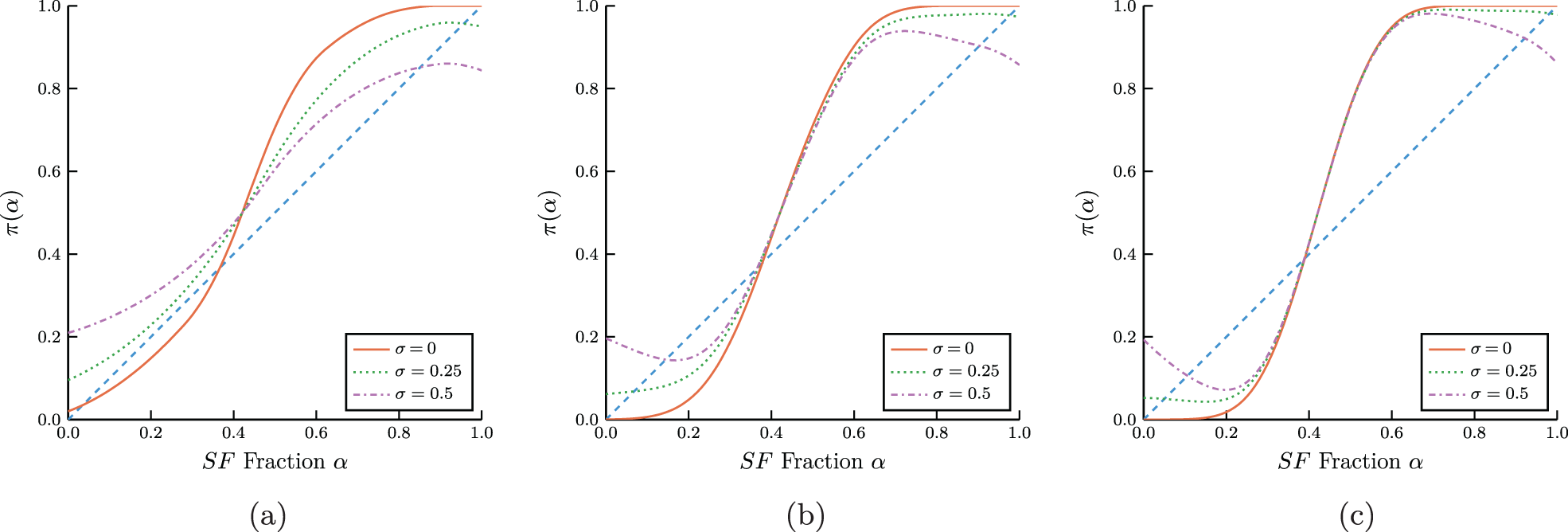
Procedurally rational response function
Thus far, our exploration has focused on a model with procedurally rational customers, each of whom draws exactly
Similar to Proposition 1, intuitively, as
(Obtaining Both Types of Anecdotes Is Sufficient for Herding)
Consider a procedurally rational model with general route anecdotes parameterized by a quantity
In other words, whether the sample size is small or large, as long as the likelihood of obtaining anecdotes for both routes is high, the procedurally rational equilibrium comes to resemble the fully rational equilibrium. This finding implies the following important and encouraging insight for managers: if customers are likely to obtain information about both routes, then increasing the number of anecdotes—which can be thought of as customers becoming more sophisticated in their reasoning—is not necessary to achieve a good customer experience.
We have intentionally defined the general route anecdotes sampling process abstractly to retain the most generality. However, for additional concreteness, in Online Appendix E we provide a specific example of a general route anecdotes sampling process. In this process, customers’ anecdotes are biased toward the missing type of anecdote until they obtain both types, and the degree of bias is related to a discernibility parameter. This parameter is a simplified abstraction of the factors other than the population proportion of routes that influence the probability of obtaining the missing type of anecdote, for example, the size and activeness of the online community in the social media example in the introduction. This sampling process with discernibility satisfies the conditions of Proposition 4, so as discernibility increases,
Cumulative System Time
To measure how well the system performs—and by extension, how satisfied customers are likely to be—we use the cumulative system time, that is, the integral of the total system time experienced by customers in each position in the queues (see Proposition D.1 in Online Appendix D for a closed-form expression). Arlotto et al. (2019) reported that herding achieves excellent performance with respect to cumulative system time in the discrete setting. The next proposition verifies that in the fluid case also, herding performs extremely well and is, in fact, optimal.
(Herding Is Socially Optimal)
The cumulative system time is minimized when customers herd, that is, for fixed
We also compare the cumulative system time at the procedurally rational equilibrium against that at herding for different values of the service rate ratio
Accuracy of the Fluid Model
With discrete customers, we now numerically study the evolution of procedurally rational routing decisions in a repeated setting. Specifically, we suppose that new customers enter to play the game in every period, and their anecdotes are drawn from customers in the previous period. We let
First, we observe that, even for systems with only 500 customers, our analytical results for the fluid system are very good predictors of the routing decisions of procedurally rational customers. Table A.1 in Online Appendix A reports sample statistics for the fraction of
Figure 2 shows typical sample paths of the discrete system. We observe a similar effect in these plots, namely that play quickly approaches
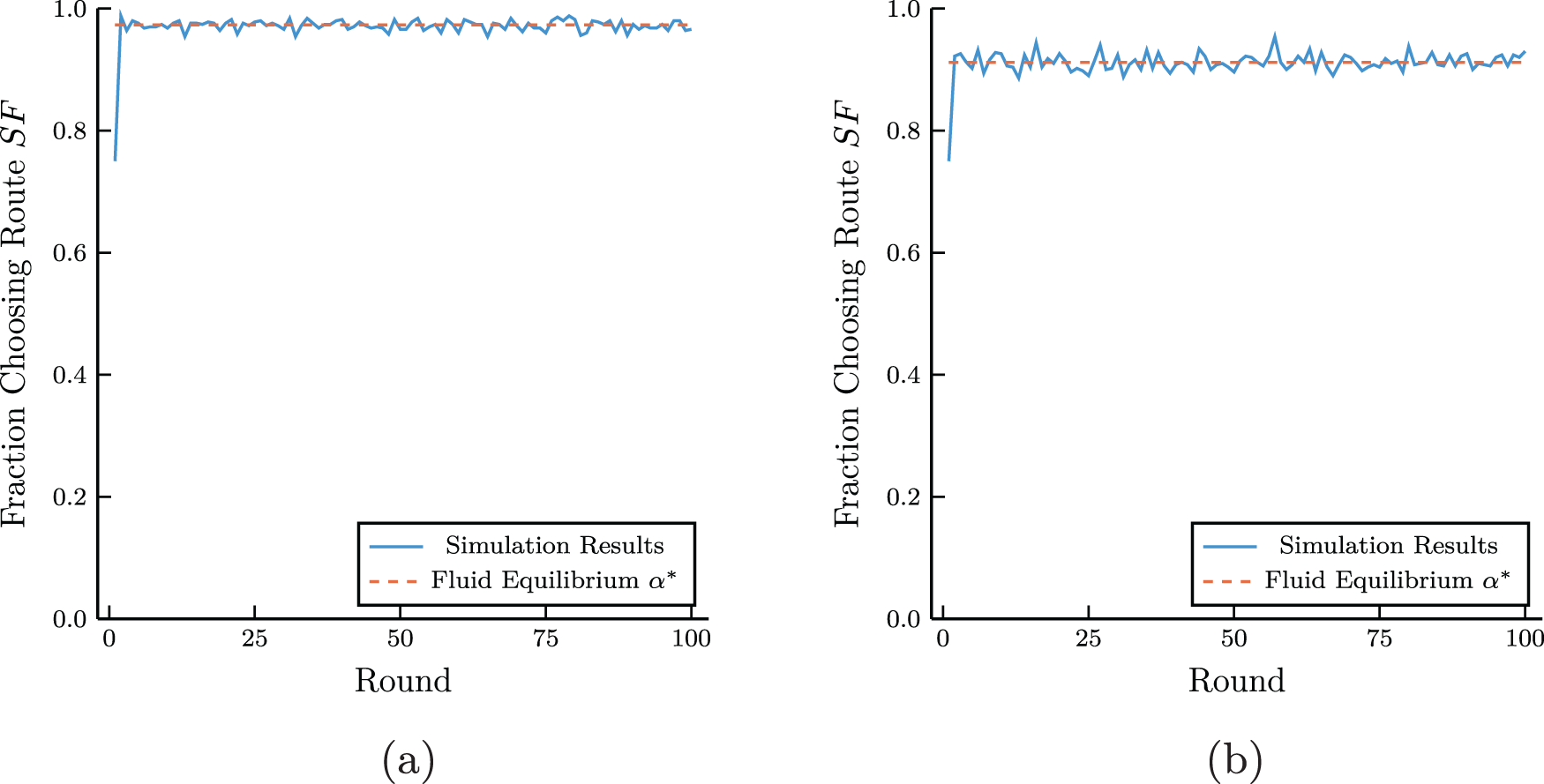
Simulated evolution of discrete system (
We study an open-routing service network with two stations and self-interested, procedurally rational customers who make decisions about which route to take through the network based on anecdotes. In addition to the managerial insights described next, we make a theoretical contribution to the procedural rationality literature by explicitly modeling the sampling process by which customers obtain anecdotes, as well as what customers do if they are missing one type of anecdote.
In the fully rational counterpart to our model, customers herd, that is, they all take the same route through the network; this outcome is also socially optimal in terms of cumulative system time. By comparing outcomes with procedurally rational customers to the fully rational outcome, we uncover three managerial insights. First, we obtain closed-form bounds on the distance between the procedurally rational and fully rational equilibrium, aiding operational planning and showing the rate of convergence to the fully rational outcome as the sample size grows. Second, if customers obtain anecdotes of both actions with high probability, then the equilibrium will approximate the fully rational outcome, despite the sampling error inherent to procedural rationality. Finally, if the noise in the prior point estimate is small, then the procedurally rational equilibrium approximates the fully rational equilibrium, even if customers ignore the prior when they have anecdotes.
These insights reveal two different ways that managers with procedurally rational customers can facilitate herding. First, managers can promote herding by facilitating information sharing among customers so that they are more likely to obtain anecdotes about both routes. Surprisingly, even if each customer’s sample is quite small, limited but diverse information encompassing both alternatives can still significantly impact customer decisions towards the fully rational and socially optimal outcome of herding. Second, if managers can influence the prior point estimates by providing information with minimal noise, then the equilibrium will again approximate herding. Importantly, this information need not even be very accurate; even if the prior is not centered at the true expected system time, if the noise (i.e., standard deviation) in the prior is small, then as long as the likelihood of the prior estimate being in the support of the system time is high, the equilibrium will approximate herding.
We remark, however, that the fully rational outcome may not always be the goal. Many examples in the literature reveal sub-optimal outcomes due to selfish customer behavior, and the cost of such behavior has even been formalized in the price of anarchy (see, e.g., Roughgarden and Tardos, 2002). So, in settings where the fully rational outcome is undesirable, the preferred managerial interventions might be strikingly different from what we have identified in this work. But regardless of whether the fully rational outcome is desirable in a particular context, we believe that our approach that directly models the sampling process improves the fidelity of the procedural rationality framework, and it may be especially useful to researchers studying procedurally rational customers in service settings.
Supplemental Material
sj-pdf-1-pao-10.1177_10591478231224957 - Supplemental material for Service Networks With Open Routing and Procedurally Rational Customers
Supplemental material, sj-pdf-1-pao-10.1177_10591478231224957 for Service Networks With Open Routing and Procedurally Rational Customers by Andrew E. Frazelle, Tingliang Huang and Yehua Wei in Production and Operations Management
Footnotes
Acknowledgments
The authors thank department editor Michael Pinedo, as well as the anonymous senior editor and referees, for many helpful suggestions that led to a significantly improved paper.
Declaration of Conflicting Interests
The author(s) declared no potential conflicts of interest with respect to the research, authorship, and/or publication of this article.
Funding
The author(s) received no financial support for the research, authorship and/or publication of this article.

Supplemental Material
Supplemental material for this article is available online (
Notes
How to cite this article
Frazelle AE, Huang T, Wei Y (2024) Service Networks With Open Routing and Procedurally Rational Customers. Production and Operations Management 33(2): 566–576.
References
Supplementary Material
Please find the following supplemental material available below.
For Open Access articles published under a Creative Commons License, all supplemental material carries the same license as the article it is associated with.
For non-Open Access articles published, all supplemental material carries a non-exclusive license, and permission requests for re-use of supplemental material or any part of supplemental material shall be sent directly to the copyright owner as specified in the copyright notice associated with the article.
