



Abstract
To address the growing obesity crisis, governments are promoting home cooking to improve dietary habits. Home-cooked food-sharing platforms, a manifestation of the sharing economy, offer consumers healthy food options. While the economic benefits of the sharing economy have been extensively studied, little is known about its impact on non-economic factors, such as consumers’ health. To address this gap, we conduct an empirical study using data from a mobile kitchen-sharing platform and four controlled experiments to investigate whether the sharing economy helps consumers develop healthy eating habits. We use manual coding and machine learning methods to evaluate the healthiness of over 180,000 unique dishes and examine food provision and consumption on the platform. Our findings indicate that as consumers use the platform more frequently, they tend to consume more unhealthy food. Additionally, sellers who receive more orders and earn more revenue tend to offer less healthy food over time. Two controlled experiments prove consumers are more likely to order unhealthy food online. Furthermore, these experiments provide causal evidence that consumer food consumption patterns drive seller food provision rather than vice versa. Our results suggest that the sharing economy may have negative consequences due to misaligned interests between sellers and consumers. Fortunately, we identify conditions that may mitigate these effects in empirical analyses and two experiments. Specifically, consumers who choose dine-in options (as opposed to takeaway) and those who order for groups (as opposed to individual orders) tend to make healthier food choices on the platform due to impression management motivation.
Introduction
In response to the growing obesity crisis, governmental and non-governmental organizations worldwide have turned to home cooking as a strategy to address poor diets and reduce obesity rates (Mills et al., 2017). It is widely believed that home-cooked food, compared to fast food and takeaways, leads to healthier dietary patterns and reduces the risk of obesity (Kramer et al., 2012). As a result, a variety of family kitchen-sharing platforms have emerged, such as Yummber and Mamadecai (‘Mother's Dishes’). These platforms list home kitchens in their delivery services to provide healthy, home-cooked meals to individuals who lack the time or expertise to cook at home. Amateur cooks share information about their dishes (such as ingredients, photos, and pricing) to attract consumers, and the platforms connect sellers to buyers based on location and time. Amateur cooks arrange to deliver meals to the buyer's doorstep or offer dining space at their facility (Kodaka, 2016). Unlike mass-produced meals offered by typical food delivery apps, these platforms promise to offer healthy, home-cooked, made-to-order fresh meals (Ni, 2016).
The current research is practically motivated by the emerging kitchen-sharing platforms. We aim to investigate how the operation management of these platforms influences the behavior of consumers (e.g., eating habits) and sellers (e.g., dishes offered). Specifically, we examine whether these platforms can promote healthy eating habits and reduce obesity risk by delivering healthy family dishes.
The theoretical drive behind this research is to elucidate situations in which a potential conflict arises between the individual welfare and the profit motives of sellers in sharing platforms, and illuminate how sharing economy platforms impact individual welfare, particularly in terms of healthy eating, and explore the intricate interplay of economic and non-economic elements in this context. As anticipated in prior literature (e.g., Li et al., 2022), we predict that kitchen-sharing platforms improve the resource utilization of sellers. However, unhealthy food tends to be more enticing to consumers, leading them to make impulsive choices for less healthy options, even when on a diet (Veling et al., 2013; Wang et al., 2011). Hence, it is challenging to ensure that kitchen-sharing platforms will unequivocally contribute to the development of a healthy diet for consumers. In other words, while these platforms offer convenience for consumers to access nutritious home-cooked meals, the consumers’ inclination toward unhealthy eating choices and the sellers’ drive for profit raise the possibility that consumers might eventually adopt an unhealthy diet. Therefore, our study delves into the complex interplay of economic and non-economic factors, examines whether the operating management of sharing platforms (e.g., kitchen-sharing platforms) can improve individual welfare of healthy eating, and adds to the literature on non-economic-related influence of sharing platforms.
Based on the literature on sharing economy and peer-to-peer markets, this study investigates how the operation management of a kitchen-sharing platform impacts the behavior of consumers (i.e., eating habits) and sellers (i.e., dishes offered). Empirical analyses of data from a popular Chinese family kitchen-sharing platform reveal that, over time, sellers provide more unhealthy food, even though the platform's mission is to offer healthy food to consumers. We also find that consumers tend to order more unhealthy food as they use the platform more frequently. Two controlled lab experiments provide further causal evidence that consumers are more likely to order unhealthy food online and that consumer food consumption pattern drives seller food provision but not vice versa. Moreover, we identify two boundary conditions for the above findings. Social cognitive theory (SCT) predicts that social factors influence people's behavior, and we apply SCT to show that food choice is affected by the consumption environment. Specifically, we find that consumers who choose dine-in options (as opposed to takeaway) and those who order for groups (as opposed to individual orders) tend to make healthier food choices on the platform. Two experiments further demonstrate the mediation role of social impression management motivations.
Our research makes several theoretical contributions. First, it deepens our understanding of the non-economic-related objectives or consequences of the operation management of sharing economy platforms. Kumar et al. (2018) suggest that the digital platform is a critical domain representing future research directions at the Operations Management (OM)/Information Systems (IS) interface. Similarly, Ba and Nault (2017) identify platforms as one of the three emergent themes reflecting the foundations for future technology research management. However, much prior research has taken an economic perspective and neglected non-economic welfare in equilibrium analysis. Our study explores how supply-demand dynamics in home-cooked food-sharing platforms affect individual welfare, thus adding to the nascent literature on the non-economic impact of sharing economy platform operations (Greenwood and Wattal, 2017; Luo et al., 2021; Pan and Qiu, 2022; Park et al., 2021). Furthermore, we partially answer the call for moving from examining the efficiency or profit-maximizing of the sharing economy to alternative objectives and other social issues (Hu, 2021). Second, our study advances the OM literature on corporate social responsibility (CSR) by highlighting the difficulties online food platforms face in reconciling profit goals with their CSR commitments to societal welfare, such as promoting healthy eating (Choi et al., 2022; Zhang et al., 2022). Despite CSR's aim to balance stakeholder accountability and societal impact, our findings indicate that profit motives can undermine these objectives. This underscores the need for operations management to integrate CSR more deeply into business strategies to achieve a sustainable balance between financial performance and social responsibility (Luo and Kaul, 2019). Third, we contribute to the emerging literature on behavioral OM, which shows that cognitive biases, social preferences, cultural norms, and emotional aspects alter individuals’ behavior (Bendoly et al., 2010; Loch, 2017; Wang et al., 2022). Specifically, the current research examines how the consumption environment (i.e., different consumption contexts: online environment, dine-in vs. takeaway) influences consumers’ healthy eating behavior.
Our research also has important managerial implications. First, our study counters the idea that less cooking time and urbanization cause obesity, suggesting that even available healthy foods do not ensure better health due to a natural preference for tasty, unhealthy options and profit-driven sellers. Second, our study provides practical recommendations for managers of sharing platforms and sellers on the platforms, particularly those in the home-cooked food-sharing industry. To practice CSR (e.g., promote healthier eating habits among consumers), platform managers and sellers should consider implementing strategies such as creating a dining environment that encourages consumers to dine in rather than opting for takeout, providing nutritional information for dishes, and offering recommendations for healthier food bundles. Third, our findings suggest that consumers who are seeking to develop healthy eating habits can benefit from choosing the group-ordering option instead of ordering alone and opting to dine in at the seller's place rather than dining out. These choices can contribute to a more conducive environment for maintaining a healthy diet.
Literature Review
Technology Innovation
Since the world entered the age of Industry 4.0, new digital technologies that shape production and operation management have become rife. For instance, deep learning and artificial intelligence, the Internet of Things (Kumar et al., 2018; Zhou and Wan, 2022), cloud computing (Arbabian et al., 2021), and blockchain (Babich and Hilary, 2020) have had transformative impacts on many industries (Dai et al., 2020). Realizing the influence of these new technological innovations, scholars have called for more research in these domains. For example, Kumar et al. (2018) emphasize that researchers need an enhanced understanding of the OM/IS interface to develop both disciplines further. In particular, they suggest that the digital platform is one of the critical domains representing future research directions at that interface. Digital platforms have increasingly swayed OM in many areas, such as supply chain management, customer services, and product development (Gaimon et al., 2017; Lin and Zhang, 2023; Tae et al., 2020).
Correspondingly, research on this topic is growing fast (e.g., Dai et al., 2020; Kumar et al., 2018; Li et al., 2020; Li and Kumar, 2018; Zhou and Wan, 2022). For instance, Zhou and Wan (2022) find that mobile digital freight matching platforms do not influence the profitability of traditional freight arrangement companies, but increase the profitability of large trucking companies. In addition, Li et al. (2020) discern that quick-response technology inhibits the positive impact between internal improvement practices and economic performance.
Adding to this stream of research, we introduce an online kitchen-sharing platform that optimizes the information superiority of mobile technologies and the Internet. We examine how this digital platform influences the behaviors of both consumers and sellers. Also, existing operations research has emphasized the significant role of technological and platform innovations in addressing social issues (Kalkanci et al., 2019; Khuntia et al., 2018). We contribute to OM literature on digital platforms by investigating how sharing platforms affect individuals’ healthy eating. The insight from our study augments our understanding of the interface between OM and IS technology innovation.
Sharing Economy Operations
Peer-to-peer markets—collectively known as the sharing economy—have emerged and developed as alternative suppliers of goods and services to those provided by traditional industries. Platforms that support the sharing economy have enabled consumers to use underutilized inventory collaboratively through fee-sharing platforms and engage in convenient and trustworthy transactions with sellers (Einav et al., 2016). Prior research on sharing economy has mainly focused on economic-relevant topics. For instance, Bai et al. (2019) examine the matching between service or product providers and customers and investigate whether it is optimal for rider-sharing platforms to charge a higher price at peak traffic hours to match the needs of impatient customers and the limitations of car supply. Some research has investigated the effect of sharing economy on incumbents (e.g., Burtch et al., 2018; Chen et al., 2019; Zhou and Wan, 2022). Another stream of research centers on pricing strategy in sharing economy (Cachon et al., 2017; Guda and Subramanian, 2019; Taylor, 2018; Tian and Jiang, 2018). For instance, Guda and Subramanian (2019) show that surge pricing controls workforce supply and boosts platform profitability.
As noted earlier, though, extant empiricism on non-economic-related objectives or consequences of sharing economy is sparse. This limited research focuses on its positive influence on social welfare (Benjaafar et al., 2019; Greenwood and Wattal, 2017; Park et al., 2021) and environmental consequences (Bellos et al., 2017). For example, Park et al. (2021) find that ride-sharing reduces rape cases in neighborhoods with limited transportation accessibility. Greenwood and Wattal (2017) discover that the entry of ride-sharing services (e.g., Uber) decreases the rate of alcohol-related motor vehicle fatalities. These preceding societal benefits are sharing platforms’ unexpected consequences—not their primary goals. In contrast, while the food-sharing platform in our study is designed to improve consumers’ diets and promote healthy eating through home-cooked food, we find evidence for its unexpectedly negative consequences on individual welfare. Therefore, our research advances our knowledge of the interplay between supply-demand dynamics and platform mission.
Unintended Consequences and Failures of Sharing Economy
Although the potential economic gains derived from sharing economy are substantial, there is a growing realization that it also has some unintended adverse consequences. For example, sharing economy has been observed to create safety or regulatory problems, facilitate racial discrimination, and add to vulnerability in labor exploitation (Schor, 2020). Online food-sharing platforms enable consumers to enjoy diverse culinary options. However, latitude in the context of dietary choices may engender augmented profit but heftier people, thus exacerbating the obesity issue (Otero et al., 2018). In other words, when consumers enjoy freedom in food choices provided by online sharing platforms, they may not prioritize their health.
Empirical work on the negative implications of sharing economy is limited. Without empirical corroboration, it is challenging to provide helpful insights into sharing economy and knowledge advancement in the field. This study utilizes data from a home-cooked food-sharing platform to test whether sharing economy helps consumers develop healthy eating habits or not. One of the initiatives of food-sharing platforms is to create a virtuous circle whereby home cooks derive economic benefits from capitalizing on their time, resources, and cooking expertise while concurrently improving consumers’ health by providing them with healthy home-cooked food.
Conceivably, however, a food-sharing platform may not realize these salutary twin objectives if the interests of the sellers (i.e., home cooks) and consumers are not aligned. For instance, providing healthy food options may not generate sufficient profit. If not, sellers on food-sharing platforms may go against the platform's initial intention to promote healthy dietary patterns, wherein sellers provide higher profit but less healthy food.
The Impact of the Environment on Eating Behavior
Another critical issue regarding consumers’ eating behavior is their eating environment. Prior research has shown that eating behavior is shaped by the environment (Patrick and Nicklas, 2005). Environmental factors influence food consumption more than people realize (Kahn and Wansink, 2004). According to social cognitive theory, people's behavior is highly influenced by social factors, such as observational learning and others’ expectations (Compeau et al., 1999; Lin and Huang, 2008). Behavioral OM researchers also emphasize that we need to consider the effects of cognitive biases, social preferences, cultural norms, and emotional aspects in behavioral operation research (Bendoly et al., 2010; Loch, 2017; Wang et al., 2022). Specifically, people may modify their eating behavior because of impression-management concerns (Lenny, 2015). After all, people typically eat in a social context in which they are quickly evaluated based on their eating behavior (Lenny, 2015). For example, people are likely to observe and control palatable food intake, not exceeding the intake of others (Herman et al., 2003). Thus, people appear susceptible to the consumption norm associated with their eating environment and will modify their diet accordingly.
Conceptual Framework
In this section, we discuss the interplay between supply and demand on a kitchen-sharing platform and how suppliers and consumers of family meals gradually adjust their behaviors.
First, we propose that consumers tend to gravitate towards unhealthy food in the online environment of the kitchen-sharing platform. While consumers are attracted to the platform for its healthy food options, they must resist their natural inclination towards tasty but unhealthy food. Research has shown that unhealthy food is typically more appealing than healthy food, and consumers often impulsively choose unhealthy options, even when dieting (Veling et al., 2013; Wang et al., 2011). As a result, consumers must exert self-control to make healthier choices, which can be particularly challenging on online platforms where environmental influences are minimal (Compeau et al., 1999; Lin and Huang, 2008). In offline environments, where consumers have more face-to-face interactions, they may be influenced by social norms and expectations, leading them to choose healthier food options (Lenny, 2015). However, when using online platforms, consumers may not feel as obligated to adhere to these norms and are likely to make unhealthy food choices. In summary, without additional interventions or incentives, online platform consumers may have a greater tendency to order unhealthy food.
Furthermore, in response to consumer demand for unhealthy food, sellers on the platform are likely to increase their supply of unhealthy dishes to maximize profit. Although the original intention of the consumers on kitchen-sharing platforms is generally to seek healthier options, sellers are primarily motivated by profit (Zhou and Wan, 2022). Therefore, sellers are more likely to adjust their menus to include more unhealthy dishes if they observe that unhealthy items are more saleable. Suppose healthy but less popular dishes are not subsidized or encouraged. In that case, profitability becomes the primary focus for sellers, and they are more likely to increase their supply of unhealthy food over time.
However, under some conditions, these hypotheses may not hold. We explore two environmental factors that could impact the proposed effects: order for groups (as opposed to individual orders) and dine-in options (as opposed to takeaway). While ordering food online may lack the environmental influence to steer consumers towards healthier options, the consumption stage may prompt consumers to maintain a healthy image. For instance, when consumers order for groups or eat at the seller's establishment, they may order healthier options to project a favorable social image. This is consistent with SCT, which suggests that consumers are susceptible to environmental influence (Lenny, 2015).
To examine our propositions, we conduct a series of analyses. First, we analyze user consumption patterns on the platform and find that consumers tend to order more unhealthy dishes over time. Next, we investigate sellers’ food provision on the platform. Our results reveal that sellers receiving more orders/revenue tend to provide more unhealthy food in the following week. Moreover, we also identify some boundary conditions that may mitigate these effects. Specifically, our findings suggest that due to the need for impression management, consumers tend to order more healthy dishes for groups (as opposed to individual orders) or dine-in (as opposed to takeaway) at the seller's establishment.
Then we replicate the above results and examine the direction of causal relationships in four controlled experiments. First, we conduct two experiments to determine the direction of the causal relationship between consumers’ ordering behavior and sellers’ supply. We find that consumers tend to order more unhealthy dishes on online platforms than offline, and sellers’ healthy food supply does not influence consumers’ food consumption tendencies (Experiment 1). In response to this consumer preference, online sellers increase their provision of unhealthy food (Experiment 2). Furthermore, we replicate the moderation effect by showing that due to impression management, consumers tend to order more healthy dishes when they order for groups (as opposed to individual orders) (Experiment 3) or dine-in at sellers’ place (as opposed to takeaway) (Experiment 4).
Context and Data
Company Background
We collect data from a popular Chinese mobile kitchen-sharing platform. We study food provision and consumption on this platform to determine whether kitchen-sharing platforms could lead to a healthier dietary pattern and identify the underlying reasons. Founded in 2014, the app operates in five major cities in China (i.e., Beijing, Shanghai, Guangzhou, Shenzhen, and Hangzhou) with more than one million registered users. The vision of this company is to create a novel lifestyle by connecting people's needs for a healthy diet and the surplus productivity of home cooks.
The platform features two main types of individual users: sellers and consumers. Sellers (i.e., home cooks) prepare food at their homes and offer meals on the platform. A seller needs to apply to the platform to open a store on the platform. Then the platform will send staff to examine the sanitary conditions of the seller's kitchen and discern his/her cooking skills (i.e., by tasting a sample of the seller's prepared dishes). If the sanitary conditions and the cooking expertise meet the platform's requirements, the seller opens the online store and designs it with the help of the staff. Consumers can browse food options, choose their favorite meals, designate the time of consumption, and then place orders on the platform. The platform offers two options for the consumers to receive their food: (1) eating at the seller's establishment (i.e., eating at the seller's home or other designated place) or (2) using its food-delivery service.
Healthiness Coding of the Dishes
Because we want to ascertain whether consumers are developing healthy dietary habits, the primary variable of interest is the healthiness of a dish on the platform. However, identifying the healthiness of dishes is difficult for three reasons. First, there is no accurate, standard definition of healthy food. All seemingly ‘healthy’ food has at least some minor ‘unhealthy’ aspects, and vice versa. Second, there are thousands of Chinese dishes. For example, our dataset includes over 180,000 unique dishes. Chinese dishes typically combine various ingredients and are cooked in over 20 alternative ways. Third, because of the considerable number and array of recipes, no independent verified source could be utilized to identify the healthiness of the dishes offered on the platform and classify them accordingly. Therefore, we do not attempt to classify a dish as absolutely healthy or unhealthy but only aim to differentiate the comparatively healthier dishes from their unhealthier counterparts.
In this study, we address this challenge of the healthiness coding of dishes through a combination of manual coding and machine learning methods. This entails three steps. In the first step, we randomly select 10,000 dishes and employ two research assistants to code them independently as healthier and less healthy food. We refer to them as healthy or unhealthy food after this for simplification. We choose the most straightforward criterion of the classification based on the WHO guidelines 1 on a healthy diet as follows: we treat a dish as unhealthy if the dish (1) contains too much free sugar (e.g., desert, candies), fat (e.g., butter, deep-fried food), or salt (e.g., bacon, ham, and salami), or (2) contains mainly processed food (e.g., processed meats, pickled salt vegetables). Thanks to the naming tradition of Chinese dish names, it is easy to tell whether a dish contains the two types of unhealthy components from the dish name. The two individuals code the healthiness of the dishes independently. If the two do not agree, they engage in a discussion to make a joint decision on the healthiness of the dish.
In the second step, using the names of the 10,000 dishes and their healthiness tags as training data, we classify the remaining dishes into healthy or unhealthy groups using machine learning algorithms. Specifically, we first process dish names using the bag-of-words model and divide the 10,000 dishes into a training group of 7000 and a hold-out testing group of 3000. Then, we use the number of keywords in dish names and the healthiness tags of the training dishes to train several popular machine learning algorithms. Finally, we assess the performance of each model on the testing sample. The results are presented in Table 1. The table shows that the ensemble (voting) model—an ensemble method combining multinomial naïve-Bayes, logistics regression, decision tree, and support vector machine (SVM)—offers the best performance.
The performance of different classifiers.
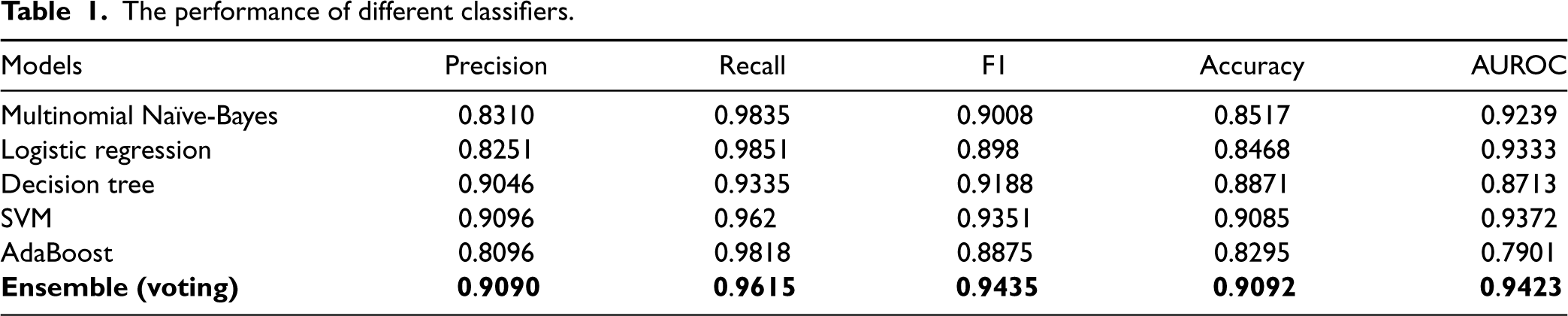
The performance of different classifiers.
We apply this voting model to all the dishes. Our dataset includes 182,937 unique dishes, among which 129,645 (70.87%) are classified as healthy, and the rest are deemed unhealthy after applying the two noted steps. The finding that most dishes are healthy is consistent with the platform's vision to provide people with healthy food options. This also aligns with the loose criterion we deploy and describe above. Some examples of healthy and unhealthy dishes are provided in Table E1 in the E-Companion.
In the third step, we take several measures to verify the algorithm's validity. First, we randomly select 3000 dishes coded by the algorithm but not coded by the research assistants in the first step and have the two research assistants manually code them. We find a consistency rate between the algorithm and the human coders of 87.17%. This indicates that our algorithm is reliable in coding the healthiness of the food. Second, in our data, around 50% of the dishes have a dish description. The descriptions generally provide information about the ingredients, cooking methods, flavor, and the look of the dishes. We randomly select 5000 dishes from this batch with dish descriptions. Then we ask two research assistants to code the healthiness of the dishes separately: one RA codes based solely on the dish name while the other RA codes based on both the dish name and the description. It turns out that the consistency rate between the two coding methods is 89.14%, in line with our knowledge that, in most cases, it is easy to judge the ingredients and cooking method, and thus the healthiness, from the name of a Chinese dish. This provides evidence that it is reasonable to code the healthiness of Chinese dishes based on dish names. Third, we randomly select 5000 dishes with dish descriptions and use the keywords in both the dish name and description of the 5000 dishes as the training set and re-train the model. And then, we use the new model to classify the other dishes. We obtain two predicted healthiness tags for each dish, one from the model trained solely on dish names and the other trained on both dish names and descriptions. The consistent rate is 91.37% for dishes with descriptions and 86.53% for those without descriptions. This indicates that our coding of dish healthiness is robust and valid. Therefore, the analysis below uses the healthiness tags we get from classification based on dish names for brevity. Fourth, we randomly select 1500 dishes, look up their rough calorie amount (aggregated from each ingredient), and classify them into high-/low-calorie dishes using a median split. The consistent rate between this tag of high/low calorie and our healthiness coding is 82.2%, indicating that our method of coding the healthiness of dishes is reliable.
As we have both seller- and consumer-level analysis in this study, we describe the variables in both levels separately in this section. We randomly select 174,645 consumers from the platform and aggregate the data to a consumer-week level. On average, each consumer uses the platform for 7.98 weeks. Consumers have two methods to get food from sellers: using the food delivery services and eating at the sellers’ places. In our dataset, 158,698 consumers only use the food delivery services and never eat at the sellers’ homes. 3029 consumers only eat at the sellers’ homes and never use the food delivery services. And the rest, 12,918 consumers, use both methods to get their food.
We randomly select 5789 sellers from the platform to conduct supply-level analysis and aggregate the data to a seller-week level. On average, each seller uses the platform for around 16.33 weeks. The consumer- and seller-level variables are described and summarized in Table 2.
Variables and summary statistics.
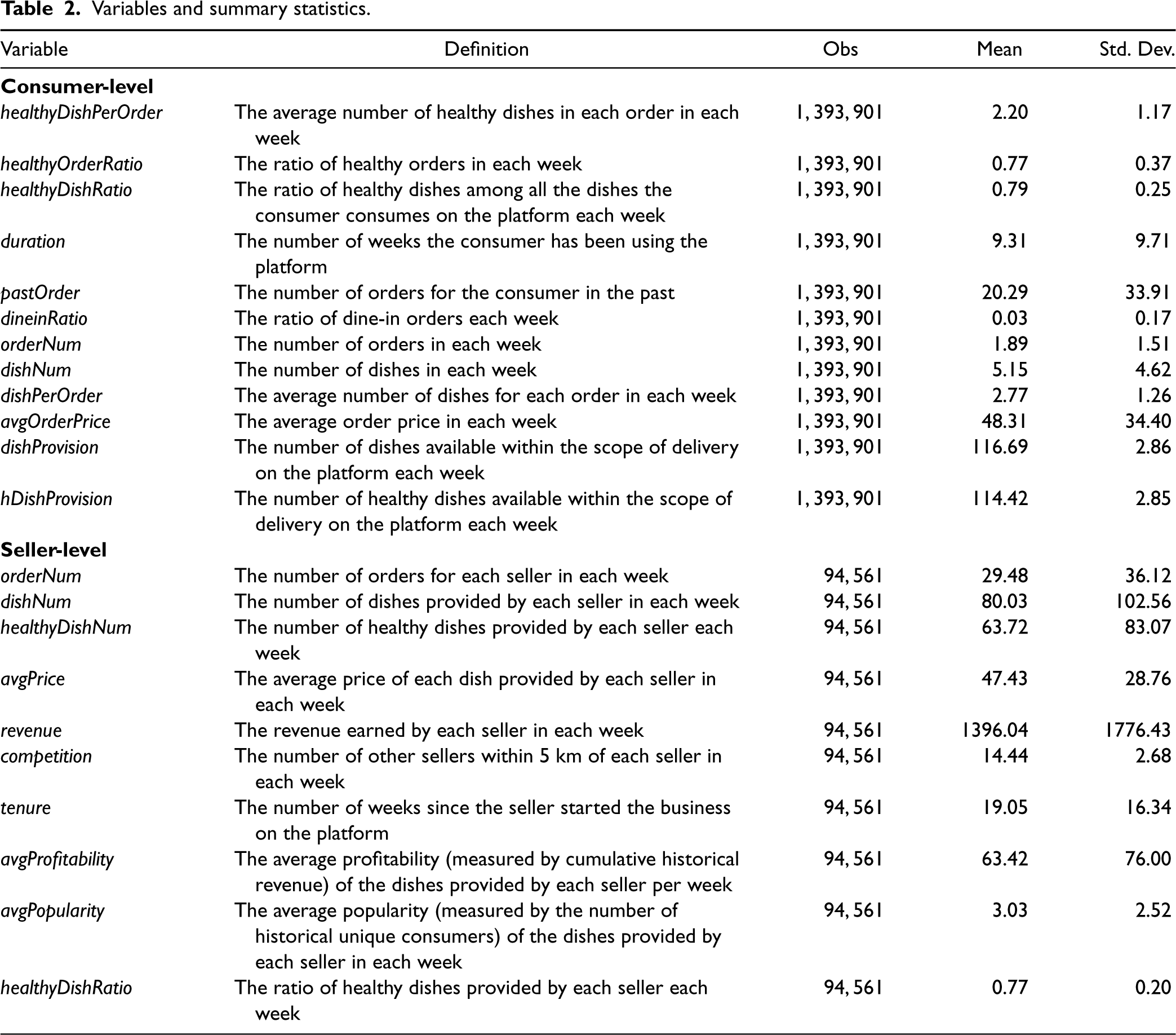
Variables and summary statistics.
Consumption Trend of Healthy Food on the Platform
Consumers engage on this platform, intending to eat healthier home-cooked food. Otherwise, they would likely opt for other larger and more convenient platforms, such as the two largest Chinese food delivery platforms (i.e., ele.me and Meituan), where they have more food options and promotions. To determine whether the platform accomplishes its objective, we organize the data into consumer-week units and examine consumers’ demand for healthy dishes to find out whether consumers eat more healthily or unhealthily when utilizing the platform over time.
Our primary independent variable of interest is duration, which reflects the number of weeks the consumer has been using the platform. To measure consumers’ healthiness of eating, we use three indicators: healthyDishPerOrder (the average number of healthy dishes in each order), healthyOrderRatio (the ratio of healthy orders in each week; we treat an order healthy if it includes more healthy dishes than unhealthy ones), and healthyDishRatio (the ratio of healthy dishes among all the dishes the consumer consumes on the platform in each week). We regress the three indicators on duration. To control for consumer heterogeneity and possible seasonal factors, we include consumer-fixed effects and week-fixed effects in our analysis. To rule out the possible influence of food provision on the platform, we also control for dish provision (dishProvision) and healthy dish provision (hDishProvision) each week. In particular, we set up a linear regression model with Ordinary Least Square estimation and heteroskedasticity-robust standard errors, as shown in Equation (1):

The results are tabulated in Table 3. Our findings reveal that consumers generally begin eating more unhealthily (i.e., eating more unhealthy dishes for each meal and each week) as they continue to use the platform for an extended period. Specifically, as consumers stay longer on the platform, they order fewer healthy dishes in each subsequent order (coef. = −0.004, p < 0.01), request fewer healthy orders each week (coef. = −0.001, p < 0.01), and consume a smaller proportion of healthy dishes (coef. = −0.001, p < 0.01) each week.
User consumption pattern on the platform.
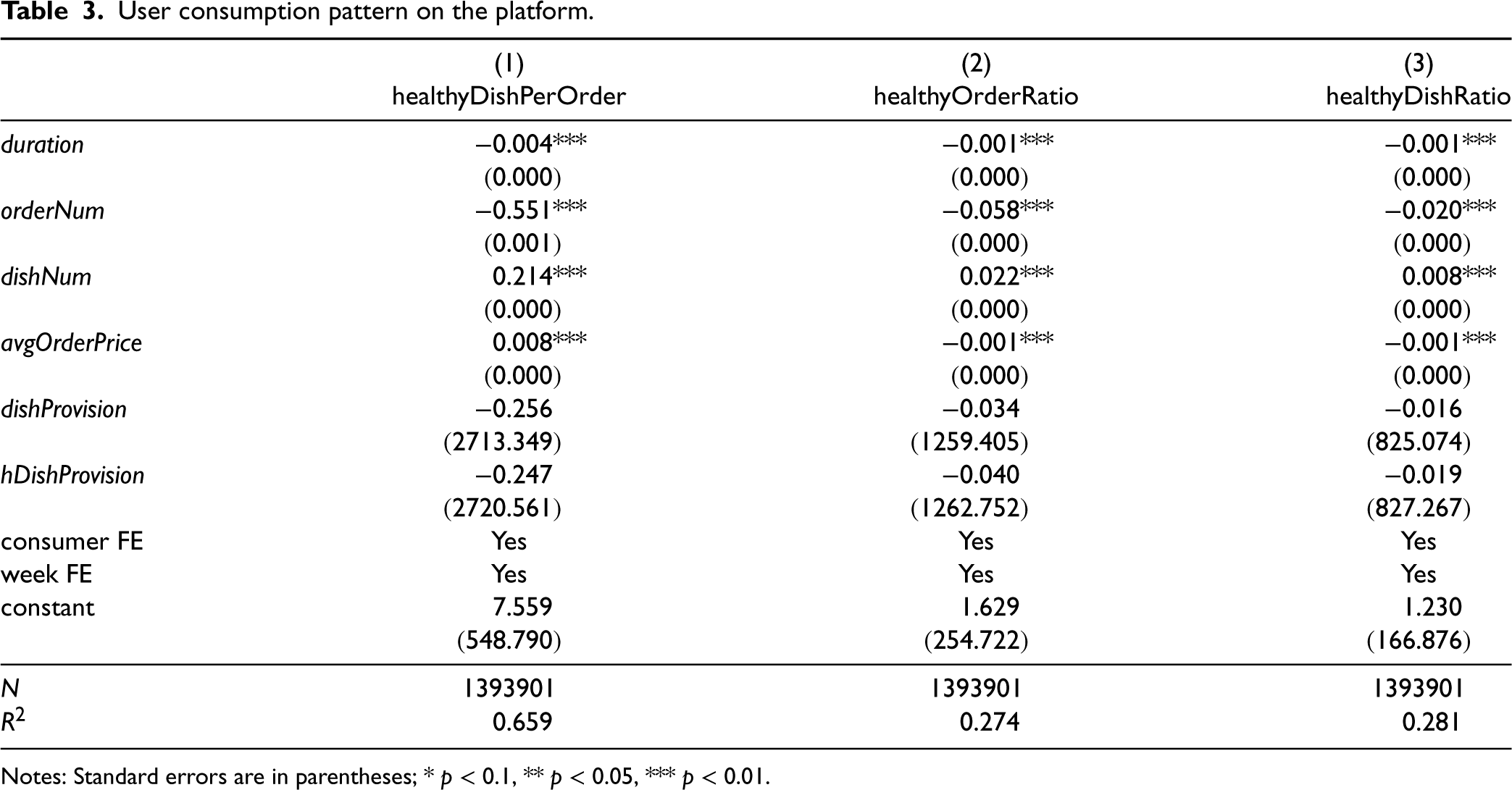
Notes: Standard errors are in parentheses; * p < 0.1, ** p < 0.05, *** p < 0.01.
Although we expect that family kitchen-sharing platforms would provide an easy option for people who do not have the convenience of cooking at home to eat healthily, we observe the opposite phenomenon. People turn to unhealthy food options over time. This result implies that people's poor eating habits are rooted in reasons deeper than just lacking time or adequate healthy cooking facilities.
The results, however, are prone to possible endogeneity issues. Specifically, the platform's consumers self-select to join, use, and leave the platform. Hence, the effect of duration is endogenous and is likely to have a confounding effect on other factors related to consumers’ food consumption on the platform. We conduct the DWH test, and the p-value is smaller than 0.001, indicating that duration is indeed endogenous.
We deploy two identification strategies to address this issue. We first use the control function approach by Petrin and Train (2010) to econometrically deal with the endogeneity concern. Compared to the two-stage least square (2SLS) approach, the control function approach is a more general form of instrumental variable (IV) approach. We carefully choose an instrument for the endogenous variables: the average order number on the platform as of the focal week. We take several steps to ensure the validity of this instrument (Rossi, 2014). First, we carefully check that the IV meets the exclusion restrictions. A consumer's continued use of the platform is closely related to past consumption. However, the consumption pattern in terms of healthiness is unlikely to be directly affected by his or her past consumption amount. With the anticipation that the past average order number is more likely to correlate with duration and less likely to influence the consumption pattern, we include the past average order number of a consumer as the instrument. Second, we run regressions with duration as the dependent variable and the IV as the predictor. As indicated in Column (1) of Table A1 in the E-Companion A, the IV is highly significant, and the F-statistics exceed the usual threshold of 10, indicating its relevance. Third, we examine the association between our IV and users’ ordering of healthy food. We observe that the IV is not significantly associated with the number of healthy dishes ordered each week (Column (2) of Table A1), suggesting that our IV is exogenous to user healthy food consumption.
As to the estimation, for the endogenous variable, we first perform an auxiliary estimation in which it is the dependent variable, and the exogenous (excluded) instrument and other included instruments (control variables in our proposed model) are predictors; with this stem, we obtain the control residuals. Then, we include the control residuals for duration in the augmented regression. The estimation results with the control function approach are consistent with our findings (see Table 4).
User consumption pattern on the platform (control function approach).
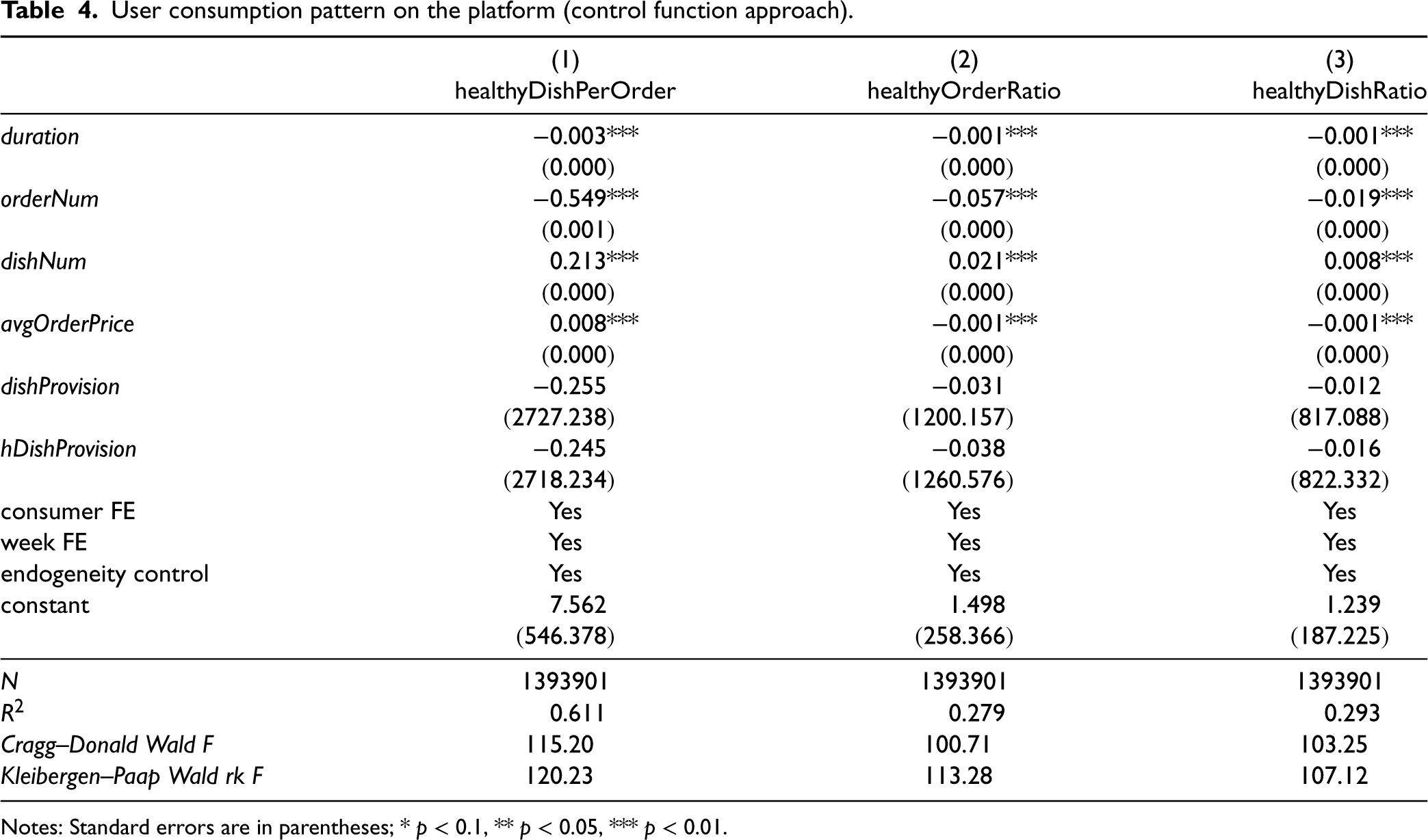
Notes: Standard errors are in parentheses; * p < 0.1, ** p < 0.05, *** p < 0.01.
We also deploy a two-step Heckman approach to mitigate duration-related endogeneity concerns further and get similar findings (please refer to E-Companion B).
The results in the preceding section imply that consumers who remain on the platform eat more unhealthily over time. This section examines food provision on the platform. Sellers are rational agents who maximize profits in light of the evolving dynamics of consumers. Therefore, we conduct a provider-level analysis and look at sellers’ provision of healthy and unhealthy food on the platform. To maximize profits, sellers must set their prices and determine the provision of healthy versus unhealthy food options in each period. These decisions subsequently influence the seller's revenue.
To examine this process, we organize the data into a seller-week level and conduct a supplier-level analysis. To address the endogeneity problem—specifically reverse causality between the provision of healthy food, food pricing, and revenue, we adopt the Arellano Bover/Blundell-Bond system generalized method of moments (GMM) estimator (Arellano and Bond, 1991; Arellano and Bover, 1995). The system GMM estimators employ the lagged values of both differences and levels of endogenous variables as instruments to address endogeneity in a dynamic panel model. It has been widely used in recent IS and OM studies to address endogeneity and autocorrelation concerns (Aral et al., 2012; Bardhan et al., 2013; Yiu et al., 2020). All endogenous variables are instrumented. Because we are interested only in how revenue affects weekly healthy food provision, we present the single equation model with the weekly healthy food provision as the dependent variable.
To control for the possible influence of product profitability and product popularity on the food provision of each seller, we constitute and control avgProfitability and avgPopularity. For each week in each shop, we first list all dishes displayed in the shop. We then calculate the following two indicators for each dish: the cumulative historical revenue (i.e., price times quantity) and the number of unique consumers who had ordered the dish in the past. Last, we average the historical revenue and the number of unique consumers to arrive at the average profitability (avgProfitability) and popularity (avgPopularity) for the seller in the week. We also control for the severity of competition each seller faced on the platform, competition (measured by the number of sellers within 5 km of the seller), and tenure—the number of weeks since the seller started the business on the platform.
Supply decisions such as the provision of healthy dishes could be persistent over time such that past dish provision is highly correlated with current dish provision. Controlling past dish provision can ensure a more robust estimation of the effects of other seller-level variables, such as sellers’ strategies and practices in selecting healthy and unhealthy food. As our research views sellers’ current provision of healthy dishes as the dependent variable and examines the effects of several seller-level variables, such as past revenue or the number of orders on the current dish provision, we follow prior research to control for past dish and unhealthy dish provision in our analysis. As a result, we construct a dynamic panel data (DPD) model, as shown in Equation (2), to investigate the roles that past sales play in influencing sellers’ current decisions on healthy dish provision.

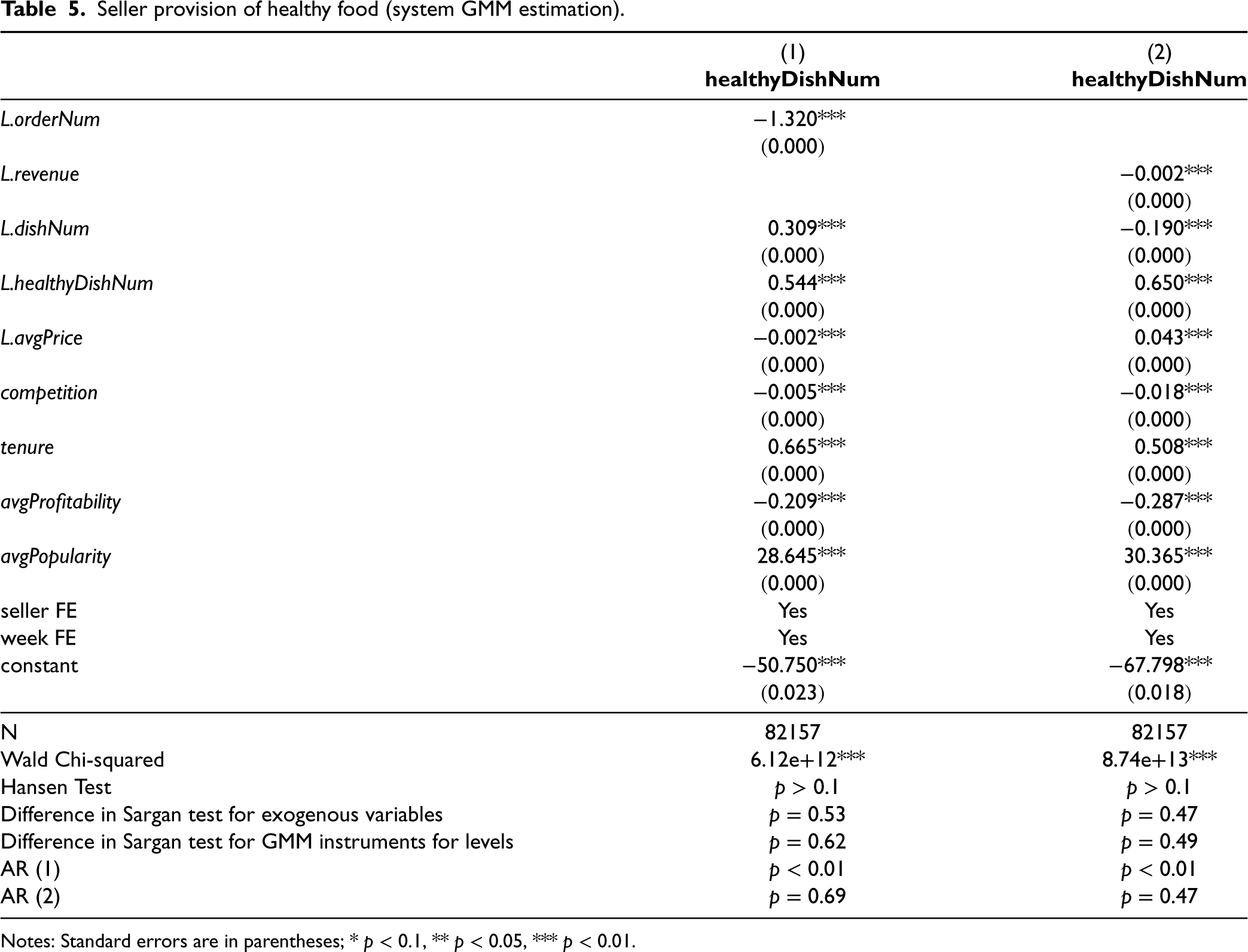
The results are presented in Table 5, from which we can find that sellers receiving more orders and revenue tend to reduce the provision of healthy food in subsequent periods. Contrary to our expectation that the home-cooked food-sharing platform would provide healthy food to consumers, sellers begin to provide more unhealthy food on the platform over time. The underlying reason is that providing healthy food is associated with less revenue. Thus, sellers would provide comparatively more unhealthy food to maximize their profits.
Seller provision of healthy food (system GMM estimation).
Notes: Standard errors are in parentheses; * p < 0.1, ** p < 0.05, *** p < 0.01.
To verify the validity of the instruments used in our system GMM estimation, we conduct two sets of tests that are related to our model specifications. We first conduct the Hansen test to check whether the instruments used in our model are correlated with the error term. The Hansen test results shown in Table 5 are insignificant (p > 0.1), indicating that the null hypothesis that the instruments are orthogonal to the error term could be rejected. These results confirm that our instruments are exogenous, which is an essential assumption for a valid system GMM estimation (Roodman, 2009). The second set of tests is to test whether there is autocorrelation in the idiosyncratic disturbances (Alessandri and Seth, 2014). Specifically, we conduct the Arellano-Bond test of autocorrelation to the residuals in differences. The Arellano-Bond test statistics shown in Table 5 indicate that although the first-order autocorrelation statistics (AR (1)) are significant (p < 0.01), the second-order correlation in differences statistics (AR (2)) are not significant (p > 0.1). These results, therefore, confirm that there is no serial correlation in the idiosyncratic disturbances. The two specification tests demonstrate the validity of the instruments used in our system GMM model.
We seek an explanation for this phenomenon. Consistent with prior research (Chen and Hu, 2020), the platform's selling point is the ability to connect home cooks who have surplus cooking productivity with consumers who do not have the time to cook. However, the platform design does not offer a clear incentive or intervention to facilitate the provision of healthy food. Because selling healthy food is less profitable, the invisible hand of competition and profit leads sellers to provide more unhealthy food. This partly explains why, although people are aware of obesity, junk food remains prominent in contemporary society globally.
Thus far, we have found that people eat more unhealthily over time on the platform. Moreover, sellers who receive more orders tend to provide more unhealthy food options. This is surely contradicting people's expectations for a family kitchen-sharing platform. To further explore the phenomenon and provide additional insights and implications, we examine possible contingent factors that will mitigate the drawbacks we identify above in this and the next section. The major difference between the platform we study and other food-delivery platforms is that the sellers on the platform are mainly home cooks. Consumers could choose to eat at the sellers’ homes. Eating at the sellers’ homes significantly affects consumers’ behavior. This is because eating at sellers’ homes provides a social environment wherein consumers are motivated to maintain a preferable image and order healthier food. To examine whether the eating environment affects consumers’ food ordering and eating habits over time, we differentiate consumers eating only at a seller's establishment from those who never eat at a seller's establishment. We then examine their consumption trends of healthy food options on the platform.
Our dataset includes an indicator of whether an order is consumed at a seller's establishment. Using this indicator, we identify two groups of consumers. In one group, consumers eat only at the sellers’ homes but do not use the platform's delivery service (i.e., dine-in consumers). In the second group, consumers employ the platform's delivery service but never eat at the sellers’ homes (i.e., take-away consumers). We expect that the consumption pattern for the two groups of consumers is different, as they utilize the platform differently. Dine-in consumers enjoy the atmosphere of having home-cooked food in sellers’ establishments. In contrast, take-away consumers generally use the platform as a delivery alternative for nominal healthy food. We conduct a similar analysis separately for the two groups of consumers to examine the possible different patterns, as described in Section 5.1.
As presented in Table 6, the results reveal that consumers who choose dine-in at seller's establishments generally begin eating more healthily (i.e., eating more healthy dishes for each meal and each week) as they continue to use the platform for a longer period. Specifically, as consumers remain on the platform longer, they order more healthy dishes in each subsequent order (coef. = 0.007, p < 0.01), request more healthy orders each week (coef. = 0.005, p < 0.01), and consume a larger proportion of healthy dishes (coef. = 0.002, p < 0.10) each week.
Consumption pattern for dine-in consumers.
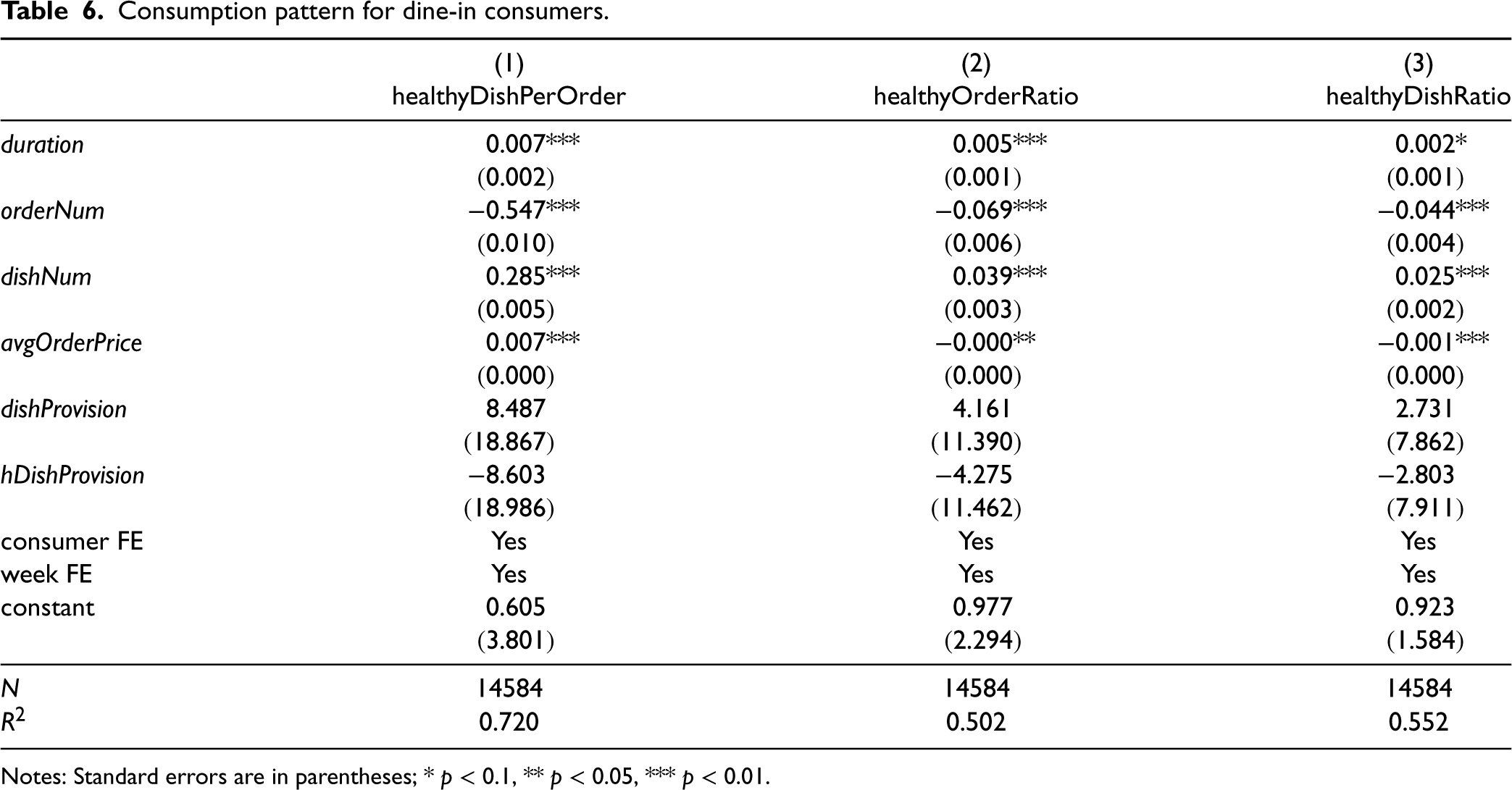
Consumption pattern for dine-in consumers.
Notes: Standard errors are in parentheses; * p < 0.1, ** p < 0.05, *** p < 0.01.
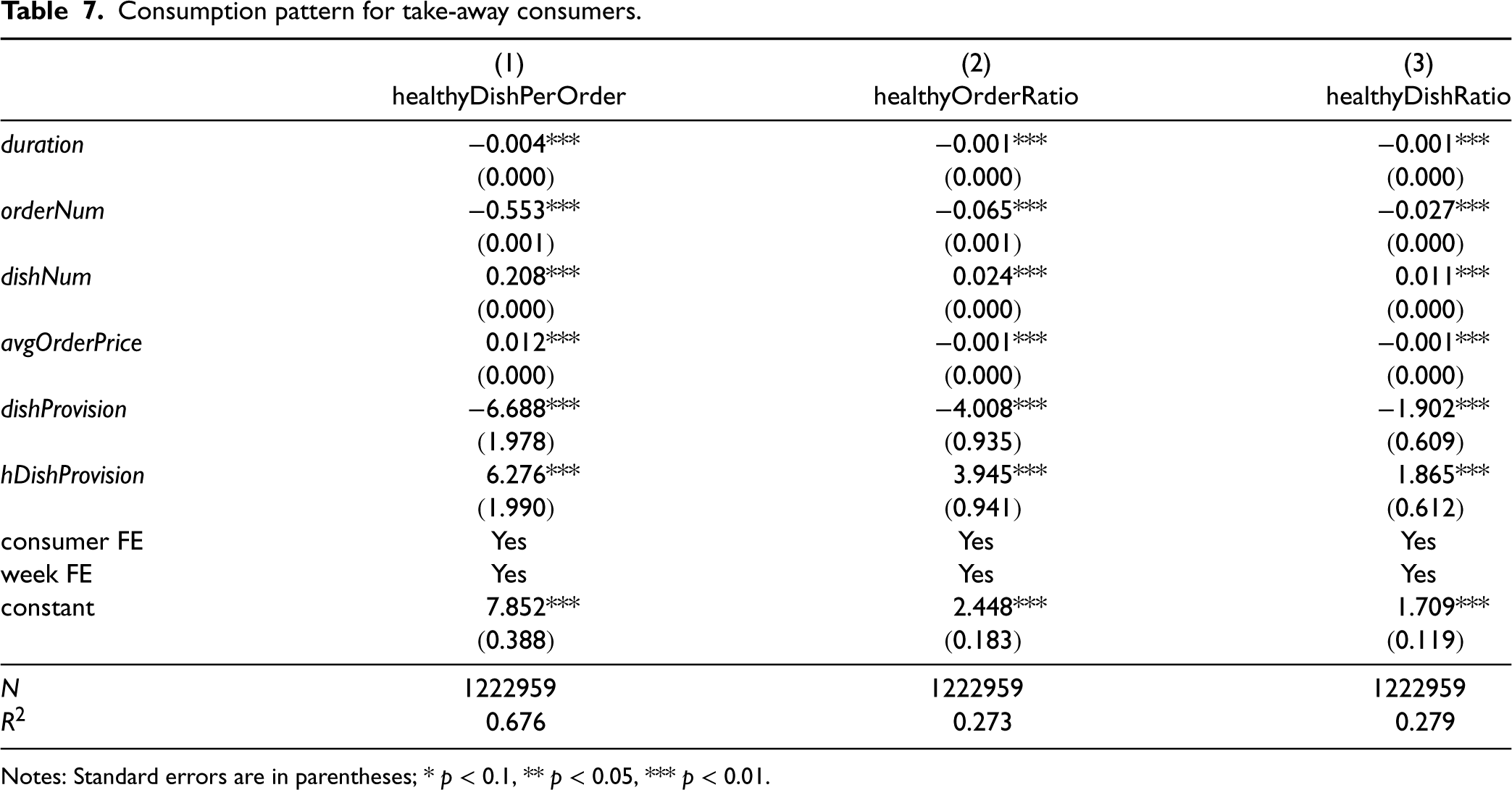
The pattern for takeaway consumers, however, is different. As these consumers stay on the platform longer, they order more unhealthy dishes in each subsequent order (coef. = −0.004, p < 0.01), request more unhealthy orders each week (coef. = −0.001, p < 0.01), and consume a larger proportion of unhealthy dishes each week (coef. = −0.001, p < 0.01).
The main results show that for those consumers treating the platform as a family kitchen-sharing platform (i.e., only eat at a seller's establishment), the more they order from the platform and the more healthily they eat (Table 6). For those consumers treating the platform as a food-delivery platform (i.e., only order food using delivery services), the more they order from the platform, the more unhealthily they eat (Table 7).
Consumption pattern for take-away consumers.
Notes: Standard errors are in parentheses; * p < 0.1, ** p < 0.05, *** p < 0.01.
We then focus on consumers who both dine in and order delivery food on the platform. To take into consideration the heterogeneity in terms of where they have the food (e.g., dine-in vs. take-away), we construct a variable, dineinRatio, which captures the ratio of dine-in orders for each consumer in each week and run a similar analysis as above to examine their consumption pattern on the platform.
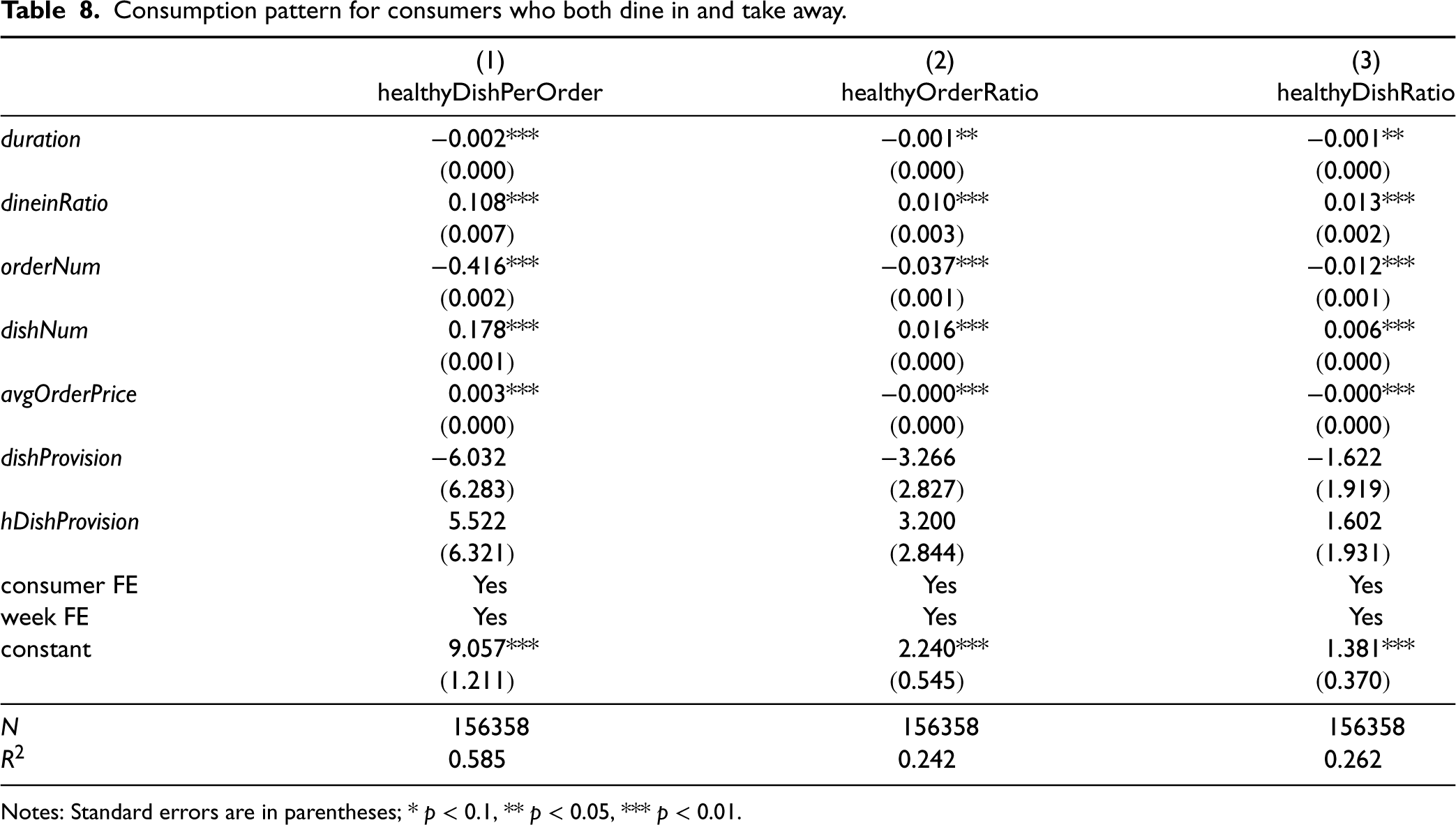
The results in Table 8 provide further support for our previous results. The ratio of dining in has a positive association with the ordering of healthy food (coef.: 0.010 to 0.108, p < 0.01), indicating consumers’ inclination to order healthier food when eating at the seller's establishment. After controlling for the ratio of dining in, we find that, like those take-away consumers, consumers who both dine in and take away order fewer healthy dishes in each subsequent order (coef. = −0.002, p < 0.01), request fewer healthy orders each week (coef. = −0.001, p < 0.01), and consume a smaller proportion of healthy dishes (coef. = −0.001, p < 0.01) each week as they stay longer on the platform. The underlying reason that these consumers share the same consumption pattern as those take-away consumers is that among the 356,271 orders made by this batch of consumers, only 66,080 (18.55%) are dine-in orders.
Consumption pattern for consumers who both dine in and take away.
Notes: Standard errors are in parentheses; * p < 0.1, ** p < 0.05, *** p < 0.01.
Another context that differentiates the eating environment is whether the consumer eats alone or with someone (e.g., friends or family members). We expect that if consumers ordered on the family kitchen sharing platform food for a group instead of for only themselves, they would care more about the healthiness of the food. To examine this, we initially explore whether there is a difference in consumers’ ordering of food when they are ordering different amounts of food.
The results in Table 9 reveal that, as consumers order more dishes for each order, they are prone to order more healthy food. If consumers are ordering many dishes in a single order, conceivably, they are ordering for a group. If they are ordering for groups, they are more likely to pay attention to the ‘healthy food’ component of the platform: providing consumers with healthy home-cooked food. Therefore, consumers are inclined to order more healthy food when making large orders.
The effect of order size on the ordering of healthy food.
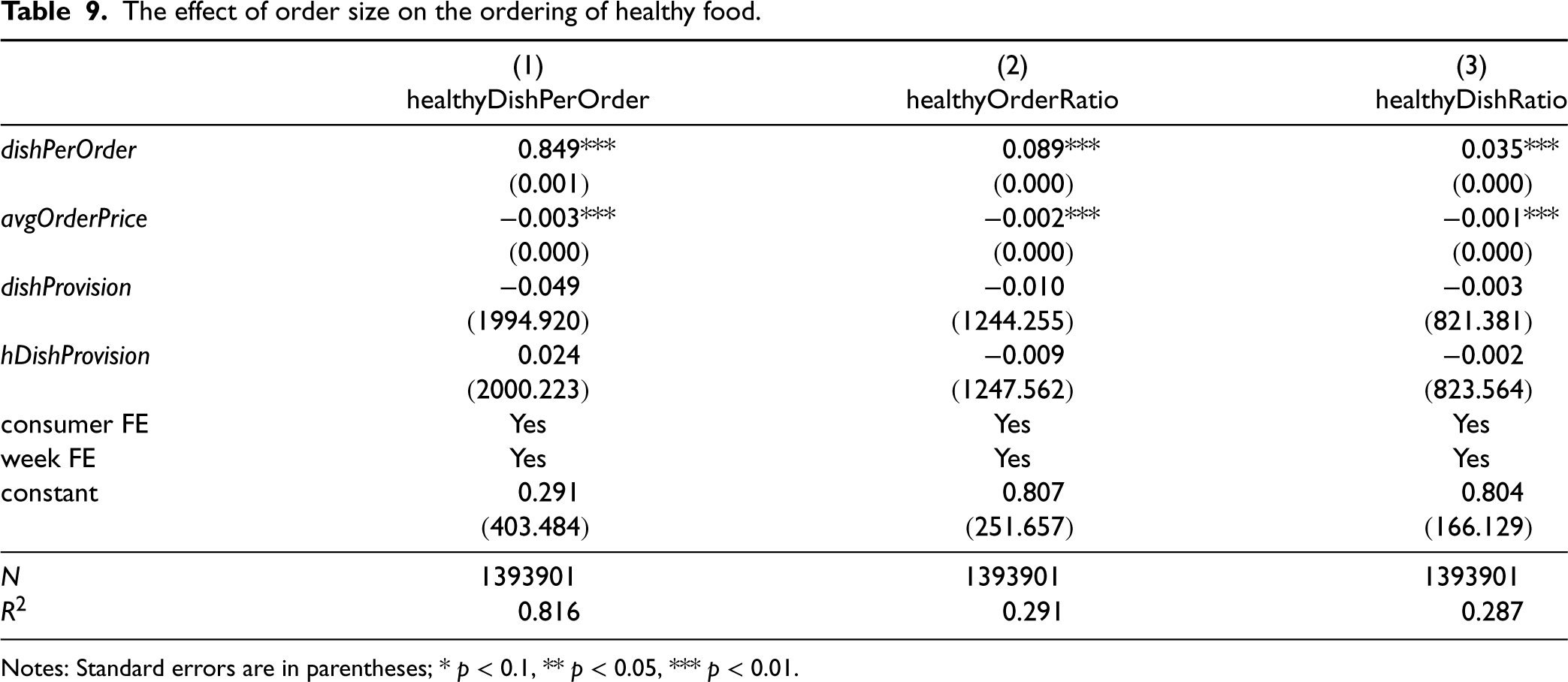
The effect of order size on the ordering of healthy food.
Notes: Standard errors are in parentheses; * p < 0.1, ** p < 0.05, *** p < 0.01.
To examine the consumption pattern of consumers further, we conduct a subsample analysis depending on the quantity per order. Specifically, if there are more than three dishes (median split) for each order, we treat it as a large order. If more than half of his/her orders are large orders for a specific consumer, then we treat the consumer as a consumer who usually orders for groups. We treat the consumer as a consumer who usually orders for himself/herself if otherwise. We conduct a similar analysis separately for the two groups of consumers to examine the possible different patterns, as described in Section 5.2.
As depicted in Table 10, the findings reveal that consumers generally begin eating more unhealthily (i.e., eating less healthy dishes for each meal and each week) as they continue to use the platform for a longer period. Specifically, we find that, as consumers remain longer on the platform, they order more unhealthy dishes in each subsequent order (coef. = −0.004, p < 0.01), request more unhealthy orders each week (coef. = −0.001, p < 0.01), and consume a larger proportion of unhealthy dishes (coef. = −0.001, p < 0.01) each week.
Consumption pattern for consumers who usually order for themselves.
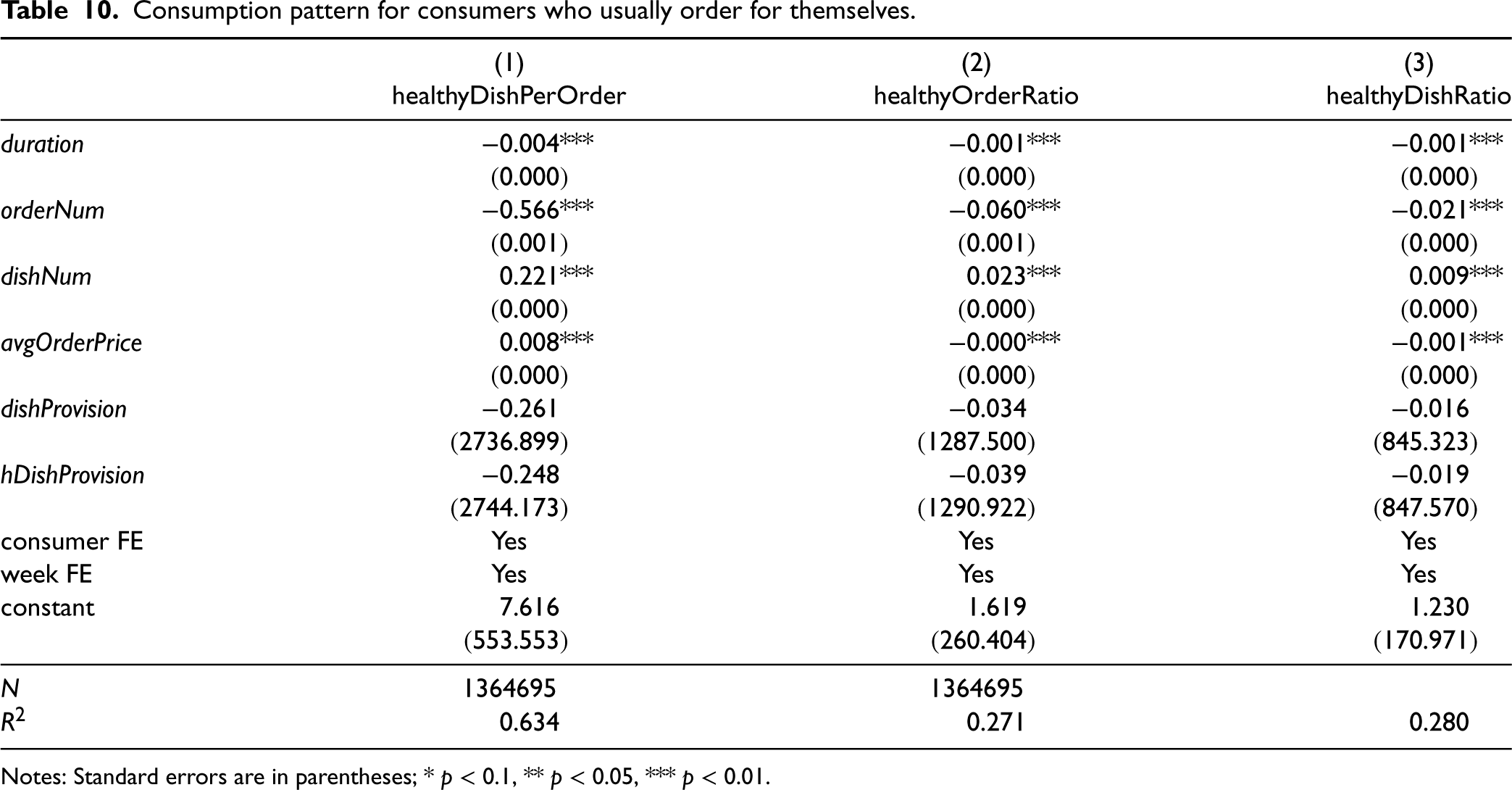
Notes: Standard errors are in parentheses; * p < 0.1, ** p < 0.05, *** p < 0.01.
Table 11 shows that the pattern for consumers who usually order for groups, however, is different. As they use this platform over time, they do not manifest a clear pattern (i.e., eating more unhealthily as they stay longer on the platform) as those consumers who use the platform for delivery and order for themselves.
Consumption pattern for consumers who usually order for group.
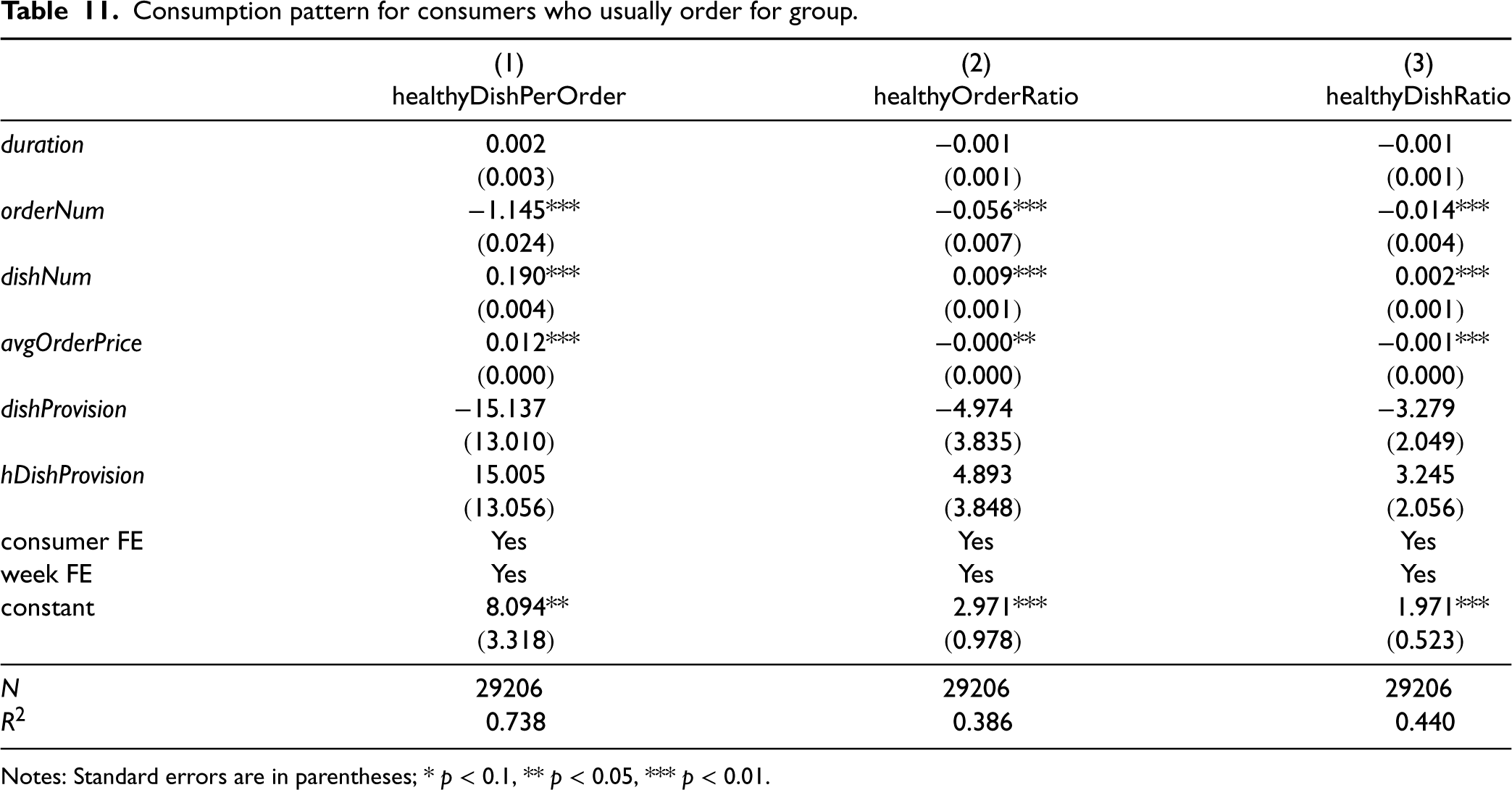
Notes: Standard errors are in parentheses; * p < 0.1, ** p < 0.05, *** p < 0.01.
To establish the internal validity of our estimated results, we conduct a battery of robustness checks to demonstrate further that a specific estimation approach does not drive our results (Please refer to E-Companion C for details). First, consumers may order less healthy food on the platform but cook more meals at home and eat healthier overall. If so, then this work's underlying logic would no longer hold. To rule out this explanation, we examine heavy consumers making more than two orders on the same day (for lunch and dinner) for at least one-half of the days when using the platform. For these consumers, we presuppose that their consumption pattern on the platform represents their everyday lifestyle. We conduct the same analysis on the subsample and find similar results as ordinary consumers.
Second, conceivably consumers having more time or under lower stress may behave differently from those having less time or under higher stress to order healthy versus unhealthy food. To partially rule out this alternative explanation, we differentiate consumers who usually order during mealtime (i.e., more than half of their orders are placed between 11 am and 1 pm or between 5 pm and 7 pm) from those who usually order during non-mealtime. We assume that these two groups of consumers are different because the first group has less time or leisure and orders food from the platform just to satisfy their hunger. In comparison, the second group has more time, usually pays more attention to their diet, and has a clear food-order plan. We analyze the two subsamples separately and obtain consistent results. The findings reveal that consumers from both groups begin eating more unhealthily (i.e., eating more unhealthy dishes for each meal and each week) as they continue to use the platform for an extended period, suggesting that consumers’ free time and stress are not likely to be a factor influencing their ordering of healthy vs. unhealthy food.
Third, in the main analysis above, we utilize the variable duration, which measures the number of weeks the consumer has been using the platform, to gauge their consumption pattern of ordering healthy food. As an alternative measure of consumer experience on the platform, we employ the number of past orders on the platform for the consumer and rerun the major analysis. We obtain similar results.
Fourth, we also conduct two sets of robustness checks for the seller-level analysis. Firstly, as seller performance, such as order number and revenue, could be quite persistent over time, we control for an additional time lag of seller performance, i.e., t – 2, in our model when performing the system GMM model. The test results with this additional control variable remain consistent. The two-week lagged seller performance (i.e., number of orders and revenue) is also negatively associated with the provision of healthy dishes. Secondly, apart from the number of healthy dishes provided by sellers, we are also wondering about the relationship between sellers’ sales and the ratio of healthy dishes provided by them. Therefore, we use this ratio as the dependent variable and rerun our system GMM estimation. We obtain consistent results: more orders or revenue are associated with a smaller ratio of healthy dishes in the subsequent period. This test provides further evidence for the seller-level analysis.
Follow-Up Experiments and Further Explanation of the Effects
Our empirical analyses reveal that consumers eat more unhealthily over time on the platform. Moreover, sellers are motivated to provide more unhealthy food options driven by higher profits. However, we are not clear on whether food consumption drives food provision or vice versa. There are two different explanations for our findings: 1) consumers choose to order more unhealthy food over time, and therefore the sellers provide more unhealthy food, or 2) the sellers provide more unhealthy food over time, and consumers have to order more unhealthy food over time. To resolve this issue, we conduct four controlled experiments and find support for the first proposition. Specifically, Experiment 1 shows that consumers are more likely to order unhealthy food on online platforms compared to offline restaurants. Moreover, the food supply by sellers (i.e., the number of unhealthy dishes offered by the sellers) does not influence consumers’ consumption patterns significantly. Experiment 2 demonstrates that consumers’ food consumption tendencies influence sellers’ food supply. Additionally, Experiment 3 reveals that consumers are inclined to order less unhealthy food from online platforms when they order for a group (vs. for themselves alone) and the underly mechanism behind it. Experiment 4 finds that consumers tend to order less unhealthy food from online platforms when they choose dine-in at sellers’ place (vs. takeaway) and the underlying mechanism behind it.
Experiment 1: Food Consumption on Online Platforms vs. in Offline Restaurants
The goal of Experiment 1 is twofold. First, we examine whether consumers are more likely to order unhealthy food from online platforms than offline stores. Second, we test whether the food supply patterns by sellers (i.e., the number of unhealthy dishes offered by the seller) influence consumers’ consumption patterns significantly. To this end, we design a scenario simulation experiment in which participants are asked to imagine ordering food online or offline. We predict that participants in the online condition would choose more unhealthy food than those in the offline condition. We also include a third condition where participants imagine ordering food online but with more unhealthy options. We assume that the differences in food choice patterns are primarily due to the mode of ordering (online or offline) rather than differences in the food supply pattern (number of healthy or unhealthy food options). Therefore, we expect that there would be no significant differences in unhealthy food choices between the two online conditions.
Participants and Procedure
It is a 3-way (restaurant scenarios: offline restaurant vs. online restaurant A vs. online restaurant B) between-subjects designed study. 300 participants from Credamo (51.0% female; Mage = 30.90, SDage = 8.51) finish all the tasks in this experiment. Participants are randomly assigned to one of the three restaurant scenarios, which offer different numbers of unhealthy dishes. Specifically, the offline restaurant offers 6 healthy and 6 unhealthy dishes, online restaurant A also offers 6 healthy and 6 unhealthy dishes, and online restaurant B offers 6 healthy and 10 unhealthy dishes. A pretest confirms that the dishes shown in the scenario indeed tap into healthy and unhealthy categories (see E-Companion D for details).
At the beginning of the survey, all participants are asked to imagine that it is mealtime, and they plan to dine out at a restaurant near their home (or dine in at home by ordering some food at an online platform). As participants browse the menu, they are shown different cooking styles for each ingredient (e.g., fried chicken vs. poached chicken, please refer to Table D1 in E-Companion D for each restaurant's menu). After reading the menu, participants are asked to indicate the three dishes they want to order.
Results
We calculate the number of unhealthy dishes each participant selects as the dependent variable (scope 0∼3, M = 1.45, SD = 0.94). As expected, restaurant scenarios significantly affect participants’ unhealthy tendencies (F (2, 297) = 5.369, p = 0.005). Specifically, participants in the offline restaurant condition (M = 1.20, SD = 0.79) indicate a lower tendency to order unhealthy dishes than do those in the online restaurant A condition (M = 1.56, SD = 0.94; F (1, 297) = 7.61, p = 0.006; d = 0.41) or those in the online restaurant B condition (M = 1.58, SD = 1.03; F (1, 297) = 8.48, p = .004; d = 0.41). Moreover, participants in the two online restaurant conditions with different numbers of unhealthy dishes show no significant difference in unhealthy tendencies (F < 1, NS).
Discussion
The results of Experiment 1 support our hypothesis that consumers are more likely to order unhealthy food in online contexts compared to offline contexts. Moreover, there is no significant difference in consumers’ food choices between the two online restaurants with different numbers of unhealthy choices. These results indicate that the ordering mode (offline vs. online) rather than the food supply from sellers (i.e., the number of unhealthy dishes offered by the seller) plays a crucial role in consumers’ tendencies to order unhealthy food.
Experiment 2: The Influence of Food Consumption on Food Supply
Experiment 1 reveals that consumers’ tendency to order more unhealthy food online compared to offline restaurants and sellers’ food supply does not influence consumers’ food consumption tendency significantly. On this basis, Experiment 2 aims to demonstrate that consumers’ food consumption tendencies influence sellers’ food supply. To this end, we design a scenario simulation experiment in which participants are asked to imagine they are online food suppliers and need to make food supply decisions. We inform the experimental group that online consumers are more likely to order unhealthy foods, while the control group does not receive this information. We predict that participants who know the consumer demand information will supply fewer healthy and more unhealthy foods.
Participants and Procedure
It is a 2-way (consumers’ consumption information informed vs. consumers’ consumption information uninformed) between-subjects designed study. A total of 200 participants from Credamo (63.0% female; Mage = 29.81, SDage = 7.91) finish all the tasks in this study. Participants are randomly assigned to one of the two scenarios.
At the beginning of the study, all participants are presented with the following scenario: ‘You are a restaurateur. Your restaurant offers two cooking styles for each ingredient to meet different consumers’ needs. One style is mild taste and relatively healthy, while the other is strong taste and relatively unhealthy.’ Next, participants in the experimental condition see an additional message: ‘You have browsed the consumer data provided by the online delivery platform and found that online consumers tend to choose unhealthy food more frequently.’ In contrast, participants in the control condition do not see this message. Subsequently, all the participants indicate how they will determine the supply quantities of the two types of dishes for each ingredient (e.g., out of a total of 10 servings of potato, how many servings will be salty and how many will be plain?) Then, participants answer a manipulation check question: ‘Do you think that online consumers’ food consumption is becoming increasingly unhealthy?’(1 = Strongly disagree, 7 = Strongly agree).
Results
First, a one-way ANOVA is conducted with the perception of online consumers’ unhealthy consumption as the dependent variable and consumer information (informed vs. uninformed) as the independent variable. Results show that compared to the control condition (M = 4.74, SD =1.54), participants in the experimental condition (M = 5.32, SD = 1.48) are more likely to agree that online consumers consume more unhealthy food (F (1, 198) = 7.348, p = 0.007 < 0.05, d =0.38), indicating a successful manipulation of the independent variable. Next, we calculate the total number of healthy food options each participant selects to supply as the dependent variable (scope 0∼60, M = 25.84, SD = 7.90). The results of ANOVA indicate that, compared to the control group (M = 27.17, SD =7.02), the experimental group decides to supply fewer healthy dishes (M =24.56, SD = 8.50; F (1, 198) = 5.596, p = 0.019, d =0.33).
Discussion
In Experiment 2, we find that participants who learn that online consumers choose more unhealthy foods tend to offer fewer healthy and more unhealthy food in their online food delivery service. This finding further confirms our hypothesis that online food suppliers respond to consumer demand rather than online consumers adjusting their demands based on online food supply.
Experiment 3: The Moderation Role of Ordering for Group
The goal of Experiment 3 is twofold. First, we aim to investigate whether consumers are inclined to order less unhealthy food from online platforms when they order for groups (vs. for themselves alone). Second, based on SCT, we test the mediating role of impression management motivation. To this end, we conduct a scenario simulation experiment where participants are asked to imagine ordering food online either for themselves alone or for themselves and a colleague together. We predict that group orders would result in healthier food choices due to stronger impression management motivation.
Participants and Procedure
It is a 2-way (order food online for selves alone vs. order food online for selves and a colleague together) between-subjects designed study. Two hundred participants (65.5% female; Mage = 30.18) from Credamo finish all the tasks in this study. Participants are randomly assigned to one of the two scenarios. First, all participants are instructed to imagine that it is mealtime. They plan to order food from an online restaurant for themselves alone (or for themselves and a colleague together). Then, participants are presented with a menu containing eight ingredients, and each ingredient is paired with two different cooking styles (e.g., fried chicken vs. poached chicken). After reading the menu, participants are asked to indicate the three dishes (or six dishes) they would like to order for themselves alone (or for themselves and a colleague together). Finally, all the participants complete the impression management motivation scale (e.g., ‘In the process of ordering food just now, I care about how positively others view me’; White and Peloza, 2009; α = 0.87).
Results
First, we calculate the proportion of unhealthy food options each participant selects as the dependent variable (scope 0∼1, M = 0.49, SD = 0.29). The results of ANOVA indicate that, compared to the participants ordering for themselves (M = 0.53, SD = 0.29), participants ordering for self and a colleague together choose less unhealthy options (M = 0.45, SD = 0.28; F (1, 198) = 4.532, p = 0.035, d = 0.28). Then, the impression management motivation items are averaged to create an index (scope 1∼7, M = 5.74, SD = 0.74). Compared to the participants ordering for self alone (M = 5.63, SD = 0.78), the participants ordering for self and a colleague together have stronger impression management motivations (M = 5.84, SD = 0.70; F (1, 198) = 4.374, p = 0.038, d = 0.28). Furthermore, we conduct a bootstrapping analysis by PROCESS Model 4 to estimate the indirect effect of impression management motivation (Hayes, 2017). The results reveal a significant mediating effect of impression management motivation (indirect effect = −0.016, SE = 0.0087, 95% CI: [−0.0340, −0.0060]).
Discussion
Experiment 3 shows that consumers who order food for the group tend to choose less unhealthy food options due to their stronger impression management motivation, supporting our prediction.
Experiment 4: The Moderation Role of Dine-in (vs. Takeaway)
The goal of Experiment 4 is twofold. First, we aim to investigate whether consumers are inclined to order less unhealthy food when they choose to dine in at a seller's establishment (vs. dine out). Second, based on SCT, we test the mediating role of impression management motivation. To this end, we conduct an experiment where participants are asked to order food and dine in the seller's place (vs. takeaway). We predict that when dine-in at the seller's place, participants will choose less unhealthy food options due to stronger impression management motivation.
Participants and Procedure
It is a 2-way (dine-in vs. takeaway) between-subjects designed study. Two hundred participants (67.5% female; Mage = 30.45) from Credamo finish the tasks in this study. Participants are randomly assigned to one of the two scenarios. First, all participants are instructed to imagine that it is mealtime. They plan to order food from an online restaurant and then dine out at their own places (or dine in at the seller's place). Then, participants are presented with a menu containing eight ingredients, and each ingredient is paired with two different cooking styles (e.g., fried chicken vs. poached chicken). After reading the menu, participants are asked to indicate the three dishes they would like to order. Finally, all the participants complete the impression management motivation scale (α = 0.90) as in Experiment 3.
Results
First, we calculate the proportion of unhealthy food options each participant selects to order as the dependent variable (scope 0∼1, M = 0.49, SD = 0.28). The results of ANOVA indicate that compared to the participants who choose to dine out (M = 0.56, SD = 0.28), participants who choose to dine in order less unhealthy food options (M = 0.43, SD = 0.28; F (1, 198) = 10.22, p = 0.002, d = 0.46). Then, the impression management motivation items are averaged to create an index (scope 1∼7, M = 5.70, SD = 0.85). The results of ANOVA indicate that compared to participants who choose takeaway modes (M = 5.48, SD = 1.00), the dine-in participants have stronger impression management motivations (M = 5.91, SD = 0.62; F (1, 198) = 13.98, p < 0.001, d = 0.52). Furthermore, a bootstrapping analysis is performed by PROCESS Model 4 to estimate the indirect effect of impression management motivation (Hayes, 2017). The results reveal a significant mediating effect of impression management motivation (indirect effect = −0.394, SE = 0.0136, 95% CI: [−0.0684, −0.0151]).
Discussion
Experiment 4 demonstrates that consumers who choose to dine in at the seller's place tend to choose less unhealthy food options due to their stronger impression management motivation, supporting our prediction.
General Discussion
Major Findings
While the sharing economy has improved resource efficiency for certain businesses, it can also have adverse consequences. Our study analyzes the demand-supply dynamics of an online home-cooked food-sharing platform through a proprietary dataset and four experiments to examine whether it promotes healthy eating. Despite the potential for these platforms to reduce the obesity crisis by offering healthy home-cooked food, our findings indicate that they do not guarantee healthier eating patterns. In fact, the longer consumers use the platform, the more likely they are to order unhealthy food. We also find that sellers are motivated to provide unhealthy options due to profitability. Moreover, our controlled experiments reveal that consumer food consumption patterns influence seller food provision, indicating a one-way relationship. Additionally, our study highlights the role of the eating environment in shaping consumers’ food choices, with consumers choosing dine-in options (as opposed to takeaway) and those who order for groups (as opposed to individual orders) tend to make healthier food choices on the platform.
Significantly, our study holds practical and economic importance for two reasons: first, to show some model-free evidence on users’ consumption patterns over an extended period of time, we focus on users who join the platform in the same month and remain active for at least one month, representing approximately 40% of all users in our dataset. We observe a decline in the average number of healthy dishes per order from 2.5 to 2.1 over a 68-week period (see Figure F1 in the E-Companion F). Considering the average number of dishes per order is around 5, this drop is not trivial.
Second, our study involves four sets of controlled experiments, each demonstrating substantial effect sizes. In comparison to offline platforms, we find that consumers tend to order a larger number of unhealthy dishes on online platforms (Experiment 1). The effect size, as measured by Cohen's d, is 0.41. This effect size falls within the medium range, which is considerably larger than the standard small effect size of 0.2 (McLeod, 2019). Similarly, Study 2 reveals that online sellers respond to this consumer preference by increasing the provision of unhealthy food (Cohen's d = 0.38). Furthermore, Experiment 3 shows that consumers are inclined to order a greater number of healthy dishes when placing group orders (Cohen's d = 0.28), while Experiment 4 indicates that consumers are more likely to make healthier food choices when dining in at the seller's place instead of opting for takeaway (Cohen's d = 0.46). Thus, the effect sizes observed in our controlled experiments are all significantly larger than 0.2. These findings highlight the practical significance of the effects identified in our study.
Theoretical and Practical Contributions
Our investigation answers the call for research on the impact of new technological innovations, such as the sharing economy (Kumar et al., 2018). In our study, we focus on an IT-based platform that utilizes the idle resources of home cooks and connects them with consumers. Our findings reveal that suppliers adapt their operations based on consumer demand. Specifically, home cooks tend to provide more unhealthy food to maximize their profits, as consumers tend to order more unhealthy food over time.
Our study makes several contributions to extant literature. Firstly, our research is one of the first to explore the non-economic aspects of the operation management of sharing economy platforms. Prior research primarily focuses on the economic benefits (e.g., Li et al., 2022; Wirtz et al., 2019), and pays little attention to the non-economic-related consequences of sharing economy platform operations (Greenwood and Wattal, 2017; Luo et al., 2021; Pan and Qiu, 2022; Park et al., 2021). We fill this research gap by examining the impact of sharing economy platforms on individuals’ welfare. We demonstrate that when monetary incentives drive the supply-demand dynamics, the sharing economy platforms produce adverse outcomes, impairing individuals’ welfare. This insight has implications for operation management within the sharing economy platforms, including how to balance economic incentives with other non-economic objectives, such as individual and social welfare.
Second, by investigating the CSR of an online food platform, our research contributes to the literature on the challenges of companies in achieving their CSR mission in OM (Choi et al., 2022; Zhang et al., 2022). Companies have recognized the importance of CSR, and this self-regulating business model aims to ensure that firms are accountable to their stakeholders and society (Luo and Kaul, 2019). To engage in CSR, companies should be mindful of their impact on all aspects of society and not just focus on profits. However, our study suggests that despite the claims of businesses to improve individual welfare (i.e., healthy eating), they may fail to fulfill this promise due to profit motives. Therefore, our research highlights the challenge of companies in achieving their CSR mission and prompts operations management to consider the broader societal implications of business practices and contribute to socially responsible operations. By recognizing the potential conflicts between profit motives and CSR objectives, operations managers can navigate these challenges and develop strategies that effectively balance economic goals with social and environmental responsibilities.
Thirdly, this study enriches the OM literature by applying social cognitive theory to illustrate how the external environment (i.e., online environment; dine-in versus takeaway) affects consumer behavior (i.e., health-related consumer choices). It extends the behavioral OM discourse, particularly the studies by Bendoly et al. (2010) and Loch (2017), which examine the impact of cognitive biases and social norms on operational decisions. By demonstrating the significant role of dine-in versus takeaway contexts on digital platforms, this research also complements the findings of Schmidt and Van der Laan (2009) on the influence of service environments on customer behavior, and contributes to the understanding of how environmental cues in digital settings can steer consumer choices, as discussed in the works of Bell et al. (2013) and Staats et al. (2011). This integration of environmental psychology with OM offers a nuanced perspective on managing consumer behavior in the context of health and nutrition on online platforms.
Our research has significant practical implications. Firstly, it challenges the notion that obesity is primarily driven by reduced cooking time and urbanization. Instead, it highlights that the availability of healthy food doesn't necessarily lead to better health due to people's preference for tasty but unhealthy options, and profit-driven sellers often promote them. Secondly, our study provides practical recommendations for platform managers and sellers, particularly in the home-cooked food-sharing industry, to promote CSR and healthier eating habits. These recommendations include creating dine-in-friendly environments, providing nutritional information, and suggesting healthier meal options. Lastly, our findings suggest that individuals looking to adopt healthier eating habits can benefit from eating in a group rather than dining alone, and choosing to eat at the seller's location instead of dining out. These choices can foster a more conducive environment for maintaining a nutritious diet.
Limitations and Future Directions
Although our study provides valuable insights into the unintended impact of home-cooked food sharing on consumers’ healthy eating, it is not without limitations. Firstly, despite our application of a variety of empirical models and the reinforcement of our findings through supplementary lab experiments, we recognize the constraints of our dataset in asserting causal relationships. The nature of the second-hand data precludes definitive conclusions about causality, particularly whether food consumption patterns drive food provision or the inverse. To address this ambiguity, we conduct four controlled experiments, which reveal that it is indeed the consumers’ food consumption tendencies that influence the sellers’ food provision decisions. This finding opens a pathway for future research to explore further this dynamic, potentially employing methodologies that can isolate and examine these causal links more precisely. Second, the four experiments conducted with Chinese participants afford in-depth cultural insights and bolster the study's internal validity by concentrating on China's unique socio-economic milieu. This methodology yields a nuanced understanding of consumer-seller dynamics pertinent to the Chinese marketplace. However, such a focus diminishes the study's external validity, circumscribing the broader applicability of its findings and possibly engendering cultural bias. China's distinctive market traits may not align with those of other international markets, thereby limiting the generalizability of the results. To enhance the universality of these findings, future research should engage in cross-cultural studies. Specifically, while our study concentrates on the healthiness of Chinese cuisine, ensuing research might explore the applicability of our findings within diverse cultural and culinary contexts. For instance, given the rising obesity crisis and the advent of health-centric food platforms in the United States, it becomes imperative to assess the pertinence of our research findings for American restaurant owners and consumers. We anticipate that our findings, which do not hinge on specific dietary practices or cultural contexts, also maintain applicability to U.S. scenarios. As articulated previously, the burgeoning obesity crisis stems from consumers’ inherent preference for flavorful, albeit unhealthy, food and sellers’ tendency to cater to these preferences—even while presenting themselves as providers of healthy, home-cooked meals—in order to enhance their profits. Thus, despite the potential divergence in cultural contexts and eating habits among different consumer bases (e.g., Chinese consumers versus American consumers), the foundational cause remains consistent (i.e., consumers’ penchant for flavorful, albeit unhealthy, food and sellers’ drive for profits, which leads to indulging consumer preferences for unhealthful food). Consequently, our findings bear substantial implications for U.S. society as well. Lastly, although we employ a battery of robustness checks to ensure the reliability of our healthiness coding for Chinese food—globally renowned for its diversity and sophistication—future studies might consider developing a method to objectively and automatically code the healthiness of different types of food. Given the increasing emphasis on healthy food, this method would be warmly received by both academics and practitioners.
Supplemental Material
sj-docx-1-pao-10.1177_10591478231224954 - Supplemental material for Sizzle or Fizzle? Supply and Consumption Dynamics of Home-Cooked Food on Sharing Platform
Supplemental material, sj-docx-1-pao-10.1177_10591478231224954 for Sizzle or Fizzle? Supply and Consumption Dynamics of Home-Cooked Food on Sharing Platform by Shaobo (Kevin) Li, LeWang, Jianxiong Huang, Ram Gopal and Zhijie Lin in Production and Operations Management
Footnotes
Declaration of Conflicting Interests
The authors declared no potential conflicts of interest with respect to the research, authorship, and/or publication of this article.
Funding
The authors disclosed receipt of the following financial support for the research, authorship, and/or publication of this article: National Natural Science Foundation of China, Grant/Award Numbers: 72102099, 71832010, 72022007, 72325002; City University of Hong Kong Funding, Grant/Award Numbers: 7200725.

Notes
How to cite this article
Li S, Wang L, Huang J, Gopal R, Lin Z (2023) Sizzle or Fizzle? Supply and Consumption Dynamics of Home-Cooked Food on Sharing Platform. Production and Operations Management 33(1): 11–31.
References
Supplementary Material
Please find the following supplemental material available below.
For Open Access articles published under a Creative Commons License, all supplemental material carries the same license as the article it is associated with.
For non-Open Access articles published, all supplemental material carries a non-exclusive license, and permission requests for re-use of supplemental material or any part of supplemental material shall be sent directly to the copyright owner as specified in the copyright notice associated with the article.
