



Abstract
“Cloud Kitchens” are delivery-only facilities that house multiple restaurants. Food-delivery platforms operate such kitchens to exploit two advantages: (a) Location advantage, arising due to a cloud-kitchen’s central location—this enables lower delivery times to customers. (b) Consolidation advantage, which accrues when multiple restaurants choose to co-locate at the cloud kitchen—this enables the platform to use a common pool of delivery drivers, thereby reducing costs. However, a cloud-kitchen’s eventual impacts on both the restaurants and the platform are intricately connected through their respective decisions—namely, the restaurants’ location decisions and the platform’s delivery capacity and delivery time. We examine conditions under which a cloud kitchen simultaneously benefits the primary stakeholders: delivery platform, restaurants, and customers. Our game-theoretic analysis considers two restaurants and a delivery platform. The restaurants simultaneously decide whether to stay at their initial (extreme) locations or relocate to a centrally located cloud kitchen. The platform decides the driver headcount and the delivery times for customers. In line with industry trends, we show that as population density increases beyond a threshold, the restaurants co-locating at the cloud kitchen is first a Pareto-dominant equilibrium and then the unique equilibrium. The platform and customers also prefer this equilibrium, leading to a win-win-win for the stakeholders. A cloud-kitchen’s benefit to the platform further increases as the drivers’ operational environment becomes more constrained, i.e. drivers’ carry-limit and speed decrease, and driver cost increases.
Motivation
“We are constantly working on innovations [cloud kitchens] that help merchants [restaurants] find new, meaningful ways to reach customers and run their businesses more efficiently.”—Fuad Hannon, Head of New Business Verticals at DoorDash [delivery platform], on the benefits of a cloud kitchen for restaurants and customers. (PR Newswire, 2019) “We were impressed by the overall partnership and scale DoorDash could reach with this concept, and we found the notion of a delivery-only kitchen in Redwood City very appealing as it helps us test out demand in new markets, reaching new customers and areas quickly.”—Min Park, CFO of Rooster & Rice [restaurant], on the benefits of a cloud kitchen for DoorDash [delivery platform], restaurants, and customers. (PR Newswire, 2019)
The restaurant industry is a vital part of economies worldwide—for instance, in the U.S., it contributes 4% to the annual GDP and employs 10% of the workforce (Lew, 2020). One of the main challenges that this industry faces is low profit margins—industry experts estimate that an average restaurant’s profit margin typically ranges from 3% to 5%, with successful restaurants earning a profit margin of about 10% (Stabiner, 2016). Over the last decade, restaurants have explored food delivery as an alternate sales channel to cater to a broader base of consumers, increase volumes, and thereby profitability. However, independent restaurants and small/mid-sized chains are too small to own and operate a delivery fleet. The business opportunity to provide delivery logistics to such restaurants has led to the emergence of smartphone-based online food-delivery platforms (or, in short, delivery platforms) such as Uber Eats, Deliveroo, Swiggy, Grubhub, Ele.me, Meituan, and DoorDash. These delivery platforms have grown rapidly and now command a large share of the food-delivery market; for instance, in the U.S., the combined market share of the top three delivery platforms exceeds 80% (Yeo, 2021; Edison Trends, 2020). This growth has also led to a change in consumer behavior, with an increasing number of customers getting accustomed to the idea of getting their food delivered through such platforms. The coronavirus disease 2019 (COVID-19) pandemic further highlighted the importance of delivery platforms for customers, who were often left with only the food-delivery option due to lock-downs or restaurant shutdowns.
The partnership between restaurants and delivery platforms has certainly benefited customers, who now have more options to choose from at their fingertips and the convenience of food delivered to their homes. For restaurants and delivery platforms, however, it is a different story. Although delivery platforms have been successful in bringing more customers and revenue to restaurants, this additional revenue comes at a steep price for restaurants. In particular, delivery platforms charge a high service fee for managing delivery logistics; this fee usually ranges from 15% to 30% of the order dollar value and puts additional pressure on restaurants’ low profitability (Forman, 2021). Given their high service fees, it would seem that delivery platforms themselves are profitable; however, recent financial suggest otherwise. For instance, in 2020, Deliveroo disclosed a loss of 309 million USD and Grubhub’s losses were 155.9 million USD (Lunden, 2021). These losses were attributed to the high costs of maintaining delivery logistics and customer acquisitions. Indeed, the low profitability of delivery platforms has been an enduring challenge due to two reasons. First, these platforms are unable to increase the current high service fees that they charge restaurants since restaurants already suffer from low-profit margins. Second, delivery platforms are unable to pass on the costs to customers in the form of an increase in delivery fees as this leads to a decrease in demand. Consequently, it is imperative for platforms to explore other drivers of profitability or radically change the current business model to sustain their business.
As a recent innovation in the restaurant industry, delivery platforms have started building “cloud kitchens” to increase their profitability. 1 Cloud kitchens typically house multiple restaurants and offer only delivery services (i.e., no dine-in facilities) (Ye et al., 2020). For delivery platforms, the cloud-kitchen business model differs from the traditional business model in the following aspect. Traditionally, delivery platforms have built and managed online portals for customers to place orders and provide the delivery logistics to fulfill these orders, with restaurants themselves owning or renting their facilities. With the cloud-kitchen, in addition to providing the online portal and the delivery logistics, the delivery platform rents the space for the facility and leases it to restaurants. 2 Cloud kitchens are often situated in “central” locations that make it convenient for the delivery platform to access customers and facilitate faster deliveries (Alexander-Erber, 2020; Nicholas Upton, 2020; Escher, 2019; Bromwich, 2019). Since customers’ propensity to order from a platform depends on delivery time, faster deliveries from a centrally located cloud kitchen can increase customer demand (Bradshaw, 2019). However, this increase is contingent on whether or not one or more restaurants choose to relocate at the cloud kitchen, which in turn depends on the rental costs at the cloud kitchen as well as the platform’s ability to optimize its delivery operations—namely, delivery capacity and delivery time, both of which are costly. Thus, the cloud-kitchen’s eventual impacts on both the restaurants and the platform are intricately connected through their respective decisions—namely, the location decisions of the restaurants and the platform’s chosen delivery capacity and delivery time. The goal of our analysis in this paper is to identify the conditions under which cloud kitchens offer a win-win-win scenario for the platform, the restaurants, and the customers.
Overview of Model and Results
We study a game-theoretic model consisting of two restaurants and a delivery platform operating in a linear city. 3 The restaurants are situated at the two ends of the city, and customers place orders through the delivery platform’s online portal. At the city center, the delivery platform operates a cloud kitchen, which the restaurants may rent for a fixed rental rate; the fixed rental rate at the two ends of the city is normalized to zero. The higher rental rate at the cloud kitchen reflects the reality that rents are higher at locations that are closer to customers or in areas with higher population density. We model this fixed rental rate as an increasing function of the population density. The platform charges the restaurants a proportion of their revenue for delivery services and employs drivers with a “carry limit,” which is the maximum number of orders a driver can carry simultaneously.
The model has two stages. In the first stage, the restaurants decide whether to remain at their current extreme locations or relocate to the cloud kitchen. The restaurants face the following trade-off: moving to the cloud kitchen entails higher rent, but it provides a central location that may allow lower delivery-time guarantees, leading to increased customer demand. The restaurants’ location decisions result in four scenarios—a “co-located” scenario in which the restaurants are co-located at the cloud-kitchen and three “dedicated” scenarios in which the restaurants choose separate locations. The platform observes the first-stage location decisions and makes the following decisions in the second-stage. For every point in the city, the platform determines the delivery-time guarantee—this guarantee is a function of the distance between the point and the restaurant. In addition, under a dedicated scenario, the platform decides the driver headcount assigned to each restaurant. Under the co-located scenario, the platform uses the same driver pool to serve both restaurants and decides the driver headcount in this pool. The platform faces the following trade-off: increasing driver head-count allows for lower delivery-time guarantees, but it also increases the cost incurred by the platform.
For each scenario, the delivery platform’s problem is to determine the driver headcount and the delivery-time guarantees, with the objective of maximizing its profit. However, this optimization problem is challenging due to two factors. First, the delivery-time guarantee is a function of the distance between the customer and the restaurant. Second, the relationships between the platform’s decision variables are nonlinear. For example, the lower bound on the delivery-time guarantee is nonlinear in the driver headcount. To tackle this problem, we use two transformations to obtain a relaxation of the original problem. Although the relaxed problem is a non-convex, non-linear optimization problem, its decision variables are real numbers. When the city’s population density is sufficiently high, the optimal solution of the relaxed problem exhibits certain structural properties, which we establish and exploit to solve the delivery platform’s optimization problem in closed form. This closed-form solution allows us to (a) derive the equilibria of the location game of the restaurants, and (b) investigate the impact of the driver’s carry-limit, speed, and cost, on the delivery platform’s profit rates under these equilibria.
Our analysis shows that a high population density combined with the advantages of the cloud kitchen make it an attractive business model for all the three primary stakeholders, i.e. the restaurants, the delivery platform, and the customers. Specifically, we show that as the population density increases beyond a certain threshold, the restaurants co-locating at the cloud kitchen is first a Pareto-dominant Nash equilibrium and then the unique Nash equilibrium. This “cloud-kitchen equilibrium” is driven by two advantages of the cloud-kitchen. First, due to its central location, the cloud kitchen provides better access to customers, which leads to increased demand. We refer to this advantage as the cloud-kitchen’s location advantage. Second, the cloud kitchen allows the delivery platform to consolidate its delivery capacity and thereby reduce cost. Consequently, the delivery platform is able to pass on the benefit of this cost reduction to the restaurants and the customers by decreasing the delivery-time guarantees. We refer to this advantage as the cloud-kitchen’s consolidation advantage; the benefit from this advantage accrues only when multiple restaurants co-locate at the cloud kitchen. Also, under the cloud-kitchen equilibrium, we show that (a) the delivery platform’s and the restaurants’ profit rates are greater than those under the status-quo equilibrium where the two restaurants stay at their current locations, and (b) the delivery-time guarantees are lower than those under the status-quo equilibrium. Consequently, cloud kitchens can indeed create a win-win-win scenario for the three stakeholders in dense cities.
For the delivery platform, a natural metric that represents the relative attractiveness of the cloud-kitchen business model is the ratio of its profit rate under the cloud-kitchen equilibrium to that under the status-quo equilibrium. We analyze the impact of drivers’ carry-limit, speed, and cost, on this ratio. The relative attractiveness of the cloud-kitchen increases when (a) driver carry-limit is below a threshold and decreases, (b) driver speed decreases, and (c) driver cost increases. Succinctly put, as the operational environment for drivers’ carry-limit, speed, and cost, becomes more constrained, the cloud-kitchen becomes more attractive for the delivery platform. This increased attractiveness can be attributed either to the cloud-kitchen’s location advantage or to its consolidation advantage. As driver carry-limit decreases, the location advantage increases but the consolidation advantage decreases; the former effect is stronger, leading to the cloud kitchen becoming more attractive for the delivery platform. As driver speed decreases, both the location and the consolidation advantages increase, resulting in an improved attractiveness for the cloud kitchen. As driver cost increases, the cloud-kitchen’s location advantage increases while the consolidation advantage remains unaffected, again leading to the cloud kitchen becoming more attractive.
Our main findings are in line with the current trends in the restaurant industry. The Euromonitor group predicts that the worldwide cloud-kitchen market will grow to 1 trillion USD by 2030 (Guszkowski, 2020). The growth in the number of cloud kitchens has also been steady over the past years, with currently about 7500 cloud kitchens in China, more than 3500 in India, and around 1500 in the United States (Lock, 2021). Further, the largest delivery platforms such as Grubhub and DoorDash in the United States, Ele.me and Meituan in China, JustEat and Deliveroo in Europe, and Swiggy and Zomato in India, have been expanding their cloud-kitchen footprint across large cities.
The remainder of the paper is organized as follows. The next section reviews the related literature. Section 3 defines our setting and model. Sections 4 and 5 characterize the conditions under which restaurants co-locating at the cloud kitchen is an equilibrium. In Section 6, we investigate the impact of drivers’ carry-limit, speed, and cost on the relative attractiveness of the cloud-kitchen equilibrium for the delivery platform. Finally, Section 7 concludes the paper.
Related Literature
The phenomenon of the co-location of firms, formally known as “clusters” in the economics and management literature, is common in the manufacturing and retail industries (see, e.g., Rosenthal and Strange, 2020; Kukalis, 2010; Klepper, 2007; Bozarth et al., 2007). One can observe such clusters, for instance, in the form of industry blocks and supplier parks in the manufacturing industry and in the form of shopping centers in the retail industry. A common theme across the literature that studies this phenomenon is that clusters benefit the co-locating firms as well as other stakeholders in the industry (Habermann et al., 2015; Konishi, 2005; Rosenthal et al., 2004; Duranton and Puga, 2004). For instance, when suppliers co-locate at a supplier park, the synergy and cooperation increase product quality and the pace of innovation (Alcácer and Delgado, 2016; Alcácer and Chung, 2007). Further, a supplier park close to a manufacturer’s production facility allows the manufacturer to focus on its core competencies and build supplier capabilities. In the retail industry, clustering is primarily attributed to consumers’ valuation or price uncertainty, which is realized once the consumer visits the retailer. This uncertainty increases consumers’ transportation costs as they may need to visit multiple retailers before purchasing a product. The co-location of retailers benefits both consumers and retailers since consumers may now visit a single location, decreasing their transportation cost and increasing the probability of sale (Zhao et al., 2019; Takahashi, 2013; Konishi, 2005).
We contribute to this literature in the following aspects. We show that, akin to clusters in manufacturing and retail, a cloud kitchen housing multiple restaurants benefits all the three primary stakeholders, namely, the restaurants, the delivery platform and the customers. Specifically, the co-location of restaurants at a cloud kitchen increases the profits of both the restaurants and the delivery platform while the customers benefit due to faster deliveries. An important aspect in which cloud kitchens differ from the clustering phenomenon in manufacturing and retail is the presence of the delivery platform and its multi-sided network. Further, unlike a manufacturer who may provide direct incentives to suppliers, such as long-term contracts, for co-locating at a supplier park, the delivery platform does not provide any direct incentives to restaurants for co-locating at a cloud kitchen. Rather, as in our model, a restaurant incurs a higher rental rate at a cloud kitchen compared to that at a non-central location. The co-location of restaurants at a cloud kitchen also differs from a retail cluster in that consumers who order from a cloud kitchen have access to detailed reviews of the restaurants and prices of the menu items on the platform and, therefore, do not have much valuation or price uncertainty.
Our paper also contributes to the growing literature on on-demand platforms, including ride-hailing services (Uber, Lyft), grocery delivery services (Instacart), food delivery services (DoorDash, Uber Eats), and handyman services (Task Rabbit). This stream of literature identifies operational mechanisms and factors that improve co-ordination between supply and demand and, hence, have a positive impact on the platform’s efficiency and the welfare of stakeholders associated with the platform. Examples include platform pricing (see, e.g., Gangwar and Bhargava, 2022; Lin et al., 2020; Guda and Subramanian, 2019; Bai et al., 2019) and capacity management (Chakravarty, 2021; Gurvich et al., 2019), labor welfare (Benjaafar et al., 2022) and incentives to drivers by the platform (Bai et al., 2019; Kabra et al., 2016), reputation mechanisms (Kokkodis and Ipeirotis, 2016) and online dispute resolution (Burtch et al., 2021), geographic proximity of buyers and sellers (Cullen and Farronato, 2021), platform’s facilitation of the exploration of new products (Hagiu and Wright, 2020), and partner search on matching platforms (Kanoria and Saban, 2021). In a similar spirit, a delivery platform’s endeavor to build a centrally located cloud kitchen allows for capacity consolidation, which improves the profits of both the platform and the restaurants and, at the same time, facilitates faster deliveries to customers.
An important feature of an on-demand platform is its multi-sided network. A promising area of research is to understand how the payoffs and incentives of certain stakeholders in such a network affect other stakeholders; see Benjaafar and Hu (2020). A recent stream of literature focuses on the restaurant industry and addresses this gap, examining aspects such as the performance of contracts between a delivery platform and a restaurant (Chen et al., 2022; Feldman et al., 2022), the impact of delivery platforms on the composition of customers for a restaurant (Chen et al., 2022), and the impact of delivery platforms on the ability of quick service restaurants to accurately forecast demand (Karamshetty et al., 2020). Since these studies examine settings in which the delivery platform does not operate a cloud kitchen, their analytical models and assumptions are not pertinent to our setting. Feldman et al. (2022) argue that a no-contract relationship can outperform a one-way sharing contract and Chen et al. (2022) show that a delivery platform can change the composition of dine-in and delivery customers at a restaurant. However, a no-contract relationship is not feasible in the cloud kitchen setting since the delivery platform provides the kitchen space for a restaurant to prepare its menu items. Further, since a cloud kitchen only serves delivery customers, the issue of change in the composition of a restaurant’s customers does not arise in our setting. Finally, since cloud kitchens are similar to local micro-fulfillment centers and urban consolidation centers in the e-commerce industry, our paper is also naturally connected to the notion of a Smart City Operations; see, for example, Deng et al. (2021) and Hasija et al. (2020).
Model
Consider a linear city modeled by the unit interval
Customers place orders for their preferred restaurant through the delivery platform; thus, all orders are delivery orders and customers do not travel to the restaurants.
4
The restaurants simultaneously decide whether to stay at their current locations or move to the cloud kitchen
5
, i.e. restaurant
Since each restaurant has two location choices, we have the following four scenarios:

The locations of the restaurants in Scenario
Customers are time-sensitive and are willing to wait for a maximum of one unit of time. We assume that a restaurant’s demand rate (number of orders per unit time) from a point in the city decreases with an increase in its delivery-time guarantee. Specifically, given a delivery-time guarantee of

Notice that the dependence of the demand rate on price is not explicit in (1). Since the revenue per order
We now turn our attention to the cost of drivers that the platform employs to make the deliveries. The delivery platform incurs a cost of
We use the elements above to build a two-stage game-theoretic model in which the objective of each party (namely, the restaurants and the delivery platform) is to maximize its individual profit. In the first stage,
(Competing Restaurants). In the model we discussed in this section, the demand rate for a particular restaurant in a given scenario depends (in addition to price) on the delivery-time guarantees from that restaurant alone. In Appendix B, we consider a model with competition in which a restaurant’s demand rate from an interval served by both the restaurants depends on the delivery-time guarantees to this interval from both the restaurants. Further, in the model with competition, the delivery platform also decides the proportion of the city to serve from a restaurant. In addition, for analytical tractability, the competitive model assumes that the delivery-time guarantee from a restaurant is the same for any point in the city that is served from that restaurant, and the drivers are un-capacitated, i.e. the carry-limit is infinite.
To determine the outcome of the simultaneous location decisions of the restaurants, we need the profit rates for both the restaurants in each scenario

The locations of the restaurants in Scenario
We consider each of the four scenarios.


We can now compute the delivery platform’s profit rate and the profit rates of the restaurants in this scenario. Let us denote the vector of the delivery platform’s decisions as
The delivery platform’s profit rate
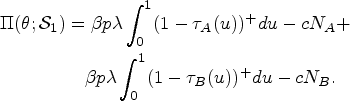

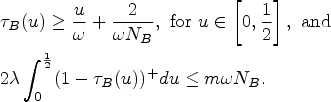
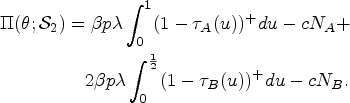
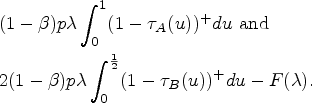

The locations of the restaurants in Scenario

The locations of the restaurants in Scenario
Scenario
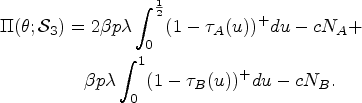
The delivery platform’s profit rate is


Restaurants
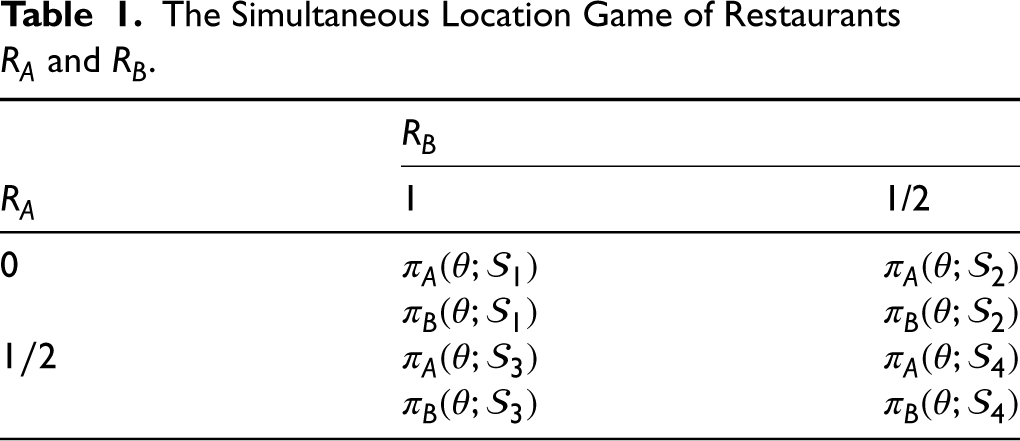
The rows and columns of Table 1 represent, respectively, the location choices of restaurants
The Simultaneous Location Game of Restaurants
and
.
The Simultaneous Location Game of Restaurants
In this section, we derive the delivery platform’s optimal decision vector, denoted as
Scenario
Recall that, in this scenario, the delivery platform’s decisions with respect to 


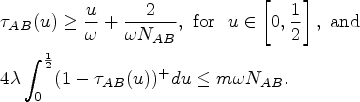
The delivery platform’s trade-offs with respect to the driver headcount
Our analysis of (
P
A1
) consists of four steps. First, we define the following relaxation of (
P
A1
); we refer to this relaxed version as (
P
A2
).
The unique optimal solution In Scenario 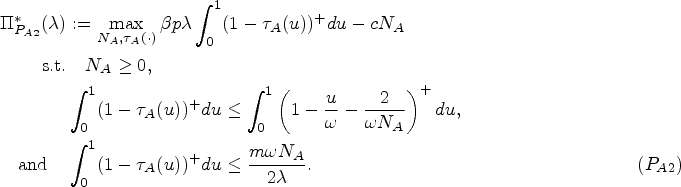
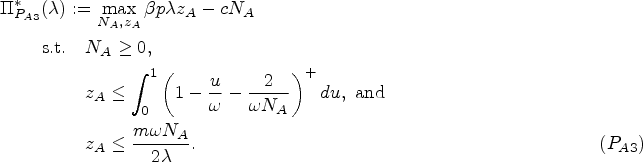


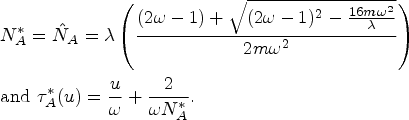
For Scenario The optimal profit rate for the delivery platform is
The profit rates for the restaurants
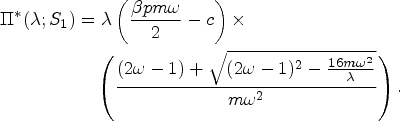
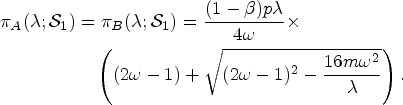
From our definition of Scenario 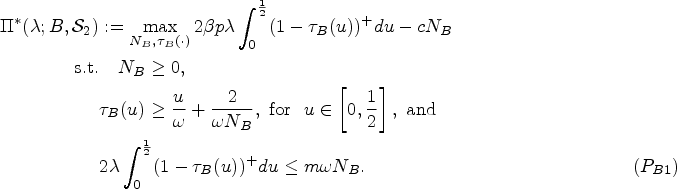
In Scenario 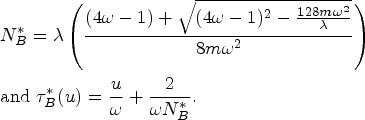
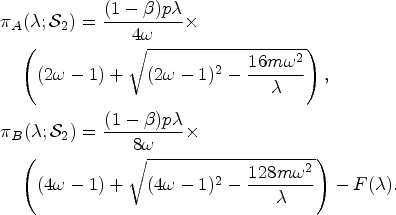
Using the results in Lemmas 2 and 3, Theorem 2 formally states the delivery platform’s optimal profit rate and the profit rates of the two restaurants in Scenario
For Scenario The optimal profit rate for the delivery platform is
The profit rates for the restaurants
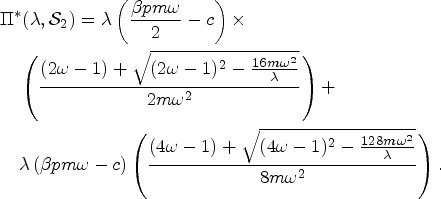
Recall that Scenario
Restaurants 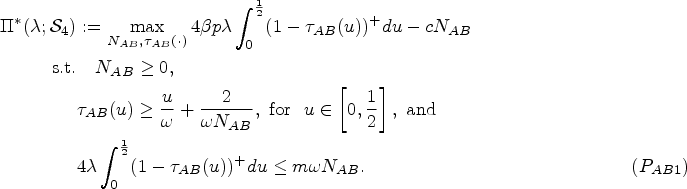
In Scenario 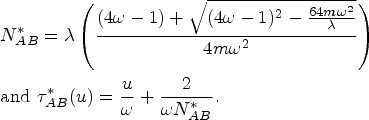
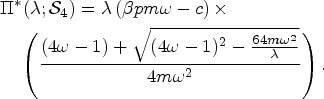
The following result states the delivery platform’s optimal profit rate and the restaurants’ profit rates in this scenario.
For Scenario
The optimal profit rate for the delivery platform is
The profit rate for the restaurants
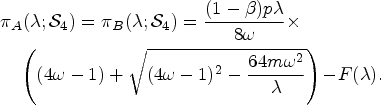
Recall from Section 3 that we are interested in the outcome of the two-stage game under sufficiently high values of the population density 
Analysis of the Location Game of the Restaurants
Given the delivery platform’s optimal decisions in each scenario, restaurants
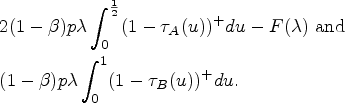
From Theorems 1–3, we have
The characterizing conditions for the status-quo and cloud-kitchen equilibria are:
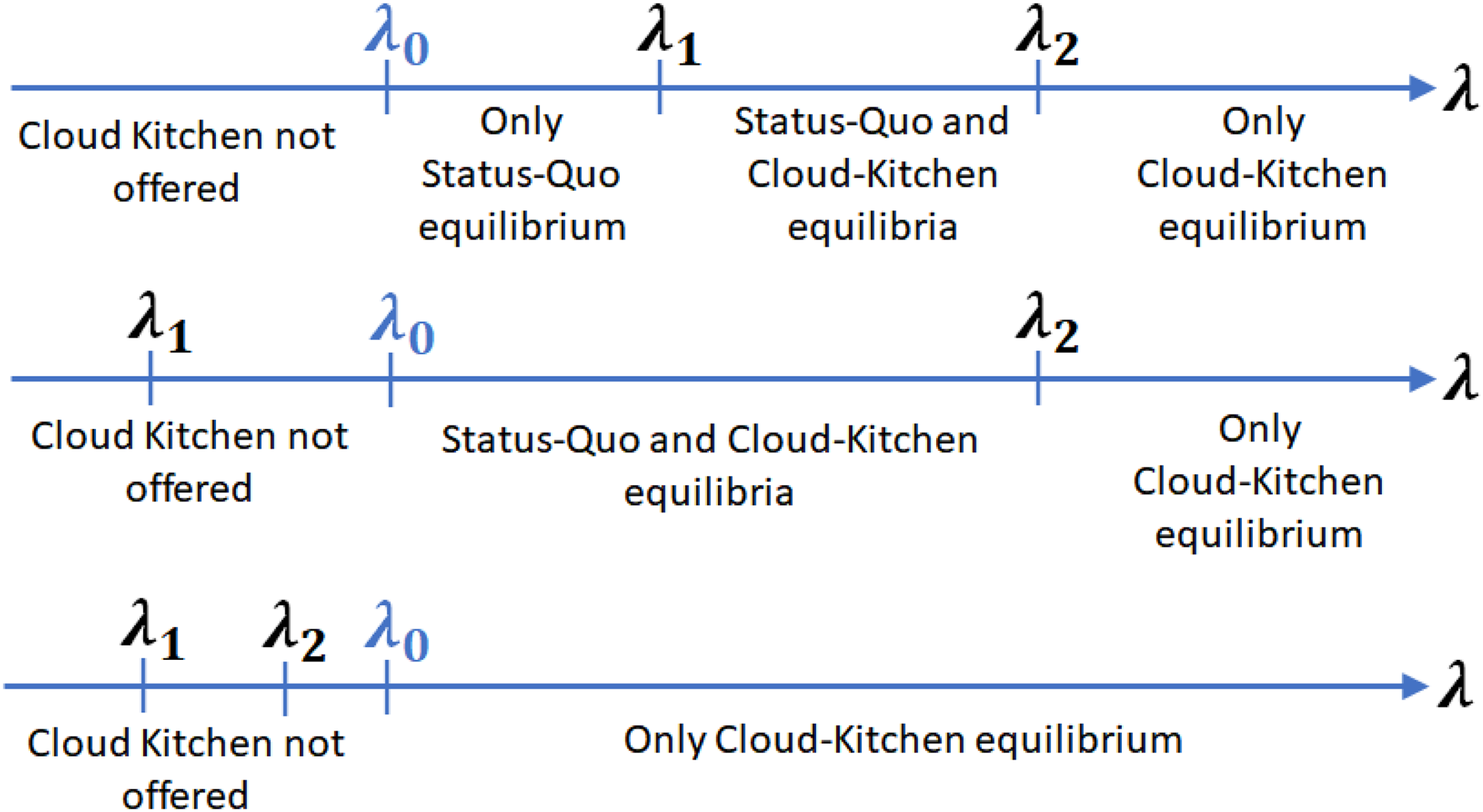
The status-quo equilibrium exists if and only if The cloud-kitchen equilibrium exists if and only if Let If Otherwise (i.e., if Pictorial Representation of Theorem 4. In the model with competition that we analyze in Appendix B, we establish Theorem 6 which parallels Theorem 4 above and conveys the same message: as the population density increases beyond a threshold, restaurants co-locating at the cloud kitchen is first a Pareto-dominant equilibrium and then the unique equilibrium. When both the status-quo and the cloud-kitchen equilibria exist, the following statements hold.
The delivery platform’s profit rate under the cloud-kitchen equilibrium is greater than that under the status-quo equilibrium. The delivery-time guarantees for customers under the cloud-kitchen equilibrium are lower than those under the status-quo equilibrium. The maximum order rate The cloud-kitchen equilibrium is driven by two advantages. The first advantage is due to a cloud-kitchen’s “central location”, which allows for better access to customers. Here, better access refers to the ability of the delivery platform to provide lower delivery-time guarantees to customers—this increases profitability for both the delivery platform and the restaurants. We refer to this advantage as the cloud kitchen’s location advantage. The second advantage accrues from the ability of the delivery platform to consolidate its driver capacity when the restaurants co-locate at the cloud kitchen. This consolidation increases the delivery platform’s profitability as it can use the same set of drivers to deliver orders for multiple restaurants. We refer to this advantage of the cloud kitchen as its consolidation advantage. An important observation from our analysis is that the delivery platform and the restaurants can both exploit the location and consolidation advantages if and only if the restaurants choose to co-locate at the center. These two advantages drive the delivery platform’s decisions and also the restaurants’ location choices in such a way that both the delivery platform and the restaurants are better off when the restaurants co-locate at the cloud kitchen.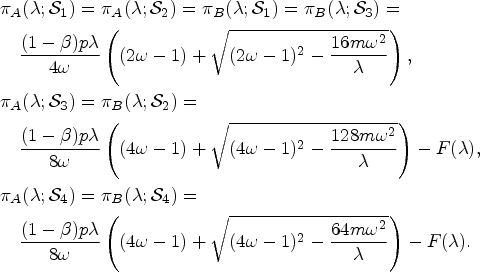
The following lemma provides necessary and sufficient conditions for these equilibria. Recall that the parameter
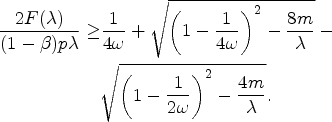
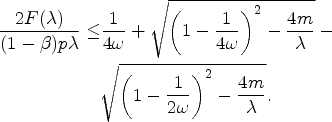
The observation that co-location of restaurants at the cloud kitchen benefits all stakeholders is similar in spirit to the benefit offered by clustering in other industries such as manufacturing and retail; see, e.g. Bozarth et al. (2007). To facilitate a better understanding of our analysis, we now present two numerical examples.
The first example illustrates the increase in the profits of the delivery platform and the restaurants as the maximum demand rate increases. The second example demonstrates the validity of the result in Theorem 4 for the “triangular” demand function, where the maximum demand rate at the cloud-kitchen is greater than that at the extreme locations.
We consider the following values of the parameters. The length of the city is
(Impact of Increase in the Maximum Demand Rate (
We now consider a
(Triangular Demand Rate Function). Recall that, in our base model, the demand rate is uniform and equal to 
The delivery platform’s optimization problem pertaining to Restaurant 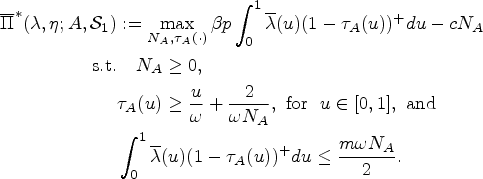
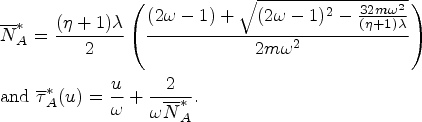
The extent of the relative benefit offered by the cloud-kitchen equilibrium depends on several factors, including the carry-limit, speed, and cost of drivers. In the next section, we offer insights on the behavior of this relative benefit.
Here, we investigate the impact of carry-limit, speed, and cost of drivers on the delivery platform’s profit rates under the cloud-kitchen and status-quo equilibria. We focus on the more interesting case when both these equilibria exist and consider the ratio of the delivery platform’s profit rate under the cloud-kitchen equilibrium to that under the status-quo equilibrium, i.e. the ratio
The relative attractiveness of a cloud kitchen for the delivery platform increases when (a) driver carry-limit is below a threshold and decreases, (b) driver speed decreases, and (c) driver cost increases. (Revenue-Share Percentage: A Lever for Delivery Platforms). The platform can exploit the revenue-share percentage as an important lever to increase its profits. To illustrate, we consider the impact of reducing the revenue-share percentage from The key takeaway from the example above is as follows. In practice, given that restaurants already operate at low-profit margins, delivery platforms are often unable to increase their revenue-share percentages. This example illustrates that the cloud-kitchen business model can allow a delivery platform to, in fact, decrease its revenue-share percentage and improve its own profit as well as the profits of the restaurants. (Incorporating Dine-In Customers). In our base model, all orders at the two restaurants are delivery orders. Consider a setting where each restaurant also serves dine-in customers. Suppose that each restaurant has the option of moving its online delivery business to the cloud-kitchen at the city center (to serve delivery customers) and continue to operate its dine-in facility at its current location. For this setting, suppose that a restaurant currently located at an extreme location pays a rental rate of (Incorporating Delivery Fee). In practice, delivery platforms typically charge a delivery fee in addition to the price of the order. We can incorporate this in our model as follows. Suppose that the delivery fee is (Surge Pricing). In practice, delivery platforms typically employ surge pricing to better match supply and demand. Specifically, surge pricing (a) helps drivers earn more during high-demand periods, thereby increasing the supply of drivers and (b) reduces the demand for orders (less people want to order food at a higher price). At an intuitive level, the impact of the introduction of surge pricing by the delivery platform is roughly similar to the impact of increasing the parameter 
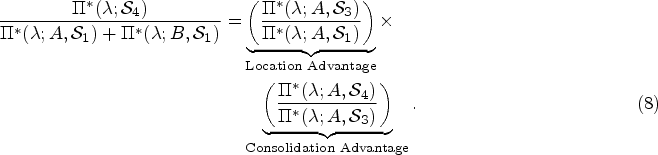


The analysis above shows the impact of driver-related parameters on the relative benefit from the location and consolidation advantages of the cloud-kitchen. Roy et al. (2022) also highlight the importance of a restaurant’s location decision and discuss the factors that affect this decision. We now present a numerical example that showcases an interesting lever through which the delivery platform can attract restaurants to the cloud kitchen.
Over the last decade, the convenience of food delivery combined with increasing traffic congestion in high-density cities has resulted in delivery orders replacing not only dine-in and drive-through orders at restaurants but also home-cooked meals (Cookpad, 2018). There are two important environmental implications of this trend, as we now discuss.
First, since cloud kitchens lead to an increase in the number of delivery orders in a city, an increase in the number of cloud kitchens can have a positive impact on the environment via a reduction in carbon emissions. Cloud kitchens are similar to local micro-fulfillment centers, in the sense that both lead to a decrease in number of last-mile delivery trips and promote the usage of electric vehicles (Specter, 2020; Accenture, 2021). Local micro-fulfillment centers, a recent innovation in the e-commerce industry, allow the placement of inventory closer to customers. This leads to an increase in the success rate of last-mile deliveries and, hence, a reduction in the number of last-mile delivery trips. Further, since these centers are located closer to customers, electric vehicles can be used to make deliveries. A recent report (Accenture, 2021) finds that local micro-fulfillment centers have the potential to lower last-mile emissions between 17% and 26% by 2025 in cities such as London, Sydney, and Chicago. Similar to local micro-fulfillment centers, cloud kitchens can lead to a decrease in the number of delivery trips. Typically, there are limited opportunities for a delivery platform to consolidate orders from multiple restaurants as they are not necessarily co-located. A cloud kitchen, however, houses multiple restaurants and, hence, allows for multiple orders to be delivered in a single delivery trip. Further, like local micro-fulfillment centers, cloud kitchens are located closer to customers and well-suited to adopt electric vehicles for delivery (Descant, 2020). Given these benefits of cloud kitchens, another potential research direction is to understand how cloud kitchens can impact last-mile delivery emissions in dense cities.
Second, an increase in the number of delivery orders may lead to a decrease in food wastage. Belavina (2021) shows that increasing the grocery-store density in a city (up to a certain threshold) improves consumers’ access to groceries, and can lead to a decrease in food wastage. In a similar vein, cloud kitchens provide consumers with better access to food delivery since they allow for faster deliveries in high-density areas. Thus, an increase in the density of cloud kitchens can result in improved food delivery and thereby a higher replacement of home-cooked meals, leading to less stocking by consumers at home and, ultimately, a reduction in food wastage. However, such a change in consumer behavior also has important health implications which can be incorporated in a model that analyzes the impact of cloud kitchen on food wastage. Further, multiple restaurants co-locating at a cloud kitchen can also lead to a reduction in food wastage at the restaurant level, since restaurants can consolidate their supply of fresh groceries required for preparing menu items. Given our main result, namely that co-locating at a cloud kitchen is either the Pareto dominant Nash equilibrium or the unique Nash equilibrium as the population density of a city increases beyond a threshold, understanding the impact of an increase in the density of cloud kitchens on food wastage is an interesting and important research direction.
Supplemental Material
sj-pdf-1-pao-10.1177_10591478231224950 - Supplemental material for Cloud-Kitchens: Value Creation Through Co-Location
Supplemental material, sj-pdf-1-pao-10.1177_10591478231224950 for Cloud-Kitchens: Value Creation Through Co-Location by Arun Rout, Milind Dawande and Ganesh Janakiraman in Production and Operations Management
Footnotes
Declaration of Conflicting Interests
The authors declared no potential conflicts of interest with respect to the research, authorship, and/or publication of this article.
Funding
The authors received no financial support for the research, authorship and/or publication of this article.

Notes
How to cite this article
Rout A, Dawande M, Janakiraman G (2024) Cloud-Kitchens: Value Creation Through Co-Location. Production and Operations Management. 33(2): 512–529.
References
Supplementary Material
Please find the following supplemental material available below.
For Open Access articles published under a Creative Commons License, all supplemental material carries the same license as the article it is associated with.
For non-Open Access articles published, all supplemental material carries a non-exclusive license, and permission requests for re-use of supplemental material or any part of supplemental material shall be sent directly to the copyright owner as specified in the copyright notice associated with the article.
