Manufacturers and their resellers generally employ online intermediaries to sell their products. These intermediaries often possess superior demand information and decide whether to share it with their sellers. In practice, the manufacturers can employ two possible selling formats: reselling (), under which they sell the products to the intermediaries who subsequently resell to customers and agency selling (), under which they sell the products to customers through the intermediaries by paying a proportional fee. Additionally, the manufacturers can also sell the products to their resellers who subsequently resell to customers through the intermediaries. We develop a game-theoretic model to investigate an e-commerce supply chain in which an online intermediary first decides whether to disclose information option to a manufacturer and/or reseller; thereafter, the manufacturer selects between the or format. Regardless of the information-sharing decision made by the intermediary, the manufacturer’s selling format selection remains qualitatively unchanged. However, the intermediary can compel the manufacturer to change his selling format by sharing information with only the manufacturer or reseller in certain market environments. When the intensity is small but the proportional fee is intermediate, the intermediary should share information with only the manufacturer to compel him to change his selling format choice from to . When both the intensity and fee are intermediate, the intermediary should share information exclusively with the manufacturer (or reseller) to prompt a change in the manufacturer’s selling format, switching from to (or from to ), contingent upon whether the magnitude of demand fluctuation is small or large.
Selling through online intermediaries, such as JD.com and Amazon, has become very common and significant among manufacturers and their resellers. Data show that from 2017 to 2022, retail e-commerce sales in the U.S. increased from $425 billion to more than $875 billion.1 In practice, the manufacturers can employ two possible selling formats: (a) reselling (), under which they sell the products to the intermediaries who subsequently resell to customers and (b) agency selling (), under which they sell the products to customers through the intermediaries by paying a proportional fee to the intermediaries. For instance, NEC Corporation, a Japanese electronics company, employs the format with JD.com to sell its projectors, whereas Vmai, a Chinese projector manufacturer headquartered in Shenzhen, employs the format with JD.com to sell its projectors. Another example is of two mug manufacturers, Fuguang and Vanow, where Fuguang adopts the format with JD.com to sell its thermo cups, whereas Vanow employs the format with JD.com to sell its thermo cups. In addition to working with the intermediaries (either through or ), these manufacturers can also sell the products to their resellers who subsequently resell to customers through the intermediaries by paying a proportional fee to the intermediaries. For instance, Fuguang and Vanow, two brands on JD.com, distribute their thermal cups to two prominent resellers: “Fuguang Tuxiang” and “Vanow Dengyuan” stores, respectively. Remarkably, both these stores have consistently achieved sales volumes exceeding 10,000 units for the most popular products from Fuguang and Vanow. These practical examples raise an important question of whether the manufacturers should adopt the or format given the introduction of the resellers.
Considering that it is easier for the intermediaries to reach more consumers than their sellers can, they can acquire abundant market data and obtain information about product demand more efficiently than their sellers can (Ghoshal et al., 2020; Jones, 2023). A typical issue faced by these intermediaries is how to take full advantage of this information to improve supply chain decision-making and even induce the manufacturers to choose their desired selling format (Tsunoda and Zennyo, 2021). In practice, several intermediaries have started sharing such data with their sellers to improve collaboration. For instance, Walmart provides all its sellers, including manufacturers and resellers, with free access to Retail Link, an online hub that shares a 52-week sales forecast and shows regions that could have a new or complementary product added to the already existing supply.2 Nonetheless, Tmall set up a data platform called the Tmall Innovation Center in 2017 and shared data about consumers’ tastes only with some manufacturers, for example, Johnson & Johnson and Oreo (Alizila, 2018; Li et al., 2021). Dissimilar to Tmall, in 2018, Vipshop launched a marketplace open platform on which it allowed all of its resellers as well as some of its manufacturers who joined the platform to access customer data.3 These current conflicting practices raise another important question of whether novel insights exist to explain these intermediaries’ information-sharing strategies.
In the information-sharing literature, without considering the presence of those resellers who procure the products from their manufacturers and sell through the intermediaries by paying a proportional fee, much work has been done to study the incentive for intermediaries to share their private information with manufacturers who employ the pure or format.4 However, little work has been done to study the information-sharing incentive for the intermediaries considering the presence of those resellers, especially in the environment where the manufacturers can decide between the or format. Without considering the presence of the resellers, it is well known that an informed manufacturer who employs the pure () format will set a more advantageous wholesale price (retail price) for its own benefit in response to the demand information shared by its intermediary. This exacerbates the double marginalization, hurting the intermediary and making it unwilling to share information with any manufacturer that adopts the pure format (Zhang, 2002; Li and Zhang, 2023); however, the benefit of the more advantageous retail price can be transferred to the intermediary via a proportional fee, making it willing to share information with the manufacturer that adopts the pure format. However, considering the presence of the resellers, as we observe from the above examples, the intermediaries are uncertain about their information-sharing strategies under the and formats because they should consider the decisions of not only the manufacturers but also the resellers. The above examples cannot be explained by the existing results. Furthermore, considering the intermediaries’ equilibrium information-sharing (EIS) strategies, it is more unclear how the manufacturers will select the or format. This study aims to fill these gaps.
We employ a game-theoretic model to study the interplay between the intermediary’s information-sharing decisions and the manufacturer’s preferred selling format ( or ) within an e-commerce supply chain consisting of an online intermediary, a manufacturer, and an online reseller. In the first stage, the intermediary first decides whether to share information with the manufacturer and/or reseller. In the second stage, the manufacturer selects between the or format. Under the format, the manufacturer sells the product through the intermediary and reseller at a wholesale price. Thereafter, the intermediary sells to the customers, while the reseller sells through the intermediary by paying a proportional fee. Under the format, the manufacturer sells the product through the reseller at the wholesale price. Thereafter, the manufacturer and reseller sell through the intermediary by paying a proportional fee. In the third stage, the intermediary observes the true value of market uncertainty and truthfully discloses it to the manufacturer and/or reseller if the sharing decision has been made in the first stage. The manufacturer/reseller who receives the demand information from the intermediary is said to be informed. Otherwise, he/she is said to be uninformed. In the fourth stage, based on the realized signal, the manufacturer decides on the wholesale price, which is observable by the reseller and intermediary, after which the reseller and the intermediary (manufacturer) set the retail prices under the () format. In this sequence, it is noteworthy that an informed manufacturer’s wholesale price decision will reflect his endowed demand information because he sets the wholesale price charged to resellers after learning the information. Therefore, even if the reseller does not receive any information from the intermediary under the or format, she can make rational inferences regarding the demand based on the wholesale price; this effect is generally referred to as the inference effect and is an important distinction from pure reselling/agency selling without considering the presence of the reseller. We highlight several major findings from our analysis.
Regardless of the information-sharing decision adopted by the intermediary, we find that the manufacturer’s selling format selection remains qualitatively unchanged. However, the intermediary can compel the manufacturer to change his selling format by sharing information with only the manufacturer or reseller in certain market environments. When the competition intensity is sufficiently small but the proportional fee is at an intermediate level, with information sharing with neither member/only the reseller/both members, the manufacturer would select the format. However, in equilibrium, the intermediary will choose to share information with only the manufacturer to compel him to change his selling format choice; the format is adopted eventually. That is, the intermediary commits to sharing information with only the manufacturer to make him switch from the to format. When both the competition intensity and proportional fee are at an intermediate level, with information sharing with neither member/only the reseller/both members (only the manufacturer), the manufacturer would select the () format. However, in equilibrium, the intermediary commits to sharing information with only the manufacturer (reseller) to compel him to change his selling format choice; the () format is adopted eventually when the demand fluctuation is small (large). In other words, the intermediary’s commitment is to share information exclusively with the manufacturer (or reseller) to prompt a change in the manufacturer’s chosen selling format, switching from to (or from to ), in cases of small or large demand fluctuation.
The remainder of this paper is organized as follows: Section 2 presents the review of the related literature. We introduce our model settings in Section 3. We obtain the equilibrium wholesale and retail price decisions, as well as the equilibrium ex-ante profits of the supply chain members given the intermediary’s information-sharing decisions in Section 4. We present our main results in Section 5. Section 5.1 explores the manufacturer’s preferred selling format given the intermediary’s information-sharing decisions, and Section 5.2 analyzes the intermediary’s EIS strategies and the manufacturer’s resulting selling format. We study the several extensions of our base model in Section 6. We conclude the paper and summarize the managerial insights in Section 7. The proofs are presented in the Online Appendix.
Literature Review
This work relates to three streams of research that study information sharing within vertical chains, reselling versus agency selling formats, and revenue-sharing versus wholesale-price contracts.
Our research contributes to the research on information sharing within vertical chains; the central issue in this analysis involves the incentives for precommitment (ex-ante) information sharing (e.g., Li, 1985; Lee and Whang, 2000; Zhang, 2002; Li, 2002; Jain et al., 2011; Li and Zhang, 2015). In a one-to-one supply chain, that is, one in which an upstream manufacturer sells a product through a downstream retailer, Jiang et al. (2016) reveal that the manufacturer might voluntarily disclose the information to the risk-averse retailer. Huang et al. (2018) confirm that the retailer might voluntarily share the information with the manufacturer in anticipation of its encroachment. Cao et al. (2020) investigate the impact of disclosing quality information on the manufacturer’s acquisition of information. In a one-to-many supply chain, Zhou et al. (2021) focus on information sharing and farmers’ welfare in developing economies, demonstrating that it is optimal to share information with only one farmer. Additional related information-sharing literature is available (e.g., Sun and Tyagi, 2020; Gal-Or et al., 2008; Li and Zhang, 2008; Kwark et al., 2017). Furthermore, previous studies focus on a many-to-one supply chain or competing supply chains (e.g., Ha et al., 2011; Shang et al., 2016; Shamir and Shin, 2016; Ha et al., 2017). These studies examine the impacts of production diseconomies/economies and competition intensity on the retailers’ information-sharing incentives. Several papers have also explored information sharing in supply chains from other perspectives, such as coalition formation (He et al., 2018), empirical valuation (Cui, 2015; Hwang et al., 2019), inventory decisions (Lai and Xiao, 2018), and capacity reservation (Qi et al., 2019). Dissimilar to the above papers, which focus on the pure reselling model without the presence of a reseller, our study focuses on two common selling formats ( and ) that a manufacturer can adopt in the presence of the reseller and an online intermediary in practice. We not only study the intermediary’s information-sharing strategies but also examine their impacts on the manufacturer’s preferred selling format.
Liu et al. (2021) and Li et al. (2021) also examine the information-sharing strategy of an online intermediary. Liu et al. (2021) consider the case in which the intermediary offers pure agency selling to all its competing sellers engaging in a Cournot competition. They find that the intermediary is motivated to share information with all the sellers and that such sharing also benefits all the sellers. However, we focus on the case in which the manufacturer adopts the or format through the intermediary, where one seller (the reseller) must procure the product from the other seller (the manufacturer) and sell through the intermediary. Dissimilar to their results, we demonstrate that the EIS strategies are not always shared information with all the sellers. Li et al. (2021) also examine the incentives for the intermediary to share information under the format. They show that sharing information with the manufacturer only or both members benefits the intermediary under certain conditions but we confirm that sharing information with the manufacturer only is always better for the intermediary. The reason for this difference is that we focus on the separating equilibrium, under which the manufacturer sets different wholesale and retail prices for different demand potentials, allowing the reseller to infer demand potential from the manufacturer’s pricing decisions. This equilibrium enables the intermediary to share information with only the manufacturer rather than both members. Nevertheless, in addition to the separating equilibrium, Li et al. (2021) also consider the pooling equilibrium, under which the manufacturer sets the same wholesale and retail prices for different demand potentials, so the reseller cannot perfectly infer demand information. Due to the presence of this equilibrium, sharing information with only the manufacturer is not always better than sharing information with both members. While ignoring the pooling equilibrium is one of our study’s limitations, our study differs from the cited studies in the following aspects: first, they assume that the random term of the demand signal follows a two-point distribution, but we extend their model to a general distribution. Second, they only focus on the format, while we study the information-sharing strategy under the and formats, which further elucidates the impacts of the different selling formats on the information-sharing strategy. Finally, we also examine how the EIS strategy affects the manufacturer’s preferred selling format.
Our study relates to the literature on operations management for the reselling versus agency selling formats. Most extant studies focus on the pricing strategies of the two formats, as well as the issue of format selection (e.g., Hao and Fan, 2014; Hagiu and Wright, 2015; Lu, 2017; Tan and Carrillo, 2017; Zhu and Yao, 2018; Belhadj et al., 2019; Shen et al., 2019). In a one-to-one supply chain, Ryan et al. (2012) consider a manufacturer that sells products through its website, as well as through an online intermediary. They design an optimum price strategy, as well as channel choice, for both members. Geng et al. (2018) examine the interaction between the manufacturer’s add-on strategy and the intermediary’s preferred selling format. Yi et al. (2018) confirm that the manufacturer prefers reselling to agency selling if the consumers exhibit a weak fairness concern. In a one-to-many supply chain, Tan et al. (2016) and Abhishek et al. (2016) confirm that agency selling could benefit supply chain members and ensure reduced retail prices. Several papers explicitly consider upstream competition. For example, Tian et al. (2018) focus on a many-to-one supply chain and demonstrate that agency selling could benefit the intermediary and suppliers through a revenue-sharing scheme. In a many-to-many supply chain, Johnson (2020) consider the dynamic competition between multiple intermediaries and manufacturers, demonstrating that prices might be higher and lower in early and later periods, respectively, when the manufacturer adopts agency selling rather than reselling. We observe that the reviewed papers do not consider the and formats. Dissimilar to those papers, we study a manufacturer’s incentive for selecting the or format. Additionally, we focus on a more realistic background where the intermediary can opt to release demand information to its manufacturer and/or reseller or not.
Recently, studies have begun to examine the interplay between information sharing and the choice between the and formats under various settings. Zhang and Zhang (2020) study how an e-retailer’s (i.e., the intermediary in our paper) information sharing and choice of pure and formats jointly affect a manufacturer’s offline expansion. They find that the e-retailer has the incentive to (a) withhold the demand information under and (b) share information under to deter the manufacturer from entering an offline channel. Ha et al. (2022) investigate whether a manufacturer should encroach by selling through an channel, in addition to an existing channel, at the same intermediary, who then decides whether to share information with the manufacturer. They show that sharing information increases the manufacturer’s possibility to encroach. Nevertheless, Tsunoda and Zennyo (2021) study how an intermediary’s information sharing affects a manufacturer’s choice between the and formats at the intermediary when the manufacturer can also sell its products through an offline retailer in a traditional manner; Zhang and Ma (2023) consider an e-retailer’s incentive to share information with upstream competing manufacturers who can choose between the or format. One of the main results of both studies indicates that sharing information can induce the manufacturer to shift from the to the format under certain conditions. Dissimilar to the above studies, we focus on the information-sharing incentive for an intermediary, especially in the environment where a manufacturer can decide to select the or format, in the presence of a reseller, who procures the products from the manufacturer and sells through the intermediary by paying a proportional fee. We confirm that considering the presence of the reseller will bring novel insights: sharing information with only the manufacturer or only the reseller can induce the manufacturer to shift from the to the format under certain conditions.
Finally, our study relates to those on revenue-sharing versus wholesale-price contracts. A wholesale-price contract is largely the same as reselling, while a revenue-sharing contract with a zero wholesale price is consistent with agency selling. Relative to wholesale-price contracts, most extant studies focus on the benefit of revenue-sharing contracts in a supply chain (e.g., Cachon, 2003; Gerchak and Wang, 2004; Cachon and Lariviere, 2005; Yao et al., 2008). Other studies related to our paper explore the potential of revenue-sharing contracts to facilitate information sharing in a supply chain. For example, Kong et al. (2013) and Chen and Özer (2019) consider a supplier that offers a revenue-sharing contract to two competing retailers with asymmetric private information. One of their main findings is as follows: compared with a wholesale-price contract, the revenue-sharing one reduces the supplier’s incentive to leak information to the uninformed retailer. Dissimilar to all the featured studies, ours consider the information-sharing preference of an intermediary, where a manufacturer who cooperates with a reseller can decide whether to choose between the or format. Our results highlight the interplay between the intermediary’s information sharing and the manufacturer’s preferred selling format.
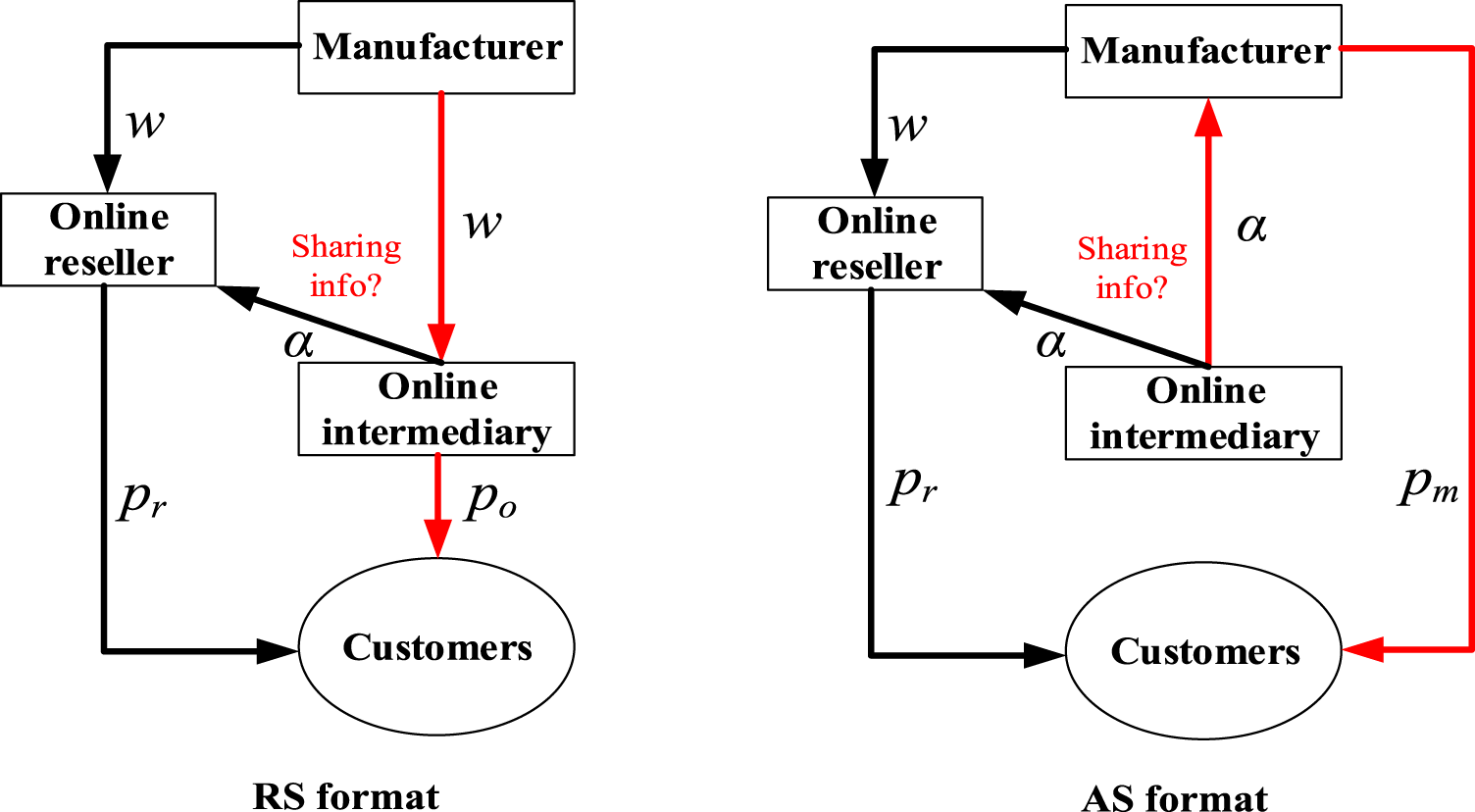
Structures of the two selling formats ( and ).
The Model
Consider an e-commerce supply chain in which a manufacturer sells a product through an online reseller and an online intermediary. Hereafter, we will adopt the pronouns, “it,” “he,” and “she,” to represent the online intermediary, manufacturer, and online reseller, respectively. Moreover, we will utilize the online intermediary/online reseller and intermediary/reseller interchangeably. Let subscript represent the manufacturer, online intermediary, and reseller, respectively. We evaluate two possible selling formats, which the manufacturer can employ in practice: (a) , under which the manufacturer sells his product to the intermediary at a wholesale price and then the intermediary sells the product to customers and (b) , under which the manufacturer sells the product to customers through the intermediary by paying a proportional fee to the intermediary. Let superscript represent the reselling/agency selling format. In addition to working with the intermediary (either through or ), the manufacturer can also sell his product to the reseller at , who then sells the product to customers through the intermediary by paying to the intermediary. A graphical illustration is presented in Figure 1.
Demand and Profit Functions
Under the format, we focus on the case in which the intermediary and reseller engage in price competition. Based on the extant literature on information sharing (e.g., Li and Zhang, 2008; Shang et al., 2016), their demand functions are given by the following:
where and are the retail prices selected by the intermediary and reseller, respectively.5 represents the competition intensity, and a larger implies a more intense competition. denotes the overall market potential, including a deterministic part, , and a random term, , that captures the market uncertainty. We normalize the operating costs of the three members, as well as the manufacturer’s production cost for each unit of sales, to zero. Thus, the profit functions of the manufacturer, the reseller, and the online intermediary are, respectively, given by
Under the format, we study the case where the manufacturer and reseller engage in price competition. Similar to the format, their demand functions are given by the following:
where and are the retail prices selected by the manufacturer and reseller, respectively. We also normalize the three members’ operating costs, as well as the manufacturer’s production cost for each unit of sales, to zero. Thus, the profit functions of the manufacturer, the reseller, and the online intermediary are, respectively, given by
In these two formats, we assume that follows a general distribution with zero mean and variance, . For convenience, we define (a smaller indicates a greater uncertainty in the market or greater demand fluctuation). Notably, these two demand specifications, (1) and (2), implicitly assume that horizontally differentiated products are sold to the consumers, where a larger can also indicate less differentiation. For instance, under the format, even if the manufacturer sells the same product through the reseller, the products can still be differentiated from a customer’s perspective in practice owing to the various other factors at play (Abhishek et al., 2016); the differentiation between the reseller and the manufacturer could be due to the website layout, inertia, loyalty and membership programs, other products offered by them, etc. We note that this is based on horizontal differentiation, not vertical differentiation, because at the same price, not all customers will agree that one is better than the other. However, these different service packages may make the operating costs of the sellers become different. We thus extend our analysis to a different cost structure scenario and verify whether our main insights still apply in Section 6.1. Based on how salient these differences are from the consumers’ perspective, they might compete on prices very aggressively or less aggressively. We also extend our analysis to the case where the intermediary (manufacturer) and reseller compete on quantities under the () format in the Online Appendix C. Additionally, from equation (1)/(2), the intermediary/manufacturer and reseller exhibit the same potential demand sizes. However, the reseller might be smaller than the intermediary and manufacturer in practice, thereby exhibiting a smaller market potential. In Section 6.2, we extend our analysis to the small reseller scenario and verify whether our main insights are qualitatively the same.
Since the intermediary can reach more consumers easily, it generally possesses a plethora of data and exhibits a more holistic view of the overall market than the manufacturer or reseller (Jones, 2023). Namely, the intermediary can obtain more information about market demand than the manufacturer and reseller before they sell directly to customers or through intermediaries. Specifically, the intermediary can acquire detailed information, such as consumers’ online browsing histories, consumers’ purchase histories, and sales data, about the market. These acquired data play a vital role in forecasting demand potentials or trends. Moreover, the intermediaries are more proficient in analyzing information because they are generally equipped with advanced information technology and data analytics tools (Li et al., 2021). For example, Tmall has a professional division, that is, the TMIC, that collects data to forecast the demand potential and market trends.
The intermediary can also decide to share the acquired information with the manufacturer and/or reseller. To incorporate this fact, we assume that the intermediary can accurately infer the true value of market uncertainty, , from its extensive data, whereas the manufacturer and reseller can infer only the mean and variance of . We studied a case in which the intermediary committed to ex-ante information sharing before realizing the true value of . This case is generally true when the information is automatically transmitted over an agreed period (e.g., POS data offered by an online data-sharing hub, such as Retail Link). Moreover, we assumed that information sharing is sincere, and this assumption is reasonable when an online intermediary shares tangible and verifiable data, such as POS data, or when the intermediary fears that the reporting of false information could jeopardize a long-term relationship with the manufacturer and reseller; several practical examples support this assumption. For instance, the online intermediary, Walmart, offers free access to Retail Link (an online hub for sharing verifiable demand forecast) to all its sellers; Tmall in China set up a data platform in 2017 and shared data on consumers’ preferences with some brands/manufacturers, for example, Johnson & Johnson and Oreo. Employing these data, Johnson & Johnson, for example, created two new flavors of Listerine, Rosemary Blossom and Vanilla Breeze, which were highly successful in Tmall’s “Double 11” promotion in 2018, further indicating that the data were verified. These two assumptions are widely adopted in the information-sharing literature (e.g., Gal-Or et al., 2008; Li and Zhang, 2008; Shang et al., 2016; Liu et al., 2021; Li et al., 2021).
Sequence of Events
The sequence of events is as follows:
The online intermediary makes the information-sharing decision. Let superscript be the information-sharing decision, where indicates that the intermediary shares information with neither member, only the reseller, both members, and only the manufacturer, respectively.
The manufacturer opts to adopt the or format.
The online intermediary observes the true value of market uncertainty, , and truthfully discloses it to the manufacturer and/or reseller if the sharing decision has been reached in the first stage. The manufacturer/reseller who receives from the intermediary is said to be informed. Otherwise, he/she is said to be uninformed.
The manufacturer decides under both selling formats, which is observable by the reseller and intermediary. Thereafter, the reseller and intermediary (manufacturer) simultaneously set the retail prices and () under the () format, respectively.
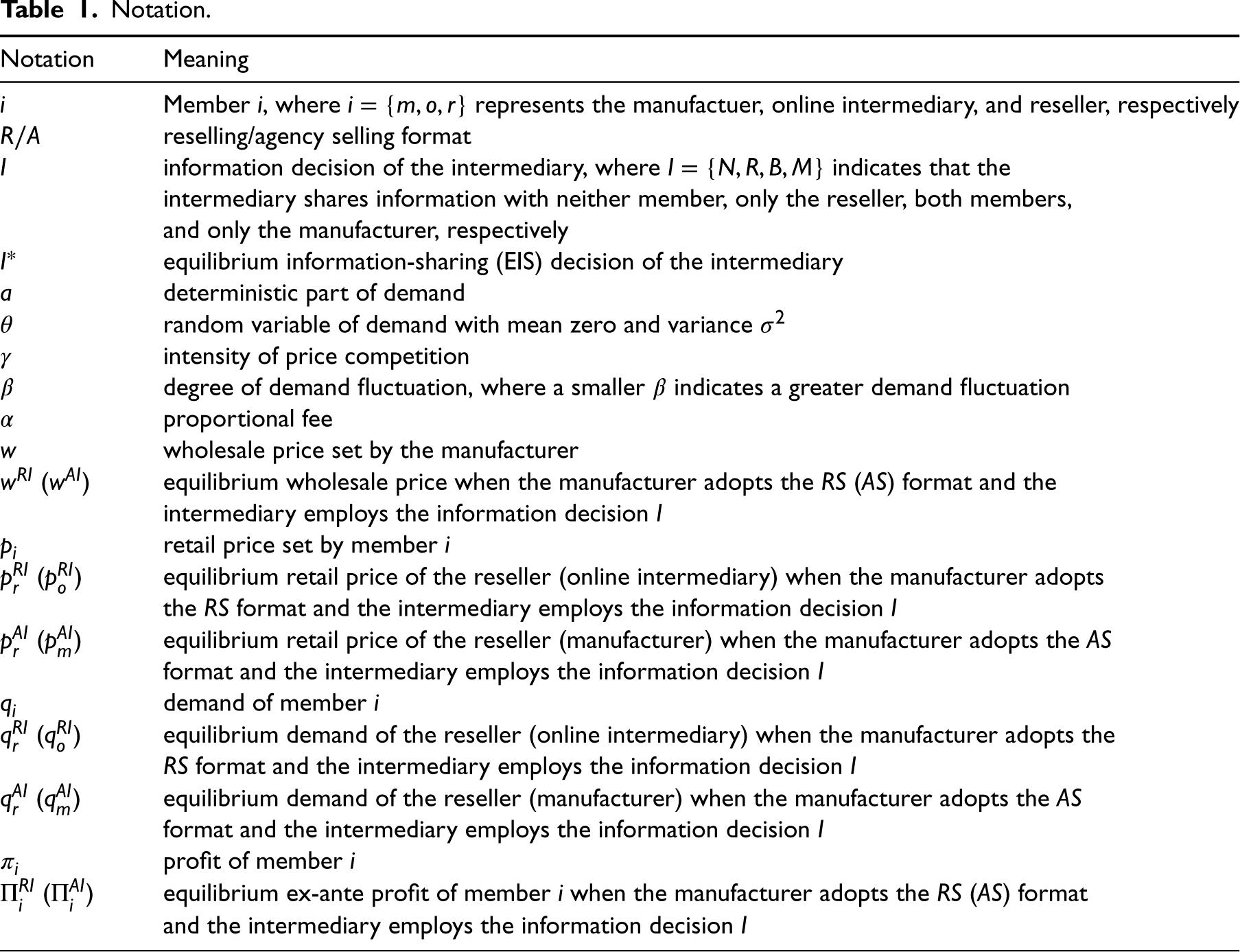
Market demands and () are realized, after which the three parties earn their corresponding profits. All the notations are presented in Table 1.
Notation.
Notation
Meaning
Member , where represents the manufactuer, online intermediary, and reseller, respectively
reselling/agency selling format
information decision of the intermediary, where indicates that the
intermediary shares information with neither member, only the reseller, both members,
and only the manufacturer, respectively
equilibrium information-sharing (EIS) decision of the intermediary
deterministic part of demand
random variable of demand with mean zero and variance
intensity of price competition
degree of demand fluctuation, where a smaller indicates a greater demand fluctuation
proportional fee
wholesale price set by the manufacturer
()
equilibrium wholesale price when the manufacturer adopts the () format and the
intermediary employs the information decision
retail price set by member
()
equilibrium retail price of the reseller (online intermediary) when the manufacturer adopts
the format and the intermediary employs the information decision
()
equilibrium retail price of the reseller (manufacturer) when the manufacturer adopts the
format and the intermediary employs the information decision
demand of member
()
equilibrium demand of the reseller (online intermediary) when the manufacturer adopts the
format and the intermediary employs the information decision
()
equilibrium demand of the reseller (manufacturer) when the manufacturer adopts the
format and the intermediary employs the information decision
profit of member
()
equilibrium ex-ante profit of member when the manufacturer adopts the () format
and the intermediary employs the information decision
In the sequence, we follow the conventional assumption in the information-sharing literature, that is, the production lead time is short and the cost of the mismatch between demand and inventory is ignorable. Additionally, we assume that the proportional fee, , is exogenous. This assumption was often adopted by the extant literature related to e-commerce or information sharing (Geng et al., 2018; Tian et al., 2018; Liu et al., 2021; Li et al., 2021). In practice, this fee is normally determined by an industry standard and is generally fixed, whereas the prices and information-sharing strategies of the intermediary might be updated frequently. We also note that the proportional fee is often <0.5 in real life. In the presence of this constraint, we find that some of our main results may change. Nevertheless, our main results in the base model are still meaningful to practice because they are robust if slightly relaxing our model setting. For example, unlike the base model, if we let () be the proportional fee of the () format, where and , we can show that our main results remain qualitatively the same. The detailed procedures are omitted for brevity, which are available from the authors upon request. Therefore, to make the model as realistic as possible while keeping the model tractable, we assume all the critical parameters under the two selling formats are the same (e.g., the proportional fees are identical). Hereafter, we employ the superscripts RI and AI to denote the equilibrium solutions for the and formats, respectively, when the intermediary adopts the sharing decision , where . For instance, indicates the equilibrium ex-ante profit of member for the format when the intermediary does not share information.
Wholesale and Retail Price Decisions
This section obtains the equilibrium wholesale and retail prices, as well as the equilibrium ex-ante profits of the three members when the intermediary shares demand information with neither member, only the reseller, both members, and only the manufacturer under both the and formats. Notably, the game involves incomplete information, as the intermediary detects the demand signal, while the manufacturer and/or reseller can infer only the mean and variance of the demand. Thus, we adopt the Bayesian Nash equilibrium (BNE) as our solution concept. For consistency with the information-sharing literature (e.g., Chen and Tang, 2015; Zhou et al., 2021), we focus exclusively on a particular type of linear equilibrium in which the wholesale and retail price decisions in equilibrium depend on the available signal. The detailed procedures and the equilibrium ex-ante profits’ expressions are available in Lemmas A1–A4 of the Online Appendix A.
Scenario : Sharing information with neither member.
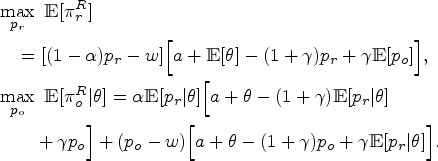
(i) Under the format, given any , the reseller and the intermediary, respectively, solve the following profit maximization problems:
Thereafter, one can explicitly characterize the linear BNE ex-post prices, and . Substituting them into and solving the following manufacturer’s profit-maximization issue:
we have the following equilibrium wholesale price:
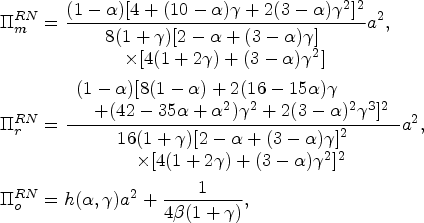
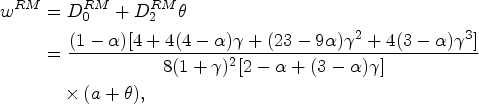
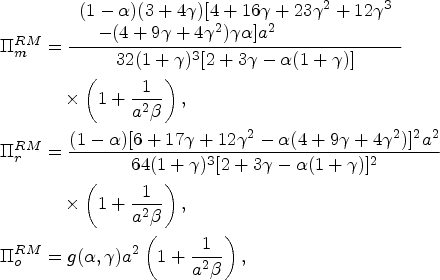
as well as the equilibrium retail prices: and . Substituting them into the above three members’ profit functions and calculating their expectations upon , their ex-ante profits are as follows:
where the expression of can be found in equation (A1) of the Online Appendix A.
(ii) Under the format, given any , the reseller and manufacturer, respectively, solve the following profit maximization problems:
Additionally, the corresponding ex-post profit of the intermediary is given by . Thereafter, we can explicitly characterize the linear BNE ex-post prices, and . Substituting them into the above manufacturer’s problem, one can obtain the following equilibrium wholesale price:
as well as the equilibrium retail prices and . Similarly, the equilibrium ex-ante profits are as follows:
Scenario : Sharing information with only the reseller.
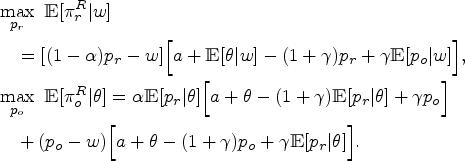
(i) Under the format, given any , the reseller and the intermediary respectively solve the following profit maximization problems:
Thereafter, we can explicitly characterize the linear BNE ex-post prices, and . Substituting them into and solving the following manufacturer’s profit-maximization issue:
the equilibrium wholesale price, retail prices, and ex-ante profits are as follows:
, , and .
Compared to scenario , when the intermediary shares information with only the reseller under the format, the reseller adjusts her retail price in a positive response to the demand signal (i.e., ) by following a linear strategy, where the expected retail price equals the retail price without information sharing. The change in the reseller’s price decision induces the platform’s retail price to respond more positively to (i.e., ) because of the competition between them, where we also have . Thus, the retail prices and become higher when the signal is higher and lower when it is lower. As the reseller is informed (i.e., she knows ), this makes both the demands and also respond positively to . On average, the price and demand changes allow the reseller and platform to capture larger revenues (i.e., and ).
However, similar to scenario , the uninformed manufacturer’s wholesale price decision under scenario does not respond to . This implies that the wholesale prices of scenarios and are the same (i.e., ). Accordingly, while the informed reseller (platform) will respond (more) positively to , from equations (3) and (5), the manufacturer’s equilibrium ex-ante (or expected) profits of these two scenarios remain unchanged (i.e., ).
(ii) Under the format, given any , the reseller and manufacturer, respectively, solve the following profit maximization problems:
Additionally, the corresponding ex-post profit of the intermediary is given by . Thereafter, we can explicitly characterize the linear BNE ex-post prices, and . Substituting them into the above manufacturer’s problem, we obtain the following equilibrium wholesale price, retail prices, and ex-ante profits:
, , and .
Similar to the format, the informed reseller’s retail price under the format responds positively to (i.e., ) by following a linear strategy, where . On average, this also allows the reseller to capture a larger revenue (i.e., ), which also benefits the platform (i.e., ) who charges the reseller a positive proportional fee. However, the uninformed manufacturer’s price decisions do not respond to , and thus, his (expected) wholesale prices and retail prices of scenarios and will remain the same (i.e., and ). From equations (4) and (6), the manufacturer’s equilibrium ex-ante (or expected) profits of these two scenarios remain unchanged (i.e., ).
Scenario : Sharing information with both members.
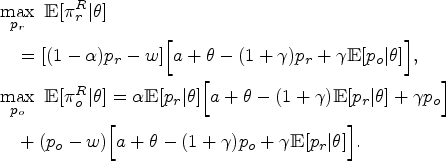
(i) Under the format, given any , the reseller and the intermediary, respectively, solve the following profit maximization problems:
Thereafter, we can explicitly characterize the linear BNE ex-post prices, and . Substituting them into and solving the following manufacturer’s profit-maximization issue:
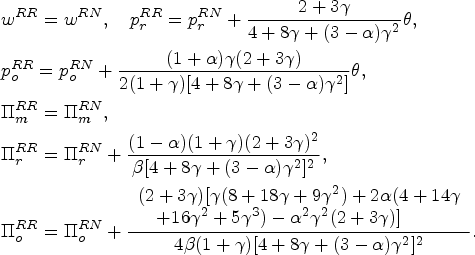
the equilibrium wholesale price, retail prices, and ex-ante profits are as follows:
(ii) Under the format, given any , the reseller and manufacturer, respectively, solve the following profit maximization problems:
Additionally, the corresponding ex-post profit of the intermediary is given by . Thereafter, we can explicitly characterize the linear BNE ex-post prices, and . Substituting them into the above manufacturer’s problem, we obtain the following equilibrium wholesale price, retail prices, and ex-ante profits:
, where .
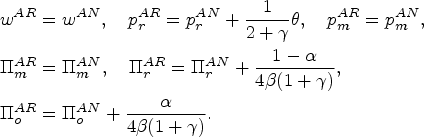
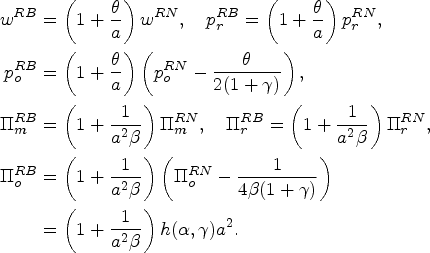
Unlike scenario , sharing information with both members (i.e., scenario ) makes both the wholesale and retail prices respond positively to the demand signal by following a linear strategy, where the expected wholesale and retail prices of scenario equal those of scenario . Due to a similar impact of on the wholesale and retail price decisions of the manufacturer and reseller, we confirm that their equilibrium prices and also the corresponding demands increase (decrease) by times when the demand signal is positive (negative). Thus, from equations (7)–(9), it is easy to see that the equilibrium ex-ante profits of the manufacturer and reseller under either selling format increase by times compared with scenario , as shown in Remark 3.
Scenario : Sharing information with only the manufacturer.
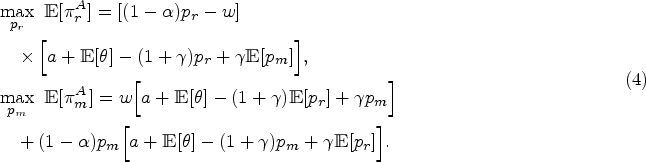
When the intermediary shares the information with only the manufacturer, the manufacturer sets his wholesale price after acquiring the demand information before the reseller sets the retail price. In practice, the manufacturer typically adjusts his wholesale price in response to fluctuations in demand. Specifically, he tends to raise the price during periods of high demand and lower it when demand is low. For example, vegetable oil manufacturers pushed the vegetable oil (wholesale) prices to hit a then-record high in February 2022 and increased an additional 23% in March of that year, mainly because over the past decade demand for vegetable oils has increased by an average of 6.2 million metric tons per year (Reiley, 2022). Another example is animal feeds, as domestic livestock and poultry, especially live pigs, are at a relatively high level, driving an increase in feed demand. Large feed manufacturers in China have announced an increase of 50–300 yuan per ton of feed price in 2022.6
Therefore, the manufacturer’s wholesale price decision will reflect his endowed demand information. Although the reseller receives no information from the intermediary, she can infer the signal from the wholesale price that is being charged by the manufacturer. Specifically, a signaling problem exists. Based on the literature on information sharing (e.g., Gal-Or et al., 2008), we assume that the reseller can evaluate the manufacturer’s linear decision rule regarding the wholesale price, which exhibits the following form:
by solving for if and .7 Equation (10) indicates that the reseller can perfectly infer from the wholesale price, , and . This effect is commonly known as the inference effect.
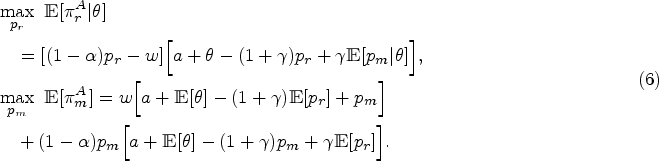
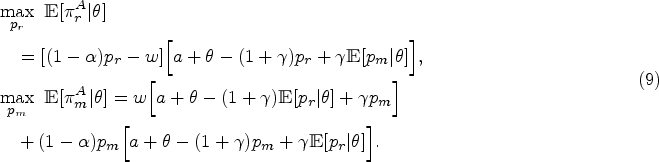
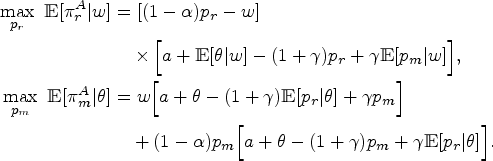
(i) Accordingly, under the format, at any , the reseller and intermediary can separately solve the following profit-maximization issues:
Thereafter, we can explicitly characterize the linear BNE ex-post prices, and . Substituting them into and solving the following manufacturer’s profit-maximization issue:
we can obtain the equilibrium and . Then, the equilibrium wholesale price is given by
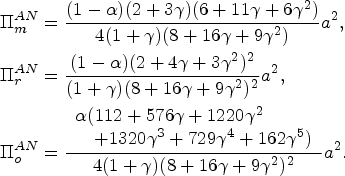
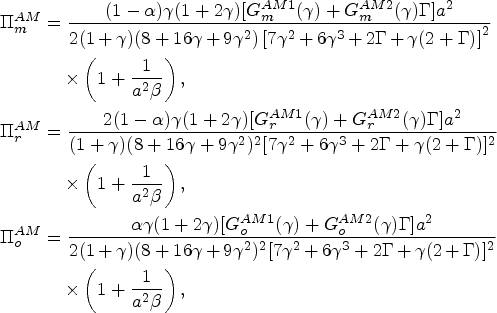
and the equilibrium retail prices and follow. Accordingly, the ex-ante profits of the three members are, respectively, given by
where the expression of can be found in equation (A14) of the Online Appendix A.
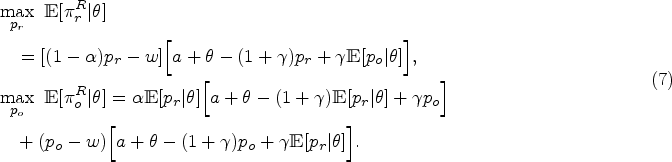
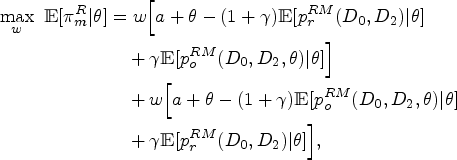
(ii) Under the format, at any , the reseller and manufacturer can solve the following profit-maximization issues:
The corresponding ex-post profit of the intermediary is given by . We can also explicitly characterize the linear BNE ex-post prices, and . Substituting them into and solving the above manufacturer’s profit-maximization issue with respect to , the equilibrium and can be derived. Then, the equilibrium wholesale price is given by
and the equilibrium retail prices and follow. Accordingly, the ex-ante profits of the three members are, respectively, given by
where and the expressions of ( and ) can be found in equation (A19) of the Online Appendix A.
(a) Under the format, we have , , and , (b) Under the format, we have , , and .
When only the manufacturer is informed (i.e., scenario ), the reseller can infer the signal from the wholesale price. Based on this inference effect, the reseller knows that a higher (lower) wholesale price will indicate a higher (lower) demand state (through the reseller’s inference on ). If the demand is low, the manufacturer must distort the wholesale price downward to convey the lower state and induce the reseller to set a lower retail price, thus preventing the reseller from mistakenly assuming that the state of the demand is high. Therefore, as indicated in parts (a) and (b) of Remark 4, compared to scenario , when only the manufacturer is informed (i.e., scenario ), the inference effect would force the manufacturer to lower the expected wholesale price under either the or format. The lower wholesale price intuitively leads to lower expected prices of the manufacturer (intermediary) and reseller under the () format.
To better explain our main results in the following section, we next compare the intermediary’s ex-ante profits of the four information-sharing scenarios under each selling format.
Under the format, .
Under the format, two thresholds exist, and , such that if and ; otherwise, .
Proposition 1 indicates that when either the or format is adopted, the intermediary always shares demand information with only one member. Nevertheless, sharing information with the reseller under the format can be optimal, but not under the format.
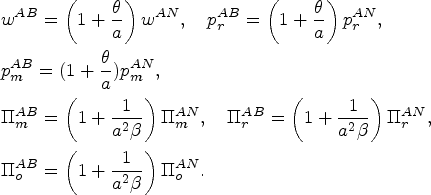
We explain the result as follows. First, from Remarks 1 and 2, we know that and . Furthermore, it is easy to see that . This is because furnishing both members with the demand information can help both the manufacturer and reseller improve their pricing decisions in line with the realized demand signal, which increases their profits; these improved profits can be directly passed on to the intermediary through the proportional fee under the format (Li et al., 2021). Second, we confirm that sharing information with only the manufacturer benefits the intermediary compared with sharing the information with both members under either selling format (i.e., and ). This is because the inference effect would force the informed manufacturer to lower the expected wholesale price, that is, and (see Remark 4), mitigating the double-marginalization effect and ultimately benefitting the intermediary. Therefore, part (a) follows.
For part (b), based on the above statements, the intermediary prefers sharing information with only the manufacturer or reseller, depending on the competition intensity and demand fluctuation. Specifically, if the competition intensity is small () but the demand fluctuation is large (), the intermediary prefers sharing information with the reseller; otherwise, it is willing to disclose information to the manufacturer. To explain, we notice that compared with sharing information with the reseller, sharing it with the manufacturer will force him to lower the expected wholesale price but increase the corresponding price uncertainty, that is, and . The lower expected wholesale price is due to the presence of the inference effect, which benefits the intermediary; the higher price uncertainty is because the double marginalization of the wholesale price becomes stronger,8 which harms the intermediary. Moreover, it can be shown that more intense competition or less demand fluctuation makes the wholesale price respond less strongly (i.e., and ), and thus, the effect of a stronger double marginalization due to information sharing with the manufacturer becomes less significant. Therefore, if the competition intensity is large or the demand fluctuation is small, the intermediary prefers sharing information with only the manufacturer rather than the reseller because now the lower expected wholesale price prevails over the less significant effect of a stronger double marginalization. Nevertheless, if the competition intensity is small but the demand fluctuation is large, although the intermediary can enjoy a lower expected wholesale price, the effect of a stronger double marginalization becomes too salient and ultimately harms the intermediary.
Selling Format Selection and Information Sharing Decisions
Manufacturer’s Preferred Selling Format
Given the information-sharing decisions () of the intermediary, this section analyzes the manufacturer’s preferred selling format.
Suppose the intermediary chooses the information-sharing decision , where .
and exist such that the manufacturer prefers the format if and only if (i) or (ii) and , where increases in , and is a constant such that .
is independent of the demand fluctuation .
and . Moreover, exists such that if and only if , where .
Under either information-sharing scenario , the manufacturer possesses identical information across both selling formats. Thus, compared to choosing the format, the manufacturer who chooses the format benefits from direct-to-consumer pricing but is harmed by being directly charged a proportional fee. Furthermore, it is not difficult to see that an increase in competition will reinforce the role of direct-to-consumer pricing. Accordingly, part (a) follows because a significant competition intensity or a small proportional fee makes the format prevail over the format for the manufacturer.
For part (b), suppose , from Section 4, we know that the manufacturer’s equilibrium ex-ante profits for both selling formats are independent of . This intuitively implies that and are also independent of . Now suppose , while the manufacturer receives information from the intermediary, the thresholds and are still independent of the demand fluctuation . This is because the signal has a similar linear impact on the two selling formats’ wholesale and retail price decisions, corresponding demands, and thereby the manufacturer’s equilibrium ex-ante profits.
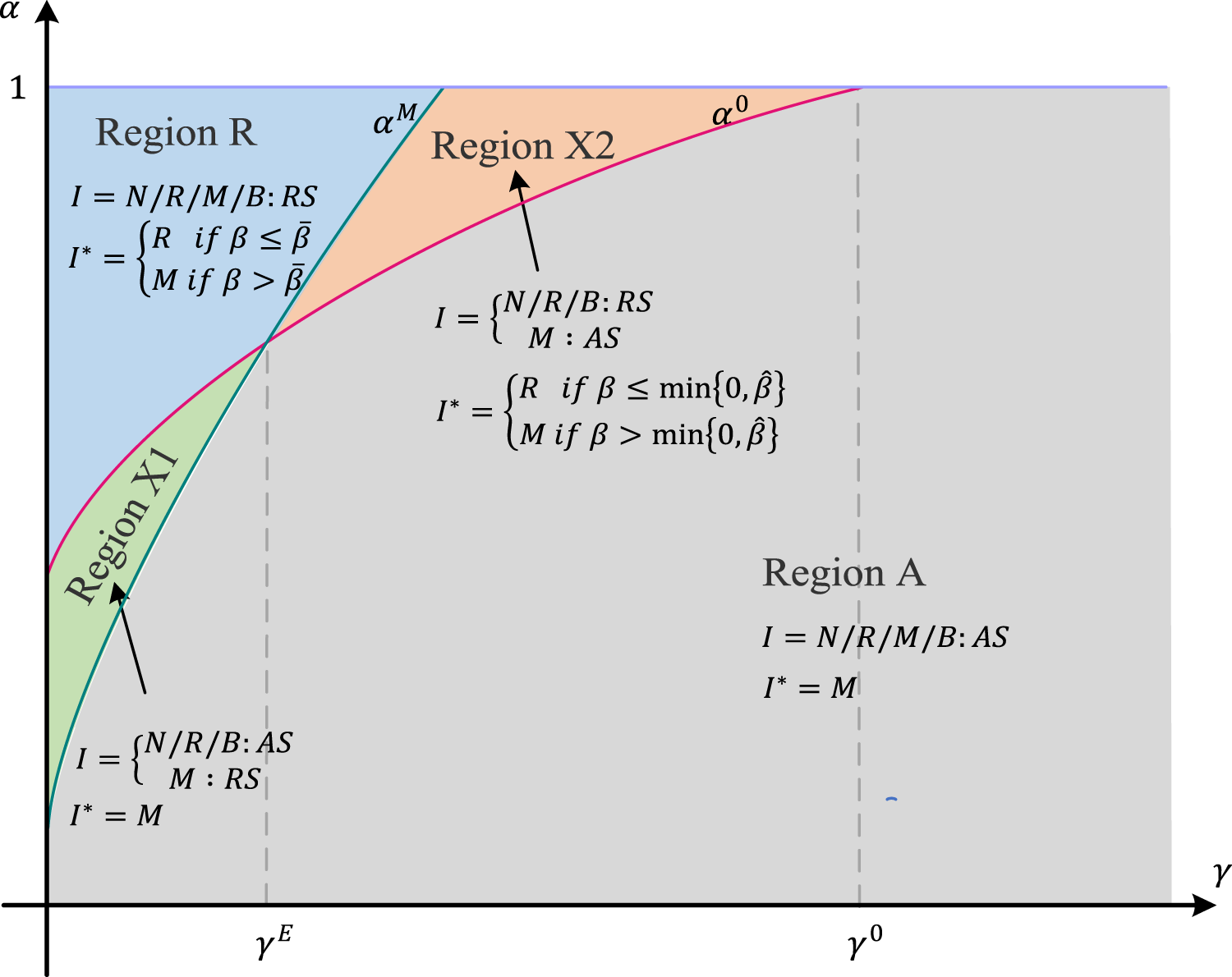
Schematic diagram of the intermediary’s equilibrium information-sharing (EIS) strategies.
For part (c), from Remarks 1–3, the manufacturer’s equilibrium ex-ante profits of scenarios and under either the or format remain unchanged, and his equilibrium ex-ante profit of scenario increases by times as against scenario . Thus, his preferred selling formats under scenarios , , and remain the same, implying that and . Moreover, if the competition intensity is small (large), that is, (), the manufacturer is less (more) likely to adopt the format under scenario than under scenario . To explain, from Remark 4, scenario induces both the manufacturer and reseller to lower the expected retail prices. This indicates that while sharing information with only the manufacturer weakens the positive effect of direct-to-consumer pricing, it also mitigates the negative effect of being directly charged a proportional fee. We confirm that the latter mitigation is salient if and only if is large. In fact, when is large, the manufacturer’s expected retail price under scenario is significantly lower than that under , implying that the expected revenue seized by the intermediary through the proportional fee under scenario is lower. The salient mitigation makes the negative effect of being directly charged a proportional fee does not outweigh the positive effect of direct-to-consumer pricing. Therefore, the manufacturer is more likely to adopt the format under scenario .
Intermediary’s EIS Decisions
This section studies the intermediary’s EIS decisions. Let be the EIS decision, and let and , then we have the following theorem:
and exist such that the following statements hold:
(Region A) If (i) or (ii) and , , and the manufacturer adopts the format.
(Region R) If and , (), and the manufacturer adopts the format when ().
(Region X1) If and , , and the manufacturer adopts the format.
(Region X2) If and , (), and the manufacturer adopts the () format when ().
Figure 2 is a schematic diagram of the intermediary’s EIS strategies.
First, from Proposition 2, we know that given any information-sharing decision chosen by the intermediary, the manufacturer will always choose the format if and only if the competition intensity is sufficiently large or the proportional fee is sufficiently small (i.e., (i) or (ii) and ), which is depicted in region A in Figure 2. In this region, according to Proposition 1(a), it can be seen that the intermediary benefits from sharing information with only the manufacturer in equilibrium. Thus, part (a) follows.
In contrast, from Proposition 2, whichever information-sharing decision the intermediary makes, the manufacturer will always choose the format if and only if the competition intensity is not moderately high and the proportional fee is sufficiently large (i.e., and ), which is depicted in region R in Figure 2. In this region, according to Proposition 1(b), the intermediary is willing to share information with only the manufacturer (reseller), as the demand fluctuation is small (large). Thus, part (b) follows.
Of special interest is the situation when the competition intensity is not moderately high and the proportional fee is at an intermediate level (i.e., and ), which is depicted in region X in Figure 2. This parameter range can be divided into two regions (i.e., regions X1 and X2) based on the size of the competition intensity .
In region X1, where is sufficiently small and is at an intermediate level (i.e., and ), according to Proposition 2, with information sharing with neither member/only the reseller/both members, the manufacturer would select the format. However, in equilibrium, the intermediary commits to sharing information with only the manufacturer to compel him to change his selling format choice. The format is adopted eventually. The reason is as follows. First, from Proposition 1(a), we know that the intermediary prefers to share information with both members rather than sharing information with neither member or only the reseller when the format is adopted (). Additionally, we find that sharing information with only the manufacturer under the format prevails over sharing information with both members under the format (i.e., ). Similar to Remark 4, this is because the inference effect would force the manufacturer who is only informed to lower the expected wholesale price, that is, , mitigating the double-marginalization effect and ultimately benefitting the intermediary. Thus, part (c) follows.
In region X2, where both and are at an intermediate level (i.e., and ), according to Proposition 2, with information sharing with neither member/only the reseller/both members (only the manufacturer), the manufacturer would select the () format. However, in equilibrium, the intermediary commits to sharing information with only the manufacturer (reseller), as the demand fluctuation is small (large) to compel him to change his selling format choice. The () format is adopted eventually when the demand fluctuation is small (large). To explain, from Remark 1, when the format is adopted, we first have . Furthermore, if the competition is not too intense (), the intermediary prefers to share information with only the reseller rather than both members (i.e., ). The reason is that the less intense competition will strengthen the double marginalization effect when the intermediary shares information with both members, which harms the intermediary and makes it disclose information to only the reseller. This implies that in region X2, the intermediary prefers to share information with only the reseller rather than sharing information with neither member or both members when the format is adopted. However, as long as the demand fluctuation is small (), the intermediary benefits from sharing information with only the manufacturer, which compels him to choose the format. In fact, sharing it with the manufacturer under the format will force him to lower the expected wholesale price but increase the corresponding price uncertainty, that is, and . Similar to the explanation of Proposition 1(b), the lower expected wholesale price is due to the presence of the inference effect, which benefits the intermediary; the higher price uncertainty is because the double marginalization of the wholesale price becomes stronger, which harms the intermediary. Moreover, less demand fluctuation also makes the wholesale price respond less strongly (i.e., ), and thus, the effect of a stronger double marginalization due to information sharing with the manufacturer becomes less significant. Therefore, if the demand fluctuation is small, the intermediary prefers sharing information with only the manufacturer because now the lower expected wholesale price prevails over the less significant effect of a stronger double marginalization. Thus, part (d) follows.
Theorem 1 indicates an important managerial insight that the intermediary can make the manufacturer change his selling format through its information-sharing decision if the competition intensity is not moderately high and the proportional fee is at an intermediate level. Otherwise, the resulting selling format, which strongly depends on the competition intensity, proportional fee, and demand fluctuation, is independent of the intermediary’s information-sharing decision.
Extensions
Different Cost Structure
In the base model, we assume that the operating costs of the reseller and intermediary (manufacturer) for each unit of sales under the () format are the same and normalize them to zero. However, recall that the products sold by different members are partially differentiated due to their different service packages (e.g., website layout, loyalty program, membership program, etc), which may lead to different operating cost structures for the sellers. We extend our analysis to this scenario and verify whether our main insights still apply in the following.
Let and () represent the operating costs of the reseller and intermediary (manufacturer) for each unit of sales under the () format, respectively, where and . Exactly following the same procedures as in the base model, we can obtain the equilibrium solutions under both selling formats when the intermediary shares the demand information with neither member, only the reseller, both members, and only the manufacturer. We omit the detailed procedures for brevity, which are available from the authors upon request. Unfortunately, fully characterizing the intermediary’s EIS strategies and the manufacturer’s preferred selling format become intractable. To match reality as much as possible and obtain theoretical results, we focus on the case in which , and is not too large. This case shows that the reseller usually needs to exert more effort and thereby a slightly large operating cost to have the same expected market potential as the manufacturer and intermediary, which is in line with practice because the manufacturer and/or intermediary usually possess more market advantage than the reseller. Under this case, we can analytically obtain the EIS strategies and the manufacturer’s corresponding preferred selling format, as shown in Theorem B1 (see Section B1 of the Online Appendix). By comparing Theorem 1 in the base model, our main results remain qualitatively the same when .
Small Reseller
In the base model, we focus on the case in which all the members have the same expected market potentials, (recall that ). However, the online reseller might be smaller than the intermediary and manufacturer in practice and might exhibit a smaller market potential. Therefore, we extend our analysis to the small reseller scenario, where we verify whether our main insights still apply.
In this section, we let the reseller’s market potential be under the and formats, where , indicating that the expected market potential of the reseller is smaller than that of the intermediary (manufacturer) under the () format because . Exactly following the same procedures as in the base model, we can obtain the equilibrium solutions under both selling formats when the intermediary shares the demand information with neither member, only the reseller, both members, and only the manufacturer. To match reality as much as possible and obtain theoretical results, we focus on the case where the proportional fee is not too large. In this case, basically, we can analytically obtain the EIS strategies and the manufacturer’s corresponding preferred selling format, as shown in Theorem B2 and Observation B1 (see Section B2 of the Online Appendix). By comparing Theorem 1 in the base model, our main results remain qualitatively the same when the expected market potential of the reseller is smaller than that of the intermediary (manufacturer) under the () format.
Conclusions and Managerial Insights
In this paper, we investigate the interplay between the intermediary’s information-sharing decisions and the manufacturer’s preferred selling format ( or ) within an e-commerce supply chain consisting of an online intermediary, a manufacturer, and an online reseller. We identify how the intermediary’s different information-sharing decisions affect the manufacturer’s selling format selection. We characterize the conditions under which the intermediary shares information with only the manufacturer or only the reseller in equilibrium. We also provide a thorough analysis of how the intermediary induces the manufacturer to choose the or format by setting the EIS policy.
Managerial Insights. Our study offers several managerial insights to help practising managers make informed decisions. First, the manufacturer should know that his optimal selling format choice (i.e., or ) remains qualitatively unchanged regardless of whether the intermediary shares demand information with the manufacturer and/or reseller. Nevertheless, the manufacturer must also realize that the format is more likely to be profitable if the intermediary shares information exclusively with him. An important insight for the intermediary is that it can compel the manufacturer to choose its desired selling format by sharing information exclusively with the manufacturer or reseller in certain market environments. To achieve this goal, the intermediary should charge the manufacturer and reseller a proportional fee that is neither too large nor too small. At this time, when the retail market is less competitive, the intermediary can commit to sharing information exclusively with the manufacturer to make him switch from the to format; when the competition intensity is intermediate, contingent upon whether the magnitude of demand fluctuation is small or large, the intermediary can commit to sharing information exclusively with the manufacturer (or reseller) to prompt a change in the manufacturer’s chosen selling format, switching from to (or from to ).
Our model has several directions that merit future research. First, we adopt the conventional assumption in the information-sharing literature, which ignores the impact of information sharing on operational improvements, such as inventory cost reduction. It would be interesting to consider make-to-stock manufacturers, whereby information sharing allows them to make production decisions with less uncertainty, thereby reducing the cost of the mismatch between production and demand, under the two selling formats. Second, our stylized model does not consider the scenario where multiple upstream manufacturers compete. Another possible avenue would be to investigate the impact of this upstream competition on the interplay between information sharing and selling format selection. Finally, we consider the case where the intermediary possesses verifiable information and offers ex-ante information-sharing contracts to sellers. It would also be meaningful to study ex-post information sharing, where the intermediary decides whether to share information after observing the demand signal, or cheap talk, where the intermediary might share obfuscated information.
Supplemental Material
sj-pdf-1-pao-10.1177_10591478231224934 - Supplemental material for Reselling/Agency Selling and Online Intermediaries’ Information Sharing With Manufacturers and Resellers
Supplemental material, sj-pdf-1-pao-10.1177_10591478231224934 for Reselling/Agency Selling and Online Intermediaries’ Information Sharing With Manufacturers and Resellers by Xiaogang Lin, Qiang Lin and Ying-Ju Chen in Production and Operations Management
Footnotes
Acknowledgments
The authors thank Professor M. Eric Johnson (the department editor), the senior editor, and the anonymous referees for their helpful comments.
Declaration of Conflicting Interests
The author(s) declared no potential conflicts of interest with respect to the research, authorship, and/or publication of this article.
Funding
The author(s) disclosed receipt of the following financial support for the research, authorship, and/or publication of this article: This work was partially supported by the National Natural Science Foundation of China (Grant No. 72001048), Major Program of National Social Science Foundation of China (22&ZD082), Hong Kong NSFC/RGC (N_HKUST615/19), Hong Kong RGC (HKUST C6020-21GF, 16210720), Ministry of Education in China (MOE) Project of Humanities and Social Sciences (Grant No. 22YJC630079), the Guangdong Basic and Applied Basic Research Foundation (Grant No. 2023A1515010857, 2021A1515011969), and the Planning Projects of Philosophy and Social Science of Guangdong (Grant No. GD23XGL023).
ORCID iD
Ying-Ju Chen
Supplemental Material
Supplemental material for this article is available online ().
Notes
How to cite this article
Lin X, Lin Q, Chen Y-J (2024) Reselling/Agency Selling and Online Intermediaries’ Information Sharing with Manufacturers and Resellers. Production and Operations Management 33(1): 264–281.
References
1.
AbhishekVJerathKZhangJZ (2016) Agency selling or reselling? Channel structures in electronic retailing. Management Science62(8): 2259–2280.
BelhadjNLausselDResendeJ (2019) Marketplace or reselling? A signalling model. Information Economics and Policy50: 100834.
4.
CachonGP (2003) Supply chain coordination with contracts. Handbooks in Operations Research and Management Science11: 227–339.
5.
CachonGPLariviereMA (2005) Supply chain coordination with revenue-sharing contracts: Strengths and limitations. Management Science51(1): 30–44.
6.
CaoHGuanXFanTZhouL (2020) The acquisition of quality information in a supply chain with voluntary vs. mandatory disclosure. Production and Operations Management29(3): 595–616.
7.
ChenY-JTangCS (2015) The economic value of market information for farmers in developing economies. Production and Operations Management24(9): 1441–1452.
8.
ChenYÖzerÖ (2019) Supply chain contracts that prevent information leakage. Management Science65(12): 5619–5650.
9.
CuiRAllonGBassambooAMieghemJAV (2015) Information sharing in supply chains: An empirical and theoretical valuation. Management Science61(11): 2803–2824.
10.
Gal-OrEGeylaniTDukesAJ (2008) Information sharing in a channel with partially informed retailers. Marketing Science27(4): 642–658.
11.
GengXTanYWeiL (2018) How add-on pricing interacts with distribution contracts. Production and Operations Management27(4): 605–623.
12.
GerchakYWangY (2004) Revenue-sharing vs. wholesale-price contracts in assembly systems with random demand. Production and Operations Management13(1): 23–33.
13.
GhoshalAKumarSMookerjeeV (2020) Dilemma of data sharing alliance: When do competing personalizing and non-personalizing firms share data. Production and Operations Management29(8): 1918–1936.
14.
HaAYLuoHShangW (2022) Supplier encroachment, information sharing, and channel structure in online retail platforms. Production and Operations Management31(3): 1235–1251.
15.
HaAYTianQTongS (2017) Information sharing in competing supply chains with production cost reduction. Manufacturing & Service Operations Management19(2): 246–262.
16.
HaAYTongSZhangH (2011) Sharing demand information in competing supply chains with production diseconomies. Management Science57(3): 566–581.
17.
HagiuAWrightJ (2015) Marketplace or reseller?Management Science61(1): 184–203.
18.
HaoLFanM (2014) An analysis of pricing models in the electronic book market. Mis Quarterly38(4): 1017–1032.
19.
HeQCChenYJShenZJ (2018) On the formation of producers’ information sharing coalitions. Production and Operations Management27(5): 917–927.
20.
HuangSGuanXChenY-J (2018) Retailer information sharing with supplier encroachment. Production and Operations Management27(6): 1133–1147.
21.
HwangB-HLibertiJMSturgessJ (2019) Information sharing and spillovers: Evidence from financial analysts. Management Science65(8): 3624–3636.
22.
JainASeshadriSSohoniM (2011) Differential pricing for information sharing under competition. Production and Operations Management20(2): 235–252.
23.
JerathKZhangZJ (2010) Store within a store. Journal of Marketing Research47(4): 748–763.
24.
JiangBTianLXuYZhangF (2016) To share or not to share: Demand forecast sharing in a distribution channel. Marketing Science35(5): 800–809.
25.
JohnsonJP (2020) The agency and wholesale models in electronic content markets. International Journal of Industrial Organization69: 102581.
KongGRajagopalanSZhangH (2013) Revenue sharing and information leakage in a supply chain. Management Science59(3): 556–572.
28.
KwarkYChenJRaghunathanS (2017) Platform or wholesale? A strategic tool for online retailers to benefit from third-party information. Mis Quarterly41(3): 763–785.
29.
LaiGXiaoW (2018) Inventory decisions and signals of demand uncertainty to investors. Manufacturing & Service Operations Management20(1): 113–129.
30.
LeeHWhangS (2000) Information sharing in a supply chain. International Journal of Technology Management1(1): 79–93.
31.
LiGZhengHTianL (2021) Information sharing in an online marketplace with co-opetitive sellers. Production and Operations Management30(10): 3713–3734.
32.
LiL (1985) Cournot oligopoly with information sharing. The RAND Journal of Economics16(4): 521–536.
33.
LiL (2002) Information sharing in a supply chain with horizontal competition. Management Science48(9): 1196–1212.
34.
LiLZhangH (2008) Confidentiality and information sharing in supply chain coordination. Management Science54(8): 1467–1481.
35.
LiTZhangH (2015) Information sharing in a supply chain with a make-to-stock manufacturer. Omega50: 115–125.
36.
LiTZhangH (2023) Gaining by ceding-bounded wholesale pricing for information sharing in a supply chain. Production and Operations Management32(3): 829–843.
37.
LiuZZhangDJZhangF (2021) Information sharing on retail platforms. Manufacturing & Service Operations Management.23(3): 606–619.
38.
LuL (2017) A comparison of the wholesale model and the agency model in differentiated markets. Review of Industrial Organization51: 151–172.
39.
QiAAhnH-SSinhaA (2019) To share or not to share? Capacity reservation in a shared supplier. Production and Operations Management28(11): 2823–2840.
RyanJKSunDZhaoX (2012) Competition and coordination in online marketplaces. Production and Operations Management21(6): 997–1014.
42.
ShamirNShinH (2016) Public forecast information sharing in a market with competing supply chains. Management Science62(10): 2994–3022.
43.
ShangWHaAYTongS (2016) Information sharing in a supply chain with a common retailer. Management Science62(1): 245–263.
44.
ShenYWillemsSPDaiY (2019) Channel selection and contracting in the presence of a retail platform. Production and Operations Management28(5): 1173–1185.
45.
ShubikMLevitanR (1980) Market Structure and Behavior. Cambridge: Harvard University Press.
46.
SinghNVivesX (1984) Price and quantity competition in a differentiated duopoly. The Rand Journal of Economics15(4): 546–554.
47.
SunMTyagiRK (2020) Product fit uncertainty and information provision in a distribution channel. Production and Operations Management29(10): 2381–2402.
48.
TanYCarrilloJEChengHK (2016) The agency model for digital goods. Decision Sciences47(4): 628–660.
49.
TanYRCarrilloJE (2017) Strategic analysis of the agency model for digital goods. Production and Operations Management26(4): 724–741.
50.
TianLVakhariaAJTanYXuY (2018) Marketplace, reseller, or hybrid: Strategic analysis of an emerging e-commerce model. Production and Operations Management27(8): 1595–1610.
51.
TsunodaYZennyoY (2021) Platform information transparency and effects on third-party suppliers and offline retailers. Production and Operations Management30(11): 4219–4235.
52.
YaoZLeungSCHLaiKK (2008) Manufacturer’s revenue-sharing contract and retail competition. European Journal of Operational Research186(2): 637–651.
53.
YiZWangYLiuYChenY-J (2018) The impact of consumer fairness seeking on distribution channel selection: Direct selling vs. agent selling. Production and Operations Management27(6): 1148–1167.
54.
ZhangCMaH-M (2023) E-retailer information sharing with suppliers online selling mode. Information Sciences622: 1252–1272.
55.
ZhangH (2002) Vertical information exchange in a supply chain with duopoly retailers. Production and Operations Management11(4): 531–546.
56.
ZhangSZhangJ (2020) Agency selling or reselling: E-tailer information sharing with supplier offline entry. European Journal of Operational Research280(1): 134–151.
57.
ZhouJFanXChenY-JTangCS (2021) Information provision and farmer welfare in developing economies. Manufacturing & Service Opertions Management23(1): 230–245.
58.
ZhuCYaoZ (2018) Comparison between the agency and wholesale model under the e-book duopoly market. Electronic Commerce Research18(2): 313–337.
Supplementary Material
Please find the following supplemental material available below.
For Open Access articles published under a Creative Commons License, all supplemental material carries the same license as the article it is associated with.
For non-Open Access articles published, all supplemental material carries a non-exclusive license, and permission requests for re-use of supplemental material or any part of supplemental material shall be sent directly to the copyright owner as specified in the copyright notice associated with the article.