



Abstract
This paper studies how capacity collaboration can benefit two competing firms. We consider a two-stage model where capacity decisions are made in the first stage when there are significant uncertainties about market conditions, and then production decisions are made in the second stage after most of these uncertainties are resolved. We vary the degree of collaboration between the two firms in their capacity and production decisions, examining multiple models and comparing the outcomes. We find that a firm can benefit from collaboration even with its competitors. Interestingly, the firms do not have to make production decisions jointly to realize the benefits of collaboration. Additionally, while collaborative capacity investment proves beneficial, collaborating on production with existing capacity can often yield greater benefits. We find that the advantages of collaboration are most pronounced when competition intensifies, demand fluctuates significantly, and investment costs are high.
Introduction
Most capacity decisions entail major resource commitments and can substantially change the firm’s asset structure. Capacity decisions are often hard to reverse, and they are made under significant demand uncertainty. Several approaches are used to mitigate risks associated with capacity decisions, including flexible capacity (Bish and Wang, 2004) and delayed differentiation (Aviv and Federgruen, 2001). Another option that is becoming more common is for firms to jointly invest in capacity and/or coordinate the use of it. Interestingly, even competing firms coordinate. One approach is to establish a joint venture where firms contribute equity to build capacity, agree on how to utilize the capacity and share the revenue. In fact, except for rare instances, such coordination and joint investment are approved by the Federal Trade Commission and are not considered anti-trust violations. For instance, Toyota’s Corolla crossover and Mazda’s new CX-50 crossover are produced in the same plant in Huntsville, Alabama (Greimel, 2021). This is a joint venture between Toyota and Mazda, whose similar models compete in the end-user market. While they use different lines for the two brands, the two lines share some common capacities, mainly stamping, painting, steel sourcing, and quality inspection. They are even considering mixing production of their similar car models in the same line in the future.
Of course, firms can collaborate and share capacity without a joint venture. In the automotive industry, Toyota and Fuji Heavy Industries agreed to share their manufacturing facilities (Toyota, 2006). In the airline industry, code-sharing allows different carriers to share flight capacity (Wassmer et al., 2010; Chun et al., 2012). The two dominant newspapers in the Detroit market, Detroit Free Press and Detroit News, have an operating agreement to print in the same facility (Busterna and Picard, 1993), although they put out separate newspapers every weekday. In 2012, Mazda used its own capacity to build a Toyota sub-compact vehicle based on a Mazda 2 platform at a plant in Salamanca, Mexico (Automotive Logistics, 2012). It was the first time that Mazda built a vehicle for its rival. Despite the possibility that collaboration can be seen as an act of collusion, these joint ventures or collaborations between competing firms are not uncommon.
As a further example, in 2018, both the U.S. and Korean governments approved a joint venture between Delta Air Lines and Korean Air for transpacific partnerships. This agreement combines the networks via fully reciprocal code-sharing between the U.S. and Asia, and it implements joint sales and marketing initiatives. 1 Furthermore, Delta and Korean Air co-located to the new terminal at Incheon International Airport and plan to do one-roof warehousing. 2 There are other examples of sharing transportation and logistics capacities as well. Nestlé, the world’s largest food manufacturer, and Pladis, the largest biscuit and snack food manufacturer in the UK, started to share truck capacity in 2009. This collaboration is estimated to reduce costs by £300,000 a year. 3 Another example can be found in retail industry. Shekar Natarajan, the chief supply chain officer at retailer American Eagle Outfitters, began building a logistics platform that other retailers including rivals can share in 2018. 4 The goal of the platform is to reduce shipping time and costs by consolidating packages. Over 100 partners have signed up to use the platform so far, including Kohl’s, Steve Madden. Another example can be observed in the forest and paper products sector. Three companies, StoraEnso, Norske Skog, and UPM, consolidated the transportation of their inbound materials from Sweden and Finland with a single, dedicated, short-sea vessel. 5 This collaboration allows them to reduce transportation and handling costs, and at the same time, to improve service through more frequent and reliable replenishments.
In this paper, we study capacity collaboration between two firms, including competitors. We consider a two-stage model where capacity decisions are made when there are significant uncertainties about market conditions (first stage), and production decisions are made after most of these uncertainties are resolved (second stage). To capture different collaboration scenarios, we consider several models that differ in the extent to which the firms collaborate in making capacity and/or production decisions.
Although many examples of capacity collaboration exist, it is unclear whether a firm benefits from such collaboration, especially when it collaborates with a competitor. Capacity collaboration allows firms to reduce investment costs. But doing so with a competing firm can be harmful because it gives the competing firm easy access to more capacity. Furthermore, as the previous examples show, collaboration scenarios vary. Firms build and operate capacity together, or firms build capacity together and operate autonomously, or firms just share the existing capacity. We are interested in how much each of these collaboration scenarios improves firms’ profits and when simple collaboration scenarios (such as sharing existing capacities but not collaborating on building capacity) are as effective as more complicated ones.
Several research questions are central to this paper: (a) Can a firm benefit from collaborating with a competitor? (b) For a given collaboration scenario, what is the total capacity and how is it allocated? (c) How do firms gain from collaboration? Is most of the gain from deciding capacity together or from utilizing capacity together to fulfill demands? (d) How do the outcomes and gains from collaboration change in business parameters such as variability, cost, etc.?
We find that a firm can considerably benefit from collaboration even with a competitor. If the firms collaborate on both capacity and production decisions, we show that there is a mutually beneficial agreement under which the firms select the centrally optimal decisions. This supports the case for a joint venture. We also find that most of the benefits of collaboration can be captured even when the two firms compete in the production stage as long as they build the capacity together and trade their allocations after they observe the demand signals. However, efficiency is lost if the firms cannot collaborate in both stages. We find that if the firms can collaborate either only in the capacity investment stage or only in the production stage, collaboration during the production stage provides more benefits, except when demands are extremely predictable.
We find that when the firms compete in the production stage, but can trade their capacity after they observe the demand signals, the total capacity is smaller than the capacity of a centralized firm. We also find that the total capacity when the firms compete in both stages might end up being smaller than the total capacity when the firms compete in capacity investment and collaborate in production. These are surprising results because competition typically leads to larger capacity than centralization in most existing literature, including Yang and Schrage (2009).
Literature Review
Several papers study capacity-sharing decisions for two or more products from the perspective of single or multiple firms. However, the substitution effects (competition) among products are not considered. Wu et al. (2013) study the setting where the firm potentially shares capacity with a supplier not competing in the end-product market. Yu et al. (2015) analyze the scenario where multiple non-competing firms can invest in a shared facility that is modeled as a queuing system with finite service rates (first come, first served). They find that capacity sharing might not be beneficial when firms have heterogeneous work contents and service variabilities. With a view toward maximizing the service level, Jiang et al. (2022) explore how to allocate a shared capacity to fulfill customer demands with individual service levels. Khanjari et al. (2022) focus on the supplier’s problems of whether to allow buyers to transfer unused capacity to other buyers and how much to charge for the transfer. They allow the demand faced by buyers to be dependent, but they do not model competition among buyers. Similarly, Van Mieghem (1998) and Roels and Tang (2017) model the capacity allocation problem between two firms with non-competing product lines. Roels and Tang (2017) find that ex-post transfer payment contracts might make one firm worse off. Yang et al. (2021) build a multilocation newsvendor model with multiple retail stores owned by a central planner. In one of the considered scenarios, each retail store decides the order quantity for their own store, whereas their inventories are pooled. The product substitution effects are not modeled. In a cooperative inventory transshipment setting, Anupindi et al. (2001) and Granot and Sosic (2003) consider a model where multiple retailers of a common product can transfer inventory after demand is realized. Van Mieghem (1999) studies a model with a manufacturer and a subcontractor. In this model, each firm separately decides on its capacity ex-ante but has an option to trade capacity ex-post. He shows that the firms can reach a centrally optimal solution only when the contract terms are contingent on the demand realizations. Our paper’s key difference from this group of literature is that we consider the potential substitution effect (competition) between products of two firms seeking collaboration. The demand in our model is endogenously determined and affected by the other player’s decision.
Several papers use cooperative game or bargaining theory to study capacity sharing. Hu et al. (2013) use bargaining theory to study the outcome of negotiated proration rates between airlines for interline and code-share flights. Slikker et al. (2005) use cooperative games to study inventory centralization with coordinated ex-ante orders and ex-post allocation among retailers. Other papers studying inventory centralization include Hanany and Gerchak (2008), Ozen et al. (2008), and Chen and Zhang (2009). Plambeck and Taylor (2005) study a model of two original equipment manufacturers that collaborate on capacity and decide investment levels in demand-stimulating innovations. They characterize the effects of collaboration structures on equilibrium outcomes. Nishizaki et al. (2022) consider the setting where multiple manufacturers individually determine the production levels before demand realization. Each manufacturer faces independent demand. After the demands are realized, manufacturers jointly produce the products using pooled resources, and surplus products are transshipped to manufacturers with residual demands. All of these papers, however, assume that the demand for one product is independent of the demand for the others. We consider a model where demands can be dependent and endogenous.
Another stream of literature studies capacity allocation with competing firms or substitutable products. None of the papers in the area, however, considers the problem with a cooperative solution in which the firms share the capacity to maximize the total profit, making the outcome closer to the centralized case. Qi et al. (2015) study the capacity investment decisions of two competing firms in the face of contractual restrictions that govern the capacity use. They model the problem as a Cournot quantity competition game, in which demand is endogenously affected by the other firm’s production quantity. In a multi-product competition setting, Caldieraro (2016) finds that strategic production outsourcing can occur between an entrant and an incumbent selling differentiated products. He shows that the firms might prefer high transfer prices to mitigate price competition. Guo and Wu (2018) study the capacity sharing problem between two firms that engage in price competition. Each firm has some fixed demand from loyal buyers and seeks to undercut its rival in competing for the non-loyal buyers. They consider a linear transfer price for capacity sharing and model the problem as a price-setting game. They show that capacity sharing softens price competition. Assuming independent and exogenously given demand distributions of two firms, Kemahlıoğlu-Ziya (2015) considers the contract between two firms (selling the same product or substitutable products) with a manufacturer for capacity reservation and wholesale prices. After demand realization, the two firms can renegotiate their contract, agreeing to use either more or less than the reserved capacity. She finds that a firm’s post-renegotiation profit can be either increasing or decreasing in its or its partner’s demand variances. None of these papers considers a cooperative solution to the problem in which the firms share the capacity to maximize a total profit. In contrast, our paper not only considers the case where the two firms compete, but also analyzes how competition incentivizes (or discourages) capacity or production collaboration to maximize a joint profit. We propose a Nash bargaining solution (NBS) for cooperative capacity and production planning decisions where two firms’ demands are endogenously affected by each other.
We model the outcome of collaboration between two firms using a bargaining game. Bargaining has been extensively studied in the economics literature and applied to model the outcomes of negotiations on wage settlement between unions and firms, price decisions between retailers and consumers, and terms of mergers and acquisitions (see Muthoo (1999) for an extensive review). To characterize the outcome of a bargaining game, we use the NBS. The NBS establishes that the equilibrium outcome maximizes the product of the firms’ surpluses net of their disagreement payoffs (Nash, 1950). Although the NBS does not directly specify the bargaining process, the outcomes of several bargaining processes (or situations) can be modeled as variants of the NBS, including alternating offers (Rubinstein, 1982). Furthermore, a number of extensions of Rubinstein’s model, such as the possibility of negotiation breakdown or the presence of inside or outside options, lead to outcomes that are slight variations of the NBS outcome (Muthoo, 1999). Significant experimental evidence indicates that the NBS is successful in predicting the outcomes of various bargaining situations (Roth, 1995). A number of papers in the operations management (OM) literature use the NBS to model bargaining between two firms: Van Mieghem (1999), Chod and Rudi (2006), Plambeck and Taylor (2005), Nagarajan and Bassok (2008), Kostamis and Duenyas (2009), Kuo et al. (2011), Davis and Hyndman (2021), Melkonyan et al. (2017), Grennan (2014), etc. A comprehensive review of cooperative game theory in the OM literature can be found in Nagarajan and Sosic (2008); Fiestras-Janeiro et al. (2011).
The remainder of this paper evolves as follows. In section 2 we introduce the model, notation, and preliminaries. In section 3 we present the analysis and results, starting with the production subgame, followed by the capacity investment decision. We carry out a computational study to gain further insights, which we present in section 4. Section 5 provides future research directions and concluding remarks.
Model, Notation, and Preliminaries
We consider two firms, each producing a single product, engaging in competition and/or collaboration over two stages. In the first stage, firms build capacity before demand information is known. In the second stage, firms observe the demand signals and then determine the production quantities. We assume that the two firms either compete or collaborate in either or both of the two stages. If they compete, each firm chooses its decisions (of capacity investment or production) to maximize its own payoff. If they collaborate, the firms make decisions jointly and negotiate over the division of the total payoff. Along with the benchmark scenario of a single centralized firm, four scenarios represent a varying degree of collaboration, as summarized in Table 1.
Capacity and production decisions under each scenario.
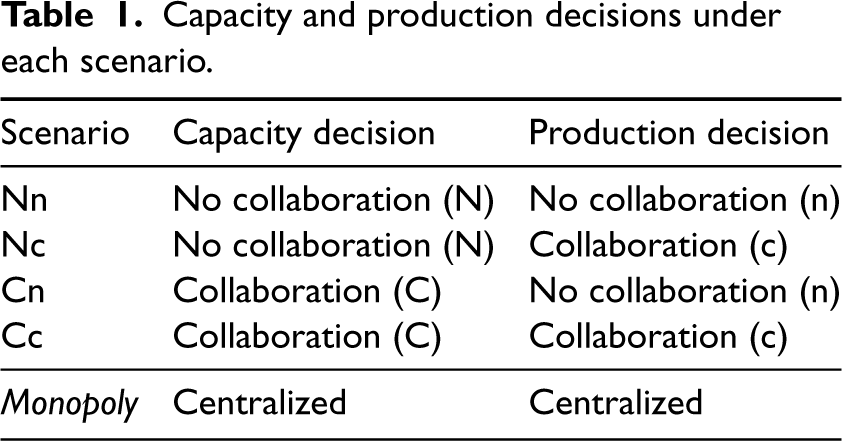
Capacity and production decisions under each scenario.
We will separately analyze each of the four scenarios, along with the centralized benchmark scenario. We aim to analyze the benefit that firms get from collaborating on joint capacity investments and/or using the capacity. Depending on the collaboration scenario, firms invest in capacity—together (C) or separately (N)—in the first stage. Let
In the second stage, the firms observe the demand signals. Let
In a given production subgame
If the firms collaborate in the production stage, a transfer payment that allocates revenues in a mutually agreeable way can occur between the firms. Let
For each of the four scenarios, we solve the problem using backward induction. We first determine the equilibrium production quantities and transfer payment for a production subgame 

Once we obtain the profit functions, we solve for the equilibrium capacities under each scenario. To distinguish these, we use superscripts. For instance,
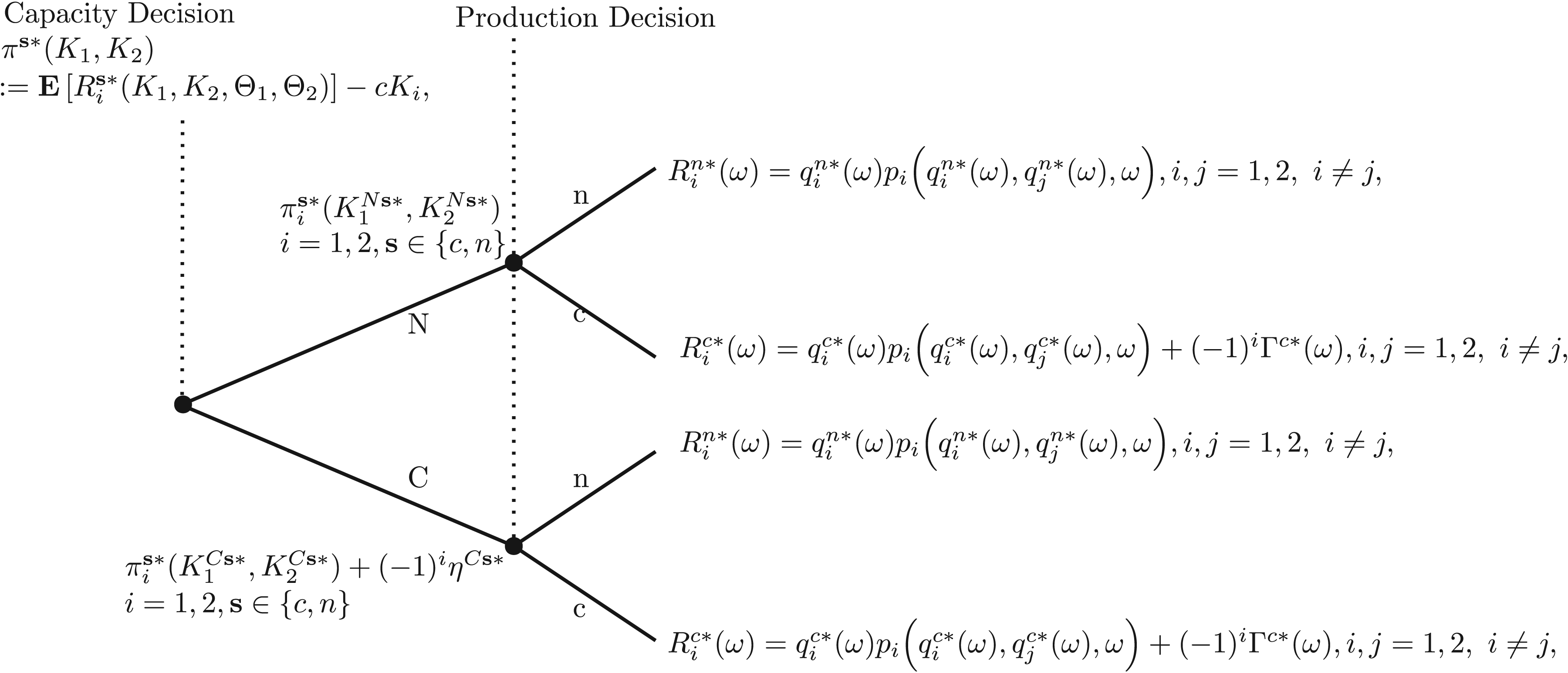
Decision tree with payoffs.
Without loss of generality, we assume that the second-stage production cost is zero because any positive (and possibly asymmetric) cost can be accommodated in our model by shifting the demand variable
When a variable or a function represents a joint/total value, we use the subscript “T.” For instance, while
We first consider a single firm that decides the capacity and production quantities for both products. For given capacity 
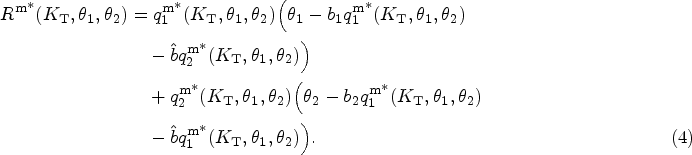

For given There exists a unique optimal capacity

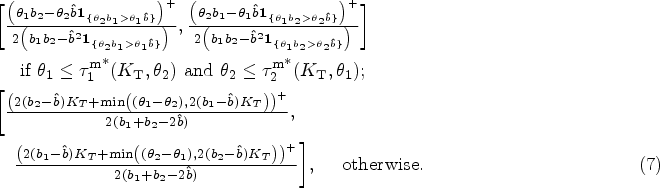
Figure 2 illustrates the optimal production policy characterized in equation (7). In this figure, we can observe that it is optimal to fully utilize the capacity only when the firm gets favorable demand signals. (These areas are marked “binding” for binding capacity in Figure 2). The allocation of the capacity to production of Products 1 and 2 depends on the relative values of the demand signals. (The gray areas in Figure 2 are areas where it is optimal to produce just one product, while in the white areas, it is optimal to produce both products.) Finally, Figure 2 also shows both thresholds
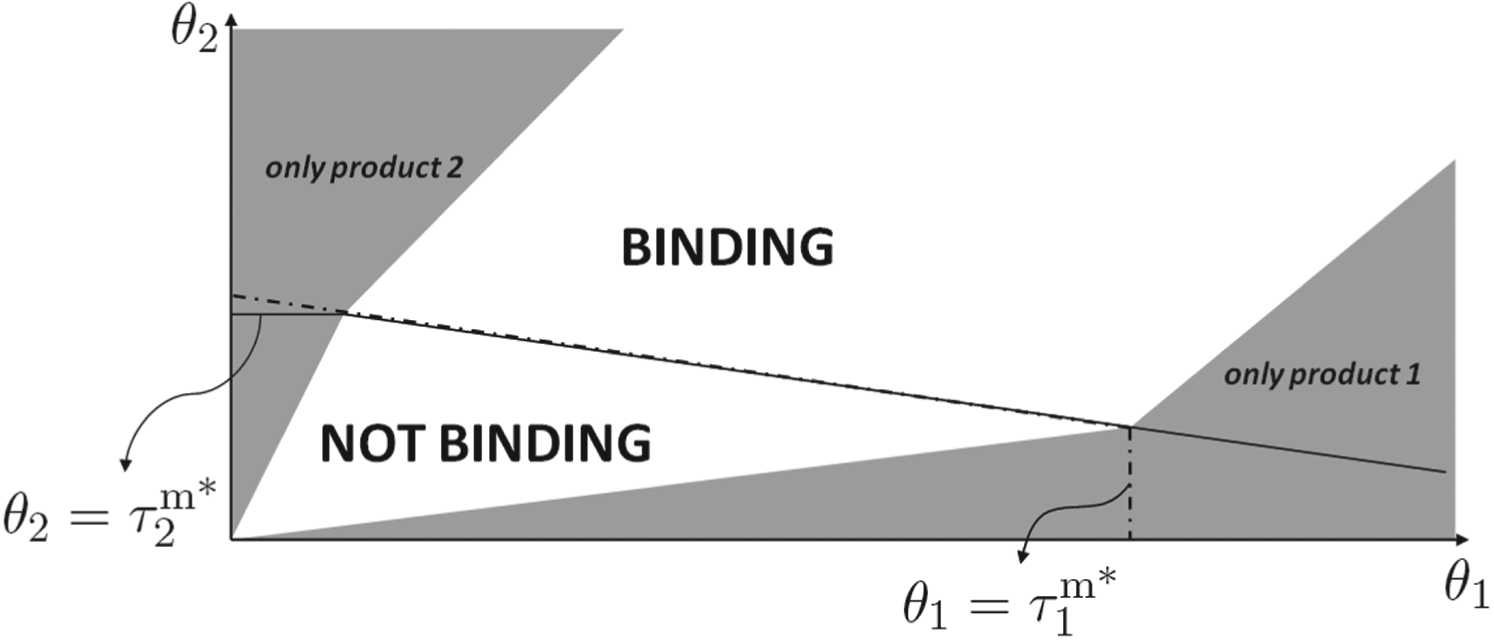
Optimal production strategy for a centralized firm with respect to demand signals.
We now provide an analysis of the different scenarios of collaboration. We first start with the production subgames for each scenario and analyze the two different settings of the second stage production subgame—No collaboration (N) and Collaboration (C)—for given capacity endowments and demand signals. We then roll back the outcome of the corresponding subgame to the first stage and determine the equilibrium strategies for each of the four different scenarios.
Noncollaborative Production
If the firms do not collaborate in the production stage (Nn and Cn scenarios), each firm individually chooses the quantity that maximizes its own revenue. Specifically, the equilibrium production quantities, for a given subgame 
In a subgame 
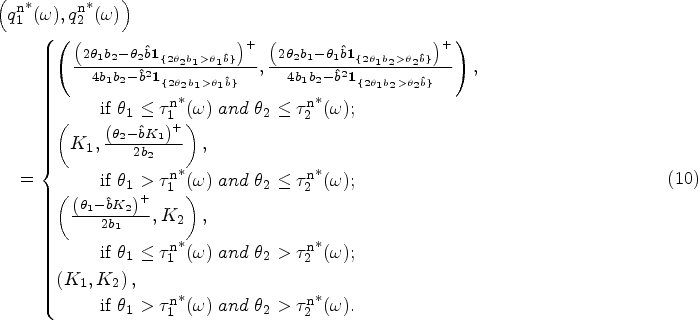
Figure 3 illustrates the equilibrium quantities with respect to demand signals,
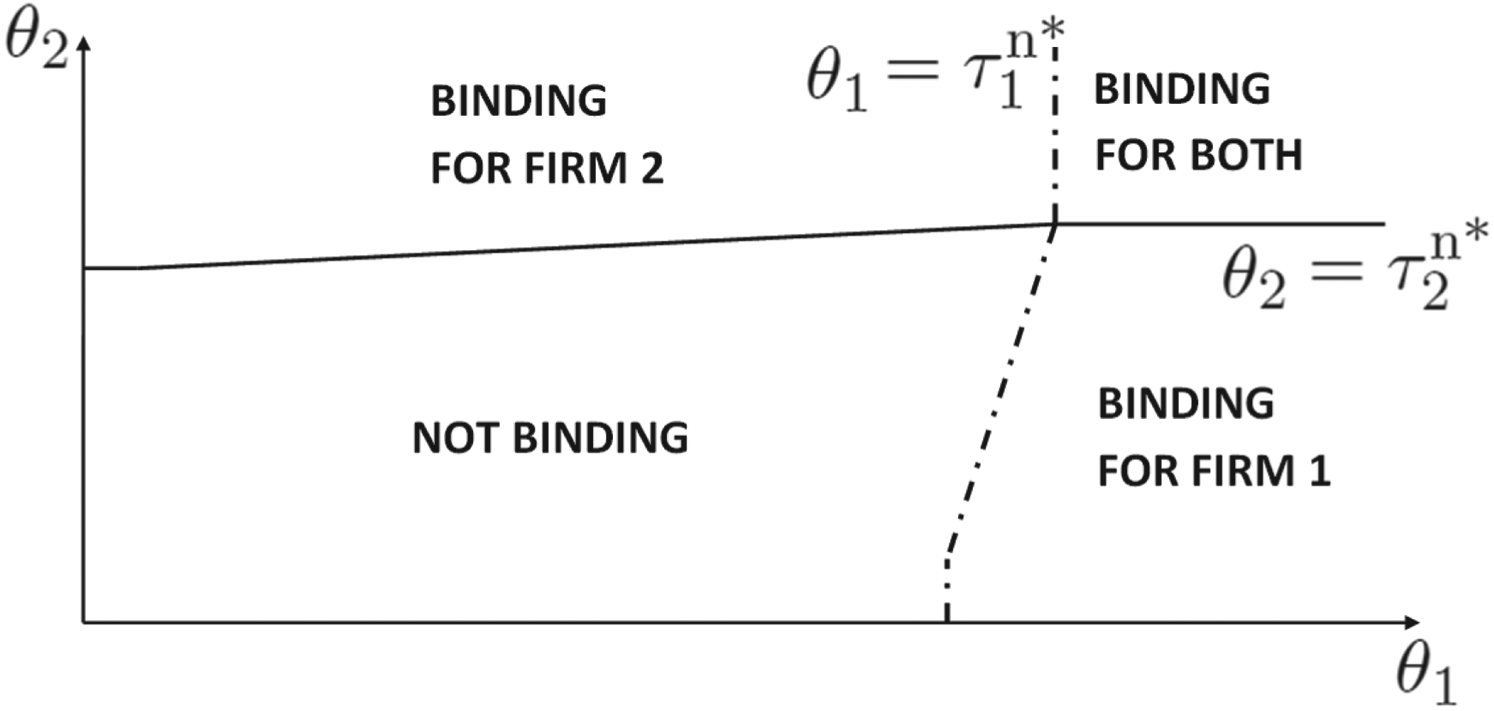
Equilibrium production strategies when the firms compete in the production subgame, with respect to demand signals.
We let 
If the firms collaborate in the production stage (Cc and Nc scenarios), they jointly set the production quantities and share the total revenue obtained from both products. We assume that firms will decide on the optimal production quantities, and then use Nash bargaining to split the revenues.
To characterize the NBS, we first need to specify the disagreement payoff for each firm (i.e.. the payoff that each firm earns if there is no deal). Note that if the firms fail to reach an agreement, each firm chooses the quantity that maximizes its own revenue within its capacity endowment. Hence, the disagreement payoff for firm
The equilibrium quantities and transfer payment of the NBS solve the problem below, and the following proposition characterizes the equilibrium:




Suppose that firms with capacity endowments the firms produce the same quantities as a centralized firm would: the transfer payment (from firm 1 to firm 2) is

Proposition 3 establishes that, in the NBS, the quantities produced by the two collaborating firms are equal to those of a single centralized firm. That is, for any demand signal, there exists a negotiation outcome where no efficiency is lost. In order to make the arrangement mutually beneficial for both firms (i.e., each firm’s payoff is no less than its disagreement payoff), the transfer payment 
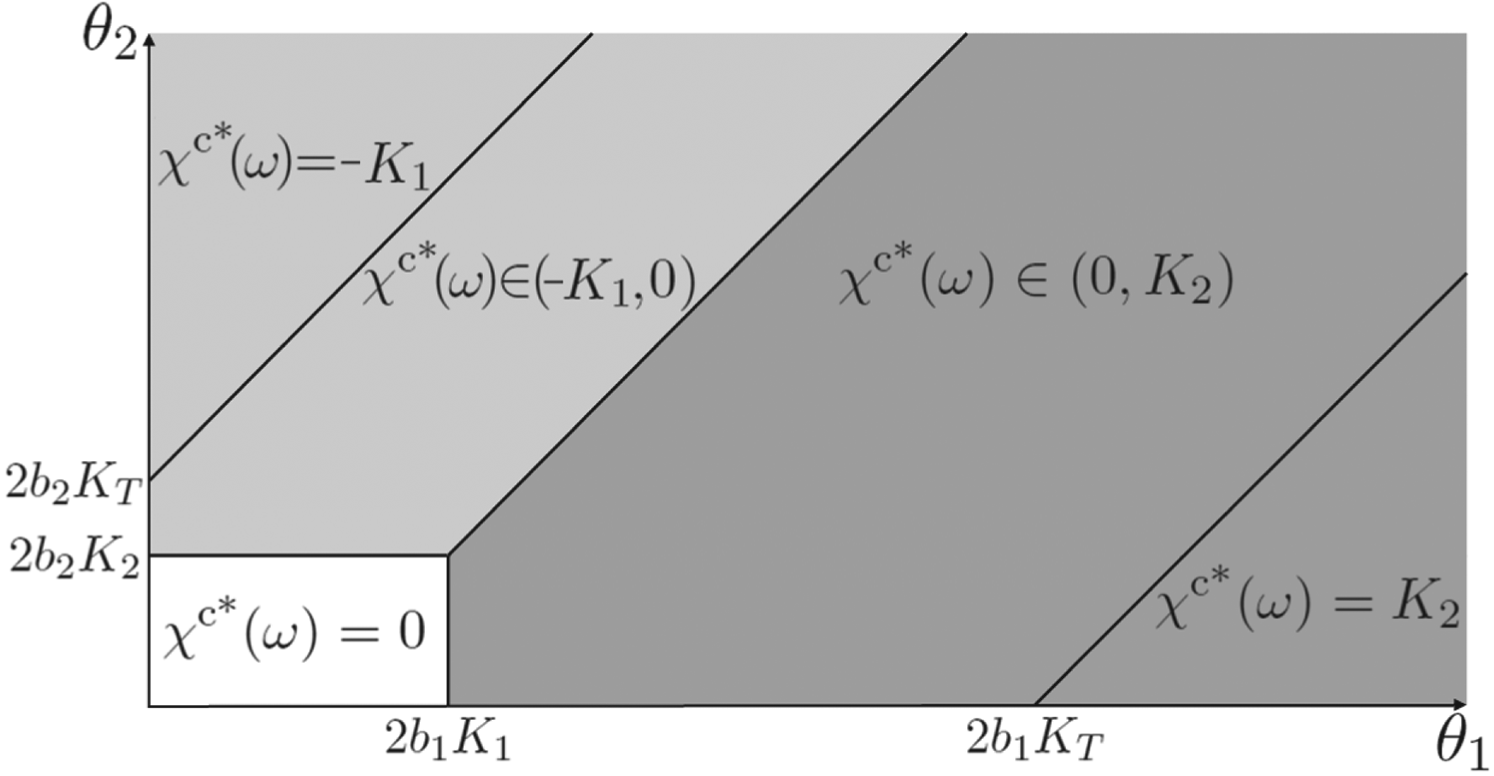
Equilibrium capacity trade with respect to demand signals.
If both firms get poor demand signals, then each firm can serve its demand with its endowed capacity, hence no capacity reallocation needs to take place. Otherwise, the two firms readily trade the capacity to produce quantities that maximize the total revenue. Note that there are regions under which the entire capacity of one firm is reallocated to the other. This happens when one firm is better off by selling its entire capacity and receiving the transfer payment than by producing and selling its own product. One may argue that demand signals can be private information to the firms. Thus, we have also examined the setting where demand signals
Note that for a given total capacity, the equilibrium quantities depend on the demand signals but not on the individual capacity endowments of each firm. Consequently, for a given total capacity, the revenue a firm earns directly from sales (before the transfer payment) depends only on the demand signals,
One may expect the transfer payment to be monotone in demand signals or in capacity endowments because capacity becomes more valuable with higher demand. Figure 5 presents the transfer payment from firm 1 to firm 2,
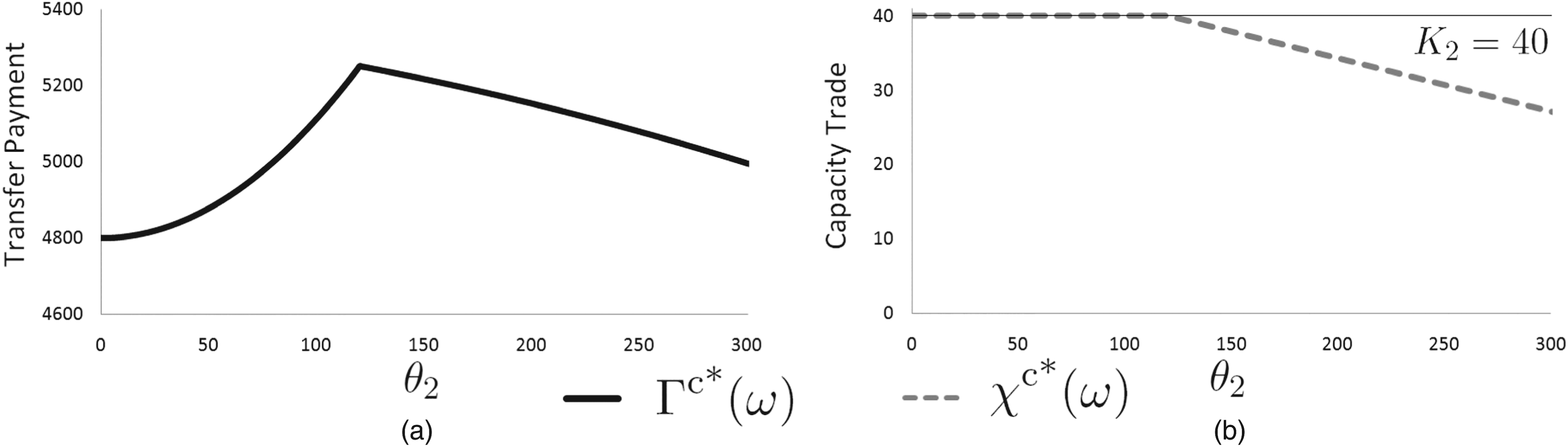
(a) Transfer payment from firm 1 to firm 2,
To examine how much a unit capacity is worth when it is reallocated, we define the price per unit of reallocated capacity:
Suppose that the two products are not substitutes (i.e., the price of capacity (per unit), the transfer payment is nonzero if and only if there is capacity trade:
When a firm’s demand signal becomes more favorable (i.e.,
However, none of these intuitive results holds when the products are substitutes. Firms pay a non-zero transfer payment even when there is no capacity trade. In addition, even when capacity is traded, the unit capacity price is not necessarily increasing as either firm’s demand increases. Figure 6 presents an example. In this example, the amount of capacity firm 1 buys from firm 2 is constant, but the price per unit of capacity decreases in the demand signal of firm 1,
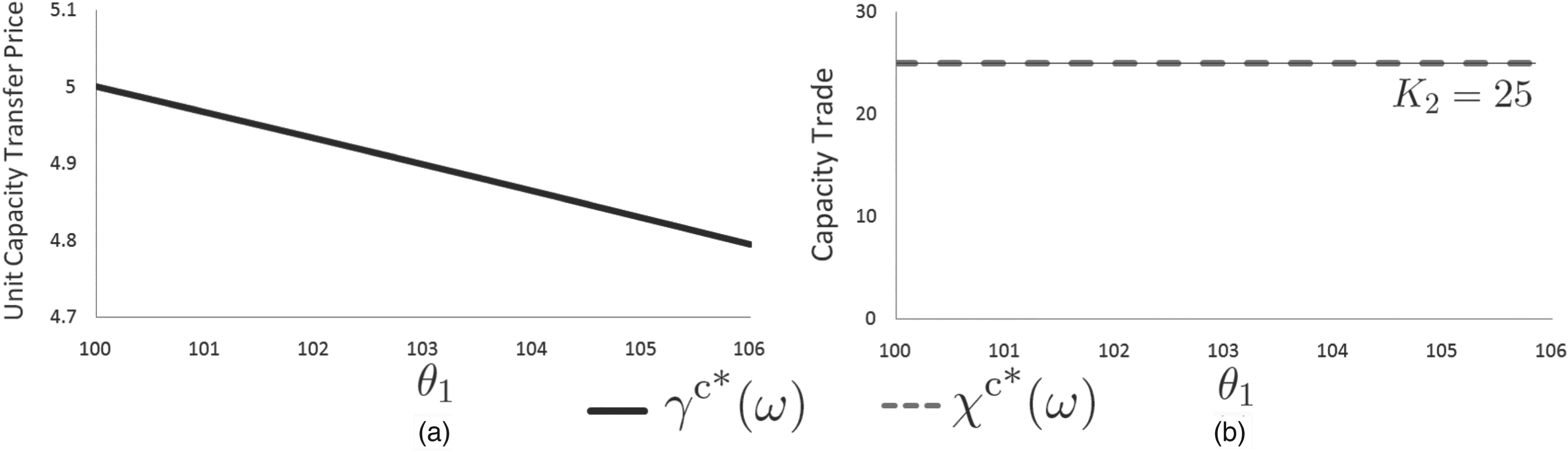
(a) Unit capacity transfer price,
After solving the production subgame, we next study the capacity investment stage in two different cases, No collaboration (N) and Collaboration (C).
If the firms do not collaborate in the first stage (Nc and Nn scenarios), each firm strategically decides its capacity level to maximize its own expected profit. Therefore, the equilibrium capacity levels 
If the firms collaborate in the first stage (Cc and Cn scenarios), they negotiate to build capacity jointly and share the capacity and its investment costs according to the NBS. We assume that each firm pays the capital to obtain its initial endowment, that is, firm
To determine the bargaining outcome, we first specify the disagreement payoff, that is, what each firm earns if the negotiation fails. Let
Thus, under a multi-period agreement between parties in the Cc scenario, if the firms fail to reach an agreement at the first stage, each firm will decide its own capacity and production quantity separately to maximize its own profit. Therefore, each firm will then earn equilibrium profits in the Nn scenario, and we have
If there is a deal, the firms invest in the capacity and obtain the capacity endowments, 
When the products are not substitutes (
In all four scenarios (Nn, Nc, Cn, and Cc), a pure strategy equilibrium exists. Moreover, the equilibrium is unique in the Nn and the Nc scenarios. When the firms collaborate on capacity investment (Cn or Cc scenarios), the following are true.
The difference between the firms’ equilibrium profits is equal to the difference in their disagreement payoffs:
In the Cc scenario, the total capacity in equilibrium is equal to the optimal capacity of a centralized firm:

Theorem 1 implies that, while capacity collaboration makes both firms better off, the difference in profit remains the same as the difference in their disagreement payoffs. In other words, the negotiation outcome only increases the total surplus without changing the difference. Theorem 1 also establishes that, if the firms collaborate both in the capacity-building and the production stages (Cc scenario), the total capacity is the same as a centralized firm’s capacity. In this scenario, the firms not only produce the centrally optimal quantities (Proposition 3) but also agree to build the optimal capacity of a centralized firm. Thus, no efficiency is lost in either stage. The result—that the Cc scenario achieves the centrally optimal solution—is consistent with the existing literature: cooperation usually leads to Pareto optimal solutions and improves profits for both parties. The primary reason lies in the dynamics of Cournot’s competition (when products are substitutes). In such a scenario, both firms will choose quantities that drive the price down, lowering revenues for both parties. However, in the Cc scenario, both firms can do better than the Cournot outcome even without a transfer payment (see Theorem 2 below) as the NBS guarantees both firms gain at least the profits in the Cournot competition. The benefit of cooperation increases as the substitutability (competition) increases.
An interesting question is how firms pay for the capacity they wish to purchase. Suppose the two firms agree to collaborate and build capacity
For the Cc and Cn scenarios, the following are true.
An investment equilibrium is subsidy-free If the products are not substitutes

The condition in equation (18) leads to a subsidy-free investment. Notice that the left-hand side is the difference between the profits when the firms compete in the second stage with the endowments
Theorem 2 also implies that when the two products are not substitutes, a subsidy-free equilibrium exists regardless of whether the firms collaborate in the production stage or not (Cc and Cn, respectively). In the Cn scenario, as no capacity sharing occurs in the second stage, there is no gain from joint capacity investment. Hence, each firm agrees to build an endowment that maximizes its own profit, leading to no investment subsidy. On the other hand, in the Cc scenario, the firms share capacity in the second stage, and hence they gain from joint investment in capacity. The second-stage negotiation allocates these gains so that the firms do not need the investment subsidy to select the centrally optimal capacity in the first stage.
On the other hand, when the products are substitutes, a subsidy-free equilibrium exists only when the firms collaborate in both stages (Cc scenario) and the total capacity of a centralized firm is smaller than the total capacity in the Nn scenario (i.e.,
When the products are substitutes and the total capacity of a centralized firm is larger than the total capacity in the Nn scenario (i.e.,
When the products are substitutes and the firms do not collaborate in the second stage (Cn scenario), a subsidy-free investment equilibrium does not exist in general. Even without capacity sharing in the second stage, there still exists a gain from joint investment in capacity for substitutable products. However, because there is no ex-post recourse to resolve the inefficiencies (due to the possible imbalance between endowments and demand signals), whether each firm realizes the gain or not depends on its initial endowment. Consequently, an up-front subsidy is generally needed so that the firms select the endowments that maximize the gains of collaboration.
When the firms collaborate in both stages, one might wonder how much will each firm invest in a subsidy-free equilibrium? First, note from Theorem 1 that the total capacity is equal to that of a centralized firm. This implies that
So far, we have analyzed the equilibrium outcomes for four scenarios and show that the firms gain the most if they can fully collaborate in both stages (Cc scenario). However, to achieve this outcome, the two firms must build capacity and set production quantities together. Furthermore, the two firms not only need to make decisions together but they also need to agree in detail on how to split the profit for each contingency. In the previous section, we show that if the two products are substitutes, the firms may exchange the transfer payment even when there is no physical exchange of the capacity. One alternative arrangement is that the firms collaborate on strategic decisions (e.g., building capacity), but each firm individually sets its production quantity, while they trade the capacity endowments if necessary. We call this arrangement the Cp scenario (where subscript
In this scenario, the firms build joint capacity in the first stage. In the second stage, after the firms observe the demand signals, they trade capacity to establish new endowments. Then, each firm individually decides its production quantity within its new endowment. An example of such collaboration can be found in an arrangement between AMD and Fujitsu for producing flash memory chips (Devine, 2003). Under this arrangement, the firms built a plant together (thus collaboratively choosing the total capacity), but each firm individually decided how much to purchase from the plant’s output (Plambeck and Taylor, 2005). Another such example is the limited joint operating agreement between two newspapers: the Detroit Free Press and Detroit News. Under this arrangement, the newspapers operate separately but are printed in the same, jointly built facility (Busterna and Picard, 1993).
Once again, we solve for the equilibrium outcome using backward induction. Let 
If the firms fail to reach a deal, each firm individually decides its production quantity using its initial endowment, 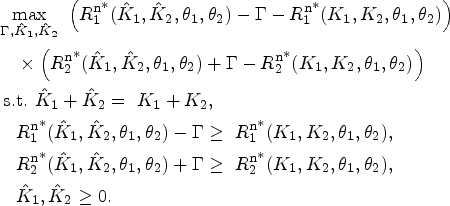
One might also be interested in the case where firms with initial capacity endowments
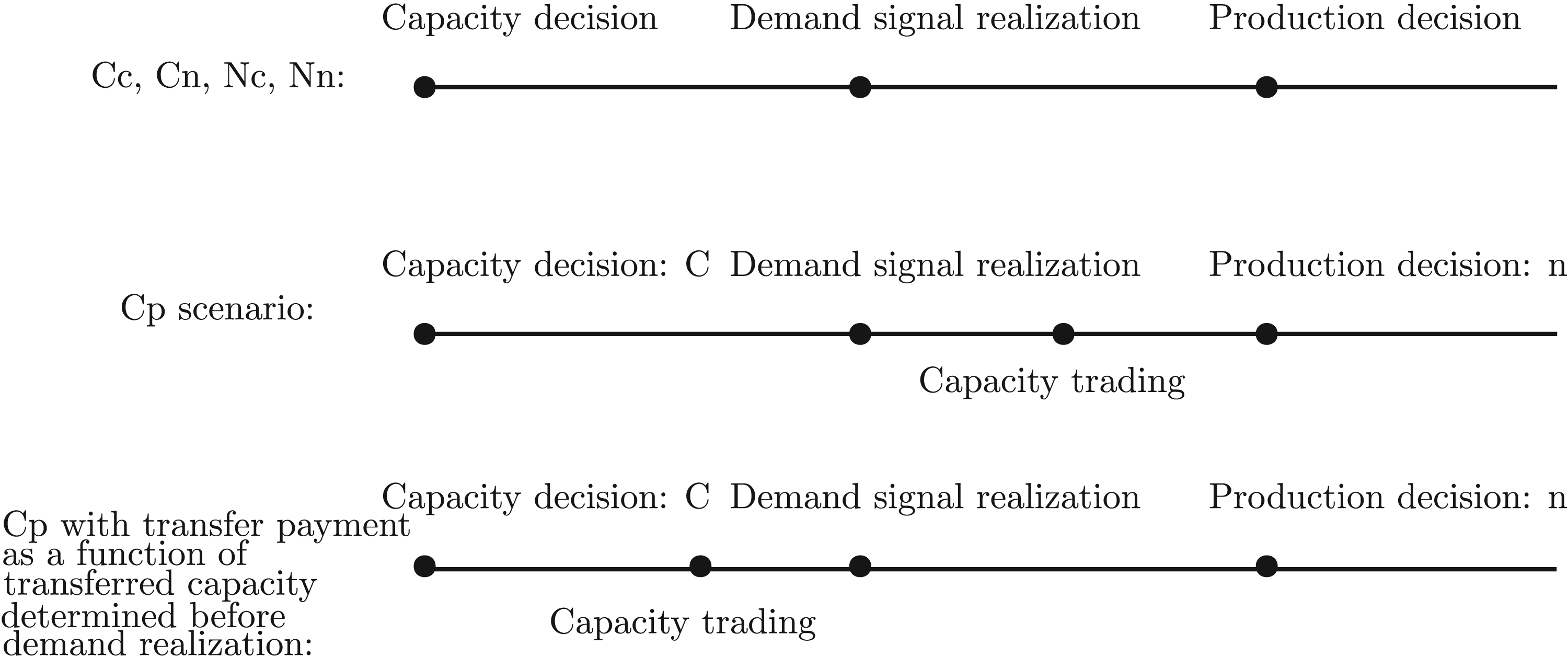
Model timelines.
The two firms thus solve the following problem:
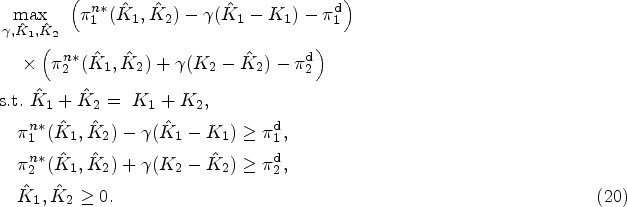

In the previous section, we solved for the equilibrium capacity in five different scenarios. We show that in some cases, collaboration leads to a centrally optimal outcome. For example, if the two firms can fully collaborate in both stages (Cc scenario), the equilibrium joint capacity level is equal to the optimal capacity of a centralized firm. Similarly, if the two products are not substitutes (i.e.,
[Comparison of Equilibrium Capacities]
When the products are not substitutes When the products are substitutes
Parts A(i) and B(i) of Theorem 3 compare the total capacity in the two scenarios—Nn and Cn. If the two products are not substitutes (part A(i)), the total capacity in the Cn scenario (i.e., collaborating in the capacity game, but not collaborating in the production subgame) is the same as that of the Nn scenario (i.e., not collaborating in both games). In other words, in terms of the total capacity, not collaborating in the production subgame is the same as not collaborating at all. On the other hand, if the products are substitutes, part B(i) implies that the Cn scenario yields smaller capacity than the Nn scenario, although the firms do not lend or borrow capacity from each other in the production subgame,
Parts A(ii) and B(ii) compare the total capacity in the Nc scenario with those in the Nn and Cc scenarios. If the products are not substitutes, the total capacity in the Nc scenario is always between 
However, this result is no longer true when the products are substitutes. Although we can establish
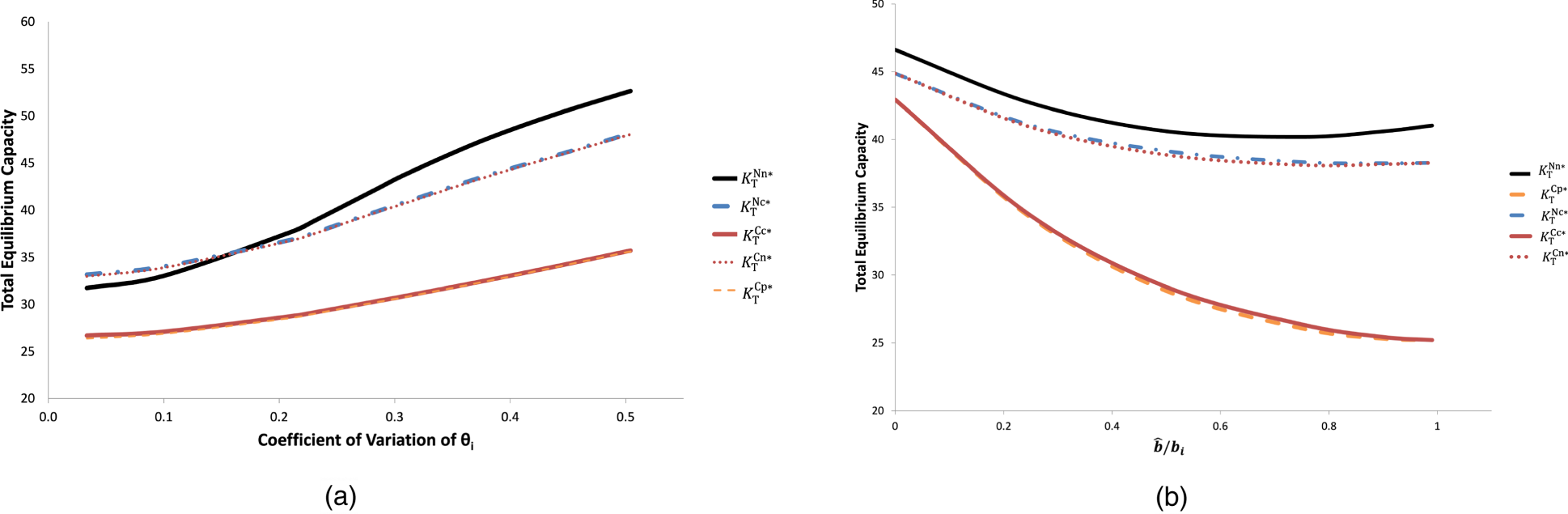
Equilibrium capacity: (a) total capacity versus coefficient of variation and (b) total capacity versus
When the demand variability becomes smaller, the chances that one firm needs to borrow capacity from the other firm decrease. However, larger capacity can still be beneficial to the firms when products are substitutes. Note that the disagreement payoff of firm
Finally, parts A(iii) and B(iii) compare the equilibrium capacity in the Cp and the Cc scenarios. One would expect the total capacity to be higher with increased competition, that is, it may be reasonable to expect that
We further examine the effects of demand uncertainty and substitutability on the equilibrium total capacities. The results are illustrated in Figures 8(a) and (b) (
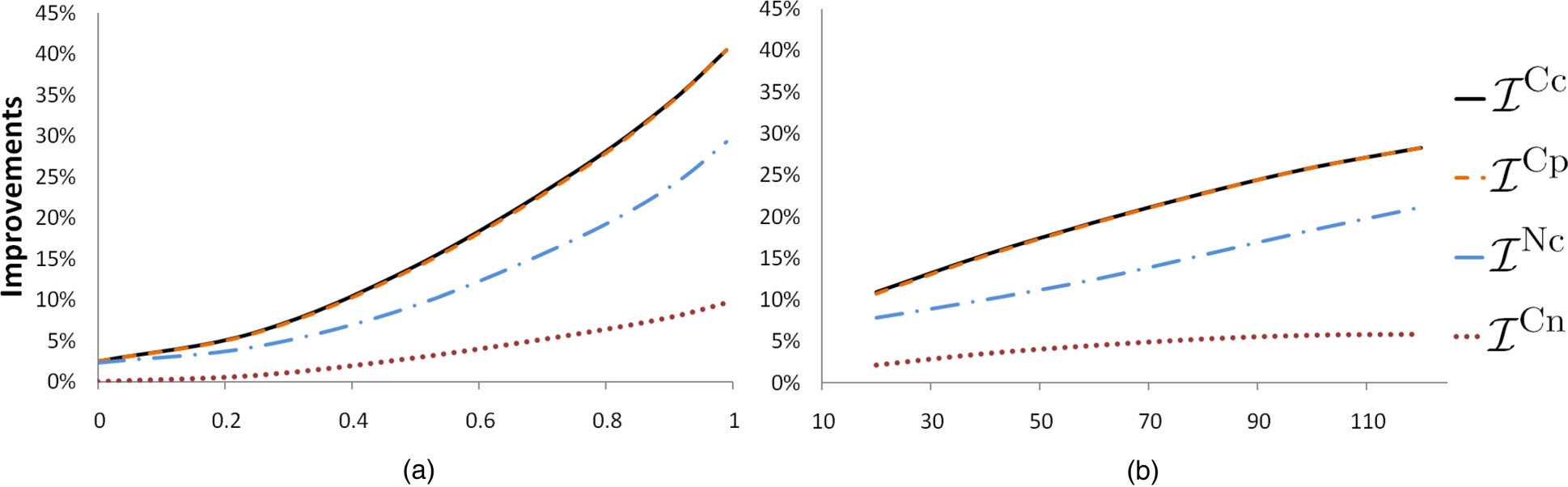
Improvements versus (a)
We conduct a computational study to gain further managerial insights into the benefit of capacity collaboration. In particular, we aim to (a) measure the gains the firms can achieve via collaboration, (b) find out how the gains change in the level and the form of collaboration, and (c) assess the impacts of business parameters (such as costs, demand variability, etc.) on the gains from collaboration.
For this, we compare the firms’ performances in five scenarios: Cc, Cp, Cn, Nc, and Nn. To examine the effects of the business parameters on the gains from collaboration, we systematically vary cost and demand parameters. Specifically, the following combinations of parameters (in 2,268 problem instances) are used in the computational study:
Throughout the experiments, we use several distributions—uniform, truncated normal, triangular, etc.—with 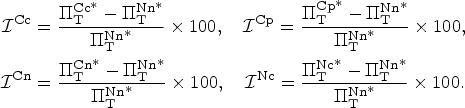
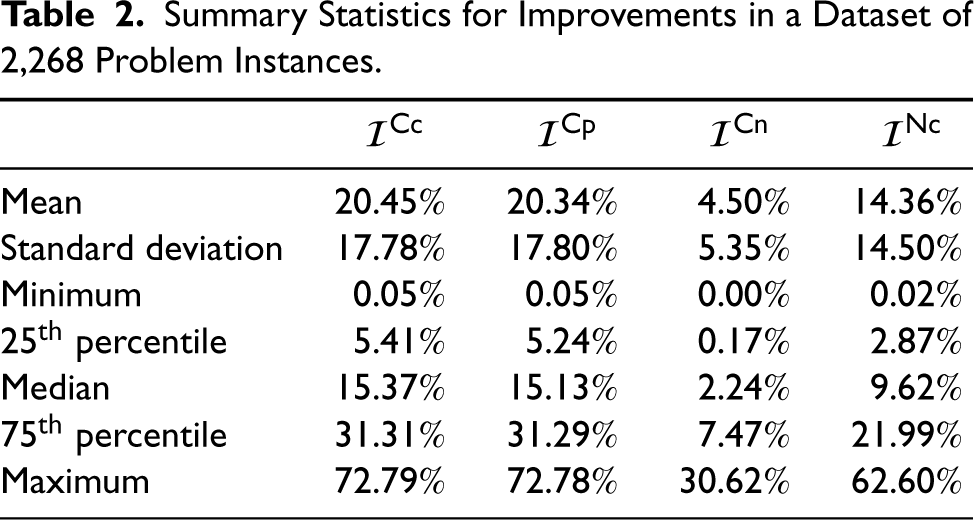
Summary Statistics for Improvements in a Dataset of 2,268 Problem Instances.
Summary Statistics for Improvements in a Dataset of 2,268 Problem Instances.
We observe that the overall gains from collaboration are significant except for the Cn scenario. In particular, the performance in the Cp scenario (where the firms invest in capacity together and decide jointly whether to trade capacity but independently on the production quantities) is very close to the performance in the Cc (full collaboration) scenario. We also observe that the gain is significant when the firms collaborate only in the production stage (Nc scenario): the total profit increases by
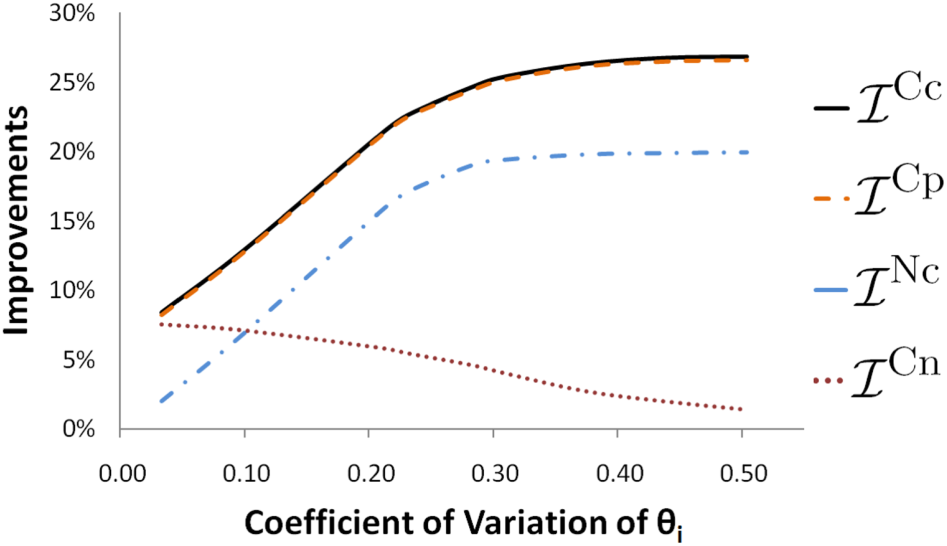
For each scenario, we examine the change in the performance with respect to the changes in the problem parameters. These results are presented in Figures 9(a) (substitutability), 9(b) (capacity cost) and 10 (demand variability). Figure 9(a) plots the percentage improvements with respect to
Improvements versus the coefficient of variation of demand.
Figure 9(b) shows that the percentage gains increase in the unit capacity building cost. When capacity becomes more expensive, the firms build smaller capacity. When the firms collaborate in the production stage (Cc, Cp, and Nc scenarios), they utilize the limited capacities more efficiently. Therefore, in these scenarios, the gains from collaboration increase significantly when the unit capacity building cost increases. On the other hand, in the Cn scenario, the gain slightly increases first, but the rate of increase diminishes as the cost increases. The firms are already building smaller capacities in the Nn scenario when the capacity cost is high, the gain in the Cn scenario is small and the growth diminishes with higher capacity cost.
Figure 10 illustrates how the gains change in demand variability. Overall, the gains increase in demand variability when the firms collaborate in the production stage (Cc, Cp, and Nc scenarios). If the firms do not collaborate in the production stage at all, however, the gain from collaboration on capacity alone (Cn scenario) decreases in demand variability. To see why, note that for given capacity endowments, as the demand variability increases, the probability that at least one firm is short of capacity increases as well. Thus, collaborating on production after observing the demand signals (reactive collaboration) becomes more valuable.
Recall that in the Cp scenario, each firm sets its own production quantity and the firms exchange capacity once they observe demand signals. Therefore, one might expect that the increased competition compared to the full collaboration (Cc) scenario will force the firms to produce larger quantities resulting in lower prices. However, when we compare the equilibrium quantities and prices between the Cc and the Cp scenarios (see Figure 11,
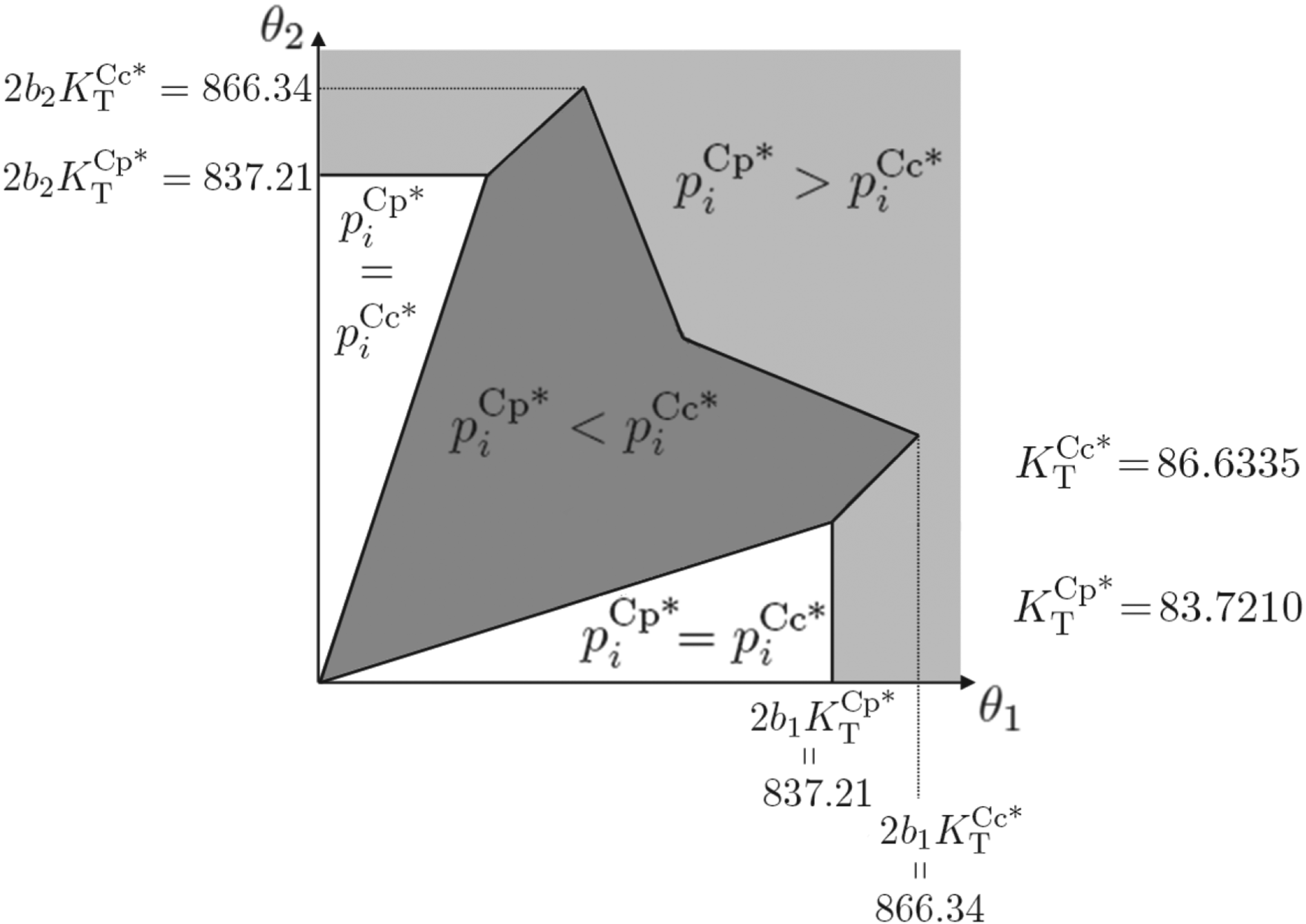
Regions on
In this paper, we considered collaboration between two competing firms. Specifically, firms collaborate on both capacity building and/or production decisions. We considered several different collaboration scenarios and examined the resulting equilibrium outcomes.
We find that if the firms can fully collaborate on both capacity and production decisions (Cc scenario), they can achieve the centrally optimal outcome in equilibrium. In other words, no efficiency is lost. Moreover, compared to the scenario in which the firms do not collaborate at all, the gains from collaboration with a competitor can be substantial. This supports the joint venture agreements between competing firms, in which the firms jointly make decisions under a separate economic entity. However, for a joint venture agreement to be sustainable, the firms might need to agree on investment subsidies and on a detailed transfer payment schedule. Interestingly, we find that an investment scheme that is proportional to the capacity endowment structure (e.g., one firm owns 60% of capacity and the other owns 40% of capacity in a 60–40 joint venture) might not always be an equilibrium, and subsidies from one firm to the other could be necessary to achieve mutually beneficial collaboration.
We also study an arrangement where the firms jointly build capacity but still compete in production after trading their capacity endowments (Cp scenario). We find that most of the benefits from full collaboration can be captured in the Cp scenario. This coordination not only benefits firms but can also benefit consumers because prices will be lower than in the centralized case and can even be lower than if no coordination took place at all. The sensitivity of the gains of collaboration with respect to different parameters implies that overall gains increase when (a) the products are more substitutable, (b) capacity is more costly to build, and (c) demand is more variable.
For future research, it would be interesting to consider collaboration structures other than the ones we consider in this paper. For instance, we assume that when the firms collaborate in the operational stage, they negotiate contract terms such as the capacity trade and the transfer payment. This causes the contract terms to be contingent on the demand signals (these contracts are labeled as incomplete contracts by Van Mieghem (1999)). One extension is to consider a simpler contract that can be agreed upon before demand signals are observed. It will be interesting to see how much of the benefit can be captured through such a simple mechanism.
Supplemental Material
sj-pdf-1-pao-10.1177_10591478231224918 - Supplemental material for Benefits of Collaboration on Capacity Investment and Allocation
Supplemental material, sj-pdf-1-pao-10.1177_10591478231224918 for Benefits of Collaboration on Capacity Investment and Allocation by Hyun Soo Ahn, Eren Çetinkaya, Izak Duenyas and Mengzhenyu Zhang in Production and Operations Management
Footnotes
Declaration of Conflicting Interests
The authors declared no potential conflicts of interest with respect to the research, authorship, and/or publication of this article.
Funding
The authors received no financial support for the research, authorship, and/or publication of this article.

Notes
How to cite this article
Ahn HS, etinkaya E, Duenyas I and Zhang M (2024) Benefits of Collaboration on Capacity Investment and Allocation. Production and Operations Management 33(1): 128–145.
References
Supplementary Material
Please find the following supplemental material available below.
For Open Access articles published under a Creative Commons License, all supplemental material carries the same license as the article it is associated with.
For non-Open Access articles published, all supplemental material carries a non-exclusive license, and permission requests for re-use of supplemental material or any part of supplemental material shall be sent directly to the copyright owner as specified in the copyright notice associated with the article.
