



Abstract
The recently enacted Inflation Reduction Act (IRA) includes a number of incentive-based programs (e.g., tax credits) designed to motivate firms to develop new clean technologies for fighting climate change. However, the IRA also includes a fee firms incur for excessive methane emissions. This represents the first time the United States government has ever levied a fee on greenhouse gas emissions, and it raises an interesting research question—how should a budget-constrained regulator balance the use of both incentive and penalty-based levers for stimulating investment in clean technology development? In this paper, we examine a regulator’s optimal penalty and subsidy decisions for motivating firms to invest in clean technology development. We illustrate how the level of competitive intensity in the market can influence a budget-constrained regulator with multiple competing objectives—the environment, firm profits, and consumer welfare. We find that a subsidy is always beneficial, irrespective of the regulator’s objective. While imposing a firm penalty always benefits the environment, it always negatively impacts the sum of firm profits and consumer welfare. However, depending on the level of competition in the market, instances can occur where imposing a high penalty actually benefits total firm profits or consumer welfare (separately). Interestingly, a regulator that cares about all three dimensions of its objective equally, should always set the penalty to either its minimum or maximum value, depending on whether the environmental cost of the harmful product is high or low.
Introduction
To combat rising inflation caused in part by the COVID-19 pandemic, in 2022, the United States government enacted the Inflation Reduction Act (IRA). 1 The IRA is a US federal law designed to reduce inflation by (i) decreasing the deficit, (ii) reducing prescription drug prices, and (iii) investing in clean energy production and infrastructure (our area of interest). For (iii), the law authorizes the spending of over $391 billion on energy and climate change programs, with a number of these initiatives providing incentives to industry to develop new clean technologies for fighting climate change. For example, the IRA includes programs that provide firms with tax credits for the development and use of emerging carbon capture and storage technologies. As stated by the Clean Air Task Force, a nonprofit focused on emissions and climate change, incentives such as these “will move carbon capture and storage closer to realizing its potential as a critical decarbonization solution for hard-to-abate industries such as steel, cement, refineries, and power generation.” 2 The IRA has similar programs that provide firms with tax credits for the development and use of clean hydrogen.
Most of the programs in the IRA that are focused on clean technology innovation rely on incentive-based methods such as tax credits to motivate firms. However, the IRA also includes the Methane Emissions Reduction Program (MERP), a $1.55 billion program designed to foster innovations to help monitor and reduce methane emissions. As part of the MERP, any firm that is over a set, industry-specific methane emissions threshold will be levied a fee of $900 per metric ton of methane in 2024. This fee represents the first time the US government has ever levied a fee or tax on greenhouse gas emissions. 3
The introduction of a penalty-based lever to motivate firms to invest in clean technology development represents a landmark moment for the US federal government’s efforts to fight climate change. It also raises an interesting research question—how should a regulator balance the use of both incentive and penalty-based levers for stimulating investment in clean technology development? While an incentive directly motivates firms to invest, a penalty can have both a direct and an indirect effect. Directly, it helps reduce the sale of harmful products by increasing firm costs; but indirectly, it can serve as a financial resource for a regulator to increase its budget for offering subsidies. We explore this research question, emphasizing how a budget-constrained regulator’s decisions are impacted by (i) the level of competitive intensity in the market and (ii) the budgetary interaction that can occur due to the regulator’s use of both a penalty and a subsidy.
The environmental programs in the IRA target a wide range of industries such as oil and gas, mining and metals, advanced energy solutions, and construction. The competitive landscape and concentration of firms in these industries can vary widely. For example, the US solar energy market is highly fragmented with no dominant players. Furthermore, solar panels are differentiated products, with panels varying by both cost and efficiency (Hoium, 2017). Conversely, the cement industry is highly concentrated, with cement being considered a commodity (Jacques, 2007). Given this variation in competitive intensity found across industries, there is a need to better understand how the level of competition within a market can and should shape a regulator’s strategy. Within the literature, tax or penalty revenue is often modeled as a social benefit in a regulator’s objective function (see, e.g., Klaus, 1993; Krass et al., 2013). However, in practice, governments regularly use funds collected from environmental fines to augment the budgets they use to promote the development of new, green technologies (Francis et al., 1999; US Congress, 2008). Due to this gap, there is a benefit to examining how a budget-constrained regulator’s subsidy and penalty policies are shaped by the regulator’s ability to utilize penalty collections to offer further subsidies.
To address our research question, we develop a game-theoretic model consisting of two firms and a budget-constrained regulator. Both firms currently use a technology that is harmful to the environment as part of their production processes. The regulator has two levers available for motivating the firms to invest in developing a new clean technology: a per-unit penalty (e.g., a fee) for each non-compliant unit sold, and a per-unit firm subsidy (e.g., a tax credit) for each compliant unit sold. To capture the fact that governments often use funds collected from environmental fines to further promote the development of environmentally friendly technologies, we model any funds collected from the penalties as being added to the regulator’s budget. To capture that consumers are increasingly demanding more sustainable products from firms, we assume that consumers have an additional positive valuation for a clean product (as compared to a product made with harmful technology). 4 In our model, the regulator first sets its regulation policy which consists of the penalty and two possible values for the subsidy—the subsidy if both firms develop and use the clean technology, and the subsidy if only one firm develops and uses the clean technology. The firms then make development investments with uncertain outcomes. Finally, after observing the outcomes of their development investments, the firms set their prices and demand is realized.
We focus on the perspective of the regulator in order to generate insights into how a budget-constrained regulator can motivate investments in clean technology development in a competitive market. Designing an effective environmental policy can be challenging since it often requires a regulator to incorporate the demands of multiple stakeholders, such as consumers and firms, all under a fixed budget. Our work aligns with the sustainable operations management literature that examines regulatory policy design in that we consider a regulator that must balance multiple objectives (see, e.g., Atasu et al., 2009; Murali et al., 2019).
We find that offering a per-unit subsidy to firms for the development and sale of a clean product always benefits a regulator’s objective, irrespective of how the regulator prioritizes the environment, firm profits, and consumer welfare. Because of this, when setting either subsidy level (i.e., both firms or only one firm successfully develops the clean technology), the regulator should always exhaust its budget and any potential funds earned through penalties. This finding illustrates how the per-unit penalty in our model serves a dual purpose in that it acts as both a lever to directly motivate firm investment and a financial instrument that a budget-constrained regulator can use to help fund subsidies. The tension in this trade-off is illustrated by the fact that the regulator’s optimal subsidy for the case in which only one firm successfully develops is unimodal in the penalty, first increasing (increasing a low penalty helps to further fund the subsidy), and then decreasing (increasing an already high penalty further decreases the sale of the harmful product and the collection of the penalty).
While imposing a penalty on firms for the sale of a harmful product always benefits the environment, it always negatively impacts the sum of total firm profits and consumer welfare. There are, however, instances in which imposing a high penalty can benefit either total firm profits or consumer welfare separately. Specifically, when only one firm successfully develops and offers a clean product on the market, a high penalty can provide this firm with a significant competitive advantage. If the level of competition in the market is high, a penalty then allows the firm with the clean product to extract a higher per-unit margin from the large consumer base, and total firm profits increase. If the level of competition is moderate, a penalty leads the firm with the clean product to aggressively price its products to increase market share, so a high penalty can lead to improved consumer welfare. A regulator primarily concerned about firm profits (consumer welfare) thus should set a high penalty when the level of competition in the market is high (moderate).
When the regulator prioritizes the environment, firm profits, and consumer welfare equally, the optimal subsidies are increasing in the regulator’s budget, while the optimal penalty is weakly decreasing. The more a regulator’s budget increases, the less it requires the financial benefit from imposing a per-unit penalty to augment its budget in order to offer greater subsidies. In practice, regulators are typically budget-constrained when setting environmental regulations, and as such, a per-unit penalty often plays a critical role in the policy design. Interestingly, we find that a budget-constrained regulator that gives equal weight to the environment, firm profits, and consumer welfare should always set the penalty to either its minimum or maximum value, with the choice being based on a threshold policy for the environmental cost of a harmful product. If the environmental cost is high, then the penalty should be set to its maximum value so as to eliminate the sale of the harmful product altogether. Conversely, if the environmental cost is low, then the regulator should set the penalty to its minimum value such that it is still profitable for firms with access to clean technology to use it. In doing so, the regulator possibly maintains some harmful products in the market but helps firm profits and consumer welfare.
Our work adds to the environmental literature that examines how regulatory interventions such as subsidies and taxes (i.e., penalties) influence firms’ environmental (clean technology) investment decisions (e.g., Bian et al., 2020; Drake et al., 2016; Krass et al., 2013). Specifically, we show why it is important for a regulator to take into consideration the level of competitive intensity in the market when designing its subsidy and penalty policy. We also provide clear guidance to a budget-constrained regulator on how it should balance the use of a penalty as both a lever to directly motivate firm investment and a financial instrument to help fund subsidies.
The remainder of this paper is organized as follows. In Section 2, we review the relevant literature, and in Section 3, we present the model formulation. In Sections 4 and 5, we provide insights into the firms’ and regulator’s decisions. Finally, in Section 6, we discuss our managerial insights. All proofs can be found in the online supplement.
Literature Review
Our study contributes to two streams of research within the environmental literature: (a) the modeling of firms’ environmental investment decisions under regulatory pressure and (b) the modeling of regulators’ environmental intervention decisions.
The examination of firms’ environmental investment decisions under regulatory pressure is a popular topic within the environmental literature (e.g., Ata et al., 2012; Baker and Shittu, 2006; Bansal and Gangopadhyay, 2003; Farzin and Kort, 2000; Fischer et al., 2003; Kraft et al., 2013; Xiao et al., 2019). For example, Drake et al. (2016) examine how different levers such as emissions taxes, cap-and-trade regulations, and investment and production subsidies affect a firm’s technology and capacity decisions. In a multi-firm setting, Yalabik and Fairchild (2011) study how external pressures such as consumers, regulation, and competition influence firms’ environmental innovation decisions. Kraft and Raz (2017) investigate how competition and firm heterogeneity affect firms’ replacement decisions for a substance of concern under regulatory uncertainty. Our work aligns with these papers in that we consider how firm penalties and subsidies impact firms’ environmental investment decisions, and how this effect is influenced by the level of competitive intensity in the market. Importantly, the papers in this stream of literature focus on the firm’s perspective under an exogenous regulatory threat. We instead focus on the regulator’s perspective, endogenizing both the regulator’s subsidy and penalty decisions.
A related stream of work takes the perspective of the regulator to model the design of regulation to motivate firms’ environmental investment decisions. Common topics studied include green technology development and adoption through the use of regulatory instruments such as subsidies (e.g., Chen et al., 2019; Cohen et al., 2016; Jung and Feng, 2020), penalties (e.g., Anand and Giraud-Carrier, 2020; Tarui and Polasky, 2005; Ulph, 1996; Wang and Scheller-Wolf, 2021), or both (e.g., Klaus, 1993; Levi and Nault, 2004); voluntary and mandatory disclosures (e.g., Lyon and Maxwell, 2003; Murali et al., 2019; Wang and de Véricourt, 2016; Zhang et al., 2023); and e-waste regulations (e.g., Atasu and Subramanian, 2012; Atasu et al., 2009; Plambeck and Wang, 2009; Toyasaki et al., 2011).
There are a few works from this latter stream of literature that are closely related to our study and deserve further discussion. First, Krass et al. (2013) study how a regulator can use environmental taxes, fixed-cost subsidies, and consumer rebates to encourage the adoption of emission-reducing technologies in a monopoly setting. They show that a high tax may motivate a monopoly firm to select a dirty technology, rather than a clean technology. Furthermore, the authors find that when the environmental concern for pollution is very low or very high, the socially optimal decision (i.e., the choice of tax) may be to induce firms to use dirty technology.
We complement these findings by demonstrating that in a competitive environment, a high penalty (i.e., tax rate) always reduces environmental harm and, in some cases, can even improve total firm profits or consumer welfare. Specifically, depending on the level of competitive intensity in the market, a high penalty can help a firm that develops clean technology to increase its market share over a competitor with a harmful product through its choice of price. 5 We also provide very clear guidance on how a budget-constrained regulator who values all dimensions of its objective equally should set its penalty. Specifically, when the environmental cost of the harmful product is low (high), the regulator should set the penalty low (high) and permit some sales (ban all sales) of the harmful product.
Second, Bian et al. (2020) investigate the impact of environmental subsidies on firms’ investments in emission-reducing technologies, examining a competitive setting in an extension. The authors compare the use of consumer and firm subsidies and find that if a regulator is financially constrained, then it should adopt the use of firm subsidies rather than consumer subsidies, as they are less costly for the regulator. This is because a firm will take advantage of consumer subsidies by increasing its production quantity, thus, increasing the regulator’s costs. We instead, investigate the potential beneficial financial interaction that can occur from a regulator’s use of a subsidy and a penalty. Specifically, we find that a regulator’s optimal subsidy when only one firm offers a clean product is increasing, then decreasing in the penalty. That is, for a small to moderate penalty, increasing its size increases penalty collections (i.e., the budget available for subsidies). Eventually, the dampening effect of the penalty on the sale of the harmful product becomes dominant and any further increase in the penalty reduces penalty collections, and thus, the subsidy.
It is important to note that in the environmental literature, tax or penalty revenue is often modeled as a social benefit in the regulator’s objective function (see, e.g., Klaus, 1993; Krass et al., 2013). For example, Krass et al. (2013) model consumer surplus as being the surplus from consuming the firm’s product plus the surplus from government services, with the latter being equal to “the net tax revenue after paying for the cost of subsidies and rebates, which is ‘returned’ by the regulator to consumers [through services]” (p. 1043). Modeling potential tax revenue in this manner does not capture the endogenous impact taxes can have on a regulator’s policy design through the reallocation of the resource to other levers such as subsidies. Our modeling of penalty revenue presents a more challenging setting for the regulator in that it forces the regulator to be strategic in balancing its budget and its use of penalties and subsidies.
In summary, we add to the environmental literature a model that demonstrates how the level of competitive intensity in a market influences a budget-constrained regulator’s joint penalty and subsidy policy for stimulating firms’ development investments in clean technology.
Model Description
Consider a setting with a regulator and two firms competing in a differentiated market. Both firms currently use a technology that is harmful to the environment as part of their production processes and face potential regulations that will (i) penalize the use of the harmful technology and (ii) promote the development of a new clean technology by the firms with a subsidy. We model the subsidy as being state-dependent on firm success. For the incentive-based programs in the IRA, how the (typically) fixed budgets are allocated amongst firms is program-specific. For some programs, the allocation depends on firm success in meeting the stated requirements. For example, part of the MERP includes programs that use competitive solicitations (under fixed budgets) to incentivize innovation. 6 For programs such as these, the amount of funding firms receive depends on the number of eligible firms (since a majority of the budgets for these programs are expected be allocated). If we were to model the problem in a similar manner, but with the regulator selecting a single subsidy (i.e., the subsidy is not state-dependent), then the optimal single subsidy in that model corresponds to the optimal per-unit subsidy in our model for the case where both firms develop the clean technology. The corresponding results of our model hold for the single subsidy model.
Specifically, we consider a game in which, first, the regulator determines the regulatory policy
Stage 3: Firms’ Pricing Decisions: Consumers’ choice depends on the firms’ pricing decisions,

Illustration of the game.
Consumers differ with regard to their (distance-based or taste-based) preferences between the two firms; specifically, we assume their preferences are represented through a spatial Hotelling-type model of unit length, where the two firms are located at the endpoints (Hotelling, 1929). We use a Hotelling model as it allows us to consider the interactive and endogenous effects of regulation and firm decisions on the competitive intensity in the market. Hotelling models have been widely used in the literature to examine competitive settings between horizontally differentiated firms where consumers differ in terms of their preferences for the firms’ products (recent examples include Bernstein et al., 2021; Fang et al., 2023; Laussel and Resende, 2022). Letting
We use the binary variable











We measure environmental impact based on the expected number of harmful products being sold in the market:





The regulator’s problem can be written as
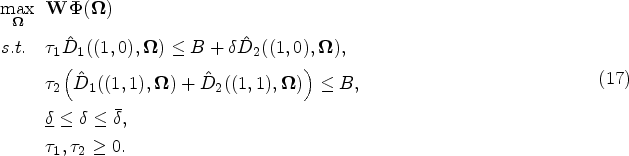
In practice, governments often use funds collected from environmental fines and penalties to further finance and promote the development of environmentally friendly products and technologies (Francis et al., 1999; US Congress, 2008). Given this, we assume that the regulator can use any funds collected from the firm penalties to help pay for subsidies. Hence,
We next derive the equilibria for the firms’ investment and pricing decisions. In Section 4.1, we determine the equilibrium to the firms’ pricing subgame for given technology development outcomes
Pricing Decisions
We first consider the third stage of the game and the firms’ pricing decisions. The two firms have already made their development investments in the second stage of the game (see Section 4.2). After observing the investment outcomes, the firms simultaneously set their profit-maximizing prices.
As will be shown, the firms’ equilibrium pricing decisions are greatly affected by the competitive intensity in the market. To define the levels of competitive intensity that we will reference going forward, we first consider the case without regulation and without firm investments, that is,

When
At the opposite extreme, when
Finally, when
Next, we present the firms’ equilibrium pricing decisions for given regulation,
Given regulation
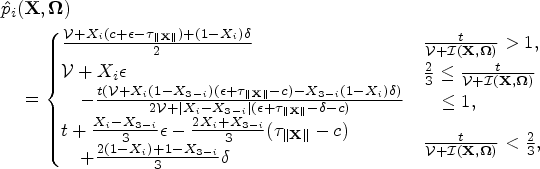
In Proposition 1, we observe that the presence of regulation and consumers’ additional valuations for the clean product can affect the level of competitive interaction between the two firms. This effect is captured through the variable
We see that a positive subsidy (i.e., at least one firm has successfully developed the clean technology) always increases
Imposing a per-unit penalty on the sale of the harmful product decreases the competitive intensity (i.e., it decreases
We next consider two cases that demonstrate how aggressive regulation and/or high consumer valuations for the clean product can completely eliminate sales for a firm that fails to develop clean technology. First, the following lemma describes the case in which the regulator imposes a very high penalty on the sale of harmful products.
If
If the regulator imposes a penalty that matches or surpasses the consumers’ willingness to pay for the harmful product, then a firm that fails to develop the clean technology incurs no demand, irrespective of the outcome of the competitor’s development process (Lemma 1(a)). If the competitor is able to develop the clean technology, then it uses monopolistic pricing and enjoys monopoly profits (Lemma 1(b)). Since all equilibrium decisions and equilibrium outcomes are identical for all
The next lemma illustrates how an aggressive regulatory policy combined with a high consumer valuation for the clean product can force a firm offering the harmful product out of the market when the competitor has successfully developed the clean technology and the level of competitive intensity is high.
If
A firm offering a harmful product always loses its entire market share to a competitor with clean technology if
In this section, we analyze the firms’ clean technology development investment decisions. Observing
Since consumers have the same (base) willingness to pay for either product from either firm, there is symmetry in the firms’ pricing decisions and hence profits; for example,
We next characterize the firms’ equilibrium development investment decisions. Firm

The unique equilibrium investment level of firm

For exposition purposes, we present a simplified version of Proposition 2 and the equilibrium investment levels using the terms for the profit differentials,
If the regulator increases the penalty or the subsidy, the competitive disadvantage of selling the harmful product increases, and the firms have a greater incentive to invest in the development of clean technology. This holds true irrespective of the value of
Firm
The previous section sheds light on how penalties and subsidies can affect firms’ development and pricing decisions. As was shown, as the penalty or the subsidy increases, firms invest more in developing clean technology in order to increase their chance of avoiding the penalty and benefiting from the subsidy. However, these findings only provide insight into the perspective of firms. When designing a new regulatory policy, a regulator must take into account its impact not only on firms, but also on the environment and consumers.
In this section, we investigate the regulator’s optimal policy. As a building block for the remainder of the section, we first derive insights into the individual effects of the penalty and the subsidy on each of the three dimensions of the regulator’s objective.
We find that increasing the subsidy (either
While a subsidy always improves each individual dimension of the regulator’s objective, it is also costly to the regulator. The other lever available to the regulator is to impose a penalty on the sale of the harmful product. We observe in Lemma 3(a) that a penalty will always reduce environmental harm. On the one hand, the penalty can lead to a reduction in the sale of the harmful product. This occurs when the firms pass the penalty on to consumers in the form of higher prices, and the higher prices then lead to some consumers no longer purchasing the product. On the other hand, the penalty also increases the firms’ investments in the clean technology, and thus, the likelihood that development is successful and the firms compete with clean products.
While imposing a penalty always reduces environmental harm, intuition would suggest that imposing a penalty always leads to a reduction in firm profits and consumer welfare. Parts (b) and (c) of Lemma 3 show that this intuition generally holds, but with two exceptions, both of which can be explained by considering the asymmetric equilibrium outcomes of the development process, in which one firm competes with the clean product and the other competes with the harmful product.
First, in Lemma 3(b), we observe that, for a range of possible
Similarly, in Lemma 3(c), for a range of possible
Interestingly, comparing the results in Lemma 3, parts (b) and (c), we notice that the intervals where firms and consumers benefit from increased penalties do not overlap, so increasing the penalty always harms either the firms or consumers. Ultimately, someone has to pay for penalty, and it can be shown that the sum of firm profits and consumer welfare always declines in the level of penalty (cf. Lemma A4 in the online supplement).
The results in Lemma 3 only characterize the isolated effects of the subsidy and the penalty on each dimension of the regulator’s objective. It is important to note that increasing the penalty also impacts the amount of penalty collections, with this amount potentially growing or shrinking depending on how increasing the penalty affects the sale of the harmful product. As the amount of penalty collections changes, this in turn affects the funds available to the regulator for offering subsidies. In what follows, we characterize the equilibrium regulation that takes into consideration the budget interaction between penalties and subsidies. In our model, this interaction is captured by the financial constraint in the regulator’s decision problem in (17), where the payment for the subsidy is constrained by the regulator’s budget allocation
The following proposition provides insight into the optimal regulation and the interaction effect between the subsidy and the penalty components of regulation.
The equilibrium regulation satisfies the following:
For ease of exposition, we present a simplified version of Proposition 3 and the equilibrium subsidies using the demand terms for the clean and harmful products. The demand values can easily be determined using the results from Proposition 1. For reference, we illustrate Proposition 3 and the structural form of the optimal subsidies for a given penalty value with Figure 2. The parameter values used in Figures 2 and 3 are selected solely for illustrative purposes.
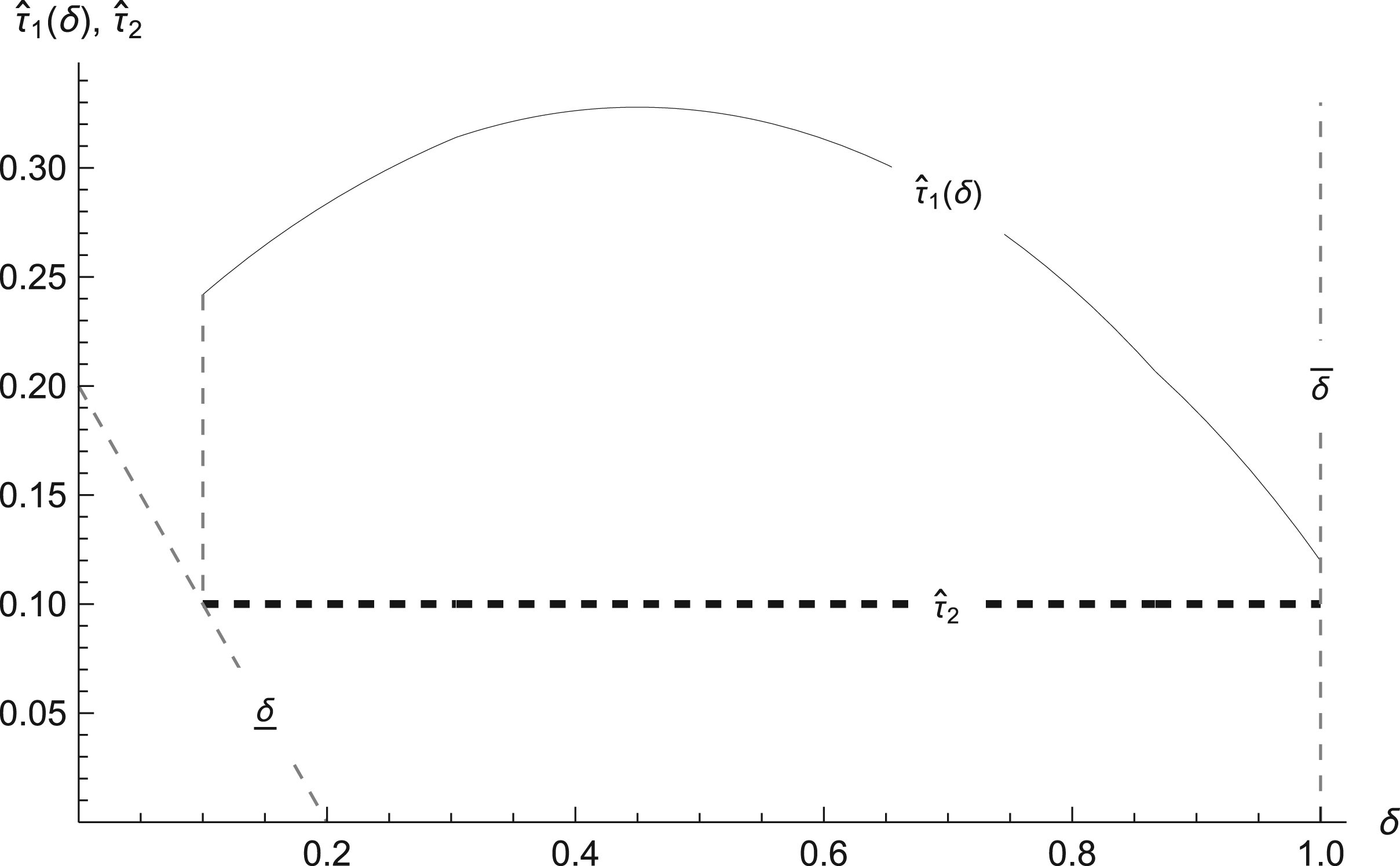
Optimal subsidy as a function of penalty (
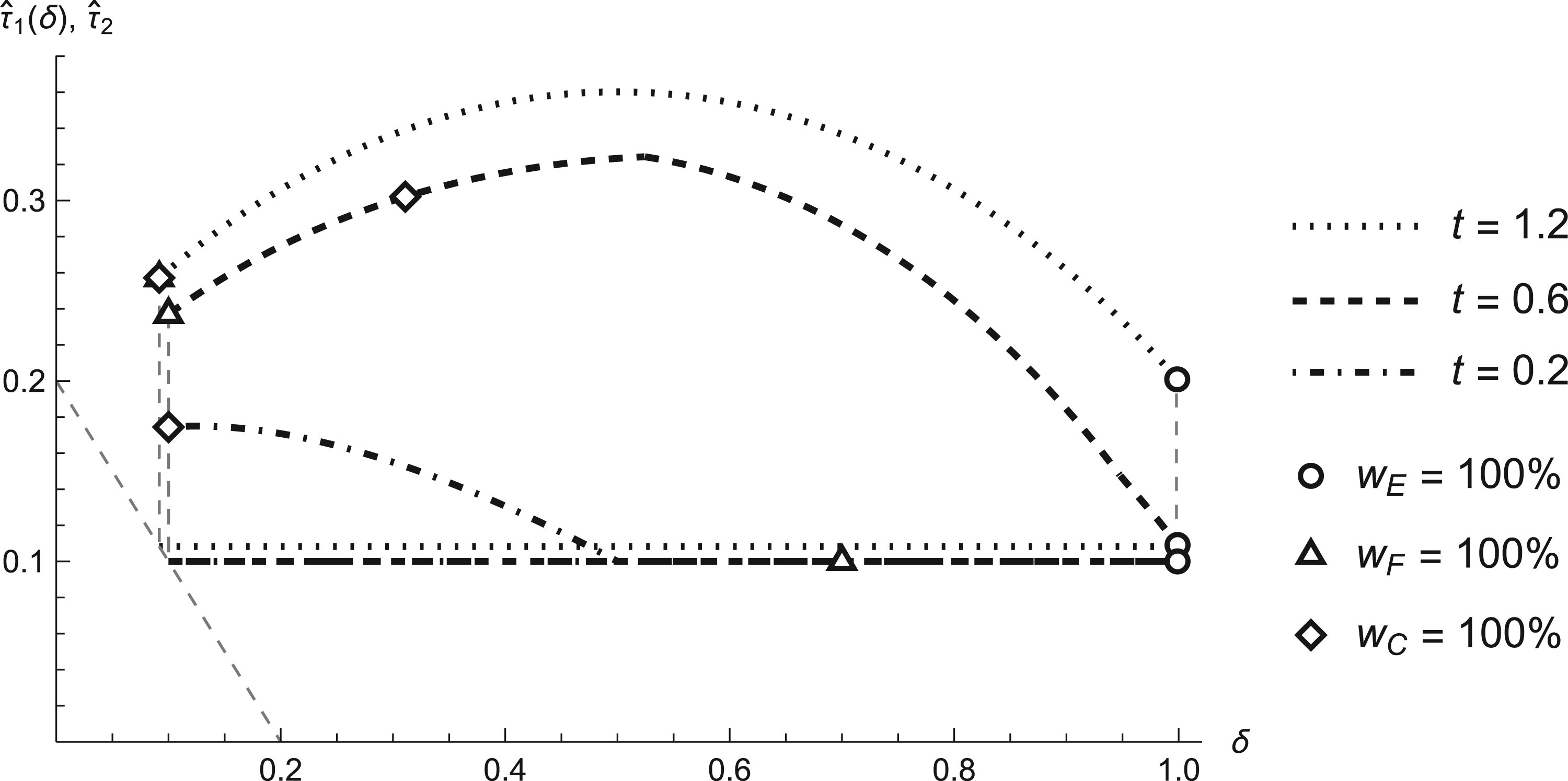
Optimal regulation for one-dimensional priorities (
We know from Lemma 3 that increasing the subsidy level always improves the regulator’s objective. If both firms successfully develop and offer products with clean technology, then the regulator does not collect any penalties, so the subsidy
When at least one firm offers a harmful product, then the regulator gains additional financial resources through the collection of the penalty. The optimal subsidy level
The fact that the collection of the penalty increases the regulator’s means to offer subsidies introduces a non-trivial interaction between the two regulatory measures. For example, a higher subsidy imposes two financial burdens on the regulator—it not only increases the amount the regulator pays in subsidies, it also reduces penalty collections. First, increasing the subsidy for firms that offer clean products makes clean products more attractive to consumers and more profitable for the firms, who then increase their investments in clean technology development (cf. Proposition 2). As a consequence, a higher subsidy always increases the sale of clean products, and therefore the number of subsidies awarded. Second, given firms’ increased investment in clean technology and the more pronounced competitive disadvantage for firms offering the harmful product, an increase in the subsidy reduces the sale of the harmful product and thus the regulator’s proceeds from penalties, further straining the regulator’s financial resources.
The impact of a higher penalty on the regulator’s financial budget is less obvious. Increasing the penalty leads to greater clean technology development investment (cf. Proposition 2) and places a firm that competes with the harmful product at a further disadvantage. As a result, at low levels of the penalty size, increasing the penalty always increases both the sale of clean products and the subsidy the regulator offers (i.e.,
As long as the penalty size remains small to moderate, increasing the penalty can also replenish the budget through penalty collections. However, as the penalty increases, firms that compete with the harmful product are forced to increase their prices, which reduces sales of the harmful product and thus limits penalty collections. Eventually, as the size of the penalty approaches the consumers’ valuation of the product,
Thus, the effect of the penalty level on the overall penalty collections is unimodal, first increasing, then decreasing, which is reflected in the budget available for the subsidy. Specifically, we observe in Proposition 3(d) that the function
Given the financial interaction between the penalty and the subsidy, the endogenous uncertainty in the development process, and the influence competitive intensity in the market has on firm interactions, it is not possible to derive closed-form expressions or clear structural insights for the general case of the regulator’s objective. However, we can provide some characterization of the optimal regulation for two special cases: (i) the regulator focuses on only one of the three dimensions in its objective and (ii) the regulator equally weights all three dimensions. We present these cases next.
The following proposition provides insight into the optimal regulation for the special case where the regulator focuses on only one of the three dimensions in its objective. For a given penalty, the optimal subsidies can easily be derived based on the characterization in Proposition 3. Because of this, in the following, we focus on characterizing the optimal penalty
The equilibrium regulation satisfies the following:
A regulator that is only concerned about the environment ( There exists a threshold There exists a threshold
Given the findings from Lemma 3, it is not surprising that a regulator that is solely focused on reducing environmental harm should always set the maximum penalty to completely eliminate harmful products from the market (cf. Proposition 4(a)). In setting such a high penalty, the regulator eliminates the sale of the harmful product. While this penalty size does not generate additional financial resources for subsidies, this is not the focus of the regulator who does not consider the potential benefits that a subsidy could offer firms and consumers in its objective. This insight holds for all levels of competitive intensity.
As shown in parts (b) and (c) of Proposition 4, eliminating the sale of the harmful product with the maximum penalty is never optimal when instead the regulator is solely concerned with either firm profits or consumer welfare.
A regulator solely focused on total firm profits should typically set the penalty to the minimum value,
For this high level of competitive intensity, total firm profits can benefit from a higher penalty when only one firm competes with the harmful product. While the firm with the harmful product can only pass part of the penalty on to consumers, the firm that competes with the clean product can slightly increase its markups and still increase its market share. For such asymmetric development outcomes, the budgetary interaction amplifies the competitive advantage of the firm that competes with the clean product, since the penalty paid by the firm with the harmful product helps to further increase the subsidy of the firm with the clean product. Overall, the benefit of the increased penalty to the firm with the clean product always outweighs the detriment it causes the competitor with the harmful product. As a result, increasing the penalty up to
Proposition 4(c) shows that a regulator solely concerned with consumer welfare should set the penalty to the minimum value when the competitive intensity in the market is either limited (
The regulator should also set the penalty to its minimum value when the competitive intensity in the market is elevated (
Interestingly, we find that a higher penalty can benefit consumers for intermediate levels of competitive intensity (
We illustrate Proposition 4 and the regulator’s optimal strategy when it only focuses on one dimension of its objective with Figure 3. As shown, when the regulator is only concerned about the environment (
Proposition 4 characterizes the optimal penalty for a regulator that only focuses on one of the three dimensions in its objective. We next discuss two results that provide insight into the optimal regulation when the three dimensions of the regulator’s objective are weighted equally. Our first result illustrates how the size of the budget impacts the financial benefit of penalties on the use of subsidies.
If the regulator cares equally about all three dimensions of its objective, then (a) the optimal subsidies
The finding in Proposition 5(a) regarding the effect of the budget on subsidies is not surprising. Subsidies always have a positive effect on each dimension of the regulator’s objective (cf. Lemma 3), and we find that a larger budget always leads to an increase in the subsidy levels. However, Proposition 5(b) underscores the dual purpose the penalty serves as both a lever to directly motivate firm investment, but also and just as importantly, an instrument by which to increase the regulator’s means with which to offer subsidies. The optimal magnitude of the penalty weakly decreases as the need for it to help fund the use of subsidies decreases (i.e., the budget increases). This implies that, as a regulator’s budget gets increasingly larger, penalties play a decreasing role in optimal regulation, and a regulator should focus its effort on offering subsidies.
Next, we define the regulator’s optimal penalty. Note that
If the regulator cares equally about all three dimensions of its objective, then there exists a threshold environmental cost associated with the sale of the harmful product,
The results in Proposition 6 are consistent with the intuition derived in Proposition 4, when the regulator only cares about one dimension of its objective. That is, when the regulator is equally concerned about all three dimensions, there exists a trade-off as designing a regulation to reduce environmental harm will hurt firm profits and consumer welfare. Consequently, the regulator’s optimal penalty choice is to set the penalty to either its minimum or maximum value. The choice between these two values then depends on the environmental cost of a harmful unit being sold,
A regulator that cares equally about all three dimensions of its objective will thus always prefer one of the following two options—a regulation that completely eliminates the sale of the harmful product (using the maximum penalty) or a regulation that reduces the penalty to the minimum level, leading to higher firm profitability and consumer welfare, while possibly maintaining some harmful products on the market. In either case, the regulator should exhaust its financial means (i.e., its budget plus penalty collections, if any) to offer subsidies.
We conducted a numerical study to help characterize the conditions under which the optimal penalty and subsidy take higher and lower values. Using the scenario depicted in Figure 2 as a base case, we set
Overall, our numerical observations are consistent with our analytical results. Specifically, we find that the optimal regulation should contain a high penalty when the regulator puts more emphasis on environmental harm (high
The recently passed IRA is a landmark federal regulation that will dramatically increase efforts in the United States to fight climate change. The legislation includes not only incentive-based levers (e.g., tax credits) for motivating firms to invest in clean technologies to reduce their emissions, but also for the first time ever in the US, a penalty-based lever (i.e., an emissions fee). The introduction of an emissions fee by the US government to fight climate change motivates our research.
In this paper, we study how a budget-constrained regulator can use a per-unit penalty and a per-unit subsidy to motivate firms’ investments in clean technology development. In making its decisions, the regulator takes into consideration the effects of the regulation on the environment, firm profits, and consumer welfare. An important contribution of our work is the explicit examination of how different levels of competitive intensity in the market impact the regulator’s optimal strategy. We conclude the paper by discussing our insights on (a) the impact of the two regulatory levers; (b) the role of competition; and (c) the strategy of a regulator with balanced objectives.
Offering a per-unit subsidy for the development and sale of products containing a clean technology always benefits a regulator’s objective, irrespective of how the regulator prioritizes the environment, firm profits, and consumer welfare.
Imposing a per-unit penalty on the sale of harmful products always reduces environmental harm, but also always negatively affects the sum of total firm profits and consumer welfare.
A regulator always improves each dimension of its objective by increasing the per-unit subsidy it offers firms that develop a clean product. Increasing the subsidy leads to increased firm investment and makes it more likely that the firms compete with clean products. This, in turn, lowers sales of the harmful product and reduces environmental harm. Increasing the subsidy also increases firm profits by helping a firm with clean products to set a higher price, and potentially, increase its sales if the competitor still offers the harmful product. Finally, increasing the subsidy benefits consumer welfare if the firms pass some of the subsidy on to consumers in the form of a price discount.
Due to the collective benefit of a per-unit subsidy, a regulator should always be aggressive and exhaust all of its budget to offer more subsidies, irrespective of the competitive landscape in the market. Furthermore, the regulator should actively search for ways to increase its financial means to offer subsidies. Often, a regulator will impose a penalty on the sale of harmful products and then use the penalty collection to increase the budget available for subsidies. However, the impact of a per-unit penalty on the different dimensions of a regulator’s objective is less straightforward as compared to the per-unit subsidy. Similar to subsidies, increasing the penalty always helps reduce the sale of harmful products, and thus, environmental harm, but it also always negatively impacts the sum of total firm profits and consumer welfare. The separate impacts on total firm profits and consumer welfare are typically negative as well. This is because increasing the penalty leads to an increase in the firms’ costs, which is then often at least partially passed on to consumers in the form of higher prices.
The per-unit penalty plays an important role in our context in that it has both a direct effect on reducing the sale of the harmful product (by increasing the firms’ costs) and an indirect effect (by increasing the regulator’s budget for offering subsidies). The interaction that exists between the penalty and the subsidy can be seen by the fact that the subsidy (for when only one firm successfully develops the clean technology) is first increasing, but then decreasing in the penalty. Initially, the indirect effect of the penalty helps the firm to increase the subsidy it offers, but eventually, the direct effect of the penalty increasing firm costs reduces penalty collections and thus the budget for the subsidy.
Our findings suggest that the IRA’s aggressive approach to subsidies is the correct strategy for motivating clean technology innovation. Conversely, the MERP’s introduction of a penalty on greenhouse gas emissions may produce mixed results. Specifically, while methane emissions will likely decrease, the penalty may lead to increased consumer prices, especially in settings with high competitive intensity. Because of this, the penalty imposed by the MERP may negatively impact inflation.
While a regulator increasing the per-unit penalty always negatively impacts the sum of total firm profits and consumer welfare, our next insight shows that special cases exist in which imposing a high penalty separately benefits total firm profits and consumer welfare.
Firm profits should impose a high penalty when the level of competition in the market is high.
Consumer welfare should impose a high penalty when the level of competition in the market is moderate.
Insight 2 highlights the importance of the regulator taking into consideration the level of competition in the market when setting its policy. The regulator imposing a higher penalty on the sale of the harmful product can separately benefit total firm profits and consumer welfare. When only one firm successfully develops and offers a clean product on the market, a high penalty can give this firm a significant competitive advantage. If the level of competition in the market is high, imposing a stricter penalty then allows the firm with the clean product to extract a higher per-unit margin from a large consumer base, and aggregate firm profits increase.
Conversely, when the level of competition in the market is relatively moderate, an asymmetric development outcome and a higher penalty can help consumer welfare. Specifically, while penalties cause the firm with the harmful product to increase its price, strict penalties lead the firm with the clean product to aggressively price its products to increase market share; overall, higher penalties can lead to improved consumer welfare.
It is important to note that these two special cases do not occur for the same levels of competitive intensity in the market. As a result, the regulator faces a trade-off when increasing the penalty, as either firms or consumers will always be negatively impacted. From a practice perspective, these findings show how in certain cases, a high degree of competition can help mitigate the negative financial impact of the penalty imposed by the MERP. For example, cases may exist in commodity-based, industrial sectors where the government is more worried about the impact of the penalty on firm profits than on consumers. In these cases, if the level of competition in the sector is high, then imposing a high penalty may actually help overall firm profits by strengthening the competitive advantage of firms with a clean product.
Our final insight provides clear policy guidance for regulators that are equally concerned about the environment, firm profits, and consumer welfare.
Set the per-unit penalty either very low when the environmental cost of the harmful product is low; or very high when the cost is high.
Offer a higher subsidy and reduce the penalty it imposes as the regulator’s budget increases.
When the environmental impact of the harmful product is considerable, the per-unit penalty should be set very high so that the harmful product is no longer produced. If instead, the impact is lower, then the penalty should be set just high enough such that it is still profitable for firms with access to clean technology to offer clean products to the market. The subsidy strategy then can easily be determined since it is still in the regulator’s best interest to exhaust all of its financial means (i.e., the budget and penalties collected) when offering subsidies.
This finding builds on Insight 1(b). Specifically, we again see that the regulator, when setting its penalty, must balance environmental harm versus total firm profits and consumer welfare combined. The level of concern over the environmental impact of the harmful product can provide clear direction as to whether the regulator should set a penalty and subsidy combination sufficient enough to introduce the clean product to the market but not eliminate the harmful product versus setting an aggressive penalty and eliminate the harmful products use.
The size of the per-unit penalty that a regulator should impose on firms depends on the extent of its resources to offer subsidies (Insight 3(b)). Specifically, the more a regulator’s budget increases, the more subsidies it can offer to motivate firms to develop new clean technologies, and the less it needs to rely on a per-unit penalty to increase its budget.
The IRA has both environmental and financial objectives (i.e., to reduce inflation). Given this and the severity of climate change, our findings suggest that when imposing a penalty (such as the penalty in the MERP), the penalty should be set very high in an attempt to completely eliminate the production of harmful products. Still, the use of regulatory penalties to combat greenhouse gas emissions is new in the US, so an overuse of penalties may receive extensive pushback from industry. One way to avoid this conflict is to set the budget very high for the different clean technology initiatives in the IRA (something that appears to have been done). Doing so can help reduce the need to supplement subsidy budgets with penalty collections.
There are a few aspects of our model that would benefit from further analysis. First, it can take a significant amount of time to develop a new clean technology. Examining a setting in which the regulator and firms must time their decisions could provide insight into how a regulator can use time as a third lever to motivate firms’ investments. Second, we model firms’ development outcomes as binary. Modeling firm development outcomes as continuous, with the regulator then setting a level firms must meet, could provide insight into how a regulator should incorporate stringency into its policy decisions. Finally, in our context, the regulator has complete information about the firms’ development decisions when setting the policy. Analyzing a setting where the regulator has uncertain information about the firms’ development capabilities could be beneficial.
Our findings provide insight into how a regulator can use a per-unit penalty and a per-unit subsidy to motivate firms to invest in the development of clean technologies to fight climate change. Importantly, we illustrate (i) why it is important for a regulator to consider the level of competitive intensity in the market when making its decisions and (ii) how a budget-constrained regulator should balance its use of a penalty as both a lever to directly motivate firm investment and a financial instrument to help fund subsidies. We hope that our study will encourage researchers to further investigate environmental issues from the regulator’s perspective, as doing so can provide valuable insight into ways that external stakeholders can stimulate firms to increase their environmental investments.
Supplemental Material
sj-pdf-1-pao-10.1177_10591478231224911 - Supplemental material for Environmental Regulation Design: Motivating Firms’ Clean Technology Investments With Penalties and Subsidies
Supplemental material, sj-pdf-1-pao-10.1177_10591478231224911 for Environmental Regulation Design: Motivating Firms’ Clean Technology Investments With Penalties and Subsidies by Mina Mohammadi, H. Sebastian Heese and Tim Kraft in Production and Operations Management
Footnotes
Acknowledgements
The authors thank Vishal Agrawal, the senior editor, and the three anonymous reviewers for their constructive and insightful feedback. The authors are also grateful to participants at the 2022 POMS Annual Meeting (online) and the 2022 INFORMS Annual Meeting (Indianapolis, IN) for their helpful comments.
Declaration of Conflicting Interests
The authors declared no potential conflicts of interest with respect to the research, authorship, and/or publication of this article.
Funding
The authors received no financial support for the research, authorship, and/or publication of this article.

Notes
How to cite this article
M. Mohammadi, H.S. Heese and T. Kraft (2024) Environmental Regulation Design: Motivating Firms' Clean Technology Investments With Penalties and Subsidies. Production and Operations Management 33(1): 32–47.
References
Supplementary Material
Please find the following supplemental material available below.
For Open Access articles published under a Creative Commons License, all supplemental material carries the same license as the article it is associated with.
For non-Open Access articles published, all supplemental material carries a non-exclusive license, and permission requests for re-use of supplemental material or any part of supplemental material shall be sent directly to the copyright owner as specified in the copyright notice associated with the article.
