



Abstract
Despite the vulnerability associated with the immigrant experience, first generation immigrants are typically less or no more likely to be victims of general forms of violence and crime. While prior individual-level research supports this, less is known about the relationship between immigrant status and victimization in longitudinal contexts. To address this gap, this study analyzes restricted and open data from the Pathways to Desistance Study, a longitudinal study of previously adjudicated youth. This study found that immigrant generational status was not significantly associated with four out of five direct victimization outcomes. At the same time, when compared to third-plus generation natives, both first-generation and second-generation immigrants were more likely to have been chased to the point where they thought they might be seriously hurt. These results may be explained by the vulnerability tied to the adjudicated status of the sample examined. Other factors may also inform these relationships. The limitations and implications of this research are discussed.
Introduction
Immigrants have a long and established history of marginalization in the United States. Historically, immigrants have encountered structural barriers to migration, integration, and acceptance into U.S. communities and continue to face violence as they navigate their social, political, and economic lives (Jolie et al., 2021; Menjívar & Abrego, 2012). Despite vulnerabilities, the research paints immigrant and immigrant-impacted (e.g., children of immigrants) experiences in a more positive light. According to prior studies, while susceptible to discrimination and anti-immigrant bias (Iwama, 2018; McCann & Boateng, 2021), immigrants are either no more likely or less likely to be victimized compared to their native-born counterparts (e.g., Kuper & Turanovic, 2022; Mammadov et al., 2021; Rojas-Gaona et al., 2016). Still, much of what is know of the immigrant-victimization relationship is heavily focused on specific contexts or victimization types, like schools or interpersonal violence respectively, and cross-sectional approaches (e.g., Hong et al., 2014; Peguero, 2009). There is much to gain from exploring this relationship through a longitudinal lens.
Although the relationship between immigrant statuses and victimization has been studied—albeit to a lesser extent than criminal offending (McDonald, 2018)—little is known about how this relationship is expected to change over the course of one's life. The research on this subject is sparse relative to criminal offending, despite their substantive overlap more generally in criminological study (e.g., Mulford et al., 2018). Prior research focusing on immigrant victimization mainly focuses on cross-sectional data. This is not surprising given that few datasets offer extensive information on criminological factors and immigrant-related processes (Kubrin & Ousey, 2023). As a result, not much is known about how immigrant generational status influences change in victimization over time. This is noteworthy as the immigrant diaspora have dynamic lives that are marked by migration experiences, cultural adaptations, and exposures to violence from people and institutions (Jolie et al., 2021; Shih, 2022).
This study aims to unpack the relationship between immigrant generational status and victimization from youth to early adulthood. To do so, I use open and restricted data from the Pathways to Desistance Study, a longitudinal study of previously adjudicated youth from Maricopa County, Arizona and Philadelphia County, Pennsylvania (Mulvey et al., 2004; Schubert et al., 2004). This provides multiple contributions. First, these data provide insights into the longitudinal relationship between immigration and victimization, which has been understudied. Second, by analyzing the prevalence of direct victimization and the several different victimization types that comprise it, this study adds nuance to the varied violence that first-generation immigrant (foreign-born youth and parents), second-generation immigrant (native-born youth with foreign-born parents), and third-plus generation (native-born youth and parents) natives experience. Lastly, by analyzing a justice involved sample, this relationship can be contextualized within a vulnerable cross-section of youth as they transition into adulthood.
Victimization Across the Life-Course
Similar to criminal offending, prior research points toward the existence of an age-victim curve (Daigle et al., 2008; Sullivan et al., 2016). That is, victimization may be expected to peak late into adolescence and early adulthood before steadily declining; however, as Daigle et al. (2010), some variance may be attributed depending on if an individual belongs to a high-risk environment. Daigle et al. (2008) was among the first to explore specific mechanisms that connect age to victimization. In this study, Daigle and colleagues extended existing ideas surrounding desistance and note victimization could also be influenced by age-graded factors and turning points. Using data from the National Longitudinal Study of Adolescent Health (Add Health), they found getting married and increases in self-control were associated with desistance from victimization, similar to its criminal offending counterpart. This suggests that perhaps the overlap seen in offending and victimization is not just reserved for their direct overlap (e.g., offending predicting victimization) but rather once viewed from the perspective of the life-course, their predictors may overlap as well. Since this study, others have built upon this longitudinal approach to analyzing victimization and reported the heterogeneity observed in victimization experiences (DeCamp & Zaykowski, 2015; Sullivan et al., 2016). For example, Sullivan et al. (2016) explored the victimization trajectories of Kentucky middle school students. They found four distinct trajectory groups, one of which had stable, near zero victimization, and contained about 80% of youth (i.e., near zero victimization). Overall, the authors noted that those belonging to higher victimization trajectory groups or classes also reported higher levels of offending, impulsivity, delinquent friends, illicit opportunities, and lower school bonds (p. 99).
Importantly, studies that have examined justice-involved populations provide insight into the victim-offender overlap across the life-course (Mulford et al., 2018; Schreck et al., 2017; Shih, 2022; Turanovic, 2019). Schreck et al. (2017) analyzed data from previously adjudicated youth from the Pathways to Desistance study and reported that over time, the impact of victimization on offending decreased. This suggests how victimization is experienced may be a partial function of age. In a later study using the same data, Mulford et al. (2018) found that having lower exposure to violence predicted dual membership to trajectories with decreasing or low offending patterns.
The Role of Immigrant Status and Victimization Across the Life-Course
Study into immigrant experiences across the life-course has steadily gained traction across areas of study like public health, individual and familial development, migration, and exposure to criminological engagement and victimization (Gibson & Miller, 2010; Guerra & Craig, 2023; Han et al., 2023; Shih, 2022). Largely contingent upon the type of documentation or authorization status, the research simultaneously shows a form of risk and resilience against negative life outcomes. Those with unauthorized statuses tend to experience highly risky life experiences marred by marginalization and fear (Caraballo & Topalli, 2023; Fussell, 2011; McDonald, 2018; Zaatut & DiPietro, 2023). Those with more secure statuses often exhibit forms of resiliency against negative criminal experiences like violence—in lieu of many barriers to socialization like discrimination and anti-immigrant biases (Rojas-Gaona et al., 2016). One study, for instance, demonstrated immigrant youth were resilient against the effects of victimization on various adverse experiences like poor health, depressive symptoms, low self-esteem, suicidality, alcohol problems, drug use, property offending, and violent offending (Kuper & Turanovic, 2022). Another study analyzed National Crime Victimization Survey data and reported that foreign-born status was negatively associated with various forms of violent victimization; however, when focusing on the foreign-born, this protection was not as crystalized when comparing naturalized citizens to noncitizens (Xie & Baumer, 2021).
Longitudinal studies focusing on immigration and individual-level victimization during the early life-course are less voluminous compared to the offending literature. The relationship between immigration and criminal offending providers researchers with a broader set of findings that suggest immigrants engage in less or no more crime than native-born immigrants (Kubrin & Ousey, 2023), though some research has attempted to bridge these topics. For example, one study suggests immigrants with less direct exposure to violence tend to have less engagement in criminal offending compared to the native born when examined over time (Shih, 2022). The focus on immigrant-centered victimization, especially studied during important transitions like adolescence to early adulthood, is much sparser. Despite this, some general trends have emerged. An early example of is Peguero (2009), which examined data from the Education and Longitudinal Study of 2002 and found that relative to first-generation Latino and Asian immigrants, second- and third-generation immigrants were more likely to be violently victimized. This suggests that across the whole sample, first-generation status acted as a protective factor relative to white third-plus generation students. Recent work from Antunes and Ahlin (2021) examined exposure to community violence using the Project on Human Development in Chicago Neighborhoods (PHDCN). Studying three different cohorts of youth (ages 9, 12, and 15), the authors concluded that first-, 1.5-, and second-generation immigrants were less likely to be victims of violence or witnesses to violence. 1 The majority of this research demonstrates that immigrant status is a notable feature neutralizing victimization, but its application is not universal, nor does it have equally protective properties within or across immigrant generations and ethnic groups (Gibson & Miller, 2010; Hong et al., 2014; Yang et al., 2021). Moreover, if an immigrant occupies as high-risk environment or context (Daigle et al., 2010), this could influence the strength of resiliency belonging to an early immigrant generation may produce. While the notion of occupying a high-risk environment is not unique to immigrant groups (or youth with immigrant parents), these groups are known for their resilience against many adverse outcomes and thus their victimization experiences and how they change over time is not well known.
As individuals move from adolescence to early adulthood, victimization trends change as do predictors of those trends (DeCamp & Zaykowski, 2015). From the perspective of immigrants, victimization experiences might also differ across generations and change as these individuals come into adulthood. One study analyzed respondent data from a 10-year follow up of a three-wave panel study from the Miami-Dade school system and reported that while males experienced greater lifetime violent victimization, there were no significant differences across U.S.-born Cubans, immigrant Cubans, immigrant Nicaraguans, African Americans, and whites (Biafora & Warheit, 2007). This would suggest immigrant groups were no less or more at risk of victimization. This is consistent with Mammadov et al. (2021), which found that immigrant status was not associated with any measure of victimization across multiple waves of the Add Health study (also see Eggers & Jennings, 2014). Overall, these findings generally suggest that immigrant status is not a salient factor on victimization when examined longitudinally into adulthood, especially when relevant theoretical control variables are integrated into the models.
Assimilation, Acculturation, and Impact of Criminal Justice Involvement on Victimization
The relationship between immigration status and criminological experiences is often understood through assimilationist processes (Bersani, 2014; Bersani et al., 2018; Knight et al., 2009; McCann et al., 2022). Importantly, assimilation and assimilationist processes, like acculturation, have been used to explain many adverse experiences across social science work (e.g., Kubrin & Ousey, 2023; Rojas-Gaona et al., 2016; Sirin et al., 2022). Broadly, assimilation refers to the process by which immigrant contact with the U.S. mainstream pulls immigrants into the majority culture (Portes & Rumbaut, 2014) as acculturation refers to individual-level change (e.g., cultural and psychological) that results from that cultural contact (Berry, 2017; Sam & Berry, 2010). In prior research, some use assimilation theories (e.g., segmented assimilation, see Portes & Zhou, 1993) to explain how, culturally, first-generation immigrants differ from the second-generation (and so on) and often refer to specific types of acculturation (e.g., Bersani, 2014; McCann et al., 2022). These ideas are applicable to victimization as immigrants may yield some resilience to victimization because they have relatively weaker cultural contact (compared to the native-born) with high-risk environments—such as those that increase victimization risk—and may retain cultural behaviors and perspectives that allow greater adaptation to stressors (see Berry, 2017). Additionally, second-generation immigrants and third-plus generation, native-born are likely to have a greater adherence to values, attitudes, and beliefs of the United States compared to foreign-born immigrants, which may be more conducive to risky environments and criminal opportunity (Guerra & Craig, 2023). These ideas are exemplified by Sabina et al. (2013) where they studied lifetime victimization among a nationally representative sample of Latino women and found that immigrant status reduced the odds of any lifetime victimization as well as other specific experiences including stalking, physical, sexual, and threat victimization. In a later study, Sabina et al. (2020) reported that although immigrant status was not predictive of victimization among Latinos, familial support and greater Latino orientation acted as prominent protective factor against any type of victimization.
Yet, immigrant experiences should not be examined in a vacuum as immigrants contend with a series of situational imperatives or “new situations [that] impose social demands on individuals” which work to “constrain role-related behaviors” (see Wingens et al., 2011, p. 12). The decision to migrate is complex as immigrants and their families consider many factors related to economics, health, safety, and upward social mobility (for overview of migration and the life-course see Jasso, 2003). In the postmigration context, however, immigrants and their diaspora confront social and psychological demands connected to the immigrant designation. These groups must contend with a U.S. environment that often labels immigrants as criminals—particularly Latinos and Latinas (Chavez, 2013)—challenges their ethnic identity, and places barriers to successful integration (e.g., discrimination and legal security) (Guerra & Craig, 2023; Jolie et al., 2021; McCann & Boateng, 2021). As such, how acculturation unfolds or changes depends on the situational imperatives immigrant groups have. For example, immigrant families may avoid certain routine activities as a means to avoid questions regarding citizenship or draw attention to their families (Bernstein et al., 2019). 2 Despite the incredible individual and familial resilience immigrants and their children exhibit against many negative stressors and experiences (Jolie et al., 2021), some situational imperatives could also relate to important life changes, like criminal justice involvement. Since childhood antisocial behavior and victimization are developmentally linked (e.g., Beckley et al., 2018), criminal justice involvement at an early age could serve to exacerbate the restrictive social conditions that immigrants, and perhaps children of immigrants, occupy. This could mean traditional engagement and connection with integral aspects of U.S. life (e.g., accessing healthcare, schools, and work) are weakened (Brayne, 2014; Portes & Rumbaut, 2014). As a result of system contact, having a greater degree of “system embeddedness” could alter how immigrant groups contend with risk (Asad, 2020) impacting their overall wellbeing. The lower acculturation typical of immigrants (compared to the native-born) may not be as important as the negative consequences of contact with the criminal justice system. For children of immigrants, their successful integration into the U.S. mainstream could be interrupted as criminal justice involvement may accelerate downward social mobility and the numerous consequences of that come with it (Portes & Rumbaut, 2014), including being targeted for crime. Altogether, any resiliency that being an immigrant (or child of immigrants) has on victimization risk may be dampened by system involvement.
Current Study
Longitudinal victimization research conveys that victimization changes over the course of a person's life. When victimization is examined through an immigrant lens, similar to the study of crime, immigrant statuses either protect against victimization or do not significantly impact it. Yet, the literature suggests that immigrant statuses may not act as a particularly salient factor influencing victimization going into adulthood—at least not on its own and equally across contexts. The current study seeks to contribute to this growing body of research by assessing the role of immigrant generational status on exposure to direct victimization. By analyzing a mixture of open and restricted data from the Pathways to Desistance study (Mulvey et al., 2004; Schubert et al., 2004), this study draws insight into the victimization experiences of previously adjudicated youth, more specifically those who have immigrant statuses. Based on their involvement with the criminal justice system, this population could provide insight into individuals who may be more vulnerable to victimization experiences. The general protective effects associated with being closer to the immigrant designation may not be as strong or as salient when victimization risk is examined. The weakened immigrant-centered effects, particularly when longitudinal studies are considered, may be further weakened among adjudicated youth; however, some research still demonstrates immigration statuses may yet operate to help protect individuals from victimization risk. As such, I provide two hypotheses for the current study:
First- and second-generation immigrant status will have a negative or nonsignificant relationship with any type of direct of victimization compared to the third-plus generation. First- and second-generation immigrant status will have a negative or nonsignificant relationship with specific types of direct of victimization compared to the third-plus generation.
Methods
Data
This study analyzes data from the Pathways to Desistance Study—a data collection effort of previously adjudicated youth from Maricopa County, Arizona and Philadelphia County, Pennsylvania (Mulvey et al., 2004; Schubert et al., 2004). These data have been used extensively to study criminological phenomena and been instrumental in illuminating how immigrants experience various criminological life outcomes into early adulthood (e.g., Han et al., 2023; Shih, 2022). This is in large part due to its longitudinal design and wide range and rather complete set of variables captured. The Pathways to Desistance Study captured baseline and follow-up information from 1,354 participants. Interview information was collected every 6 months for the first 3 years and then collected every 12 months until the 84-month or 7-year mark. Respondent follow-ups were collected at month 6, 12, 18, 24, 30, 36, 48, 60, 72, and 84 postbaseline. This study analyzes data from open and restricted portions of the dataset to understand how immigrant generational status influences various victimization outcomes over time. This analysis focuses on the male-only subsample of the data (N = 930, see Analytic strategy section). This was done for two reasons. First, when the limited number of female study participants is considered alongside a longitudinal approach that considers 84 months of postbaseline data, there are major limitations imposed by the resulting low sample size and variability. Second, victimization is often experienced differently for females and investigations that integrate immigrant statuses calls for their own dedicated research inquiries. Lastly, the Pathways to Desistance study (open and restricted data) was approved to use by the institutional review board at Sam Houston State University (IRB 2021-151). 3
Dependent Variables
The outcomes for this study comprise the prevalence of multiple variables generated from the Exposure to Violence Scale (ETV, see Selner-O’Hagan et al., 1998). The ETV was initially developed by Selner-O’Hagan et al. (1998) to address the shortcomings of previous exposure to violence instruments (e.g., consistency in items, interval scaling, psychometric verification). In the Pathways to Desistance study, ETV is comprised of two subscales, one related to experiencing direct victimization of a crime and one witnessing a crime. This study uses the direct victimization subscale of six items to assess prevalence, which includes asking the victim if in the months since the previous interview, they have: (1) been chased where they thought they might be seriously hurt (2) been beaten up, mugged, or seriously threatened by another person, (3) been attacked with a weapon, like a knife, box cutter, or bat, (4) been shot at, (5) been shot, and (6) had someone attempt to rape them or been sexually attacked in some other way. These were collected during each of the follow-up periods, including the baseline, which asked if they had ever experienced the items on the ETV scale.
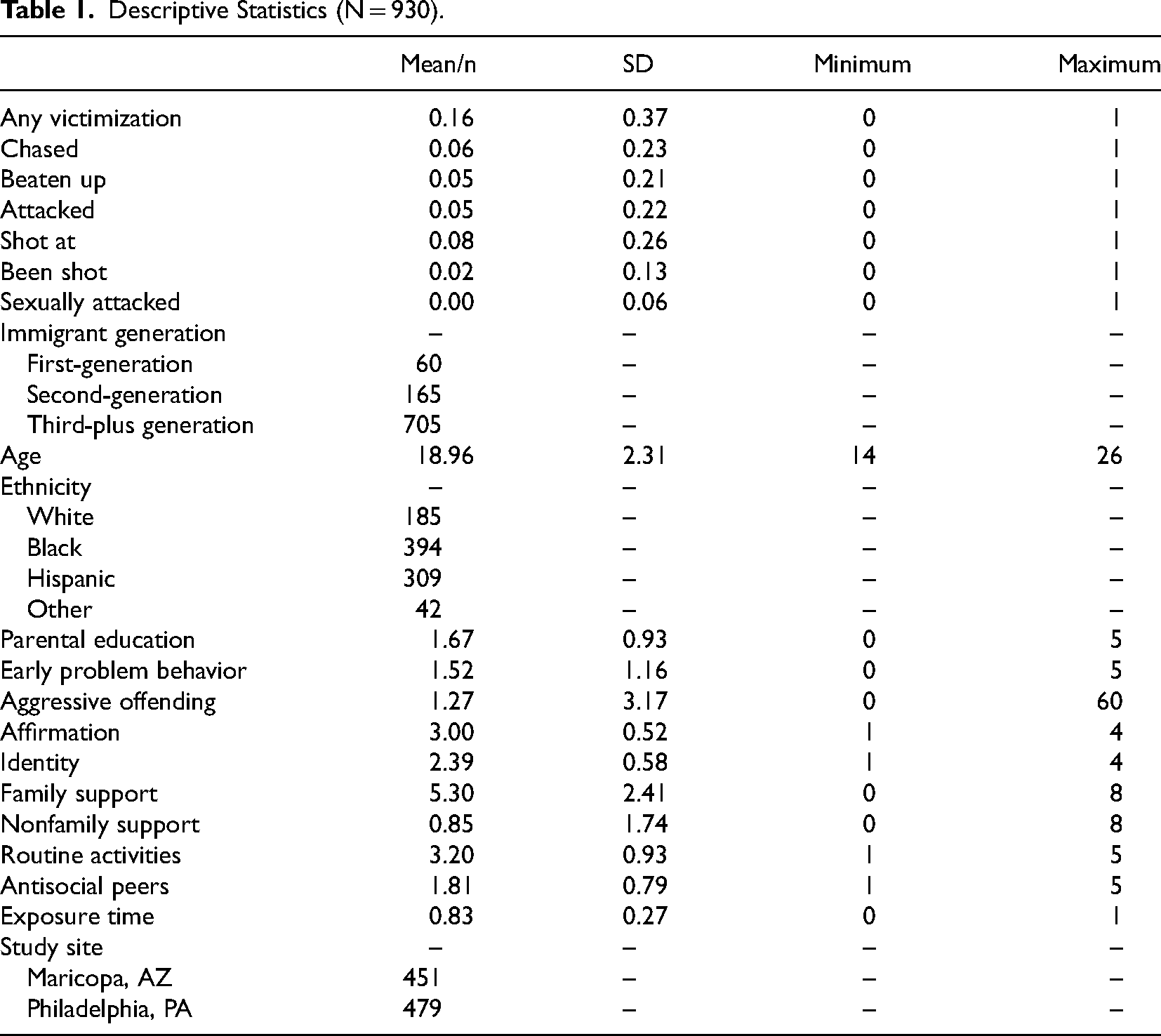
For ease, the measures will be referred to as Any Victimization (x̄ = 0.16, SD = 0.37, range = 0–1), Chased (x̄ = 0.06, SD = 0.23, range = 0–1), Beaten Up (x̄ = 0.05, SD = 0.21, range = 0–1), Attacked (x̄ = 0.05, SD = 0.22, range = 0–1), Shot At (x̄ = 0.08, SD = 0.26, range = 0–1), Been Shot (x̄ = 0.02, SD = 0.13, range = 0–1), and Sexually Attacked (x̄ = 0.00, SD = 0.06, range = 0–1). In the analyses, a total of five variables are assessed using the follow-up information: one measure capturing having experienced any victimization and one measure for four of the six individual items comprising the any victimization measure—Chased, Beaten Up, Attacked, and Shot At. Assessing these individual items represents a departure from prior research as these items are only available through a restricted portion of the Pathways to Desistance Study. Two variables—Sexually Attacked and Been Shot—were not assessed as standalone outcomes. Since the former variable only had 0.34% of responses coded as affirmative, there was not enough variation for a reliable model to converge and estimate. For the latter variable, the model failed a likelihood ratio test. This suggests the full model examining “Been Shot” as an outcome did not significantly differ from the restricted model with no additional parameters estimated—perhaps, like the former model, also likely influenced by low variability (≈ 1.72% affirmative). Another version of any victimization measure was created to capture the frequency of victimization (x̄ = 0.25, SD = 0.67, range = 0–5) but was not included in this study's analyses. This was due in part to the distribution the variable, which encountered very low frequency of any victimization experienced both across individuals and within individuals. This low variability was also observed in the individual items that comprised the any victimization measure that captured frequency. As such, this study elected to focus on prevalence across the described victimization dependent variables. 4
Independent Variables
The primary independent variable of interest is immigrant generational status. This variable comprises multiple observed birthplace measures about the participant and their biological parents. Based on the classification strategy, the respondents are organized into three generational dummy categories for this study: first-generation immigrant (foreign-born youth and parents), second-generation immigrant (native-born youth and foreign-born parents), and third-plus generation (native-born youth and parents). Each of these generations is mutually exclusive and is coded on a range from zero (0) for first-generation immigrants, (1) for second-generation immigrants, and (2) third-plus generation. These variables are dummied in the analysis.
Control Variables
The control measures captured in this study reflect not only variables that have been used in prior immigrant-victimization work but studies examining victimization using the Pathways more generally (Mulford et al., 2018). I control for a series of predictors, some stable and captured at baseline and some that vary over time. Basic demographics were captured at the baseline interview. Race/Ethnicity is categorized as non-Hispanic white (n = 185), non-Hispanic Black (n = 394), Hispanic (n = 309), and other (n = 42). For the analysis, each will be dummied with white as the reference category. Since most respondents enter the baseline wave at different points, age (in years) is controlled for (x̄ = 18.96, SD = 2.31, range = 14–26) as well as a quadratic function of age. 5 For Parental Education, each respondent was asked to indicate the highest level of education that their biological mother and father completed (0 = grade school or less, 1 = some high school, 2 = high school diploma, 3 = business or trade school/some college/graduate of a 2-year college, 4 = college graduate, and 5 = some graduate or professional school). These were reverse coded from the initial measure for ease of interpretation and both scores were averaged to provide a mean parental education measure (x̄ = 1.67, SD = 0.93, range = 0–5). Lastly, to account for early indications of antisocial behaviors, which has been found to be associated with violent victimization in Pathways to Desistance youth (Chen, 2016), this study controls for Early Onset of Problem Behavior. The baseline interview captured five behaviors that occurred before age 11. Respondents were asked if (no = 1, yes = 1) before age 11 they got into trouble for cheating, disturbing class, being drunk/stoned, stealing, and fighting. These items were summed (x̄ = 1.52, SD = 1.16, range = 0–5).
This next set of predictors is used as a means of controlling for effects that may impact the analyses over time. First, the victim-offender overlap using the Pathways to Desistance Study sample has been documented and recent work shows this is salient when considering immigrant generational status (Shih, 2022). Aggressive Offending is measured using self-report information of 11 binary items related to aggressive offending from the Pathways to Desistance Study Calendar data, which captured information for each of the 84 months of follow up. To align with the rest of the traditional follow-up points used in this study, all items were summed for that period captured. For example, all aggressive offending binary responses for months 1 through 6 were summed to produce the aggressive offending score for month 6 and so on. The 11 items included (1) purposely destroyed or damaged property not belonging to them; (2) purposely set fire, to a house, building, car, or vacant lot; (3) forced someone to have sex; (4) killed someone; (5) shot someone; (6) shot at someone where they (the respondent) were the one who pulled the trigger; (7) taken something from another person by force, using a weapon; (8) taking something from another person by force, without a weapon; (9) beaten up or physically attacked someone so badly that they probably needed a doctor; (10) been in a fight; and (11) beaten up, threatened, or physically attacked someone as part of a gang (x̄ = 1.27, SD = 3.17, range = 0–60).
Though not direct measures, two culture-related variables are included to ensure immigrant generational status effects are isolated. Affirmation and Belonging is a subset of seven items from the Multigroup Measure of Ethnic Identity (Phinney, 1992). Respondents were asked to indicate how much they agreed with relevant statements on a four-point Likert-type scale ranging (1 = strongly disagree to 4 = strongly agree) such as I have a clear sense of my ethnic background and I feel a strong attachment towards my own ethnic group (x̄ = 3.00, SD = 0.52, range = 1–4). Identity Achievement is a subset of the same measure by Phinney (1992). This was made up of five items using the same Likert-type scale and include statements such as I have spent time trying to find out more about my ethnic group, such as its history, traditions, and customs and I participate in cultural practices of my own group, such as special food, music, or customs (x̄ = 2.39, SD = 0.58, range = 1–4).
Since family often informs immigrant attitudes and behaviors, family-related variables are included. Immigrant status also partially informs violence in family units (see Curry et al., 2018) suggesting that family-related processes play a role in how victimization is experienced among immigrant groups (Rojas-Gaona et al., 2016). This study incorporates two variables that address the closeness of the family unit, which is seen as an important feature of immigrant families (Sabina et al., 2020; Sabogal et al., 1987). Family Social Support is a measure taken from the modified version of the Contact with Caring Adult inventory (Nakkula et al., 1990; Phillips & Springer, 1992). This inventory aimed to assess the presence of supportive adults present in an adolescent's life. Across eight social support domains, participants were asked to indicate if at least one person from their family satisfied the domain (0 = no, 1 = yes). These included domains such as having adults you admire and want to be like adults (in the family) and you can depend on for help (in the family) (x̄ = 5.30, SD = 2.41, range = 0–8). Similarly, the importance of nonfamily influences of social support might also impact outcomes in this study. Nonfamily Social Support is also taken from the same inventory as the previous measure (Nakkula et al., 1990; Phillips & Springer, 1992). Across the same eight domains, participants were asked to indicate if at least one person from outside of their family satisfied the domain (0 = no, 1 = yes, x̄ = 0.85, SD = 1.74, range = 0–8).
Unsupervised Routine Activities was analyzed to control for everyday routine activities and unstructured socializing that are heavily linked to the study outcomes, particularly violent victimization. To do so, this variable takes items from an adapted version of the “Monitoring the Future” questionnaire (Osgood et al., 1996). Respondents were asked how often they participate in certain activities using a Likert-type scale ranging from never (1) to almost every day (5). Some of these activities included how often they get together with friends informally or go out for fun and recreation (x̄ = 3.20, SD = 0.93, range = 1–5).
This study includes the variable Peer Antisocial Behavior to account for the impact of deviant peers throughout the included time points. Respondents were asked nine questions from a subset of peer delinquency questions adopted from the Rochester Youth Study (Thornberry et al., 1994). Respondents were asked to indicate how many of their friends had engaged in a listed antisocial activity since the last interview date (1 = none of them, 2 = very few of them, 3 = some of them, 4 = most of them, and 5 = all of them). Some of the behaviors include having hit or threatened to hit someone and sold drugs (x̄ = 1.81, SD = 0.79, range = 1–5).
The amount of time an individual spends outside institutional confines represents a risk being victims of violent crime (Mulford et al., 2018). Exposure Time captures the amount of time spent freely in the community or outside of an institution such as group home/supervised community living, residential treatment center, medical hospital, psychiatric hospital, shelter/emergency home, secure living, jail/prison, detention, and other. 6 This variable is made up of the number of days that an individual spent outside of these settings divided by the number of days in the recall period. For example, from the 6-month follow up to the 12-month follow up, if an individual spends 24 days in a residential treatment center and there are approximately 180 days in the recall period, then they spent 156 days at exposure. Using this, a proportion score of exposure time was created (e.g., 156/180 = 0.866 time of exposure) (x̄ = 0.83, SD = 0.27, range = 0–1). Finally, since the Pathways to Desistance Study collected data from locations in Arizona and Philadelphia (Mulvey et al., 2004; Schubert et al., 2004), the study site was controlled to ensure contextual effects are accounted for.
Analytic Strategy
To understand the relationship between immigrant generational status and various victimization outcomes over time, this study uses Stata 18 to analyze and estimate a mixture of descriptive and longitudinal data. Descriptive statistics and correlation matrices are presented to assess the broader contours of the data. Next, mixed effects logistic regression models are conducted for each of victimization outcomes (Any Victimization, Chased, Beaten Up, Attacked, and Shot At). This approach is important to undertake as people tend to be like more like themselves overtime and as such, observations at multiple times points cannot be classified as independent of one another (Osgood, 2009). Assessing observations both at level 1 (individuals nested within themselves) and level 2 (between-individuals) allows researchers to estimate individual growth parameters to function as a result of the measured time-stable and time-varying covariates (Bryk & Raudenbush, 1987). To estimate the mixed effects logistic regression models, this study used the melogit command in Stata 18. This approach allows me to examine the individual-based longitudinal and associative nature between immigrant generation and various forms of victimization. Moreover, the analysis takes into consideration the time-varying nature of the control variables. Following this, the predicted values of the models (using the predict command) are estimated. These graphical representations plot the trajectory of how each victimization type changes by age and how this varies by immigrant generational group.
Importantly, since the data are examined using long-form, individuals may have as many potential observations as there are waves in the data. Since there are varying degrees of attrition or intermittent attrition across individuals—combined with the relatively large number of individuals retained in the full models (>900)—listwise deletion is suitable here. To be sure, the regression models were estimated again using missing data techniques. The effects of these models were similar to the models that used listwise deletion. 7 As a result, a final sample of 930 males was used for the analyses in this study.
Results
Descriptive Statistics and Polychoric Correlations
First, descriptive statistics are presented on Table 1. Predominately, any victimization demonstrates relatively low levels of prevalence as only 16% of the sample reported any direct victimization over time. Other victimization types reported low prevalence as well ranging from having been sexually attacked (≈0.00) to beaten up and attacked (<0.05). A table with descriptive information of the sample separated by immigrant subgroup was also generated (see Supplemental Appendix), which does demonstrate some minor variation across these items by immigrant generational subgroup. Second, polychoric correlations on Table 2 demonstrate that the correlational relationship between any immigrant generation with any victimization type is generally weak. 8 When looking at the correlation between age and victimization variables, the relationship is also weak.
Descriptive Statistics (N = 930).
Polychoric Correlation Matrix of Key Variables.
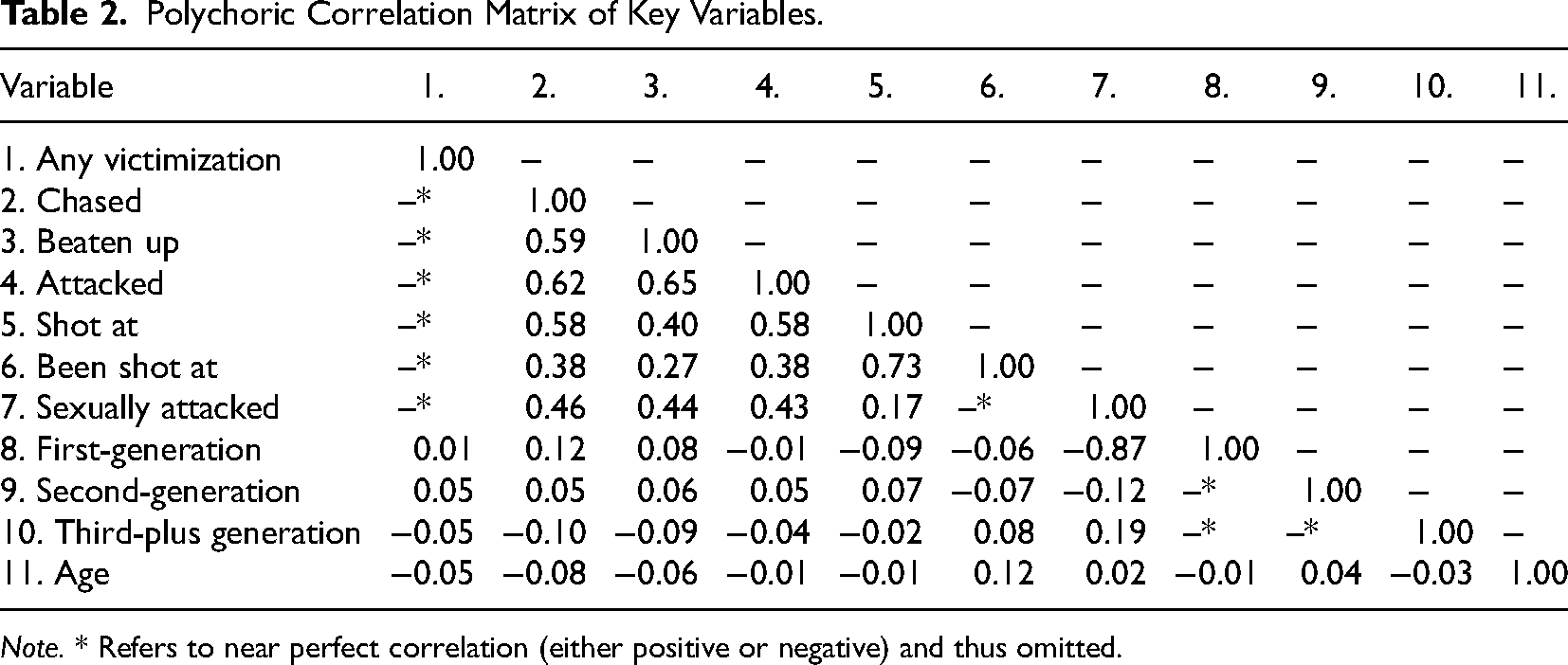
Note. * Refers to near perfect correlation (either positive or negative) and thus omitted.
Mixed-Effects Logistic Regression Models
Next, multiple mixed-effects logistic regression models were estimated—one for each outcome including the Any Victimization prevalence and models for outcomes examining the Chased, Beaten Up, Attacked, and Shot At variables (see Table 3). With the exception of the Chased model, the immigrant generation dummies were not significantly associated with the victimization outcomes. In the Chased model, first-generation immigrants were shown to be more likely to have been chased where they thought they might be seriously hurt compared to third-plus generation natives (odds ratio [OR] = 3.50, p = .000, confidence interval [CI] =1.74–7.07). 9 In the same model, second-generation immigrants were also shown to be significantly more likely to have experienced the outcome compared to third-plus generation natives (OR = 1.83 p = .025, CI =1.08–3.12).
Mixed-Effects Logistic Regression Models of Immigrant Generation and Various Direct Victimization Items.
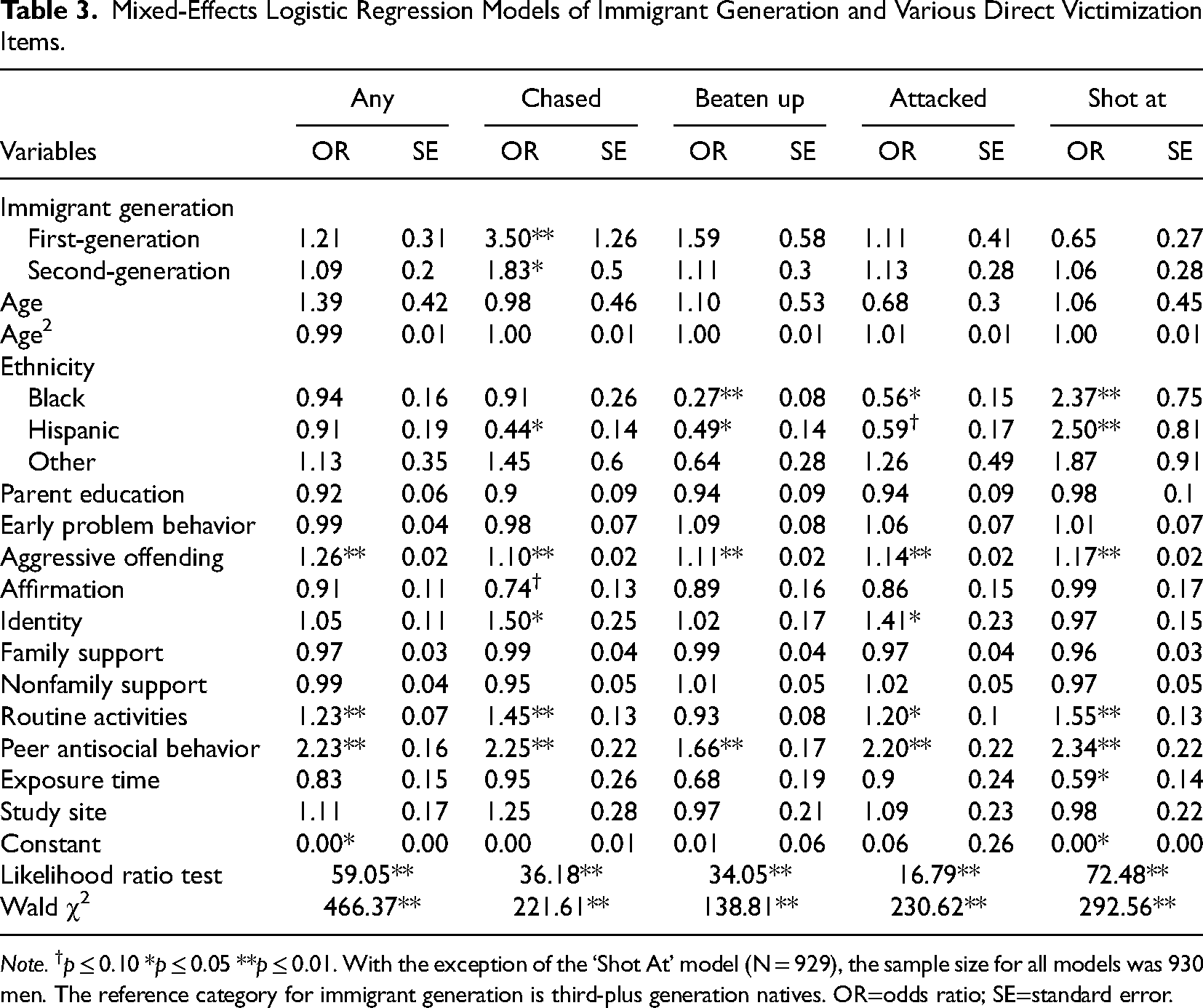
Note. †p ≤ 0.10 *p ≤ 0.05 **p ≤ 0.01. With the exception of the ‘Shot At’ model (N = 929), the sample size for all models was 930 men. The reference category for immigrant generation is third-plus generation natives. OR=odds ratio; SE=standard error.
In Table 3, several other important findings emerged. Neither age nor the quadratic function of age (age^2) were associated with any of the outcomes. For race and ethnicity, being Black was significantly associated with a decrease in the odds of being beaten up (OR = 0.27, p = .000, CI =0.16–0.48) or attacked (OR = 0.56, p = .035, CI =0.32–0.96) but was associated with an increase in the odds of being shot at compared to whites (OR = 2.37, p = .006, CI =1.27–4.41). Similarly, being Hispanic decreased the odds of being chased (OR = 0.44, p = .008, CI =0.24–0.81), beaten up (OR = 0.49, p = .013, CI =0.28–0.86), but increased the odds of being shot at (OR = 2.50, p = .005, CI =1.32–4.72).
Some variables typically associated with victimization experiences were also salient. Aggressive offending was significantly associated with every victimization outcome modeled. For example, higher aggressive offending was associated with a 26% increase in the odds of experiencing any victimization (OR = 1.26, p = .000, CI =1.21–1.31). With the exception of being beaten up, engaging in more unsupervised routine activities increased the odds of experiencing all victimization outcomes (e.g., Shot At, OR = 1.55, p = .000, CI =1.32–1.83). Lastly, the more friends that had engaged in antisocial activity a respondent had, the higher the odds of all victimization types. These effects were generally stronger than any other relationship examined here. For instance, a one unit increase in the amount of reported peers engaging in antisocial behavior (e.g., none of them to very few of them) increased the odds of experiencing any victimization by 123%.
For each of the models presented in Table 3, the predicted values were estimated. Figure 1 provides a graphical representation of the predicted values of the any victimization outcome by age and separated by immigrant generational group. It is clear the first- and second-generation trajectory lines peak between ages 15 and 17 and subsequently fall. Both of these more or less exhibit greater prevalence during middle adolescence with a general decline. Despite these visual differences, Table 3 reports that first- and second-generation immigrants do not significantly differ from the third-plus generation on the prevalence of experiencing any victimization over time. This aligns with the positioning of the third-plus generation trajectory, which sits between the first- and second-generation lines. Figure 2 provides a graphical representation of the predicted values of the Chased victimization outcome—the only model of the single item outcomes from Table 3 that exhibits significant effects between the immigrant generational dummies. As the reference category, the third-plus generation trajectory starts with a decline at age 14 and levels off with some variation across time; however, the first- and second-generation trajectories exhibit a different shape with a peak around ages 15 to 17 and see a somewhat gradual decline as these individuals entered early adulthood. The rest of the models and their figures follow a similar trend and separation as Figure 1 (see Supplemental Appendix).
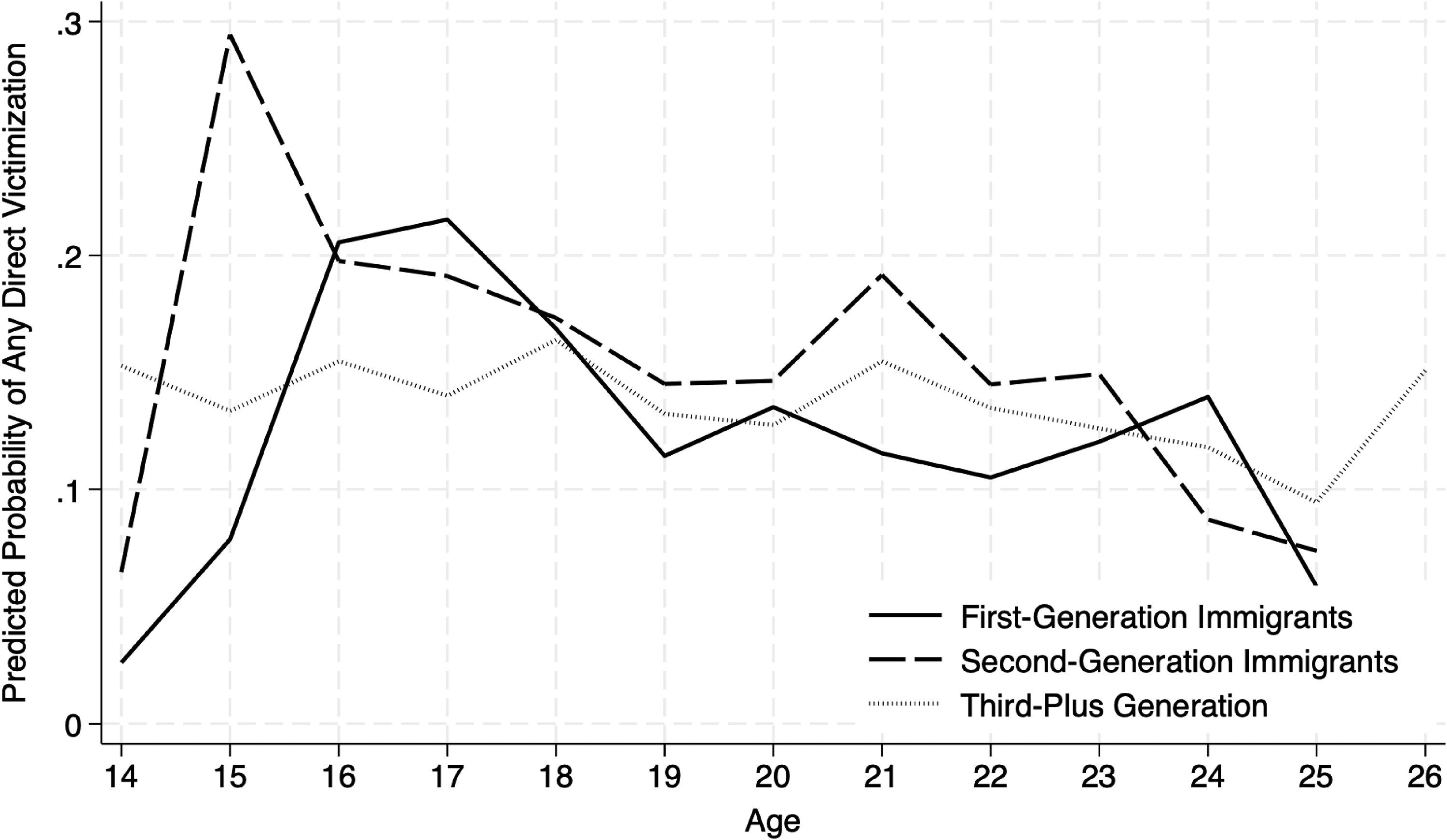
Predicted values of any direct victimization by age across immigrant generational group.
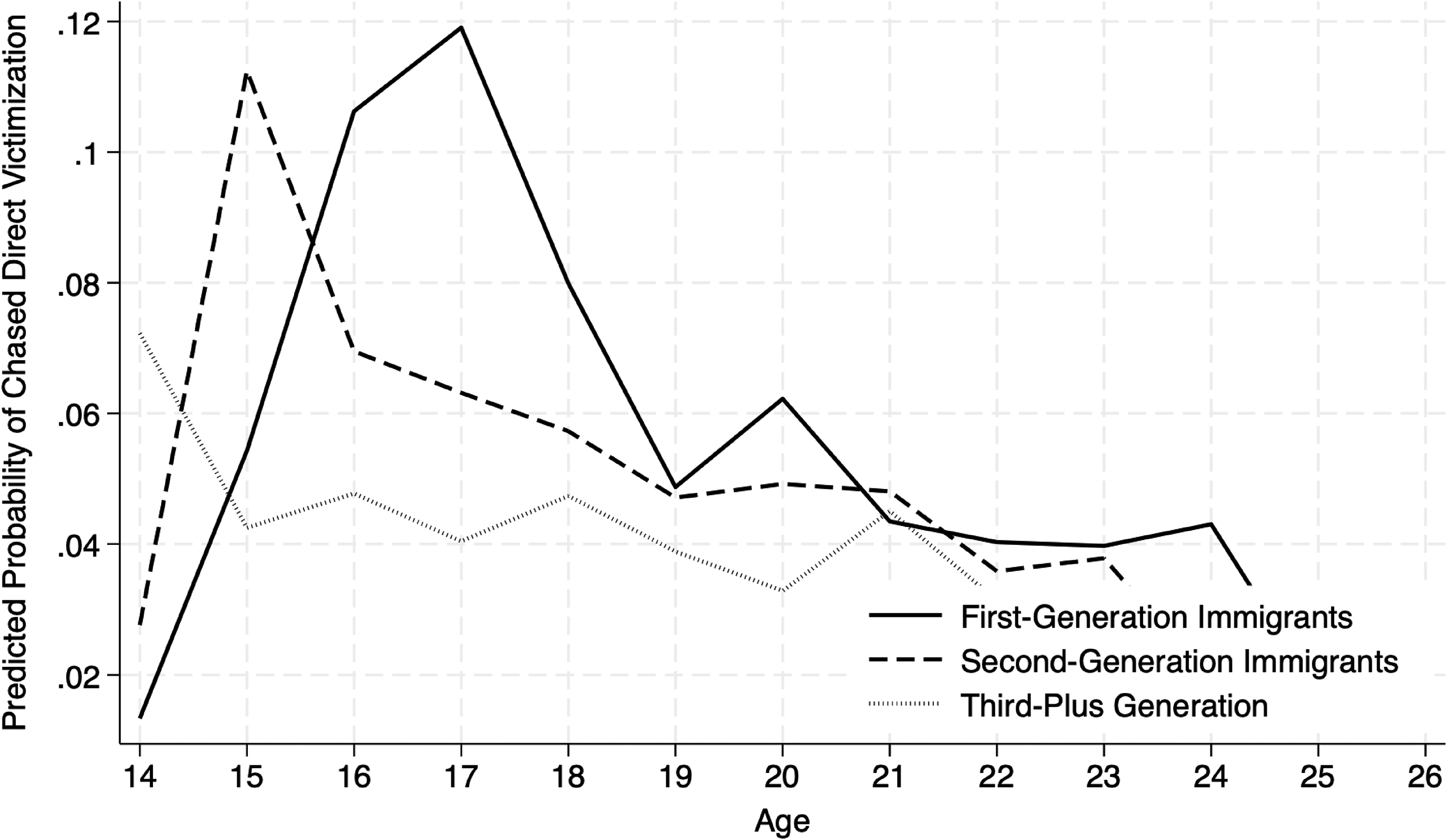
Predicted values of chased direct victimization by age across immigrant generational group.
Discussion
Scholarship centered on immigrant victimization has grown substantially. While immigrants are often marginalized and vulnerable to discrimination and targeting, there is heterogeneity in this experience conditioned by personal characteristics, social position, their development. Studies show that immigrants are either no more likely or less likely to be victims of crime compared to their native-born or later generation counterparts (Biafora & Warheit, 2007; Eggers & Jennings, 2014; Gibson & Miller, 2010; Hong et al., 2014; Peguero, 2009; Sabina et al., 2013; Yang et al., 2021). Research that examines this relationship over time tends to find immigration has little effect on victimization (Biafora & Warheit, 2007; Eggers & Jennings, 2014; Fussell, 2011; Mammadov et al., 2021). However, victimization is often experienced differently at various stages of life with victimization risk peaking as one transitions from adolescence to early adulthood (Daigle et al., 2008). In this case, those in adulthood may still benefit from being an immigrant when victimization is concerned (Sabina et al., 2013; Xie & Baumer, 2021). In this study, I analyzed longitudinal data from the Pathways to Desistance Study—a sample of previously adjudicated youth. I analyzed the impact of immigrant generational status on five victimization outcomes, one outcome capturing any victimization and four outcomes that speak to specific victimization experiences (having been chased, beaten up, attacked, and shot at).
The bulk of the findings suggests the general relationship between immigrant generational status is weak, which supports the first research hypothesis. First, Table 3 indicated that immigrant generation was not associated with any direct victimization. This null relationship is also observed in Figure 1, which did not demonstrate, visually, substantially different trajectory shapes and separation when comparing those in first- and second-generation immigrant groups to the third-generation plus group. This aligns with prior, mixed research that has studied this relationship over time (e.g., Biafora & Warheit, 2007; Eggers & Jennings, 2014; Mammadov et al., 2021). Second, in three out of four models that examine specific types of direct victimization, the effect of the immigrant generational dummies on victimization (beaten up, attacked, and shot at) was null (see Supplemental Appendix for graphical representations of these models). This largely supports the second research hypothesis with an important distinction. Importantly, the mixed-effects logistic regression models demonstrate there was only one significant relationship between immigrant generation and a victimization outcome. When compared to third-plus generation natives from the study, first-generation immigrants were more likely to have been chased where they thought they might be seriously hurt. This positive and significant relationship was also observed when examining second-generation immigrants compared to third-plus generation natives and when examining the predicted values of the Chased victimization models.
The broader findings that first- and second-generation status operate here either as nonsignificant factors—or risk factors for the being chased variable—should be interpreted through the lens of the broader sample. Pathways to Desistance Study youth are all previously adjudicated individuals, indicating prior involvement in the criminal justice system (Mulvey et al., 2004; Schubert et al., 2004). Inherently, part of this group's uniqueness in empirical study is their heightened vulnerability for adverse experiences as they transition into adulthood. Since their involvement in crime occurred during middle adolescence, their risk of future involvement in crime and other antisocial experiences, like being victimized, is high. This situational context should be considered alongside the broader immigrant experience. First-generation immigrant status or being close to it (i.e., being a child of an immigrant) is often attributed to hosting a series of protective benefits that often mitigate cultural and social values, attitudes, and behaviors that may lead to criminological exposure—at least when compared to their later-generation, native counterparts (Rojas-Gaona et al., 2016). Perhaps any ameliorating effects that having lower acculturation (relative to third-plus generation natives) are nullified, and in some cases heightened, by criminal justice involvement.
Immigrants and children with immigrant parents are sensitive to their standing and understand the risks involved when arrested and processed through the system. They are strategic in how they engage with formal institutions despite the regulatory and social challenges they must confront everyday (Asad, 2023). Immigrant youth are especially vulnerable as even in instances where they retain legal permanent residency, it does not guarantee standing in the United States. They may be motivated to “retreat” from engaging with aspects of U.S. life (Brayne, 2014; see also Asad, 2020), which may then exacerbate their sense of vulnerability. For children of immigrants with citizenship, the many challenges they face related to their racial/ethnic identity, educational gap, and social context means they are at higher risk of downward assimilation or joining the most disadvantaged parts of U.S. society (Portes & Rumbaut, 2014, p. 279) exacerbating exposures to criminal victimization. Altogether, on one end, being justice-involved may offset or nullify any beneficial effects that come from being an immigrant or having immigrant parents. At the other end, an immigrant status could be compounded by the immediate and residual consequences of becoming justice involved. This may heighten the risk of experiencing some types of victimization, like those that may be a byproduct of intentional targeting like getting chased to the point where they might be seriously hurt (see Table 3).
Other findings here add some nuance to the longitudinal nature of victimization. Age nor its quadratic function had a significant effect on any victimization outcome. This is surprising as some research points toward an age-victimization curve but at least for the developmental periods captured through the data (i.e., middle adolescence through early adulthood), this is not the case. Similar to immigration status, it could denote the nature of sample. Age on its own may not significantly increase the risk of victimization but by being justice-involved, there may not be considerable enough variation on the outcome, at least for the age ranges captured. Based on the rest of the findings, other factors may better explain involvement across victimization outcomes. When analyzing race/ethnicity, several relationships emerged. For example, Blacks and Hispanics had higher odds of being shot at compared to whites. Among the direct victimization events empirically examined in the study, this could be considered the most severe with the possibility of lethality. Some findings indicated the opposite. For instance, Blacks and Hispanics had lower odds of having been beaten up, mugged, or seriously threatened by another person compared to whites. When race/ethnicity is considered, it appears there is variation depending on the type of victimization. The varied risk of violent victimization across racial and ethnic groups has been reported in prior research; however, these findings would be better understood when assessed within-groups or through an intersectional lens (e.g., Semenza et al., 2022; Tillyer & Tillyer, 2016). At a minimum here, perhaps Blacks and Hispanics are disadvantaged when the risk of death is most present and advantaged when less than lethal but still serious risk is experienced. Though, further research is needed to unpack these effects.
There were several other findings that add nuance to the results. Aggressive offending was associated with every type of victimization modeled. This aligns with prior research that has analyzed data from the Pathways to Desistance Study and found that criminal offending is strongly linked to direct victimization as well as other components of the exposure to violence scale (e.g., witnessing victimization) (Mulford et al., 2018; Schreck et al., 2017; Shih, 2022; Turanovic, 2019). The presence of victim-offender overlap is clear from these results and suggests a time-varying relationship exists between the two (Shih, 2022). Perhaps the seemingly nonrecursive relationship between aggressive offending and victimization displayed here offers evidence that these factors play intricate roles on one another over time—particularly when immigrant statuses are considered.
The study also found that routine activities and peer antisocial behavior both played a significant role in increasing odds of any victimization and other victimization types. Since these two have theoretical overlap (e.g., routine activities often involve delinquent peers among youth), their influence on victimization is not surprising to see here (e.g., Schreck & Fisher, 2004). There significant impact these variables have on many of the direct victimization outcomes also suggests there is a time-varying relationship. Within-person changes in both unsupervised routine activities and more peer antisocial behavior are associated with within-person changes on different forms of direct victimization. However, these findings should also be contextualized with the sample here as justice-involved youth may have structurally different circumstances that heighten the negative influence of routine activities or deviant peers in early stages of development (see Pratt & Turanovic, 2016).
Limitations and Future Research
Though the insights gathered here provide an understanding of how immigration status relates to victimization, this study contains limitations. The measurement of victimization contains several restrictions. The outcomes were derived from the direct victimization subscale from the Exposure to Violence Scale (Selner-O’Hagan et al., 1998). As such, only six different types of victimization were considered when assessing the general outcome of victimization (any victimization). Victimization is highly variable as a concept and these items may not capture broader experiences, especially those that pertain to other categories of vulnerability (e.g., nonviolent interpersonal crime, sexual violence, fraud, and cybercrime). Future studies should seek to integrate more diverse constructs to explore the full scope of victimization through an immigrant lens. Another limitation is more endemic to the study of immigrants in criminological study. The relatively fewer number of first- and second-generation immigrants in these data reduces the precision of estimated coefficients. Yet, the findings still provide insight as immigrant-focused researchers seek to establish baselines across various criminological lines of inquiry. To better improve upon these limitations—withholding the adding or targeting of more immigrants or children of immigrants in any given research design—researchers could disentangle and focus on factors (e.g., acculturation and legal status) organic to the immigrant experience. That is, it is crucial to unpack what it means to be an immigrant in order to understand why it matters. While this study did not explicitly test an assimilation theory (e.g., McCann et al., 2022), it remains that culture is an important set of mechanisms that could inform victimization outcomes. What it means to be an immigrant is also connected to the different contexts of reception examined with these data (see Portes & Rumbaut, 2014). Even though researchers oversampled Maricopa County, Arizona over Philadelphia County, Pennsylvania for Hispanics, which contained a larger share of the first- and second-generation immigrants, it remains two different geographic contexts were engaged in the data collection effort. Even though the site location was not significantly associated with any of the outcomes, future research should seek to further disentangle how the immigrant diaspora embed and develop in their proper communities. This oversampling also limits conclusions made about race and immigrant generation as very few first- and second-generation immigrants identified as anything other than Hispanic (see Supplemental Appendix).
Measurement withstanding, it remains that certain types of victimization may not be prevalent enough to examine in a longitudinal fashion without substantial participants and observations. This issue is not unique to this sample, but it is impactful as two of the six items that comprised the any victimization measure were not able to be modeled individually. Additionally, while the Pathways to Desistance Study captured detailed information about participants across many waves, this study would have benefitted from data spanning further into adulthood. This type of right censoring is not unusual as longitudinal study designs and implementations often suffer from various barriers that impact continued data collection (e.g., funding and attrition); however, since so few U.S.-based data exist that capture the longitudinal criminological experiences of immigrants and children of immigrants, future studies should continue to explore these data alongside other datasets (e.g., Add Health) to explore the broader developmental contexts of immigrants and the immigrant diaspora. Another concern is that females were not included as a central part of this analysis. Future research should aim to explore the intersections of immigrations status, gender/sex, and victimization—particularly among those with markedly higher risk experiencing violence throughout their life. Lastly, studies show immigrants who are undocumented are especially vulnerable to victimization (Bucher et al., 2010; Caraballo & Topalli, 2023; Fussell, 2011). Since these data do not capture legal documentation, authorization status, or any indicators that speak to mixed-status families, future data collection efforts should seek to integrate these instrumental factors.
Overall, while immigration remains a major subject of interest for social science researchers, the study of immigration and victimization is still burgeoning. While belonging to an immigrant group may produce some ameliorating benefits against criminal offending, health outcomes, and, to some extent, victimization, this study showed it either has mostly little effect or a detrimental effect on victimization prevalence between adolescence to early adulthood. The experience of having been previously adjudicated and belonging to early immigrant generation may provide evidence that victimization vulnerability may make way to other salient factors that are important. In some instances, immigrant generation is influential but as a risk factor, not as a protective factor. These findings indicate that there is much more to unpack regarding this relationship than previously expected. Researchers should parse out potential mechanisms or factors that could help explain how immigration status and victimization are linked. This speaks to the importance of approaching this growing area with both quantitative and qualitative methodology in mind.
Supplemental Material
sj-docx-1-icj-10.1177_10575677251335032 - Supplemental material for Immigrant Generation and Direct Victimization: A Longitudinal Analysis of Previously Adjudicated Youth
Supplemental material, sj-docx-1-icj-10.1177_10575677251335032 for Immigrant Generation and Direct Victimization: A Longitudinal Analysis of Previously Adjudicated Youth by Chris Guerra in International Criminal Justice Review
Footnotes
Declaration of Conflicting Interests
The author declared no potential conflicts of interest with respect to the research, authorship, and/or publication of this article.
Funding
The author received no financial support for the research, authorship, and/or publication of this article.

Supplemental Material
Supplemental material for this article is available online.
Notes
References
Supplementary Material
Please find the following supplemental material available below.
For Open Access articles published under a Creative Commons License, all supplemental material carries the same license as the article it is associated with.
For non-Open Access articles published, all supplemental material carries a non-exclusive license, and permission requests for re-use of supplemental material or any part of supplemental material shall be sent directly to the copyright owner as specified in the copyright notice associated with the article.
