




Abstract
Given that young people have a limited capacity to recognize the unlawfulness of their actions, the minimum age of criminal responsibility (MACR) presents an important subject of professional and political inquiry. In addition to the natural and legal sciences, public opinion is confirmed to influence the decision-making of legislators in the matter of criminal policy. Research on determinants of public opinion on the MACR is relatively scarce; however, some studies focusing on punitiveness in general suggest that it is influenced by both cognitive assessments as well as emotions and beliefs. Using a representative sample of Czech citizens, this study finds public support for a lower MACR to be particularly driven by their perception of children crime trend, mediated through people's negative attitude toward the behaviour of today's children.
Introduction
An important condition for establishing the minimum age of criminal responsibility (MACR) is the individuals’ capacity to recognize the unlawfulness of their actions and their ability to control their behaviour. According to neuroscience and developmental psychology (Lamb & Sim, 2013; McDiarmid, 2013) these abilities are limited in childhood and adolescence. During this period, important changes in brain maturation occur affecting executive functioning, emotional processing and social cognition (Farmer, 2011) together with emotionality and emotional lability, sensation seeking and inadequate inhibitory self-control (Lamb & Sim, 2013). Moreover, involving children in the criminal justice system can bring about various unintended consequences, such as stigmatization, greater involvement in deviant social groups and the tendency to reoffend (Bernburg et al., 2006, McAra & McVie, 2023), notwithstanding that sanctions based on deterrence and discipline have been proven to be rather ineffective (Lipsey et al., 2010; MacKenzie, 2002; Petrosino et al., 2005). Professional community such as criminologists, developmental psychologists and practitioners thus emphasizes that the MACR should not be set too low (McDiarmid, 2013).
Nevertheless, criminal policy is often informed by other factors than those arising from expertise furnished by the natural and legal sciences. A very important factor that influences the decision-making of legislators is public opinion (Garland, 2001). Indeed, there must be dialogue between politics and public opinion so that people trust the system, participate in its maintenance and behave according to its rules (Wood & Tendayi, 2004). In response to public concerns, politicians thus often lean toward tightening laws against criminally irresponsible children, i.e., lowering the MACR (Roberts, 2004; Welch et al., 2019). It is therefore necessary to pay increased attention to public opinion regarding the MACR. Unfortunately, the number of studies on this topic is scarce (Lumintao & Butalid, 2020), both in terms of what the public considers an appropriate MACR and the factors that influence such reasoning.
In general, public attitudes associated with a desire to reduce the MACR can be understood as one manifestation of punitiveness (Wong, 2024). However, the concept of punitiveness itself must be approached with caution, as it is a complex issue that has not yet been clearly defined (Carvalho, Chamberlen & Lewis, 2020; Hamilton, 2014; Kury & Shea, 2011; Matthews, 2005; Pfeffer, 2024). Previous research also pointed to the important role of the overall concept of the research and the wording of questions posed to respondents (Adriaensenn & Aertsen, 2015) as generally worded questions about the sufficiency of sanctions tend to elicit significantly more punitive responses than questions based on case-specific assessments (Roberts & Hough, 2005b). Some studies thus find that the vast majority of citizens prefer practices based on harsh punishment for dealing with offenders (Roberts & Hough, 2005b; Stalans, 2002), while other consider such a portrayal of the public to be a myth or artefact created by certain types of studies rather than a reflection of reality (de Keijser, 2014; Green, 2006; Matthews, 2005; Viki & Bohner, 2009).
In a similar vein, there is also no consensus among criminologists on the factors influencing levels of punitiveness. Some scientists have discussed the role of factors such as gender, age, and education (Cochran & Piquero, 2011; Mayhew & Van Kesteren, 2002; Tyler & Boeckmann, 1997), and found that men, older and well-educated people are more punitive than women, youth generations and those with lower education. Overall, however, the results of research in this area remain rather mixed, suggesting that the main factors of punitive attitudes must be sought elsewhere (Adriaensenn & Aertsen, 2015; Payne et al., 2004; Sprott, 1999; Zarafonitou, 2011).
The instrumental theory (Gerber & Jackson, 2015; Zimring et al., 2001) argues that public punitiveness emerges mainly because of personal experiences with victimization or in response to rising crime in a particular locality or country (Jennings et al., 2017). However, such reasoning did not find support in research, as levels of punitiveness do not correlate with trends in recorded crime, and victims of crime often express less punitive attitudes than non-victimized people (Maruna & King, 2004), which is sometimes attributed to their experience with functioning of the criminal justice system (Gray, 2009). Therefore, some authors suggest that the perception of growing crime (Enns et al., 2022; Jennings et al., 2017; Kleck & Jackson, 2017) and lower awareness of existing crime control measures (cf. Gray, 2009; Kääriäinen, 2019; Roberts & Hough, 2005b) play an important role in explaining punitive attitudes among the public. On the other hand, the expressive-emotional approach considers punitiveness to be related to the anger people feel when someone commits a crime (Hartnagel & Templeton, 2012; Johnson, 2009), subsequent fear of crime (Armborst, 2017; Sprott and Doob 1997), or even to more general moods and anxieties in postmodern societies (Carvalho et al., 2020; King, 2007; King & Maruna, 2009). In addition, emotions are confirmed to affect the public's evaluation of the effectiveness of criminal justice system and the importance they assign to deterrence-based strategies (Applegate et al., 2009; Roberts & Hough 2005b).
Criminologist has also theorized that the cognitive and emotional determinants of punitiveness are interrelated (Ferraro, 1995; Shi, 2022). Specifically, Shi (2022) confirmed that the relationship between cognitive beliefs and punitiveness is mediated through emotions. Nevertheless, research in this area remains limited in both the indicators used and the populations studied. Drawing on the aforementioned research and using data from a survey conducted on a representative sample of the Czech citizens, the aim of the study is to examine whether similar patterns can also be found with respect to public opinion on the MACR. The study is structured as follows: First, the theoretical background is outlined in reference to studies that focus on public punitiveness and factors that inform it. The second section specifies the parameters of the study, including the aim of the study, data, variables and analytic strategy. Finally, the results of the descriptive, bivariate and regression analysis, together with the structural equation modelling (SEM) are presented, followed by a discussion and conclusion.
Theoretical Background
Crime Trend Perception, Awareness and Punitiveness
One of the reasons why people hold punitive attitudes is their distorted perceptions of the extent, structure, or trends of crime (Kleck & Jackson, 2017). If they believe that the risk of victimization or the number of serious crimes is increasing, they are convinced that society should treat offenders much more severely (Hogan et al., 2005; cf. Kleck & Jackson, 2017; Maruna & King, 2004; Mirrlees-Black 2001; Roberts and Indermaur 2007; Shi, 2022). Indeed, research in this respect shows that a large proportion of citizens of various countries are convinced that crime is steadily increasing, despite statistics showing otherwise (Manning et al., 2022; Ramirez, 2013; Roberts & Stalans, 1998; Zeman et al., 2009). This perception also holds true in relation to young offenders. Despite the decline in youth crime rates in most Western countries since the late 1990s (Andersen et al., 2016; Blumstein, 2006; Farrell et al., 2014; Matthews & Minton, 2018), the majority of the public believes the trend to be the opposite (Anderson et al., 2005; Hough & Roberts, 2004; Mattinson & Mirrlees-Black, 2000). Moreover, people tend to overestimate the proportion of youth in the total number of offenders (Haines & Case, 2007; Roberts & Hough, 2005a). For, example, in a study conducted in the Czech Republic in 2009, people estimated that, on average, youth under the age of 18 committed one fifth of all criminal acts (18%), although according to official statistics the real number was only 7% (Zeman et al., 2009).
Similarly to crime trend perceptions, low awareness of the existing system of sanctions or common court practices has been confirmed to be associated with punitive attitudes (Kääriäinen, 2019; Roberts & Hough, 2005b). This relationship is particularly evident in research concerning attitudes towards alternatives to prison or restorative justice programs. Negative attitudes towards these alternatives often stem from low familiarity with such measures or the conditions under which they are implemented (Allen, 2016; Butter et al., 2013; Doble & Greene, 2000). In addition, evidence exists that the public also has limited awareness of measures related to youth crime and thus incorrectly assumes that courts impose less severe sentences on young offenders than they actually do (Roberts and Hough, 2005a; Zeman et al., 2009). This misconception may lead them to believe that children under the MACR face minimal consequences from the justice system, even for serious offenses (Hulmáková et al., 2023). Therefore, raising public awareness appears to be a promising approach to reducing public punitiveness (Chapman et al., 2002). Some experimental studies provide partial evidence for the effectiveness of such strategies (Roberts and Hough, 2005a, 2005b, 2011; Sanders and Roberts, 2000; Van Gelder et al., 2015). However, other authors (see de Kejseir, 2014) consider such efforts unrealistic, arguing that the public will never become as informed about crime and its control as professionals.
Emotions, Beliefs and Punitiveness
The crime always goes hand in hand with the emotional reaction of society (Karstedt, 2002). Relatedly, punitiveness is influenced not only by perceptions of crime trends or awareness of the existing sentencing system but also by the emotions that crime triggers in citizens (Canton, 2015; Maruna and King, 2004). Some authors consider anger, resentment towards, and fear of offenders as significant predictors of punitive attitudes (Graham et al., 1997; Hartnagel & Templeton, 2012; Johnson, 2009). For youth offenders, this issue is particularly crucial because their actions attract extraordinary attention from society (Brown, 2005; Muncie, 2015). Although serious crimes committed by children are rare, they garner significant media interest and provoke various degrees of moral panic (Jewkes, 2004), often leading to calls for a reduction in the MACR (Applegate et al., 2009; Scott et al., 2006; Wong, 2024). Furthermore, some authors argue that attitudes towards child offenders are exacerbated by intergenerational conflicts (Connolly, 2019; Urick et al., 2017) and the prevailing belief that today's youth are in many ways worse than previous generations (Bostrom, 2001; Nichols & Good, 2004). Attitudes towards juvenile offenders and their punishment thus likely reflect broader concerns about the direction of society overall (Jewkes, 2004).
Emotions also influence how the public evaluates the effectiveness of various criminal justice measures. Since people often have their own ideas about what is effective and what is not in dealing with offenders (Maruna and King, 2004; Roberts and Hough, 2005b), they demand justice to be both effective and affective, aligning with their feelings and impressions (Freiberg, 2001). Typically, this involves beliefs about the preventive effect of harsher sentences (Kury & Shea, 2011; Tyler & Rankin, 2011). As Roberts (2008) notes, some people have a naive expectation that the imposition of punishment results in subsequent desistance and thus tend to support deterrence-based strategies, both in the sense of general and individual prevention (cf. Roberts & Hough 2005b). As a result, people are likely to believe that a lower MACR and the related punishment will deter both potential offenders as well as those who have already committed a crime (Applegate et al., 2009; Zeman et al., 2009), although there is little support for such reasoning (Lipsey et al., 2010; MacKenzie et al., 2002; Petrosino et al., 2005).
Interplay Between Cognition, Emotions and Punitiveness
For more than two decades, academics and scientists have discussed the relationship between cognition and emotions (Pessoa, 2008). For example, Lazarus (1982) describes cognitive appraisal as a mediator between an individual and the environment, which further elicits a particular emotional response. Emotional experiences are thus often rooted in cognitive evaluations and judgments (Frijda, 1993). In criminology, cognitive and emotional dimensions have often been examined in relation to fear of crime (Ferraro, 1995), suggesting that crime perceptions are closely related to fear, anxiety, and other emotional reactions to crime (Pickett et al., 2018; Shi, 2021). In addition, Persak (2019) point to the fact that appropriateness of emotions in criminal law-making depends on the accuracy of the underlying cognitive appraisal. On the other hand, research focusing on the relationship between cognition, emotions, and punitive attitudes is scarce. In fact, to our knowledge, only a study by Shi (2022) has examined this relationship. Using data from a survey-based experiment of 441 American adults and conditional process analysis the author confirmed that anger about crime mediates the crime trend perception–punitiveness link. Specifically, she found that people who believe that crime rates are increasing tend to feel more anger about crime, which in turn makes them more punitive. Nevertheless, further research is needed to determine whether this pattern holds for other indicators of punitiveness and in different populations.
The MACR in the Czech Republic
Since 1950, the MACR in the Czech Republic, which ranks among a higher MACR, similar to, for example, Norway, Sweden, Finland, Iceland and Denmark, has been associated with the completion of 15 years of age and this age limit was also adopted by current Czech Criminal Code (Law No. 40/2009 Coll.). 1 Children under the age of 15 who commit a crime (according to Czech law, “an act that would otherwise be criminal”) are not criminally responsible for their conduct. Conversely, juveniles who have reached 15 years of age at the time the criminal offence was committed but who are under 18 are criminally responsible. However, the conditions of criminal liability were significantly modified by the Youth Justice Act. 2 Juveniles are not considered criminally liable if, due to a lack of intellectual and moral maturity, they cannot have recognized the illegal nature of their conduct or control it at the time the act was committed.
Children younger than 15 years of age are not formally prosecuted. Criminal proceedings should be discontinued as soon as it is established that a crime was committed by a child under 15 years of age, rendering it an act that would otherwise be criminal. After the discontinuance of criminal proceedings special civil proceedings are mandatorily conducted in the best interest of the child. Pursuant to Section 1 (2) of the Youth Justice Act, these proceedings, comprising measures of an educational and protective nature, should primarily focus on the restoration of disrupted social relations, inclusion of the juvenile into a family and social environment and the prevention of future unlawful acts. Nevertheless, some of these measures are identical to those imposed on juveniles–e.g., protective education (placement of the child in a special facility under the Ministry of Education, Youth and Sports) and protective treatment (either in outpatient or institutional form in a facility under the Ministry of Health)–and imposing them on children thus significantly interferes with their basic human rights and liberties. At the same time, these measures can be perceived as a type of sanction, even though they are not penal measures, and as such do not go on the criminal records of these children.
In the second half of the 1990s, some politicians as well as criminologists and other experts in the field of criminal justice made concerted efforts to lower the MACR (Marešová, 1997); this was likely spurred by the significant increase of investigated children under 15 years of age suspected of committing an act that would otherwise be criminal. However, since 2000, the number of investigated children has long been on the decline (see Graph 1).
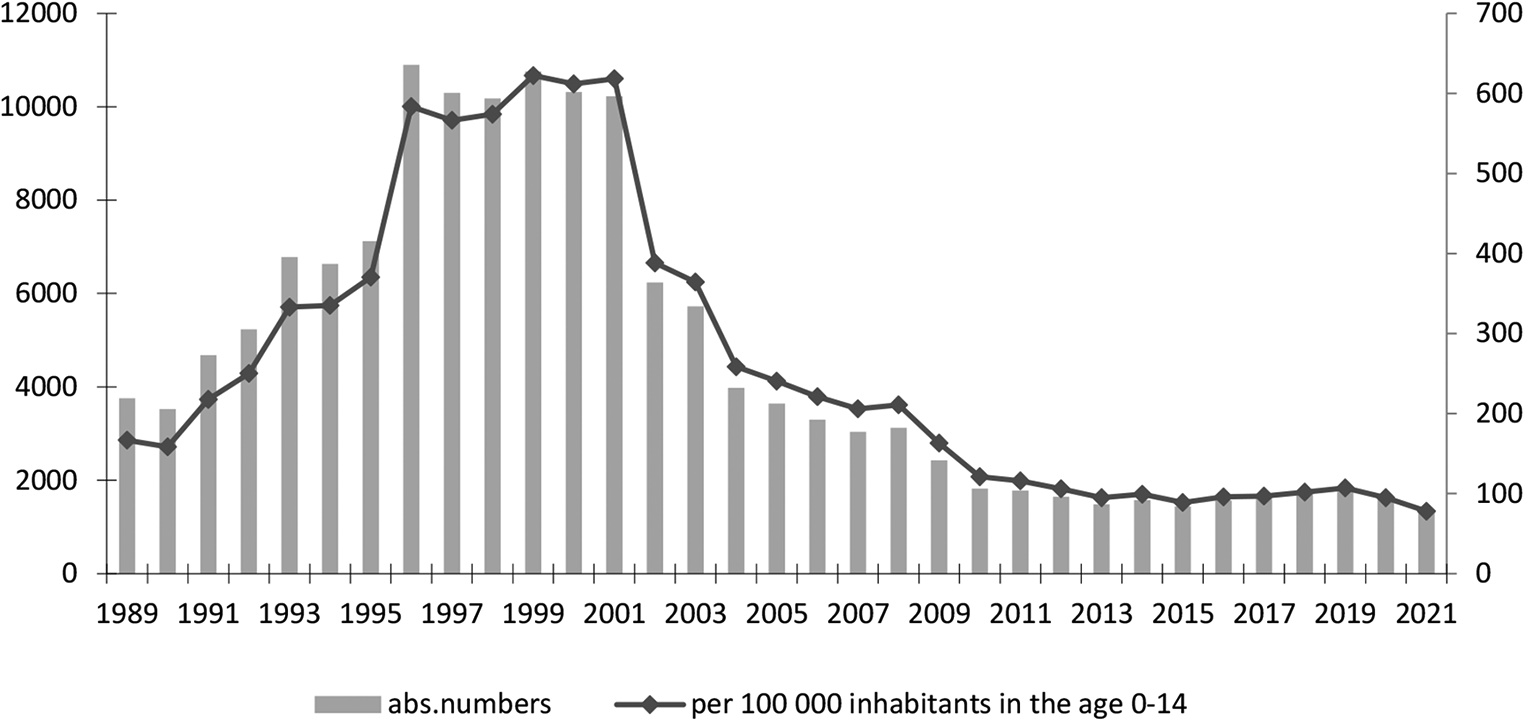
Investigated children under 15 in pre-trial proceedings. Source: State Attorney's Statistics for the relevant years–Overviews for prosecuted and suspected individuals non-standard set, CSLAV (non–public database). Ministry of Justice; Information about population numbers–Czech Statistical Office, available at: https://csu.gov.cz.
In addition, a decline in the number of acts that would otherwise be criminal committed by these children has also been observed (Policie České republiky, 2022) and similar trends were found when comparing youth statements in the 2nd and 3rd waves of the International Self-Report Delinquency Study (Moravcová et al., 2015). Despite the positive trend, however, voices calling for a lower MACR repeatedly appear in the Czech Republic, especially in connection with serious violent acts that would otherwise be criminal, such as murder committed by children under 15, 3 although they have long been an exceptionally rare phenomenon in the Czech Republic (Válková et al. 2019).
Current Study
Since there is evidence that inaccurate knowledge about youth crime and related crime policies together with negative emotions it evokes may manifest in increased punitiveness among public (Hartnagel & Templeton, 2012; Hogan et al., 2005; Kääriäinen, 2019; Shi, 2022), we assume both cognitive and emotional factors to be also associated with public preferences regarding the MACR. Moreover, it is also plausible that cognitive evaluations not only influence public preferences for the MACR itself but also shape emotions and beliefs regarding the severity of punishment and the behaviour of today's children (Shi, 2022). The aim of the present study is thus to examine the effect of cognitive and emotional factors on punitive attitudes of the Czechs. Specifically, we test whether crime trend perception and awareness of youth justice measures influence the public opinion on MACR both directly and indirectly through belief in deterrence and attitude towards the behaviour of today's children.
We pose following hypotheses:
A lower awareness of sanctions imposed on children younger than 15 years of age, the Youth Justice Act, and the perception that crime rates among children younger than 15 are rising are associated with a lower preferred MACR by the public. A stronger belief in deterrence and negative attitude towards the behaviour of today's children are associated with a lower preferred MACR by the public. Perception that crime rates among children younger than 15 are rising and lower awareness of youth justice system are associated with a higher belief in deterrence and more negative attitude towards the behaviour of today's children, leading to a lower preferred MACR by the public.
Method
Data
The data analyzed in this study were collected within the framework of the Children under the age of fifteen in the youth justice system project, carried out by the Institute of Criminology and Social Prevention in 2020–2023. It focused on a wide range of public opinion topics such as politics, trust in institutions, respondent's opinion on the MACR, awareness of the crime trend concerning criminally irresponsible children and measures associated with the youth justice system, belief in deterrence as well as attitudes regarding the behaviour of today's children.
Data collection was carried out by the Public Opinion Research Centre (PORC) of the Institute of Sociology of the Czech Academy of Sciences (IS CAS). The PORC follows the principles of ESOMAR and acts according to the Personal Data Protection Act. It is registered with the Office for Personal Data Protection of the Czech Republic. In addition, the implementation of the survey was approved by the Ethics Committee of the IS CAS.
Respondents were interviewed in person using a combination of the Pen-And-Paper-Interviewing (PAPI) and tablet or computer (CAPI). A representative sample of 1,015 Czech respondents was created using quota sampling, with the selection of following criteria: region, size of place of residence, gender, age and level of education. Subsequently, the data were weighted according to the census of population, houses and flats conducted in 2021.
Dependent and Independent Variables
In order to examine public preferences regarding the MACR, respondents were asked the open-ended question: “At what age would you personally set the minimum age of criminal responsibility?” The resulting (dependent) variable ranged from 10 to 20 years, with an average age of 14 years. In addition to the question on their preferred MACR, respondents were also asked, “What is currently the minimum age of criminal responsibility in the Czech Republic, i.e., from what age can a person be prosecuted and convicted of a crime?”, in order to examine public knowledge of the current MACR. The latter indicator served as a filter in the subsequent analysis (see below).
Drawing on existing literature, we distinguished two groups of factors–cognitive and emotional–that are likely to be associated with public opinion on the MACR. 4 First, we included variables that capture the respondent's perception of the crime trend for children under 15, the youth justice law and sanctions imposed on children under 15. To measure the perceived crime trend for children under 15, we asked respondents “Over the last ten years, do you think that crime committed by children in the Czech Republic under the age of fifteen:”, with answer categories 1 = ‘has increased significantly’, 2 = ‘has increased’, 3 = ‘has remained stable’, 4 = ‘has dropped’, 5 = ‘has dropped significantly’, 9 = ‘do not know’. For the sake of the subsequent analysis and due to the low-frequency categories of ‘has dropped’ and ‘has dropped significantly’, we recoded the variable so that 1 = ‘has increased’, 2 = ‘has remained stable or dropped’ and 3 = ‘do not know’. Awareness of juvenile law (Youth Justice Act) was measured using the question: “In many countries, there is a special law that addresses juvenile delinquency and children under the age of 15. Is there such a law in the Czech Republic as well?”, with answer categories 1 = ‘yes’, 2 = ‘no’ and 3 = ‘do not know’. Further, awareness of sanctions imposed on criminally irresponsible children was measured using the question: “If a child who is not yet criminally responsible commits a serious criminal act such as robbery or personal injury, how is such a case handled in the Czech Republic?”, with answer categories 1 = ‘The police will drop the case but the court will continue to pursue it and the child will face potential sanction’ (yes) 2 = ‘The police will drop the case and the court will not pursue it further’ (no) and 3 = ‘do not know’.
Second, we examined the effect of emotional factors such as belief in deterrence, i.e., the extent to which the respondent understands deterrence as an effective tool for crime control, and attitude toward the behaviour of today's children. The belief in deterrence index (Cronbach Alfa = 0,691), ranging from 1 = ‘weak’ and 5 = ‘strong’, consists of two variables measuring general (“If the law imposes severe penalties on perpetrators, it will deter people from committing crime”) and individual (“If an offender is punished severely, he/she will avoid future criminal conduct”) deterrence. Further, an index of attitude regarding the behaviour of today's children under 15 (from approximately eleven to fourteen years of age) compared to children of the same age 10 years ago was constructed (Cronbach´s Alfa = 0,899). It consisted of five statements about today's children, where respondents were asked to express their agreement or disagreement on a 4-point scale (1 = ‘disagree’ and 4 = ‘agree’). The statements were as follows: today's children a) bully their classmates more often, b) are more likely to commit theft, c) are more often involved in fights, d) are more likely to commit violent crime, e) who commit acts of violence are crueller when committing them. The final scale was coded with 4 indicating negative attitude toward the behaviour of today's children.
Third, we considered a standard set of socio-demographic variables that are usually considered in research on public attitudes towards crime and punishment (see Allen et al., 2012; Hough & Roberts, 1998; Mattinson & Mirrlees-Black, 2000; Sprott, 1999; Van Kesteren, 2009; Zarafonitou, 2011; Zeman et al., 2010). We thus included gender (1 = ‘men’), age of the respondent and education (1 = ‘elementary’, 2 = ‘secondary without GCSE’, 3 = ‘secondary with GCSE’ and 4 = ‘tertiary’). Moreover, we controlled for the number of dependent children in the household (1 = ‘one’, 2 = ‘two +’ and 3 = ‘none’) and victimization experience of a respondents or their family members in the past five years (1 = ‘yes’).
Analytic Strategy
To ensure that respondents did not misunderstand the concept of MACR and did not confuse it with the legal age limit, we included only those who correctly answered the question about the current minimum age of criminal responsibility in the Czech Republic (above). The final sample considered in the subsequent analysis thus comprised 608 respondents. We also used weights to present descriptive statistics of the analysed variables.
The data analysis proceeded in three steps. First, we presented descriptive statistics and bivariate associations between our dependent, independent and control variables. Second, we estimated three hierarchic OLS regression models in order to examine the unique effect of cognitive and emotional factors on public opinion on the MACR. Model 1 only includes socio-demographic variables. Model 2 also considers awareness of the juvenile crime trend, the youth justice law and sanctions imposed on children younger than 15 years of age. Finally, Model 3 examines the influence of belief in deterrence and attitude regarding the behaviour of today's children on public opinion regarding the MACR. Due to the relatively high frequency of ‘do not know’ answers for some of the variables considered in our study, they have been included in the analysis as reference groups. Third, we employed structural equation modelling (SEM) to assess both the direct and indirect effects between afore-mentioned factors and public opinion on the MACR.
Results
Descriptive Statistics and Bivariate Associations
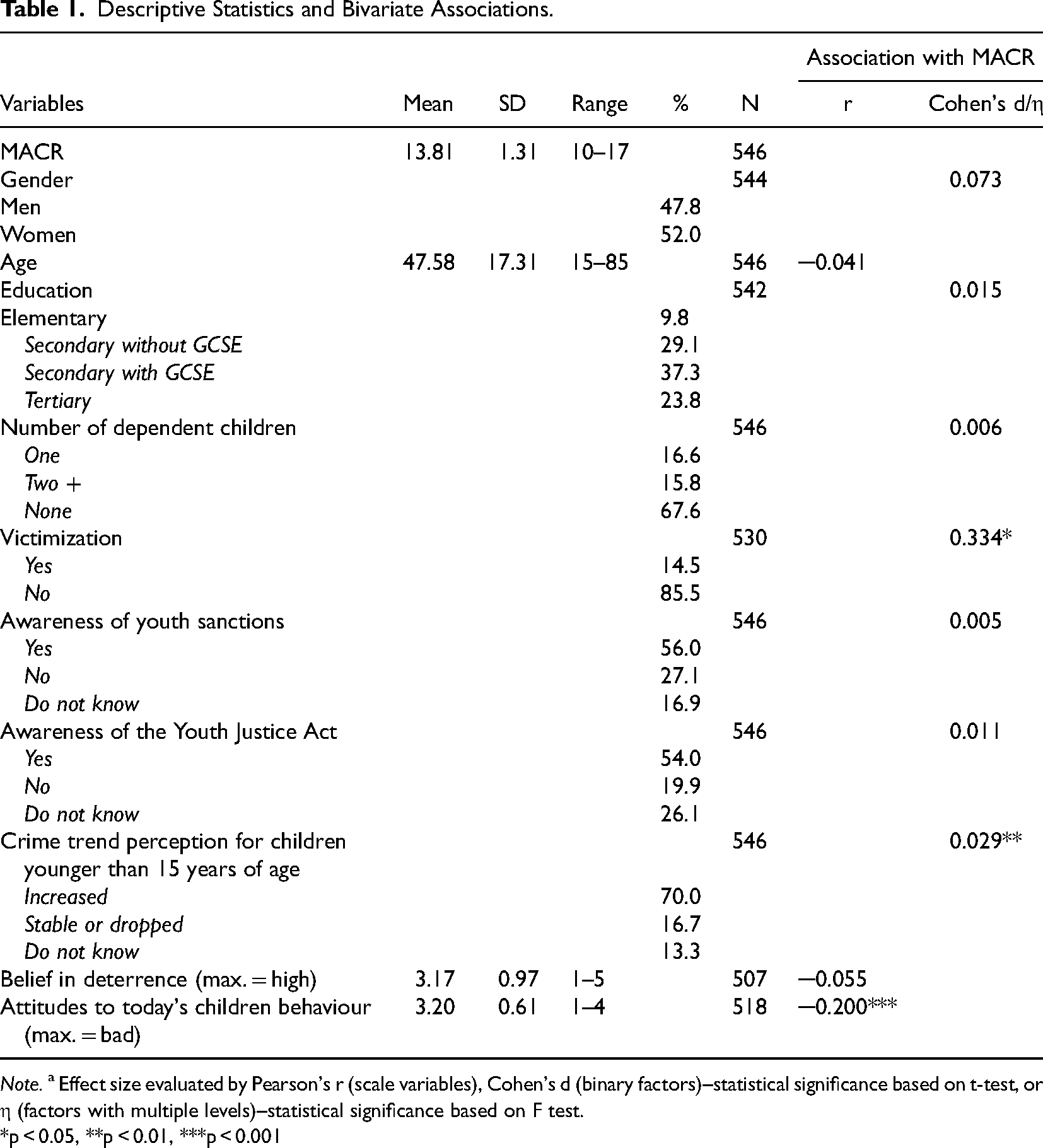
Table 1 presents descriptive statistics for all variables included in the analysis as well as bivariate associations between the preferences regarding the MACR and independent variables. On average, respondents would rather the MACR be set to 14 instead of the current 15 years of age. Further, our sample has an equal distribution of men (52%) and women (48%), with an average age of 48. One fourth of respondents (24%) have attained tertiary education. On average, the public perceive deterrence to be an effective tool for preventing crime, perceive crime by children younger than 15 years of age to be on the rise, and assess the behaviour of today's children as rather poor.
Descriptive Statistics and Bivariate Associations.
Note. a Effect size evaluated by Pearson's r (scale variables), Cohen's d (binary factors)–statistical significance based on t-test, or η (factors with multiple levels)–statistical significance based on F test.
*p < 0.05, **p < 0.01, ***p < 0.001
OLS Regression–Public Opinion on the MACR.
Note. ref. = reference category in dummy coding.
N = 478;
*p < 0.05, **p < 0.01, ***p < 0.001.
For the latter two variables, moderate associations with our dependent variables were found. Those who perceive crime by children younger than 15 years of age to be on rise and assess the behaviour of today's children as poor would prefer a lower MACR. A moderate association was also found between our dependent variable and previous victimization experience–one of our control variables.
Regression Analysis
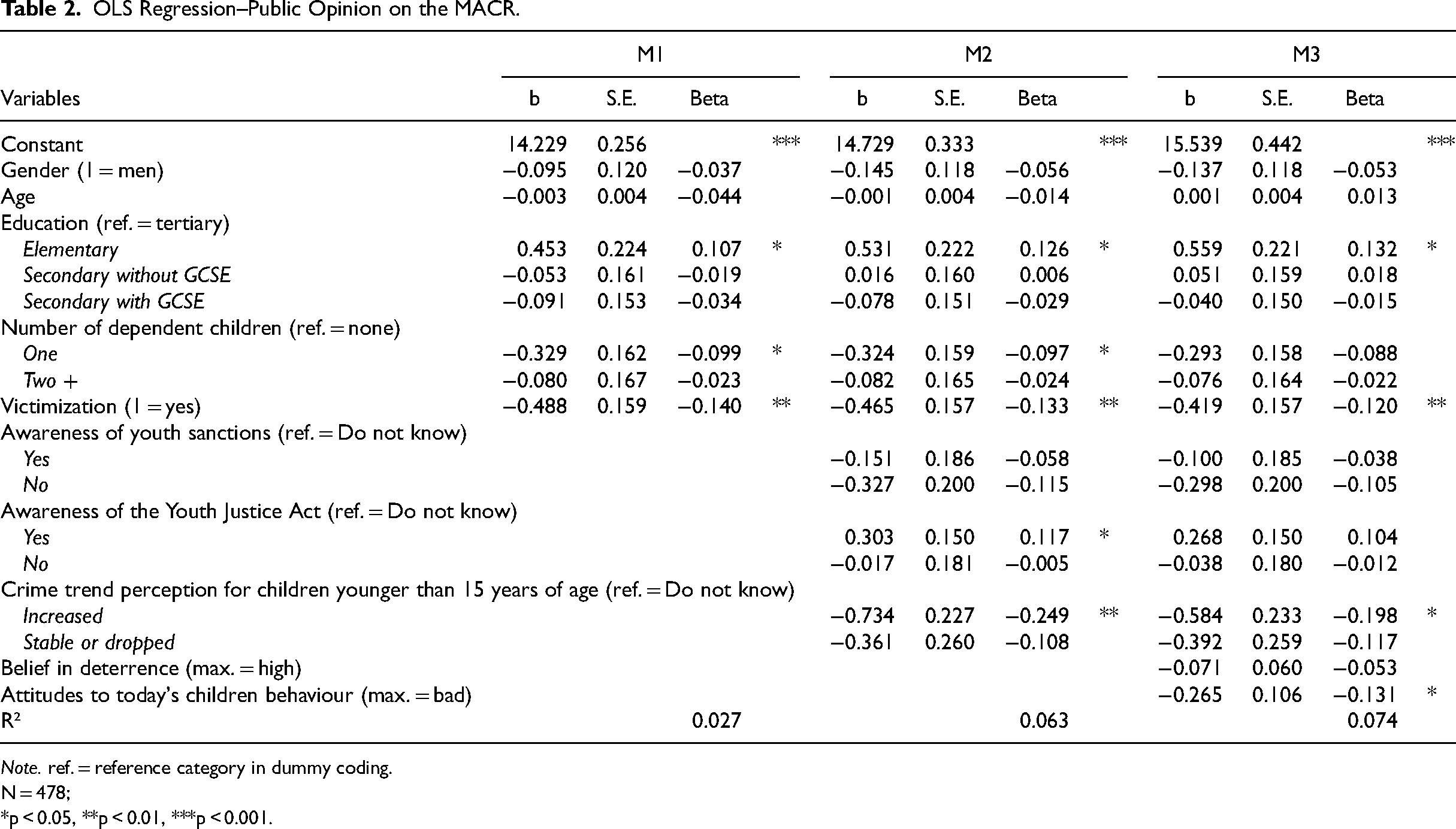
The regression analysis proceeded in three steps (Table 2). First, we estimated Model 1, which contains socio-demographic variables only. The data suggest that these variables have an almost negligible effect on public opinion of the MACR (R2 = 0.027). Beside victimization, a significant association was found for number of dependent children in the household and education, with those with elementary education preferring a higher MACR compared to the university educated.
Second, we included cognitive factors, i.e., crime trend perception for children younger than 15 years of age, awareness of the Youth Justice Act and sanctions imposed on these children, in Model 2. The strongest association was found with respect to perception of the crime trend for children under 15 years of age. Those who perceived it as increasing would prefer a lower MACR (Beta = -0.249) compared to those who were uncertain about the crime trend. Preference for a lower MACR was also associated with victimization (Beta = -0.133). On the other hand, those who were aware of the Youth Justice Act (compared to those who answered ‘do not know' ) would prefer a higher MACR (Beta = 0.117).
Third, Model 3 examines the role of emotions, i.e., belief in deterrence and attitude to the behaviour of today's children. The strongest determinant of public opinion on the MACR was revealed to be the public's attitude to the behaviour of today's children (Beta = -0.131). In addition, once included in the model, the effects of awareness of the Youth Justice Act and perception of the crime trend for children younger than 15 years of age became nonsignificant or weakened. This suggests that the effect of cognitive factors on public opinion on the MACR is rather indirect, mediated through emotions, i.e., notably negative attitude to the behaviour of today's children.
SEM
To thoroughly assess the direct and indirect effects of cognitive and emotional factors on public opinion of the MACR, we employed structural equation modelling (SEM). The results are presented in Figure 1. The model fits the data well, with acceptable fit statistics (RMSEA = 0.04, CFI = 0.971, TLI = 0.938). As expected, awareness of Youth Justice Act was linked to preferences for a higher MACR (0.091). In addition, awareness of sanctions imposed to children was associated with negative attitude to behaviour of today's children. Consistent with the results of the regression analysis, SEM confirms that perception of the crime trend for children younger than 15 years of age primarily influences the dependent variable indirectly, through attitude toward the behaviour of today's children (specific indirect effect = -0.073), further affecting public opinion on the MACR. Individuals who perceive crime to be on the rise tend to hold negative attitude toward the behaviour of today's children (0.486), resulting in a lower preferred MACR by the public (−0.149).
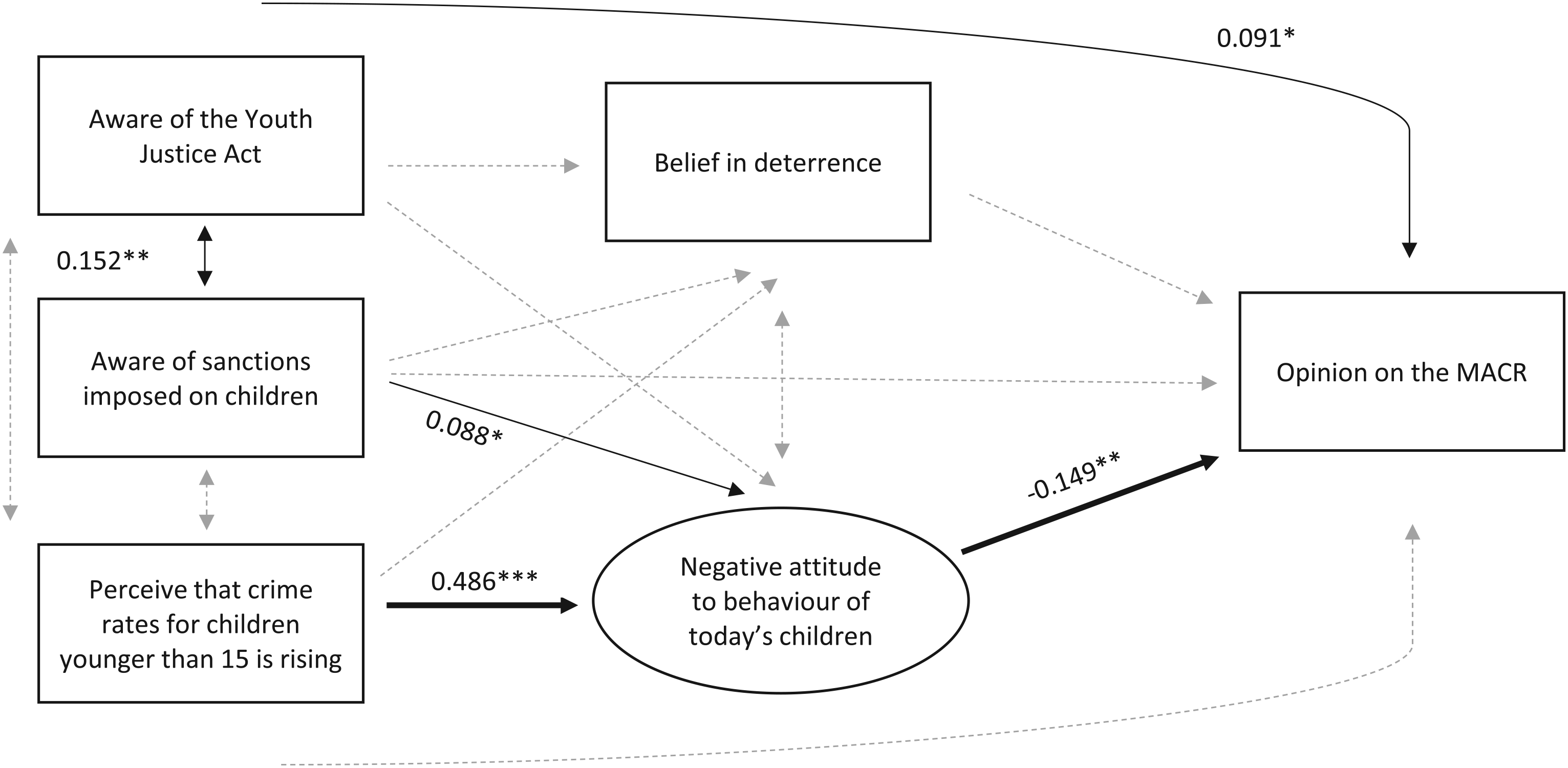
SEM–public opinion on the MACR. Note. SEM (Mplus 8), N = 478; standardized coefficients (StdYX); method MLR, CFI = 0.971, TLI = 0.938, RMSEA = 0.04; dashed arrows indicate non-significant paths, R2 (MACR) = 0.09. Controlled variables: gender, age, education; *p < 0.05, **p < 0.01, ***p < 0.001.
Discussion and conclusion
Criminal policy measures are significantly informed by public opinion and people's concerns about crime expressed by their punitive attitudes are demonstrably linked with stricter legislation, including lowering the MACR (Roberts, 2004; Welch et al., 2019; Wood & Tendayi, 2004). The recent study by Shi (2022) on public punitiveness highlighted the role of cognitive and emotional factors in informing punitive attitudes. However, knowledge in this research area remains limited. Further evidence is needed to validate these findings across different populations and using various indicators of punitiveness. Therefore, our study aimed to address this gap and explore the relationship between cognitive and emotional factors and public opinion on the MACR. Specifically, we investigated whether perception of crime trends and awareness of youth justice measures influence public opinion on the MACR directly or indirectly, through belief in deterrence and attitude towards the behaviour of today's children.
Regression analysis confirmed perception of the crime trend for children younger than 15 years of age to be moderately associated with our dependent variable. Those who perceived an increase in crime by these children thought the MACR should be lowered. On the other hand, awareness of the Youth Justice Act was associated with a more lenient stance. Further, the analysis showed that negative attitude to the behaviour of today's children was negatively associated with public opinion on the MACR. In other words, the stronger the belief that today's children behave substantially worse than in the past, the greater the public tendency to lower the MACR. Moreover, when this factor was introduced into the analysis, cognitive factors were revealed to be non-significant or weakened, suggesting that they influenced public opinion on the MACR rather indirectly. Subsequently, the indirect effect of one of cognitive factors–perception of the crime trend for children younger than 15 years of age–was confirmed by the SEM. Specifically, those who perceived crime to be on the rise tended to hold negative attitude toward the behaviour of today's children, which further influenced preferences for a lower MACR among the public. In addition, we found a direct effect of awareness of the Youth Justice Act on the MACR.
Although our study offers important findings with respect to public opinion on the MACR, we must also draw attention to its limitations. First, we included a wide range of cognitive and emotional factors as well as common socio-demographic factors in the analysis. However, other possible determinants of public opinion on the MACR, e.g., anxiety or fear of youth crime (cf. Shi, 2022) need to be examined in order to verify the robustness of existing findings. Future research could also take into account the effect of media as the public's primary source of crime-related information (Jewkes, 2004). Moreover, increased media coverage of particularly serious cases of child crime can draw attention to the issue of the MACR and incite moral panic (Brown, 2005). Another possibility is to use a more specific indicator for belief in deterrence targeted at youths. In a similar vein, it would be interesting to ask respondents about their opinion on the effectiveness of various educational and preventive measures in the criminal justice system and examine whether their support for these measures bears any association with their opinion on the MACR. Second, as has already been mentioned, people's attitude towards punishment are highly contingent on the chosen methodology. It has been confirmed that broadly worded questions elicit more punitive responses compared to inquiries based on specific case evaluations (Roberts & Hough, 2005b). Future research could thus focus on public opinion on the MACR with respect to specific cases of youth crime. Finally, the cross-sectional nature of our data does not allow us to examine the direction of the analysed relationships. Claims of causality are thus based solely on knowledge arising from theories focusing on public punitiveness and attitude toward criminal policy and previous research in this field.
Determining an appropriate MACR will always be a controversial topic, leading to endless debates among experts, politicians, and the public (Dwyer & McAllister, 2017). On one hand, there are indisputable arguments about the specific characteristics of children under 15 years of age and the need to tailor appropriate methods for addressing the criminal acts they commit. On the other hand, we must also consider that cases of serious offenses committed by children, though rare, tend to provoke moral panic in society. Emotions, heightened by public perceptions of overall crime trends and the existing juvenile justice system, clearly play a significant role in shaping punitive attitudes among citizens and should thus be taken into account when considering appropriate strategies for communicating with the public regarding the MACR.
Footnotes
Declaration of Conflicting Interests
The authors declared no potential conflicts of interest with respect to the research, authorship, and/or publication of this article.
Funding
The authors disclosed receipt of the following financial support for the research, authorship, and/or publication of this article: This study was supported by the Institutional Support for the Long-term Conceptual Development of the Research Organization at the Department of Sociology and Social Work, University of West Bohemia.
