




Abstract
Through surveys in Flanders (Belgium), the article investigates the criminal policy preferences of the public and the police, a topic of considerable policy relevance that has so far received limited academic attention. It describes and compares such preferences both for specific crimes, within the realm of the criminal justice (CJ) process, and in general, considering interventions that reflect the broadening scope of contemporary criminal policy. Data from 2,348 citizens and 381 police officers point to the capability of both groups to discriminate, that is, to support different CJ interventions depending on the crimes considered, and shows that, for most crimes, the public backs more lenient interventions than the police. Instead, both groups’ general criminal policy preferences are quite similar.
Introduction
Criminal policies in western countries have undergone considerable transformation since World War II, yet research on public criminal policy preferences has not kept the pace with these developments. Such research still primarily focuses on preferences concerning judges’ sentencing decisions or broader attitudes towards punishment (see Adriaenssen & Aertsen, 2015), despite the fact that only a minority of criminal proceedings are brought to court and most are ended by the police or prosecution services (see Wade, 2006). Hardly any study has examined which options the public prefers in the earlier phases of the criminal justice (CJ) process for different crimes. In other words, hardly any study has investigated what we term “crime-specific CJ preferences.” There is, instead, a small literature on “general criminal policy preferences,” in which people are asked to choose among CJ- and non-CJ options on how best to deal with crime in general, but these studies have almost exclusively been conducted in the US (e.g., Cohen et al., 2004).
There has also been some research on CJ officials’—and in particular police officers’—preferences for sentencing and punishment and their broader related attitudes, including their trust in the CJ system (e.g., Fielding & Fielding, 1991; Terpstra & Kort, 2016). However, for this group, too, there has been no systematic investigation of their preferences for specific pre-trial interventions for different crimes.
These research gaps are all the more surprising because crime and criminal policy have since the 1980s become almost everywhere contentious public issues, which many politicians and even some CJ officials have repeatedly used to profile themselves and gain public support. In most countries, politicians nowadays set crime control high on their agenda and are eager to grasp, and respond to, public crime concerns and criminal policy preferences. 1 Even many left-wing politicians are afraid to look “soft on crime” (e.g., Bellafante, 2024). True, in Europe CJ officials are more insulated from public opinion requests than their US counterparts, because they are career civil servants (Tonry, 2007). Nonetheless, research suggests that even non-elected public officials are responsive to public opinion, especially on emotional issues, such as crime and its containment, because they strive to maintain institutional legitimacy (Casillas et al., 2011).
Aiming to tackle these gaps, in this article we pursue two interrelated aims, through surveys among residents and police officers in Flanders, the Dutch-speaking part of Belgium and an affluent region of about 6.8 million inhabitants. 2 First, we measure and compare, for specific crimes, the preferences of the public and the police concerning the decisions of the main actors in the CJ system (i.e., lawmakers, police, prosecution services and courts), ranging from formal criminalization to sentencing. Second, we measure and compare public and police's general preferences for dealing with crime, considering interventions that reflect the broadening scope of contemporary criminal policy beyond the enforcement of criminal law and the punishment of offenders.
The article is structured as follows. The first section briefly sketches the most significant changes western criminal policies have undergone since the 1950s. The second section reviews the literature on criminal policy preferences and broader attitudes. In the third section, we formulate our hypotheses, and in the fourth and fifth sections, we present the research design and findings of our empirical study. The last section discusses the main findings and draws research and policy recommendations.
The Ongoing Transformation of Western Criminal Policies
Contemporary criminal policies in many western countries have progressively shifted away from the original aims and constraints established by Cesare Beccaria and other Enlightenment thinkers and spread by the American and French Revolutions and Napoleon's campaigns. In its original “classical” conception, criminal policy was largely equated to the application of criminal law through the CJ system and aimed to prevent crime through the threat and imposition of punishment, and particularly imprisonment (i.e., deterrence). The exercise of such sovereign power, though, was constrained by the principle of proportionality, requiring punishments to reflect the severity of the crimes for which they were imposed, and the respect of procedural standards, most importantly a fair and public trial (Fijnaut, 2017).
As doubts grew about the effectiveness of punishment as an instrument of crime prevention, the latter aim also started to be pursued through alternative means, or a reinterpretation of past ones. Until the 1970s, Anglo-Saxon CJ systems, and particularly the US one, emphasized offenders’ rehabilitation during imprisonment and made extensive use of indeterminate prison sentences, granting extensive discretion to judges and parole boards (Tonry, 2013). When the idea of rehabilitation came under attack (e.g., Martinson, 1974), there was a brief rediscovery of retributivism, with several theorists emphasizing the relevance of deserts considerations for the justification of punishment (e.g., von Hirsch, 1976). In US criminal policymaking and practices, though, the principle of proportionality was soon discarded again, with new sentencing laws mandating lengthy sentences primarily meant to incapacitate offenders (Tonry, 2013). While criminal policies in other Anglo-Saxon countries were influenced by the changes in US policy, CJ systems in continental Europe remained throughout more faithful to the principle of proportionality, although positivist ideas about rehabilitation inspired the development of separate juvenile CJ systems (e.g., Lappi-Seppälä, 2007; Snacken, 2007).
Despite partially diverging paths at the core of criminal policy, the latter's scope has widened considerably in all western countries. Since the 1980s, crime prevention through non CJ-means has become so prominent in western criminal policies that some commentators speak of a “preventive turn” (e.g., Edwards & Hughes, 2009). Not only have businesses and households increasingly been made responsible for their own security, resulting in a boom of the private security industry, but also the palette of state interventions has grown considerably. State agencies nowadays pursue crime prevention through wide-ranging approaches, from developmental and situational crime prevention to rehabilitation and treatment of offenders, both in and outside prisons (for an overview, see Tilley & Sidebottom, 2017). In some countries, including Belgium, criminal policies have even been formally integrated in broader security policies (Federale Overheidsdienst Justitie, 2022). In all, they have become closely intertwined with the so-called public–private “governance of security,” which aims to prevent not only crime-related but also other security threats (Greenfield & Paoli, 2022).
Given the ongoing shift from the “post-crime” logic of criminal law to the “pre-crime” logic of security and risk preemption (Zedner, 2007) and the associated rise of intelligence-led policing (Ratcliffe, 2016), the police have come to play key roles in determining the crimes to be prioritized, as they produce the intelligence on the basis of which such decisions are made. At the level of the European Union (hereafter: EU), for example, the data and analyses of Europol, the EU police agency, feed the EU Policy Cycle for Organized and Serious International Crime, which has become the core instrument of EU internal security policy (see Europol, 2022). Doubts have been raised, though, on the methodologies through which EU criminal policy priorities are set and criminal interventions are decided, especially with regards to drug trafficking (e.g., Paoli, 2014; van Duyne & Vander Beken, 2009).
Since the 1980s there has also been a great expansion of victim initiatives, programs and legislation. Whereas victims were until then barely visible in the CJ process, in many western jurisdictions they now have, at least in principle, access to justice, restitution and compensation for the harm suffered as well as a modicum of medical, psychological and social assistance (Shapland, 2018). Restorative justice has also spread rapidly since the late 1990s, leading to the establishment of victim–offender mediation and family conferencing for juvenile—and increasingly adult—offenders in most western countries (see https://www.restorativejusticeinternational.com/).
The sanction arsenal itself has also broadened, prompted by both the progressive differentiation of sentences on the basis of offender characteristics and the slow recognition of the harms accruing from imprisonment. In most western jurisdictions, including Belgium, (a variety of) community sentences have been added to imprisonment (Dünkel & Lappi-Seppälä, 2014). Whereas white-collar crimes have since their acknowledgment been primarily handled via non-penal (i.e., civil or administrative) procedures and sanctions (Braithwaite, 2003), such procedures and sanctions—as well as hybrid civil–criminal preventive orders—have since the 1990s been used to deal with a growing number of offences (Ashworth & Zedner, 2014).
The traditional criminal law approach is increasingly questioned in drug policy. Several countries (e.g., Spain and Portugal) have decriminalized the use and/or possession of small amounts of illegal drugs for personal use, substituting criminal with administrative sanctions (European Monitoring Centre for Drugs and Drug Addiction, 2022). Other countries (e.g., Canada and Germany) have gone further and, to varying extent, legalized the production and distribution of cannabis (Hammond et al., 2020; Thurau, 2024). The Belgian drug legislation, instead, has remained fairly conservative. There, even the possession of small quantities of illegal drugs remains a criminal offence, potentially generating prison sentences; however, since 2005 the simple possession of up to three grams of cannabis or a plant has been given the lowest prosecution priority (De Bondt & Colman, 2023).
To cope with the growing overload of CJ systems, there has also been a substantial reduction in the number of cases brought to court. Many western jurisdictions have increased the discretion of police and prosecution services in closing criminal proceedings. In Belgium, for example, in 2023 only 6% of all cases handled by prosecution services were referred to a judge for further investigation or brought to court (College van Procureurs-Generaal, 2024). While prosecution services often serve as “judges before the judge,” the discretion of the police has also grown in many jurisdictions. Moreover, even when a case is brought to court, judges increasingly rely on simplified procedures through which they de facto rubberstamp prosecutorial decisions (the so-called penal orders; Wade, 2006). On the basis of an extensive comparative analysis, Jehle (2006) concluded that hardly any country in Europe follows the principle of legality, i.e., prosecution and public trial for all offenders, without exception. In many common law jurisdictions, large proportions of defendants opt to plead guilty because the penalty for exercising their constitutional right to a public trial is too high to risk (National Association of Criminal Defense Lawyers, 2018).
Hence, while criminal trials continue to be presented as the bread and butter of criminal policy in mass media content, they have become the exception rather than the rule and, reflecting the growing complexity of western criminal policies, are flanked or substituted by numerous other penal and non-penal means.
Research on Criminal Policy Preferences and Attitudes
Much like the media, the literature on criminal policy preferences has not yet fully acknowledged the growing complexity of western criminal policy. Studies concerning legislative measures or policies have mostly examined public preferences for sentencing or punishment. In particular, public preferences have been investigated for mandatory sentencing, such as the “three strikes and you are out” legislation in the US (e.g., Applegate et al., 1996; Roberts, 2003; Roberts & Stalans, 2000), parole (e.g., Bartels et al., 2018; Cullen et al., 2000; Roberts, 1988), disenfranchisement (withdrawal of right to vote for (ex-)prisoners; e.g., Cain & Parker, 2019; Manza et al., 2004; Pinaire et al., 2003), and, most extensively, the death penalty (e.g., McCarthy & Brunton-Smith, 2024; Unnever, 2010; Vidmar & Ellsworth, 1974).
There is a broader literature investigating public preferences concerning judges’ sentencing decisions. Many studies have asked people to choose the most appropriate sentence for particular offences or offenders. In the fifth round of the European Social Survey, for example, respondents were asked to determine which sentence should be given to a 25-year-old male found guilty of house burglary for the second time. Though such decisions represent, in fact, preferences, the literature usually labels them as attitudes towards punishment or punitive attitudes (see Adriaenssen & Aertsen, 2015).
Broader attitudes towards punishment—that is “personal beliefs, perceptions, values, emotions, etc. about punishment” (Adriaenssen & Aertsen, 2015, p. 93)—have also been investigated. Many of these studies indicate that most people believe that judges are too lenient (e.g., Cullen et al., 2000; Kury et al., 2002), because they tend to underestimate the severity of the sentences judges actually impose (Gelb, 2006; Roberts & Hough, 2005; Roberts et al., 2003). 3 On the basis of this and other data, several scholars have spoken of “populist punitiveness” (Bottoms, 1995), arguing that since the 1980s the public has become more harsh towards crimes and offenders and less willing to defer criminal policy deliberations to experts or professionals than before. Other scholars, though, have retorted that such evolution, if at all, has occurred only in the Anglo-Saxon countries (Tonry, 2007). A study in Germany, for example, has shown that, in fact, public punitiveness has decreased between 2004 and 2014 (Baier et al., 2017).
Only few studies have examined public preferences beyond sentencing and punishment, also considering crime prevention and control. Some of them have measured people's support for a specific policy option, such as hot spots policing (e.g., Metcalfe & Pickett, 2018) or police defunding (e.g., Cobbina-Dungy et al., 2022). Others have mimicked the actual task of policymakers, asking people to choose which of two or more policy options they would rather fund (e.g., Baker et al., 2015; Cullen et al., 1998; Sims & Johnston, 2004) or how they would allocate a predefined budget across a given set of policy options (e.g., Cohen et al., 2006; Dunbar, 2020; Wozniak, 2020). Aiming at a stronger measure of commitment, some researchers have even asked respondents whether they would be willing to pay additional taxes to support specific policy options (e.g., Cohen et al., 2004; Nagin et al., 2006; Piquero & Steinberg, 2010).
The findings of these studies are not easily comparable, as they consider different policy options. Nevertheless, they generally indicate that the public is more willing to fund preventive and rehabilitative measures than repressive measures (e.g., Dunbar, 2020; Roberts et al., 2003; Wozniak, 2020). Although longitudinal studies are scarce, some researchers have concluded that public support for repressive, “get tough” policies focusing on deterrence, law enforcement and punishment has dwindled in the past decades, while public support for non-CJ preventive measures has grown (e.g., Ramirez, 2013).
In the literature on criminal policy preferences, key concepts are often not precisely defined. Crime control, for example, is frequently presented as an overarching concept encompassing all possible ways of dealing with crime, from prevention to punishment (e.g., Dunbar, 2020). To our knowledge, no effort has been made to single out the different phases of the CJ process; for example, no study has asked the public how the police and prosecution services should proceed after a crime has been reported to them.
In addition to these substantive and conceptual weaknesses, the literature on criminal policy preferences suffers from two other shortcomings. First, it has not distinguished between policy preferences for different crimes and has measured such preferences only for crime in general. Second, it has a strong Anglo-Saxon focus, with few studies involving continental European countries.
The corresponding literature on CJ officials has mostly focused on their—and specifically police officers’—attitudes, rather than their criminal policy preferences. A few studies have examined police officers’ attitudes towards single measures or approaches, including community policing (Lurigio & Skogan, 1994) and pre-trial diversion (Schaible et al., 2021). Several quantitative studies have investigated police officers’ punitive attitudes (e.g., Kemme et al., 2021; Simmler et al., 2021) and, more rarely, those of other CJ officials (e.g., Baier et al., 2017). In broader, often mixed-methods studies, police officers' attitudes towards specific interventions, such as rehabilitation and capital punishment, have also been compared. These studies have often concluded that police officers favor (harsher) punishment over efforts to rehabilitate (e.g., Fielding & Fielding, 1991; Terpstra & Kort, 2016). In some of these and other studies, including some by now classical ethnographies (e.g., Skolnick, 1966), police officers were also reported to be frustrated with the CJ system, because the latter, in their view, does not effectively contribute to solving the social problems they face in their daily work (see, for example, Terpstra & Kort, 2016).
There have also been a few comparative studies, which have mostly concluded that police officers are, in general, more punitive in their orientation than the general public (e.g., Furnham & Alison, 1994; Ortet-Fabregat & Perez, 1992). Police officers’ punitiveness has been seen as a consequence of their specific role and tasks (e.g., Fielding & Fielding, 1991). The scarcity of comparative research is particularly surprising because police officials contribute to shaping, not just implementing criminal policy, and their legitimacy would be weakened if the discrepancy between public views and actual policy and practice became too large (Roberts, 2008; Roberts & Hough, 2005).
Aims and Hypotheses
The current study addresses some of the above-mentioned shortcomings, i.e., the outdated, partial and simplistic conceptualization of criminal policy; the neglect of public and CJ officials’ preferences concerning the numerous decisions in the CJ process that precede sentencing and punishment; the lack of systematic attention for crime-specific CJ preferences; and the scarcity of comparative research.
First, we measure and compare, for ten crimes, the preferences of the public and the police in Flanders, the Dutch-speaking part of Belgium, concerning the decisions of lawmakers, police, prosecution services and courts, reflecting the options available to the key actors in the Belgian CJ system (which we term “crime-specific CJ preferences”). In particular, we examine how far the Flemish public and police support the implementation of what we refer to as the “model CJ process” (hereafter: extent of support for the model CJ process) for different crimes. 4 Taking the Belgian criminal law and procedures into account, we have operationalized this process as consisting of the following steps: (a) formal criminalization; (b) initiation of criminal proceedings; (c) prosecutorial decision; and (d) sentencing (specifically, unsuspended prison sentences for all guilty adult offenders).
Second and more broadly, we measure and compare the general criminal policy preferences of the Flemish public and police. Reflecting the broadening scope of western criminal policies, and drawing from the literature, we let the Flemish public and police allocate a certain budget among five interventions: (a) arresting, prosecuting, and punishing offenders; (b) proactive policing and other forms of situational crime prevention (hereafter: SCP); (c) offender rehabilitation; (d) addressing social and individual causes of crime; and (e) harm restoration, an intervention reflecting the expansion of victim assistance and restorative justice. We refer to the first option as “classical” CJ-interventions and the latter three as non-CJ interventions. 5 We consider the second option an intermediate one, as it consists of both proactive policing, encompassing police's “sentinel” function (Nagin, 2013), and situational crime prevention, which can be implemented by the police, non-CJ state agencies and even private entities.
With regards to the first aim, we cannot draw hypotheses directly from the literature given its above-mentioned shortcomings. Therefore, we have derived tentative hypotheses from the related literature on crime seriousness perceptions, initiated by Sellin and Wolfgang (1964), and from the comparative studies on punitive attitudes. First, we expect the public and the police to show the highest support for the model CJ process—and hence the most severe interventions—for interpersonal crimes, above all murder, to be less supportive of such process for property crimes and least supportive of it for drug crimes (hypothesis 1A; Adriaenssen et al., 2020; Rossi et al., 1974). Second, we expect the police to prefer more severe interventions than the public (hypothesis 1B; Furnham & Alison, 1994; Ortet-Fabregat & Perez, 1992).
With regards to the second aim, we expect the public to be more in favor of non-CJ interventions than of classic CJ interventions, proactive policing and other forms of SCP (hypothesis 2A). This hypothesis is based on the findings of recent studies (e.g., Dunbar, 2020; Wozniak, 2020). Because of their affiliation with the CJ system, we expect the police to be more in favor of classic CJ interventions, proactive policing and other forms of SCP than of non-CJ interventions (hypothesis 2B; see also Fielding & Fielding, 1991; Terpstra & Kort, 2016). Combining these two hypotheses, we also assume that the public is more supportive of non-CJ interventions and less supportive of classic CJ interventions, proactive policing and other forms of SCP than the police (hypothesis 2C).
Methods 6
Sampling
Public Sample
The target population consisted of adult residents in Flanders (± 5.4 million people; Vlaamse Overheid, n.d.-b). The budget did not allow us to obtain a substantial mail or telephone sample. Therefore, we opted for a social media sample. More concretely, we advertised our questionnaire to randomly chosen Facebook/Instagram users meeting two criteria, i.e., being 18 years or older and having their main residence in Flanders. Only people who met these two criteria could receive the advertisement. An algorithm made the actual selection of who was (not) shown the advertisement.
We acknowledge that this procedure entailed some risks. First, a risk of non-coverage bias, as previous studies have shown that not all societal groups have equal access to the internet and/or are equally active on social media (e.g., Chinn & Fairlie, 2007; Mellon & Prosser, 2017). Second, a risk of unit non-response bias, with the likelihood of noticing the advertisement, clicking on the link included in the advertisement and starting the questionnaire likely to differ between societal groups. Third, a risk of item non-response bias and drop-out bias, with some societal groups having a higher chance of not answering specific questions or quitting the questionnaire. To address these potential biases, we continuously compared the sample distribution to the population distribution for all characteristics on which population data was available, i.e., sex, age, and educational level. If differences became too large, we temporarily changed the selection criteria of the advertisement.
We advertised our questionnaire for eight weeks, from September 22 to November 18, 2021. 7 After data-cleaning, 8 we obtained a final public sample of 2,348 people. Table 1 presents their socio-demographic characteristics.
Samples’ Socio-Demographic Characteristics.
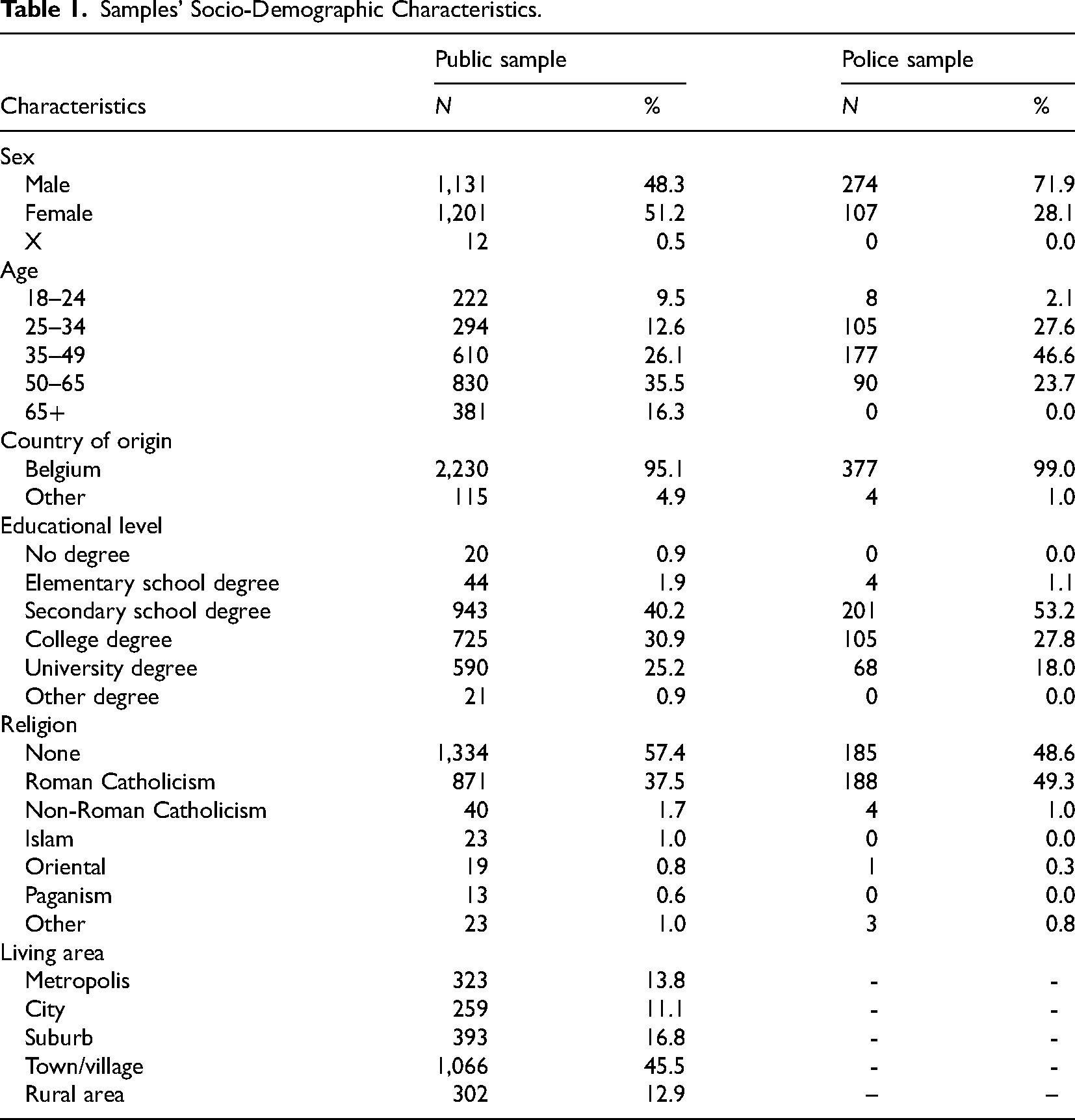
We compared the sample distribution to the population distribution for sex, age and educational level. Our sample was representative for sex (χ²=0.337, df = 1, p = .562), but not for age (χ²=182.789, df = 4, p < .001) or educational level (χ²=399.114, df = 2, p < .001). In our sample, people 25–34 and 65 + years old as well as those with no degree or an elementary school degree were underrepresented, whereas people 35–65 years old and those with a college or university degree were overrepresented. Kühne and Zindel (2020) found similar differences between their social media sample and the general population: in their study, too, the former was younger and higher educated than the latter. These differences likely reflect the fact that social media users in general are younger and higher educated than non-social media users (Mellon & Prosser, 2017).
To correct for these sample-population differences, and hence potential bias in our findings, we calculated weights using a raking procedure. Accordingly, the weight for each case in our sample was iteratively adjusted until our sample distribution aligned with the population distribution for age and educational level (Kalton & Flores-Cervantes, 2003). To avoid excessive sampling error, we truncated weights more than five times the mean weight or more than the sum of the median weight and six times the weight interquartile range (Peck, 2011). Applying these weights, our sample became representative of the population of adult residents in Flanders, at least for sex, age and educational level.
Police Sample
The target population consisted of people employed part- or full-time as police officer for a decentralized judicial federal police unit (DJFPU; 6) or a local police unit (107) in Flanders (± 16,075 people). 9 To obtain a sample of this population, we requested all six DJFPU and 38 local police units to participate in the survey. Eventually, four DJFPU and 23 local police units agreed to participate and invited their officers to fill out the questionnaire. The participating units were asked to send a reminder approximately three and a half weeks after the initial invitation.
The police survey also ran eight weeks, from September 22 to November 18, 2021. After data-cleaning, 10 381 questionnaires remained. The socio-demographic characteristics of the final police sample can be found in Table 1. With regards to professional characteristics, the large majority of the police officers worked for a local police unit (90.6%); the sample distribution of local police and DJFP officers reflected the distribution in Flanders (χ²=0.056, df = 1, p = .813). 11 The police officers’ seniority ranged from less than a year to 43 years, with an average of 16.90 years (SD = 10.30). Most of them were inspectors (60.3%) or chief inspectors (26.8%); 11.3% were commissioners and 1.6% chief commissioners.
Measurement Instrument
Crime-Specific CJ Preferences: Crime Selection
For the first study aim, the measurement of CJ preferences for specific crimes, we selected ten crimes. To ensure that not only police respondents, but also public respondents could provide valid answers to the questions, we chose crimes that were shown regularly on Flemish television (Adriaenssen, 2016) and/or had received considerable attention in recent policy debates (e.g., Federale Overheidsdienst Justitie, 2022; Federale Politie, 2022). Furthermore, we included not only serious crimes, but also less serious crimes to allow for diversification in the respondents’ answers. More concretely, we included the interpersonal crimes of murder, physical assault and stalking, the property crimes of burglary, vandalism and fraud, and the drug crimes of cannabis use/possession, hard drug use/possession, cannabis trafficking and hard drug trafficking. 12 For the two drug use/possession crimes, we specified that they entailed no aggravating circumstances according to the Belgian drug legislation, i.e., involved no minors and took place in a private setting.
To avoid burdening respondents excessively, we included only six crimes in each questionnaire. All respondents received questions on burglary and murder, because we regarded them as benchmarks for the assessments of the other crimes. Burglary has one of the highest recorded incidences in Belgium (Federale Politie, 2023), and thus respondents were likely to have had some direct or indirect experience with it. Murder is usually assessed as the most serious crime in perceived crime seriousness studies, including a recent Flemish one (Adriaenssen et al., 2020). Next, we presented either cannabis use/possession or hard drug use/possession (based on randomization with equal chances), because drug use is usually considered one of the least serious crimes in perceived crime seriousness studies (e.g., Borg et al., 2023). The questionnaire continued with either vandalism or fraud, followed by physical assault or stalking (both based on randomization with equal chances). The last questions concerned either cannabis trafficking (in case of an earlier assignment of cannabis use/possession) or hard drug trafficking (in case of an earlier assignment of hard drug use/possession).
For each crime, we gave a brief, generic description to the respondents. For example, vandalism was described as “someone intentionally damages or destroys property of someone else.” In this way, we tried to avoid the opposite risks of having the respondents “fill in the blanks” (Lynch & Danner, 1993) or having them assess a specific event rather than a crime.
Crime-Specific CJ Preferences: Questions
We developed five questions to measure crime-specific CJ preferences. First, for cannabis and hard drug use/possession, we asked whether these acts should remain prohibited or be legalized. 13 Second, for each crime (except cannabis or hard drug use/possession if legalization was preferred), we asked the respondents whether criminal proceedings should be initiated for adult offenders or whether an alternative or additional measure should be adopted, i.e., police drop and/or administrative sanction. Respondents could select multiple options, if their choice depended on the specificities of the concrete offences (context, offender, victim, etc.). Third, for each crime that in their view required the initiation of criminal proceedings for at least some adult offenders, and hence no de facto decriminalization, we asked the respondents to choose a standard prosecutorial decision for first-time adult offenders. Here, respondents could choose among the three main options used by Belgian prosecutors: prosecutorial drop, conditional disposal, and court referral (College van Procureurs-Generaal, 2024). Fourth, for the same subset of crimes, respondents were asked to indicate the extent to which they supported unsuspended prison sentences for all adult offenders found guilty by a criminal court. Here, we used an 11-point answer scale (0–10).
General Criminal Policy Preferences
To investigate general criminal policy preferences, we selected the following five interventions: (a) arresting, prosecuting and punishing offenders; (b) proactive policing and other forms of SCP (“organizing police patrols/checks and implementing other measures that might discourage people from committing crime [e.g., CCTV]”); (c) offender rehabilitation (“organizing treatment for offenders to restrain them from committing more crime”); (d) addressing social and individual causes of crime; and (e) harm restoration (“restoring the harms caused by crime”). The first four interventions were informed by previous studies on public preferences for criminal policy priorities (i.e., Baker et al., 2015; Buckler et al., 2009; Cohen et al., 2006; Dunbar, 2020). Harm restoration was added to explore respondents’ support for victim assistance and restorative justice vis-à-vis “classic” CJ.
To let the respondents experience the complexity of public policymaking, we mimicked the task of actual policymakers and used a 100-point distribution question (see also Altamirano et al., 2024), i.e., asked the respondents to allocate a total budget of 100 points among the five interventions. Respondents could allocate the budget (or points) to the five interventions in any way they wanted, but they had to spend the full budget (or 100 points); if they spent more or less than 100 points, they received an error message, reminding them that they had to spend exactly 100 points. Our approach is similar to that employed in recent studies on public preferences for criminal policy (e.g., Dunbar, 2020; Wozniak, 2020) and other areas of public policy (e.g., Altamirano et al., 2024).
Analyses
First, we compared CJ preferences for the different crimes and between the two samples. More concretely, we calculated, for each sample, (a) the percentages preferring the legalization of cannabis and hard drug use/possession, and, for each crime and sample, (b) the percentages preferring police drops, administrative sanctions and criminal proceedings for some or all adult offenders; (c) the percentages preferring prosecutorial drops, conditional disposals and court referrals for first-time adult offenders; and (d) the mean support for unsuspended prison sentences for all adult offenders found guilty by a criminal court. We tested the differences between the samples for significance via chi-square tests (categorical variables) and independent samples t-tests (continuous variables).
We then compared the general criminal policy preferences of the public and police samples. For each sample, we calculated the mean proportion of the budget assigned to each intervention. We tested the differences between the samples for significance via independent samples t-tests. For these and all other tests, we used the standard significance level of .05.
Findings
Crime-Specific CJ Preferences
We report the findings per question. The findings regarding the first three questions are summarized in Table 2 and Figure 1.
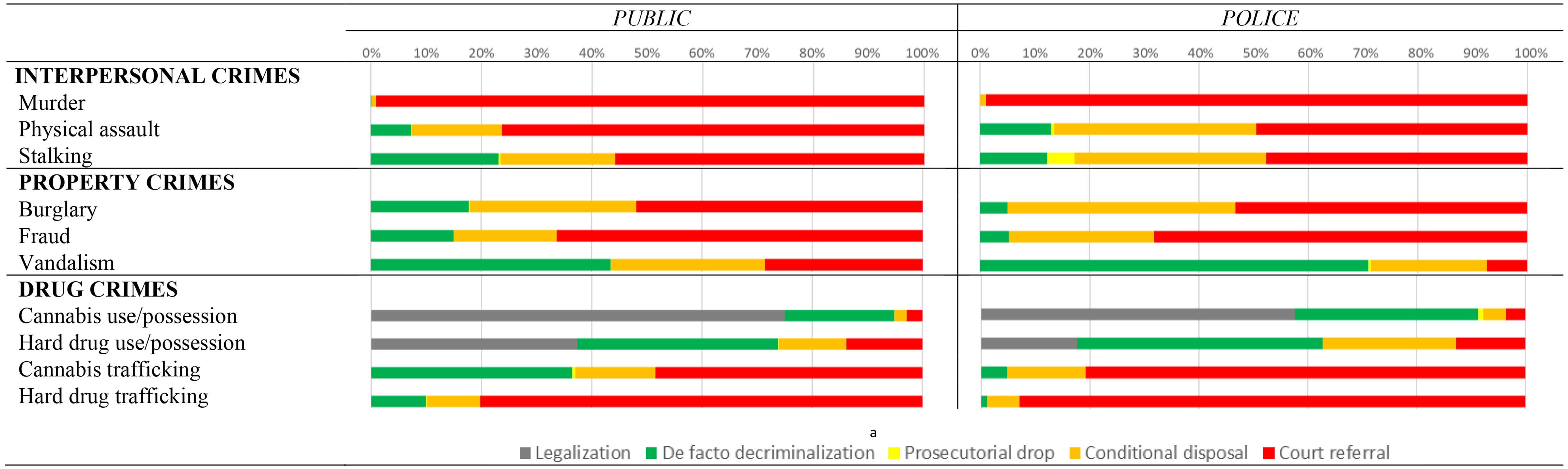
Preferred CJ approach.
Preferred CJ Approach (in %).
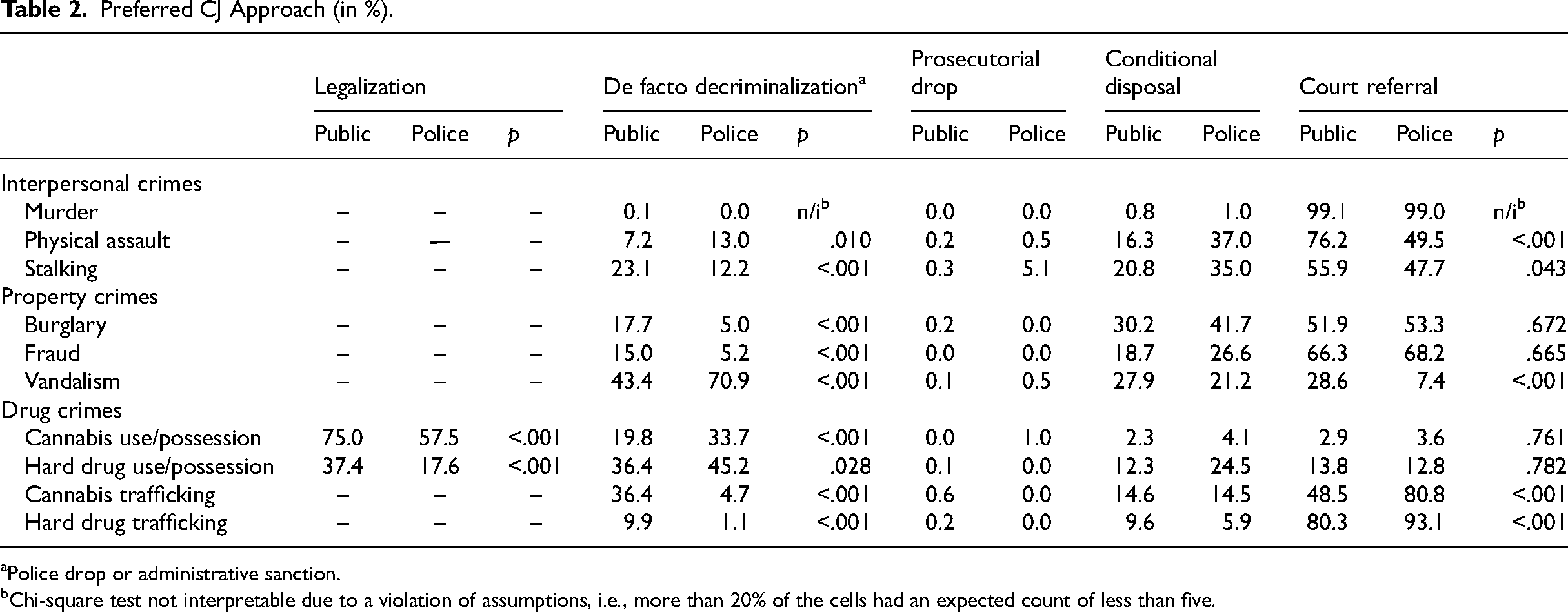
Police drop or administrative sanction.
Chi-square test not interpretable due to a violation of assumptions, i.e., more than 20% of the cells had an expected count of less than five.
Legalization of Drug Use/Possession?
With the first question, we asked the respondents whether cannabis or hard drug use/possession should remain prohibited or be legalized. For the former, (large) majorities in both the public and police samples supported legalization (75% and 57.5%, respectively). No majority in either sample, instead, opted for the legalization of hard drug use/possession, though 37.4% of the public respondents did so (versus 17.6% of the police respondents). For both cannabis and hard drug use/possession, the percentage preferring legalization was significantly higher in the public sample than in the police sample (χ²=24.006, df = 1, p < .001 and χ² = 27.093, df = 1, p < .001, respectively).
De Facto Decriminalization?
Answering our second question, respondents had to decide whether police drops, administrative sanctions, and/or criminal proceedings were appropriate for the selected crimes. Their answers here, too, showed their capacity to discriminate among the different crimes. In both samples, more than 90% of the respondents opted for criminal proceedings for at least some offenders in the cases of murder and hard drug trafficking. Large majorities (>70%) in both samples also called for criminal proceedings for at least some offenders in the cases of physical assault, stalking, burglary and fraud. For vandalism, the percentages were much lower: only 56.6% of the public and 29.1% of the police respondents wanted criminal proceedings for at least some offenders. For cannabis trafficking there was also a large, but inverted, split between the two samples: 95.3% of the police sample supported criminal proceedings, whereas only 63.6% of the public sample did so. The support for criminal proceedings was lowest for drug use/possession. Only 5% of the public and 8.8% of the police respondents opted for criminal proceedings for at least some offenders in the case of cannabis use/possession, whereas the respective percentages grew to 26.2% and 37.2% in the case of hard drug use/possession.
Relatively few respondents chose police drops, especially in the public sample. Here, the highest percentages were found for cannabis trafficking (15.9%) and hard drug use/possession (9.6%), followed by vandalism (7.5%) and cannabis use/possession (7.1%). Perhaps because they are more familiar with the functioning of the CJ system, the police respondents chose this option slightly more often, especially for hard drug use/possession (17.0%), vandalism (16.9%), cannabis use/possession (10.4%) and burglary (8.7%).
There was generally much more support for administrative sanctions. A large majority of the police sample (71.4%) considered such sanctions appropriate for vandalism, but a substantial share also supported them for hard drug use/possession (39.4%) and cannabis use/possession (28.0%). Among the public respondents, administrative sanctions were also considered an appropriate reaction to vandalism (51.4%), but less so than in the police sample. Approximately one third of the public respondents also chose these sanctions for a variety of other crimes (hard drug use/possession: 33.6%; cannabis trafficking: 32.3%; stalking: 29.7%; burglary: 27.7%; fraud: 23.6%).
More generally, we see that considerable shares of the public and police samples did not regard criminal proceedings as an appropriate reaction to several crimes, and hence supported their de facto decriminalization. In both samples, this percentage was highest for vandalism (public 43.4%; police: 70.9%). Hard drug use/possession scored second (public: 36.4%; police: 45.2%). More than a third of the public respondents also called for the de facto decriminalization of cannabis trafficking (36.4%) and lower fractions did so also for stalking (23.1%) and cannabis use/possession (19.8%). Instead, in the police sample only the latter was considered suited for such an approach by a considerable share of the respondents (33.7%).
Chi-square tests reveal that, for several crimes, the percentage of public respondents who preferred de facto decriminalization was significantly higher than the percentage of police respondents who did so. 14 This pattern was inverted (and again significant) in the cases of vandalism and physical assault, perhaps because the police are more aware than the public that many manifestations of these two crimes only entail limited harm. For cannabis and hard drug use/possession, too, the support for de facto decriminalization was significantly higher in the police sample than in the public sample. In this respect, however, it is important to recall that the public support for the legalization of drug use was substantially higher than the police's (see above).
Standard Prosecutorial Decision?
We found similar patterns when we measured the samples’ preferences for standard prosecutorial decisions with our third question. The highest percentages supporting the most severe option, i.e., court referrals, were found for murder (public: 99.1%; police: 99.0%) and hard drug trafficking (public: 80.3%; police: 93.1%). For the latter, the support was significantly higher in the police sample than in the public sample (χ²=16.991, df = 1, p < .001). Different crimes were ranked third highest in the two samples regarding support for court referrals: in the public sample, physical assault (76.2%; police: 49.5%), and, in the police sample, cannabis trafficking (80.8%; public: 48.5%). For these two crimes, the differences between the samples were also significant (χ²=55.015, df = 1, p < .001 and χ²=67.536, df = 1, p < .001, respectively). At the opposite end, court referrals were least chosen for cannabis use/possession (public: 2.9%; police: 3.6%; χ²=0.092, df = 1, p = .761). Low percentages also opted for court referrals for hard drug use/possession (public: 13.8%; police: 12.8%; χ²=0.076, df = 1, p = .782). In the police sample, the support for court referrals was even lower for vandalism (7.4%); in the public sample, such support was significantly higher (28.6%; χ²=36.970, df = 1, p < .001), but still the third lowest. There was, instead, considerable consensus between the samples regarding support for court referrals in the cases of fraud (public: 66.3%; police: 68.2%; χ²=0.188, df = 1, p = .665) and burglary (public: 51.9%; police: 53.3%; χ²=0.179, df = 1, p = .672). There were rather small, but significant, differences between the samples in the case of stalking (public: 55.9%; police: 47.7%; χ²=4.093, df = 1, p = .043).
Very limited percentages of respondents opted for prosecutorial drops. In the public sample, none was higher than 1%; in the police sample, the highest percentage was 5.1%, in the case of stalking. There was, instead, considerable support for conditional disposals, especially among the police respondents. In both samples, burglary was the crime considered most suited for such measure (public: 30.2%; police: 41.7%). In each sample, more than 20% also chose conditional disposals for stalking (public: 20.8%; police: 35.0%) and vandalism (public: 27.9%; police: 21.2%). For the police respondents, this was also true for physical assault (37.0%), fraud (26.6%) and hard drug use/possession (24.5%). In the public sample, instead, less than 20% backed conditional disposals for these crimes. In both samples, the support for conditional disposals was lowest for the crimes that elicited the most severe or lightest reactions (i.e., murder and cannabis use/possession, respectively).
Unsuspended Prison Sentences?
In a fourth step, we compared the support for unsuspended prison sentences for all adult offenders found guilty of the selected crimes by a criminal court among the public and police respondents. Here, we set the value to zero for respondents not supporting criminal proceedings for any offender, and, in the case of drug use/possession, for those preferring legalization.
Unsurprisingly, the support for unsuspended prison sentences was highest for murder (public: M = 9.20, SD = 2.01; police: M = 9.46, SD = 1.49). Hard drug trafficking obtained the second highest scores (public: M = 7.84, SD = 3.38; police: M = 8.84, SD = 2.06). There was, instead, no consensus between the two samples regarding the crime ranked third highest. For the police sample, it was cannabis trafficking (M = 7.88, SD = 2.86), for the public sample physical assault (M = 7.52, SD = 3.25). For these two crimes, the respective scores were much lower in the other sample (cannabis trafficking in the public sample: M = 4.92, SD = 4.37; physical assault in the police sample: M = 6.07, SD = 3.55).
At the opposite end of the scale, the support for unsuspended prison sentences was lowest for cannabis use/possession (public: M = 0.38, SD = 1.77; police: M = 0.63, SD = 2.26). Slightly higher, but still low, scores were recorded for hard drug use/possession (public: M = 2.01, SD = 3.66; police: M = 2.40, SD = 3.54). Once again, the second lowest score in the police sample concerned vandalism (M = 1.61, SD = 2.95). Vandalism triggered considerably more support for unsuspended prison sentences in the public sample (M = 3.94, SD = 4.11), but was still the public's third lowest ranked crime. As previously, the opposite pattern was found for cannabis trafficking (public: M = 4.92, SD = 4.37; police: M = 7.88, SD = 2.86). In both samples, intermediate scores in terms of support for unsuspended prison sentences were recorded for fraud (public: M = 6.57, SD = 3.62; police: M = 7.16, SD = 3.01), burglary (public: M = 5.73, SD = 3.84; police: M = 7.20, SD = 3.14) and stalking (public: M = 5.94, SD = 3.99; police: M = 5.88, SD = 3.17).
Independent samples t-tests reveal that the support for unsuspended prison sentences for cannabis and hard drug use/possession did not significantly differ between the two samples (t[236.46]=–1.491, p = .137 and t[1226]=–1.375, p = .169, respectively); for cannabis and hard drug trafficking, though, the support for such sentences was significantly higher in the police sample than in the public sample (t[376.06]=–12.008, p < .001 and t[397.43]=–5.440, p < .001, respectively). For the interpersonal and property crimes, the picture was blurred. The public sample was significantly more in favor of unsuspended prison sentences for physical assault (t[237.67] = 5.192, p < .001) and vandalism (t[333.83] = 9.330, p < .001), and significantly less in favor of such sentences for murder (t[659.12]=–2.971, p = .003), burglary (t[605.23]=–8.086, p < .001) and fraud (t[301.53]=–2.404, p = .017), than the police sample. The support for unsuspended prison sentences for stalking did not significantly differ between the two samples (t[329.27] = 0.232, p = .816).
Extent of Support for Model CJ Process?
To synthetize CJ preferences in a single score, we constructed, for each crime, an index summarizing the respondents’ answers to the four questions discussed above. As these questions cover the whole CJ process, this index measures the extent to which the respondents supported, for each crime, the model CJ process. To construct the index, we first transformed the respondents’ answers to the second and third question into scores on a 0–10 scale 15 ; such a scale was also used for the fourth question. Then, for each crime, we summed up the respondents' answers to the last three questions. The index could thus range from zero to 30. If a respondent opted for the legalization of cannabis or hard drug use/possession as an answer to the first question, his/her index score for this crime was set to zero. Similarly, if a respondent did not call for criminal proceedings for any offender of a crime, his/her scores for the last two questions were set to zero for that crime.
In Table 3, we present the index scores for each crime. Table 3 shows that both the public and police samples went far in backing the model CJ process for murder (M public = 29.12; M police= 29.41) and hard drug trafficking (M public = 25.66; M police = 28.33). Conversely, they strongly opposed it for cannabis use/possession, favoring various sorts of diversion (M public = 1.93; M police = 3.19). The extent of support for the model CJ process was higher, but still rather limited, in the case of hard drug use/possession (M public = 7.89; M police = 10.00). In both samples, the interpersonal crimes of physical assault and stalking as well as the property crimes of burglary and fraud obtained (moderately) high scores (physical assault: M public = 25.45, M police = 21.95; stalking: M public = 21.10, M police = 21.56; burglary: M public = 21.23, M police = 24.25; and fraud: M public = 23.17, M police = 24.93).
Extent of Support for Model CJ Process (Means, Standard Deviations and Independent Samples t-Tests). a
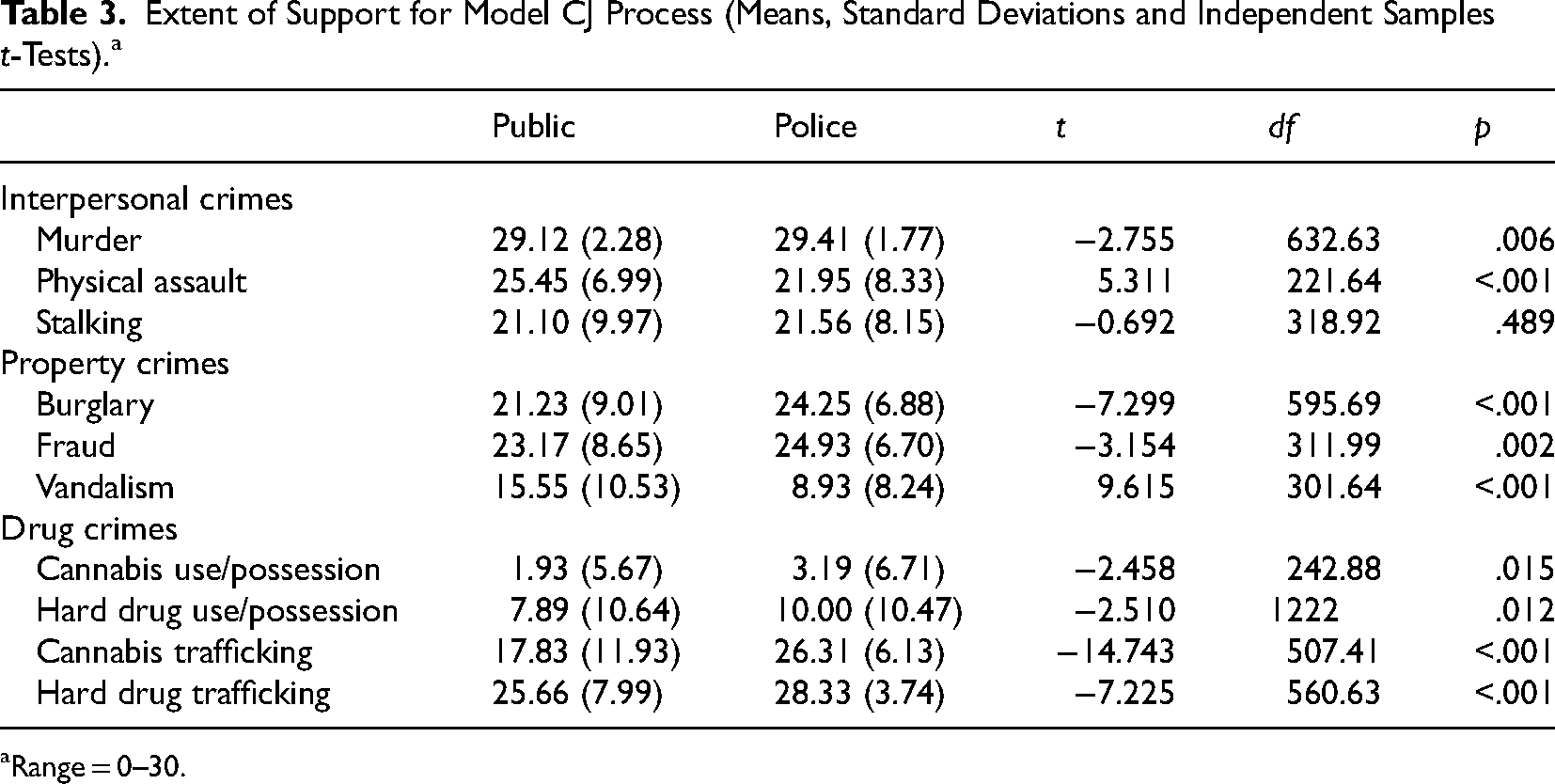
Range = 0–30.
The most divergent scores were found for vandalism and cannabis trafficking. For the former, the police respondents had a strong preference for diversion (M = 8.93), whereas the public respondents preferred a more severe approach (M = 15.55). Among the public respondents, the extent of support for the model CJ process was only slightly higher for cannabis trafficking (M = 17.83) than for vandalism. Instead, the police respondents favored almost the same hard approach for cannabis trafficking (M = 26.31) as for hard drug trafficking.
Independent samples t-tests (see Table 3) reveal that, for all four drug crimes as well as murder, burglary and fraud, the police sample supported the model CJ process significantly more strongly than the public sample. Conversely, for physical assault and vandalism, such support was significantly stronger among the public respondents than among the police respondents. For stalking, the extent of support for the model CJ process was not significantly different in the public and police samples.
General Criminal Policy Preferences
In Table 4, we summarize the general criminal policy preferences in the public and police samples. Table 4 shows that both samples allocated the budget quite similarly and split it almost equally between classic CJ interventions and proactive policing and other forms of SCP, on the one hand, and non-CJ interventions, on the other. More concretely, both samples would spend approximately 30% of the budget on arresting, prosecuting, and punishing offenders, and about 20% on proactive policing and other forms of SCP. In the non-CJ half, they would allocate approximately 20% to interventions targeting social and/or individual causes of crime, and about 15% each to offender rehabilitation and harm restoration.
Preferred Percentage of Criminal Policy Budget Spent on Different Interventions (Means, Standard Deviations and Independent Samples t-Tests).
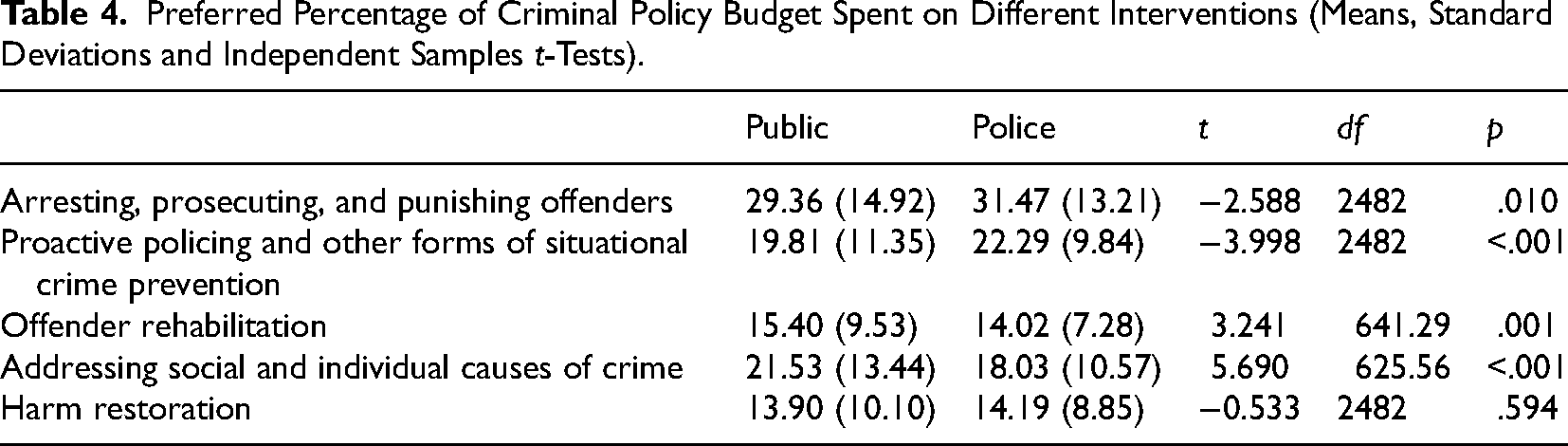
Independent samples t-tests reveal significant, but small, differences between the two samples. Compared to the police sample, the public sample would spend significantly smaller proportions of the budget on arresting, prosecuting, and punishing offenders, and proactive policing and other forms of SCP, and significantly larger proportions of the budget on interventions targeting social and/or individual causes of crime, and offender rehabilitation. The proportions of the budget both samples would allocate to harm restoration were not significantly different, though.
Discussion and Conclusion
This article pursued two aims, namely, to measure and compare (a) the preferences of the public and the police, for ten crimes, concerning key decisions in the CJ process, and (b) their general preferences for criminal policy. To those ends, we conducted an empirical study, yielding data from 2,348 residents and 381 police officers in Flanders. We acknowledge the limitations of our study, which might affect the generalizability of its findings: a small number of crimes, selected on the basis of their “visibility” in the media and policy debates rather than their registered incidence; a regional survey; and a dataset that, despite the application of a weighting procedure, might contain some biases. Our study is descriptive, as it does not elaborate on possible explanations for the findings. Given the gaps in the literature, we cannot systematically compare our findings with those of previous studies, but we refer to related studies whenever possible.
Despite its limitations, we believe that our study has a clear value added. It is the first study to examine general criminal policy preferences in continental Europe. For both the public and the police, it also investigates CJ preferences for different crimes and for the decisions of different key actors in the CJ system. Because of its attention for the separate steps in the CJ process and several non-CJ interventions in addition to the classic CJ interventions, it also reflects the growing complexity of western criminal policy to a much larger degree than previous studies. It thus represents a major step forward vis-à-vis the predominantly Anglo-Saxon literature that has almost exclusively considered preferences for sentencing and punishment.
The most striking finding emerging from the first part of our study was the capability of both the public and the police to discriminate, and hence to support different interventions, depending on the crimes considered. This capability is most synthetically shown by the index, which measured the respondents’ extent of support for the model CJ process and could range from zero to 30. In the public sample, the scores on this index varied from 1.93 for cannabis use/possession to 29.12 for murder; in the police sample, the span for the same two crimes was 3.19 and 29.41.
Nonetheless, our findings only partially confirm hypothesis 1A, i.e., the highest support for the model CJ process for interpersonal crimes, above all murder, followed by property crimes and, lastly, drug crimes. In fact, murder was ranked first, but the second highest crime was, in both groups, hard drug trafficking, and not another interpersonal crime. In the public sample, though, the difference in the scores for hard drug trafficking and physical assault was very small. The severe CJ approach preferred for hard drug trafficking probably reflects the growing concern for cocaine trafficking, following the staggering growth of cocaine seizures in the port of Antwerp (Federale Overheidsdienst Financiën, 2023), and the related violence. Whatever its causes, the second rank of hard drug trafficking partially invalidates hypothesis 1A. Further debunking this hypothesis, vandalism was ranked below not only hard drug trafficking but also cannabis trafficking. The police ranked the latter third, right after murder and hard drug trafficking. In line with the latter part of hypothesis 1A, though, cannabis and hard drug use/possession elicited the lowest support for the model CJ process, and hence the mildest CJ interventions.
Both the public and the police called for an amendment of the Belgian legislation regarding consumption-related drug possession. In both samples, a clear majority supported the legalization of simple consumption-related cannabis possession. The call for change became even clearer once the percentages supporting legalization were added up to those favoring de facto decriminalization. In the case of cannabis, more than 90% in both samples plead for one of the two changes, and substantial majorities did so even in the case of hard drugs. More than a third of the public respondents also called for the decriminalization of cannabis trafficking, but only an absolute minority of the police respondents shared this view.
Our findings also show that the participating Flemish residents did not back the model CJ process for several crimes in addition to the two consumption-related drug offences, i.e., vandalism and cannabis trafficking, and, to a lower extent, stalking and burglary. Two of these crimes—vandalism and stalking—and physical assault did not even elicit extensive support for the model CJ process of the participating police officers.
Our findings partially confirm hypothesis 1B, i.e., the police support more severe interventions than the public. For some crimes, the CJ preferences of the public and the police were similar, whereas for others substantial differences were found. Specifically:
there were no major differences in the cases of murder, stalking and cannabis use/possession; the public backed more severe CJ interventions than the police for physical assault and vandalism; and the police favored more severe CJ interventions than the public for burglary, fraud, hard drug use/possession and drug trafficking.
These findings are thus not fully in line with those of comparative studies on punitive attitudes, which have concluded that police officers are, in general, more punitive in their orientation than the general public (e.g., Furnham & Alison, 1994; Ortet-Fabregat & Perez, 1992). Our study, instead, suggests that this might be true for some crimes, but not for others.
Moreover, much like the public, the police officers in our sample could discriminate among crimes too. For several crimes, they did not call for the most punitive interventions. Although we did not ask our respondents to evaluate the decisions of prosecutors and judges, our findings are hardly compatible with the repeated claims since Skolnick's (1966) study that police officers are generally dissatisfied with prosecutorial and court decisions, and mistrust the overall CJ system (see also Terpstra & Kort, 2016). The police officers in our sample seemed to have at least reconciled their preferences with the workings of the Belgian CJ system.
Our hypotheses concerning general criminal policy preferences were also only partially confirmed. The broad similarities in the public and police rankings of the five interventions—with the highest support for classic CJ interventions and the lowest support for offender rehabilitation and harm restoration—debunks hypotheses 2A and 2B. Conversely, the finding that, compared to the police, the public showed more support for two of the three non-CJ interventions, and less support for classic CJ interventions and proactive policing and other forms of SCP, confirms hypothesis 2C.
Although it is not possible to compare the preferences we recorded with Belgium's criminal policy expenditure due to the lack of data, it is striking that classic CJ interventions attracted in both samples only about a third of the budget. The considerable support for proactive policing and other SCP measures probably reflects the relatively high public rating of police performance in Belgium (e.g., van Dijk et al., 2007). Both samples also opted to spend half of the budget on non-CJ interventions, probably more than these interventions receive in reality. The support of both the public and the police for harm restoration also stands out and possibly reflects the pioneering role Belgium has played in implementing restorative justice (Aertsen, 2006). Our findings on general criminal policy preferences thus confirm earlier findings that the public prefers non-CJ measures to classical criminal trial and punishment (e.g., Dunbar, 2020; Wozniak, 2020). They also align with the results of earlier studies that police officers are more punitive than the general public (e.g., Furnham & Alison, 1994; Ortet-Fabregat & Perez, 1992). However, the differences between the public and police samples in our study were, albeit significant, quite small.
In conclusion, our findings give a much more differentiated picture of public and police's criminal policy preferences than expected. Even the general public has a fairly sophisticated understanding of the different phases of the CJ process. Contrary to any claim of “populist punitiveness” (Pratt, 2007), both groups call for prosecution and public trial (including prison sentences) only for serious crimes, such as murder and hard drug trafficking. In the case of cannabis, by far the main illegal drug consumed in Belgium and elsewhere in Europe (European Monitoring Centre for Drugs and Drug Addiction, 2023), both the general public and the police are in favor of reforming the current laws, even if they differ in how far they would like to go.
Our findings matter for policymaking purposes for at least three reasons. First, they disprove the assumption of widespread populist attitudes and preferences among the general public and the police at least for an important country in the EU, thus suggesting opportunities for politicians daring to appear “soft on crime.” Second, despite the growing hiatus between the functioning of the CJ system and the classical ideal of criminal trial, our findings provide a somewhat reassuring message: the general public and the police themselves favor pre-court drops and disposals for several less serious crimes and embrace the growing reliance on non-CJ means to deal with crime, in line with what is already happening in reality. The lack of insistence on a full CJ process bodes well for the empirical—though not necessarily the normative—legitimacy (Snacken, 2013) of contemporary criminal policies. Third, reinforcing such empirical legitimacy, our findings show considerable alignment between public and police's preferences for several crimes. They also indicate, though, that the gap is widest for cannabis trafficking and vandalism: for the former, police's support for the model CJ process was 8.48 points higher on a 30-point scale than public's support; conversely, for the latter, public's support for the same process was 6.62 points higher than police's support. These differences imply that criminal policymakers and professionals should do a better job in explaining to the public why they have decided to focus on cannabis trafficking and, instead, grant only limited attention to vandalism.
We note, though, that even if there were a perfect alignment between public and police's preferences, this would not suffice to dispel doubts on how criminal policy priorities are set and policy interventions are chosen (see also Paoli, 2014). No doubt, we need to know more about criminal policy preferences, especially (a) crime-specific ones, (b) concerning the earlier phases of the CJ process, (c) in Europe. Yet, given the peculiar harms associated with the CJ system (for an overview, see Travis et al., 2014), we need to combine these additional data on criminal policy preferences with data on the implementation and consequences of criminal policies, and to start a debate on what is desirable and possible, at which cost, and with which harm for whom (Greenfield & Paoli, 2022).
Footnotes
Acknowledgments
We would like to thank the three anonymous reviewers and Dr. Eric L. Sevigny, the editor of the International Criminal Justice Review, for their helpful comments and suggestions, which have greatly strengthened our article.
Declaration of Conflicting Interests
The authors declared no potential conflicts of interest with respect to the research, authorship, and/or publication of this article.
Funding
The authors disclosed receipt of the following financial support for the research, authorship, and/or publication of this article: The Special Research Fund of the KU Leuven, grant number 3H190229.
