




Abstract
The cryptomarket ecosystem has become increasingly volatile and fragmented with sites shutting down on short notice. Displacement to new marketplaces is tricky when the original location was domestically oriented. We examine the spatial and temporal displacement of 83 Swedish vendors in the aftermath of the Flugsvamp 3.0 shutdown. Vendors rejected the successor Flugsvamp 4.0 and moved to German-run Archetyp Market. Using quantitative cross-sectional data from Archetyp Market we measure bivariate correlations between the temporal displacement and status-related variables. We found moderately strong correlation between vendors’ number of sales per day and the order of their relocation to Archetyp. We also examined cryptomarket discussion forums and blogs during the time of the Flugsvamp 3.0 shutdown. This qualitative data supported the finding that migration choices of high-status vendors inspired others to follow.
Introduction
Since Operation Onymous shut down the pioneering cryptomarket Silk Road 2.0 in 2014, law enforcement agencies worldwide have cracked down on these platforms. Despite the effort, the overall ecosystem of encrypted platforms used for trading illicit goods and services persists because vendors and buyers displace to other marketplaces (Décary-Hétu & Giommoni, 2017; Jardine, 2015; Ladegaard, 2020). These displacements are important for the matured cryptomarket phenomenon (Martin et al., 2020), and resemble the “war of attrition” between law enforcement and drug sellers known from conventional drug markets crackdowns (Curtis & Wendel, 2000; see also Cohen et al., 2003). Another important trend in cryptomarket drug trading is the increased preference for domestic shipping (Norbutas, 2018). Sending illicit drugs in the mail across international borders is the riskiest step (Bakken et al., 2018; Demant et al., 2018; Giommoni et al., 2023) and regionally oriented cryptomarkets are increasing in numbers (UNODC, 2023), e.g., Russian Hydra, Finnish Silkkitie, and Swedish Flugsvamp (Groshkova et al., 2018; Magnúsdóttir, 2019; Nurmi et al., 2017). The combination of these two trends implies that there are more but smaller cryptomarkets with a shorter lifespan than before (UNODC, 2023).
In Sweden, the location of this study, the cryptomarket Flugsvamp (FS) appeared around 2013 and specialized in domestic drug shipments. Operation Onymous disrupted the platform in 2014, but it resurfaced as FS 2.0, then FS 3.0, following repeated crackdowns (Stockholms Tingsrätt, 2023). At its peak, around 150 vendors were active on the platform and the value of trade increased from € 530,000 in 2015 to an estimated € 3,100,000 in 2021 (Tollin et al., 2021). On 30th October 2021, Flugsvamp 3.0 (FS3) was shut down by its administrators. They cited unspecified security reasons while denying it was an exit-scam, but this was questioned in the Swedish cryptomarket community. A fourth installment launched as Flugsvamp 4.0 (FS4) on 2nd November 2021, but it never reached the same popularity as its predecessors. Instead, FS4 suffered from persistent rumors and allegations of various frauds (flashback.org, 2021; Luffarn, 2021c; see also Moeller et al., 2017), and at this point, most of the Flugsvamp vendors displaced their operations to German-run Archetyp Market (Luffarn, 2021a).
The purpose of this study is to examine the displacement of vendors following the shutdown. With several alternative locations to choose from, it was not given that Archetyp Market would be the destination. Nor is it self-evident how vendors choose a new cryptomarket to operate from. We analyze the temporal order of the displacement measured as time on the marketplace in relation to vendor's status characteristics measured as their number of sales, reputation score and number of accounts. We augment this analysis with qualitative data from discussion forums to provide context and assist our interpretation. This contributes to improving our understanding of the matured cryptomarket phenomenon.
In some ways, cryptomarkets are an exotic niche of the global illicit drug market (Sumnall, 2018), that may be declining in importance as compared to other forms of online drug distribution (Bhaskar et al., 2019) but they continue to evolve technologically and still have potential for growth (Hiramoto & Tsuchiya, 2020). They also illustrate the wider phenomenon of offending moving online, and merging with offline contexts as drugs bought on cryptomarkets are resold offline (Brown et al., 2023; UNODC, 2023). The Swedish National Council for Crime Prevention argued that law enforcement needs a better understanding of longer-term trends in the online drug trade (Tollin et al., 2021; see also Jardine, 2015).
Review of Literature
We interpret reactions to the closure of FS3 as examples of the strategic displacements offenders make to reduce apprehension risk and sanction severity. In Gibb's (1975; Moeller et al., 2016) theory of restrictive deterrence these strategies broadly consist of three forms of displacements: spatial, temporal, and tactical. We focus on the spatial and temporal displacement, the where and when of offending. We follow Yar's (2005) proposition that space, time, and routine activities are applicable to cybercrime and assume that displacement processes are neither random nor uniform (Brantingham & Brantingham, 1995). Spatial displacement refers to a change of geographic location to avoid law enforcement or other threats. Eck (1995) noted that routine activity marketplaces for illicit drugs will displace spatially to similar locations, and for our analyses, this corresponds to the move to a different platform. Temporal displacement conventionally refers to changing the time of day where offenses are committed or offense duration (Maimon et al., 2014). In our study, this pertains to the urgency or hesitation that vendors display in moving to a new platform. Vendors have different opportunity costs. For less popular vendors it is better to wait and see what others do, for popular vendors, hesitating entails more lost revenue.
These decisions regarding the location and timing can be conceptualized as questions of uncertainty and information. Selling and buying drugs on cryptomarkets involves uncertainty at every decision stage (Beckert & Wehinger, 2013; Munksgaard & Tzanetakis, 2022; Przepiorka et al., 2017), and reliable information is difficult to find. Vendor's displacement decision reflects their trust in their peers and in the platform. We follow Wehinger's (2011; see also Moeller, 2023; Munksgaard et al., 2023), distinction between a process-based trust reflected in the number of sales, the reputation-based trust of the reputation score, and an institutional-based trust that covers individual platforms and the cryptomarket ecosystem more broadly. Following this conceptualization, we interpret vendor's username, sales number, and reputation score as status variables that signal their trustworthiness to potential buyers and other vendors.
First, buyers learn to trust individual vendors through personal experience with buying from them, a process-based trust. If this personal experience is not sufficient, vendors are also evaluated through their sales numbers and reputation score, which Wehinger (2011) conceptualized as a reputation-based trust. Both process- and reputation-based trust connects to the vendor's username. Vendors are protective of their username, and many encourage customers to encrypt their communication using the vendors’ personal “PGP keys,” so that they may verify their identity if they move platform (Booij et al., 2021). Norbutas (2020) argued that vendors face a dilemma following a crackdown because their online identity is now known to law enforcement. He found that, after market closures, vendors with more sales and higher reputation scores more frequently kept their identity compared to vendors with fewer sales and lower reputation scores. He argued that their motivation was economic. The cost of losing customers and starting over building trust and reputation would be greater for the successful vendors. Individual vendors’ reputation for trustworthiness is discussed on forums such as Reddit and Dread (Hardy & Norgaard, 2016; Moeller et al., 2017). When buyers make repeated transactions with the same vendor, they build process-based trust with this individual account, but they also add to the reputation-based trust and institutional-based trust in the platform where the trade occurred (Munksgaard, 2021). In this way, microlevel outcomes contribute to macrolevel outcomes (Matsueda, 2017).
It is a key finding in the cryptomarket research that sales and earnings are concentrated among few vendors (Décary-Hétu & Quessy-Doré, 2017; Duxbury & Haynie, 2018). The top one percent sell four times as much as the bottom 90 percent combined (Paquet-Clouston et al., 2018; Tzanetakis, 2018). Vendors therefore compete for buyers and offer polite customer service, speedy deliveries, responsiveness to complaints (Kamphausen & Werse, 2019; Van Hout & Bingham, 2014), and use their profile pages to communicate professionally including delivery and refund information (Bakken et al., 2018). The reputation scores are the aggregate summation of transaction evaluations. Buyers are encouraged to leave feedback after finalizing their trade using a rating from 1 to 5 along with a comment (Norbutas et al., 2020b; Przepiorka et al., 2017; Tzanetakis et al., 2016). Brinck et al. (2023) found that the majority of 53 Dark Web marketplaces displayed consumer feedback and review indicators on their sites, from January to March 2022. Munksgaard and Tzanetakis (2022) described how cryptomarkets used different measures of reputation, e.g., Empire reviews are either labeled positive or negative, while Silk Road 3.1 reviews ranged from −48 to 380. Bhaskar et al. (2019), observed that only a small proportion of online drugs deals received bad ratings, between 2013 and 2016, and importantly, that there were slightly more negative ratings on cryptomarkets than legal e-commerce (studies from 2002 to 2010). Hardy and Norgaard (2016) found a mean seller rating 4.84 out of 5 on Silk Road 2.0 in November 2013 to October 2014, while Kas et al. (2022) found ratings on legal online platforms to be highly left-skewed, 92.1% of all ratings were 5-star ratings. This skew reduces the informativeness but increases the importance of the number of ratings. Studies from legal and illegal platforms alike agree that bad ratings lead to sales reductions and market exit and that a credible platform makes it easier for sellers to retain customers (Bhaskar et al., 2019; Liu et al., 2018). Consequently, even a few low scores can have a negative impact and vendors are mindful of their reputation scores (Décary-Hétu et al., 2016), while buyers view them with warranted skepticism (Moeller et al., 2017; Munksgaard et al., 2023).
Lastly, vendors demonstrate their trust in a platform and its administrators by being present with an account. The longer they are present, the more time they had to learn about malfeasance or technical difficulties. Vendors with many sales and high earnings, display higher levels of this institutional-based trust in the platform administrators, demonstrating that they are technically competent and honest enough not to abscond with funds (Odabas et al., 2017). This connects the individual vendor's trustworthiness with an institutional-level trust. Vendors vouch for the platform by being present for a longer time, and the platform administrators vouch for the vendor by not banning them. We measure this abstract institutional trust by the number of accounts a vendor has on different platforms (Moeller, 2023; Wehinger, 2011).
Research Questions
We depart from the observation that many Swedish vendors from FS3 reappeared on Archetyp Market. Collective actions are characterized by their temporal relation to each other. The order of “when” vendors moved reveals some coordination. We want to examine whether Norbutas’ (2020) findings that vendors make economically-motivated displacement decisions (i.e., keeping their username), can also be observed in their spatial and temporal displacement. Specifically, if there is an economic need for high status vendors to keep their username to avoid disappearing from the cryptomarket scene, is there also a need to minimize their unavailability following a shutdown?
Formulated as research questions:
Does high status in Swedish vendors on Archetyp Market, as measured in sales, reputation score and accounts on other sites, correlate with the urgency of their displacement following the Flugsvamp 3.0 shutdown?
The quantitative insights gained from answering the first question will be complemented by the second question, which aims to offer a more qualitative perspective.
How is the decision to displace to Archetyp Market reflected in related discussion forums following the shutdown of Flugsvamp 3.0?
If the first question results in a clear affirmative answer, we can conclude that high-status vendors move first because they will lose more sales by waiting. Indirectly, they also lend legitimacy to the new platform (Brantingham & Brantingham, 1995; Munksgaard et al., 2023; Norbutas, 2020). Low status vendors can afford to wait and choose the market with the highest institutional trust.
Through answering the second question, we hope to identify primary themes of discussion, and thereby reach an understanding on what issues are valued more than others when it comes to displacement decisions. This question supplements the first question by contributing qualitative insight through a content analysis that will either support or challenge the results gained from question one.
Methodology
We first collected quantitative data from Archetyp Market on vendor characteristics. Next, we searched discussion forums for qualitative data on the reactions to the FS3 shutdown. We combine these in a “explanatory sequential design” (Wilkes et al., 2022), where we give priority to the quantitative analysis and use the qualitative data to inform and augment our interpretation (Creswell & Clark, 2011). Below, we first present our quantitative data collection and coding of variables, before moving to the qualitative data.
Quantitative Data
We retrieved cross-sectional data from each vendors’ profile page, on the 24th of February 2022. To collect the data, we created an account on Archetyp Market, and compiled a baseline list of all vendors. Next, we visited each vendor page and downloaded them as HTML-files (Guarita et al., 2021; Tzanetakis et al., 2016). This manual approach was feasible due to the limited number of vendors and ensured that each profile page was downloaded without fault, as opposed to an automated procedure that risks script malfunction (Aldridge & Décary-Hétu, 2015) or being thrown out from DDOS protection (Van Buskirk et al., 2015). From the HTML files, we extracted our variables using a custom-made script based on the HTML-parsing Python library “Beautiful Soup” (Richardson, 2007).
We coded the duration of involvement in the market, location country, reputation score, total number of sales at the time of data collection and the number of accounts on alternative cryptomarkets. We code duration of involvement in the market as the variable “days” with data from a static date-field named “Joined” on each vendors’ profile page. This field is created automatically when the account is registered. To simplify, we subtract the date of the data collection with this variable. The variable “shipping from” is the country that the vendor lists as their location. Vendors may lie to hide their actual location, but previous research has argued that it is a suitable proxy for vendor origins (Kruithof et al., 2016). Our fourth variable is the “reputation score,” the average of customer ratings from 1 to 5, based on their history of transactions (Duxbury & Haynie, 2023). The fifth variable, “sales” is the number of times they’ve received a reputation score from a buyer following a transaction. This is a commonly used proxy for number of sales in cryptomarket research (Aldridge & Décary-Hétu, 2014; Norbutas et al., 2020a; Paquet-Clouston et al., 2018). There is an ongoing debate whether reputation score or sales number provides the better representation of vendor status (Duxbury & Haynie, 2018; Munksgaard & Tzanetakis, 2022). We collect both and evaluate their suitability.
Our final variable “accounts” is the number of alternative accounts a vendor has, as they may have several to diversify their overall cryptomarket presence. We collected each vendors’ PGP-key to search Recon for the number of accounts beside Archetyp Market. Recon is a darknet search engine, designed to search multiple cryptomarkets at once for vendors and listings (Butler, 2020). Prior studies have used the similar but now defunct Grams for this purpose (Norbutas et al., 2020b; Soska & Christin, 2015; Van Wegberg & Verburgh, 2018). Unfortunately, Recon does not include FS4, due to its regional characteristic. We supplemented by manually searching the vendor's PGP-key and username on FS4. Our dependent variable will be one of the two status-related variables sales or reputation score as determined from a univariate analysis.
Qualitative Data
We searched online discussion forums and blogs for insights into the community response to the FS3 shutdown. Discussion forums are important for cryptomarket community interactions (Kamphausen & Werse, 2019; Moeller et al., 2017; Morselli et al., 2017), in particular during periods of market disturbances and crackdowns (Ladegaard, 2019). Specifically within the Swedish cryptomarket scene, Flashback Forum has served as an important information platform since 2011 (Stockholms Tingsrätt, 2023). However, it's important to clarify that online forums are generally anonymous, meaning that we cannot separate vendors from buyers.
In our analysis, forum posts are the core semantic unit. Each post is situated in a thread of posts that constitute a written conversation, amenable to qualitative analysis (Rolando & Beccaria, 2018). This is epistemologically linked to Rogers’ (2013) point about “following the medium,” where they referred to an appreciation for the native functionalities of the internet, and experiencing the particular website as intended.
We accessed discussion forums on August 2023 and passively “lurked” threads, that is, viewed without commenting or otherwise interacting with the posters (Addeo et al., 2019; Garcia et al., 2009). This retrospective study of online communities with “natural data” is limited to posts made roughly two years before the writing of this paper, and we believe that interacting with posters would be of limited value as our interest is in the time-specific coordination between users at the time of FS3 closure (Kamphausen & Werse, 2019).
We selected three discussion forums and one blog: Flashback.org, Archetyp Market discussion forum, Dread and Luffarn.com. We searched these using the terms: “Flugsvamp,” “FS3,” “FS4,” “Archetyp,” and limited ourselves to posts dated between the 30th of October and 30th of November 2021, that is, posts made within a month of the closure of FS3.
Flashback.org is a Swedish language discussion forum with more than 1.5 million registered accounts. It is a classically designed forum, divided into sections and subsections defined by area of interest, including illicit activities and other controversial content (Östman & Aschberg, 2015). We found only one thread on Flashback that related to FS3, but it consisted of 5,136 posts spread out over two years. During our period of interest, there were 1,115 posts by 318 unique users, averaging 3.5 posts per user, with the most prolific user posting 34 times. Flashback moderators enforce a rule that prevents new threads when the topic is covered by an existing thread (flashback.org, 2023; Moeller et al., 2021).
The Archetyp Market forum requires an account to access the market, view the forum. It has a classic forum design, with sections and subsections based on topics, mainly focused on drug types, harm reduction, and marketplace news (Addeo et al., 2019). Dread resembles Reddit but is located on the darknet. The threads are sorted by sections based on area of interest, and all content is presented according to time of the posts and a voting score derived from registered users up- or down-voting posts/threads and comments (Medvedev et al., 2019). We focus the analysis on the Swedish subsection of Dread.
Luffarn (“the tramp”) is a Swedish blog with content on recreational drug use, active since 2008. The posts vary from opinion pieces on current issues to guides on operational security of drug dealing. The site hosts a well-known darknet guide intended for beginners and serves as a directory site, posting onion links to major cryptomarkets. The posts made by the editor also host an active commentary section, with upwards of hundreds of comments on each. Flashback Forum posts frequently reference Luffarn as a trusted source of cryptomarket information in Sweden (see flashback.org, 2021, p. 27, 50, 79).
While these online spaces contain valuable information pertaining to the displacement process, we acknowledge that retroactive data collection run the risk of missing data that was deleted in the meantime or from human error. Interpreting textual data always involves uncertainty. Without interacting with the original posters, it can be difficult to ascertain when the posts are sarcastic or reference subcultural terms unknown to the researchers. Lastly, we cannot be sure if the poster is fabricating or exaggerating their claims (Enghoff & Aldridge, 2019; Garcia et al., 2009).
Results
Descriptive Statistics
Table 1 shows the descriptive statistics for the variables for all vendors shipping from Sweden. The N represents valid cases for each variable. Out of the 88 vendors shipping from Sweden, five vendors lacked reputation scores and were excluded.
Descriptive Statistics.
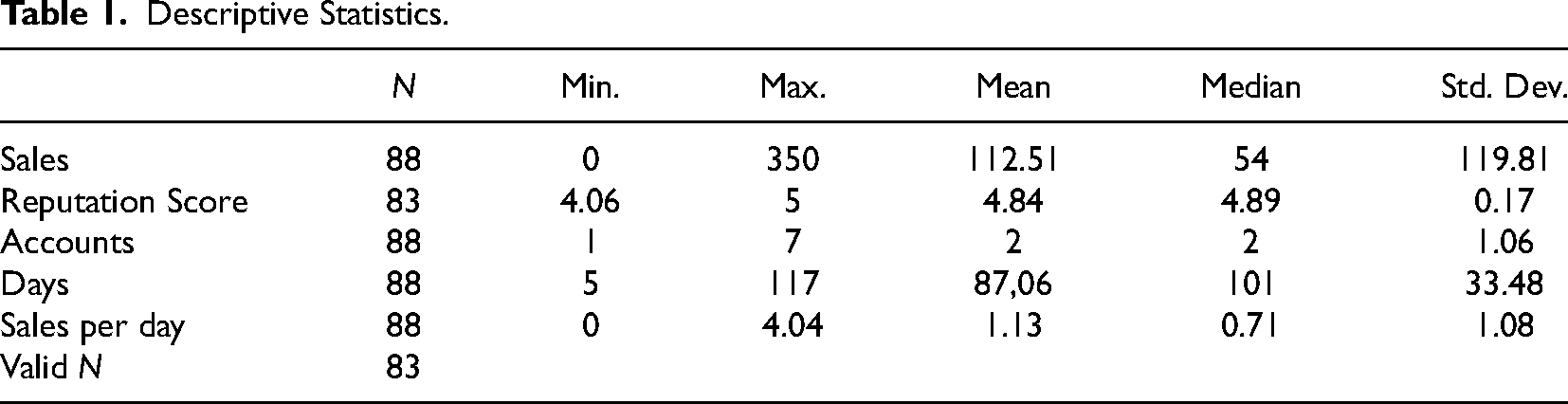
The most active vendor had 350 sales, but the mean and median are markedly lower. This positive skew, with sales concentrated among few popular vendors, is common on cryptomarkets (Duxbury & Haynie, 2021; Paquet-Clouston et al., 2018). As expected, the mean reputation score was negatively skewed, with no cases having less than four, out of the maximum of five. Even the distribution of scores between four and five was negatively skewed. The mean and median are very similar, and the standard deviation is very small (see also Tzanetakis et al., 2016). The number of accounts varied between one and seven, and around seventy percent of the vendors in the sample were active on one to three sites. The number of days since joining has more variation, as there was an ongoing influx of new members to the site. Most vendors joined between the 16th and 30th November 2021 with a standard deviation of around one month. This variation relates to their shipping country.
First, without considering the country of origin, Figure 1 visualizes the influx of vendors to Archetyp Market in an area chart. From 23rd August 2020 to 22nd February 2022, 289 vendors joined, averaging a new vendor every other day, and only rarely surpassing more than four new vendors on a single day. There are four exceptions where seven or more new vendors joined in one day with a maximum of eleven on 1st November 2021.
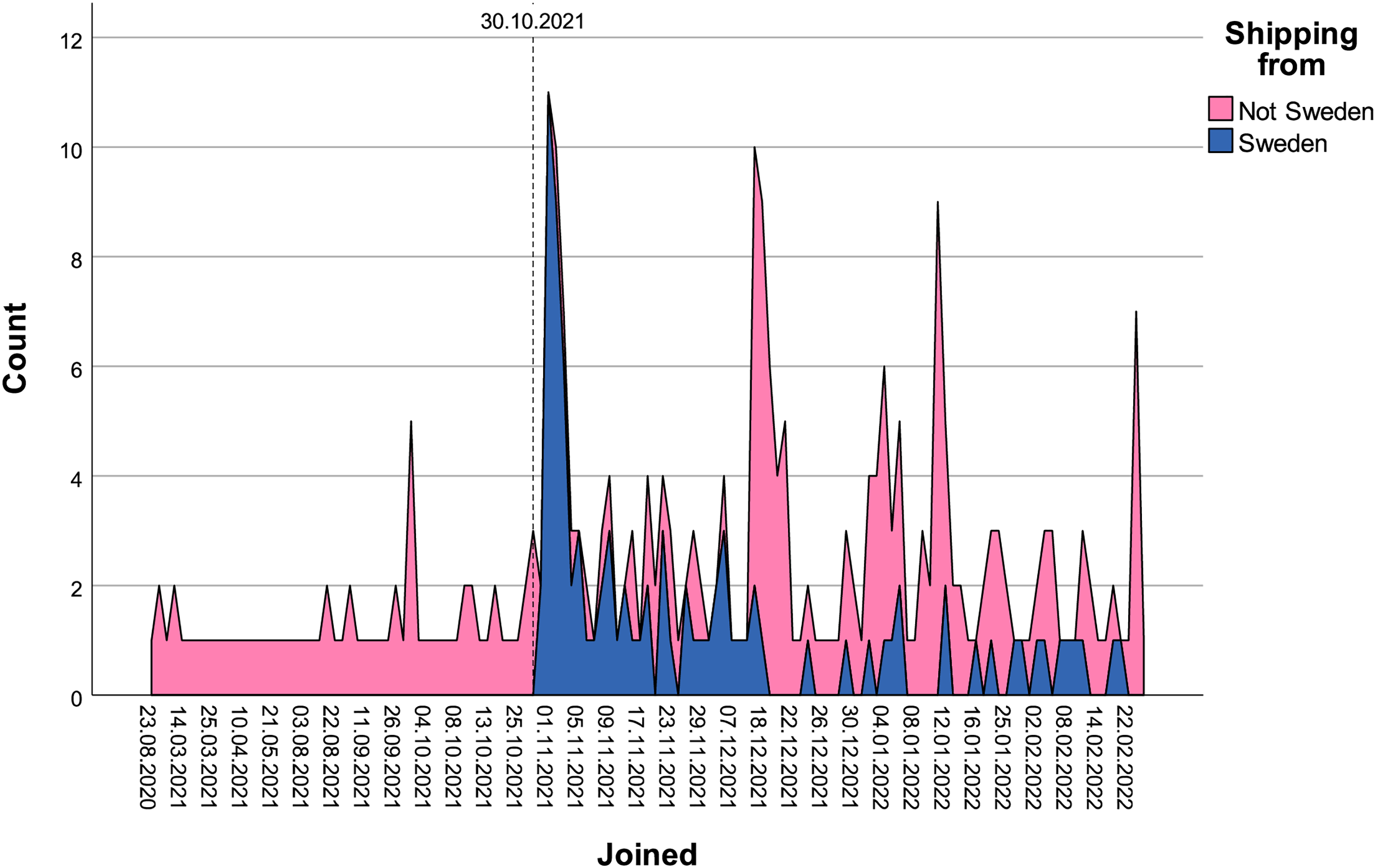
Number of vendors joining Archetyp Market.
Taking the country of origin into account we can see that there were no Swedish vendors on Archetyp market prior to 30 October 2021, the day of the FS3 closure (TT-Nyhetsbyrån, 2021). Up until this day, vendors from 23 different shipping countries had registered on the site. In the following days, new accounts were almost exclusively shipping from Sweden. In the ensuing two months, vendors shipping from Sweden figured prominently among new signups to Archetyp Market, with 51.5% of signups. The two main observations concern the expediency with which the Swedish vendors joined after the closure of FS3, and the intensity with which they joined. This rapid succession following the initial spike may suggest some form of informal coordinated displacement. The spikes are also notable in an international perspective. In a recent study of 30 cryptomarkets, most averaged around four new vendors per day, and only two averaged more than 10 new vendors per day (Howell et al., 2023).
Lastly, we computed a variable named Sales per Day, by dividing Sales with Days. The purpose is to identify vendor differences in sales that cannot be explained by length of exposure on Archetyp. Doing so, we aim to achieve higher validity in measuring status through sales numbers. This new variable shows positive skew, similarly to Sales, suggesting its usefulness in representing the leader group of vendors.
Bivariate Analysis
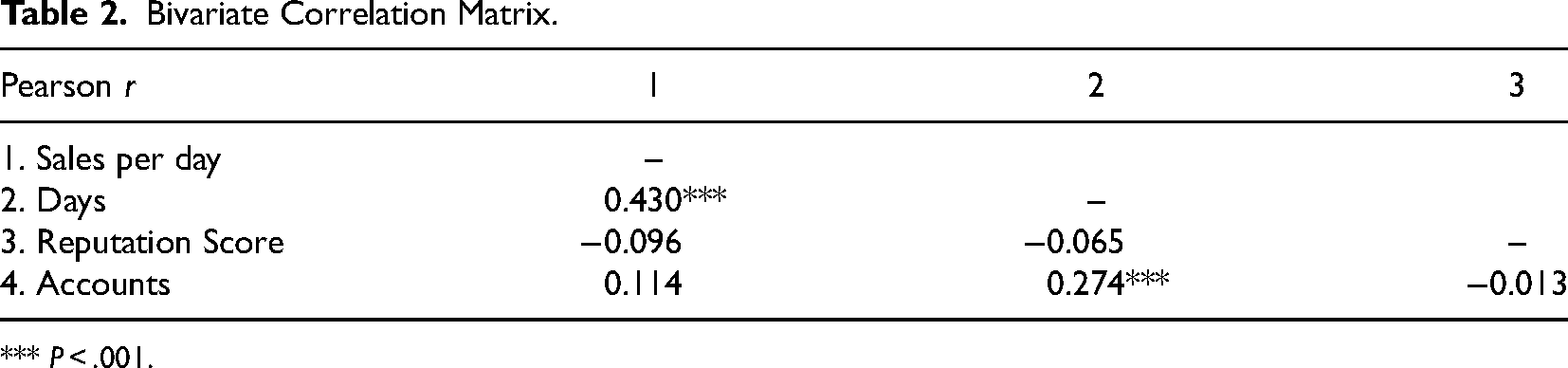
Continuing our examination of the relationship between the independent variables, days, reputation score, accounts, and the dependent variable sales per day. As mentioned above, we suggested that sales per day would be a more valid representation for status, leading us to replace sales with sales per day in the bivariate analysis. Table 2 shows the bivariate correlation coefficients, revealing a highly significant, moderate positive correlation between the number of sales per day and the number of days since joining.
Bivariate Correlation Matrix.
*** P < .001.
Sales per day also have a less strong, but significant, correlation with the number of alternative accounts. Reputation score correlation coefficients are very small and insignificant. In combination with the univariate statistics, we find that reputation score is not appropriate for representing cryptomarket status. All remaining bivariate correlations are vanishingly small and not statistically significant. Sales per day have a more normal distribution and a stronger and more meaningful correlation to Days. It is a more suitable representation for vendor status. Connecting back to our first research question, we can conclude that there is support for a correlation between vendor status and temporal displacement, when status is represented by sales per day.
Qualitative Analysis of Coordinated Displacement
We continue our exploration of this seemingly coordinated displacement and analyze forum and blog posts during the first month following the FS3 shutdown. The earliest post relating to the shutdown appeared on 30th October as a user created a new thread on Flashback, citing an administrator announcement posted on Flugforum: “Flugsvamp 3.0 is closing. Due to personal and external circumstances we will need to shut down Flugsvamp for good. We understand this creates problems for buyers and sellers, and we wish we could continue to manage this site, but unfortunately this is not possible.” (flashback.org, 2021, p. 1)
While the statement had reconciliatory intent, not returning existing balances to users was met with harsh reactions from Flashback posters. While a few posters argued that it seemed like a controlled shut down, most called it an exit scam and expressed anger and irritation. Many claimed to have lost thousands Swedish kronor (corresponding to hundreds of Euros) in nonwithdrawn balances. A user mockingly paraphrased the post in the following way: “Not to fear, after stealing your money […] we donated it to a more important cause. Granted, we did forget to ask your permission, this is drug trading after all. Please excuse our decadent depravity.—FS3 sends our regards from the beach.” (flashback.org, 2021, p. 9)
These suspicions are not unprecedented. Several cryptomarket administrators have claimed being victimized by bitcoin-robberies when being shut down. Yet such claims have commonly been met with skepticism. Following the shutdown of Evolution Marketplace, a former insider confirmed its closure to be a planned exit-scam by the administrators. Subsequently, users have displayed suspicion during market closures (Moeller et al., 2017).
Another common topic of discussion on Flashback was the whereabouts of specific popular vendors. One user captures how the grievance cause by the shutdown is not limited to the monetary loss, but also to the new risks induced on the buyers: “What bullshit! Annoying as hell having to learn how the other sites work to buy from. FS was so childishly simple! Not to mention the insecurity of ordering from new unknowns. It would be great to know who from FS is registered where, so you can buy from those you feel safe with.” (Luffarn, 2021b, p. 9)
Initially, vendors were reported to set up alternative channels for trade, through both encrypted apps such as Wickr or setting up temporary Clearnet sites (flashback.org, 2021, p. 9). For vendors, setting up stores outside the protection of darknet is surprising but could indicate that the desire for a quick displacement is particularly high among vendors with username recognizability. The Clearnet sites also puzzled some users, questioning whether it's legitimate and secure. The Luffarn administrators responded in one case “I can confirm that those who run that site is using the same PGP as the earlier [Vendor name] on FS3” (Luffarn, 2021c, p. 2) Later on, users asking for specific vendors were mainly directed towards Archetyp (flashback.org, 2021, p. 52, 74).
We also found instances of Archetyp administrators actively promoting their site. On 1st November, on the Swedish section of Dread consisting of 91 subscribers (as of July 2023), a user posted the following: “Hey lads, sorry for using English. I was told to post here, as I can offer you /d/Archetyp as solid European alternative to FS3 :) Feel free to check us out, when you find time.” (Dread, 2021)
This is the earliest found instance of Archetyp being mentioned within the Swedish cryptomarket community. A few days later, on 4th November an account calling themselves “Archetyp” posted in a Luffarn comment section that “Archetyp is the place to be” followed by mentioning several vendors that had already signed up (Luffarn, 2021b). Such well-timed and focused advertisements to the Swedish cryptomarket community may have played an important part in attracting some of the first migrating vendors. According to Hiramoto and Tsuchiya's (2023) study, a fast increase in drug supply in one cryptomarket following closure of another is likely to lead to long-term growth.
The 1st November on Archetyp Markets’ user forum, a thread was created titled “Welcome Sweden” where the sites' administrators welcomed new users. It was met by enthusiastic replies from Swedish users that praised the sites’ functionalities and interface. These users started new threads in Swedish and rejoiced in meeting again on a new site, like Ladegaard's (2019, p. 643) finding that the cryptomarket community became “affectionately united in symbolically meaningful and emotionally intense efforts to overcome the crackdown.”
The day after, on 2nd November, news of a FS4 launch spread on Flashback forum (flashback.org, 2021, p. 29). No more than a day later, FS4 had both its reliability and security questioned by several users (flashback.org, 2021, pp. 30–31). In the comment section at Luffarn, users reviewed FS4 shortly after launch. While some posts described successful transactions, the comment section was mostly negative. Several posters reported difficulties logging in and complained about the site interface. On 2nd November, a user wrote: “Flugforum seems to be down… now there seems to be two choices for sellers/buyers: Torrez Market, international, huge, old, ddos’ed 24/7, takes bitcoin and a few other. Archetyp Market, more European, small, new, fast and accept only Monero.” (flashback.org, 2021, p. 30)
This example restates the importance of site functionalities for cryptomarket growth, supporting Felstead's (2018) observation that community alone doesn’t drive the choice of cryptomarkets because some users act with “consumer impersonality” and seek to optimize their own purchasing with little regard for the community. Site functionality issues might push these participants to seek out Archetyp as the next cryptomarket. As for Torrez Market, less than two months later, it was shut down (Cimpanu, 2021). Luffarn partly attributed the rise of Archetyp to the Torrez shutdown in the following way: “When FS3 closed all vendors moved to two new markets, Torrez and Archetyp. Torrez closed their market shortly after, making those that didn’t already have an Archetyp account to join all other Swedish vendors…” (Luffarn, 2021a).
A more alarming concern for FS4 however, is the emergence of reports of fake vendor accounts (Luffarn, 2021c). An example from 7th November stated: “It's a scam site straight up; among other things, [Vendor] wrote that if they were seen on fs4, it wasn't them. This has been communicated to this vendor. Those on fs4.0 have copied and faked accounts. Simply put, it's a scam.” (Luffarn, 2021c, p. 1)
Such reactions to supposed fake accounts explicitly connect the authenticity of vendor accounts with the institutional-based trust of the cryptomarket. Just as trustworthy vendors provide institutional trust, untrustworthy vendors erode it. In extension, FS4 might have suffered from the rumors of an exit scam that surrounded the FS3 closure. Continuing with the Flugsvamp name while exit scam accusations were voiced may have reduced vendor's willingness to displace here.
In sum, several push and pull effects influenced what became the migration of Swedish vendors to Archetyp Market. The post advertising Archetyp Market in the Swedish Dread forum on the same day as the spike in vendor registration might have pulled vendors with a high darknet presence. Arguably, these “leaders” of the migration pulled more users towards Archetyp. Additionally, the uncertainties surrounding the shutdown or exit scam of FS3, combined with the technical difficulties of FS4, might have further pushed Swedish vendors away from the Flugsvamp brand.
Discussion and Conclusion
Vendor displacement behaviors following disruptions are important for understanding the matured cryptomarket phenomenon. The increasingly volatile ecosystem entails that domestically oriented shipping patterns and platforms take up a larger share of overall cryptomarket trade (UNODC, 2023). Vendors are increasingly hesitant about shipping drugs across international borders and prefer domestic destinations or countries perceived to have lower policing efficiency (Décary-Hétu et al., 2016).
In this study of Swedish vendors’ spatial and temporal displacement patterns we found that a few vendors with high status in the community first moved to Archetyp Market and the remaining vendors followed their lead. This corresponds well with previous research on trust in cryptomarkets and the finding that sales are typically concentrated among few vendors. Sales represent a snowball effect that leads to concentration (Hoffart et al., 2019). The risks and uncertainties associated with selling illicit drugs on cryptomarkets (Munksgaard & Tzanetakis, 2022) imply that it is a difficult decision to choose a new platform. Respected vendors lend credibility to the cryptomarkets that they have accounts on (Munksgaard, 2021). Their economic investment in the decision is larger, and other vendors may expect that they have done their due diligence. Our main finding was the correlation between the variable Sales per day, and the temporal order in which vendors relocated to Archetyp Market. Vendors with more sales relocated to Archetyp Market quicker than those with fewer sales did. Connecting our findings to the wider criminological research on drug markets, we may say that the higher status vendors served as “crime attractors” in the displacement process (Brantingham & Brantingham, 1995).
We also found a weaker, yet significant correlation between Sales per day and the number of alternative accounts. It could be that the connection between status and diversification of accounts is not very solid or that the incentive to be open for business is not strong enough to rush the displacement destination decision. This vendor-to-vendor status hierarchy is reflected in the temporal pattern of migration. While more time on the market equals more opportunities to trade, the reputation transferability (Norbutas et al., 2020b) found in migrating vendors indicates that the stratification of vendor status is likely to be maintained during migration. In our case, the status hierarchy of vendors is not likely to have appeared after the FS3 shutdown, but rather to have been mostly similar before the migration.
We do not propose that all vendors conduct elaborate comparative analyses of cryptomarket alternatives before reaching a decision on spatial displacement. Arguably, this may be more of standing decision to follow those you already trust, since it has worked out well before (Moeller et al., 2016). Our qualitative analysis of discussion forums and blogs identified how these assisted in forming a decision on where to relocate. From our reading of online forums and blogs we identified several threads which may have served a coordinating function.
The sudden shutdown of FS3 caused major grievances within the Swedish cryptomarket community, shown by the minimal faith placed in the explanation offered by the FS3 administrators. It was the first instance of a Flugsvamp market being accused of exit scam, and this may have set its successor FS4 back by guilt of association. FS4 also came to face accusations of hosting fake vendor accounts before it had a chance to compete with Archetyp. The grievances were also shown to promote a sense of community through positive expressions of solidarity, as posters reconvened in the Archetyp discussion forum.
When answering our second research question, we found that the presence of known and respected vendors on Archetyp was highly referenced. This finding offers support for the theoretical assumption that high status vendor lends their trustworthiness to the platform, attracting more vendors and customers. This explanation is however limited to the followers in the migration. It does not explain why the initial vendors chose Archetyp. The early instances of Archetyp advertising on Dread and Luffarn might have been influential in pulling the initial influx of vendors. These “leaders” of the migration were predominately vendors now identifiable by their high-selling numbers. Perhaps Swedish vendors realized their dependence on Swedish customer concentration on FS3 and saw an advantage in displacing collectively? A comparison between how domestically shipping vendors and internationally shipping vendors displaced temporally could illuminate this question.
Connecting our findings to previous research, both the spatial and temporal displacements in cyberspace come at a cost for vendors. A key assumption was that those with more to lose financially from being unavailable would be faster in reestablishing on a new platform. We found some support for this because vendors quickly relocated to encrypted chat applications or Clearnet websites (Childs et al., 2020). Being offline is an example of the added costs, the frictions, which drug traders bear from law enforcement. The platforms also suffer these search costs.
Van Buskirk et al. (2017) noted that successive disruptions reduced the recovery capacity of cryptomarkets and undermined trust in the institutional structure. Extending this thinking about law enforcement as added costs to the drug trade, Sherman's (1990) concept of residual deterrence serves as a reminder that successive crackdowns may incentivize users to improve their operational security, e.g., increasing the use of escrow, reducing direct deals, thereby adding time and required competencies to transactions. Law enforcement operations exploit these costs when they take over cryptomarket platforms and use them as “honeypots,” entrapping vendors, and sowing distrust in the overall institutional arrangement. This method is also used against child sexual abuse material sites and encrypted phone applications that are used in organized crime (Bleakley, 2019; Harper et al., 2022).
From a restrictive deterrence perspective, some offenders are more deterrable than others (Moeller et al., 2016). Those with more to lose from an arrest will arguably be more susceptible to reacting to sanction threats and added uncertainty. Cryptomarket users generally have higher educational attainment and in Sweden fewer have criminal records than other drug buyers (Tollin et al., 2021). These buyers may be relatively easier to deter than users of street-level markets.
Less research has examined whether spatial displacement entails other forms of displacement. Avoidance strategies concern the adaptations offenders make about how to trade drugs in a way that is less conspicuous. Cryptomarkets, by design are an example of drug buyers and sellers applying an apprehension avoidance strategy. Ideally, cryptomarkets keep law enforcement from knowing a crime has taken place, and offenders remain discreet, escape detection. Yet, after more than ten years of cryptomarkets, vendors know that indirect contact with law enforcement is inevitable (Décary-Hétu & Giommoni, 2017; Ladegaard, 2020; Munksgaard et al., 2017). In extension, mitigation strategies aim to reduce the severity of an eventual criminal sanction, and for our problem, it would be interesting to examine if vendors on the new platform decide to sell different types of drugs. Law enforcement is more interested in prosecuting sellers of very harmful drug types, e.g., fentanyl. Do the quantities and types of drugs offered for sale change after a crackdown?
This study examined the behaviors of a small sample of Swedish cryptomarket vendors following a shutdown of the primarily domestic site FS3. The main limitation of our study was the lack of access to F3 data. It would have strengthened our analysis if we had compared vendor accounts directly before and after closure, to assess which vendors used the opportunity to change their identity. In this analysis we assumed a general stability of status, but we cannot exclude the possibility that some vendors changed status before and after the relocation. This might influence the data by either unduly weakening or strengthening the measured relationship. For example, low-to-high status vendors joining late or low-to-high status vendors joining early. While these two influences may counteract each other we cannot ascertain this without FS3 data.
We do not see these limitations as detrimental to our findings, mainly because we consider it unlikely that a new account would experience a sudden increase in status. The research on vendor status consistently finds that trades are concentrated among a few vendors with many sales and high reputation scores. It takes time and effort to achieve this status (Paquet-Clouston et al., 2018). Anecdotally, we found that some vendors advertised on discussion forums that the profile they used FS3 would continue on Archetyp Market, but under a different name. Another limitation is that our understanding of low-selling vendors may be inhibited as some may drop out from Archetyp Market. Some months after data collection we revisited Archetype and searched for the thirty lowest-selling vendors from our data set. There were some vendors that were no longer active on Archetyp, and this was indeed more common among the low sellers. When we searched for higher-selling vendors most were still active.
Another limitation is the potential interference of simultaneously closing cryptomarkets. Around a month before the FS3 shutdown, White House Market announced it was shutting down (DarkNetLive, 2021a). A week before the shutdown, a law enforcement operation cracked down on Berlusconi Market and Deep Sea Market (DarkNetLive, 2021b). Due to the dominant role of FS3 in Swedish darknet drug sales (Stockholms Tingsrätt, 2023) we do not expect these shutdowns to have caused considerable interference. Further qualitative analysis of darknet forums or interviews with vendors and administrators would better probe their migration decisions. What are their risk perception and adaptive strategies, how close were they to abandoning cryptomarkets after yet another closure?
Footnotes
Declaration of Conflicting Interests
The authors declared no potential conflicts of interest with respect to the research, authorship, and/or publication of this article.
Funding
The authors received no financial support for the research, authorship, and/or publication of this article.
