




Abstract
Research on fear of crime (FOC) is well established in urban contexts. However, few studies explore how common predictors of FOC operate within nonurban environments. This study examines typical predictors of FOC within the nonurban context of Roma, Queensland, and specifically explores mental health as a predictor in this context. Using survey data, key findings indicate that a number of individual and ecological level predictors, such as gender, prior victimization, social cohesion, and social disorder, remain consistent with previous literature on urban contexts. However, these results counter recent findings indicating that gender does not predict FOC in the nonurban context. Interestingly, the results also indicate that mental health is not a predictor of FOC. These findings present implications for fear reduction strategies and future research in nonurban contexts.
Introduction
Fear of crime (FOC) produces a range of negative physical and psychological consequences that reduce quality of life (Perkins & Taylor, 2002). Avoidance behaviors resulting from FOC limit one's social interaction and physical activities, affecting health and the social functions of a neighborhood (Stafford et al., 2007). Given the seriousness of FOC as a social and ecological problem, researchers have explored what predicts FOC, suggesting a combination of individual- and ecological-level factors (Rader, 2017; Warr, 2000). These predictors include age, gender, ethnicity, prior victimization, collective efficacy, social cohesion, and social and physical disorder (Perkins & Taylor, 2002; Scarborough et al., 2010).
Although these predictors of FOC are heavily researched in urban environments, less is understood about how fear affects those in nonurban contexts. For example, in a recent study of FOC in a small community in Canada, the researchers found that gender, one of the most common predictors of FOC, was not statistically significant (Hodgkinson & Lunney, 2021). This finding suggests the need to further explore common predictors of FOC in nonurban settings. Furthermore, residents of nonurban areas often face unique challenges. For example, these areas often suffer from high rates of violence, a lack of access to mental health care, and higher rates of suicide (Caldwell et al., 2004; Hodgkinson & Harkness, 2020; Hodgkinson & Harris, 2021; Morley et al., 2007). However, little research has explored the role of mental health and FOC in nonurban contexts (Foster et al., 2016). As such, this study examines both common predictors of FOC, and the impact of mental health, in the nonurban context of Roma, Queensland. Findings not only contribute to our understanding of FOC in nonurban contexts in Australia but also potential fear-reduction strategies in nonurban contexts.
Background
Defining Nonurban Contexts
Defining the nonurban context has proven difficult (Donnermeyer, 2007). There is no universal definition of “rural” within Australia (Carcach, 2000). The Australian Bureau of Statistics (ABS) classifies rural areas as those that have fewer than 1,000 residents. However, “rural” and “remote” are both terms that include all areas outside of major metropolitan areas and capital cities in Australia (AIHW, 2020; Carcach, 2000). The Australian Standard Geographical Standard indicates these rural and remote areas are classified as inner regional, outer regional, remote, or very remote. The ASGS defines Roma as an outer regional area, meaning its geographic location imposes restrictions on socialization opportunities, and the accessibility of goods and services (ABS, 2001, 2018). Although not considered a rural area by the ABS, Roma is considered nonurban and reflects the characteristics of rural and remote areas of Australia, including a large agricultural and/or oil industry, longer distances to services, and higher crime rates (ABS, 2017). Nonurban and rural will be used interchangeably in this study.
Fear of Crime
Fear of crime has long been a focus of study in criminological research, because it has both individual and social implications. Beyond personal concerns or anxiety, fear of crime can result in social disengagement. If residents are afraid of crime in the neighborhood, they may retreat to the safety of their homes, leading to fewer people on the streets and, in turn, less guardianship against crime. As such, FOC can result lead to avoidance behaviors that reduce social cohesion and social control and can actually lead to increases in opportunities for crime (Bursik & Grasmick, 1993; Hale, 1996).
Despite extensive investigation, researchers have struggled to provide a clear and specific conceptualization of FOC (Hale, 1996; Rader, 2017; Warr, 2000). Previously, the concepts of FOC and perceived risk have been used interchangeably (Ferraro & LaGrange, 1987; Rader, 2017; Warr, 2000). However, researchers have argued these are distinct constructs and, rather, FOC is the emotional response to an individual's perception of how likely they are to be victimized (Rader, 2017; Warr, 2000). According to Alper and Chappell (2012), there are three main theoretical models for FOC: vulnerability, social disorder, and social integration. Respectively, there are individual variables that make a person believe they are more susceptible to being a victim (age, gender, etc.), there are neighborhood indicators of incivility that contribute to fear, and finally, there are protective factors such as collective efficacy and cohesion that can guard against FOC. Although all theoretical models statistically significantly predict FOC, they vary in their predictive strength (Alper & Chappell, 2012). As such it is important to consider all three models in testing variations in nonurban areas.
Measuring Fear of Crime
As researchers have critiqued previous metrics, they have refined definitions and measurements of FOC (Chataway & Hart, 2016; Jackson, 2005; Warr, 2000). Early research employed single-measure questions to measure FOC. These measures ignored context, the varying dimensions of risk perception, and the physical and emotional responses to fear (Chataway & Hart, 2016; Farrall et al., 1997; Hale, 1996). In contemporary literature, a myriad of measures and scales are used to measure FOC (Gray et al., 2011; Rader, 2017). Similarly, researchers have determined that FOC should be approached using crime and location-specific measures alongside fear intensity (Collins, 2016; Ferraro & LaGrange, 1987; Rader, 2017). Additionally, others have explored social–psychological models of fear consisting of worry, likelihood of victimization, perceptions of control over victimization, consequences of victimization, and beliefs about the occurrence of crime in a neighborhood (Jackson, 2005). Given these considerations, this study understands FOC as the combination of the emotional, cognitive, and behavioral responses to the perceived risk of victimization, and measures respondents’ location and crime-specific worry to more accurately assess FOC. Predictors of the vulnerability model of FOC will be described as individual-level variables and predictors of the social disorder and integration models of FOC will be described as ecological-level variables here.
Individual-Level Predictors in Urban Research
As discussed, FOC is influenced by both individual- and ecological-level predictors. Research finds that individual-level variables including gender, age, ethnicity, previous victimization, socioeconomic status and, sometimes, education level, consistently predict FOC (Collins, 2016; Rader, 2017). Arguably the most common finding within FOC literature is that women experience greater levels of FOC, despite being at a lower risk of most types of victimization than men (Cossman & Rader, 2011; Ferraro, 1996; Hale, 1996; Reid & Konrad, 2004; Schafer et al., 2006). Offered as an explanation for this paradox, the “shadow of sexual assault hypothesis” speaks to how women's fear of rape and sexual assault heightens their overall FOC (Ferraro, 1996) and that this difference disappears when controlling for crime type (Hilinski, 2009).
Studies have also correlated increasing age with FOC (Ceccato & Bamzar, 2016; Rader et al., 2012). The elderly (65+) commonly report having higher rates of fear (Hale, 1996; Warr, 2000). However, these findings have been critiqued as the elderly may perceive higher levels of vulnerability, because they experience poor health, mobility issues, and judge themselves as unable to be protected from victimization (Sacco & Nakhaie, 2001).
Despite inconsistent findings, ethnicity is also noted as a significant predictor of FOC. In a meta-analytic review, Caucasian respondents generally indicated less fear (Collins, 2016). Specifically, Caucasian people living in racially homogenous neighborhoods are less fearful than those living in neighborhoods with highly diverse ethnic populations (Collins, 2016; Rader, 2017). Other studies have found insignificant results (Reid & Konrad, 2004), and that non-Caucasian people are more fearful until controlling for neighborhood characteristics (Scarborough et al., 2010).
Several other indicators have been shown to predict FOC. Direct or indirect previous victimization also heightens FOC as experiencing victimization or consistently witnessing it, can increase perceptions of risk and vulnerability (Gibson et al., 2002; Yates & Ceccato, 2020). Attaining a higher level of education (Cossman & Rader, 2011; Scarborough et al., 2010) and higher income levels (Rader et al., 2012) is shown to reduce FOC, acting as protective factors by increasing access to better jobs and safer housing, affording additional security measures, and participating in safer social networks. However, the predictive value of income and education is relatively low. Furthermore, married individuals and homeowners are less likely to be fearful of crime (Cossman & Rader, 2011; Schafer et al., 2006).
Finally, while the literature is limited, recent studies are beginning to indicate a link between mental health and FOC (Cossman et al., 2016; Foster et al., 2016; Lorenc et al., 2012; Wallace, 2012). This would be consistent with the vulnerability model of FOC, as individuals may see themselves at greater risk of being victimized. In this context, mental health is commonly measured through depression and anxiety scales (Jackson & Stafford, 2009; Stafford et al., 2007), psychological distress assessments (Foster et al., 2016), or self-report surveys capturing well-being (Pearson & Breetzke, 2014). The literature has found that mental health conditions directly increase FOC (Cossman et al., 2016; Lorenc et al., 2012), heighten fear over time (Foster et al., 2016), and aggravate feelings of fear and unsafety (Cossman et al., 2016; Stafford et al., 2007; Whitley & Prince, 2005).
However, the order of causality between mental health and FOC remains unclear. Previous studies have shown FOC can also result in poor mental health (Stafford et al., 2007; Whitley & Prince, 2005). In assessing the pathways between mental health and FOC, researchers have found both direct and bidirectional relationships may exist as a result of perceptions of vulnerability (Foster et al., 2016; Wallace, 2012). Additionally, the relationship between FOC and mental health may be cyclical where anxiety heightens fear and leads to a breakdown of social cohesion through avoidance behaviors, causing further disorganization, FOC, and criminality (Jackson & Stafford, 2009). In the context of this study, we treat mental health as a predictor of FOC and test it as such.
Ecological-Level Predictors
Consistent with a social disorganization framework, ecological-level predictors that affect social cohesion and collective efficacy can also influence perceptions of crime. Social disorganization theory suggests that changes in neighborhood ecology and disruptions to social structures can account for varying levels of crime and criminality (Sampson & Groves, 1989). Social disorganization theory highlights how disruptions to physical and social environments can enhance FOC and encourage further neighborhood deterioration (Sampson & Raudenbush, 2004). Importantly, these ecological predictors often moderate individual-level predictors (Brunton-Smith & Sturgis, 2011), suggesting that these models should be initially separated to best understand their impact in new contexts. Recurring ecological predictors of FOC include collective efficacy (measured here as social cohesion, organizational participation, and social integration)and perceptions of physical and social disorder.
Collective efficacy refers to the ability and willingness to intervene in neighborhood problems in order to uphold the common values and expectations of a community (Morenoff et al., 2001). Collective efficacy and trust between neighbors protects a community from experiencing crime and disruption through informal social controls (Gibson et al., 2002). Collective efficacy is consistently associated with FOC and shown to decrease fear levels while increasing feelings of safety (Gibson et al., 2002; Gray et al., 2011; Sampson & Raudenbush, 1999). In addition, socially cohesive neighborhoods that encourage trust, friendship networks, and neighborly communication report less FOC as social networks act as a protective factor (Scarborough et al., 2010). Where neighbors frequently interact with each other, a sense of trust and cohesion generates a less fearful community (Foster et al., 2016; Yates & Ceccato, 2020).
Within the ecological-level predictors of FOC, there is an assumption about informal and formal social control. Informal social control is often indicated through perceptions of physical and social disorder. The incivilities model suggests that FOC arises from community perceptions of physical and social disorder, causing breakdowns of social norms (Perkins & Taylor, 2002). These disorder cues signal an absence of neighborhood care and informal social control, generating fear within residents and promoting criminality to others (Hinkle, 2015; Perkins & Taylor, 2002). Visible disorder cues are recognized as graffiti, broken glass and windows, abandoned buildings and vehicles, and litter (Jackson, 2004; Skogan, 1986). Within the neighborhood context, perceptions of physical disorder have been consistently associated with higher fear levels (Gray et al., 2011; Lorenc et al., 2012). Social disorders, such as public intoxication, drug use, drug dealing, loitering groups, and other incivilities within the social environment (Perkins & Taylor, 2002; Skogan, 1986), can lead to increased levels of perceived risk and fear.
Finally, perceptions of procedural justice and police have also been associated with FOC in urban contexts, as a form of formal social control. Referring to the perceived fairness and quality of treatment by police, greater perceptions of procedural justice in urban areas have been shown to influence FOC (Renauer, 2007). Furthermore, urban studies have also associated perceptions of the police with FOC, indicating that positive perceptions may reduce FOC (Lee et al., 2020).
Predictors of FOC in Nonurban Settings
FOC in rural settings is traditionally overlooked, with research focusing on urban and western areas, despite differences in crime rates and social ecologies in nonurban (Donnermeyer, 2007, 2015). The “rural idyll” creates an image of rural areas as cohesive and safe communities where residents know each other and crime is low (Jones, 2012; Little et al., 2005). The lack of research on areas within rural communities with high rates of violent crimes, and drug and alcohol abuse contributes to the persistence of this myth (Carcach, 2000; Ceccato, 2016; Hodgkinson & Harris, 2021; Jobes et al., 2004). For example, crime rates differ across rural areas in Australia, and certain areas are experiencing growing ethnic heterogeneity that can contribute to an inability to recognize shared values, increasing social disorganization (Jobes et al., 2004). As such, it is important to study FOC in nonurban areas, as there is potential for predictors of FOC to vary in different social contexts.
Predictors of FOC in rural areas are somewhat inconsistent with the general FOC literature, suggesting further investigation is needed. For example, Hodgkinson and Lunney (2021) did not find a statistically significant relationship between gender and FOC in the study of a nonurban Canadian municipality. Furthermore, while age has a distinct influence on FOC and victimization in urban areas, there are mixed findings in rural environments. In many nonurban studies, age has had no direct relationship with FOC (Bolger & Bolger, 2019; Hodgkinson & Lunney, 2021; Pleggenkuhle & Schafer, 2018). Ethnic heterogeneity also contributes inconsistently to FOC in nonurban contexts. For example, in a study of a small city in the United States, Bolger and Bolger (2019) found ethnicity to have a strong association with fear where Indigenous populations emerged as the most fearful. However, no significant relationship between ethnicity and fear was identified in Hodgkinson and Lunney’s (2021) study in Canada, despite Indigenous representation in the sample. Additionally, many nonurban studies have also found inconsistent results for other individual-level predictors such as education and income (Bolger & Bolger, 2019; Hodgkinson & Lunney, 2021). Finally, rural neighborhoods are thought to be more socially cohesive than their counterparts (Avery et al., 2021). However, social cohesion has inconsistently predicted FOC in rural areas (Bolger & Bolger, 2019; Hodgkinson & Lunney, 2021).
Several predictors appear to be consistent in the nonurban and non-Western FOC literature. These include perceptions of police and procedural justice. Additionally, the ecological-level predictors of physical and social disorder have been shown to significantly heighten fear of crime in rural areas (Alda et al., 2017; Bolger & Bolger, 2019; Hodgkinson et al., 2017; Hodgkinson & Lunney, 2021).
Mental health and FOC have not been well studied in the nonurban context. However, this research is important considering the context of mental health in these regions. For example, research has consistently shown that nonurban areas in Australia are more likely to suffer from high suicide rates than urban areas despite having similar levels of mental health diagnoses (Caldwell et al., 2004; Fitzpatrick et al., 2021). Researchers have suggested that these high rates of suicide may be due to a lack of services, decreasing diagnoses, and the treatment of mental health issues that are prevalent in rural and remote areas (Caldwell et al., 2004; Fitzpatrick et al., 2021; Judd et al., 2006). Environmental impacts, such as drought, that significantly affect rural areas have also been associated with mental health problems in Australia, whereas negative agricultural impacts are associated with higher rates of mental health issues in farmers (Edwards et al., 2015). Given the severity of these mental health issues in rural areas, particularly, in nonurban agricultural contexts like Roma, more research is needed on the effect of mental health on FOC within nonurban contexts.
Current Study
This study aims to address two gaps in the FOC literature. First, existing FOC research is largely focused on urban and western settings, missing those in rural and nonurban contexts. This calls for further research on what predicts FOC in rural areas, particularly those with high crime rates. Second, the relationship between mental health in the nonurban context and FOC is unclear. Although scholars have found a link between poor mental health and FOC (Cossman et al., 2016; Foster et al., 2016; Lorenc et al., 2012; Wallace, 2012), mental health as a predictor of fear in nonurban contexts has not been well studied. This study focuses on addressing these gaps through two research questions. How do traditional individual-level and ecological-level FOC predictors act in a nonurban setting, and does mental health predicts FOC in a nonurban setting?
Methods
Sampling Procedure
Data for this study were collected between August and November of 2020 using a survey administered in Roma, Queensland. Roma has a population of 6,848 (Australian Bureau of Statistics, 2017) and is situated 477 km west of Brisbane, the nearest capital city. Roma has a crime rate of approximately three times that of Brisbane—approximately 12,000 per 100,000 (Queensland Police Service, 2019). Roma's main industries are agriculture and oil and gas, and this accounts for the majority of the economy. Unlike many other regional and rural areas of Queensland, the percentage of the population that identify as Indigenous is relatively low in Roma, due to the fact that historically, Roma does not have a large natural water source.
In partnership with the city planning department, a stratified sampling technique was used to randomly select a representative sample of addresses for participation from across the community. In-person surveys were conducted by members of the research team. When there was no response, door hangers with information and a QR code to the online survey were left on the front door or in the mailbox which elicited additional participants. As in-person surveys yielded a low response rate (approximately 100), additional methods were used to ensure a representative sample. We worked with local Indigenous leaders to reach Indigenous residents in the homes identified by the original stratified sample. Indigenous Australians are often hesitant to engage with university researchers and initial engagement sessions with these leaders ensured representativeness. Additionally, to boost gender diversity in the sample, the research team approached male-dominated businesses with paper copy surveys and QR code flyers. Furthermore, a link to the online survey was posted on social media platforms to recruit participants, and community members were encouraged to share the details of the survey with others in Roma. Although such methods of recruitment can contribute to issues of overrepresentation in the sample, the research team was able to confirm representation through the original neighborhood stratified sample selection questions and demographic details against Roma's census profile. This was done to ensure the generalizability of the findings to the Roma community and potentially other nonurban areas.
The survey was designed to measure community involvement, feelings of safety, perceptions of neighborhood safety, experiences with crime, physical and mental health, procedural justice, and demographic information. The eligibility criteria for participants included being over the age of 18 and living within the town boundaries of Roma. Approximately 30 participants were removed for extensive missing data. Mode imputation was used for missing data under 5%. The final number of participants in the study was 185.
Analytic Strategy
To examine the effect of individual-level and ecological-level predictors on FOC, ordinary least squares (OLS) regression was used. Although the dependent variable in this study is technically ordered, because of the range of the FOC scale, ranging from 8 to 37, it is quasi-continuous, and OLS allows for the clearest interpretation of results. Three models were used in this analysis. The first includes only individual-level variables, the second includes only ecological-level variables, and the third model comprises of all variables to control for moderating effects.
Dependent Variable
Fear of crime is the dependent variable in this study. This was measured using an index of eight questions on a five-point Likert-type scale. Participants were asked to indicate whether they strongly agree, agree, neither agree or disagree, disagree, or strongly disagree with the following: (1) it is safe for children to play outside in your neighborhood, (2) in general, it is safe to walk in your neighborhood at night, (3) you are afraid of being attacked in your neighborhood, (4) you are worried that someone will break into your home, (5) is it safe for you to go outside alone during the day, (6) you are worried about drugs in your neighborhood, (7) most people think your neighborhood is becoming more dangerous, and (8) if someone tried to attack you in your neighborhood, you could easily defend yourself. This index (Hodgkinson & Lunney, 2021; Weisburd et al., 2011) is consistent with the literature, measuring both cognitive worry and emotive fear (Hilinski, 2009; Hodgkinson et al., 2017; Hodgkinson & Lunney, 2021). After reverse scoring the appropriate variables, Cronbach's alpha indicated the reliability of this FOC scale as high (α = .81). The FOC variables were combined to create a quasi-continuous additive index of FOC ranging from scores of 8 to 40 with higher scores indicating greater FOC.
Independent Variables
This study asks about a range of demographic factors including age, gender (female or male), ethnicity (Caucasian or non-Caucasian), homeownership (own or rent), marital status (single or married), highest level of education (less than high school diploma to graduate/ professional degree), and annual income (no income to over $120,000).
Collective efficacy was measured using social cohesion and informal social control, organizational participation, and social ties/social integration. Social cohesion was measured using a five-point Likert-type scale on 12 indicators. The additive index (α = .81) ranges from 18 to 60 where higher scores indicate greater social cohesion. Informal social control was measured on a four-point scale across 14 questions. The additive index (α = .92) ranges from 14 to 56 with higher scores indicating greater informal social control.
Organizational participation was measured by asking participants if they, or any member of their household, had participated in a range of five activities in the past year (yes or no) including attending community meetings or speaking to elected officials about safety issues. Cronbach's alpha indicated the reliability of these items is below the acceptable reliability level (α = .53). Nonetheless, a small additive index for collective efficacy was created using these five measures, ranging from 0 to 5 with higher scores indicating perceived collective efficacy. However, this measure should be interpreted with caution.
Social ties/social integration were measured using a four-point Likert-type scale across three questions: (1) how often do you chat with your neighbors, (2) how often do you visit with your neighbors, and (3) how often do you and your neighbors help each other. The additive index is highly reliable (α = .89) and ranges from 3 to 12 with higher scores indicating greater social ties.
A social disorder index was measured on a five-point scale across 11 indicators. Social disorder is an additive index of these 11 measures (α = .89), ranging from 11 to 54 with higher scores indicating more social disorder. Physical disorder was measured on a three-point scale (none, one or two, many) asking participants about the presence of seven indicators of physical disorder their neighborhood, present in their neighborhood. The additive index (α = .80) ranges from 7 to 21 with higher scores indicating more physical disorder.
Prior victimization was measured by asking if the participant had been a victim of a crime in the past two years. For those who answered yes, the number of prior victimizations was measured by asking how many times they had been victimized in the past two years. Those who had not been victimized were coded as 0 for this variable, and the measure ranged from 0 to 25.
Procedural justice was measured on a five-point Likert type scale with seven indicators. The additive index (α = .70) ranged from 16 to 35 with higher scores representing more greater perceptions of procedural justice. Police perceptions were measured on a five-point Likert type scale with six indicators. The additive index (α = .86) ranges from 7 to 30 with higher scores indicating more positive police perceptions.
Mental health was evaluated through a common public health questionnaire instrument (PHQ9) consisting of nine items measuring depression (Kroenke et al., 2001). The scale asked questions regarding how frequently (four-point scale) respondents experienced a range of nine mental health–related issues. The additive index (α = .91) ranges from 9 to 40.
Results
Descriptive Results
As seen in Table 1, the dependent variable, FOC, ranges from 8 to 37 with a mean of 19.62 and standard deviation of 5.68, indicating the average amount of fear in Roma was moderate.
Descriptives.
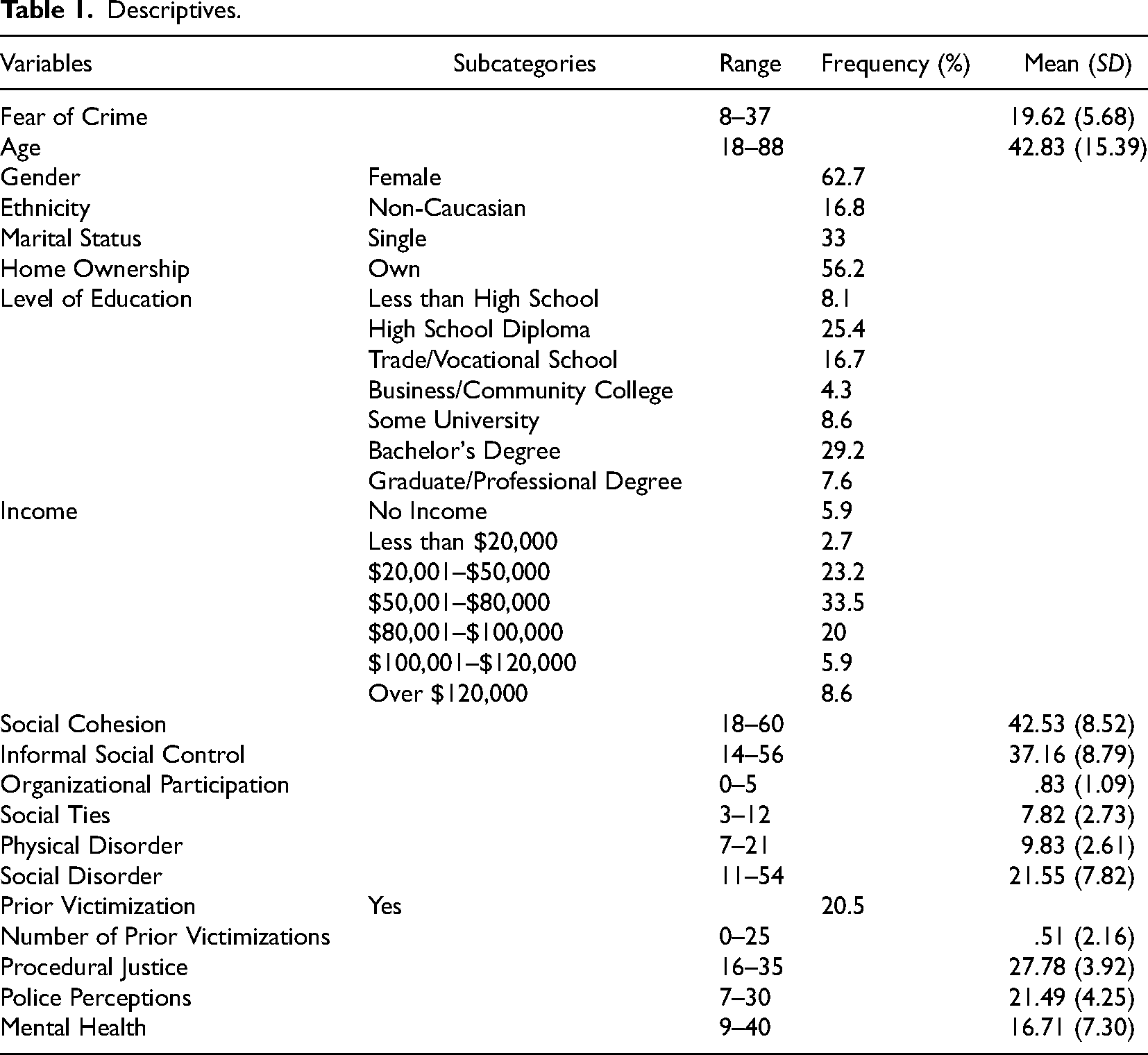
The average age of participants in this sample was 43.83, 62.7% of respondents indicated their gender was female, 16.8% identified as non-Caucasian, 67% indicated they were married, 56.2% indicated they owned their home, 29.2% held a bachelor's degree as their highest level of education, and 33.5% of participants reported an annual income between $50,001 and $80,000. Additionally, 20.5% of participants indicated they had been a victim of a crime in the past two years with the number of prior victimizations ranging between 0 and 25. These findings indicate several similarities with the most recent census data for Roma, suggesting a good representation of the sample (ABS, 2017).
Linear Regression
Three ordinary least squares regression models were utilized with FOC as the dependent variable, as shown in Table 2. Model 1 includes the individual-level variables of age, gender, ethnicity, marital status, home ownership, level of education, income, prior victimization, number of prior victimizations, and mental health. This model explained 13% of the variation in FOC. In this model, gender was a positive and significant predictor of FOC (B = 2, SE = .87, p = .02), along with prior victimization (B = 4.31, SE = 1.11, p < .001), and mental health (B = 12, SE = .06, p = .03), indicating that females, those who have been previously victimized, and experience with poor mental health have higher levels of fear. In this model, income was marginally significant (B = −.5, SE = .26, p = .06).
Regression Analysis Results.
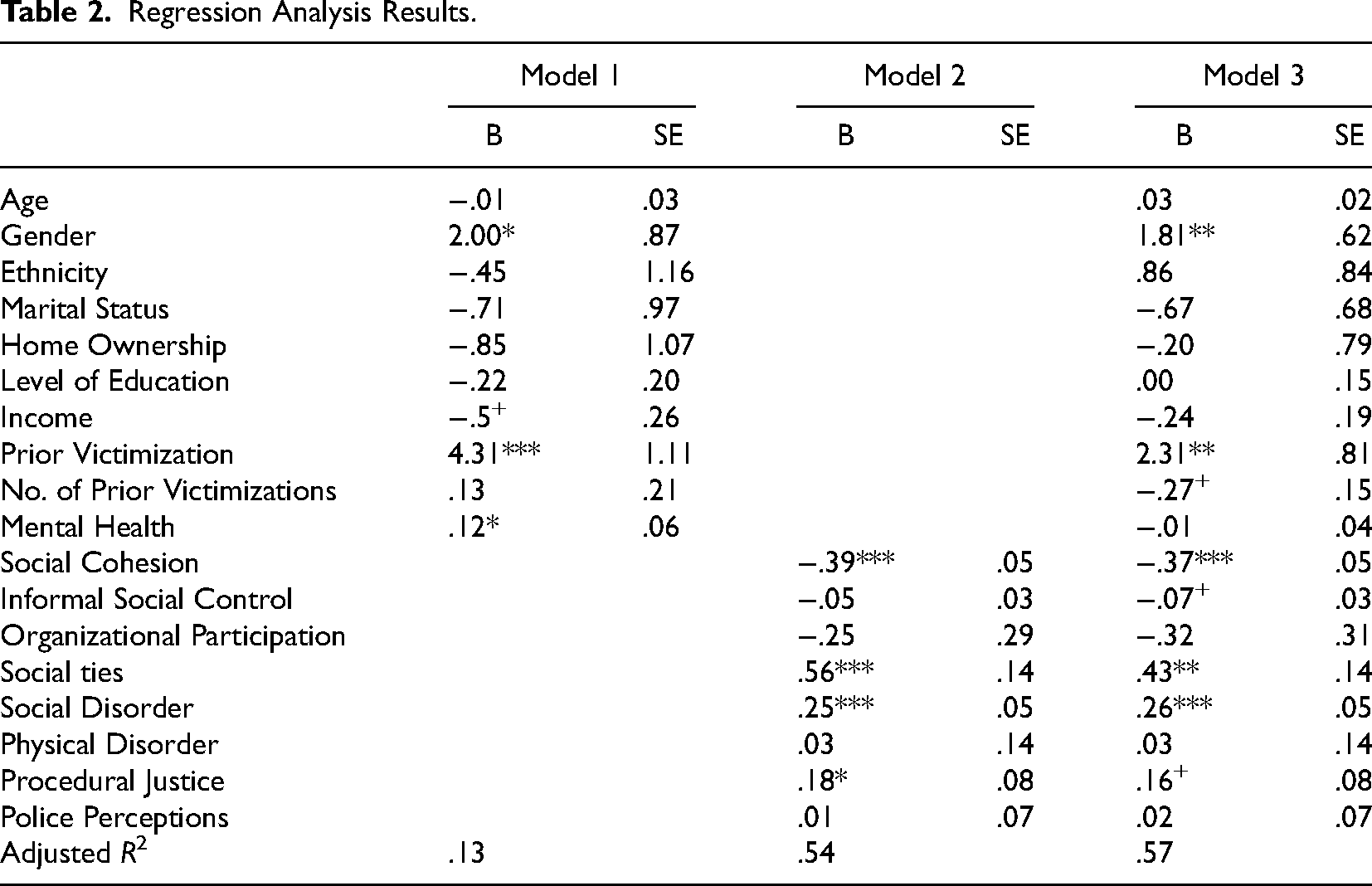
Model 2 included ecological-level variables of social cohesion, informal social control, organizational participation, social ties/social integration, social disorder, physical disorder, procedural justice, and police perceptions. This model explained 54% of the variance in FOC in this sample. In this model, social cohesion was negatively and significantly associated with FOC (B = −3.9, SE = .05, p < .001), suggesting as social cohesion increases, FOC decreases. Additionally, social ties (B = .56, SE = .14, p < .001), social disorder (B = .25, SE = .05, p < .001), and procedural justice (B = .18, SE = .08, p = .02) were positive and significant predictors of FOC. This indicates that greater social ties, perceptions of social disorder, and perceptions of procedural justice lead to an increase in FOC.
Model 3 comprised all individual-level and ecological-level variables and explained 57% of the variation in FOC. With all variables included in the model, mental health became insignificant (B = −.01, SE = .04, p = .83). Gender (B = 1.81, SE = .62, p = .004) and prior victimization (B = 2.31, SE = .81, p = .005) remain significant individual-level predictors of FOC. Social cohesion (B = −.37, SE = .05, p < .001), social ties (B = .43, SE = .14, p = .002), and social disorder (B = .26, SE = .05, p < .001) also remain significant in this final model. Additionally, number of prior victimizations (B = −.27, SE = .15, p = .07), informal social control (B = −.07, SE = .03, p = .06), and procedural justice (B = .16, SE = .08, p = .05) become marginally significant demonstrating the importance of including all possible theoretical explanatory variables in the model.
Discussion
This study examined traditional predictors of FOC in Roma, Queensland. Specifically, it aimed to further understanding of predictors of FOC in nonurban areas, particularly those that experience higher crime rates and issues unique to the nonurban landscape, such as a lack of access to social services and resources and high rates of violence and drug use (Hodgkinson & Harkness, 2020) as well as the impact of mental health on FOC in a nonurban context. Hard to reach and remote communities like Roma, Queensland, are important areas of study, because they are rarely represented in FOC research and mental health issues have been identified as more prevalent in nonurban areas such as these. Findings indicate that several of the traditional predictors of FOC in the urban context are consistent in this nonurban context including gender, previous victimization, social cohesion, social disorder, and social ties. These findings generally support the consolidation of theoretical models of vulnerability, social disorder, and social integration, while emphasizing greater empirical support for social disorder and social integration models in the nonurban context.
Gender is typically regarded as the most common predictor of FOC across the urban literature (Hale, 1996). As expected, women expressed greater FOC than their male counterparts. In accordance with the majority of previous research, the women in this nonurban community are significantly more afraid of crime (Cossman & Rader, 2011; Hale, 1996). However, despite using the same measure, this finding is inconsistent with findings from a similar nonurban context in Canada (Hodgkinson & Lunney, 2021). It is possible that the context of the previous research in Canada is unique. It is also possible that the smaller sample size and a slight overrepresentation of females in this study created different results. This contradictory finding also could suggest that there might be contextual differences between Canada and Australia that have yet to be explored and highlights the importance of not treating all nonurban communities as equal.
The previous victimization was found to contribute to heightened levels of FOC. This is consistent with urban studies that have indicated having experienced both general and crime-specific victimization impacts FOC (Gibson et al., 2002; Yates & Ceccato, 2020). This positive association and lack of a significant relationship between FOC and number of prior victimizations may suggest that multiple experiences of victimization are less influential on fear levels than direct victimization itself. In contrast, Hodgkinson and Lunney (2021) reported that the number of crime victimizations, not prior victimization, heightens FOC. This could suggest that the type of victimization is an important predictor of FOC (Rader, 2017) and that the type of victimization may differ across nonurban areas, as the most common crime type in the Canadian community studied by Hodgkinson and Lunney (2021) study was mischief (Hodgkinson, 2022). As such, research on this predictor should be expanded.
Social cohesion, in both the second and third models, was negatively associated with FOC in which the presence of community trust and cohesion act to reduce fear. Social cohesion is a reoccurring predictor of FOC across urban literature (Scarborough et al., 2010); however, it is slightly contested within rural studies (Bolger & Bolger, 2019; Hodgkinson & Lunney, 2021). In general, rural communities are considered more socially cohesive than urban areas as they have more opportunities to create meaningful bonds and relationships with neighbors in comparison to larger, urban communities (Avery et al., 2021). This suggests that a reduction in social cohesion may have a strong influence on FOC in rural contexts and has been reiterated in this study (Avery et al., 2021).
Consistent with FOC literature, in both urban and nonurban contexts, this study finds that perceptions of social disorder led to greater FOC (Bolger & Bolger, 2019; Hodgkinson & Lunney, 2021). This could suggest that social disorder may be a strong predictor of FOC across varying contexts. Interestingly, the relationship between physical disorder and social ties to FOC in this nonurban environment differs from that of urban literature. In this context, physical disorder did not significantly predict FOC. This is noteworthy considering other nonurban studies have consistently found a link between physical disorder and FOC (Bolger & Bolger, 2019; Hodgkinson & Lunney, 2021). Researchers have suggested that communities that experience high crime rates and physical disorder may become desensitized due to the continuous presence of disorder (Lytle & Randa, 2015). It is also possible that the indicators of physical disorder differ in the nonurban, Australian context.
Counterintuitively, within Roma, Queensland, stronger social ties between neighbors foster, rather than mitigate, higher levels of FOC. Stronger social ties could heighten FOC in this context for multiple reasons. As other scholars have suggested, those who live in tight-knit communities and engage in frequent communication can be more exposed to crime-related conversations, which may increase FOC and reduce feelings of trust and safety (Yuan & McNeeley, 2017). Paired with high crime rates (Jobes et al., 2004), frequent interactions with neighbors may exacerbate FOC in rural contexts. As this positive relationship between FOC and social ties is inconsistent with nonurban literature, further research may be needed to consider whether this is an experience unique to rural communities.
Finally, while poor mental health predicts FOC in the first model, in the full model, it is no longer significant. This may suggest that those who experience poor mental health in nonurban contexts, may also be situated in more disorganized areas and, as such, ecological variables are better suited for explaining both mental health and FOC (Bolger & Bolger, 2019; Lorenc et al., 2012). This is supported by previous literature exploring the relationship between mental health and FOC. Jackson and Stafford (2009) have suggested there may be a feedback model in which poor mental health can increase fear, prompting avoidance behaviors and further breakdown of social cohesion, triggering more disorganization and fear. This cyclical relationship observed in other studies indicates that the relationship between mental health may exist at both the individual and ecological levels (Foster et al., 2016; Lorenc et al., 2012). This study suggests that in the nonurban context, like Roma, Queensland, the link between mental health and FOC is not direct.
Limitations
As with all research, this study has limitations. First, the sampling techniques used to gather data for this study had to be expanded during data collection to boost participation in the nonurban context. As a result of initial low response rates, purposive sampling was used to recruit a more representative sample. Although this may affect generalizability, this sampling strategy allowed us to recruit participants that otherwise may not have participated in the study, including men and Indigenous persons. In addition, we asked participants to identify their home within a precategorized map used to create the initial stratified sampling procedure. This acted as a further check to ensure geographical representation from across the community.
Second, this study utilized a relatively small sample of participants compared to other FOC studies. Although the sample is generally representative of the population of Roma, Queensland, the findings of this study may not be generalizable to other contexts. In addition, the sample size may impact the level of significance for some common predictors of FOC. As such, the findings presented in this research should be interpreted with caution.
Third, the operationalization of FOC has been criticized by scholars. Research suggests that FOC is best operationalized through five specific measures of fear that can achieve more accurate measures of fear (Jackson, 2005). The FOC measure used for this study attempts to capture many of these measures but does not capture them all. A similar issue emerges in the measurement of ecological factors. Many of these factors are not only measured objectively but also measured as perception. Nonetheless, the measures used in this study are consistent with contemporary FOC literature, in both urban and nonurban studies (Gibson et al., 2002; Hodgkinson & Lunney, 2021; Rader, 2017).
Fourth, this study utilized a depression severity questionnaire (PHQ9) as an overall measure of mental health. Although only using a depression scale may not be able to represent poor mental health in its entirety, the use of the PHQ9 scale in this study is consistent with FOC and mental health research. However, future studies may benefit from utilizing multiple or more in-depth scales relating to mental health.
Fifth, and finally, COVID-19 also contributed to challenges surrounding data collection, affecting not only the daily routine activities and social lives of people in Australia and around the world (Andresen & Hodgkinson, 2020) but also the data collection time frames. This could impact the nature of the data we were able to collect. However, Roma (and Australia more broadly) was mostly unaffected by the first few waves of the COVID-19 pandemic and did not impact the research design. Furthermore, to control for COVID-19 changes in the data, a measure of mental health change post-COVID-19 was included in the survey. This did not affect our overall findings and, thus, was not included in the model.
Implications and Future Directions
The study has important implications for FOC research. First, it suggests, that while many of the traditional predictors of FOC continue to operate as expected in nonurban contexts, there are indeed differences. In this context, we found that gender was a significant predictor of fear of crime. This counters recent nonurban research and suggests that this is an area that requires further exploration. Although social disorder impacted FOC as expected, physical disorder was insignificant. This finding could suggest that the signals of physical disorder in nonurban contexts require additional exploration. Second, our study was one of the first (that we know of) to explore the impact of mental health on FOC in the nonurban context. We found that mental health was not a significant predictor of FOC and that this appeared to be influenced by ecological factors. This suggests a need to consider the role of the neighborhood environment for people living in nonurban and urban areas when exploring mental health and FOC. Future research may consider further exploring the role of mental health and FOC using other scales and measures. Practitioners and policy makers who are interested in addressing FOC and mental health in nonurban contexts may want to invest time and resources into addressing ecological indicators of disorder and integration.
Conclusion
Despite a few limitations, the results of this study contribute to the growing literature of FOC in nonurban environments in two ways. First, many existing variables predict FOC in this nonurban study such as gender, prior victimization, social cohesion, and social disorder. However, some consistent FOC predictors, such as social ties and physical disorder, did not predict fear in the usual direction. Second, mental health was found to directly correlate with FOC but was not a predictor of FOC when controlling for ecological predictors in this nonurban context. Findings suggest that in the nonurban context of Roma, strategies to reduce FOC should focus predominantly on reducing victimization, improving social cohesion, and reducing social disorder. In addition, mental health supports should be offered with consideration of the neighborhood context. Future research may benefit from seeking to further understand the contextual differences and relationships between gender, mental health, and FOC in nonurban contexts.
Footnotes
Declaration of Conflicting Interests
The author(s) declared no potential conflicts of interest with respect to the research, authorship, and/or publication of this article.
Funding
The author(s) received no financial support for the research, authorship, and/or publication of this article.
