




Abstract
Focusing on the guilty plea statements in sex crimes cases at the International Criminal Tribunal for the former Yugoslavia, this article investigates the ways that defendants re-present themselves, their agencies, and their offenses in response to the legal framework within which they talk. While their acts are at the core of international criminal justice (ICJ), defendants are more often spectators than participants when their guilt is negotiated and judged. They have for the most part also been absent in research on ICJ. As defendants’ voices are rarely heard during proceedings, their guilty plea statements produce rare access to war criminal’s staging of self and individual agency. At international criminal tribunals, defendants have wide audiences beyond the courtroom, and when they do speak, their stories potentially influence not only the court proceedings but also wider cultural and societal narratives about wartime agency and sexual violence. After identifying a guilty plea script, this article draws attention to a consistent and intriguing silencing of sexual crimes in the past and to how the defendants’ imageries of present and future selves align with the ICJ effect narratives about the individually disciplining and rehabilitative character of criminal justice and its general deterrent effects.
Keywords
Although defendants are the focal points of international criminal justice (ICJ) proceedings, their voices are largely missing, both in trials and in ICJ research. 1 Paralleling research on ICJ, perpetrators have traditionally been sidelined in research on conflict-related sexual violence (CRSV). Here, perpetrators have received scant attention despite wide efforts to understand the causes and consequences of their offenses. Presser (2009) suggests a lack of interest in defendants and offenders is based on an assumption that their perspectives serve only self-interest and, consequently, that their stories can add nothing to our understanding of their violence. In this article, however, I argue that defendants’ stories matter because of the instrumental purposes they serve rather than in terms of the truth level they entail. Whether their stories help or challenge the prospects of justice and reconciliation, international criminal tribunals provide a platform for defendants to address multiple constituencies (Houge, 2019).
Merging the overlapping defendant/perpetrator gaps in research on ICJ and CRSV, this article zooms in on guilty plea statements made by defendants who were convicted for their direct participation in sexual violence at the International Criminal Tribunal for the former Yugoslavia (ICTY). The tribunal has been particularly acknowledged for its prioritization and prosecution of sexual violence offenses, consistently pushed for by feminist advocacy from within and outside the institution. The ICTY ended its mandate in December 2017. By then, the chambers had sentenced 32 individuals for sex crimes, five of which pleaded guilty to having directly committed the sexual offenses (see ICTY, n.d.-a, n.d.-b, n.d.-c). Building on the ICTY records from these cases, this article addresses and analyses ICJ as a narrative space for sex crimes defendants to re-present themselves and their acts for a global audience.
Facing not only the court but also family members, peers, victims, and domestic audiences—indeed, world public opinion—defendants’ testimonies and statements amount to especially important stories in and of their lives, about who they are and have been, and about why they are now facing criminal charges. Particular to sex crime cases, defendants charged with their direct involvement in the offense must answer to “a public discourse about sexual offenders that is essentialist in nature…and that [suggests their] aberrant or evil behaviour is an intrinsic part of [their] selfhood” (Victor & Waldram, 2015, p. 97; see also Kruse, 2020). The international legal discourse about perpetrators of sexual violence coalesces their character, who they are, with the characterization of their offenses. So, how do defendants re-present and construct themselves within the limits and prospects of this institution? Do they manage to explain (away) their involvement in conflict-related (sexual) violence?
Through its focus on sex crimes cases in particular, this article addresses an important, remaining gap in research on CRSV by providing access to and a framework for understanding established perpetrators’ stories about themselves. Focusing beyond guilty/innocent and true/false dichotomies, the analysis approaches the defendants’ statements and the intriguing silences herein as social performances, producing particular imageries of self through re-presenting harm and agency in the past, capabilities in the present, and ambitions for the future. This article shows how defendants navigate between societal expectations, individual needs, and legal demands, as their statements affirm the individually disciplining and rehabilitative character of criminal justice and its general deterrent effects.
First, however, I situate this article at the intersection of research on ICJ and CRSV, and the analysis within a narrative expressivist framework well suited to address the constraints and opportunities for sex crimes offenders’ storytelling within international criminal court settings.
CRSV and ICJ
Since the early 1990s, scholars have investigated CRSV from various perspectives, most of which have had victims’ experiences and perspectives as their starting point (see, e.g., Henry, 2010). Indeed, victims are the epistemic point of reference in this field. To many of these studies, the records of the ad hoc criminal tribunals in general, and the ICTY in particular, have played a key role. Established in 1993 by UN Security Council Resolution 827, the ICTY has been central and groundbreaking in its investigations, prosecutions, and convictions pertaining to sex crimes, producing case law and best practices for the International Criminal Court and beyond—but also because it has contributed to a significant shift in the political and societal framing of what CRSV is.
Research on the international prosecution of CRSV tends to focus on the quality and precision of statutes, historical and current case law development, and the application of established international criminal law and court room practices when victim witnesses are questioned during proceedings (see, e.g., Askin, 1997; Bergsmo, 2012; Brammertz & Jarvis, 2016; Buss, 2009; de Brouwer, 2005; Henry, 2010). Increasingly, research questions the ways through which criminal justice is naturalized as primary among possible responses to the challenge that CRSV is (see Engle, 2020; Houge & Lohne, 2017), and the implications of the “humanitarian hype” (Boesten & Henry, 2018) and hierarchization through which CRSV is made separate from and worse than other forms of (gendered) violence spanning peace and conflict (Baaz & Stern, 2013; Houge & Skjelsbæk, 2018; Meger, 2016).
Considering this proliferation of research pertaining to CRSV, relatively few research projects have focused on CRSV perpetrators (confer, however, Baaz et al., 2018, for an excellent overview). An even smaller number of research outputs have focused on CRSV perpetrators in ICJ processes. Skjelsbæk (2015) conducts a narrative analysis of perpetrator representations in ICJ sentencing judgments, and I have previously assessed the re-presentations of defendants by counsels (Houge, 2016)—for the purpose of examining courts as a site for knowledge construction on CRSV. To date, however, none have specifically focused on the representation work sex crimes defendants themselves do in ICJ proceedings against them. Thus, cases where defendant perpetrators speak may serve to show how “institutions can at once enable and constrain the kinds of stories told” (Bano & Pierce, 2013, p. 231). The narrative expressivist framework of this article emphasizes this particular narrative space of ICJ.
A Narrative Expressivist Approach to ICJ
Traditionally, inquiries into offenders’ narratives have focused on the degree to which their stories are true, assessing stories’ values as good (true) or bad (false) records of past crimes and criminal behavior (Sandberg, 2010). War or peace, violent offenders’ stories are met with suspicion: Their stories cannot be trusted because offenders will lie to appear tougher than they are, to come forth as better persons than their offenses suggest, and/or not to incriminate themselves (Presser, 2009; Rauschenbach, 2018). These are reasonable suspicions that may explain why analyses of guilty pleas specifically and expressions of remorse generally have received limited attention in ICJ research (see, however, Clark, 2009; Diggelmann, 2016; Gobodo-Madikizela, 2002; Simić & Hola, 2020). The context’s impact on storytelling is rarely as explicit as it is for stories told in a criminal trial. Defendants’ in-court stories in particular depend largely on the chosen defense strategy, constructed to either prove innocence or alleviate sentencing (Duncanson & Henderson, 2014). In that sense, defendants follow institutional scripts; they play their designated part in judicial speech rituals if they testify or make statements during sentencing hearings. Their statements are likely to be influenced, if not crafted, by their counsels (Christie, 1977), whereas their testimonies are mediated by the help or provocation of questions during direct or cross-examination.
Yet, because trials “[penetrate] and increasingly [invade] culture, literature, art, politics, and the deliberated public life of society at large” (Felman, 2002, p. 2), the discourses created and used in courts reflect, engage, and feed a broader social discourse about the phenomena to which the court responds—whether or not they are “true” or honest recollections of the past. Importantly, defendants speak not only to institutional expectations, constraints, and risks but also to a wider audience, with a potential to directly address, and possibly alter, societal stories about the crimes they are there for, their consequences, and the criminal justice process itself (see also Trbovc, 2018).
Building on narrative criminology, narrative expressivism highlights the importance of narrative as a conduit for meaning and knowledge in and from law. It refers to research that addresses ICJ as a site for storytelling and knowledge construction, catering to the different constraints and motivations of stories in this field. Narrative expressivism “considers [ICJ] as a site that impacts on present and future societal understandings of mass violence, promoting a particular structuring of thought” (Houge, 2019, p. 288). I have previously exemplified narrative expressivism by reference to the speech acts of two defiant defendants who used the ICTY proceedings against them as a platform for public protest as they attempted to taint the history of their role and responsibilities that the Tribunal produced (Houge, 2019). Yet, defendants’ narratives need not take the form of protest for them to be relevant subjects of narrative expressivist analyses. Whether authentic or not, court stories—including defendants’ statements—are seen as important units of analysis because they can shape action and societal perspectives on agency, crimes, and courts (see also Presser & Sandberg, 2015).
Focusing on defendants’ narratives as they plead guilty, this article understands narrative as “a story that people create to make sense of their lives and environment” (Autesserre, 2012, p. 206). Importantly, a story is an effort to make sense of experiences for a particular audience, having that particular audience and its perceived expectations in mind (Bano & Pierce, 2013, p. 225). This approach enables analyses that focus on what the ongoing renegotiation of past experiences can tell us about the storyteller’s perception of the past in relation to present audiences; the social, institutional, and structural context; and that context’s constraints and opportunities for story making, as well as the story’s expected effects (Poletta et al., 2011, p. 110). Both the content and the meaning of the stories told, as well as that which is not articulated, or silenced in a story, may be subject to narrative analysis. This article emphasizes how defendants’ narratives perform important work, both in terms of explaining (away) defendants’ agency in past crimes and in terms of what work the stories perform in the present, for the future, and for the court.
Material and Method
During its almost 25 years in operation, the ICTY convicted and sentenced 90 individuals, of which 20 pleaded guilty. A third (32) of those convicted by the ICTY were convicted for sex crimes (ICTY, n.d.-a), 12 of which were convicted for their direct participation in the offense (Houge, 2016). The cases settled upon guilty pleas at the ICTY are listed and highlighted at the tribunal’s webpage (see ICTY, n.d.-ac). Here, all guilty plea statements are transcribed, with pictures of the defendants, YouTube videos of them giving their statements, and special highlights of each defendant’s speech. The statements are also part of the sentencing hearing transcripts. 2 To identify which guilty plea cases concerned direct sexual violence, I first cross-checked the list of guilty plea cases with the list of sexual violence convictions at the ICTY web page—identifying 11 guilty plea cases that concerned sexual violence. I then read the charges and the related trial and appeal chamber judgments of these cases to identify which defendants were directly involved in the sexual violence offenses. This narrowed down the number of cases and defendants’ statements to five (see Table 1). 3
Guilty Plea Cases Including Direct Sexual Violence at the International Criminal Tribunal for the former Yugoslavia.
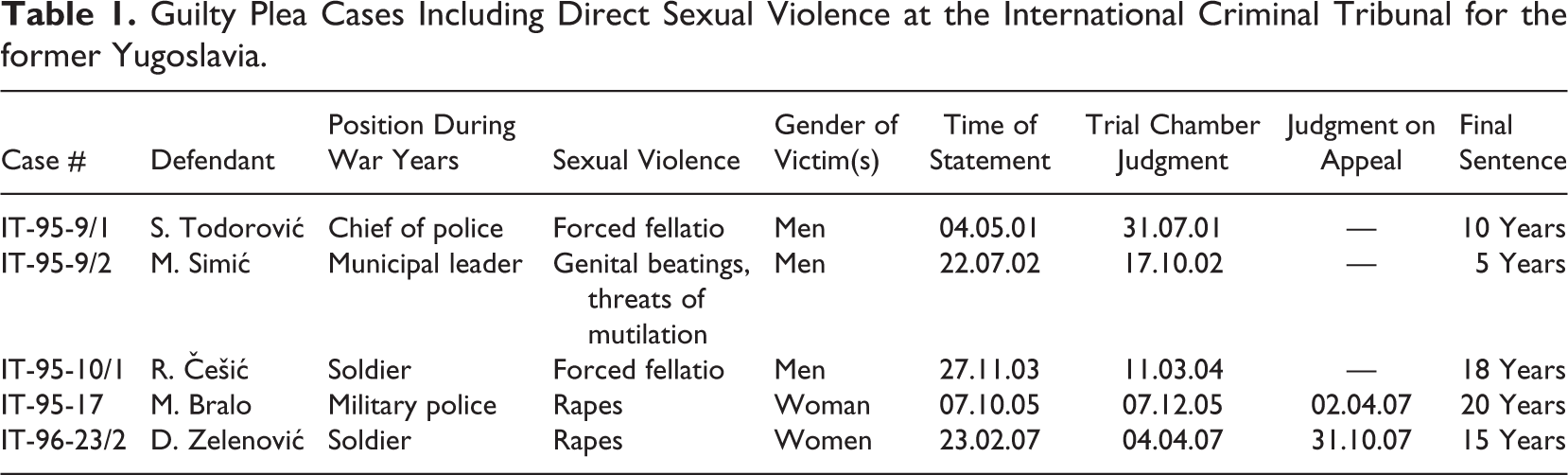
This article is based on a qualitative, narrative analysis of the defendants’ oral and written guilty plea statements in the five guilty plea cases that ended in final conviction for direct participation in sexual violence at the ICTY. Although it is not a large number of cases, these comprise all guilty plea cases before all the international ad hoc tribunals concerning direct sexual violence. 4 Provided the publicity of these cases and the potential audience the defendants speak to, a single guilty plea statement before ICJ institutions is arguably worthwhile analytic attention. Once the five guilty plea statements were identified, I read and repeatedly reread them. From a narrative expressivist outset, I looked for patterns and themes in the ways defendants construct themselves and their involvement in sex crimes within the limits and prospects of the court. Compared to defendant testimonies, guilty plea statements are short but compact, less fragmented, and saturated with meaning. In a relatively few and expectedly carefully chosen words, the statements seek to sufficiently and convincingly express the defendants’ repentance, against the background of crimes that are often used to refuse their very humanity (Baaz & Stern, 2013, p. 13). To submit a guilty plea, the defendants are required to admit to the facts underlying their conviction, which suggests some level of recognition on the part of the defendants of what they have done. However, and as will become clear in the below analysis, as I read through the statements, I could find little to nothing to indicate that the guilty plea referred to sexual violence. I had to confer and read the charges, the related trial and appeal chamber judgments, and the respective closing briefs of both prosecution and defense counsels to know what crimes the defendants actually admitted to and contextualize the statements.
Aside from this clouding of sex crimes in particular, I could quickly establish that the guilty plea statements follow a certain script: During the first few lines, the defendant in a more or less direct manner expresses his remorse or prepares the ground for the expression of remorse to come. He then addresses why he acted as he did under the circumstances and more or less explicitly what he did. Next follows a part about who he is now and what he hopes to contribute with his plea and in the future. The plea statement concludes by restating remorse. This script is reflected in statements beyond those that address sexual violence charges and responds to the developed case law as to what counts as mitigating factors, such as any help they may have offered to victims, an assessment of the expressed remorse, any actions for atonement, voluntary surrender, and the timing of the plea (Hola et al., 2012).
For the purpose of this analysis, I bracket the meaning of time passed on the kind of narratives told, well aware that it is an important factor that should be subjected to its own research agenda. I also accept from the outset that defendants’ talk depends on the strategy of counsels, the quality of work of the defense, and factors such as the articulation ability of the defendants, their potential trauma, and memory. It was the crosscutting silences that provided analytical curiosity and focus, while the script and its temporal axis gave structure to the analysis, as the defendants story themselves through re-presentations of their (lack of) agency in a violent past, an imprisoned and remorseful present, and an imagined future (see also McAdams, 2013, p. 279).
Of the five defendants, Todorović was the first to plead guilty to sex crimes before the ad hoc criminal tribunal, in December 2000, followed by his guilty plea statement in May 2001, 7–8 years after the events charged against him. Zelenović was the last to plead guilty in 2007, 14 years after the crimes he admitted to. Simić, originally a co-accused in the Todorović-case, voluntarily surrendered and plead guilty, inter alia, to kicking male detainees’ genitals and threatening to cut off a naked detainees’ penis. Češić also plead guilty to forcing detainees to perform fellatio on each other. Notably, these three, the first guilty pleas involving sexual violence at the ICTY, were submitted by Bosnian Serbs and pertained to violence against male detainees. Bralo was the first Croat to admit to sexual violence and the first defendant at the Tribunal to plead guilty to sexual violence against women. He also added crimes himself to the original indictment. Finally, Zelenović, originally indicted together with several others in the notorious Foĉa-case, was the only one to plead guilty to numerous rapes of Bosnian Muslim girls and women in that area. All defendants were men.
The sentences ranged from 5 to 20 years. Two defendants—Bralo and Zelenović—appealed their respective 20- and 15-year sentences, unsuccessfully. All but Bralo have been granted early release after serving two thirds of their prison sentences. Todorović, who was granted early release in 2005, died in 2006 in an apparent suicide. Todorović was set to testify for the prosecution in a coming trial against two former leaders of the Serbian security service (Simons, 2006; Trial International, 2012).
There are evident differences in the types of sexual crimes for which the five defendants were convicted and the charges under which they were subsumed. While all were directly involved in the perpetration of the crimes, some personally and physically abused victim, others directly ordered unarmed detainees to commit sexual acts on one another in their presence. Moreover, the defendants had different positions when they committed sexual violence, ranging from a local political leader and chief of police to foot soldiers and military police. The youngest defendant was in his mid-20s at the time of his offenses (Bralo), whereas the oldest was in his late 30s (Todorović). While each of these differences in terms of rank, age, and type of abuses, as well as the different charges for which they were convicted, could constitute an analytical entry point in and of itself, the purpose of the current analysis is to look more broadly at how defendants in sex crimes cases at the ICTY re-present and construct themselves and their agencies within the limits and prospects of an ICJ institution and on what meanings can be ascribed to their stories. Differences aside, all five plead guilty to crimes of a sexual or sexualized character and their personal, direct involvement.
The analysis below focuses particularly on the guilty plea statements of Stevan Todorović and Miroslav Bralo. The two statements are purposefully selected as they follow the same script, are of approximately the same length, yet have different emphases, and thus illustrate both the story-making constraints and freedoms of the courtroom. Zooming in on two statements allows for inclusion of the statements at length, and more into-depth analysis. Throughout, however, I reference other statements where they differ in meaning and/or content from the example statements.
Analysis: Imageries of Self
Your Honours, never in my life did I want to be chief of police, but perhaps destiny and a set of unfortunate circumstances put me in that position and at the worst possible time, the time of war, and here I am today, standing before you, before world public opinion, and before God. War is hell.
These are the opening words of Stevan Todorović’s guilty plea statement before the ICTY in May 2001. 5 The extract illustrates how saturated with meaning guilty plea statements are. In two sentences, Todorović makes his responsibility involuntary, references the difficult circumstances under which he became chief of police, and prepares his coming statement as a dramatic plot aiming for legal, public, and religious atonement. Todorović plead guilty to persecution as a crime against humanity, following the first bargained plea agreement at the tribunal. The prosecutor withdrew 26 counts, but the offenses these counts referred to were covered by the persecution count that remained. The offenses included beating a man to death, beating several others, instigating torture, and ordering six detainees to perform fellatio on each other.
In the following analysis, Todorović’s statement will be analyzed in depth, in comparison with the guilty plea statement of Miroslav Bralo. While guilty plea statements follow a script, defendants still narrate their stories in varying ways. In their respective first paragraph, Todorović’s and Bralo’s statements illustrate both the constraints and opportunities of framing selves in guilty plea statements. Bralo submitted a written guilty plea statement to the court, and this is how his statement begins: My name is Miroslav Bralo. I wish to make a personal apology to each one of my victims who I made suffer, and to each member of every one of the families affected by my actions. I wish to say that I am truly sorry for their suffering and the suffering of their loved ones. What I said in court last time I really meant: I am guilty, and I deeply regret it.
6
In the following, the statements are presented and analyzed per segment according to the temporal axis of the guilty plea script—focusing on how defendants re-present their harmdoing and agency in the past, capabilities in the present, and ambitions for the future.
Silenced Crimes in the Past
Already in the first sentence of his guilty plea statement, Todorović points to destiny and unfortunate circumstances, alluding to him being an ordinary man under extraordinary circumstances. When he continues to contextualize his acts, he further emphasizes the chaos and loss brought on by the war: The town of Bosanski Šamac, as well as the police station, throughout the war were actually on the very front line. Artillery shells were falling almost daily on the town, as well as throughout the territory of the municipality. Frequent deaths, the wounding of soldiers, civilians, and children occurred. Attending the funerals of my relatives, friends, and acquaintances was frequent. The testimony of Serbs who came from Odžak and Orašje through a process of exchange, events followed one another at great speed, and at times, it was very difficult to act wisely. A great deal of fear, panic, fatigue, stress, and at times alcohol, too, influenced my actions.
9
Under those circumstances, I made erroneous decisions and I committed erroneous acts. At the time, I didn’t have sufficient courage or determination to prevent volunteers and local criminals from committing evil and plundering the non-Serb population, and for this I feel great remorse.
Next, Todorović addresses the issue of intent as he emphasizes that he “had not planned ethnic cleansing or persecution:” Before the war, I had not planned ethnic cleansing or persecution, nor was I aware of any such plan. Two weeks into the war, I realised that a large number of non-Serbs had left and were continuing to leave the territory of Šamac municipality. I realised but I lacked courage to prevent the illegal and inhuman activities that were going on and that such treatment of non-Serbs, due to which those people left the territory of Šamac municipality. Some of them left out of fear even before the conflict, some via Yugoslavia to Western European countries, while a certain number left through the exchanges and against their own will. Those exchanges in those days seemed to me as a temporary solution. I realise today that those exchanges were unfair and unjust. In the autumn of 1992, I realised that the volunteers from Serbia had done more harm and evil than good. As I was still afraid of them, secretly we undertook to get rid of them and to expel them into Serbia. After that, they were arrested and transferred to the military prison in Banja Luka. And during that year, the year of 1992, I became aware that Croats and Muslims had suffered a great deal, to my great regret.
Miroslav Bralo’s statement both parallels and contrasts that of Todorović. The first paragraph of his guilty plea statement was cited above, illustrating a man who acknowledges great individual responsibility and agency. After an extended apology, Bralo comments specifically on the massacre in Ahmići: One of the gravest counts is the first one, which talks of Persecutions as a Crime against Humanity. This means something particular to me. As a human being these are my crimes alone, committed against people whose voice I silenced in the massacre at Ahmici. I would like to apologize in the name of those who committed horrific crimes and are not alive any more. And to all those who had to experience pain and suffering due to war and inhumane behavior in Ahmici. These were acts which I always knew to be wrong, which anyone would know to be wrong, and for which there really can be no excuse at all. I know I acted badly, and compounded this later by my words. Our wrongs were so terrible—I include others here—that we even clung to them, and tried to justify them. I tried to be proud of my actions and to think they were the actions of a successful soldier. Today I am ashamed of all that, ashamed of my conduct and ashamed of how I behaved. No, these were not the actions of the soldier I once wanted to be. I was present when women and children were gunned down in front of me, and at that moment the good soldier in me was gone, silent. I hope that the victims of this senseless war will hear my words too. This is a war that didn’t make anybody happy.…I feel sorry for all the victims who were victimised by anything that I did, and that is why I express from this forum my deepest remorse and regret. I am a human being with virtues and vices, and I didn’t know how to deal with these vices when I should have.
10
Before turning his attention to his present self, Bralo also points to his lack of courage during the war: I was sometimes brave during that time, but I was not brave enough to recognize what I had become, I was not brave enough to speak out for people whose lives should have been saved. At that time that would have been the heroic act.
The preceding analysis shows how the defendants account for the crimes they admit to and for their participation in the violence these crimes entail. It draws attention to a consistent and intriguing silencing of sexual violence. Such crimes are captured in phrases such as “erroneous acts” or “anything that I did.” In fact, reading only the guilty plea statements, there is nothing to indicate that the defendants committed sexual violence during the war years. We would know that they witnessed the violence of others, and in particular, that Bralo participated in a massacre, but their sexual violence is only vaguely referenced, if at all. In contrast, prosecutors and judges elaborate at length about the sexual violence covered by the indictment and use these detailed descriptions to characterize the defendants. For instance, the prosecutor in Bralo held that his sexual crimes “paint a picture of total contempt for human dignity, and of unimaginable cruelty.” 11 Later, the judges declared that the rape and sexual violence Bralo admitted to constituted “crimes of a most depraved nature” and pointed to the fact that even though war puts enormous pressures on people, most people do not respond to these pressures by committing crimes of this kind (Houge, 2016). 12 The combination of defendants’ silences and judges’ and prosecutors’ essentialization of defendants based on their crimes resonates well with literature that claims available cultural discourses about sexual violence refuse the perpetrators their humanity. It makes sense that the defendants avoid detailing their crimes, if their crimes are seen to reflect inherent, evil characteristics (Victor & Waldram, 2015).
In the next section, the focus is on the defendants’ portrayal of their present selves. I show how their (lack of) agency in the past is contrasted to—and narratively constitutes—their agency in the present.
New Agency in the Present
According to the script set out for guilty plea statements, the whys and whats about the past are followed by constructions of contemporary selves, who he is now. Above, I left Todorović’s statement where he explained how his mindset now differs from his mindset then. He was not always courageous enough, at the time. He continues, That is why I feel very profound repentance and remorse. I pray to God every day for forgiveness for my sins. I have cooperated fully with this Tribunal, and I’m ready to continue to do so. I am ready to testify, to cooperate, and to say everything I know in the interests of truth and justice. Guided by biblical teachings that the truth is not to be feared because that is the only thing that will help all, I have confessed as to my guilt, and I am prepared to bear all the consequences of that. I know that not a single form of punishment can erase the suffering sustained by my victims. However, faith teaches us that admission of having committed injustice to someone is the best way of helping them. And also in order to protect the victims from being reminded yet again of their suffering, I admitted my guilt.
In his short statement, Zelenović references religion a third time, as he rounds off his statement: Your Honours, it is for you to give your say now. I will courageously take any sentence meted out, and I hope that God will give me strength to go through all of this and that I go back to my family.
Of the five statements, Češić presented the most explicit contrast between his past and present self. Češić was sentenced to 18 years’ imprisonment for murdering 10 individuals and for forcing two detainees to perform fellatio on each other at gunpoint. In his short statement, Češić expresses and repeats his “deep remorse,” “the deepest remorse,” his “sincere remorse, which I feel deeply,” and “this feeling of guilt” and adds that “words such as ‘remorse’ are insufficient.” Beyond these emphases, Češić states that, …there is an enormous difference between my state of mind now and then. Now I would never do the things I did then, the things that took place in a time of euphoria, a time when all human dignity was abolished. It has taken me years to understand and acknowledge my full responsibility for each of my own actions. Now, reasoning about my own conduct, I feel enormously sorry and can do nothing but pray that never ever happens again in this world. The Tribunal has had to deal with a lot of lies. I do believe that the only way forward is for the truth to be told and for the denial to stop. I don’t think I lied, but I was one of the biggest deniers—particularly to myself. My apology should go further. It should be bigger than a globe. It should include my apology to all the victims and their families; all those who had to pass through the horrific events that took place—those known and those still unknown. I also want to apologize to the many people who are still living in fear and despair as refugees all around the world.
Constitutive Ambitions for the Future
Upon the imageries of repentant sinners addressed above, four of the guilty plea statements
13
focus next on how the defendants will help restrain harmful action and promote good in the future. In this part of his statement, Todorović recounts a romantic prewar past and laments that he cannot change history as he continues: My wish and hope is, and that depends on you, Your Honours, to go back to the wonderful prewar times that we had when all the people of Bosnia lived in unity and happily together. Unfortunately, I cannot change history. I would wish and am ready, if you give me such a chance, to try and improve the future. If fate gives me such a chance, I will dedicate myself to my family and my children. I’m also ready to invest every effort in the new multi-ethnic Bosnia, to have a positive effect on the surroundings so that the inter-ethnic wounds should heal as soon as possible and that peoples and nations should live in mutual respect and harmony and thereby to atone for my sins up to a point, my sins towards men and to God.
Whereas Todorović focuses his plea statement on what he could contribute upon release from prison, Češić focuses on the deterrent effect of the statement itself: I hope that my sincere remorse, which I feel deeply, will help to prevent similar things from happening in the future.…I hope nobody will ever do the things that I have done and that prison is not the only punishment for me, because it is even harder to go on living with this feeling of guilt. But there must be an end to the cover up of crimes. Families should grieve knowing the truth. I know what it is to grieve for the one whom you love deeply. I truly hope all sides will cooperate in search for the truth and by doing so they will shorten the agony of many families. I would have said let people take their own course, but I do not believe it. I would say that I encourage anyone who can do so to come forward and talk to their neighbours, to talk to the court and begin to make their peace. When one says the truth and admits the truth - both the neighbour and the court will believe him or her. At the Tribunal, from last November, I knew straight away that the original indictment did not tell it all. I wanted to offer up the truth about my own crimes, even though I knew that the worst were known only by me. This, and more, is what I owe. My wish is that this admission of mine convince everyone in Bosnia and Herzegovina, in the territory of the former Yugoslavia and throughout the rest of the world that the crimes were committed and that all who have acted as I did need to face up to their responsibility, in the same way as I am doing it. I hope that my gesture will contribute to the establishment of truth, to reconciliation, and enable common life with mutual respect in the territory of the former Yugoslavia.
14
It is noticeable how the analyzed statements display different kinds of positively constitutive ambitions. Todorović’s narrative is focused on what he may contribute and do differently—it is the most explicit form of a constitutive narrative in that it focuses directly on how the individual storyteller will be a better version of himself in the future. Češić focuses on how his public display of remorse and the feeling of guilt he lives with may prevent others from participating in crimes under conditions similar to what he experienced. His narrative thus ambitiously suggests to be socially constitutive in the same way that criminal law is legitimized by its assumed general deterrent effect. Bralo and Zelenović, in turn, focus on how their guilty pleas, and their acknowledgment of the crimes they have committed, can make life better for victims and their families. These are narratives that focus on how acknowledgment of guilt can somehow limit harm and allow grieving, as Bralo emphasizes in particular. Moreover, their narratives share constitutive ambitions in that they encourage and ask other perpetrators to come forth and make amends for the better of victims and for society. Combined, the statements allude to and confirm the individually disciplining and rehabilitative function of criminal justice and its general deterrent effects that proponents of criminal law uphold.
Discussion
The court is a storytelling site that provides a particular frame for presenting self. The defendants’ narratives are wringed in-between individual needs, defense strategies, legal demands, and societal expectations—reflecting the situation’s demand for particular sensemaking. Their individual freedom is on the line, but also their public legacy is at stake. In front of the court, defendants tell a story that becomes a carefully crafted version of who they are, what they have done, and why. The preceding analysis demonstrates how defendants’ stories in guilty plea statements follow a clear script and share a dramatic plot of good versus evil, re-presenting themselves as quite complex characters that are both the antagonists and the protagonists of their stories. Their guilty plea statement bridges past, present, and future, and defendants’ statements work to “reconcile multiple selves,” that is, “the bad person they were with the good and responsible agent they must now be” (Presser, 2009, p. 180). The analysis draws particular attention to the ways in which the sexual crimes they admit to are consistently silenced, while the imageries of their present and future remorseful and responsible selves allude to and confirm the rehabilitative and disciplining purpose of the criminal justice process. As such, the statements play into the naturalization of criminal justice responses to CRSV, as referenced above. In this section, I will first address this silencing, then I reflect on what work the defendants’ stories perform from a constitutive narrative perspective.
Firstly, the analysis establishes a consistent silence in defendants’ guilty plea statements pertaining to sexual violence. The defendants admit to such crimes in the overall plea deal, but they never mention nor detail them. Rather, the defendants use vague, generic terms, and as a result, there is nothing in the statements that indicate the defendants committed sexual violence. Having interviewed a number of individuals accused by the ICTY, Rauschenbach et al. (2016, p. 230) find a similar silencing in the interviewees’ discourse about the excessive violence they were charged with. They conclude: By not naming them properly, crimes such as deportation, mass murder, and collective rape become trivialized and fortuitous events that “just happened” and for which no one in particular is responsible. This absence of precision is therefore a strategy to elude blame and responsibility.
This resonates with research that finds the public discourse about sexual offenders to be essentialist. However, it does not immediately align well with the universal fact that although levels and vulnerabilities vary greatly, sexual violence is widespread and sanctioned in both conflict and peacetime (see, e.g., Kuo et al., 2018). The essentializing discourse on the inhumane, deplorable, convicted sex offender coexists with discourses that condone, neutralize, and deny sexual violence; blame victims; and render most offenders ordinary rather than aberrant. Yet, once offenders get prosecuted and convicted, or subject to justice campaigns, a large apparatus goes to show that they are deviant, different, monsters—feeding into the hierarchy of violence that constructs CRSV as a particularly heinous crime (Meger, 2016). By avoiding reference to a type of violence that, once established, is expected to merge their character with their offense (Baaz & Stern, 2013, p. 13; Victor & Waldram, 2015), the silencing of sexual violence in defendants’ statements creates a narrative space that allows defendants to re-present themselves as now moral, rehumanized individuals, “fit to be among us,” detached from the offenses that is expected to essentialize them in the eyes of others.
The hierarchy of crimes that the silences are likely to reflect and respond to forms part of the end impunity-campaigning that is particularly strong in advocacy and policy addressing CRSV (Houge & Lohne, 2017). This brings us to the second key emphasis of the analysis; that the defendants’ stories do the work of the court in their statements. The Tribunal emphasizes the guilty pleas’ contribution to truth pertaining to specific crimes and holds that this prevents historical revisionism and promotes reconciliation (ICTY Outreach Programme, 2003). In sentencing judgments, the judges consider various positive effects of a guilty plea. In particular, they underline that guilty pleas save the victims from testifying, that they contribute to the truth, and prevents historical revisionism. Overall, the Tribunal emphasizes how defendants’ guilty pleas lessen the suffering their crimes have caused.
The defendants’ guilty plea statements similarly emphasize this potential contribution of their guilty pleas. They offer personal stories of rehabilitative journeys within the criminal justice system, express hope that the guilty pleas will alleviate pain and contribute to reconciliation, and suggest that their experiences can have a general deterrent effect. The defendants’ statements contemplate that their guilty pleas may animate the lives of others by inspiring others to atone for their wrongs and by impacting public imagination of the effect of criminal justice. Moreover, with a societal, constitutive perspective on narratives about participation in collective violence, the ways in which the self is constructed in terms of agency matters, too. That is, what stories are emphasized about choice, about opportunity, and about possibilities for action? Bralo’s statement does not provide a story of his crimes in which the situational circumstances made his harmdoing unavoidable. Rather, the statement emphasizes his lack of courage when his bravery would have mattered. It insists that he knew at the time that what he did was wrong. In some respect, Bralo’s statement performs less of an act of self-pity and offers no excuses or justifications for his crimes. 16 Whereas Todorović’s statement also references his lack of courage, the preceding emphasis on destiny, the situational pressures, his fear and panic, as well as his lack of awareness, gives the statement a stronger taint of being self-serving—aiming to avoid rather than claim responsibility for his acts. Both stories, however, insist that courageous men would have resisted, objected, and prevented the crimes that they took part in—which would also have relieved them of the ordeal that it is to be a war criminal.
Todorović did not appeal his 10-year sentence and agreed to substantially cooperate with the prosecution in future cases. In 2006, a year after his early release, he died in what was reported to be a suicide, before he had given testimony in the cases he had agreed with the prosecution. Bralo appealed the 20-year judgment without success. In 2018, he motioned for early release after having served two thirds of his prison sentence. The motion was dismissed by the ICTY on the last day of 2019. In the decision, the president of the International Residual Mechanism for Criminal Tribunals references chilling reports from the relevant prison authority in Sweden, according to which Bralo has recently and repeatedly stated that he—contrary to his guilty plea statement—regrets nothing, have no remorse, and do not think he did anything wrong during the war. He is furthermore reported to have denied the sexual violence altogether ( Prosecutor v. Miroslav Bralo , 2019). As court narratives, prison narratives respond to and reflect institutional narrative constraints and opportunities, whether the stories are true or false. Arguably, these later denials of responsibility emphasize the instrumentality of the guilty plea statements that inspired this analysis from its outset. While the guilty pleas align with the purpose of the court and contribute to a narrative about the individually disciplining and rehabilitative character of criminal justice, and its general deterrent effects, Bralo’s recent withdrawal of his admissions place him with the defiant defendants that protest the legitimacy of the Tribunal, yet without the platform that hearings and proceedings at the Tribunal provide. Both defiant and confirming defendant narratives can become constitutive with their support or rejection of the ICJ project in different audiences.
Concluding Remarks
Guilty plea statements are not only public expressions of remorse, they are also the defendants’ carefully crafted imageries of self. At stake are not only the defendants’ statuses as free citizens but also their standing among peers, neighbors, relatives, victims, and domestic and international public audiences. Narrative expressivism provides an analytical framework with which to address court narratives in general and defendants’ narratives in particular and through which we can understand them better both in the immediate legal context as well as part and constitutive of societal narratives. This article draws attention to a particular narrative pattern in guilty plea statements and a compelling obscuring of the sexual violence the defendants plead guilty to. The discussion suggests that the essentializing character of the legal and societal discourse surrounding established perpetrators of CRSV limits what can be said by defendants in court and renders sexual violence invisible in their statements. This article further addresses how defendants’ imageries of present and future selves play into the naturalization of criminal justice responses to CRSV, as their statements align with the ICJ narratives about the rehabilitative and individually disciplining character of criminal justice and a general deterrent effect. As such, the empirical focus and analytical frame of this analysis provide access to and interpretation of the representations of agency, self, and ICJ by established perpetrators of CRSV—hitherto a source in short supply in CRSV research.
Footnotes
Acknowledgments
I would like to thank Lois Presser, Damien Scalia, Frédéric Mégret, Inger Skjelsbæk, Sveinung Sandberg, Anne Bitsch, Liv Finstad, May-Len Skilbrei, Peter Scharff Smith, Susanne Karstedt, and Alette Smeulers for their feedback on an earlier version of this article and the anonymous peer reviewers for thoughtful, critical, yet constructive comments that significantly improved the quality of this article.
Declaration of Conflicting Interests
The author declared no potential conflicts of interest with respect to the research, authorship, and/or publication of this article.
Funding
The author received no financial support for the research, authorship, and/or publication of this article.
