




Abstract
This article examines deaths after police contact (DAPC) in the United States using qualitative research undertaken with families who lost loved ones after police contact. It aims to understand their perceptions of the processes they go through in the aftermath of these deaths and how this affects their worldview. The article uses the principles of procedural justice and belief in a just world (BJW) to consider how these experiences affect families’ views of justice and injustice in the United States. Key findings are that families perceive police and criminal justice system processes to be procedurally unjust in cases of DAPC and that their BJW is significantly affected as a result of the outcomes they experience. It further argues that there is a racial dimension to these experiences, as White participants appeared to feel these effects more keenly than Black and Mixed-Heritage participants.
Introduction: Deaths After Police Contact in the United States
There has been considerable academic focus recently on the issue of deaths after police contact (DAPC) in the United States. Articles have variously considered the issue via secondary data analysis of existing survey data (see Campbell et al., 2018; Cesario et al., 2019; Johnson et al., 2019), literature reviews (see e.g., Desmond et al., 2016; Dunham & Petersen, 2017; Marenin, 2016), and theoretical pieces (see e.g., Katz, 2015; Kleinig, 2014). There is, however, no known primary academic fieldwork–based research on this issue involving the families left behind in the aftermath of cases of DAPC. Writing about miscarriages of justice in the UK, Charman and Savage (2009) note that families of the deceased possess special knowledge about contentious deaths, while Scraton (2002, p. 112) notes that there is a “yawning gap” between official discourse about controversial deaths and what families say. The article addresses this gap by examining the experiences of families whose loved ones have died after police contact in the United States.
It contextualizes participants’ responses using two principles: procedural justice and the belief in a just world (BJW). The capacity of police and the criminal justice system in the United States to operate using processes that are legitimate and accountable largely relates to whether society perceives police to be procedurally just (Katz, 2015). If citizens broadly perceive this to be the case, it is likely to positively affect their BJW. The article adds to the canon of knowledge on DAPC by being the first known study to use empirical data generated from the loved ones of the deceased and by using the principles of BJW and procedural justice to evaluate their responses. Both of these principles emerged at the analytical stage of an inductive research process, they were not sought for in the data-gathering phase by the Principal Investigator. As such, the article’s findings deepen our understanding of DAPC by outlining the far-reaching ramifications of these deaths in terms of the potential corrosion of societal legitimacy and trust in the police and criminal justice system.
The role of police in democratic societies is underpinned by them being perceived as a legitimate organization that operates in an accountable manner (Kleinig, 2014; Zimring, 2017). Societal consensus is key as it enables police to operate with the consent of the population (Katz, 2015). Legitimacy and consent are fundamental in ensuring that police are able to function effectively within society, both concepts are intimately linked to the issue of trust between the public and the police (Desmond et al., 2016). Legitimacy and consent are granted on the basis that police activity is regulated and held accountable when events occur, which challenge society’s view of what constitutes legitimate and consensual policing (Katz, 2015; Zimring, 2017).
How the police are perceived to use force is a significant factor in ensuring this relationship functions effectively (Katz, 2015; Marenin, 2016). If police are perceived to use force in a disproportionate or unnecessary way, it can raise questions about their legitimate right to use it (Kleinig, 2014). Similarly, if their actions are perceived to be unaccountable, these factors in combination have the capacity to create a lack of societal trust and confidence in the police (Marenin, 2016; Zimring, 2017). The lack of data on these deaths has exacerbated societal concerns about why governmental and policing authorities are unable to quantify the number of cases of DAPC 1 in the United States annually (Campbell et al., 2018; Dunham & Petersen, 2017; Marenin, 2016). In 2015, the director of the Federal Bureau of Investigation acknowledged the Guardian Media Group’s website “The Counted” represented the most accurate count of cases of DAPC (Davis & Lowery, 2015). It registered 1,148 deaths in 2015 and 1,083 in 2016—approximately three citizens die every day after contact with police in the United States (The Counted, 2015, 2016). This article considers the relationship between citizens and trust in the police and criminal justice system. It examines these issues by investigating families’ perceptions in the aftermath of cases of DAPC, and how their worldview can be altered as a result of the police and criminal justice processes they go through.
Procedural Justice
Procedural justice has been the focus of a significant amount of interest from policing scholars, partly due to diminishing public confidence in policing due to perceived failures in the ways in which police operate (Gau et al., 2012). It focuses on the perceived fairness of procedures involved in decision-making by police (Tyler & Huo, 2002). Procedural justice comprises four key principles of police behavior: dignity and respect, trustworthy motives, neutrality, and participation. When police are perceived to treat citizens with respect, demonstrate trustworthiness by showing care and concern for the well-being and quality of life of citizens or society in general, are unbiased in their decision-making, and allow citizens a voice in decision-making processes, then they are more likely to be seen as acting in a procedurally just manner (Schulhofer et al., 2011).
Procedural justice is viewed as being central to shaping public perceptions of police legitimacy (Jackson et al., 2012). In this sense, legitimacy is established by fair and appropriate exercise of authority (Tyler, 2004). A smaller body of research focuses on social identity and procedural justice (Roberts & Herrington, 2013). Police being seen to act in a procedurally just manner can confirm a citizen’s status, reaffirm a sense of group identity, and encourage allegiance to authority (Sargeant et al., 2014). Therefore, treatment by police that is perceived to be disrespectful can produce negative consequences not only for an individual’s self-worth but also their relationship with police and the rule of law (Jackson et al., 2012).
Accountability and Regulation of DAPC in the United States
In cases of DAPC in the United States, procedural justice can be applied as a 2-fold principle, in which police can be perceived as being unjust in both aspects. First, in the perceived inability to conduct themselves in a fair manner during interactions with citizens prior to their deaths (Dunham & Petersen, 2017); second, in the apparent lack of procedural justice displayed toward families’ attempts to get accountability in the aftermath of deaths (Lara, 2017). Therefore, police–community relations can be damaged by societal perception of officers’ actions and exacerbated by a perceived lack of effective accountability systems (Katz, 2015; Zimring, 2017).
Cases of DAPC are subject to a two-track investigation. The first is typically conducted by police internal affairs units and assesses whether the officer in question committed a crime (Katz, 2015). If there is probable cause to believe a crime has been committed, the internal affairs unit refers the matter to a local prosecutor who decides whether to file charges against the officer (Katz, 2015; Lara, 2017). If it is believed that a crime has not been committed, the case is classed as a “justified” death, and the officer/s involved exonerated.
Nationwide, between 2005 and 2017, Stinson (2017b) found that 82 officers were charged as a result of using lethal force, and 29 were convicted, often for lesser charges such as involuntary manslaughter or official misconduct (Stinson, 2017a). Due to the lack of accurate federal data on cases of DAPC, it is not possible to assert with certainty what percentage of these deaths result in an officer being charged, but the public perception is that officers are prosecuted infrequently in these cases (see e.g., Dunham & Petersen, 2017; Katz, 2015; Zimring, 2017). The perceived opacity of justice processes does little to contribute toward positive perceptions of legitimacy or procedural justice, thus negatively affecting community perceptions of outcomes (Levine, 2016a).
Prosecutors also face a significant conflict of interest in their duty to investigate and prosecute cases of DAPC (Katz, 2015; Lara, 2017). To ensure successful convictions of defendants, prosecutors must maintain positive working relationships with the police (Levine, 2016b). Consequently, prosecutors are perceived to be partial when investigating cases of DAPC due to these relationships (Green & Roiphe, 2017). The lack of federal data compounds concerns about a perceived lack of procedural justice and accountability in policing and its regulation. The article now considers the utility of the “BJW” principle in understanding how this might affect citizens’ worldview.
BJW
The genesis of the BJW hypothesis rests with Lerner (1980) who saw it as a “fundamental delusion” that individuals bought into to make sense of their life experiences. For an individual to invest in the social world, one must first perceive of it as just and fair in order to engage with it; in this sense, “A just world is one in which people ‘get what they deserve’” (Lerner, 1980, p. 11). Notions of justice and injustice are fundamental to the human condition, affecting our social identities and establishing feelings that we are valued members of society (Lerner, 1980). BJW provides a framework that guides us through adverse experiences and enables us to make sense of them by conceiving of society as being broadly just.
Academic literature on BJW covers a wide range of issues in which justice and injustice affect an individual’s perception of their experiences. Articles focus on attitudes toward rape victims (Adolfsson & Strömwall, 2017; Egan & Wilson, 2012), health (Gruman & Sloan, 1983; Hagiwara et al., 2015), education (Faccenda & Pantaléon, 2011), the dynamics of personal relationships (Nudelman & Nadler, 2017), workplace environments (Bastounis & Minibas-Poussard, 2012), societal perceptions of refugees (Khera et al., 2014), and racist hate crimes (Sullivan et al., 2016). Research typically focuses on how BJW affects individuals’ perceptions of their experiences in relation to them being just or unjust.
BJW acts as a buffer, enabling individuals to adapt to adverse situations that occur in their lives while maintaining their overall normative belief system about a just world (Bastounis & Minibas-Poussard, 2012; Lerner, 1980). When one’s experience of justice is inconsistent with one’s expectations, BJW is challenged necessitating a reconciliation with one’s societal contract in terms of BJW (Khera et al., 2014). In this way, a system of justification that includes elements of avoidance and denial enables individuals to reframe events in order to fit their sense of BJW and overcome any short-term injustice they might feel (see e.g., Bastounis & Minibas-Poussard, 2012; Gruman & Sloan, 1983).
People with high BJW are usually able to adapt to relatively adverse events due to their strong belief in an inherently just world and typically have conservative values (see Beierlein et al., 2011; Lerner, 1980). The views of the high-BJW group tend to correlate strongly to victim blaming and harsher views toward those from marginalized social groups, underlining the principle that in BJW people believe they get what they deserve (see Adolfsson & Strömwall, 2017; Bastounis & Minibas-Poussard, 2012). For example, in the context of DAPC, Johnson et al. (2019) found that the race of citizens who died as a result of being shot by police correlated to violent crime rates. As such, individuals with high BJW might view citizens who die as a result of contact with the police as “getting what they deserve.” Individuals with low BJW have low sensitivity to injustice and see little point in challenging it, largely because they view the world as essentially unjust (Faccenda & Pantaléon, 2011). Consequently, BJW has similarities with procedural justice as it affects the social identity of individuals and their perceived worth in sociopolitical terms (see e.g., Jackson et al., 2012; Sargeant et al., 2014). Perception is key to citizens’ understanding of how police use force, not least because the great majority of citizens neither witness it firsthand nor are recipients of its use (Marenin, 2016; Reiner, 2000). Whether police are deemed to be held accountable for using lethal force is therefore also largely determined by societal perceptions (Hirschfield & Simon, 2010).
The frameworks of procedural justice and BJW are also concerned with perceptions at both individual and group levels in relation to encounters with wider systems of authority or belief, and how these interactions in turn influence individuals’ perceptions of their relative worth in terms of identity. The research in this article focuses on participants’ responses to highly traumatic experiences, whereby their loved one died as a result of being in contact with police officers. As such, participants reflected not only on their perceptions as a result of the processes they underwent in the aftermath of such deaths but also on the perceived identities of the loved one who died. Procedural justice and BJW are useful frameworks that can help our understanding of families’ experiences in the aftermath of cases of DAPC. As such, this article provides new findings that might enable a better understanding of some of the issues surrounding cases of DAPC in the United States.
Method
This article uses qualitative data gathered from semistructured interviews with the families of loved ones who died after police contact in the United States in the period of 1999–2015. The recruitment of participants was initially driven by inquiries to local civil rights or community-activist organizations in 16 U.S. states. Personnel within these organizations identified relevant participants based on the key criterion of the research project, which was that participants should be family members of a citizen who died after police contact in the United States. The organizations also made assessments about the suitability of participants to undergo the interview process. In advance of the interviews, participants were made aware of the interview questions by email via a participant information sheet and spoke with the Principal Investigator by phone. Participants signed informed consent forms prior to conducting the interview and were made fully aware they could withdraw from the interview process at any time.
A total of 43 deaths were examined, for which 58 family members were interviewed. Forty-two family members were interviewed face-to-face and the remaining 16 were interviewed using either Skype, Zoom, or FaceTime. Interviews typically lasted 1 hr and were conducted principally with individual family members or in pairs. The interviews were then transcribed and analyzed using NVivo software 12.0. Family members were typically parents, partners, and/or siblings, with a few exceptions being aunts or nephews. In 43 cases, 40 were shot dead by police, the remainder died as a result of being restrained by police. Seven of the deceased could be considered to have been in possession of a weapon at the time of their death, four with a handgun and three with a knife. Thirty-nine cases were deemed to be justified killings; of the four that subsequently progressed to a criminal trial, officers involved in three of the cases were found not guilty. The interviews focused principally on how families perceived their experiences with police and justice agencies in aftermath of the death of their loved one.
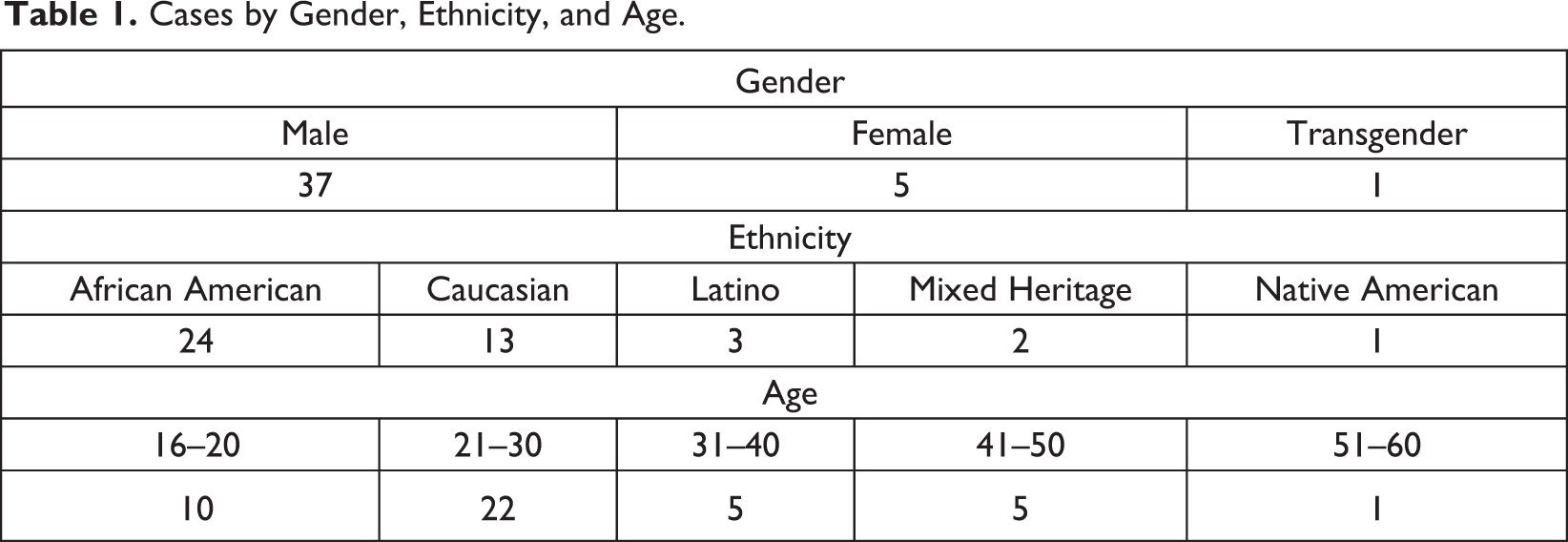
The research covered 16 U.S. states, in addition to examining a demographic cross-section of DAPC that included variation in ethnicities, gender, and age (see Table 1). The authors make no claim to the generalizability of findings from a sample of 43 cases but argue the research is highly original and produces findings that further knowledge about a subject of significant interest to academia and society.
Cases by Gender, Ethnicity, and Age.
Numerous academic authors (Liebling, 2001; Reiner, 2000; Snell & Tombs, 2011) note that research into sensitive subjects in the criminal justice system often depends on small sample sizes but that the importance of the findings should outweigh the relative limitations of the sample size. The sample for this article was gathered by what Bryman (2012) terms “convenience sampling” (pp. 201–202) but is also known as “snowball sampling” (Sudman & Kalton, 1986). This type of sampling is typical when dealing with sensitive subjects and special populations (Bryman, 2012; Sudman & Kalton, 1986). The majority of participants were recruited as a result of initial participants referring to known others who had similar experiences with DAPC. Lee (1993) states that this type of sampling often represents the only way of obtaining a sample on some issues.
The data were analyzed interpretatively, adopting framework analysis, the aim is to uncover subjective meanings and interpret them within a variety of contexts. In this sense, a specific version of reality is revealed by the process of research as distinct to any definitive statement of such a reality (Bryman, 2012). Applying framework analysis (Ritchie & Spencer, 1994) first, researchers became familiar with the corpus of data in order to gain an overview of the nature of its contents. Second, familiarization enabled a thematic framework to be constructed using NVivo software. Third, a process of indexing took place in the form of subnodes in NVivo to break down themes into case numbers and key issues. Fourth, charting enabled associations to be made by indexing within and between issues. For example, the link between legitimacy and procedural justice in this article resulted from an association made between those two issues when comparing the indexing of data. Finally, charting led to a process of mapping and interpretation. Maps emerged in the form of typologies such as accountability and legitimacy, and the relationship between procedural justice and BJW in cases of DAPC in the United States. These concepts emerged through an inductive research process, rather than being explicitly identified at any point in the planning of the project or during the collection of data in the field.
Findings
Black and Mixed-Heritage Citizens’ Experiences and Perceptions—Reinforcing Low BJW
In the aftermath of the death of their loved one, all participants broadly viewed police as being a nonlegitimate and procedurally unjust institution. There was, though, a marked difference in terms of Black and Mixed-Heritage and White participants in terms of how this affected their BJW. A common view among the former group was to be overtly critical of the capacity of police to provide any sort of legitimate service to their communities, as stated below by three mothers:
Case 15: We went out, [let] the community know “hey, this could have happened to your loved one as well. Whenever there’s an issue in your family, please don’t call the cops, because nine times out of ten, your loved one will end up killed.”
Case 31: The role of the police is not to protect and serve the people, it’s to protect and serve the system. To preserve thestatus quo: who gets what, who lives where, who gets to say what—that’s what the system is supposed to do
Case 32: You can’t be here to protect us, if you are the one doing the killing how are you protecting us?
Case 25: For Black people this has been happening for years and years that they get treated differently.
Case 19: Normally when your loved one is killed you have the police helping you solve it, we had the police working against us because it was the police that did this.
Case 38: [The non-indictment] really didn’t come as a surprise to me because of past cases and current cases where we can see from videos blatant murders by officers of citizens and we see it with our own eyes; but when the cases go to the grand jury they always come back a non-indictment, so I wasn’t surprised in that aspect of my son’s case.
Case 8: I didn’t get the chance to have a judge, a court date. I didn’t get to see the officer stand up and say anything—I haven’t [even] seen him. The justice system just said “you know what, that’s another one gone”; that’s how I feel “just another one gone.” It was like—we killed your son, move on.
Case 7: There is such a divide between the Black and White community because they put us like that. I mean, it all started from slavery—it all boils down to slavery where a light-skinned person is better than a dark-skinned person like me.
Case 15: Don’t trust no politician, no DAs, anybody that’s in position to dictate or make change, anyone in the government—you can’t trust [them].
Case 22: Black folks have been marching and having meetings in the basement all our damned lives. I am tired of meetings, I am tired of marching…take me to Washington to get those laws changed.
Case 23: [The officers] said he’s not doing nothing, you know we can’t tell him to leave a public park when he hasn’t done anything.
White Citizens’ Experiences and Perceptions—Challenging High BJW
While White participants were highly critical of police in relation to the death of their loved one, it was also typical for them to overtly state that they did not believe the police as an institution were uniformly bad, in a way that was not typically the case for Black and Mixed-Heritage participants. Usually this manifested itself as statements affirming the need for a police force and/or as acknowledging that not all officers were bad. The quotations below from a mother and then a sister illustrate this:
Case 27: It’s like over the years I have told my kids “guess what there are really good people in every kind of job there are also bad people in every job, there are bad doctors, lawyers, police, priests”—people in authority—the problem is when all the other ones don’t point it out.
Case 24: Don’t get us wrong, we don’t teach the kids that cops are bad. We knew a lot of cops growing up and we lived next to a cop and like I always had respect for police officers and I still know that there are many, many awesome police officers in this world.
Case 17: I was in a protest carrying a sign to the DA outside his house. That’s where we confronted 75 police officers to their face and they were shoving the finger at us, they really are despicable people.
Case 28: I look out and I see a bunch of cops joking in my yard and…it was just killing me and I told the cop in my house “they just killed my husband, why are they joking outside my house?” And [she] said “oh they didn’t just kill your husband”; and I said “I know they are joking about my husband.” How can they kill one human and be joking with each other?
Case 33: Constitutional rights need to be followed, it says everyone [is] responsible for action not that police aren’t responsible, they need to be followed and not broken. The police don’t follow [them], if we break [them] we will be in prison, but not police. You were not born a policeman, you swore to protect the rights of people.
Case 17: We had some recordings and…it was almost like the guy that was interviewing [the officer] was leading him to the right answers, and he was like “yes, that was what happened,” and I was like “what the hell?” I find it disturbing that they didn’t wait for the officer to respond, they were leading him to the answers.
Case 11: The DA is essentially wired at the hip to the police, and they all worked together to make sure the cops were exonerated. The DA reviews the police investigation that they did on themselves and he has a 100% record finding that whatever the cops found was justified.
Case 36: The district attorney decided that he would call me on Mother’s Day to let me know he was going to announce his decision. But [he] did it in such a way to make sure that I knew it was going to be a non-indictment. It was a Sunday and I think that for me that was one of the most disgusting parts of this entire thing. To start Mother’s Day without my son.
The Effects of BJW Being Shattered
Reflecting on the processes they experienced, a significant majority of all participants articulated a belief that they perceived the world to be unjust. This affected White participants in a more profound way than Black and Mixed-Heritage participants. In the examples below, White mothers reflect that having gone through the processes that unfolded after their loved one’s death, they could now see the world for what it really was:
Case 18: I didn’t know what to think, it was 3 years ago before all this happened at Ferguson, so I didn’t know police were like this. I just thought there was some misunderstanding, I never thought they would kill him.
Case 20: I didn’t realize how bad it was until it actually happened to us. I guess that’s a lesson I’ve learned. There should be change. Something needs to change, otherwise violence is going to keep happening.
Case 25: My eyes have been opened, I see what’s going on…I see you know, that police do cover for each other, police lie, police plant things, I see more things than I have wanted to see.
Case 29: Cops killing people and no one being accountable for it and as a normal person that doesn’t have anything to do with attorneys or think about what is said on the news, you are blindsided and then all of a sudden boom you know that this stuff that is going on is real.
Case 17: We have met the enemy and it is ourselves. I didn’t even realize till my daughter was killed that this system existed and I don’t think most people do…because all the preconceived bias they may have and you know it creates cognitive dissonance from what is the truth, and what they believe is the truth.
White participants recognized the reactions of wider society to their loss in terms of victim blaming, as they had also previously held those views. This led to the shattering of their high BJW. Some White participants acknowledged that the views of others are adopted out of their need to make sense of the world and that, “Taking the injustices committed against others into account would be an obstacle to their psychological well-being” (Faccenda & Pantaléon, 2011, p. 496). In this sense, Lerner’s (1980) view of BJW being essentially self-delusional is reflected in Bastounis and Minibas-Poussard’s (2012) view that those who hold high BJW do so because they prefer to act as though the world is just rather than actually knowing it to be so. This observation is voiced by a White mother in this example:
Case 27: I feel like I made [my son] a promise that I would never stop telling his story where I believed anybody gave a shit. It’s just that people don’t, they really don’t, it’s uncomfortable.
Ramifications of Low BJW
The research presented in this article suggests that families who experience the death of a loved one after police contact hold strong beliefs that the world is fundamentally unjust, and this clearly has wider ramifications for policing and justice in the United States. In the following example, a Black mother emphatically rejects calls for improved police/community relations because of her experiences:
Case 8: I am not going to let my grandson build a relationship with someone that was supposed to protect his dad and killed him. I am not going to raise my grandson like that and none of my children will raise their children to hold hands and sing la de dah, that’s not what I am going to have done. He won’t ever be rubbed on the head and patted like a dog at the cook out that we have for the police officers in the community to get together because thirty minutes later the community are going to be mourning another child that got killed by a police officer, just watch and see.
Case 20: Just recently…in the States with the shooting of police officers. It’s happening, like it’s entering a revolution. Everyone has their story handled differently but it all ends the same, justified [killing].
Case 42: I think a lot of the police shootings, ambushes and problems are a result of people being
Discussion
Perception has been identified as a key issue throughout the article in terms of how we might examine cases of DAPC in the United States. It affects how society views both the legitimacy of police when using lethal force and how apparent accountability is in the processes that unfold after a citizen’s death. Perception is central to tenets underpinning procedural justice and the relationship between police and society in terms of trustworthiness, neutrality, and participation. It is also fundamental in affecting citizens’ worldview in terms of whether they perceive themselves to be living in a just world. The concepts of procedural justice and BJW are intimately connected to how citizens perceive justice and injustice and, consequently, to their own sense of identity as reflected in the relationship they have with police and the justice system in the United States. Perception is therefore demonstrated to be a multidimensional issue that affects the issue of DAPC in the United States. An increased focus on the perception of citizens might, therefore, better inform academics and policymakers’ understanding of DAPC in the United States.
A second finding from the article indicates that the concept of BJW might be fruitfully used in researching issues related to policing and legitimacy, particularly in relation to holding the police to account for instances of perceived wrongdoing. The responses from White participants demonstrate that the perceived failure of regulatory processes to respond to cases of DAPC appeared to affect their BJW more than the death itself. This suggests that a focus on the perceived efficacy of regulatory processes in the aftermath of cases of DAPC might be advisable in policy terms by attempting to improve the perceived legitimacy of justice. That said, the responses from Black and Mixed-Heritage participants suggest that any attempts to improve the perceived legitimacy of policing and regulatory responses might also need to look beyond these spheres because these participants’ perceptions of justice and injustice are shaped by their everyday experiences and histories that transcend policing and the justice system. The death of their loved one after police contact and the justice processes that unfold in the aftermath of the death are perceived as being relatively unsurprising—compared to White participants—and therefore, any attempts to address their low BJW would need to consider wider structural issues that Black and Mixed-Heritage participants perceive they encounter in their lives. The concept of BJW deals with notions of justice and injustice but has been relatively underused in criminological and policing literature. This article suggests it could be used by academics researching these spheres.
There are, though, potential weaknesses with applying the BJW hypotheses to the research presented in this article. It should be acknowledged that the measurement of BJW has been questioned due to its relatively uncertain results (Sullivan et al., 2016). However, the article does not deploy BJW as a measurable hypothesis, but as a principle through which we might better understand families’ experiences of DAPC. The research undertaken for this article led to BJW emerging through an inductive process at the analytical stage of the project rather than as a hypothesis-driven investigation. It is notable that the great majority of research on BJW is quantitative (one exception is Faccenda & Pantaléon, 2011), and this may indicate that more research of a qualitative nature might be undertaken on BJW in relation to crime and justice issues.
The third finding from this article demonstrates that the effects of cases of DAPC extend beyond the individual who dies. It is reasonable to extrapolate that approximately 20,000 U.S. citizens have been killed by police since the turn of the century (The Counted, 2015, 2016). If one estimates that each death occurred within a family group of four members, these deaths could have directly affected the lives of 100,000 citizens. The increasing use of social media to disseminate footage of these incidents online further underlines how this issue has become of increasing importance to U.S. citizens (Campbell et al., 2018). The ripple effect that these deaths can cause should not, therefore, be underestimated in terms of the corrosive ramifications they might have on citizens’ perceptions of police legitimacy, accountability, and trust in the justice system.
There is evidently a lack of empirical academic research into the relatives of people who died after police contact in the United States, and this article has made an initial step in addressing this. It has also extended the principles of procedural justice and BJW to consider cases of DAPC. As these principles emerged from an inductive process of research, this raises a series of questions about how they might be utilized in future research on DAPC. For example, as BJW can be both a precursor and an outcome of families’ perceptions, it could be useful to consider whether one precedes the other as a sequence or whether they exist as separate entities. Similarly, it is not entirely clear whether an absence of procedural justice negatively affects high BJW or whether the presence of procedural justice positively affects low BJW. Each principle, and also the relationship between them, could be fruitfully examined in more detail in further research on DAPC.
The article examines the views and perceptions of a largely overlooked and unheard group of victims in the criminal justice system and clearly identifies that perception is a key factor that affects societal beliefs about cases of DAPC. It seems likely that if police and criminal justice organizations in the United States wish to alter the way in which they are perceived in cases of DAPC and to repair some of the damage done to police–community relations as a result of these deaths, then considering societal perceptions of their practices and processes would seem to be an obvious starting point.
Footnotes
Authors’ Note
David Baker is now affiliated with Department of Sociology, Social Policy and Criminology, University of Liverpool, United Kingdom.
Acknowledgment
The authors are grateful for the insightful comments and feedback provided by the reviewers of this article in the peer-review phase.
Declaration of Conflicting Interests
The authors declared no potential conflicts of interest with respect to the research, authorship, and/or publication of this article.
Funding
The authors disclosed receipt of the following financial support for the research, authorship, and/or publication of this article: US-UK Fulbright Commission.
