



Abstract
Federal legislation mandates the inclusion of students with disabilities in all classrooms, yet teacher preparation requirements vary by state. Initial teacher preparation programs in Florida lack this required specialization. This article reviews the curricula of select NASM-accredited music education programs in Florida and their curricular offerings and provides strategic recommendations for enhancing preservice educators’ preparation. Some programs integrate content into existing methods courses, while others offer specific courses or lack coverage entirely. There is a noticeable lack of consistency in preparing music teachers to teach students with disabilities, which may lead to varied levels of preparedness among future educators.
Federal legislation mandates that students with disabilities be included in the least restrictive environment, meaning that students are educated in general education classrooms as much as possible and provided with necessary supplemental resources, support, and aides (National Education Association [NEA], 2025; U.S. Department of Education [USDOE], n.d.-a). However, teacher preparation requirements to teach students with disabilities vary by state (USDOE, n.d.-b). For example, Georgia and Iowa require dedicated coursework related to students with disabilities as part of initial teacher education and certification requirements. In many states, initial teacher certification requirements related to students with disabilities are unclear. Other states, such as Colorado and Florida, require teachers to earn at least one semester hour of college credit in teaching students with disabilities for certification renewal (Florida Department of Education [FLDOE], 2024b). Although in-service teachers typically meet this requisite through professional development or a college class, there is no requirement for preservice music education programs to include this specialization (FLDOE, 2024a). Therefore, music teachers with initial certification may be underprepared to include students with disabilities in their classrooms and ensembles. With legislation such as the Individuals with Disabilities Education Improvement Act (2004); (U.S. Department of Education [USDOE], n.d.-a) mandating the inclusion of students with disabilities among their nondisabled peers, the music classroom is a common setting for inclusion (Jones, 2015); therefore, it is crucial that preservice music educators are prepared to teach students with disabilities.
In this article, I will examine the content and requirements of select Florida music teacher education programs in preparing preservice music educators to work with students with disabilities. Appendices A and B contain definitions regarding students with disabilities and a timeline of legal milestones referenced throughout this article. I detail the current federal and state laws regarding the education of students with disabilities and investigate how selected music education training programs in Florida address the topic of students with disabilities. Based on the findings, I conclude with strategic recommendations to better prepare preservice educators in special music education.
The Evolution of Students With Disabilities in U.S. Public Schools
The concept of free and appropriate public education (FAPE) for students with disabilities was first introduced in 1973 through the Rehabilitation Act (PACER Center, n.d.). This act entailed that all students, regardless of disabilities, had the right to be educated. FAPE continued to be a benchmark of major legislation through the 1975 Education for All Handicapped Children Act and its 1986 amendment. The 1975 legislation, PL 94-142, was the precursor to the Individuals with Disabilities Education Act (IDEA).
The most recent federal law regarding students with disabilities, IDEA, was introduced in 1990 and reauthorized in 1997 and 2004. IDEA established legal provisions for students with disabilities in public schools (Appendix C), namely, expanding guidelines for diagnoses included and clarifying the requirements, services, and technology needed to succeed in school. Although there has not been a reauthorization of IDEA since 2004, the ever-changing dynamic of inclusion in schools, especially among politicization of public education in President Trump’s second administration, requires teachers and students to adapt to changing policies, as mentioned below.
Special education programs and approaches like mainstreaming (i.e., placing students in general education classrooms for specific subjects or activities) and inclusion (i.e., placing students into general education classrooms) demonstrated that children with disabilities benefited intellectually and socially from being among their peers (Powell, 2016). The move toward inclusion came from separation and stigmatization of special education placement (Powell, 2016; West et al., 2022); researchers have found that students with and without disabilities benefit from inclusion (Bakken, 2016). Inclusion also aligns with the social model of disability (Burchardt, 2004). This model identifies “society’s attitudes and barriers” (Blanck, 2019, p. 608); environmental (West et al., 2022); and historical, cultural, and geographic (Powell, 2016) factors that create a sense of disability and difference, not an individual-based deficit.
Although the passing of IDEA and its subsequent amendments initiated research and coursework to prepare teachers to work with students with disabilities (Jones, 2015), a disconnect exists between the law, research, and implementation of preparing teachers for inclusive classrooms and those teachers’ efficacy to teach in such classrooms (Lewis et al., 2021). In Florida, there are no state-level requirements for music teacher preparation programs to require training in special education or disability studies. Therefore, future research is needed on the music teacher preparation process and strategies available to teachers once they are in the field.
Preservice Teacher Education
In general, preservice education is an appropriate time to address teachers’ attitudes toward disability (Chambers & Forlin, 2010), child development, and supportive learning strategies (Waitoller & Kozleski, 2010). The broad topic of special education in preservice music education varies; in some cases, it might be considered separate or supplemental (Powell, 2016). In other cases, teacher educators lack specific “pedagogical tools, strategies, and frameworks” to address special education topics (Bernard, 2023, p. 4). Teacher educator expertise contributes to the quality and presence of instruction in this area (Salvador, 2010). These limitations can result in inconsistent education among preservice music educators, if it is even covered at all.
Because the music classroom is often the first inclusion setting for students with disabilities (Draper & Bartolome, 2021), it is crucial that music teachers be prepared to meet the needs of students with disabilities among their nondisabled peers. A lack of training results in decreased confidence in teaching in inclusive settings (Rouse, 2010). Preservice teachers often find it difficult to manage problematic behaviors in the classroom, self-identifying a lack of knowledge or skills to do so (Shook, 2003). Recent research in diverse teaching strategies promotes concepts like Universal Design for Learning (UDL)—an educational framework that aims to improve and optimize teaching and learning for all students by providing flexible methods of engagement, representation, and action and expression to accommodate diverse learning needs (Bernard, 2023; CAST, 2023; Schreiner et al., 2024)—and differentiation—a teaching approach that tailors instruction to meet diverse learning needs by varying content, process, products, and learning environments (Center for Teaching and Learning, n.d.). Other practitioner strategies, such as winding, which entails varying education through multiple access points and learning levels to honor individual learning needs (Hammel et al., 2016), can help music teachers meet their students’ diverse needs.
In its most recent guidelines for curricular structure for music education training requirements, the National Association of Schools of Music (NASM, 2024) Handbook for 2023–2024 had no mention of disabilities and only one mention of special education: “Professional education is defined as those courses normally offered by the education unit that deal with philosophical and social foundations for education, educational psychology, special education, history of education, etc.” (p. 123). This language suggests that in the major accrediting body for schools of music, meaningfully and intentionally preparing preservice music educators to teach students with disabilities is not an explicit area of coverage, despite federal regulations and the reality many teachers experience upon entering the classroom.
Method and Data Collection: Review of Preservice Music Teacher Programs
In this descriptive content analysis, I reviewed data from academic bulletins and course syllabi of select music teacher preparation programs in Florida. The goal was to determine whether and how course content was devoted to students with disabilities; whether assignments and assessments allowed preservice music education students to demonstrate an understanding of students with disabilities; and what resources and course materials, such as textbooks or websites, were provided.
I created a rubric (Appendix D) to identify aspects of inclusive education in course syllabi. My rubric creation was informed by Salend’s (2010) criteria that explicitly targeted initial teacher certification related to inclusive education and included standard dimensions of program evaluation. The criteria included core beliefs that “inform the inclusive [initial teacher education] program’s curriculum, which in turn [shape] the development, delivery, and sequence of the courses that make up the program” (Salend, 2010, p. 131); curriculum, courses, and competencies; inclusive pedagogical practices and learning activities; and field-based experiences. I critically reviewed the course syllabi for these areas and identified gaps in the curriculum.
I examined NASM-accredited schools of music located in Florida that offer degrees and certification in music education. Although there are more schools providing music education training in Florida than the 15 institutions contacted for this study, limiting the scope to NASM-accredited schools provided a commonality in program requirements. These 15 institutions’ names were put through a randomizer and then given a number, which is used below in this report. Information about the institutions, including public/private status and whether courses on the topic of students with disabilities are offered, based on academic bulletins, is provided in Appendix E. Four institutions had a dedicated class regarding students with disabilities in music education, four institutions had a dedicated class regarding students with disabilities in general education, and seven institutions had no dedicated class.
I investigated academic bulletins for the preservice music education program at each institution to determine if courses may cover the topic of students with disabilities, either explicitly (e.g., Music and Special Education) or implicitly (e.g., Human Development and Learning). I contacted the chairs of music education departments and instructors to ask about the content of courses for classes I identified in and out of music education that seemed to explicitly cover the topic of students with disabilities, and also asked if they knew of any other courses that would cover students with disabilities, such as methods courses where the topic could be embedded in a discipline-specific way. While this data collection process involved communicating via email, and responses included sharing syllabi and in some cases included additional commentary from professors regarding the content of their courses, the research was deemed “Not Human Research” by the author’s IRB.
After emailing up to 5 times over the course of 3 months, I received communication from only 47% of the schools and was unsuccessful in communicating with Schools 6, 7, 8, 9, 12, 14, and 15. Based on information in the syllabi and personal communications from the institutions that did provide information (n = 7), I recognized four emerging categories: courses on teaching students with disabilities in music education, courses on teaching students with disabilities in general education, the “integrated model,” and an uncovered topic. Based on the information collected, I did not determine an overlap between categories at any institution.
Findings and Discussion
Course Offerings and Core Beliefs
Some schools required courses on teaching students with disabilities in the music education program—Schools 2 and 5 offered one course for three credits, and School 13 offered one course for two credits. These courses explicitly focused on disabilities and how they impact students in the music education setting. The main contents of the courses included developing inclusive teaching strategies and curricula to support students with disabilities, collaborative learning, and practical components for use in the field. Syllabi outlined student expectations, instructor responsibilities, communication guidelines (for both in-person and online discussions), as well as the course’s goals and objectives.
Some schools had courses in teaching students with disabilities in the general education program. The music instructors at Schools 1 (where an education course is offered) and 11 (where a course in education is required for music education students) responded to my email inquiry with voluntary feedback about the courses offered at their schools and expressed a desire for more specialized instruction in music education. The music instructors noted when they shared syllabi for these general education courses that they try to include at least some strategies or time dedicated to the topic of students with disabilities in music classes. Their feedback highlights their perceived inadequacies of current offerings at their institutions and underscores the importance of integrating comprehensive strategies for teaching students with disabilities into music education curricula. Aligning with prior research, such courses in general education may leave students with gaps in knowledge as to how to make connections from the general education context to a music setting (Culp & Salvador, 2021; Salvador, 2010). Despite their efforts to incorporate relevant strategies and resources, these instructors recognized that more targeted and specialized training is essential to meet the diverse needs of all students effectively. Prior research has shown that music-specific courses, as opposed to courses in general education, lead to enhanced confidence and preparation for music teachers to work with students with disabilities (Jones, 2024).
Some schools do not offer or require a specific course on teaching students with disabilities but integrate the content into their existing methods courses. Such an integrated approach would rely on faculty support and a philosophy of embedding inclusive teaching practices within the general music education curriculum. The integration of content on teaching students with disabilities into existing methods courses reflects a broader, inclusive approach in the general music education curriculum rather than isolating the topic in standalone classes. These integrated models underscore a commitment to preparing music educators to teach all students effectively but lack the degree of explicit coverage found in a dedicated course in either general or music education. Other researchers have recommended such an integrated approach (Culp & Salvador, 2021) but highlight its success on the dependency of instructor commitment to cover the topic of disabilities across the music education curriculum. Furthermore, limitations in factual expertise can inhibit the depth of topic coverage across an integrated curriculum (Culp & Salvador, 2021; Salvador, 2010).
Based on visual examination of available online academic bulletins, seven institutions did not appear to offer a course on teaching students with disabilities. Communication was unsuccessful with these institutions, so I cannot discuss reasons for the apparent absence of instruction in these preservice music education programs.
Texts and Disability Models
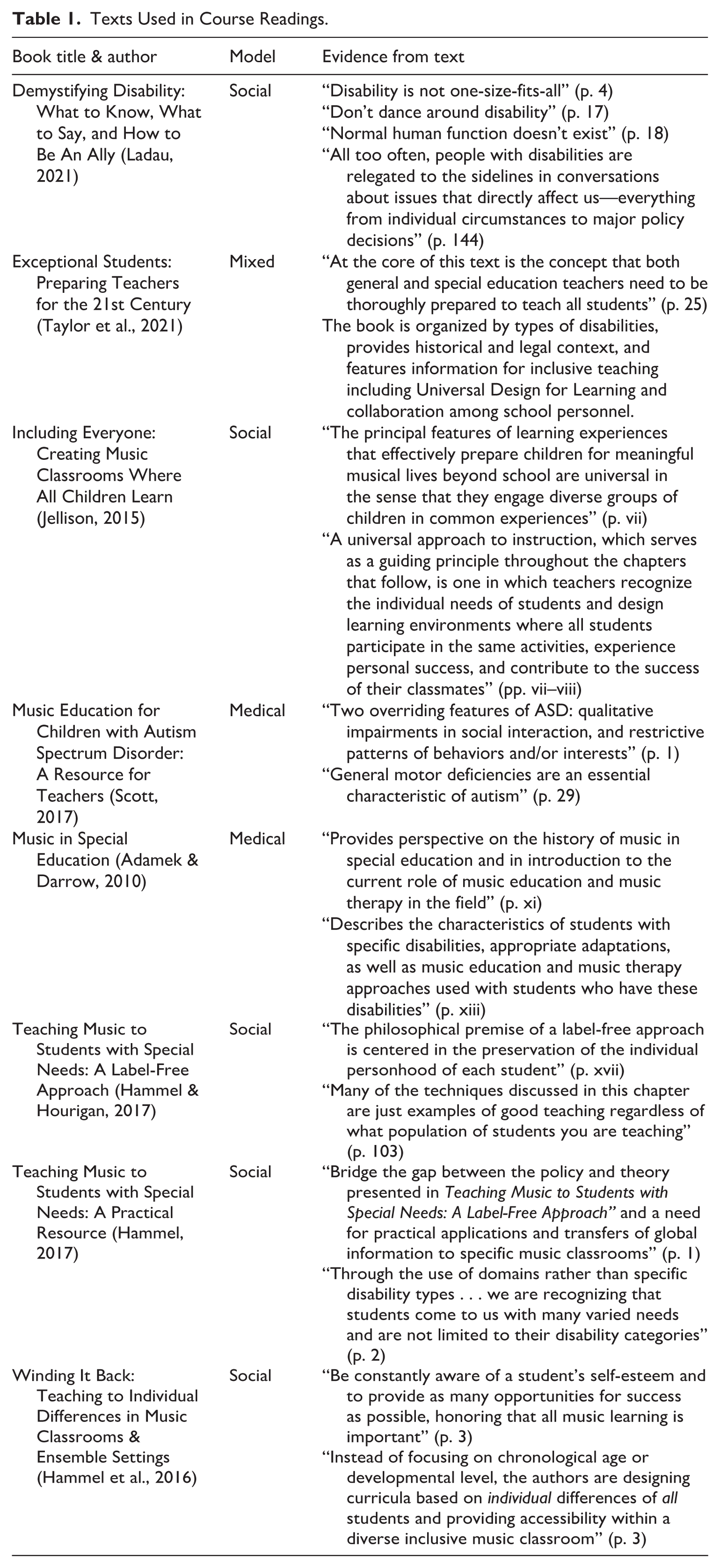
Course readings included both specific disabilities and broad domain areas and how they impact students in the music education setting. One text, Teaching Music to Students with Special Needs: A Label-Free Approach (Hammel & Hourigan, 2017) was used in two institutions’ courses. Other texts were unique to each institution and encompassed various views of the medical and social models. Table 1 describing the texts and their disability model is below.
Historically, special education has followed a medical model (Kauffman, 2007). The books aligning with the medical model of disability provide suggestions for individualized adaptations and modifications as well as characteristics of diagnoses. Outlining specific characteristics associated with various disabilities, while valuable for those unfamiliar with diagnoses, can introduce a sense of limitations of what the student(s) may be capable of. Such a focus could also provide a narrow understanding of the many disabilities and differences a teacher may encounter in the music classroom.
The books aligning with the social model of disability reject the notion that disability is a universal experience and challenge the concept of normalcy. Many of the texts aligning with the social model mention universal approaches to teaching, ensuring that the best strategies are promoted for teaching all students. The range of approaches to disability model in these texts demonstrates that a range of experts in the field, from various music education and music therapy backgrounds, are valued.
Texts Used in Course Readings.
Inclusive Pedagogical Practices, Learning Activities, and Field-Based Experiences
Assignments to create lesson plans were common, and many instructors required students to include relevant notes for inclusion, accommodation, adaptation, modifications, and Universal Design for Learning within the lesson plans. These lesson plans for elementary music or rehearsal classes allowed students to consider learning differences in the planning process proactively.
Presentation assignments, often covering domain areas—communication, cognitive, behavioral, emotional, sensory, and physical (Hammel & Hourigan, 2017; Ladau, 2021), and less often on particular diagnoses—appeared to distribute content among students so that many topics could be covered and shared with their peers. These presentations at Schools 11 and 13 seemed to be collaborative opportunities for students to learn more about particular aspects of a specific disability.
A common assignment for Schools 2 and 13 was to interview a teacher, professional, or a parent of a student with a disability to learn more about their role and interactions. The goal of these interviews was to learn more about the experiences of these individuals’ education in and beyond music.
Other assignments included developing teaching philosophies, behavior intervention plans, decibel awareness resources for teachers, and identifying inspiration porn (i.e., images or stories depicting a person with noticeable impairments engaging in a particular activity and accompanied by a caption urging viewers to find inspiration in the image) (Grue, 2016).
Fieldwork and interaction with people with disabilities can facilitate positive attitudes toward inclusive education, including in preservice education and in-service practice (Chambers & Forlin, 2010; Culp & Salvador, 2021). Personal interactions, such as having a disability or interacting with people with disabilities, can contribute to teachers’ self-efficacy for inclusive teaching (Metsala & Harkins, 2020). Schools 2, 5, 10, and 13 indicated a fieldwork requirement for the course, and the required observations ranged from four to ten hours. In only one of these courses was direct interaction (tutoring) required in the fieldwork component. Although experiences with students with disabilities can lead to greater acceptance and positive attitudes, observation alone is not as effective as direct interaction (Jellison & Taylor, 2007). Music teacher educators may consider how direct experiences of interacting with students with disabilities, rather than observation alone, can be incorporated in field experiences, both for a specialized course or in the general music education curriculum.
Implications
Among the different approaches to covering the topic of students with disabilities, there was a noticeable lack of consistency among texts, assignments, and fieldwork components. The variety of texts, ranging from those that adopt a medical model to those that embrace a social model of disability, highlights the absence of a unified pedagogical framework. This inconsistency may lead to varied levels of preparedness among future educators, as well as philosophies and approaches to working with students with disabilities. In addition, the limited fieldwork opportunities, with only a few institutions requiring direct observation of students with disabilities, suggest that more practical, hands-on experience is needed to foster positive attitudes and develop effective teaching strategies for inclusive education. Although these preliminary findings cannot be generalized in full due to the study’s geographic limitations (institutions in Florida), there are some takeaways that may be helpful to stakeholders both within the state and nationally. Below, I provide suggestions for various stakeholders based on the findings of this study.
Music Teacher Educators
As lack of expertise was a common barrier in prior research covering this topic (Culp & Salvador, 2021; Salvador, 2010), music teacher educators may be among those needing professional development on the topic of including students with disabilities. Learning about and implementing models and approaches such as positive behavior support (Carr et al., 2002), Universal Design for Learning (CAST, 2023), and assistive technologies can help future music teachers not only learn about such resources for inclusive teaching but to also experience and benefit from them firsthand as students.
The music education curriculum should also be investigated to determine which classes cover the topic of inclusion. Culp and Salvador (2021) found that singular classes and field experiences may not result in lasting change and may even “create silos rather than fostering intersectional understanding” (p. 60). Although a dedicated class allows for explicit and in-depth coverage, an integrated approach enables students to deepen their understanding of the topic through multiple exposures across contexts.
General Teacher Educators
If classes are offered solely in general education, music teacher educators can connect with general education teacher educators to discuss topics included in course offerings. Music teacher educators can provide specific details about music settings and advocate for any field experience requirements for preservice music educators to be completed in music settings.
Preservice Music Educators
Preservice music educators should be encouraged to take a course on the topic of students with disabilities, wherever it may be currently offered in an institution’s curriculum or elective offerings. Music teacher educators should encourage preservice music educators to seek out field experiences and observations of K–12 music classes, particularly those involving students with disabilities. Additional experiences can be gained through observing extra-curricular music programs that serve students with disabilities, connecting with a board-certified music therapist, or working at summer music camps.
In-Service Music Educators
For teachers who feel unprepared or want to learn more about teaching students with disabilities in their music classes, a multitude of resources are available online for music educators, many of which are free. Blog posts and fact sheets from organizations such as the American Music Therapy Association, the National Association for Music Education (NAfME), and the NAfME Accessible Music Education special research interest group offer suggestions and resources. Many of these organizations also offer webinars and/or formal professional development sessions with certificates of attendance. Furthermore, books such as the ones listed above can serve as introductions to common disabilities or characteristics music teachers may notice in the music classroom, as well as provide guidance through suggestions, vignettes, and research to support music teachers working with students with disabilities.
K–12 Administrators
Many of the affordances provided to general education teachers, such as attendance at Individualized Education Program (IEP) meetings, collaboration with special education experts, and assistance of paraprofessionals, are not as commonly experienced by music educators (Jones, 2024). K–12 administrators can ensure that IEPs are provided for all teachers, including music teachers, before the start of the school year. Furthermore, music teachers can and should be encouraged to collaborate with paraprofessionals and special education experts to ensure they provide the specific accommodations, adaptations, and modifications necessary for students who require them. Finally, allowing music educators to observe students with disabilities in other academic content areas may reveal successful strategies that can be implemented in the music education classroom.
Policymakers
As political changes challenge the Department of Education and the services it provides, all stakeholders must advocate for the needs and agency of students with disabilities in public education. The Supreme Court decision in Endrew F. v. Douglas County School District RE–1 (2017) asserted that IEPs must be “appropriately ambitious” and provide “the chance to meet challenging objectives” (p. 3). Policymakers should continue to prioritize students with disabilities to ensure they receive a free and appropriate public education, as outlined in IDEA.
K–12 Students
Ultimately, the work that in-service music teachers, preservice music teachers, and music teacher educators do is for the benefit of K–12 students. Enhanced educational experiences lead to more positive and success-oriented music-making experiences at all levels of music education.
Conclusion
Courses on teaching students with disabilities in music education appear to cover the topic most thoroughly, going so far as to include observation hours, presumably toward the fieldwork requirement before student teaching. Although some institutions explicitly offer this type of course in music, other courses (such as methods courses in elementary, choral, or instrumental music) may partially include the topic. Such inclusion, even if minimally, in a course focused on another topic could be helpful for preservice music educators. However, the exclusion of the topic altogether could potentially or inadvertently communicate an attitude that addressing the needs of students with disabilities is an “add-on.”
The sense of comprehensiveness found in a course in music education underscores a perceived benefit achieved in music education-specific classes lacking elsewhere: some music education faculty supplement content in their music courses to provide music-specific scenarios. Given the unique nature of music classrooms, it may be important to investigate further how preservice music teachers are prepared to teach students with disabilities in general music and ensemble classes.
Future research may determine whether a single course in music or general education is more effective than an integrated curriculum. It was difficult to evaluate how various courses in the integrated model addressed teaching students with disabilities. A response rate below 50% requires readers to interpret these descriptive findings with caution.
I did not have access to all assignment instructions and required readings. Therefore, I could not examine content approaches, such as “imagining what disabilities students might bring to their classrooms” or creating “a multifaceted pedagogy through a UDL framework” (Hess, 2023). The philosophy of the course instructor is an area to explore in future research.
The varied approaches to teaching students with disabilities in music class require an investigation to determine whether preservice teachers are adequately prepared to meet the needs of all students once they enter the field. Further research is needed to determine how effective these courses are in preparing preservice teachers to teach students with disabilities and preservice teachers’ or in-service teachers’ efficacy in working with that population. Such research can elucidate if singular courses versus integrated approaches are more effective, if there exists an ideal amount of fieldwork working with students with disabilities, and if there are particular experiences that foster efficacy for preservice teachers to work with students with disabilities. Such findings can inform future practice for preparing music teachers and institutional policies on course requirements before certification.
Footnotes
Appendix A
Acknowledgements
Special thanks to the professors who provided correspondence, documents, and support in this study.
Declaration of Conflicting Interests
The author declared no potential conflicts of interest with respect to the research, authorship, and/or publication of this article.
Funding
The author received no financial support for the research, authorship, and/or publication of this article.
Ethical Approval
This article does not contain any studies with human or animal participants.
Informed Consent Statement
Not applicable.

Data Availability Statement
Data sharing not applicable to this article as no data sets were generated or analyzed during the current study.