




Abstract
The purpose of this study was to explore employment preferences of preservice music teachers through a critical quantitative approach. Building on Robinson’s work in this area, I used adaptive conjoint analysis to revisit these questions while highlighting perspectives of preservice music teachers of color and trans, nonbinary, and gender-expansive preservice music teachers. Across 111 undergraduate music education majors from 24 institutions, the two most important factors were (a) welcoming environment and (b) musical expertise. Least important were (a) student SES, and (b) student race/ethnicity. Although results suggest that preservice music teachers were more similar than different, trans, nonbinary and gender-expansive participants placed heightened importance on welcoming environments, while Black preservice music teachers expressed a greater preference for working in schools with predominantly Black students. These preferences underscore the broader role of familiarity and supportive conditions in influencing employment decisions for future music educators.
Researchers have previously explored music teacher retention, job satisfaction, and employment preferences using large-scale data sets (Elpus & Miller, 2024; Gardner, 2010; Hancock, 2008, 2009) and surveys of inservice (Matthews & Koner, 2017; Robison & Russell, 2022) and preservice (Kelly, 2003; Robinson, 2012) music teachers. Although findings from these studies are representative of the music teaching population (Elpus, 2015), they may obscure perspectives of music teachers from marginalized racial and gender identities. Revisiting these questions through a different approach may help bring to the forefront views of those who have not been represented in previous research, offering insights that may help music teacher educators in better supporting students from these identities as they enter the profession.
Retention of Early Career Music Teachers
Early career music teachers have noted challenges to retention during their first years in the profession related to low salary, professional expenses, lack of mentorship and support, and feelings of isolation, burnout, and disconnection (e.g., Conway, 2015; Nápoles, 2022). In addition to these challenges, music teachers of color have noted specific concerns regarding insensitivity from White faculty to their racial and ethnic backgrounds (DeLorenzo & Silverman, 2016; Yoon, 2022). Structural challenges may also affect school environments for music teachers of color. Hancock (2008) found that music teachers of color nationally were more likely to leave their positions than White music teachers due to differences in working conditions, teacher efficacy, and salary. Similarly, Miller (2024) noted that Black and Asian music teachers in Maryland were at higher risk of attrition than White music teachers. Although data regarding school characteristics are limited, most Black, Latinx, and Native American music teachers work in schools attended predominantly by students from low socioeconomic status (SES) backgrounds (Elpus, 2022). Because racial and economic inequality are fundamentally intertwined in the United States (Manduca, 2018), schools serving low-income communities are often systematically under-resourced, potentially leading to the “less desirable working conditions” (Ingersoll et al., 2022, p. 831) cited as primary reasons for teacher turnover from these schools.
Trans, nonbinary, and gender-expansive music teachers have also faced unique challenges related to retention, especially in navigating school policies and interactions with students, colleagues, and parents (Bartolome, 2016; Palkki, 2023; Rowland, 2023). Although some music teachers in these studies taught at schools that affirmed their gender identities, support was often tenuous, dependent on district policies and actions of individuals rather than comprehensive legal protections. Beyond their classrooms, trans, nonbinary, and gender-expansive music teachers have also expressed the need to face the sociopolitical climate of their communities (Palkki, 2023; Rowland, 2023), a challenge intensified by the rise of anti-LGBTQ+ legislation since 2021 (Salvador & Shaw, 2025).
Adaptive Conjoint Analysis
Adaptive conjoint analysis (ACA), which originated in market research regarding consumer choice (Green et al., 2004) offers a method for attempting to disentangle underlying factors to explore stated—and unstated—employment preferences. Because ACA estimates tradeoffs that survey participants make when evaluating several factors, it has the potential to both measure individual preferences and uncover factors that may be hidden in decision making. ACA has been used in previous educational studies to investigate employment preferences of inservice and preservice teachers. Horng (2009) used ACA to survey elementary teachers in one school district in Southern California. The most important factors were school facilities, administrative support, and class size, while the least important were student race/ethnicity, student academic performance, and student SES. In addition, Latinx teachers in this study expressed a greater preference for working with low-income students, students of color, and low-performing students. Viano et al. (2021) also used ACA to survey teachers in Memphis and Nashville, TN. Most important factors were student discipline policy, salary, and administrator support, while the least important were student SES, student race/ethnicity, involvement in establishing the school, and student performance. The researchers attempted to analyze teacher subgroups, but sample sizes were too small to make meaningful conclusions.
Within music education, Robinson (2012) used ACA to examine employment preferences of undergraduate music education majors. Participants, 93% of whom were White and all of whom selected either male or female from a binary option, reported that administration support, parental and community support, and program sustainability were the most important factors, while student race and student SES were the least important. Robinson (2012) noted that “understanding more about employment factors that are important to preservice music teachers may assist with good job placement in hopes of reducing attrition or mobility” (p. 296). By extending Robinson’s (2012) work and revisiting questions through a critical lens, this study aims to identify factors for music teacher educators to consider when supporting preservice teachers from marginalized racial and gender identities in finding well-matched teaching positions post-graduation.
Purpose and Research Questions
The purpose of this study was to examine employment preferences of preservice music educators using a critical quantitative theoretical framework, which questions “models, measures, and analytic practices of quantitative research in order to offer competing models, measures, and analytic practices that better describe the experiences of those who have not been adequately represented” (Stage, 2007, p. 10). Critical quantitative methods differ slightly from quantitative critical race theory, or QuantCrit, “whose epistemological genealogy is [specifically] rooted in critical race theory” (Tabron & Thomas, 2023, p. 771). Although these two approaches are related, Rios-Aguilar (2014) outlined the following practices for critical quantitative inquiry:
(a) ask relevant questions (about equity and power), (b) choose relevant data, (c) apply appropriate, rigorous, and sophisticated analyses, (d) disaggregate analyses [among various demographic factors], (e) conduct research on several groups of marginalized students, (f) know how to interpret the results (g) employ challenging and enriching theories in multiple disciplines, (h) inform and challenge existing institutional practices and decisions, and (i) inform and challenge existing educational policies. (p. 101)
Given that questioning and exploring previous models are a core component for critical quantitative research, I addressed the following research questions that extend the work and methods of Horng (2009), Robinson (2012), and Viano et al. (2021).
Method
Participants
To address RQ2 regarding differences for preservice music teachers of color, randomly sampling collegiate music education students may not have yielded sufficient participation from students of color to meaningfully disaggregate data by race and ethnicity given that approximately 80% of recent music education graduates are White (DeAngelis, 2022). Therefore, to over-sample music education students of color, I created a stratified sample of 72 colleges and universities from the 605 institutions that reported granting music education degrees between 2011 and 2018 (DeAngelis, 2022). Different from Robinson (2012), who surveyed a geographically stratified sample of 100 public universities, I chose four groups of 18 schools each: Historically Black Colleges and Universities (HBCUs), Hispanic Serving Institutions (HSIs), Predominantly White Institutions (PWIs), and large diverse institutions (LDUs). 1
Because one-third of recent Black graduates in music education attended HBCUs and one-fourth of recent Latinx graduates attended HSIs (DeAngelis, 2022), intentionally seeking out students from these institutions was a priority to ensure that perspectives of Black and Latinx preservice music teachers were represented. After receiving study approval from my Institutional Review Board, I contacted music education coordinators, department chairs, and other music education faculty at each of the 72 schools to invite their students to participate in this survey. Once faculty members agreed to distribute their survey to their students, I then sent out a follow-up email with instructions and the link to the consent form and survey.
To address RQ3, which revisited findings related to gender through a critical lens, participants responded to two questions to capture the multifaceted nature of gender. The first question asked “What best describes your gender” with options: male, female, nonbinary, and not listed here. The second question followed: “Is your gender the same as the sex you were given at birth” with options: yes, no, and prefer not to say.
Survey
As with Horng (2009), Robinson (2012), and Viano et al. (2021), I designed an adaptive conjoint analysis (ACA) survey instrument through Sawtooth Statistical Software (Sawtooth Software, 2023). Within Sawtooth ACA, the survey designer specifies attributes and levels. Attributes refer to specific characteristics of the teaching position, and each attribute may contain two to four levels. A Sawtooth ACA survey contains the following sections:
Preference for levels. Participants rate their preference for levels within a single attribute. For example, “please rate the following teaching positions from not desirable (1) to extremely desirable (7): most students are from high-income families, most students are from middle-income families, most students are from low-income families.”
Attribute importance. Participants rate the relative importance of each attribute on a Likert-type scale. For example, “How important would this difference be to you: School A has excellent facilities and resources; School B has limited facilities and resources.”
Paired-comparison trade-off questions. Participants select between two partial job profiles. For example, “School A has strong parental/community support, offers $0 in additional base salary, and most teaching responsibilities in your area of musical expertise. School B has limited parental/community support, offers $10,000 in additional base salary, and no teaching responsibilities in your area of musical expertise.”
Calibrating. Using respondents’ previous answers, the Sawtooth software generates a series of full job profiles. For example, “Below is a potential teaching position. On a scale of 0 to 100, indicate how likely you are to choose to work at that school.”
Survey Attributes and Levels
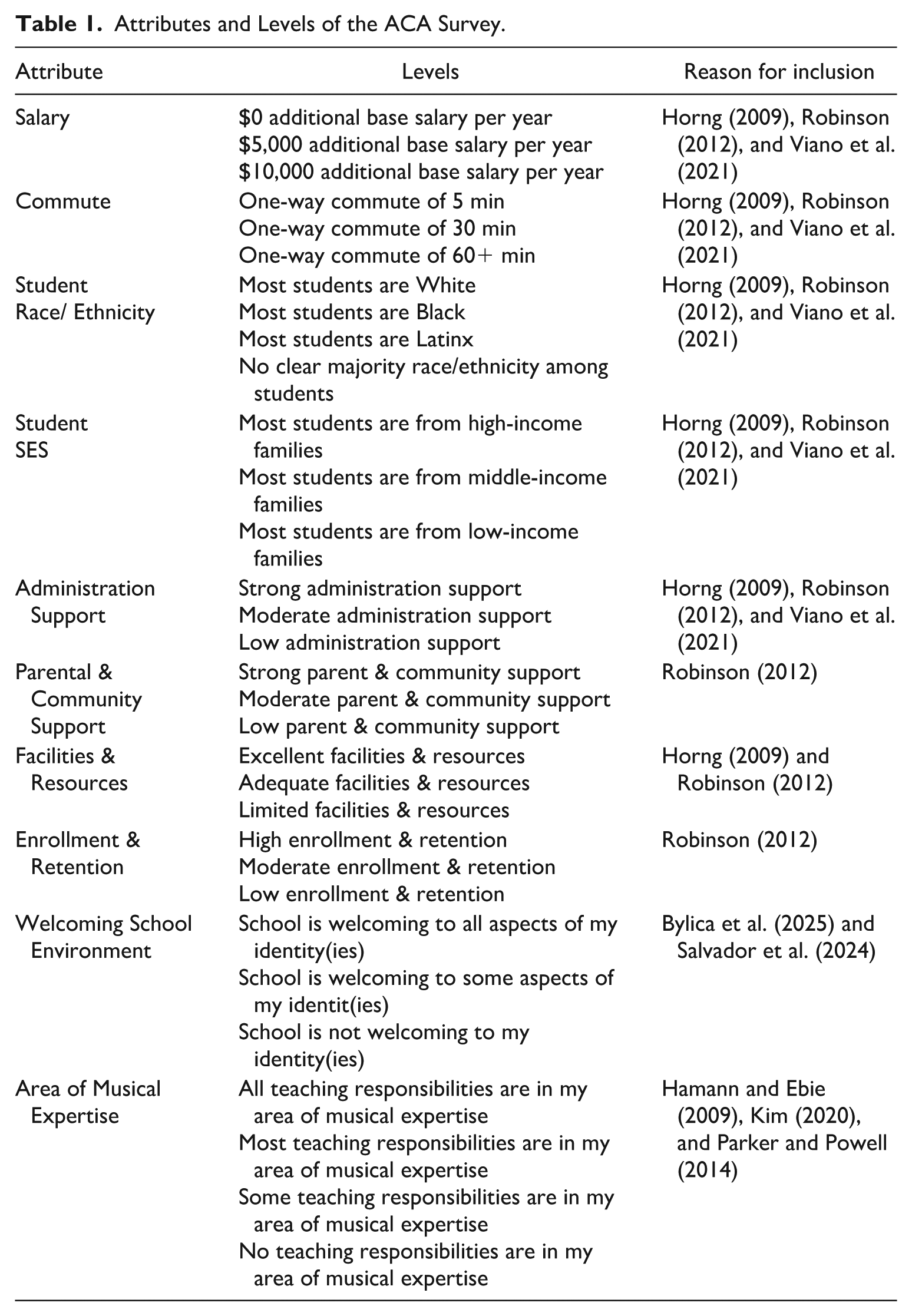
I constructed a Sawtooth ACA survey that consisted of 10 attributes and 35 total levels. Although Viano et al. (2021) used more attributes to reveal more nuanced opinions, I decided on 10 attributes to minimize participant fatigue, which is similar to the number of attributes in both Robinson (2012) and Horng (2009). Eight of the 10 attributes had been included in previous educational ACA surveys, and I included two new attributes that had not previously been studied in ACA-based educational research: welcoming school environment and musical expertise.
Rationale for New Attributes and Levels
As of 2025, divisive concept laws have been passed in 25 states (Salvador & Shaw, 2025). These laws may refer to legislation prohibiting critical race theory in public schools and/or bills targeting LGBTQ+ issues. Music teachers have expressed concern regarding these laws contributing to hostile teaching environments and teacher attrition (Bylica et al., 2025; Salvador et al., 2024). Given that divisive concept laws and other policies continue to emerge, I added the attribute Welcoming and the following three levels: school is welcoming to all/some/no aspects of my identity/identities.
Regarding musical expertise, music teacher preparation programs generally track students into areas of specialization such as instrumental, choral, and elementary/general (Kim, 2020). Although 80% of early career music teachers have reported teaching outside their area of musical expertise (Groulx, 2016), they have both indicated a reluctance to do so (Hamann & Ebie, 2009) and have continued maintaining identities closely tied to primary areas of musical study (Parker & Powell, 2014). Therefore, I added the attribute Musical Expertise with the following levels: all/most/some/no teaching responsibilities are in my area of musical expertise (Table 1).
Attributes and Levels of the ACA Survey.
Data Analysis
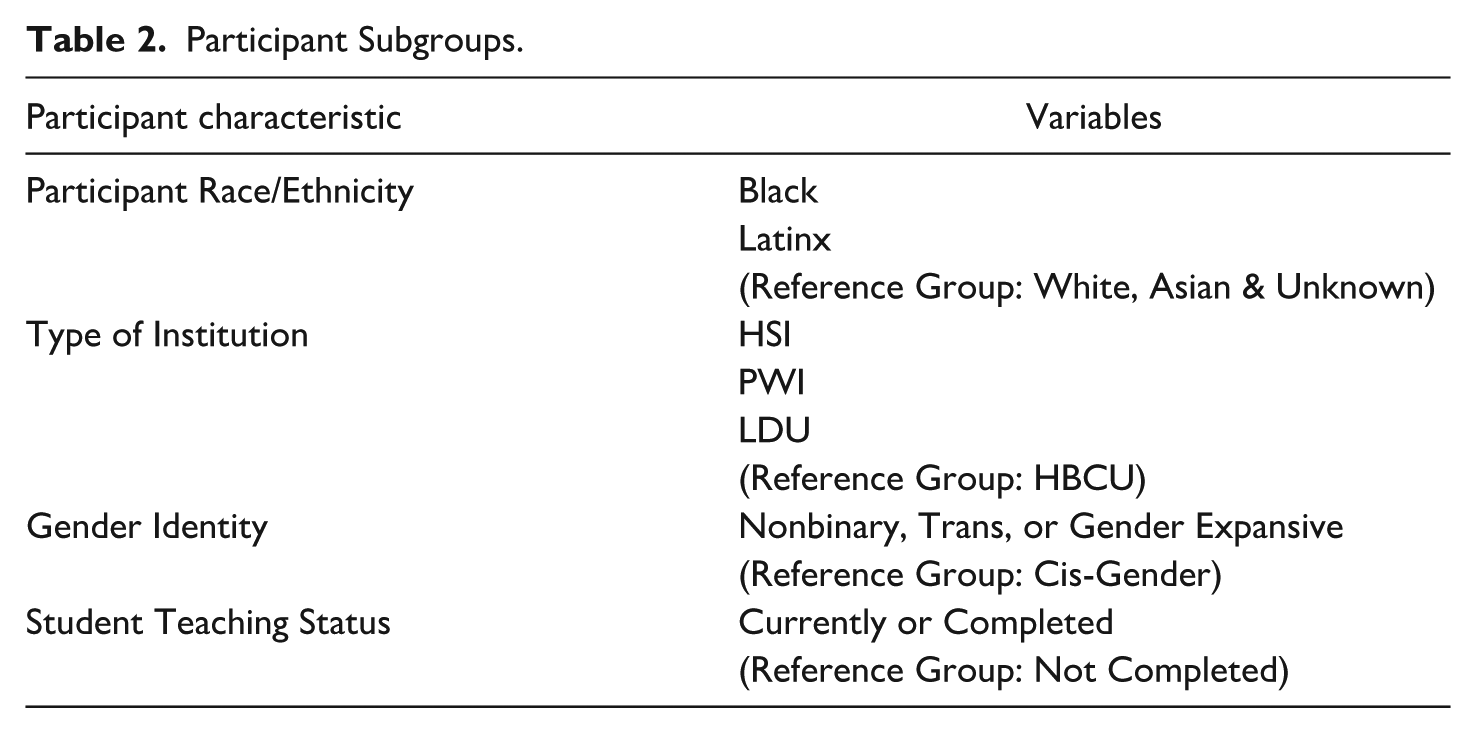
Sawtooth ACA reports two metrics: utility and importance. Utility scores compare levels within a single attribute and cannot be compared across attributes. Importance scores compare preferences across attributes and can indicate the relative importance of one attribute compared with others. After examining aggregate utility and importance scores, I analyzed subgroup differences in importance scores by creating ten multiple linear regression models, one for each attribute, with participant characteristics as predictor variables and the attribute’s importance score as the single response variable. Creating a single multivariate model with all attribute importance scores as response variables would have violated a primary assumption of a multivariate model; because importance scores across all 10 attributes sum to 100 for each participant, there is multicollinearity among the data, necessitating either omitting one attribute from the model (Horng, 2009), or examining each individually. Within each model, I determined that the data met assumptions of linear regression by examining residual normality, homoscedasticity of variance, and multicollinearity. Finally, a power analysis indicated that a minimum sample size of N = 103 was required for a model with seven predictor variables to achieve .80 power with a moderate (.15) effect. This study’s sample size of N = 111 exceeded this threshold, suggesting sufficient power to detect moderate effects. Finally, I coded participant race/ethnicity, institution type, gender, and student teaching status into dichotomous variables (see Table 2), condensing some into larger groups because a subgroup size of at least eight is recommended for linear regression (Jenkins & Quintana-Ascencio, 2020).
Participant Subgroups.
Results
Participant Demographics and Backgrounds
Between October 1, 2023, and February 29, 2024, approximately 1,800 undergraduate music education majors across 72 schools were invited to participate in the survey. Of the 196 students who began the survey, 111 completed it for a response rate of 6% and completion rate of 57%. Participants represented 24 different institutions: seven HSIs, five HBCUs, five PWIs, and seven LDUs. Twenty-seven (24.3%) attended HSIs, 15 (13.5%) attended HBCUs, 33 (29.7%) attended PWIs, and 35 attended LDUs (31.5%). When compared with recent graduates with bachelor’s degrees in music education (DeAngelis, 2022), participant demographics in this study were more racially diverse. Sixty-four (57.5%) were White, 22 (19.8%) were Latinx, 16 (14.4%) were Black, four (3.6%) were Asian, two (1.8%) were Black and Latinx, one (0.9%) was American Indian/Alaskan Native and Latinx, and two (1.8%) preferred not to respond. Fifty-three (47.8%) participants were female, 51 (46.0%) were male, four (3.6%) were nonbinary, and three (2.7%) selected “gender unlisted.” In addition, 94 (84.7%) reported that their gender was the same as their sex assigned at birth, 14 (12.6%) that their gender was different than their sex assigned at birth, and three (2.7%) preferred to not respond. Two participants (1.8%) already completed student teaching, 11 (9.9%) were currently student teaching, 94 (84.7%) planned to student teach in the future, and four (3.6%) did not plan to student teach. Of the 85 participants who did not complete the survey, 43 provided demographic information. Twenty-three were White (53.5%), nine were Latinx (20.9%), seven were Black (16.3%), and four (9.3%) identified as more than one race/ethnicity.
Survey Results
Average utility scores (see Figure 1) indicated that participants preferred higher salaries, shorter commutes, strong administrative and parental support, excellent facilities, and high enrollment and retention. When looking at student characteristics, participants indicated a slight preference for working at schools with students from predominantly middle-SES backgrounds and at racially diverse schools, worded in this survey as “there is no clear racial/ethnic majority among students.” Finally, participants indicated a strong preference for both teaching positions in their area of musical expertise and schools that are welcoming to all aspects of their identities. Average importance scores (see Figure 2) indicated that Welcoming was the most important attribute overall (M = 14.33, SD = 5.49), followed by Musical Expertise (M = 13.61, SD = 4.89). Least important overall were Student SES (M = 5.45, SD = 3.52) and Student Race/Ethnicity (M = 7.09, SD = 3.83).
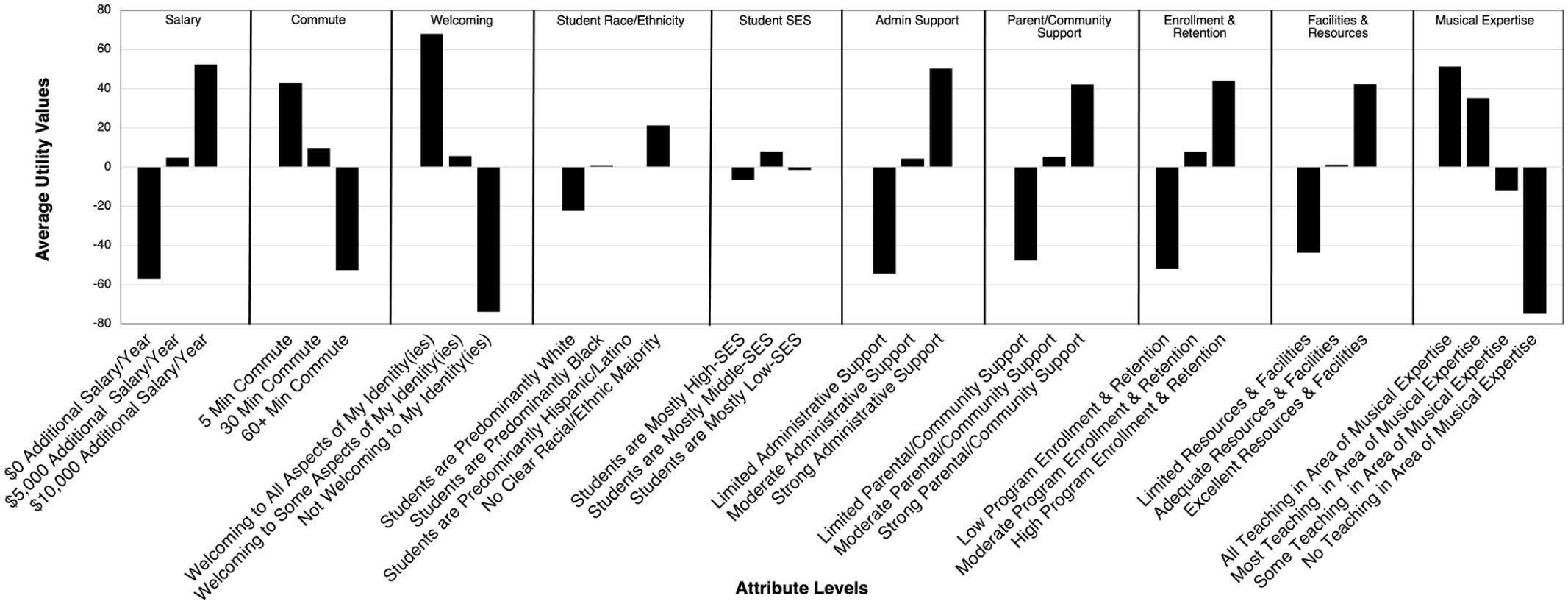
Average Utility Values for Each Level of Employment Factor.
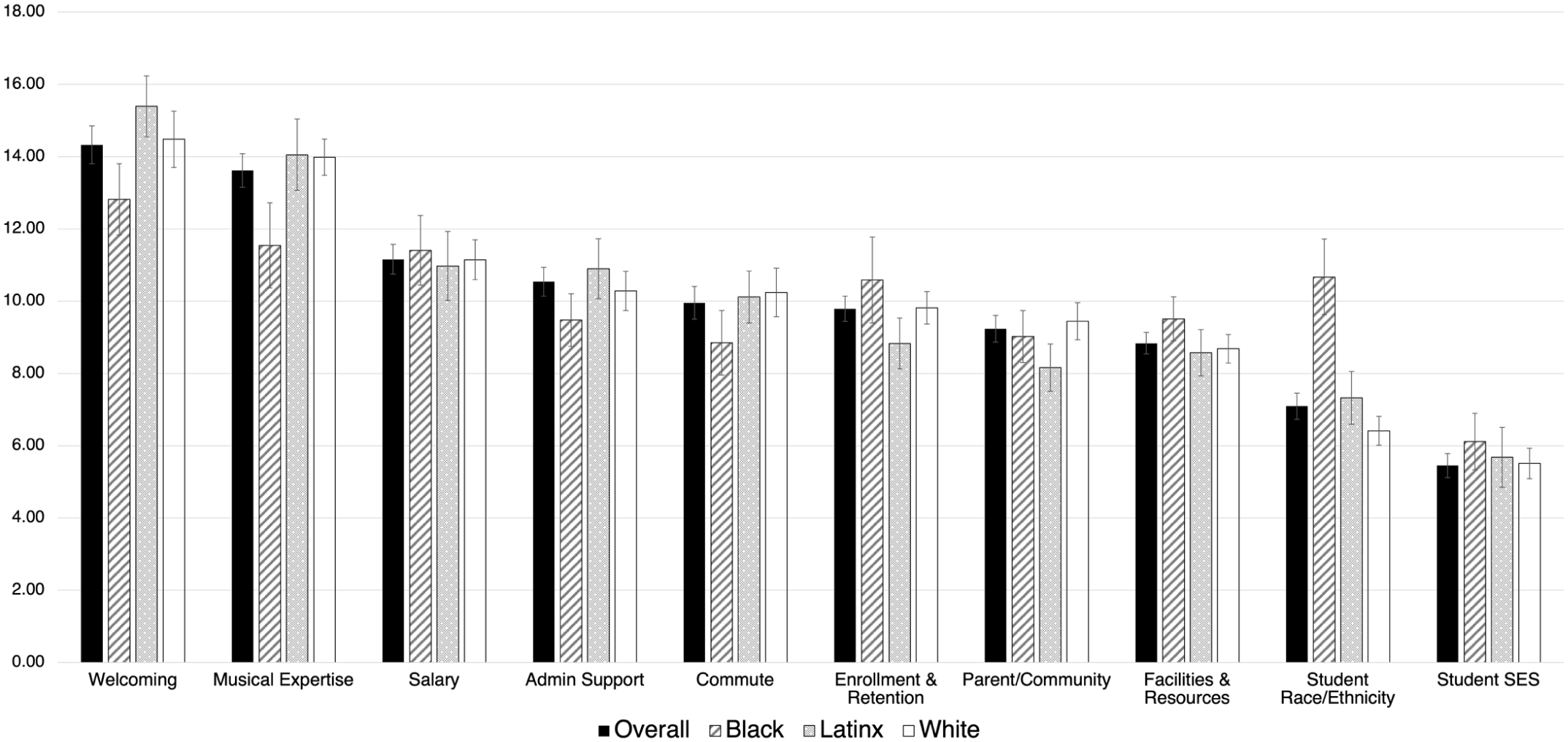
Average Importance Scores by Participant Race/Ethnicity for Each Employment Factor.
Participant Subgroups
Analysis of variance (ANOVA) results for each model indicated that only three of the ten attributes were statistically significant: Welcoming (F = 3.693, p < .001), Student Race/Ethnicity (F = 4.330, p < .001) and Facilities and Resources (F = 2.267, p < .05). Full regression coefficients for these three attributes are presented in Table 3. Within Welcoming, identifying as trans, nonbinary, or gender expansive was a significant predictor (β = 5.203, p < .001). Within Student Race/Ethnicity, identifying as Black (β = 3.720, p < .05) and having student teaching experience (β= −2.648, p < .05) were significant predictors. Finally, for Facilities and Resources, identifying as trans, nonbinary, or gender expansive (β = −1.806, p < .001) and having student teaching experience (β= 1.996, p < .05) were significant predictors. Because each predictor was coded as a dichotomous variable (1 = yes, 0 = no), membership in that subgroup corresponded to the associated change in importance score for the respective attribute. For example, identifying as trans, nonbinary, or gender expansive was associated with a 5.2-point increase in Welcoming importance score.
Multiple Linear Regression Models for Significant Employment Attributes.
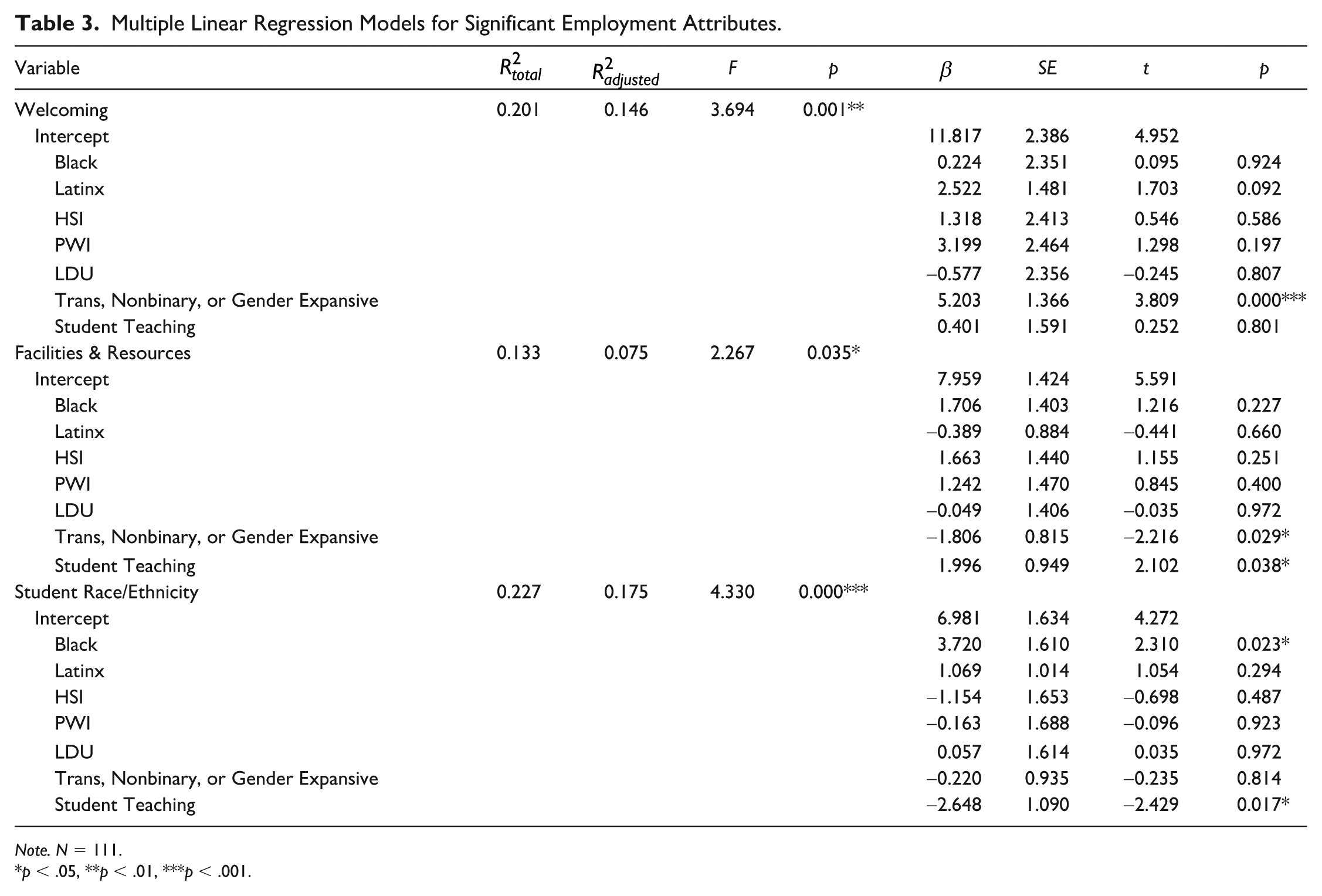
Note. N = 111.
p < .05, **p < .01, ***p < .001.
Given the
Discussion
Results both reinforce and challenge previous findings regarding employment preferences of preservice music teachers. Given that these findings are drawn from a 6% response rate, however, caution should be taken when interpreting results while still highlighting the meaningful insights from those who completed the survey. Across all participants in this study, the most important attributes were Welcoming and Musical Expertise, while the least important were Student Race/Ethnicity and Student SES. These two most important attributes differ from those identified in Robinson (2012); however, it is difficult to make a direct comparison because the attributes in each study were not identical. Administration support and parental/community support, the two most important attributes in Robinson (2012), ranked fourth and seventh, respectively, in this study. While it is possible that results from this study reflect attitudes of a different group of preservice music teachers, in terms of collegiate programs, race/ethnicity, and time, it is unknown how important Welcoming and Musical Expertise may have been to participants in Robinson (2012), because these attributes were introduced specifically for this study.
Consistent across both studies was the relative lack of importance regarding student race/ethnicity and SES; in both studies, these two attributes ranked lowest in importance, reinforcing findings from previous ACA research regarding employment preferences of teachers (Horng, 2009; Viano et al., 2021). The relative unimportance of student race and SES (e.g., “the race, ethnicity, or SES of my students is less important to me than other attributes of a potential job”) may suggest preservice music teachers prioritize what or where they teach over who they teach. Although this may be interpreted positively, it may conversely suggest a more concerning “colorblind” (Bonilla-Silva, 2002) mentality for new teachers (e.g., “I don’t see race”). Paired-comparison trade-off questions revealed that participants prioritized attributes such as facilities, resources, and support, gravitating toward jobs offering greater resources rather than serving specific student populations. Preservice music teachers who placed a greater importance on student demographics may exhibit a more developed sense of critical race and class consciousness (Ullucci, 2011), intentionally seeking out employment in schools that serve low-income students of color.
When examining differences in participant subgroups, preservice music teachers generally valued the same attributes, reinforcing the work of Horng (2009), who found that teachers were more similar than different. However, key differences emerged in the following three attributes: Facilities and Resources, Student Race/Ethnicity, and Welcoming.
In the Facilities and Resources model, student teaching experience was associated with a significant increase in importance for this attribute. This finding may point to a pivotal moment in a teacher’s development at which one exits the theoretical world of a teacher preparation program; student teachers must negotiate how the profession was presented in coursework against their new lived experiences in the classroom. For those with student teaching experience, the importance of having adequate facilities and resources to do their jobs may have become apparent only after spending extended time working in schools. Importance of facilities and resources has also been noted by student-teachers in music education who were frustrated by the structural inequalities of both their schools and wider educational landscape (Abramo, 2015).
Within Student Race/Ethnicity, student teaching experience also emerged as a significant factor. Although this attribute was already the second least important overall, it was even less important for those with student teaching experience. Because importance scores sum to 100 across all attributes, as some scores increase, others must decrease. Given this “zero-sum” mechanics of importance scores across all 10 attributes, it seems that for those with student teaching experience, as the importance of facilities and resources increases, characteristics such as student race/ethnicity may decrease. Shifting professional focus away from student characteristics toward factors such as facilities and resources may be better understood through the lens Fuller’s model of teacher development (Fuller & Bown, 1975) in which new teachers, including music teachers (e.g., Draves, 2021) move from concerns about self to concerns about tasks before finally considering their eventual impact on students.
Within the Student Race/Ethnicity model, identifying as Black was associated with a 3.7-point increase in the importance of this attribute. Further analysis of utility scores within this attribute revealed that Black preservice music teachers indicated a significantly higher preference for working in schools with predominantly Black students. This finding aligns with previous research regarding the importance of racial match for Black teachers, which refers to the alignment between an educator’s racial identity and that of their students (Fairchild et al., 2012; Renzulli et al., 2011). Student Race/ Ethnicity was elevated to the third most important factor for Black preservice music teachers when considering a future job, behind only Welcoming and Musical Expertise. In contrast, Latinx preservice music teachers in this study did not indicate a preference for working in racially matched schools; differing from Horng (2009) who reported that Latinx teachers “greatly preferred teaching at high-minority schools” (p. 712).
Notably, 13 of the 16 Black participants in this study attended HBCUs, institutions whose “principal mission was, and is, the education of Black Americans” (U.S. Department of Education, 2024). The observed preference among Black preservice music teachers in this study to work in racially matched schools may reflect the importance for HBCU students to seek educational opportunities in predominantly Black spaces. Another way to frame Black preservice music teachers, especially from HBCUs, seeking racially matched K–12 teaching positions is that these jobs may feel familiar to their own educational experiences. Seeking familiarity has been a consistent theme in previous research, with preservice music teachers often expressing a preference for working in schools that resemble their own experiences and backgrounds (Hellman, 2008; Kelly, 2003; Robinson, 2012).
Extending this broader idea of familiarity to explore racial match may provide insights into results from Latinx teachers in this study. Although Latinx preservice music teachers did not express a preference for working in racially matched schools, HSIs are different in their mission and purpose from HBCUs. Whereas HBCUs were specifically founded with the intent of educating Black students, HSIs receive this designation once their Latinx student enrollment surpasses 25% (Hispanic Association of Colleges and Universities, n.d.). Latinx music education students who attend HSIs may be enrolled in music education programs in which they are still in the minority, even at a “minority serving institution.” Teaching in a predominantly Latinx educational environment, therefore, may not be a familiar experience for the Latinx preservice music teachers in this study. In contrast, teachers surveyed in Horng (2009) all worked in a predominantly Latinx district. Therefore, the observed preference for Latinx teachers to work in “high-minority schools” (p. 712) may have reflected their familiarity in these environments.
The final attribute in which there was a significant difference among participant subgroups was Welcoming. Its emergence as the most important employment attribute overall points to a potential inflection point within education today regarding teacher identity. As divisive concept laws and policies restrict how teachers operate within schools (Bylica et al., 2025; Salvador et al., 2024), expressing a preference to work in welcoming school environments suggests broader concerns among preservice music teachers regarding the political landscape awaiting them in the profession. For trans and gender-expansive preservice music teachers, however, this concern was even more pronounced. The importance of a welcoming school environment, already the most important attribute overall, increased by five points for this subgroup, underscoring its critical significance. These heightened concerns echo previous challenges of trans and gender-expansive music teachers in navigating school policies, interactions with students, colleagues and parents, and a shifting sociopolitical context (Bartolome, 2016; Palkki, 2023; Rowland, 2023).
Limitations
Although ACA provides an approach to explore stated and unstated preferences when considering future employment, there are limitations to this method. First, using ACA to investigate employment preferences assumes that teachers attempt to maximize their utility when choosing potential jobs (Horng, 2009). Second, ACA relies on teachers self-reporting information to predict how they may choose between different job options; it is not known how teachers might respond to competing job offers. Finally, ACA is designed to disentangle social and structural factors to present hypothetical job profiles; these jobs may not exist.
In addition, there are sampling limitations in this study. First, oversampling preservice music teachers of color yielded a sample that is not representative of the population, so results from this survey cannot be generalized. Second, the small sample size of subgroups in this study hinders the specificity of the analysis. Part of the small sample size was due to design, using a targeted sampling frame (Bonevski et al., 2014) to combat issues of racial homogeneity prevalent in previous surveys of music teachers (Matthews & Koner, 2017; Robinson, 2012; Robison & Russell, 2022). However, the small sample frame of this study was exacerbated by approximately half of the students who started the survey exiting it before completion. A missed opportunity that may have both ameliorated the high rate of survey abandonment and encouraged greater participation was that participants were offered no compensation. Not compensating students may have also created self-selection bias, as those opting to complete the survey may have had stronger opinions or more investment in the topic. In addition, with small subgroup sizes there is an increased risk of Type II error, where meaningful differences may exist between groups without being observed statistically.
Finally, although results from this study did highlight the perspectives of trans, nonbinary, and gender-expansive individuals, I did not include any questions related to sexual orientation, missing an opportunity to highlight perspectives of other marginalized voices. Additional attention to these areas may have allowed for not only the reporting of meaningful results but also allowed for intersectional analysis that would have potentially captured the nuanced perspectives of individuals with multiple marginalized identities.
Conclusion
In this study, I employed a critical quantitative approach to revisit findings from previous research regarding employment preferences of preservice music teachers, center the experiences of those who have been historically marginalized, and explore alternative theories and models. One such framework worth revisiting is the role of familiarity in the employment preferences preservice music teachers. Teacher’s preferences to work in familiar environments is so well documented it is now considered a “defining feature of the teacher labor market” (Redding, 2022, p. 939). Within music education, Robinson (2012) observed that “preservice music teachers gravitate toward the ‘known’ rather than the ‘unknown’ when selecting certain types of schools for employment” (p. 304). Historically, however, given the demographics of music teachers, seeking the familiar has alluded to a cycle of coming from (Grisé, 2019) and returning to predominantly White and affluent schools and communities.
Results from this study offer an alternative perspective to Robinson (2012), who identified support, enrollment, and sustainability as the most important employment factors for preservice music teachers. Rather than viewing these attributes in isolation, however, these attributes may fall under a broader umbrella of familiarity, reflecting characteristics of the programs and communities where the preservice music teachers surveyed had grown up and intended to return. Examining familiarity through the lens of a more diverse group of preservice music teachers may therefore yield a wider range of factors that feel “familiar.” For example, when considering positions with limited administrative support or lower salaries, results from this study suggest that Black teachers might seek employment in these settings because of racial match and/or other aspects of familiarity, including welcoming environment and musical match.
The allure of the familiar may extend beyond student demographics; it may also apply to Musical Expertise, which emerged as the second most important attribute across all participants. As musical expertise is closely tied to music teacher identity (Parker & Powell, 2014), finding a job in which teaching responsibilities align with musical identity is critically for preservice music teachers seeking “musical match” in future employment. Finally, if familiarity across multiple dimensions is a key factor for preservice music teachers when seeking out employment, then music teacher educators should prioritize a variety of field placements for their students that both broaden perspectives of students from culturally dominant backgrounds and affirm previous experiences of students from marginalized backgrounds. Such placements can help all preservice teachers develop this critical sense of familiarity within K–12 learning environments.
Many states have enacted legislation to increase teacher diversity, often aligned as part of their Every Student Succeeds Act (ESSA) accountability plans. However, meaningful progress remains limited, suggesting a need for alternate policies and practices rather than legislative mandates (Smith et al., 2023). One approach involves rethinking how we recruit music teachers into collegiate music education programs. By intentionally seeking future teachers who possess a diverse set of musical skills, backgrounds, and experiences, music teacher preparation programs may move closer toward fulfilling the goal of acting as a “self-sustaining feedback loop” (Abramo & Bernard, 2020, p. 21) to a wider range of communities, and not only ones that the music education community has historically served.
Given the overwhelming importance of finding a welcoming school environment across all participants, it appears that preservice music teachers primarily want to work at schools in which they can bring their full selves to their classrooms and their students. For trans, nonbinary and gender-expansive music teachers, however, this sentiment was even more critical, highlighting the precarious reality of entering the teaching profession in 2025 with marginalized gender identities. These insights point to the need for music teacher educators to recognize and support the multifaceted identities of their students, including but not limited to their racial, gender, and musical identities, as they transition from college to their first teaching roles. Whereas some positions may appear more desirable in terms of salary, support, or enrollment, results from this study suggest that these factors may be secondary to the presence of an affirming and welcoming environment, where new music teachers feel empowered to thrive in their communities.
Supplemental Material
sj-docx-1-jmt-10.1177_10570837261422468 – Supplemental material for Employment Preferences of Preservice Music Teachers: A Critical Quantitative Analysis
Supplemental material, sj-docx-1-jmt-10.1177_10570837261422468 for Employment Preferences of Preservice Music Teachers: A Critical Quantitative Analysis by David R. DeAngelis in Journal of Music Teacher Education
Footnotes
Declaration of Conflicting Interests
The author declared no potential conflicts of interest with respect to the research, authorship, and/or publication of this article.
Funding
The author received no financial support for the research, authorship, and/or publication of this article.

Supplemental Material
Supplemental material for this article is available online.
Notes
References
Supplementary Material
Please find the following supplemental material available below.
For Open Access articles published under a Creative Commons License, all supplemental material carries the same license as the article it is associated with.
For non-Open Access articles published, all supplemental material carries a non-exclusive license, and permission requests for re-use of supplemental material or any part of supplemental material shall be sent directly to the copyright owner as specified in the copyright notice associated with the article.
