




Abstract
The purpose of this research was to examine recent doctoral music education alumni perceptions of how their doctoral programs informed their current work. We placed a specific focus on how the curricular, scholarly, and experiential facets of music education doctoral programs have transferred to graduates’ current positions. Participants (N = 74) completed a researcher-designed survey based on previously conducted research that consisted of three categories: description of current positions, doctoral experiences, and the significance of doctoral experiences in preparation for their current positions. Results indicated that most participants were employed in full-time tenure track and nontenure track positions and that the most common opportunities during doctoral programs involved writing, presenting, and publishing research. Implications include examining recruitment practices for doctoral programs, degree program environments and expectations, the connection between degree programs and definitions of career success, and ways to prepare alumni for positions both in and outside of R1 institutions.
Music education doctoral students can face uncertainties related to career preparation and placement. Graduate coursework, teaching assistantships, and community engagement opportunities often provide doctoral students a framework for understanding the profession they have chosen to enter (Conway, 2016). Still, a variety of postdoctoral careers exist, including college (Fredrickson & McCabe, 2007; Kelly & VanWheelden, 2017), PK–12 (Martin, 2016), and community (Snow, 2013) teaching positions. Additional questions can arise when doctoral students consider how research skills and publication experience could play a part in their postdegree careers. Often, it can be difficult for music education doctoral students to anticipate the balance of research, teaching, and service expectations that will be required for a job they have yet to obtain (Bond et al., 2022; Brewer & Rickels, 2012; Hewitt & Thompson, 2006; Kelly & VanWheelden, 2017).
Furthermore, career preparation for college settings can be enigmatic and multifaceted (Van Lankveld et al., 2017), particularly as it relates to the ways in which doctoral students construct new identities as teachers and researchers (Foot et al., 2014; Pellegrino et al., 2018; Rodgers & Scott, 2008). Rodgers and Scott (2008) noted that teacher identity in higher education is often a fluid, social-constructed process that is context dependent. Likewise, Van Lankveld et al. (2017) posited that university faculty members build a teacher identity after a few years of teaching and can base that identity on multiple selves (e.g., researcher, professional, scholar). However, music education doctoral alumni might experience a different transition to higher education, given that they already have a background in pedagogy and have accrued years of classroom teaching experience. While PK–12 music teaching and college music teaching might share pedagogical similarities (Martin, 2016), the amalgam of experiential components in graduate music education programs could be essential in constructing and reinforcing career readiness among doctoral students. This study represented one such examination of graduate program experiences and career preparation among music education doctoral alumni.
Experiential Considerations in Doctoral Programs
Doctoral music education curricular offerings vary from program to program (Bond et al., 2022; Kelly & VanWheelden, 2017; Rutkowski et al., 2013). Typically, doctoral programs provide students opportunities for teaching, conducting research, and preparing conference presentations (Austin et al., 2013; Rutkowski et al., 2007). Teaching experiences often include observing faculty teaching practices, serving as a teaching assistant or instructor of record for undergraduate classes, supervising field experiences and student teachers, and teaching graduate courses (Kelly & VanWheelden, 2017). In graduate coursework, music education doctoral students commonly produce original research that they present at conferences and symposia, often collaborating with faculty as co-presenters and co-authors (Conway, 2016). Many doctoral students also participate in weekly or monthly seminars, spaces designed to spark curiosity, evaluate peer work, engender socialization, and help students to think critically about presentations and publications (Conway, 2016; Conway et al., 2014). Doctoral music education program curricula can incorporate group projects, peer review, faculty modeling, interaction with public school teachers, and committee service (Conway, 2016; Kelly & VanWheelden, 2017). The combination, frequency, and depth of such experiences could be fundamental in shaping doctoral students’ self-concept as prospective college faculty.
The desire to learn can have a positive influence on those who seek a music education doctoral program (Teachout, 2004). Becoming a music education faculty member, however, often necessitates a potentially challenging identity change when taking on new roles as teachers and researchers (Martin, 2016). Researchers have noted multiple ways to support doctoral students as they transition into careers, in higher education or otherwise, after graduation. Creating an overall culture of inquiry, collaboration, and nonhierarchical community within doctoral programs has been an important consideration (Robinson & Taggart, 2011), as has providing opportunities for students to connect to caring and accessible faculty who can provide strong models of teaching, research, life balance (Robinson & Taggart, 2011; Rutkowski et al., 2007), and parenthood (Fitzpatrick & Sweet, 2023). Meyers (2017) similarly acknowledged that collegial relationships between faculty and students can create an environment that allows space for all voices to be heard. In addition, mentoring has been valuable in contributing to doctoral students’ expanding identities and has contributed to professional collaboration, community-building, and socialization into the profession (Bond et al., 2022; Conway et al., 2014; Kuebel et al., 2018; Reybold, 2003). Typically, mentoring assignments between faculty and students have been influenced by music specialization (e.g., choral, instrumental, elementary general), although Bond et al. (2022) found that personality and fit were more important factors.
Overall, learning experiences in doctoral programs that balance teaching and research activities can help prepare doctoral students for potentially becoming music education faculty members (Robinson & Taggart, 2011). Meyers (2017) found that individuals beginning a doctoral program with more teaching experience and higher self-concepts were able to teach, assist in courses, and supervise student teachers more successfully than those who entered with less teaching experience and lower self-concepts. Such factors were influential in shaping the degree of self-doubt participants held about university teaching. Consequently, providing opportunities for doctoral students to teach classes independently, especially ones that match doctoral students’ interests and develop university teaching skills, could be valuable for students’ evolving identities (Meyers, 2017). Furthermore, doctoral students can benefit from self-study and reflection as they come to understand their identity development as teachers and scholars (Conway et al., 2010). Martin (2016) found that some doctoral students believed others were less likely to see themselves as educators, scholars, and researchers compared to how they saw themselves. Similarly, Foot et al. (2014) conducted a self-study to explore their own emerging identities as doctoral student practitioners and found themselves struggling to let go of old identities, maintain multiple identities, and connect with other doctoral students. Disruptions to their identity development included fear of the future and fear of failure, comparing themselves to others, and striving to fit in. Thus, music education doctoral students’ development as teachers, researchers, and future colleagues remains a prime consideration in doctoral music education programs, especially as it relates to career readiness and the jobs that await aspiring alumni after graduation.
Rationale and Purpose of the Study
The relationship between music education doctoral alumni’s career preparation, career readiness, and career attainment is uncertain. Research has shown that curricular offerings (Conway, 2016; Kelly & VanWheelden, 2017), research practices (Austin et al., 2013), graduate student mentorship (Bond et al., 2022), and identity development (Martin, 2016) have helped to shape doctoral students’ career profiles. Still, research concerning graduate student education (Bond et al., 2022; Conway et al., 2020) is minimal compared to undergraduate and early-career PK–12 music teaching (Conway, 2002, 2015; Hourigan & Scheib, 2009; Miksza & Berg, 2013), particularly with regard to how graduate students conceptualize the distribution of teaching, research, and service in their future careers. While Austin et al. (2013) and Conway (2016) noted the importance of building community among graduate cohorts and improving ways to teach research skills, determining the process by which graduate students apply graduate coursework to their future careers is unclear, as is how these factors align with an evolving job market. Despite research on opportunities and curricula for doctoral students (Bond et al., 2022; Kelly & VanWheelden, 2017), there is limited research that features alumni perspectives on their own career readiness.
Therefore, the purpose of this research was to examine recent doctoral music education alumni perceptions of how their doctoral programs informed their current work. A specific focus was determining the degree to which curricular, scholarly, and experiential facets of music education doctoral programs have transferred to alumni’s current positions. Research questions were (a) What types of positions have recent music education doctoral alumni attained? (b) What opportunities did alumni receive to enhance their career readiness during their music education doctoral degree program? and (c) How well did these opportunities prepare alumni for their current careers?
Method
Research Design and Questionnaire Construction
This study encompassed a survey design, which was useful for gathering information from music education doctoral alumni from the past 5 years regarding their attitudes, opinions, insights, or experiences and to describe characteristics of a population of interest (Fraenkel et al., 2012). A group of eight members from the Society for Music Teacher Education’s (SMTE) Music Teacher Educators: Recruitment, Preparation, and Professional Development Areas for Strategic Planning and Action (ASPA) constructed a questionnaire using Qualtrics (2013) Software to examine music education doctoral degree alumni experiences related to teaching, research, and service both during their degree programs and in their current positions. We adapted the questionnaire from those used in previous studies on doctoral music education curricula, graduate music education opportunities, and faculty identity (Hewitt & Thompson, 2006; Kelly & VanWheelden, 2017). Our alterations were intended to address the transition from doctoral studies to early career. That is, how the curricular, scholarly, and experiential facets of music education doctoral programs have transferred to work conducted by alumni in their current positions. For example, participants indicated whether their positions included areas outside of music education including conducting, applied study, music theory, and ethnomusicology, among others.
The questionnaire we designed consisted of three broad categories: descriptions of current position (seven multiple choice items), doctoral experiences (24 binary choice items), and the significance of doctoral experiences to participants’ preparation for tasks in their current position (35-items with a 5-point Likert-type scale) understanding that for some individuals, comfort with certain tasks (e.g., music theory or jazz) may have been developed prior to their doctoral degree program. In addition, participants responded to an open-ended question at the end of the questionnaire about opportunities from their doctoral program that they believed were most germane to their current position. We conducted a pilot study with current music education faculty who taught in higher education for 6 years or more and who fell outside the target population for this study (i.e., 5 years or less). We recruited study participants using a list of doctoral music education degree programs collated by the Music Teacher Educators: Recruitment, Preparation, and Professional Development ASPA. The pilot survey served as a way to ensure that music education faculty outside of our target population for the study were able to provide their expert feedback and offer suggestions regarding our questionnaire. In addition, by using music education faculty who were later asked to recruit their alumni who met the criteria for our study, we were able to reassure those faculty taking our pilot survey that our study was in no way an assessment of their doctoral degree program. After receiving feedback and suggestions for clarifications from the pilot study participants, we revised the questionnaire for the main study (Babbie, 1990). The final version of the questionnaire took approximately 8 to 12 minutes to complete.
Procedures and Analysis
Study participants (N = 74) were recruited by current area heads of music education doctoral degree programs in the United States identified on a list collated by The Music Teacher Educators: Recruitment, Preparation, and Professional Development ASPA. Any music education doctoral degree program (e.g., DMA, DME, EdD, PhD) alumni who graduated within the previous 5 years (2017–2022) was eligible to participate in this study. Prior to contacting institutions, we updated the ASPA list to account for retirements, sabbaticals, and new hires. After accounting for any changes in faculty, we contacted the 58 total music education area heads on our ASPA list who offer a doctoral degree program in music education within the United States. Through a formal recruitment email communication, we asked the music education area heads to forward the survey link to any alumni of their music education doctoral program who graduated within the past 5 years. In addition, we asked area heads to report the number of alumni who met the study criteria so that we could ascertain the general scope of the population in relation to the pending questionnaire response rate. We sent a second participation request 1 week into data collection. After 2 weeks of data collection, we received a response from 18 different music education area heads who identified 144 of their doctoral music education alumni as potential participants. Of these identified candidates, 74 alumni completed the questionnaire, yielding a 51.14% response rate. While the response rate was lower than desired, the actual number of respondents fell within an acceptable and usable range for survey criteria (Rea & Parker, 2014).
We analyzed numeric data using descriptive statistics (Creswell & Creswell, 2018), which were reported in means, standard deviations, and percentages. Composite findings were separated by each of the three research questions and are presented in the results section below. A fourth section highlights thematic material from participants’ open-ended responses and was analyzed for thematic patterns and organized them into overarching categories (Braun & Clarke, 2006). These open-ended responses served as a way to provide context complementing, to some extent, the numeric results. We acknowledge that our findings are limited to the number of participants who received and completed the questionnaire as well as those who opted to respond to the open-ended response question. Although we were able to achieve a satisfactory response rate, we cannot know where our respondents completed their doctoral degree programs or provide any additional clarification to open-response questions due to the anonymous nature of our questionnaire design. However, we feel our questionnaire design and use of a pilot survey prior to distribution did a satisfactory job of ensuring that our results and analysis could be done effectively.
Results
Types of Positions
The research team asked participants about their doctoral degree background and the type of position they had attained. Of the 74 participants, the vast majority held a PhD (n = 68, 91.8%), followed by a DMA (n = 3, 4.1%), EdD (n = 2, 2.7%), and DME (n = 1, 1.4%). Most participants held full-time tenure track (n = 35, 47.3%) or nontenure track (n = 19, 25.7%) positions in higher education. A few participants worked in higher education in a part-time position (n = 2, 2.7%) or nonteaching role (n = 1, 1.4%; see Table 1). A dozen participants (n = 12, 16.2%) indicated that they worked as PK–12 music teachers.
Current Positions Held by Music Education Doctoral Alumni.
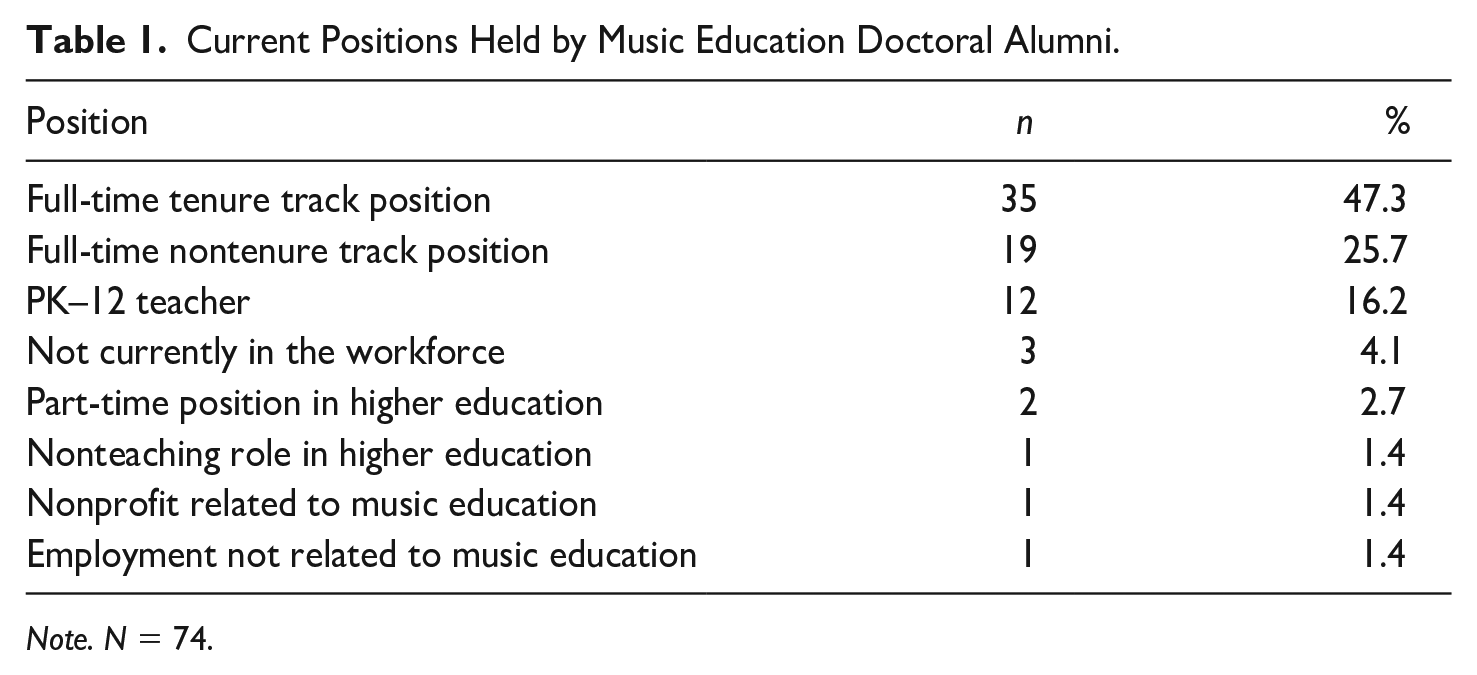
Note. N = 74.
Regarding the participants’ ranks, a considerable amount of participants held an assistant professor position (n = 34, 45.9%). Other participants worked as a lecturer (n = 8, 10.8%), adjunct (n = 6, 8.1%), or instructor (n = 6, 8.1%; see Supplemental Table 1). Two participants already attained full professor (n = 1, 1.4%) and associate professor (n = 1, 1.4%) positions. Based on the Carnegie Classification system, participants held positions at R1 (n = 21, 28.4%), R2 (n = 11, 14.9%), and PK–12 institutions (n = 11, 14.9%; see Supplemental Table 2).
Participants also responded that their assigned areas of courses included music education (n = 60, 90.9%), conducting (n = 17, 25.8%), and applied music (n = 12, 18.2%). Participants taught undergraduate courses, including student teaching (n = 49, 74.2%), pedagogy or techniques (n = 47, 71.2%), secondary methods (n = 46, 69.7%), and introduction to music education (n = 39, 59.1%). Teaching graduate courses, such as research methods (n = 21, 31.8%) and music education seminars (n = 21, 31.8%), was less common. Full results are available in the Supplemental files.
Doctoral Program Opportunities
Participants selected a binary (yes or no) response as to whether they had the opportunity to engage in 24 career development activities during their doctoral program (e.g., teach a class, observe student teachers, submit a paper, present at a conference). Among those items, opportunities that overwhelmingly garnered the most responses were creating a poster for a research presentation (n = 74, 100%), conducting a research project (n = 73, 98.6%), and presenting research at a conference (n = 70, 94.6%). Conversely, the least-cited career development activities were creating or modifying a syllabus for a graduate music education class (n = 15, 20.3%), having a paper accepted for publication in a music practitioner journal (n = 21, 28.4%), and teaching a graduate music education class (n = 23, 31.1%). Table 2 depicts the range of responses on the 24 career development opportunities.
Frequency of Doctoral Student Opportunities.
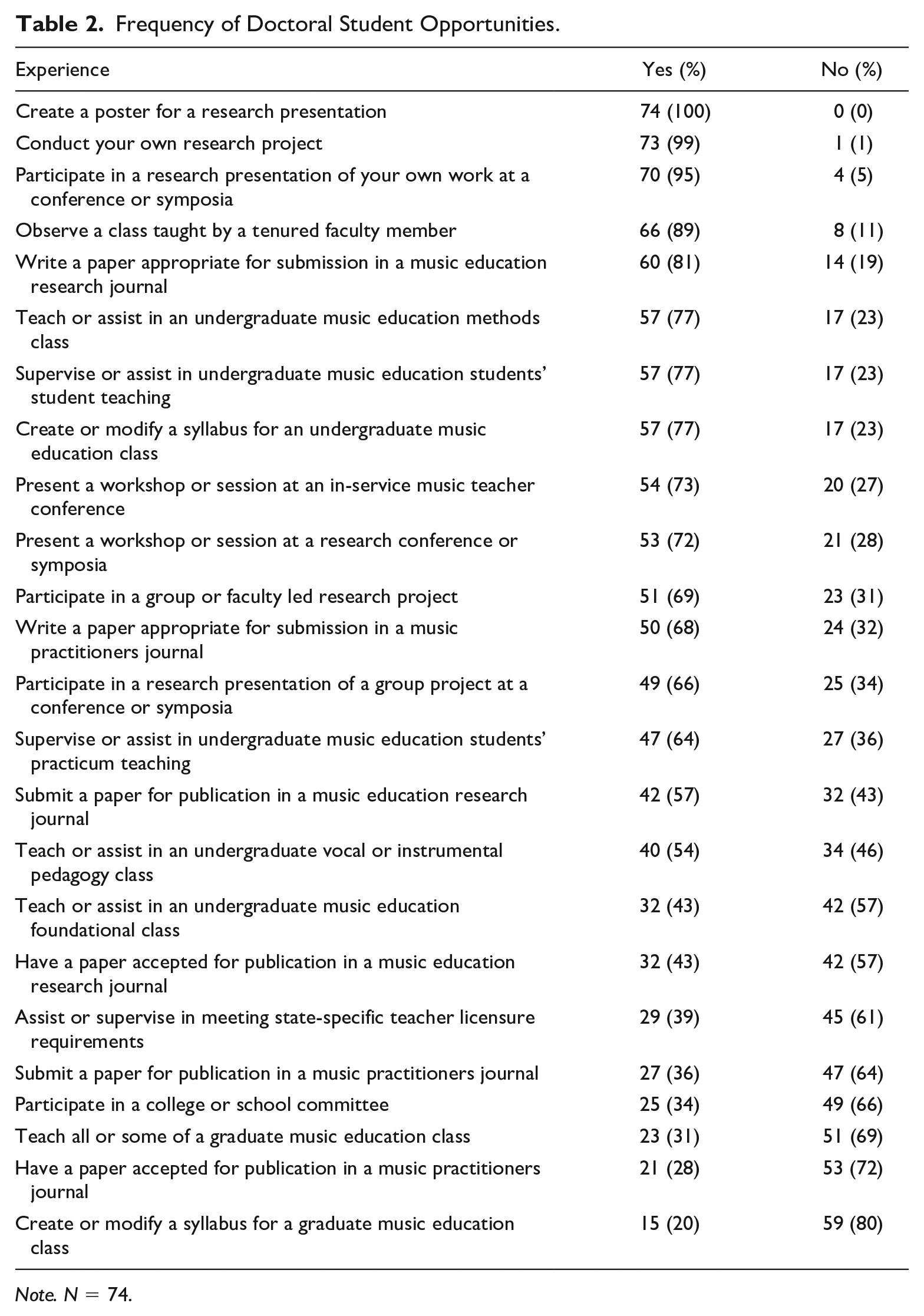
Note. N = 74.
Preparation for Current Position
Participants indicated the significance of the preparation they received in their doctoral programs for various tasks that they undertake in their current position. This section of the questionnaire consisted of 35 items with a 5-point Likert-type scale, ranging from 1 (not at all significant) to 5 (extremely significant). We also included N/A as an option, which was excluded from the calculation of means (M) and standard deviations (SD) in Table 3. The current tasks with which participants felt most comfortable were creating a poster for a research presentation (M = 4.49, SD = .73), conducting their own research (M = 4.46, SD = .80), and presenting research at a conference or symposia (M = 4.39, SD = .93). In contrast, the participants indicated that they felt least comfortable with teaching nonmusic education courses such as jazz (M = 1.50, SD = 1.14), ethnomusicology (M = 1.57, SD = 1.10), or musicology (M = 1.75, SD = 1.27; see Table 3). Participants also were asked the percentage of contract time their program specified for certain task activities in their current position (e.g., teaching, research, service), if they were employed in higher education. The participants selected a number from 0% to 100% for each item (see Supplemental Table 3). Teaching rose to the top at 47.53% (SD = 31.58), followed by research and service at 14.41% (SD = 17.92) and 9.14% (SD = 9.13), respectively. However, the large SD indicated that responses varied considerably among participants. Some participants responded 100% for teaching while others responded 100% for research with respect to contract time.
Preparation for Current Position.
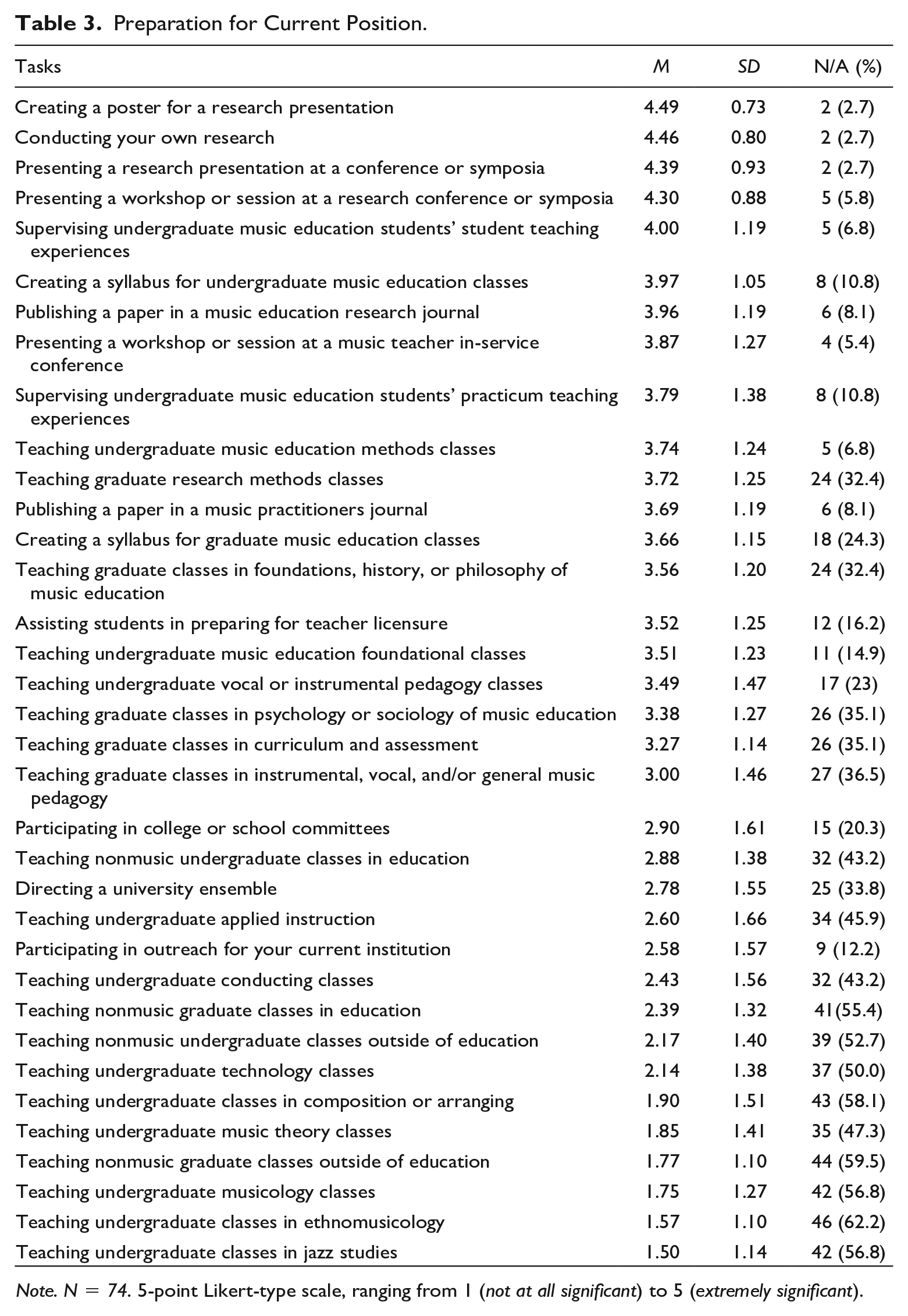
Note. N = 74. 5-point Likert-type scale, ranging from 1 (not at all significant) to 5 (extremely significant).
Open-End Responses: Areas of Strengths and Concern
The final item on the questionnaire was an open-ended response where participants shared the experiences they had in their doctoral programs and how those experiences prepared them for their current positions. This item served as a descriptive supplement to the numeric data in the previous three questionnaire sections. Out of 74 respondents, 64 provided narrative comments. Participants reported that opportunities for teaching and research experiences were the most advantageous elements in their programs, which aligns with the numeric portions of this study. Of the participants who addressed research, being a part of collaborative research teams with peers or faculty on topics of personal interest was a clear thread across responses. A parallel benefit was preparing proposals for and presenting at research conferences. From a teaching perspective, participants appreciated being treated like early-career faculty and relished taking on the pedagogical and research roles that they would 1 day fully assume. In one example, a participant who self-identified as an international student whose first language was not English, commented that they successfully executed and published a research study prior to completing their PhD, which they believed was a substantial point of accomplishment. Overall, participants particularly appreciated informal mentoring conversations with faculty, co-teaching opportunities, preparing undergraduate syllabi and teaching materials, having the latitude to work with student teachers, and seeing “behind the curtain” of faculty members’ handling of daily tasks.
While participants shared many positive comments about their doctoral program experiences, including one individual who noted finding, “authentic and positive experiences” in forming meaningful relationships with other faculty and department members as being crucial in their degree program. However, there were three areas of concern that other individuals raised (eight respondents). The areas that participants reported as being most negative were the climate and content of programs, postdegree challenges, and alternative career choices. First, in terms of negative climate, one individual commented, I had the opportunity to observe the ambiguous political climate that can exist in a university setting. I had the opportunity to see my colleagues demoralized in multiple settings. I ultimately decided not to pursue a career in higher education.
Other comments centered on hidden time and burdensome graduate teaching assistant loads. One individual shared that in addition to supervising an outreach program, they also supervised nearly three-dozen student teachers. Other participants focused on the lack of attention doctoral programs paid to examining pedagogy at the higher education level. Although participants valued the opportunity to teach undergraduate classes, they remarked that the “sink or swim” method impacted them negatively, as they felt they had neither the support to discuss higher education pedagogical approaches with faculty nor the leeway to assist with or teach graduate-level courses (e.g., possibilities of guest lectures rather than peer-teaching episodes in classes). Second, in terms of postdegree challenges, participants who were part-time doctoral students commented they regretted not having the opportunity to teach courses as either co-instructors or instructors of record, which they believed was an impediment in the job search. A related concern was navigating the transition from an R1 program to a smaller institution that may place a different emphasis on research and teaching activities during the promotion and tenure process (e.g., valuing a wide range of research or professional activities in addition to publication). Third, participants commented on the importance of finding alternate career paths, especially if academic life became a mismatch to raising a family. One participant noted that “academia is very unkind to parents” who are raising young children, and several participants disclosed that they chose to leave higher education because of this tension. Other participants reported that they started careers in higher education but ultimately returned to PK–12 music teaching and mentoring preservice music teachers tangentially to achieve a more hospitable work–life balance.
Discussion
The purpose of this research was to examine recent doctoral music education alumni perceptions of how their doctoral programs informed their current work. Using a researcher-constructed survey, participants reported the types of positions they attained, the doctoral program opportunities that enhanced their career readiness, and the degree to which these opportunities prepared them for a postdoctoral career. A summary of the findings is presented below, followed by implications for the profession and suggestions for future research.
First, survey responses indicated that a significant number of participants earned a PhD, attained a full-time tenure track position, and held the rank of Assistant Professor. Smaller percentages of participants earned doctoral degrees in parallel programs (e.g., DMA, DME, and EdD), attained nontenure track or PK–12 teaching positions, and held a variety of ranks (e.g., part-time, adjunct, associate professor, full professor). These findings appear consistent with previous research on the variety of postdoctoral careers that exist in music education (Fredrickson & McCabe, 2007; Kelly & VanWheelden, 2017; Martin, 2016; Snow, 2013). Because of the configuration of some college teaching positions and the nature of anonymity ensured with this particular study, it is unclear how the participants of this study employed at the rank of associate (n = 1) and full (n = 1) professor moved through the tenure and promotion processes at their institutions. This indicates that there may be a need to examine the configuration of some college teaching positions, the induction process offered at varying institutions to support the transition from doctoral student into teaching in academia, the promotion and tenure process at varying institutions, and the overall job market in higher education.
Second, participants’ survey responses indicated a wide variety of opportunities across degree programs. The highest-rated opportunities were creating research posters, conducting independent or co-authored research, and presenting at research conferences, while the lowest-rated opportunities were creating syllabi for and teaching graduate-level classes and crafting articles for practitioner-based journals. While career development opportunities during doctoral studies may help prepare students for jobs held after graduation, variations in curricular offerings from program to program may require investigating what alumni are expected to do in their positions postdegree (Bond et al., 2022; Kelly & VanWheelden, 2017; Rutkowski et al., 2013). While many doctoral programs focus on preparation for employment in higher education, only 47.3% (n = 35) of participants in this study held those positions. To mentor alumni effectively for a variety of position types and throughout each stage of their career after graduation, more attention may need to be paid to not only community-building among graduate cohorts (Austin et al., 2013; Conway, 2016), but also reinforcing and expanding cohorts to better reflect the types of positions in which alumni are applying to, interviewing for, and working in, whether in higher education or not.
Third, participants reported feeling most prepared in their current positions to create research posters, conduct research, publish research, and present at conferences. These findings align with those in the previous research question, which may not be surprising, given the opportunities that participants reported as being most beneficial in their music education doctoral programs. As documented in previous research, focusing on research opportunities can help graduate students begin to see themselves as both teachers and scholars (Conway et al., 2010; Foot et al., 2014; Meyers, 2017). Participants noted in their open-ended responses their appreciation for both formal and informal research mentoring during their doctoral education. Feeling supported as both a doctoral student and an early-career researcher could lead to a clearer understanding of how teacher identity shifts throughout a degree program can account for pedagogical, personal, and professional growth (Martin, 2016; Rodgers & Scott, 2008; Van Lankveld et al., 2017).
Participants reported feeling least comfortable teaching nonmusic education classes, such as jazz studies, musicology, and ethnomusicology. While the breadth of participant teaching assignments was extensive (see Table 3), this could demonstrate further the varied nature of academic positions in music education and the expectations that programs and faculty have of each other. Owing to the nature and scope of the questionnaire, we could not identify how prior experience with certain tasks impacted participant current comfort with those tasks in their current positions. However, participant comfort with content specific to their background in addition to tasks related to teacher education could indicate that a heightened focus on these areas during doctoral coursework may results in alumni feeling more confident in their abilities to teach a range of courses. The findings from this study mirror Kelly and VanWheelden’s (2017) assertion that creating more opportunities for doctoral students to develop teacher education skills could benefit the profession. Therefore, we believe that music education faculty should consider having career readiness conversations with doctoral students about how their backgrounds and experiences prior to entering into their doctoral program could play a vital role in how they prepare for their future careers.
This study showed, in part, how the curricular, scholarly, and experiential facets of music education doctoral programs transferred to work conducted by alumni in their current positions. While the generalizability of the findings in this study may be limited due to the sample size, questionnaire content, and method of questionnaire distribution, participants’ responses provided insight for the profession. Implications for how music education faculty can support career readiness for their doctoral students were focused on the three areas of mentorship practices, community-building and learning environments during doctoral degree coursework, and preparing doctoral students to thrive in whatever their careers may be after graduation.
First, continued mentorship practices in music education doctoral degree programs are foundational. Preservice teacher education programs often focus on mentorship and identity development (Conway, 2016; Kuebel et al., 2018), although broadening an understanding of teacher identity at the graduate level could help music education doctoral alumni more securely settle into their roles within and outside of higher education. Implementing mentorship and recruitment practices in doctoral music education programs that reflect those in preservice education programs and early-career professional development opportunities (e.g., curricular alignment, professional expectations, theory vs. practice) could be one avenue toward preparing self-aware and career-ready alumni. For example, doctoral seminars, guest scholars, and professional development opportunities with university personnel or faculty across campus could be viable forums for doctoral students to interrogate practices as they construct an image of their own future careers. It also could be beneficial for music education faculty to have conversations with doctoral students about what various institutional models look like, what a typical day or week might involve for a faculty member, what faculty meetings can entail, and what the expectations of an R1 and non-R1 institution might encompass. While the goal for some doctoral students may be to work at an R1 institution, it should not be assumed that all individuals entering a music education doctoral degree program will have this as their career goal. Rather than preparing alumni to teach and work in one specific pathway, music education faculty could broaden their curricula, expectations, and opportunities during coursework to include multiple career pathways that consider individual backgrounds and experiences before entering their doctoral degree program. Such an approach necessitates heightened mentoring practices, which could help doctoral students think more critically about their career pathways and teaching futures. Intentional mentorship throughout the doctoral degree program can then serve as an intentional response to both desired careers of alumni after graduation and the shifting landscape of job postings and position expectations in higher education.
Second, community-building practices and the perceived learning environment within degree programs could play vital roles in shaping future doctoral student career profiles. While some particularly stark open-ended responses came from only a few participants in this study, the sentiments shared still point to the importance of maintaining healthy graduate program climates. Although not all participants had negative things to say about their doctoral degree experiences, comments drawing attention to negative learning environments, or observed instances of faculty being demoralized, even if in the minority of responses, should not be taken lightly. Environments that are not perceived as supportive, demand what are perceived to be high teaching assistant loads, and lack discussions addressing work–life balance issues for students, particularly those who are parents, could impact doctoral students’ desires to continue in higher education after graduation. Open-ended responses from participants speaking to hidden or high workloads indicate that this should be investigated further to help ensure that doctoral students are immersed in an environment where they are supported, treated fairly, and mentored appropriately to help them achieve their desired career goals. While some doctoral programs may already foster a supportive environment that treats students as early-career faculty (e.g., Meyers, 2017; Robinson & Taggart, 2011), music education doctoral programs must consider not just curricular and pedagogical opportunities for their doctoral students, but establishing a climate that helps individuals learn to become effective music educators and mentors regardless of their eventual career.
Third, exploring underexamined areas of music education doctoral preparation could be insightful. Although it appears that student perceptions of opportunities in doctoral music education degree programs are in alignment with faculty perceptions (Kelly & VanWheelden, 2017), there still seems to be a gap in preparing future music education doctoral alumni to teach graduate courses, work in a variety of institution types, and envision a long-term career that allows for individuals to obtain a desired balance between work and life outside of work. While doctoral students might benefit from variation in degree program opportunities and curricula, continued vigilance of program continuity as it relates to job market norms is imperative. Music education doctoral students may additionally benefit from individual career mentoring that takes place prior to degree completion that focuses on the background and experience of the individual, honest conversations about the job market in higher education, and honest discussions about potential career pathways. Conversations with doctoral students who are interested in careers in higher education about typical job limits and loads, navigating the job search process, research expectations for different types of positions, and finding success in a variety of positions could help students to envision, to some degree, what is required for degree programs and universities to run smoothly (Martin, 2016; Meyers, 2017).
Based on the findings from this study, future research is needed to better understand the experiences and expectations of music education doctoral alumni. Future researchers could explore successes, challenges, and anomalies in doctoral music education programs that shape alumni entering postdoctoral teaching positions and how they find success in ways that are most meaningful to them. Based on the results of the survey, nearly one-fourth of the respondents are employed outside of faculty positions. While it is likely that several factors impact a decision to not pursue a career in higher education, open-ended responses may point to the need for future researchers to consider the desired career of individuals entering music education doctoral degree programs. In addition, music education faculty should be aware of and explore how their program climate impacts decisions of their alumni related to future employment. Future studies also could include larger and more diverse sample, more targeted surveys, or qualitative or mixed-methods approaches that generate a variety of graduate student and music education doctoral alumni accounts. The connection between career success and growth opportunities in relation to music education doctoral degree programs and the faculty who design them continues to be a thought-provoking consideration for the profession.
Supplemental Material
sj-docx-1-jmt-10.1177_10570837241295756 – Supplemental material for An Examination of Career Readiness Among Music Education Doctoral Alumni
Supplemental material, sj-docx-1-jmt-10.1177_10570837241295756 for An Examination of Career Readiness Among Music Education Doctoral Alumni by Elizabeth S. Schultz, Ian W. Miller, Charles Oldenkamp, Julie M. Song, Troy R. Thomas, Kristina R. Weimer, Nathan B. Kruse and Martina L. Miranda in Journal of Music Teacher Education
Footnotes
Declaration of Conflicting Interests
The author(s) declared no potential conflicts of interest with respect to the research, authorship, and/or publication of this article.
Funding
The author(s) received no financial support for the research, authorship, and/or publication of this article.
ORCID iDs

Supplemental Material
Supplemental material for this article is available online.
References
Supplementary Material
Please find the following supplemental material available below.
For Open Access articles published under a Creative Commons License, all supplemental material carries the same license as the article it is associated with.
For non-Open Access articles published, all supplemental material carries a non-exclusive license, and permission requests for re-use of supplemental material or any part of supplemental material shall be sent directly to the copyright owner as specified in the copyright notice associated with the article.
