



Abstract
In this paper, a resilience assessment framework for microencapsulated self-healing cementitious composites is proposed based on a micromechanical damage-healing model. A 3D micromechanical analytical model is constructed to analyze the performance evolution during the damage-healing process of self-healing concrete. The resilience assessment of microencapsulated self-healing concrete is defined by virtue of the residual stiffness, self-healing effect on stiffness and damage cumulative on stiffness, which corresponds to three main features of resilience; namely, the robustness, recoverability and adaptability. The assessment results indicate that the release of healing agents within microcapsules and healing process of extended microcracks allows the microencapsulated self-healing concrete to have higher resilience than conventional concrete. Moreover, a parameter sensitivity analysis is conducted to investigate the influence of the healing efficiency, the applied initial damage and the fracture toughness of the repaired microcrack on resilience of microencapsulated self-healing concrete. The results indicate that higher healing efficiency and applied initial damage leads to high resilience, and fracture toughness of the repaired microcrack makes less difference to the results. The findings of this paper lay a theoretical foundation for the resilience design of self-healing material layer of underground structures.
Keywords
Introduction
The development and utilization of urban underground space is an effective way to solve the problems of urban development such as traffic congestion and shortage of land resources. It is also a necessary means to improve the living standard of urban residents. With the continuous development of urbanization, urban underground space resources are increasingly scarce. Large-scale and multifunctional development and utilization of underground space in megacities will inevitably develop into deep underground space (Chen, 2018; Zhao et al., 2023). The complex and changeable underground geological environment makes it difficult to recover the underground structure after damage, which requires it to have high performance and durability during the entire life. In order to improve the safety and durability of urban underground space structure system, the concept of resilient underground space structure system comes into being. There is no doubt that the research on resilience at the material level will become a research hotspot in the field of materials. Concrete structures built with self-healing materials have self-healing properties after disaster damage, and research on this aspect can improve the safety and sustainability of the entire life cycle of underground structures (Chen et al., 2021; Ivica et al., 2022; Tian et al., 2019; Voyiadjis et al., 2020; Wei et al., 2023; Zhang et al., 2022; Zhu et al., 2021). Based on different healing methods, many healing materials have been proposed by different scholars, such as the microencapsulated self-healing concrete (Andrushia et al., 2020a, 2020b; Jahadi et al., 2023; Zhou et al., 2020; Zhuang et al., 2021), the UHPC (Fang et al., 2022; Luo et al., 2019; Zhu et al., 2022), the slurry infiltrated fiber concrete (Zhou et al., 2023), the lightweight aggregate concrete (Xiong et al., 2019, 2022a, 2022b), the calcined wollastonite powder (Zheng et al., 2021), the ECC (Zhou et al., 2020) and the bacteria-based concrete (Zhuang and Zhou, 2019).
Through field and laboratory tests, numerical simulation and theoretical analysis model, scholars have carried out extensive practice and research on microencapsulated self-healing cementitious composites. At present, a large number of studies have verified and quantitatively analyzed microencapsulated self-healing concrete from the perspective of field and laboratory tests, but cannot analyze the property evolution of self-healing concrete from the perspective of micromechanics. The damage-healing constitutive model and multi-scale mechanical properties of microencapsulated self-healing concrete which can reflect the self-healing mechanism are worthy of further study. In the damage-failure process of microencapsulated self-healing concrete (c.f. quasi-brittle material) under loading, the fracture and propagation route of microcracks have a significant influence on the stress-strain curve of the material. In recent years, the team of Prof. Ju and his collaborators proposed a series of damage-healing models of 2D/3D microencapsulated self-healing concrete composites under tensile or compressive loads using meso-damage mechanics (Han et al., 2021a, 2021b, 2023; Zhu et al., 2015, 2016). The self-healing mechanisms of microencapsulated self-healing concrete were successfully revealed from a micromechanical perspective, which were later widely cited and discussed by scholars (Lv et al., 2017; Zhou et al., 2016, 2017, 2022). It is worth emphasizing that the damage-healing mechanism of microencapsulated self-healing concrete can be explained from the perspective of microcrack propagation and healing by using mesoscopic damage mechanics and probability-statistics, which defines the internal mechanism of damage-healing.
Since the concept of resilience can reflect the entire process of time-related system changes, it has been adopted by many scholars to study the problems in the fields of economics, ecology and engineering. Based on the functional time curve of the system, some scholars evaluated the resilience of infrastructure from the perspective of resilience characteristics such as system robustness, redundancy and recoverability. Tierney and Bruneau (2007) established a resilience assessment model and proposed that the resilience indicator of infrastructure is the area surrounded by the functional time curve and the initial functional time curve. Attoh-Okine et al. (2009) defined the resilience indicator as the ratio of the area surrounded by the functional time curve after disturbance and the horizontal axis to the area surrounded by the initial functional time curve with horizontal axis. Ayyub (2014) studied the resilience of communities in a multi-disaster environment, and proposed a corresponding resilience model for economic evaluation. Huang and Zhang (2016) established a model suitable for the evaluation of tunnel structure resilience, and conducted a detailed analysis of the engineering case of tunnel structure damage. Lin et al. (2021) proposed a resilience assessment method for shield tunnel structure under multiple perturbations. Further, Lin et al. (2022) proposed a resilience analysis model of shield tunnel lining considering multi-stage disturbance and recovery. However, the current research lacks the resilience design at the material level. The resilience design at the meso-material level is crucial to the parameter optimization of self-healing concrete for underground structures.
This paper proposes a resilience assessment framework for microencapsulated self-healing cementitious composites emanating from the perspective of three-dimensional micromechanical damage-healing, as shown in the next section. A 3D micromechanical analytical model is constructed to analyze the performance evolution during the damage-healing process of self-healing concrete, as rendered in Section ‘Characterization of damage-healing process based a 3D micromechanical model’. Section ‘Resilience assessment method of microencapsulated self-healing concrete’ displays the resilience assessment for microencapsulated self-healing concrete by virtue of the residual stiffness, self-healing effect on stiffness and damage cumulative on stiffness. Finally, parameter sensitivity analysis is conducted to investigate the influence of the healing efficiency, applied initial damage and the fracture toughness of the repaired microcrack on resilience of microencapsulated self-healing concrete, as indicated in Section ‘Parameter sensitivity analysis and resilience design’.
The resilience assessment framework
This paper intends to systematically study the resilience assessment and evolution analysis method of microencapsulated self-healing concrete based on the microscopic mechanical model by combining microscopic damage mechanics and probability statistics. The resilience assessment framework proposed in this paper is exhibited in Figure 1.
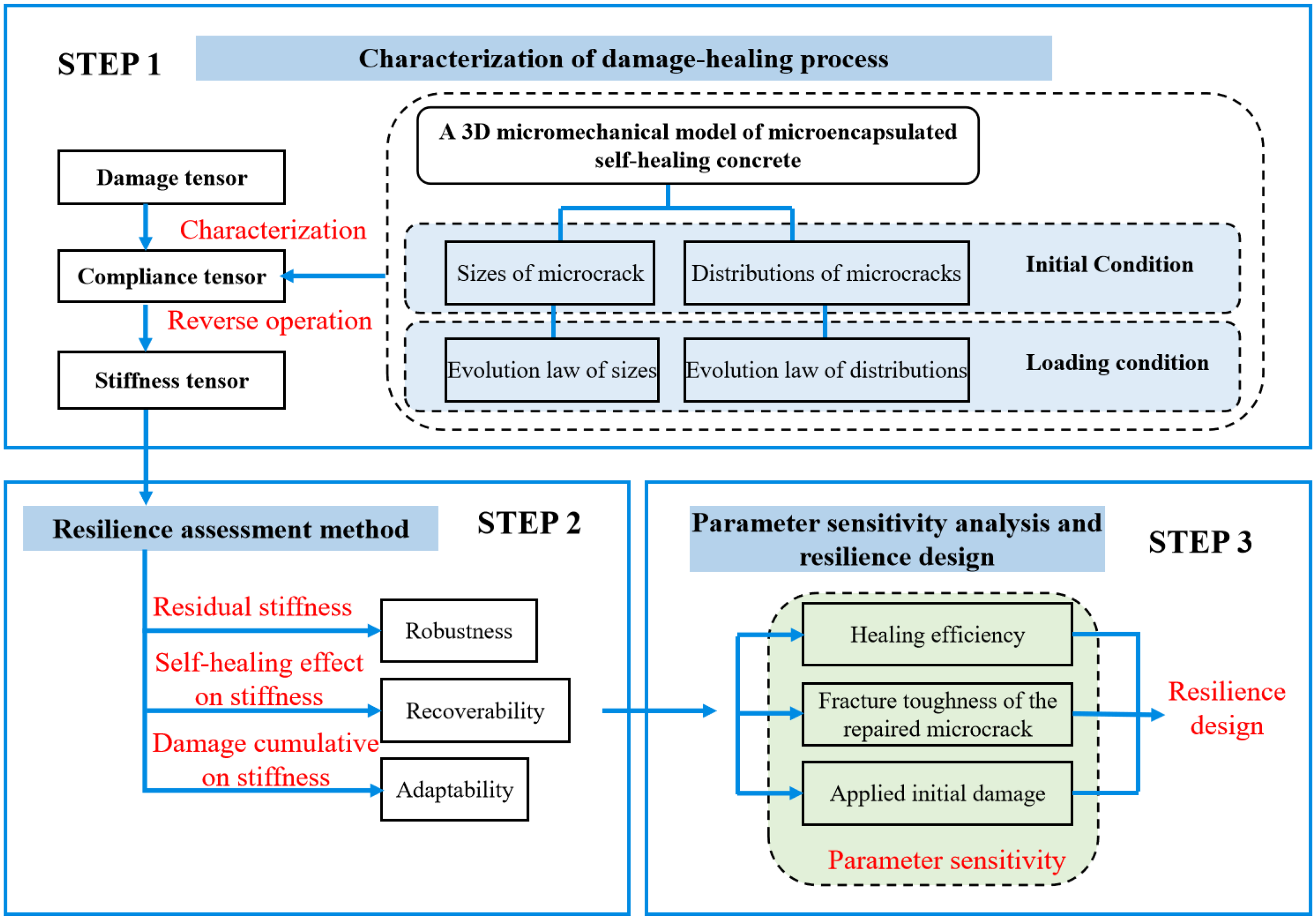
The proposed resilience assessment framework.
As rendered in Figure 1, the proposed resilience assessment framework mainly includes the following three aspects:
Step 1. Characterization of damage-healing process: Based on mesoscopic damage mechanics and probability statistics, the elastic secant compliance tensor is employed as the characterization quantity of material’s damage degree, and a damage-healing mechanical model of microencapsulated self-healing concrete is proposed. Step 2. Resilience assessment method: Based on the three main characteristics of resilience (i.e. the robustness, recoverability and adaptability), a resilience assessment model of microencapsulated self-healing concrete is established by virtue of the residual stiffness, self-healing effect on stiffness and damage cumulative on stiffness. Step 3. Parameter sensitivity analysis and resilience design: The influences of the healing efficiency, applied initial damage and the fracture toughness of the repaired microcrack on resilience of microencapsulated self-healing concrete are investigated. Then the obtained results are applied to resilience design.
Characterization of damage-healing process based a 3D micromechanical model
Characterization of the evolution of damage-healing process of concrete
Based on the idea that plants and animals repair wounds in biomimetics, the healing agent within microcapsules will release to heal the damage of concrete subjected to externally applied loads. Referring to the existing microencapsulated self-healing concrete model (Han et al., 2021a, 2021b; Zhu et al., 2015, 2016), a basic framework of a 3D micromechanical model is constructed in this paper to analyze the evolution of the damage-healing procedure of microencapsulated self-healing concrete. The 3D micromechanical model presents a detailed calculation method of the elastic secant compliance tensor

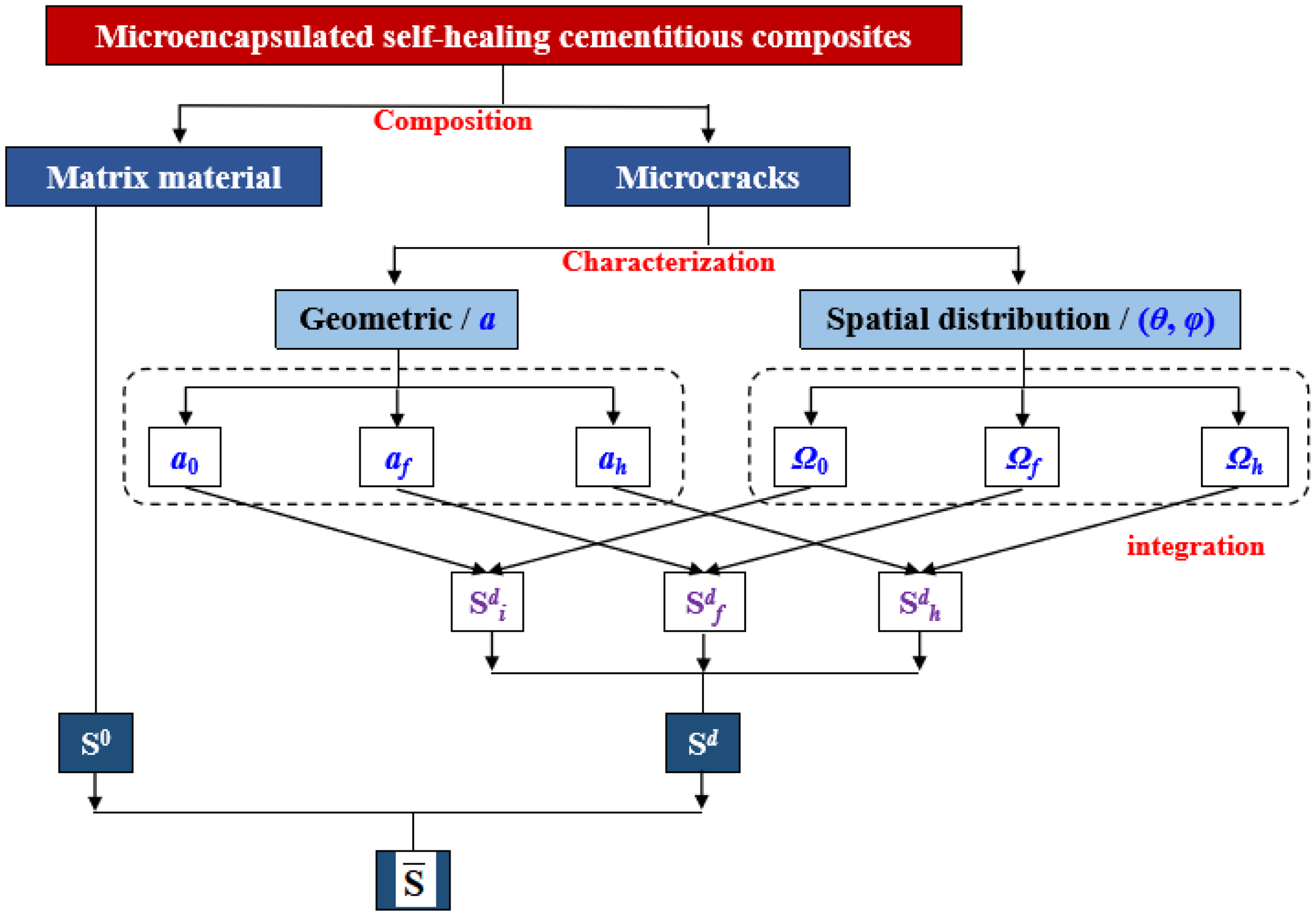
Schematic diagram of the composition of the compliance tensor.
Calculation of the additional compliance tensor
Figure 3 renders the calculation process of the additional compliance tensor
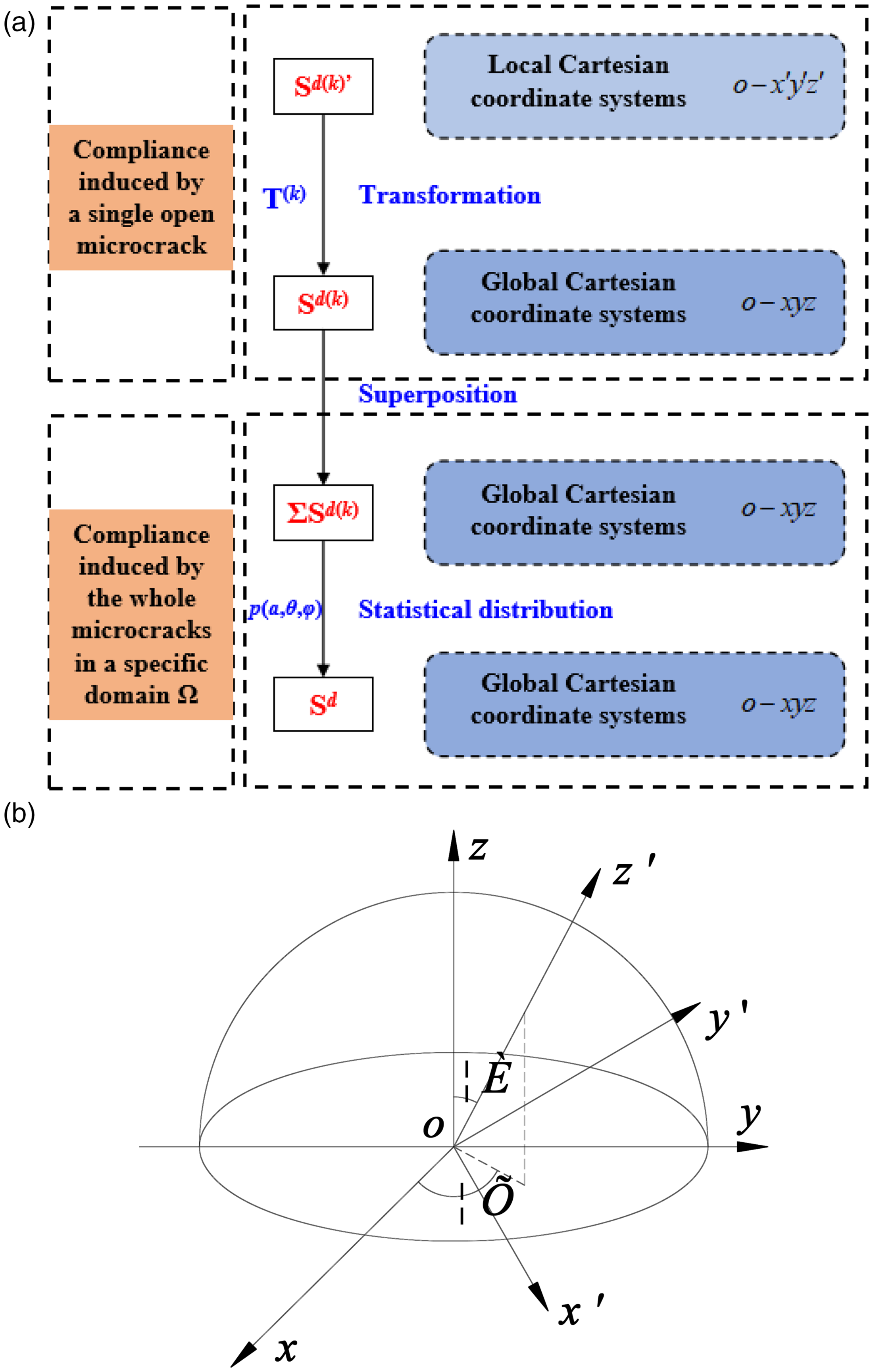
The calculation process of the additional compliance tensor and adopted coordinate system.
Firstly, the contribution of a single open microcrack to additional compliance

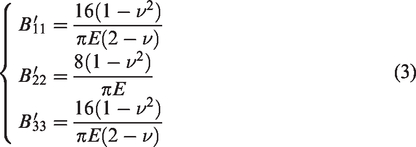
Secondly, the

Finally, the summation and integral form of additional compliance due to the entire microcracks in the (


Spatial distribution region of microcracks with different radii
As displayed in equation (6), the value of the compliance caused by all microcracks is related to the spatial distribution characteristics of microcracks with different radii. Specific spatial distribution region
After the linear elastic stage, the microcrack will undergo the expansion when the external load exceeds the critical tensile stress σc. The radius of the microcrack expands from



Damage-healing evolution analysis of self-healing concrete
As the applied external load increases, microcracks in a specific region in the representative element will undergo the extension. Correspondingly, the evolutionary domains of extended microcracks during the entire loading process for any triaxial load can be calculated using the equations (7) to (9), as exhibited in Figure 4.
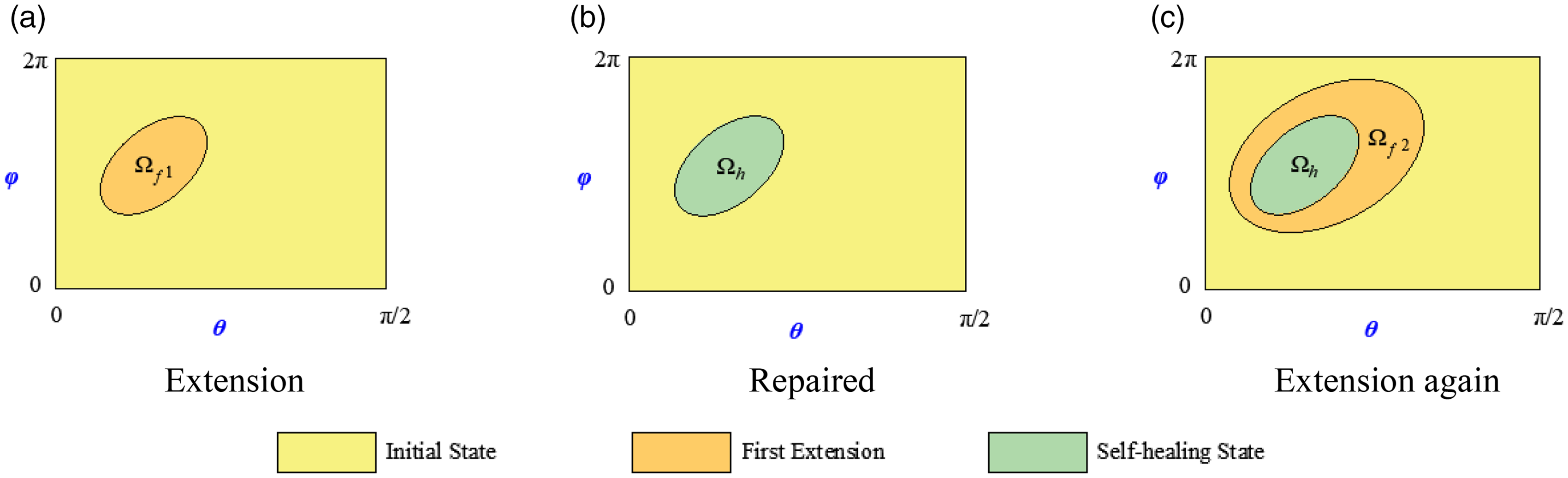
The evolutionary domains of microcracks during the entire loading process.
As the microcrack expands, the compliance tensor of the representative element changes dynamically. The detailed development and evolution rules of compliance tensor are as follows:
The linear elastic stage (before self-healing)
When the tensile load increases from 0 and does not exceed the critical tensile stress σc of the microcrack, the radius of all microcracks in the representative volume sample is


The nonlinear strengthening stage (before self-healing)
When the applied external load exceeds the critical tensile stress σc and the tensile load does not exceed the maximum tensile stress σcc, the radius of the microcrack in a specific area of the representative volume sample increases from



The linear elastic stage (reloading after self-healing)
When loaded to a applied initial damage and unloaded, the extended microcapsules in the sample are repaired by the healing agent outflow, and the radius decreases from



The nonlinear strengthening stage (reloading after self-healing)
As soon as the applied initial damage stage is exceeded and the loading continues to increase, specific areas of microcrack extension occur. The radius of the microcrack in a specific area of the representative volume sample increases from




Through the above analysis, we obtain the formula for calculating the compliance of concrete, and the stiffness (or elasticity modulus) of concrete in the later section can be attained through the reverse operation of the compliance.
Resilience assessment method of microencapsulated self-healing concrete
Based on the three main characteristics of resilience (i.e., the robustness, recoverability and adaptability), a resilience assessment model of microencapsulated self-healing concrete is established by virtue of the residual stiffness, the self-healing effect on the stiffness and the cumulative damage on the stiffness. Figure 5 shows the schematic diagram of the damage-healing of microencapsulated self-healing concrete. Reasonable micro-parameter design of self-healing concrete materials can enable them with certain resilience. In addition, the self-healing mechanism of microencapsulated self-healing concrete is the process of microcrack propagation, microcapsule cracking, outflow and solidifying bonding and expanding microcracks after some initial damage. In order to reflect the resilience of the self-healing concrete material, the self-healing concrete that initial damage is applied after the self-healing (c.f. Stage: Load II in Figure 5) and the conventional concrete (c.f. Stage: Load I in Figure 5) are adopted to define the three main characteristics of resilience.
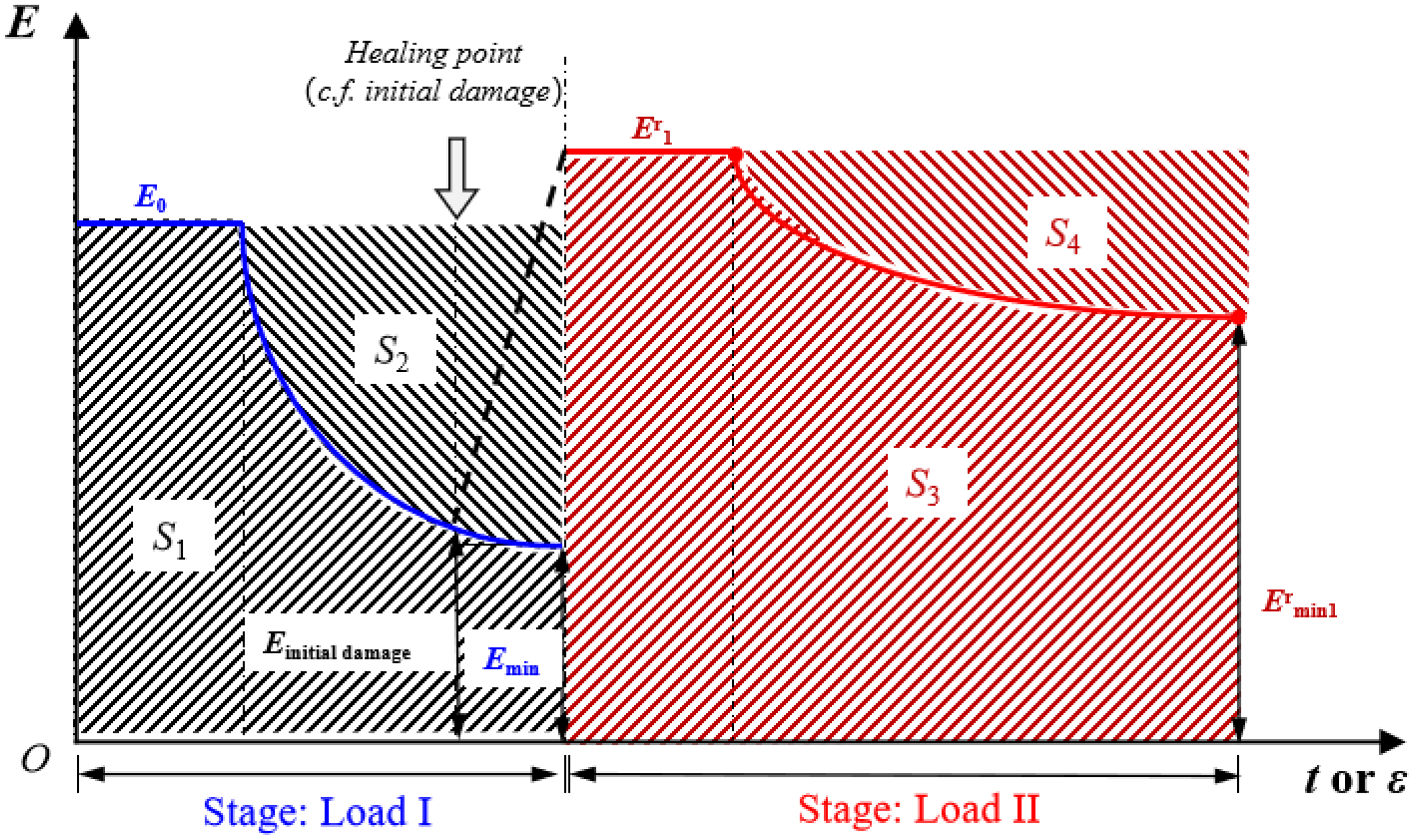
Schematic diagram of damage-healing of microencapsulated self-healing concrete.
Definition of robustness
Generally, the robustness characterizes the damage vulnerability of a material and is usually defined by the residual properties of a material subjected to a certain amount of the external load. In this paper, the residual elasticity modulus ratio of self-healing concrete before self-healing to that of conventional concrete when subjected to the same amount of external load is employed to evaluate the robustness

Definition of recoverability
The recoverability generally indicates the degree of recovery of the properties of a material after bearing the external load. In this paper, the percentage increase in the elasticity modulus of the material after initial damage and self-healing is adopted to evaluate the recoverability

Definition of adaptability
The adaptability defines the ability of a material to adapt and transform to damage caused by the external load, and is usually represented by the cumulative damage on the properties of the material. In this paper, the percentage of covered area under the elasticity modulus-time curve of the material undergoing two loading processes is adopted for the adaptability assessment:

Parameter sensitivity analysis and resilience design
Performance evolution and resilience assessment for microencapsulated self-healing concrete based on the proposed 3D model
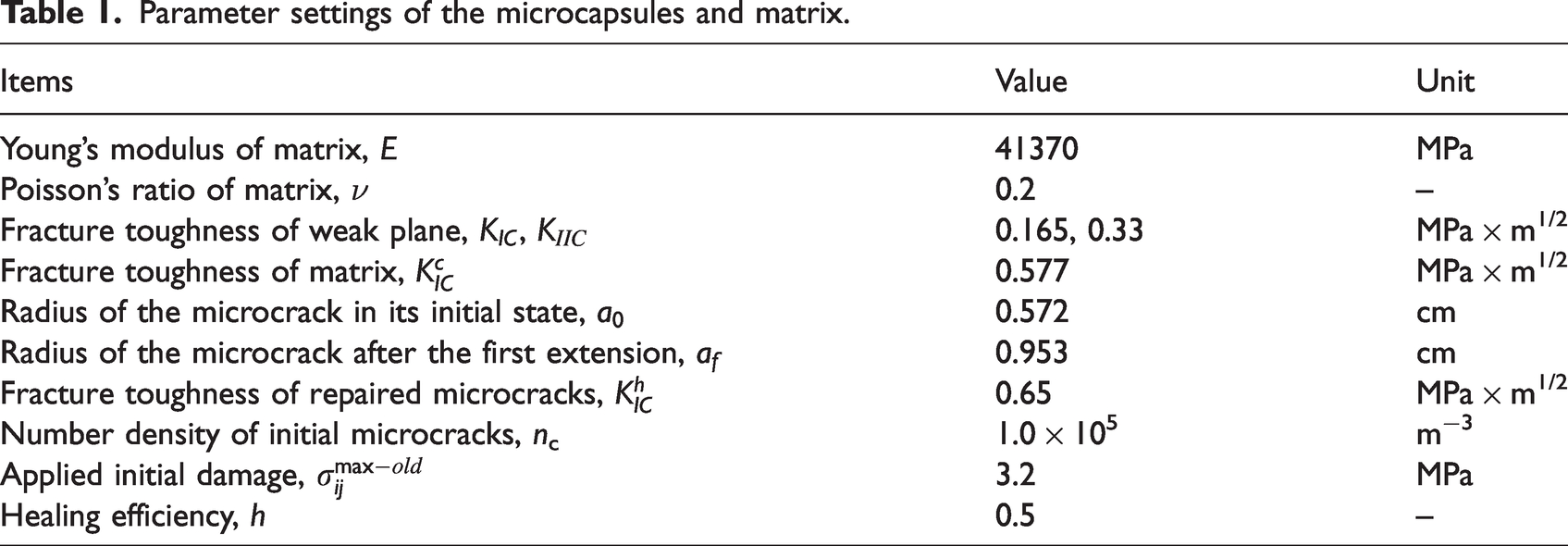
Based on the schematic diagram of damage-healing of microencapsulated self-healing concrete (Figure 5), performance evolution and resilience assessment for microencapsulated self-healing concrete based on the proposed 3D model are obtained, as rendered in Figure 6. The parameter values of the microcapsules and the matrix adopted therein refer the relevant literature (Han et al., 2021a; Zhu et al., 2015), as rendered in Table 1.
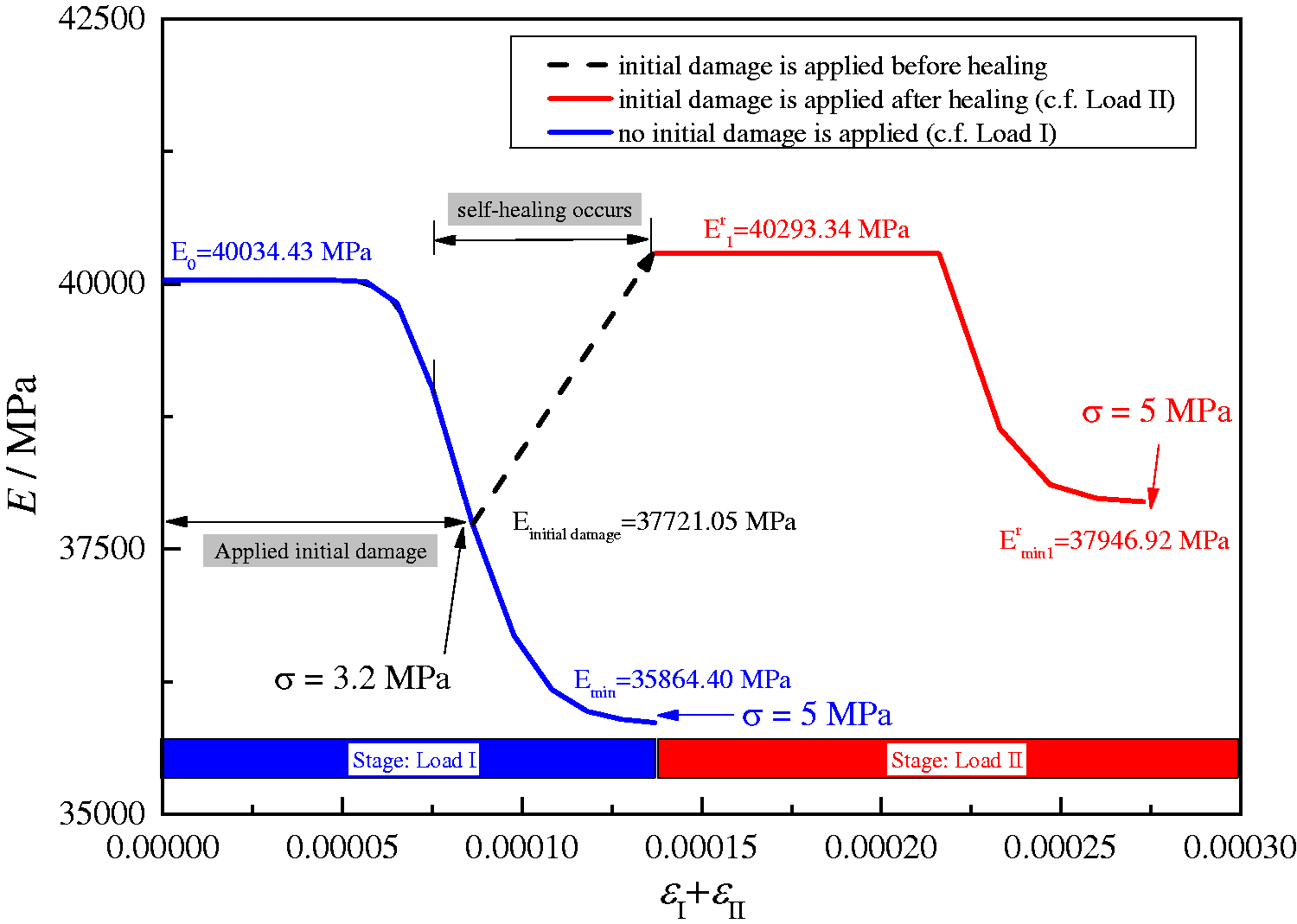
Performance evolution for microencapsulated self-healing concrete based on the proposed 3D model.
Parameter settings of the microcapsules and matrix.
Moreover, according to the three characteristic definition formulas of resilience (c.f. equations (22) to (24)), the evaluation results of resilience are displayed in Table 2. Considering that the adopted external load should be less than the maximum tensile stress σcc, the same load range (0 to 5 MPa) are selected for Load I and Load II. For the convenience of comparison, the strain of the repaired concrete is translated, so the horizontal and vertical coordinates are denoted as
Evaluation results of resilience.

Parameter sensitivity analysis
Based on the above analysis, the release of healing agents within microcapsules and healing process of extended microcracks allows the microencapsulated self-healing concrete to have higher resilience than conventional concrete. This section discusses the influence laws of several main parameters (e.g., the healing efficiency, the fracture toughness of the repaired microcrack, and the applied initial damage) of self-healing concrete on the results of resilience assessment.
The influence of the healing efficiency
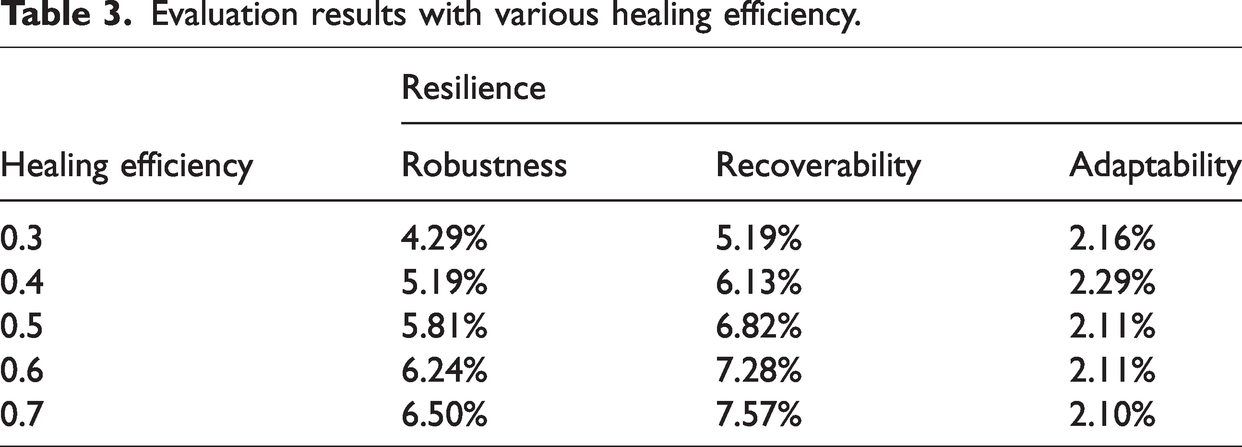
Figure 7 and Table 3 display the evolution curve of the elasticity modulus and evaluation results with various healing efficiency, respectively. As the healing efficiency increases, the variation in the robustness gradually increases from 4.29% to 6.50%. With the increase of healing efficiency, the change of recoverability also increases gradually, with its value increasing from 5.19% to 7.57%. When the healing efficiency changes, the adaptability changes with no apparent regularity, but it is positive overall, indicating increased adaptability.
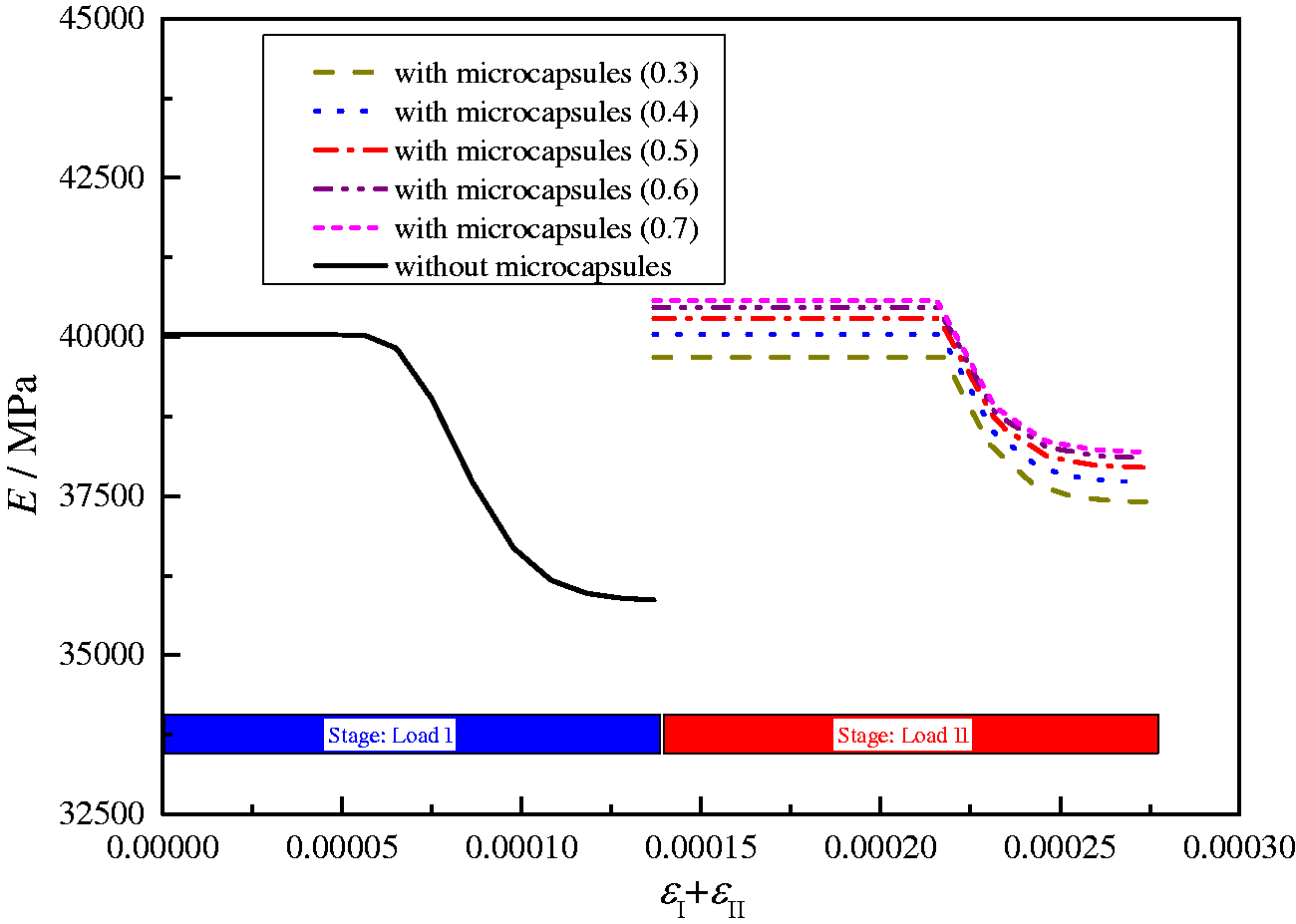
The evolution curve of elasticity modulus with various healing efficiency.
Evaluation results with various healing efficiency.
The influence of the fracture toughness of the repaired microcrack
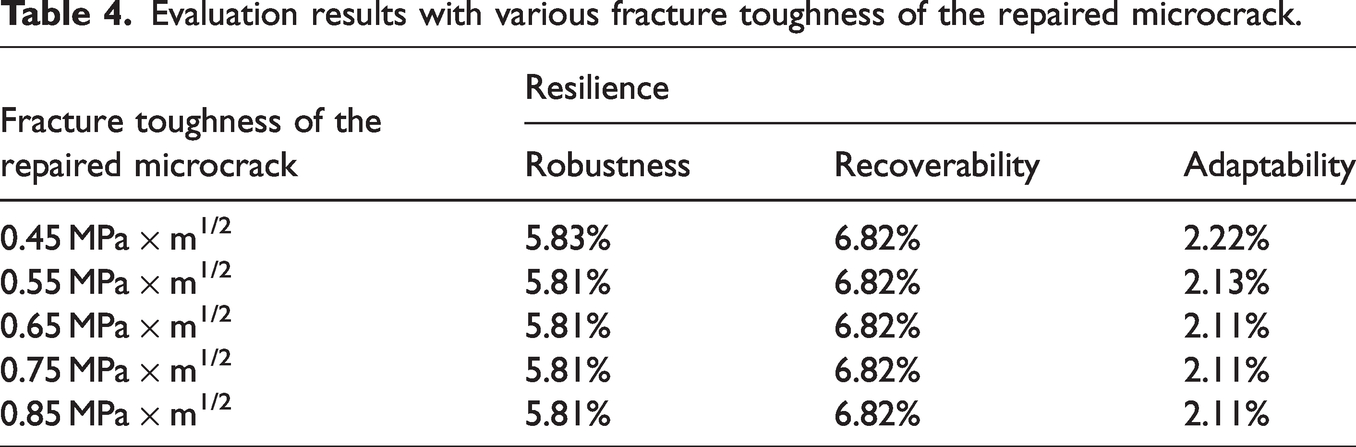
Figure 8 and Table 4 render the evolution curve of elasticity modulus and evaluation results with various fracture toughness of the repaired microcrack, respectively. When the healing efficiency changes, the robustness and recoverability change with no apparent regularity, but it is positive overall, indicating increased robustness and recoverability. As the healing efficiency increases, the variation in the adaptability gradually decreases from 2.22% to 2.11%. In general, the range of these changes is small, resulting in a variety of working conditions, and the concrete is not ready to make the repaired microcrack expansion or destruction of the situation.
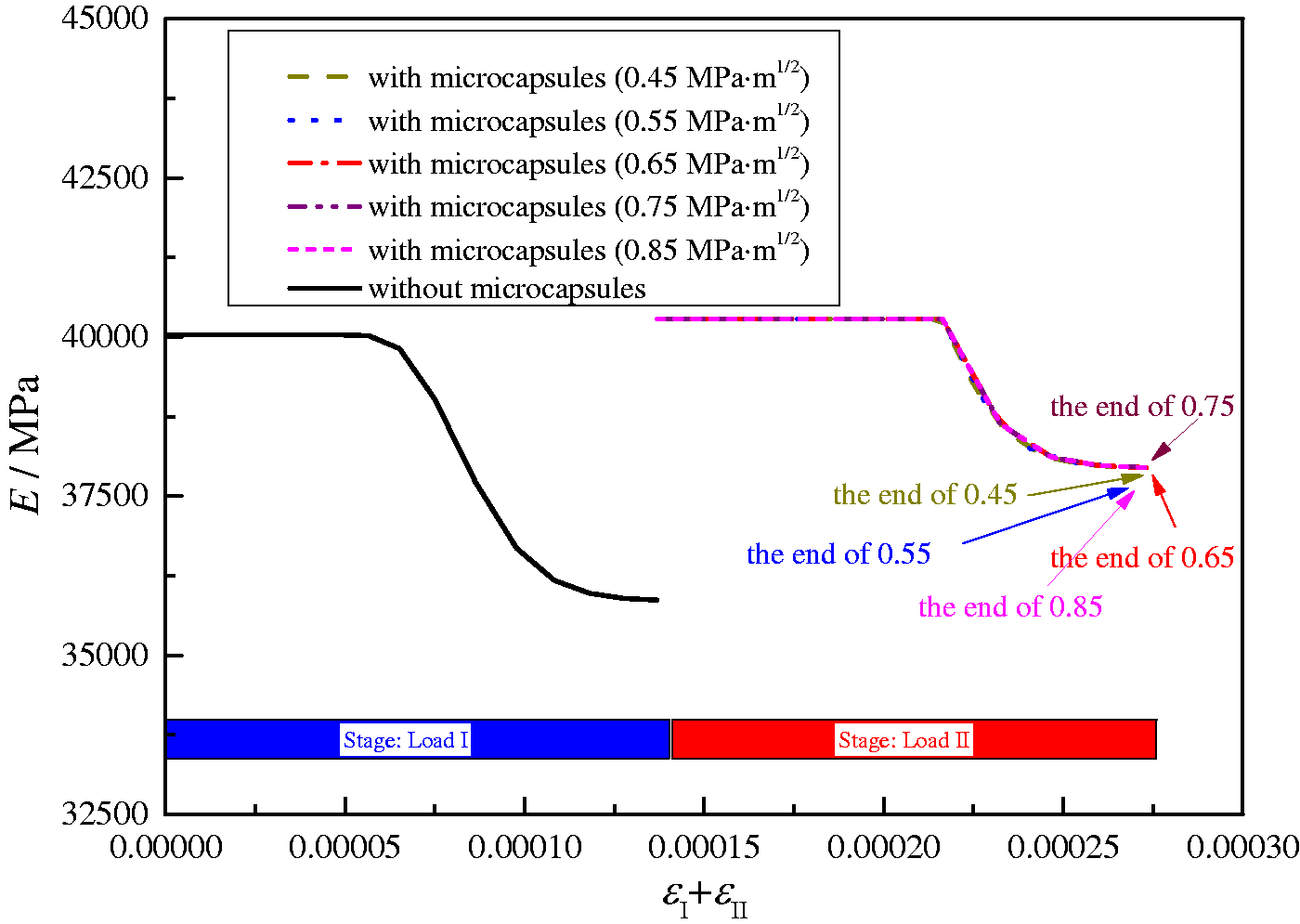
The evolution curve of elasticity modulus with various fracture toughness of the repaired microcrack.
Evaluation results with various fracture toughness of the repaired microcrack.
The influence of the applied initial damage
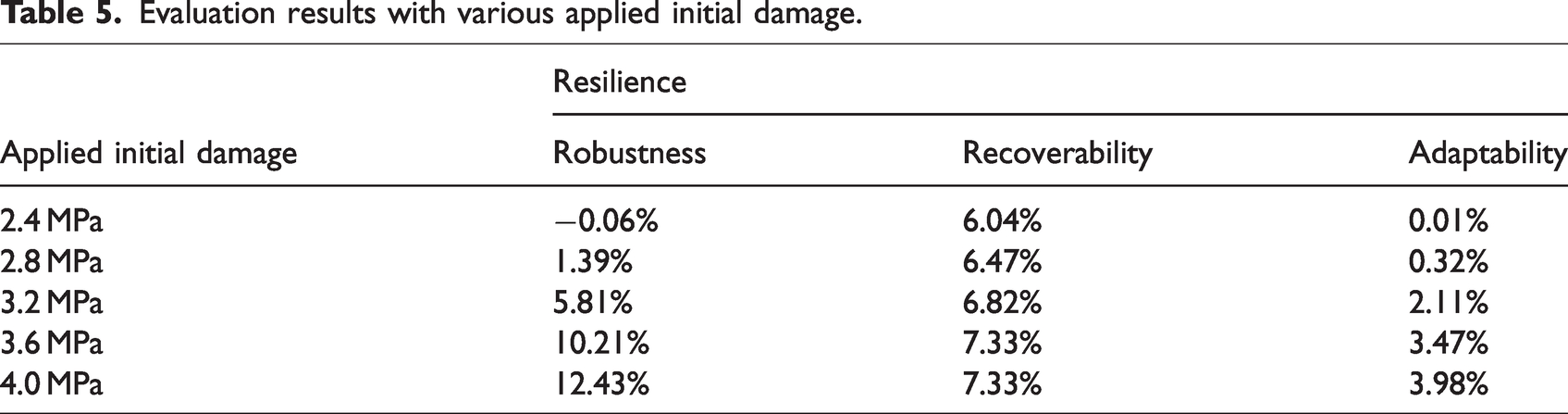
Figure 9 and Table 5 show the evolution curve of elasticity modulus and evaluation results with various fracture toughness of the repaired microcrack, respectively. As the healing efficiency increases, the variation in the robustness gradually increases from −0.06% to 12.43%. The value −0.06% indicates that the robustness decreases when the initial damage is low (c.f. 2.4 MPa). With the increase of healing efficiency, the change of recoverability also increases gradually, with its value increasing from 6.04% to 7.33%. As the healing efficiency increases, the variation in the adaptability gradually increases from 0.01% to 3.98%.
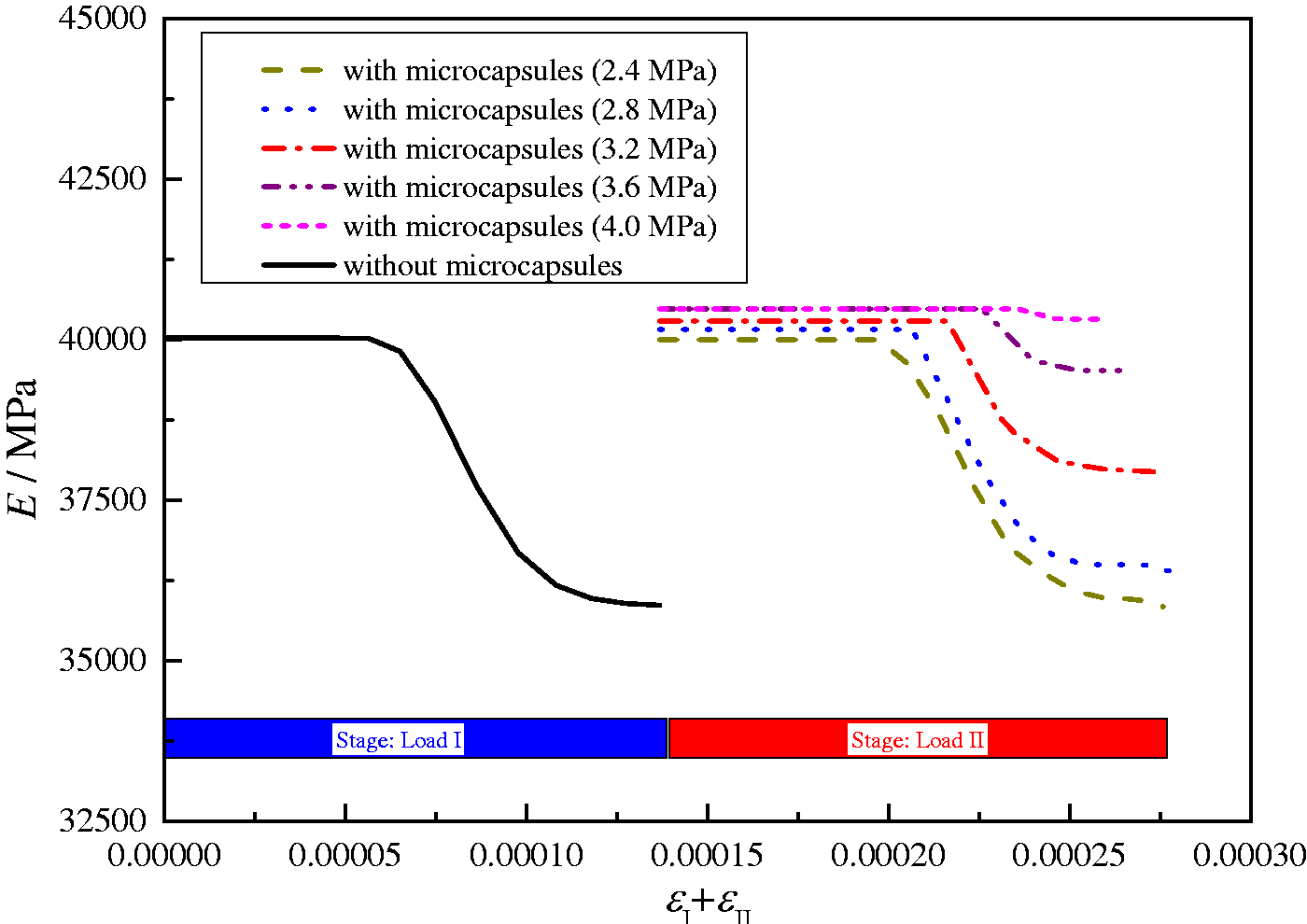
Evolution curve of elasticity modulus with various applied initial damage.
Evaluation results with various applied initial damage.
In the previous section, the influences of the healing efficiency, applied initial damage and the fracture toughness of the repaired microcrack on resilience of microencapsulated self-healing concrete have been studied quantitatively. Those results can be applied to resilience design. That is, to obtain microencapsulated self-healing materials with high resilience (strong robustness, high recoverability and intellectual adaptability), it is necessary to focus on the healing efficiency and applied initial damage.
Conclusions
In this paper, a resilience assessment framework for microencapsulated self-healing cementitious composites in underground structure is proposed from the perspective of three-dimensional micromechanical damage-healing. The main conclusions are as follows:
Based on the elastic secant compliance tensor, a 3D micromechanical analytical model is constructed to analyze the performance evolution during the damage-healing process of self-healing concrete. The resilience assessment method for microencapsulated self-healing concrete is proposed by virtue of the residual stiffness, self-healing effect on stiffness and damage cumulative on stiffness, which corresponds to three main features of resilience, namely, robustness, recoverability, adaptability. The assessment results indicate that the release of healing agents within microcapsules and healing process of extended microcracks allows the microencapsulated self-healing concrete to have higher resilience than conventional concrete. Parameter sensitivity analysis is conducted to investigate the influence of the healing efficiency, applied initial damage and the fracture toughness of the repaired microcrack on resilience of microencapsulated self-healing concrete. The results exhibit that higher healing efficiency and applied initial damage lead to high resilience, and fracture toughness of the repaired microcrack makes less difference to the results. The findings of this paper lay a theoretical foundation for the resilience design of self-healing material layer of underground structures. However, the resilience assessment framework proposed in this paper is applicable to tensile loads, and the case of more complex loads will be investigated in our forthcoming studies.
Supplemental Material
sj-pdf-1-ijd-10.1177_10567895231197237 - Supplemental material for A resilience assessment framework for microencapsulated self-healing cementitious composites based on a micromechanical damage-healing model
Supplemental material, sj-pdf-1-ijd-10.1177_10567895231197237 for A resilience assessment framework for microencapsulated self-healing cementitious composites based on a micromechanical damage-healing model by Kaihang Han, Jiann-Wen Woody Ju, Chengping Zhang, Dong Su, Hongzhi Cui, Xing-Tao Lin and Xiangsheng Chen in International Journal of Damage Mechanics
Footnotes
Declaration of conflicting interests
The authors declared no potential conflicts of interest with respect to the research, authorship, and/or publication of this article.
Funding
The authors disclosed receipt of the following financial support for the research, authorship, and/or publication of this article: The authors acknowledge the financial support provided by the National Key Research and Development Program of China (No. 2022YFC3800905), the Major Program of National Natural Science Foundation of China (Grant No. 52090084), the State Key Program of National Natural Science Foundation of China (Grant No. 51938008) and the Shenzhen Natural Science Fund (the Stable Support Plan Program 20220810164959001)

References
Supplementary Material
Please find the following supplemental material available below.
For Open Access articles published under a Creative Commons License, all supplemental material carries the same license as the article it is associated with.
For non-Open Access articles published, all supplemental material carries a non-exclusive license, and permission requests for re-use of supplemental material or any part of supplemental material shall be sent directly to the copyright owner as specified in the copyright notice associated with the article.
