



Abstract
Growing scholarship emphasizes social media as potential platforms to facilitate social justice discourse, while others document simultaneous polarization and trivialization. With the objective of supporting educators, students, and community members, this article conceptualizes a framework of critical social media literacy (CSML) based upon Freirean pedagogy. While social media platforms exist in diverse formats, social media numbers in the form of likes, shares, and views emerge as common elements to influence social justice ideologies. Building upon this preliminary conceptualization, the framework proposes that students may benefit from understanding how social media numbers can: grant automatic, unfounded legitimacy; be mobilized toward not social justice but the pursuit of profit; be a prerequisite for visibility of content; replace critical thinking as ubiquitous metrics; lead to false sense of disorienting dilemmas; facilitate antagonization of nuanced perspectives; encourage conformity; and be directly purchased. Implications on conformity—and expanded thinking for students—conclude the study.
Introduction
Building upon existing conceptualizations on social media literacy, this article considers divergent scholarship which simultaneously notes value of social media platforms toward global social justice activism—alongside simultaneous evidence on trivialization, radicalization, and dissemination of oppressive ideologies via social media. The proposed framework emphasizes three foci. First, social media in relation to the goal of social justice, or Freirean theorization of reduction of inequalities, is considered. Second, an aim of supporting reduced trivialization of social justice discourse, which is increasingly documented in scholarship. Third, literacy is situated on re-assessing social media numbers in the form of diverse reactionary metrics such as views, likes, and shares. The resulting framework considers 16 themes, sub-divided into methods of conformity, directions of expanded thinking, and eight preliminary competencies. The article grounds existing scholarship within Freirean critical pedagogy, toward disentangling complexity of observed relationships between social justice and social media.
Context: Social Media Literacy
The literature on social media literacy has seen diverse conceptualizations (O’Neill, 2010; Parandeh Afshar et al., 2022; Ryan, 2021; Thoman & Jolls, 2004), with some considering it a professional capacity for individuals working in social service sectors (Vanwynsberghe et al., 2015). This perspective suggests that social media literacy can be harnessed toward social service objectives, potentially contributing to social justice when platforms are intentionally used for this purpose. Additionally, researchers have examined social media literacy in various disciplinary contexts which may have less direct relevance to social justice (Scolere, 2023). It is anticipated that different disciplines may develop their own frameworks for social media literacy in accordance with existing industry standards; as such, this diversity underscores the importance of exploring the implications of social media literacy within the precise context of social justice education. In theoretical frameworks aiming to mitigate known social harms of social media, literacy extends beyond mere technological familiarity to encompass skills such as analysis, evaluation, and contribution to “civic goals and collective good” (Cho et al., 2024). Existing theoretical models thus highlight a significant intersection between social media and concepts pertinent to social justice: for instance, Masullo et al. (2022) outline a framework comprising 14 competencies for social media, including support of humanization, fostering civic competence, boosting community resilience, making power accessible, and supporting civic action. In contrast to these broad theoretical frameworks, social media literacy initiatives may also target specific objectives, such as equipping students with skills to combat fake news (Zhang et al., 2022), encouraging university students to prioritize empowering content over entertaining content (Smith et al., 2023), and reducing the dissemination of misinformation by students during a pandemic (Balakrishnan, 2024).
Theoretical Foundation
In recognition of the multiplicity of existing frameworks, this article builds upon critical pedagogy as established by Paulo Freire (1968), supplemented briefly by Mezirow's transformative learning framework (1997). Freire notably developed his pedagogy in a context of severe, intersectional (hooks, 2014) oppression, and leveraged education as means to address social justice concerns such as colonialism; deprivation of livelihood; limited access to education; racism; and classism in the global south. Freirean pedagogy underscores education's potential to empower individuals who face lived experiences of these structural—and potentially simultaneous—inequalities, toward seeing oneself as agents who are capable of transforming society. Emphasizing dialogic approaches imbued with solidarity, Freire advocated for understanding diverse perspectives as a foundation to foster critical consciousness. In relation to social media, evidence suggests that nuanced discourse and complex perspectives may be self-censored under pressures to conform. In response, Freirean pedagogy champions acts of transformation over what he terms as “armchair revolution”—in which social justice is performed instead of authentically pursued (1968). This theoretical framework informs two of the three foci of this study: emphasis on social media as intersecting with social justice, as well as an objective of reducing trivialization of social justice. The third focus emerges organically via the design of mainstream social media platforms; the narrow focus on social media numbers suggests that Freire's conceptualization of social conformity over social transformation can be generated even through a minor component of social media.
Social Media and International Social Justice
Significant research indicates value in mobilizing social media to overcome oppression in society. In alignment with Freire's consideration of critical consciousness (2021), Petray & Collin notes social media as “important space for dialogue and consciousness-raising” (2017). Social media thus emerges as an educational tool (Kumar & Nanda, 2020) which can lead to greater awareness and knowledge of social justice issues, suggesting that a rigorous conceptualization of CSML presents simultaneous potential to support social justice pedagogy. Beyond social media as pedagogical tool, research has also considered social media as publicly-accessible outlets to initiate social justice efforts. Global-scale resistance movements such as #blacklivesmatter, #metoo, #marchforourlives, and #thisisourlane are examples of such campaigns and constitute noteworthy attempts at engaging the public in social justice dialogue (DeBlaere et al., 2019). Social media, therefore, emerges as a tool to facilitate discourse which otherwise may be limited in physical and face-to-face settings. As an example, research notes that social media has been used extensively by politicians, who not only use the platform to enhance online publicity but also grant new means for citizens to not just engage but “question or even criticize” (Sobieraj et al., 2020). Whereas not all citizens have access to face-to-face opportunities for critical dialogue of such natures, social media facilitates new modes of communications toward inclusivity. Social media used for criticism suggests that dialogue presenting conflict is not innately detrimental to social justice objectives, and that social media may shed light on perspectives which are historically less visible in society. New, online sharing of information can also overlap with research and research methodology in itself. As one example, Foster et al. mobilizes social media as a tool to expand the utility of photovoice methodologies (2023), which has been mobilized in various educational research studies toward equitable inclusion of marginalized populations (Brion, 2023; Cornell et al., 2022; Evans-Agnew et al., 2022)
Social media has potential to connect the local to the global, or, expand local social justice concerns into global movements. Examples of global movements beyond the aforementioned hashtag campaigns include “environmentalism; transnational movements around race, gender and sexuality … and transnational rights and social justice campaigns” (Flew & Iosifidis, 2020). The capacity to build global movements facilitates the inclusion of “developed and developing societies” (Sorour & Lal Dey, 2014) toward collaboration, with researchers noting how social media can foster activism ranging from “mass protests at Tahrir Square in Cairo and Taksim Square in Istanbul, demonstrations against sexual harassment in Delhi and the Shahbag Square uprising in Dhaka.” A study on virtual intercultural bridgework (Sobré-Denton, 2016) considers social media for its utility to mediate global–local relationships, and describes social media as a tool for “virtual community-building and participat[ion] in communication to build global citizenship.” While this community-building and participation can be oriented toward varying objectives, Sobré-Denton specifically notes cases of “trans-local and transnational community-building for social justice movements and activism, including community liaison-building across corporeal borders and boundaries.” In other words, division amidst the existing global community may be ameliorated through intentional use of social media, and the rise of “intercultural liaisons” via such usage may guide new perspectives and solutions for social justice.
Existing research also suggests that communities marginalized by racial or colonial oppression may utilize social media in various ways, presenting value in considering how social media impacts diverse populations differently. As one example, African American communities are noted to use social media at higher rates than other racial counterparts, with research noting that social media can be mobilized by African Americans to forge positive identities. Social media is also used by some members to engage in collective action on behalf of Black communities (Stamps, 2022), suggesting that oppressed groups may find greater leverage through social media to counteract existing oppression. Likewise, a study on indigenous experiences in New Zealand suggests that social media can benefit “political engagement and indigenous development”. The authors note that social media can guide dialogue aligning with various existing indigenous ideologies such as tino rangatiratanga (self-determination) and whanaungatanga (relationships/networks). On the other hand, social media can lead to negative impacts on indigenous development, with the authors noting cultural misappropriation as one distinct risk (Waitoa et al., 2015).
Social Media as Freirean Oppression
The existing body of literature presents varying views on social media to suggest value in nuanced investigation. In stark contrast to aforementioned hashtag movements, research also directly notes that racism and xenophobia are “all over social media” (Romero, 2020). While it is possible that these oppressive ideologies are simply made more visible through public engagement in social justice discourse, research suggests that not all dialogue is conducive to positive outcomes. In other words, while discourse may be present at an international level, social media can emerge as oppressive as it “tends to extremes, moral outrages, lack of nuance and incivility” (Bouvier, 2020). This is echoed by research suggesting that social media can build communities, but essentialize these communities and rapidly polarize them (Shenton, 2020). Under a Freirean framework of social justice, the act of attempting social justice is often referred to as a struggle (2000); as such, the manifestation of this struggle on social media can lead to observations of online conflict which further subjects oppressed individuals to inequitable power relations. There is value in considering how a critical framework of social media literacy can reduce potential online oppression—especially when oppressed communities are attempting to use social media to access visibility, legitimacy, and equality in social outcomes.
Oppression that marginalized communities may face on social media include recurring “public online shaming” and antagonism (Shenton, 2020), or distress from outright cyberbullying (Parris et al., 2022). The diversity of information and perspectives lead to not just diverse social media experiences, but also different levels of engagement or uptake of social justice concepts. As one example, social media studied for the purpose of improving health outcomes for students is noted to require tailored, “attractive messaging” if positive outcomes are to be achieved (Plaisime et al., 2020). In other words, social media as a platform which gives ample space to social justice perspectives also gives space to content irrelevant to social justice. If students choosing to engage in social justice content on social media face online oppression, there exists a wide variety of other content individuals can choose to consume instead. Contemplating and tackling one's oppression is a task which can come with considerable emotional toil (Nicholls, 2011). As such, oppressed individuals may easily disengage with social justice to locate more tailored and attractive messaging given the diverse content made available through social media.
Social media platforms should also be considered as inseparable from the companies which develop and have full rights over such platforms. Social media companies thus have “power to regulate communication in the public sphere,” with regulations which may not always be aligned with social justice objectives (Aytac, 2022). If social media is not only mobilized toward discourse but political participation, social media represents an opportunity for corporate interests to regulate public interests in the policy arena. This regulation may be intentional or unintentional, described in research as algorithmic governance (Aytac, 2022) which nonetheless can alter social media experiences and shape social media culture. Under the framework of Freirean oppression, what constitutes power, dominance, or authority in social media takes on importance to consider for a CSML framework. Aside from the authority which social media companies hold over the platforms they offer the world to use, authority may also arise from social media influencers (Riedl et al., 2023). Power can be generated on social media via “self-infatuation,” which in turn can be conceptualized as power in the form of “individualized charismatic authority” (Gustafsson & Weinryb, 2020). This authority, while not always leading to oppressive or socially unjust outcomes, can be difficult to challenge when it does lead to inequitable impacts. Gustafsson and Weinryb consider how such self-infatuation can be increasingly institutionalized as a “predominant manner of organizing” in modern society. In other words, as social media grants new players unforeseen authority over entire populations, the insertion of social justice discourse into these platforms would benefit from acknowledging such existing authorities at play.
Framework of Critical Social Media Literacy
Building upon this context of social media as potential contributor of inequalities in society, this article considers how social media numbers may lead to social justice trivialization. Increasing research points to concepts of trivialization of social justice, in which committed or preventative actions toward social justice outcomes are instead replaced by performative allyship (Kalina, 2020; Kutlaca and Radke, 2023); performative activism (Thimsen, 2022); brand activism with intentional marketing or profit-generating intent (Cammarota et al., 2023; Mwencha and Njuguna, 2023; Pimentel et al., 2023); rainbow capitalism (Rine, 2022); greenwashing (de Freitas Netto et al., 2020; Johnsson et al., 2020; Lyon and Montgomery, 2015); cancel culture (D. Clark, 2020); and slacktivism among other overlapping concepts (Cornelissen et al., 2014; Leyva, 2017). The existing body of evidence suggests a new form of oppression may arise via insertion of social justice dialogues into the social media sphere: in place of outright censorship or repression of social justice ideologies, these ideologies may be trivialized and in turn commodified for neoliberal pursuit. Under the framework of critical pedagogy, this article posits that as students can invariably be exposed to such social justice trivialization on the internet, efforts to improve social justice pedagogy can be supported by minimizing learned trivialization. Challenging how the digital sphere impacts and trivializes social justice, therefore, forms the basis of the following discussions on reforming social justice education.
While critical thinking has significant value as indicated by aforementioned social justice frameworks (Cho et al., 2024; Masullo et al., 2022), this article seeks to take an alternative approach in resisting trivialization. In order for students to assess what is valid, legitimate, or untrivialized social justice content, students may need to be educated on a wide variety of issues such as racism, colonialism, sexism, ableism, and environmentalism to name a few widely studied concerns. This diversity suggests that students who wish to perform critical thinking on online social justice discourse may face challenges arising from the level of their existing knowledge. As it is not feasible for a single social media literacy framework to simultaneously educate students on all relevant social justice issues, the CSML framework is focused on re-orienting students’ perspectives of social media numbers as a leverage point. The following sections outline key competencies of the proposed CSML framework, to support future efforts in social justice pedagogy.
Social Media Numbers Grant Automatic Legitimacy
Social media numbers, in the form of likes; views; follows; shares; retweets; subscribers (Tenenboim, 2022) and a host of other creative metrics should be understood by students as granting automatic legitimacy. CSML should help students acknowledge how they may actively or subconsciously attribute legitimacy to any highly numbered content. Regardless of validity of social-justice ideology or thought in the content, any highly numbered content can overshadow or even delegitimize valuable perspectives, opinions, and lived experiences which receive lower social media numbers. These numbers therefore have the capacity to allow non-social justice content to appear more legitimate than social justice content; oppressive parties in social justice discourse to appear more legitimate than collaborative or oppressed parties; and trivialized social justice content to appear more legitimate than serious dialogic approaches. Students who are not aware of the innate tie between social media numbers and automatic legitimacy may be led toward prioritization of all highly numbered content they come across, or, surrendering authority to highly numbered creators.
Beyond understanding the inclinations of the self to attribute automatic legitimacy, CSML should also help students identify the same inclination in other social media users. Students who gain a critical perspective on how other social media users behave—either as individuals or as a collective—have greater liberty to determine whether they wish to follow the behaviors they witness. As a specific example, when a large collective of social media users exhibit direct sexism (de Coning, 2016) in a social justice discourse, students with CSML may have greater confidence in analyzing and rejecting sexist views regardless of the social media numbers attached.
Social Media Numbers Are Mobilized to Pursue Privilege and Capital
Students should also understand that under current social media structures, highly numbered content can be converted into direct monetary profit. As such, the creation of highly numbered content does not always align with social justice objectives, but rather the desire of an entity or an individual to pursue privilege. As Freire's framework offers a simplified perspective of a privileged class dominating an oppressed class, the pursuit of privilege can be viewed as potentially hindering social justice objectives—especially in a context of finite resources (Robinson, 1973). Highly numbered content, therefore, cannot be assumed to be legitimate discourse but rather as privilege-pursuing discourse. While it may be difficult for students to understand how pursuit of privilege can contribute to Freirean oppression, classism, economic inequalities, and other socially unjust outcomes, CSML posits that students would nonetheless benefit from seeing highly numbered content as potentially serving the purpose of privilege as opposed to social justice.
Popularity, societal acceptance, and personal attention can be mobilized toward greater profit-generating potential via social media platforms. In other words, social media presents opportunities for individuals to convert existing social privilege into monetary gains. Students can be exposed to widely disseminated messaging on how some social media creators become highly paid members of society (Cunningham & Craig, 2017); this messaging, in turn, may serve as what Freire considers oppressive given that “one of the methods of manipulation is to inoculate individuals with the bourgeois appetite for personal success” (2000). CSML seeks to bring a Freirean perspective on privilege (Nicholls, 2011) so that students learn to associate high numbers with appetite for personal success, rather than legitimacy of social justice thought.
Social Media Numbers Grant Visibility
Aside from rewarding monetary gains, existing structures of social media platforms further reward visibility to highly numbered content. With massive amounts of content available on platforms, what students can feasibly search for or feasibly see when they log into accounts may be determined by content with considerable social media numbers. In other words, content which does not generate large social media numbers can struggle to be seen on social media platforms: regardless of how massive the traffic and user-base may be, content which has generated limited views can become extremely difficult to search for and come across. For social justice content which fails to compete with highly numbered content, this can lead to a form of unintended silencing or censorship to sideline important perspectives. While social justice content which have lower numbers may be viewed as less legitimate than highly numbered content, there is a potential situation in which social justice content with low numbers are not only less-legitimate but entirely not visible.
Under CSML, students could benefit from acknowledging that visibility is not automatically granted to all content. Social media platforms, as free-to-use services, are not obligated to grant equal visibility to all content that is uploaded. Awareness of how visibility is not a given may guide students to consider what is continually sidelined or marginalized in social justice discourse. Content that is difficult to locate on social media platforms should not be tied to illegitimacy, as this discourse may simply be linked to invisibilized social issues such as hidden homelessness; intersectional marginalizations; and severe forms of oppression bordering on criminal violation (Barongo-Muweke, 2016; Borderon et al., 2021; Langegger & Koester, 2016; Soroka et al., 2003). CSML posits that social media should not be mobilized to further delegitimize and invisibilize these issues in the online sphere, specifically when few other platforms may be accessible to communities that are affected by such severe social injustices.
Social Media Numbers Ease the Need for Critical Thinking
Reflecting upon inequitable social structures and outcomes can be a challenging process. What may be considered as critical thinking in social justice in itself is a query which can generate several valuable frameworks and scholarly investigations. As students may persistently face pressure to apply critical thinking when engaging with social justice content online—even when they have not necessarily been given opportunity to develop critical thinking skills—this can lead to disorienting user experiences. In light of this disorientation and complexity emerging from critical thinking, social media numbers serve as false yet ubiquitous thinking aids. CSML proposes that students should be educated toward how the psyche may automatically rely on social media numbers as quick evaluation metrics in place of critical thinking.
Social Media Numbers Create Illusory Disorienting Dilemmas
Under transformative learning theory (Mezirow, 1997), it is hypothesized that learners change their perspectives when they overcome disorienting dilemmas—situations in which individuals are forced “to call into question their values, beliefs, or assumptions” (DeAngelis, 2022). CSML suggests that social media numbers often simplify all discourse into binaries such as liking versus disliking online content, resulting in students believing that they have overcome a disorienting dilemma when there has been no reflective questioning of existing ideologies. Social media numbers may guide students to agree with the present, most highly numbered perspective—or otherwise be seen as antagonists in an oversimplified binary. This in turn may be a contributing factor in scholarly evidence on polarization of communities, as well as on the radicalization of perspectives via social media (Bouvier, 2020).
Students, when faced with social justice content, are often not tasked with challenging existing socially unjust or oppressive ideologies they may hold. Instead, the task is simplified into leaving a positive or negative social media footprint. As leaving a negative social media footprint—such as clicking a dislike button—can be seen as antagonism and a cause for unnecessary conflict, students may be strongly guided toward agreeing to any social justice content presented before them. This agreement is not founded upon actually working through one's disorienting dilemmas and rejecting one's previous socially unjust beliefs. Giving a view, leaving a like, dropping a retweet emerge as new ways to appear as if one has challenged, interrogated, and given up past oppressive ideologies. The result is a potential lack of transformation to hinder development of social justice beliefs among students.
Social Media Numbers Antagonize Dissent
In relation to how social media numbers create illusory disorienting dilemmas, social media numbers can make any and all challenging perspectives appear antagonizing. Individuals wishing to expand upon or fill gaps in the most highly numbered perspective in a social justice discourse may be automatically viewed as antagonists of social justice. With the binaries that social media numbers present, all nuanced or complex voices may be assessed by other users as antithetical to the cause; as such, CSML posits that trivialization of social justice cannot be addressed when discourse on preventing trivialization is immediately viewed as hostile.
Students may question why specific individuals—instead of leaving a like or a retweet like the vast majority of other social media users—would instead wish to bring more elaborate and complex perspectives into social justice discourse. Longer discourse which does not fit perceived or regulated length requirements on social media (Kontopoulos et al., 2013) may be viewed as simply not suited for social media. As social media numbers often guide students to think in binaries, any perspectives which do not align squarely with highly numbered content may be eligible for dismissal. New perspectives thus can only emerge when advertisement expenditure (Kim, 2012) is dedicated to purchase a certain degree of visibility and perceived legitimacy as a prerequisite. Beyond this removal of nuance and complexity in social justice discourse, social media numbers also guide students toward defining other social media users in binaries such as woke versus not woke—ultimately leading to phenomena such as cancel culture (Sailofsky, 2022). CSML proposes that students would benefit from a refusal to antagonize not just complex perspectives but also any conflicting perspectives. Students can be taught that there is more value in collaboratively engaging with—as opposed to antagonizing—individuals who do not support social justice ideologies at the present moment. Students may also benefit from recognizing that a tendency to antagonize may be linked to aforementioned research, in which social media is mobilized for construction of identity for the self and self-infatuation as opposed to social justice objectives.
Social Media Numbers Facilitate Conformity
In combination, CSML proposes that social media numbers guide students toward conformity in social justice discourse. Under the CSML framework, students do not choose this conformity but are rather forced into this positionality, as refusing to conform may: task them with the more challenging assignment of critically thinking through social justice issues; place them as antagonists among existing friends, family, and social circles; reduce their profit-earning potential on social media; and negatively impact their own social media numbers, thus delegitimizing their future content and perspectives on social media.
On conformity, Freire writes that oppressive structures in society often force the oppressed class into “prefer[ring] gregariousness to authentic comradeship; they prefer the security of conformity with their state of unfreedom to the creative communion produced by freedom and even the very pursuit of freedom” (1968). In other words, conformity can be prioritized as it grants a base level of security and illusion of camaraderie. Freire considers a desire to conform as “a prescribed behavior” which often does not serve social justice purposes.
Existing platform structures, centered around the value of social media numbers, present a number of ways through which students can demonstrate conformity. First and foremost, it is possible to completely avoid dissent, conflict, and being perceived as an antagonist when students choose to drop a like or a positive emoji (Alfano et al., 2022; Graham, 2019; Kariryaa et al., 2022; Logi & Zappavigna, 2023) in place of any written perspectives. CSML encourages students to gain insight into how they self-censor more complex and complete communications within such structures. Second, when students do choose to engage in social justice discourse through uploading written content, students may be forced to adopt more widely accepted ways to communicate their ideas. As an example, humor is a recurring theme in social media content (Shifman & Blondheim, 2010), and can be mobilized to secure a level of social acceptance in the online sphere (Davis et al., 2018). Students should recognize how they are encouraged - or prescribed - to adopt humor and other presumed standards of online communication in order for their social justice content to find acceptance online. A desire to follow humor to increase likeability can also lead to silencing when individuals resort to posting memes as part of their online discourse (McLoughlin & Southern, 2021; Morrison-Young & Bres, 2023; Sharma, 2023). Memes as massively disseminated digital content emerge as another option for youth to quickly post content that would be liked by others while censoring more complex ideas. Third, students should also understand how social media numbers direct them to conform via language, syntax, and vocabulary. In order to achieve visibility or legitimacy of content, students may be tasked with learning linguistic elements which are popular on social media prior to the presentation of their social justice beliefs. Research documents a vast variety of linguistic elements arising from social media usage (Dyagilev & Yom-Tov, 2014; Lutzky & Lawson, 2019; Page, 2012); in turn, lack of conformity to accepted syntax may lead to automatic sidelining. Lastly, students should acknowledge that there is allure in directly copy/pasting written content which has generated a high number of likes and other positive online sentiments. Conformity can be induced by identifying content which has already proven itself to be effective in generating social media numbers, and directly disseminating equivalent or largely similar content even if it is written by other individuals. In midst of these multiple pathways toward conformity, there is limited rationale for students to fully articulate nuanced perspectives in social justice.
Social Media Numbers Can Be Purchased
With social media numbers granting automatic legitimacy, higher visibility, and profit-generating potential, CSML proposes that there is value for students to understand how social media numbers can be purchased. Research suggests that not only can numbers such as views be officially purchased through social media companies, various means to manipulate these numbers which are not approved by the social media companies also exist (Arora et al., 2020; Dutta, Arora, et al., 2021; Dutta, Jobanputra, et al., 2021). Therefore, highly numbered content cannot be viewed as indication of public support if both investment of capital and willingness to engage in data manipulation can lead to the same outcome. As social media numbers can generate profitability of an account, purchasing views and other social media numbers is no longer seen as taboo but rather sound business practice (Odden, 2012). Highly numbered content can also be viewed as having direct financial value, as research also documents digital markets in which entire social media accounts are sold and traded (Thomas et al., 2013). Students who lack a critical perspective on the growing commodification of social media numbers may continue to attribute legitimacy, and pursue numbers as an indicator of both quality of content and even personal self-worth (Sabik et al., 2020).
Given existing neoliberal structures in society and the massive influence that social media may have over global populations, it can be difficult to separate social media numbers from neoliberal structures. CSML proposes that students must be familiar with the official advertisement policies of social media companies, as this information is not intended to be hidden. Corporate entities have long understood and tapped into the power of social media advertising (Kanth & Prasad, 2023; Khan & Jan, 2019; Muñoz & Wood, 2015) by familiarizing themselves with such policies. Gaining understanding into how social media marketing works can grant students a holistic perspective - to understand how beyond their peers, other political and corporate players in society mobilize social media in diverse ways approved by the companies which own social media. Students should not be confined by this illusion that they themselves own their social media accounts: all users are granted access to an account that is provided for free by corporations. CSML proposes that students should not develop a self-centric focus in relation to social media, but rather consider social media in larger social, economic, and political contexts which affect their everyday lives. Through social media, students may gain a greater understanding of the aforementioned contexts to deepen their awareness of social justice issues.
Implications for Social Justice Pedagogy
The proposed conceptualization (Table 1) outlines eight competencies in what may be considered as a Freirean framework of social media literacy. The framework is informed by conflicting research which both suggests massive value in leveraging social media for social justice—and various oppressive outcomes ranging from cyberbullying to cultural misappropriation online. In terms of application to educational practice, educators interested in including social media as part of a social justice project may find benefit in field-testing the framework with students. CSML recommends that practitioners and students do not need to be confined to social media numbers as their only metric of success for an online social justice effort or project. Additionally, there is little utility in comparing social media numbers of an educational social justice project to other highly numbered content on the same platform, especially if no advertisement spending has been committed toward comparable exposure. CSML recommends nuanced consideration of social media, as social media companies are not obligated to provide free visibility to any and all projects. Educators, students, and other community members mobilizing social media for their social justice projects cannot assume that visibility would be automatically generated just by being on social media; at the same time, educators and students should acknowledge that visibility is only one benefit of social media in addition to advantages such as facilitated communications, data archiving, and sharing and delivery of multimedia content.
Framework of critical social media literacy as guided by social media numbers.
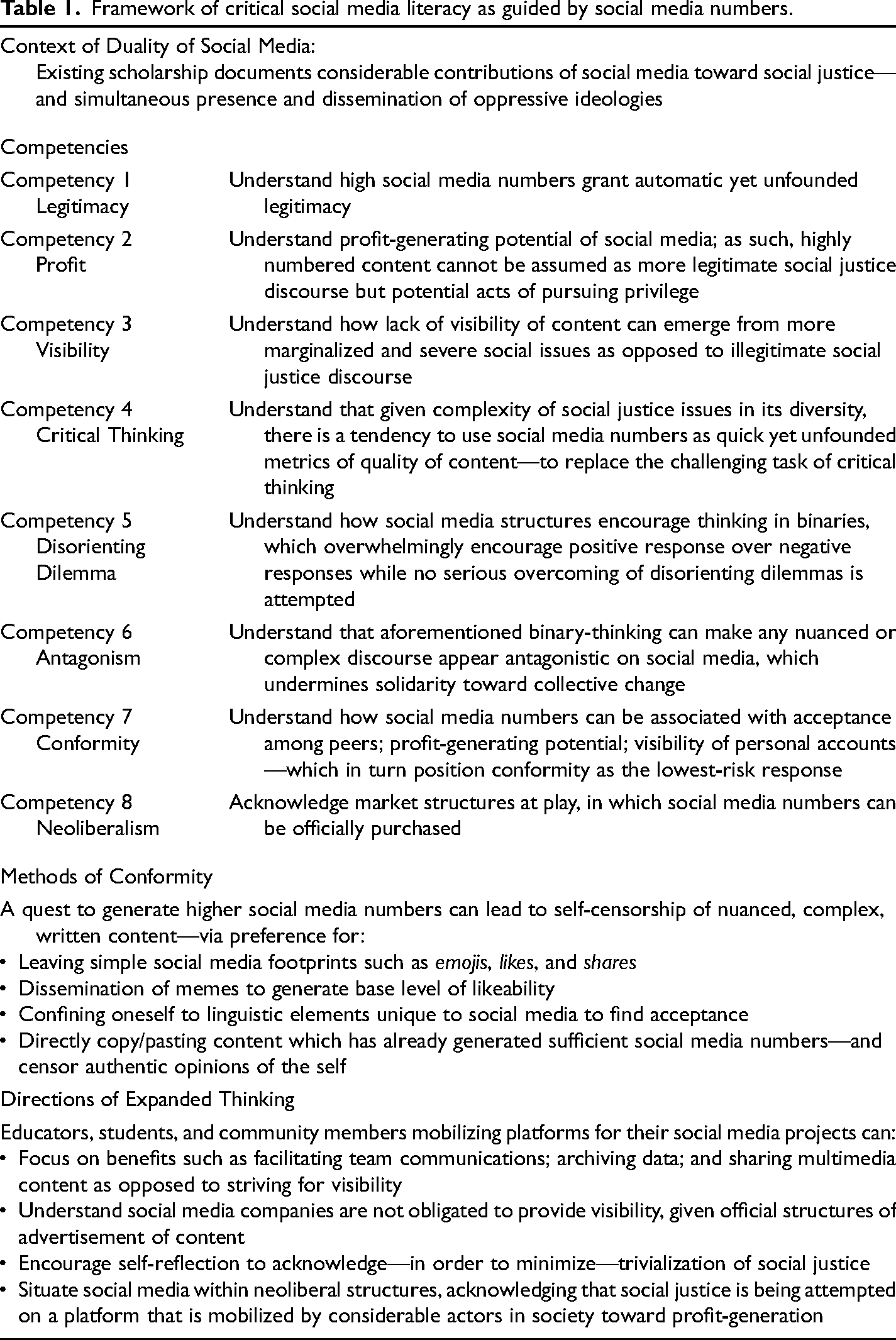
The CSML framework suggests value in openly acknowledging and discussing social justice trivialization. Under the framework, trivialization is not something to be ashamed of or deny in oneself, but is rather a default outcome given the way social media numbers are structured. CSML posits that as social media numbers are universally present, trivialization of social justice should be an equally universal phenomenon. Students who previously trivialized social justice should understand that acknowledging risk of trivialization does not confine them to a future of continued trivialization. The framework explicitly confronts trivialization not to criticize students for past social media behaviors, but to facilitate conversation on how trivialization can be recognized and prevented. Identifying trivialization in oneself and in others may require more complex and nuanced dialogue than what is made possible by social media—which, as discussed, often simplifies all issues into binaries. When trivialization is identified in other users, students should be aware that their past practices of cancel culture or antagonization should no longer be their default reactions. As tempting as it is for social media to be used to generate personal profit, attention, and even identity, CSML proposes that students should see social media as powerful tools to connect rather than divide.
Lastly, the CSML framework seeks to be open about capitalist or neoliberal structures in society; students of social justice may benefit from acknowledging the economic realities operating in their communities. Students who choose to make a living off social media, or mobilize social media toward the pursuit of privilege do not need to be shamed. Rather, these students should gain self-awareness of their intentions to mobilize social media for personal privilege, lest they confuse their pursuit of privilege as social justice activism. For educators, open acknowledgment of the intersection between capitalism and social media creates a broader view of the social media community. Platforms have long served as lucrative means of production, and thus the social media user-base forms a diverse community where one should expect to encounter community members; activists; corporations; politicians; and profit-seekers.
Reforming how students view social media numbers can impact social justice discourse happening at an international scale. Educating students with a Freirean framework of social media literacy, therefore, may lead to both more equitable educational outcomes as well as more socially just outcomes. Social media numbers do not encapsulate the entirety of the online experience, but nonetheless may guide the consideration of eight competencies in social media literacy. With growing usage of social media in various educational systems around the world, future efforts to expand and complete a full framework of critical social media literacy may help maximize the value of social media in pedagogy.
Footnotes
Declaration of Conflicting Interests
The author declared no potential conflicts of interest with respect to the research, authorship, and/or publication of this article.
Funding
The author disclosed receipt of the following financial support for the research, authorship, and/or publication of this article: This study is funded in part by the Social Sciences and Humanities Research Council of Canada.
