



Abstract
Employers agree that high school graduates lack teamwork skills needed for workplace productivity. The lag in student readiness to meet employer expectations urges school reforms that implicate group interaction, empirical assessment, and reporting of teamwork competencies. The Teamwork Skills Inventory (TSI) evaluated how well individual students performed in cooperative learning teams as observed by peers and self with anonymous feedback. Field-testing involved 303 high school students in the United States from middle class and racially diverse families. Psychometric indicators of reliability, validity, exploratory factor analysis, and group analytics were determined. Qualitative responses by participants to TSI methodology were highly favorable.
Keywords
Introduction
Global and domestic competition in business and industry have motivated employers in the United States to revise their expectations for employees (American Institutes for Research, 2021; Diamandis & Kotler, 2020; Hill & Hult, 2020). These changes have implications for high school and college reforms that could improve the preparation of students for employment. No one is able to predict all of the competencies employees may need for success in the future. However, there is general agreement that teamwork skills will be essential in a socially interdependent workplace. Newcomers to employment are expected to possess teamwork skills, function effectively as a team member, and provide evidence to confirm their social competencies (Collins & Halverson, 2018; Levine, 2020; Lieberman, 2021; McDaniel et al., 2018).
High school teachers want to collaborate in helping students acquire teamwork skills. However, educators realize that more effective strategies for instruction and assessment must be developed to achieve this goal. For example, awareness of the advantages and obstacles of group achievement should be included in student orientation to teamwork. Instruments with acceptable psychometric indicators are needed for self and peer demonstration of teamwork skills. Parents should be recruited to reinforce the benefits of interdependence in the workplace. Teacher guidance should enable students to process anonymous criticism from peers in a non-defensive manner. An e-portfolio record system should be established that reveals teamwork skills and deficiencies individual students can present to potential employers as evidence of their ability to collaborate in solving group problems. These concerns define important cooperative learning reforms addressed in this presentation.
Review of Literature
Student Readiness for Employment
The Association of American Colleges and Universities conducted a survey of 496 executives and hiring managers to find out their observations about how college contributes to workplace success (Finley, 2021). Only 60% reported that recent college graduates have the knowledge and skills needed to perform well in entry-level positions at their companies or organizations employing from 25 to over 1,000 workers. The top five abilities employers identified in rank order for employee recruitment were (1) ability to work in teams, (2) critical thinking, (3) ability to analyze and interpret data, (4) application of knowledge in real-world settings, and (5) digital literacy. Employers expressed concern that school reports on student achievement are too narrow. Teachers provide grades that show how a student performs when working alone but there are seldom records that give evidence of student ability to work effectively in groups. Recommendations are presented that valued qualifications, such as teamwork skills, should be evaluated in class, reported by school e-portfolios, and accessible for job applications.
Bloomberg Next (2018) surveyed 100 senior business leaders and 100 higher education faculty to find out their views on student readiness for employment and methods for improving collaboration between schools and corporations to build a more efficient education-to-work pipeline. All of the corporate respondents were from organizations having a minimum of 500 employees; the faculty were from large and small public and private higher education institutions. Corporate respondents (90%) and academics (88%) agreed that new recruits possess essential computer and written communication skills. However, a majority also felt many recruits do not perform well because they often lack soft skills. The most prominent soft skills both groups identified were (a) teamwork, (b) analytic reasoning, (c) problem-solving, (d) agility/adaptability, (e) ethical judgment, and (f) decision-making. Ritter et al. (2018) have described why soft skills are usually seen as important, tough to master, and difficult to measure.
Pew Research Center (2016) conducted a nationwide survey about the state of American jobs. The sample consisted of 5,000 adults, ages 18 and older, who were employed in all 50 states. The employees put teamwork skills, critical thinking, and computer skills atop the list of assets needed to perform their job; only 8% reported that their high school diploma, bachelor's degree, or community college certificate had provided the skill set and work experience needed for their position.
Secondary teachers try to persuade students that teamwork skills will be necessary for their future but admit they are unable to accurately evaluate this domain of achievement in the classroom. Students are also disappointed because they know teachers cannot simultaneously observe many cooperative learning groups or know how members of groups influence one another (Forsell et al., 2020). In addition, students may suppose that, because report card grades reflect individual performance for curriculum subjects but not teamwork, collaboration must be a less important factor in defining success (Griffith & Dunham, 2014; McDaniel et al., 2018; Sackstein, 2017).
Schools claim to equip adolescents with teamwork skills necessary for a job. Yet, schools do not keep records about student achievements, deficits, progress, or dysfunction in the social context (Rodríguez-Campos, 2015; Toth & Sousa, 2019). In most parts of the United States, adolescents are expected to show proficiency in reading, mathematics, and science to graduate from high school but they are not required to show evidence of ability to work effectively as members of cooperative groups. Eurich (2018) and Lieberman (2021) reported employers agree that the scope of achievement schools make known is too narrow, does not reflect contemporary criteria needed for work, and should expand to include individual performance as team members.
Link Teamwork Evaluation Methods in Class with Workplace Evaluation Methods
What conditions should be met to evaluate the teamwork performance of individuals? A common strategy in business is to rely on reports of multiple observers to confirm or refute self-impressions about performance on a team. This method requires that peers identify teamwork skills individuals consistently demonstrate while working in groups. Large companies like Apple, Bank of America, Ford, Intel, Microsoft, and Motorola rely on multi-rater methods to evaluate individual performance (Brecheisen et al., 2018; Heathfield, 2021). Employees also support multiple observation sources because co-workers interact enough to judge how well peers perform and detect their limitations (Brock et al., 2017). They believe the historic custom of one supervisor judging all subordinates is unreasonable in a team-oriented workplace (Church et al., 2019; Royal, 2019).
Management also supports team performance reviews by multi-rater assessment because there is evidence that it increases productivity (Heathfield, 2021). Employees might choose to ignore suggestions of a supervisor by rationalizing, “The boss doesn’t see me often enough to know all the things I do or how I perform.” Malone (2018) maintains that the feedback from co-workers has greater credibility so their criticisms and commendations get more attention.
One way to link evaluation in the classroom with methods used on the job is to schedule sustained practice for students, beginning in middle school, with peer and self-evaluation in cooperative learning groups (Eurich, 2018; Ritter et al., 2018; Steinberg, 2020; Teaching & Learning Services, 2020). This strategy can support the acquisition of teamwork skills for workplace readiness, reconcile work-study programs with expectations of employers, provide anonymous formative feedback from peers that are meant to foster improvement without impacting grades, and require student accountability for making individual contributions to group learning. Educational researchers have acknowledged the advantages of this strategy (Jimenez, 2020; Sackstein, 2017).
Teachers want to fairly evaluate student performance in cooperative teams. This becomes possible when observations of teammates are considered. Sharing responsibility with students for some aspects of teamwork evaluation is a departure from classroom tradition. Teacher trust is needed to allow student involvement with evaluation (Forsell et al., 2020; Griffith & Dunham, 2014). Group assessment also depends on accurate self-evaluation that occurs more often if students receive anonymous peer feedback to verify or challenge self-impressions. Hall et al. (2018) reported flawed self-impression is a common limitation whenever students work together in groups.
In addition to judging themselves fairly, students should objectively evaluate the behavior of teammates to enable awareness of their growth needs. Toth and Sousa (2019) explained that the evaluation of student teamwork skills is a task teachers cannot accurately perform alone because they do not know the social dynamic in multiple cooperative groups and are unable to interpret how students influence one another. Teachers who acknowledge students are the most reliable observers of group interaction are more willing to trust them. Johnson & Johnson (2017, 2018) point out that knowing student observations can increase teacher knowledge of social skills, identify learning needs of individuals and teams and improve direct instruction about team functioning.
Limitations of Measurement Scope
Developers of instruments to assess teamwork skills have sometimes been criticized for failing to report any psychometric information, lacking relationships with conceptual models of teamwork, and inefficiency of administration procedures for students (Britton et al., 2017; Varela & Mead, 2018). In addition, some teamwork measures are restricted to the performance of students within particular subject matters such as STEM curricula or for specific occupations like nursing. More general emphasis across the curriculum is needed to equip students with teamwork competencies for a wide range of employer expectations (Brock et al., 2017; Hughes et al., 2016; Ritter et al., 2018).
Meta-analyses have found general acceptance for peer observations in team assessment (Forsell et al., 2020; Teaching & Learning Services, 2020). However, procedures that are acceptable to compare self and peer assessment are lacking along with confidential feedback from peers (Sridharan & Boud, 2019). Students are seldom able to compare their progress or set goals to strive for improvement from formative to summative evaluation (Mayfield & Tombaugh, 2019). These limitations must be overcome in order to improve the quality of evaluation for teamwork skills.
In summary, the literature review revealed that business and industry assign high value to teamwork skills as criteria for recruitment of new employees. Perceptions about how well schools prepare students to collaborate with classmates in teams have been documented. The conditions necessary to evaluate teamwork skills in cooperative learning groups are linked with the use of multi-rater methods widely applied in business. Employer concerns are expressed about newcomer lack of soft skills and failure of schools to measure and report evidence of student ability to work together in groups. Students should have opportunities to engage in peer and self-evaluation to gain insight regarding their personal development. Each student should anonymously contribute to teammate awareness about their demonstrated teamwork strengths and limitations.
Method
Hypothesis and Research Questions
The main hypothesis tested in the present study was to determine the effectiveness of involving students in teamwork skills evaluation based on observations of peer and self-behavior in cooperative learning groups. The hypothesis implicates specific tasks defined by the following research questions.
Can a multi-rater system of peer evaluation be put into practice by high school students? Can students provide anonymous feedback that identifies teamwork skills of their peers? Can peer observations of teamwork skills enable more accurate evaluation by teachers? Can the TSI determine teamwork ratings and learning needs of individuals and teams? Can student inflation of peer and self-teamwork ratings be determined for remediation? Can the level of agreement between self and peer rating be established as acceptable? Can parents contribute to student reflection about outcomes of their peer evaluation? Can an exploratory factor analysis identify items with fair to good component loadings? Can teachers learn how individual students are seen by all the members of their team? Can schools expect parents to help students in the interpretation of their TSI results?
Purposes of the Teamwork Skills Inventory (TSI)
The goals of teachers are to establish evidence-based student accountability, identify teamwork competencies, detect learning needs, and ensure confidential feedback to individuals. The online TSI also enables schools to track and record student performance in cooperative learning classroom settings. The TSI recordkeeping procedures provide students access to teamwork electronic profiles as part of their school transcripts for college or job applications to describe personal performance in demonstrating teamwork skills (Strom & Strom, 2021).
The specific purposes for administering students the TSI are to:
Recognize teamwork skills demonstrated by individual students. Provide individual profiles containing anonymous peer feedback. Compare peer observations of performance with self-impressions. Discover the skills that deserve recognition and encouragement. Determine social deficits that implicate mental health and safety. Credit hard workers for the contributions they make to their team. Detect slackers who fail to do their share of the group teamwork. Identify students who inflate peer or self-performance ratings. Produce an evidence-based e-portfolio of individual teamwork skills.
Theoretical Base for Teamwork Construct
The authors based items of the TSI on adolescent development theories about cognitive development (Piaget, 1947/1969); creative thinking (Torrance, 1965); self-perception, identity, and social relationships (Erikson, 1950; Havighurst, 1953). In addition, content for the inventory items was drawn from the research literature on cooperative learning in secondary schools (Gillies, 2007; Roseth et al., 2008), corporate employee evaluation methods (Lepsinger & Lucia, 2009), and small group dynamics (Chiriac & Granstrom, 2012; Forsyth, 1990
The adolescent peer culture was a prominent consideration in the development of the TSI. Based on classroom experiences, teachers are the most informed adults about the peer culture of adolescents. To acquire their expert advice, we brought together 10 high school teachers with substantial experience in cooperative learning. Their tasks were to examine, discuss, and evaluate the relevance and practicality of more than 50 items from the research literature as useful for defining the inventory construct. This valuable screening by teachers who considered conditions of team learning for adolescents yielded a pool of 25 items for field-testing in the classroom.
Choice of School
The purpose of this initiative was to field-test the Teamwork Skills Inventory (TSI) to assess student teamwork skills in cooperative learning settings. Superintendents representing a southern metropolitan center of the United States were invited to nominate high schools within their district where cooperative learning was prominent. The high school chosen for participation was unique because the entire faculty had previously been provided in-service training about cooperative learning. This school enrolled 1,200 students from middle class and racially diverse families.
Administrative Approval
The principal, faculty, and student volunteers approved their participation in the teamwork evaluation project for school improvement (Every Student Succeeds Act, 2015). In addition, an Institutional Review Board approved this study.
Faculty Orientation
The principal scheduled a meeting with the faculty to explain the rationale of the TSI, the multi-rater peer and self-evaluation method, provide examples of expectations for students, and identify benefits for individuals and school improvement. Ten faculty who volunteered to engage in the project represented a broad range of curriculum subjects including biology, chemistry, economics, mathematics, history, English, science, physics, social studies, and technology. Faculty teaching experience ranged from 3 years to over 20 years.
Student Participants and Orientation
Each of the 10 teachers chose one of their classes to engage in the field test. Adolescent volunteer participants were 303 students; 152 (50.17%) males, and 151 (49.83%) females. The subjects included 15 freshmen, 146 sophomores, 118 juniors, and 24 seniors; the average age of participants was 16 years old.
Cooperative learning teams of four to six members were formed that engaged in teacher-led instruction and discussions about teamwork skills evaluation. The purposes of five lessons were to gain understanding about (a) how success is defined within a team setting, (b) definitions for each of 25 skills used to assess all team members, (c) priorities for teamwork skills identified by research literature, (d) conditions necessary to ensure that assessment is fair and accurate, and (e) rationale for student engagement in the evaluation of teamwork skills. The instruction also identified teachers as experts on the quality of products submitted by teams while students gained experience practicing teamwork skills and participating in peer and self-evaluation. Discussions enabled the students to anticipate challenges they would encounter and ways to manage them.
Cooperative teams maintained stable membership for four weeks, considered sufficient time to support the reliability of observations. After this period of working in teams, each student evaluated every member of their team including themselves. As a group, students completed their paper-and-pencil evaluation in class. The reports were submitted to the teacher who checked that each student's evaluation was complete.
Feedback to Students and Teachers
After completion of the TSI, each student received feedback on an Individual Profile. The Profile contained anonymous feedback showing the number of teammates who credited the student with consistently demonstrating each of the 25 teamwork skills compared with self-evaluation. The group dynamics results for each team were provided to teachers only with feedback for TSI items of all individuals and teams.
Results
Content and Empirical Validity
For the field test, 10 teachers served as expert sources of judgment regarding content validity. Every teacher reported that cooperative learning skills they expected from students in their classes were included and well-defined by the inventory items. Empirical validity is ordinarily determined by correlation with an existing measure of the same function. However, the limitations of teamwork measures previously mentioned discouraged reliance on correlation procedures. Instead, a more rigorous procedure was applied, the comparison of student-expressed behaviors with student-observed behaviors. Self and collective peer reports were compared to determine levels of agreement for each of the teamwork skills. Using self and peer judgment as predictors requires that the level of agreement between these two sources exceeds 50%. When agreement among observers reaches 70%, there is ample justification that particular skills have been demonstrated (Bandalos, 2018).
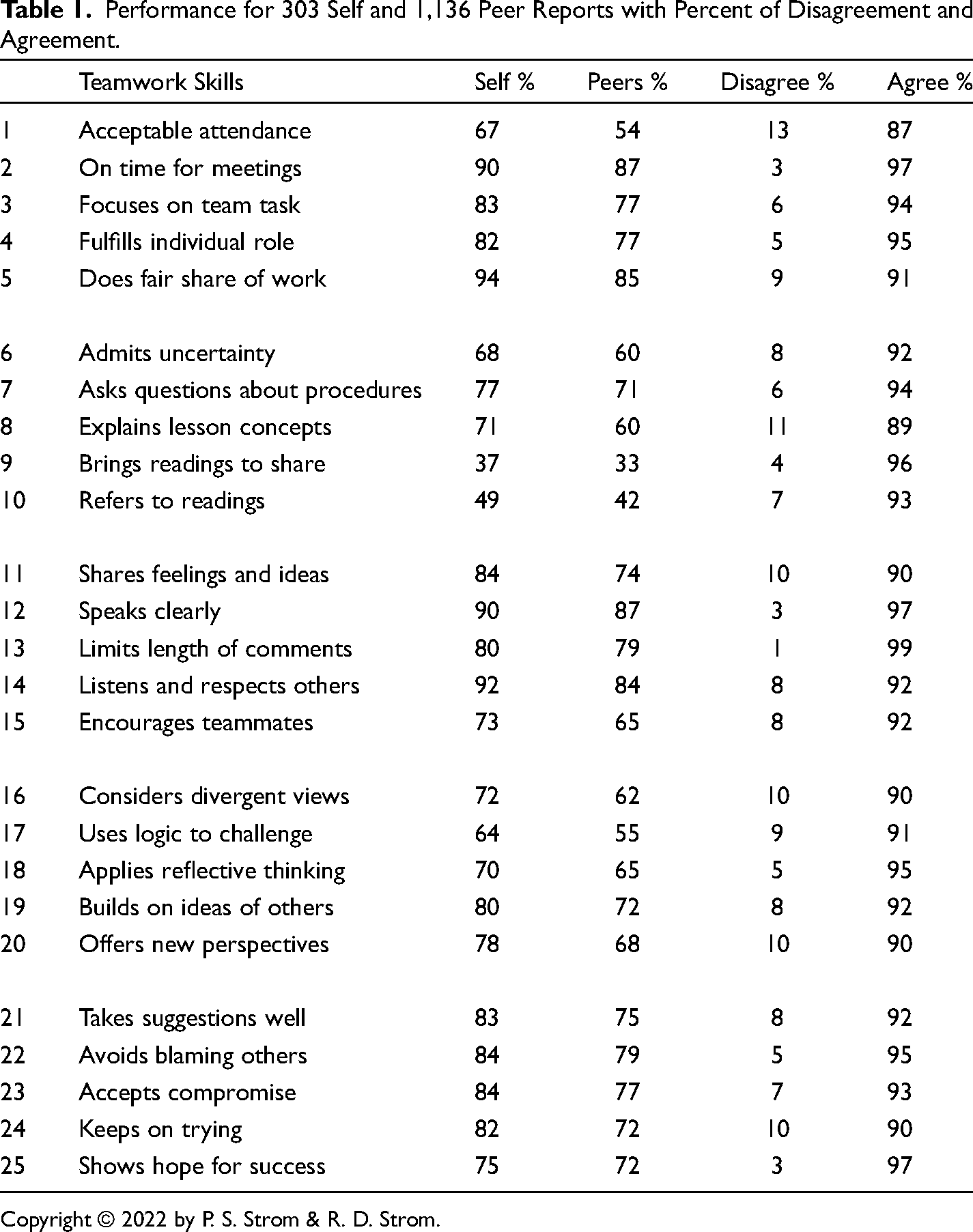
As shown in Table 1, the levels of agreement for 25 items on teamwork performance between 303 self and 1,136 peer ratings were high, ranging from 87% to 99%; the levels of disagreement ranged from 1% to 13%. For 23 of 25 skills, an agreement between self-ratings and peer ratings was at least 90%. These data were corroborated by 90% of teachers and 86% of students who reported being comfortable with the overall truthfulness of student evaluations on teamwork. These results indicate that, when administering the TSI, students should be trusted to provide honest perceptions about self and peer teamwork skills.
Performance for 303 Self and 1,136 Peer Reports with Percent of Disagreement and Agreement.
Copyright © 2022 by P. S. Strom & R. D. Strom.
Results can be used by teachers to detect skills where high levels of self and peer ratings identified favorable and unfavorable performance. Table 1 reveals high-level agreement (96%) for item 9. Students agreed that only one-third of the class demonstrated favorable performance for “brings readings to share” (self 37%, peer 33%). This undesirable performance makes known the need for further class discussion. Another example, Item 14, shows high agreement (92%) regarding favorable performance. In this case, most students performed well for “listens to and respects others” (self 92%, peer 84%). This evidence of teamwork was commended as an achievement.
Exploratory Factor Analysis
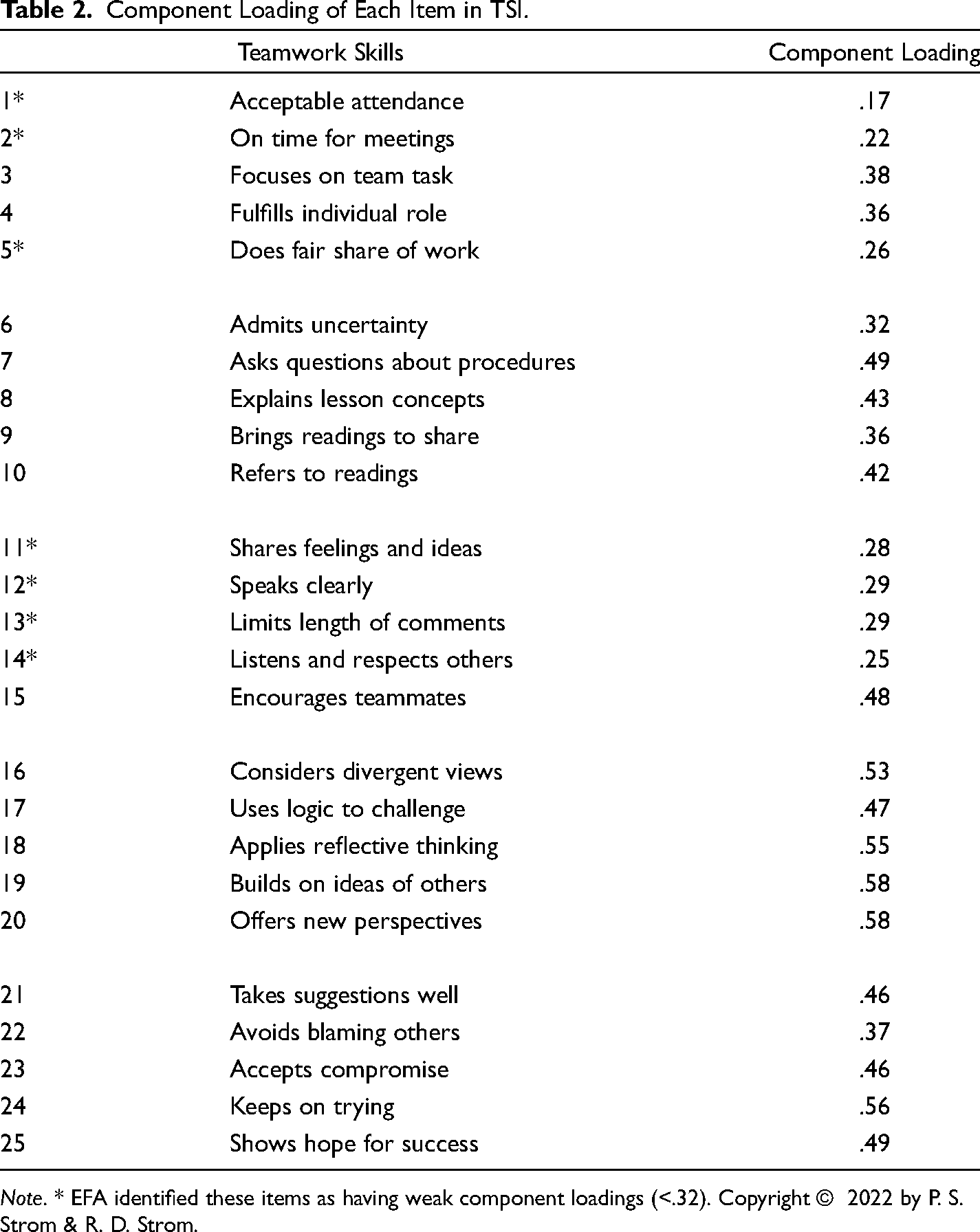
Since items in the TSI were categorical variables, an exploratory factor analysis (EFA) using principal component analysis of categorical data strategy was conducted (Gorsuch, 1983). The EFA result indicated a one-factor solution with an eigenvalue equaled to 4.36 and accounting for 17.46% of the total variance. Seven of 25 items were identified as having weak component loadings (<.32). These seven items were: (Item 1) acceptable attendance, (Item 2) on time for meetings, (Item 5) does a fair share of work, (Item 11) shares feelings and ideas, (Item 12) speaks clearly, (Item 13) limits length of comments, and (Item 14) listens and respects others. All other items had fair to good component loadings (.32 to .58). As a result, it was suggested that the validated TSI contains 18 items. Table 2 presents the component loading for each item.
Component Loading of Each Item in TSI.
Note. * EFA identified these items as having weak component loadings (<.32). Copyright © 2022 by P. S. Strom & R. D. Strom.
Instrument Reliability
The internal consistency of the instrument was evaluated by an analysis of Team Scoring Forms. Cronbach's alpha coefficient provided a floor estimate for the reliability of self and peer scores on the overall instrument. The total alpha for 303 self-reports was .79. Corresponding alpha for 1,136 collective peer observations was .87. Overall alphas for combined 303 self-reports and 1,136 peer responses (N = 1,439) was .86. These estimates are in the high range for group analyses (Bandalos, 2018). In addition, to assess text readability, a Flesch-Kincaid Reading Grade Level formula was applied; the reading level is grade 6.85.
Qualitative Responses by Participants
When the field test was completed, the principal, teachers, and students were asked to provide reactions to the TSI. An anonymous questionnaire included 25 multiple-choice items and the option to write other responses. The inquiry focused on the adequacy of instruction on authentic reporting, ease of understanding teamwork skills, and clarity of directions for completing the instrument. Feelings about the confidentiality of reporting, benefits of receiving anonymous peer feedback, and the worthwhileness of individual profiles were considered. Student impressions were shared about the need for parent involvement, truthfulness of student responses, and appeal of the TSI for peer and self-evaluation. The overall responses by students, faculty, and principal were highly favorable.
Key results indicated that teachers should rely on students in cooperative learning as essential sources of observation for evaluating teamwork skills. The individual profile that portrays student achievement in specific teamwork skills as perceived by peers and self was found to be an efficient procedure to inform students and parents about progress and deficiencies.
The development of a new interpretation tool, the Teacher Analytics Profile, informs teachers about group dynamics by learning how individuals rated themselves (self), and how each student rated each of their teammates (peers). The analytics profile for formative and summative evaluation also identifies students who inflate ratings and need remedial instruction. The research questions presented in the literature review were all answered positively, thereby contributing new knowledge that can improve conditions of cooperative learning.
Discussion
Student Profiles of Performance
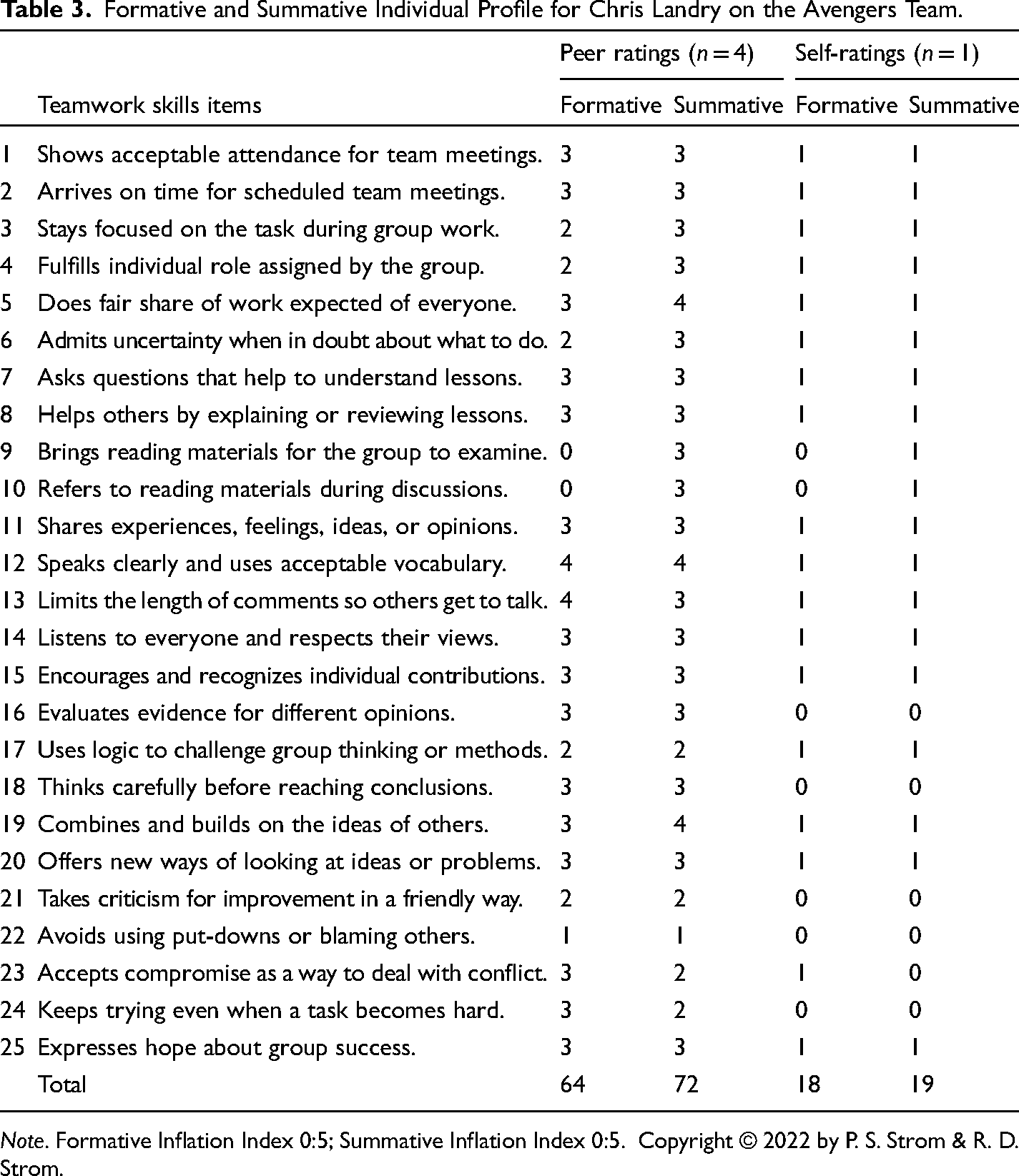
The recordkeeping format used by teachers to provide students with anonymous feedback about their teamwork skills is the Individual Profile. Table 3 presents a hypothetical individual profile for Chris Landry in Mr. Jensen's 10th-grade English class and a member of the Avengers cooperative learning team. The number of peers (n = 4) who have consistently observed Chris demonstrating each of the 25 TSI items appears in the Peers Formative and Summative columns (no names of peers are given to the student). Chris's Self Formative and Summative columns with a one (1) or zero (0) show how she credited herself for each of the skills. By using the Individual Profile, Chris can identify her teamwork skills
Formative and Summative Individual Profile for Chris Landry on the Avengers Team.
Note. Formative Inflation Index 0:5; Summative Inflation Index 0:5. Copyright © 2022 by P. S. Strom & R. D. Strom.
Inflation Index Detection
Fair evaluation is essential for anonymous feedback to support personal improvement. In contrast, if a student assigns higher ratings to a teammate because s/he is a friend, that individual is denied the benefit of an objective external observation since the performance rating is inflated. When students complete the online version of TSI, a pop-up on the screen appears if they have evaluated any team member (including themselves) as demonstrating 20 or more team skills. The pop-up tells them “This is a very high rating; are you sure you want this rating?” To identify inflated ratings and gauge the extent of this behavior, each individual profile has an Inflation Index. Specifically, teachers can identify the students who give inflated ratings to one, two, or more teammates and find out if an inflation pattern exists in other classes of the student.
Chris Landry's Inflation Index on her formative and summative evaluations are displayed on the bottom left of her profile in Table 3; both Indexes were 0:5. This means Chris did not rate any of the five team members as demonstrating 20 or more teamwork skills on formative or summative evaluation. The Inflation Index functions as an intervention tool to identify students who perform poorly in providing authentic assessment to peers. The Inflation Index also offers evidence about progress as a student moves from inflation to a more realistic appraisal everyone can benefit from.
Teacher Guidance for Goal Setting
Students meet individually with their teacher to confidentially review their formative profile and discuss strengths and limitations. This guidance helps process perceptions of peers and interpret formative results in a nondefensive manner. Students can choose items they want to improve between formative and summative evaluation. Setting goals based upon peer feedback helps to think critically about shortcomings and motivates efforts for improvement. As an example, Chris selected items 9 and 10 as improvement goals; Table 3 shows her progress in getting higher summative peer and self-ratings. Profiles also help teachers know individual deficits. Individual Profiles can be kept electronically in school records to track achievement, identify skills for further learning, and inform prospective employers about student achievement.
Teacher Analytics Profile
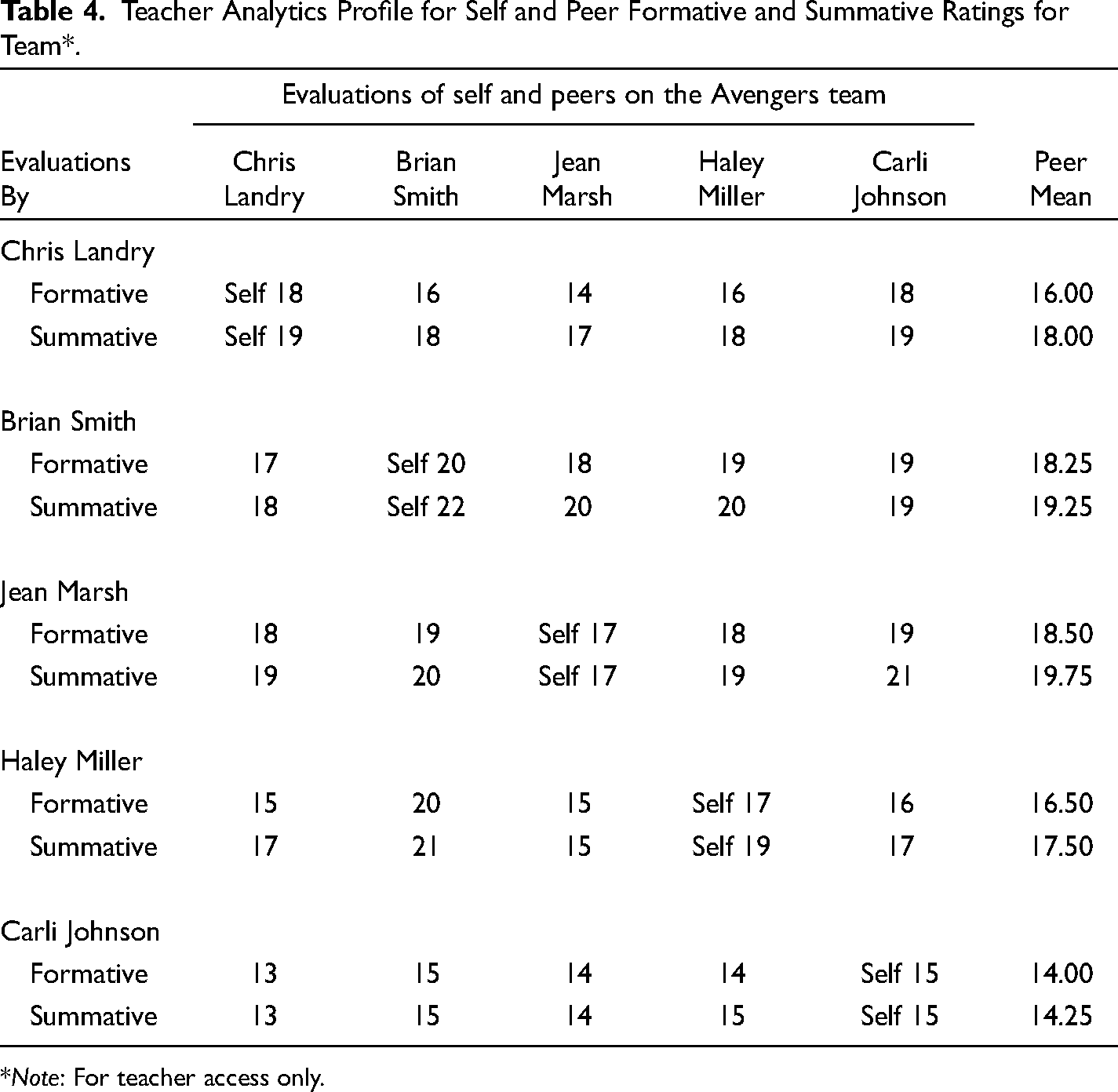
Table 4 presents an example of the Teacher Analytics Profile. This confidential document is accessible by the teacher only, showing student names with their self and peer scores for a specific team. This profile of group dynamics provides a review of the total items out of 25 each team member reported for every peer and self on the formative and summative evaluations. Peer mean scores for ratings on formative and summative evaluation ranged from 14 to 19.75; self-ratings ranged from 15 to 22. The Teacher Analytics Profile is used to determine how each student (a) is evaluated by every teammate, (b) evaluated each teammate, and (c) evaluated themselves. Teacher evaluation about the quality of submitted team assignments can be compared to overall team ratings of performance presented in the Teacher Analytics Profile.
Teacher Analytics Profile for Self and Peer Formative and Summative Ratings for Team*.
*Note: For teacher access only.
Guidance from Parents
Some school lessons relate to concepts that are unfamiliar to parents so they are unable to supplement the instruction provided by teachers. However, in the social context, mothers and fathers usually have expertise (Levine, 2020). Ritter et al. (2018) observed most parents have a job and recognize the importance of teamwork for them to succeed at work and the family. Accordingly, parents should be encouraged to accept a guidance role to help students prepare for employment. An effective way to support this possibility is to have students share their individual profile with parents and discuss peer and self-impressions of teamwork skills and learning needs. Students are more inclined to consider parent advice if the topic involves behavioral expectations that could improve their chances for success at work. Parents can better support social competencies when the school orients them to the TSI purposes and procedures. Harrison et al. (2017) urged teachers and parents to help adolescents fairly examine differences between peer observations and self-impressions to promote mental health and productivity.
Complexity of Working in Teams
Johnson & Johnson (2017, 2018), long-time leaders in cooperative learning, assert that how students interact with peers in teams continues to be a neglected aspect of instruction. Teacher training emphasizes planning how to engage teams, but the ways students should interact with one another are relatively ignored. How teachers structure collaboration influences learning, self-esteem, and views of school, classmates, teachers, counselors, and administrators.
Cooperative learning has been studied to determine how social relationships influence student behavior and achievement. Johnson et al. (2014) compared the relative effectiveness of teachers using cooperative, competitive, and individualistic goal structures. In combination, the 685 studies involved 52,000 participants in 26 countries. A meta-analysis showed that students in classes with cooperative learning goals emphasizing social interdependence earned higher scores in problem-solving, reasoning, and critical thinking than peers in classes emphasizing competitive or individualistic goals.
Difficulties in getting along with teammates should not be underestimated. Narcissism is a factor. The Narcissism Personality Inventory was first introduced by Raskin and Terry (1988). Since then Twenge (2018) found that narcissism scores of 16,000 college students have risen dramatically. Narcissism is defined as excessive self-admiration and inflated self-impression. Two-thirds of college students agreed their generation is more self-centered, more fragile, and more narcissistic than predecessors.
Receiving anonymous feedback from peers on individual profiles and learning to process criticism are valuable lessons. Twenge (2018) contended that a hyper-individualistic orientation is the result of a non-stop promotion of self-esteem independent of behavior or achievement level, constantly telling children they are special, protecting them from acknowledging failures, and thereby preventing resilience that is needed to recover when things go wrong. Students who believe they always perform well are unlikely to accept and benefit from peer criticism. For this reason, defensiveness is a common barrier to collaboration and requires instructional attention (Forsell et al., 2020).
There was evidence that student input to teamwork evaluation produces greater accuracy than when teachers are the only source of judgment on individual and group performance. The Individual Profile comparing peer and self-evaluation enabled students to become aware of how their personal contribution to group problem solving was perceived by teammates. The Teacher Analytics Profile identifies how every student rated themselves, how all team members rated each of their peers and individuals who inflated ratings.
Limitations of the Study
The student participants were not chosen at random. One high school was targeted where cooperative learning was applied by the faculty to explore a new evaluation method.
Conclusion and Future Prospects
Employers want schools to orient students to the importance of interdependence as well as independence. This paradigm for evaluation can bring success when teachers use suitable measurement tools, students get anonymous peer feedback, and records of teamwork skills are maintained at school. The unique contributions students and teachers can make to teamwork evaluation should be more widely understood. Peers are the most reliable sources of observation of teamwork skills by teammates; teachers are the best judges of products submitted by teams.
Individual profile results are often the first formal feedback students get from peers that include constructive criticism as well as recognition for achievement. Being able to reflect on observations of others regarding self-limitations and strengths during adolescence are benefits of the TSI. Critical self-evaluation helps students recognize when to view themselves favorably and when to change their behavior based on the conditions that peers identify as needing improvement. The Teacher Analytics Profile provides an interpretation of group dynamics for student teamwork skills.
Secondary teachers value cooperative learning because this method of instruction enables students to sustain practice with teamwork skills needed for college and future careers. Shifting from reporting only individual performance for each academic subject to also include the performance of teamwork skills requires innovative assessment for student accountability. Examining peer and self-impression of teamwork enables adolescents to realize each of us is not only the individual we suppose ourselves to be but also the person seen by others. Learning to unite these separate views is a key to enabling greater school achievement.
Footnotes
Declaration of Conflicting Interests
The author(s) declared no potential conflicts of interest with respect to the research, authorship, and/or publication of this article.
Funding
The author(s) received no financial support for the research, authorship, and/or publication of this article.
