




Abstract
Corporate sustainability actors often work in office-based settings, spatially and symbolically removed from the ecosystems their work seeks to protect. Management scholars emphasize ecological embeddedness—long-term, place-based immersion in ecosystems—as foundational to ecological sensemaking and sustainable practice. How, then, does ecological orientation emerge without sustained immersion? Drawing on in-depth interviews with sustainability professionals, we examine retrospective accounts of formative experiences with biodiversity and nature. We introduce ecological light bulb moments (ELBMs): vivid, direct or mediated encounters with biodiversity and nature, retained for their emotional intensity, sensory vividness, and cognitive salience. The ELBMs serve as enduring interpretive anchors influential in shaping ecological commitments, even without sustained ongoing immersion in professional work. We contribute to theory by extending ecological embeddedness beyond continuous immersion to include episodic, symbolic, and affective experiences, and by theorizing—drawing on the retention component of sensemaking—how retained experiences may condition early stages of meaningful ecological sensemaking despite professionals’ spatial and symbolic distance from ecosystems.
Keywords
Introduction
My father, who is not an educated man, had gone to a council meeting and just asked them to slightly move this road on the plan to save a several 100-year-old oak tree. He did actually manage to do that, but it was surprising that the people that had drawn the plan had not thought of that, and it just made me very aware of how biodiversity is impacted all around … that sort of light bulb moment of how things are impacted on a daily basis … And I think when you have that early childhood experience, you start growing up looking for solutions and how to change that. ––(Tiimah, Nature Positive Lead)
Management scholars have long argued that ecological embeddedness—long-term, place-based immersion in ecosystems—enables commitment to ecological respect, reciprocity and caretaking (Whiteman & Cooper, 2000). Such embeddedness is understood to attune actors to subtle ecological cues over time, supporting meaningful ecological sensemaking (Whiteman & Cooper, 2011). Empirical studies have consistently reinforced this view, showing how farmers, fishers, and indigenous land stewards who live and work within particular ecosystems develop deep ecological awareness through ongoing embodied engagement with the land (Bond, 2015; Hannah et al., 2023; Kim et al., 2019; Løland & Hällgren, 2023; Tisch & Galbreath, 2018). Yet this dominant perspective sits uneasily with contemporary organizational realities. Today, most corporate sustainability actors work in office-based settings (urban, highly mediated environments that are spatially distant from the ecosystems affected by corporate activities). From an ecological embeddedness perspective, such conditions would appear to constrain the development of ecological awareness and limit meaningful engagement with biodiversity and nature. Indeed, prior work explicitly associates office-based contexts with fragmented or shallow ecological sensemaking, in which ecological issues are experienced as abstract, distant, or peripheral to organizational life (Guthey et al., 2014; Whiteman & Cooper, 2011).
At the same time, however, corporate actors frequently articulate a strong concern for social–ecological issues and describe a sustained personal commitment to advancing sustainability agendas within firms. This empirical pattern directly contradicts prevailing theoretical assumptions. While prior studies document actors with such orientation in firms (e.g., Carollo & Guerci, 2018; Girschik, 2020; Hahn et al., 2014; Williams et al., 2021; Wright & Nyberg, 2012), they offer limited insight into how ecological orientation develops when routine professional work lacks sustained ongoing material contact with ecosystems. This unresolved tension points to an undertheorized question at the intersection of ecological embeddedness and sensemaking research: how and from where does ecological orientation arise in the absence of long-term, place-based immersion? Existing theories largely assume sustained ongoing place-based ecological engagement, leaving little conceptual space to account for formative experiences that occur episodically, indirectly, or earlier in life, yet persist to shape actors’ relationship with ecological issues years later.
In this study, we address this gap by examining how corporate actors retrospectively narrate experiences they view as pivotal to their ecological orientation. We focused on sustainability actors (e.g., sustainability managers, CSR officers, and related professionals) because they are organizational actors directly responsible for interpreting and acting on ecological issues within corporate settings. Rather than analyzing sensemaking processes as they unfold in real time, we spotlight how vivid experiences are retained and recalled by actors in office-based contexts. This lens directs attention to a foundational, preprocess layer of ecological sensemaking—one that shapes identity, plausibility judgments, and attentiveness, and thus may theoretically inform interpretation and action on ecological matters.
Drawing on 48 interviews with 44 sustainability professionals in office-based roles, we identify a recurring class of experiences that participants describe as transformative. We theorize these as ecological light bulb moments (ELBMs): emotionally intense, sensorially rich, and cognitively striking encounters with biodiversity and nature (direct or mediated), which actors retrospectively frame as defining turning points. Participants repeatedly invoked these moments to explain why ecological issues matter personally and why they feel compelled to champion sustainability.
In our theorization of ELBMs, we make two contributions. First, we extend research on ecological embeddedness by showing that episodic, brief, or momentary affective encounters with biodiversity and nature can serve as formative ecological experiences, that shape ecological orientation even in the absence of sustained ongoing place-based immersion. Second, we enrich sensemaking scholarship by highlighting the role of retained experiences as interpretive foundations that precede and may condition later sensemaking in organizational contexts—without claiming to analyze sensemaking processes directly. Together, these insights deliver a more nuanced, precise account of how ecological orientation can thrive in office-based or ecologically disembedded corporate settings.
Theoretical Background
Our theorization of ELBMs rests on two interconnected foundations. First, ecological embeddedness, positioned as the primary pathway to meaningful ecological sensemaking and commitment to sustainable practices. Second, ecological sensemaking, which examines how managers interpret and act upon ecological cues, provides a framework for understanding how retained experiences may condition interpretive processes.
Ecological Embeddedness and the Limits of Place-Based Assumptions
Research on ecological embeddedness has been foundational in explaining how individuals and organizations come to recognize, value, and respond to ecological issues. At its core, ecological embeddedness relies on long-term, place-based immersion in specific ecosystems through work and daily life, enabling actors to develop ecological respect, reciprocity, and caretaking orientations (Guthey et al., 2014; Whiteman & Cooper, 2000; Yu, 2024). Repeated embodied engagement with land, water, and nonhuman species helps individuals notice ecological cues, interpret environmental change, and act in ways that support ecosystem integrity (Kim et al., 2019; Whiteman & Cooper, 2011; Yu, 2024). Empirical studies consistently show that farmers, fishers, forestry workers, and indigenous land stewards develop ecological knowledge and responsibility through long-term sustained physical presence in particular places (Bond, 2015; Hannah et al., 2023; Kim et al., 2019; Løland & Hällgren, 2023; Tisch & Galbreath, 2018; Yu, 2024). In these accounts, ecological understanding is inseparable from lived experience: knowing the ecosystem means being embedded within it. As a result, ecological embeddedness has become the central explanatory condition for ecological awareness and meaningful engagement with biodiversity and nature.
However, this emphasis on ongoing place-based immersion also produces an important theoretical limitation. Ecological embeddedness research implicitly assumes that ecological orientation must be forged through continuous, embodied ecological engagement in the present. Actors who are spatially and symbolically removed from ecosystems, such as many corporate sustainability professionals in office-based settings, are therefore theorized as disadvantaged in developing ecological understanding (Fazey et al., 2005; Folke et al., 2007; Guthey et al., 2014; Whiteman & Cooper, 2000). Office-based work, characterized by abstraction, mediation, and material distance, constrains embodied learning and attentiveness to ecological cues (Guthey et al., 2014; Whiteman & Cooper, 2011).
While some office-based actors engage sporadically through field visits, audits, monitoring programs, or interactions with local stakeholders, such contact remains episodic rather than routine. These office-based professionals or managers often hold decision-making authority over corporate ecological outcomes, raising a critical question: how do they develop ecological orientation in the absence of sustained ongoing place-based engagement? In this study, we examine retained formative experiences as potential resources for such orientation.
Ecological Sensemaking and Retention as an Interpretive Foundation
Ecological sensemaking research has sought to explain how actors notice, interpret, and act upon ecological cues (Whiteman & Cooper, 2011). Drawing on broader sensemaking theory (Jennings & Greenwood, 2003; Weick et al., 2005), it highlights processes that render environmental issues salient, plausible, and actionable within organization (see Hahn et al., 2014; Williams et al., 2021). However, much of this work implicitly assumes readily available interpretive resources, often treating ecological embeddedness as a background condition that supplies these resources rather than as a focal object of inquiry. This assumption is not trivial, as Whiteman and Cooper (2011) note, “members of cultures that miss important signals that arise from the local ecology are more vulnerable to surprise; in the past, such cultures have experienced greater hardship and resource stress” (p. 890).
Sensemaking theory identifies retention as the accumulation of experiences, identities, and understandings that shape present interpretation (Cristofaro, 2022; Weick, 1988; Weick et al., 2005). Rooted in Darwinian Variation-Selection-Retention (VSR) principles (refer Weick et al., 2005), retention acts as a provisional stabilizing process in the ongoing sensemaking cycle. Following variation (enactment of cues) and selection (plausibility testing of interpretations), retention preserves selected plausible interpretations as organizational memory, causal maps, identity anchors, or shared meanings. This stabilization reduces future equivocality by providing reference points that condition subsequent noticing (enactment) and plausibility judgments (selection), while anchoring actor identity and enabling consistent action amid ongoing flux (Cristofaro, 2022; Weick et al., 2005).
Empirical applications have explored retention's role in preserving interpretations in executive sensemaking to mitigate ambiguity in decision-making (Parry, 2003), shaping adaptation in organizational learning (Colville et al., 2016), solidifying interpretive frameworks in strategic change (Weiser, 2021); and sustaining organizational cohesion via retained shared meanings (Helms Mills et al., 2010).
Retained experiences thus influence what is noticed, what is considered plausible, and how actors define themselves in relation to events. A powerful illustration of retention's transformative potential in ecological sensemaking appears in Whiteman and Cooper's (2011) seminal autoethnographic study. During fieldwork with Cree indigenous hunters in the Canadian subarctic, the first author, Whiteman, experienced a near-death incident when her snowmobile broke through thin ice on a frozen river, plunging her into freezing water and triggering severe hypothermia. She was rescued by Freddy Jolly, a Cree tallyman (traditional land steward), whose calm and precise actions—intuitively reading subtle cues in the ice, river currents, wind patterns, and seasonal indicators—demonstrated deep ecological embeddedness grounded in lifelong immersion, cultural knowledge, and reciprocal respect for the land, Jolly's sensemaking was inseparable from his identity and daily practices, enabling him to anticipate and navigate ecological hazards effectively.
This traumatic episode served as a formative “light bulb moment” for Whiteman, exposing the fragmentation in her own Western-trained sensemaking, which relied on abstract representations and scientific tools rather than direct embodied engagement. The contrast with Jolly's embedded sensemaking highlighted how disembedded actors may fail to notice critical ecological signals and thus remain vulnerable to ecological surprise. Importantly, this experience was retained long after Whiteman returned to academic settings lacking ongoing ecological embeddedness. It persisted as a vivid interpretive anchor that reshaped her identity, conditioned her subsequent noticing of ecological cues, and informed her theorization of ecological sensemaking itself. This case exemplifies how a singular, intense episode can populate the retention layer, sustaining an ecological orientation and enabling plausible ecological interpretations even in the absence of ongoing immersion (cf. Weick et al., 2005).
In ecological sensemaking research, however, retention remains underexamined, especially in contexts where embodied ecological engagement is limited. While retention features in broader applications of the sensemaking cycle, dedicated studies foregrounding it as a distinct phase are scarce. Systematic literature reviews confirm the VSR framework, particularly retention's stabilizing role, has received limited empirical scrutiny or conceptual updating (Cristofaro, 2022). This gap is especially acute for office-based sustainability professionals: if sustained ecological immersion is absent, what experiences populate the retention layer that informs ecological interpretation? How do actors come to see ecological issues as meaningful, morally salient, or personally relevant in the first place? Existing research provides few answers, often presupposing an ecological orientation that precedes ecological sensemaking without specifying how such orientations are formed and sustained.
Formative Ecological Experience Beyond Continuous Immersion
A growing body of research suggests ecological orientation may also arise from episodic or affective encounters with biodiversity and nature. Environmental identity studies show emotionally salient experiences with nonhuman species, often earlier in life, can integrate into an individual's sense of self and influence how environmental issues are interpreted over time (Clayton & Opotow, 2003; Hagen & Gould, 2022). These experiences may persist as enduring reference points that inform ecological concern and attentiveness even in urban or organizational contexts.
Research on significant life experiences demonstrates momentary or brief interactions with biodiversity and nature (e.g., wildlife encounters, moments of perceived ecological loss, meaningful outdoor experiences) produce long-lasting effects on environmental values and commitments (Chawla, 1998, 1999). Emotional intensity and perceived significance enable retention and revisitation across time. Kennedy et al. (2009), for example, show that childhood or early year’s experiences with nature play a significant role in shaping environmental concern later in life, including among individuals who no longer live in rural or nature–proximate environments. These findings challenge the necessity for sustained ongoing embodied engagement, highlighting retained formative experiences as a potential foundation for ecological sensemaking.
Despite these insights, such experiences remain theoretically marginal in organizational research, often reduced to biographical background. Dominant theories of ecological embeddedness and sensemaking provide limited conceptual tools for understanding how such experiences are retained, narrated, and connected to sensemaking in office-based or disembedded contexts.
This article foreground how corporate sustainability actors retrospectively describe formative experiences with biodiversity and nature, bringing these neglected elements into analytical focus. Rather than displacing ecological embeddedness, we extend theory by showing how ecological orientation can emerge from retained, episodic, momentrary or brief experiences that persist across time. These retained formative experiences may serve as interpretive foundations that theoretically condition subsequent noticing, plausibility judgments, and action on ecological issues in office-based settings, as suggested by retention's stabilizing role in the sensemaking cycle.
Methods
This qualitative study examined sustainability professionals in highly developed, Western corporations and UK-based firms situated in urbanized environments. These organizations span sectors including retail, finance, consumer goods, and energy with global supply chains and significant environmental footprints, yet core business activities concentrated in office and corporate hubs. Such settings feature marked spatial, organizational, and symbolic distance from impacted ecosystems and communities embedded in those ecosystems, distinguishing them from the ecologically embedded contexts examined in prior work (e.g., Bond, 2015; Good, 2020; Hannah et al., 2023; Järvelä, 2023; Kim et al., 2019; Løland & Hällgren, 2023; Whiteman & Cooper, 2000; Yu, 2024).
To conceptualize this distinctiveness, we draw on and adapt spatial and symbolic perspectives from organizational research (Boxenbaum et al., 2018; Höllerer et al., 2017, 2018; Quattrone et al., 2021). These works highlight how physical layouts, visual representations, multimodal communications, and institutional processes create separations between actors and phenomena, often abstracting or mediating direct engagement. We dimensionalize distance along with three interrelated dimensions: (1) spatial distance refers to the physical separation between participants’ everyday work environments (urban offices) and sites of ecological impact (e.g., remote ecosystems or supply chain locations); (2) organizational distance captures the separation between sustainability roles (often strategic or advisory) and operational activities that directly interact with ecosystems (e.g., production, extraction, or field-based functions); and (3) symbolic distance refers to the mediated and abstracted ways in which ecological issues are encountered in corporate settings, often through reports, metrics, dashboards, indicators, or visual representations rather than direct sensory or embodied experience.
We purposively selected mostly office-based sustainability actors (e.g., sustainability managers, CSR officers, and related professionals), along with four outliers serving as sustainability champions, as our unit of analysis. This group represents a theoretically revelatory case for investigating experiential foundations of ecological orientation when sustained, place-based ecological immersion in day-to-day work is largely absent. By focusing on these actors in highly abstracted corporate environments, we could foreground retained formative experiences as potential interpretive resources—a phenomenon underexplored in prior ecological embeddedness research.
Research Design and Approach
We adopted an inductive approach informed by reflexive thematic analysis (Braun & Clarke, 2006, 2021). The research sequence began with desk-observation of sustainability work in abstracted corporate contexts, where routine direct ecological engagement is minimal. This empirical phenomenon prompted initial curiosity about the source of ecological orientation and led to the iterative formulation and refinement of the research question through ongoing engagement with the data. Inductive research is particularly valuable for exploring this understudied area because it enables scholars to challenge prevailing assumptions and uncover patterns that may not be visible through deductive reasoning (see, Baudoin & Arenas, 2023).
Rather than testing predetermined hypotheses, we pursued an open-ended exploration of how office-based actors describe past experiences with biodiversity and nature that they regard as formative for their ecological orientation. This approach allowed us to iteratively move between the data and emerging insights, through constant comparison of interviews, reflexive memoing, and team discussions to develop, challenge, and refine themes. In line with Bansal and Corley (2011), our method prioritizes the richness and complexity of context-relevant insights that might otherwise be overlooked in more structured research designs.
Data Sources, Access, and Sample
Participants met two criteria: (1) senior-level roles in sustainability, biodiversity or environmental management; and (2) current or prior employment with Western or UK-based corporations in highly developed contexts. We focused on sustainability actors because they are organizational actors directly responsible for interpreting and acting on ecological issues within corporate settings. This made them particularly relevant for exploring the experiential foundation in presumed low ecological immersion environments. Whiteman and Cooper (2000) describe their urban workplace as “buildings” with its members lacking the sophistication, acuity and attitude about resource decision in comparison to local conservation officers, forestry managers, or indigenous land managers (Guthey et al., 2014).
We acknowledge sustainability actors may be predisposed to interpret biodiversity and nature experiences as meaningful and frame them as turning points. This predisposition does not undermine our inquiry. Our inductive, purposive design focused on theoretical exploration rather than statistical generalization or prevalence claims across populations. Our aim is not to determine who is most likely to have visceral experiences (i.e., deeply embodied, sensory, and emotionally intense encounters that register at gut level), but to examine how such moments—when present—are retained and associated with ecological orientation in office-based setting. Selecting majorly actors already engaged in sustainability roles provided rich, reflective narratives particularly valuable for theorizing preprocess interpretive foundations.
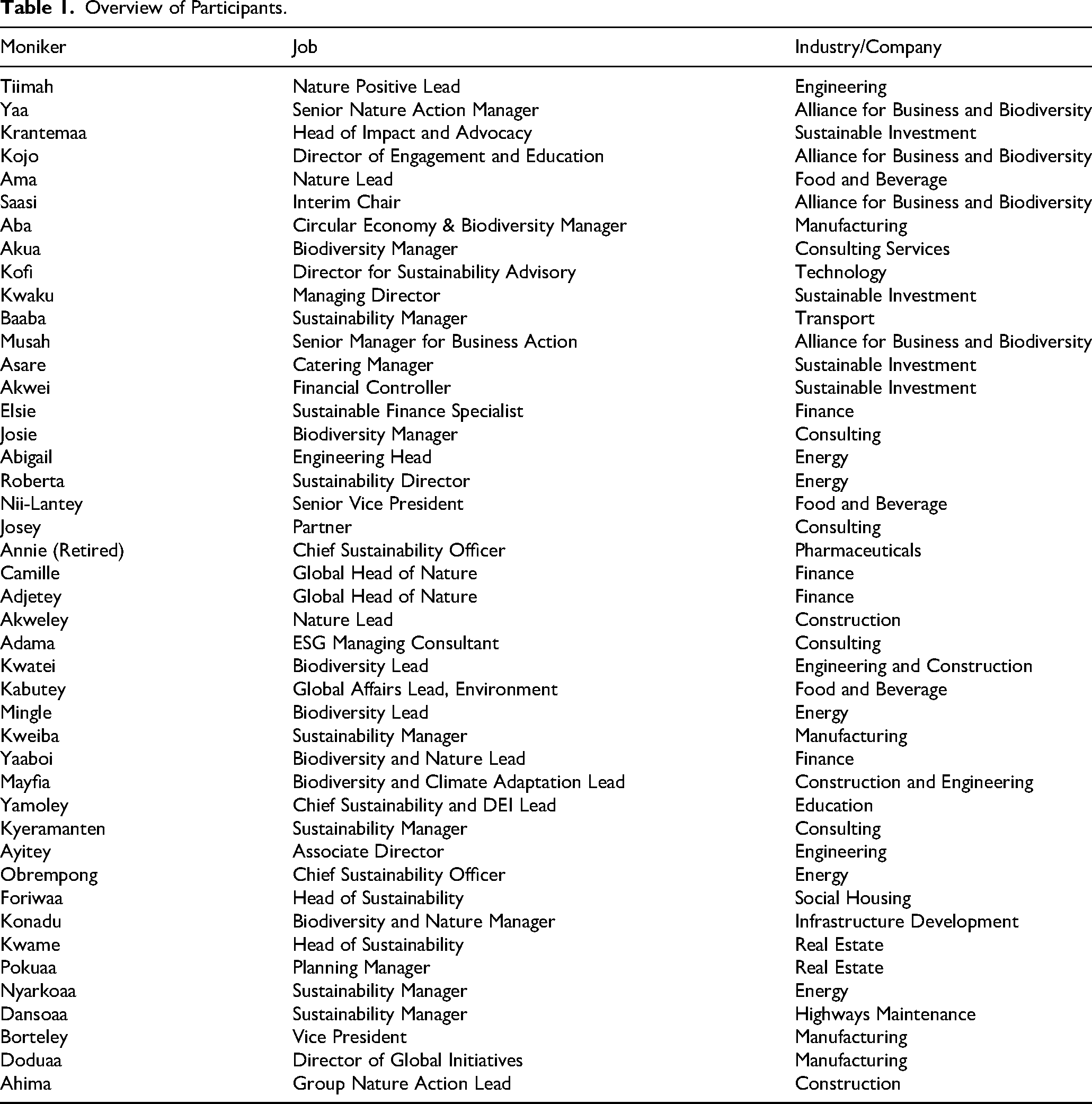
Sampling combined purposive and snowball techniques (Bernard, 2017). Initial contacts came from a global business-biodiversity coalition, expanding through professional networks and targeted outreach. The final sample included professionals from a wide range of sectors, including manufacturing, food and beverage, energy, construction, technology, finance, consulting, and noncorporate organizations engaged in business-biodiversity alliances. Actors from noncorporate organizations were selected due to their prior experience working in corporate environments. This category forms approximately 12% of our overall sample. This variation was important to reflect the heterogenous contexts in which companies engage with biodiversity and nature. It also allowed us to capture a broad spectrum of experiences with biodiversity and nature across different organizational settings. Table 1 provides an overview of the participants included in the study.
Overview of Participants.
Data collection proceeded until we reached analytic sufficiency (rather than seeking classical saturation). This was done by ceasing data collection when additional data no longer refined our interpretive understanding of the core construct. This assessment was conducted iteratively alongside data engagement, and reflexive memo-writing, ensuring that the sample was adequate to support robust theorizing.
Interview Protocol
The interviews were semistructured (Bluhm et al., 2011; Graebner et al., 2012) and were largely held via Zoom to provide scheduling flexibility and geographic reach; three interviews were held in person. A total of 48 interviews were conducted with 44 participants, including four participants who were interviewed twice to clarify or complete information that was unclear or incomplete in their initial interviews. These follow-up interviews were conducted during the early stages of data collection to ensure accurate accounts and factual coherence. Because we analyzed and coded interviews as data collection progressed, we were able to identify these ambiguities early and address them promptly. Only four follow-ups were needed, as these additional conversations resolved the ambiguities identified. These follow-ups were not intended to test theoretical saturation but to strengthen the completeness and accuracy of the primary data. After these clarifications, no further confusions appeared. This process also refined our line of questioning, enabling us to avoid similar gaps in subsequent interviews.
Each interview lasted between 30 and 45 minutes and was audio and video recorded with participants’ consent. Transcripts were sent to participants for validation and factual accuracy. Among those who responded, one participant corrected a minor factual error related to a named company, and another requested review of specific quotes intended for use in vignettes; both were satisfied with the final versions. Over half of the participants declined to review the transcript but provided full consent for data usage. Four additional participants consented but opted out of further engagement.
Interviews followed an open-ended protocol designed to elicit participants’ personal and professional experiences with biodiversity and nature, as well as their sustainability journey. Key questions included:
Briefly introduce yourself, where you work, your job role and what you do in your role? Can you walk me through your journey into sustainability? What brought you into this profession? Can you describe a personal experience or interaction with biodiversity and nature that is particularly important for you?
This structure allowed participants to reflect on their biographical journeys and critical moments, which we used as retrospective data to explore how personal biodiversity and nature experiences may relate to ecological orientation (Pettigrew, 1990).
Data Analysis
We employed reflexive thematic analysis (Braun & Clarke, 2006, 2021) to identify recurring patterns in retrospective narratives of formative experiences. Consistent with our interpretivist epistemology, we treated meaning as coconstructed and contextually situated. Accordingly, we did not approach biodiversity and nature experiences as self-evident events but as moments that gained salience through participants’ reflection and narrative articulation.
Given our focus on emic, retrospective accounts rather than real-time organizational processes or objective events, we relied on in-depth semi-structured interviews as the primary (and sufficient) data source. To enhance trustworthiness and mitigate potential biases associated with retrospective accounts (e.g., recall inaccuracies, social desirability), we engaged in ongoing reflexivity through analytic memos, iterative close readings of transcripts, and theoretical triangulation with sensemaking and embeddedness literature (Braun & Clarke, 2006, 2021; Miles & Huberman, 1994). This approach prioritizes interpretive depth over multimethod triangulation, aligning with inductive traditions that value rich, grounded accounts for theory-building in underexplored phenomena (Bansal & Corley, 2011; Shah & Corley, 2006).
Data collection and analysis proceeded iteratively, with ongoing cycling between interview data, emerging insights, and relevant literature (Miles & Huberman, 1994). We used NVivo 14 to support data organization and retrieval throughout the analytic process. Our analysis began with close readings of each transcript, followed by a combination of in vivo coding and descriptive coding. In vivo coding anchored the analysis in participants’ own language, while descriptive coding enabled us to track recurring experiences and narrative patterns across participants (Saldana, 2009). Throughout this process, we wrote analytic memos to document emerging insights, note tensions and ambiguities, and support the gradual development of conceptual insights.
We adopted a two-stage analytic strategy. First, we conducted a within-participant analysis to trace how individuals linked experiences with biodiversity and nature to their ecological orientation (defined as a relatively stable, experience-shaped disposition sensitizing actors to ecological concerns, and aligning personal and professional choices accordingly). This stage focused on understanding how participants themselves narrated continuity between experiences and their ongoing sustainability commitments.
Second, we carried out a cross-participant thematic analysis to identify broader patterns in how formative experiences were narrated, remembered, and rendered meaningful. Early in this process, we observed recurring accounts of encounters with biodiversity and nature—both direct (e.g., physical immersion in natural settings) and indirect (e.g., mediated exposure through books, news, or documentaries)—that participants repeatedly described as formative or “shaping.” Through iterative rounds of open and axial coding, we noted that these accounts were often characterized by heightened emotional, sensory, or cognitive emphasis and were frequently invoked as reference points when participants reflected on their ecological orientation.
Throughout the cross-participant analysis, we remained attentive to the inherent messiness and ambiguity typical of retrospective sensemaking narratives, including nonlinear timelines, evolving interpretations, and mixed or ambivalent emotions. To surface this complexity, we drew on repeated probing during interviews (rephrasing questions and inviting elaboration) to encourage participants to reflect further, reveal inconsistencies, or refine their accounts. Rather than resolving such tensions, we documented them in analytic memos and retained them within the coding structure to preserve the interpretive richness of participants’ narratives.
As these patterns became more apparent, we inductively clustered accounts that participants consistently framed as vivid, memorable, and formative under the sensitizing concept of ELBMs. This label was used analytically to capture a recurring pattern in how participants retrospectively narrated particular encounters with biodiversity and nature as pivotal in shaping their ecological orientation. The ELBMs were treated as retrospectively constructed reference points, and not as objective events or causal mechanisms.
This analytic process remained nonlinear and recursive. We repeatedly returned to the data, revisited codes, and reexamined relationships between individual accounts and emerging themes. Contradictory recollections were retained rather than smoothed out, allowing us to capture how participants imposed retrospective coherence on equivocal experiences. This approach yielded shared attributes across ELBMs while staying grounded in narrative variability and interpretive complexity.
Findings and Data Presentation
Our analysis revealed a recurring pattern in how participants described vivid experiences with biodiversity and nature that they regarded as formative for their ecological orientation. These moments were often recalled with striking detail. Participants frequently framed them as moments of heightened clarity or realization, using language such as “defining,” “powerful,” or “something that stayed with me.” We conceptualize these experiences as ELBMs defined as vivid, direct or mediated encounters with biodiversity and nature, retained for their emotional intensity, sensory vividness, and cognitive salience, which participants retrospectively position as meaningful and enduring interpretive reference points.
The consistency with which participants narrated these moments—across diverse sustainability roles, sectors, and career paths—may appear surprisingly uniform given sensemaking's inherent messiness and ambiguity (Weick, 1995). However, this coherence aligns with the retrospective nature of sensemaking: individuals actively construct plausible, orderly accounts of past experiences to sustain a stable meaning and identity in the present, that is, ecological orientation (Weick et al., 2005). Our probing during interviews (rephrasing questions to elicit elaboration, surfacing inconsistencies, or ambivalence) revealed underlying variability (e.g., initial dismissal of experiences before retrospective salience emerged, nonlinear timelines, mixed emotions), yet participants consistently resolved these into vivid, pivotal reference points. This pattern does not reflect data smoothing but rather how participants themselves impose retrospective coherence on equivocal encounters, reinforcing ELBMs as foundational anchors rather than messy anomalies.
Across our dataset, three ELBM attributes consistently surfaced: emotional intensity, sensory vividness, and cognitive salience. These attributes were present in both direct ELBMs (firsthand, physical encounters) and indirect ELBMs (mediated encounters), though their configuration varied. This distinction does not refer to outcomes or effects but to the mode of engagement through which participants encountered biodiversity and nature, and how those encounters were remembered as salient. Direct encounters were typically characterized by proximity, immediacy, and felt emotion. Indirect encounters, by contrast, tended to carry mediated or symbolic and cognitive weight, as emotions were evoked through mediated representations and reinforced by reflective interpretation.
These attributes emerged inductively from participants’ narratives as shared features of experiences recalled as formative, rather than predefined categories. They align with theoretical accounts of retention in sensemaking, where affect, embodiment, and meaning determine what is preserved or remembered and narrated over time (Cristofaro, 2022; Weick et al., 2005).
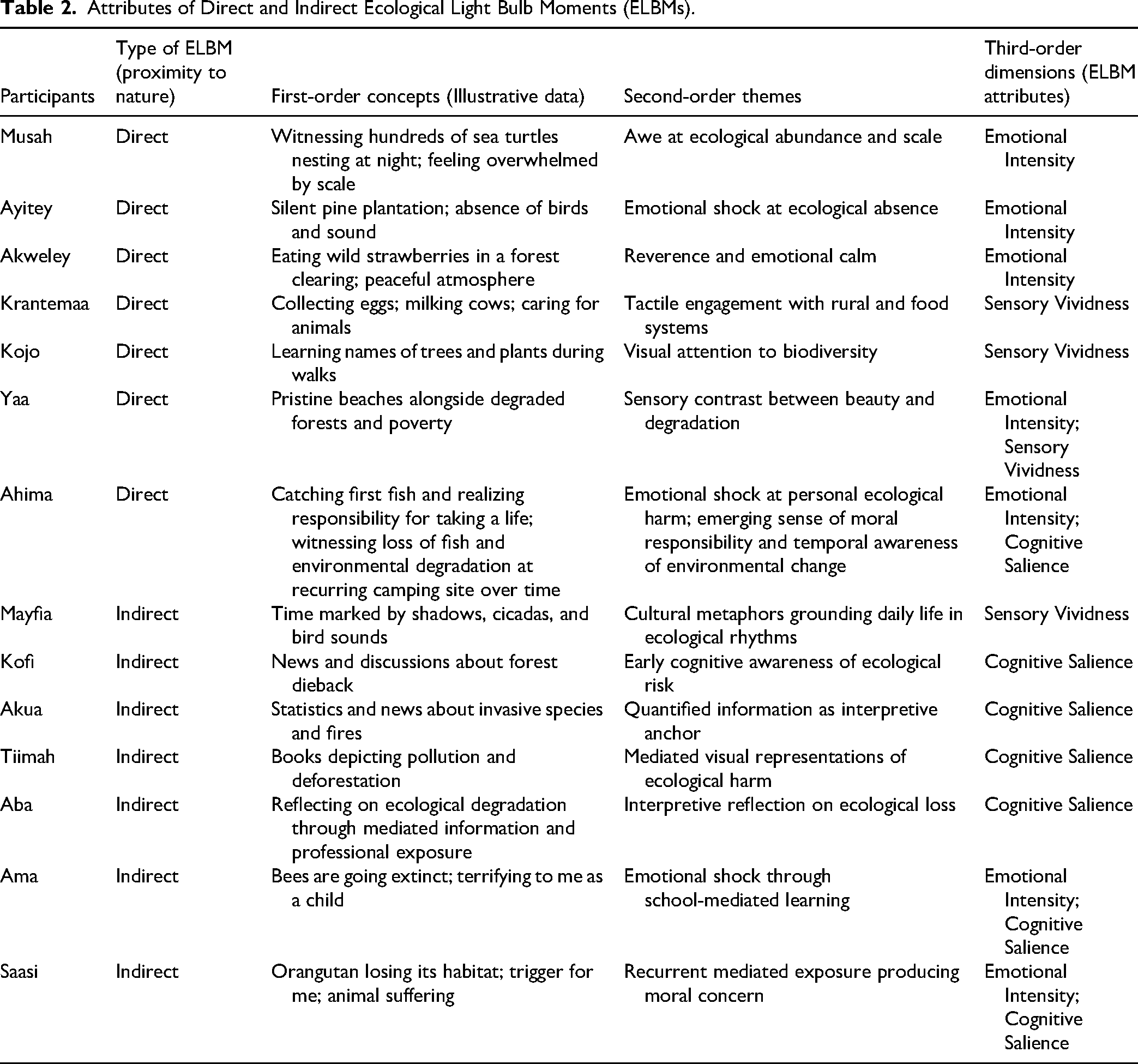
We present our findings in two stages. First, we detail the three ELBM attributes, illustrated with participants’ accounts. Second, we present how the attributes combine differently in direct and indirect ELBMs. Table 2 summarizes the manifestation of these attributes across our dataset, contrasting the two forms.
Attributes of Direct and Indirect Ecological Light Bulb Moments (ELBMs).
Emotional Intensity
A defining attribute of ELBMs is their emotional intensity. Participants consistently recalled these moments that struck them with awe, shock, fear, wonder, and moral responsibility. These emotions lingered long after the event. Further, these experiences stood out in participants’ narratives because of the visceral reactions they described at the time. Across accounts, emotional intensity marked these episodes as distinctive and memorable.
For some participants, emotional intensity emerged as awe in the face of ecological scale and life. Musah recalled witnessing thousands of sea turtles nesting on a beach at night: We were at the beach sort of a bonfire in the evening, and it was just a fascinating scene, seeing literally all the turtles and I'm talking hundreds, if not thousands, coming out and emerging from the sea around midnight to come and lay their eggs and sort of burrow it away and then go back into the ocean … it was just the scale of nature that was emerging, was so powerful; was so interesting, it was so overwhelming that I just got fascinated immediately, that was a really defining moment for understanding sort of the scale of nature and I think over time it just put things in perspective around the diversity of life and the fact that there is a whole universe that is not even visible.
Musah's account highlights how the sheer magnitude of the scene evoked an intense emotional response. His emphasis on scale, abundance, and being “overwhelmed” shows how awe functioned as a defining feature of the experience. The scene is narrated as emotionally striking and is recalled as a moment that stood out for its intensity and memorability.
Other participants described emotional intensity through grief and distress at ecological absence or visible degradation. Ayitey recalled entering a pine plantation in Scotland and later encountering pollution: I went up to Scotland, not that long ago, in an old pine forest plantation, and it was just dead. It was nothing in there. There was not a single sound, not a single bird, nothing … Coming from Singapore, where you walk into the forest, and it's loud and noisy. And that, to me was a real contrast … But I think what made me think differently about it is, when I go out and I see factories just pumping pollution into the world … when you see it actually happening, it's very different, and you realize how significant and damaging and problematic it is … And that was the point for me that made me realize that I had to get into this kind of work [sustainability work] and actually do something about it, because I thought, unless there are like-minded people who try to shape things differently and change things from the business side, probably not much is going to happen.
Ayitey's narrative foregrounds emotional disturbance generated through contrast and loss. The silence and absence of life were experienced viscerally unsettling, and the experience is narrated as a moment of realization that stood out for its emotional force.
For others, emotional intensity took the form of joy, peace, and reverence. Akweley recalled a childhood walk through a forest clearing where she ate wild strawberries: We walked a little bit into the forest, and there was a very beautiful part of a clearing with wild strawberries … They were by far the best thing I've ever eaten. They were delicious, and it was very beautiful. And it was in the habitat that was not very disturbed … and it was … very peaceful. And I remember my father saying people spend so much time talking about heaven and whether they'll get into heaven, but heaven is right here, like we're already here … that was a very cherished memory of nature and what nature gives us already, and how it's very easy to take it for granted.
In this account, emotional intensity is conveyed through appreciation, peace, and reverence. The experience is recalled as emotionally rich and is narrated as a cherished memory, emphasizing its lasting presence in Akweley's recollection.
Across participants’ accounts, emotional intensity—whether expressed as awe, distress, or reverence—functioned as a key marker of ELBMs. These emotions rendered particular experiences vivid and memorable in participants’ retrospective narratives, distinguishing them from more routine or less affectively charged encounters with biodiversity and nature.
Sensory Vividness
A second defining attribute of ELBMs is their sensory vividness. Participants often recalled the textures, sights, sounds, and rhythms of their experiences in striking detail. These sensory elements featured prominently in participants’ recollections and were repeatedly emphasized as making certain moments stand out from other encounters with nature.
For some of our participants, sensory vividness came through early encounters with rural life and food production. Krantemaa remembered a school trip to the countryside: We had a school trip … it helps city kids get out to the countryside and have a greater understanding of where eggs come from … we went and collected the eggs from the chickens and we helped look after the animals, learned to milk cows etc. That was the first time I really understood where our food came from … that was just mind blowing to me, because I've not really had much exposure to that before. So that was really beautiful and very important from a young age … what that taught me was the amount of work that goes into caring for landscapes, and yet none of us do it … It's not a given … there's a huge amount of deep knowledge whether that be scientific or inherited cultural practices that go into looking after landscapes which, like for us [city dwellers], food just arrived. We're really lucky in London where food will just appear [that] we can buy it from shops.
Krantemaa's account is anchored in tactile and embodied engagement (collecting eggs, caring for animals, milking cows). These concrete sensory details contributed to the memorability of the experience and distinguished it from abstract or secondhand understandings of food systems.
Other participants described sensory vividness through close attention to ecological detail. Kojo recalled childhood walks with his father: My dad used to take me for walks … and he used to show me all the trees and plants along the longer route, many trees actually, and tell me what their names were and how to recognize them and how to identify them. And it really stayed with me for a long time. Well, just a really nice connection with my dad on the way to school … something that started to show me the diversity of trees and plants that there were just in our back garden or in the town that we were living in understanding a little bit about the diversity of the species that are there, and actually what is in your own environment, understanding that, I suppose I came to see that as being really important … it shaped my understanding of how we interact with other living things around us … one of the things that shines through most of the time is that we just have no oversight, no idea, or very little, in any case, of how we're dependent on the complex, intricate natural processes that are happening around us all the time to create the stability with which we can operate economically.
Here, sensory vividness is conveyed through repeated exposure to visual detail and naming practices. The act of noticing and identifying plants anchors the experience in concrete sensory observation, making it a lasting point of reference in Kojo's recollection.
Sensory vividness also emerged through striking contrasts within a single setting. Yaa, reflecting on volunteer work in Madagascar, described: I did one of these paid volunteer programs in Madagascar, because at that stage, I didn't know what I wanted to do. I wanted to be an accountant after my undergraduate … they [Malagasy people] had these beautiful pristine beaches and gorgeous degraded coastal forests, but human excrement everywhere, because they didn't have any basic sanitation in the village, and everybody going around and chopping down trees for firewood … I have never, ever seen such levels of poverty in this region … And so I think for me, that was a critical experience in my life, because I can start to realize it is part of the problem, but part of the solution and by the way, this is a much more complex issue. When we look at saving nature, we have to bring people along too, so I think that's really shaped all my interactions throughout. It's like trying to find that pragmatic way forward.
Yaa's account juxtaposes sensory impressions of beauty and degradation. The sharp contrast between these elements heightens the vividness of the experience, which is recalled as difficult to forget and central within her narrative of her exposure to ecological and social conditions. Her vivid sensory experience also shines through her present-day sustainability role as she highlights how it has shaped her interactions throughout—finding pragmatic way forward.
In other cases, sensory vividness was embedded in cultural metaphors that tied everyday rhythms to ecological cues. Mayfia recalled her grandparents’ saying: So, if I would ask, what time is lunch, they would say lunch is when there's no shadow anymore. When is nap time? Nap time is when it's so hot that even the butterfly stops flying. You need to go to bed when the Cicadas stopped singing, it was all like that … but that shaped me … I think it taught me to find peace … My grandma, when I was obsessed, she used to say, go and speak to the Blackbird. The Blackbird will have the answer. Well, really, what she meant is just like, sit silently and just observe nature, really the basics of meditation and contemplation and just to find peace, inner peace. This really deep feeling … this is like a spiritual conviction that there's no way out for mankind unless we get closer to biodiversity … Very saddening that nowadays … our children … .they recognize better the notification sound of various apps, more than they will recognize bird sounds. And we know that it's linked with the well-being plummeting. So, it's just my personal conviction … what led me into doing this role … I'm bidding that into more like a strategic and translating a spiritual feeling into something more quantifiable and strategic for a company … what I like now with my job is just finding ways to convince people that wouldn't probably have the same background as me, and finding the right words that would bring them along.
These metaphors ground daily life in sensory markers drawn from the natural world. The rhythmic and sensory nature of these expressions in emphasized in Mayfia's recollection, contributing to their memorability and emotional resonance. Further, these experiences grounded her spiritual connection which in her today's role, translates it into something quantifiable and strategic for her company.
Across accounts, sensory vividness, whether tactile, visual, auditory, or metaphorical, anchored ELBMs as distinctive and enduring experiences. Participants consistently described this sensory detail when recalling these moments, marking them as particularly vivid within their retrospective narratives.
Cognitive Salience
A third attribute of ELBMs is their cognitive salience. Participants described these experiences as standing out not only because of how they felt or what they sensed but because they were remembered as moments of heightened clarity, insight, or realization.
For some participants, cognitive salience emerged through early exposure to ecological risk. Kofi recalled learning about forest dieback in Germany as a child. He said: This is one that changed my life from a very young age … In Germany at the time, these things were popular like forest dieback, acid rain … it was all over the newspapers my parents read … I started to read at age 6, so I could read headlines, see pictures … also discussed in the 8PM news I was sometimes allowed to watch … I understood that forests dieback in Germany was a serious threat. I was really scared that what would I do little me if that forest would die? … I went to my parents and asked them what do I need to do to stop this? And they told me you got to become a politician … that experience … that threat of that nature being gone, that was unbearable for me … it shaped my thinking and doing going forward … This led me to working for a biodiversity NGO … and moving into the corporate path … for the last 15 years and that's exactly what is driving me today, using this role that I have to change.
Kofi's account highlights how mediated exposure through news coverage and family discussions made ecological threats cognitively salient at a young age. The experience is recalled as intellectually striking and emotionally unsettling, which contributed to its lasting prominence within his retrospective narrative. Kofi also highlights how this experience was salient in directing his future career path and commitment to influencing change in corporations.
Other participants described cognitive salience through numerical or factual information. Akua explained: For me, it's more like numbers … I actually get affected more when I see the news of invasive species, or like fires, or when it [forest] gets destructed, or when I see it disturbed in the news … I guess I feel more alarmed … that ‘Oh, like this is what has happened; this much is destroyed … I also work in sustainability because of that, but I also don't eat animal products, and I also don't buy new things. I try not to buy new things, because I think climate change, biodiversity destruction, everything, is because of overconsumption, and especially animal livestock industry. It's the easiest thing I can give up … it individually reduces lot of impact on nature, but at the same time, this is very small—that's why I'm also working in sustainability, hoping that it may bring larger impact.
In Akua's account, statistics and reports function as cognitive anchors. The experience is recalled less through sensory immersion and more through interpretive attention to quantified information, which made ecological issues salient and difficult to ignore. She also highlights how her experience informs her personal and professional commitments to sustainable practices.
Cognitive salience also appeared through mediated childhood experiences. Tiimah remembered books her grandmother gave her depicting pollution and deforestation. She said: When I was probably under 13, before my granny died, she bought me two seminal books, one was ‘Cry for Our Beautiful World’, and it had pictures. It had poems by children in different parts of the world, and pictures that depicted either pollution or deforestation. And it really impacted me being able to see these visuals by children like me in other parts of the world. And there was another book called ‘How to Be Green’, and this is back in the 80s, and we're still not doing a lot of those simple things that I had back then … I think you have to have … that sought of light bulb moment of how things are impacted on a daily basis … You and I are probably only doing this [sustainability related endeavour] because we had a personal experience when we were children.
Tiimah's narrative illustrates how images and stories served as cognitive cues that made ecological issues intelligible and memorable, even in the absence of direct physical immersion.
Across participants’ accounts, cognitively salient ELBMs were remembered as moments that clarified ecological concerns and provided enduring interpretive reference points. These experiences stood out in participants’ narratives because they offered ways of understanding ecological issues that were repeatedly returned to when recounting their relationship with biodiversity and nature.
Table 2 presents a Gioia-style data structure that links participant narratives to first-order codes, second-order themes, and third-order attributes of ELBMs. Attributes are not mutually exclusive; individual ELBMs may exhibit multiple attributes simultaneously, reflecting the composite nature of vivid experience.
Direct ELBMs. Direct ELBMs arose from firsthand vivid encounters with biodiversity and nature that participants described as important, visceral, and often overwhelming. These moments were marked with sensory immediacy––hearing, seeing, or touching biodiversity and nature in ways that could not be ignored––and frequently evoked a sense of both wonder and responsibility.
Ahima, Group Nature Action, lead of a construction company reflected on camping and fishing experience with dad. She said: My dad always brought us on tenting, camping trip per year where we would go and fish. He likes fly fishing, and every year we would go. I remember the first time I caught a fish, and everyone was so excited, and I was so sad, and I immediately started crying because I understood that, okay, now I've actually taken the life of this animal and it's never going to live. I think that was the first real experience I've had where I’m like okay, you have the power over the environment around you. There is actual impact, and small things can mean the whole life of something else, and I think that really started my journey of wanting to, at least, not have a negative impact. And so, I stopped eating meat, and that was kind of the charge of it. And then also later in life, just seeing how the places that we would go camping at, changed so much over the years due to various environmental factors, whereas there was no more fish in the lake, you know those things were really sad to see … that kind of keeps me motivated that change can happen in very short periods of time. So, there's still the need to change it now, and there's still the opportunity to change it now.
Ahima's reflection illustrates a direct ELBM characterized by both emotional intensity and cognitive salience. The immediacy of catching a fish generated visceral emotional reactions, sadness, crying, and a sense of moral responsibility, while the repeated observation of environmental change over years added a temporal dimension, highlighting the consequences of human activity. Ahima's encounter was grounded in personal action within a familiar environment, linking firsthand experience of causing harm to longer-term awareness of ecological change. Her narrative shows how direct engagement can trigger both an emotional and ethical awakening, motivating personal behavioral change and enduring concern for ecological outcomes.
Tiimah, a Nature Positive Lead of a Technology Company, also reflected on her three months experience in the Amazon rainforest: I lived in the Amazon rainforest for three months … And I think what impacted me there was seeing how the Amazon rainforest was being impacted, even in protected zones and the buffer zones. You could hear chainsaws going, you could see poachers wandering about, and it made me realize that actually people back home in the UK, going to a supermarket, and buying something, or wanting furniture made from mahogany, how we are having a huge impact, and not realizing and not understanding.
Tiimah's account combines sensory immediacy—sound (“chainsaws”) and sight (“poachers”)—with a retrospective framing of distance and disconnection (“people back home in the UK … not realising”). She narrated this experience as especially salient because ecological harm was encountered directly and in situ, rather than abstractly or at a distance. In retrospect, she framed the experience as a moment that clarified connections between everyday consumption and environmental degradation.
Other participants similarly described direct ELBMs through embodied immediacy. Musah recalled awe at the sheer scale of turtle nesting, while Ayitey described the unsettling silence of “dead” pine plantation in Scotland. Akweley remembered the taste of wild strawberries in a forest clearing accompanied by her father's reflection that “heaven is right here.” Krantemaa recalled collection of eggs and milking cows on a childhood school trip, while Kojo described daily walks to school during which his father named and identified local trees—an experience he described as staying with him for a long time.
Across these accounts, direct ELBMs were narrated as experiences in which sensory immersion, emotional response, and interpretive attention converged. Participants consistently described these moments as standing out in memory and referenced them when reflecting on their ecological orientation.
Indirect ELBMs. While many participants described direct encounters with biodiversity and nature, others reflected on indirect experiences, mediated through school curricula, books, documentaries, newspapers, or online videos, which they retrospectively regarded as formative. Although these encounters lacked physical proximity or sensory immediacy, participants frequently narrated them as emotionally and cognitively salient, memorable, and consequential.
Ama described a school lesson about bees and extinction risk. She said: And for me, I guess actually was in school, we probably did like a session on bees and how their contribution to the life as we know it, and just their role. And then at the end was very much saying that bees are now on the list of possible extinction, which was terrifying to me as a child. So, I think that would probably be the personal story that has gripped me as a child and then I paid attention growing up … it's a reason why I picked this as a career to kind of make sure businesses are doing that what they need to do to stop nature loss.
Although Ama's experience was mediated through formal education, it was narrated as emotionally charged (“terrifying to me as a child”) and cognitively salient (“it's a reason why I picked this as a career”). Her language conveys a lasting impression (“gripped me as a child … then I paid attention growing up”), which she explicitly linked to her career orientation.
Saasi similarly described repeated exposure to online narratives of animal suffering: It's always the story of the orangutan losing its habitat, or the turtle whose nest gets destroyed. That has always been a trigger for me, making me realize how important the things that I have been doing, or that we need to do. Whenever I watch videos, like on this YouTube channel where they try to help Seals in Namibia, who get stacked in fishing nets or strings, and volunteers work to catch and free them, always fascinate me … It also makes me reflect what we have done to the world. It's a pity when you see so much suffering among animals. It has always triggered me [to be conscious of how my behavior endangers these species].
Saasi described repeated exposure to narratives of animal suffering through online platforms (e.g., YouTube) as “triggers” for reflection. He used emotionally resonant language (“pity,” “suffering,” “fascinate me”) and described these mediated experiences as prompting a broader reflection on human responsibility (“what we have done to the world”). These mediated encounters were remembered not as isolated moments, but as recurring narratives that accumulated salience over time.
Aba recalled watching documentaries about planetary boundaries and marine life. She said: I watched a few documentaries about planetary boundaries, marine life and climate change four years ago on Netflix. They made me realize the severity of the problems we are facing today.
While Aba's narrative is less sensorially rich than other accounts involving physical immersion, it illustrates how mediated representations can nevertheless foreground scale, urgency, and ecological vulnerability. In retrospect, she narrated these experiences as moments of recognition that remained salient in how she later spoke about environmental issues.
Together, these examples demonstrate that indirect ELBMs, despite being mediated, carried affective and cognitive force. Participants described vivid, mediated experiences that left lasting impressions. Although these moments occurred in classrooms, in front of screens, or through secondhand stories, participants consistently pointed to them as emotionally moving and cognitively salient episodes. The salience of these moments supports their identification as ELBMs.
Figure 1 presents a conceptual model that illustrates how ELMBs emerge, the attributes that characterizes them, the forms they appear, and the potential outcomes they may generate. The outcomes are denoted by dashed lines to signal their indeterminate and nondeterministic character.
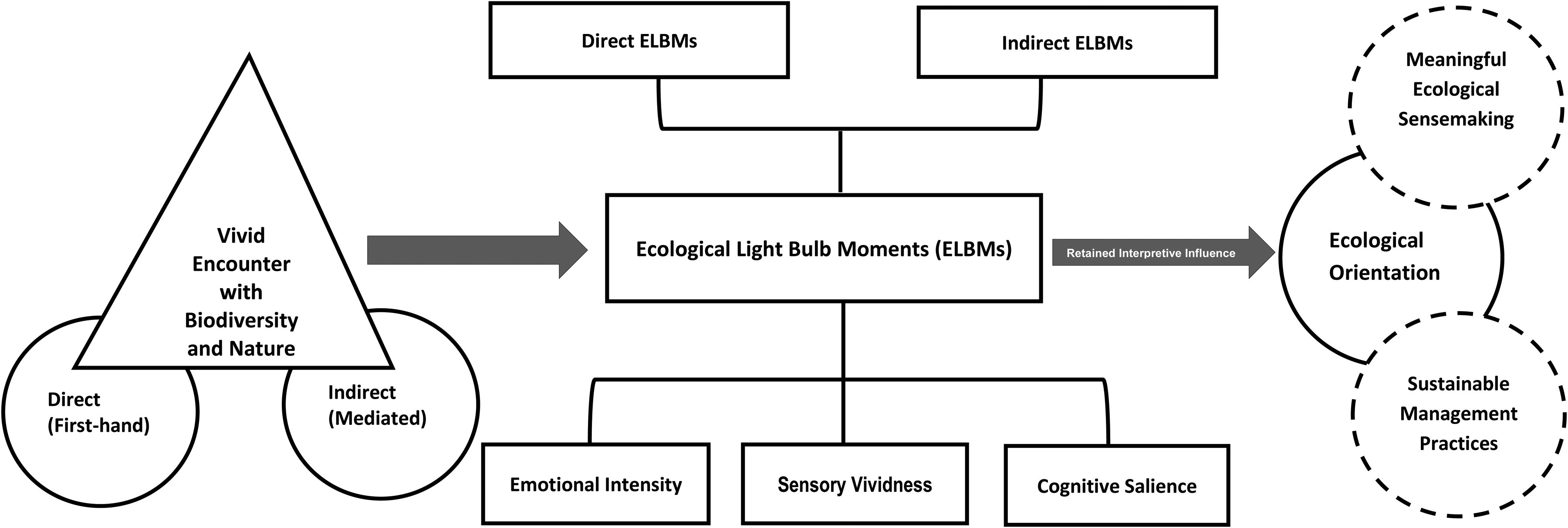
Ecological light bulb moments: attributes, forms, and interpretive implications.
Figure 1 presents a conceptual representation of ELBMs as retained, vivid experiences of biodiversity and nature characterized by emotional intensity, sensory vividness, and cognitive salience. The figure summarizes how participants retrospectively narrated these experiences as formative reference points in the development of their ecological orientation.
The directional arrow from ELBMs to ecological orientation reflects the narrative ordering present in participants’ account: ELBMs were described as earlier experiences that, in retrospect, came to be understood as shaping how individuals currently relate to ecological concerns. This arrow does not denote a causal mechanism or an empirically analyzed process, but rather a retrospective linkage articulated by participants when explaining their ecological orientation.
Ecological orientation is depicted as a solid circle to indicate a relatively stable background disposition that is sustained by retained experiences. Two intersecting dotted circles—meaningful ecological sensemaking and commitment to sustainable management practices—represent interpretive and practical domains discussed in the literature, not empirically examined outcomes in this study. Their dotted boundaries signal that these are neither deterministic nor causally guaranteed consequences of ELBMs or ecological orientation.
Consistent with sensemaking theory, and particularly the retention literature, the figure theorizes ecological orientation (a by-product of ELBMs), as an interpretive foundation that may condition what actors notice, find plausible, and attend to in organizational contexts. The intersections indicate that meaningful ecological sensemaking and commitments to sustainable management practices may be supported by such an orientation, without implying linear progression, direct causality, or empirical demonstration within the study.
Discussion
This study examined formative experiences that sustainability actors in office-based settings retrospectively identified as pivotal in shaping their ecological orientation—that is, a relatively enduring disposition toward ecological concerns and responsibility. Prevailing research on ecological embeddedness has emphasized long-term, ongoing, place-based immersion in ecosystems as the primary pathway to ecological awareness and ecological sensemaking (Whiteman & Cooper, 2000, 2011). By contrast, our analysis highlights a complementary pattern in participants’ accounts: individuals repeatedly returned to temporally bounded encounters—often brief, episodic, and sometimes momentary—that they recalled with vivid detail and emotional resonance, and that they framed, in retrospect, as enduring reference points in how they came to relate to ecological issues.
We conceptualized these experiences as ELBMs. Across participants’ narratives, ELBMs were consistently described through three attributes: emotional intensity, sensory vividness, and cognitive salience. Present in both direct (firsthand embodied) and indirect (mediated) forms, these attributes highlight how temporally bounded encounters can achieve lasting interpretive significance. The distinction between direct and indirect ELBMs further nuances assumptions in the ecological embeddedness literature, which often privileges sustained, embodied immersion (Bond, 2015; Kim et al., 2019; Løland & Hällgren, 2023; Tisch & Galbreath, 2018). While participants’ accounts reaffirm the formative power of direct encounters, they also indicate that mediated experiences can evoke comparable emotional, sensory, and cognitive resonance, rendering ecological harm imaginable and morally salient even in the absence of physical proximity (Barberá-Tomás et al., 2019; Boxenbaum et al., 2018; Höllerer et al., 2017, 2018; Quattrone et al., 2021).
The apparent uniformity in how participants narrated these moments, despite diverse functional areas and career trajectories within sustainability roles, may seem surprising given sensemaking's inherent equivocality and nonlinearity (Weick, 1995). Yet this retrospective coherence aligns with core sensemaking principles: individuals actively impose plausible, orderly accounts on past experiences to sustain stability or continuity of meaning and identity in the present (Weick et al., 2005). Although probing during interviews surfaced nonlinear recollection and ambiguity, participants consistently resolved these into vivid, pivotal anchors. Importantly, this pattern reflects participants’ own retrospective meaning construction of enduring ecological orientation from equivocal encounters (rather than analytical simplification by the researchers).
These findings invite closer attention to retention as a foundational element in the sensemaking cycle. Embedded in the VSR framework (Weick et al., 2005), retention preserves selected plausible interpretations, identities, and experiences over time. This stabilization reduces future equivocality by conditioning subsequent enactment and selection, while providing durable reference points that anchor identity, causal maps, and remembered experiences (Cristofaro, 2022; Maitlis et al., 2013; Weick et al., 2005). Empirical applications across organizational domains illustrate retention's role in sustaining meaning over time (Colville et al., 2016; Helms Mills et al., 2010; Parry, 2003; Weiser, 2021), yet its ecological dimensions of retention have received limited empirical attention—particularly in office-based organizational settings where sustained ecological immersion in professional work is largely absent.
From this theoretical perspective, ELBMs represent a specific class of retained formative experience that populates the retention layer of sensemaking in such contexts. Theoretically, such retained experiences may function as interpretive foundations that condition how actors notice ecological cues, test plausibility, and integrate abstract information (e.g., metrics, reports) with lived meaning in office-based settings (Weick et al., 2005). In office-based settings, where environmental issues often appear cognitively distant and morally muted (Bansal & Hoffman, 2011; Grewatsch et al., 2023; Spence et al., 2012), such anchors could bridge abstraction and experiential resonance, supporting forms of ecological sensemaking without substituting for sustained ecological immersion.
Insight from human geography further nuances this argument. While long-term, place-based immersion can foster emotional attachment to a specific environment (Stedman, 2003; Tuan, 1997), such attachment may also stabilize perception of place in ways that lag behind ecological change. In some cases, strong place attachment can dampen attentiveness to environmental degradation or sustain practices that undermine ecological integrity (Massey, 2008; Tuan, 1997; Yu, 2024). For example, Järvelä (2023) documents how a Finnish community deeply attached to its local place nonetheless tolerated unsustainable mining practices. This insight suggests that sustained immersion does not uniformly heighten ecological awareness or meaningful sensemaking. Retained formative experiences such as ELBMs may thus complement—or occasionally resensitize—place-based embeddedness by providing fresh interpretive anchors that remain salient across time and context.
In sum, this study foregrounds how retained, brief, momentary or episodic experiences with biodiversity and nature are narrated by sustainability actors as foundational to their ecological orientation in office-based organizational settings. By focusing on retention as a preprocess foundation rather than on real-time sensemaking processes, the analysis clarifies how ELBMs persist as enduring reference points. Grounded in retention literature, we suggest that such experiences may condition subsequent noticing, plausibility judgment, and meaningful engagement with ecological issues within firms (Cristofaro, 2022; Weick et al., 2005), without implying deterministic implications or linear effects. We emphasize that these theoretically reasoned implications offer a complementary pathway to meaningful ecological sensemaking in contemporary organizations where sustained ecological immersion in day-to-day professional work is often absent.
Theoretical Contribution
This study extends theory on ecological embeddedness and sensemaking by foregrounding retained formative experiences as a complementary pathway to ecological orientation in office-based settings and ecologically disembedded organizational contexts. Dominant accounts of ecological embeddedness emphasize long-term, ongoing, place-based immersion in ecosystems as the primary precondition for developing deep ecological awareness, respect, and responsibility (Whiteman & Cooper, 2000, 2011). In contrast, our findings illustrate how brief, episodic, and sometimes momentary encounters with biodiversity and nature—recalled with emotional intensity, sensory vividness, and cognitive salience—can serve as enduring reference points that shape individuals’ present ecological orientation, even when daily professional work unfolds far from ecosystems.
These ELBMs, whether direct or indirect, challenge the assumption that ecological orientation requires sustained copresence with ecosystems. The distinction between direct and indirect forms further refines ecological embeddedness theory by suggesting that mediated experiences can evoke comparable emotional, moral, and interpretive resonance (Barberá-Tomás et al., 2019; Boxenbaum et al., 2018; Höllerer et al., 2017, 2018; Quattrone et al., 2021). In an era of increasing urbanization, virtualization, and data-driven sustainability governance, where organizational actors interpret ecological issues primarily through abstract metrics and representations rather than direct engagement, ELBMs highlight how retained experiences can provide interpretive resources that bridge cognitive distance and moral muting (Spence et al., 2012).
This study also advances sensemaking theory by conceptualizing retention as a critical interpretive foundation under conditions of organizational separation from ecosystems. Sensemaking scholarship underscores that interpretation is shaped by the experiential cues, frames, and identity anchors individuals bring to situations (Cristofaro, 2022; Maitlis & Christianson, 2014; Weick, 1988, 1995; Weick et al., 2005). Within the VSR cycle, retention preserves selected plausible interpretations as organizational memory, causal maps, subsequent noticing (enactment), and plausibility testing (selection) (Cristofaro, 2022; Weick et al., 2005). Empirical applications across domains affirm retention's stabilizing role (Colville et al., 2016; Helms Mills et al., 2010; Parry, 2003; Weiser, 2021; Whiteman & Cooper, 2011), yet it remains underexamined in ecological sensemaking, particularly in office-based and disembedded settings (Cristofaro, 2022).
Theoretically, ELBMs represent a form of retained formative experience that populates the retention layer when sustained immersion is absent. These anchors may condition how actors notice ecological cues, test plausibility, and connect abstract information to lived meaning, thereby supporting the interpretive preconditions for meaningful ecological sensemaking (Cristofaro, 2022; Whiteman & Cooper, 2011; Weick et al., 2005). Rather than determining action in a linear or causal manner, such retained experiences remain available as nondeterministic touchstones that individuals draw upon amid organizational constraints, competing priorities, and flux.
Our findings also offer a more differentiated view of ecological embeddedness by problematising romanticized assumptions that continuous place-based immersion necessarily heightens ecological awareness and responsibility. Insights from human geography indicate that strong place attachment can stabilize mental maps that resist perceiving ongoing degradation (Massey, 2008; Stedman, 2003; Tuan, 1997), with empirical examples from management scholarship showing embedded communities tolerating harmful practices (Järvelä, 2023). Retained formative experiences like ELBMs may thus complement—or occasionally resensitize—place-based embeddedness by providing fresh interpretive anchors.
In conclusion, this study theorizes ELBMs as retained formative experiences that serve as interpretive foundations in office-based and ecologically disembedded organizational settings. By preserving emotionally intense, sensorially vivid, and cognitively salient encounters as enduring reference points, ELBMs populate the retention layer of the sensemaking cycle—reducing future equivocality and conditioning subsequent noticing, plausibility testing, and identity anchoring (Weick et al., 2005). Through this retention process, ELBMs may give rise to ecological orientation as a by-product: a relatively stable disposition characterized by awareness, concern, and responsibility toward ecological issues. This orientation, in turn, carries plausible theoretical implications for how individuals interpret and engage with ecological cues in office-based contexts. By foregrounding ELBMs as a complementary pathway to interpretive resources—beyond sustained place-based immersion—this work refines understanding of how ecological orientation can thrive in contemporary, abstracted organizational environments.
Implications for Practice
This study offers practice-relevant insights for organizations aiming to foster ecological orientation and sustainability engagement among managers in office-based settings, where routine work is abstracted and direct ecological immersion is limited. While ELBMs emerge inductively from individual retrospection, they suggest practical levers for fostering interpretive resources that may support more grounded ecological sensemaking.
First, since ELBMs are associated with brief, momentary, and often episodic vivid encounters (direct or mediated) that participants retrospectively frame as enduring interpretive anchors, organizations could create opportunities for exposure to vivid ecological encounters that individuals may later interpret and retain as meaningful. For instance, sustainability initiatives might include immersive field visits, interactive virtual reality experiences, provocative and curated storytelling formats (e.g., documentaries or testimonies). Such encounters are more likely to be retrospectively experienced as formative when they are emotionally engaging, sensorially vivid, and cognitively salient. A useful parallel can be found in The King's Seeing is Believing Programme (Business in the Community), which brings senior business leaders into direct contact with communities facing social challenges (e.g., homelessness, educational disadvantage, health inequalities), by exposing participants to emotionally resonant situations that can help connect abstract issues to lived experience and render them more personally salient over time. Similar approaches could help organizational actors’ link distant ecological data to lived meaning, potentially enriching interpretive resources for sustainability discussions and actions.
Second, the salience of emotionally resonant narratives in participants’ accounts, such as those involving animal suffering, ecosystem loss, or human–nature connections, suggests that sustainability communication should move beyond metrics and compliance language. Internal sustainability messaging could incorporate empathy-evoking stories to surface latent ecological orientations and stimulate reflection, and complement analytical approaches, potentially strengthening moral and personal relevance.
Third, since participants frequently drew on early-life or episodic experiences as enduring touchstones, organizations might create structured reflective spaces (e.g., facilitated workshops, peer storytelling sessions, or leadership development conversations), where individuals are invited to articulate and reflect on formative experiences. These practices could activate existing ecological attentiveness, making it more accessible in organizational dialogue without mandating behavior change.
Fourth, the findings caution against assuming proximity alone generates ecological responsibility. Brief but meaningful experiences (e.g., walk in nature, a compelling video or documentary) can be highly generative. Leaders could encourage informal reflection within organizational routines, such as lunch and learn sessions, offsites, or mindfulness practices, which encourage individuals to revisit and reinterpret such moments as part of their ongoing understanding of ecological issues.
Finally, HR and talent development functions could integrate ecological sensibility into recruitment, onboarding, and development. Rather than viewing sustainability as a purely technical expertise, selection processes might value demonstrated ecological attentiveness (e.g., through narrative-based interviews about formative experiences). Performance systems could recognize and reward such orientations, gradually institutionalizing ecological interpretation as a valued organizational capability.
These implications are suggestive: ELBMs may provide interpretive foundations, but their activation and translation in practice depend on organizational context, incentives, structures, and power dynamics.
Limitations and Avenues for Future Research
This study has several limitations that highlight avenues for future inquiry. First, the findings draw on retrospective interview accounts, which are well-suited to examining retained meaning but do not capture real-time sensemaking as it unfolds. Future research could employ ethnographic methods, diary studies, or longitudinal designs to observe how ELBMs are activated in actual decision-making, strategy sessions, or interactions.
Second, while distinguishing direct and indirect ELBMs, the study does not assess relative strength, durability, or differential impacts of these types over time. Future work could investigate how variations in emotional intensity, sensory vividness, and cognitive salience interact with contextual factors to shape the lasting influence of ELBMs.
Third, the sample primarily comprises sustainability-oriented roles in Western corporate contexts, appropriate for exploring orientation in disembedded settings but limiting generalizability to other functions or less receptive cultures. Future studies could examine ELBMs among nonsustainability managers or in organizations with varying sustainability maturity.
Fourth, the inductive construct emerged from highly developed Western settings. Comparative research in non-Western, rural, or Global South contexts—where everyday ecological connection may differ—could illuminate cultural or institutional influences on ELBM triggers and interpretations.
Finally, while this study makes no causal claims about ELBMs’ influence on ecological sensemaking or sustainability outcomes, future research could explore how organizational structures, incentives, and power dynamics enable or constrain the translation of retained orientations into practice, perhaps through multimethod designs.
Conclusion
This study explored how individuals working in organizational contexts—characterized by separation from embodied interaction with biodiversity and nature, in day-to-day professional work—come to develop and sustain ecological orientations. By focusing on ELBMs—brief, momentary or episodic vivid encounters with biodiversity and nature marked by emotional intensity, sensory vividness, and cognitive salience—this study demonstrates how such experiences can be retained as enduring interpretive anchors that shape present dispositions toward ecological concerns long after the original experience.
The findings challenge dominant assumptions that meaningful ecological sensemaking depend primarily on ecological embeddedness (Whiteman & Cooper, 2000, 2011). Instead, they suggest a complementary pathway: brief, momentary or even episodic experiences, whether direct or mediated, can acquire lasting significance by populating the retention layer of sensemaking, providing stable reference points that condition interpretation amid abstraction and distance.
Theoretically, ELBMs highlight retention's underexamined role as a foundational process in ecological sensemaking—preserving plausible interpretations that reduce equivocality and anchor identity over time (Weick et al., 2005). Practically, they point to opportunities for fostering interpretive resources through facilitated experiences, narratives, and reflection, potentially enriching sustainability engagement in office-based or disembedded settings.
As ecological crises intensify and organizations face growing demands to address biodiversity and nature loss, geopolitical issues and regulatory backtracking are contributing to corporate sustainability backsliding. Understanding the interpretive and affective foundations of ecological orientation thus becomes essential. This study offers a nuanced lens on how brief, momentary, or episodic formative encounters with biodiversity and nature can sustain meaningful engagement, complementing long-term, place-based approaches, and offering avenues for theory and practice that support responsible, ecologically attuned organizational action.
Footnotes

Funding
The author(s) disclosed receipt of the following financial support for the research, authorship, and/or publication of this article: This work was supported by the Natural Environment Research Council, (grant number NE/W004941/1).
Declaration of Conflicting Interests
The author(s) declared no potential conflicts of interest with respect to the research, authorship, and/or publication of this article.