



Abstract
This study explores how Australian winemaking, once considered peripheral, came to influence the entire field and reshape its shared meanings and practices. Although subfields are often assumed to remain at the margins of their fields, our historical analysis shows how Australia drew on elements of its institutional infrastructure – such as professional networks, wine competitions and critics – to reconfigure the centre-periphery order of the field. We identify three mechanisms driving this process: camouflaged deviance, encroachment and integration. These findings highlight the role of subfield dynamics in driving field evolution, the role of the institutional infrastructure in that process and how we understand subfields.
Institutional infrastructure is the basic requirement for organisational fields to exist. It represents “the mechanisms of social coordination by which embedded actors interact with one another in predictable ways” (Zietsma et al., 2017, p. 392), which “provides structure and stability to a field” (Mityushina & Hehenberger, 2025, p. 1). It includes cultural, operational and relational elements (Hinings et al., 2017; Logue et al., 2024). Cultural elements concern shared meanings, manifest in practices, labels and categories. Operational elements concern contracts and standard operating procedures, while relational elements include both direct interrelations among subfield members (DiMaggio & Powell, 1983) and the organisations that facilitate coordination, such as collective interest organisations, regulators, status differentiators and field-configuring events (Anand & Watson, 2004; Faulconbridge & Muzio, 2021; Greenwood & Suddaby, 2006). These institutional infrastructure elements are unevenly distributed and unequally available, positioning field members along a centre-periphery dimension.
Institutional infrastructure also shapes field-subfield relationships (Faulconbridge & Muzio, 2021). Subfields emerge to meet local needs or niche markets, putting them in peripheral positions, either opposing the field or confined by a geographic area (Lepoutre & Valente, 2012; Negro et al., 2015; Quirke, 2013; Weber et al., 2008). However, subfields are not necessarily oppositional; higher education, energy and public health serve local communities, operate under regional/national jurisdictions, yet still share core meaning systems and practices.
Subfields may influence the field by introducing alternative practices and meanings, e.g., grass-fed beef, organic horticulture, Italian corporate law, or alternative schools (Faulconbridge & Muzio, 2021; Lepoutre & Valente, 2012; Quirke, 2013; Weber et al., 2008). Yet field evolution research has largely focused on isolated subfields, overlooking subfield interactions. Addressing this lacuna is crucial for three reasons: First, many organisational fields contain multiple subfields, increasing the likelihood of interrelations. Second, while some institutional infrastructure elements may keep subfields in peripheral positions, other elements, like global rankings (Voronov et al., 2013), may connect them. The common institutional infrastructure is what defines subfields’ centrality (or marginality). Third, we lack understanding of how a peripheral subfield can influence a central subfield by leveraging its institutional infrastructure, thereby transforming the entire field – as shown in the case of Australian winemaking. This gap suggests the need to explore the role of the institutional infrastructure in interactions between subfields. Such dynamics tie subfield repositioning to their engagement with the institutional infrastructure, making this a promising lens for studying field evolution (Micelotta et al., 2017; Zietsma et al., 2017). Thus, we ask: How do institutional infrastructure dynamics shape the center-periphery position of subfields?
To explore this question, we studied the peripheral Australian winemaking subfield and its relation to the central French subfield, both members of the global winemaking field. Using archival data and interviews from 1950 – when Australian practices began diverging from French traditions – to 2013, when the centre–periphery relation between the two subfields had notably shifted, we identified three subfield-repositioning mechanisms. First, camouflaged deviation: establishing indirect relational channels between subfields while reinforcing cultural subfield boundaries by partially concealing new meanings. Second, encroachment: establishing direct relational channels between peripheral and central subfields, and transcending cultural boundaries through openly communicating new meanings. Third, integration: intensified exchange between subfields, weakening their relational boundaries and rendering cultural boundaries permeable.
These findings advance the understanding of how institutional infrastructure shapes centre–periphery dynamics in fields (Hinings et al., 2017; Logue & Grimes, 2022; Raynard et al., 2021). By focusing on dynamics between subfields rather than their isolation, we contribute to the literature on field evolution (Faulconbridge & Muzio, 2021; Micelotta et al., 2017; Zietsma et al., 2017). Our findings also refine the conceptualisation of subfields and shed light on the surprisingly nonconfrontational nature of the shift from the periphery towards the centre.
Organisational Fields, Subfields and Their Institutional Infrastructure
The concept of the organisational field represents a cornerstone of organisational scholarship (Scott, 2014; Wooten & Hoffman, 2008). It builds on relational structures (DiMaggio & Powell, 1983; Windeler & Sydow, 2001), which comprise communities “of organizations that partake of a common meaning system and whose participants interact more frequently and fatefully with one another than with actors outside the field” (Scott, 1994, p. 207). While this definition applies to various types of fields, e.g., professional fields or social movement fields, we focus on industry exchange fields as conceptualised by Zietsma et al. (2017). These fields coordinate exchange among members, who collaborate on shared interests through lobbying or industry promotion, or developing common technologies, standards, or labour relations. “Members often compete […] over market share and legitimacy, and look to one another for best practices, technologies, industry recipes” (2017, p. 410).
To enable coordination and collaboration, a set of institutional infrastructure elements is essential. These include regulatory bodies, collective interest organisations, field-configuring events, status differentiators, critics, organisational templates, categories, labels, shared meanings and practices (Hinings et al., 2017). Together, these elements interlock to stabilise the field, allowing it to operate, evolve and persist (Logue et al., 2024; Raynard et al., 2021). Field members are thus bound by a shared sense of belonging, continuously enacted in practices, rituals and events (Zilber, 2018).
Relational structures are often underpinned by geographical proximity (DiMaggio & Powell, 1983; Wooten & Hoffman, 2008). Therefore, different regions may produce different institutional arrangements (Lounsbury, 2007; Marquis & Lounsbury, 2007). Local fields can be studied as distinct organisational fields, or in relation to other fields of the same type. Fields such as cricket, high tech, or winemaking can all be studied either with a regional focus, e.g., English Cricket, Israeli high tech, or French wine (Lepoutre & Valente, 2012; Negro et al., 2015; Wright & Zammuto, 2013; Zilber, 2011), or with a wider scope including other regions, practices and meaning systems (Negro et al., 2011; Voronov et al., 2013). Given the scholarly interest in variance, such local fields are often theorised as subfields which develop in opposition to the field.
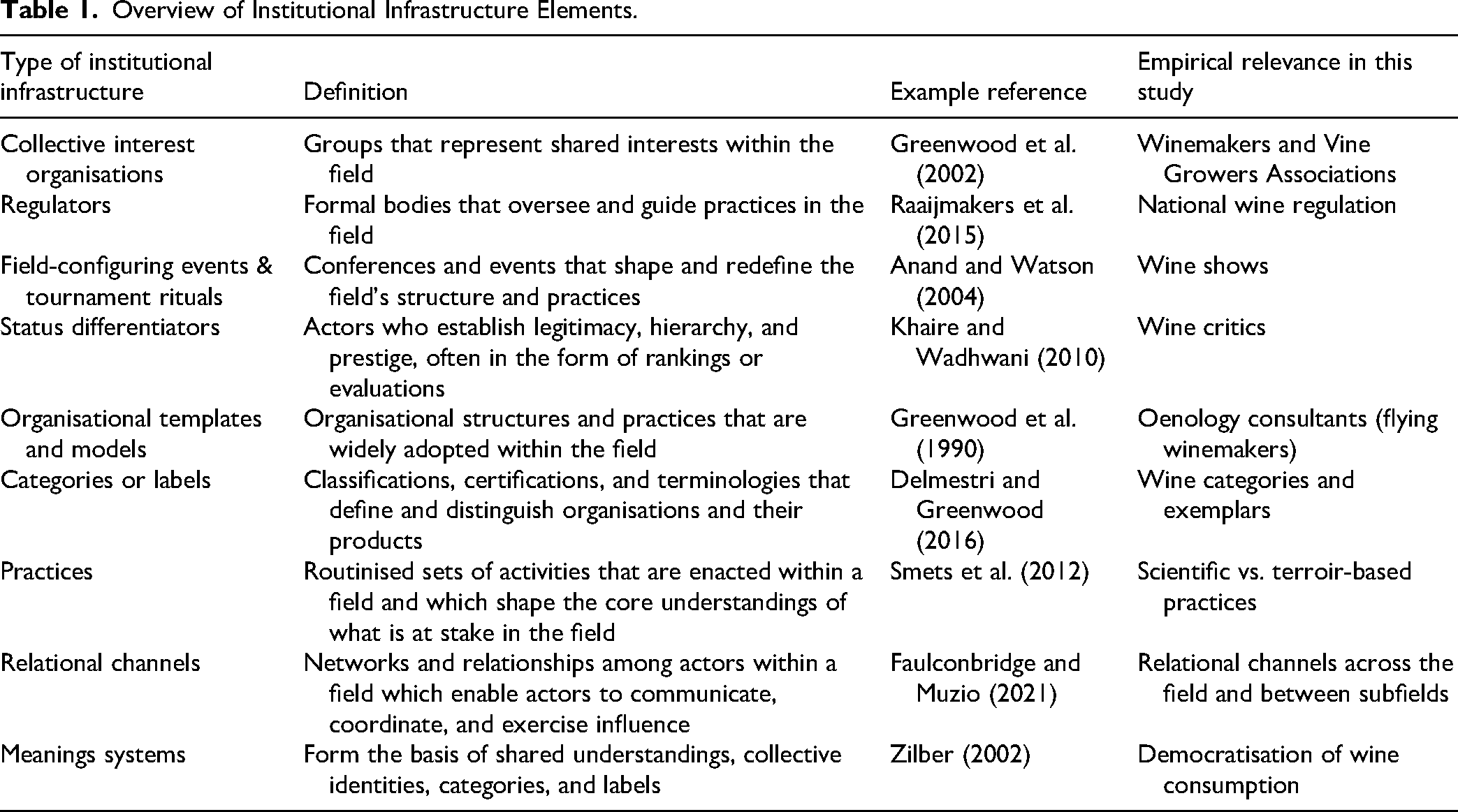
Although subfields lack a uniform conceptual definition, they are commonly seen as compartmentalised areas within larger fields, each with its own institutional infrastructure and organisational communities that form around specific issues, resources, or technologies (Hinings et al., 2017; Zietsma et al., 2017). Faulconbridge and Muzio (2021) defined subfields more precisely as distinct institutional realms that emerge from a process of partitioning from a larger field. Subfields thereby borrow elements of the institutional infrastructure from the field during their emergence but eventually develop their own distinct institutional infrastructure (Faulconbridge & Muzio, 2021), e.g., professional associations, infomediaries, subfield-configuring events, status differentiators, labels, categories, or subfield-internal rankings. They may form either around market niches, such as grass-fed beef or horticulture (Lepoutre & Valente, 2012; Weber et al., 2008), or based on geographical remoteness, which enables deviation from dominant field norms. Quirke (2013), for instance, showed how a remote area of the private school field in Toronto developed independent practices and meanings. Similarly, Negro et al. (2015) described how biodynamic winemaking flourished in Alsace, and Massa et al. (2017) highlighted the importance of provenance for winemaking in Ontario. Scottish knitwear (Porac et al., 1989), corporate law in Milan (Faulconbridge & Muzio, 2016), mutual funds in Boston and New York (Lounsbury, 2007), community banking (Lounsbury, 2007; Marquis & Lounsbury, 2007) and French business schools (Raynard et al., 2021) have provided similar examples. Thus, subfields are often underpinned by their members’ geographical proximity (DiMaggio & Powell, 1983; Scott, 2014). Table 1 provides an overview of institutional infrastructure elements and their relevance for this study.
Overview of Institutional Infrastructure Elements.
Both geographical seclusion and occupation of market niches shield subfields from conforming to institutional expectations (Faulconbridge & Muzio, 2016, 2021; Lepoutre & Valente, 2012). When emerging in opposition to dominant fields (Lepoutre & Valente, 2012; Quirke, 2013; Weber et al., 2008), subfields develop sharply defined boundaries. Like fields, they form cultural boundaries that delineate the realm of shared meanings and practices, and structural-relational boundaries distinguishing members from outsiders. As fields evolve, these boundaries shift (Grodal, 2018). A field's central actors generally strengthen cultural boundaries to maintain their authority and exclude or even delegitimise peripheral actors (Riaz et al., 2016), whereas peripheral actors may form alliances to redraw the field's cultural boundaries (Helfen, 2015).
While some subfields remain secluded and thus unlikely to interact with each other, other subfields compete in the same market. In such cases, relational positioning becomes central to inter-subfield dynamics, as they compete for market shares, resources, moral authority and prestige (Furnari, 2016; Lepoutre & Valente, 2012; Weber et al., 2008). These interrelations can be understood along a centre–periphery dimension, similar to actor positions in a field. In the next section, we turn to scholarship on how institutional infrastructure elements influence actor centrality in fields.
The Centre–Periphery Order and the Role of the Institutional Infrastructure
The positioning of field members shapes how they perceive and respond to institutional expectations. For instance, Durand and Kremp (2016) showed that symphony orchestras at the centre and periphery are more likely to make unconventional programme choices than those in the middle. Jonsson and Buhr (2011) found that centrally positioned banks suffer less from negative media coverage. Centrality also affects actors’ ability to influence or dominate a (sub)field, its practices and meanings (Riaz et al., 2016; Wild et al., 2020). These positions hold different potentials for effectuating change. While centrality allows actors to dictate practices (Greenwood & Suddaby, 2006), peripheral positions grant more immunity from institutional pressures and are therefore more likely to induce innovative practices.
Peripheral actors are often outsiders or activists (Van Wijk et al., 2013; Zietsma & Lawrence, 2010), lacking the same professional background as the central actors (Cattani et al., 2017; Leblebici et al., 1991; Maguire & Hardy, 2009). Their outsider status gives them more freedom to introduce novel ideas. Conversely, interactions among actors with similar professional backgrounds typically show central actors leveraging their resources to shape the institutional infrastructure (Greenwood & Suddaby, 2006; Helms et al., 2012). For instance, the “big five” in the field of accounting leveraged their centrality to transform the business model and consequently the entire field via the professional association (Greenwood et al., 2002; Greenwood & Suddaby, 2006). Similarly, international associations coordinate the diffusion of ISO standards from the centre to the periphery (Helms et al., 2012). These relational channels facilitate the diffusion of meanings and practices across fields or between a field and its subfields (Faulconbridge & Muzio, 2021; Smets et al., 2012).
Other elements of institutional infrastructure shaping fields include critics, infomediaries and ranking bodies. These help establish new categories of art or alcoholic beverages (Croidieu et al., 2016; Delmestri & Greenwood, 2016; Khaire & Wadhwani, 2010). Similarly, ranking bodies can transform entire fields (Espeland & Sauder, 2007). While critics balance continuity and disruption (Bowers & Prato, 2019), they may become deeply invested in new ideas (Massa et al., 2017), therefore driving transformation rather than acting as “neutral” arbiters. While some studies focus on their relevance for market categories, other studies point to their relevance for the formation of subfields (see e.g., Khaire & Wadhwani, 2010; Massa et al., 2017).
The interplay of category and subfield emergence is particularly relevant to market-driven fields like horticulture, cuisine, or the meat industry (Lepoutre & Valente, 2012; Rao et al., 2003; Svejenova et al., 2007; Weber et al., 2008). Since categories create order, reduce complexity and give meaning (Hinings et al., 2017), they become associated with standards and norms for the evaluation of actors and practices, which either reinforce or undermine their legitimacy and status (Delmestri & Greenwood, 2016; Zuckerman, 1999). The interplay of critics, categories and field-configuring events creates a lock-in effect. During field-configuring events, such as the Booker Prize or Grammy Awards, critics and rating bodies negotiate the meanings of categories which thereby become embedded in the field's institutional fabric (Anand & Jones, 2008; Anand & Watson, 2004).
By drawing on scholarship on institutional infrastructure and centre–periphery dynamics, we can better understand subfield interactions. We thereby follow scholars who show how subfields borrow, fuse, or transpose institutional infrastructure elements across subfield boundaries (Faulconbridge & Muzio, 2021; Hinings et al., 2017). While remoteness may be conducive to creating nonconforming institutional infrastructure, little is known about how the latter affects subfield positioning.
Methods
Research Context
To address the lacune, this study focuses on the initially peripheral Australian winemaking subfield and its interrelation with the central French winemaking subfield, both part of the global winemaking field. The industry exchange field (Zietsma et al., 2017) is characterised by established relationships among producers, suppliers, distributors, regulators, media and critics, who share a common understanding of meanings and production practices of wine made from grapes, which also includes dessert wine, sherry and port. The field also shares a market through which products, services and resources are exchanged (Mountford & Geiger, 2024). Historically, the shared meanings revolved around French practices of terroir winemaking, which emphasises the unique environment of each vineyard – altitude, slope, soil, drainage, sun exposure and ambient climate – thought to shape the quality of wine (Zhao, 2008). These practices were globally replicated and adapted to local contexts.
Because winemaking is tied to national jurisdictions and historically has been bound to the local sourcing of grapes, the field comprises various subfields. These subfields maintain independent regulatory systems, resulting in different national or regional subfields and wine categories (Massa et al., 2017; Negro et al., 2015; Voronov et al., 2013; Zhao, 2008). Each subfield has established institutional infrastructure elements, such as trade shows, educational and research facilities, professional bodies and domestic markets. Subfield members include winemakers, vine-growers, merchants, associations, oenologists (wine researchers), critics and wine show organisers. Historically, these subfield members operated within their geographical boundaries, with infrequent inter-subfield exchange and a primary focus on domestic markets. Interviewees emphasised the tension of being distinct while also feeling connected to the global field, resulting in loosely coupled subfields.
The field has long been marked by a hierarchy of influence and prestige favouring French winemaking practices; at the Great Exhibitions in Vienna (1873) and Paris (1878), prizes awarded to Australian wines were withdrawn once their origin was revealed (Evans, 1973, p. 35; Faith, 2003, p. 50), reinforcing the undisputed centre–periphery order. As the subsequent dynamics between the Australian and French subfields were driven by Australian actors, we focus on their efforts to employ institutional infrastructure elements to alter their position. We also analyse responses from French subfield members who attempt to maintain the original order.
The Empirical Material
We employed a qualitative, abductive research approach (Sætre & Van De Ven, 2021; Timmermans & Tavory, 2012). To understand the local phenomena, we immersed ourselves in the subfield, drawing on archival data, documents, interviews and online posts. Initially focused on how the market category of Australian wine changed over time, we were surprised to discover that Australian winemakers not only repositioned the wine category but also contributed to the transformation of winemaking globally. Our focus thus shifted towards the field level, specifically subfields and their institutional infrastructure. To avoid a singular perspective, we triangulated the emerging understandings with data from non-Australian sources, including critics and winemakers.
Empirical material was gathered from three sources (see Table 2 for details). First, we collected archival material to understand the peripheral subfield, its practices and shared meanings. This included historical books on Australian and global winemaking (the latter helping contextualise local interpretations), and articles on Australian winemaking from acclaimed international critic Jancis Robinson's online blog. The first author also followed blogs by Australian critics Richard Farmer, Kim Brebach, Ken Gargett and Max Allen, as well as British critic Mark O’Neill and US wine economist Mike Veseth. References to other sources by members of the subfield led to the inclusion of additional sources such as articles from wine-searcher.com or the Sydney Morning Herald.
Empirical Material.
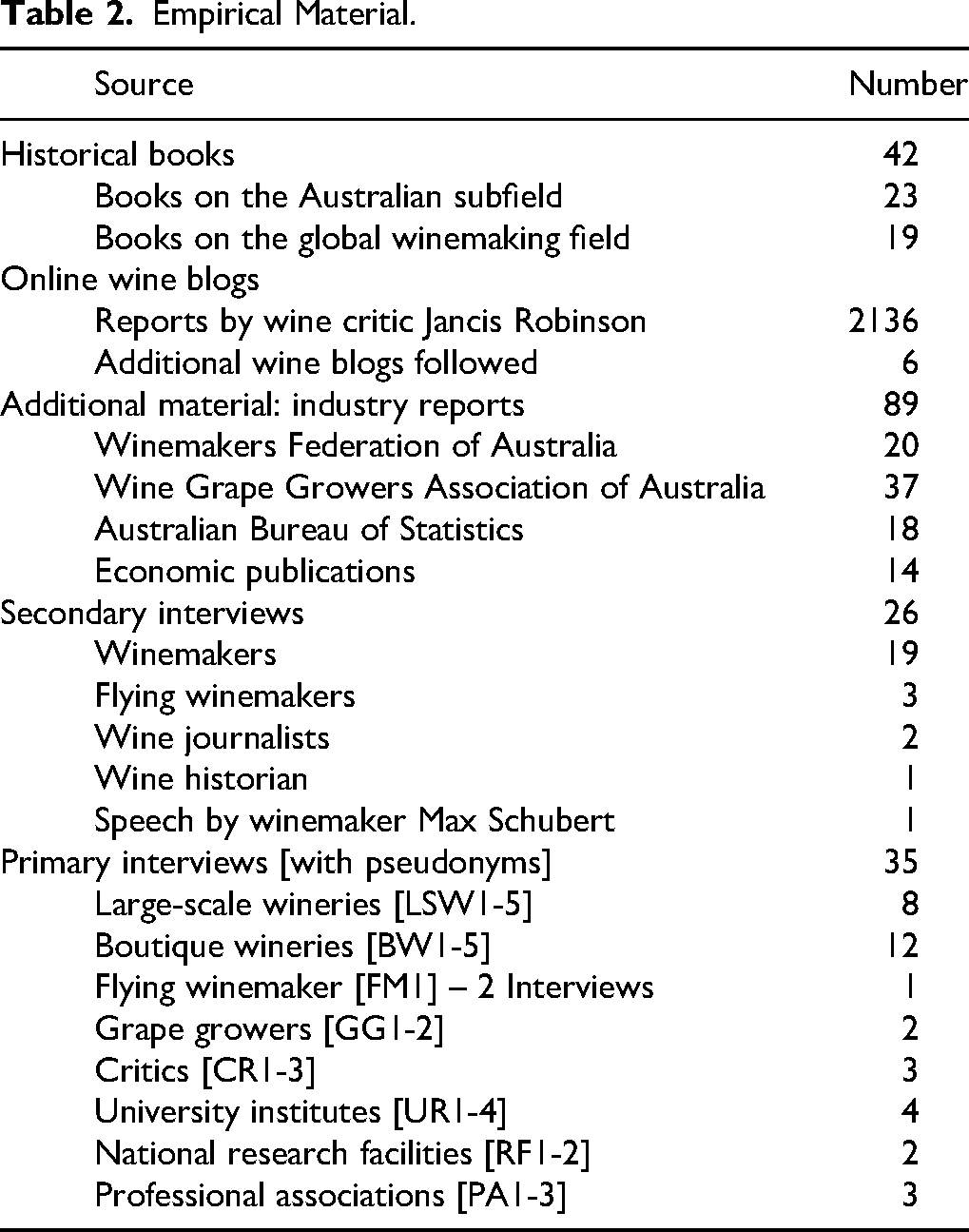
To contextualise developments, we included industry reports by the Winemakers Federation of Australia, along with reports by the Wine Grape Growers Association, statistics from the Australian Bureau of Statistics (1994–2011) and economic publications. We also included secondary interviews printed in books, online archives and a transcription of a speech by Max Schubert, one of the most acclaimed figures in the Australian subfield.
To complement the archival data, the first author conducted 35 interviews with Australian subfield members to better understand the developments and their effects in retrospect. Some were interviewed twice. The interviews lasted between 30 and 180 min. To ensure diversity, participants included small family-run wineries (3 hectares, 600 cases/year) to large publicly listed companies (8,000 hectares, 22 million cases/year). Interviewees represented regions including Adelaide Hills, Barossa Valley, Coonawarra, Eden Valley, Fleurieu, McLaren Vale, the Mornington Peninsula, Hunter Valley and the Yarra Valley. We did not assign specific sources to specific events, as all contributed to understanding subfield institutional infrastructure dynamics. One interview was also conducted with a leading international critic who had witnessed the developments firsthand. Finally, to more deeply explore the emerging themes of flying winemakers, critics and wine shows, we collected additional secondary data from books and interviews with Chris Ringland, Brian Croser and Len Evans. The primary interviews were pseudonymised using abbreviations indicating the interviewees’ professional backgrounds (see Table 2).
The Analytical Process
Following an iterative, abductive approach to data analysis (Timmermans & Tavory, 2012), we refined our research focus throughout the process. Initially, guided by the market categories literature, we read archival texts, annotated codes and revised them as new data was added. This approach allowed us to immerse in the data and stay attuned to latent themes. We then complemented the analysis by adding the interview data. First, we organised the emerging themes using hand-written notes and thematic maps (see also Reissner & Whittle, 2022) and then transferred the themes and quotes into tables.
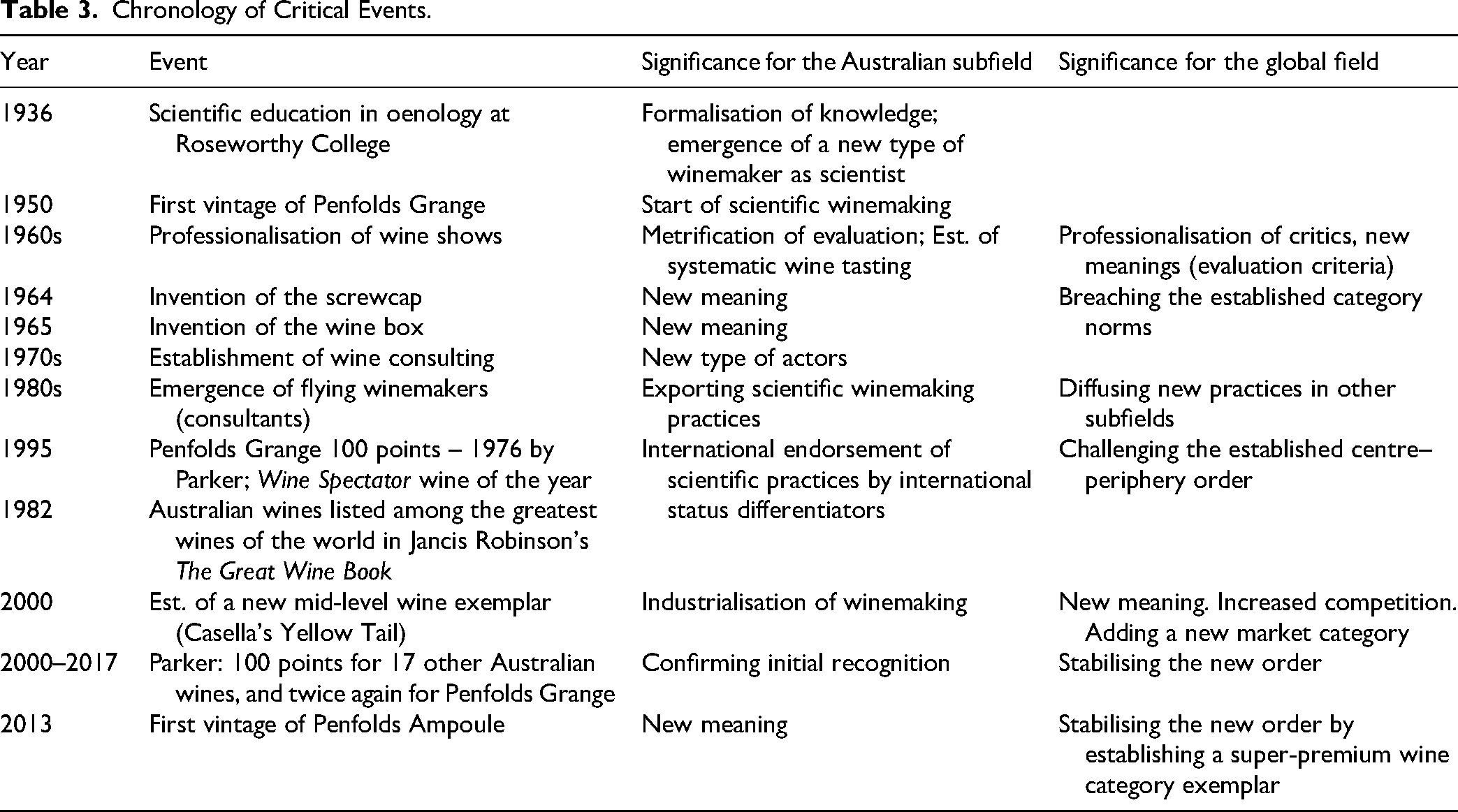
Once we started identifying the main actors, we realised focusing solely on market categories was insufficient; the involvement of diverse actors – such as winemakers, education and research facilities, critics, organisers of wine shows and professional associations – in redefining meanings and practices pointed to a broader perspective on organisational fields. Tensions between Australia and France, highlighted in interviews, led us to focus on the subfield literature. We then compared the emerging themes across all data material to identify commonalities and differences. Some themes, like the scientification of winemaking, emerged early, while others surfaced after several iterations of adductive reasoning. Retrospective insights from interviews helped identify high-relevance themes, such as the role of wine shows or flying winemakers. This process resulted in a chronology of critical events in redefining the subfield relation (see Table 3). The chronology distinguishes dynamics identified as affecting the local subfield and the wider field.
Chronology of Critical Events.
We iteratively moved between emerging understandings and focused engagement with the literature (Folger & Stein, 2017). These oscillations led us to engage with the literature on the institutional infrastructure of subfields to better understand their dynamic relationship with the wider field (see also Faulconbridge & Muzio, 2021). Following Hinings et al. (2017), we categorised wine shows as tournament rituals and critics as status differentiators and identified oenology consulting as a novel organisational model. Professional networks between critics, wine shows and flying winemakers were categorised as relational channels. We also identified the importance of scientific winemaking practices, new meaning systems and category-related tactics, such as adhering to category norms, category signalling and creating new exemplars. Operational infrastructure elements did not emerge as relevant.
While refining our coding structure, we dropped less relevant aspects like fluctuations of taste, market trends and exchange rates and tariffs. While economic studies show that these factors affect the subfield's cycles of expansion and consolidation (Anderson & Pinilla, 2018; Anderson & Wittwer, 2013), they are not germane to illuminating the specific mechanisms that enabled a change in the relational order among the subfields. To ensure reliability, we collaboratively discussed the themes, codes and data structures. We also engaged in discussions with colleagues to increase the theoretical plausibility of the emerging themes (Plakoyiannaki & Budhwar, 2021). To ensure that our conclusions reflected the subfield dynamics, we discussed our interpretations with members of both the Australian and other winemaking subfields.
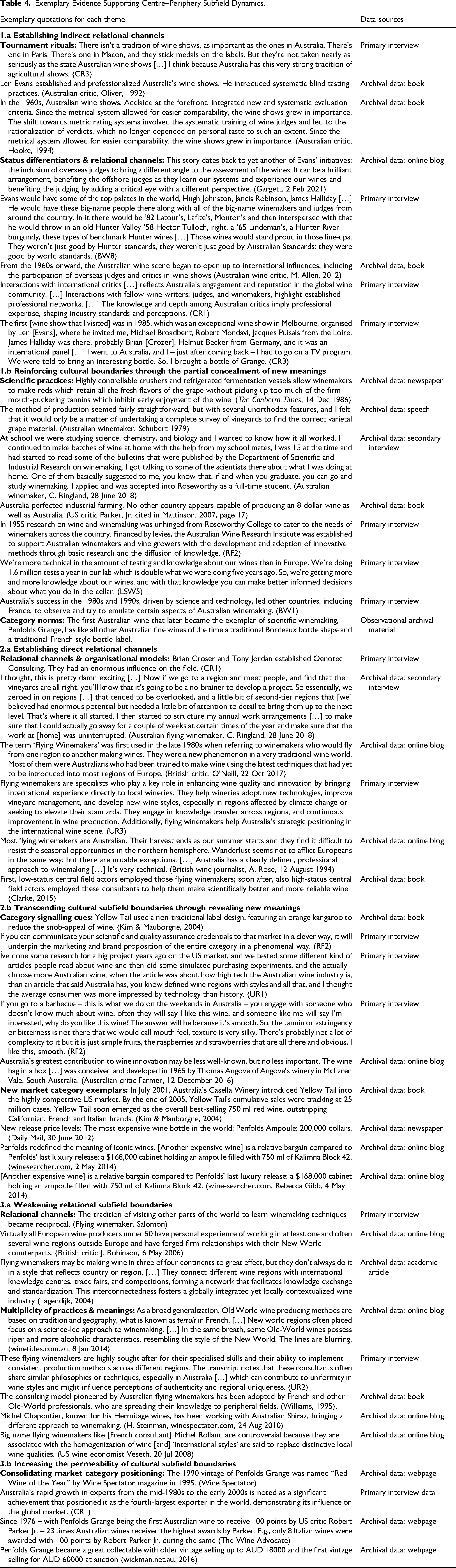
To condense the sequence of how institutional infrastructure elements have been employed to alter the relationship with the central subfield, we bracketed the themes based on their effects’ temporal unfolding (see Table 4). For each bracket we grouped one theme on meanings and another on relational aspects: (1) establishing indirect relational channels while reinforcing cultural boundaries through partial concealment of new meanings; (2) establishing direct relational channels and transcending cultural boundaries by openly communicating new meanings; (3) weakening relational boundaries and increasing the permeability of cultural boundaries. These three pairs form the mechanisms of (1) camouflaged deviation, (2) encroachment and (3) integration (see Figure 1). The findings are structured chronologically according to the sequence of the three brackets. Each bracket is then organised thematically.
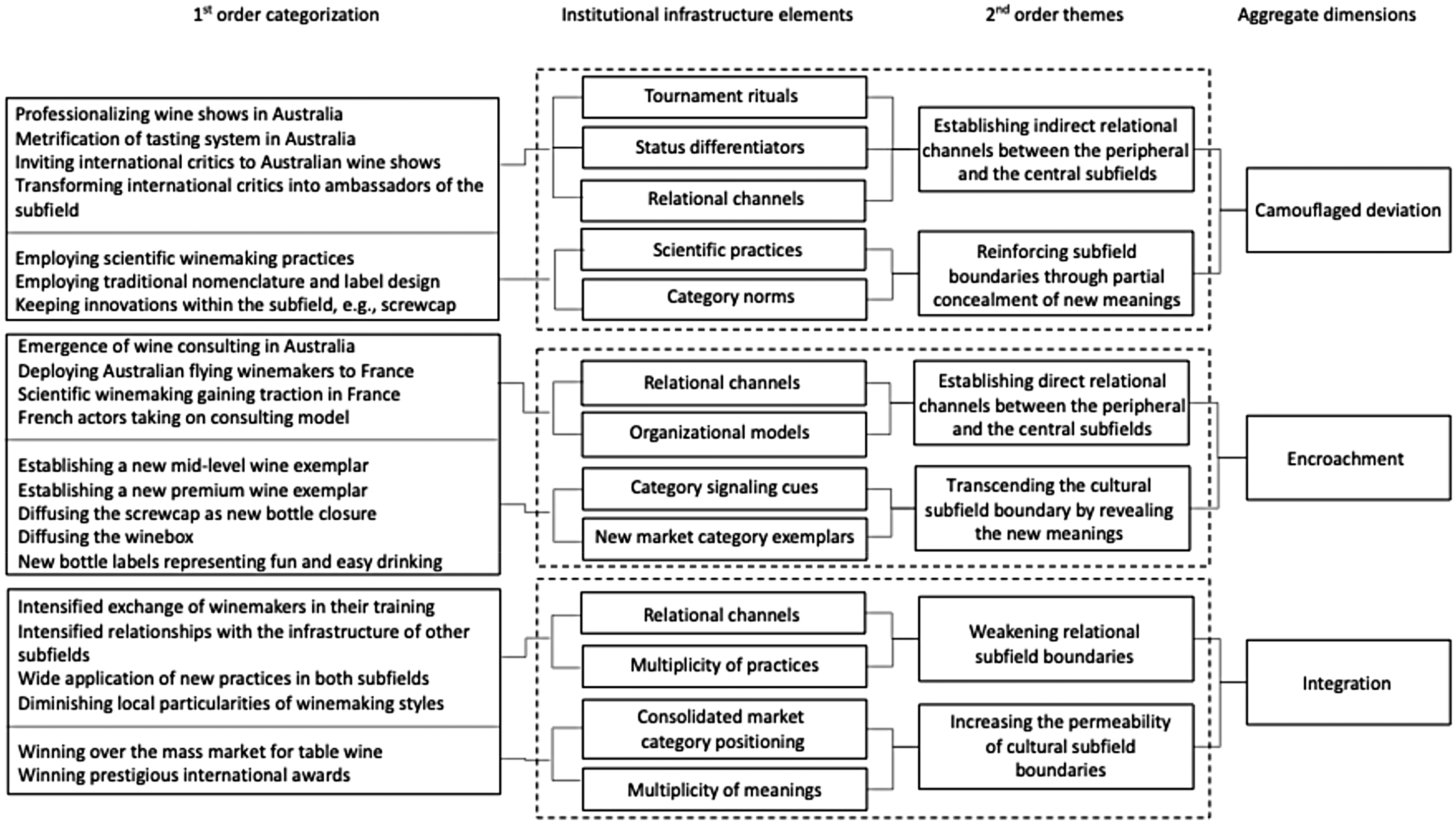
Coding Structure.
Exemplary Evidence Supporting Centre–Periphery Subfield Dynamics.
Findings
Bracket 1: Camouflaged Deviation
The first mechanism involves the radical redefinition of practices and meanings, a shift from traditional to scientific winemaking. The secluded location of the periphery subfield – both geographically and socio-culturally – provided greater immunity from the central subfield's isomorphic pressures, and laid the groundwork for connecting the subfields and ultimately reordering the field's centre–periphery structure.
Two other manifestations of new meanings concern the invention of the screwcap closure and the wine box. The screwcap diffused within Australia from 1976. It shifted the wine consumption's meanings by emphasising reliability over the appreciation of different vintages’ varying quality. This invention initially remained within the subfield until the 2000s, when screwcaps became globally adopted. By 2017, 98% of Australian wine was topped with a screwcap (Sydney Morning Herald, 28 June 2017). The wine box, patented by Australian winemaker Thomas Angove in 1965, was designed to hold larger volumes, aesthetically distinguishing bulk wine from fine wine. Other subfields’ producers typically sold their wine – regardless of quality – in bottles. Boxed wine also changed the meaning of wine consumption. Catering to leisure activities like picnics and barbecues, it took over the lower-end market in Australia and was subsequently embraced overseas (Clarke, 2015, p. 134). The aesthetic differentiation between bulk wine and fine wine sold in bottles signalled a new focus on quality.
[Len] Evans would have some of the top palates in the world, Hugh Johnston, Jancis Robinson, James Halliday […] He would have these big-name people there along with all of the big-name winemakers and judges from around the country. (Primary interview BW8) The first [Australian wine show I visited] was in 1985, which was an exceptional wine show in Melbourne, organised by Len [Evans]. Then I did a few more, sort of, serious, proper, normal state shows after that. (Primary interview CR3)
Bracket 2: Encroachment
The second mechanism concerns efforts to bring the subfields closer together and gradually reveal the new meanings. Two key elements of the institutional infrastructure in this process are oenology consulting and the use of category signalling to reveal the new meanings.
At different tastings, I have seen that they want the wine to be drinkable and easy and good, right when it's bottled, or maybe half a year later, even if it's a very rich and heavy wine, which would take years to be drinkable if it's a European bottle. (Primary interview UR4)
Spite and panic led French winegrowers to force a change to the name of Australia's most respected red wine, according to a leading British wine expert. Journalist and author Auburn Waugh said the overall quality of Australian wine was the reason for the French campaign. (The Canberra Times, 3 Jun 1988)
Another step in breaching the established meanings was creating new category exemplars, first for mid-level and subsequently for premium wines. The first development concerns Yellow Tail wines, established by Casella in 2000. These wines broke norms in taste, price, label design and closure, redefining wine consumption for new-to-wine audiences by transforming quality table wine into a mass-market product (for more details, see Kim & Mauborgne, 2004). Pointing to the earlier ontological challenge, the new category exemplar's sheer existence underscored that “Yellow Tail wine isn’t wine as we know it” (Veseth, 2011, p. 140).
At the premium level, Penfolds Grange became highly collectible, with vintages selling for up to AUD 60,000 at auctions (Wickman.net.au). Other iconic Australian wines include Henschke's Hill of Grace, Torbreck, Leeuwin Estate and Giaconda. Capitalising on this success, Penfolds redefined the meaning of premium wine by creating Ampoule, a small-scale production bottled in a distinctive carafe, for a regular release price of AUD 186,000 per bottle, all of which sold out in China and Russia – both important markets for French premium wine – immediately after release.
Bracket 3: Integration
The third mechanism diminished the local particularities of subfields due to intensifying exchanges among winemakers during their training and deepening relationships across subfields. In addition, the meanings became increasingly detached from their place of origin, rendering the cultural boundaries more permeable.
Old and New World: Blurring the lines. […] They [the Old World] are the historic birthplaces of wine […] all about tradition, restraint, and elegance. The New World is often described as […] producing wines defined by technology, experimentation, and ripe, powerful fruit. […] International influences and travelling winemakers have led to some Old-World producers eschewing the regulations. (Online blog J. Barrow, bibendum-wine.co.uk, 6 March 2020)
For scientific practices to co-exist with traditional ones, they had gained equal legitimacy. At the highbrow level, influential international critics awarded top ratings. Jancis Robinson (1982) listed three Australian wines in her book Greatest Wines of the World, and Penfolds Grange earned 100 points from Robert Parker Jr. three times. By 2016, twenty other Australian wines had received perfect scores, a distinction historically achieved by very few. At the lowbrow level, most prominently, the Yellow Tail wines broke every sales record, selling 112,000 cases in its first year in the U.S. and reaching eight million cases by 2005, surpassing the combined sales of all French wines (Veseth, 2011). Despite typically reviewing only fine wine, critics occasionally reviewed Yellow Tail wines highly, with several gold medals at Mundus Vini, a large European wine competition, and 90 + scores from Wine Spectator magazine.
In short, the Australian subfield successfully repositioned itself relative to the central French subfield by leveraging elements of its institutional infrastructure. These collective efforts connected the subfields through relational channels and established new meanings and practices alongside traditional ones. Based on these findings, we developed a process model of field evolution driven by subfield infrastructure dynamics (see Figure 2).
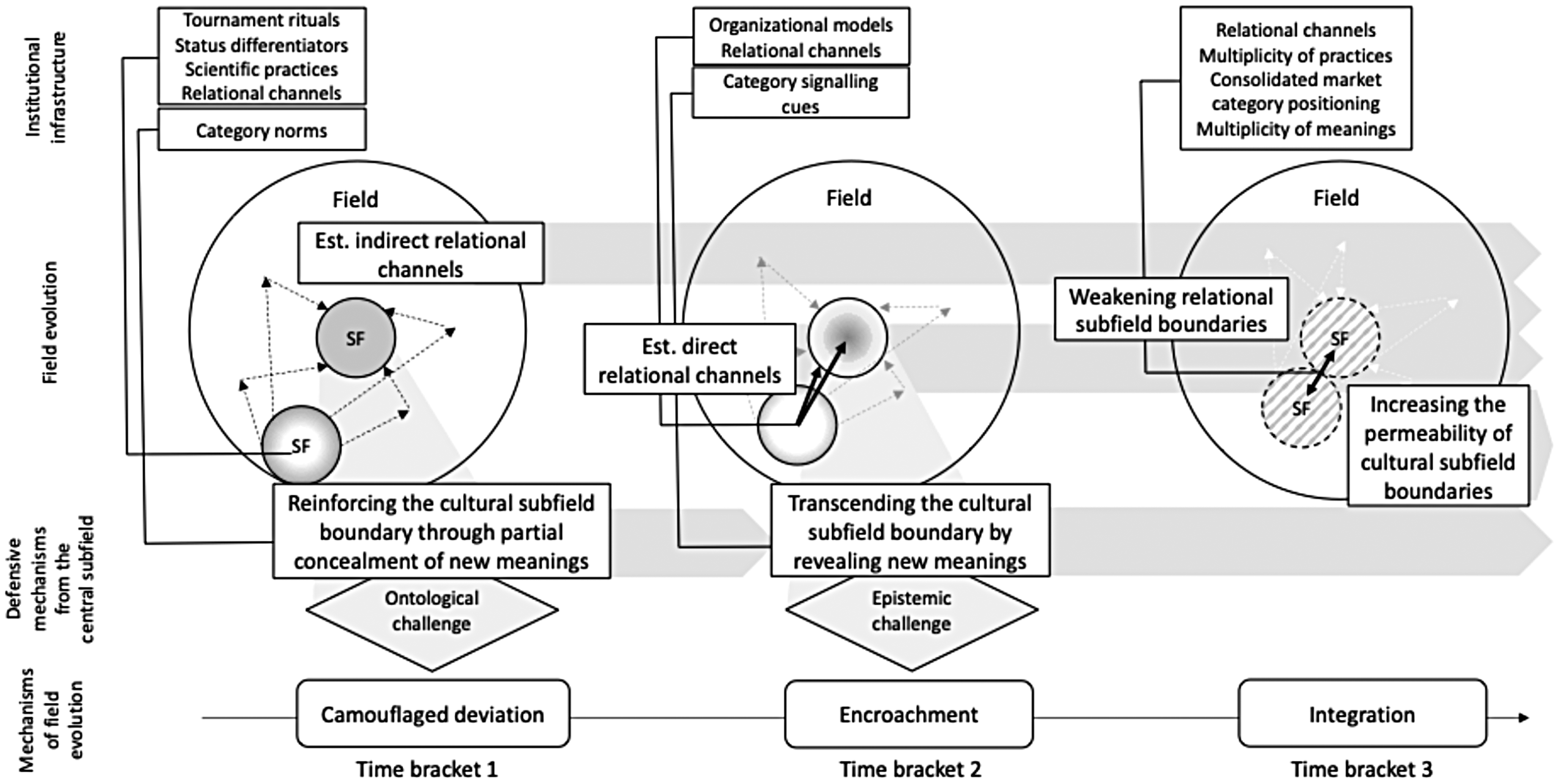
A Process Model of Field Evolution: Institutional Infrastructure and Subfield Dynamics.
Discussion
This study explores how institutional infrastructure dynamics shape the centre–periphery positioning of subfields. While studies have shown the relevance of the institutional infrastructure for the emergence and consolidation of individual subfields (Faulconbridge & Muzio, 2021), our study extends these insights by exploring the role of infrastructure in defining relationships between subfields. Our findings offer a new perspective on the origins of field evolution and practice variation (Lounsbury, 2007; Micelotta et al., 2017; Voronov et al., 2013; Zietsma et al., 2017). We thereby contribute to the institutional infrastructure literature (Hinings et al., 2017), deepen our understanding of centre–periphery dynamics (Cattani et al., 2017; Greenwood & Suddaby, 2006; Leblebici et al., 1991) and supplement the conceptualisation of subfields (Faulconbridge & Muzio, 2016, 2021; Quirke, 2013).
Contributions to Institutional Infrastructure Scholarship
By focusing on a broad set of institutional infrastructure elements, our study reveals the complex interplay between structural-relational and cultural elements (Faulconbridge & Muzio, 2021; Logue et al., 2024; Raynard et al., 2021). Unlike the findings of Raynard et al. (2021) on institutional infrastructure's status-quo cementing effects, our findings highlight its transformative potential. By focusing on inter-subfield dynamics, this finding extends the prevailing understanding of institutional infrastructure as a means to differentiate subfield from field (Faulconbridge & Muzio, 2021; Lepoutre & Valente, 2012; Quirke, 2013; Weber et al., 2008). Below, we disentangle both the structural and the cultural dimensions of this process.
Institutional infrastructure's relational elements can bridge disparate actors (Logue et al., 2024; Logue & Grimes, 2022; O’Mahony & Bechky, 2008). Thus, negotiating new meanings requires not only cultural and political work (Perkmann & Spicer, 2008), but also infrastructural scaffolding – establishing relational channels as conduits through which alternative meanings diffuse. Changing a subfield's position can be difficult, as shown at the Great Exhibitions, where Australian wines were withdrawn from competition because it was unthinkable that colonial produce could rival Old World excellence. Our findings thus suggest a cascading sequence of first indirect, then direct interaction, in which relational elements preceded and enabled cultural change. Employing structural elements may be easier, given their apparent neutrality as “structures”, compared to meanings, which are inherently value-laden. This finding also extends the notion of proactive engagement with critics (Khaire & Wadhwani, 2010; Massa et al., 2017). While reminiscent of evangelisation's emotional aspects (Massa et al., 2017), the professionalisation of tournament rituals underscores the structural dimension of enlisting critics. In this sense, structural elements can act as a Trojan horse for new meanings to diffuse.
The role of critics points to the importance of markets as a relational type of institutional infrastructure. Serving both economic exchange and legitimisation of shared meanings and practices, this view reaches far beyond the economic realm of the market (Mountford & Geiger, 2024). Actors are therefore not constrained to taking advantage of opportunities as they arise; they can also proactively employ institutional infrastructure to create opportunities (cf. Delbridge & Edwards, 2008). Another example of this concerns the structural element of consultants (“flying winemakers”). Although their primary aim was to professionalise practices in the central subfield, they inadvertently became relational channels which rendered cultural boundaries more permeable, enabling encroachment into the central subfield.
Unpacking the cultural dimension of camouflaged deviance, our findings reveal the ambivalent role of market categories as means to both disguise and signal meaning. Camouflage reduces contestation risk by aesthetically emulating established norms, akin to robust design (Hargadon & Douglas, 2001). The vulnerability of novelty, which is particularly high when it comes from the periphery, can thus be mitigated. However, while robust design is meant to remain unchanged, camouflaged deviance was merely one step in a process of changing the shared meanings. While the deviance was hidden from public scrutiny, it was partially communicated to international critics, perhaps because critics are generally more open to innovative ideas (Bowers & Prato, 2019). Thus, what seems a nascent category externally may rather represent a fully developed category concealed from the wider public. This finding extends the understanding of categories as attention-channelling devices (Arjaliès & Durand, 2019; Khaire & Wadhwani, 2010) by adding nuance to how and when category signalling occurs. Since first impressions generally stick (Aversa et al., 2021), the timing of when new meanings underpinning a category are revealed matters for its legitimacy.
Contributions to Field Centre and Periphery Dynamics
The positional dynamics between subfields highlight a field's uneven topography (Faulconbridge & Muzio, 2021; Lounsbury, 2007; Quirke, 2013). Prior research shows that the centre–periphery order of actors can change (Espeland & Sauder, 2007; Wright & Zammuto, 2013; Zietsma & Lawrence, 2010). Our findings extend this view by showing that these dynamics apply not only to individual actors but also to entire subfields.
While our findings are consistent with research showing that peripheral positions are conducive to deviations from field norms (Cattani et al., 2017; Cattani & Ferriani, 2008; Hardy & Maguire, 2010; Leblebici et al., 1991), we add nuances to this understanding by disentangling actors’ professional background homogeneity. Prior studies show that when changes originate within the same profession, they tend to come from the field centre (see e.g., Greenwood & Suddaby, 2006; Helms et al., 2012). Our findings reveal that novel practices can also emerge from peripheral actors within the same profession. This is surprising, as innovations originating from the periphery usually come from actors with different professional backgrounds than those at the centre (Leblebici et al., 1991; Wright & Zammuto, 2013).
This finding highlights a non-confrontational approach to incorporating practices across subfields within the same professional community (Smets et al., 2012). Rather than seeking to displace existing practices and meaning systems (see e.g., Micelotta et al., 2017), actors from the peripheral subfield avoided confrontation. This suggests a new category within the field-governing infrastructure typology (Mityushina & Hehenberger, 2025); unlike opposition, expert lobbying, or collaborative governance, our findings reveal latent embedded competition operating within established professional communities.
Contributions to Subfield Conceptualisation
Traditionally, subfields are seen as communities united by shared values opposing the field's dominant logic, such as grass-fed beef, alternative schooling, or biodynamic winemaking (Negro et al., 2015; Quirke, 2013; Weber et al., 2008). While this oppositional view suits subfields catering to market niches, our findings show that subfields can also emerge from subtle meaning differences fostering actors’ local identification and often based on local cultural roots and a common history and fate (Coraiola et al., 2018), similar to national myths or localised traditions (Negro et al., 2015; Voronov et al., 2013; Zilber, 2006).
This suggests that sharing a common regulatory system with the broader field (Faulconbridge & Muzio, 2021; Quirke, 2013) is not essential for a subfield's existence. Thus, a subfield's definition rests on two dimensions: an internal one, based on self-conception and social cohesion, and an external one, based on recognition within the field's wider socio-economic reality. This conceptualisation extends the view of subfields as remote and secluded (Faulconbridge & Muzio, 2016; Quirke, 2013), showing that nested subfields interact with not only the parent field (Faulconbridge & Muzio, 2021) but also each other, with differences in prestige and influence shaping these relationships. This finding also extends the view of subfields as simply partitioning from the field (Faulconbridge & Muzio, 2021). Instead, subfields may coexist within the field by balancing interdependence and differentiation.
Limitations and Future Research
Our analysis is based on the efforts of one peripheral subfield to change its relational positioning vis-a-vis the central subfield. As such, it does not aim to systematically compare processes among several subfields. Future research should explore similar processes in varied contexts. Relevant cases might include subfield dynamics in public health, emerging technologies, transportation, or energy. While these areas are typically shaped by national regulation, they are highly relevant for tackling global challenges. Studying these cases might thus reveal alternative practices and potential solutions to prevailing issues. Future studies should also consider the geopolitical dimension of subfield relations and further unpack the multi-dimensional nature of centrality, disentangling influence, prestige, power, status and domination. This research agenda might also unearth differences in resource dependencies between subfields (Furnari, 2016).
Conclusion
By analysing institutional infrastructure dynamics between the initially peripheral Australian and the central French winemaking subfields, our study offers a new perspective on field evolution. We show how the peripheral subfield established relational channels with the central subfield, thereby diffusing novel practices and infusing the central subfield with alternative meanings. These dynamics allowed traditional and novel practices to coexist, which ultimately redefined the centre–periphery relationship by moving the peripheral subfield closer to the centre. These findings extend the understanding of field evolution by emphasising the role of institutional infrastructure and offering a more dynamic view of subfields. We thus advocate for a more topographical approach to field analysis that foregrounds how field evolution can originate within and between subfields.
Footnotes
Acknowledgments
We are grateful to the Associate Editor Karan Sonpar and the anonymous reviewers for their thoughtful guidance and encouragement throughout the review process. This manuscript emerged over the years from the helpful feedback of Daniel Muzio, Roston Greenwood, Kirstie Ball, Santi Furnari, Dennis Jancsary, Stephan Leixnering, Mia Raynard, Claudio Biscaro, Heike Mensi-Klarbach, Katharina Pernkopf, Thorsten Koch, participants in the 2019 EGOS subtheme ‘Organizational Fields of the Future and the Futrue of Fields’ in Edinburgh and the 2018 Paper Development Workshop at the University of Edinburgh Business School.

Funding
The authors received no financial support for the research, authorship, and/or publication of this article.
Declaration of Conflicting Interests
The authors declared no potential conflicts of interest with respect to the research, authorship, and/or publication of this article.