



Abstract
We propose a novel, multi-faceted approach to organization theory building that is more likely to engender theories that are relevant to the work that managers and organizations do—one predicated on principles associated with design. Invoking and synthesizing a set of core design principles and applying them to the process of theory building generates an approach that not only provides organizational scholars a way of thinking differently about thinking theoretically, but also helps answer the call for increasing the relevance of our theories as a way of making contributions that are more practical, more prescient and greater in scope. The resulting model of “design theorizing” has several significant implications for addressing how organizational scholars approach current and future issues likely to affect the theory and practice of managing.
Organizational theorists have long grappled with the question of relevance: Do our theories matter to the managers, leaders, and practitioners as one of the audiences we should be serving? Despite decades of theoretical advancement, our organizational theories are often criticized for their limited impact on practice, with scholars pointing to a persistent gap between the rigor of academic work and its practical utility (Bansal et al., 2012; Corley & Gioia, 2011). The consensus answer among practitioners is that traditional organization theorizing falls well short of providing workable answers to the fundamental questions and issues facing today's organizations and their leaders (Petriglieri, 2020). This issue remains unresolved despite repeated calls for change, implying the need for a fresh perspective that better integrates academic insight with real-world application (Bartunek et al., 2006; Bartunek & Rynes, 2010; Thomas & Tymon, 1982). Even articles providing conceptual grounding for this issue or potential solutions have had less impact on pragmatic concerns than we might have hoped (e.g., Alvesson & Sandberg, 2013; Bartunek & Rynes, 2014).
In this paper, then, we focus on the question of (ir)relevance, or what Banks et al. (2016, p. 2205) has labeled “a science—practice gap” and Corley and Gioia (2011, p. 22) described as “a bona fide concern with the practical applicability of our theories.” In so doing, we ask ourselves: how might we, as organizational scholars, systematically develop theories that have relevance as a hallmark?
We believe that our field needs a new approach that does not merely account for the present and the past (Emirbayer & Mische, 1998) but focuses more on anticipating and influencing organizational thought and practice (Corley & Gioia, 2011). To address this long-standing issue, we propose a novel approach grounded in design principles that not only addresses calls for greater relevance but also offers a practical framework for reimagining the role and utility of organizational theories. In short, we need a revised way of thinking differently about thinking theoretically.
We see the invocation of design principles as one with immediate potential to help us rethink how best to approach theorizing. In its essence, design is about “devising courses of action aimed at changing existing situations into preferred ones” (Simon, 1996, p. 111) and relates to “how things ought to be” in contrast to explanatory sciences that “are concerned with how things are” (Simon, 1996, p. 114). The principles underpinning design thought and practice can provide organizational scholars with the wherewithal to develop a new way of theorizing. In this paper we seek to provide a pragmatic answer to the question “How can organizational theories become more relevant?” We first outline the principles underpinning design and the genuine practice of design, thus establishing the foundations for explaining our alternative approach. Then, we articulate our proposed approach and explain how and why we developed it. Finally, we provide an explanation of the details of the approach necessary for others to use it and provide an example of design theorizing in action.
Designerly Ways of Knowing
Leveraging Simon's (1996) distinction between natural sciences and the “sciences of the artificial,” some scholars advocate the inclusion of a design science approach as a primary mode of engaging in research in organization studies (Romme, 2003; Romme & Endenburg, 2006; Van Aken, 2004) and entrepreneurship (Berglund, 2021). Based on pragmatism and focused on discovering and solving ill-structured problems, design science often involves inquiry into systems that do not yet exist, resting upon the production of knowledge intended to support the design of interventions or artifacts aimed at changing existing situations into desired ones. Design scientists are, therefore, not just interested in explaining a phenomenon of interest, but indeed in shaping an understanding of it (Simon, 2002) by developing solutions that the professionals of the discipline in question can use to solve their problems (Van Aken, 2005). The nature of design knowledge is, thus, inherently instrumental, prescriptive and synthetic, and occupies the middle ground between descriptive theoretical knowledge and its actual application (Van Aken, 2004; Van Aken & Romme, 2009).
Within the broader design-science paradigm, a particular branch of design studies has focused on a participatory process in which designers work with the problem “owners” (i.e., clients, customers, users, the community) to solve seemingly intractable problems through user-centered solutions (Cross, 2007). Scholars usually refer to these design approaches as “designerly” ways of knowing (e.g., Cross, 1982, 2001, 2007; Lawson, 2006, 2012), using this term to emphasize how the ways designers think and generate knowledge differ from the more usually recognized scientific (e.g., Alexander, 1964; Cross, 1982, 2001; Gregory, 1966) and managerial (e.g., Boland & Collopy, 2004) ways of creating new knowledge and solving problems. This is especially so in situations faced by many modern organizations where volatility, uncertainty, complexity, and ambiguity reign (VUCA problems—see Bennett & Lemoine, 2014). Interest in how designers think and solve problems has grown in popularity within the business community (Elsbach & Stigliani, 2018). Explicitly labeled as “design thinking,” the use of designerly ways of knowing has been advocated because of its ability to produce radically different ways of seeing problems and developing new solutions to them by focusing on the users’ point of view (Brown, 2008; Martin, 2009).
In comparing such user-centered design approaches with other approaches, design studies highlight how designers rely on “reflection-in-action” (Schön, 1983) when trying to understand and address problems. Because design problems are ill-defined or “wicked” (Buchanan, 1992; Churchman, 1967), open-ended and highly ambiguous (Goldschmidt, 1997), designers do not treat them as puzzles to solve by searching for a solution within a given problem space. Rather, designers engage in problem setting, a “process in which, interactively, we name the things to which we will attend and frame the context in which we will attend to them” (Schön, 1983, p. 40). Designers frame and reframe ambiguous situations as they engage in reflective conversations.
Although design has been increasingly integrated into organizational studies (e.g., Knight et al., 2020; Rindova & Martins, 2021), its application spans adjacent fields like operations management, information systems, and entrepreneurship that offer valuable perspectives on integrating design principles into research. For instance, Holmström et al. (2009) demonstrate how iterative testing and refinement can bridge theory and practice in Operations, whereas recent work in Entrepreneurship highlights the distinction between theory OF (explaining phenomena) and theory FOR (providing actionable blueprints for change) (Dimov et al., 2023). These disciplines illustrate the power of design-inspired, iterative approaches for tackling complex, real-world challenges while advancing theoretical understanding.
Building on these interdisciplinary insights, we outline the core design principles that underpin a user-centered approach to design. The first principle relates to the designers’ main effort to produce an appropriate solution by “organizing complexity [and] finding clarity in chaos” (Kolko, 2010, p. 15). This occurs through a process of synthesizing aesthetic, cultural, and technology trends, as well as consumer and organizational needs. Such synthesis is “often a more insular activity, one that is less obviously understood, or even completely hidden from view” (Kolko, 2010, p. 15). Synthesis arises from an ability to incubate and interpret materials collected during problem setting and exploration (including photographs, videos, interview transcripts, etc.) and to extrapolate insights by identifying and forging connections among incomplete and seemingly unrelated pieces of data. Such insights, then, become a springboard that allows designers to take “best guess leaps” (Kolko, 2010, p. 20) in the form of unprecedented solutions. As such, synthesis is essentially an abductive sensemaking process (Johnson-Laird, 2005; Kolko, 2010; Peirce, 1988), because it relies on the interpretation of available cues and information to generate previously unimagined but nonetheless plausible solutions. In contrast to deductive and inductive reasoning, abductive reasoning rests on designers’ ability to look at problems from different points of view and to find plausible, workable solutions.
Another principle involves recognizing that for designers, practicing and thinking are recursively related and complementary. Practicing both supports and extends thinking in the moves and probes of experimental action, thinking feeds on practicing and its results. Designers “think by doing” (Lawson, 2006), often visualizing unusual solutions (Cross, 1999; Michlewski, 2008; Schön, 1983). Design visualization, therefore, is part of the process of thinking about a design. In this view, designers perform the acts of visualizing and creating prototypes to pursue creative imagination, and to “see” and experiment with new possibilities in an iterative fashion. Iteration is used to frame and reframe the problem being addressed (Beckman & Barry, 2007) and to experiment with various plausible solutions (Rylander, 2009). Such an approach is essential to keep a design problem in a “liquid state” (Boland & Collopy, 2004, p. 273) that is open to many possible directions. Plausible solutions therefore depend on wide-ranging explorations, sometimes for extended periods. Progressively and iteratively, designers begin to crystallize a solution by adding refinement and working out subproblems in the solution under consideration.
Moreover, the multiple modes of visualization designers produce are part of their efforts to evoke and respond to human experience, both cognitive and emotional. By engaging in thinking-by-doing (Lawson, 2004, 2006), designers can understand the problem at hand through the actual experience users have with these phenomena. In this way, a design approach allows for multiple voices to be heard, with each voice speaking to a different aspect of human experience (Boland et al., 2008). In this respect, human-centeredness is a fundamental feature of design (Brown, 2009; Martin, 2011). Empathy represents an important way to activate the principle of human-centeredness (Carlgren et al., 2016; Micheli et al., 2018), as it refers to taking the perspective of another to identify their points of view and their actions, as well as their physical and emotional needs, and to understand what they consider meaningful. Designers encourage the ability to see the world from multiple perspectives—those of colleagues, clients, end users, and customers (Brown, 2008; Michlewski, 2008). Through these means, they can more easily imagine solutions that meet both expressed and unexpressed needs of those for whom they are designing (Glen et al., 2014).
Finally, designers rely on generative reasoning aimed at creating “solution conjectures” (Cross, 2004) by shifting their attention from what is to what if and by entertaining imaginative possibilities. Designers rely on imagination to speculate how things could be and to imagine possible futures for their users (Dunne & Raby, 2013). By seeking inspiration from multiple contexts and co-designing with a range of different stakeholders, designers explore alternative scenarios by asking themselves, “What is possible here?” Thus, design rests on a purposely future-oriented and prospective process, as captured by a designer who participated in a study involving one of the authors, explaining that “…we [designers] are constantly trying to come up with something you can’t think of today, but that tomorrow becomes obvious.” Such prospective sensemaking is generative in that it suspends disbelief and momentarily forgets how things are now, to open up 1 new possibilities (Auger, 2013).
A distinct approach thus pervades the way user-centered designers address problems, a mindset that scholars refer to as a “design attitude” (e.g., Boland & Collopy, 2004; Boland et al., 2008; Michlewski, 2008). Boland et al. (2008, p. 13) define design attitude as “a thorough, ongoing expectation that each project is a new opportunity to create something remarkable, and to do it in a way that has never been done before.” Each problem, then, presents an opportunity for innovation that rests upon questioning basic assumptions about the problem itself, with a goal of coming up with meaningful solutions. We believe this attitude is necessary to reach beyond the normal purview of traditional theorizing (see Kelley, 2001; Liedtka & Ogilvie, 2011; Martin, 2009). For instance, contrasting the “decision attitude” typical of managers to a “design attitude,” Boland and Collopy (2004) suggest that managers can benefit from developing an orientation that goes beyond rational decision-making, especially when dealing with VUCA business and organizational issues. In turbulent business environments, like those characterizing today's organizations, managers need theories that will help them consider better ideas and alternatives. Current organization theories are inadequate to deal with the kinds of problems that are increasingly likely to occur in the future.
As organization theorists, we are at an important juncture: the pendulum has swung too far away from theories that are useful and usable. Our approach to theorizing needs to change. We argue, therefore, that adopting a design attitude and incorporating design principles into our theorizing practices can help scholars generate theories that are more relevant to all users, i.e., fellow scholars, students, and practitioners. Applied to organization theorizing, such an attitude requires:
a broader focus encompassing all users of the theory (not only theorists); a shift from deductive analysis to abductive thinking and synthesis; an orientation toward the future using imagination, leading to theories with more prescience; and a balance between liquid and crystal states (Boland et al., 2008) through the use of iteration and experimentation.
We might note that each of these four principles is not necessarily revelatory as a freestanding tenet in and of itself. Rather, it is their synthesis into a different way of seeing and doing theory-building that reveals their transformative potential. Therefore, the revelation lies in the constellation, not in the individual elements constituting the process.
A Design Theorizing Approach
So, how do these key principles combine to generate a framework that might improve theorizing? Table 1 provides a summary by employing four phases of a design-theorizing approach derived from the principles of design discussed above, which we summarize in the form of 4 Rs: Resonating, Reframing, Reimagining, Realizing. Importantly, the details of this 4-phase design-theorizing approach emerged from our own efforts to apply the principles of design to the process of theorizing.
Embedding Design Principles into the Practice of Theorizing.
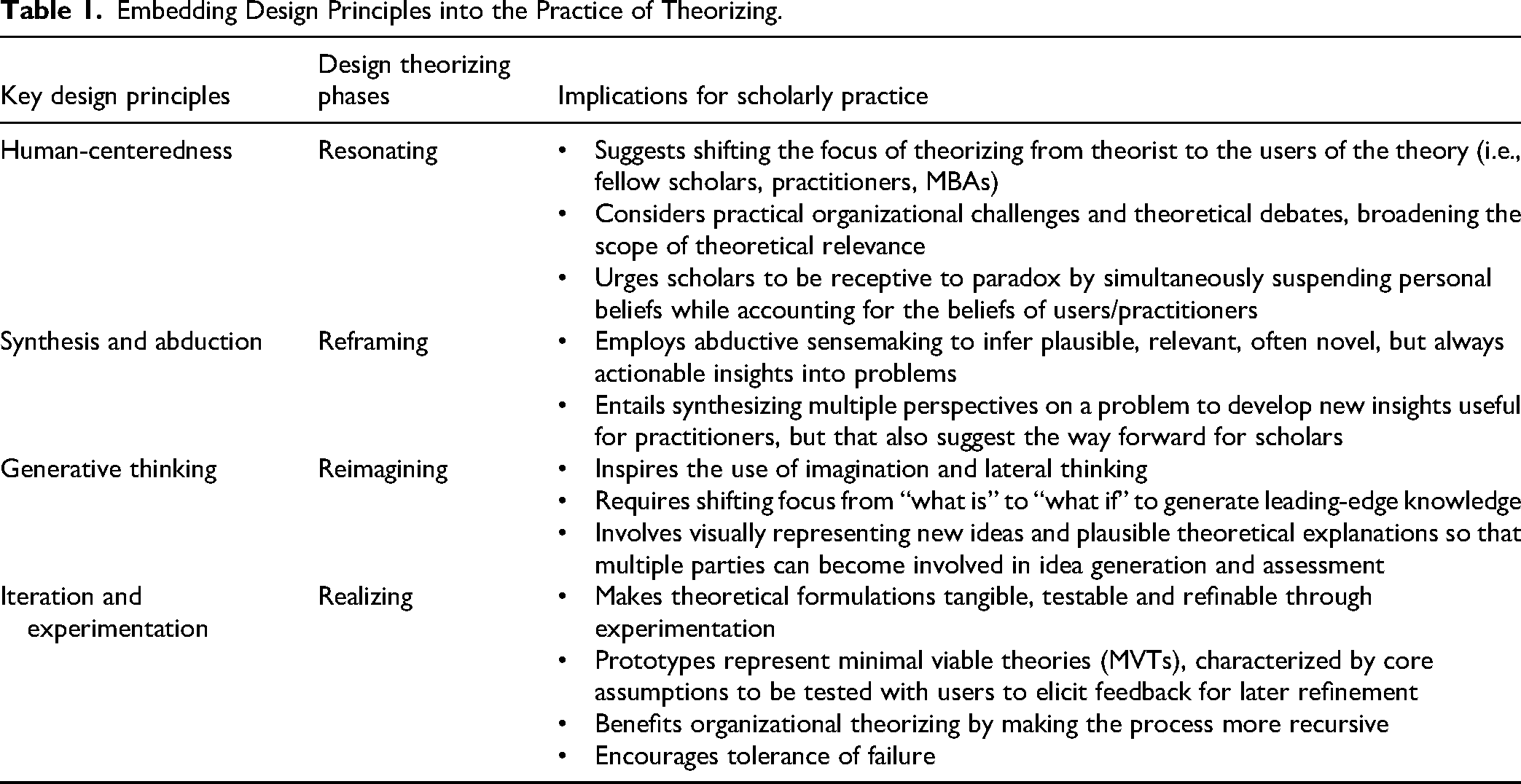
Below we describe an approach embedded in practice and intended to improve other scholars’ theory-development efforts.
A High-Level View of the Process
Resonating
At the heart of design is the desire to understand experience from the user's perspective and to develop solutions centered around user needs, goals, and aspirations. This prompts the designer to seek deeper appreciation and understanding of the practitioner's world with the aim of eliciting and surfacing better understanding of the phenomenological problem. Developing an ability to accomplish these kinds of outcomes helps designers relate cognitively, emotionally, and behaviorally to users, which has direct relevance to building theories that appropriately capture practical experience. Just as designers attempt to engage and empathize with end users, so too can a theorist attempt to resonate with practitioners. It is important to notice that the identification of the focal phenomenon and the relevant users is neither unilaterally determined by the theorist, nor brought forward by the practitioner. Rather, our design theorizing approach sees problem formulation as a co-creative and iterative process in which theorists and practitioners engage in dialogue to identify, define, and prioritize the most pressing challenges. This type of engagement helps determine who the users are, what issues are most salient to them, and how those issues might be framed for theorizing. In other words, users are not given—they are discovered through empathic inquiry and mutual sensemaking. This collaborative process ensures that the phenomenon of interest is not pre-determined but emerges through interaction, enhancing both the practical relevance and theoretical richness of the work.
Reframing
Once the problem has been identified, designers shift to interpreting and synthesizing information gathered about the problem with the aim of identifying both its proximal and distal causes. Designers avoid assuming they already understand the problem (hence, the deep engagement with the end user) by synthesizing incomplete information into coherent wholes and making inferences about how things could be. Or, as Kolko (2010, p. 23) explains, reframing constitutes “a method of shifting semantic perspective in order to see things in a new way.” Focusing on understanding the root causes of the problem allows designers to bring together several perspectives for a more complete view on what types of solutions might work. Rather than relying only on deductive and inductive reasoning to accomplish this synthesis, designers employ abductive reasoning (Coyne, 1988; Kolko, 2010) to elicit plausible, relevant, often novel, but always actionable insights into problems. Once crafted, such insights can then be further refined and re-envisioned in terms of more specific “how might we?” questions, thus becoming the springboard for further idea generation. Insights reframed as how-might-we questions suggest a way forward as designers begin to envision plausible future solutions.
Reimagining
As a solid foundation emerges for understanding why the problem exists, designers can begin anticipating and creating plausible (future-oriented) solutions that address the reframed causes of the problem at hand. We label this stage as Reimagining because it involves building on the insights and plausible explanations arising from Reframing a problem to imagine new ways of resolving it. Imagination is a distinguishing feature of creative people (Stigliani & Ravasi, 2012), although we treat imagination somewhat differently from the norm. Imagining is related to perceiving, but they are distinctive notions. Perceiving is a process aimed at representing “what is” in the world; imagining is aimed instead at envisioning what might be—i.e., a “what if” version of the world. Current portrayals cast managers as adapting to a changing environment, which assumes that the main goal is to accurately perceive and interpret the world as it is. Imagination from a design perspective treats managers as potential shapers of a future they would like to deal with, such that they attempt to create (rather than discover) future opportunities (see Gavetti et al., 2017; Patvardhan & Ramachandran, 2020). This way of viewing imagination sees managers not in terms of the classic “information-processor” metaphor (Fiske & Taylor, 1991) or as a “camera” that records experience (Felin & Zenger, 2017), but rather as a creator (or at least influencer) of possible futures. Imagination, therefore, involves more than mere associations, analogies, and metaphors (Cornelissen & Clarke, 2010; Gavetti et al., 2005; Ketokivi et al., 2017); it also involves active constructions of alternative possibilities.
Reframing the problem with an emphasis on “what if” (rather than “what is”), with a goal of considering plausible future theoretical possibilities, reimagining in the design process can be seen as related to De Bono's (1969) notion of lateral thinking. Rather than adhering to the popular catchphrase “thinking outside the box,” lateral thinking prompts “thinking in different boxes” (i.e., different domains, industries, cultural contexts, etc.) and using those metaphorical boxes as a source of inspiration for new ideas. Designers are encouraged to search for promising ideas in unlikely places and use them as the starting points for recombination processes (like Hargadon and Sutton's, 1997, “knowledge brokering”).
Realizing
Designers act upon their visions by creating tangible representations of the imagined solution (e.g., a 3D model of a chair, a 2D paper version of a phone app, a pilot program for a new subscription model, etc.), such that others can interact with and provide feedback on it, setting the stage for further refinement. In design applications, this process usually means prototyping a new product (McElroy, 2016), service (Blomkvist, 2016), or change program (Coughlan et al., 2007). The goal is to prototype fast and often, and test the prototype on real users; or as David Kelley, founder of IDEO, suggested, take a “fail fast to succeed sooner” approach. Rapid prototyping frees design thinkers to treat failure as a learning opportunity, i.e., the opportunity to learn quickly about the shortcomings of the mock product, service or program, to make changes. The expectation is not to get things right the first time, but to innovate breakthroughs that arise from failure. How do designers get to prototypes? By considering ideas previously generated, choosing those that best strike a balance between user desirability, technical feasibility and business viability, and realizing them in a tangible prototype.
Applying Design Theorizing to Organization Theorizing
With the basic phases of our design theorizing approach articulated, we can now apply them to making organization theories more relevant. Figure 1 shows the framework for theorizing based on Design Principles we propose.
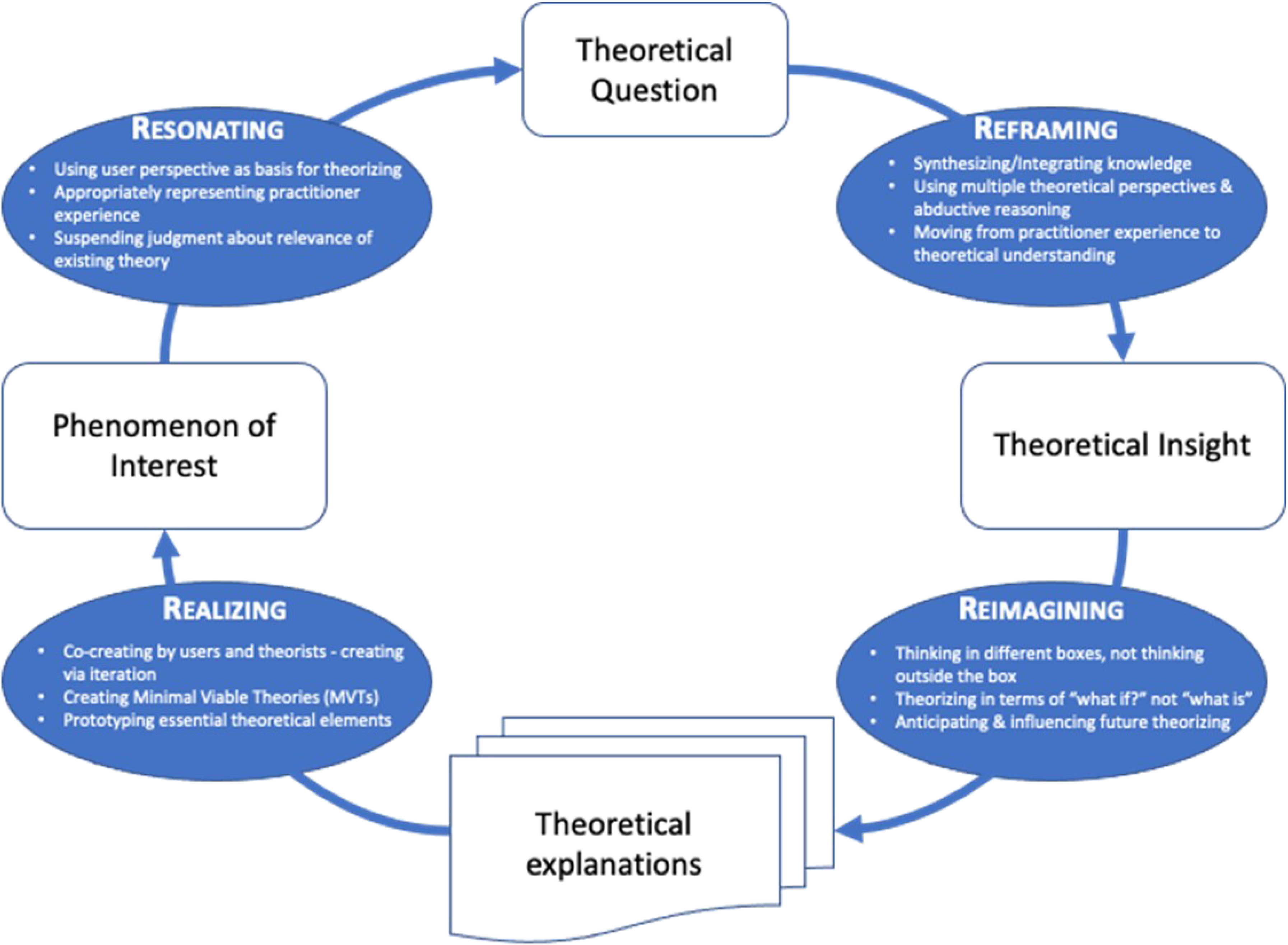
A Framework for Theorizing Based on Design Principles.
Resonating: What's the Problem Here?
The phenomenon we are engaging is theorizing in organizational fields; the users we need to connect with are the scholars producing theories that intend to describe and explain practitioner experience. To accomplish our goal, we consulted past literatures examining the role of theory in our field, as well as engaging organization theorists in discussions about their practices. Additionally, however, we also called upon our own experience as scholars whose main work involves developing theory. An important part of our resonating activities involved engaging with what has already been written about the relevance of organization theories. Over the past 30 + years, there have been several attempts to delineate the problem. Many of those have taken the form of editorials in top journals (e.g., Davis, 2015; Simsek et al., 2018; Wickert et al., 2021), Presidential addresses at the annual Academy of Management meetings (e.g., DeNisi, 2010; Hitt, 1998) and special issues in journals (e.g., Kovoor-Misra, 2020). Still others have made informed pleas for organizational scholars to make their work more relevant (e.g., Chia & Holt, 2008; Hambrick, 1994; Thomas & Tymon, 1982). All these stances imply that our field needs to produce theories that practitioners can understand and find useful, as well as doing a better job of reconciling differing standards for assessing what constitutes a theoretical contribution. With rare exceptions (e.g., Nahapiet & Ghoshal, 1998), the field of organizational study has yet to develop enough such theories that practitioners find useful. Consequently, there remains a “troubling disconnect between management theory and practice” (Corley & Gioia, 2011, p. 22).
More recent works have shifted the narrative from one of lamenting the irrelevance of organization theory and research to advocating for making an impact on practice. For instance, noting that academics and practitioners are guided by “different knowledge systems,” Simsek et al. (2018, p. 2021) explored three different pathways theorists/researchers could take in interacting with practitioners (trailing, leading, and concurrent theorizing) to increase the likelihood of affecting practice. Kieser et al. (2015, p. 144) advocated for applying the scientific rigor of our research practices to the issue of organizational relevance to create a systematic examination of the problem. Conversely, Bartunek (2020, p. 11) offered three examples of scholars attempting to affect practice by “performing their own theories in practice settings.” Drnevich et al. (2020), looking specifically at research on strategic management, called for a return to a “logic of discovery” in scholarly practices, whereas Bresser and Balkin (2022) centered the impetus of the issue on the governance of our academic journals and suggested that a move to open-source publishing of research could help resolve the problem. Finally, the Responsible Research in Business and Management (RRBM) network was recently created to serve as a driver for change “dedicated to inspiring, encouraging, and supporting credible and useful research in the business and management disciplines” (https://www.rrbm.network).
As we resonated with other theorists and tapped into our own experience of theorizing, it became clear that regardless of the perspective taken in approaching the notion of practical relevance, it has largely (and erroneously) been treated as a unidimensional concept. That is, the notion of how to be relevant for practice is rarely discussed in great depth, as if a theory with practical relevance is a straightforward idea. Any discussion with practitioners, however, quickly reveals that developing theory that is relevant and usable outside the academic realm is quite complex. Corley and Gioia's (2011), however, argued that practical relevance is a multi-dimensional concept, consisting of three specific elements: impact, prescience, and scope. First, echoing many others, they acknowledged that practical relevance involves theory that affects practice and the understandings of those engaged in real-world problems and issues. Additionally, they argued that relevant theory also should be “prescient,” which they defined as work that not only anticipates theoretical needs, but also leads practice into the future, rather than following from existing practice (which fits with Emirbayer and Mische's (1998) observation that current theorizing tends to account for the present and the past, but essentially ignores a future-orientation). Finally, relevant theory would have grander scope—i.e., theories with greater reach that not only make a contribution to theory and practice but also provide a bridge to solving many of society's “grand challenges” (Ferraro et al., 2015; George et al., 2016). This multi-dimensional approach proved important to our process, as it provided a foundation for approaching the issue in new ways.
The result of our attempts to resonate with the problem of theoretical relevance led to a worrisome conclusion: even after decades of highlighting the problem and advocating for change, our theories still do not have the kind of impact on practice that leads the people whose actions we are trying to describe to regard us as relevant (Gioia, 2022). This problem persists for many reasons, the observation that too many of our theories do not focus on concerns that represent actual problems that practitioners deem relevant to their work (which is ironic, given that we are a field that ostensibly tries to describe and prescribe best practices for practitioners). Furthermore, our usual approaches do not adequately take into consideration future-oriented issues that practitioners might just become aware of. Finally, our existing theories often lack the scope that would allow us to speak to the bigger challenges facing societies. This is not a “boundary conditions” problem (Busse et al., 2017), but rather a problem with the scope of our theoretical thinking. With persistent issues such as these, it should be apparent that we need to rethink our thinking about theorizing. A design-theorizing approach suggests that we need to reframe the issue instead.
Reframing: Why Is This a Problem?
In attempting to reframe the problem, we began by asking ourselves why our theories are still perceived to be lacking in terms of relevance. It was not for lack of awareness about the issue, as our initial problem exploration pointed out; likewise, it was not for lack of trying, as there are many examples of scholars who have attempted to shift our field's perspective, with little success. We decided, therefore, to deepen and broaden our perspective and to look at the ecosystem in which we, as organization theorists, operate so we could map out our main stakeholders, their expectations, and their influence on the way theorists work. This was a revelatory exercise for us, as it helped us infer possible explanations (Locke et al., 2008; Mantere & Ketokivi, 2013; Peirce, 1988) for issues with relevance. Specifically, we refocused our attention beyond just the practitioners and organizations that typically are the focus of such relevance discussions to include our MBA and Executive MBA students, who expect to learn new concepts, frameworks, and tools that can be applied in their daily jobs. It also included scholars’ career expectations and reward structures and processes, which are often biased toward the number of publications in top organizational journals, with relatively little attention paid to practical relevance. It also included the top organization journals themselves that, on the one hand, stated an interest in novel theoretical contributions, but on the other, encouraged and rewarded what we came to label as “safe theorizing,” i.e., theoretical contributions that incrementally build on and expand existing theories—that is, encouraging theories novel enough to pass a reviewer's threshold for contribution, but not novel enough to challenge existing theories. In other words, “optimal distinctiveness” (Brewer, 1991) seemed to be the watchword: distinct enough to be seen as novel, but not so distinct as to be declared radical.
This broader view of the landscape driving theory-development helped us to understand the social and institutional dynamics underlying our field. One reason that calls for change have been largely ineffective is because organization theorists find themselves in a system that pulls them in opposite directions. Practitioners and students need theories that help them solve current and future challenges, so they ask for guidance to illuminate a way forward, but publication mostly rests upon safe theorizing to get one's work quickly into print in the right journals. This recognition aided us in looking at the problem differently: the root cause of the problem lies not necessarily in the theories themselves, but in the way we theorize and reward theorizing.
In this sense, it is impossible to ignore the fact that the institutional dynamics of academia play a significant role in perpetuating the lack of relevance in organizational theorizing. Scholars are often incentivized to produce theoretical contributions that align with journal standards emphasizing novelty and rigor over practical utility (Bansal et al., 2012). This misalignment of incentives discourages risk-taking and the development of theories that address real-world challenges. Moreover, the reward structures of tenure and promotion, which prioritize publication in top-tier journals, reinforce a system that values safe, incremental theorizing over bold, impactful ideas (Bartunek, 2020; Wickert et al., 2021). These institutional challenges reveal the need for a fundamental shift in how organizational theorists approach their work. Addressing the misalignment between scholarly incentives and practical relevance requires not just changes to the system but also a reimagining of the theorizing process itself. This realization prompted us to rethink our core question: rather than focusing solely on the relevance of theories, we sought to explore how the theorizing process could empower organizational scholars to bridge the gap between academic insight and societal impact.
Therefore, we reframed our problem from, “How can organization theories become more relevant?” to “How can we help organization theorists theorize in more relevant ways?” The difference might be subtle, but it is also significant. Such reframing asks, for instance, how might we facilitate theorists in accounting for the practical implications of their ideas, enabling them to address society's larger challenges? This seemingly minor shift could significantly increase the relevance of our theories. If we assume that organizations, not individuals, are the key “unit of analysis” in society, our task as organizational theorists could be construed as the most important theoretical task of the modern era. Thus, reframing the question in ‘how might we?’ terms became the springboard for generating ideas to address the problem through a new type of imagination.
Reimagining: How Might We Envision Solving This Problem?
Having reframed the problem of theorizing in practice (not content) terms, we afforded ourselves a basis for exploring beyond the typical solution sets often provided in the literature (e.g., translating theory into practice, partnering with practitioners, etc.). We began looking at “other boxes” to see if there was a way to reimagine doing theory development. One of the boxes we considered was the design of theories and their underlying principles. Asking ourselves, “what if we treated this as a design problem?,” we explored what it would look like if theories were constructed according to design-thinking principles. How then would theorizing look differently? This thought experiment afforded us an opportunity to see how creating or synthesizing new ideas (the essence of theorizing) could be intertwined with the roots of our reframed relevance problem: i.e., invoking deep engagement with potential users of the theory (practitioners, students, fellow scholars), assuming a bias toward imagination (i.e., thinking about what if vs. what is) and generating mental representations of how the future could be with an orientation toward tackling problems with significant scope and potential impact. We continued imagining what a combination of designing and theorizing would look like and how design principles could be translated into new guidelines for theorists. This design-inspired process led to our initial attempts at what would eventually become the 4R model articulated in this paper.
Realizing: How Can We Turn Vision into Practice?
Although our portrayal of the typical designer's prototyping efforts might not initially seem to translate well to the theory-development process, there are some parallels theorists can use that sufficiently mirror the principles designers enjoy through prototyping. Perhaps the most powerful of these notions emanates from the lean startup movement's notion of a minimum viable product (Reis, 2011): “that version of a new product which allows a team to collect the maximum amount of validated learning about customers with the least effort” (Reis, 2009). The idea is to create a working form of the new product/service (essentially a prototype) that is feasible enough for customers to use and provide feedback on. Thus, the prototyped product/service can be used to assess ideas, assumptions, descriptions and explanations that enable the designer to make appropriate adjustments based on user experience.
Likewise, for theorists, a minimal viable theory (MVT) would be a version of a new model that allows a theorist to collect the maximum amount of learning from its intended audience with minimal effort. Specifically, an MVT is not a fully realized theoretical model but a provisional framework—a “living hypothesis”—designed to be refined through iterative feedback loops. So instead of the typical image of a theorist toiling to develop the perfect version of a new theoretical model and then submitting it to a journal, using MVTs would have the theorist stage the theory-development process such that initial versions of the model could be shared with practitioners and scholarly colleagues alike, providing the chance to assess its viability and improve it based on their feedback. Realizing the viability of a theoretical model frees theorists to experiment with ideas and treat changes as learning opportunities for addressing shortcomings and theoretical boundary conditions. The expectation is that developing “first approximation” models via abduction (see Bamberger, 2018) facilitates innovative theoretical breakthroughs.
Crucially, Realizing is not a one-time event but a continuous process of socialization where theories are integrated into organizational practices through training, shared narratives, and co-created tools. Therefore, Realizing the potential of a theory involves a deliberate process of operationalizing, testing, and refining. Design theorizing intentionally involves addressing specific organizational challenges to ensure relevance and practical utility, for instance, by piloting interventions grounded in the MVT postulates. Feedback from these interventions would inform iterative refinements to the theory, ensuring its applicability across diverse organizational contexts ensuring that the theory evolves in tandem with practical challenges. As such, an MVT works because the postulates guide actionable interventions that improve organizational outcomes. At the same time, the MVT allows theorists to derive broader principles that inform organizational practice across diverse settings. Therefore, by balancing immediate applicability with long-term generalizability/transferability, design theorizing ensures that theory is both useful and usable.
As demonstrated in the practical examples above, the ‘Realizing’ phase underscores how theoretical development and practical implementation inform one another. This reciprocal process builds on the iterative nature of our design theorizing approach. This iterative approach bridges Holmström et al.'s (2009) two-phase model by embedding the processes of explanation and generalization within the cyclical feedback loops of design theorizing. Rather than treating context-specific findings as a precursor to theory development, however, MVT treats them as integral to the simultaneous refinement of practice and theory.
Our first versions of this design theorizing approach were MVTs shared with our intended audience (organization theorists and management practitioners, because both should be end-user audiences for our theories). Our design theorizing approach then underwent refinement based on their feedback. That feedback helped us think through not only the content of each phase, but more importantly, how the four phases could be intertwined to create a novel process for developing new theories. The process begins with Resonating because the practitioner's perspective should drive any theorizing based on design-thinking principles. As is evident in our descriptions of the 4 Rs, the practitioner's perspective is always key to the design theorist's attempts to develop theory that is relevant to practice. Not only does resonating provide the foundation for understanding which problems need theorizing in the first place, but the remaining 3 Rs are more effective if that resonance carries through to the development of an emergent model. The remaining Rs proceed progressively, with each process building on the others. Linear progression through the model, however, is neither required nor recommended. A key attribute of design is its recursive, structuration-like character, with designers continually looping through different phases to best uncover insights and novel ideas that can produce new products, services, and programs. The same holds for theorists basing their work on design principles. Repeatedly cycling through the 4Rs would be common and would be helpful in developing more prescient and practical theorizing with scope.
Putting Design Theorizing into Action
What follows is a prototypical trip through the design-theorizing process from the perspective of an imagined team of scholars attempting to build a new theory on remote working. We use the Covid-19 pandemic to provide an illustration of how the design theorizing process could be used to develop novel theoretical insights that not only resonate with practice but are also broad in scope and prescience (i.e., can be applied to coming pandemics). The non-medical community was caught flat-footed by this pandemic and the key issues in most organizations turned out to be management-related, not health-related. This created an imperative that we do a better job of theorizing for future practice. The example that follows demonstrates the use of a design-theorizing approach and serves as a sort of “proof of concept” to help theorists see the process in action. Specifically, we illustrate the application of the 4R model through the case study of a creative agency. We show how design theorizing begins with context-specific insights before broadening its applicability to other organizational contexts in the Realizing phase.
Resonating
Under the impetus of COVID-19, the issue of hybrid vs. in-person work has become paramount for many organizations. Some have decided to deal with the issue by giving up their physical spaces and transitioning to a fully remote way of working. This transition poses opportunities and threats for organizations and begs important questions with theoretical implications, like: How can organizations best manage transitions to virtual ways of working? What issues are involved in such transitions? How can issues be transformed into opportunities that enable organizations not only to survive, but thrive? The first step toward developing theory is engaging with those organizations that have recently decided to give up their physical spaces to better understand what led to such a move (beyond the obvious cost-cutting, medical and legislative reasons) and what issues employees face as they embark on this transition. For instance, we had conversations with John and Helen, respectively, the Managing Director and Creative Director of “Creative Formula 2 ,” an innovation agency located in London, UK, who had recently given up the lease on their studio workspace. From their point of view, this was the most sensible move to make, given the fully remote way of working imposed by the outbreak of Covid-19 and considering the decrease in business. Both shared their concerns about the repercussions that such a move would have on team collaboration and coordination, creativity and motivation.
We began our inquiry by learning about the life of various employees at Creative Formula to understand how they experienced their new virtual work life. For example, we talked to Adrian, a digital native business designer, for whom working virtually was the opportunity to cultivate other interests like the possibility of living in Tanzania (because one could work for a virtual company from anywhere in the world) and working on social innovation initiatives for the local community. We spent a day with Reema, a more experienced service designer, who did not have enough physical space to accommodate whiteboards to facilitate brainstorming sessions. We also sat in on a number of weekly team meetings, brainstorming sessions, and client meetings and personally experienced technological glitches, “Zoom fatigue,” the difficulty in running engaging client meetings—in other words, many of the disconnecting experiences felt by most workers forced by the pandemic to alter their approaches to traditional work practices. Moreover, we talked to Richard, futurist in residence in one of our Schools and head of the Foresight Team, about current trends and his predictions about future ways of working and doing business.
As a part of this immersive experience, we also reviewed existing literature dating back to the 1980s that examined the rise of geographically dispersed organizations and the characteristics necessary for the effective running of such organizations (e.g., organization design, coordination mechanisms, etc.), as well as more recent work on the effect of Covid-19 on virtual teams. This engaged experience allowed us to empathize with the struggles and challenges faced by members of an organization accustomed to physically working and interacting in a common workspace, as well as to collect key information about the actual challenges encountered when transitioning to a fully virtual way of organizing. Finally, these steps provided the basis for exploring the relevance (and deficiencies) of existing theory and getting “the lay of the land” when it comes to scholarship applicable to virtual organizing and organizations.
Reframing
By carefully considering our notes, meeting recordings and conversation transcripts, we started identifying patterns emerging from exploring and synthesizing surprising insights about the employee experience. Existing theory suggested a different view than the one revealed by our synthesis. We inferred that the main struggles experienced were not concerned with teamwork coordination and collaboration, per se; neither were they related to overall levels of creativity. Instead, we identified a generalized lower level of motivation and enthusiasm among people at Creative Formula because of a lower sense of identification with the vibrant and innovative culture they had experienced when working in-person. Collective identification had once represented the strong “glue” that kept members together; under virtual-work conditions, these members perceived that Creative Formula's culture was losing its strength, because of the lack of a common physical space and the interactions that would take place there. Put differently, employees missed the feeling of being part of a cohesive collective dedicated to pursuing a higher-order purpose connected to their organization's values and beliefs (Schwartz, 1992). This recognition helped us to reframe the original problem of how organizations can best manage the transition from physical co-location to virtual space into different questions, such as: How might we create virtual interaction patterns to reinforce organizational values and beliefs? How might organizations substitute for the kind of cohesive culture fostered by in-person experience? How might organizations facilitate organizational identification in virtual space?
With such questions in mind, we revisited the literature on virtual organizations to understand whether existing theories could provide adequate answers to these questions or whether prior theory could be used to begin answering such questions. As importantly, we posed these questions back to John, Helen, Adrian, and Reema to help us revise them. These iterative forays back into resonating helped us realize that the most pressing issue in need of theorizing was to understand how to create attachments among members of a wholly virtual organization. We found that (past-oriented) existing theory could not adequately address this set of (current and future) conditions. Our reviews and interviews also suggested that any effective new theoretical frameworks relevant to this new context would need not merely to anticipate, but also to help shape the design of future workspaces—perhaps especially those formed from inception as purely virtual organizations. Unlike organizations that transition to a virtual way of working, nascent virtual organizations do not have a cohesive culture with rituals, routines, and physical artifacts that can act as glue among employees. We therefore reframed our focal problem as: How might nascent virtual organizations create attachments among their members? And how can team collaboration and cohesion be achieved and sustained despite physical separation? This reframing better aligned the agency's focus with the core values of its workforce.
Reimagining
Using this question as our new starting point, we took the next step by conducting a thought experiment: projecting ourselves 30 years into the future, could we imagine a world where most organizations are fully virtual, and people are digital nomads? Where individuals can live literally anywhere in the world and work for virtually any company thanks to ubiquitous satellite-based internet. Under this set of conditions, interest in working for the same company for one's entire career becomes a thing of the past, and traditional perks like a corner office, free food, on-site gyms, or lucrative pensions are no longer attractive or relevant. Instead, individuals move fluidly from one corner of the world to another and from one job to another, attracted by the purpose of the project and how much a job allows them to make a positive impact on the world. Physical social interactions and material perks have been replaced by the pursuit of personal fulfillment.
In this scenario, virtual organizations need to fundamentally rethink how they attract, create, and maintain attachment in their members. As the source of attachment ceases to be material and becomes primarily cognitive and emotional, virtual organizations shift focus from relying on a physical space with a specific look and feel to drive attachment, with rituals and routines no longer built around co-locating to build a cohesive culture. Instead, organizations seek to create a much deeper connection with their members through increased resonance with the organization's mission, purpose, and even ideology, as well as the employees’ personal values and beliefs. This suggests that virtual organizations will envision new inclusive and sustainable forms of enterprise that take into consideration social inclusion, diversity and the well-being of employees, customers and communities and where creating social value is as important as creating economic value.
By running through this thought experiment and imagining what a world composed of successful virtual organizations might look like, two key ideas became apparent. First, much of what current organizations rely on to build attachment among their members is predicated upon there being a physical aspect to the organization. Be it iconic buildings, fancy headquarters (Levy, 2017), or even physical meeting spaces, much of what we currently know about organizational attachment (e.g., culture, identity, identification) assumes some physical interaction in a physical space. Any reasonable prediction about the character of future work needs to surrender that assumption. Second, once we remove this assumption, attracting and retaining members require the potential for them to associate with a higher purpose, something other than relying on being part of a team working in a certain place.
Realizing
These previous two ideas represent the seeds of a potential new theory on attachment in virtual organizations. Instead of aiming to develop a full-fledged theoretical model outlining our new theory of attachment, we aimed for a minimum viable theory (MVT) that would allow us to validate or disprove the most critical assumptions underpinning such a nascent theory, thus maximizing learning about our interpretations in a short period of time. If we receive feedback from practitioners and other scholars that aspects of the MVT are implausible, then we will again engage in reimagining new aspects to our emerging theory by leveraging the feedback received from them. If, on the other hand, our assumptions are affirmed by those others, we will have confidence to start further evolving and refining a new theory. To this end, and in line with designers’ “fail fast to succeed sooner” approach, we developed a set of working postulates representing the main pillars of an emerging theory of attachment in a completely virtual organization:
Postulate 1: Employees of the future will value personal fulfillment over work-based social interactions and material perks. Postulate 2: Developing stronger mission-/purpose-driven organizational cultures will allow organizations to better resonate with their employees’ values and beliefs. Postulate 3: Organizations that provide personal value fulfillment for their members will experience better employee attachment than those that do not. Postulate 4: Future enterprises will rely on the creation of social value as much as the creation of economic value in fulfilling stakeholder expectations.
To assess these postulates, we prototyped and tested our MVT with members of three organizations undergoing transitions to fully virtual work environments to ensure a broader applicability of our MVT: our creative agency, a mid-sized consulting firm, and a tech startup. In each case, we introduced tailored interventions based on the MVT's core postulates and systematically collected feedback over six months.
At Creative Formula, we helped implement bi-weekly virtual “value alignment workshops.” Employees participated in sessions where they co-created a shared narrative about the organization's purpose and how their personal goals aligned with it. We monitored engagement through surveys and interviews. Early results showed that employees initially expressed skepticism but later reported feeling more connected to the company's mission. For example, one designer noted that, “It reminded me why I joined this company in the first place.” By the fourth session, participation increased by 20% and employees rated their sense of organizational belonging 1.5 points higher on a 5-point scale compared to baseline measurements.
For a mid-sized consulting firm, we worked with leadership to establish a “Digital Campfire” initiative, i.e., weekly virtual gatherings where employees shared stories of how their projects aligned with the company's broader mission. Initial feedback indicated a lack of engagement, so we iterated by introducing rotating facilitators and incentives (e.g., digital badges). After three iterations, 85% of participants reported that the campfire sessions helped them reconnect with the organization's goals, compared to 60% in the initial prototype.
Finally, in the tech startup, we tested policies derived from Postulate 1, such as a “Purpose Sprint,” where teams dedicated one week per quarter to aligning their work with the company's stated values. Employees engaged in co-designing future product strategies that prioritized environmental sustainability and social impact. We assessed this intervention using both real-time data collected during sprints and quarterly surveys. Results showed that 70% of employees felt more motivated by having a direct role in shaping purpose-driven initiatives.
Throughout these interventions, we treated the theoretical postulates as “living hypotheses” to be iteratively tested. For example, we refined Postulate 3, which connects personal value fulfillment with employee attachment, to emphasize the role of peer relationships in fostering fulfillment after qualitative data revealed that social connections significantly affected employee satisfaction in all three organizations. Moreover, the insights gained from refining “Digital Campfire” sessions contributed to a broader understanding of how virtual rituals could foster a sense of community and purpose, thus refining Postulate 2. Through these efforts, we not only validated key elements of the MVT but also identified areas for further refinement, such as integrating feedback mechanisms more explicitly into organizational routines. This iterative, feedback-driven approach enabled the MVT to evolve into a more actionable, scalable framework.
Finally, we shared our model with two professors of organization theory whose research interests focus on ethical issues related to new ways of organizing. During these discussions, one highlighted the importance of addressing potential tensions between personal fulfillment and collective alignment in fully virtual organizations. This feedback led us to further refine Postulate 3 by emphasizing the role of structured opportunities for peer interaction as a mediator between value alignment and employee attachment. The second professor questioned whether our postulates sufficiently accounted for power dynamics in shaping virtual organizational cultures, prompting us to add a specific focus on leadership practices in our theoretical framework. These conversations, as well as the progression from the creative agency to other organizational settings, strengthened the theoretical rigor of our model and revealed areas for further empirical testing, thus ensuring the MVT remained both context-specific and more broadly applicable and scalable.
As this example illustrates, engaging in design theorizing broadens the focus of theorizing from the sole point of view of the theorist to that of the users of such theories and relies on theorists’ imagination to generate knowledge that deviates from current thinking. Differences from current theorizing practice might be subtle, but they are nonetheless profound. Design theorizing, therefore, offers a new paradigm for building relevant theories.
It should be noted that, although our initial prototyping of an MVT began within the specific context of a creative agency, we treated this case only as a starting point for broader theorizing. As design theorizing rests upon iterative testing and refinement, we extended our inquiry to two additional organizations in distinct sectors to probe the boundary conditions and applicability of our postulates. Although these organizations also operate in knowledge-intensive domains, their structures, cultures, and client-facing practices differed meaningfully, allowing us to surface nuances and revise our theoretical assumptions. Further validation across more diverse sectors (e.g., manufacturing, education, agriculture, etc.) is necessary, which we as an opportunity rather than a limitation: design theorizing explicitly treats theory as provisional and contextually grounded, to be progressively generalized through iterative engagement across settings.
Discussion
Assessing our Future Potential
Feedback from external stakeholders underscores the lack of relevance in our theories, prompting us to shift the basis of theory building toward design principles. This shift reflects two insights: first, relevance efforts have largely focused on making theory outcomes more practical, whereas a processual approach (Weick, 1989) offers greater potential for addressing the complexity of modern organizational challenges (hence our intentional choice of the term theorizing). Second, the relevance issue is frequently approached as unidimensional, wherein suggested theoretical solutions involve mainly making our theories more directly applicable to practice. We believe, however, that a multi-dimensional approach to relevance not only more appropriately captures the features of many present and future issues but also provides a foundation for imagining more creative and effective solutions. The beauty of applying design principles to reconceiving the theorizing process is that the resulting theories have the potential for addressing the multi-dimensional character of relevance, not only for theorists, but for practitioners as well.
Our design theorizing approach aligns with emerging distinctions between theory OF and theory FOR (Dimov et al., 2023). Theory OF seeks to explain and fit existing phenomena, whereas theory FOR provides a blueprint for shaping future possibilities. Design theorizing sits at this intersection, bridging explanatory and generative paradigms. By leveraging a forward-looking, iterative processes that engage with both current realities of organizations and their envisioned futures, design theorizing combines factual inquiry with prospective exploration. Similarly, our approach complements work differentiating factual inquiry, aimed at understanding “what is,” from prospective inquiry, envisioning “what could be” (e.g., Muñoz & Dimov, 2023). This distinction resonates with our emphasis on abductive reasoning and the iterative refinement of MVTs to generate theories that not only describe but also help create preferred futures for organizations.
Moreover, organizational theorists offer unique value by abstracting individual practices into broadly applicable theoretical frameworks. Whereas practitioners might generate highly context-specific insights, these are often difficult to scale or make transferable. Design theorizing allows organizational scholars to synthesize diverse, complex inputs from multiple contexts into frameworks that provide both prescriptive and explanatory power. For example, our MVT approach is not meant to replicate the practical advice found in practitioner literature, but to provide a scaffold for theorists and practitioners to iteratively develop context-specific applications while contributing to a broader, shared body of knowledge. Furthermore, by starting with context-specific insights (from the creative agency in our example), design theorizing ensures practical relevance, whereas the iterative refinement of interventions (e.g., the Digital Campfire and Purpose Sprint) in other organizational contexts show its capacity to generate principles applicable across diverse organizational contexts. Such scalability positions design theorizing as a robust framework for bridging the gap between theory and practice.
The 4R model reveals several implications for the orientation we believe organizational scholars could and should adopt. One important implication relates to maintaining a consistent focus on the user's perspective—i.e., theorists working to account theoretically for experience of practitioners. By emphasizing user-centered design principles, theorizing can effectively bridge the gap between academic abstraction and practitioner relevance, providing a foundational framework rather than isolated advice. An emphasis on this stance does not assume that new theory occurs simply by “standing on the shoulders of giants” (Newton, 1675), which tends to generate only incremental advances; instead, our focus allows the possibility of actually seeing differently.
A second important implication of design theorizing is its ability to engage with paradoxes and ambiguity (cf. Lewis, 2000). The design theorist withholds judgment, suspending prior assumptions when confronting the VUCA landscape of messy current and future problems—sometimes by holding different or even contradictory ideas in tension. For instance, the process of reframing asks theorists to consider current theoretical beliefs while simultaneously seeing differently in previously unconsidered terms. Moreover, the process of reimagining circumvents the presumption that the future is likely to be a variation or an extension of the past and visualizes an alternative future by emphasizing a what-if? way of thinking, instead of using a more traditional what-is? approach (which too often generates a solution that addresses yesterday's or today's concerns, not tomorrow's). Finally, the Realizing phase demands that new theoretical formulations be tangible, testable, and refinable through experimentation and prototyping.
Embracing design theorizing necessitates revisiting the very nature of theory and its relationship with practice. Whereas classical theorists like Kurt Lewin (1943, 1944) emphasized the practical utility of theory, many contemporary organizational scholars have prioritized abstraction over applicability, with the result of widening the gap between organizational scholarship and practice. To realign with Lewin's vision and Thompson's (1956) framing of administrative science as parallel to applied engineering, design theorizing emphasizes creating theories that not only explain but also solve real-world problems. These solutions are iteratively refined within specific contexts before being scaled, generalized, or made transferable. This approach echoes Boland and Collopy's (2004) concept of a “design attitude,” which prioritizes creating solutions that work in practice over simply choosing among theoretical alternatives.
The distinction between the MVT approach and traditional design-science models is not merely procedural but conceptual, as well. By maintaining a fluid interplay between theory development and practical experimentation, MVT avoids the rigidity of sequential phases, enabling scholars to generate insights that are both contextually grounded and theoretically robust. This dynamic interplay ensures that a theorist does not engage with the problem merely “indirectly,” but participates in co-creating solutions that reflect the complexities of modern organizations.
One critique against an expanded view of practical relevance for our theories and a reimagined process-orientation is that this type of approach might be infrequent because it is harder to do than traditional theorizing. Will this kind of work be rarer? Perhaps. But our stance is that just because we have not done enough relevant (i.e., impactful, prescient, large scope) work in the past does not mean it should not be an integral part of our future. As Katz and Kahn (1966) argued, scholars have dual responsibilities: to maintain existing knowledge and to adapt by generating new knowledge. Although maintenance-oriented dissemination (e.g., teaching “what works”) is common, the adaptive role of generating new knowledge is what drives progress in our field. Design theorizing embodies this adaptive responsibility by pushing the boundaries of knowledge-generation, valuing innovation over replication, and aspiring to address practical challenges in ways that contribute to broader theoretical development.
Benchmarking our Past
In an era characterized by increasingly intractable or “wicked” problems (Churchman, 1967) that demand increasingly creative solutions, we have argued that organization study needs to develop a more relevant approach to theory building. More than a decade ago, Corley and Gioia (2011) argued that future theorizing should be assessed according to three criteria of relevance: that new theory should: (1) be more practically oriented, (2) be more prescient, and (3) have greater scope. A key question might therefore be: How have we been doing in the intervening years?
An Orientation Toward Practical Impact
It is gratifying to see that scholarly attention paid to increasing the applicability of our theories to practice has accelerated in recent years, especially since 2015. Bartunek (2020), Drnevich et al. (2020); Gioia (2022), Kieser et al. (2015), Simsek et al. (2018) and Wickert et al. (2021), among others, all have made impassioned statements and offered practical suggestions for increasing the impact of our scholarship on practice. Other organizational scholars have applied “the design science paradigm” (Simon, 1996) to increase the significance and application potential of empirical research (e.g., Romme, 2003; Romme & Endenburg, 2006; Van Aken, 2004). Drawing on the idea of managing as designing (Boland & Collopy, 2004), these scholars argue that academic research in the field of organization and management studies should be less explanatory (i.e., focused on describing, explaining, and predicting organizational phenomena) and more design-oriented (i.e., exploratory, prescriptive-driven and solution-focused) so as to develop alternative courses of action in dealing with organizational problems (Holmström et al., 2009; Van Aken, 2004, 2005). In so doing, design science research sits in between explanatory sciences on whose knowledge it often builds and the concrete practices of the professionals it seeks to support (Berglund et al., 2018).
All these recent efforts suggest that our field is now more attuned to the need to conduct research and generate theories that practitioners find useful to their work. They also have the laudable effect of helping to redefine, or at least expand, the notion of what constitutes a contribution to organizational theorizing. Our design-theorizing approach builds on these efforts to show how researchers can enact conceptual structures that shape practitioner ways of understanding, which they then can use in further theory-building practices (see Orlikowski, 2002).
An Orientation Toward Prescience
On the prescience criterion, our field has done less well, although there are some encouraging examples of theories that exhibit elements of prescience. To date, the usual approach to developing new theory has been to presume that the future is some variation of the past. Revising our theory building requires a change of orientation, however, because the traditional approach to sensemaking is essentially retrospective (Weick, 1979), in that people are portrayed as invoking a rather passive (Felin & Zenger, 2017), backward-looking (Gavetti et al., 2012) way of thinking. In this view, decision makers are portrayed as using “future perfect” thinking (Weick, 1979)—i.e., casting themselves into the future, acting as if events already will have occurred (according to forecasts based on past performance), and then interpreting those forecasts “retrospectively.” There are two problems with this portrayal: first, it treats future-oriented sensemaking as a special case of retrospective sensemaking, rather than a distinctive process in itself; second, its orientation is predicated on past experience (rather than oriented toward influencing a desired future).
The design process has been described as a sensemaking process oriented toward the future (Stigliani & Ravasi, 2012), however; design theorizing can be viewed as a similar kind of process for scholars. What if managers did not just want merely to adapt, but instead wanted to try to shape a future (Levinthal, 2017)? Would they project from a known past? No, they would not, especially if they hoped for a future unlike the past. A genuine approach intended not only to anticipate, but also to influence and shape future action, therefore, cannot be based on a retrospective orientation, but instead requires the skillful use of imagination. Adopting a genuinely projective approach means that it is necessary to suspend our dependence on prior models that align with an organization's existing dynamic capabilities (see Teece & Pisano, 1994). Whereas prior models assume that firms are at the mercy of the environment and therefore must develop features allowing them to better conform to changing conditions, an alternative model would assume that managers can proactively shape the future by taking actions now that would produce events in a direction that favors their firm's abilities and strengths. In design-thinking terms, managers take actions in the present intended to affect future opportunities. In terms relevant to our current enterprise, the more relevant question becomes, “How can we adopt a genuinely prescient way of understanding theory building—one that not only anticipates theoretical needs, but can influence the ability to achieve them?” Applying a design-theorizing lens asks theorists to work toward advancement by reimagining what could be, thus becoming “inventors and shapers of realities” (Patvardhan & Ramachandran, 2020, p. 689).
An Orientation Toward Scope
Adopting a design-theorizing approach means we must think differently about how we think about and go about theory building. For decades, the main focus of organization theorists has largely rested upon making contributions to theory and (sometimes) practice. The question of the relevance of our professional field, however, has made a shift in the scope of our theories both necessary and timely considering the growing interest of organization scholars in addressing “societal grand challenges” (George et al., 2016). Simply put, our theories should provide a bridge to solving such challenges. Just as “the fundamental principles underlying a grand challenge are the pursuit of bold ideas and the adoption of less conventional approaches to tackling large, unresolved problems” (Colquitt & George, 2011, p. 432), so too our theories need different principles to be relevant. The design principles we invoke offer theorists the means to address problems where multiple domains collide—at the intersections of business, society and technology, logic and emotion, rational and creative thought, human needs and economic demands and among systems and individuals.
Conclusion and Boundary Conditions
Building relevant theories represents a kind of “stretch goal” (Sitkin et al., 2017)—a challenging objective that cannot be achieved by doing better what we already have been doing but requires figuring out a different way of dealing with problems. We believe that aspiring to reach this goal is necessary for our own well-being as organization theorists, and perhaps even our survival as a professional field. We argue that adopting design theorizing as a new approach to thinking theoretically represents a key to unlocking our multi-dimensional problem of relevance.
Although design theorizing provides a powerful framework for addressing the relevance issue in organizational theory, its effectiveness is contingent on some boundary conditions. First, design theorizing is most suitable for phenomena that are complex, ambiguous, and lack clear solutions. In contrast, it might offer limited utility for theorizing that requires deductive reasoning based on well-established paradigms or for problems that are primarily technical and narrowly defined. Second, the iterative nature of this approach assumes that theorists have access to rich, real-time feedback from practitioners or other stakeholders. In contexts where such engagement is limited, or where theoretical contributions are too abstract to prototype effectively, the potential for meaningful iteration diminishes. We also recognize that some elements of design theorizing—such as making theoretical formulations tangible, testable, and refinable through experimentation—might already exist implicitly in certain areas of organizational research. However, these practices are often ad hoc or peripheral, rather than forming a central, intentional approach to theorizing. By foregrounding these elements as part of a structured process, design theorizing offers a way to systematically address gaps in the relevance of organizational theory.
Finally, for design theorizing to reach its full potential, it is critical to address the institutional structures that shape academic priorities. Misaligned incentives currently discourage the development of practically relevant theories, favoring safe, incremental contributions. Moving forward, reimagining these structures—through changes in reward systems, journal priorities, and academic training—can create a foundation where design-inspired approaches can flourish. We believe this systemic shift is vital for transforming organizational studies into a discipline that not only explains but also help to shape the future of management and society.
Footnotes

Funding
The authors received no financial support for the research, authorship, and/or publication of this article.
Declaration of Conflicting Interests
The authors declared no potential conflicts of interest with respect to the research, authorship, and/or publication of this article.