



Abstract
Recent advances in research have shed light on why and how community-based enterprises (CBEs) emerge. Nevertheless, little is known about the underlying factors that contribute to their success over time. This lack of attention is intriguing, given CBEs’ widespread proliferation as an instrument for socioeconomic development. We contribute to the CBE literature by applying and extending socioemotional wealth (SEW) to the CBE context. Our findings demonstrate how the presence of community socioemotional wealth (CSEW) enables CBEs to achieve enduring success. Beyond the presence of SEW's five traditional dimensions, we identify two new dimensions (empowerment and holistic mission) unique to CBEs. When jointly present, these seven dimensions explain how CSEW creates a favorable terrain for the CBE to succeed.
Keywords
Introduction
Entrepreneurship is a key element for socioeconomic development in both developed and emerging economies. Far from the glitter of high-tech ventures, community-based enterprises (CBEs) play a vital role in local communities’ ability to tackle local and broader societal challenges (Hertel et al., 2019). CBEs are a widespread phenomenon around the world, from Sami reindeer herders in Finland (Dana & Light, 2011), to Mayan communities in Mexico (Giovannini, 2016), to the Māori in New Zealand (Campbell-Hunt et al., 2009), to green energy initiatives in Burundi or Germany (Cieslik, 2016; Hertel et al., 2019). Despite the proliferation and importance of CBEs, surprisingly little is known about the underlying factors that contribute to their success over time (Hertel et al., 2019; Peredo & Chrisman, 2017).
CBEs are collectively established enterprises that are owned and controlled by the members of the local community in which they are embedded, and for whom they aim to simultaneously generate social, economic, environmental, and cultural value (Hertel et al., 2019; Peredo & Chrisman, 2006). Peredo and Chrisman (2006) define a CBE as “a community acting corporately as both entrepreneur and enterprise in pursuit of the common good.” Our motivation for gaining a deeper understanding of how CBEs succeed follows the surge of interest in improving enduring entrepreneurial initiatives of local communities (Daskalaki et al., 2015; Hertel et al., 2019). Many CBEs, especially those in poor regions, have to cope with extreme adversity due to their liabilities of newness and smallness in the form of resource constraints, competition, and environmental dynamics (Peredo, 2003). As a consequence, many CBEs fail (Peredo & Chrisman, 2017). For all the above reasons, the success of CBEs constitutes a significant concern for scholars, practitioners, and policymakers across the world (Daskalaki et al., 2015).
Recent advances in research have shed some light on why and how CBEs emerge (Daskalaki et al., 2015), and the factors that lead to their successful creation (Hertel et al., 2019). However, important gaps remain in the knowledge about how CBEs evolve once they have emerged. In this paper, we set out to advance the current knowledge about CBEs by studying important characteristics that shape their success and preservation over time. Specifically, we use socioemotional wealth (SEW) (Berrone et al., 2012; Gómez-Mejia et al., 2007) as an analytical lens in the context of CBEs. Thus, like Kurland and McCaffrey (2020), we use SEW beyond the realm of family businesses and show how the affective endowment rises to the community level. SEW comprises the nonfinancial aspects of family businesses that meet their affective needs, such as identity, the ability to exercise family influence, and the perpetuation of the family dynasty (Gómez-Mejia et al., 2007). Adapting SEW to the specific particularities of CBEs allows for a better insight into the relationships within the CBE, and with society at large, that form the basis of their success or failure. More precisely, we seek to address the following research question: Which underlying socioemotional features facilitate CBEs’ ability to successfully fulfill their multiple goals and achieve enduring success?
To answer this question, we examine a CBE in the rural Cauca region of Colombia, Association for the Production and Commercialization of Agricultural and Aquaculture Products of Silvia (APROPESCA) 1 . The idiosyncratic features of this remarkable CBE, along with rich longitudinal data, provide a unique opportunity to understand the interconnection between business performance and broader social value for the community. We deem the research setting particularly appropriate as this CBE's foundational unit is the family unit—it constitutes a collective of 325 families that balances economic objectives with affective needs. Moreover, decision-making has a conspicuous resemblance to those in family businesses, with co-dependence being a distinctive feature of this CBE. Members of the organization (farmer families) are at the base of the socioeconomic pyramid, and as such they rely heavily on each other for their well-being, as family units and as a larger collective.
Through an abductive approach to theory elaboration, our paper contributes to the CBE literature by applying and extending the construct of SEW to CBEs. Our findings provide insights into how the presence of community socioemotional wealth (CSEW) enables the CBE to successfully fulfill its multiple goals and achieve enduring success. Not only do we observe the presence of SEW's five dimensions at the community level (control and influence, identity, bonding social ties, emotional attachment, and dynastic succession), but notably we uncover two novel dimensions (empowerment (EMP) and holistic mission (HMI)) that are unique to CBEs. These seven dimensions create a valuable construct to study CSEW and, when observed, help explain the presence of a favorable terrain for CBEs to succeed.
In the next sections, we review the literature on CBEs, family businesses, and SEW. We then introduce the data gathering and analysis methods. Finally, we present and discuss the findings and conclude with implications and avenues for future research.
Theoretical Background
Community-Based Entrepreneurship
In their seminal paper, Peredo and Chrisman (2006, p. 310) note that CBEs are “managed and governed to pursue the economic and social goals of a community in a manner that is meant to yield sustainable individual and group benefits over the short and long term.” In their conceptualization, poor socioeconomic conditions prompt the positioning of the community as a “unique whole” working for the common good. Economic aspects combined with contextual and social aspects allow a community to act as both an enterprise and an entrepreneur through a united group of individuals who manage the venture themselves. Implicit in that definition is a recognition that noneconomic group objectives are also part of the decision-making process. CBEs, as defined by Peredo and Chrisman (2006), are characterized by five elements, namely: (1) embeddedness, that is, the entrenchment of a CBE into a local community's structures; (2) self-sustaining business activity, that is, the production and commercialization of a product or service in an economically viable way; (3) multiplicity of goals, that is, the goal to generate not only economic but also social and/or ecological benefits; (4) community orientation, that is, the goal of generating benefits for the community as a whole, and not only for specific individuals; and (5) collective establishment, ownership, and control, that is, the community members are the main actors in enterprise creation and governance, and hold most of the shares in the enterprise.
Since then, scholars have delved into the study of such enterprises in both developing and developed economies to empirically investigate how the five elements described by Peredo and Chrisman (2006) play out in CBEs. For example, they have studied how culturally and socially united communities join to form an enterprise (Somerville & McElwee, 2011), and how CBEs in various contexts have come into existence to tackle market failures and institutional voids (Fiszbein, 1997). Dana and Light (2011) focus on Sami communities involved in reindeer herding in Sweden, Handy et al. (2011) study a community of jasmine growers in India, Kraybill and Nolt (2004) write about Amish communities, and Anderson (1997) investigates specific indigenous communities in Canada. Some studies have highlighted specific factors of the creation process of such enterprises, including identity (Dana & Light, 2011), bonding social capital (Haugh & Brady, 2019), legitimacy (Vestrum et al., 2017), and resource mobilization (Vestrum, 2016). All these factors are important in encouraging the creation of CBEs. Hertel et al. (2019) further advance the literature on CBEs by explaining why some communities create CBEs successfully while others fail to do so, focusing on the role of identity as a differentiating factor. More recently, Kurland and McCaffrey (2020) apply SEW to the context of communities to explain decisions around the preservation of these communities, referring to the concept as CSEW.
While CBEs are of growing relevance, and recent literature has made important strides in understanding why CBEs are created, what their characteristics are, and how they can be successfully created (Hertel et al., 2019; Peredo & Chrisman, 2017), we still know little about which factors help to explain how CBEs can be successfully managed, fulfill their multiple goals, and preserve themselves over time. Our study seeks to further develop theory on CSEW by drawing additional insights from SEW in family businesses.
Family Businesses and Socioemotional Wealth
A family business can be defined as a business that is at least partially owned and controlled by one or more members of a household related by blood, marriage, or adoption (Olson et al., 2003). Existing management research has established that family businesses, despite their heterogeneity, behave in unique ways and differently than nonfamily businesses, primarily by focusing on idiosyncratic noneconomic goals that are not typically assessed in traditional business research (Villalonga & Amit, 2010). Family businesses face challenges that may be more pronounced than they would be in nonfamily businesses, or that may need to be addressed differently. Zellweger (2017) notes that: “while governance in nonfamily firms is mainly concerned with the effective structuring of the cooperation between a dispersed group of owners and a limited number of managers, governance in family firms also includes topics such as the effective collaboration of a group of family blockholders or the efficient oversight of family managers (such as children) by family owners (such as parents)” (Zellweger, 2017, p. 1).
It has been established that family businesses make strategic decisions to preserve their socioemotional wealth (SEW) wherever possible (Gómez-Mejia et al., 2011). SEW is defined as the “nonfinancial aspects of the firm that meet the family's affective needs, such as identity, the ability to exercise family influence, and the perpetuation of the family dynasty” (Gómez-Mejia et al., 2007, p. 106). SEW comprises five dimensions, abbreviated as FIBER (Berrone et al., 2012): (1) Family control and influence, which refers to the control and influence of family members over strategic decisions. Families’ propensity to ensure continued control over strategic decisions through the appointment of family members to key positions is driven by their desire to preserve the family's values and characteristics, and consequently SEW, in the organization (Gómez-Mejia et al., 2011); (2) Identification of family members with the firm, whereby the intertwining of family and business gives rise to an intrinsically unique identity within family businesses, causing both internal and external stakeholders to view the business as an extension of the family itself. This influences the attitudes of family members, toward employees, and even toward internal processes, as well as the quality of the services and products provided (Carrigan & Buckley, 2008); (3) Binding social ties, which refers to family business’ social relationships. Kin ties between immediate and extended family members engender strong social bonds within the family, as well as with the community at large (Cruz et al., 2012). These social ties provide collective benefits typically present in closed networks, including collective social capital, relational trust (Coleman, 1988), and feelings of closeness and interpersonal solidarity (Uzzi, 1997). Moreover, these binding social ties promote a sense of stability and commitment to the business (Miller & Le Breton-Miller, 2005); (4) Emotional attachment of family members deals with the affective content of SEW and refers to the role of emotions in the family business environment. By their very nature, families are characterized by a wide range of positive and negative emotions that permeate the day-to-day management of the family business (e.g., warmth, tenderness, love, pride, happiness, fear, loneliness, sadness, or disappointment) (Epstein et al., 2003). Moreover, emotional attachment also refers to the psychological appropriation of the business by the family in order to maintain a positive self-concept (Berrone et al., 2012); (5) Renewal of family bonds to the firm through dynastic succession refers to the intention of handing the business down to descendants. For family members, the business is not just any asset that can easily be sold, as it embodies the family's heritage, tradition, and values (Casson, 1999), and, as a consequence, they view it as a long-term family investment to be bestowed on future generations (Berrone et al., 2012).
In family businesses, SEW influences key managerial decisions in a way that sets them apart from nonfamily businesses (DeTienne & Chirico, 2013). However, Olsen and colleagues’ (2003) definition of family businesses can be interpreted as excessively restrictive. It has been established that what is considered a “typical” family differs between people and cultures (Trost, 1990). Alternative ways to define a family, besides the normalized Western view of the nuclear family, range from social relationships to biological relations to economic dependence, among others (Morphy, 2006). For example, in Indigenous communities, the concept of a family unit may be much larger (Pattel, 2007). Family belonging is not necessarily based on blood, marriage, or adoption, but can be established by cultural kinship systems (e.g., parenting practices, language, or social or territorial embeddedness) (Tam et al., 2017). Other communities, such as the Amish in the US (Anderson & Kenda, 2015), jasmine growers in India (Handy et al., 2011), or rural village communities in Germany (Hertel et al., 2019), may share strong bonds and exhibit collective agency akin to typical or extended families. A more inclusive and realistic view of what is understood to be a family enhances scholarship by furthering the application of concepts, such as SEW, from traditional Western-centric family business literature to the context of CBEs.
Like family businesses, CBEs stretch beyond the pursuit of economic gains and include explicit efforts to contribute to and/or preserve the heritage and well-being of the community. Given that CBEs are enterprises that are owned and controlled by members of the local community for which they aim to simultaneously generate social, economic, environmental, and cultural value (Hertel et al., 2019; Peredo & Chrisman, 2006), their behavior with regard to management and strategic decision-making shows many parallels with that of family businesses (Kurland & McCaffrey, 2020). The fact that both family businesses and CBEs are oftentimes embedded within a territorial social and institutional structure that intertwines economic and cultural relationships further underscores the presence of these parallels (Le Breton-Miller & Miller, 2009; Martínez-Sanchis et al., 2020).
Drawing on the literature, we identify relevant similarities and differences between family businesses and CBEs to explore SEW as a fitting theoretical lens for a better understanding of how CBEs are managed and sustained. Much like family businesses, CBEs need to manage important nonfinancial aspects to meet the affective needs of the community, such as the preservation of the community's identity, relationships between members with divergent views, multiple families, and generations.
Community-Based Enterprises and Socioemotional Wealth
In their paper, Kurland and McCaffrey (2020) establish the link between communities and SEW. They expand SEW to explain affective endowment considerations at the community level that inform decisions about the preservation of the community. Other studies allude to the same link. For example, Miller and Breton-Miller (2014)> distinguish between restricted SEW and extended SEW; the latter recognizes the benefits that go beyond the family, including the investments that are made into the community to ensure goodwill toward the family and its business. Reay and colleagues (2015, p. 293) illustrate how community logic, defined as the logic in which “a firm is organized to serve community needs,” guides the behavior of businesses embedded in a community.
The link between CBEs and SEW has yet to be explicitly established, despite advances toward this link by scholars working on communities more broadly. While CBEs have a multiplicity of goals transcending the continuity of the community and comprising social, economic, environmental, and cultural value (community-oriented), the main goal of the family business is geared toward the continuation of the family legacy through the survival of the business (family-oriented). For this reason, hierarchies in family businesses tend to be clearer to retain control, despite nonfamily members often being involved in the management and ownership of the business. Nevertheless, both CBEs and family businesses maintain sufficient ownership to control the business. Hence, the first dimension of SEW, relating to family control and influence, would be equally pertinent for CBEs.
For members of both family and community enterprises, the business is more than just a commercial activity, given the high degree of identification with the enterprise. This heightened identification is nurtured by characteristics such as shared kinship, in-group belonging, common goals, history, and culture (Tajfel, 1974). Identification of members with the CBE is a factor that Hertel and colleagues (2019) describe as essential for the successful creation and long-term survival of such businesses.
Binding social ties are also a key aspect of family businesses and CBEs which is well documented in extant literature: SEW provides kinship ties with collective benefits comparable to those observed in other closed networks (e.g., Cruz et al., 2012). Peredo and Chrisman (2006, 2017) similarly underscore the importance of binding social ties and, more generally, the role that networks and social capital play in the creation of CBEs through their relationship with community members and external stakeholders. It is established that such ties provide the necessary cohesion, trust, and reciprocity that support CBEs’ entrepreneurial process and success (Dana & Light, 2011).
The fourth dimension of SEW relates to its affective content and refers to the role of emotions. Families are characterized by a range of emotions that constitute an integral part of how they manage their business. The interaction of emotional factors, originating from family involvement, with business factors is considered a distinctive attribute of family businesses (Eddleston & Kellermanns, 2007). These emotions, however, are not only reserved for the context of family businesses. CBEs, too, comprise members with strong ties and shared experiences, history, or culture. It is thus likely that emotional and business factors will be similarly interwoven. This aspect of emotions has not yet been explored in the context of CBEs.
The fifth FIBER dimension, the renewal of family bonds to the business through dynastic succession, refers to the intention of handing the business down to future generations (Gómez-Mejia et al., 2007). The venture, therefore, symbolizes the family's heritage and tradition (Casson, 1999) and, as such, must be managed accordingly to perpetuate the family legacy. Although this aspect of succession is of equal importance for the sustainability and continuity of CBEs, no studies have yet been devoted to understanding how it plays a role in CBEs’ management and decision-making processes.
Given the above similarities, we consider CBEs through the lens of SEW to gain valuable insights into how this type of enterprise is managed and how the behavioral patterns within such organizations safeguard its continuity. Specifically, we examine a CBE comprising 325 families originating from three different Indigenous communities in the Cauca region of Colombia.
Methods
Data Collection
Our empirical setting is the Association for the APROPESCA, a CBE located in the Cauca Department in the southwestern part of Colombia. The Department is characterized by great ethnic and cultural diversity, with nearly 43.75% of the population in Cauca consisting of diverse Indigenous (21.55%) and Afro-Colombian communities (22.20%). While its inhabitants are involved in a wide range of economic activities, most of the population is rural, consisting primarily of smallholders. Due to the marginalization and breakdown of social structure, remoteness, and guerilla warfare adversities that these communities face, their socioeconomic situation is precarious and their basic needs indicators (e.g., access to education, healthcare, and income per capita) are among the lowest in the country (Miklian & Medina Bickel, 2020).
In 1995, the Colombian government established a program to develop trout production to improve the diet of indigenous communities. The program included the provision of all the necessary resources and support required for establishing production facilities. In 1998, the participating producers from the different communities founded APROPESCA to commercialize pisciculture. None of the members had prior experience in trout production or any other entrepreneurial activity. When governmental subsidies stopped, the producers—who relied heavily on them—could no longer cover the production costs, and nor had they penetrated the market sufficiently to be sustainable in the longer term (Molina, 2014). In 2001, APROPESCA was forced to cease its activities due to the dire organizational and financial condition of the venture. However, in 2004 the Regional Productivity and Innovation Centre of Cauca (CREPIC) 2 launched a project to promote pisciculture in the Cauca region. The former APROPESCA members decided to participate and relaunch the CBE, which continues to operate to this date. The new collaboration with CREPIC and their prior experience, as well as better knowledge of the product and market environment, placed the relaunched CBE in a firmer position. In 2017, APROPESCA operated on behalf of 325 Indigenous families across the three communities, approximately 41% Guambianos, 37% Paeces, and 22% Mestizos. APROPESCA is recognized as an exemplary case of collaboration between small-scale producers from different ethnic communities in the Cauca Department, achieving economic and environmental sustainability (Theodorakopoulos et al., 2012, 2014). Notably, beyond economic and environmental positive outcomes, since 2004 APROPESCA's operations have brought together these different ethnic communities, which did not have a tradition of working collaboratively, and have promoted trust and social harmony among them (Solis et al., 2013). Our research focuses on this successful venture.
Importantly, the idiosyncratic features of this remarkable CBE form a lasting “familiness” characteristic, which—along with rich longitudinal data—provides a unique opportunity to understand the interconnection between business performance and broader social value for the community. More specifically, in relation to its potential for exhibiting CSEW, the research setting is particularly appropriate for three reasons. First, the organization is a CBE—where family is the foundation unit, i.e., APROPESCA is a collective of families—that balances its economic objectives with its affective needs. Second, the decision-making processes within the enterprise bear a resemblance to those in family businesses. Third, the members of the organization (farmer families) are at the base of the socioeconomic pyramid, and their participation in organizing the CBE is key to their well-being, both as family units and as a larger collective.
We aim to theorize within the context of CBEs and our unit of analysis is the CBE that emerges successfully as a social unit. To this end, using a single case study is appropriate for several reasons. Case studies are well suited to support and facilitate comprehension of phenomena that are not well understood (Flyvbjerg, 2006; Mair & Marti, 2009; Yin, 2013). Similarly, they are suitable for carving out the specific mechanisms underlying the entrepreneurial process (Maguire et al., 2004; Short et al., 2010). We consider APROPESCA as a demonstration case study for analytical generalization, not a sample of one (Yin, 2013). It was selected for its potential to show “what may be” (Gomm et al., 2000), in this case, what the key ingredients of successful venturing may be for a CBE, where success relates to economic, social, and/or ecological benefits.
APROPESCA offered access to rich (largely retrospective) longitudinal data, enabling us to document an interesting phenomenon, and proffered transparently observable insights, allowing us to gain a certain perception of successful CBE emergence. Put another way, APROPESCA provided us with a substantial opportunity for theory elaboration. The latter refers to theorizing where researchers “… use existing concepts and models to collect and organize data to contrast, specify, and structure theoretical constructs and relations so as to refine existing theory” (Fisher & Aguinis, 2017, p. 442). More specifically, this setting was a fertile ground for refining SEW in the context of CBEs.
Our empirical units comprise a range of key informants as units of observation (Fletcher & Plakoyiannaki, 2011). This includes producers within APROPESCA originating from the three Indigenous communities, past and present external managers of the CBE and technical staff who do not belong to these communities, researchers from CREPIC and the University of Cauca, as well as a representative of the Indigenous government. All key informants have been directly involved in the new venture's relationships and the emergence of APROPESCA from 2004 onwards. Access to these actors was negotiated through one of our key informants, Sandra Rebolledo Acosta, who has APROPESCA's trust and firsthand experience with this CBE's development process. This key informant is a consultant from CREPIC, who has worked closely with APROPESCA and the communities since its successful establishment in 2004, as well as with the third coauthor, who maintains an ongoing relationship with her and APROPESCA. A list of all key informants is provided in Table 1.
Informants.
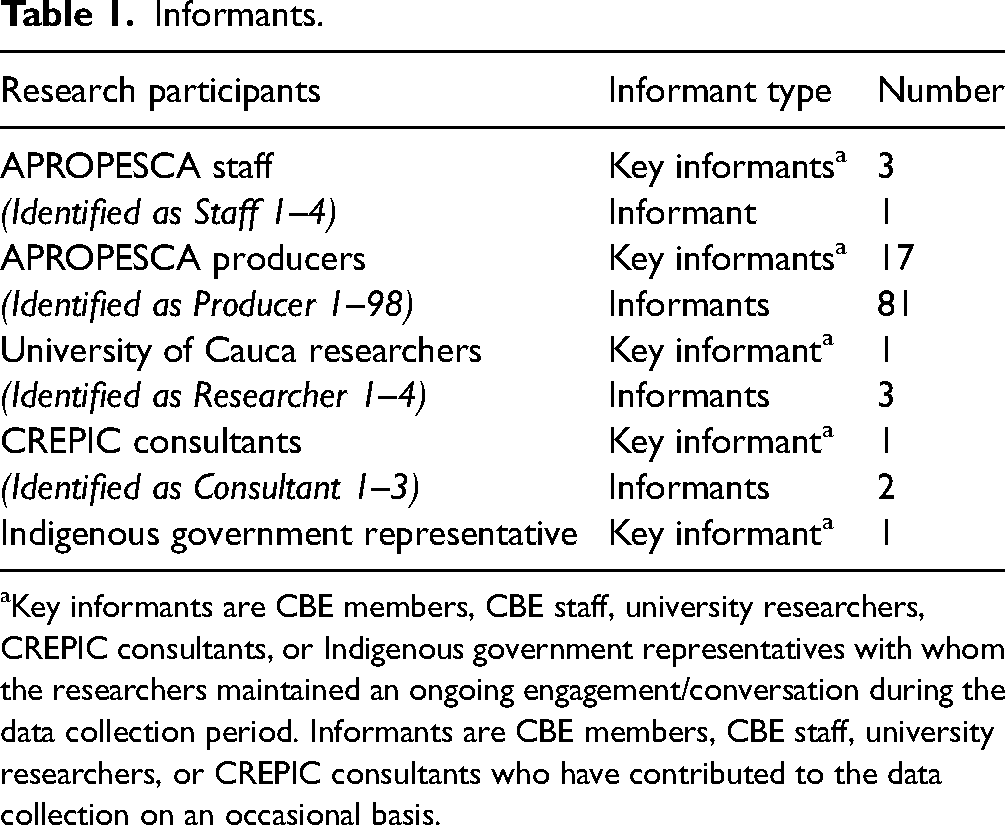
Key informants are CBE members, CBE staff, university researchers, CREPIC consultants, or Indigenous government representatives with whom the researchers maintained an ongoing engagement/conversation during the data collection period. Informants are CBE members, CBE staff, university researchers, or CREPIC consultants who have contributed to the data collection on an occasional basis.
Data collection for this study involved several sources and multiple rounds between 2010 and 2017. This included interviews with 22 members of APROPESCA. These typically lasted between approximately 1 and 2.5 hours, and were recorded and transcribed. Interview data were supplemented by observations during visits to 45 trout producer farms from the three Indigenous communities. These were carried out by the second and third authors, and were recorded in field notes. Moreover, participant observation during ten producer workshops allowed for the systematization of experience. This range of primary data sources, workshops, participant observation, and visits to farms provided the empirical basis on which we construe our research findings (Eisenhardt & Graebner, 2007). It was supplemented by secondary data on the organization provided by key informants, including a variety of actors involved in this intervention (managers, producers, CREPIC, and researchers). These secondary data drew on a host of materials as shown in Table 2, which sets out the primary and secondary data sources in this study.
Data Used in the Study.
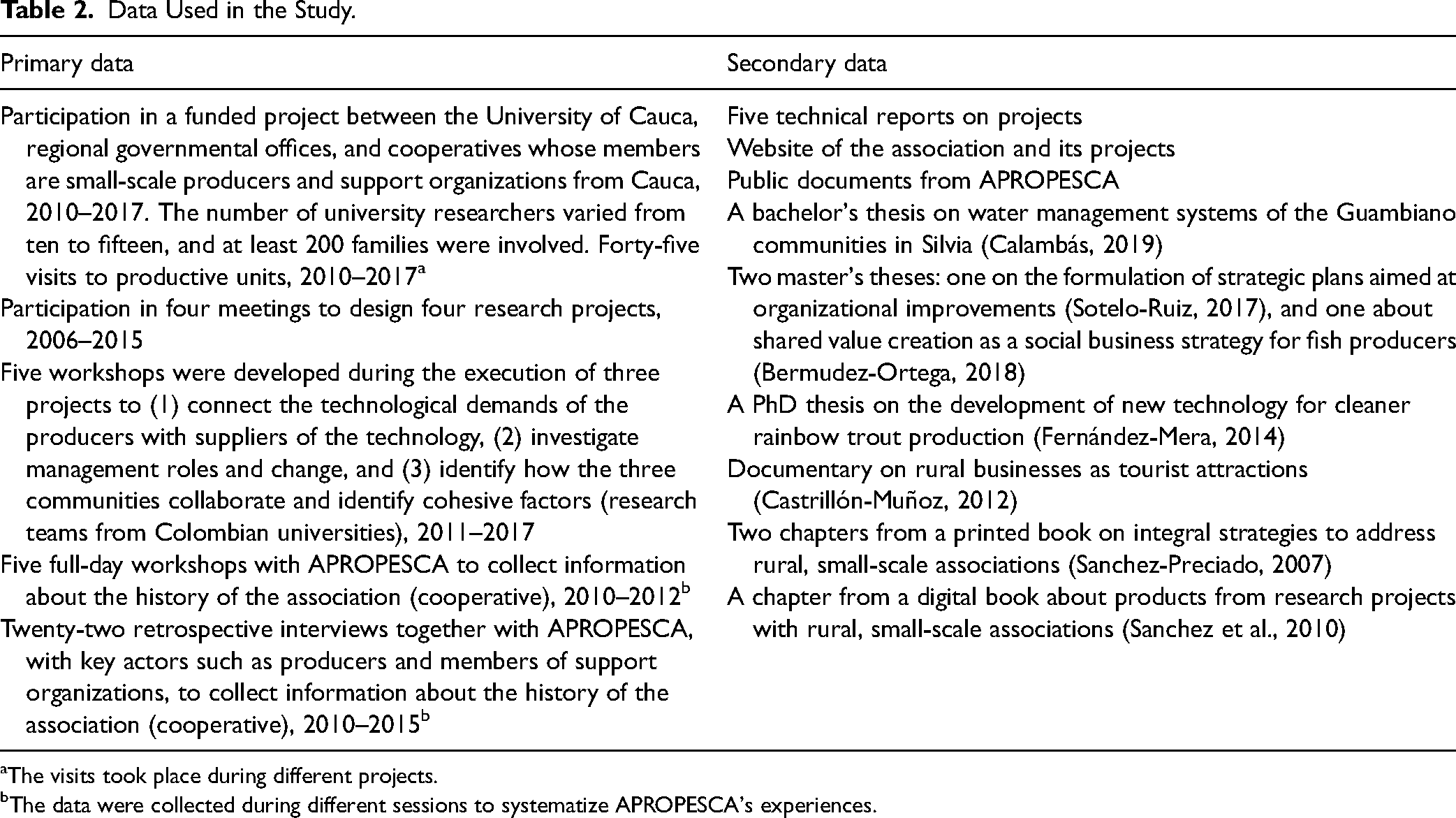
The visits took place during different projects.
The data were collected during different sessions to systematize APROPESCA's experiences.
Notably, these multiple sources of evidence were used to strengthen the findings through data triangulation (Creswell, 2013), and provide a systematic understanding of APROPESCA's relational qualities that enabled successful venturing.
Data Analysis
First, we organized primary and secondary data to build an “event history database” for APROPESCA (Datta & Gailey, 2012; Van de Ven & Poole, 1990) that was cross-checked with the key informants. We checked whether our overall interpretation of the data collected through interviews and meetings was consistent with the participants’ views, and with the observations from the workshops and farm visits (primary sources). Secondary sources were mainly used to triangulate accounts gleaned through primary sources. By way of example, when participants referred to the significance of familial ties for the emergence of APROPESCA, we looked at secondary sources for evidence that indicates cohesion among constituents of the CBE and favorable outcomes of common endeavors. In this process, we confirmed or revisited certain interpretations.
Then, following the general analytical procedure (Miles & Huberman, 1994), we created a category analysis of the data gleaned from interview transcripts and field notes relating to participant observation, farm visits, and workshops with the producers and other participants in the study. Our analysis was driven by what Whetten et al. (2009) describe as “horizontal theory borrowing,” as we borrow and adapt SEW, which was developed when theorizing about family businesses, to examine CBE development. In abductive logic, SEW served as a guiding theory to inform our preunderstanding, where “abduction is a process driven by an interplay of doubt and belief, which in turn fuels the imaginative act creating new knowledge” (Mantere & Ketokivi, 2013, p. 104).
Initially, we coded for general themes. For instance, during this first pass, one of our initial broad themes was “decision-making.” In a process akin to Gioia's methodology (Gioia et al., 2013), we identified first-order, second-order, and aggregate dimensions. The first-order analysis is research that uses “informant-centric terms and codes” or those terms that the respondents use. Second-order analysis, by comparison, uses “researcher-centric concepts, themes, and dimensions” (Gioia et al., 2013, p. 18). Finally, aggregate dimensions were derived through a logical progression, where second-order categories gave rise to a distilled unifying concept. Together, these three elements—first-order concepts, second-order categories, and aggregate dimensions—create a data structure that provides a “graphic representation of how [the researcher] progressed from raw data to terms and themes in conducting the analyses” (Gioia et al., 2013, p. 20). The unforeseen coding categories that emerged through iterative engagement with the data were also included, and our interpretation was discussed with a committee consisting of four producers and a member of the research team. Whilst SEW was useful as an analytical lens in deriving five aggregate dimensions, the last two aggregate dimensions in our data analysis (empowerment - EMP and holistic mission - HMI) were the outcome of abductive work, “where empirical observations resulted in the identification of unanticipated yet related issues… [bringing about] the need to redirect the [initial] theoretical framework through expansion…” (Dubois & Gadde, 2002, p. 555).
Figure 1 is an extract from our data analysis process, demonstrating how the first aggregate dimension is derived from first- and second-order categories. Further analysis is available in the supplementary material online.
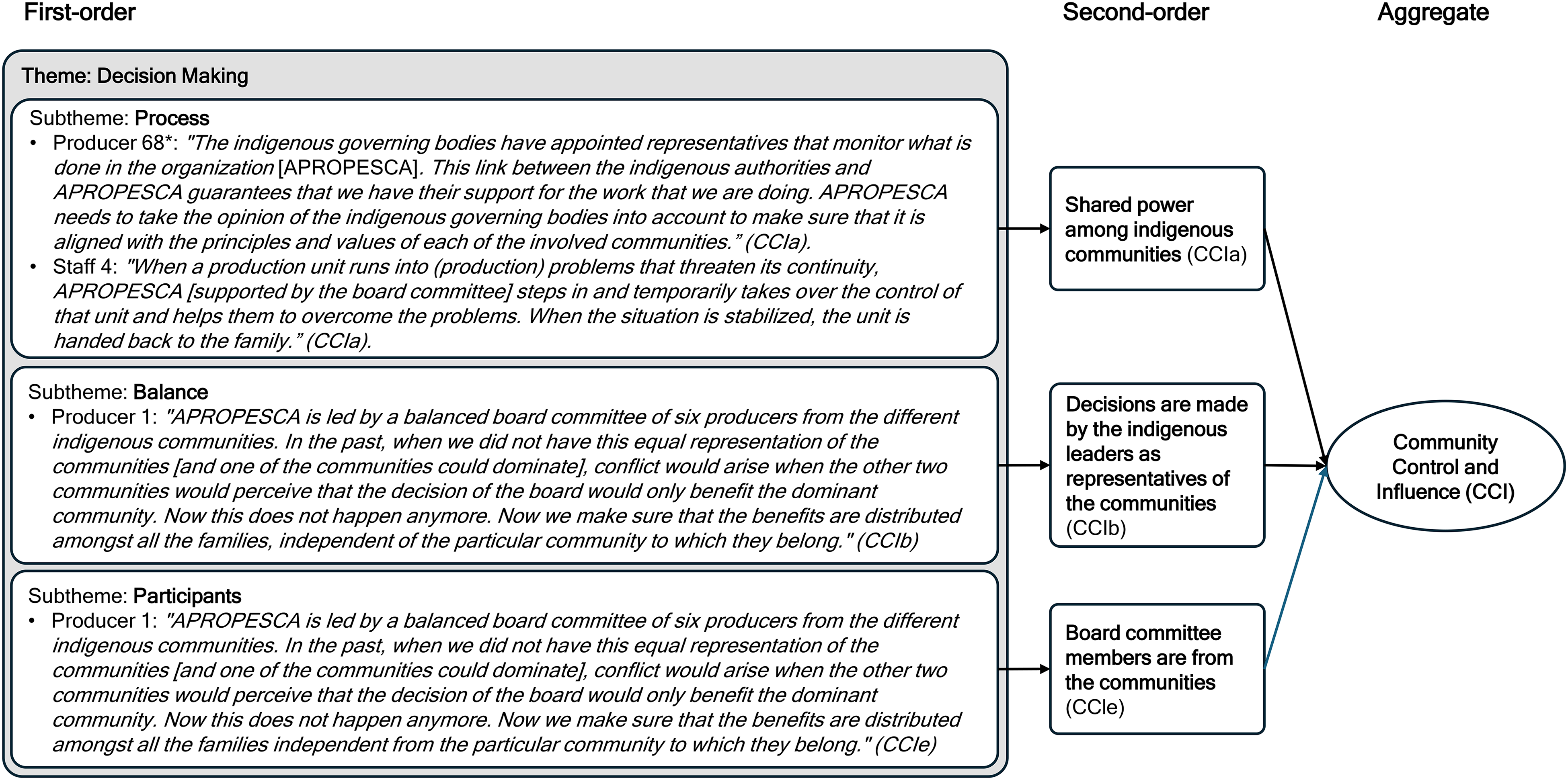
Data analysis extract: deriving aggregate dimension 1.
Table 3 shows the first-order and second-order categories and aggregate dimensions in sequence.
A Summary of Logical Progression in Data Analysis.

*Indicates comments/evidence provided by key informants.
This practice helped with analytical generalization (Yin, 2013) and theory elaboration (Fisher & Aguinis, 2017). In line with abductive logic, we generate plausible “first suggestions” about the phenomenon (successful CBE emergence) based on our pre-understanding of SEW and observations from the data (Bamberger, 2019; Heckman & Singer, 2017).
Findings
Socioemotional wealth (SEW) is defined as the “nonfinancial aspects of the firm that meet the family's affective needs, such as identity, the ability to exercise family influence, and the perpetuation of the family dynasty” (Gómez-Mejia et al., 2007, p. 106). It differentiates family businesses from nonfamily businesses because family businesses place relatively higher value on particular affect-related noneconomic utilities in their decision-making processes (Gómez-Mejia et al., 2011; Lamb & Butler, 2018). Our findings from the interviews and workshops reveal that APROPESCA members, as a united extended family, also possess the five dimensions of SEW at the community level: (1) community control and influence (CCI), (2) identification of community members with the firm, (3) binding social ties, (4) emotional attachment of community members, and (5) renewal of community bonds to the firm through dynastic succession. Moreover, we also identify two additional dimensions, (6) EMP, and (7) HMI. Taken together, these seven dimensions illustrate the presence of CSEW in CBEs.
Community Control and Influence
The three involved communities make the important decisions for APROPESCA, demonstrating shared power amongst the communities. They organize themselves with a board committee comprising representatives of these communities, supported by an external professional manager. Because the external manager does not have roots in the communities, he or she must comply with certain fundamental requirements. Specifically, the manager must demonstrate the ability to integrate into the communities, as doing so is deemed necessary for effective communication, and to make APROPESCA's members accept required changes.
Producer 26: “I wouldn’t have anyone coming to my business and telling me what to do, but I have time for the manager and advisors [CREPIC] because they know what they’re talking about. Some come from families that are in this trade, are local people, and genuinely care about the community. Not some kind of ‘egghead’ [difficult to translate] who thinks they know but they don’t know the first thing about your business and the community.”
The CBE prioritizes members from its own communities to hold positions at CBE's office. When such people cannot be found, externally contracted individuals must follow the decisions of the board. Therefore, the communities maintain their control and influence over decisions affecting the CBE. This relationship also has detrimental aspects, since the board, at times, does not have the necessary competencies to make the best decisions. However, they persist in making decisions to maintain control within the communities.
Producer 55: “Our board committee members are producers from the different indigenous communities. They make important decisions for the operations of APROPESCA.”
Producer 26: “Sometimes highly educated and experienced candidates for APROPESCA's positions did not work because they did not understand the organization and they didn’t know how to explain their ideas in a clear way to the producers.”
Producer 21: “If we can’t find someone in the producers’ group to take the positions at APROPESCA's office in the main town, then we choose a person outside the communities. This person will follow the decisions of the board committee.”
To achieve the goal of preserving CSEW, community members require continued control of the CBE even if they appoint a manager who is not part of the community.
Identification of Community Members With APROPESCA
The members of the communities feel that APROPESCA is the entity that binds them together through a common goal from which they all benefit. They feel proud to belong to it and feel united. APROPESCA creates identification not only within the communities but also externally. For example, in the region or even in Colombia, APROPESCA represents the success of these three communities. The communities are looked upon with respect in the region through the CBE. Occasionally, however, some newer producers undertake actions that are more oriented toward the pursuit of self-interest to the detriment of the CBE, for example when they want to sell their produce to external companies for a better price. The situation could be compared to conflicts arising within extended family businesses (Sciascia et al., 2013). Aware that such actions interfere with—or weaken—the common identity within the CBE, the majority of members explicitly and strongly disapprove of them. Vigilant of the value that the CBE creates for the communities, the members thus exercise a degree of social control, which further enhances the sense of identity.
Workshop participant Producer 40—illustrative view: “When APROPESCA was created again [in 2004], we realized it was necessary to work together despite the differences of each Indigenous community. We found that all the producers wanted to succeed in business and create better living conditions for themselves and their families.”
Consultant 1: “The common idea shared by most of the members of APROPESCA is that technical assistance, commercialization, marketing, and other services are mechanisms to connect everyone and keep them satisfied. While there is a strong appreciation of the idea of APROPESCA, occasionally there is a lack of understanding about the implications of “selfish actions” (selling trout individually outside APROPESCA).”
Workshop participant Producer 68—illustrative view: “The prestige and recognition of APROPESCA by the institutions, customers, and suppliers are not easy to replicate. We feel great pride in belonging to such a recognized business.”
Numerous family business scholars find that the intertwining of family and business gives rise to an inherently unique identity within family businesses (e.g., Berrone et al., 2012; Dyer & Whetten, 2006), which we equally observe in our study. Ultimately, the three communities identify as one big extended family and exhibit a collective identity with the CBE.
Binding Social Ties
By working and learning together about production and commercialization, producers come together (in workshops and other social events) to establish routines of formal and informal interactions. In such instances, they not only talk about professional matters but also meet as communities. Without APROPESCA, members of remote production stations would not come together and would interact less (other than, perhaps, going to the market and selling their produce).
Workshop participant Producer 52—illustrative view: “Every week, we go to APROPESCA's office to receive the payment for the products we deliver, and we see the other producers, but the real interaction happens when we visit the other farms and learn from each other about the best and worst production practices. That experience changed our perception of the other members and of the communities. We have a close relationship, trust, and respect.”
Consultant 1: “By participating in this program [one of the projects led by the University of Cauca], the fish farmers see themselves as part of a system. They see their success as the success of the network to which they belong, they identify with the interests of their communities. Because of this, they see themselves as innovative entrepreneurial adopters helping to grow and strengthen the network.”
Indigenous government representative 1: “At times, the community comes together to carry out specific laborious or heavy tasks [that are not directly part of the trout production itself] and for this, they organize ‘Minga Days’. These ‘Mingas’ 3 are held with the community; the community comes [to a specific trout-producing unit], gets involved, gets to know the unit and the family that runs it, and that is part of the social support system that the community offers. To operate a trout-producing unit, it is necessary that someone be there every day and be in charge. As the indigenous government, we have approached this at a family level, that a family takes responsibility and manages the operational part of the units. This [the fact that the families have taken responsibility] has had a social benefit for the community and, at the same time, it also has economic benefits, helping to sustain both the community as a whole and the families. However, the families have been given objectives so that they also do not only stay within the trout rearing units but that they also look beyond, so that it evolves, and over time can also become a tourist destination.”
APROPESCA has also developed partnerships and invested in innovative technology with CREPIC. The significance of the latter is illustrated below:
Staff 1 (former external manager): “Thanks to the program [with CREPIC and the University of Cauca], our members are part of a network that has access to large procurers. The program gave them the technology that helped them achieve certain standards and allowed them access to such procurers. Beyond the fact that technology makes their life easier, their sales increased considerably as a result.”
Social ties have also been nurtured with local institutions and other business partners, such as producers of fry or fingerlings (young fish) or pellet (fish food) suppliers, and more generally with local and regional shops. Some of these shops have even specialized in providing materials for APROPESCA. Due to the binding social ties, APROPESCA does not necessarily “window shop” for the best cost/benefit partner. Consistent with SEW, the risks that the CBE takes by not sourcing from the best cost/benefit partner show that SEW shapes its behavioral patterns differently from what one would expect in a purely commercial or economically efficient organization. Nevertheless, this approach consolidates the binding social ties of SEW. While the CBE does business diligently, the choice of certain business partners also integrates the ties and network facet.
Staff 2* (former external manager): “Often, suppliers support us by being sponsors for different events, training, and projects. In the fish production sector, there are not many suppliers, and we have maintained close relationships over the years. They trust us and they want to help us if they have the opportunity.”
In a similar vein to how family members create links with the family business, the social links that CBE members create with the enterprise facilitate a stronger sense of belonging, making the CBE a place where the needs for affect and intimacy are satisfied (Kepner, 1983).
Emotional Attachment of Community Members
APROPESCA is clearly more than a venture providing income and employment for the communities. Even professional events (workshops and board meetings) are a blend of business and social interaction. Business is often followed by joint dinners/parties. Personal ties are established through these events, which fosters a deeper understanding of the concerns of each community, which in turn facilitates emotional attachment to the CBE. The venture's mission goes beyond creating economic wealth. The CBE caters to the affective and nonfinancial needs of the communities involved. The interdependencies created are remarkable.
Staff 2* (former external manager): “The idea of being an organization that changes the lives of the producers in a positive way is the main motivation to work for APROPESCA.”
Workshop participant Producer 78—illustrative view: “APROPESCA is a nonprofit organization; we distribute the profits in services and in developing the infrastructure we have. We do not have lots of profits, but we can operate and receive benefits that are not necessarily cash-based. We appreciate more activities like traveling to learn what other regions are doing to produce high-quality products.”
Emotional attachment provides the community members with a sense of celebration and continuity with a valued past (the roots of the community), the present (the values that the community represents for them at present), and a future vision of who they would like to become (the ability to project themselves in a common future).
Renewal of Community Bonds Through Dynastic Succession
Similar to how APROPESCA provides a sense of identification for community members, it also facilitates the creation and renewal of community bonds. Many of the families are located in remote areas of the Cauca region, and their involvement in APROPESCA provides them with an opportunity to meet and discuss not only business matters but also the preservation of their legacy. Moreover, trout production is often done among family members, involving second and third generations. Thus, there is a generational legacy of being producers and more opportunities for future generations to continue working within APROPESCA.
Workshop participant Producer 11—illustrative view: “The challenge to make APROPESCA successful directly impacts our families. We want our children to have work and better lives than us, and to receive more benefits. We see a better future for our children and grandchildren in APROPESCA.”
Researcher 4*: “The community is the nucleus in which each family learns and strengthens their cultural processes in each region. It is easy to see how each parent teaches their oral tradition, knowledge, and values to their children so that each product will intrigue the visitor.”
The increased unity among and between the communities has created a better basis for the next generations to learn, share, and collaborate. Beyond that, it has created an awareness that the current skills and abilities of the younger generations to successfully manage the increasingly diverse and specialized tasks within the CBE need to be strengthened. Along with this awareness, a realization has emerged that the younger generation requires further training and education to take over the responsibility of running the CBE in the future.
Workshop participant Producer 44—illustrative view: “In the past, we thought with the projects we could have many new jobs because of APROPESCA's performance. Currently, we are aware that this is not easy, and we need to evolve and educate our children to be eligible for these new alternatives.”
Similar to family businesses, APROPESCA seeks to “professionalize” activities and ensure knowledge transmission to maintain SEW, so that the entity will be better managed by the current and next generations (Sirmon & Hitt, 2003). Beyond finding clear evidence of the five FIBER dimensions that indicate the presence of SEW in family businesses, we found evidence of two additional dimensions that appear to be much more specific to the CBE context. The presence of these two dimensions, empowerment and holistic mission, also contributes to the decision-making processes and the perception of the success of the CBE.
Empowerment
Empowerment refers to the existence of an enabling environment that encourages popular participation in decision-making that affects the achievement of goals, such as poverty eradication, social integration, and decent work for all, as well as sustainable development (United Nations Department of Economic and Social Affairs [UN-DESA], 2012). Increasing the empowerment of rural communities has been an important goal of the institutions providing the initial resources and support that facilitated the establishment of APROPESCA. Originally, USAID's “Plan Colombia” and the Colombian government's support for launching APROPESCA were geared toward freeing rural communities in the Cauca region from the influence of drug cartels by promoting entrepreneurial initiatives.
Researcher 4*: “To eradicate poppy cultivation [the raw material for heroin production] from this area, the government made several proposals for farmers to grow another product range. In response, a group of indigenous leaders picked up on this opportunity, and this is how trout farming was chosen in this area.”
The empowerment of its members has since continued to be an important aspect of the CBE. Indeed, APROPESCA has provided opportunities for its members to increase their level of economic independence through employment. Moreover, APROPESCA helps to address income seasonality through credits and payments in kind to cover the periods during which fish mature and cannot yet be sold. Beyond the income that is generated through the CBE, its success has also provided its members with an important sense of achievement, both as individuals and as a community, and has empowered them in the eyes of the authorities and of the wider population by boosting their status and reputation. Increased status and reputation, in turn, increase the sense of pride and motivation of CBE members to act in ways that preserve the venture over time.
Producer 21*: “We cannot do it alone; we need everyone. You know we rely on each other; we are proud of what we have achieved in Cauca and in the whole country.”
Staff 1*: “One of the examples of a leader who emerged from APROPESCA is Añir Rivera Camayo. He became president of APROPESCA, then went into politics and held a position as Director of Sports at the Municipality of Silvia. This is a matter of great pride for us.”
When the success of APROPESCA transcended the core activity of the CBE, its members felt further empowered, and they acknowledged that the CBE has contributed to this broader scope of empowerment, such as political empowerment, as illustrated above. Finally, APROPESCA played a key role in fostering recognition and improved representation of the communities involved in the eyes of the local and regional governing bodies, as well as within the business community. This has put the communities “on the map” and allows them to be seen as more than indigenous populations at the base of the pyramid. The broader involvement of CBE leaders in the wider community in which APROPESCA operates (and the demands that this places on their time) has called for the inclusion of new members in the board of directors to be trained as future leaders.
Staff 2*: “The training of new leaders promoted by the leadership of APROPESCA has motivated producers to renew the board of directors so that the members of the board of directors are not perpetuated.”
Holistic Mission
This last dimension refers to ensuring the collective well-being of the CBE members over time and that multiple goals are achieved. Indeed, APROPESCA is managed and governed to pursue its goals as a CBE in a manner that is meant to yield sustainable individual and group benefits over the short and long terms (Peredo & Chrisman, 2006). Being aware that the CBE's success is reflected through a variety of accomplishments, its members frequently reflect on what APROPESCA stands for beyond providing for their economic needs. They agree that success transcends the latter and comprises aspects that include enhancing living standards, preserving culture, traditions, the environment, community esteem, and generally the well-being of their communities.
Producer 74: “We initially thought that the organization that we have, APROPESCA, that it was sufficient to have some managers and organization in place. But when we started thinking about it, we realized that we have many goals, many things to conquer.”
Indeed, beyond its role in the production and commercialization of trout, APROPESCA provides emotional, logistical, or financial support on various occasions—from celebrations of events such as births to funeral undertakings. Ensuring the well-being of the CBE members as a cohesive unit is also achieved by a conscious process of sharing information and knowledge about core activities, through solving day-to-day problems and forming common ambitions. The well-being of the communities involved is also nurtured when their values, culture, and traditions are understood, respected, and preserved.
Staff 2* (former external manager): “APROPESCA is a multi-ethnic and cultural organization of small producers that join their efforts between the Páez, Guambiano, and Mestizo ethnic groups to produce, transform, and market aquaculture products, with the quality standards required by the market, seeking to improve living conditions for their partner families. As an association, they are part of a constant effort to unite the past, the traditional, and its wisdom with the progress and opportunities provided by knowledge and technology.”
Within the communities, there is also immense respect for natural elements anchored in ancestral religious beliefs. Moreover, given that the communities view the earth as their first provider, a fundamental element in the mission of APROPESCA involves considering the natural habitat and preserving the environment, not only for their immediate surroundings but also for the wider region.
Workshop participant Producer 3*—illustrative view: “APROPESCA is very important because it will have an environmental and social impact as it will benefit the whole region, more than 140 fish stations, and will help improve the flow of rivers and productive activity as such.”
Indigenous government representative: “From an economic perspective, we [APROPESCA] have been able to contribute to the community council and, through that, to all families in the wider community. Some objectives have been agreed upon such that this activity not only remains limited to trout production but that it can also become a resort where we can host people from other regions. This will be a benefit for the local community and for visitors.”
Discussion
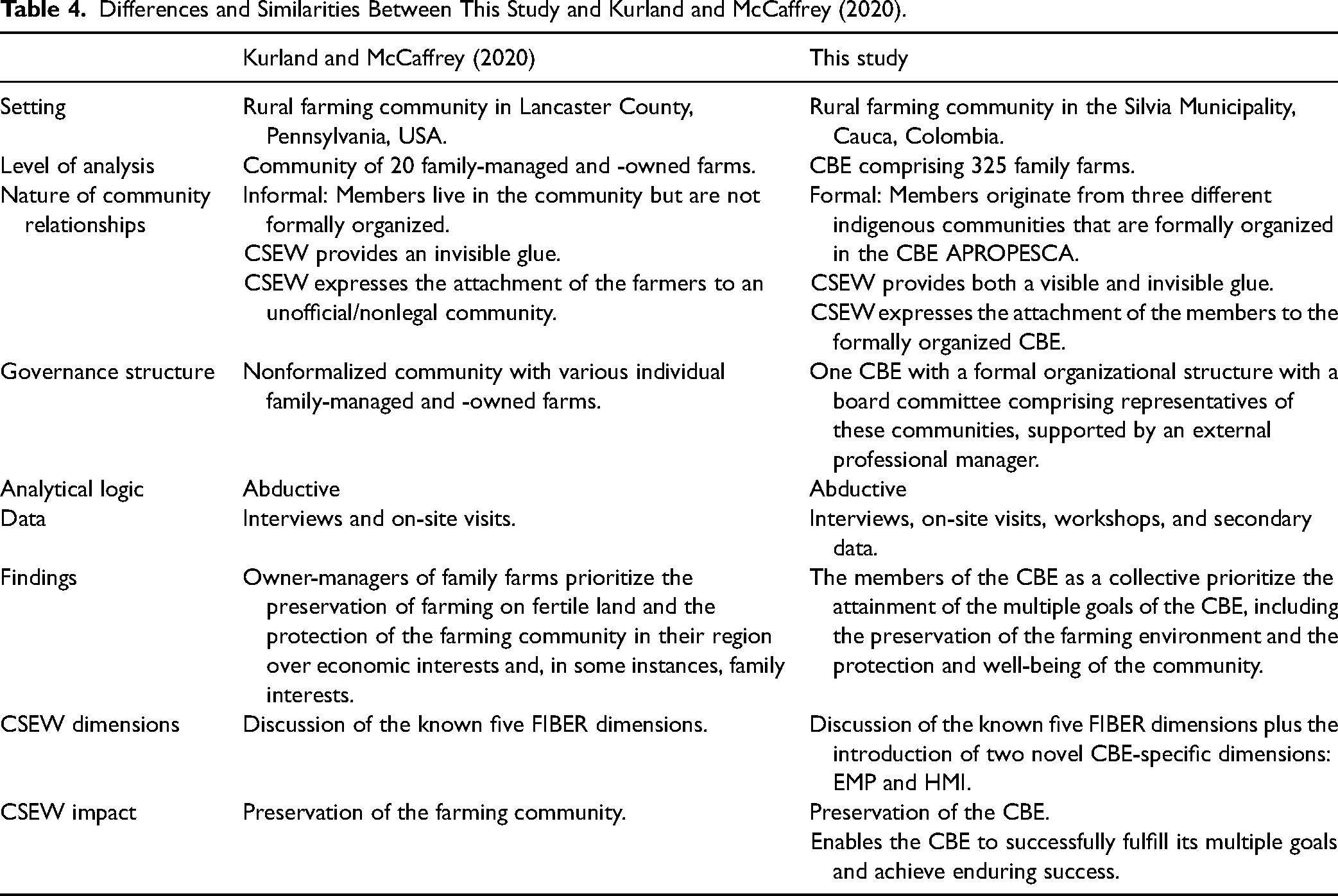
Unleashing the potential of local collective entrepreneurial endeavors makes a significant contribution toward socioeconomic development and enhanced welfare. For this reason, understanding CSEW and the role it plays in the enduring success of local initiatives, including CBEs, is fundamental. Thus far, Kurland and McCaffrey (2020) and our study explicitly make this link, albeit in different community settings, illustrating the relevance of this analytical lens for such contexts. (Table 4 provides an overview of the main differences and similarities between these two studies.)
Differences and Similarities Between This Study and Kurland and McCaffrey (2020).
The insight that we gain from looking at CBEs through the lens of CSEW contributes to filling the gap in the knowledge about how CBEs evolve once they have emerged—an aspect of CBEs that was hitherto under-researched. Through its seven dimensions, CSEW embodies key underlying features that facilitate a CBE's ability to fulfill its multiple goals and successfully sustain itself over time by ensuring that the nonfinancial aspects of the enterprise meet the community's affective needs.
The first of the CSEW dimensions, CCI, refers to the importance of the control that community members maintain over the CBE's orientation and key strategic management decisions. In the specific case of APROPESCA, a board committee comprising community members controls and approves the decisions made by the management of the CBE. While maintaining control and influence over the business and its strategic direction is fundamental to both family businesses and CBEs, the purpose of this dimension for each may differ. Whereas in family businesses the prime purpose of the influence and control is the perpetuation and preservation of business within the family, in CBEs it is geared toward enhancing the lives of the community members by fulfilling its multiple goals (i.e., simultaneously generating social, economic, environmental, and cultural value). Thus, control and influence allow the CBE to be managed in a way that is congruent with the values and goals of the community members. They can make important strategic decisions such as hiring an external manager, diversifying trout products, choosing suppliers, building dispensaries, or even funding education for future generations. Consequently, the CBE can fulfill its goals, which in turn contributes to the longevity of the CBE. Thus, managing CBEs in this way ensures congruence between the values and expectations of the community members and the CBEs’ continued ability to pursue the common good of the community in which it is embedded (Peredo & Chrisman, 2006). To achieve this, communities must pay close attention to the mechanisms they have in place to govern the CBE.
The second CSEW dimension, the identification of community members with the enterprise, is a fundamental determinant of success, as established by Hertel et al. (2019). Identification directly impacts the CBE's ability to convey what it stands for (the coherence of its mission), how it is recognized by external stakeholders (whether members’ actions and behavior are congruent with this mission), and the extent to which members will be (or continue to be) motivated to achieve the goals of the CBE collectively (Dana & Light, 2011; Hertel et al., 2019). Additionally, clarity regarding the CBE's identity and mission impacts its ability to negotiate with external stakeholders and obtain the necessary resources for its long-term survival.
Efforts to establish and nurture binding social ties are another aspect that plays an important role in the CBE's success. What family businesses and CBEs have in common is that the social bonds between their members extend well beyond the purely professional domain (Baù et al., 2019; Kleinhans, 2017). However, where family businesses build and nurture bonds on existing “blood ties”, most CBEs must make a much more concerted effort to achieve this (Sánchez Preciado et al., 2016). For example, many of APROPESCA's organized gatherings, such as “mingas” and workshops, not only afford opportunities to deal with professional matters but are also important events for furthering social bonds and cohesion. The strength of the binding social ties is decisive in ensuring cohesion within the CBE, and between the CBE and its external stakeholders. Cohesion is essential for members of a CBE to readily participate and remain motivated to accomplish its goals. Moreover, cohesion also contributes to the reduction of conflicts, leading to more efficient use of resources and time as well as smoother management processes (Ramos-Vidal et al., 2019). As such, cohesion through binding social ties contributes to the success and preservation of the CBE.
Understanding what matters to community members and their relationships shapes how they interact and make strategic decisions about the CBE to preserve their CSEW. Given that the CBE's goals typically span well beyond the purely economic arena and that the social bonds and ties between the CBE members span well beyond the purely professional domain, the extent to which CBE members understand each other's personal and professional motivations becomes a fundamental basis on which the ability to create value is predicated. Because CBEs are usually deeply embedded in the region in which they operate, it is essential that binding social ties also extend to stakeholders beyond the community (Davila & Molina, 2017). For example, in APROPESCA we observed the invaluable role that suppliers, external advisors, and consultants (e.g., CREPIC), as well as government officials (both local and regional), play in the performance of the CBE.
The integration of multiple concomitant goals of the CBE and the often indistinguishable separation between the personal and the professional blurs the boundaries between the community members and the enterprise. Peredo and Chrisman (2006) refer to the blurring of such boundaries as the social unit acting as both an enterprise and entrepreneur for the common good. Emotions thus permeate the management and decision-making processes of the enterprise (Baron, 2008). The emotional attachment of participants to the CBE fulfills their needs for belonging, affection, and intimacy (Kepner, 1983; Peredo & Chrisman, 2017). Members’ emotional attachment is important, as it nurtures the relevance of the CBE to the community and contributes to the persistence and intensity that helps them to deal with the situations and challenges they face. The presence of emotional attachment is an indicator of the degree to which the CBE is driving the behavior and actions of its members toward accomplishing its goals. In other words, emotional attachment is best viewed as the inclination of members to engage with the CBE in the pursuit of its goals (Welpe et al., 2012). Higher emotional attachment is acknowledged as an important driver of performance in entrepreneurial success (Cardon et al., 2012), including for CBEs.
A central element of SEW is the family's desire to keep the venture operational and profitable over multiple generations. Doing so aims to protect the family's wealth, traditions, and values—the family legacy (Gómez-Mejia et al., 2007). Unlike family businesses, there is no evidence in the literature that CBEs explicitly consider succession strategies from the outset. However, involving the younger generation serves as a vehicle for safeguarding the sustainability of the CBE, thereby improving its ability to contribute to the long-term well-being of the community. In our study, we observed that APROPESCA makes concerted efforts to enhance the skills and knowledge of younger community members, who are first in line to occupy any employment opportunities. Thus, to ensure that CBEs can preserve their ability to fulfill their goals over successive generations, they not only need to improve how they are managed by being able to adapt and learn, but they must also pay close attention to how they pass these abilities on to the younger generations.
Beyond serving the common good through the creation of social, economic, environmental, and cultural value, members’ involvement in a CBE provides them with a sense of empowerment. According to the United Nations, empowerment refers to the existence of an enabling environment that encourages popular participation in decision-making that affects the achievement of goals, such as poverty eradication, social integration, and decent work for all, as well as sustainable development (UN-DESA, 2012). Interestingly, evidence from our study suggests that empowerment supports and even strengthens the other CSEW dimensions. For example, empowerment driven by the CBE facilitates a deepening of the emotional attachment between the members and the CBE, as well as a stronger motivation to encourage future generations to become involved in the enterprise. The confidence, pride, and status that empowerment generates changes in members’ attitudes and behavior vis-à-vis each other and external stakeholders. The motivational concept of empowerment enhances the CBE members’ ability to attain authority over their lives, thereby increasing their autonomy, access, and control through collective action contributing to the success of the venture (Conger & Kanungo, 1988; Perkins & Zimmerman, 1995).
Considering that the well-being of communities is driven by multiple factors (e.g., cultural, social, economic, and environmental), the extent to which the CBE recognizes and works toward addressing these multiple factors through a holistic mission is an important indicator of its focus and ability to address its ultimate goal. As such, the presence of a holistic mission is an important extension of SEW to CSEW in the context of CBEs. Typically, the missions of CBEs span well beyond the mere creation of economic value for their members (Peredo & Chrisman, 2017). The degree to which a CBE manages to pursue a holistic mission to enhance the well-being of the community not only keeps it relevant in the short term but also justifies its continued role over time. Thus, like in APROPESCA, it is important that CBEs strive to develop an awareness of the various goals that their members seek to attain to ensure that resources are managed accordingly and that the communities’ goals of enhancing the well-being of their members are met. Scholars like Giovannini (2016), Loomis (2000), or (Walsh, 2010) have, for example, stressed the importance of “buen vivir” (which is Spanish for “good living” or “living well”) in the context of Indigenous communities in Latin America in terms of culture, natural environment, and collective well-being. According to Giovannini (2016, p. 10), “buen vivir” “derives from the indigenous belief of the interconnectedness of all life forms and conceives well-being as possible only in the context of a community where the natural environment also becomes a subject of rights.” This aspect of well-being is not specific to Indigenous cultures. It is present in other CBEs around the world, in both developing economies, such as in the context of cultural tourism in Tanzanian communities (Salazar, 2012), and developed economies, such as in Amish communities in rural USA (Anderson & Kenda, 2015).
Given that the relevance of individual components of a holistic mission is likely to fluctuate over time depending on the needs and requirements of the community at any given moment in time, the fact that each of these components is captured in the HMI contributes to the CBE's longevity. For example, in APROPESCA, when the number of production stations and their productivity increased as the CBE gained more knowledge and experience, its environmental mission also gained momentum. If the mission of a CBE comprised only a single component, the enterprise would risk losing relevance for the community when that component ceases to be paramountin achieving its well-being. When that happens, CBEs may struggle to refocus on a new mission or to maintain the commitment, drive, and involvement of its members. Achieving long-term success requires the incorporation of a holistic mission congruent with the idiosyncratic norms, values, and beliefs of the community.
Implications
This paper applies the construct of SEW to CBEs and identifies two new dimensions that are uniquely applicable to this context. While the presence of SEW in family businesses provides an insight into the extent to which such organizations seek to preserve the business within the family, the presence of CSEW in a CBE is not only about the preservation of the enterprise in the community but also about the extent to which a CBE accomplishes its goal of enduringly improving the lives of its members.
Our research thus underscores the relevance of SEW in the context of communities (Kurland & McCaffrey, 2020) and extends it to CBEs by furthering the construct of CSEW. This has implications for the broader community of entrepreneurship and development scholars. We encourage them to further research CSEW, not only as a construct to explain decisions made in CBEs and other types of community organizations such as cooperatives or local enterprises (Davila & Molina, 2017), but also as a theoretical lens through which to analyze factors that contribute to their preservation. The insights can be useful for social entrepreneurship scholars studying local community social enterprises, who could further investigate parallels between civic wealth creation and CSEW (Datta & Gailey, 2012; Lumpkin & Bacq, 2019).
Moreover, in extending the construct of CSEW, we advance the original construct beyond the five FIBER dimensions (Berrone et al., 2012; Kurland & McCaffrey, 2020). Our specific focus on CBEs (as opposed to communities) leads us to identify and highlight two additional key dimensions: empowerment and holistic mission. When present, these make an important contribution to the CBE's ability to fulfill its goals in a manner that yields sustainable benefits for its members. Considering both dimensions is crucial when dealing with CBEs. Failure to acknowledge or properly consider these dimensions may lead to incorrect evaluations of the CBE's effectiveness, potentially resulting in ineffective results or mistaken assumptions about resource allocation within the CBE. The two new dimensions may have remained unobserved in the local community investigated by Kurland and McCaffrey (2020), given the apparent absence of a more centralized governance structure in the management of local community efforts.
The amalgamation of the known FIBER dimensions with the two newly identified dimensions provides the CBE literature with CSEW as a construct of its own. This unique construct equips scholars with an analytical tool that allows them to study each of the dimensions separately while preserving the ability to bring their findings together in a comprehensive framework. For example, Hertel et al. (2019) have made important strides in explaining how identity matters for CBEs. Further research can be carried out to examine the governance structures of CBEs, how control can be maintained within the enterprise, or how emotions can affect the direction and performance of such ventures.
Our findings have implications for other areas of entrepreneurship and beyond where entrepreneurial endeavors in the form of CBEs play an important role. For instance, CBEs are often created to address institutional voids or problems that local communities face, from environmental sustainability to poverty alleviation, to gender equality and female empowerment. Thus, understanding how CBEs can be successful over time is critical for addressing these challenges (e.g., Bruton et al., 2013; Hertel et al., 2019; Torri & Martinez, 2011). It is well established that base-of-the-pyramid entrepreneurs and many female entrepreneurs have less access to resources for their new ventures (e.g., Brush, 1992; Peredo, 2003). Therefore, pooling resources through a CBE can be an attractive option for such entrepreneurs, not only for the creation phase but also—importantly—for the growth phase in the entrepreneurial process. By pursuing synergies and through collective agency, community members can establish businesses that generate benefits well beyond those that would be available to solo entrepreneurs. These advantages, coupled with a better understanding of how CSEW affects the enduring success of CBEs, allow community-based enterprises to represent a very promising alternative form of entrepreneurial endeavor to foster local and societal development (Alvarez & Barney, 2014).
Finally, local communities constitute a fertile terrain for entrepreneurial endeavors that enhance socioeconomic development (Handy et al., 2011). An increasing number of communities dedicate considerable resources to solving local and societal concerns through CBEs, like APROPESCA, providing further insights into how entrepreneurial opportunities can be created and exploited (Alvarez & Barney, 2007).
The findings of our study also have implications for practitioners and policymakers. The implementation and success of CBE initiatives, such as the demonstration case dealt with in this study, are partly facilitated by collaboration programs between the government and academic-related/innovation institutions (for instance, NGOs such as CREPIC) (Theodorakopoulos et al., 2012, 2014). Such collaborations must be promoted, and policymakers should include them whenever they launch development programs that incentivize the creation of CBEs (Seixas & Berkes, 2009). By explicitly proposing seven distinct dimensions, our study contributes to facilitating the formation of smaller, more manageable projects (around specific individual dimensions) that work toward the preservation and enduring success of CBEs. For example, projects could emphasize the strengthening of binding social ties between communities and external stakeholders (McVea & Freeman, 2005). In particular, the practical implications of the newly identified dimensions are far-reaching. By bringing HMI and EMP explicitly to the attention of policymakers and CBE members, these dimensions are more likely to receive due attention. Recognizing the holistic nature of CBEs’ mission may help expand their focus beyond economic performance in gauging the success of business ventures. This has practical implications when evaluating funding or nonfinancial resources attributed to CBEs to enhance their development or to facilitate their emergence. Emphasizing the HMI dimension is in line with the recently recognized necessity for sustainable business models that simultaneously incorporate economic, social, and environmental performance. Unequivocally recognizing CBEs’ holistic mission also contributes to achieving important United Nations sustainable development goals, such as promoting good health and well-being, decent work and economic growth, responsible consumption and production, and reduced inequalities (e.g., Loomis, 2000).
Dedicated attention to the empowerment dimension informs CBE members and conveys to society at large the rights and abilities of CBE members to participate in the decision-making processes affecting their well-being. In turn, this can encourage policymakers to implement policies that recognize and promote under-represented populations, resulting in broader institutional change. An example of this is reducing barriers to education, healthcare, and development funds for “Scheduled Tribes” in India (Karade, 2009). Our findings also indicate that traditional top-down approaches, where a CBE is created and fully funded by external organizations, may not manage to create a strong sense of cohesion and collaboration or improve the living standard of its members (Davila & Molina, 2017). By contrast, a bottom-up approach to CBE formation, fostered by a local initiative and a sense of empowerment, may lend itself to better prospects for sustainable venturing and more positive impacts on the local economy and society at large. To mitigate such challenges, many communities could address unemployment, poverty, institutional voids, and increasing market failures through CBEs (Córdoba et al., 2021).
Limitations and Future Research
Through the concept of CSEW, we make it possible to gain a deeper understanding of the mechanisms underpinning successful CBE creation for sustainable socioeconomic development. However, our study is subject to the commonly mentioned limitations of single-case study research; it does not allow for theoretical replication, as in multiple-case studies. Yet, we consider APROPESCA a demonstration case of a successful CBE—a case of “what may be” (Gomm et al., 2000)—not a sample of one. Access to sources with intimate knowledge of the details of the venture's evolution allowed us to examine in depth how CSEW has been built up over several years. In line with proponents of analytical generalization, we deem the implications for theory and practice not strictly delimited to this particular setting (Yin, 2013). For replication purposes, more cases of this nature should be scrutinized in different countries and cultures involving different sectors
Conclusion
In this paper, we advance the nascent literature on CBEs by bringing into stark focus the utility of CSEW as a theoretical lens for understanding successful emergence. We adapt the five FIBER dimensions of SEW to the context of CBEs and reveal two further dimensions unique to this specific setting. The seven dimensions of the CSEW construct explain how a CBE can be managed to pursue its goals in a manner that yields sustainable benefits for its members over the short and long term. Our study contributes to the conversation about how CBEs can evolve successfully after their creation. In doing so, we hope our work will encourage scholars to undertake further research on this topic, community enterprise members to focus on factors that enhance CSEW and the preservation of their enterprise, and policymakers to support such communities for socioeconomic development.
Supplemental Material
sj-docx-1-jmi-10.1177_10564926241285798 - Supplemental material for Community Socioemotional Wealth as the Glue that Binds Distinct Communities in Enterprising: A Tale of Success From Colombia
Supplemental material, sj-docx-1-jmi-10.1177_10564926241285798 for Community Socioemotional Wealth as the Glue that Binds Distinct Communities in Enterprising: A Tale of Success From Colombia by Sonia S. Siraz, Björn Claes, Deycy J. Sanchez Preciado and Nicholas Theodorakopoulos in Journal of Management Inquiry
Supplemental Material
sj-docx-2-jmi-10.1177_10564926241285798 - Supplemental material for Community Socioemotional Wealth as the Glue that Binds Distinct Communities in Enterprising: A Tale of Success From Colombia
Supplemental material, sj-docx-2-jmi-10.1177_10564926241285798 for Community Socioemotional Wealth as the Glue that Binds Distinct Communities in Enterprising: A Tale of Success From Colombia by Sonia S. Siraz, Björn Claes, Deycy J. Sanchez Preciado and Nicholas Theodorakopoulos in Journal of Management Inquiry
Footnotes
Declaration of Conflicting Interests
The authors declared no potential conflicts of interest with respect to the research, authorship, and/or publication of this article.
Funding
The authors received no financial support for the research, authorship, and/or publication of this article.

Supplemental Material
Supplemental material for this article is available online.
Notes
References
Supplementary Material
Please find the following supplemental material available below.
For Open Access articles published under a Creative Commons License, all supplemental material carries the same license as the article it is associated with.
For non-Open Access articles published, all supplemental material carries a non-exclusive license, and permission requests for re-use of supplemental material or any part of supplemental material shall be sent directly to the copyright owner as specified in the copyright notice associated with the article.
