



Abstract
More insights are needed about how to overcome situations where conventional leadership breaks down. By teasing apart concepts and processes associated with the inclusion of unconventional leaders, Greimas and Courtès’ actantial model is leveraged to collate the relationships threaded by the actors involved with the 2018 rescue mission of the Wild Boars soccer team in Thailand. What we label as the Rudolph Effect describes how outcasts, misfits, and mavericks can be redefined as valuable members of a leadership team. This case study suggests that providing opportunities for unconventional team members to demonstrate their skills and capital allows them to shift from supporting or advisory roles to more decisional and leadership roles. Both theoretical and practical managerial tools that facilitate the development and inclusion of unconventional leaders are provided.
In his seminal paper “Drop your tools”, Weick (1996) proposes that a group of firefighters died because they did not drop their heavy equipment when shifting winds forced them to run from an explosive forest fire. Justification, identity and trust are some of the factors that led to this behaviour. First, the justification of the firefighters’ actions can be directly related to the intensity of training and pre-operation briefings. In other words, the firefighters might have behaved differently with in-depth and detailed briefings and training on actions to take in worst-case scenarios. Second, the firefighters’ behaviour was influenced by how they conceived their identity. Specifically, they struggled to act against who they thought they were, as their heavy tools had become and intrinsic part of how they saw themselves, thus making dropping them inconceivable, even when their lives were at stake. Finally, their actions on the ground demonstrated that they had difficulty following leaders who were unfamiliare to them. This is because the firefighters perceived the new leaders’ directives to be strange or unconventional. Indeed, trust, which is “at the heart of virtually all organizational interactions” (Lumineau et al., 2023, p. 21), had not yet been established.
Lack of trust may arise, as in the case of Weick's smokejumpers, because the leaders are new or unfamiliar. But lack of trust, as demonstrated in the case we examined, can also arise because potential leaders lack psycho-social proximity (Bowden, 2010) with their would-be followers. Alternatively, lack of trust can also arise because some individuals are simply thought to be socially awkward, viewed as misfits, or as one main actor of the case we studied puts it: “we were losers.” Put differently, they are not trusted simply because they are seen as being different from the dominant view of what a leader should look, sound, or act like. And because they do not fit in, or do not fit in with preconceived ideas or schemas about what a leader is, they are considered to be unconventional. Arguably, many situations, such as the one described by Weick, could have turned out differently if processes had been in place to allow for what we will define in this paper as unconventional leaders to take charge of both extreme as well as more mundane contexts. This is important as it is arguably more difficult to follow or even trust someone we view as being unconventional – even though following someone who does not meet the stereotypes of what a leader looks or sounds like can make the difference between living and dying. Thus, better understanding how trust in unconventional leaders comes about is important, and not only in extreme contexts. For instance, some authors suggest that the more trust a leader has built, the more that it possible for them to create the conditions though which people maximize their power and capacity (Frei & Morriss, 2020). Accordingly, this paper will demonstrate one process through which a group learned to trust, and subsequently follow, individuals who were originally perceived as being unconventional. Moreover, we will also demonstrate the transformation, in action, of a group's outcast into leaders who provide mission critical leadership. This transformation can be well represented through the metaphor of the well-known North American fairy tale Rudolph the Red-Nosed reindeer which inspired the descriptor we assigned to this progression, namely the Rudolph effect. In this popular North American children's story, Rudolph is ostracized for being different because of his unique red nose that glows. Yet, he is subsequently recognized as a valuable asset, and is thus given an opportunity to use his special ability to guide Santa's sleigh through a storm, and thus save Christmas. This approach offers a counterpoint to longstanding leadership development approaches that emphasize the role of charismatic individuals who have the almost mystical ability to create “compelling visions to which all organizational actors are expected to subscribe” (Collinson & Tourish, 2015, p. 576). In short, this paper will demonstrate the process through which individuals, who are anything but charismatic and are rather viewed as unconventional, provide or contribute significantly to the direction and alignment that generates the commitment in a group (Drath et al., 2008) needed to resolve a situation in an extreme context. Accordingly, this article challenges the standard dominant identity of a leader as well as our fascination with heroic, or conventional leader-centered leadership, in which a situation is resolved through an individual's skills or personality (Schweiger et al., 2020). This is important as there are numerous examples, such as in this case study, in which heroic leadership breaks down, prompting the need to consider, and better understand, new types of leader's potential contributions to a group's leadership.
Thus, as we will demonstrate, a leader may very well be, in some circumstances, someone who does not have power, or authority to command subordinates to follow their direction, nor are they able to provide some sort of transformational experience for others. Rather, we suggest that leadership can also be found in individuals who simply have the ability to imagine and contribute to a possible future. This position counters much of the leadership literature, and development industry, that focused on traits or competences, that are for the most part associated with, or emerged from the study of, specific types of white men (Collinson & Tourish, 2015; Ladkin & Patrick, 2022). Rather, our position is more aligned with ongoing shift in much of the leadership literature that increasingly focuses on leadership as a system of relationships between individuals and the contexts in which the action of achieving a specific aim occurs (Kellerman, 2016). As such, this study does not assume a phenomenological point of view in which leadership can easily be defined though scientific inquiry – Indeed, leadership is not a “stable object that exists in the world and can be tracked down with the correct analytical tools” (Alvesson & Spicer, 2014, p. 43). However, the rich and complex nature of the relationships leaders weave suggest that proven methodologies will arguably be needed to create manageable research projects needed to produce what Kincheloe and Mclaren (2011) describe as dangerous knowledge that challenges sovereign regimens of truth. In other words, we aim to better understand leadership development of leaders who are not heroic, charismatic, or in most ways do not meet the standards and expectations we have constructed about what a leader should look, sound and act like.
Providing insights on how unconventional team members can contribute to a collective's leadership is timely when one considers the ongoing debates “regarding the value of extreme, unconventional, or unsettling contexts in management research” (Sharma et al., 2023, p. 1). For instance, in certain very specific, complex, or unprecedented situations, conventional leaders may simply not know what to do – they may simply not have ever faced this type of situation and are at a loss for what do about it. And the rise in unprecedented events throughout the world today underscores the importance of understanding how effective leadership comes about, and especially in extreme situations. Thus, this study can be viewed as our contribution to a) conceptualization how trust in unconventional leaders comes about as well as b) offer a new methodological approach for analyzing extreme contexts. Our research interest was also prompted by the fact that, in extreme contexts, “issues such as leadership, decision-making, motivation, resilience, and teamwork, become more critical than they are in ‘normal’ settings” (Buchanan & Denyer, 2018). Also, as there is “very little time for decision-making and action” (Grint, 2005, p. 1473), there is a clear danger that, in critical situations, what is usually considered to be leadership is usurped by authoritarianism. The inclusion of other voices in the leadership process may be one way of avoiding this slide.
Thus, as Buchanan and Denyer (2018, p. 99) noted, “extreme context research can increase the probability of generating fresh insights” – about both management and leadership – this article therefore posits that it is plausible that some extreme challenges can best be resolved by the inclusion of unconventional leaders who may be the only ones who are able to provide these critical fresh insights. Perhaps, they may not be given a chance to lead for many reasons, such as they are unknown, or are not in the organization's leadership development pipeline or in the established chain of command; they may be overlooked and lack the trust of their colleagues because they are perceived as asocial, awkward, or simply just not fitting in. It is also conceivable that certain individuals are viewed as being unworthy of leadership roles simply because they challenge dominant beliefs, schemas, and preconceptions about what leaders are supposed to look, sound, or act like – to the point where they may challenge the identity and sense conventional leaders have constructed about their privileged roles in organizations (Weick, 1995). Alternatively, it may be that certain individuals cannot be viewed as leaders simply because they do not fit with the dominant romanticized vision many people have about what leaders are (Meindl et al., 1985).
In contrast, this study submits that purposefully providing regular opportunities for all team members to demonstrate their leadership abilities as well as their social capital (Bourdieu, 1979) can favour the emergence of unconventional leadership needed to deal with extreme, as well as in more mundane, contexts. The natural tendency of organizations is to turn to conventional leaders in extreme contexts, relying on their hierarchy of authority and centralized decision-making. Nevertheless, some extreme situations cannot be solved through conventional thinking or actions; some extreme contexts are so novel and peculiar that only the insights, skills, and capital provided by unconventional leaders can resolve the situation. Parallels can be made with Alan Turing, who Levin labelled as a lonesome outcast (2009). Turing was an individual who possessed unusual skills that lay in his mathematical insight, logical reasoning, and innovative thinking, which, while working with a team of experts at Bletchley Park, significantly influenced the fields of computer science and artificial intelligence to break the German Enigma code during the Second World War. For the cave divers who are at the core of this analysis, the crucial insights and skills emerged from their extensive experience acquired through their rather unique, and for many people hard to understand, pastime of diving deep underground in dark and unchartered locations – yet their unique knowledge, specialized equipment they crafted for their activity, combined with the social capital they have acquired within an exclusive community established them as experts in the highly select network of international cave divers.
By focusing on the very specific circumstances associated with leadership in critical situations (Grint, 2005), in which the impacts of events exceed the capacity of an organization members (Hannah et al., 2009), this case concurrently provides insights about leadership development in everyday situations as well. Yet, the broad nature of the leadership research field presents a clear risk of scope creep. A manageable research framework was therefore needed. Greimas and Courtés’ (1979) actantial model was therefore mobilized to highlight the roles, and relationships of the main actors involved in the extreme, or even what may be consider to be a polar case (Eisenhardt, 2021), of the 2018 rescue of the Wild Boars soccer 1 team from a cave in Thailand. We concede that while the actantial model is rarely used in leadership studies, and thus may seem unusual to scholars in this areas of leadership and leadership development, it is a method that has proven to be effective in a broad range of management-related fields, such international business and accounting (Gendron & Breton, 2013; Gertsen & Søderberg, 2011; Hasbani & Breton, 2013; Webb, 2022). Moreover, mobilizing semiotics as our theoretical framework is arguably pertinent because, on the one hand, the process we describe draws metaphorical parallels to the story of Rudolph the Red-Nosed reindeer, but also, on the other hand, collates data drawn, in part, from sources that are structured much in the same way as sagas, legends, and folktales. In short, semiotics and its associated actantial model provide an effective framework for understanding stories and actors alike.
The remainder of this paper will be divided as follows. First, we will present the object of research, the field, and theoretical foundation of this work. We will follow with the research design, which mobilizes rich and diversified data to attain our research objectives. We will then present our findings and discuss them before highlighting theoretical contributions and addressing managerial implications, limits, and future research directions.
Setting the Stage: Introducing the Case
In a world that is increasingly characterized as the society of the spectacle (Debord, 1992; Webb & Richelieu, 2022), few events have captured universal public interest as much as the unprecedented efforts, in the summer of 2018, to save 12 young soccer players, aged between 11 and 16, and their 25-year-old coach. The team, known as the Wild Boars, was trapped inside Tham Luang Nang Non cave in northern Thailand for 18 days, after heavy rain submerged the passageway that was their only way out. As the whole world watched, rescue efforts required thousands of people, “including 2,000 soldiers, 200 divers, and representatives from 100 government agencies” (Beech et al., 2018). Yet, even with the international rescue team's efforts, it was hard to imagine that overcoming the unparalleled obstacles presented by this exceptional scenario was even possible. Hence, it is appropriate to categorize this event as a critical situation as there was very limited time for first deciding what needed to be done and subsequently getting on with the action (Grint, 2005). What is more, the extremity of the situation even inspired a wide range of interpretations of who or what contributed to the unlikely positive outcome. For some, like Maj. Gen. Chalongchai Chaiyakham, the deputy commander of the Third Army region helping the operation, “[t]he most important piece of the rescue was good luck” (Beech et al., 2018). For others, such as many of the divers and residents of the nearby northern Thai town of Mae Sai, their eventual success was attributed to divine protection (Beech et al., 2018). To some, however, much of the success can be attributed to unconventional leaders who were called upon after the legitimate authorities were unable to provide the leadership needed to get the boys out. One unique characteristic about this rescue is that it was conceived and led by an international group of individuals who practice the rather unique hobby of scuba diving in underwater caves. Nevertheless, before the rescue, this rare pastime led many to see them as being odd and even somewhat abnormal. Indeed, one of the divers describes the locations they enjoy exploring as being as claustrophobic environments that represents some people's worst nightmares. However, their vast experience, knowledge, and networks associated with this subculture allowed them to develop uncommon skills and social capital, which ultimately proved to be critical in the case we studied. Undeniably, their unique knowledge of how to navigate cold and dark waters deep underground, combined with the social capital they possess within this specialized community of international cave divers, was crucial to the rescue efforts, making them effective, albeit unconventional, leaders. This shift from being social outcasts to heroes leads us to posit that managers should, during normal operations, consider and plan for the inclusion of unconventional leaders as they are sometimes the only ones who can resolve extreme, or critical, situations. The rest of this paper will expand on this assumption. As we will demonstrate further, this paper will leverage the aforementioned Rudloph metaphor to communicate, in a reader-friendly manner, the intricate interconnections and dynamics underscored in this research. Real-life stories in which human capability faces mother nature are very fertile for better understanding the relationships between a diversified group of actors working to attain challenging goals. More specifically, this analysis, and its associated metaphor, sheds light on the process that leads to actors’ shifting roles in an extreme context by understanding the dramatic phases of a story in action.
Theoretical Background
The theoretical background will first focus on extreme contexts and will subsequently expand to consider some specificities about leadership in such situations.
Extreme Contexts
Despite a significant interest in researching extreme contexts, the existing literature on this topic remains highly fragmented (Hällgren et al., 2018). Hannah et al. (2009) suggest there is “concomitant oscillation of levels of extremity” that will “vary over the stages of preparation, response and recovery from an extreme event.” Regarding preparation, Leonard and Howitt (2007) distinguished between routine and non-routine extreme events and “extremity is often defined in the literature based on scope and scale of damage or effects” (Hannah et al., 2009, p. 905).
Following their extensive literature review, Hällgren et al. (2018) distinguished three types of extreme contexts :
Risky contexts (potential and related) are “characterized by near-constant exposure to potentially extreme events” where the reliability of systems and specific routines, processes, and materials becomes crucial. Emergency contexts (actual and related) encompass situations where the potentiality of catastrophe materializes, allowing for some degree of preparation as they are often related to core activities. Disrupted contexts (actual and unrelated) arise from extreme events outside the scope of usual operations, catching organizations and communities off-guard and presenting unique challenges as they are “unique, unprecedented, on even uncategorizable.”
According to Hällgren et al. (2018), while risky contexts involve the constant potential for catastrophe, emergency and disrupted contexts experience the actual occurrence of such events. Christianson et al. (2009) focused on rare events “which by definition are not equivalent; they can vary along a number of dimensions, including magnitude, frequency, valence (positive or negative) and cause (internal versus external).” Therefore, they serve as disruptions that prompt learning by highlighting weaknesses and unveiling untapped behavioural potential within an organization. These events ultimately compel a reassessment of organizational identity as the organization gains insight into its knowledge, capabilities and true potential.
Leadership in Extreme Contexts
Understanding how individuals in organizations gain trust in general, and in extreme situation in particular, can arguably be achieved by examining how the leadership of the organization is constructed. Yet, the fact that few human constructs are as universal as leadership presents challenges when attempting to study such phenomena scientifically. Since just about everyone has either led, or has been led by others, most individuals have formed opinions about what both good and bad leadership looks and feels like. Even academics have not yet reached a consensus about a definition of what leadership is. Some consider leadership as “the accomplishment of a goal through the direction of human assistants” (Prentice, 2004, p. 102), or as the action involved with the “shaping of the ideas, values, perceptions and feelings” (Alvesson & Spicer, 2014, p. 43) about meaning, while for others it is “the capacity of a human community to shape its future” (Senge, 2002, p. 358). The concept of community is important here and much empirical research has moved away from providing insights about the actions of individual leaders to studying leadership from new perspectives such as collective leadership (Contractor et al., 2012), trauma-informed leadership (Middleton et al., 2015), or distributed leadership (Spillane, 2012), to name a few. Thus, when conceptualizing a phenomenon on which so much has been written, and on which many common and crystallized representations exist, perhaps the only way of conducting scientific investigation in such a field requires recognizing, and then breaking from, preconstructed ideas. To the point where some suggest that the preconstructed ideas should become the object of research (Bourdieu et al., 2013).
Following a review of existing literature, Hannah et al. (2009, p. 902) developed a “framework to guide future research and to examine the execution of leadership in extreme contexts.” One valuable contribution of Hannah et al.'s work is the insight it provides for conceptualizing organizations’ adaptive leadership responses. These authors offer greater understanding of the factors that enhance and hinder adaptive leadership in four types of organizations that are more or less prepared to deal with extremity. As Osborn et al. (2002) point out, “leadership and its effectiveness, in large part, are dependent on the context. Change the context and leadership changes” (p. 797). Thus, it seems also pertinent to consider adaptive leadership factors in ad hoc organizations that have no history of working together but hastily join forces to deal with an extreme situation. However, it is necessary to also consider what happens when contexts change so radically that current leadership becomes overwhelmed to the point of panic (Gröschl & Lepoutre, 2022) and are accordingly unable to adapt or even act. For example, some authors are interested in the “process through which decision-makers persuade their followers, and perhaps themselves, that a certain kind of action is required” (Grint, 2005, p. 1469). Yet, less has been written about what happens when the decision-maker does not know what to do, or cannot even imagine the kind of action required to resolve a critical situation, is unable to persuade their followers, or doesn’t even have any followers. And, as we will suggest in this paper, sometimes, in such situations, unconventional leaders might need to take over. This is because, even though they might not be viewed as typical managers, decision-makers, or leaders, they may be the only ones who, in some situations, can conceive or execute the kind of action required, or have the social capital needed to identify and mobilize others into following them. Hence, organizations that deal in extreme situations, such as first responders or military units, as well as more standard organizations that only occasionally face extreme situations, such as schools, municipalities, or major corporations, might benefit from proactively thinking about the development of unconventional leaders.
Yet, even though authors such as Sweeney et al. (2009) posit that trust in leader's abilities is required for followers to maintain their commitment to the mission, Hannah et al.’s (2009) adaptive leadership model does not provide a process for how unconventional leaders may gain the essential trust needed for a group to move forward when all adaptions fail to resolve the context. As such, moving beyond the traits or competencies of the individual, focusing on the processes that influence the flow of knowledge, activities, and interactions (MacGillivray, 2018), or manipulate configurations in a way that favours the inclusion of different types of leaders can help us better understand how to grow good leaders (Kellerman, 2016). Thus, breaking from the preconstructed idea that only someone who possesses certain traits or competencies can provide leadership in a critical situation appears as a pertinent tactic.
Methods and Material
We will now describe the methods we leveraged, and materials we collated, to allow for new insights about the inclusion of unconventional leaders to inductively emerge.
Methods: Analyzing an Extreme Context with the Actantial Model
Presenting our aims and object of research allowed us to briefly introduce the theoretical model mobilized for this study. As stated, following Weick (1996) aforementioned suggestion that administrative sciences should focus on relationships, we will use Greimas and Courtés (1979) Dictionnaire sémiotique and its related actantial model as a lens for better understanding the actors, and their relationships, involved in the rescue of the Wild Boars soccer team.
It is, regrettably, far beyond the scope of this paper to present a detailed and complete overview of how all the rich and complex concepts collated in the Dictionnaire sémiotique can help an analyst understand both the meaning and sense of language and stories. However, by focusing on the categories of actors that are present in all stories, the essence of this model offers a promising and manageable approach for understanding the emergence of unconventional leaders. Indeed, the actantial model provides an understanding of how the relationships between actors shift over time and, thus, influence their roles. To this end, Figure 1 conceptualizes the key groups of actors identified in the actantial model while highlighting the three main types of relationships, labeled here as phases, that occur in most stories, be it a folktale, a corporate annual report, or in a stylized documentary about a highly complex rescue operation.
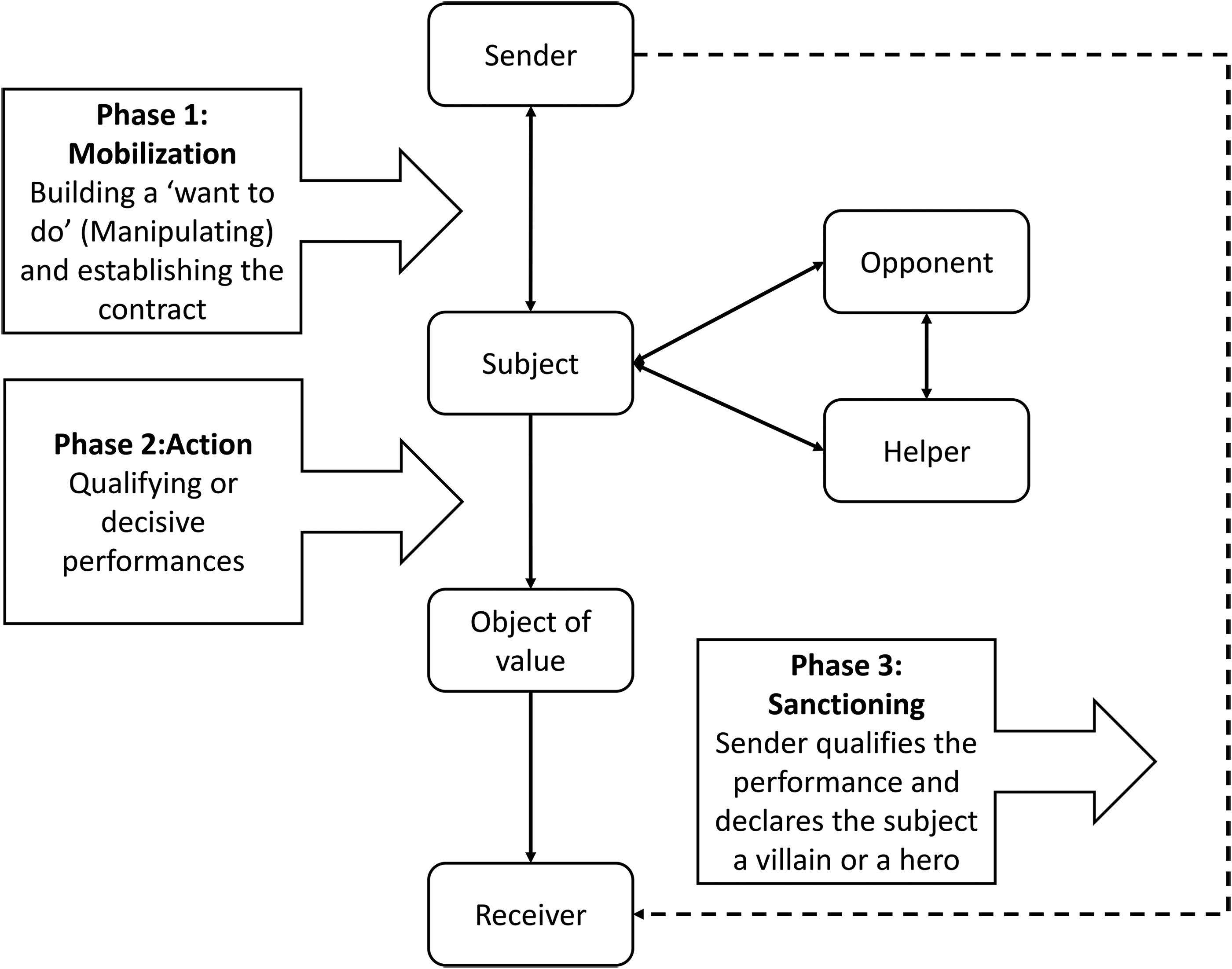
Actantial categories, phases and types of relationships.
Phase 1 relationships: Mobilization
The first grouping of relationships is formed between the sender, which is the actor who activates a subject into wanting to acquire a targeted object of value. In the actantial model, the relationships in this phase involve building a semiotic want-to-do (vouloir faire) on the part of the subject. This is labeled as manipulation. Manipulation is an essential relationship to understand because a subject who does not want to do something will not deploy the required effort, and thus there will be no story to tell. Yet, it is important to note that manipulation can be positive (calling on common values, patriotism, offering valuable compensations, or promising rewards) or negative (threatening, intimidation, etc.). The second element of the mobilization phase is known as the contract, which formalizes the relationship between the sender and the subject. The contract clarifies and codifies how the subject will acquire the object of value. This includes what values must be respected, what rules must be followed, and what the subject can and cannot do to acquire the object.
Phase 2 relationships: Action
After a subject has been activated into wanting to deploy the efforts needed to acquire the targeted object of value and has subsequently agreed to the sender's social contract, the subject can proceed with the action. Relationships in this phase of the story center around the performance of the subject and can be broken down into two stages. The first stage is known as the qualifying performance, in which subjects might need to acquire skills, knowledge, capital, or the resources needed to complete the required task. Put differently, wanting to do something is not always enough; developing the abilities to complete the mission may be necessary.
When a subject has acquired the necessary want-to-do as well and the ability-to-do (pouvoir faire), they can then embark on the second stage of the action phase which is the decisive performance of acquiring the object of value. It is important to note that, throughout both stages of the action, the subject will likely be aided by a group of actors broadly labelled as “helpers” (or adjuvants), as well as concurrently hindered by another group of actors labeled as “opponents.” The relationships between the subject and these two groups of supporting actors must also be considered when analyzing the relationships in the action phase of a story.
Phase 3 relationships: Sanctioning
If the subject acquires the object of value, it can then be transferred to the receivers, who are the ultimate beneficiaries of the action. The original sender who mobilized the subject then returns to assess, or qualify, how the sender performed the action. If the subject acquired the object in accordance with the contract, then the sender can qualify the subject as a hero or, if not, they can be labelled as a villain.
Throughout the analysis of a narrative, it is important to remember that actors can, and often do, shift roles throughout a story, thus becoming any one of the six actantial categories of actors. For instance, a subject can also be a beneficiary of a given object of value, or a helper in one chapter of a story can reenter to become the subject in a case where the original subject is unable to obtain the object of value. Having provided an overview of this model, we can now share how we used it to inform our methods and the selection of research material.
Materials
Unsurprisingly, the authors weren’t physically present during the rescue itself. Accordingly, our approach involved systematically compiling the existing data related to this event. Data provided by documentary were one source that we retained as observing behaviour on film and in television series is suggested as a solution to manage the problem of research access when studying extreme contexts (Buchanan & Denyer, 2018). Referencing cinema, including award-winning films, for theory building has become increasingly important, as demonstrated by the recent work of Munyon and Summers (2023).
The material for this case study is drawn from over 50 sources that were consulted to get a sense of the story and the roles of the actors involved: a documentary, news coverage, scientific literature, and online searches including LinkedIn profiles.
Documentary
The National Geographic 107-min documentary film by E. Chai Vasarhelyi and Jimmy Chin on the Wild Boars recue, released in 2021, was analyzed as our core data. The short synopsis is the following: THE RESCUE chronicles the enthralling, against-all-odds story that transfixed the world in 2018: the daring rescue of twelve boys and their coach from deep inside a flooded cave in Northern Thailand. Academy Award-winning directors and producers E. Chai Vasarhelyi and Jimmy Chin keep viewers on the edge of their seats as they use a wealth of never-before-seen material and exclusive interviews to piece together the high stakes mission, highlighting the efforts of the Royal Thai Navy SEALs and US Special Forces and details the expert cave divers’ audacious venture to dive the boys to safety. THE RESCUE brings alive one of the most perilous and extraordinary rescues in modern times, shining a light on the high-risk world of cave diving, the astounding courage and compassion of the rescuers, and the shared humanity of the international community that united to save the boys. (Mongrel Media Inc., 2021, p. 3)
According to the directors’ statement, “there's a fairy-tale quality of the story” (Mongrel Media Inc., 2021, p. 4) to their film, streaming, perhaps appropriately, on Disney+. The documentarians employed the Thai cave divers in the reenactments because maintaining authenticity was crucial (Guerrasio, 2021). A 38-page transcript of the documentary was produced by the research team, including the time stamp of the documentary when someone was speaking, the name of the person speaking, as well as additional information for context. The transcribed narrative formed the core of this work, with additional sources providing more context, and/or completing the information. For example, to better understand the documentary, we concurrently analyzed a media kit from National Geographic, the contents of which included an interview with the directors of The Rescue. The media kit helped distinguish the archival sources from the recreated footage, provided additional background about some key actors, and presented the challenges the production faced when constructing the narrative (Mongrel Media Inc., 2021, p. 4). This documentary was our primary source of data for experimenting with analytical frameworks during the data analysis stage, as Buchanan and Hällgren (2019) did on a project containing methodological similarities. Some might argue that the value of these observations is diminished because a reenacted documentary remains, to some extent, fiction. However, research has found that interactions displayed in film may be more realistic than the ones observed with conventional methodological supports (Buchanan and Hällgren, 2018). Using this kind of data offers researchers an extensive perception, often with added temporal and cultural nuances (Buchanan and Hällgren, 2018).
News coverage
Undoubtedly, the rescue caused an international media frenzy. This “feel-good story of 2018” (Marshall, 2019) was closely monitored across the globe, providing a diversity of perspectives on the subject readily available to provide more context and triangulate the data, including several newspaper articles, television, and radio interviews. To acquire further data on the actor's involvement and their past qualifications, the research team analyzed and considered news articles from the localities around the world. These sources granted supplementary perspectives on the events that unfolded, underlining the contributions of some actors who were omitted from the documentary.
Academic literature
A scoping review of the academic literature pertaining to the Wild Boars rescue was also performed. Several articles were uncovered (e.g., Ahmed et al., 2021; Panphae & Phoewhawm, 2020; Preedaananthasuk, 2019; Suebvises, 2020; Wattanagun, 2021) but none studied this object of research through the lens chosen by our research team. Nevertheless, the articles offered pertinent conceptual and theoretical insights that contributed to our understanding of the case.
Online searches
Google search queries were also performed to create portraits of the main actors involved in the rescue. Each actor's profile was constructed by mixing a variety of sources, mainly news websites, government websites, and databases. The descriptions are somewhat uneven, however, as information is more detailed for some than for others. This imbalance of available information is certainly due to the significant media attention some cave divers received, especially the ones present early in the rescue, namely, John Volanthen and Rick Stanton.
Data Analysis
The research team, consisting of the two authors and a graduate student, conducted the analyses, including the coding and peer-review process, in three steps as follows:
In Step 1, the rescue mission was divided into key chapters, that synthesize crucial moments in the story. The initial coding was then performed on the content to extract meaningful insights and patterns. These chapters were outlined according to the storyline emerging from the documentary. The available data from the news coverage, the academic literature, as well as the online searches were also gathered to nuance certain aspects. The key chapters of the rescue were divided according to the major events that modified the dynamic between the key actors. Significant actors were identified for each chapter and were subsequently coded to one of the six actantial categories, based on the role they played in each chapter. In Step 2, we identified and coded the roles of the different actors in each chapter (axial coding). As mentioned previously, the actantial model contains six main roles: the sender, the subject, the object of value, the receiver, helper, and the opponent. If actors shown in the documentary did not meet the characteristics of one of these roles and/or only had a narrative role, the research team excluded them for that particular chapter. In Step 3, the shifting roles of the key actors were identified and coded to interpret the data coded in Step 2. The research team's study of the shifting roles also drew inspiration from Greimas and Courtés’ dictionnaire sémiotique (1979, 1982, 1986) and its associated actantial model as leveraged in previously published management studies (see for instance Breton, 2009; Gendron & Breton, 2013; Hasbani & Breton, 2013; Søderberg, 2006; Webb & Richelieu, 2018). We considered various semiotic principles, such as highlighting the key actions described in the material and allocating them to one of the three action phases. The aim was to highlight the conditions and process needed for unconventional leaders to succeed in extreme context. To enhance our analytical framework, we also considered the model of Extreme Dimensions and Adaptative Leadership Response, as conceptualized by Hannah et al. (2009), especially for the final chapter of the story, which consecrated the success of the overall rescue.
Findings
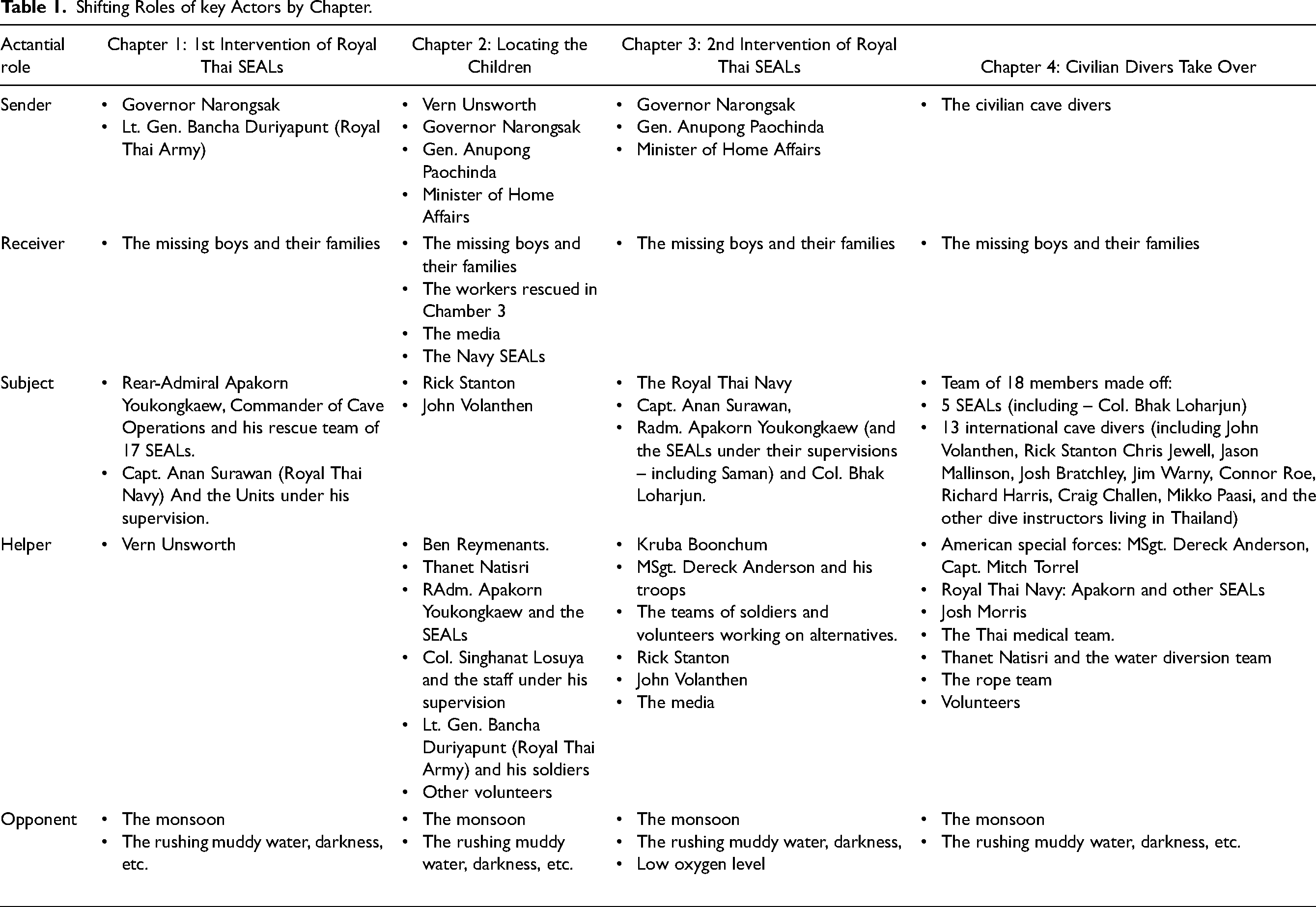
As mentioned in the previous section, we first identified all main actors mentioned in each chapter and allocated them to their appropriate actantial category as shown in Table 1. We will begin this section by describing, using the actor's own words, the unconventional nature of these individuals. We will then describe how their roles shifted as the story unfolds through four chapters, or acts, that synthesizes the key highlights of the documentary. As the story evolved, we observed that several of the actors frequently shifted actantial categories, while some remained in the same category throughout. For instance, the members of the soccer team and their families remained as receivers, whereas other actors, such as the civilian divers, frequently changed roles. The shifting roles of the cave divers will therefore be highlighted in the second part of this section.
Shifting Roles of key Actors by Chapter.
The Unconventional Nature of the Cave Divers
In this case, the skepticism and mistrust directed towards the cave divers can be attributed to their perceived lack of psycho-social proximity (Bowden, 2010) with other actors in this story. This absence of a relatable connection with potential followers stems from their perceived social awkwardness, deviation from the conventional image of a leader in terms of appearance, lifestyle choices, and communication style as opposed to military personnel. Succinctly put, fitting-in is difficult for them.
The documentary clearly depicts how the cave divers were often perceived as unconventional individuals in their everyday lives due to their unique passion for exploring narrow, dark caves. As a case in point, Amp Bangnoen, a nurse dating one of main actors of this story, Rick Stanton, expressed her astonishment when he showed her his cave diving videos, exclaiming, “Are you crazy? You crawl into narrow dark caves where you can’t see! You call it a hobby?” She found his enthusiasm for such a perilous activity to be unusual. Moreover, at the beginning of the rescue efforts, MSgt. Dereck Anderson, a US Air Force Pararescue member, noticed that Rick Stanton and John Volanthen stood out from the traditional military image. He stated that they appeared laid back, dressed in shorts, flip-flops, and T-shirts, which was quite different from what he was accustomed to seeing. And after experiencing the challenging conditions of Chamber 3 of the cave himself, he pondered why anyone would voluntarily engage in such activities for fun. This reflected the general perception that cave divers like Rick Stanton and John Volanthen were unconventional in their pursuit of cave diving.
Cave divers as outcasts
What is more, the cave divers expressed, in their words, that they are marked by a history of being viewed as outcasts, using the terms “loser” (Richard Harris), “quiet and shy, not so sociable” (John Volanthen, Jim Warny), “self-conscious” (Josh Bratchley) and “not a team player” (Rick Stanton, John Volanthen). They also share the notion of feeling different (Rick Stanton) or inadequate by characterizing themselves or cave divers in general as “emotionally challenged” (John Volanthen), “lack of confidence” (Richard Harris) or “peculiar type of person” (Rick Stanton). To the point where one result of being viewed as outcast was that several of the divers shared that they had been bullied as children (Rick Stanton, Jim Warny).
A particular incident vividly exemplifies the distrust and even bullying they endured even while attempting to provide assistance. During the rescue, Elon Musk proposed that he had developed a mini submarine that could do the Job. But Unsworth quickly rejected this proposal as he knew from experience that is was unworkable. To which Musk reacted by labelling him as “pedo guy” to his then 30 million Twitter followers. Vernon Unsword testified during a defamation trial about feeling “humiliated, ashamed,” and “dirtied” after being labeled a “pedo guy” by Musk online and describing the comment that left him feeling “very vulnerable” and “very isolated” as “very hurtful.” While expressing remorse in court, Musk mentioned that he hadn’t anticipated the “pedo” tweet to be interpreted literally. At the time, he believed Mr. Unsworth was merely a “random creepy guy” unrelated to the rescue (BBC, 2019). It is important to note that such remarks had not been directed at a navy SEAL or someone within the established chain of command, but rather targeted someone who was viewed as a easy target.
Cave diving as an escape
The commonality of the divers being viewed as outcasts perhaps not only contributed to the need to find a lifestyle that suited their unconventional nature. For instance, they shared a sense of independence that drove them to cave diving: “Isolated. It is the place where I kind of feel comfortable and feel like I am safe” (Josh Bratchley), “[I resort to cave diving to] get away from everything in normal society. [and to go] back to the age of the cave man” (Jim Warny). Some acknowledge that being in a pitch-black cave underwater is “probably some people's worst nightmares” (Josh Bratchley), but “once I get underground, that all disappears” (Jim Warny). Is sum, for these self-described unconventional individuals, their love for cave diving and exploration serves as a form of escape and empowerment, while concurrently allowing them to accept that they stand out from the norm.
The shifting role of the cave divers by chapter
Following the arc of the cave divers made analysis more manageable and allowed for subtle, yet important nuances to emerge. The unconventional leaders’ journey is synthesized in Figure 2. In Chapter 1, the civilian divers enter the story as helpers to the Thai Navy SEALs, advising them on cave diving. Yet, when the SEALs realized that cave diving was unlike anything they had ever done, and they were unable to navigate the cold, dark, rushing waters, they decided to let the cave divers try. This worked and the cave divers located the children in Chapter 2. This represents a first shift in their roles as they moved from helper to subject because they possessed the knowledge, or semiotic “can-do”, necessary to operate in this unforgiving environment. Then, in Chapter 3, the Thai Navy SEALs reasserted their roles as subject, believing that they now had both the “want-to-do” as well as the “can-do” (with the help of the cave divers) to complete the mission. However, the SEALs underestimation of the challenges posed by their opponents (roaring muddy water, darkness, confusion, etc.), combined with an overestimation of their identity-based abilities (à la “if these civilians can do this, we surely can”) had disastrous effect: those who were able to reach the children got stuck there due to a lack of oxygen to make the journey back. Chapter 4 begins when all seems lost. Indeed, the rising water, the conventional leaders (senders) not knowing what to do, and the SEALs inability to get the children out combined to reach a point where many thought that it was senseless to continue. This situation seemed to forecast that the object of value would shift from saving the soccer team to a new mission of eventually recovering the bodies, as it seemed impossible for the children to survive until the water retreated after the monsoons. This is when something interesting occurred: the cave divers shifted roles again and became senders who a) conceived a plan that had a chance of working, b) convinced the conventional senders to let them try, and c) mobilized a new team of expert cave divers from around the world who possessed both the “want-to-do” and “ability-to-do” necessary to execute a bold and unprecedented rescue plan. Moreover, they did not only remain in the sender role; when the team was assembled, they became subjects of the story when they physically led the rescue into the cave. Against all odds, they managed to get all the children out safely.
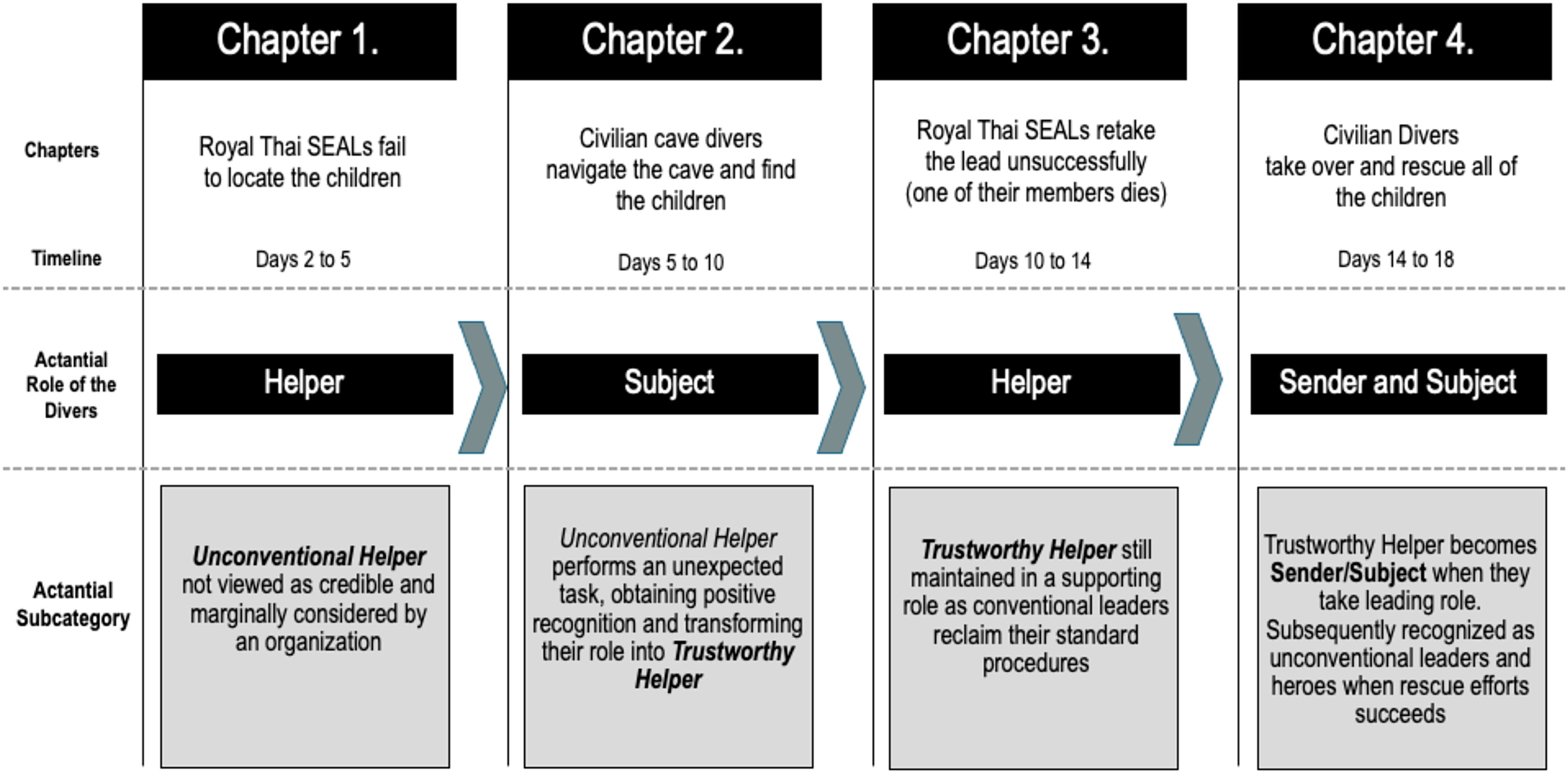
The Rudolph Effect or the process of including unconventional leaders.
Discussion
Having shared the findings obtained through the actantial model, notably that the cave divers shifted roles throughout the overall story, we now discuss and conceptualize the relationships that these findings provide. Collating the different roles the civilian cave divers played throughout the four chapters of this story provides valuable practical as well as conceptual insights. We will begin discussing these shifts, as synthesized in Figure 2, by examining the first shift, or the transformation of what we label as unconventional helper to trustworthy helper, before considering the impacts of the new Subject/Sender role the civilian divers assumed in Chapter 4 and that was ultimately critical for completing this harrowing rescue.
At the beginning of the case, the future unconventional leaders were clearly considered within the broad role of helper. However, Greimas and Courtés (1979) definition of the helper (or adjuvant) is limited to their contribution to the subjects’ ability to perform the task of obtaining the object of value or to obstruct an opponent's plans (p. 10). However, these authors do not provide nuanced types of helpers, and thus, a more precise descriptor may be helpful. We therefore suggest the idea of actantial subcategories, and in this case, we will propose the unconventional helper subcategory. In a sense, since the civilian divers had not gained the trust of the other actors, other actors appeared to believe that they were less than completely competent or able to help. Moreover, their lifestyles and very atypical hobby contrasted so significantly with the dominant notion of how a leader or a hero is supposed to look or act – embodied in this story by the Thai Navy SEALs – how others perceived the cave divers prevented them from being fully trusted as helpers. Therefore, a new taxonomy of leadership and/or heroic qualities may be needed to overcome the limitations imposed by the dominant or conventional thought about what a leader is. This point of view explains why, in Chapter 1 of this story, we categorized the cave divers as unconventional helpers rather than potential helpers, leaders, or heroes. Granted, they shared their ideas and experience, yet they were not fully trusted by the SEALs. We posit that this lack of trust emerged by a combination of factors acting as barriers to trust-building: (1) Leadership schemas (because the cave divers were viewed as unusual), (2) Habit (because the SEALs were only used to working together), or (3) Identity dissonance (because the civilian caves divers contrasted significantly with the SEALs’ strong “gung-ho” attitude and dominant thought that if it is underwater, the SEALs can handle it.) As such, for many Government officials and navy SEALs, there is no way that these “scruffy looking middle-aged men” could be leaders simply because they are too different from their dominant conception of how a leader should behave.
Yet, in the second chapter, the SEALs were unable to find the children and asked the unconventional helper to give it a try. The fact that the unconventional helper located the children changed how they were viewed by the other actors. Their success broke down the perception of them as only being unusual or unconventional individuals and allowed them to gain the trust of the other actors, including the SEALs. To the extent that it is appropriate to shift the civilian cave divers to a new actantial subcategory – in this chapter of the story, their role shifts from unconventional helper to what we label as trustworthy helper. However, even though the civilian cave divers demonstrated that it was possible to get to the children, while concurrently laying guide ropes for future attempts, the SEALs, at this time, still insisted that they would take charge once again. Unfortunately, this did not work out and one of their members died.
The tragic loss of a member of the SEAL team coincided with a serious degradation in both the health of the children and the conditions in the cave. Despite the colossal efforts of thousands of volunteers to divert the water entering the cave, the ongoing monsoon rainfalls threatened to make further rescue attempts impossible for several months. As the conventional leaders (Senior officers and Government Officials in Table 1) of the operation were at a loss for what to do and the conventional subjects (SEALs) were unable to continue, the operation was almost completely abandoned as it was deemed impossible. As explained by Rick Stanton: “The moment Saman Gunan died, the Rear Admiral said, ‘We won’t be diving to the boys any further.’ And from that time on, there was no further diving by Thai SEALS beyond Chamber Three. […] It had to be us.”
Put differently, the rescue group's adaptive leadership response broke down (Hannah et al., 2009). This is where the shift from unconventional helper to trustworthy helper becomes critical – the fact that the divers were now perceived as trustworthy meant that a new, yet very risky, solution that only they could conceive, was considered at length. Indeed, having found the children, they were able to transform the claim that they could accomplish this mission into a fact (Latour, 1987). In other words, the persistent demonstration of that they had both the semiotic “want-to-do” and “ability-to-do” convinced the other actors to let them to first try, then eventually lead. They therefore shifted roles again to become, first, senders who mobilised an international team of expert cave divers and, second, subjects themselves of the decisive performance of rescuing the children – and as such embodied a third new actantial subcategory of sender/subjects. As described Rick Stanton's word, a tangible shift occurred: “The moment I found the boys, Amp 2 said I totally changed. The responsibility, despite not officially being on my shoulders, was morally on my shoulders. It had to be us.”
What is more, we propose that actors who shift from an unconventional helper role to a trusted helper to eventually assume the new Subject/Sender role could be labelled as unconventional leaders. Moreover, let us recall that in the actantial model presented in Figure 1, the third phase of this model is labelled as sanctioning, in which the original sender qualifies the performance of the subject. In this case, as the civilian cave divers have now assumed the role of the sender/subjects who performed the action of saving the children, they are now labelled a semiotic Hero by the original senders. Being qualified as a Hero now allows these once misfit individuals to be considerer as uncontested unconventional leaders.
As mentioned in the introduction, one allegory that might help to quickly convey the conceptual relationships at play in this case is that of the one-time misfit and outcast reindeer with the glowing red nose, who was recast as the hero in extreme circumstances and saved Christmas with his unconventional abilities. Therefore, we posit that two factors will facilitate the emergence of what we label as the “Rudolph Effect”:
conventional leaders’ and heroes’ inability to resolve the crisis and unconventional leaders had an opportunity to demonstrate their abilities in a way that transforms them from an unconventional helper into trustworthy helpers.
This evolution—from (a) outcast to (b) unconventional helper, to trustworthy helper, to eventually becoming (c) an accepted, albeit unconventional, leader – synthesized as the Rudolph Effect, is another contribution of this work. It further extends on the theoretical contribution of proposing the new combined Subject/Sender actantial subcategory as well as proposing two new subcategories of helpers: unconventional helper and trustworthy helper. This is not something that is, to our knowledge, proposed in the Dictionnaire semiotic. Also, we recognize that actors’ potential to shift from one actantial category to another is clearly stated in Greimas and Courtés (1979) model, but not that they can combine roles.
A related contribution is to suggest that organizations can purposely design opportunities to promote the Rudolph Effect, in both day-to-day operations, or while planning for extreme events. Indeed, we suggest managers deliberately provide space for their unconventional helpers to demonstrate the skills, motivation, and capital to facilitate recasting them as trustworthy helpers in the minds of the other members of their group. This is important because, as we have demonstrated, shifting from unconventional to trustworthy helpers appears to be a prerequisite for becoming, when needed, a Subject/Sender or unconventional leader who can step in when all seems lost. Put differently, even though the divers lacked both the desire to take command and originally had no followers in the rescue team, their unique knowledge and social capital allowed them to provide the answers to the crisis situation, and this, without hard power, coercion, or hierarchical authority (Grint, 2005). Yet, conceptualizing the many processes and elements, such as organizational design or evidence-based leadership development programs (Leroy et al., 2022) that favour the inclusion of unconventional leaders is beyond the scope of this paper, managers and leaders alike may benefit from reflecting on how to include unconventional individuals in management, leadership as well as in crisis management positions.
This brings us to present the limits of this research as well as avenues for future research.
Conclusion: Contributions, Limits, and Avenues for Further Research
Kellerman argues that “we do not have much better an idea of how to grow good leaders…than we did one hundred or even one thousand years ago” (2016, p. 85). Yet, the 2018 rescue mission of the Wild Boars soccer team tells a story of the emergence of unconventional leaders in an extreme context, and accordingly, provides ideas about how the inclusion of atypical or unconventional individuals can contribute to a group's leadership. This research, which considered alternative methodologies for theory development as proposed by Alvesson and Sandberg (2013), provides theoretical and managerial contributions while suggesting future research directions to scholars.
The proposed Rudoplh Effect brings a practical dimension, offering an example to encourage reflection and provide a pathway. It tackles biases and challenges associated with typical leadership heuristics, making it more inclusive for individuals who may not identify with conventional leadership models. With this paper, we aim to challenge the traditional image of a leader and underscore that, in certain circumstances, the effectiveness of heroic leadership diminishes, leading to the need to explore alternative leadership forms.
Contributions
To the best of our knowledge, this study is the first to mobilize Greimas and Courtés’ actantial model to study leadership development. In doing so, we showed that it is a promising tool for conceptualizing various forms of leadership. And while we focused primarily on adaptive leadership response, we can see no reason for not leveraging this model to provide better insights about collective leadership, distributed leadership, and leadership configurations, for example. By applying a semiotic approach to the rich data analyzed, this case study led us to expand the actantial model and to propose the concept of actantial subcategories, specifically, the unconventional and trustworthy helper subcategories, as well as the sender/subject category that provide the theoretical contribution of this study. As such, this paper also addresses Casciaro et al.’s (2022) call for more insight on the mechanisms responsible for the distinctive effects of relationships on performance by unpacking the underlying evolution of the affective experience of the helpers on the rescue team.
Managerial Implications
The analysis of the empirical data we collated demonstrates that, in extreme situations, successful outcomes may depend on the inclusion and involvement of unconventional leaders who possess the semiotic concepts of “wanting-to-do” and “ability-to-do.” This analysis sheds light on the process that leads actors to shift roles in extreme contexts by understanding the dramatic phases in action as it was the case in the story of Rudolph the Red-Nosed Reindeer. We also suggest that unconventional and trustworthy helpers can become unconventional leaders who have the abilities, skills, knowledge, and social capital to deal with extreme situations that are beyond the grasp of those who would normally act as leaders under more normal contexts. But only if they have previously been given an opportunity to demonstrate their rare or unique abilities and capital.
This case study provides tools to managers to better understand critical situations as they unfold, in order to reevaluate, reassess, and deploy the resources needed to attain the desired outcomes. Based on the findings of this empirical study, we also posit that, in extreme situations, managers should consider the inclusion of unconventional leaders. To facilitate this transition, management should keep track of the unconventional skills and social capital of their workforce during their risk management exercises to be able to pinpoint potential unconventional leaders. Also, they should strive to evaluate back-up options if pre-identified solution fail. It is also essential to recognize that this phenomenon extends beyond extreme contexts. Our objective is to underscore this point by presenting an extreme context example, illustrating that leaders should offer more opportunities for unconventional leaders to excel even in non-extreme situations. Emphasizing such instances, even on a smaller scale, can contribute significantly to fostering leadership diversity and innovation in organizations. This is important as some argue that providing innovative solutions to unknown situations is one of a leader's key functions (Grint, 2005).
Limitations
Like all research projects, this case study presents some limitations. Primarily, it focuses on a single case and analyzed secondary data to depict it. While this may present some drawbacks, the vast quantity of documents available on this case and the ability for triangulation minimized the issue, especially considering how empirically challenging it is researching extreme context management. Moreover, on a broader level, our goal is to inform theory rather than make general assessments (Buchanan & Hällgren, 2019). External data, in the form of supplementary sources, was exclusively utilized to triangulate and corroborate the content presented within the documentary. The exploration of less positive aspects of the rescue, such as the unfortunate deaths resulting from the rescue efforts, was not incorporated into the study’s analysis or findings as it is outside of the scope. In the documentary, no human opponent was identified or depicted, focusing instead on showcasing the subject matter from a different perspective. We acknowledge that the collective dimension, encompassing the interactions and dynamics among multiple individuals and teams, was not directly explored as it was outside of the scope of this study.
Future Research Directions
Like Hannah et al. (2009), we “hope this discussion has provided additional building blocks to guide future theory-building and research to better understand the impact of leadership in extreme contexts.” We invite scholars to mobilize the actantial model to study other extreme contexts as well as to obtain insights on the construction of other forms of leadership. Conceptualizing organizational design elements or leadership development programs that favour the inclusion of unconventional leaders is beyond the scope of this paper, so we invite scholars to target this promising avenue of research further, not only for extreme events research, but also for the important field of inclusion management. Exploring the multifaceted dynamics of trust in extreme contexts, including the impact of alternative leadership options, situational leadership and other contextual factors on trust development, presents another promising avenue for future research. We also encourage more scholars to use documentary and the true-to-life realism of literary fiction, making it fruitful for the study of the real world. It could be interesting, for instance, to couple the data we analyzed with the film on the subject titled Thirteen Lives, produced by Ron Howard and directed by William Nicholson, that was released on July 29, 2022. In a day and age when inclusion is more important than ever and diverse opinions are recognized as strengths, this case study conceptualized one pathway of facilitating the rise of unconventional leaders.
Footnotes
Acknowledgements
We would like to express our sincere gratitude to the anonymous reviewers for their invaluable contributions to enhancing the quality of our manuscript. Their thoughtful suggestions and insightful comments have played a crucial role in refining and strengthening the overall content. We also acknowledge Jean-Baptiste Collin who provided excellent support during the data collection and analysis phases of this paper.
Declaration of Conflicting Interests
The authors declared no potential conflicts of interest with respect to the research, authorship, and/or publication of this article.
Funding
The authors received no financial support for the research, authorship, and/or publication of this article.

Notes
Correction (November 2024):
In the published version of the article, a spelling error was noted in the affiliation of the first author, Andrew Webb. The affiliation has now been corrected to “École nationale d'administration publique, Université du Québec, Quebec, QC, Canada” in the article.