



Abstract
Despite an increasing remit and recognition of the role of the board Chair, resources that effective Chairs of the 21st century deploy remain inadequately explored in the existing literature. This article addresses this gap through the innovative use of 57 face-to-face, elite interviews with board members and provides new insights into the best practices of Chairs of the largest listed companies in the United Kingdom. The findings of the study indicate that effective leadership of boards requires an enlightened approach, with seven Mantras of effective board leading being commonly employed. These Mantras are—support for the CEO, lead with values, exercise influence (not power), compose diverse boards, communicate inclusively, resolve conflicts intuitively and reflect and course correct. The article makes a three-fold contribution: to resource-based theory and enlightened leadership theory, to the literature on board Chair effectiveness and praxis of leading in the 21st century.
Introduction
This study explores best practices of effective board Chairing. Effective chairing of the board is far more nuanced than the existing governance literature reports (Veltrop et al., 2021). While the chief executive officer's (CEO's) role is clearly defined, and their performance is quantified with organizational performance parameters (Combs et al., 2007; Jensen et al., 2020; Ling et al., 2007; Malan & Kriger, 1998), the role of a board Chair is vast and ambiguous, and their effectiveness is difficult to measure (Ahmed et al., 2022). Another complexity in performing the board Chair role is its paradoxical functions, for example, when monitoring the executive, Chairs must challenge the executive power of the CEO while still being dependent on the executives for obtaining operational information for appropriate board decision making (Veltrop et al., 2021). Similarly, Chairs are expected to conduct nonexecutive directors (NEDs)-only conversations for instilling confidence in the NEDs, yet they are required to forge a functional relationship between the NEDs and executive directors (EDs), to secure contributions from all (Bezemer et al., 2018).
However, despite the vast, subjective, and paradoxical remit of the Chair's role, there is no roadmap on how they can lead effectively because the existing leadership discourse is almost exclusively focused on executive action (Adler & Delbecq, 2018). The extant literature seldom reports practices of effective board leading, which other Chairs can emulate. It is argued that organizations have rites, rituals, and ceremonies which are instrumental in improving their performance and attaining their objectives (Islam & Zyphur, 2009). Islam and Zyphur (2009) synonymize practices of effectiveness with rituals, which are used in organizational ceremonies. Brundin et al. (2022) add that boards have a range of rituals, for example, power, status, and interaction rituals, which are often overlooked in the extant literature. Extending the argument to board leadership, this study aims to examine the practices of effective Chairs. Therefore, the purpose of this study is to identify the practices that effective Chairs adopt to lead boards effectively in the context of the UK corporate governance regime, which is known for pioneering several corporate governance reforms.
Workplace rituals are the practices which create meaning (Kakabadse & Kakabadse, 2022). Alper (1991) further articulates rituals as Mantras adopted for specific practical goals or transcendental objectives. Therefore, in this study, through unique data obtained by elite interviewing board members of FTSE350 companies, interpreting their perspective thematically and integrating literature on enlightened leadership, we report seven such rituals as Mantras. Mantras (Senders, 2004) are rituals and meditation practices developed in response to formidable challenges (Staal, 1985). Therefore, the term Mantra aptly captures the spirit of the leadership effectiveness of Chairs. The seven Mantras reported in this study are repeated contemplations and ritualistic practices which effective Chairs of the largest for-profit companies are found to adopt.
There is a need for more qualitative studies in understanding boardrooms which can provide unique insights into approaches to effective board governance (Kakabadse & Morley, 2021). Therefore, we adopt a rigorous qualitative approach of 57 elite interviews (47 board members and 5 company secretaries [CSs]), and report best practices adopted by effective Chairs of top listed companies in the United Kingdom (hereafter, FTSE companies). Through an interpretive approach of thematic analysis of interview data, this study addresses a significant knowledge gap on how effective Chairs lead boards. The emerging themes identify seven Mantras practiced by effective Chairs, which suggest a parallel with enlightened leadership (Millick, 2009; Sharma, 1995, 1998), so far discussed in conceptual studies only (Ten Hoopen & Trompenaars, 2010). The findings of the study are in the context of the top listed companies in the United Kingdom (i.e., FTSE350).
The article makes a three-fold contribution. First, providing unique insights into the remit and role of board Chairs of the 21st century, the article offers an alternative theoretical perspective—enlightened leadership—as a model of best practices for leading boards effectively. Second, in an empirical study and rare dataset, the article presents the perspective of a uniquely placed participants—board actors—and contributes significantly to the resource-based view of board Chairs. Third, the article provides a roadmap for board Chairs, particularly those corporate leaders who are newly transitioning from an executive role (e.g., CEO) to a board Chair role where the nature of engagement (nonexecutive and part-time), remit (governance, long-term, and vision setting) and expectations are different, to lead effectively. The findings of the study, articulated as Mantras, offer awareness to board Chairs about the limitations of a monitoring-only approach and invite them to broaden their repertoire of governance approaches to board effectiveness for the improvement of their practice. Finally, through the rarely deployed methodology of elite interviewing, the article provides insights which may have global implications for policy and corporate praxis because the United Kingdom is host to a pioneering regime in corporate governance reforms with global implications.
The rest of the article is structured as follows. We first present a brief review of the relevant literature to justify the rationale of the study and articulate the knowledge gap on board leadership best practices. We then explain the methodology adopted in this qualitative, exploratory study for sample selection, recruitment, data collection, and analysis. Findings are presented next, along with vignettes from participants, followed by a discussion of each Mantra with reference to the extant literature on enlightened leadership. We conclude the article with contributions of the study to theory, literature, praxis and policy and record its limitations and suggestions for future research.
Leading the Board: The Role of the Chair
Compared to the CEO, the nature of the role of the Chair is fluid and poorly understood (Ahmed et al., 2022). In 21st-century corporate governance, the significance of the Chair's role has increased manifold, with scholars claiming it to be even more important than the CEO (e.g., Banerjee et al., 2020). Furthermore, the remit of the Chair is also highly discretionary, interpretive, and contextual (Banerjee et al., 2020; Levy et al., 2020; Morais et al., 2019). Chairs lead by setting the tone in boardrooms (Financial Reporting Council [FRC], 2018). They determine board agendas and regulate the quality/availability of board papers (Bezemer et al., 2012; Coles & Hesterly, 2000; FRC, 2018; Sundaramurthy et al., 1997). Chairs also shape the policy and practice of engagement of board members in board deliberations and decision making (Morais et al., 2019). The resource-based view of the board Chair considers them responsible for advising the executive on critical strategic issues, facilitating access to essential resources for the firm, lending legitimacy, and prestige to firms (Withers & Fitza, 2017) and providing psychological safety to senior executives and board members (Veltrop et al., 2021). Chairs, therefore, are a critical resource in effective boards who, with their human capital, offer strategic guidance to boards (Feng & Johansson, 2019; Harrison et al., 2018; Krause et al., 2016; Withers & Fitza, 2017).
Effective Chairs and Board Effectiveness
A Chair's effectiveness relates to their ability to ensure compliance with the governance regulations and norms, communications with the executives, nominating board members, and protection of the interests of a broader set of stakeholders (Banerjee et al., 2020; Veltrop et al., 2021; Withers & Fitza, 2017). While effective board Chairs help organizations improve their performance and are highly engaged in the role and have good relationships with the executives, ineffective Chairs, are either less engaged or too engaged in the role and impact board and organizational performance adversely (Harrison & Murray, 2012; Leblanc & Gillies, 2005). Ineffectiveness on the part of the Chair leads to poor decision making in boardrooms and poor firm performance (Bezemer et al., 2018).
Effectively led boards promote firms’ regulatory compliance, have high governance standards and improve firm performance (Banerjee et al., 2020; Kakabadse & Kakabadse, 2007; Morais et al., 2019; Withers & Fitza, 2017). On the other hand, ineffective Chairs cause an increased executive and director turnover; inhibit much-needed organizational change and hesitate in precipitative actions, such as replacing the CEO, despite the urgency, until it is too late (Harrison & Murray, 2012). In the context of higher education, ineffective Chairs are claimed to be micromanagers, lack relevant executive experience, have poor fiscal management, and have high staff turnover (Palmer & Freeman, 2020). Effective Chairs with stronger relationships and strategic clarity, can lead organizations to improved performance and improved board effectiveness (Northcott & Smith, 2011).
The abilities of the Chair in leading effective boards are particularly put to the test when organizations undergo disruption and upheaval (Parker, 1990). In the 21st century when companies are undergoing unprecedented change, complexity, volatility and disruption, the remit and resources of board Chairs require a fresh look. Furthermore, newly appointed Chairs transitioning from an executive leadership role often find themselves ill-prepared for performing a role significantly different from that of the CEO (Stratton, 2018).
Knowledge Gap
Despite the significance of the role of the Chair and their effectiveness in corporate governance, the existing academic literature seldom investigates the best practices of effective board leading (Bezemer et al., 2018), a gap in knowledge that this study addresses. The extant knowledge on leadership still primarily investigates CEO and senior manager leadership styles, approaches, and characteristics (e.g., Delbecq, 2000; Kisfalvi & Pitcher, 2003; Stein, 2013). Therefore, the best practices of board Chairs need further exploration (Bezemer et al., 2012; Levrau & Van den Berghe, 2013; Roberts, 2002). Furthermore, while corporate governance literature continues to acknowledge the significance of the monitoring role of boards (Goyal et al., 2019), the nature of a board's role is transforming, with other competing approaches (e.g., stewardship role, legitimacy, and signaling roles) now attracting the attention of scholars and practitioners. In the 21st century, boards face many new challenges, such as the pace of technological innovation and the increased uncertainty of corporate governance brought about by global phenomena such as the COVID-19 pandemic and financial crises. As a result, 21st century corporate governance is increasingly complex and ambiguous. Yet, board Chairs are expected to “just know” how to lead effectively, with little insight into what constitutes effective leadership (Morais et al., 2019). In such scenarios, it is even more critical to determine how Chairs effectively navigate their boards through these challenges.
Additionally, scholars of corporate governance recommend further research into how board Chairs of the 21st century apply their resources for better-performing boards and firms (Alvesson & Kärreman, 2016; Banerjee et al., 2020). Additionally, in order to demonstrate the validity and robustness of the study findings, researchers are encouraged to approach hitherto inadequately understood contexts (Langley, 1999). Furthermore, studies which make assumptions about boardrooms, with inadequate understanding of the social systems of boards, restrict the development of academic knowledge on the subject (Lorsch, 2017). Moreover, Banerjee et al. (2020) suggest that academic research on board Chairs needs to move from a limiting approach of focus on Agency and Stewardship theories and opportunities to draw from a broader set of theories should be explored. Therefore, we adopt a qualitative, exploratory approach to data collection and analysis in this study.
The context of the study is a part of the picture, yet often neglected in the extant literature (Alvesson & Kärreman, 2016, p. 4). Johns (2001, 2006) argues that a better appreciation of context through adequate details, although warranted, is not often reported by authors in academic articles. Moreover, the role of the Chair is highly interpretive and contextual (Banerjee et al., 2020; Kisfalvi & Pitcher, 2003; Levy et al., 2020). Therefore, a nuanced and context-specific view on the role as both a leader and an equal, is critical for developing insight into the Chair's position and contribution (Bezemer et al., 2018).
Chairs’ role in the UK corporate governance context is the setting for our study. In the United Kingdom, the Anglo-American corporate governance regime prevails in which the Chairs hold significant discretionary authority (Kakabadse & Kakabadse, 2007; Lester, 2016). In top FTSE boards (e.g., FTSE150 boards), the roles of the Chair and the CEO are performed by different individuals (Spencer Stuart, 2023a). An overwhelming majority of Chairs (96% in FTSE150 companies) hold the position in a nonexecutive capacity, and on average, the tenure of board Chairs is 5 years (Spencer Stuart, 2023b). Furthermore, Chairs often work in a part-time capacity and lead boards which meet infrequently—only up to eight times a year (Singh & Vinnicombe, 2003)—making the task of effective board chairing even more challenging. Although there have been several reviews of the role of board Chairs, three landmark recommendations on the subject are the Cadbury report (Cadbury, 1992), Higgs Review (Higgs, 2003), and the UK Corporate Governance Code (hereafter, the Code) (FRC, 2018). A summary of the main recommendations of these reviews is in Annexure 1. The Code (FRC, 2018), which has been developed from the periodic reviews of corporate governance in the United Kingdom, identifies the role of the Chair as composing and leading effective boards, ensuring a conducive environment for deliberations, reviewing board and director performance, and supervising the executive.
Participants’ Board Leadership Experience.
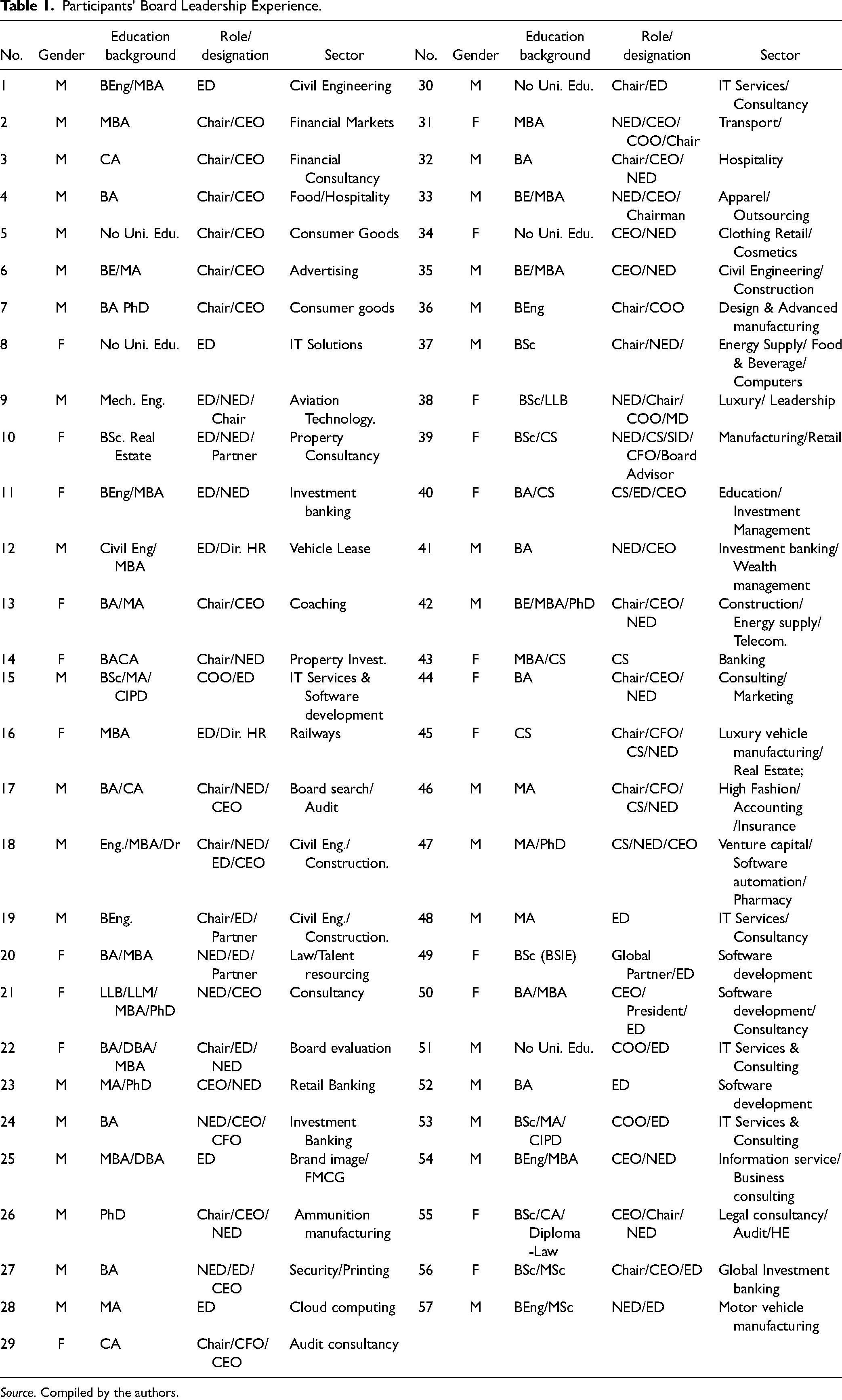
Source. Compiled by the authors.
Therefore, in 21st-century board leadership discourse, Chairs’ resources need to be explored in order to identify the best practices of effective leading (Alvesson & Kärreman, 2016). The need is even more critical in the institutional context of the UK corporate governance, where Chairs of listed companies play a significant role (The UK Corporate Governance Code [FRC, 2018]).
Methods
As a result of the well-recorded difficulties in obtaining access to boardrooms, there has been an over-reliance on assumptions about boardroom activity, limiting our understanding of the dynamic social systems of boards (Lorsch, 2017). Although access is a challenge, interviewing board elites is an effective, inductive, exploratory and qualitative approach to obtaining information on elite experiences (Frémeaux & Pavageau, 2022; Karakas & Sarigollu, 2013). This approach has been successfully adopted in a few studies on FTSE boards (e.g., Goyal et al., 2021; Kakabadse et al., 2018; Roberts, 2002). In this study, we collect the data via elite interviewing and analyze the data thematically (Baumgartner & Schneider, 2010). In this study, we explore perceptions on board Chair's effectiveness practices from those who have board Chair experience or who lead with them (as also done in Harrison & Murray, 2012).
Research Design
We conducted audio-recorded interviews with 57 corporate elites of top FTSE companies, which allowed us to listen to them several times and develop a deeper understanding of the participants’ perspectives (as also done by Bezemer et al., 2018). Along with 52 board members, which include board Chairs, CEOs, NEDs, EDs and senior independent directors, the sample in our study also includes five CSs. Although positioned at senior management, that is, “the first layer below the board” (FRC, 2018, p. 8), CSs are often the longest-serving individuals in boardrooms and have the most up-to-date and critical information on board issues, dynamics, and interactions (Kakabadse et al., 2016). CSs also act as the main communication channel between the Chair and other board members and support Chairs in running boards efficiently and effectively (Cadbury, 1992; Roberts, 2002). Our sample selection approach of including board members and CSs is consistent with other board Chair studies (e.g., Kakabadse et al., 2016; Levrau & Van den Berghe, 2013).
The main research themes explored in elite interviews are as follows:
How do you view the role of the Chair in the board's effectiveness? Who were the effective Chairs that you have worked with? Why do you consider those Chairs effective? How would you describe their leadership style/What were the approaches demonstrated by those effective Chairs? How would you describe the leadership approach of the less effective Chairs you worked with? How do effective Chairs shape boards’ effectiveness/dynamics?
Sample: Purposive Snowball Sampling
In our study, the sample is purposive (Tongco, 2007). All participants have extensive board experience, including in at least one FTSE350 board. Most participants have performed different board roles and been on multiple boards across industries. There are 32 male and 20 female board directors; and 3 female and 2 male CSs in the sample. While we conducted 57 interviews, it's noteworthy that most of the participants had experience in multiple board roles. This multifaceted involvement significantly contributes to their comprehensive understanding of the Chair's role and effectiveness, as illustrated in Table 1.
We first approached potential participants through the personal and professional network of the principal author. We also availed ourselves of the networking opportunities at business schools with which the we are affiliated to approach potential participants. Additionally, organizations such as the Chairman's Forum, Institute of Civil Engineers (UK), International Women's Forum (UK), Institute of Directors (IoD), and Associated Chambers of Commerce (ASSOCHAM—UK chapter) were also approached to recruit participants for the study. Out of 59 board members who were contacted, one declined, citing prescheduled engagements, and one was not available on the day of the interview and did not reschedule for later. All five CSs who were approached agreed to be interviewed. Emails were sent to potential participants requesting face-to-face, one-to-one interviews lasting 60 to 90 min. Emails also mentioned that participants would be anonymized in the study. We also assured them that the collected data would be used for research and knowledge transfer and that no commercial reward would accrue.
Participants 16 and 18, after their interviews, agreed to facilitate access to other potential participants in their network. This snowball exercise (Goodman, 1961) continued, and a few more participants introduced the authors to a third set of participants. The purposiveness of the sample set was maintained throughout the study.
Data Collection: Elite Interview
Data were collected through elite interviews with open-ended questions on six main themes (as mentioned in Research Design section). Most participants preferred to be interviewed at their places of work, often in boardrooms. Three interviews were conducted in cafés. No reward for participating in the research was requested by the participants or offered by the authors. Interviews lasted, on average, 53 min; the shortest interview was 29 min and the longest 92. All interviews were digitally recorded. The consent of the participants for recording the conversation was obtained through email and confirmed at the beginning of the audio-recorded interviews.
Recordings were transcribed verbatim by the principal author using InqScribe software. Verbatim transcription was carried out in order to minimize any potential bias.
Data collection and analysis were carried out simultaneously in order to feed in any new codes into subsequent elite interviews (as also done by Francis et al., 2010). An iterative process of elite interviewing and analysis continued even after data saturation in order to benefit from the unique access to FTSE directors optimally and to further strengthen the findings (as did Morais et al., 2019). Not all themes were discussed in each interview because of time constraints and participants’ preference for and expertise in specific themes. Only one participant, who had led The Chairman's Forum, and had deep insights and institutional knowledge of the role, its challenges, and the future trends, spoke on all the themes mentioned in the research protocol. CSs spoke extensively on the Chair's role in agenda-setting, board pack availability to NEDs, board review, and conflict resolution. Participants substantiated their views with anecdotes/examples of their actions or other Chairs’ actions. Transcribed data were thematically analyzed (Braun & Clarke, 2006) to explore emerging themes/patterns.
Data Analysis: Thematic Analysis
We adopted the thematic analysis approach because it provides a deeper understanding of a phenomenon interpreted by the people living and experiencing it (Shah & Corley, 2006). All transcripts were arranged in a tabular form, separating questions from answers in numbered rows. We read all transcripts to immerse ourselves in the context and the content. We coded each transcript separately and then reconciled the codes to cohesively capture all emerging themes (as in Karakas & Sarigollu, 2013). Coding was done manually in order to avoid the constraints of the “code and retrieve” method (Liamputtong, 2009; Zhang & Wildemuth, 2009). We contend that although digital analysis software packages such as NVivo provide excellent data management and retrieval facilities that support analysis and write-up, the traditional approach to coding scaffolds the analysis process comprehensively (Maher et al., 2018). Therefore, in the interest of a more profound understanding of effective Chairs’ resources, we adopted manual coding in the study.
We coded for first-order, second-order, and conceptual categories to observe patterns (as did Bezemer et al., 2018). We used both priori and grounded codes for open coding in data analysis (Panagiotakopoulos, 2013). An example coding process is presented in Table 2. The highlighted text is given a category in the “codes” column. Codes are then grouped in second-order codes, forming subthemes (Braun & Clarke, 2006).
Themes were run across all transcripts for refinement (as suggested by Braun & Clarke, 2006; Morais et al., 2019), and conceptually categorized as they emerge after multiple readings of transcripts, codes, and subthemes. Analyzed qualitative evidence is selectively presented as the most common themes in the findings section which provide rich descriptions of the observed patterns (as in Bezemer et al., 2018). These themes are ritualistic behavior observed in/practiced by effective Chairs. These themes also represent effective Chairs’ best practices and their deep-seated beliefs in the effectiveness of those practices.
Findings: The Effective Chair
Our elite, interview-based, exploratory, qualitative study avails us of a deep insight into how effective Chairs of FTSE350 companies lead. Responding to scholars’ call for new theorizing (e.g., Banerjee et al., 2020), we report seven main approaches that effective Chairs of FTSE350 companies adopt: (1) support for the CEO, (2) values-based conduct, (3) experiential influence, (4) commitment to diverse perspective, (5) inclusive communication, (6) intuitive conflict resolution, and (7) reflection (through board evaluation) for course correction.
Support for the CEO
The participants in our study claim that effective Chairs have a supportive approach toward the CEO. They explain that effective Chairs mentor their CEOs by offering experience-based counsel. Effective Chairs do not compete with the CEOs for power or recognition. One of the participants, a CS, explains this through an example of a less effective Chair they have worked with: “There's a bit of frustration if the Chairman keeps an executive hat too close to hand when doing his or her Chair role. Or who's previously had a lot of executive roles and is finding it difficult to step back. Or if the chief executive is feeling a little bit controlled by the Chairman or checked.” (Participant 44)
Another participant adds that effective Chairs lend support to CEOs in the interest of efficient decision making in boardrooms. They further explain: “When I chair a company, I say to the CEO, ‘Look, I am here to help you be successful. So, what I am going to do as your Chair man is to let you know who are the characters on the board that may be challenging that we need to address. What we need to do before we go to the board meeting is to make sure that we deliver and we don't get derailed. On an item that requires a board decision, what would you like the board decision to come to? What do you see as a challenge?’ So, I am advising [the CEO] in anticipation of what questions may be asked at the board meeting. As a Chair, that is my role!” (Participant 18)
In our study, support demonstrated by the Chair toward the CEO is reported as one of the key approaches of an effective Chair.
Values-Based Conduct
Participants in our study describe effective Chairs that they have worked with as “performance-driven but values-focused.” Participants argue that effective Chairs practice and preach the same values, and ensure that their companies adhere to ethical norms. A participant in the study—a Chair of several top FTSE boards with a reputation for effective board leading and for being on several corporate governance reform committees—claims that they have deliberately chosen to lead the companies with aligned corporate practices and values. “You see a lot of comments on excesses and bad practices in businesses. But all the businesses that I have been involved in are layers away from that. Now, that may be because these are the businesses that I have chosen to work in because of the values in me. I think my values are compatible with what most people would consider a righteous business.” (Participant 22)
Another participant identifies these ethical norms as fairness, truthfulness, having and promoting integrity, and a clear delineation between right and wrong, and underlined the need to deeply imbed them into boards and executive teams. “Business, for me, is performance-driven and value-led. You develop a set of rules which you live by: seeking truth, being fair with people, operating with integrity, and knowing where the line between right and wrong is. Unless they have deeply embedded beliefs, there is a risk that you stray away. And if they are embedded, they tend to bring you back, whatever the temptations are to deviate from them.” (Participant 9)
Our study findings indicate that the role of values-based and performance-driven leadership is crucial for effective board leading.
Experiential Influence
The participants in the study report that effective board Chairs lead by exercising influence instead of positional power and still succeed in accomplishing their objectives. Board members respect a Chair's long, versatile, and successful executive careers which they had before taking up board Chair positions. As a result, board members willingly defer to the Chair's knowledge and wisdom. Effective Chairs also compose boards in such a manner that there is mutual respect between the Chair and other board members. One participant, a Chair, articulates the approach as follows: “The first thing you recognize is that it is a job done by influence rather than absolute power … the fact that you have decided you no longer want to be a chief executive, the willingness to exchange power for influence, is a very important transition … you have made a decision that you are prepared to be influential. Therefore, that also means you need people around you whom YOU respect. Because then you willingly listen to their views and encourage their participation without feeling threatened by it.” (Participant 38)
Participants in the study add that effective Chairs have held executive and nonexecutive board positions in the past, which gives them a profound appreciation of the capabilities and contribution of board members. One Chair underlines the need for a versatile board experience for effectiveness as follows: “[Y]ou've got to have the experience of the executive role and you have got to have an understanding of the business. Just as important it is to have an executive [position], it is also important to have a non-executive position in another company, as it helps you understand the nature of boards. Some of the best Chairmen were chief executives or they were finance directors. But you have to have a diverse experience of both sides! It is important. That way, you understand why the other person is asking what they are asking. And you respect it more.” (Participant 5)
Since, on average, boards meet only up to eight times a year, and since most board Chairs hold their positions in a part-time capacity and have a significant information gap (as compared to the CEO), exercising positional power, the participants claim, would not be prudent.
Commitment to Diverse Perspective
Participants in the study assert that effective Chairs compose boards which meet the unique skill/experience need of that board for effective decision making. Since board Chairs often lead nomination committees (which appoint board members and senior executives), they can influence board composition. One participant, a board Chair, argues that in 21st-century organizations, “insufficiently diverse information sources are bound to be inadequate” (participant 6). Effective Chairs, therefore, define “diversity” in the broadest sense and consider it critical to decision making. In response to the question on how to compose diverse boardrooms, a participant responds as follows: “No magic. Just make sure you have got people who don't think like you. Mostly, make sure that you have got people that disagree with you and challenge your outlook. Otherwise, the danger is that you will have people who will quickly say, ‘yeah, yeah, that's right.’ Because they're all from the same narrow, rather than diverse, backgrounds.” (Participant 29)
Another participant underlines the need to compose diverse boards in order to deal with the new challenges of the 21st century: “As we look forward over the forthcoming decades, all businesses, headquartered here or not, purely [in] the UK or not, will come from the areas outside the UK and outside Europe. It will come from India, Southeast Asia, China, South America, and Mexico, areas that are often referred to as the more rapidly growing areas of the world. Any business which doesn't think it needs to be tuned in is going to get the exposure they don't realize … It [decision-making] needs the currency of inputs.” (Participant 32)
Our study findings show that effective Chairs systematically assess the skill, competency, and experience needs of their boards and then compose boards with members who meet those requirements.
Inclusive Communication
The participants in the study explain that effective Chairs are thoughtful and inclusive communicators. They keep key stakeholders such as investors/shareholders informed of board decisions and their rationale, and integrate stakeholders’ concerns into board decision making. At times, those conversations are without the CEO present to facilitate an open conversation about the company's health. “My role as Chairman is to manage the board and guide them [directors] in the right direction to make sure that we are getting the best effectiveness out of the board that we possibly can. And that means … making sure that our shareholders are happy and, if not happy, then very aware of what it is that we are trying to do and why we are trying to do that. So that's a responsibility of the Chair.” (Participant 17)
Also, effective Chairs communicate well within boardrooms and can elicit contributions from even the less engaged members. They allow board members to express their views independently by keeping their opinions reserved until other members have spoken. This allows them to hear diverse perspectives on board agenda items without casting deliberations in one direction. One participating Chair explains: “It means that you say what you mean—last, not first. Because if you speak first, you cast the whole discussion. It means you need to make sure that people contribute. So, if they are quiet, ask them what they think. And it also means you build a group of people who fit together for skills and characteristics and who happily give and receive constructive criticism. But the key thing is the orchestration of the interaction of people. That's what it's all about. The best Chairmen do that well.” (Participant 19)
Again, compared to executive team leading, where the directive style of communication is reported to be effective in relevant contexts, our study findings show that, for effective board leading, the communication style needs to be inclusive and facilitative.
Intuitive Conflict Resolution
Participants in our study share that, in boardrooms, deliberations can lead to conflict because of the contentious nature of issues being discussed and the domineering personalities of board members. Furthermore, participants explain, board members are all highly successful, competitive, and overachieving individuals with significant discretion, power, and monetary rewards. As a result, there are several occasions on which board deliberation can potentially be heated, leading to disagreements and conflicts. However, conflict in boards results in inefficiency and ineffectiveness, requiring the Chairs to address such a scenario with tact, intuitiveness and firmness. A participant, a CS, summarizes the scenario as follows: “Sometimes, you do have quite strong characters as CEOs, and they can be quite performance-oriented and driven by the reward. That can sometimes be an area for conflict, particularly where you're going to exercise discretion. Those scenarios can lead to some very robust and tense conversations. In such scenarios, the Chairman is one person who can hold the chief executive to account. That's the skill of a good Chairman to ensure that one doesn't bring their agendas into the boardroom. Also, it's the Chairman's job to manage everybody else's ego.” (Participant 47)
Participants elaborate that contentious issues in board deliberations are a company's strategic direction, executive remuneration, board nominations and renewal, and executive accountability on firm performance. However, effective Chairs demonstrate the ability to navigate such issues and obtain consensus. A participant, with board experience as a CS and an NED, articulate their view as follows: “The Chairman needs to think of alternative ways of tackling it [conflict]. The Chairman needs to be able to keep the conversation moving. Also, when something is getting quite tense, and there's no immediate answer, they know when to take it off the table and say, ‘look, I suggest we come back to this.’ That might just diffuse a situation from becoming tense right at the outset. A measured and experienced Chairman should always avoid taking anything to a vote.” (Participant 43)
Reflection and Course Correction
The ability to reflect not only on their own ability to lead a board but also on collective competencies as a board is reported by the participants in the study to be one of the underlying characteristics of an effective Chair. Such a reflection ensures that boards remain fit for purpose, and each member is appointed to meet the role requirements of the board. A reflective approach to board leading also helps Chairs correct the course pre-emptively with effective Chairs involving all board members in such a reflective process. One participant, with Chair and CEO experience, shares as follows: “One of the things that I do in a chairman's role is to do an audit. I speak to the individual board members one-on-one. ‘How long have you been on the board?’ ‘What do you bring to the board?’ ‘What is your observation of the board?’ ‘Where do you think we can improve the business?’ ‘What do you think we don't know strategically?’ ‘Do we have a problem that we are not reflecting on?’ ‘Is the board able to give us a balanced view to help us make a strategic decision, commercial decision, the human capacity decision that we need to make?’ And that is critical.” (Participant 56)
A reflective board evaluation also allows Chairs to reflect on board members’ contributions individually, with reference to the collective goals of the board. Such a reflection helps them take remedial measures if there is a lack of alignment of interests which can potentially vitiate board dynamics. For example, one participant, a CS, explains: “In UK plc, board evaluation can be very helpful because sometimes an external facilitator can point out things that the board either hadn't seen or hadn't recognized. In board evaluations, they interview each director separately, and ask each of them how they regard their and the board's roles. I think a board that doesn't have a cohesive view of its own role, a cohesive view of their accountability, or what constitutes good performance is set on a path of conflict.” (Participant 47)
The academic literature on reflection as a resource for effective board leading is skeletal, and the usual suspect is the lack of access to members. Participants in our study claim that effective Chairs favor even more frequent reflective board evaluation than recommended by the Code (FRC, 2018)—once every 2 years.
The extant literature reports that corporate elites of for-profit companies have short-termism, an insatiable desire for recognition and applause, a need for power, and jealousy towards other power centers in the team. We demonstrate that effective Chairs leading large corporate entities with significant, responsibilities are behaving in an enlightened manner; a style often attributed to leaders of nonprofit organizations.
Discussion: The Enlightened Chair
We now analyze the findings with reference to the attributes of enlightened leaders, as reported in the existing leadership literature. Each approach of effective board Chairs is analyzed with literature on board leadership, identifying the gap that this study addresses and drawing a parallel with reported attributes of enlightened leaders. The corporate governance literature extensively discusses the discretionary leadership style, monitoring ability of boards and, in a few cases, stewardship of boards and board Chairs. In contrast, the attributes of enlightened leaders are often reported with reference to nonprofit leadership. Therefore, our study's findings, which draw a parallel between the two, are of unique value. In this section we present how Mantras emerge from the findings of the study and align with the approaches of enlightened leaders.
Participants in the study often referred to the leadership approach of effective Chairs as “enlightened”. Additionally, the authors of this article who are experts on different leadership approaches, identified some parallels in emerging themes from analyzed data with resources of enlightened leaders (Chism, 2016; Gazley & Kissman, 2015; Millick, 2009; Rhee & Sigler, 2010; Sharma, 1995). Those resources are referred to as Mantras in this section. As Islam and Zyphur (2009) define rituals to be actions demonstrated through values and identity in specific contexts, we report the rituals (i.e., Mantras) of effective Chairs as reported in the study.
Yelle (2004) defines a Mantra, a Sanskrit word, as “magically charged verbal formulas used in the Hindu and Buddhist traditions to achieve a broad range of goals, including many that are extremely pragmatic and immediate” (p.viii). In a secular context, Mantras can also be statements and practices, repeated for the desired outcomes (Flick, 2017). The best practice Mantras, as reported in this study, are the ones adopted by effective board Chairs, as claimed by the participants in the study. The findings of the study are presented in Table 3. The section below presents the Mantras and integrates them with relevant literature on enlightened leadership. Only representative vignettes summarizing the theme are presented in Table 3).
Representative Coding and Data Analysis Process.
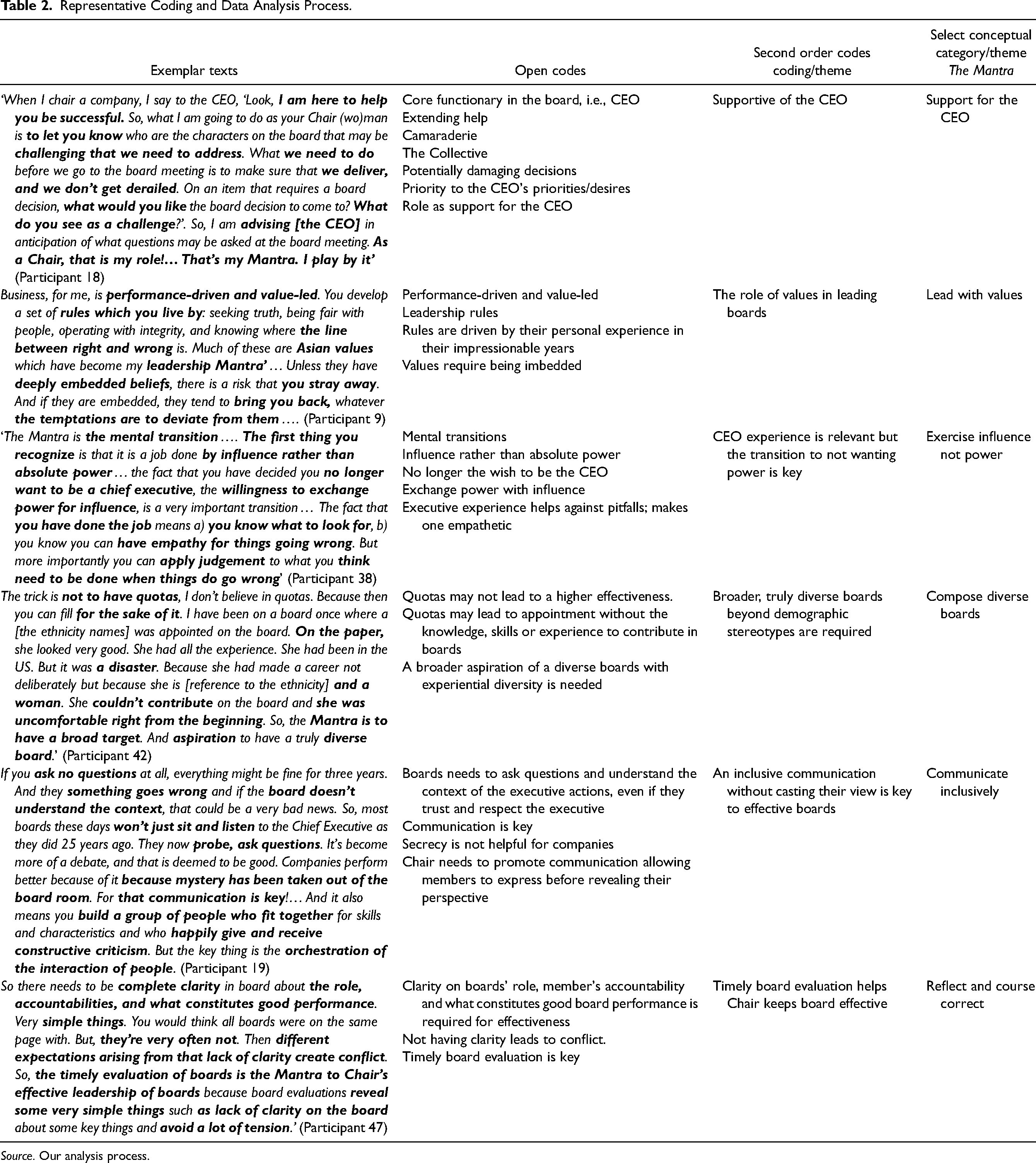
Source. Our analysis process.
Seven Mantras of the Enlightened Chair.
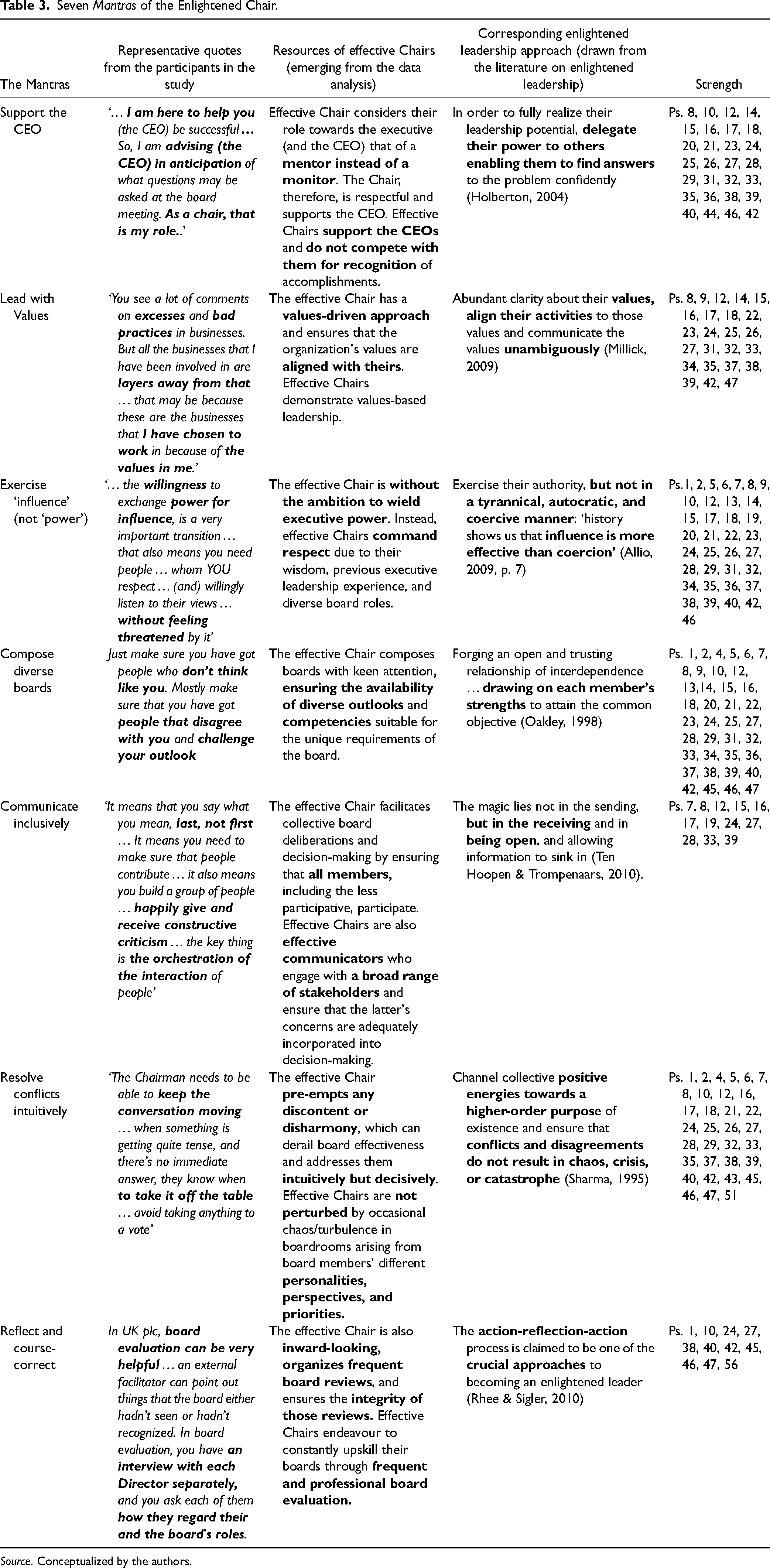
Source. Conceptualized by the authors.
Mantra 1: Support the CEO
The extant literature underlines the monitoring role of the Chair and its role in preventing rent-seeking and agency cost to the shareholder, with little exploration of the Chair–CEO mentoring dynamics. In other contexts, the shift from the Chair's monitoring role to the mentoring role is emerging too, as studies report that board leaders who mentor their peers to shine are perceived as effective and cherished (e.g., Frémeaux & Pavageau, 2022; Satter & Russ, 2007; Shekshnia, 2018). In Australian boards, effective Chairs have been observed to be nondomineering, who willingly allow the CEO to receive accolades for their performance (Veltrop et al., 2021). A trusting relationship between the Chair–CEO duo is argued to be favorable for firm performance (Zheng & Zhu, 2022). In line with these trends, our study significantly reports (a) the implications of a vitiated CEO–Chair relationship and (b) the role of Chair's enlightened approach to CEO–Chair dynamics in their effectiveness and improving board dynamics.
In leadership literature, an enlightened approach of bringing out the best in others is claimed to be a higher level of leadership ability (Holberton, 2004, p. 57). An enlightened leader acts as a “hero maker,” and such an attribute is considered a good measure of their effectiveness (Oakley & Krug, 1994; Ten Hoopen & Trompenaars, 2010). An enlightened leader facilitates high performance in others, without dominating them or feeling threatened by their accomplishment (Preston, 2004). Enlightened leaders know that developing their team members as future leaders is as important as it is to appoint a suitably skilled team (Holberton, 2004). Enlightened leaders are instrumental in achieving their team members’ aspirations because they have high self-confidence and self-esteem (Oakley & Krug, 1994). In a separate body of literature, a supportive approach toward a team member is claimed to be a strategic resource of an effective leader (Schyns & Schilling, 2011).
As can be seen above, the enlightened leadership literature presently refers to effective team leading. Although boards have a different remit than that of an executive team, our findings suggest that effective Chairs demonstrate an enlightened approach of supporting the executive leaders in boards.
Mantra 2: Lead With Values
The Chairs have discretion on various moral and ethical issues (Guerrero et al., 2015). The FTSE Chairs are responsible for determining corporate values, culture and standards, and upholding them to the highest standards of integrity and probity (e.g., Board Agenda & Mazars, 2017; Higgs, 2003). The role of value-based leadership in the sustainability and longevity of organizations is even more acutely felt in the aftermath of corporate scandals in the United States and Europe (Reilly & Ehlinger, 2007; Viinamäki, 2009). However, most of those studies discuss executive leadership and are often set in other country contexts.
Enlightened leaders (see Table 3) recognize the role of moral values, clearly communicate those values to stakeholders, and personally adhere to them (Ten Hoopen & Trompenaars, 2010). They believe that adhering to moral values helps in leading 21st-century organizations through change and toward sustainability and longevity (Chism, 2016; Millick, 2009, 2012). For enlightened leaders in the business world, values are the “true North of [their] moral compass” on which leaders should set their vision (Ten Hoopen & Trompenaars, 2010, p. 49).
The corporate governance literature is replete with accounts of the rent-seeking behavior of leaders, short-termism, and agency cost to shareholders in for-profit companies. Yet the findings of our study show that, at the apex of strategic leadership in the largest for-profit companies, value-driven conduct is a Mantra for effective leading. Carr (1968, p. 22) famously argues that business practices ought to be judged by the rules of business and not by the principles of ethics and morality as taught in a church. We agree and demonstrate with empirical evidence from for-profit companies that an enlightened approach works in board Charing.
Mantra 3: Exercise “Influence”’ (Not “Power”)
The existing knowledge defines “power” as a structurally determined potential for a favored payoff and is often associated with wielding authority over employees (Willer et al., 1997). Even though frequently applied interchangeably, power and influence are two related but different phenomena (Willer et al., 1997). Influence is the advice of a competent member, which is followed by other members; therefore, competence is an antecedent of influence (Anderson et al., 1966). In corporate entities, Power, is the control arising from the discretion available to the CEO in executive decisions, board appointments and access to firm-specific information (Westphal & Zajac, 1995).
Enlightened leaders exercise their authority, but not in a tyrannical, autocratic, or coercive manner, because they know that adopting those approaches will alienate their stakeholders (Allio, 2009). Allio (2009, p. 7) argues that a leader's style of wielding power, subtly or blatantly, may determine an organization's success or failure because “influence is more effective than coercion” (p. 7). An enlightened leader is not driven by positional power but instead by cultivating shared passion (Ten Hoopen & Trompenaars, 2010). An accumulated wealth of academic qualifications, training and practicing, developing deep insights into and mastering the craft of leadership makes leaders “enlightened” (Holberton, 2004).
Although effective board Chairs are expected to have extensive board experience and reliable social networks (Banerjee et al., 2020), how they operationalize the influence for effectiveness is missing in the extant literature, a gap that our study addresses. Our study findings, therefore, reveal another facet of effective board leading, which seems to echo the traits of an enlightened leader (see Table 2).
Mantra 4: Compose Diverse Boards
The existing literature on board effectiveness recommends diversity on boards and encourages the corporate sector and board Chairs to take measurable initiatives to compose diverse boards (Kakabadse, Figueira et al., 2015; Kakabadse, Goyal et al., 2018; Sonnabend, 2015). Chairs are recommended to leverage board members’ diverse knowledge, competencies, and experience for effective board work (Bezemer et al., 2018; Guerrero et al., 2015; Roberts et al., 2005). Globally, Chairs are reported to be taking measure to promote diverse boards (e.g., Australian boards, see Veltrop et al., 2021). However, the knowledge of how boards can operationalize diversity for higher effectiveness is still developing (Langan et al., 2022). Researchers are encouraged to investigate how effective Chairs lead boards that are becoming increasingly diverse (Banerjee et al., 2020; Kirsch, 2018). Our study addresses this knowledge gap and reports that for effective Chairs, board diversity is a business-case requirement, to be applied as per the unique requirement of each board.
The literature on enlightened leadership claims that such a leader composes a team with people who may not look or think like the leader, but who represent the stakeholders’ perspective, because it is not humanly possible for the leader to know all the answers for the present and future challenges that organizations may face (Holberton, 2004). Therefore, an enlightened leader forges relationships of trust and interdependence with team members, drawing on each member's strengths for optimum collective performance (Oakley, 1998).
Several board Chairs of top FTSE companies (a few are also participants in this study) are actively leading policy initiatives and corporate praxis on board diversity in the UK. Therefore, our study findings not only provide insights into how effective Chairs deploy board diversity for collective board outcomes but also demonstrate the conviction of those effective Chairs who are promoting it through their involvement in policy initiatives and as corporate influencers. These attributes echo several characteristics of an enlightened leader.
Mantra 5: Communicate Inclusively
Existing literature acknowledges the Chair's role in streamlining boardroom discussions and engaging board deliberations (e.g., Bezemer et al., 2018), but the knowledge on how they deploy their communication abilities in engaging stakeholders is an area requiring further development, and researchers are encouraged to explore how effective Chairs manage communication with a range of stakeholders (e.g., Banerjee et al., 2020). Our article addresses this gap.
An enlightened leader gives paramount importance to communication: listening attentively during deliberations, being responsive to others’ views, probing further for shared meaning, and having empathy for a different perspective (Gazley & Kissman, 2015). Holberton (2004, p. 53) claims that a leader needs to go beyond “knowing the answers” and to “seeking the answers,” which can only be done when the leader is willing to listen and actively seeks communication from peers and others. For an enlightened leader, the key to effective communication lies not in the sending, but in the receiving and in being open to new information (Ten Hoopen & Trompenaars, 2010). Furthermore, enlightened leaders do not influence the discourse by presenting their views and, instead, empower peers to share their perspectives Before sharing their own (Holberton, 2004).
Enlightened leaders have an inclusive, facilitative, and nuanced approach to communication—an attribute effective Chairs have mastered, as revealed in our study.
Mantra 6: Resolve Conflicts Intuitively
There is a significant knowledge gap in the extant literature on how to effectively manage conflict in boardrooms. Veltrop et al. (2021) underline the need to explore how board Chairs manage cognitive conflicts and provide psychological safety for effective and collaborative board work. Furthermore, with increasing disruptions and complexities of business as witnessed in today's organizations, Chairs will be called upon more often to resolve conflicts within boardrooms and their ability to build trust will be tested like never before (Morais et al., 2019).
Enlightened leadership literature claims that such leaders proactively resolve conflict for collaborative decision making (Allio, 2009). Enlightened leaders can conjure productivity even out of chaos and do so by channeling a team's collective positive energies in visualizing a higher order purpose in conflicts and disagreements, thereby avoiding chaos and catastrophe (Sharma, 1995; Ten Hoopen & Trompenaars, 2010). Enlightened leaders have foresight and are skillful in correcting any cognitive dissonance arising out of diverse perspectives and beliefs in a group (Chism, 2016). Enlightened leaders refine their intuitive abilities and skills until it becomes second nature (Holberton, 2004).
Not taking issues to vote in the board, but resolving contentious issues with tact and skillful mediation are often reported by the participants as key to a successful board chairing. Taking an agenda off the table if a consensus is not in sight and then addressing it again after backroom discussions and mediation are carried out, is reported to be a characteristic of an effective Chair, in the study. Such an intuitive approach to conflict management in boards is akin to how an enlightened leader would manage conflict but is not discussed in the extant academic literature on board governance, a gap our study addresses.
Mantra 7: Reflect and Course-Correct
Reflection is not a new concept in the extant knowledge. Confucius encouraged it more than two millennia ago, as did Ivy League academics and management experts in the 20th century (Adler & Delbecq, 2018; Gardner, 1995). Reflection with an inquiry into one's own experience has a quantifiable and positive impact on individuals and organizations (Allen & Williams, 2017; Karssiens et al., 2014). Spending time to reflect, improving the knowledge of processes and then using the insight to improve the processes is a commonly practiced approach for effective leadership (Hixon & Swann, 1993; Reave, 2005). The practice of reflection in leaders can result in enhanced and quantifiable performance (Karakas & Sarigollu, 2013; Reave, 2005).
An enlightened leader learns from mistakes, adversities and setbacks and turns them into an opportunity for growth (Holberton, 2004). The action–reflection–action process is one of the crucial approaches to becoming an evolved and enlightened leader (Gardner et al., 2011; Rhee & Sigler, 2010). An enlightened leader is learning-centred and adaptable and one who learns from their mistakes through active reflection (Holberton, 2004; Rhee & Sigler, 2010).
Participants in this study argue that Chairs of the 21st century use reflective learning as a critical resource for course correction, improving their and their board's effectiveness. Therefore, our article characterizes an effective Chair as an enlightened one, following the seven Mantras of effective board leading.
Conclusion
The purpose of this article is to develop a better understanding of strategies employed by effective board Chairs and record some of their best practices, which will provide a roadmap for current and future board Chairs. We report that board Chairs’ discretion continues to be vast in 21st century boardrooms, and Chairs play a key role in creating an environment of support, transparency and collaborative idea-sharing. Through rich qualitative data, our article presents the lived experience of Chairs and other board elites providing valuable insight into practices within boardrooms, and identifies enlightened practices (Mantras) adopted by effective Chairs of FTSE companies. Contrary to the practices around religious mantras we do not suggest that effective Chairs have “visionary experiences” or “the insights in their lucid moments” or that they have renounced material possessions and are practicing “detachment” (Ten Hoopen & Trompenaars, 2010). Our findings address the call to provide new knowledge for management education programs on enlightened leadership in order to develop self-aware, learning-centred, adaptable, interpersonally competent, and team-oriented leaders (Rhee & Sigler, 2010).
Even though the article is based on a study conducted in the boardroom of top listed companies in the United Kingdom, its implications may extend to global board leadership in other governance regimes and provide them with guidance for navigating through change to sustainability.
Finally, responding to the call from Banerjee et al. (2020) for new theories to explain Chairs’ resources in effective board leading, the article contributes by extending enlightened leadership (Sharma, 1995) to the unique contexts of board leadership of top-listed companies in the United Kingdom. The theory, so far, had conceptualized and applied only to the executive and not-for-profit leadership. Our study findings support the extant literature claiming that 21st-century leadership warrants an effective, intuitive, and intellectual leadership approach (Adler & Delbecq, 2018).
The article reports the approaches of effective board leading as required by the Chair. Chairs who are new to the position, after prolonged executive leadership roles, may not have developed those capabilities or perspectives or may not utilize them. Particularly, Chairs who have recently transitioned from CEO roles may find the transition challenging to navigate because of the inherent differences in role requirements of both CEO and Chair positions. Through the Mantras identified in the article, we also provide Chairs with a roadmap to lead boards confidently and with effectiveness. Furthermore, the article provides granular details of the context, the process of data collection and analysis, and the role and competencies of the authors in interpreting the data, as has also been recommended by Johns (2001).
Limitations and Guidance for Future Research
Collecting data through interviews with corporate elites and presenting their first-hand perspective, is one of the main strengths of the article; yet, the use of a nonrandom sample from 57 participants, which does not allow us to claim generalizability for our results, is a limitation. The study also focuses on the corporate governance context of FTSE350 companies and we acknowledge that strategies of leading boards of small firms, entrepreneurial firms and firms in distinct corporate governance regimes may vary. We believe that future research could build on the insights gained from this study and investigated them with a structured survey with a larger dataset. Future studies may also explore the strategies of effective Chairs in other governance regimes. We recommend that future studies also collect data with proximity to the research subject (e.g. through interviews or survey questionnaires).
We did not find all reported attributes of enlightened leaders in board leadership practices of effective Chairs of a 21st-century FTSE firm, in our study; however, the best practices of board leading seem to echo several of them. A few attributes of an enlightened leader reported in the extant literature—such as networks, commitment, selfless contribution, and enabling others’ spiritual capabilities—were not observed in our study. We attribute this to the limited size of our sample. Future studies, through quantitative studies looking for generalizable results and a larger representative sample, may investigate that aspect.
Footnotes
Appendix 1. The Role and Responsibilities of the Chair in FTSE Companies
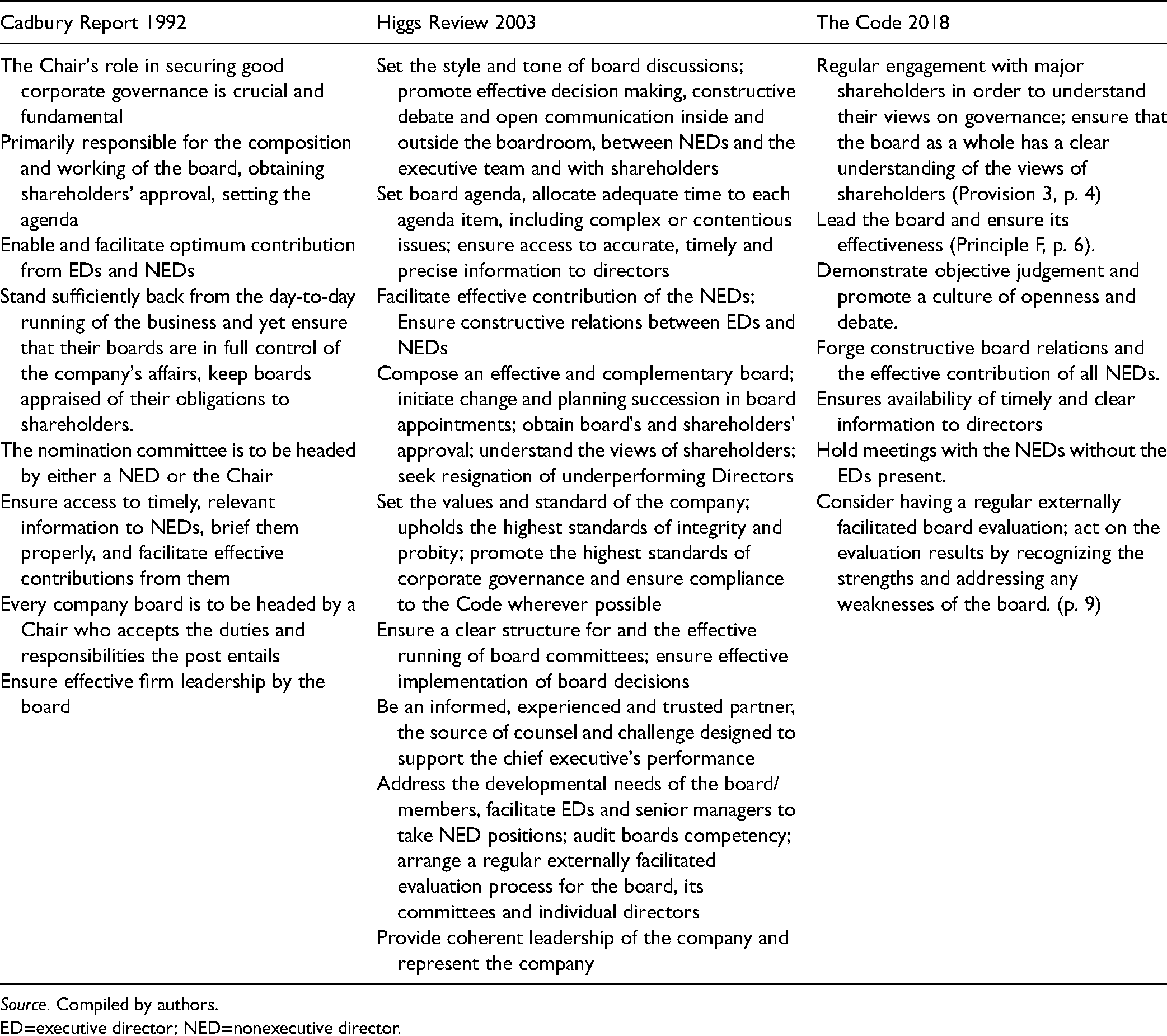
| Cadbury Report 1992 | Higgs Review 2003 | The Code 2018 |
|---|---|---|
| The Chair's role in securing good corporate governance is crucial and fundamental Primarily responsible for the composition and working of the board, obtaining shareholders’ approval, setting the agenda Enable and facilitate optimum contribution from EDs and NEDs Stand sufficiently back from the day-to-day running of the business and yet ensure that their boards are in full control of the company's affairs, keep boards appraised of their obligations to shareholders. The nomination committee is to be headed by either a NED or the Chair Ensure access to timely, relevant information to NEDs, brief them properly, and facilitate effective contributions from them Every company board is to be headed by a Chair who accepts the duties and responsibilities the post entails Ensure effective firm leadership by the board |
Set the style and tone of board discussions; promote effective decision making, constructive debate and open communication inside and outside the boardroom, between NEDs and the executive team and with shareholders Set board agenda, allocate adequate time to each agenda item, including complex or contentious issues; ensure access to accurate, timely and precise information to directors Facilitate effective contribution of the NEDs; Ensure constructive relations between EDs and NEDs Compose an effective and complementary board; initiate change and planning succession in board appointments; obtain board's and shareholders’ approval; understand the views of shareholders; seek resignation of underperforming Directors Set the values and standard of the company; upholds the highest standards of integrity and probity; promote the highest standards of corporate governance and ensure compliance to the Code wherever possible Ensure a clear structure for and the effective running of board committees; ensure effective implementation of board decisions Be an informed, experienced and trusted partner, the source of counsel and challenge designed to support the chief executive's performance Address the developmental needs of the board/members, facilitate EDs and senior managers to take NED positions; audit boards competency; arrange a regular externally facilitated evaluation process for the board, its committees and individual directors Provide coherent leadership of the company and represent the company |
Regular engagement with major shareholders in order to understand their views on governance; ensure that the board as a whole has a clear understanding of the views of shareholders (Provision 3, p. 4) Lead the board and ensure its effectiveness (Principle F, p. 6). Demonstrate objective judgement and promote a culture of openness and debate. Forge constructive board relations and the effective contribution of all NEDs. Ensures availability of timely and clear information to directors Hold meetings with the NEDs without the EDs present. Consider having a regular externally facilitated board evaluation; act on the evaluation results by recognizing the strengths and addressing any weaknesses of the board. (p. 9) |
Source. Compiled by authors.
ED=executive director; NED=nonexecutive director.
Declaration of Conflicting Interests
The authors declared no potential conflicts of interest with respect to the research, authorship, and/or publication of this article.
Funding
The authors received no financial support for the research, authorship, and/or publication of this article.
