



Abstract
Platform cooperatives promise to provide an alternative organizational model of worker ownership and governance to heavily criticized investor-owned gig platforms, but have until now remained relatively rare. This study examines the development of platform co-ops to gain insight into the reasons and mechanisms behind their slow but steady growth in Europe. Using desk research on 48 platform co-ops and 16 in-depth interviews with founders of platform co-ops, we build on paradox theorizing to analyze how founders of platform co-ops manage competing demands during the start-up phase. Extending recent studies on interorganizational paradoxes, we show how systemic tensions in the gig economy motivate the creation of platform co-ops as a way of coping and that interactions between tensions on different levels during actual development can result in failed market entry. Hence, this study also addresses the counter-intuitiveness to the establishment of organizations permeated with paradoxical tensions.
Introduction
In May 2021, a new ride-hailing platform opened for business in New York City. Although its app is similar to that of Uber or Lyft, the organization behind it is very different. The Drivers Cooperative is a worker-owned and worker-governed platform cooperative (hereafter: platform co-op). Without outside investor control, a larger share of every transaction ends up with the driver while also consumers can be charged less (Conger, 2021). On its website, The Drivers Cooperative describes their mission as having an impact even beyond direct users: “For better pay in the short term, and a just, green transition of the industry in the long term” (The Drivers Cooperative, n.d.). The potential of platform co-ops to improve working conditions is also recognized in Europe, for instance as a means of economic recovery, post-COVID-19 (Calzada, 2020). It is not just taxi services or food delivery either. We can see platform co-ops emerging in sectors like social care (Equal Care Co-op, n.d.), creative work (Doc Servizi, n.d.), and interpreting services (The Interpreting Collective, n.d.). This article provides an in-depth analysis of the reasons and mechanisms behind the formation of platform co-ops and as such captures the dynamics behind an alternative future of work (Balliester & Elsheikhi, 2018).
While there exist many different types of platform co-ops, such as those concerned with sharing idle assets between consumers (Münzel et al., 2018) or managing personal information of data-subjects (Blasimme et al., 2018), most attention in research and practice is paid to platform co-ops in the gig economy (Eum, 2019; Mannan & Pek, 2023; Schor, 2020). Gig platforms function as online labour market intermediaries for short-term services that are supplied, often by solo self-employed, either locally or remotely to paying clients (Koutsimpogiorgos et al., 2020). In contrast to platform co-ops, investor-owned platforms in the gig economy face scrutiny for various reasons: using self-employed workers to dodge employer's responsibilities around social safety-net benefits and rights of collective representation (Kalleberg & Dunn, 2016), retaining a level of control over workers that is normally reserved only for employers through algorithmic control and gatekeeping the market (Schor et al., 2020), extracting value from platform labor by high commission rates and data valorization (van Doorn & Badger, 2020; West, 2019), and surviving only by large investments that drive aggressive market expansion. All of this while operating at a loss (Srnicek, 2017). In response to these concerns about investor-owned platforms, platform co-ops engage in business model innovation to redefine “the purpose of the firm and the value creating logic, and rethinking perceptions of value” (Bocken et al., 2014, p. 43).
Investor-owned platforms that promise to be the “Uber-for-X” are started regularly and while not each of these proves to be viable over time, the relative rarity of platform co-ops may be related to more severe difficulties with market entry. Like any cooperative, platform co-ops constitute both a democratic association and a business enterprise (Zamagni, 2012). That means their activities are coordinated by self-governance and market mechanisms, with decision and property rights shared among members. Because of this, platform co-ops face tensions “between politics and enterprise, democracy and the market, commons and commercialization, activism and entrepreneurship” (Sandoval, 2020, p. 812). While Sandoval (2020) argues that platform co-ops need to resist the coexistence of opposing elements by moving in a more political direction, using a paradox perspective may help to redefine such elements not as mutually exclusive, but as competing demands that need to be embraced simultaneously for platform co-ops to become viable (Smith & Besharov, 2019; Smith & Lewis, 2011; van Bommel, 2018).
Paradoxes then become a useful heuristic approach to discover tensions without claiming they should be resolved through trade-offs, as is illustrated by paradox scholarship on social enterprises (Child, 2020; Mason & Doherty, 2016; Smith et al., 2013) and ambidextrous organizations (Andriopoulos & Lewis, 2010; Papachroni et al., 2015). Previous studies on platform co-ops argue either that they are well positioned to advance the Sustainable Development Goals (Zhu & Marjanovic, 2020), but also that their ecological and social impact for nonmembers would not necessarily be any different from investor-owned platforms (Frenken, 2017). This suggests that platform co-ops likely face ambiguities, complex goals, and conflicting stakeholder interests (Mannan & Pek, 2023).
The study therefore sets out to answer the following research question: What tensions do platform co-ops face from competing demands during their formation, and how do founders manage these tensions? Our scope is limited to Europe, where criticism on the gig economy has arguably been stronger than in parts of the world with fewer labor protections (Forde et al., 2017). In our study, we draw on desk research on 48 platform co-ops and 16 business biographical interviews with founders of platform co-ops. The analysis uses a paradox perspective to unveil how the navigating of tensions gives birth to and matures platform co-ops when done so successfully (Lewis & Smith, 2014), but results in an untimely death of the organization if one tensional pole remains dominant. We conclude that paradoxical tensions are a double-edged sword for platform co-ops: motivating their development, but also being a cause for failed market entry.
The contributions of this study are twofold. First, it contributes to the burgeoning literature on platform co-ops (Fuster Morell & Espelt, 2019; Lampinen et al., 2018; Sandoval, 2020). There has been very little empirical research on platform co-ops so far (Belloc, 2019), especially studies that go beyond description (Philipp et al., 2021). The present study contributes by empirically studying platform co-ops in the European gig economy context, and by introducing paradox theory (Lewis & Smith, 2014) to help understand the mixed expectations about platform co-ops’ ability to do better than investor-owned platforms (Frenken, 2017; Mannan & Pek, 2023; Zhu & Marjanovic, 2020). It demonstrates how paradoxical tensions in the gig economy foster the creation of platform co-ops, but once accommodated can result in a successful or failed development depending on how these tensions are managed.
Second, this article contributes to a growing field of paradox scholarship (Miron-Spektor et al., 2018; Schad et al., 2016). Existing paradox research focuses a lot on typologies of paradoxes or ways of coping with them and rarely on how the organizational context matters for how paradoxes emerge and are coped with (Jarzabkowski et al., 2019; Keller et al., 2020). There is a counter-intuitiveness to the establishment of organizations imbued with paradoxical tensions (Cameron & Quinn, 1988), because why would founders start such an organization if their goals can be achieved in ways that involve fewer to no competing demands? Moving beyond recent studies on interorganizational paradox (Jarzabkowski et al., 2019; Schrage & Rasche, 2022), we develop a new multilevel approach to identify systemic tensions in the gig economy that motivate coping strategies of integration into platform co-ops (van Bommel, 2018). Once integrated, these paradoxes interact and co-evolve both within and across different levels (Jarzabkowski et al., 2013, 2022), resulting in vicious cycles when one tensional pole remains dominant or virtuous cycles when both tensional poles are embraced.
Theory
Business Model Innovation: From Investor-Owned to Worker-Owned Platforms
Platform co-ops have received substantial attention by researchers and practitioners that are critical of the emerging gig economy (Borkin, 2019; Eum, 2019; Frenken, 2017; Johnston & Land-Kazlauskas, 2019; Scholz & Schneider, 2016; Schor, 2020). Following Schor et al. (2020), we can categorize the gig economy literature in the following manner: “precarity”-studies on insecure working conditions and employment misclassification, “efficiency”-studies on the autonomy of working as a micro-entrepreneur and related lower barriers to access labor markets for marginalized groups, and “algorithmic control”-studies on data commodification and digital tools that exert control over workers. Interestingly, Schor et al. (2020) find more positive outcomes when workers use platforms to supplement their income and more negative outcomes when workers are dependent on platforms for their main income. They interpret this as free-riding behavior of platform businesses on conventional employers. A similar argument on parasitic behavior is that many investor-owned platforms survive only by attracting continuous streams of capital investment without actually turning a profit (Srnicek, 2017). A fourth branch of the gig economy literature could therefore be labeled “parasitic business model”-studies (Fleming et al., 2019; Healy et al., 2017).
The potential of platform co-ops in addressing shortcomings of the gig economy can be illustrated based on these four branches of literature. To address precarity, workers could decide to become employed by the cooperative or stay self-employed but have the cooperative provide them with functional equivalents to the social safety-net benefits in standard employment (Eum, 2019; Lorquet et al., 2018). Secondly, efficiency could be driven by mimicking the online matching technologies of investor-owned platforms and even adopting digital tools to scale collective decision making (Frenken, 2017). Next, algorithmic control can be appropriated by workers through collective ownership and governance of the platform (Fernandez, 2006; Lampinen et al., 2018). And lastly, platform co-ops may strive to build more sustainable business models by balancing growth with a distinctive identity (Karanovic et al., 2020), breaking monopolies (Vaheesan & Schneider, 2019), and creating not just economic but also social and environmental value (Fuster Morell & Espelt, 2019; Zhu & Marjanovic, 2020).
Coping With Tensions in Cooperatives
Notwithstanding the potential of platform co-ops, the gig economy context may also exacerbate tensions that cooperative enterprises face from dynamics of cooperation and competition (Audebrand, 2017; Smith & Lewis, 2011). This context then triggers salience of tensions that are inherent to the cooperative model, but which in other contexts might remain latent (Hahn & Knight, 2021). For instance, there is always a tension in cooperatives between achieving social goals like fair pay and economic goals such as a competitive market position (Sandoval, 2020). Within the gig economy, market pressures of investor-owned competitors with established network effects and vast resources may force worker-owned platforms to also lower their pay (Cant, 2020; Srnicek, 2017). Likewise, cooperatives face tensions between the member-community as a whole and the individual expectations of members (Puusa et al., 2016). Yet, gig workers are highly heterogeneous and compete with each other for assignments (Schor et al., 2020), which might undermine both collective decision making and sense of belonging to a platform co-op. Another common tension in cooperatives exists between democracy and hierarchy (Hernandez, 2006). Considering that the management of platforms requires advanced technical skills and gig workers are geographically dispersed, it is easier if executives make all decisions but that also undermines the democratic accountability to members. Moreover, cooperatives are confronted with tensions between strategies of staying alternative and growing mainstream (Audebrand, 2017). As the dominant strategy for investor-owned gig platforms is to capture network effects by growing rapidly and underpricing their services to consumers, it will be quite difficult for platform co-ops to deviate from this established pattern (Karanovic et al., 2020).
When ignored, organizational tensions result in inertia and frustrate human desire for consistency (Smith & Lewis, 2011). Pulling toward one pole of a tension or making trade-offs between opposing poles, however, hurts the organization over time (Berti et al., 2021). For example, a platform co-op that focuses all of its resources on improving the working conditions of its members without a solid value proposition will not survive, whereas a platform co-op that prioritizes economic performance likely drifts away from its social mission and will lose its members. The paradox perspective redefines such tensions as inherent to the cooperative model with opposing elements that are contradictory yet also interrelated and persistent (Audebrand, 2017; Cornforth, 2004; Hernandez, 2006). In turn, this implies that competing demands cannot be resolved but should be embraced to satisfy both demands simultaneously (Lewis, 2000; Smith & Lewis, 2011). Organizational tensions are therefore not necessarily problematic, but can be navigated in order to benefit an organization too (Schad et al., 2016).
In response to calls for paradox scholarship that takes into account multiple levels (Jarzabkowski et al., 2013; Keller et al., 2020), we follow Audebrand's (2017) suggestions to use a paradox lens to study platform co-ops and look at different levels of analysis instead of assuming a specific set of tensions from the outset. Zoomed into the experience of specific actors (Jarzabkowski et al., 2019), microlevel paradoxes refer to tensions within and between founders of the cooperative, particularly when different roles or identities clash. Zooming out to the organizational level (Jarzabkowski et al., 2019), mesolevel paradoxes originate from tensions inherent to the dual nature of cooperatives as both democratic associations and business enterprises. Zooming out even more to interdependence at the boundaries of organizations (Jarzabkowski et al., 2019), macrolevel paradoxes manifest as tensions between cooperatives and the specific institutional environment in which they are embedded. Moreover, we examine the potential interactions both within and between levels of analysis as these may amplify or attenuate tensions (Jarzabkowski et al., 2022; Sheep et al., 2017).
Multilevel Approach to Paradoxes of Platform Co-ops
While not explicitly using a paradox perspective, Sandoval (2020) does stress two types of tensions in platform co-ops. To begin with, she presents a critique of platform co-ops’ relation to entrepreneurship which may either be interpreted as a radical political project or as reproducing a neoliberal emphasis on individual responsibility and self-help. Microlevel paradoxes could similarly be used to study tensions between contradictory yet interrelated roles, identities or values that exist within and among founders (Miron-Spektor et al., 2018). For example, tensions between the identities of worker and entrepreneur (Mannan, 2022).
Moreover, Sandoval (2020) argues that platform co-ops are likely to fail either their political ambitions or economic survival. Instead of viewing these opposing elements as part of a dichotomy, mesolevel paradoxes similarly focus on tensions resulting from the dual nature of cooperatives as democratic associations and business enterprises (Audebrand, 2017). Some of these tensions result from the scaling strategies pursued by platform co-ops, which previous research suggests are often torn between building a distinctive identity based on local ethical consumption and achieving cost advantages through size (Belloc, 2019; Karanovic et al., 2020). A case study finds that slowness of democratic decision-making risks lowering income generation for platform co-ops but also prevents economic goals from becoming dominant over social goals (Martin et al., 2017). Lampinen et al. (2018) discuss digital technology as a site of tension for cooperatives, who often settle for a good-enough-option instead of the preferred tools due to scarce resources.
Another issue involves tensions between platform co-ops and their specific institutional environments. To explain these tensions more precisely, we turn to macrolevel paradoxes. Lynch (2020) describes the “technology sovereignty movement” in Barcelona, Spain, where dozens of decentralized initiatives related to digital development have emerged in the form of cooperatives, community groups and associations. Reflected in this unique example is a tension between the autonomy of cooperatives and dependence on their institutional environment, which enables a cooperative innovation cluster in Barcelona that also may be vulnerable if the political climate becomes less favorable. A detailed case study of Smart Belgium, which is also one of the cases in the current research, finds that practices of alleviating precarity of gig workers must be complemented by activities to gain legitimacy in an already highly institutionalized labor market in order to be accepted by external stakeholders (Xhauflair et al., 2018). However, these legitimacy-building activities may also distract from the cooperative's mission.
To recap: we explained the potential of platform co-ops in the gig economy while also acknowledging that the gig economy will likely exacerbate tensions in the cooperative model. The paradox perspective redefines such tensions as opposing elements that are contradictory yet interrelated and persistent, suggesting vicious cycles that hinder platform co-op formation if one pole of a tension is too dominant and virtuous cycles that help platform co-op formation if both poles are embraced. By looking at different levels of analysis, our adaptation of paradox theory moves beyond the traditional focus on organization-level tensions (e.g., Child, 2020; Papachroni et al., 2015) and the recent attention for interorganizational tensions (e.g., Jarzabkowski et al., 2019, 2022; Schrage & Rasche, 2022). In addition, we examine how tensions within and between different levels might amplify or attenuate each other. These insights are taken as sensitizing concepts in our analysis.
Methodology
The study employed an explorative research design to investigate the tensions that platform co-ops face from competing demands during their formation, and how founders navigate these tensions (Lewis & Smith, 2014). Getting a grip on the overall population of platform co-ops is difficult because there is no official registration. Moreover, some cases may still fly under the radar during their formation, some never reached the stage of legal formalization and others have already disappeared off the radar because they failed. An initial list of platform co-ops, specifically worker-owned gig platforms, was drawn from the platform co-op directory (The Internet of Ownership, 2016). Additional platform co-ops were discovered through snowballing with the help of early participants in the study. Positioned in different development phases, some platform co-ops were just starting up while others had existed for quite some years or had already failed market entry. Yet overall, we might expect our sample to be more successful in managing tensions than the cases we could not find. The most important selection criteria were that an organization presents itself as a platform co-op, functions as a labor market intermediary for gig work, and is based in a European country. This means that not all platform co-ops included in this study are also legally registered as a cooperative, nor do they fulfill the exact same intermediary functions: for example, Pwiic helps gig providers and requesters to find each other while Smart intermediates the legal and financial aspects of transacting. This exercise of mapping the overall population of European platform co-ops resulted in Figure 1.
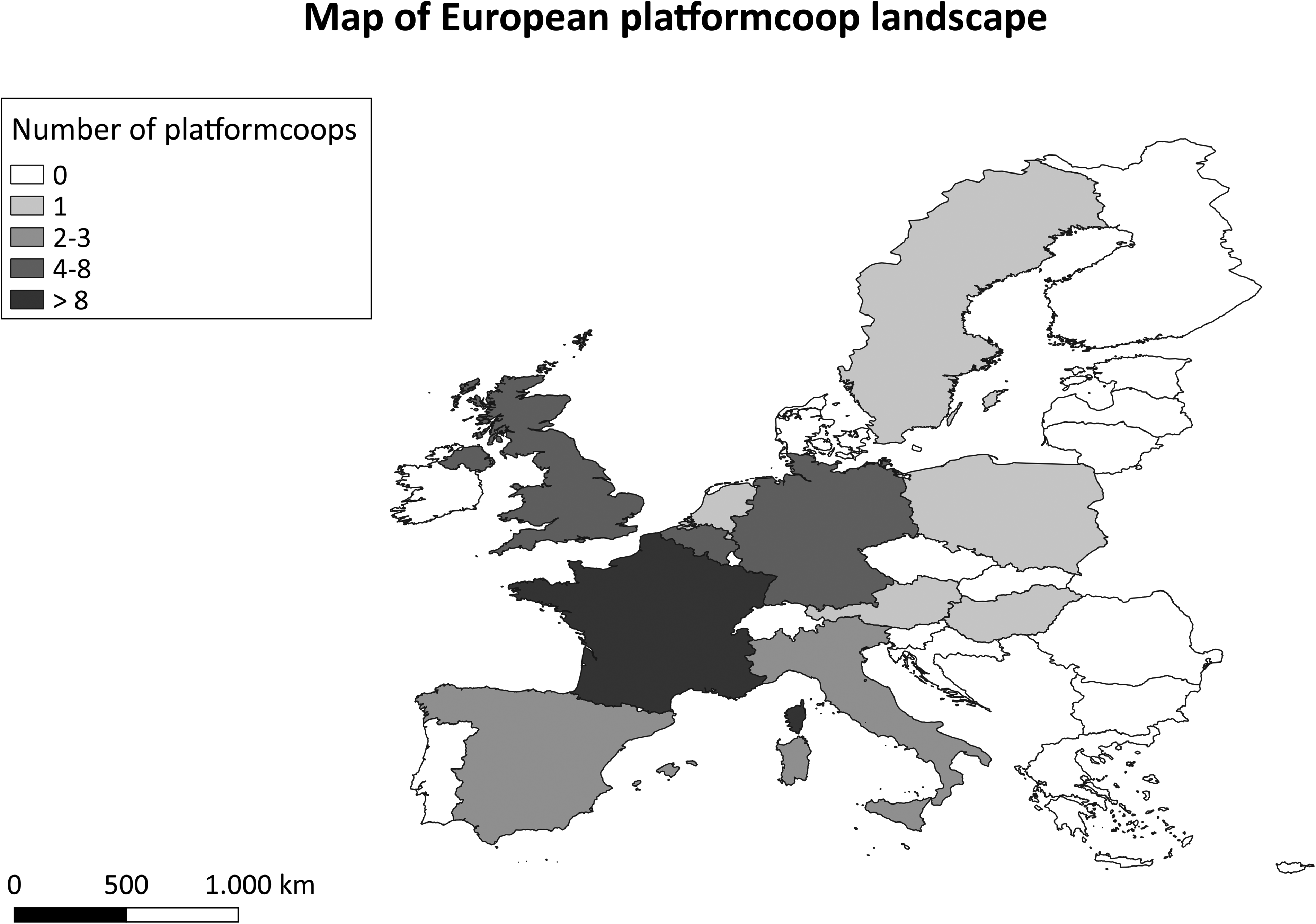
Platform co-op landscape of European gig economy (based on list in Appendix 1, June 12, 2020.
Most European Union member states are reforming their highly institutionalized labor markets in order to promote “flexicurity” (Charmettant et al., 2016). However, there are significant differences between them in how flexibility and security are treated. To take into account influences from different institutional environments, we invited all platform co-ops that had contact information available for an interview. Ultimately 15 out of 48 cases accepted an interview. Nonresponse was mostly caused by time constraints of platform co-op founders. Nevertheless, sufficient variation in interviewees was obtained by cases from multiple European countries, different economic sectors, and various stages of development including four “failed” cases. Some of the selected platform co-ops use a federative structure to scale through independent but connected instances, for example, Smart and CoopCycle. We identified one or two founders in each platform co-op.
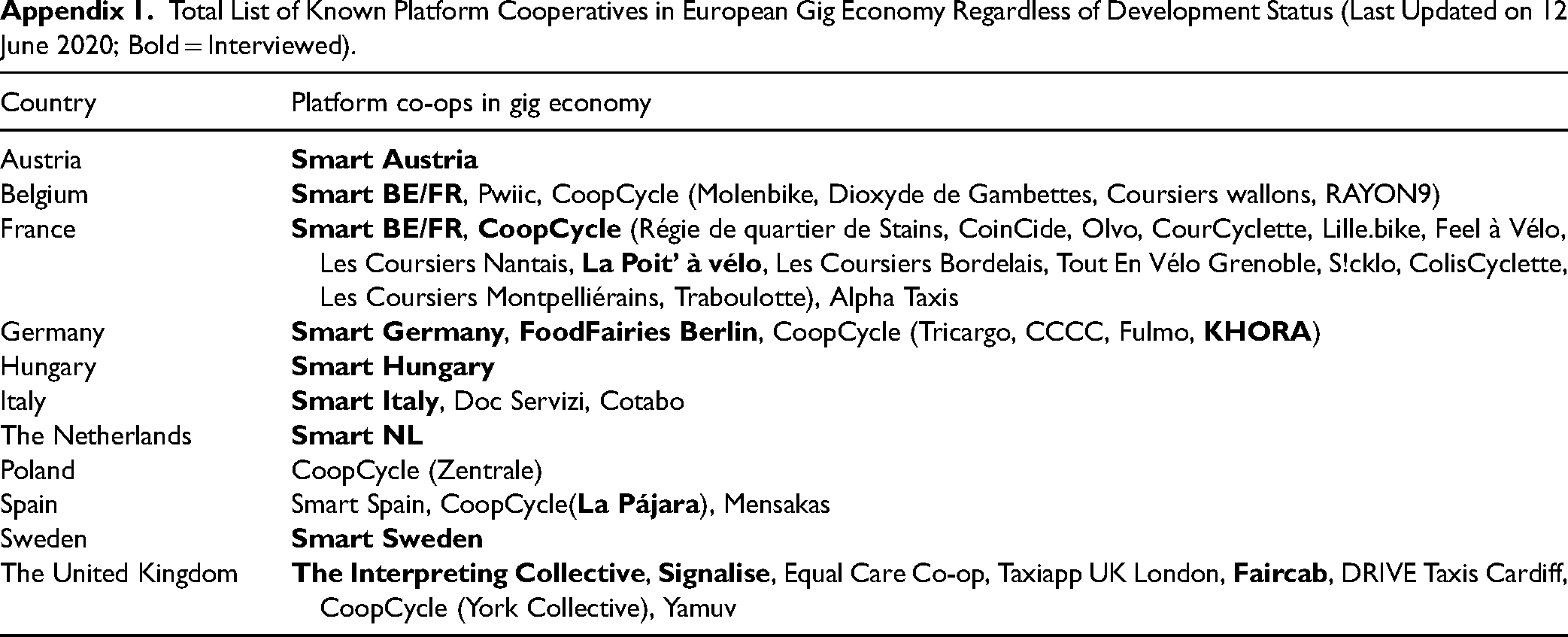
Data collection, which took place from December 2019 until the end of March 2020, was based on archival data from the available websites, social media posts, online articles, and information flyers of all 48 platform co-ops, and semistructured interviews with the founders of 15 platform co-ops (Lincoln & Guba, 1985) (see Appendix 1). Archival data provided information on the mission of the platform co-ops, organizational structure and activity, contributions from and benefits for members, technology use, and development processes. In total, 16 interviews were conducted either face-to-face or via Skype/Zoom. Since Smart Belgium was converted to a cooperative legal entity in 2016 and merged with Smart France in 2018, both its original founder and its leader during these recent changes were interviewed. Their citations are distinguished. Each interview took on average 1 h and was recorded to be transcribed verbatim. We used a topic list to question participants about their motivations to start a platform co-op, what alternatives they considered before choosing for the cooperative model, and how development of the platform co-op actually took place with specific attention for important milestones and crises during start-up (see Appendix 2). Instead of directly asking about tensions already categorized by earlier paradox research (Smith & Lewis, 2011), we let respondents voice their reasons for starting a platform co-op and tell the story of its development in their own words. Applying such a business biography technique allowed us to retrieve tensions in the development of platform co-ops and how they are managed relating to individual founders, organizational features, or the institutional environment. Informed consent was obtained before each interview and we guaranteed participants pseudonymity by only reporting organization-names instead of their personal names.
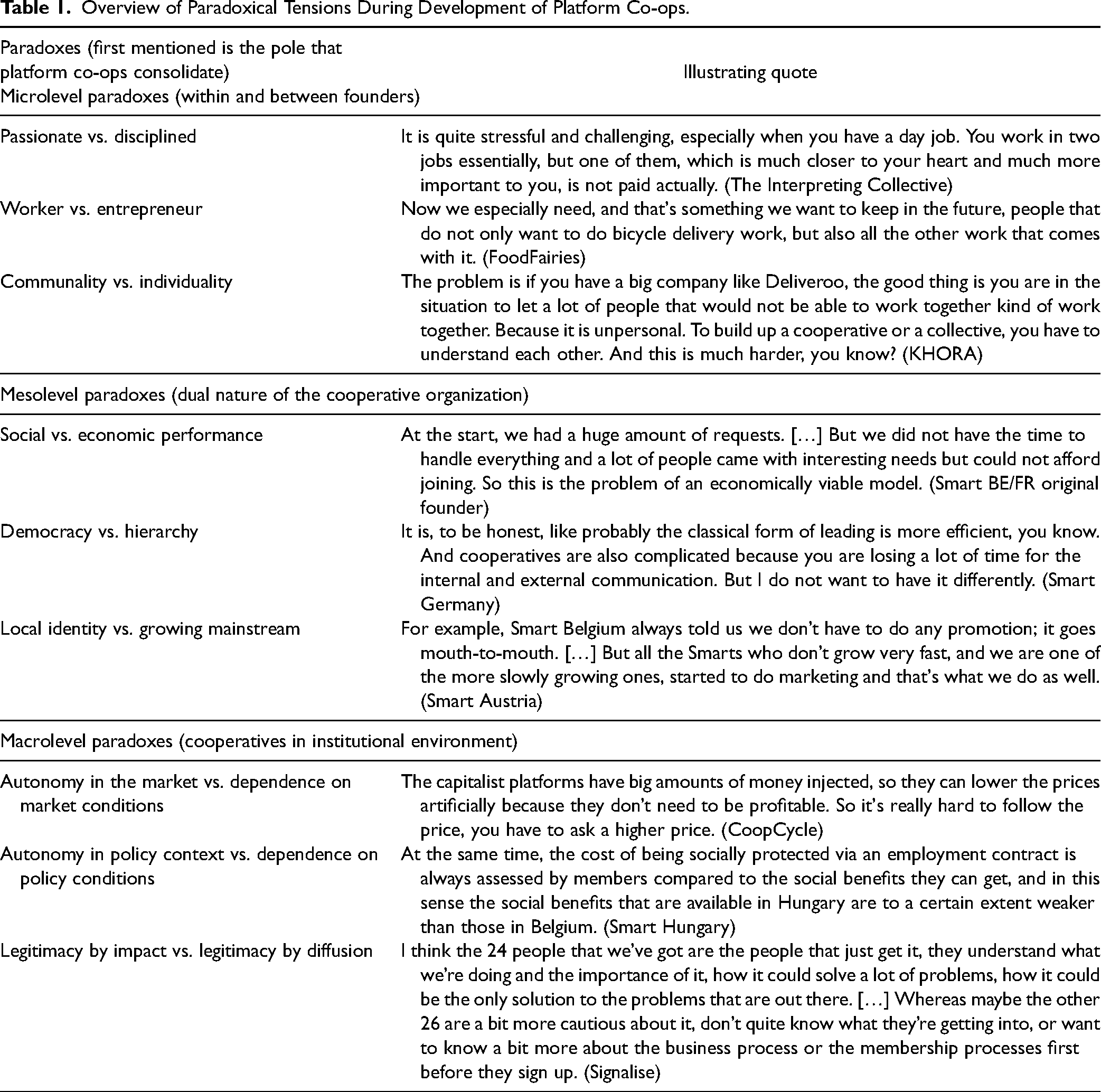
Qualitative content analysis was guided by the research aim and our multilevel approach to paradox research. Following Mason and Doherty's (2016) analysis of paradoxes in fair-trade social enterprises, priority was given to the meaning of stories instead of their historical accuracy while also contextualizing the interviews with complementary data collected during desk research. We thus take a constructivist view of paradox. In this way we could corroborate or nuance some of the findings, for example by checking the uniqueness of tensions or placing statements from the interviews in an organization's timeline. The study followed an iterative process of data collection and data analysis, which means that the analysis of later interviews could be compared to initial findings to help interpretation and the phrasing of interview questions. This process continued until thematic saturation was established based on a stabilized number of codes that stayed close to the participants’ phrasing. Analysis was computer-aided by NVivo 12 to code interview transcripts, by seeking similarities and differences. Drawing on existing paradox literature wherever possible for labeling the categories, we then theorized the data along microlevel, mesolevel, and macrolevel into nine paradoxical tensions. It became clear to us that the same paradoxical tensions that played up during the development phase had initially also motivated founders to “choose” starting a platform co-op in the first place. As such, we were able to document how platform co-ops are founded to accommodate paradoxical tensions in the gig economy by creating a new organizational form (van Bommel, 2018) and then have to continuously manage these tensions during actual development. We labeled these as motivation phase and development phase, thereby creating a two-by-nine matrix with the multilevel paradoxes to structure our findings (also see Table 1). To enhance quality and minimize researcher bias, participants were solicited for feedback on the findings.
Overview of Paradoxical Tensions During Development of Platform Co-ops.
Findings
Motivation Phase: Platform Co-ops as a Strategy of Coping With Paradoxical Tensions
If platform co-ops are permeated with paradoxical tensions, there logically is a counter-intuitiveness to their formation similar to what Cameron and Quinn (1988) described as the paradoxical nature of paradox. In other words, why start a platform co-op if other means to achieve the same ends might involve fewer competing demands? We find that it is rarely a founder's first choice, but platform co-ops are ultimately considered as a tentative resolution of tensions already salient in the gig economy. Altogether, the reason for founders to start a platform co-op can best be explained as “an experience of serendipity” (Smart BE/FR original founder). Similar to synthesis strategies of coping with paradoxical tensions (van Bommel, 2018), platform co-ops accommodate competing demands by creating a new organizational form. In other words, the gig economy context triggers salience of paradox which through the development of platform co-ops becomes a latent but also persistent characteristic of this new organizational form (Hahn & Knight, 2021).
On a microlevel, personal interest in founding a platform co-op stems from the desire to learn new skills like coding or starting an enterprise, while also contributing existing skills to a cause that founders find important. Most founders had a limited knowledge about cooperatives before starting, but having experience with managing associations (Smart NL), worker organizing via Facebook (The Interpreting Collective), or as a union leader (Signalise), for example, encourages them to put their existing knowledge to yet another form of collective action. One founder explicitly compared staying in an investor-owned platform to starting a platform co-op: “you just listen to an algorithm and obey its orders, and so you do not develop any personal knowledge. While now, through doing this, I have learned a huge amount through creating this company, and even if it stopped tomorrow, maybe because of coronavirus, if it never took off again, at least I would have learned so much that it would help me in the future” (La Poit’ à vélo). Here we notice how an exploitation-exploration paradox with too much emphasis on disciplined exploitation of current skills is brought into harmony with passion for exploring new approaches by forming a platform co-op (Andriopoulos & Lewis, 2010).
Likewise, founders describe cooperativism as reconciling conflicting identities in the gig economy, particularly those of worker and entrepreneur: “Most of us did not consider other options like striking or appealing to politicians, because we also see ourselves as kind of entrepreneurs” (FoodFairies). This observation matches previous research on how the role of “cooperative member” can integrate the contradictory but interrelated roles of worker and entrepreneur through either becoming employed by the cooperative or staying self-employed but have the cooperative provide functional equivalents to the social safety-net benefits in standard employment (Mannan, 2022).
Founders also see platform co-ops as a novel institution that can bring back a sense of belonging to gig workers: “They were accustomed to having cultural and social activities associated with companies and unions. A, shall we say, collective socialization, which surrounds one's job. And when an individual lost their job, when they created their own individual company, I noticed that many people expressed a lack of collectivity” (Smart BE/FR leader during conversion). Here we recognize how a belonging paradox with a dominant individuality pole is rebalanced towards the communality pole by founding a platform co-op (Audebrand, 2017).
On a mesolevel, the mutual interest of founding a platform co-op is based on cutting out the middlemen so that a larger share of every transaction ends up directly with the gig worker who provides services to a client while the remaining share is used for the platform's upkeep and providing members with benefits either through employment or in the form of services to self-employed members: “So we wanted to specifically have a type of company that is nonextractive. So capitalism cannot extract money easily out of a platform co-op. That is part of the design, part of the genius of it. We want something that rewards drivers fairly” (FairCab). What is happening here is that founding a platform co-op involves the integration of social and economic goals in a performing paradox (Smith & Lewis, 2011).
By cutting out the middlemen, the development of a platform co-op also rebalances an organizing paradox from a dominant hierarchical pole with algorithmic management towards a democratic pole of collective decision making (Audebrand, 2017; Hernandez, 2006): “I was also really interested into giving power back to the users of the platforms, because the workers are completely powerless in front of the platform” (CoopCycle).
Founders understand the cost advantages and attractiveness for clients that come with network effects achieved by big platforms and agencies, but also want to compete with a strategy of local embeddedness and distinctive identity: “Basically, the government wants to save money by giving contracts to larger companies. A lot of those companies were very large spoken language agencies that said to the government that they could provide sign language, even though they had no connection to the deaf community. They didn't know anything about sign language” (Signalise). In line with previous research (Karanovic et al., 2020), we can identify here how the formation of platform co-ops involves the embracing of an identity-size or learning paradox as it is also called in the literature (Smith & Lewis, 2011).
On a macrolevel, platform co-op founders see a broader societal interest of taking matters into their own hands by building alternatives instead of continuing to rely on existing market players: “Because the system as it is now, it is not only us interpreters who are suffering because of how the whole system works, it is also the people who need interpreters. Because what they get is incompetent bilingual speakers who are sent in place of professional qualified interpreters because the agency is not able to provide one” (The Interpreting Collective). Platform co-ops still have to be competitive and abide by market conditions of course, but they claim at least some self-determination to do better than investor-owned competitors with respect to ecological footprint, quality of service provision to clients, paying taxes, and enduring relations with local partners. As a result, we can see how platform co-ops aim to work through an autonomy-dependence paradox (Wilson et al., 2013).
Founders also perceive platform co-ops as providing faster results than political advocacy for government regulation, without claiming that platform co-ops are a substitute for new labor market regulations: “I think if you want to improve the position of self-employed via the political process, by the time you get result it probably takes you 10 years plus. At the same time, I think this is a very good idea, but this does not exclude each other” (Smart Hungary). Again we can see how the development of platform co-ops involves a shift from dependence, this time on the (lack of) policies established by governments, toward at least somewhat more autonomy based on self-governance.
And finally, founders of platform co-ops aim to integrate the public enthusiasm for gig platforms with making true on some of the idealistic promises made about the gig economy: “Getting rid of Uber didn’t mean getting rid of the technology or getting rid of this amazing service that had been delivered, but it should be about getting rid of this company which wasn’t providing drivers with a good livelihood” (Faircab). By using the perspective of a legitimacy paradox (Haack & Rasche, 2021), it becomes clear that founding a platform co-op integrates the dominant justification for the gig economy of inevitable diffusion across countries and sectors with a thus far contested justification of having impact by creating decent work.
Development Phase: Paradoxical Tensions Within Platform Co-ops
In line with the paradox perspective, the findings show that while platform co-ops accommodate paradoxical tensions by consolidating the pole that was weaker in the gig economy overall, these tensions do not go away but re-emerge during the cooperatives’ development (see Table 1). Four of the cases that are included in the interviews even failed to launch or had to make a restart (i.e., Faircab, FoodFairies, Smart Hungary, and Smart NL), and two more in the total list of European platform co-ops disbanded as well (i.e., Yamuv, Traboulotte). The distribution of platform co-ops over Europe is also not evenly spread (as shown before in Figure 1). There exist concentrations in France, Belgium, the United Kingdom, Germany, and to a lesser extent also in Spain and Italy.
On the microlevel, we first find paradoxical tensions between passion and discipline as creative fuels driving the development of platform co-ops. Passion entails an intrinsic motivation and belief that platform co-ops are the solution to fixing the gig economy, but discipline is also needed to bring this idea to fruition in particular considering that founders need to invest a lot of unpaid time to start a cooperative. Passion alone breeds unfinished projects, while too much discipline can drain founders of their energy and inspiration. Next, founders experience tensions between their identities as worker-organizers and the need to gain an entrepreneurial mindset and knowhow such as the ability to strategize risks and opportunities. If they only identify as worker, founders lack direction as there is no boss telling them what to do. But if founders identify too much as entrepreneur, they lose touch with their social activism and the gig work itself. Moreover, we observe tensions between the group of founding members as a communality versus their distinctive individualities. Without a communal sense of group identity and solidarity, internal conflict easily drives the founders of a platform co-op apart. Yet without their personal motivations and individual skills brought to the table, a platform co-op could never start up.
On a mesolevel, we then find competing demands between making progress on the social mission of platform co-ops and remaining economically viable. Loosening their stance against extractive financing, for example, harms the social mission of platform co-ops by making profit for investors instead of investing in the working conditions of their members. But at the same time this restricts the options that platform co-ops have available for funding, thereby harming their economic viability. What is more, founders perceive tensions between democratic and hierarchical decision making. Full and equal participation of members without any differentiated roles slows down collective decision making, resulting in an inefficient organization. Yet, leaving all decision making to professional managers undermines democratic accountability and can hurt the interests of cooperative members. Likewise, founders feel divided between a business strategy of local embeddedness and distinctive identity versus a more mainstream business strategy of growth and scale advantages. Only staying small, local and alternative restricts the social impact of platform co-ops to progressive metropolitan areas with a critical mass of ethical consumers. Only growing big, global and mainstream, on the other hand, removes their distinctiveness from investor-owned platforms and opportunities to cater to specific local demands.
On the macrolevel, we observe a tension between the autonomy claimed by platform co-ops and their dependence on market conditions. When founders of platform co-ops make decisions as if they are not at all constrained by consumer demand and their market position, the organization will simply not survive. But if founders make decisions completely depending on their awe and fear for large competitors, they become paralyzed and leave their organization to the whims of the market. Furthermore, tensions exist between the autonomy of platform co-ops and their dependence on the policy context. If the founders of platform co-ops make decisions without considering differences in government regulation, they are taken aback by compliance challenges and miss out on supporting policies. But when founders of platform co-ops make decisions completely depending on the regulatory constraints, they also become paralyzed and fail to create novel institutions for gig workers outside of the system as it is. On top of that, platform co-ops face competing demands of gaining legitimacy through impact on the working lives of members versus gaining legitimacy through diffusion of awareness and building good public relations. Legitimacy by impact alone is not enough to win over support from potential partners like unions or to remove suspicion and locally specific negative stereotypes about cooperatives in the minds of potential members. However, legitimacy by diffusion alone moves effort and resources from the social mission of platform co-ops towards enhancing public relations.
Vicious Cycles That Hinder Platform Co-op Development
To illustrate how treating tensional poles with an either/or approach ends up hurting platform co-ops, we discuss two failed cases in a bit more detail: Faircab and Smart NL. In particular, we show how a dominant pole on one paradoxical tension amplifies imbalance on other paradoxical tensions so that a vicious cycle emerges that ultimately results in a failed development.
Faircab (see Figure 2) was a platform co-op for ride hailing started by the London-based thinktank New Economics Foundation, which did several other projects at the time and intended to hand over control to the taxi drivers. Passionate about the vision for Faircab, but without the drive to completely develop the organization, the initial founder looked for a co-founder among London's Uber drivers. Finding one who also had experience with starting tech-businesses seemed like a perfect match at first, but his identity as entrepreneur proved much stronger than his ties to the gig work itself. Faircab's founder perceived the need for substantial start-up capital as impossible to achieve while staying true to their social mission of being a nonextractive business. With limited funding and a co-founder that saw more in a traditional business than a cooperative, Faircab also failed to involve and use the knowledge of prospective members in decision making. Its founder felt taken aback by the regulatory decision of Transport for London to raise operator licensing costs in response to Uber's disruption of the existing minicab market, which minimized the prospect of organizational autonomy. While the development of Faircab was first started when Uber temporarily left London after new regulations were introduced (similar to CoopCycle with Take Eat Easy that left France and Belgium in 2016, or FoodFairies and KHORA with Deliveroo that left Berlin in 2019), the fear of Uber coming back into London and engaging in unfair competition by underpricing services paralyzed any further cooperative development. As a result, Faircab's founder explained that ceasing its development was the rational choice.
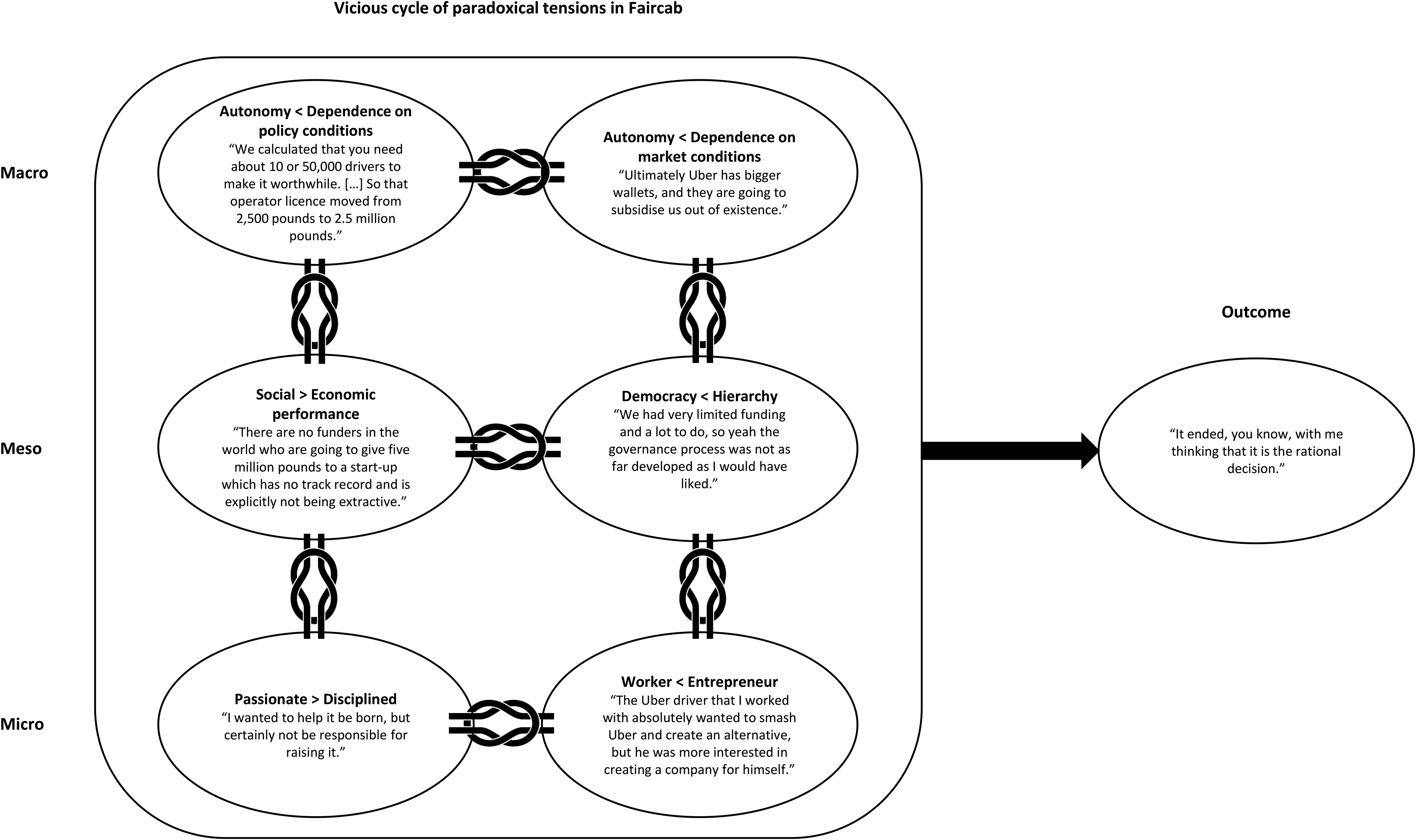
Vicious cycle of paradoxical tensions in Faircab.
Smart NL (see Figure 3) still exists today as a platform co-op for creative and professional freelancers, but it has seriously downscaled after a temporary suspension of all activities. Its founder described how initial successes in improving the working lives of members (i.e., legitimacy by impact) did not translate to a growing membership, because they failed to convey awareness and trust for this new organizational model among Dutch freelancers (i.e., legitimacy by diffusion). A lack of trust and being open to an organization like Smart NL was also tied to the policy context of the Netherlands, where labor market flexibilization has been more far-reaching than in other European countries. Claiming autonomy outside of the system as it is, the founder claimed, was very unlikely here because of the normalization of solo self-employment. The organization therefore experienced slower growth than other instances of Smart in Europe, which frustrated one of the founding members who put in a lot of work but was ultimately drained of his passionate belief in the project. With different individual expectations and the main founder focused more on building community, Smart NL lost a co-founder who brought useful skills to the table. To incite growth, the founder of Smart NL then felt pressured by Smart Belgium, who finances the federative growth of their model over Europe, to open up their membership to all professional freelancers instead of just creative freelancers. In line with Schad et al. (2019), we notice here how power relations can turn one pole (i.e., growing mainstream) more status enhancing. Smart NL's founder experienced this situation as a threat to the organization's local identity and, in turn, also as a governance crisis where democratic member control was interrupted by a top-down decision. The organization disbanded and only later restarted at an even smaller scale.
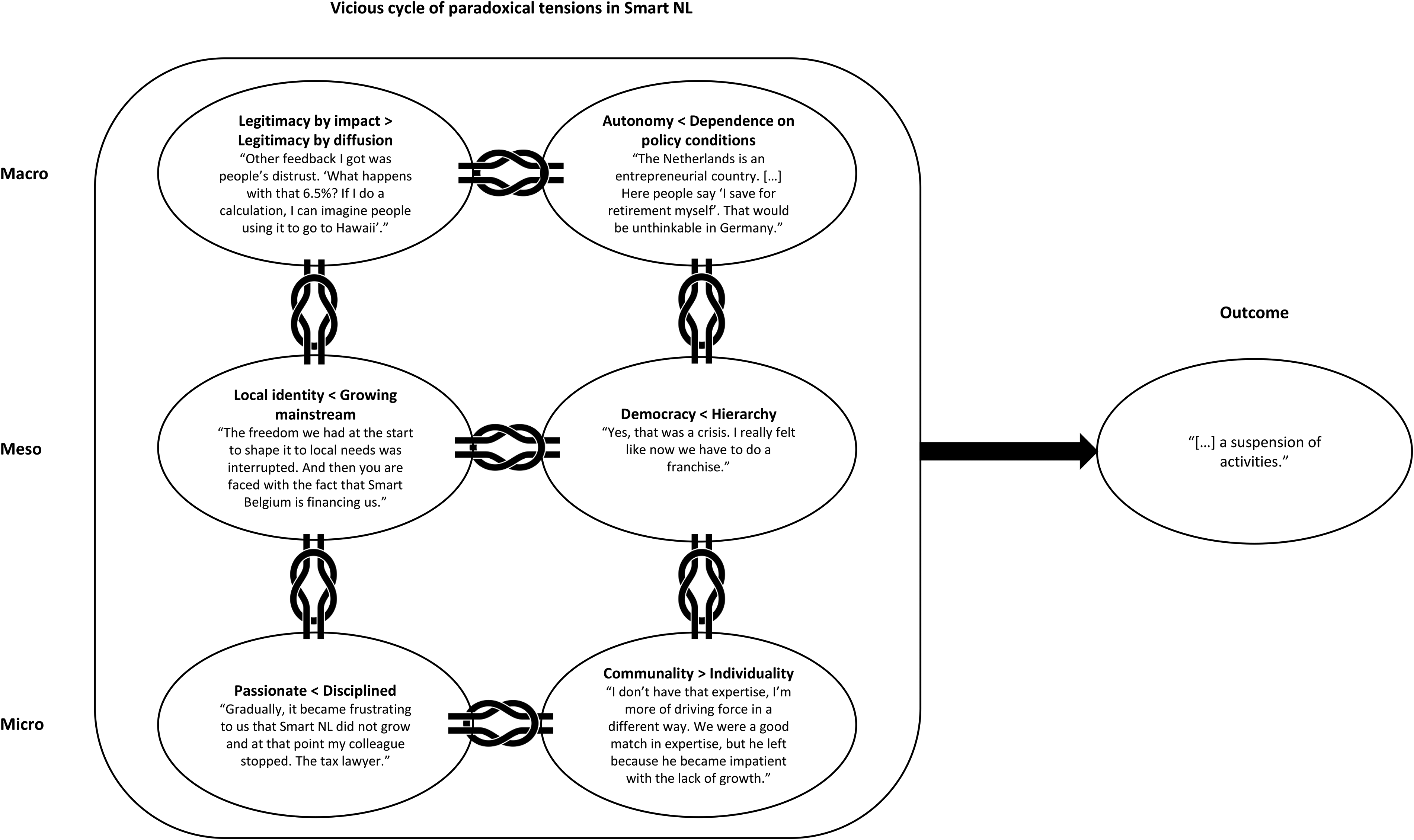
Vicious cycle of paradoxical tensions in Smart NL.
Virtuous Cycles That Help Platform Co-op Development
To illustrate how treating tensional poles with a both/and approach ends up helping platform co-ops, we discuss two successful cases in a bit more detail: Signalise and Smart Germany. In particular, we show how embracing both poles on one paradoxical tension attenuates other paradoxical tensions so that a virtuous cycle emerges that ultimately results in a successful formation process.
Signalise (see Figure 4) is a platform co-op for sign language interpreting in the Merseyside region of the United Kingdom. The cooperative has both sign language interpreters and deaf individuals as members. Its founder explained that learning from another bilingual cooperative would help to forge a community with two quite different individual groups that both need to feel included. This insight stems from dividing their time between developing the platform co-op and working as a sign language interpreter, which also enables the founder of Signalise to balance the identities of worker and entrepreneur. Previous research likewise identifies a temporal separation of competing demands as a strategy of coping with paradox (van Bommel, 2018). Because the founder continues to work as a sign language interpreter out of necessity, it compelled a larger participation of members by taking up responsibilities and making decisions after some groundwork was established in a more hierarchical manner in the first year. Gaining enough start-up capital to be economically viable takes up much time and effort, but by having a social impact on both the sign language interpreters and deaf members Signalise qualified for and was awarded two grants. To then affirm this initial viability, Signalise copes with macrolevel paradoxes by finding pockets of autonomy within the larger market and policy context. Some other platform co-ops follow a similar strategy, such as KHORA and La Poit’ à vélo who diversified their activities to food delivery to businesses because these are recurring services that yield more stable income than food delivery to individual consumers. By doing market research and gaining detailed regulatory knowledge of the sector, Signalise was ultimately able to win a bid for the new framework agreement by the National Health Service's Liverpool Clinical Commissioning Group.
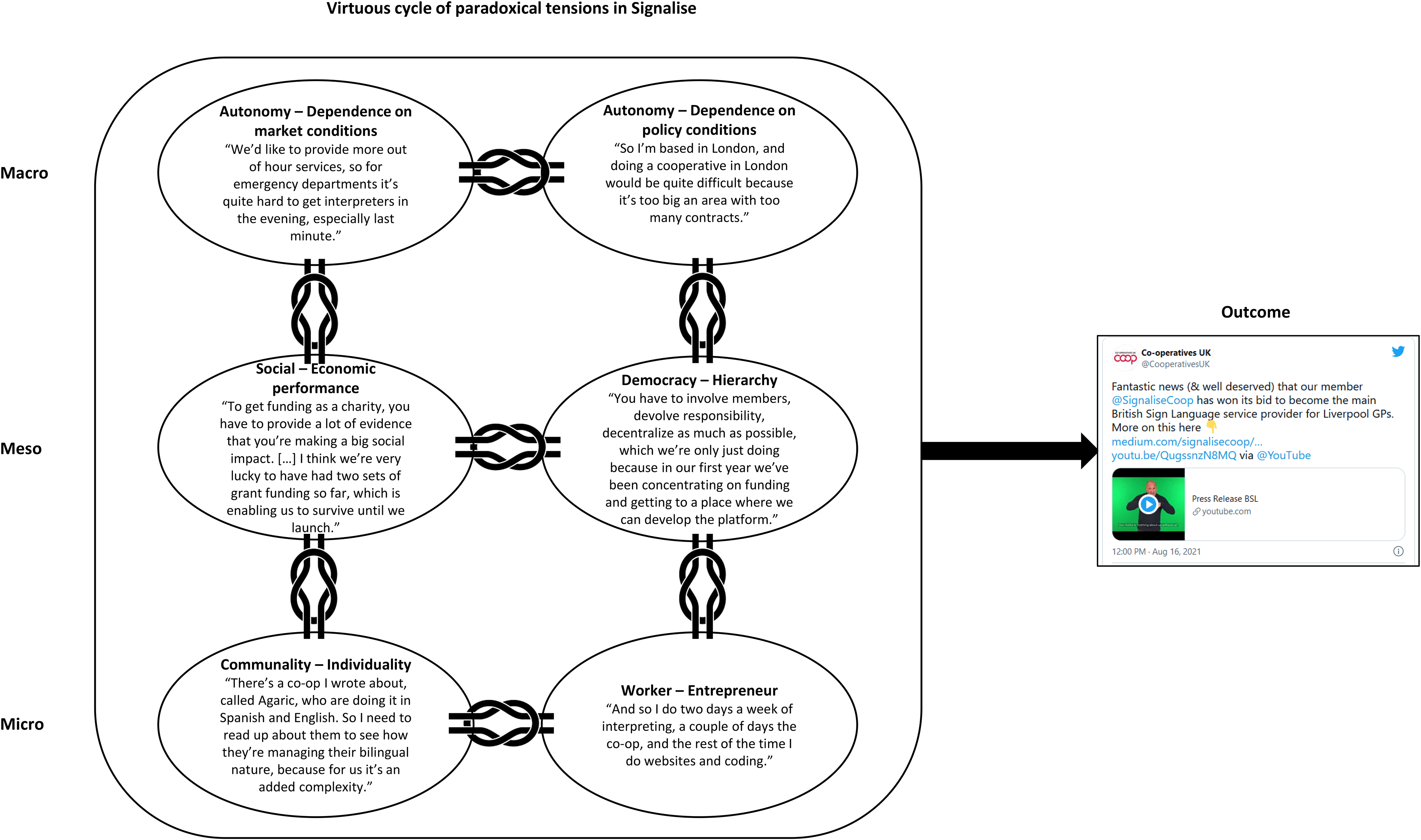
Virtuous cycle of paradoxical tensions in Signalise.
Smart Germany (see Figure 5) follows the same organizational model as the other Smart instances in Europe, but interestingly enough its development was much more successful than Smart NL. The founder of Smart Germany stressed the need to combine a passionate belief in the idea of platform co-ops with the disciplined actions to bring this idea to fruition. Self-identification as a social entrepreneur helps Smart Germany's founder to retain a connection to their social activism and the gig work itself, while also understanding the necessity of obtaining entrepreneurial skills that they did not have before. Creating an overarching category, like social entrepreneur, is a well-known coping strategy in the paradox literature (van Bommel, 2018). By extension, the founder of Smart Germany creates another overarching category to cope with the paradoxical tensions between democracy and hierarchy: cooperative leadership. Founders of other platform co-ops described cooperative leadership in similar terms: “to have faith and trust in the collective intelligence” (Smart Italy) and “be prepared that other people might […] have a completely different idea about how things should be run” (The Interpreting Collective). In contrast to Smart NL, the founder of Smart Germany experienced their relationship with mother-cooperative Smart Belgium very positively. As there was no outsider interference in decision making, the strategy of growing mainstream while retaining a local identity in each country by means of a federative structure worked out much better in this situation. Having a migrant background, like many other platform co-op founders do as well, helps Smart Germany's founder to find pockets of autonomy within the larger policy context as they do not take the system as it is for granted. The early membership of Smart Germany also consisted largely of freelancers with a migrant background, which allowed the organization to demonstrate legitimacy by impact that could then be used in public relations activities to also convince the native population. As a result, Smart Germany not only expanded their membership but also gained the support of unions.
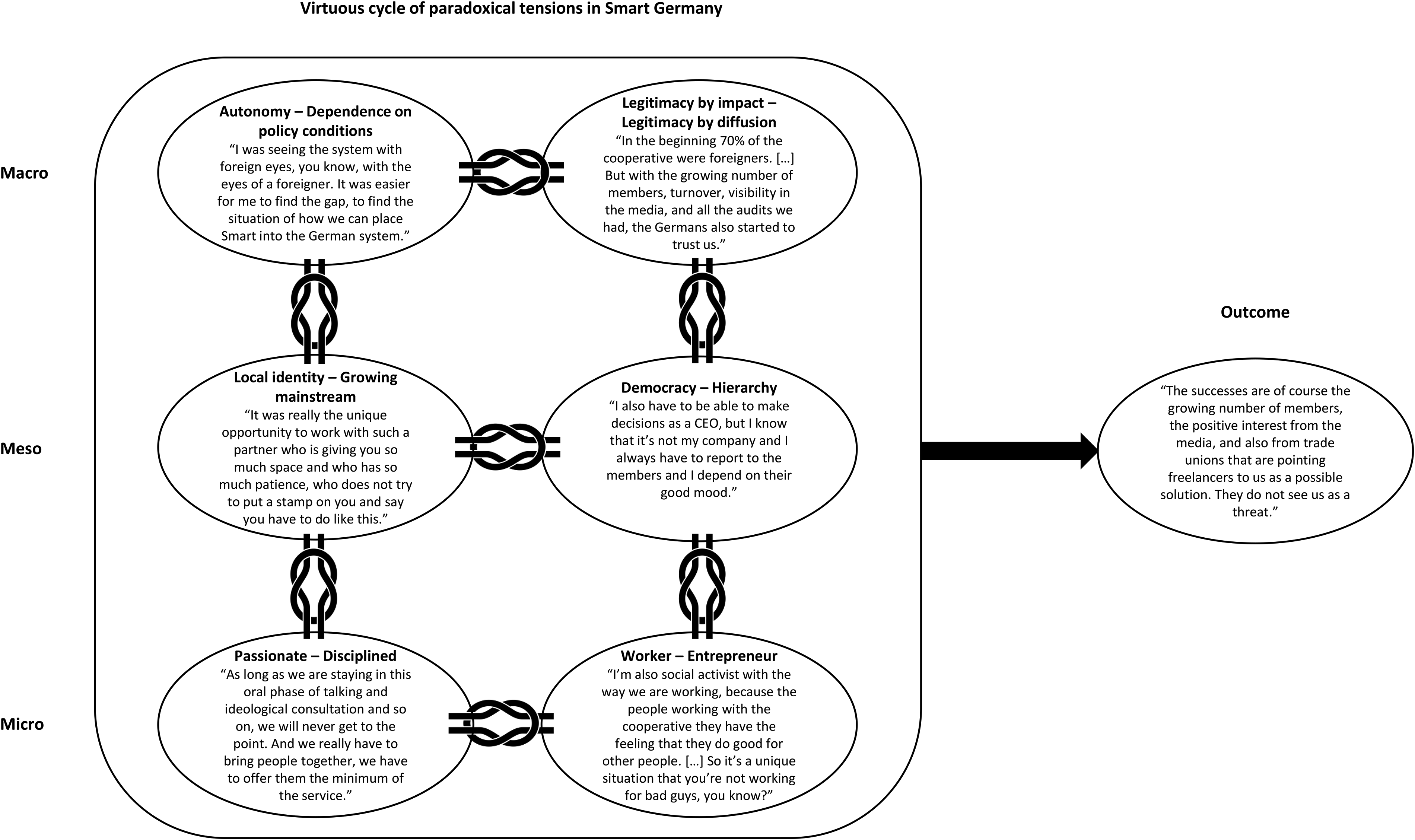
Virtuous cycle of paradoxical tensions in Smart Germany.
Discussion
Most gig platforms are investor-owned, managed on their behalf, and prioritize perhaps not an immediate profit but certainly market share and company value (van Doorn & Badger, 2020). They are also surrounded by controversy due to precarity among workers, practices of algorithmic control, and parasitic business models (Schor et al., 2020). Platform co-ops present themselves as challengers of this logic through ownership and governance by gig workers themselves (Scholz & Schneider, 2016). However, their relative rarity seems to indicate more severe difficulties with market entry and expectations on platform co-ops’ ability to do better than investor-owned platforms are mixed (Frenken, 2017; Zhu & Marjanovic, 2020). Through desk research on 48 platform co-ops in the European gig economy and interviews with 16 founders, this study provides insight into the tensions that platform co-ops face from competing demands during their development and how founders manage these tensions.
Overall, we conclude that paradoxical tensions are a double-edged sword for platform co-ops: driving their development, but also being a cause for failed market entry. Systemic tensions in the gig economy, such as the one between worker and entrepreneur, motivate business model innovation with platform co-ops as a new organizational form. Initially consolidating the weaker tensional pole, paradoxical tensions resurface during the actual development of platform co-ops and interact on multiple levels. We document how platform co-ops end up in vicious cycles when one tensional pole remains dominant, and virtuous cycles when both tensional poles are embraced. We thereby contribute to an increased understanding of platform co-ops at a moment these organizations are increasingly gaining attention from researchers and policymakers (Borkin, 2019; Eum, 2019; Frenken, 2017; Johnston & Land-Kazlauskas, 2019; Karanovic et al., 2020; Mannan & Pek, 2023; Scholz & Schneider, 2016; Schor, 2020).
Whereas Sandoval (2020) critiqued the coexistence of opposing elements in platform co-ops, such as social and economic goals, we adopt a paradox perspective to show why and how competing demands need to be embraced simultaneously instead of being treated as mutually exclusive (Audebrand, 2017). To become a realistic alternative for the future of work (Balliester & Elsheikhi, 2018) or even contribute to the Sustainable Development Goals (Zhu & Marjanovic, 2020), but also truly do better than investor-owned platforms in the gig economy (Frenken, 2017), platform co-ops are dependent on how well they navigate competing demands. Neglecting either side of these paradoxical tensions risks failure, which helps to explain the relative rarity of platform co-ops so far.
Moving paradox scholarship beyond the identification of ever new typologies of tensions and coping strategies, we develop a multilevel approach that helps to identify systemic tensions (in this case in the gig economy) which motivate business model innovation of new organizational forms (in this case platform co-ops) and in turn may result in failed market entry during development. Thus, we respond to calls for explaining how context matters for how paradox emerges and is coped with (Jarzabkowski et al., 2019; Keller et al., 2020). Building on paradox scholarship that examines multiple levels (Jarzabkowski et al., 2013, 2019; Keller et al., 2020), we find that the gig economy context triggers salience of paradox which through the development of platform co-ops becomes a latent but also persistent characteristic of this new organizational form (Hahn & Knight, 2021). An advantage of this multilevel approach is that the interorganizational system is fully considered, expanding on previous research on tensional knots that usually consider just two levels of analysis (Jarzabkowski et al., 2022; Sheep et al., 2017). Instead of emphasizing the uniqueness of platform co-ops, we argue that the multilevel approach can be applied in paradox research on other forms of cooperatives or social enterprises too since these are likely also motivated by systemic tensions. Doing so might also open up more connections between paradox and system perspectives (Schad & Bansal, 2018), like grand challenges and wicked problems.
As any research, this study also has its limitations. First, there is a danger of selection bias because failed cases are harder to identify and potentially many more platform co-ops never make it past the drawing board. This may imply an underestimation of the competing demands that complicate the development of platform co-ops. Future research should therefore track platform co-ops over longer periods of time, ideally in comparison to the development of investor-owned platforms. Second, the study focused on platform co-ops in the beginning phase of their organizational lifecycle and is therefore less informative about how they can become resilient in the long run. Coping with paradox likely looks different in different stages of organizational development (Chowdhury et al., 2021). Although outside the scope of this paper, these are important subjects for further research.
Notwithstanding such limitations, our research sheds light on the value of platform co-ops compared to other strategies for decent work in the gig economy like government regulation or union campaigns (Lenaerts et al., 2018). Rather than being a substitute, the findings demonstrate that platform co-ops are almost never the first strategy considered by their founders but that they help to cope with ambiguities, complex goals, and conflicting stakeholder interests that pre-exist in the gig economy. Although paradoxical tensions complicate the formation of platform co-ops, our research may also offer inspiration and confidence to practitioners who want to start a platform co-op that embracing these tensions ultimately helps the development of their organization.
Footnotes
Total List of Known Platform Cooperatives in European Gig Economy Regardless of Development Status (Last Updated on 12 June 2020; Bold = Interviewed).
| Country | Platform co-ops in gig economy |
|---|---|
| Austria |
|
| Belgium | |
| France | |
| Germany | |
| Hungary |
|
| Italy | |
| The Netherlands |
|
| Poland | CoopCycle (Zentrale) |
| Spain | Smart Spain, CoopCycle( |
| Sweden |
|
| The United Kingdom |
Appendix 2. Topic list for interviews with founders of platform co-ops
Acknowledgements
The authors thank Joshua Keller, in his role as editor, for his insightful comments and encouragement. Informal conversations of the first author with Daan Peeters have also helped to shape this article. Moreover, the authors are grateful for all support and suggestions received while presenting this research at the 7th International Workshop on the Sharing Economy.
Declaration of Conflicting Interests
The authors declared no potential conflicts of interest with respect to the research, authorship, and/or publication of this article.
Funding
The authors received financial support for the research, authorship, and/or publication of this article: This study is part of the research program Sustainable Cooperation – Roadmaps to Resilient Societies (SCOOP). The authors are grateful to the Netherlands Organization for Scientific Research (NWO) and the Dutch Ministry of Education, Culture and Science (OCW) for generously funding this research in the context of its 2017 Gravitation Program (grant number 024.003.025).
