




Abstract
This article addresses an underexplored issue within management and organizational studies researcher reflexivity, namely how participants perceive and construct the researcher. However, reflexivity which includes how our participants see us is necessary for a more complete understanding of the research process and ourselves as researchers, and for how participants choose to talk about themselves and their practice. I therefore present a novel method for reanalyzing research data to construct a version of myself-as-researcher from the talk and responses to me of my manager participants, addressing the question: “to whom were my participants speaking?” which identifies multiple constructions of the researcher as auditor, consultant, and therapist. I extend the literature on the researcher–participant relationship by highlighting the role of emotion and uncertainty of managers in making sense of the research occasion, and I add to the suite of tools available to researchers to review and reflect on their research practice.
Introduction
Reflexivity has become something of a “gold standard” (Gabriel, 2015, 2018) in qualitative research, not least because it provides one important way for qualitative researchers to assert the validity of their research within a subjectivist or poststructuralist paradigm, by highlighting both the inevitable problem of the impact of the researcher and the solution through properly acknowledging and examining it (Brewer, 2000). The reflexive turn (Cunliffe, 2016; Gabriel, 2015; Lumsden, 2012) within qualitative research has also led to reflexivity becoming a research subject in its own right, but more reflexive attention has tended to be paid to some areas than others. Firstly, reflexivity remains primarily an act of self-examination, conducted and presented as autoethnographical, insider accounts of the research encounter. Secondly, reflexivity remains focused on research outcomes, and how we and our research practices affect what we can know about the phenomenon of organizations and management, and how we construct them. Therefore, despite research being the interactions of two parties and two communities or social systems (Hardy et al., 2001; Tuckermann & Rüegg-Stürm, 2010), reflexivity has largely been concerned with, firstly, the researcher's understanding of her research practice and experience, and then with the participant's understanding of their organizational practice and experience.
In this article, I argue for reflexivity which includes how our participants perceive and experience the research occasion and especially how they perceive and experience us as researchers. Such reflexivity provides a more complete understanding of the research process and of our research practice, by acknowledging the plurality of the research encounter (Shim, 2018) and counter-balancing risks of either researcher narcissism (Fournier & Grey, 2000; Tomkins & Eatough, 2010; Weick, 2002) or what Vangkilde and Sausdal (2016) call “over-thinking” participant statements and practices. More specifically, even as we approach the research occasion as reflexive management researchers, we may still take for granted what our scope and purpose are, why we are here and what we do, and that our participants share such understandings. It is therefore important to also ask: How do participants perceive and construct “the researcher”: to whom do they speak and perform their roles? Reflexivity that includes how our participants see us therefore offers both a more complete understanding of the research process and our research practice and also further insight into how participants choose to talk about themselves and their practice, what they include and what they do not.
In this article, I therefore present a novel method in which I study myself as a researcher, not through reflecting on my own perceptions and experiences of conducting research and interacting with participants, but by revisiting and reanalyzing a research project I conducted in 2013–2014 to construct a version of myself-as-researcher from the talk and responses to me of my research participants. I seek to answer the question: to whom were participants speaking, acting in front of, and working with, and how were they constructing and experiencing me? I identify three distinct constructions of the researcher as auditor, consultant, and therapist, and I discuss the implications of such constructions of the researcher as an outsider, and as a form of authority, for how managers described and accounted for their management practices. I further discuss how such an analysis of how participants constructed me also revealed new insights into my own practice and self-concept as a researcher. The article's contribution is to complement and extend existing literature on the researcher–participant relationship, particularly by highlighting the role of emotion for both researcher and participant in the co-construction of versions of the researcher; and to add to the suite of tools available to researchers to review and reflect on their research practice.
The Reflexive Turn in Management and Organization Studies
Qualitative research is increasingly informed by the reflexive turn (Cunliffe, 2016; Gabriel, 2015; Lumsden, 2012). Reflexivity acknowledges and questions the role of the researcher in the research process and possible outcomes (Hibbert et al., 2014; Robinson & Kerr, 2015), both in terms of the effects of the researcher's own values and assumptions (Jenks, 2002), and their impact on others and the external environment (Cunliffe, 2003). In management and organization studies (MOS), which continue to be heavily influenced by positivist paradigms and concerns with “rigor,” “trustworthiness,” and “replicability” (Bell et al., 2017; Pratt, 2009; Pratt et al., 2020), reflexivity is one important way in which qualitative researchers can assert the validity of their research within a subjectivist or poststructuralist paradigm: reflexivity highlights both the inevitable problem of the role of the researcher and the solution through properly acknowledging and examining it (Brewer, 2000).
Nevertheless, reflexivity has become much more than an attempt to create a qualitative boilerplate (Pratt, 2009), or a purely methodological concern. It has also become a research subject in its own right, as a means of both better understanding, and expanding our research practice. This increasing focus on reflexivity has extended in several generative directions. For example, attending to the researcher-as-instrument (Hammersley & Atkinson, 1995; Pezalla et al., 2012; Soh et al., 2020) is concerned with ways of surfacing the impact of the researcher, the role of the researcher throughout the research process and the paradox of the researcher as both a scientist engaged in truth-seeking and methodological rigor, and an individual who uniquely observes, interacts with, interprets and reports on their research (Jenks, 2002). Another productive area is reflexive practice itself and how researchers might be supported to develop sensitivity to their own role and impact on others (Cunliffe, 2016) such as offering frameworks or typologies for researchers to critically apply to or review their own practice (Cunliffe & Karunanayake, 2013; Goldspink & Engward, 2019; Hibbert et al., 2019). A third dimension is the application of reflexivity to those agreed and shared practices which define us as researchers which we may take for granted as we learn to become members of the research community (Hardy et al., 2001). For example, Mason-Bish (2019) reflects on how research methods text books commonly counsel the researcher about the value and rarity of “elite interviewees” and how this framed both her approach to such interviewees (as a humble and grateful supplicant), and her assessment of the value of their knowledge and its importance for her research.
However, in this article, I wish to address what remains the most common area of interest, namely the relationship between researcher and participant. Here, the focus is on research as a “situated, social, communicative practice, just like the practice we explore” (Tuckermann & Rüegg-Stürm, 2010, p. 3). Studies addressing the researcher–participant relationship have highlighted a number of related but distinct dimensions. Firstly, there are those who seek to elicit greater sensitivity to the relationship, as the fundamental means by which knowledge is co-constructed. For example, Hibbert et al. (2014) call for what they term “relational reflexivity” which involves not only critical awareness of the researcher's relationship with their surroundings, situation and context, but actively engaging with participants by also disclosing “something of who we are, why we think the way we do, and the influence of our peer community upon us” (Hibbert et al., 2014, p. 289). Cunliffe and Scaratti (2017) offer a method of dialogical sensemaking as a means of drawing on both researcher and practitioner expertise, tacit and explicit knowledge in order to make experience sensible, through “movement” which keeps boundaries of knowledge open, and “opacity” which recognizes knowledge may not be easily explicable, or is taken for granted. Another perspective is represented by Langley and Klag (2019) who highlight the question of how researchers represent the relationship in their write-up, and propose a typology of interrelated dimensions of researcher representation across visibility, voice, stance and reflexivity to facilitate researcher awareness throughout the research process.
A second concern is researcher positionality. Recent studies have focused both on the researcher's position in relation to participants, and in relation to the topic of conversation, and highlight how each may shift and change over the course of a research project or within a single conversation. They include tools to enable researchers to better recognize and reflect on the nature of their relationship with participants moment by moment, such as Cunliffe and Karunanayake's (2013) typology of hyphen–spaces of insiderness–outsiderness, sameness–difference, engagement–distance, and political activism–active neutrality; and generative metaphors such as “the closet” and “queer reflexivity” (McDonald, 2013, 2016; Nelson, 2020) to explore the role of researcher disclosure to participants, participant assumptions about the researcher and researcher self-knowledge. In a similar vein, Berger (2015) and Goldspink and Engward (2019) propose methods for researchers to recognize and acknowledge moments of familiarity with participant experiences, in which researchers may work with their own presuppositions rather than bracket them, to develop greater phenomenological sensitivity as it is coconstructed. A third approach is a psychoanalytically informed perspective and especially the role of the emotional response of the researcher to the participant and their account as a means of surfacing the researcher's unconscious response to the participant, stimulating not just reflexivity but further creative engagement (Burkitt, 2012, 2018; Diamond & Allcorn, 2003; Duncan & Ellis, 2021; Gemignani, 2011). This has similarly led to tools to support researcher awareness of their emotions such as attending to physical responses (Ruiz-Trejo & García-Dauder, 2019) and capturing and categorizing emotional responses (Lustick, 2021).
A third area of interest is participant perceptions of the researcher and the research project. In the age of Google, the researcher is no longer able to remain an unknown figure but is herself researchable (Saltmarsh, 2013). Tuckermann and Rüegg-Stürm (2010) highlight the research occasion as communicative acts between members of two different social systems, who each bring concerns and perspectives from their respective systems to temporarily share a research space. They argue that by conceptualizing research practices as communication systems, we are better able to recognize and reflect both the practice context, as well as the research context, the expectations, involvement and contributions of practitioners and the role and value of empirical findings for practitioners. A small number of researchers have sought to explore participant perspectives directly in various ways. For example, Robinson and Kerr (2015) deliberately build preliminary questions to participants about their reasons for taking part, as part of surfacing and acknowledging preunderstandings within a hermeneutic analytical framework. Other researchers have undertaken forms of participant debriefing which include their experiences and perceptions of the research process (Anderson & Henry, 2020; Whiting et al., 2018), while O’Boyle (2018) analyzes unofficial conversations with participants that took place outside recorded interviews to reveal some of the negotiated understandings between researcher and the researched.
Expanding Reflexivity: Who Do They Think We Are?
Despite the diverse range of approaches outlined above, and the attention paid to the researcher–participant relationship, reflexivity remains primarily an act of self-examination, conducted and presented as autoethnographical, insider accounts: that is, the researcher's view of herself as the “lone hero” of the encounter (Hardy et al., 2001). This centring of the researcher has been a source of criticism of reflexivity. Reflexivity can risk becoming an end in itself (Weick, 2002), drawing attention from the phenomenon being studied to the process of study (Fournier & Grey, 2000; Tomkins & Eatough, 2010). It risks overly focusing on the researcher's relationship with the phenomenon and participants and thus on the researcher's ability to recognize aspects of themselves rather than to imaginatively perceive possibilities from what is new and different (Gabriel, 2015; Tomkins & Eatough, 2010; Warnock, 1987). It risks inflating the importance of the researcher and their ability to affect the socio-cultural worlds of research subjects (Vangkilde & Sausdal, 2016). Reflexivity as self-examination also starts to reduce the research process to a single story from a single perspective (Herrmann et al., 2013; Shim, 2018). By attending so closely to our own role and our effects on the research occasion we inadvertently start to close off the plurality of the encounter (Shim, 2018) and the multiple and shifting perceptions and effects of the other.
Our concept of reflexivity, and the tools available to researchers, therefore need to include not just the researcher's understanding of her research practice and experience, and how this then impacts their interpretation of the participant's understanding of their organizational practice and experience, but how our participants see us as researchers. Such an approach offers an important alternative perspective on the research encounter, from those who are intimately involved in and affected by it, and which can help to maintain the plurality of the research encounter by acknowledging multiple experiences (Herrmann et al., 2013; Shim, 2018; Vangkilde & Sausdal, 2016). It can thus enable researchers to remain “unsettled” (Pollner, 1991) and to continue to question their assumptions (Cunliffe, 2004). Furthermore, we enter the research occasion as members of a research community (Hardy et al., 2001; Tuckermann & Rüegg-Stürm, 2010) and with taken-for-granted knowledge of what our role means and our purpose in seeking new knowledge and improving management and organizational practice. But how do our participants perceive and make sense of our role as management researchers? How do we know that they share our taken-for-granted knowledge? This matters both for increasing insight into our own research practice and how we are perceived by potential informants, and also for what we seek to research: how “management research” and the “management researcher” are perceived by participants, and what their involvement means for them and as representatives of their practice and community, have implications for what they say and do within the research occasion (Hardy et al., 2001; Robinson & Kerr, 2015; Tuckermann & Rüegg-Stürm, 2010).
This aspect of reflexivity remains underdeveloped within MOS literature. Of the small number of studies seeking participant perspectives on the research process, some (e.g., Robinson & Kerr, 2015; Saltmarsh, 2013; Tuckermann & Rüegg-Stürm, 2010) only address their perspectives before the research encounter, rather than how they may emerge or evolve during the research encounter itself. While the relational reflexivity of Hibbert et al. (2014) emphasizes the need for the researcher to share something of themselves, and other authors note the effect of particular social categories such as age, race, gender, and sexual orientation (Anderson & Henry, 2020; Berger, 2015; Cunliffe & Karunanayake, 2013; Hamilton, 2020; Mason-Bish, 2019; McDonald, 2013, 2016; Nelson, 2020) it also remains the case that we do not only enter the research encounter as unique individuals but as “management researchers.” Participants entering into encounters and conversations with such “management researchers” will also bring assumptions and expectations—or lack of knowledge—of which we may be unaware, but which also inform what they say and do within the research occasion. Only a very small number of studies directly investigate participant perspectives of the research encounter itself, and these focus on different and specific aspects of research such as effective interviewing skills (Anderson & Henry, 2020), the mediation of technology (Whiting et al., 2018) or professional standards (O’Boyle, 2018).
In this article, I therefore seek to address this gap by presenting a new and more structured way of “getting at” participant perspectives and experiences of the researcher and the research occasion. I do this by reanalyzing the texts of a research project to construct a version of myself-as-researcher from the talk and responses to me of my research participants. I seek to answer the question: To whom were participants speaking, acting in front of, and working with, and how were they constructing and experiencing me as a management researcher? Although this method has its own limitations, discussed below, it offers a way of revealing participant perspectives of me as a researcher and the research encounter in a way that minimizes my own reflections and memories of the research encounter, and which can capture participant responses to me and the research occasion moment by moment. In presenting and discussing this reanalysis I also illustrate and elaborate the potential of this dimension of reflexivity for understanding ourselves as researchers and our research practice.
Methodology—Researching Researchers
The research project which I reanalyze was a 15-month narrative investigation into manager identity conducted in 2013–2014. My interest then was in how managers make sense of their organizational position as managers and controllers of others, while simultaneously being managed and controlled themselves (Harding et al., 2014; Hassard et al., 2009). The research took place at a North West England social housing provider. For this article, it is relevant to note that the organization had invested in education and training opportunities for managers, including Institution of Leadership and Management courses and the MBA.
I carried out interviews with 21 managers. I interviewed each manager once, with interviews lasting between 40 and 75 min. The key feature of the interview was story elicitation. I invited each manager to “tell me a story” that they felt said something important about their organizational role and its meaning for them. Managers were given this question and some broad guidelines in advance of the interview. Having listened to their story without interruption or comment, I then explored the story further with them, meaning that the interview was largely determined by the nature and content of their story. By using story elicitation I deliberately offered participants the opportunity to give me a “commissioned performance” (Beech & Sims, 2007) of how they interpreted their organizational role and the meanings that it held for them, and how they wanted to present themselves to a researcher (Clifton, 2018). I also sought to insert some “creative disruption” (Sanger, 1996) into the usual interview format of question and answer and thus encourage managers to describe how they saw themselves and their role, rather than how they thought they ought to be seen.
I also undertook work-shadowing of managers with their agreement in an “observer-as-participant” role (Gill & Johnson, 2002). A key aim in collecting observational data was to gather wider organizational and societal narratives within which context managers constructed their own self-narratives. The collection of observational data was therefore deliberately not systematic (Simons, 2009) but opportunistic and intuitive, using a blank template (Spradley, 1980). In total, I undertook approximately 35 hrs of work-shadowing which included every manager at least once.
In reanalyzing the data from this research project I included all my original interviews and observational notes. However, my focus this time was not on how managers talked about themselves as managers but on how they saw and experienced me as a researcher, and the wider research process. To do so, I turned my attention away from what I had previously treated as the manager texts—discrete, bounded accounts of their experiences of management—to examine the “margins” of the texts: the spaces, borders and joins between the “substantive content” I was originally looking for, analyzing, interpreting, and reporting, where the presence of the researcher and the research occasion seeps into the text. That is, I now deliberately center the parts of my research data which, at the time and despite my stated commitment to acknowledging my impact as a researcher on the research process, I ignored precisely because it revealed my presence as a researcher (c.f. Langley & Klag, 2019).
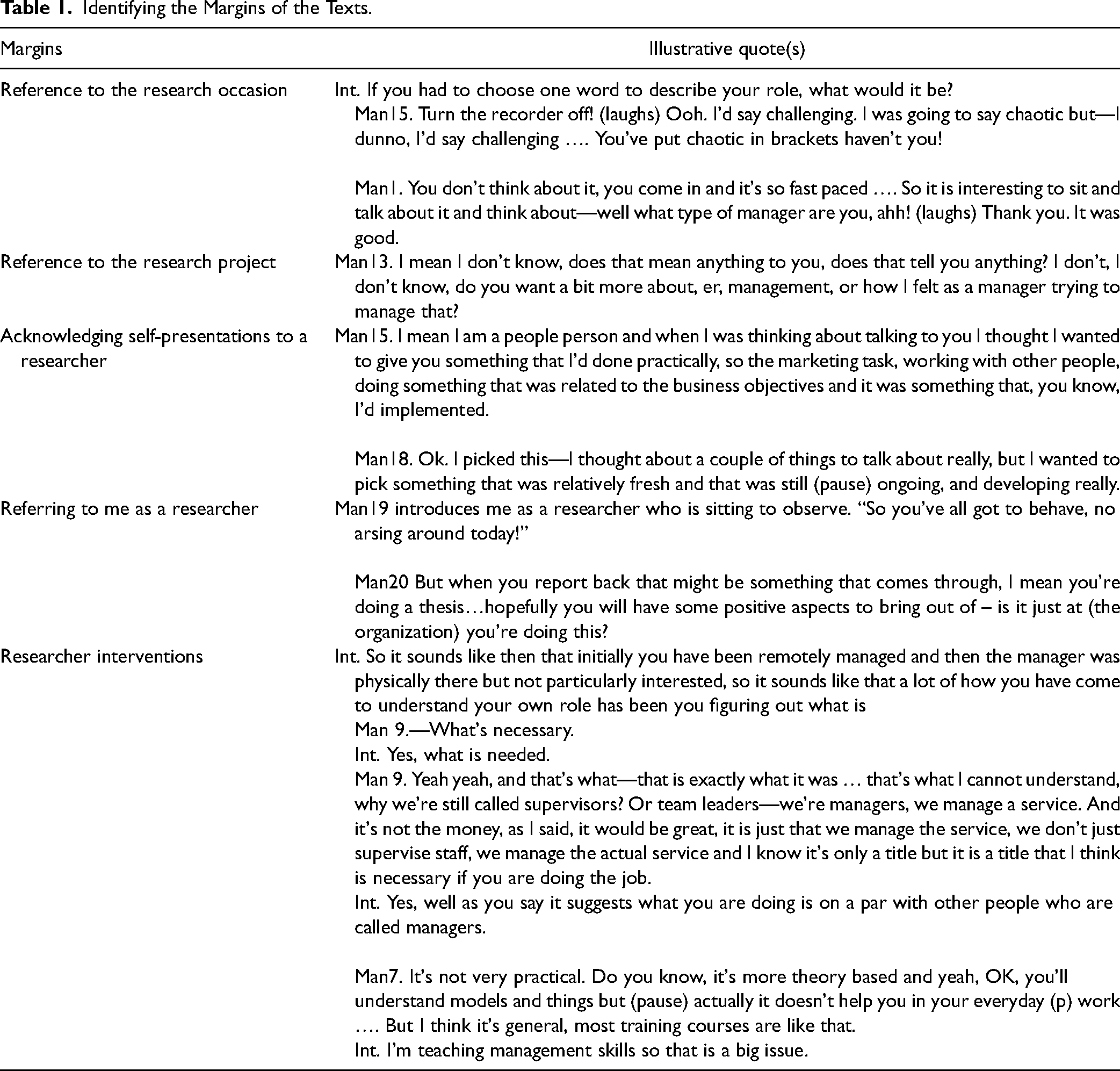
In searching such “margins” I read and reread the interview and observation texts, looking for any evidence of my presence as a researcher. In doing so I found it helpful to look for five types of occasion, illustrated in Table 1. First, there were references to the research occasion itself—taking part in an interview or being observed—such as referring to the presence of a tape recorder or notetaking. Second, there were references to the research project, such as being part of an investigation or a search for knowledge. The third area was participants explicitly or implicitly acknowledging their self-presentations to me as a researcher, such as explaining why they had chosen to tell a particular story or something they wanted me to observe them doing, and where the nature of our conversation between a manager and a researcher was acknowledged. Fourth, participants made direct reference to me as a researcher, for example soliciting my opinion on a management issue, expressing interest in my findings or other research activities, or introducing me or speaking about me to colleagues. Finally, I examined my own interventions: my questions, interjections, and comments. Through these five areas, I sought to examine how my participants and I together constructed me as a researcher in the occasion of this research project.
Identifying the Margins of the Texts.
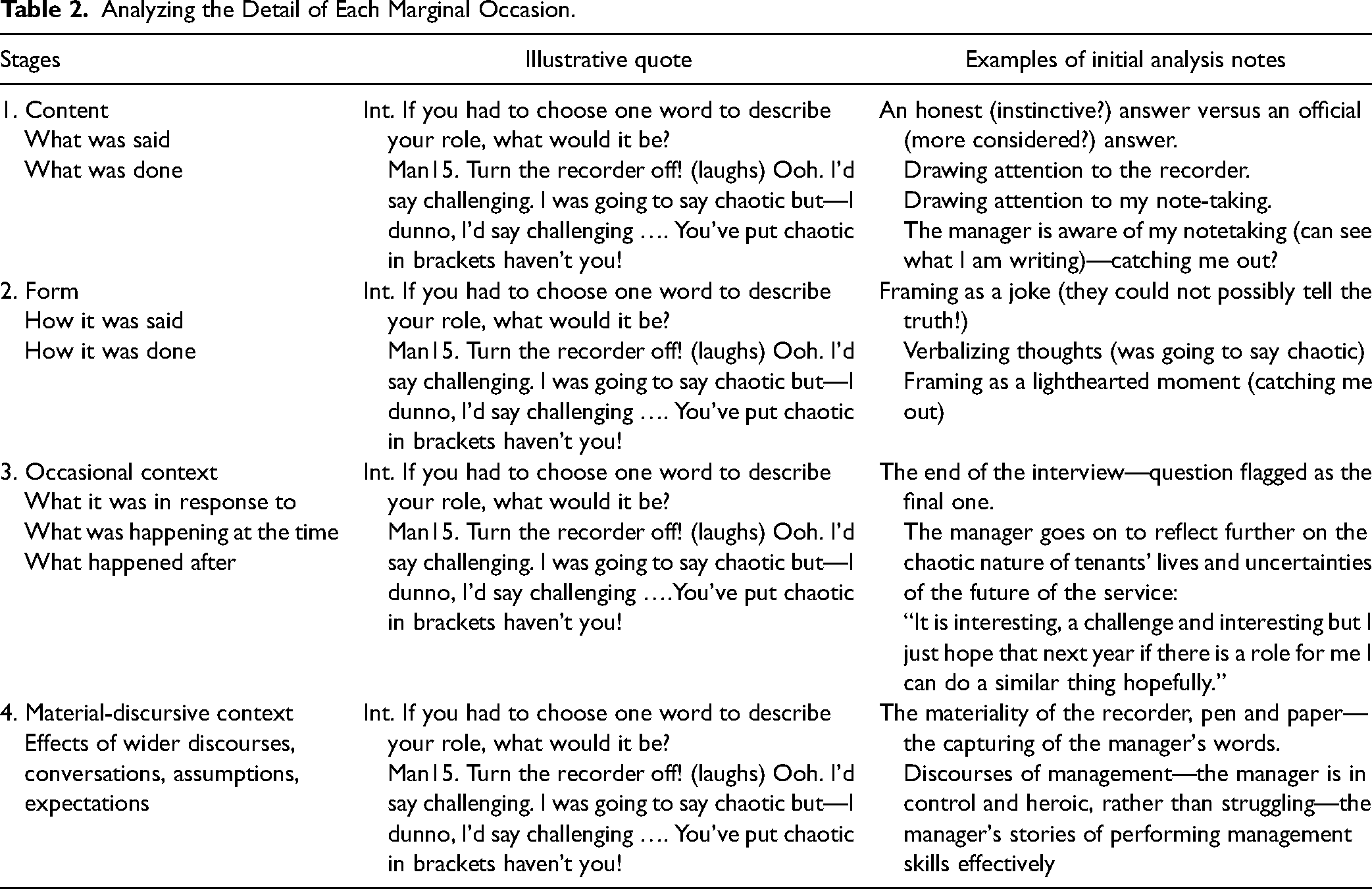
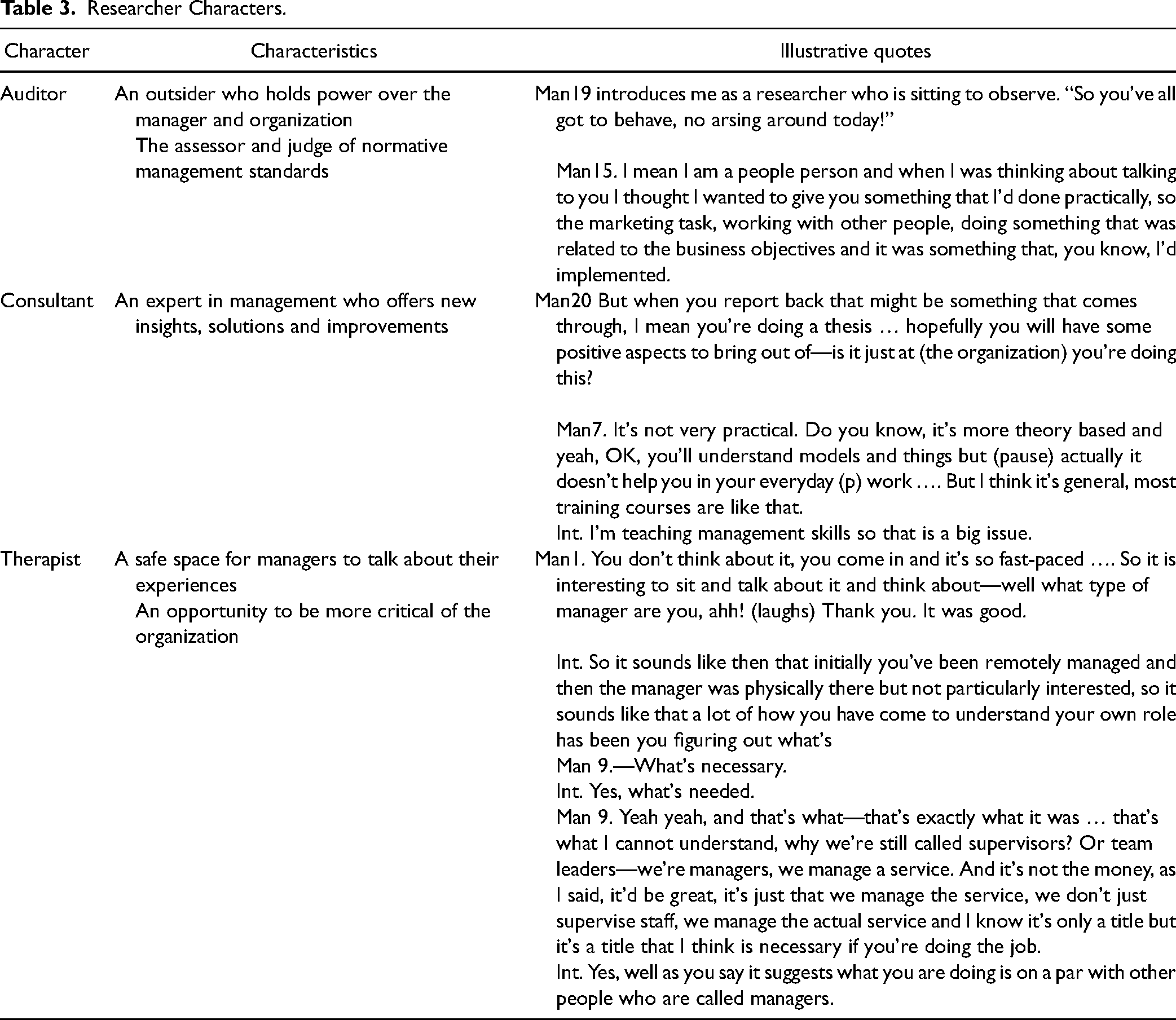
Having identified occasions where the researcher is made salient, I examined each occasion in detail. Table 2 provides an illustration of my initial analysis for one such occasion. Firstly, I considered the content itself: what was happening at that moment, what was being said and implied, and what was being done. Second, I considered the form, and how it was said or done: for example, pauses or hesitations, rhetorical devices, nonverbal communication such as laughter, or—in the context of observations—whether something was directed to me or about me. Third, I examined the occasional context: what it was in response to, what was happening at the time, and what followed. Fourthly, I paid attention to the discursive context, and what wider discourses, conversations, assumptions or expectations the talk and action appeared to draw on or respond to. Following this initial analysis, I used a form of thematic coding (King & Horrocks, 2010) to descriptively label different ways in which I was being constructed as a researcher, and then to aggregate these descriptive labels into clusters and overarching themes. Finally, I applied these themes to my question: to whom were participants speaking? Taking the themes and their underpinning clusters and descriptive codes I sought to identify the researcher characters constructed by the participant responses, and how these different characters were constructed or made salient by different participants and at different times and contexts (see Table 3).
Analyzing the Detail of Each Marginal Occasion.
Researcher Characters.
One potential objection to this method is that although I analyze participant responses to myself as a management researcher, I am nevertheless still mediating my own analysis. I have not sought to go back to participants and ask them for their recollections of the research encounter, or asked them directly for their impressions of me (c.f. Anderson & Henry, 2020; Corlett, 2009). My analysis of their interpretations of me therefore remains my own interpretation. The reason for this is both practical and deliberate: the research was conducted nearly 10 years ago and my aim is not to seek retrospective accounts but to investigate participant interpretations of me within the moment-by-moment turns of the particular research encounter.
Nevertheless, this remains subject to my own selection and analysis. What I choose to notice is informed by my own experience of research practice, and it is therefore important to acknowledge my positionality within the research. I am now a senior lecturer at a U.K. Russell Group university, reexamining myself conducting my first research project as a PhD candidate. As a “full” member of the research community for over 10 years I have learned, and now reproduce the community's own constructions and meanings of research and what constitutes it (Hardy et al., 2001), which informs what I look for and recognize as evidence of myself as researcher in the texts. For example, research discourses of avoiding preframing or prejudging participant talk made me especially sensitive to occasions where I shared a personal opinion with the participant, or when I pursued a point of interest. I also undertake autoethnographical research, and am familiar and comfortable with writing about myself and with sharing some of my vulnerabilities and failings, although I also acknowledge that I remain in control of what I choose to reveal and that such disclosures can also be a way of reestablishing myself as “successful” (Rostron, 2022). In undertaking my analysis I therefore frequently reviewed and reflected on my selections and interpretations and whether there were other possible perspectives. I found it especially helpful to recall that I was subjecting myself to the same processes that I had previously applied to my participants. As a researcher, I felt this was something I owed my participants and it encouraged me to focus on the texts themselves rather than my memories and feelings about them.
It is also important to acknowledge the role of my memories of the research project (Learmonth & Humphreys, 2012; Winkler, 2014). I deliberately selected a project that took place several years ago to facilitate my ability to stand outside myself within the text (Ford & Harding, 2008): my aim is not to produce an autoethnographical account but to analyze myself through the extant data rather than personal experience. Nevertheless, I acknowledge that it is impossible to completely separate myself as both researcher and research subject and my memories of the research may still influence the way in which I interpret the data. However, by seeking such distance I do also open up space for more opportunities to see myself from the perspective of others. I maintained a research journal throughout the original research but I deliberately do not use it as part of the analysis of manager texts. I only draw on it subsequently in order to reflect on the construction of me as a researcher by my participants and how it compares to my own recorded perceptions of the conduct of the research and my interactions with participants at the time.
Findings—Constructing the Management Researcher
My reanalysis identified several ways in which my participants constructed me as a researcher (Table 3). As I elaborate below, the various “characters” of the researcher are not necessarily contradictory, but they do represent distinct meanings of the role of a researcher and their relationship with managers. Moreover, these characterizations featured variously across interview and observational data, and across managerial levels, with some managers commonly shifting between different constructions at different times and occasions.
The Management Researcher as Auditor
The character of the researcher as an Auditor comprised two particular features. Firstly, the Auditor is a potentially dangerous outsider. They are not a member of the organization and have no loyalty to it, and they cannot fully understand how and why things are done or how decisions are made. Nevertheless, the Auditor also holds some power over the organization and/or the individual manager. They require vigilant handling during their time in the organization, including the curation of their experience of the organization at its best.
Many managers were overtly careful in their responses to me. As well as avoiding negative comments about the organization they monitored and corrected their own accounts. When asked what one word described their role, one manager responded: “Turn the recorder off! (laughs) Ooh. I'd say challenging. I was going to say chaotic but—I dunno, I'd say challenging.” Asking managers what others thought about them and whether they shared their view of the purpose of their role elicited some guarded answers. Some managers stressed that their view was “most definitely” shared or “without a shadow of a doubt.” Others implied that I might be cross-checking their answers: His (line manager's) expectations of me are to make sure (pause) gosh I hope I've—have I got this right? (pause) erm, his expectations of me are to make sure that I support the business, protect the business, and help make sure the business is successful—and—want to be here—Manager 5
In another example, I asked a service manager about their relationship with their team leaders: Int. So team leaders. By the sound of it then you work with them to manage the whole team? Or…
Man 2. Yeah, at times but I allow, I—sorry, allow, that's the wrong word—I—
I knew from talking to the CEO and from other interviews that the organization has a strong ethos of empowerment and collaboration. During the interview this manager continued to correct references to “allow,” later suggesting that “enabling” was the better word.
Managers also overtly policed the behaviors of other organizational members in my presence. Introducing me to a team meeting, a manager commented: “So you've all got to behave, no arsing around today!” At a working group, one manager explained that they had agreed to me observing the meeting, whereupon another manager joked: “I object!” As a joke it nevertheless reinforced my outsider status and that I was being given privileged access to the inner workings of the organization—and that group members should remember this.
More generally, many managers expressed varying degrees of concern regarding the purpose of my questions and the information I was seeking. These ranged from seeking assurance that they had been helpful—“I hope it was an appropriate story as well, I wasn't sure which to pick” (Manager 5); “I don't know if I've given you the right answers, well not the right answers but what answers you might really need” (Manager 9)—to implying a possible hidden agenda on my part: It was difficult really, you should have given us a few examples really, it was kind of throwing it out there and then I'm thinking what's she trying to figure out from this, what's she trying to unearth here, what's behind it—Manager 20 Int. And again this is not a loaded question I hope, but are you ever aware of that? You talked about, you put it in terms of the managing-supervising side and the supporting Man4.—supporting, yeah. Int. Are you ever aware of any tension between the different demands of those roles? For example if an individual was not meeting their targets.
The second feature of the researcher as an Auditor is an assessor and judge of normative management standards. In my explanations about my research aims I emphasized that my interest was in managers themselves and how they made personal sense of their organizational role. Nevertheless, throughout interviews and work shadowing, managers wanted to account for themselves to me as doing management in the right way and fulfilling recognized standards in ways that suggested I was the arbiter and upholder of such standards.
Several managers offered accounts of themselves that drew on normative management discourses. These included the importance of leading and inspiring staff through a “journey” (Manager 5, Manager 16), recognizing the knowledge and contribution of staff (Manager 13), inviting their views and involving them in decisions (Manager 19). Another common theme was being focused on performance, success and growth: “I'm just hungry for success, it's a growing business but it's the going in the right direction all the time” (Manager 3); and on a commitment to change and continuous improvement, “help[ing] the organization to continually improve and to strive for excellence as well” (Manager 12). A third common theme was the manager carefully controlling resources: “I want to make sure that it is spent wisely and spent correctly and we're getting the right things in and the right people there and none of it's getting wasted, and, you know, value for money” (Manager 18).
For example, one manager explained their choice of two stories—one of undertaking a marketing presentation and one of leading a change management project—to me: I mean I am a people person and when I was thinking about talking to you I thought I wanted to give you something that I'd done practically, so the marketing task, working with other people, doing something that was related to the business objectives and it was something that, you know, I'd implemented …. The change management thing, I thought that would be a good one to share with you because it was something that is, you know it's in management books and everything isn’t it?—Manager 15
During work shadowing, managers also frequently took the opportunity to explain their actions to me in terms of good management practice. For example, one service manager explained their decision to help deliver Christmas hampers: “the higher up the food chain, the more detached you can become from the ground … I always keep one foot firmly in operations” (Manager 2). I also noted managers emphasizing important practices and discourses at meetings I observed. At the start of a performance review meeting which included tenant representatives, the chairing manager invited me to introduce myself and then emphasized the importance of listening to tenants and to hear their views, which they subsequently reiterated at various points during the meeting: “it's your service,” “it's about customer satisfaction and knowing what you want.” In my observational template, I noted my impression of a deliberate performance and whether it was for the benefit of the tenants or me: “am I the real audience here?” (contemporaneous notes).
The Management Researcher as Consultant
Like the Auditor, the researcher as Consultant is knowledgeable about management practice. But whereas the Auditor assesses and judges managers and the organization against those standards, the Consultant is a potentially more friendly and supportive character who may offer new insights and solutions and ways to improve.
Managers were interested in what might come out of my research and how it might benefit the organization. Several managers directly referred to my “report,” either asking or assuming that they would be able to read it and expressing interest in what they might learn from it. One manager concluded their reflections on their chosen story and the importance of “caring and nurturing and coaching” by suggesting that I would be developing this in my findings: But when you report back that might be something that comes through, I mean you're doing a thesis that we—and hopefully you will have some positive aspects to bring out of—is it just at (the organization) you're doing this?—Manager 20 I mean I don't know, does that mean anything to you, does that tell you anything? I don't, I don't know, do you want a bit more about, er, management, or how I felt as a manager trying to manage that?—Manager 13 So I don't know if that's the type of thing, that you're looking for?—Manager 1 I don't know if it kind of answers, in terms of, I know your thing is about how my personality (pause) encompasses the role—Manager 2 Ok. I picked this—I thought about a couple of things to talk about really, but I wanted to pick something that was relatively fresh and that was still (pause) ongoing, and developing really—Manager 18
In this last example, the manager deliberately picked an ongoing issue to discuss, rather than a “completed” incident from the past. Here the researcher as Consultant offers an opportunity to reflect on and learn from ongoing practice, and perhaps suggest new solutions, rather than demonstrating the manager's proven abilities with a completed story, as to an Auditor.
My own interventions also contributed to the construction of the researcher as Consultant. I frequently referred to my own management experience and knowledge. For example, I responded to a manager's story about welfare reform by saying that I had worked in a related field and that “obviously the welfare reform was something I knew was a key issue.” In the following example, the manager mentioned how being able to recruit more team members sometimes led to internal conflicts, and I commented: Int. It can go either way, can’t it?
Man 10. Yeah, yeah.
Int. The sense of the team growing, or other people coming into my patch, my territory.
Here I not only reflect the manager's comments but imply my own management experience by suggesting I recognize the manager's and can offer insight into the possible causes. I was also positioning myself as someone over and above the day-to-day business of management. During the interviews, following each manager's story and subsequent discussions of their role, I would try to summarize the meaning of the story and the manager's role. Although my talk includes attempts to be deferential and to avoid speaking for managers—“So that sounds like…”; “What I am picking up is…’—I also imbued each manager with a unique role and purpose, taking the manager's talk and returning it with my own words: as, for example, “rethinking and reimagining older people,” “an advocate of the community development ethos,” “doing the right thing in spite of the formal process.” In my attempts to make meaning from manager talk, I was also offering them a new conceptualization of themselves and their role, and conferring a particular, sometimes complicating judgment on their value and practice.
The Researcher as Therapist
Finally, as an outsider offering a confidential and anonymized conversation, the researcher as Therapist offers a safe space for managers to talk about themselves and their experiences.
Several managers became more candid as the interview progressed and began to speak about their personal views of the organization and their experience of it. Unsurprisingly, most managers chose stories which presented them as purposeful and successful, but a small number subsequently went on to express some vulnerabilities. Manager 6 described how they had been unaware of the effects of some personal struggles on their own performance until a “really harsh” 360-degree appraisal, and Manager 18 acknowledged the serendipity which led to them being seen as a hero by staff. Some managers also raised frustrations and even criticism of the organization. For example, Manager 10 spoke about how senior managers did not better understand the work of their service: “it's like, oh my goodness (laughs), have you read anything (laughs).” Another manager spoke about how the organization failed to recognize the level of responsibility their role carried. This latter criticism only emerged after we had spoken about the manager's story at length: Int. So it sounds like then that initially you have been remotely managed and then the manager was physically there but not particularly interested, so it sounds like that a lot of how you have come to understand your own role has been you figuring out what's
Man 9.—What's necessary.
Int. Yes, what's needed.
Man 9. Yeah yeah, and that's what—that's exactly what it was … that's what I can't understand, why we're still called supervisors? Or team leaders—we're managers, we manage a service. And it's not the money, as I said, it'd be great, it's just that we manage the service, we don't just supervise staff, we manage the actual service and I know it's only a title but it's a title that I think is necessary if you're doing the job.
Int. Yes, well as you say it suggests what you're doing is on a par with other people who are called managers.
Here the researcher as Therapist not only provides a safe space to express informal and alternative views, but offers encouragement that such views might have validity.
Some managers also explicitly acknowledged the value of having time to talk about themselves and reflect on their practice. Managers were used to being interviewed for audits as well as internal roles, but Manager 15 reflected on how this interview differed: “You know I've gone for so many interviews sometimes I get—I haven't spoken about myself for quite a long time (laughs) you know, so I've forgotten what it is like.” Manager 1 reflected on the unusual opportunity to take time out of management practice: You don't think about it, you come in and it's so fast paced … you're continually meeting challenges from the community, from individuals, from your organization, KPIs …. So it's interesting to sit and talk about it and think about—well what type of manager are you, ahh! (laughs) Thank you. It was good—Manager 1
Discussion: Managers, Researchers, and Management Research
In seeking to answer the question “To whom were my participants speaking?” my analysis of one cohort of managers in one organization identified three distinct characters that the management researcher could be recognized as. As an Auditor the management researcher measures and judges managers and the organization against normative management standards. As a Consultant they can potentially offer helpful advice and solutions to problems, while the Therapist offers a safe and supportive space for managers to reflect on their experiences and criticisms of the organization. These characters were reflected across managers and organizational positions, with some shifting between some or all characterizations, and others reflecting one dominant character.
In themselves, these characters are not especially surprising or new; researchers will likely recognize some or all of these characters as risks they have planned to mitigate or considered when reflecting on the research process. Nor do I claim that these constitute an exhaustive list of characterizations of the researcher: these characters are grounded in the particular context of one organization, its managers and their interactions with me. Nevertheless, explicitly examining such characterizations of the researcher has significant potential for better understanding both the research process and our research practice.
Firstly, each character has different implications for what the manager may choose to say or do in the presence of the management researcher. In speaking to an Auditor the manager needs to demonstrate their awareness of, and compliance with management norms, and to protect themselves and the organization from any risk of criticism. A Consultant represents an opportunity to get expert advice, or to be able to gain valuable and practical solutions, and managers may have particular issues in mind as they talk. Speaking to a Therapist may be an opportunity to take a brief period of “time out” to be listened to and to share and reflect on particular pressing concerns. When analyzing manager talk and behavior, it is therefore important to consider which of these (or other) constructions of the researcher may be in play, and how this may affect what is (or not) said and done. During the original research project I was aware of deliberately inviting a “commissioned performance” (Beech & Sims, 2007) which I hoped would reflect how the manager wished to present themselves to a researcher (Clifton, 2018). However, I also took it for granted that managers shared my understanding of my role as a researcher. I had not considered that the nature and meaning of “the researcher” might itself differ manager by manager and even moment by moment, and how this itself might afford and constrain how managers chose to present themselves to me.
Second, each character of the management researcher carries different forms and degrees of power or authority. The management researcher is an outsider who sits beyond the daily complexities, and contingencies of management. The Auditor measures and judges management practice against prescribed norms, and needs to be carefully managed as they may not appreciate the realities of management practice or fail to take account of the improvised and contingent nature of daily decision-making. In contrast, the Consultant offers the possibility of expert-based solutions and valuable insights. The Therapist offers a safe space but this is contingent: managers remained careful about what they spoke about and only revealed personal criticisms of the organization in the expectation that I would agree with them and confer their perspective with authorized approval.
Such varied forms of power and authority contrast with my own contemporaneous journaling. After my first meeting with the CEO, in which we discussed my research, I noted down the particular thoughts and fears that the meeting had surfaced: (I need to be) not wholly academic but practical as well. I made a point of emphasizing my hopes for the theoretical model to be useful to organizations; (I also need to appear) sufficiently experienced and knowledgeable as a former manager. (I need to avoid) not being seen as an annoyance or irrelevance—and especially not producing any research which would be of no interest or value to managers—Research Journal
This leads to the third implication, which is that managers were uncertain as to the nature and purpose of my role. Uncertainty and doubt were commonly expressed by managers in their interactions with me: what I really wanted from them; what my real purpose was; whether they had been sufficiently helpful; and whether I represented any kind of threat to them or the organization. Managers did not share my taken-for-granted understanding of the researcher as an honest, open, and neutral seeker of knowledge. Instead, they drew on more familiar figures to make sense of my role and purpose, as a means of negotiating uncertainty and providing appropriate ways to speak and behave. Reflecting on my reanalysis I am struck by how prominent uncertainty and doubt is within manager talk, and how unaware of it I was at the time. Although I was aware of my own uncertainties and fears as a researcher, I was unaware of the extent to which managers also had doubts and fears, and how these informed their responses to me.
Finally, the nature and prevalence of different constructions of the “management researcher” may suggest a possible new way to “get at” management itself and how managers construct it. How managers construct the “management researcher” implies differing ways of constructing what it is that the “management researcher” is studying. That is, the more familiar figure that managers choose to frame the researcher as may say something about their organizational experience and practice. In the organization I studied, the researcher as Auditor was the most dominant. This likely reflects the organization's experience of frequent audits both as a social housing provider and an enthusiastic seeker of awards and accreditations. But it also implies construction of management based on normative standards, language and practices that are widely recognized internally and externally, and against which managers can demonstrate their competence, and where competence is also associated with success. Conversely, the researcher as Therapist suggests the possibility of ambiguous, uncertain, exhausting or vulnerable dimensions to management (Hay, 2014; Mischenko, 2005) which managers may be interested in exploring and reflecting on.
Conclusions and Future Directions
In this article, I set out to answer the question: To whom were participants speaking, acting in front of, and working with, and how were they constructing and experiencing me as a management researcher? My analysis of a management project in an English social housing provider has revealed that participants constructed me as multiple characters, as Auditor, Consultant, and Therapist. Such interpretations do not reflect my own taken-for-granted understanding of the researcher as an honest, open, and neutral seeker of knowledge, but draw on more familiar figures as a means of negotiating uncertainty about the nature and purpose of my role. Each construction represents a different form of authority and power effects, with different implications for managers and what they may (not) say or do in the presence of such a researcher. My analysis has also revealed the ways in which I coconstructed such interpretations with managers, and especially the role of emotions such as doubt and uncertainty both for me, as an inexperienced researcher, and for managers working with an unknown outsider and ambiguous agenda.
The article therefore contributes to MOS researcher reflexivity by highlighting and addressing an important but underdeveloped dimension, namely not just the researcher's own understanding of her research practice and experience, and how this then impacts their interpretation of the participant's understanding of their organizational practice and experience, but how our participants perceive us as researchers. This matters because it offers an important alternative perspective of the research encounter other than that of the researcher, and which can therefore maintain the plurality of the research encounter by acknowledging the perspectives of all those involved (Herrmann et al., 2013; Shim, 2018; Vangkilde & Sausdal, 2016). It also offers important insight into both our own research practice and that which we seek to investigate, by asking how participants perceive us not just as unique individuals but as “management researchers” and what meanings they ascribe to our role. How “management research” and the “management researcher” are perceived by participants, and what their involvement means for them and as representatives of their practice and community, have implications for what they say and do within the research occasion (Hardy et al., 2001; Robinson & Kerr, 2015; Tuckermann & Rüegg-Stürm, 2010).
Specifically, the article contributes to this dimension of researcher reflexivity in three ways. First, it complements and adds to the small number of papers in this area. Previous studies have highlighted both the challenges of researcher openness and sharing personal information and experience with participants (Hibbert et al., 2014; McDonald, 2013, 2016; Nelson, 2020), and the effects of social characteristics such as age, race, gender, and sexual orientation on the researcher–participant relationship (Anderson & Henry, 2020; Berger, 2015; Cunliffe & Karunanayake, 2013; Hamilton, 2020; McDonald, 2013, 2016; Nelson, 2020). However, this article highlights the importance of considering the researcher not only as a unique individual but as the category of “management researcher” and how participants perceive and understand this role within the research encounter. Some studies have considered how participants perceived the research encounter beforehand (Robinson & Kerr, 2015; Saltmarsh, 2013; Tuckermann & Rüegg-Stürm, 2010), or examined specific aspects of the encounter such as interview technique (Anderson & Henry, 2020), mediation of technology (Whiting et al., 2018) or professional standards (O’Boyle, 2018) but this article examines how participants perceive and construct the researcher and the research occasion moment by moment within and throughout the research encounter.
Secondly, notwithstanding its contextual specificity, the article provides important new insight into the researcher–participant relationship. By focusing on how manager participants perceive and understand us as management researchers, the article has revealed the predominance of uncertainty and doubt among managers as they sought to make sense of the research occasion. Managers did not share my past or present taken-for-granted understanding of the purpose of research: the process and experience were unfamiliar to them, and unlike the researcher they only saw a small element of the overall project. Managers therefore sought to make sense of the research occasion by constructing the researcher in more familiar ways: as an examination or audit of management practice; as an opportunity for professional advice; as a safe space to offload personal frustrations or simply as time out. Although increasing attention has been paid to the researcher's emotional response to participants (Berger, 2015; Burkitt, 2012, 2018; Diamond & Allcorn, 2003; Duncan & Ellis, 2021; Gemignani, 2011; Goldspink & Engward, 2019; Lustick, 2021) this article reveals the importance of also paying attention to the emotions of participants and their effects on how they perceive and experience the researcher and the research occasion. The emotional responses of participants, and the role of emotion in the research process for participant responses and the researcher–participant relationship is an underexplored area in which further research is likely to generate additional and generative insight.
The article has also revealed the multiple ways in which manager participants might construct the researcher, and how different constructions as, for example, Auditor, Consultant, or Therapist, have different implications for what the participant may choose to say or do. The article therefore provides an important counterpoint for existing work which seeks to enable researchers to uncover and reflect on the dynamic nature of the researcher–participant relationship (e.g., Berger, 2015; Cunliffe & Karunanayake, 2013; Goldspink & Engward, 2019; Langley & Klag, 2019). It is counterpoint in taking the other, participant side of the relationship; but our challenge as researchers is also to create counterpoint in the musical sense by being able to effectively combine researcher and participant perspectives as independent yet blended elements of the research relationship in which both are fully recognized and developed (Hardy et al., 2001; Tuckermann & Rüegg-Stürm, 2010). This also reflects an important area for future research and reflexive study to focus on.
Thirdly, the article offers a new method for reflexive researcher practice by reanalyzing extant research data to examine how participants constructed oneself as “management researcher.” Arguably any new reflexive method or exercise has value through its invitation to look differently at ourselves and our practice and to create “unsettlings” (Pollner, 1991). However, the method also has a number of particular benefits. It affords a novel alternative to the typical insider–out approach to reflexivity by making ourselves the subject of our participant talk. It offers a way of revealing participant perspectives of the researcher and the research encounter in a way that minimizes the researcher's own reflections and memories of the research encounter. It provides an opportunity to examine the responses of others within the moment-by-moment turns of the research encounter, rather than as retrospective participant accounts. Finally, and arguably most importantly, the method facilitates researcher reflection on the power of the researcher within the research process and the expectations of the research community (Hardy et al., 2001) by making ourselves the research subject of participant talk and subjecting ourselves to the same practices we apply to our participants. As those who presume to gaze at others in order to investigate, diagnose, analyze, select, unpick, interpret, and construct their lives and practices, we should at the very least be prepared to be subject to the same gaze ourselves.
Footnotes
Declaration of Conflicting Interests
The author declared no potential conflicts of interest with respect to the research, authorship, and/or publication of this article.
Funding
The author received no financial support for the research, authorship, and/or publication of this article.
